Time for Texas Lottery to ride off into the sunset, commissioners are told

AUSTIN—After a two-decade record of failing to deliver on its promises, the Texas Lottery Commission should be abolished, several Texas Baptists and others told the state’s Sunset Advisory Commission in an April 10 public hearing.

The Sunset Advisory Commission reviews and evaluates the need for state agencies and seeks public input through hearings on whether an agency under review should continue to exist.

Apart from some substantive changes regarding the regulation of charitable bingo, a staff report issued prior to the hearing focused mostly on issues such as increasing the size of the Texas Lottery Commission, requiring the commission to develop a comprehensive business plan and mandating that the commission develop complaint procedures.

Rob Kohler, a consultant with the Texas Baptist Christian Life Commission, challenged the Sunset Advisory Commission to “look at the big picture” and ask whether it is time for Texas to revisit whether the lottery is an appropriate and effective tool for raising state revenue.

“Ask the hard questions: Where is the money coming from? Where do the sales come from? What effect has it really had on education?” Kohler said.

He urged the commission to ask what socio-economic, demographic and sales data are available on the players by year and lottery product. He also asked if the lottery has provided a real increase in education funding or whether it simply replaced other revenue sources.

Sunset Advisory Commission Chair Dennis Bonnen, R-Angleton, insisted his commission focuses on examining the effectiveness and efficient operation of state agencies, not major public policy issues such as the abolition of a state lottery.

“Don’t expect that we are going to put a poison pill in the commission report that will kill the lottery,” he warned.

But Rodger Weems, chairman of Texans Against Gambling/Stop Predatory Gambling in Texas, countered by saying, “The name of the commission itself suggests there are times when some state agencies should ride off into the sunset.”

Weems noted several colleagues at the Dallas-area public school where he teaches urged him to tell the Sunset Advisory Commission how unhappy schoolteachers are that the lottery broke its promises to fund public education.

“It is not just experts who know that the Texas Lottery, no matter how well-intentioned, has failed to provide additional funding—new money—for Texas public schools,” Weems said. “And it’s not just the experts who realize that the lottery does its business on the backs of the poor. Both sad facts are now common knowledge in the state of Texas.”

As an alternative, Weems recommended the alcohol excise tax be raised 10 cents per serving or 60 cents per six-pack.

“Doing away with the lottery and raising the alcohol tax by just 10 cents per can of beer, serving of wine or mixed drink would produce revenues of approximately $1 billion a year,” he said.

Bill Brian, an attorney and member of First Baptist Church in Amarillo, quoted the introduction to the staff report on the Texas Lottery Commission, saying, “The …commission walks a tightrope in balancing the many contradictions in the state’s attitudes about gaming.”

The report notes the tension between a mandate to design and market lottery games to increase sales while operating under “statutory direction to not unduly influence anyone to buy a lottery ticket.”

“That points to the conflict of interest inherent in the gaming enterprise,” Brian said, insisting that the state has no business being involved in operating gambling and enticing some of its most vulnerable citizens to participate.

“It’s time to get rid of the state lottery,” said Weston Ware, who served from 1982 to 2000 as associate executive director of the Texas Baptist Christian Life Commission.

In 1991, Texas voters approved a constitutional amendment authoring the lottery’s creation based on “false promises … that the lottery would be a major funding resource for public education in Texas,” Ware said. Lawmakers should re-examine the ethics of a state-run gambling operation, he insisted.

“The lottery is a business that cannot thrive without abusing citizens, so it is a business Texas should not be involved in,” Ware said.


Opinion divided on Jesus’ descent into hell

WASHINGTON (RNS)— Christians know Jesus was crucified on Good Friday and rose from the dead on Easter Sunday. But what did he do on Saturday?

That question has spurred centuries of debate, perplexed theologians as learned as St. Augustine and prodded some Protestants to advocate editing the Apostles' Creed, one of Christianity's oldest confessions of faith.

An altar reredos at Chapel in Oxford, England, depicts Jesus freeing the Jewish Patriarchs in hell. (RNS PHOTO/Courtesy Lawrence Lew)

Roman Catholic, Eastern Orthodox and most mainline Protestant churches teach Jesus descended to the realm of the dead on Holy Saturday to save righteous souls, such as the Hebrew patriarchs, who died before his crucifixion.

The Catechism of the Catholic Church calls the descent "the last phase of Jesus' messianic mission," during which he "opened heaven's gates for the just who had gone before him."

An ancient homily included in the Catholic readings for Holy Saturday says a "great silence" stilled the earth while Jesus searched for Adam, "our first father, as for a lost sheep."

Often called "the harrowing of hell," the dramatic image of Jesus breaking down the doors of Hades has proved almost irresistible to artists, from the painter Hieronymus Bosch to the poet Dante to countless Eastern Orthodox iconographers.

But some Protestants say there is scant scriptural evidence for the hellish detour, and they maintain Jesus' own words contradict it.

On Good Friday, Jesus told the repentant thief crucified alongside him that "today you will be with me in paradise," according to Luke's Gospel.

"That's the only clue we have as to what Jesus was doing between death and resurrection," John Piper, a prominent Calvinist author and pastor from Minnesota, has said. "I don't think the thief went to hell and that hell is called paradise."

First-century Jews generally believed that all souls went to a dreary and silent underworld called Sheol after death. To emphasize that Jesus had truly died, and his resurrection was no trick of the tomb, the apostles likely would have insisted that he, too, had sojourned in Sheol, said Robert Krieg, a theology professor at the University of Notre Dame.

"It helps bring home the point that Jesus' resurrection was not a resuscitation," Krieg said.

Belief in the descent was widespread in the early church, said Martin Connell, a theology professor at St. John's School of Theology-Seminary in Collegeville, Minn. But the Bible divulges little about the interlude between Jesus' death and resurrection. Churches that teach he descended to the realm of the dead most often cite 1 Peter 3:18-20.

"Christ was put to death as a human, but made alive by the Spirit," Peter writes. "And it was by the Spirit that he went to preach to the spirits in prison." The incarcerated souls, Peter cryptically adds, were those who were "disobedient" during the time of Noah, the ark-maker.

Augustine, one of the chief architects of Christian theology, argued that Peter's passage is more allegory than history. That is, Jesus spoke "in spirit" through Noah to the Hebrews, not directly to them in hell. But even Augustine said the question of whom, exactly, Jesus preached to after his death, "disturbs me profoundly."

The descent might not have become a doctrine if not for a fourth century bishop named Rufinus, who added that Jesus went "ad inferna"—to hell—in his commentary on the Apostles' Creed. The phrase stuck, and was officially added to the influential creed centuries later.

But changing conceptions of hell only complicated the questions. As layers of limbo and purgatory were added to the afterlife, theologians like Thomas Aquinas labored to understand which realm Jesus visited, and whom he saved.

Other Christian thinkers such as Martin Luther and John Calvin disagreed on whether Christ suffered in hell to fully atone for human sinfulness. That question, raised most recently by the late Swiss theologian Hans ur von Balthasar, stirred a fierce theological donnybrook in the Catholic journal First Things several years ago.

Wayne Grudem, a former president of the Evangelical Theological Society, says the confusion and arguments could be ended by correcting the Apostles' Creed "once and for all" and excising the line about the descent.

"The single argument in its favor seems to be that it has been around so long," Grudem, a professor at Phoenix Seminary in Arizona, writes in his Systematic Theology, a popular textbook in evangelical colleges. "But an old mistake is still a mistake."

Grudem, like Piper, has said that he skips the phrase about Jesus' descent when reciting the Apostles' Creed.

But the harrowing of hell remains a central tenet of Eastern Orthodox Christians, who place an icon depicting the descent at the front of their churches as Saturday night becomes Easter Sunday. It remains there, venerated and often kissed, for 40 days.

"The icon that represents Easter for us is not the empty cross or tomb," said Peter Bouteneff, a theology professor at St. Vladimir's Orthodox Theological Seminary in Crestwood, N.Y. "It's Christ's descent into Hades."


Borderland doctor deals with physical, spiritual ailments

MATAMOROS, Mexico—With a stethoscope draped around his neck, an otoscope in his hand and a prescription pad on the table next to him, tools for ministry surround Dr. Guillermo Lozano.

Nearly every Saturday morning, Lozano and his team of volunteers serve with Texas Baptist River Ministry at clinics in multiple locations in Mexico, listening to people's ailments, diagnosing their problems, providing free medical care and introducing them to the gospel.

Guillermo Lozano prays with a couple at a medical clinic in Mexico. About 10 percent of the people whom Lozano and other River Ministry physicians treat end up making faith commitments to Christ. (PHOTO/John Hall/BGCT)

"I accepted Jesus Christ about 15 years ago," Lozano said. "Being a doctor, they asked me to help with mobile medical clinics (along the Rio Grande). That has motivated me to continue to serve the Lord through this ministry of health. That way I can be in contact with people and be able to share the love of Christ."

Lozano believes it is important to take a holistic approach in treating people. People have physical and spiritual dimensions, he insists. They can be healthy physically but still be troubled by something spiritually or emotionally. Individuals may be spiritually healthy but struggle physically. It's important to diagnose and treat both kinds of issues.

"The need is constant," he said. "It might be that we can never alleviate completely. But when we're able to share with somebody to meet their physical need, they're more likely to open up so we can share with them for their spiritual need."

Lozano and his team served about 12,000 people last year, helping with a variety of issues. He prayed with many of them. All of them heard the gospel, and about 1,200 people embraced a relationship with Christ as a result.

That means about 10 percent of the people who come to Lozano's clinics make spiritual decisions for Christ—the highest rate of any ministry supported by Texas Baptists' River Ministry through the worldwide portion of the Texas Baptist Cooperative Program and Mary Hill Davis Offering for Texas Missions.

Daniel Rangel, director of River Ministry, said the secret to Lozano's success is his desire to share the hope of Christ by meeting physical and spiritual needs. While people are waiting to see Lozano, another volunteer shares a devotional with the crowd. Each person receives a gospel tract. Patients are offered sandwiches and can pick up clothes.

Lozano takes his time with each patient, investing in the life of each person he serves. His ministry exemplifies the life of Christ in every facet, Rangel said.

"It's helping the local churches grow because the local churches are able to follow up," Rangel said. "Also, in some areas, it's helped start some churches. This is one of the main areas he comes to because the need is so great."


Where was Jesus buried? Bible scholars hold differing views

JERUSALEM (RNS)—During Holy Week, Christians remember the familiar story of Jesus' death and resurrection. But exactly where does that story take place? The Bible offers only a few clues.

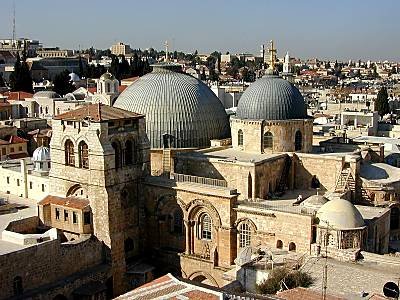
The Church of the Holy Sepulchre in Jerusalem, traditional site of Jesus' burial.

"The Gospels weren't really written to record a history," Mark Morozowich, acting dean of the School of Theology and Religious Studies at the Catholic University of America, told the PBS program Religion & Ethics NewsWeekly. "They were written to provide a testimony of faith."

According to the New Testament, Jesus was crucified at a spot outside Jerusalem called Golgotha, which in Aramaic means "place of the skull." The Latin word for skull is "calvaria," and in English, many Christians refer to the site of the crucifixion as Calvary.

The Gospel of John says there was a garden at Golgotha and a tomb that had never been used. Since the tomb was nearby, John says, that's where Jesus's body was placed. The Gospel writers say a prominent rich man, Joseph of Arimathea, owned the tomb. They describe it as hewn from rock, with a large stone that could be rolled in front of the entrance.

In the 4th Century, as Emperor Constantine was consolidating the Roman Empire under his newfound Christian faith, his mother, St. Helena, traveled to Jerusalem. According to tradition, she discovered relics of the cross upon which Jesus had been crucified. Early Christians had venerated the spot, and she concluded it was Golgotha. Constantine ordered the construction of a basilica on the spot, which became known as the Church of the Holy Sepulchre.

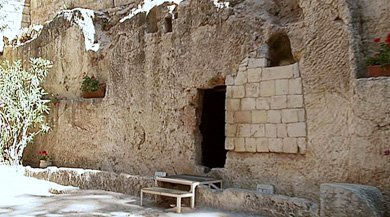
Some Bible scholars believe the Garden Tomb best fits the description in the Gospels of the place where Jesus was buried. (RNS PHOTO/Courtesy of Religion & Ethics News Weekly)

Over the centuries, the Church of the Holy Sepulchre was destroyed, rebuilt and renovated several times. There have been numerous power struggles over who should control it, and even today, sometimes violent squabbles can break out among the several Christian denominations that share jurisdiction.

Still, it's considered one of the holiest sites in Christianity, a massive place of pilgrimage and intense spiritual devotion. "What more of a moving place, to walk in Jerusalem, the place of the crucifixion, to meditate at Golgotha where Jesus Christ died, the place where he rose from the tomb," Morozowich said.

But despite the history and devotion, some Christians—including many Protestants—believe Jesus could have been crucified and buried at a different place in Jerusalem known as the Garden Tomb.

"The (Garden) Tomb was discovered in 1867. For hundreds of years before that, it had lain buried under rock and rubble and earth," said Steve Bridge, deputy director at the Garden Tomb, located just outside the Old City's Damascus Gate.

Charles Gordon, a British general, promoted the Garden Tomb in the late 19th century, Bridge said. The site includes a rock formation, with two large indentations, which resemble the eye sockets of a human skull. Gordon, and others, believed this could have been the "place of the skull" mentioned in the Bible.

The ancient garden below the rock formation has ruins of cisterns and a wine press, which Bridge said could indicate a wealthy person, perhaps Joseph of Arimathea, owned it. In the garden is a tomb, cut from the rock.

"The tomb itself is at least 2,000 years old. Many date it as older than that. But it's certainly not less than 2,000 years old," Bridge said. "It's a Jewish tomb. It's definitely a rolling-stone tomb. That means the entrance would be sealed by rolling a large stone across."

According to Bridge, the Garden Tomb is not trying to set up a competition with the Church of the Holy Sepulchre. "There's no doubt that historically, the Church of the Holy Sepulchre, has the evidence on its side," Bridge said. "What we say we have here is something that matches the Bible description."

And for him, Bridge said it ultimately doesn't matter where the actual place was, because he believes Jesus rose from the dead three days after the crucifixion.

Morozowich agreed. His faith teaches that during the Easter season, Christians should focus more on what Jesus did, rather than on where he may have done it.

"We know that Jesus is more than this historical figure that walked the earth. And in his resurrection, he transcends all of that so he is as real and present in Mishawaka (Ind.) and in Washington, D.C. as he is in Jerusalem," said Morozowich.

A version of this story was first broadcast on the PBS television program Religion & Ethics NewsWeekly www.pbs.org/religion


TBM responding to disasters from North Texas to the Valley

LANCASTER—Texas Baptist Men disaster relief volunteers are preparing 300 meals for breakfast, lunch and dinner for Lancaster-area residents affected by tornadoes that moved through the Dallas-Fort Worth area Tuesday afternoon.

Texas Baptist Men disaster relief volunteers Freddie Ransom (center) from FBC Sunnyvale serves with Karl Walden (left) from Wildwood Baptist Church in Mesquite and David Current from Northside Baptist Church in Mesquite. (PHOTO/John Hall/BGCT)

The meals prepared by volunteers with the Dallas Baptist Association Unit are feeding families whose homes were damaged, as well as personnel and volunteers responding to the devastation left by the storms.

The team first was asked to respond about 5 p.m. on April 3. By 7:30 p.m., the group had prepared its first batch of meals.

"The Lord commands us to take care of others and serve him in any way we can," unit coordinator Bill Gresso said. "I'm not a preacher. I can't preach. But I can cook. So, that's what I do."

The unit will continue serving as long as needed. TBM has called out two chainsaw teams to Forney and three to Lancaster.

About 650 homes in the Dallas-Fort Worth area were damaged by 18 tornados.

George Felkner from Mimosa Lane Baptist Church in Mesquite serves in Lancaster with Texas Baptist Men disaster relief. (PHOTO/John Hall/BGCT)

Karl Walden from Wildwood Baptist Church in Mesquite works with Texas Baptist Men disaster relief, unloading food at the Lancaster Recreation Center. (PHOTO/John Hall/BGCT)

As TBM has ramped up service in North Texas, it has wound down ministry in Devine and continues serving in McAllen.

A clean-out team and a box team are ministering in McAllen where hailstorms and strong winds damaged about 1,100 buildings March 29. Additional teams will begin serving in the area Monday.

Calvary Baptist Church in McAllen has been a key partner in TBM's work in the area, said Robert Cepeda, Rio Grande Valley Baptist Association director of missions. Despite having sustained damage to its facilities, the congregation combed about a 50-block area near the church seeing what needs people had. Church members found 60 homes that needed some sort of assistance.

TBM is focusing its efforts on people who do not have insurance and are struggling to recover. One woman made a profession of faith as a result of TBM's work.

Freddie Ransom from First Baptist Church in Sunnyvale serves with Texas Baptist Men disaster relief, cooking meals for people in a shelter at the Lancaster Recreation Center. (PHOTO/John Hall/BGCT)

Additional volunteers and teams are needed to help in the area—for one day, a weekend or longer, Cepeda said.

Tornados in Devine and Natalia damaged 38 structures March 19, including 17 that were destroyed. TBM provided chainsaw teams, a shower unit, a skid-steer loader and a man-lift. Area Baptists also pitched in to help those in need.

"It was encouraging to see how planning and training pays off as organizations sprang to life to provide help," said Jimmy Smith, director of missions of Frio River Baptist Association. "We can be proud of our local churches, their pastor and leaders.  They were on the ball; pitching in to do what was needed to be done."

First Baptist Church in Devine is coordinating volunteers who wish to help in the area. Call (830) 663-4408.

Joe Detterman, TBM's disaster relief coordinator, said people want to know why individuals would offer to help someone else for free.

"They always wonder why," Detterman said. "The teams have the chance to tell them why. That's the big motivator. This gets us in places where we may normally not be welcome. It gives us a chance to give a witness."

TBM's disaster relief ministry is supported by designated gifts. To support TBM financially, visit www.texasbaptistmen.org or mail checks, payable to "Texas Baptist Men" and designated for disaster relief, to 5351 Catron, Dallas 75227

Texas Baptists Disaster Response gifts to the Baptist General Convention of Texas will fund ministry following natural disasters, including TBM. To give through the convention, visit www.texasbaptists.org/give.

Texas Baptist personnel also are in areas affected by the tornados discovering ways congregations and teams can respond to the tornados. Local volunteers from congregations already are beginning to connect with Red Cross efforts. To view the most up-to-date mission opportunities, visit www.texasbaptists.org/disaster.

This story will continue to be updated as new information is available.


Biomedical ethics not just an abstract ivory-tower debate

ABILENE—For Jim Denison, the practical and ethical implications of precision medicine aren't just topics of conversation among scientists and ethicists.

As theologian-in-residence with the Baptist General Convention of Texas and founder of the Denison Forum on Truth and Culture, he is deeply involved in those conversations. But his interest took a dramatic turn in January when his son, Ryan, was diagnosed with a malignant tumor on his neck along the jaw line.

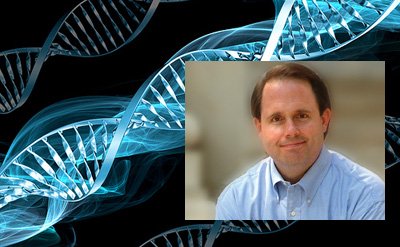
Jim Denison

The mass was removed in February, and Ryan began proton radiation therapy the week of March 19. He has been told there is a 20 to 30 percent chance the malignancy will return, and he must have a CAT scan every six months for the rest of his life.

As precision medicine, based on genetic makeup, advances, the day may come when surgery, radiation, chemotherapy and other forms of cancer treatment are a thing of the past.

"Don't we all look forward to the day when all of that is history?" Denison asked during a Forum on Faith and Intellect at Hardin-Simmons University. "That day may be coming. For my son, it can't come soon enough."

But, Denison warned, the exciting promises of precision medicine, which tailors treatment based on an individual's genetic map, also must be viewed from an ethical standpoint.

"I am so grateful for the technology," Denison said, "and so desirous that it be practiced within a proper ethical framework."

Denison and Dr. Peter Dysert II, chief of pathology at Baylor University Medical Center in Dallas, were the two keynote speakers for the recent forum at Hardin-Simmons focused on bioethics.

Over two days, participants heard from Denison and Dysert, as well as others in science and academia discussing the practical and ethical implications of precision medicine.

Denison noted his interest in precision medicine started from reading The Language of God: A Scientist Presents Evidence for Belief by Francis Collins, who describes himself as an atheist who came to believe in God through his scientific endeavors.

Collins is the former director of the National Human Genome Research Institute and oversaw the Human Genome Project, which mapped human DNA.

Denison was hooked as soon as he started the book.

"We are on the cusp of what experts unanimously believe is the greatest revolution in the history of medicine," Denison said, "with implications in every direction and ethical implications of enormous significance."

Denison believes the ethics of precision medicine must align with "kingdom ethics." Without that ethical framework, he fears that precision medicine could have limitless bad outcomes.

For example, what if the day comes when preconception genetic screenings for disease also reveal capabilities? Will couples decide not to have children if they fear the child won't be a great athlete or student or musician?

"Will we see a day when genetic profiles are a part of dating and marriage decisions?" he asked.

Despite federal law prohibiting discrimination based on genetic information, Denison wonders how that information might be used by insurance companies or employers.

The list of possible nightmare scenarios is endless, but the promise of huge advancements in medicine also is a reality. Precision medicine must be practiced within an ethical framework, Denison said, to ensure those nightmares don't become reality.

Denison quoted King Solomon, who said, "The fear of the Lord is the beginning of wisdom."  Denison wondered how wise practitioners of precision medicine will be as its possibilities increase.

"That, to me," he said, "is the question of the day."

Prior to Denison's keynote address, breakout sessions featured scholars and doctors talking about various aspects of bioethics.

Dan Stiver, a professor of theology at Hardin-Simmons, posed a question that he says must be answered before the larger ethical issues such as cloning and genetic manipulation to produce "designer children" can be addressed.

The question, he said, is what kind of language to use in the discussion.  

"Is the debate and the discussion going to be posed basically in scientific language," he asked, "or, is there an essential role for the first person or personal language?

The tendency to think that only scientific language is valid was evident even at the Baptist-affiliated college that Stiver attended. He recalled that in his psychology lab, "brain waves" could be discussed, but not "feelings."

His own conclusion, Stiver said, is that scientific language cannot adequately cover ethical issues.

"We need the personal knowledge, the language of human experience, motive, desire, and morality," he said. "It's irreplaceable and essential for us to be able to handle these things."


Howard Payne students lead ministry at local nursing home

BROWNWOOD—Every Thursday night around 6:30 p.m., residents of Songbird Lodge have plans. That's when they know Bianca Monge, Philip Jorgensen and other Howard Payne University students will stop by to visit.

Monge and Jorgensen are student leaders for the senior adult ministry of HPU's Baptist Student Ministry. They lead by example as they encourage their peers simply to spend quality time with the residents.

Howard Payne University students Philip Jorgensen and Bianca Monge visit with Ina Hood on a weekly visit to Songbird Lodge.  (HPU PHOTO)

"Sometimes we go in and tell them about the weather. Sometimes we go and listen to their truly amazing stories. And sometimes we just smile at each other," Jorgensen said.

Monge, a junior elementary education major from Fort Worth, has been a part of the BSM senior adult ministry since her first semester at HPU.

"I have come to form such sweet relationships with some of the people there," she said. "We pour love onto them, but I feel like I receive so much more back from them."

The goal of the ministry each week is to make certain each person a student visits feels loved—by the students and by Jesus.

Jorgensen, a junior cross-cultural studies major from Dallas, loves to hear the stories residents share with him.

"Honestly, I just feel so blessed to get to listen to these people," Jorgensen said.

There are numerous nursing homes in the Brownwood area, and eventually Jorgensen would like to have other teams that visit them on a regular basis.

At the funeral of an elderly woman dear to Monge, the student met an HPU alumna who had been involved with a homebound ministry during her time at the university. The alum had befriended the same woman during her time at HPU and had continued to stay in touch with her.

"It was such a blessing and encouragement to know that for the past 15 years, this elderly woman had been cared for and loved on by different college students," Monge said.

Monge wants to see the BSM senior adult ministry continue long after she graduates, to know that the residents with whom she built relationships will continue to build relationships with other students.

Jorgensen and Monge's weekly time spent with the residents is an outgrowth of the love and passion they share for this ministry.

"I love getting to share their lives with them," Monge said. "It is an absolute blessing to learn about and be involved in the lives of some amazing individuals God has created."


God changing lives in Laredo through home-based churches

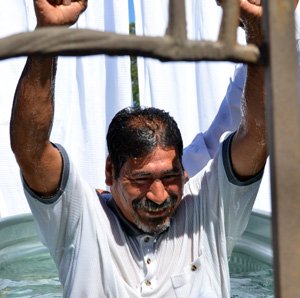
LAREDO—Emerging from the baptismal waters, Fernando Luna raises his arms in celebration. He smiles broadly and soaks in the moment. Luna gave his life to Christ, is following him and is enjoying the sensation of a fresh start.

Fernando Luna of Laredo rejoices as his baptism symbolizes the death of the person he used to be and the new person he has become through faith in Christ. (PHOTO/John Hall/BGCT)

It's a new beginning he says he needed. Luna was wandering the streets. He had stopped enjoying life. His wife and children didn't want him around. His daughter specifically told him to leave. He felt he'd be better off dead and had asked God to find a way to make it happen.

Then he turned to Christ, embracing a relationship with God. His perspective on life changed, and his relatives noticed it. He became a positive influence on others—inside and outside his family. Now, he cherishes the time he has with his family, and they cherish their time with him.

"It has been a great blessing," he said. "I've been able to get my children and my wife back. They look at me with respect now. They listen to me when I speak."

Luna is one of a growing number of people who are coming to Christ through home-based churches in Laredo. In the past 11 months, about 13 of these churches have started in the border city—each led by a layperson who feels called by God to share the gospel with a city onlookers say needs the gospel.

The unfunded congregations function autonomously but are strongly connected back to the churches where the house church founders attend. This structure provides a beautiful balance, leaders argue—freedom with accountability.

The majority of the people who have started home-based churches have done so after hearing and responding to the call to plant a church during Texas Baptists' Mission-Shaped Leadership Training, a program along the Texas-Mexico border that helps people clarify God's call in their lives and respond positively to it.

{youtube}VG-HFyuDb64{/youtube}

The effort, taking place in Laredo and Juarez, is funded by gifts to missions through the worldwide portion of the Texas Baptist Cooperative Program and funds from the Mary Hill Davis Offering for Texas Missions.

"We need people to respond to the call," said Mario Garcia, a River Ministry coordinator for Texas Baptists. "If people respond to the call, they will share their faith. That will affect churches and communities."

The training program is in response to the need for a stronger Baptist presence in a city where 12 Baptist congregations attempt to minister to a community of 250,000 people. Texas Baptists have had one traditional church-start in Laredo during the past 18 years, and that happened in the past year.

The new approach seems to be effective, Garcia said. People who already know the culture of Laredo are starting congregations that non-Christians are comfortable visiting. The home-based churches have baptized more than 60 people in the last 11 months, enough that Garcia recently retrofitted a trailer with a frame, platform and horse trough to make it a mobile baptismal the churches can share.

"People are coming to Christ," Garcia said. "People are being reached. That's what it's all about—reaching communities."

Norma Sanchez was the first person baptized in the mobile baptismal. Tears ran down her face as she shared her story. She had been a prostitute, a drug addict and a neglectful mother. But a friend of hers wouldn't give up on her and repeatedly invited her to church where she heard the gospel and gave her life to Christ. The change has been nearly instant, she said.

"For eight months, I have not prostituted, used drugs or drank," Sanchez said. "In those eight months, I'm taking care of my children, taking care of their meals, helping them with their homework. I'm trying to help them in everything."

Sanchez isn't proud of her past, but she's willing for God to use it to bring other people to him. Like those in the mission-shaped leadership program, Sanchez has sensed God's call upon her life and is attempting to pursue it for the growth of God's kingdom.

"I want to tell people I was a very closed person who didn't believe, but Jesus can save you," she said. "There's not a better way than to follow Jesus. Jesus can help with everything. I give you my testimony because there are a lot of people who don't believe. I was a woman of the street. Now people see me and ask, 'Is it true you are a Christian?' They are surprised by the change in me."


Chilean miner testifies of God’s power and presence

DALLAS–Trapped in a mineshaft in Copiapó, Chile, in 2010 with 32 other miners, Jose Henriquez experienced firsthand God's provision during 69 days of waiting and praying for rescue.

"Without any doubt, the power of God has no limits," Henriquez told students at Dallas Baptist University during a recent chapel service. He has written a book recounting his experiences, Miracle in the Mine: One Man's Story of Strength and Survival in the Chilean Mines, published by Zondervan.

Jose Henriquez, who spoke recently at Dallas Baptist University, was one of 33 Chilean miners trapped underground for 69 days in 2010. He is pictured with his wife, Blanca, and DBU alumnus Miguel Faundez. (PHOTO/Blake Killingsworth)

Speaking with the help of a translator, Henriquez said it was not the first accident he had experienced in his mining career. Having been a Christian more than 30 years, he had seen God's hand on his life.

The 2010 accident, however, received worldwide notice, and he refers to it as "God's accident" since he said God used it to make himself known.

The explosion that set the story in motion occurred in the mining shaft where Henriquez was working Aug. 5, 2010. After assessing the damage and accounting for all 33 miners, the group soon realized all exits were blocked. Henriquez and his co-workers came to the conclusion only God could save them.

All of the miners were aware Henriquez was a Christian, and they soon called on him to lead the group in a prayer.

Henriquez recounted telling his friends: "As God's children, we pray to the living God. So, if you want to pray to that God I will. But if you want to do something else, then look for somebody else."

"We want to pray the way you know how to pray," he recalled a spokesman for the group saying.

"So, we began to pray in an incredible way," Henriquez said.

The miners began a practice that lasted 69 days—holding a prayer service every day at noon and 6 p.m. As the days progressed, even the miners who were not Christian became more willing to join in prayer and sing praise songs.

"For us, prayer was so important," he explained. "We felt God's presence in a very special way."

During the two months that they were trapped, Henriquez was confident God would save them. The miners also felt the presence of the Holy Spirit with them. They saw physical healing take place, reconciliation occur, and God provide nourishment just when it was needed most.

"It was amazing to watch the Lord responding to us, even in the dark … we began to see what God was planning to do with each of us," he said. "That was the reason we could be tranquil. We could have peace and be united together.

"God didn't need any doors to get down there in the mine where we were. Every time we called on his name, he came. He was there, and he was present."

One week before the miners were rescued, Henriquez held worship service and presented the gospel to his friends. Joined by a minister above ground, the miners were presented with the opportunity to dedicate their lives to Jesus Christ, and 22 professed faith in Christ.

When the time came for their rescue, before anyone left the mineshaft, the group came together and prayed, thanking God for saving their lives. They prayed for blessings over the capsule that would take them to freedom and greatly rejoiced together when they finally made their way above ground again.

The accident was meant to bring glory to God, Henriquez insisted. Fifteen days after he was saved, he began traveling around the world, sharing about the miracle that occurred and the saving power of Christ.

When the chapel crowd rose to their feet to give him an ovation, he said: "Please don't give me praise. The glory goes to Jesus Christ. He is the one who accomplished this."


Pat Anderson named CBF interim coordinator

ATLANTA (ABP) — The Cooperative Baptist Fellowship’s officers and personnel committee have chosen former CBF moderator Pat Anderson of Florida to serve as the interim executive coordinator, beginning July 1.

Pat Anderson

Anderson will assume the interim role as Daniel Vestal, CBF’s executive coordinator for the past 15 years, retires from the Fellowship on June 30.

“Pat is coming to us in a key time of transition, and his familiarity with CBF and proven commitment to the Fellowship made him the ideal person to fill this role,” said Keith Herron, the Fellowship’s moderator-elect and pastor of Holmeswood Baptist Church in Kansas City, Mo.

“Our chief wish was to determine we weren’t going to sit still during this time,” Herron said. “We cannot afford to do so. We envision that Pat will begin to help us develop a methodology for putting together an orderly process of implementation when the 2012 Task Report is adopted.”

Anderson and his wife, Carolyn, have been involved in CBF from the inception of the movement. In 1989 they joined the unsuccessful effort to elect Daniel Vestal as president of the Southern Baptist Convention, and in 1990 Pat was part of the initial movement to establish the CBF. In 1995 he was the national moderator of CBF, the year Cecil Sherman retired and Daniel Vestal was named coordinator.

The Cooperative Baptist Fellowship of Florida was organized in the Anderson home in 1990, and Anderson served as coordinator until 2002 when he joined the national CBF as missions advocate. In that role, he has written and spoken on behalf of CBF missions and has taken small groups of pastors to hard places where CBF field personnel are working.

“I am very excited, and humbled, for the opportunity to help in the transition of CBF to new executive leadership,” Anderson said. “CBF has been the life work of Carolyn and me, and I look forward to working on behalf of everyone who loves Cooperative Baptist Fellowship.”

Vestal announced his retirement in September, Mercer University recently announced he will lead the university’s new Eula Mae and John Baugh Center for Baptist Leadership and serve as a distinguished professor beginning July 1.

Anderson will begin work at the Fellowship on June 15 in order to overlap with Vestal ensuring a smooth transition. An executive coordinator search committee, chaired by George Mason, pastor of Wilshire Baptist Church in Dallas, is currently receiving nominations from the Fellowship through e-mail at the address, CBFsearchcommittee@gmail.com.

The son of a Southern Baptist pastor-evangelist-director of missions, Anderson was born in Florida and earned a bachelor’s degree from Furman University, a master of divinity degree from Southwestern Baptist Theological Seminary and a doctorate in criminology from Florida State University.

He has been a professor of criminology at Louisiana State University and at Florida Southern College, retiring as professor emeritus at Florida Southern in 2011. He has been a bi-vocational pastor and interim pastor in several churches.

Currently serving as the editor of Christian Ethics Today, Anderson has written several books, the most recent being The Decision-making Process: An Introduction to Criminal Justice published in 2011.


Transformation: From streets to shelter to self-sufficiency

WACO—Michael DeLeon, 58, has a smile that will make anybody laugh. And he has a lot to smile about. He has emerged from the streets to a new life that overcame his own personal disappointments.

"I have never been a drunk or a drug user, but I had a disregard for financial responsibility," said DeLeon, a former photojournalist who has more than two years of college at the University of Texas.

Michael DeLeon

"I love electronic things and would waste each paycheck on things I did not need. I had no savings and couldn't pay my rent, ending up on the streets of Waco in March, 2011. If it wasn't for Mission Waco, I'd still be out there."

For the next several months, My Brother's Keeper—a homeless shelter operated by Mission Waco/Mission World—became his temporary home.

"I couldn't believe I was living in a shelter since I didn't consider myself as a homeless man," he said.

It was there that things began to change. He learned about Mission Waco's transitional program that allows residents of the shelter to stay in the same bed for six months while they get a job and commit to move responsibly toward permanent housing.

"They gave me the tools to succeed," he said. "I just had to find the desire to change and be productive."

And he did. Within three months, DeLeon found a job as dishwasher at the World Cup Cafe, started his savings account, and soon graduated from the transitional program earlier than anyone before him.

After several months of work, he saved enough to buy a bicycle so he would no longer have to walk everywhere. Within a few more weeks, he had enough money to move out of the shelter into his own apartment.

"It's not much, but it will certainly do for now," he said, adding he is saving money to buy a car. "I don't want to be a dishwasher the rest of my life, so I need to get an inexpensive way of getting out to look for better jobs. But for now, it is one step at a time."

After becoming a Christian at Church Under the Bridge in the midst of his struggles, DeLeon began attending Acts Christian Fellowship, where he worships weekly.

"Christians have loved me, showed me direction and stood with me throughout this transformation," he said.

Jimmy Dorrell, Mission Waco/Mission World


The poor among you

They gather at dawn at day-labor centers or designated parking lots where contractors hire workers. Some stop on their way to pick up a cheap breakfast taco at a convenience store, buying their meal from an employee earning minimum wage. At the store, they wait in line with members of a crew purchasing gas for the mowers and trimmers they will use to cut the grass of other people's lawns.

Men line up early on a brisk morning at a North Texas day labor center, hoping to be hired for a work crew. (PHOTO/Ken Camp)

They are the working poor—people who may work more hours a week than the average salaried employee, but they do it at a cobbled-together assortment of part-time jobs without benefits. Some find themselves trapped in the situation because they lack the education or technical skills to find a better job. Others lost salaried positions due to economic recession and are working part-time or temporary jobs to try to make ends meet.

Living in poverty

Ron Sider, founder of Evangelicals for Social Action, sees that situation—coupled with the United States' deficit and a growing gap between the rich and poor—as a justice crisis.

"Minimum wage doesn't get a person even close to the poverty level. People ought to be able to work their way out of poverty," Sider, professor at Palmer Theological Seminary in Wynnewood, Pa., said in an interview.

But more Americans live in poverty today than at any time in more than 50 years, according to the U.S. Census Bureau and the National Bureau of Economic Research.

"The richest nation in human history now has the highest poverty level of any Western industrialized nation," Sider writes in his new book, Fixing the Moral Deficit: A Balanced Way to Balance the Budget.

Difficult choices

Poverty forces some individuals and families into making tough decisions, said Jeremy Everett, director of the Texas Hunger Initiative, a program of the Baylor University School of Social Work in partnership with the Texas Baptist Christian Life Commission.

"Often, people find themselves having to choose between paying the rent, the light bill and the water bill or paying for groceries. For the elderly, it may be a choice between the mortgage and medication," Everett said.

Some even find themselves living on the streets, noted Jimmy Dorrell, founder and executive director of Mission Waco/Mission World, a Central Texas-based ministry focused on community transformation.

"We have folks in our shelter who had never been in one and never imagined themselves there," Dorrell said. "Minimum-wage jobs, especially 29-hours-a-week jobs without benefits, can't come close to paying the bills. The growing unskilled workforce has few living-wage job choices."

The poor among you

Underemployed or unemployed victims of recession, together with the ranks of the working poor who have been unable to rise above poverty, have forced growing numbers to rely on government welfare. Nearly 15 percent of all Americans—a record 45.7 million people—now participate in the Supplemental Nutrition Assistance Program, formerly known as food stamps.

"Many people who never thought they would have to rely on federal safety net programs to help make ends meet do now—and without these programs, many more Americans would have fallen into poverty and hunger in this last recession," said David Beckmann, president of Bread for the World, a Washington, D.C.-based Christian advocacy group.

"You also have to consider how low the federal poverty line is—$23,000 per year is too low for most two-person households to live comfortably in America, let alone a family of four."

Neither SNAP benefits nor refundable tax credits—like the Earned Income Tax Credit or Child Tax Credit—factor into poverty figures in the U.S. Census, he added.

"If they were, the data would show that these programs lifted 9.3 million people above the poverty line in 2010. These programs can mean the difference between getting by and going hungry for poor families—whether newly or generationally poor," Beckmann said.

What did Jesus say?

Some Christians fail to consider the plight of the poor because they don't recognize the emphasis Jesus placed on concern for one's neighbor and compassion for the vulnerable, Everett observed.

"Many Christians are not well-versed in what Jesus had to say about the poor," Everett said. "Caring for the poor is intrinsic to our calling as Christians. Every person is created in the image of God, and that means we are all interconnected."

Some reserve their compassion only for the few whom they consider worthy of assistance, he added.

"There's no such thing as the deserving poor and the undeserving poor. Jesus didn't say, 'Whatever you did for the least of these my brothers—when they deserved it—you did it to me,'" Everett said.

Rugged individualism

Others insist the poor simply should take more initiative and pull themselves up by their own bootstraps, Dorrell noted.

"Some continue to blame the poor for their own harsh realities and point to the rugged individualism of 'my grandpa, who brought himself up without any help,'" he said.

That attitude finds its most extreme expression in the libertarian views advanced by mid-20th century writer Ayn Rand, who believed each person should pursue his or her own self-interests, not sacrifice for others, Sider noted in an interview.

"It's astonishing to me that any Christian would embrace a philosophy that says we have no responsibility for our neighbors," he said.

Charity not enough

Other Christians take seriously biblical teachings about compassion for the poor and vulnerable. They operate food pantries, volunteer at homeless shelters, support free or reduced-price medical clinics and work on Habitat for Humanity projects to build homes for low-income families.

But for all their efforts, they hardly make a dent in the problem of poverty. Charities nationwide provide only about 6 percent of the assistance that government programs for the poor provide, Bread for the World reports.

Five federal programs—SNAP, Temporary Assistance for Needy Families, Earned Income Tax Credit, Supplemental Security Income for the disabled and Medicaid—cost about $485 million in 2010.

"If the 325,000 religious congregations in the United States wished to take over these programs, each congregation would need to add about $1.5 million to its annual budget," Sider writes in Fixing the Moral Deficit.

Christians should lead by example in meeting the needs of the poor, but they cannot do it by themselves, Everett noted.

"The church should lead the way, but the church cannot do it alone. Churches developed the hospital system to care for the sick. They led the way in creating hospitals. But if only churches ran hospitals today, we wouldn't have enough to care for everybody," Everett said.

"In terms of responding to poverty, the church should lead the way, but Christians should use their influence to get others involved—to bring government, the nonprofit sector and the private sector to the table."

From compassion to justice

Christians need to move from concern about the poor to hungering for biblical justice, Sider said. In Scripture, justice means more than procedural fairness in the courts; it also means fair access to society's productive resources so people can earn their own way, he said.

"Biblical justice rejects the Marxist idea of equal outcomes just as it rejects limiting justice to fair procedures. But it does demand equality of opportunity up to the point where everyone has access to productive capital so that, if they work responsibly, they can enjoy an adequate income and be dignified members of society," Sider writes.

Biblical justice also means protecting the interests of the vulnerable, he added. While Sider believes the current national deficit is "intergenerational injustice" and wants to see the government move toward a balanced budget, he warned against politicians who "want to balance the federal budget on the backs of the poor."

Beckmann agreed, noting that "cutting the amount of money dedicated to programs that help hungry and poor people make ends meet would not make as big a difference to the budget deficit as it would to low-income families."

Sider and Beckmann urged Christians to create a "circle of protection" around governmental programs that are vital to poor people and advocate for their interests.

"It is sometimes a challenge to understand the importance of advocacy when addressing these issues, but we need to change the politics of hunger if we want to create more widespread and lasting change," Beckmann said.

"With the stroke of a pen, decisions are made that affect millions of lives and redirect millions of dollars."