DBU students Run with a Mission

DALLAS—Sixty-five Dallas Baptist University students, faculty and staff members recently raised more $7,000 for summer missions though a Baptist Student Ministry-sponsored Run with a Mission event.

BSM Director Chris Holloway launched Run with a Mission last year. As an avid runner, Holloway knew Fort Worth's Cowtown Marathon was upcoming, and originally set a goal of enlisting 10 students who would commit to running the 13.1-mile half-marathon and find people to sponsor them. To his surprise, 38 students, faculty and staff signed up for the event and raised more than $5,500 to help DBU students take part in mission trips.

Dallas Baptist University student Alai Mayar runs in the Fort Worth Cowtown Marathon as part of the university's Run with a Mission fundraising event. (DBU Photo)

BSM leaders recognized they needed to make Run with a Mission an annual event. Following the same format as last year, each student who signed up was asked to find 10 sponsors who would agree to pay $1 for every mile they ran in the 2012 half-marathon.

"Last year I heard about the stories of God's faithfulness in preparation of the run, the run itself, and the fundraising aspect," said Jonathan Rhodes, a DBU student and 2012 Run with a Mission participant.

"I wanted to be part of that team this year, and I pray that through these trips taken DBU students are able to share the love of God with everyone they come in contact with."

Holloway noted Run with a Mission enables people to become involved in varied ways in helping to spread the gospel.

"You have students who run. You have contributors who give, men and women who pray and encouragers who come to cheer and support during the race. No matter what part a person plays, the end is the same—Christ's glory and his fame spread throughout the world," he said.

Part of the money raised will be sent to the Go Now Missions program of the Baptist General Convention of Texas that sends college students all over the world. The remainder of the money will be used to help DBU students going on university-sponsored mission trips.

Last year, Run with a Mission helped provide funding for student mission trips to Nicaragua, China, Guatemala, Costa Rica, Brazil, England and Wyoming. This year's funds are expected to help students go to New York, South Padre Island, Honduras, Kenya, Israel, London, India, Uganda, Slovenia and France.

While BSM leaders were pleased to have 65 runners, they were just as encouraged by the number of students who showed up to stand on the sidelines and cheer them on.

"The amount of people who came out to support us was so awesome and encouraging," said DBU student Sarah Hood. "It really helped me understand the way that the body of Christ is intended to work. Everyone played a different but equally essential part in this whole experience, and I was just grateful to be able to watch it all play out."


White House offers to expand exemptions in birth control mandate

WASHINGTON (RNS)—The Obama administration is offering to expand the number of faith-based groups that can be exempt from the controversial contraception mandate and proposing that third-party companies administer coverage for self-insured faith-based groups at no cost.

At its heart, the newest offering from the White House would allow religious groups—dioceses, denominations and others—to decide which affiliated institutions are “religious” and therefore exempt from the new requirement that employers offer free contraception coverage as part of employee insurance plans.

The proposals represent an effort by the administration to blunt criticisms of the controversial regulation, especially by the nation’s Catholic bishops, who have been at loggerheads with the White House since President Obama announced the contraception mandate in January.

Obama was sharply criticized by faith groups for not providing a sufficiently broad exemption for religious groups. On Feb. 10 he outlined an “accommodation” that tried to circumvent most of the problems by having insurance companies—rather than religious employers—provide the birth control coverage through a separate rider and at no cost to the employer.

While that move appeased some concerns, Catholic bishops and others argued that the religious exemption was still too narrow and could set a dangerous precedent by appearing to allow the government to determine what groups within a faith should be considered religious.

Others—including some Baptist agencies and institutions—object that many religious groups self-insure in order to save money, and so having the insurer pay for contraception coverage rather than the employer made no difference because insurer and employer are one and the same.

The 32-page proposal, published March 16 in the Federal Register, goes out of its way to state that “this religious exemption is intended solely for purposes of the contraceptive coverage requirement” and does not “set a precedent for any other purpose.”

“Whether an employer is designated as ‘religious’ for these purposes is not intended as a judgment about the mission, sincerity, or commitment of the employer, and the use of such designation is limited to defining the class that qualifies for this specific exemption,” the proposed rule states.

The other main innovation in the new proposal is to have a “third-party administrator of the group health plan or some other independent entity” assume responsibility for the contraception coverage for self-insured organizations, with various proposals for ensuring that self-insured groups with religious objections would not directly or indirectly pay for the birth control policy.

Whether any of these ideas will satisfy critics of the contraception mandate is unclear and perhaps unlikely.

“At the end of the day, no accounting gimmick changes the fact that the mandate forces religious organizations to pay health insurance companies for coverage to their employees with drugs and services that simply violates their religious convictions,” said Jeanne Monahan, director of the Center for Human Dignity at the Family Research Council.

Mary Ann Walsh, spokeswoman for the U.S. bishops’ conference, told National Catholic Reporter she was “surprised that such important information would be announced late Friday of St. Patrick’s Day weekend and as we prepare for the fourth Sunday of Lent.”

Others involved in the negotiations said it would take time to review the proposals properly.

Carol Keehan, the head of the Catholic Health Association, which represents hundreds of Catholic hospitals, said she and her members “will have to give it a careful review” before responding.

Some critics charge the latest proposals are an effort to “kick the can down the road” so that the administration does not have to issue a final determination until after the November election. Yet the delay in finalizing the regulations also could serve to prolong the debate.

Others believe that the 90-day open comment period on the proposals, known as an Advance Notice of Proposed Rulemaking or ANPR, actually could function as a kind of cooling-off mechanism for this issue, which has exploded into an election-year debate that poses risks and rewards for all sides.

The ANPR at several points sets out a variety of possible solutions to religious objections, and invites “input on these options, particularly how to enable religious organizations to avoid such objectionable cooperation when it comes to the funding of contraceptive coverage, as well as new ideas to inform the next stage of the rulemaking process.”

By providing new details and extending the opportunity for dialogue, the Obama administration now can begin to shift discussions to the nuts and bolts of addressing the religious freedom concerns and away from rhetorical broadsides that the White House is launching a “war on religion” and can’t be trusted.

Staff members from the U.S. Conference of Catholic Bishops were involved in initial discussions to work out a deal, but those ground to a halt when bishops accused the White House of negotiating in bad faith, a charge the administration strongly rejects.


Churches, Media & Technology

It's not about hunting. It's about farming.

That's how bestselling author Ivan Misner, founder of one of the world's largest business networking organizations, describes social networks, which he says attempt to do one thing—cultivate relationships.

For church leaders—keen to deepen the authentic community at the heart of Christianity—the metaphor is apt. And ever since Facebook leapt off America's campuses and onto the computers of 850 million people worldwide, churches have regarded social media as essential to missional strategies.

Yet eight years after Mark Zuckerberg famously launched "Thefacebook" in his Harvard dorm room, congregations largely remain uncertain about their engagement with social media.

"The fact is, if churches don't know why they have a Facebook page, it doesn't matter what they do with it," says Natalie Aho, a Mobile, Ala.-based social media consultant.

Part of the dilemma, say specialists, is failure to distinguish between web sites—which are primarily about communicating information—and social networks such as Facebook, Twitter and Foursquare—which aim to create … well, social networks.

The distinction is important if churches hope to maximize the power of social media, which primarily lies in its interactive, community-developing potential rather than its information-distribution ability, said Aho. If an organization uses social media like a web site, "they won't get out of it what it's intended to do."

Less than half of Protestant churches—about 47 percent—actively use Facebook, ac-cording to a survey conducted last year by LifeWay Research, an arm of LifeWay Chris-tian Resources of the Southern Baptist Convention. Far fewer (3 percent) use MySpace or church-specific social networks like The City.

Fully 40 percent of churches use no social networking tools at all, the research found.

And while LifeWay Research found more than three-quarters of churches have web sites, most aren't attempting to use their sites'—admittedly less effectivecommunity enhancing tools—as substitutes for social media. More than 90 percent use them to provide information to potential visitors and almost 80 percent to provide information to the congregation.

"If churches desire to connect with their congregation and community in meaningful ways, then they need to establish a strategy for actively engaging in the social media conversation," said Curtis Simmons, vice president for marketing and community at Fellowship Technologies, a LifeWay partner. "Thousands of individuals are sharing support and encouragement through these tools. The church needs to be an active participant in these conversations and connections."

For some churches, reluctance to fully embrace social media may be simply bewilderment at navigating a world of newly invented technical incarnations with newly coined names—Ning, Pinterest, Tumblr, Xanga.

But for others, there may be a more deep-seated theological suspicion that social media is a superficial substitute for authentic, embodied community. For Christians serving a God who "became flesh and dwelt among us," anything that undermines incarnation is problematic.

But Claire Diaz Ortiz, who leads social innovation at Twitter, says social media is a natural tool for religious organizations.

"'Religion' is about relationships, and social media is about relationships," she told Christianity Today at last fall's Catalyst conference. "A lot of companies don't understand that. They think it's a new way to market themselves. In contrast, religious organizations have been relying on word-of-mouth marketing and relational marketing for forever."


Women in ministry are neither divine nor demonic, pastor says

As women enter the ministry, they will find that "there will be voices inside and outside telling you, 'You're divine' or 'You're demonic.' But both are telling you a lie," Julie Penning-ton-Russell, lead pastor of the First Baptist Church of Decatur, Ga., told an audience primarily of women at a Waco conference.

She spoke to nearly 200 people at Sacred Voices, the 2012 Women in Ministry Conference, sponsored by George W. Truett Theological Seminary at Baylor University and Texas Baptist churches through the Cooperative Program of the Baptist General Convention of Texas.

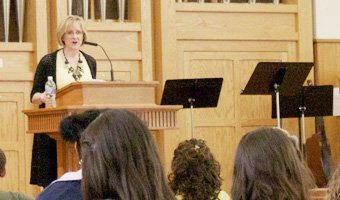
Julie Pennington-Russell speaks to nearly 200 at Sacred Voices conference. (Photo/Baylor)

Pennington-Russell recalled the note she got at one point early in her ministry: "Everything God is doing right now is because of you. … You're the best pastor this church has ever had," the writer said.

But on the same day, she received an anonymous letter informing her, "You're the worst pastor this church has ever had. … I pray every day for your hasty departure."

"One of those is harsh; the other leads to pride, which in my mind is the worse of the two," Pennington-Russell said. "God is the only one who tells you the whole truth about yourself."

One New Testament account is a marvelous example of how to handle conflicting messages—in that case given to men, the apostles Paul and Barnabas, as they healed a lame man, she said.

"The people who saw it started hollering, 'The gods are here!'" she said. Paul and Barnabas, horrified, protested they were merely humans.

The mood shifted when the apostles' enemies showed up to incite the crowd. People stoned Paul until they thought he was dead, then hauled him out of town.

"In one moment they're worshipped; in the next, they're walloped," Pennington-Russell said. "But when they get beat up, they shake it off. Why? Because they're secure in their identity as God's children and their commitment to their mission. They know who they are, and they know whose they are.

"There's always going to be someone who wants to put you out of town. Then there are our own up-and-down opinions of ourselves. But when you let Jesus show you who you are, no one's flattery will puff you up—and no one's criticism will throw you down."

During panel discussions, topics ranged from discerning a call to the ministry, to pastoral time management, to ways lay leaders can encourage women pastors.

Some Baptist churches grapple with whether women should be pastors, seeking to reconcile biblical texts about women's significant roles in the ministries of Jesus and Paul with Scriptures about how women are to participate in worship, said Todd Still, professor of Christian Scriptures at Truett.

Van Christian, chair of the Executive Board of Texas Baptists, said churches "don't know what they're supposed to believe about women in ministry. They want to do what's right, what's godly. … It's going to be a matter of education."

The BGCT hired Meredith Stone as women in ministry specialist a year ago to be a resource for churches and is exploring other ways to aid, said Bill Tillman, director of theological education for Texas Baptists.

In many small rural churches, "we're running out of men (pastors)," Christian said. "If the churches are going to survive, they're going to have to turn to women as leaders."


Video blog offers deeper connection between pastor and church

When a church consultant recommended to Second Baptist Church in Liberty, Mo., that its senior minister needed an additional venue—other than the pulpit—to connect to its members, the church's media minister pushed Pastor Jason Edwards to consider a video blog.

"We were thinking that would require me to find a professional studio to go to each week to tape it," said Edwards, who was reluctant to add another item to his already full schedule.

One day, however, "I closed my office door, turned on my iPhone camera, shared some comments, loaded it to my YouTube channel, and told the media minister, 'Here you go.'"

Since then, Edwards' weekly v-blog (or vlog) has become a standard feature of Second Baptist's interaction with its community.

"I actually was shocked by how well it's been received," said Edwards, an Atlanta, Texas, native who graduated from Baylor University's Truett Seminary in Waco. "I didn't have any sense that it would be what it has become for us."

Edwards—who continues to use his iPhone to record his comments—tries to keep his vlog to two or three minutes and tapes them in a variety of settings. A visit to his East Texas hometown prompted a reflection (taped in his car on the drive in) on the spiritual impact his youth choir had. A discussion of the biblical concept of "Sabbath" was taped at an airport's Gate 7—a reference to God's post-creation rest on the seventh day.

The media minister uses Adobe Premiere to place Edwards' name and sometimes Scripture references on the video screen. Then she loads the vlog to the church's YouTube channel and sends out an email alert to the congregation.

"Church members say they know they're looking at a video, but they add that it's a genuine connection," Edwards notes. "For a couple of minutes, the pastor is looking them in the eye and sharing something with them. They feel connected in a personal way because of that."


Beyond Facebook: Scanning the social media landscape

Facebook has become the social network of choice for the vast majority of people—it's hard to argue with 850 million users around the globe—and it's not likely to disappear any time soon.

But some specialists see a growing market for "niche" networks.

"Some are predicting that we'll stop seeing movement toward one platform and more toward niche groups," said social media consultant Natalie Aho. "None of these platforms will be as large a market as the ones that preceded them," but exploring them can enhance churches' community-building efforts.

Linkedin. A professional networking site, Linkedin's no-nonsense approach—there are no distracting games, for instance—leaves it virtually free of spammers. Linkedin Groups allow churches to network with others around similar interests and start discussions without requiring email addresses, eliminating the need for frequent database updates.

Pinterest. The virtual pinboard allows members to organize and share visual images reflecting their interests. Churches looking to engage the arts can identify "the beautiful things of the world" that represent its values, like social justice, or liturgical seasons, said Aho.

Google+. The newest kid on the social media block, Google+ (or Google Plus or G+) integrates a variety of social networking functions, backed by the mighty Google empire.

Apps allow users to create documents, edit photos and listen to music without having to install complicated software, and are especially useful for browsing church web sites on smart phones or tablet computers. Randolph Memorial Baptist Church in Madison Heights, Va., is typical of churches that have created an app on iTunes at a modest cost. "It offers church news, information about us, directions to the church, sermons and items off our web site," says Pastor Derik Hamby. "It's an easy weekly connection for our members, and they love it." The church is developing an app for the Droid as well.

Foursquare. A location-based social network, Foursquare allows users to "check in" at locations around the globe and lets followers know where they are. "I have a client who encourages church members to use Foursquare because it signals to their followers how important church life is to them," said Aho. "It offers opportunities for conversations about spiritual matters."

QR codes. Not a social network, QR (Quick Re-sponse) codes are barcodes from which a website URL can be read by smart phones loaded with the appropriate software. Churches have placed QR codes near their entrances. They allow worshippers to access online giving sites to make financial contributions or to download the service's order of worship on phone or tablet.

Instagram allows users to snap photos on an iPhone and send to Facebook, Twitter or Flickr—another photo sharing site—without first loading them on a computer.


So your church is on Facebook. What now?

While about half of Protestant churches have Facebook pages, many essentially use it as a bulletin board, missing out on the potential to nurture relationships with congregants and its community.

"It's OK for a church to use Facebook like a web site," says social media consultant Natalie Aho. "That may be all a church feels it needs. But understand that if you're not using it as it was intended, you might not get the results you want. If you want to tap into its power, you need to use it socially. It's all about building community."

Social media specialists suggest several ways a congregation can get the most out of Facebook:

Examine other pages. See what other churches are doing and experiment. Don't reinvent the wheel.

Keep it current. Post updates regularly—at least several times a week —so fans have a reason to return often. A stagnant site quickly loses its appeal.

Open it up. Set the page's parameters to allow as many people as possible to post. Moderate comments frequently, if you have concerns about unrestricted content. But Facebook isn't about controlled release of official information. It's about encouraging engagement with your church's mission.

Be a first responder. The Economist recently reported that almost 90 percent of posts on businesses' Facebook pages went unanswered. Acknowledge comments, answer questions, clarify confusion and express thanks for compliments.

Focus on the congregation. "I don't see Facebook at a place to connect initially with visitors and nonmembers," said Aho. "That's the role of the web page. They'll go to your Facebook page, but they'll evaluate you on the basis of the shared community that they find there."

Share the wealth. Encourage members to post photos and comments that reflect God's impact on their lives. Some congregations are better at this than others. "If they're not good at sharing in person, they're probably not going to be good at it on Facebook," Aho said.

Delegate responsibility. Staff ministers may not be the best administrators of a Facebook page. "In fact, I'd encourage them not to be," said Aho. Find a church member who's proficient at posting and understands the community-building aspect. For some members, the role may satisfy an unfulfilled desire to increase their church involvement.

Start a discussion. It might be last week's sermon or a story in today's newspaper. Facebook conversations aren't limited by time or geography, and everyone can participate.


Text message donors represent new category of giver, study shows

One in 10 Americans have made a charitable donation using the text messaging feature on their mobile phones, according to a newly-released study produced by the Pew Research Center's Internet & American Life Project and Harvard's Berkman Center for the Internet & Society.

According to the study, released in January, two thirds of American adults now use text messaging, and 9 percent have texted a charitable donation.

Those donors represent a new kind of charitable giver, suggests the study, which analyzed the "Text to Haiti" campaign after the 2010 earthquake. Individuals gave an estimated $43 million for reconstruction efforts on the Caribbean island using text messaging in the weeks following the disaster.

Often the contributions were spur-of-the-moment decisions in response to images seen on television that spread virally through friend networks. Almost three quarters of donors contributed using their phones on the same day they heard about the campaign, and 76 percent said they typically make text message donations without conducting much in-depth research beforehand. And most have not paid close attention to continuing reconstruction efforts in Haiti—43 percent have been following these efforts "not too closely" and 15 percent have been following them "not at all."

By contrast, online donations—typically on a web site—tend to involve more deliberation, as half of these donors say they generally do a good bit of research before donating money.

Yet while texters' initial contribution often involved little deliberation, 43 percent of these donors encouraged their friends or family members to give to the campaign as well. In addition, 56 percent of those surveyed have continued to give to more recent disaster relief efforts—such as the March 2011 earthquake and tsunami in Japan—using their mobile phones.

Among other findings of the study:

• For three-quarters of Haiti text donors, their contribution to Haiti earthquake relief was the first time they had used the text messaging function on their phone to make a charitable contribution.

• Although technology helped facilitate texters' initial donation, the donors were more likely to spread the word about their contribution through face-to-face conversations than through online means. Of those who encouraged a friend or family member to contribute, 75 percent did so by talking with others in person, and 38 percent did so via voice call. By comparison, 34 percent encouraged others to contribute by sending a text message, 21 percent did so by posting on a social networking site and 10 percent did so via email.

• Mobile givers are divided when it comes to their preferred tool for making charitable contributions. Overall, text messaging (favored by 25 percent of these Haiti text donors) and online web forms (favored by 24 percent) are most preferred, followed closely by mail (favored by 22 percent) and in-person donations (favored by 19 percent). Voice calling stands out as the least preferred option, favored by just 6 percent.

• Donors in the survey are similar to Americans as a whole when it comes to participation in social or civic groups and engagement with news, but differ when it comes to technology ownership. While they are no more or less involved with charitable or nonprofit groups than other Americans, they are much more likely to own an e-reader, laptop computer or tablet computer; use Twitter or other social networking sites; or use their phones for activities such as accessing the Internet, taking pictures, recording video or using email.

Mobile givers also are younger and more racially and ethnically diverse when compared with those who contribute through more traditional means.

A Pew Foundation analysis of the survey indicated mobile giving offers opportunities to charitable groups for reaching new donors under new circumstances, but warned it also poses challenges, including the uncertainty about whether the donors will remain engaged once they make their donation.

The Pew survey is based on telephone surveys with 863 individuals who contributed money to the Haiti earthquake efforts using the text messaging feature on their cell phones, and who consented to further communications at the telephone number they used to make their donation. The margin of sampling error is plus or minus 3 percentage points.


Bible library on a chip for persecuted Christians

WASHINGTON (RNS)—Persecuted Christians now can hold an entire seminary library on a fingertip.

Bible League International is working with the Digital Bible Society to carry the thumbnail-sized chips to Christians in countries such as China or Saudi Arabia, where possessing unapproved religious materials can result in prosecution or even death.

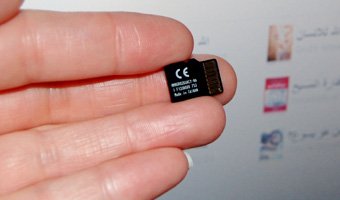
Bible League International is distributing thumbnail-sized microchips that contain entire theological libraries to Christians around the world who are persecuted for their faith. (RNS PHOTO/Courtesy Bible League International)

"It's like a miniature Christian bookstore," said Robert Frank, global CEO of Bible League International, an Illinois-based nonprofit evangelical ministry dedicated to training church leaders using the Bible.

The digital ministry continues the historic work of the Bible League, which went international after World War II when Gen. Douglas Mac Arthur asked U.S. Christian groups to send Bibles to Japan.

The Bible League's 2011 merger with the Texas-based World Bible Translation Center expanded its abilities to get materials to Christians around the world in their own languages.

The Digital Bible compresses data for maximum storage, then copies the material to cell phone cards, thumb drives, CDs and DVDs, depending upon the country where they will be used. The advantage of the format is that a person can use them, but leave no trace on a computer of their use, unlike the trails left by accessing websites.

Publishers who made their work available for the chip also have agreed to allow copying the cards without a fee, Frank said. The works have been translated into Arabic, Farsi, Mandarin and other languages of areas where Christians are persecuted.

"And the content has been donated," said Synetta Armstrong, senior director of global communications for the Bible League, who demonstrated the chip at last fall's Religion Newswriters Association conference. "We want to spread the word of God."

In addition to several versions of the Bible, each of the Digital Bible libraries include worship music, movies, Bible commentaries, a study library, a copy of Rick Warren's The Purpose Driven Life and other landmark books about discipleship, ministry and history, as well as more than 1,200 images that can be used for a pastor's study and for teaching others.


Chaplain brings ministry to TV audience’s homes

SAN ANTONIO— Julie Webster was making her Sunday morning rounds as a hospital chaplain-in-training when she recognized First Baptist Church was a frequent part of the décor.

"I realized that almost every-other room I was going into had our church on TV. I would go in and say, 'That's my church,'" she recalled.

Julie Webster

In talking with the patients and their families, she found many of them believed it to also be their church and Pastor Don Guthrie to be their pastor—even though they never actually attended a service there.

"When I realized how many people were watching us, it blew me away to think this is my church where I am normally sitting and worshipping every Sunday morning, but there's 30,000 people out there worshipping with me that feel like they're my brothers and sisters in Christ, that feel like they are part of my church family, that we don't have a name for, that we don't have an address or telephone number for.

"We were just saying, 'We're so glad you watch us on TV,' and that's great. And we're praying with them, which is a little better than ignoring them, but I just thought, 'We need to be following up with these people,'" Webster said.

After completing the requirements for her chaplaincy certification, she went to Guthrie with the idea of designating a chaplain for the people who "attend" the church through its television ministry.

The church has televised its services 40 years. For at least 30 of those years, members have answered telephones during the service, taking prayer requests.

"But we never reached back to them," Webster said. "We would pray with them when they would call, and sometimes we would take their names, but it really didn't matter, because we didn't follow up. We just prayed with them in that moment, and we were done."

Last year, First Baptist increased the number of people answering the phones to seven, and Webster came on board as chaplain to the television ministry as a pilot program. Rather than just praying with people who called, the volunteers ask if a follow-up call or visit from a chaplain would be acceptable.

"Every single one were willing to give us whatever we wanted," Webster said. "Last name, phone number, address, email —'what do you want to know?' They were wanting us to love them."

"Some are regular callers—little lonely ladies whose only regular contact is with us every Sunday morning. They call us by name," she said.

About 20 people rotate on the phones. Most take one Sunday each month, but a few people answer the telephones every week as their personal ministry. They attend one of church's other worship service times so they can be available to answer the telephones during the 11 a.m. service.

Webster follows up with at least 20 people each week, and sometimes the number hits 45.

"The needs out there are just astronomical. It blows my mind sometimes the deep burdens so many people are carrying. Heavy burdens of broken relationships; the call to pray for 'my daughter who hasn't spoken to me in 18 years, and I don't know where she is.' From that to, 'I'm afraid my granddaughter is being abused,'" Webster said.

"We encourage our telephone people that they are prayer warriors—they are not trained counselors. They are not to offer advice or counseling. They are to listen and pray about what need they heard," she pointed out.

"I'm the one who follows up during the week to say: 'We need to call Child Protective Services. I want you to call, or I will. So, will you make that phone call?'" Webster said.

Many people who call are experiencing grief.

"Last week was a man who didn't feel like he could put one foot in front of the other because he was missing his wife and was just ready to be with the Lord. Just wanting someone to tell him he could keep living, keep hanging on until it was the Lord's time for him," she said.

"The gamut is amazing. If you can dream it or think of it, I've had it this year," Webster said.

"There have been some instances of where people have been carrying a hidden sin that they want to confess to a stranger. I've been able to tell them they can be forgiven for that sin, that God is waiting to forgive them.

"I think about 75 percent of the people who call don't know the Lord, and I pick up on that real quick. They'll say, 'I hope I've been good enough to go to heaven.' I tell them it's not earned or deserved; it's a free gift. They don't have to hope; they can know they have eternal life, and I get to share the gospel with them," she said.

The youngest person to call was a 17-year-old boy who asked, "How much do you charge to pray for me?"

"It broke my heart," Web-ster recalled.

"I have God story after God story. I get so excited, because every day I get to be in on something God is doing. God is at work."

She recalled a man with four young children. He called to ask for prayer for his wife who was about to undergo emergency surgery while he was home with the children. When Webster visited the woman that afternoon in the hospital, the woman couldn't believe her husband would watch a religious service or that he would call to request prayer for her. "I didn't know he loved me that much," she told Webster.

"If we had never started taking numbers, taking names, returning phone calls, these God things we now get to be a part of wouldn't be happening," she said.

Webster has conducted 25 to 30 funerals in the last 15 months.

"People call in and ask me to do their loved one's funeral because they don't go to a church, and they don't have a pastor," she said.

"It's amazing how they feel loved and cared for because we're reaching back to them."


U.S. mosques multiply, take ‘moderate’ approach

WASHINGTON (RNS) —The number of mosques in America has jumped 74 percent since 2000, and the majority of them—56 percent—espouse a less-than-literal approach to interpreting Islam's holy texts, according to a new survey of American mosques produced by a coalition of Islamic civic groups and Muslim and non-Muslim religion scholars.

"Islam is one of the few growth spots in America's religious mosaic," said David Roozen of the Hartford Institute for Religion Research, part of a Protestant seminary.

The number of mosques in America has jumped 74 percent since 2000. (RNS photo by Aristide Economopoulos/The Star-Ledger)

Leaders of the institutions that sponsored the survey offered it as a counterargument to the currents of "Islamophobia" they say have tainted much political and personal discourse during the past 10 years.

The report, they said, shows a strong willingness on the part of mosque leaders to encourage worshippers to engage in American society, including its politics.

"Post-9/11, I was really afraid of the new negative attitude Muslims were receiving," said Safaa Zar-zour, secretary general of the Islamic Society of North America. "It made me feel that Muslim communities would feel marginalized from American society, and that, to me, is where things can become dangerous."

But that did not happen, he continued.

"We see outreach and engagement among mosques—mosques with food pantries, medical clinics. You have people who can look at mosques in their neighborhood and see Muslims as people who can help, not people to be feared."

The survey, "The American Mosque 2011," counted 2,106 mosques in the nation, and a spike in the number of people who attend Eid prayers, the Muslim holy days that tend to attract more people than any other. In 2011, the survey found 2.6 million people had gone to Eid prayers, up from 2 million in 2000.

That last figure challenges many previous estimates of the U.S. Muslim population, which generally fall well below 3 million. Given the number of Muslims who do not pray the Eid prayers, the total number of Muslims in the United States likely exceeds 3 million, perhaps by more than a million, the study's authors conclude.

Within those mosques, a more flexible attitude toward the interpretation of Islam is more typical, with 56 percent of mosque leaders describing their own approach as one that sees the Quran and other Muslim holy writings as a guide relevant to modern life.

Of the remaining mosque leaders surveyed, 31 percent take a more conservative approach and base their interpretations on centuries of Islamic scholarship. Another 11 percent follow a single, traditional religious school of thought.

Just 1 percent followed a strict interpretation the study's authors likened to Wahhabism, the brand of Islam that predominates in Saudi Arabia.

For most of American history, American Muslims have not drawn much attention. That changed on 9/11, but much of the new focus on Muslims has been negative and depicted American mosques as a breeding ground for radicalism. The House Homeland Security Commit-tee has held a series of widely publicized hearings on the subject.

But the 524 mosque leaders interviewed for the report tell a different story, according to the survey. Asked whether they agree that American Muslims should be involved in American institutions, 98 percent agree or strongly agree; none strongly disagree.

And 91 percent of mosque leaders either agree or strongly agree Muslims should participate in the American political process.

The study also reveals the diversity of American mosques. Among regular mosque participants, 33 percent are South Asian, 27 percent are Arab, and 24 percent are African-American.

Other findings of the report include:

• A steady conversion rate. In 2011, the average number of converts per mosque was 15.3 compared to 16.3 in 2000.

• A decrease in the number of mosques in urban areas and an increase in suburban mosques. In 2000, 16 percent of mosques were located in the suburbs, compared to 28 percent in 2011.

• A shift in geographic distribution of mosques, which in 2000 were mostly concentrated in the Northeast. In 2011, the South had the greatest number of mosques, 34 percent, compared to 26 percent in 2000.

• About 7 percent of the mosques surveyed identified as Shiite, with the greatest proportion located in the West (37 percent).

The survey is part of a larger, continuing study of American congregations called Faith Communities Today, a multifaith effort.

The mosque survey in particular was sponsored by the Hartford Institute for Religion Research at Hartford Seminary; the Association of Statisticians of American Religious Bodies; the Council on American-Islamic Relations, the Islamic Society of North America, the Islamic Circle of North American and the International Institute of Islamic Thought.


HPU students raise money to provide clean water

Cindy Kimery was one of many customers to peruse original artwork by HPU students, faculty and alumni at the Art for Water event .(HPU Photo)

BROWNWOOD—Howard Payne University students raised more than $1,800 through recent campus events to support Charity: Water, an organization dedicated to providing clean drinking water for people in developing nations.

HPU art students, faculty and alumni sold original paintings, jewelry, baskets and other pieces of art during Art for Water on Thursday, Feb. 23. The following Friday, 15 students gathered for Water Walk, in which they pledged $5 each for the opportunity to walk one mile with an empty water jug and walk a mile back to campus with a jug filled with clean water.

"What an amazing effort on the part of our students to raise money for those in need," said Keith Platte, HPU's Baptist Student Ministry director.