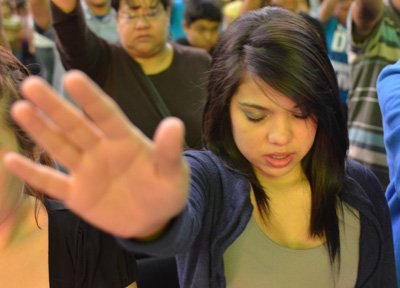
Merging churches across racial lines demands work

As its neighborhood shifts, a congregation often chooses to sell its facility and relocate. Many times, church's members have moved to a different part of town and want a building close to where they live.

At St. Paul Baptist Church at Shively Heights in Louisville, Ky., pastors Lincoln Bingham (center left) and Mark Payton (center right), along with their wives, lead their newly united congregation in prayer in 2009. (PHOTO/David Winfrey)

Members either give away or sell the facility to another church in the neighborhood, usually one that ministers to the area's largest ethnic group.

Blended community

A few congregations, however, choose to create something new by merging two distinct churches. But creating a blended Christian community takes work.

St. Paul Baptist Church at Shively Heights in Louisville, Ky., drew national media attention when the historically black St. Paul Missionary Baptist and the predominately white Shively Heights Baptist merged to create the blended congregation in August 2009.

Pastor Lincoln Bingham of St. Paul Baptist reached out to Shively Heights' pastor, Mark Payton, when Payton moved to the area 26 years earlier. The two became close friends, and as more African-Americans moved into the area, the two began talking about ways to minister to their community.

The pair wanted to lead their congregations to minister. But St. Paul's didn't have the facilities it needed, and Shively Heights members didn't have the economic resources to cover the upkeep on its building. Bingham and Payton felt God showing them a merger would be the best way to reach a community of nearly 300,000 people—both black and white.

Merger hasn't been all that uncommon in the past 20 to 25 years, but often the result reverts to one primary culture, or a church will hold two distinct services to accommodate each culture. As co-pastors, Payton and Bingham have worked hard to lead the blended congregation to remain blended.

Currently, the church's makeup is about 60 percent black and 40 percent white. While the community is predominately African-American, the racial mix of new members since the merger has been about 50/50, with a few Hispanics and other minorities joining, as well.

The congregation works at keeping a blend, even in its programs and governance. All Sunday school classes have two teachers—one black and one white—who rotate responsibilities each month. Every committee has a balanced representation, and the pastor scheduled to preach isn't announced ahead of time. "They know who it is when they see the bulletin," Payton said with a laugh.

Members concentrate on ministry, with an organized evangelistic outreach every Monday night, Vacation Bible School each summer and an annual back-to-school block party. For the past three years, the church has offered a basketball league, attracting 500 to 600 participants and spectators each weekend during the season.

"We've really been amazed at how well it is working," Payton said. "We just tried to determine what God's will is. … We just don't think there's room for prejudice."

Slowly becoming one

Members of New Home Baptist Church in Kansas City believed God had called them to reach the unchurched in Kansas City. In 2010, the church had about 200 members, with about 75 percent African Americans and 25 percent other groups. But they quickly outgrew their building. To continue making an impact on the area, they needed more room.

The nearby Mount Washington Baptist Church had been a large urban congregation in its heyday in the 1960s. But by 2008, when Tom Renfro became pastor, the congregation had dwindled to about a dozen senior adults. "Our youth department was two people in their 60s," Renfro quipped. Everyone else had long been retired.

New Home's pastor, Clarence Newton, and Renfro began discussing possibilities. New Home needed the room Mount Washington had, and Mount Washing-ton needed a future. Members decided both visions could be realized by merging.

The new congregation, though, decided to maintain each culture's identity by offering two services—one traditional and one contemporary. The traditional service, which Renfro led, became the home of Caucasian members, while black members chose the contemporary service, with Newton preaching.

Last year, when church decided it no longer could afford two pastors, Renfro resigned. Both the traditional and contemporary services still are offered, with Newton preaching both services.

Each has become a little more blended as older blacks have chosen the traditional service and young whites have moved into the contemporary worship.

The church has baptized more than four dozen people since the merger.

Renfro anticipates Mount Washington will become a predominately black Baptist church in the near future.

"But overall, the merger has been a success because the building is being used, and the church is reaching people for Christ and moving forward," he said.


Veteran minister reflects on losses in African-American church life

BELTON—After more than five decades of ministry, George Harrison understands what African-American Christians have gained and lost in the last half-century.

Black church music chronicles the African-American experience, and veteran minister George Harrison wants to see that heritage preserved and passed along to the next generation.

Harrison, pastor emeritus of First Baptist Church-NBC in Waco and a veteran church musician, vividly remembers life in segregated Central Texas. Growing up in Belton, he recalled how a society where whites and blacks existed in separate spheres that rarely intersected severely restricted his view of reality.

"Even though I could see beyond my community, it was like I was wearing blinders," he said.

The end of Jim Crow laws opened up opportunities for African-American advancement—and for whites to benefit from the contributions of black Americans, he noted.

"Desegregation was good for the nation. … Desegregation had great value in terms of opening up opportunities to learn about other cultures," he said.

Even so, Harrison acknowledged, segregation created a unified—albeit restricted—black community with the church at its center.

"There was a richness in the close-knit community," he said. "You can't gain without losing. You can't lose without gaining."

In a closed, segregated society, Harrison got an early start in ministry as a church musician and composer. He began playing the piano at age 3 and wrote his first song, "Flowers in the Spring," at age 6. After he taught the song to the other children at Macedonia Baptist Church in Belton, where his father was chairman of deacons, the church called him to direct the children's choir and begin leading music in worship. At age 12, he began preaching.

Without question, Harrison recognizes he gained personally from the changes that occurred as a result of the Civil Rights Movement. He earned his undergraduate degree at the University of Mary Hardin-Baylor, where he directed the premiere choral group and traveled extensively as a student recruiter.

After graduation, he worked several years in a post with a railroad company that allowed him to enter a master's degree-equivalency program before pursuing further graduate courses at Baylor University and Southwest Texas State University.

He also served as pastor of churches in Temple, Gatesville and Lampasas, as well as Macedonia Baptist Church in Belton. In 1987, he became pastor of First Baptist Church-NBC in Waco.

About that same time, he was named director of cultural affairs at Baylor University and the first director of Heavenly Voices, the university's Black Gospel choir.

He went on to serve in several administration posts at Baylor. In 2003, Harrison returned to UMHB, first as director of community services and cultural affairs and later as director of digital media services.

Through it all, Harrison has maintained his love for music—particularly music distinctive to the African-American church. And he has made it his mission to help preserve that musical heritage.

Harrison produces a local radio program, "Gospel Now." He also leads occasional seminars that explore the meaning of Spirituals dating back to days of slavery, as well as more recent Black Gospel songs.

"There is a rich culture in those songs, and it's endangered. There's a richness in our worship, and the new generation has no idea about it," he said.

Even so, Harrison hopes the black church can regain its central role in the lives of African-Americans and recapture its ability to instill a clear sense of identity in young people. And he wants to teach the rising generation of black church leaders—as well as anyone else who will listen—about the history chronicled in African-American church music.

"The music tells the story," he said.


Faith Digest

Brits OK prayer at town halls. The British government has fast-tracked a move to restore the rights of towns and cities to hold prayers as part of their official business, effectively overriding a High Court order to stop the practice. Communities Secretary Eric Pickles spearheaded the introduction of a new "general power of competence of local authorities in England" that gives new powers to local governments to resume prayers and to sidestep the court ruling issued two months ago. In its own decision against Bideford Town Council, in southwest England, the High Court said in February it was illegal for town halls to continue with the centuries-old practice of conducting prayers at the start of official meetings. The British government now says, "Parliament has been clear that councils should have greater freedom from interference." In broadening these new powers to town and parish councils, it adds, it enables them to innovate and "hands them back the freedom to pray."

Faith DigestPoll: Christianity good for the poor and children, bad for sex. Americans feel the Christian faith has a positive impact on help for the poor and raising children with good morals, according to a new poll, but it gets a bad rap on its impact on sexuality in society. In a new study conducted by Grey Matter Research, more than 1,000 American adults were asked if the Christian faith had a positive, negative or no real impact on 16 different areas of society, such as crime, poverty and the role of women in society. Strong majorities (72 percent) said Christianity is good for helping the poor and instilling morality in children. Around half (52 percent) said Christianity helps keep the United States a strong nation, and nearly as many (49 percent) said the faith has a positive impact on the role of women in society. Americans hold their most negative perception for how Christianity impacts sexuality, with 37 percent who feel there was a negative impact, compared to only 26 percent who feel it was positive. The total sample of 1,011 adults selected at random from all 50 states had a margin of error of plus or minus 3.1 percentage points.

Cure for homosexuality? London's mayor axed an ad campaign spearheaded by two conservative Christian groups because their ads suggest homosexuality is a disease that can be cured through prayer. Core Issues Trust and Anglican Mainstream made posters reading: "Post-gay and proud. Get over it!" and had planned to plaster them on the sides of London's iconic double-decker red buses. The slogan mimicked a recent drive by the pro-gay rights group Stonewall, which used the line: "Some people are gay. Get over it." Core Issues and Anglican Mainstream both fund "reparative therapy" for gay men and lesbians to "cure" them of homosexuality. The Christian groups' campaign had been scheduled to cover the sides of buses for two weeks, but London Mayor Boris Johnson stepped in to ban it. "It is clearly offensive to suggest being gay is an illness someone recovers from," Johnson said. "And I am not prepared to have that suggestion driven around London on our buses."

Compiled from Religion News Service


Exodus Ministries helps women put difficult pasts behind them

DALLAS—Haley Blanton's childhood was what many people long for—loving parents, supportive environment and a comfortable life.

Blessed with scholarship-level athletic ability, intelligence, good looks and popularity, her future could not have looked brighter—until her world was shattered as a high school junior.

She was raped, and her world turned upside down.

Haley Blanton is one of many women helped through Exodus Ministries in Dallas.

Blanton kept that knowledge to herself for a while. When she finally told her friends, they did not believe her version of the event.

The experience crippled her emotionally to the point she simply stopped caring, she said.

One bad choice led to another, and she found herself in a series of increasingly dangerous situations.

She ended up on the streets of Fort Worth, deeply involved in a gang, dealing drugs. By age 30, Blanton was in and out of incarceration.

"The amount of shame you have after something traumatizing like that is enough to just shut you down as a person," she said.

Watching it happen, Blanton's mother felt helpless. She often didn't know where her daughter was living, going as far as posting fliers on telephone poles.

When Paula Blanton saw Haley, it was for short periods when she would get clean and vanish again.

"It was sad," Paula Blanton said. "I would go into her room sometimes and just sit on her bed and look around and think about the fun times that we had."

When Haley Blanton decided to turn her life around, her mother went with her to Exodus Ministries, a non-denominational program for women supported in part by the Texas Baptist Hunger Offering.

The ministry offers a rigorous yearlong program that provides a furnished apartment, life-skills classes, parenting classes and support designed to help women with difficult pasts emerge from poverty.

The classes and schedule—which for Blanton includes two jobs and early morning bus trips to take her young daughter to school—have been challenging and rewarding, she said.

As she nears the end of her time at Exodus, she feels like she's gained a lot.

Blanton has dealt with her past, even reaching out to a young woman who was in much the same situation she found herself in during high school.

She has spoken at churches, using her experiences as a tool to help others.

Blanton isn't sure exactly what her future holds, but she looks forward to it.

{youtube}Y-Yk_e3HRuw{/youtube}

She hopes to go back to college, possibly pursue a career in criminal justice—an area in which she has a passion, given her involvement in the system.

She wants to help others who are facing the same struggles she has endured.

"It's just an awesome feeling. I'm doing it," she said.

For more information about Exodus Ministries, visit www.exodusministriesdallas.org.

For more information about the Texas Baptist Hunger Offering, visit www.texasbaptists.org/worldhunger.

To give to the offering, visit www.texasbaptists.org/give.


Soccer tournament offers chance for global outreach

FRISCO—For 19 years, youth soccer teams from all over the world have been drawn to the Dallas Cup soccer tournament, now held in Frisco. Throughout that time, North Texas churches have sought to make the most of an opportunity when the world comes to them.

Dallas Cup participants enjoy the relaxed and welcoming atmosphere of the hospitality center staffed by North Texas churches. (PHOTOS/George Henson)

First Baptist Church in Frisco houses the hospitality center, where teams and their coaches relax and refuel between matches. They play ping pong, pool, foosball and video games, as well as eat and just sit and talk.

In addition to First Baptist in Frisco, other churches helping this year included Shiloh Terrace Baptist Church, Kessler Park Baptist Church and New Creation Bible Church in Dallas, North Irving Baptist Church in Irving, Eastern Hills Baptist Church in Garland and Prestonwood Baptist Church in Prosper. The staff of Mount Lebanon Baptist Encampment also helped. The churches rotate staffing the center half a day for each of the five days it is open, and they provide a meal for the teams who visit the center.

This year 1,413 players and coaches visited the center, and 560 attended a chapel service. Ninety-six people prayed to receive Christ as Savior. Eighty-three others asked for individual prayer. About 500 New Testaments and Bibles were given away.

Jana Jackson, family and community director of Dallas Baptist Association, hopes at least 10 churches will assist in running the hospitality center next year.

"The challenge is that the ministry has grown so much," she said. "Years ago, if we had 75 people come through, it was a good day."

Churches usually bring a team of seven to 10 people, and their investment in food generally is about $500, Jackson said.

Dallas Cup participants play pool in between games.

David Balyeat, associate pastor of missions and ministries at Shiloh Terrace Baptist Church, said churches should remember they are getting a chance to experience foreign missions for less than the price of a single plane ticket.

"The international flavor is especially attractive to Shiloh Terrace. The ability for a church to minister to a community of people from all over the world for at least one day a year is something that is difficult to put a price on," he said, noting many of the nationalities represented in the tournament also are represented in the Dallas area.

"It's an opening for us when we seek to minister to the people from those countries who are now living here to say, 'We met a team from your part of the world earlier at the Dallas Cup.' It's a connection point for us," Balyeat said.

Glen Jolley, the longtime chaplain for the Dallas Cup, said the tournament presents an opportunity to begin a work that God alone probably will see to completion.

"All we can do is sow seeds while we have them during that week," he said. "Our prayer is that they go back to their country, to their city, and find a church where they can continue to grow. We tell them it is like soccer where you have to continue to work to grow and become better. We tell them it is important to find a church, to read their Bible, to pray."

Because of his longevity in the ministry, he has seen youth who made a profession of faith at age 12 return years later.

"They come and give me a big hug, and I find they are still growing in their faith. That makes it all worth it. That's what's really exciting," Jolley said.


Cowboy church pastor reels in bass fishermen at tournaments

PALMER—Reggie Stewart is proud to be a fisherman. He's even prouder to be a fisher of men.

Stewart, pastor of J-Bar-C Cowboy Church in Palmer, also is president of the Cowboy Church Christian Bass Club.

The bass fishing ministry began at the Cowboy Church of Ellis County when Stewart was a member there.

Reggie Stewart, pastor of J-Bar-C Cowboy Church in Palmer and president of the Cowboy Church Christian Bass Club, delivers a biblical message to participants at a bass tournament.

For many years, bass fishing was much more important to Stewart than Jesus. He fished in tournaments across the state and noticed men who drank hard the night before tournaments and did other things that fractured their families.

He remembered those men when Jesus took first place in his life, and he wanted to find a way to reach out to them.

He took the idea of a Christian fishing club to leaders of Cowboy Church of Ellis County, who approved. The first tournament had 15 teams.

"I wanted to offer a ministry where it would be good honest guys doing something they really enjoyed, but also bring them closer to God," Stewart said.

The bass club holds one tournament a month from February through October. The entry fee for each team of two fishermen is $60.

Each tournament begins at 6 a.m. with prayer.

"We all come together and pray, which is really a sight to see when you've got about 80 guys out there in prayer," he said.

{youtube}y51j2hx53EI{/youtube}
Reggie Stewart talks about the Christian Bass Club ministry.

Each team returns in the afternoon with three fish to be weighed. Before any prizes are awarded, Stewart presents a devotional.

"They get to hear a little of God's word. We're feeding it to them in little spoonfuls," he said.

Most tournaments now have about 40 teams entered. More than 200 people are members of the club. Some men's wives are their teammates.

The club's rules not only detail the important things concerning fishing, but also conduct. No alcohol or profanity is al-lowed. Violators are disqualified.

Other rules are unwritten but just as important. If someone's boat motor quits running, someone helps him. If the fish aren't biting for someone, the unsuccessful fishermen sometimes call someone else for advice. In other tournaments where money is king, those things are not as common.

"We also pray that we'll always be a witness out on the water. No matter how anybody else acts, we have to be like Jesus," Stewart said.

Stewart especially hopes the non-Christian fishermen in the tournament will notice a difference.

"Our goal is that everybody has fun and catches fish—that way they'll continue to show up. If they continue to show up to the bass ministry's tournaments, maybe we'll have the opportunity to get them regularly involved in church. That's what it's all about—bringing people to Christ," he said.

"People are getting to hear about Christ on their own terms instead of dragging them into a building where they don't want to be or feel uncomfortable. The other side of that is the more they get to know God, the less problem they have going to church."

Several men have made professions of faith in Christ through the ministry, been baptized and now are regular church attenders.

"We've baptized several of them at the lake. We were on the lake, so we baptized them right there. It's been really rewarding," he said.

It's not unusual for a wife to learn of the bass fishing ministry and to ask Stewart to invite her husband to participate since he won't come to church.

"We've heard some thank you's from some wives, but we've also heard thank you from some guys who said, 'I really didn't realize how far out of line I was,'" Stewart said.

The group has become very close knit, he added.

"The fellowship is just overwhelming. God tells us to share our burdens with one another. It's remarkable, but these guys get comfortable in doing that. They'll say, 'This is what is going on in my life.' I get a lot of phone calls," Stewart said.

About half the participants are from cowboy churches, about 30 percent from traditional churches and about 20 percent are unchurched.

Some without a church affiliation find out about the tournaments through the Fishing Forum on the Internet, which Stewart described as like Facebook for fishermen.

While he's sure some click on by when they see "Christian" in the club's name, he thinks others may be intrigued by the words "Cowboy Church." Others seem to think Christians may be easy money.

"We get guys who look at it and see the payout and think, 'This is a bunch of old church people, and I might be able to go there and win some money.' But I tell you what, bring your best game, because we've got some fishermen.

"But sometimes they come and see there's some competition and they stay because everyone likes to compete," Stewart explained.

People who want to fish with the club but did not fish in at least three tournaments last year either have to have a member recommend them, or pay for two tournaments in advance.

"We started that this year because we had people just show up for one tournament and try to take everybody's money, that didn't want to listen to the devotional and then would just walk off and we'd never see them again.

"We want people to get involved. This way, if they pay for two tournaments, we get two shots at them, and maybe that second one will get them over on our side," he said.

For Stewart, changed lives make all his efforts worthwhile.

"I've seen lives turned around through fishing, the rodeo arena—just every place. All you have to do is plant the seed and let God go to work."

The club has been successful in every way it has tried except one—replicating itself.

"Our goal is to get other churches to start a bass ministry out of their church. If it has to be small, it doesn't matter. And then at the end of the year, we'll all come together for one big tournament and celebration," he said.

Stewart noted he would be glad to help anyone get started, and the clubs rules are located on its website at www.cowboychurchbassclub.org.

He just wants to get as many hooks in the water as possible.

"Everybody uses that old saying, 'You get them here, and God will clean them.'"

Especially people who have seen it happen.


Congreso draws more than 6,000 students to Baylor campus

WACO—About 900 students stepped away from their chairs and walked down aisles to the front of Baylor University's Ferrell Center to make a commitment to Christ during Congreso, the Hispanic youth conference. The walk forward was more than a change of location; it was a change of life.

Juan Contreras, youth director at Primera Iglesia Bautista in McAllen, urged young people at Congreso to commit their lives to God and follow him.

"We continue seeing kids moved by the Spirit," said Frank Palos, director of Hispanic evangelism efforts for the Baptist General Convention of Texas. "That's what it's all about."

Of the 900 decisions for Christ recorded at the event, about 300 were young people embracing the hope of Christ for the first time, and 90 people felt called to vocational ministry. More than 6,000 students attended the conference.

At the front of the arena, students prayed with youth group leaders. Tears flowed down the faces of some of those whose lives were changing, as well as those who had spiritually nurtured them. Youth circled their friends who made spiritual decisions, to pray over them.

This scene is why God brought students to Congreso, said Tiny Dominguez, pastor of Community Heights Baptist Church in Lubbock. God is calling people to have a relationship with him, he said.

"It was God's plan for you to be here because his desire is for you to know he loves you," Dominguez said during a worship session. "I don't care what you look like. I don't care how the world treats you. I don't care what sins you brought to this place. Jesus loves you. And his love will never fail."

Juan Contreras, youth director at Primera Iglesia Bautista in McAllen, said by turning to Jesus, teenagers can find the answer to three basic questions they are asking: Who am I? Where am I going? Where do I belong?

Seeking answers for those questions led Contreras initially down a life of alcohol abuse late in his teen years and into his 20s. He got into fights, and he indulged sexually. He committed never to let anyone hurt him.

"I served my flesh, my desires, my lust," he said.

Then he embraced Christ as Lord. "That decision ultimately changed my life—not only the outside, but the inside too," he said.

Contreras urged young people to commit their lives to God and follow him exclusively. He of-fered an invitation, and young people flooded forward, filling the stage and spilling onto the arena floor.

"Life in (Christ) is the best life," Contreras said.

The scene of multitudes of young people deciding to follow Christ thrilled Christina Gaona, Baylor event manager who previously had attended Congreso as a student.

"It's exciting," she said. "It's a good opportunity to have lots of students on our campus. It's a good ministry and partnership with the Baptist General Convention of Texas."

Hispanic young people join in prayer and worship at Congreso, held on the Baylor University campus. (PHOTOS/John Hall/BGCT)

Julio Guarneri, pastor of Calvary Baptist Church in McAllen, said his congregation brought a group of 30 students. During Congreso, one made a profession of faith, several volunteered for leadership positions within the youth group and several more asked to be baptized.

"I think Congreso has the potential of igniting a flame in a generation of young people who can really make a difference in our state and around the world," Guarneri said. "It can turn into a movement of students who are on mission."

Among the first places students took their faith was to 10 Waco mission projects, where they shared the hope of Christ.

Students also gave more than $10,000 through an offering taken during Congreso—about $7,000 for college scholarships and more than $3,800 for a Congreso summer missions team.

"Congreso is not an event," Palos said. "It's an experience. What happens at Congreso doesn't stay at Congreso. It's my heart prayer that Congreso impacts the local church—whether it's by encouraging a pastor who sees students serving the Lord, students who serve in their local church or a student who shares the gospel with their friends at school."


New Mexico Baptists ponder future of Glorieta

ALBUQUERQUE (ABP) — Around 30 people from New Mexico, Texas and Oklahoma gathered April 12 at Baptist Convention of New Mexico’s building to offer suggestions for the future of Glorieta Conference Center.

BCNM Executive Director Joseph Bunce welcomes those who came to offer suggestions for the future of Glorieta while Glorieta Study Committee members get ready to listen. (Photo by John Loudat)

They met at invitation of an ad hoc committee created in January to explore “the future and possibilities of Glorieta,” LifeWay Christian Resources’ conference center near Santa Fe.

Last fall, during the BCNM’s annual meeting, messengers resolved to “strongly urge the Southern Baptist Convention and LifeWay Christian Resources to insure that Glorieta continues its vital ministry to the people known as Southern Baptists now and well into the future or until Jesus returns.”

The resolution came one month after LifeWay trustees voted to cut back operations and pursue “viable options for the disposition of the property” at Glorieta.

State convention President Maurice Hollingsworth told the Albuquerque audience the committee was in a “fact-finding mode” to consider all possible options for what to do with the property.

BCNM Executive Director Joseph Bunce said he had been told that LifeWay was willing to sell the New Mexico convention the property for $1, and Hollingsworth added that LifeWay would require the convention to present a detailed and viable business plan.

Five of the seven individuals who presented proposals own residences located on land they are leasing from Glorieta.

Specific suggestions offered during the three-hour listening session included:

— Dividing the property into two “manageable” units, separating the campus from the residences.

— Finding new ways of encouraging people to come to Glorieta.

— Subletting the property to a variety of Christian ministries.

— Employing a full-time sales staff that would “aggressively” encourage people to attend.

— Taking advantage of Glorieta’s excellent access to water.

Rick Sullivan, pastor of First Baptist Church in Artesia, N.M., and a former state convention president, urged the committee first to act on New Mexico Baptists’ belief that Glorieta has a viable future in reaching the next generation and then to conduct an economic audit and employ a team of “economic architects” who could develop a plan they could propose to the committee.

“We need to rethink throwing in the towel,” said McCollum, whose pastoral predecessor in the pulpit at Gallup was the late Harry P. Stagg, who served as executive director of New Mexico Baptists from 1938 until 1968.

Stagg, remembered as the most important Southern Baptist in New Mexico history when he died in 2000 at 101, led the BCNM to purchase the original property at Glorieta in 1947 and deed it three years later to LifeWay’s predecessor, the Sunday School Board, “with the intent that a great Baptist training center would be established and maintained in the West.”

Former New Mexican Bill Lawson of Collinsville, Texas, urged New Mexico Baptists to work to work with neighboring state conventions to keep Glorieta alive. “Glorieta must not die!” said Lawson.


On the Move

Bill Black to First Church in Lone Grove, Okla., as pastor from McKinney Street Church in Denton.

Ryan Dunn to First Church in Sanger as associate pastor/youth minister.

Anthony Holt to First Church in Jefferson as minister to students.

Anson Nash to Corpus Christi Association as executive director, where he had been interim.

Billie Stone to GracePointe Church in Denton as preschool minister from McKinney Street Church in Denton, where she was children's minister.


Texas Tidbits: Energy saver loans for churches

Texas TidbitsLoans available for church energy improvements. The Texas controller's office is offering a small window for congregations to take advantage of low-interest loans that help churches remodel and save money on energy usage. Churches have until May 18 to apply for loans up to $25,000 to help with energy-saving projects such replacing lights, installing insulation and upgrading air conditioning systems.

The loans are offered at a 5 percent interest rate and can be paid back with the savings from the remodeling efforts in 10 years. The application process requires congregations to present an energy efficiency retrofit plan from a licensed engineer to show calculated monetary savings for proposed projects. "In the past, there have been tax incentives for businesses to do this kind of work," said Suzii Paynter, director of the Texas Baptist Christian Life Commission. "State-run schools and such also have had a program. But churches, because they do not pay taxes, have not had these kinds of vehicles. This program offers churches a way to make desired changes and pay the loan back with funds saved as a result of those efforts."

Texan nominated for VP at SBC. Nathan Lino, pastor of Northeast Houston Baptist Church in Humble, will be nominated for first vice president of the Southern Baptist Convention during the annual meeting in New Orleans this summer. Lino, 35, is a former first vice president of the Southern Baptists of Texas Convention. Ken Whitten, pastor of Idlewild Baptist Church in Lutz, Fla., announced his intention to nominate Lino.


Baptist Briefs

WMU celebrates missions at annual meeting. "The Story Lives On" is the theme of the Woman's Missionary Union Missions Celebration and annual meeting, June 17-18, in the La Nouvelle Orleans Ballroom at the Ernest Morial Convention Center in New Orleans.

David Crosby, pastor of First Baptist Church of New Orleans

Baptist BriefsFeatured speakers include David Crosby, pastor of First Baptist Church of New Orleans; Jay and Kathy Shafto, International Mission Board field personnel; Damian Emetuche and Stacey Smith, North American Mission Board field personnel; Wanda Lee, executive director of national WMU and author of The Story Lives On: God's Power Throughout Generations; and Debby Akerman, president of national WMU. Participants are encouraged to bring items for hygiene kits for Global Maritime Ministries, which ministers to seafarers and port workers; snack pack items for Baptist Friendship House, a ministry offering transitional housing for women with children and outreach to the homeless; and various items for Inward Ministry, which ministers to women working in the sex industry on Bourbon Street. For a complete list of needed items, visit www.wmu.com.

Alliance takes aim at gun deaths. At its 25th anniversary convocation at Highland Park Baptist Church in Austin, the Alliance of Baptists adopted a statement of support for the family of Trayvon Martin and others who have experienced similar losses. The statement expressed grief at the death of the Florida teenager widely viewed as a case of racial profiling and "outrage at the delays in the investigation and initial lack of concern by the authorities about the killing." The Alliance also endorsed efforts to reduce gun violence including those by Heeding God's Call and the Coalition to Stop Gun Violence.

Stories from women ministers wanted. Jennifer Harris Dault, a student at Central Baptist Theological Seminary, is working on a book project collecting stories from Baptist women about their calling to the gospel ministry. She is seeking 2,000- to 3,000-word first-person accounts about how calling was discerned and what answering that call has meant, along with a photo and brief biographical sketch of each person who submits an essay. Deadline is May 31. Contact her at doveintheattic@gmail.com.

Baptist educators to meet. The Fellowship of Baptist Educators—an organization focused on long-term and short-term volunteer teaching opportunities overseas—will celebrate its 25th anniversary at its annual meeting, July 26-27 at Samford University in Birmingham, Ala. In addition to publishing an online list of volunteer teaching assignments abroad, the fellowship also sponsors the Book-Link ministry that ships Christian literature to English-speaking international pastors and the Universal Pen Pals project. For more information about the fellowship or the celebration, contact Bob Lamb at rlamb12@carolina.rr.com or call (704) 434-9392.


Around the State

Dillon International will hold a free adoption information meeting May 14 at 6 p.m. at the Buckner Children's Home campus in Dallas. A representative will give an overview of adoption from China, Korea, Haiti, India, Hong Kong and Ghana. A domestic adoption program for Texas families and adoption programs in Russia, Ethiopia and Honduras, available through an affiliation with Buckner, also will be discussed. For more information or a reservation to attend the meeting, call (214) 319-3426.

Hardin-Simmons University inducted five people into its Hall of Leaders. The 2012 honorees are Gene Adams, Dale Haralson, Clifton Caldwell, Charles Logs-don Jr. and Koreen Logsdon-Hemphill. Established in 2001, the HSU Hall of Leaders honors graduates, former students, former employees and other university leaders who have records of achievement and good character.

The 2012 Young Maston Scholars were named as a part of the T.B. Maston Christian Ethics Lectures held at Hardin-Simmons University's Logsdon Theological Seminary. Pictured, front row, left to right, are Bill Tillman, director of theological education for Texas Baptists; Danielle Wells, Howard Payne University; Bethany Franz, University of Mary Hardin-Baylor; Kaylan Suarez, UMHB; Joy Freemeyer, Baylor University; Julia Fanning, BU; Carolyn Brown, Baptist University of the Americas; Michael George, HPU; and Neville Callam, general secretary of the Baptist World Alliance and lecture keynote speaker. Back row, Samuel Martinez, BUA; Keith Roberts, Dallas Baptist University; Travis Nicks, East Texas Baptist University; Zach Littleton, ETBU; Blake Fox, HSU; Chad Moore, HSU; Jordan McKinney, DBU; and Don Williford, dean of the Logsdon School of Theology.

Gary Manning is retiring after 30 years as a professor of religion at Wayland Baptist University.

Five members of the East Texas Baptist University student publication staffs were recognized at the Texas Intercollegiate Press Association Convention. Ryan Ringo won second place in yearbook cover design and honorable mention in newspaper feature page design. Michelle Gallimore and Casey Morris received honorable mention for a newspaper picture story. Emily LeBeck took second place for yearbook opening spread. Kelsey Shaw re-ceived second place for yearbook photo story.

Bob Colton, professor of psychology and counseling, has been named Dallas Baptist University's advisor of the year. He has been a member of the faculty since 1990 and was director of the school's counseling center 20 years. Prior to entering the teaching profession, he was a pastor for 20 years in Texas and Colorado. He and his wife, Mary Jane, are members of Heritage Church in Waxahachie.

The Howard Payne University moot court team took top honors at a tournament held at Southern Methodist University. Jake Aschmutat and Charity Chambers were named tournament champions.

Anniversaries

United Church in Laredo, 20th, May 6. A celebration service will be held at 5:30 p.m. and a banquet will follow at 7 p.m. For more information, call (956) 727-7729. Mike Barrera is pastor.

Event

A concert to benefit missions will be held at First Church in Irving May 4 at 7:30 p.m. Jimmy Needham is the featured artist. No tickets are required. A love offering will be taken during the concert to raise financial support for a missionary family who will serve in East Asia. For more information, call (972) 253-1171.

Ordained

Randy Walls as a deacon at First Church in Skidmore.

Death

Donnal Timmons, 90, April 22 in Huntsville. A graduate of Baylor University, Southwestern Theological Seminary and Sam Houston State University, he served in World War II in the Army infantry. He was captured at the Battle of the Bulge, where he became a prisoner of war. After his release, he was Baptist Student Union director at Texas A&M-Kingsville and Sam Houston State University in Huntsville. He then became a vocational rehabilitation counselor with the Texas Rehabilitation Commission. He was a longtime member of First Church in Huntsville and later a member at Tallowood Church in Houston. He was preceded in death by his sister, Lila McGraw, and brother, Avery. He is survived by his daughters, Carol Gallagher, Donna Fitschen and Lana Fenske; son, Andy; his former wife, Jo Nell Hess; nine grandchildren; and one great-granddaughter.