Obituary: Rebekah (Becky) Louise Latham

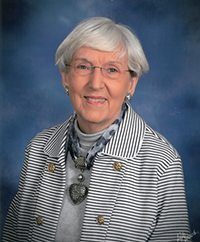
Rebekah (Becky) Louise Latham, missionary supporter and devoted wife to a longtime pastor, died Aug. 30 in Houston. She was 94. She was born Jan. 19, 1930, in McKinney to Elger and Virgie Parr. She grew up in Galveston and was baptized at First Baptist Church of Galveston. She graduated from Ball High School and from Howard Payne University in Brownwood. She served alongside her husband, who was pastor at Sharpstown Baptist Church in Houston for 22 years, before moving to Northside Baptist Church in Indianapolis. After retirement, they moved back to Texas and served with the Southern Baptist Convention’s International Mission Board to fill in for missionaries in Japan, Hong Kong and Alaska who needed to come home for short-term relief. She was preceded in death by her husband, Robert Lee Latham Jr., and daughter, Susan Randel. She is survived by son Tim Latham and his wife Debbie; son Mark Latham; daughter Beth Runnels and her husband Brian; and daughter Liane Latham Bofenkamp and her husband Hugh; six grandchildren; and 14 great-grandchildren.


Political journalist insists: ‘It doesn’t have to be this way’

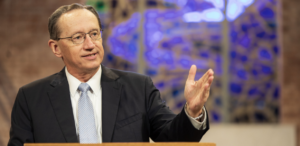
(WACO)—Two months before November elections, Tim Alberta challenged a packed house in the Armstrong Browning Library on the Baylor University campus in Waco to trust in God and stop failing the test.

Alberta is a staff writer for The Atlantic and New York Times bestselling author of American Carnage and The Kingdom, the Power, and the Glory.

“We are here to discuss the crisis in the American church,” Alberta began. But, he pointed out, “There is nothing new under the sun.”

So, the things the white evangelical church in America is dealing with right now really span all the way back to the 4th century with Constantinople and earlier.

Even though it may feel new now, Alberta said, God’s people have been dealing with the pitfalls contributing to the current crisis among evangelicals a long time—so long, it’s a story woven all through the Old and New Testaments.

While Alberta acknowledged it is not only evangelical white American Christians who are struggling, this is the tradition he is part of and knows best. So, when he speaks of the “American church,” white evangelicals are who he means, he explained.

A church in crisis

The American church has become, “in some ways, every bit a secularist’s fever dream—hateful, bullying, hypocritical—more consumed with winning the culture wars than with promoting peace on earth and goodwill toward men.”

“We have acted and spoken in ways that bleed the church of its credibility, while diminishing its capacity to evangelize a world that is unbelieving and desperately in need of Christ,” Alberta said.

“The stench of scandal and the lack of accountability that perpetuates it drags the precious name of Jesus through the mud.”

Alberta lamented the damage that has been done to churches “crumbling under the weight of political strife. The Lamb of God is being appropriated as a mascot for the elephants, and in some cases for the donkeys, too.”

He described pastors who have treated their pulpits as “cable news sets” to “weaponize the word of God to justify their lust for worldly idols, grafting the enduring power of the gospel onto their ephemeral obsession with winning elections,” subjugating their enemies, and imposing a version of Christianity focused on strength and status.

Alberta pointed out this religion they promote includes none of the “self-sacrificial love that turns enemies into friends, friends into brothers and brothers into co-heirs of the kingdom of God,” which is terrible news.

Alberta suggested that to consider this bad news, however, requires a turning to the good news.

The unexpected, “insane” truth that almighty God chose to be “humbled, even humiliated in ways that we cannot fathom,” giving up his majesty and glory to be dishonored on a cross, and that cross would someday become a profound symbol of victory, must be part of the conversation.

The Three ‘Ts’

Then, Alberta got to his main point—“The Three ‘Ts’ that we face inside the church today and has us in crisis—the temptation, the threat and the test.” He said he would “attempt to discuss the nature of following Jesus and why it is so difficult, where we go wrong and how we might do better.”

“All of us, myself included” face these obstacles, even Jesus’ closest followers.

Turning to Luke 4 and Jesus’ temptation, Alberta noted the synoptic Gospels introduce Jesus as an adult in this story, where he is offered the world by Satan.

Jesus responds to the temptation of worldly power with the words: “Get thee behind me, Satan. For it is written, thou shalt worship the Lord thy God and serve him only.”

But Simon, later named Peter, offers a foil to this response by Jesus, Alberta said. Peter was looking for a Messiah who would return the kingdom of Israel to a place of prominence. He hated the oppressive, occupying Roman forces and wanted them defeated.

“Simon … was obsessed with making Israel great again” and restoring worldly power, Alberta said.

Yet Jesus proclaims a new kingdom is here, the kingdom of God. Simon, in following Jesus, comes to understand—and answers Jesus when he is asked in Matthew—that Jesus is the Son of God, no doubt hoping, even expecting, to stand beside Christ and reign, Alberta continued.

But the problem is, Peter does not understand what the kingdom of heaven is all about, Alberta said. Because when Jesus began to explain that he will go to Jerusalem to be killed, “Peter pulls Jesus aside and begins to rebuke him,” and says never, never will this happen.

What does Jesus say in response, Alberta asked, but the same words he’d spoken at his temptation: “Get behind me Satan.”

Jesus addressed Peter in this way because “Peter is flirting with the same temptation”—the temptation to rule the world, to focus on the here and now, Alberta said.

“Peter was pursuing victory in this world, while Jesus was pursuing victory over this world,” Alberta stated.

The American church, Alberta suggested, struggles with this same temptation and perhaps even more so because it believes, as does Alberta, “that we are blessed … and when you believe that we are blessed … be careful, because those blessings, pretty quickly, pretty quietly can become indistinguishable from entitlements.”

The threat was real, Alberta said. The Jewish culture was under attack. All around them there seemed to be a coordinated assault on their faith and the traditional values of Israel. He said he could sympathize with their hope for a Messiah who would come to eliminate the threat.

They wanted a “political strongman” to come do whatever needed to be done to set everything right, Alberta continued. “Desperate times call for desperate measures. The ends justify the means, don’t they?”

The arc of Peter’s life shows his struggle with the temptation to pursue worldly power and eliminate the threat to his people, God’s people, Alberta said.

But with Jesus, the means matter very much, Alberta contended. Only by the spotless Lamb of God could the salvation of the world be attended to.

Jesus promised his followers not worldly success or power, but hardship and pain. The trials Peter faced, he often failed. But in his letters, Peter’s words are “almost unrecognizable.”

In 1 Peter, he tells his audience they are exiles, blessed despite threats. They can withstand the temptations and threats, because through Jesus they are now co-heirs to an otherworldly kingdom.

Good news/bad news

Alberta said Peter is presenting a good news/bad news scenario: “The good news is the kingdom and the power and the glory that belongs to God can be ours also. The bad news is it’s not free, and it’s not easy. It requires suffering. It requires fiery ordeals. We will be tested.”

“We think so much about the ends justifying the means,” Alberta said, but “we are being tested.”

The means matter—the Christian response to testing brings them closer to Jesus and demonstrates to those outside the faith the validity of Christianity. The early Christians’ faithfulness under trials facilitated Christianity’s growth, Alberta explained.

Alberta said the American church today is again being tested, tempted under threat to cling to power, “and we are failing.”

But it doesn’t need to be this way. Christians can fix their eyes on the eternal, seeing themselves as exiles here and citizens of another kingdom.

“Let God handle these big, thorny, scary problems,” he said. Instead, focus on how these challenges or threats actually are opportunities to draw closer to Jesus and share him with others.


Members of shuttered Rwandan churches gather in homes

KIGALI, Rwanda (RNS)—On a recent Sunday morning, a dozen people congregated in a home in the Nyabisindu neighborhood of Rwanda’s capital to ponder their next steps after the government shuttered numerous churches for noncompliance with health and safety regulations.

“We are appalled by the government’s denial of our freedom to worship our God,” said a woman whose small Pentecostal church was among the nearly 10,000 closed in late July and early August.

“We are compelled to hold our services in secret and in silence. Our inability to pray aloud, sing, and express our devotion to God is a result of our fear of arrest.”

Rwanda’s President Paul Kagame gestures as he gives a press conference after his final election campaign rally at Kigali Convention Centre in Kigali, Rwanda Saturday, July 13, 2024. Kagame has held power since 1994. (AP File Photo/Brian Inganga)

The woman, who asked to remain anonymous for fear of retribution from security officials, accused Rwandan President Paul Kagame, who ordered the closures, of displaying dictatorial tendencies, warning, “God will punish him for opposing the spread of the gospel.”

The closures were carried out in accordance with a 2018 law that mandates that places of worship meet safety and hygiene standards, including proper infrastructure, parking, fire hazard equipment and soundproofing systems, and that they are safe to occupy.

The law also requires pastors to hold university degrees in theology and churches to obtain legal registration and provide clear statements of their doctrine.

Human Rights Watch has cited Kagame as one of the world’s worst offenders against freedom of expression and other basic human freedoms, reporting that those who criticize his government face repression, including killings, kidnappings, beatings, enforced disappearances and arbitrary detention.

But the government has said the crackdown is not aimed at restricting religion, but part of an ongoing effort to protect Rwandans from corruption and fraud. Kagame, who has proposed taxing churches, said after winning a fourth term in July that he opposed the “mushrooming churches” that “squeeze even the last penny from poor Rwandans.”

“This nationwide operation is dedicated to upholding the rule of law within churches,” said Usta Kaitesi, CEO of the Rwanda Governance Board, which oversees the delivery of services in the East African nation.

“We are steadfast in our pursuit of proper standards for places of worship. It is essential for people to comprehend that these guidelines are designed to promote healthy and safe practices in worship.”

Pentecostal churches allegedly targeted

A church elder representing the Association of Pentecostal Churches in Rwanda, who also spoke to RNS on condition of anonymity, claimed the authorities had targeted Pentecostal churches, closing hundreds without prior notice, because pastors did not have academic degrees or certificates in theology.

“It’s God who calls people to serve him,” the elder said, “and not the level of education or intelligence someone has.”

The elder said the government has effectively forced the association’s churches underground.

“The closures have left us with no option but to gather in our houses and worship secretly,” he said, noting that security agencies were on the lookout for such gatherings.

“The fear of arrest has forced congregants to be very careful while gathering, to ensure they do it secretly, and pray in low tones, so that no one hears, even their neighbor, because anyone can report you to the authorities.”

The elder urged the government to reconsider its abrupt action and instead find a practicable solution with religious leaders.

“There’s no way a church can fully comply with the required standards set by the government in less than six years. We need more time,” he said. “We want the government to understand us and know that what we are doing is the work of God, and we are not doing it for ourselves.”

Christianity is the dominant religion in Rwanda, with Catholics comprising about 45 percent of the population and Protestants 35 percent. The country, approximately the size of the state of Maryland, had 15,000 churches in 2019, according to official figures. Only 700 were legally registered at the time.

Leaders of several Christian denominations have approved the closures, claiming that the restrictions will protect the poor from exploitation by untrained pastors.

“It’s crucial to adhere to the law and support the government’s efforts to ensure compliance within churches,” said Esron Maniragaba, president of the Evangelical Free Church of Rwanda. “Implementing regulations is essential to prevent individuals with minimal theological knowledge from establishing churches arbitrarily.”

But other religious leaders say the government’s move encroaches on religious freedom by applying occupancy and noise standards unequally.

Pastor Patrick Iyakaremye, founder and president of Africa Bright Future Ministries and senior pastor of the Calvary Temple Church in Kigali, said the government’s demand for soundproofing in churches is unfair when noise from bars and entertainment venues goes unregulated.

He also pointed to unequal demands for adequate parking spaces, which is not applied to nonprofits such as hospitals and clinics.

“It’s unfair for the government to treat churches like this. We have been forced to conduct our worship services secretly and sometimes do it online to ensure our congregants can continue to receive the teachings of the word of God,” said Iyakaremye.

The pastor also criticized the focus on small Pentecostal prayer houses run by charismatic preachers, who often draw followers with promises of miracles.

“It’s also shameful for the government to condemn the performance of miracles and prophecies by pastors without recognizing that these are spiritual gifts of the Holy Spirit. The leaders of the government lack knowledge of the word of God,” he said.


SBC Executive Committee staff reorganization announced

NASHVILLE (BP)—The Southern Baptist Convention Executive Committee announced a reorganization of executive-level leadership roles on Sept. 3, a little less than three months after Jeff Iorg became president and CEO.

While there were no staff reductions, Iorg made changes to the Executive Committee’s departmental structure.

Interim Chief Financial Officer Mike Bianchi was hired to fill that role on a permanent basis.

Jeff Iorg, president and CEO of the SBC Executive Committee. (BP photo)

“We are delighted Mike has agreed to continue with us—removing the interim title—and fulfill his new role as our chief financial officer,” Iorg told Baptist Press. “He understands our financial challenges and has the expertise to help us resolve them.”

Jonathan Howe was named vice president for convention administration.

“Jonathan served with distinction as our interim president,” Iorg said. “His new role capitalizes on his overall knowledge of the Executive Committee’s work and oversight of the annual convention meeting.”

Howe has served as the Executive Committee’s vice president for communications since November 2019. He served as the entity’s interim president from August 2023 through May of this year.

Charles Grant will remain as associate vice president of convention partnerships but will move to the president’s office to work closely with Iorg in maintaining relationships with affinity groups and partners.

“When multiple staff members who served various partner groups were laid off for financial reasons, Charles stepped up to maintain those partnerships,” Iorg said. The Executive Committee eliminated five full time staff positions in Sept. 2023.

“Moving him to the president’s office connects these partner relationships more directly to me as president. Despite the staff reductions, we want our partners to know we value their relationships and input,” Iorg said.

Brandon Porter has been named vice president for communications.

“Brandon Porter has been a vital leader in communications and Cooperative Program promotion on our team,” Iorg said. “His new role is a recognition of his gifts and commitment to our overall mission.”

Porter, former Executive Committee associate vice president for convention news, will manage the communications team, which includes Baptist Press, and oversee Cooperative Program promotions.

The SBC Executive Committee is set to meet Sept. 16-17 in Nashville.


Most hit worship songs are a team effort

(RNS)—In January 2023, Chris Brown and a group of fellow songwriters working on a live worship album for Elevation Church, a nondenominational megachurch in Charlotte, N.C., sat down for a writing session.

In the room with Brown were Pat Barrett, Chandler Moore, Brandon Lake and Cody Carnes, authors of such worship staples as “Good, Good Father,” “Build My Life” and “The Blessing,” which can be heard in churches of every size and stripe across the United States.

During the session, Brown pulled out a song that he, Lake and Elevation’s pastor, Steven Furtick, had been batting around for a year with little success. Tinkering with it that day in January, they decided the result, which combines soaring vocals over a galloping beat, was good enough for the album but, said Brown, “We really didn’t see it doing much.”

On stage at Elevation, moments before they debuted it, at a live recording session for the new album, they were still piecing together the song’s opening. But backed by a choir and gaining energy from the live audience, the song took off.

“We left that night going, ‘That was crazy, but we’re still going to put it at the end of the album,’” said Brown.

The song, “Praise,” has since become just the latest example of the power of a tight coterie of songwriters in Christian music, who have increasingly worked together to produce hits.

A live video of “Praise,” recorded that night and posted on YouTube in May 2023, has been viewed 103 million times, and the song, having topped the Billboard Hot Christian Music chart for 25 weeks, has been nominated for a song of the year Dove Award by the Gospel Music Association.

In recent years, songs from the so-called Big Four megachurches—Elevation; Bethel Community Church in Redding, Calif.; Hillsong, a megachurch headquartered in Australia; and Passion City Church in Atlanta—have dominated the Top 25 lists for Christian Copyright Licensing International and PraiseCharts, which track what songs are played in churches.

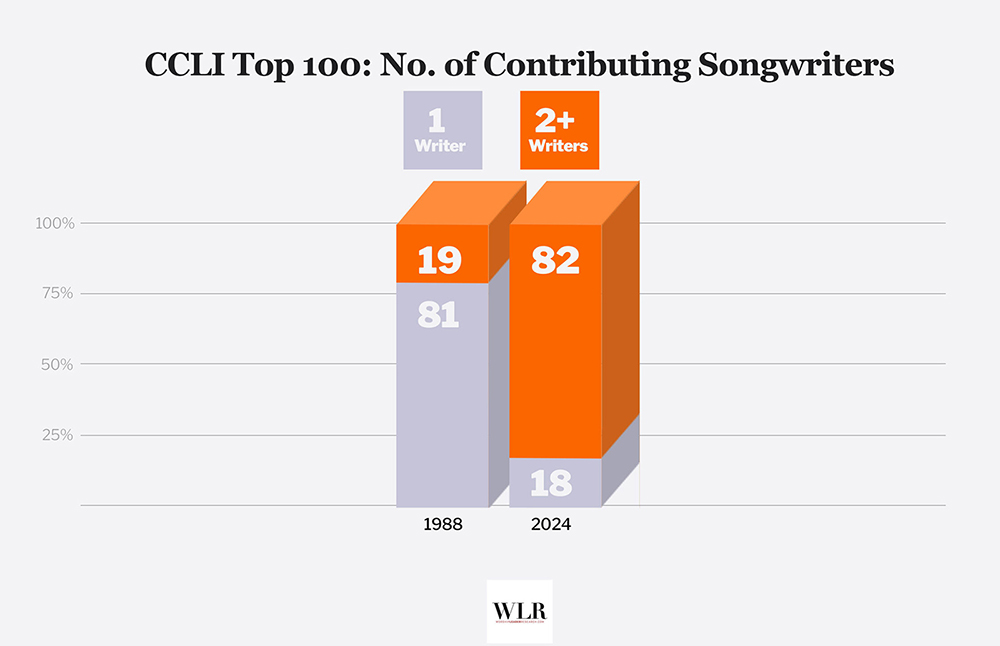
An academic song tracking effort, Worship Leader Research, wrote in a new report that 82 percent of the songs on the CCLI Top 100 in 2024 had at least two writers. When the CCLI Top 100 chart debuted in 1988, only 19 percent had more than one writer—and most of those were written by the legendary gospel music team of Bill and Gloria Gaither.

The “Praise” co-writers Brown, Barrett, Furtick, Carnes, Moore and Lake, like most of the collaborators on recent Top 25 hits, have ties to the Big Four.

“What started as a large pool of individuals contributing their voices to the contemporary worship soundscape eventually became a collection of interconnected enclaves,” according to the Worship Leader Research report.

Many songwriters largely unknown to worshippers

Many of the most successful worship songs have become more associated with the churches that produced them than the songwriters who wrote them.

Jason Ingram, lead singer of the Christian band One Sonic Society, has co-written the hits “Goodness of God” and “Great Are You Lord” to go with more than a dozen of the songs highlighted in the Worship Leader Research study, but he remains relatively unknown in the public eye.

Other successful Christian songwriters such as Ed Cash, co-writer of “Goodness of God” and “How Great Is Our God,” or Jonas Myrin, who co-wrote “Cornerstone” and “10,000 Reasons” and later went on to write for Barbra Streisand, also have relatively low profiles.

Since many churches don’t use hymnals or print music in bulletins—the lyrics tend to be projected on screens around their sanctuaries—congregations don’t always see the names of writers.

“I think the reason why Jason Ingram isn’t considered a household name in general is—especially if you’re a congregant and never even looking at a chord chart—you’ll never see his name, even though he’s around,” said Shannan Baker, a postdoctoral fellow at Baylor University and member of the Worship Leader Research team.

Marc Jolicoeur, a worship pastor from New Brunswick, Canada, and member of the research team, theorizes co-writing is more liable to transform a songwriter’s solo inspiration into something that feels accessible for congregations. He cited a writer’s saying that one should write with the door closed, but rewrite with the door open.

“There’s the idea that many hands won’t just make light work but will make work that might rise to the top,” he said, adding writers often show up to co-writing sessions with works in progress that just need a bit of help to work.

The presence of a well-known co-writer also may help a worship song get more notice, Baker said. She pointed to the ongoing popularity of “Great Are You Lord,” by David Leonard and Leslie Jordan, both of the band All Sons and Daughters, and Ingram.

“I think that song, in and of itself, is a perfect example of the power of a career songwriter, elevating a song,” she said. “All Sons and Daughters had a following, but the minute you add Jason Ingram into that mix, they have a hit.”

Brown, who helps produce Elevation’s worship songs, said he had great respect for past songwriters who wrote on their own, but he appreciates the chance to collaborate with friends and fellow writers. The church, he said, has helped create an environment where that can flourish.

Brown said that’s in large part because the church—and not an outside music label—controls the creative process. If a song or an album is not ready, the church isn’t under pressure to release it.

“We are our own label, so to speak,” he said. “It’s always been that creativity is king.”

Doing the songwriting at the church rather than in a Nashville writing room helps as well, he added. Brown said he doesn’t mean to knock Nashville, which is a hub of songwriting, but said the feel of the church’s writing room is more hospitable and more open to inspiration.

“We worked hard through the years to create an environment where the goal is to go away having enjoyed this day together, feel spent and hopefully inspired,” he said.

In co-writing, Brown said he often learns from others—how they create melodies or find the right cadence to the lyrics or just the right words to make a song better.

“If I partner with someone else creatively or with several other people, there’s a chance it can turn into something even greater—or go in a way that I never saw it going,” he said. “Not to over-spiritualize it, but I think it’s cool to acknowledge that we need each other.”

And in the process, something unexpected may appear.


Bill Arnold nominee for BGCT secretary of the corporation

Bill Arnold, who led the Texas Baptist Missions Foundation more than three and a half decades, will be nominated for the Baptist General Convention of Texas secretary of the corporation.

Steve Vernon, director of church relations at the University of Mary Hardin-Baylor, announced his plans to nominate Arnold at Texas Baptists’ annual meeting in Waco, Nov. 10-12.

Arnold “carries the credentials applicable to the position,” said Vernon, who worked 11 years as associate executive director of Texas Baptists.

Arnold served four decades on the BGCT staff, including 36 years as president of the Texas Baptist Missions Foundation.

“Nobody knows the convention better than Bill Arnold,” Vernon said. “He knows the ins and outs of the BGCT. Bill has the expertise and experience to do the job.”

If elected, Arnold will fill a post occupied for two decades by the late Bernie Spooner, who Arnold nominated for secretary of the corporation on several occasions.

“I have great admiration for Bernie and for all his work on behalf of the convention and local churches. It would be an honor to follow him as secretary of the corporation,” he said.

Decades of experience in BGCT life

Arnold noted he has attended more than 50 consecutive BGCT annual meetings and spent most of his career serving Texas Baptists.

“I appreciate what the BGCT does and see this position as a good way to serve after retiring,” he said.

Arnold spent his early years at a small town in northern Mississippi until his family moved to Memphis, Tenn. He earned his undergraduate degree in economics at Mississippi College and a master’s degree in religious education from Southwestern Baptist Theological Seminary.

After he graduated from seminary, he served as minister of youth at Willow Meadows Baptist Church in Houston. He went on to work seven years at Dallas Baptist Association before joining the BGCT staff, initially serving in the Sunday School Division.

As part of the Mission Texas emphasis in the mid-1980s—a five-year effort to begin 2,000 new churches in the state—Arnold worked on a fundraising effort to triple giving to state missions two consecutive years.

That effort gave birth to the Texas Baptist Missions Foundation, and Arnold served as its founding president.

Under his leadership, the foundation raised more than $180 million to support missions and ministries, including the construction of Baptist Student Ministry buildings on five university campuses.

Arnold and his wife Margaret have two adult children and four grandsons.


Obituary: Floyd Allen Craig

Floyd Allen Craig of Franklin, Tenn., who influenced and encouraged an entire generation of Baptist communicators, died Aug. 30 in Nashville. He was 91. Born in Oklahoma City on Feb. 25, 1933 to Bonnie and Floyd M. Craig as the oldest son of a Baptist preacher, Craig was a graduate of Oklahoma Baptist University and Southwestern Baptist Theological Seminary. OBU recognized him with its Outstanding Alumni Award in 1981. He served two churches as pastor during his student years in college and seminary, and he worked as assistant director of public relations at Southwestern Seminary following his graduation. As a marketing and public relations professional, Craig’s experience ranged from creating and implementing fundraising campaigns to the design, development and conducting of statewide communications programs for state, regional and national denominational and nonprofit organizations. Anyone who met Craig invariably was told at some point: “You are significant. God made you that way.” And because he said it, the person who received that word of encouragement believed it. Craig was director of communications for the Baptist General Convention of Oklahoma from 1962 to 1967. From 1967 to 1979, he was public relations and communications director of the Southern Baptist Convention’s Christian Life Commission. During James B. Hunt Jr.’s two terms as governor of North Carolina, he was deputy director of the Governor’s Office for Citizen Affairs and ombudsman. He was president of Craig Communications Inc., founded in 1981 with his wife Anne. Together with Anne and veteran journalist Dan Martin, he was instrumental in the founding of Associated Baptist Press, predecessor organization to Baptist News Global, in 1990. He wrote 10 books on communications, marketing and crisis management. He was preceded in death by his brother Gene Craig of Garland. He is survived by his wife of 68 and a half years Anne of Franklin; sister Doris Floyd and husband Roy of Oklahoma City; sister-in-law Linda Craig of Garland; son Paul and wife Dorothy of Nashville; daughter Suzanne and husband Alan of Nashville; four grandchildren; and three great-grandchildren.


Obituary: Jo Alice “Jody” Darden

Jo Alice “Jody” Darden, a former employee of the Southern Baptist Convention’s Radio & Television Commission, died Aug. 23. She was 95. “Jody” Darden was born in Rotan on Jan. 6, 1929, to George Edward Darden and Nora Iness Connelly Darden. She graduated from Hardin-Simmons University in 1950 with a bachelor’s degree in business administration. Not long after college, she and her lifelong friend Mabel Jo Wells served as civilian employees with the U.S. Army Air Corps, during which time they lived in London, England, for a year. Upon return to the United States, she began working for the Western Company, first in Midland and later in Fort Worth. Once she was hired by the SBC Radio & Television Commission, she served as an executive in the office of vice president of production. She later worked for Fort Worth oilman and philanthropist Howard Walsh as a director in his philanthropic endeavors. After retiring, she started a financial services business, assisting elderly individuals with their bills and financial concerns. She was a longtime member of Travis Avenue Baptist Church in Fort Worth. Later, when she and Mabel moved to North Richland Hills, they eventually became faithful members of North Fort Worth Baptist Church. She served on the pulpit committee and the personnel committee, and she often took on other leadership roles. The heart and soul of her service to North Fort Worth Baptist Church was the children’s ministry, where she and Mabel served in the nursery for as long as she was physically able. She also served on the board of the Christian Education Commission of the Baptist General Convention of Texas. She was preceded in death by her sisters Alline Northrop and Lilian Pearston, brother Cecil Darden, niece Joyce Huffman, great-niece Jill Elaine Huffman Nettles, and her exceptional lifelong friend, Mabel Wells. She is survived by her three nieces, Mary Northrop Risely, Cheryl Darden Carlson and Janice Darden Jameson; and by four nephews, Alton Northrop, Bill Northrop, Daniel Northrop and Richard James Pearston. A memorial service is scheduled at 2 p.m. on Sept. 7 at North Fort Worth Baptist Church.


Nicaraguan government cancels religious organizations

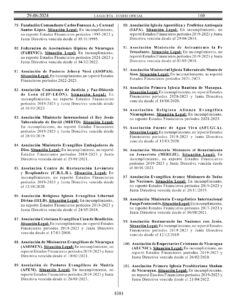
Primera Iglesia Bautista of Managua is among more than 90 religiously oriented civil organizations that had their legal status revoked by the Nicaraguan government last week.

Primera Iglesia Bautista of Managua appears as No. 93 on a list of nongovernmental organizations whose legal status was revoked by the Nicaraguan government.

Nicaragua’s Ministry of the Interior published a list Aug. 29 of 169 nongovernmental organizations—including 92 religiously affiliated organizations—whose legal status was cancelled.

However, the church’s Facebook page included a video of its Sept. 1 worship service, casting some doubt on what the change in legal status means for the church—at least in terms of  religious assemblies, if not its community-oriented ministries.

A representative for Christian Solidarity Worldwide, a United Kingdom-based human rights organization, said the Nicaraguan government apparently has allowed many organizations on the published list to remain open while negotiating ways for them regain legal status—likely by submitting to “much more intrusive oversight” of their day-to-day affairs, activities and finances.

The revocation of legal status for 169 NGOs followed on the heels of an earlier government action, cancelling the legal status of 1,500 nonprofit organizations. Since 2018, Nicaragua President Daniel Ortega and Vice President Rosario Murillo have revoked the legal status of more than 5,500 organizations, Christian Solidarity Worldwide reported.

The government announced all property—land, buildings and furnishings—associated with the organizations whose legal status was cancelled will be transferred to the government.

Repression expanded to include Protestant groups

Previously, the government cancellations of religious organizations’ legal status focused on the Roman Catholic Church in areas where church leaders spoke out against human rights violations by the government.

The latest round of cancellations expanded to include Protestant and evangelical organizations, along with other nonprofits that have not been as politically vocal.

Organizations that had legal status revoked included the Nicaraguan Evangelical Alliance and the Latino-Islamic Cultural Association, along with “scores of Protestant churches,” Christian Solidarity Worldwide reported.

Protestant denominations affected included the Episcopal Church of Nicaragua, the Moravian Church of Nicaragua and the Christian Reformed Church of Nicaragua.

Even before the latest governmental actions, the U.S. Commission on International Religious Freedom condemned the Ortega-Murillo administration for “severely deteriorating religious freedom conditions in Nicaragua.”

In a report released June 28, the commission stated: “Nicaragua’s government continues to repress the Catholic Church for its human rights advocacy by arbitrarily arresting, imprisoning and exiling clergy and laypeople and shuttering and seizing the property of Catholic charitable and educational organizations.

“As Ortega and Murillo seek to maintain their hold on power, the authorities have been using similar tactics to oppress Protestant denominations.”

The commission noted the Nicaraguan government has “resisted any international scrutiny of their religious freedom violations including by withdrawing from the Organization of American States (OAS), expelling OAS staff from its territory, and refusing to cooperate with the United Nation Group of Human Rights Experts on Nicaragua.”

In its 2024 annual report, the U.S. Commission on International Religious Freedom recommended the U.S. Department of State again designate Nicaragua as a County of Particular Concern for “engaging in systematic, ongoing and egregious violations of religious freedom.”

Concerns about impact on social fabric

Christian Solidarity Worldwide repeatedly has condemned the Nicaraguan government for its actions—including the most-recent revocation of legal status for nongovernmental organizations.

“Once again, CSW strongly condemns the Nicaraguan government’s arbitrary cancellation of the legal status of another 169 independent civil society organizations. We call on the international community to do the same,” said Anna Lee Stangl, the organization’s head of advocacy.

“The arbitrary cancellation of historic and diverse religious associations is, in many cases, leaving their members with nowhere to gather for religious purposes, but they are not the only people who will be affected.

“We are also highly concerned about the impact on the thousands of children and adults who interacted with the schools, and other institutions—like hospitals—run by these organizations. Many of the affected associations form a key part of the social fabric and culture of their locales.”

For example, Baptists in Nicaragua operate one of the top-ranked hospitals in the country, a seminary and schools that serve thousands of children.

“We continue to stand in solidarity with those who have dedicated their lives to the improvement of their communities only to see it all arbitrarily taken away by a totalitarian government interested only in its own survival,” Stangl said.

EDITOR’S NOTE: After this article originally was published Sept. 4, Christian Solidarity Worldwide provided this additional information from a confidential source: “While the First Baptist Church of Managua has been permitted to remain open and carry on with its activities despite the legal cancellation, its bank accounts were frozen, and they are no longer allowed to receive funds from outside Nicaragua. The source noted that a conservatory belonging to the Baptist Convention was confiscated by the government when they confiscated the Polytechnic University (which was affiliated with the Baptists) a few years ago.”


On the Move: Brosette, Colston

Chris Brosette to First Baptist Church in Colorado City as minister of youth and children.

Alicia Colston to South Garland Baptist Church as worship leader, from Church on the Hill in Mesquite where she was director of worship ministry.


Suburban D.C. county most religiously diverse in 2023

WASHINGTON (RNS)—Montgomery County, Md., a suburb of Washington, D.C., was the most religiously diverse county in the United States last year, according to a census released Aug. 29 by the Public Religion Research Institute.

When the institute conducted a similar study in 2020, Montgomery County came in third behind the New York City boroughs of Brooklyn and Queens. In 2023 those boroughs were relegated to second and 10th, respectively.

PRRI’s Census of American Religion, which focuses on U.S. adults age 18 and over, calculates religious diversity by analyzing 18 different religious and racial groups in counties with more than 10,000 residents.

In the index used to rank counties, 1 signifies complete diversity, where every religious group is of equal size, whereas 0 signifies a homogenous religious population. Montgomery County received a score of 0.886.

Montgomery County, with a population of more than a million, is significantly more educated and wealthier than the U.S. average. One in six county residents has a bachelor’s degree or higher, and the median household income is $118,323. Voters go heavily blue, with 78.6 percent having supported Joe Biden in the 2020 presidential election.

The county is home to many federal government agencies, including the National Institutes of Health, the U.S. Food and Drug Administration and Walter Reed Military Medical Center and Army Institute of Research. It is also home to at least one Supreme Court justice, Brett Kavanaugh.

High concentration of religious minority groups

Only 56.8 percent of county residents speak English at home, with Spanish (17.2 percent), other Indo-European languages (10.3 percent) and Asian and Pacific Island languages (9.8 percent) most commonly spoken.

Beyond the religiously unaffiliated, who represent slightly less than 2 in 10 (17.8 percent) residents, the largest religious group in the county was Black Protestants, who make up 10 percent of the population.

Christians overall made up about 60 percent of the population, with other large Christian groups including white mainline/non-evangelical Protestants (9.6 percent), Hispanic Catholics (7.7 percent), white Catholics (7.4 percent), Hispanic Protestants (6.9 percent) and white evangelical Protestants (5.4 percent).

In most of the top-10 religiously diverse counties, the religious groups with the greatest representation are the religiously unaffiliated, but in Nassau County, N.Y., (20.6 percent) and Montgomery County, Penn., (19.8 percent), white Catholics were the largest religious group. Nassau County, part of Long Island, came in third, and Montgomery County, a Philadelphia suburb, came in fourth.

Montgomery County, Md., the most religiously diverse county, was among the top 10 counties in the country with the highest concentration of several minority religious groups.

Montgomery County, Md., has:

  • The second-highest concentration of Orthodox Christians, who make up 2 percent of the population.
  • The third-highest concentration of Hindus, who make up 2.7 percent of the population.
  • The fourth-highest concentration of Jews, who make up 9.3 percent of the population.
  • The fourth-highest concentration of Muslims, who make up 3.2 percent of the population.
  • The fifth-highest concentration of Buddhists, who make up 2.7 percent of the population.
  • The fifth-highest concentration of Unitarian Universalists, who make up 1.3 percent of the population.

While PRRI does not separate Seventh-day Adventists as one of their 18 religious categories, the group has a significant presence in Montgomery County. The county is home to Washington Adventist University, and Adventist HealthCare is a major employer in the county.

Throughout 2023, the county experienced religious conflict related to LGBTQ learning content in the public school system.

In May of that year, Muslim, Catholic and Orthodox Christian parents began a legal challenge to the public school system’s decision to prohibit parents from opting their children out of lessons on books with LGBTQ characters, a decision also opposed by Moms for Liberty, the Council on American-Islamic Relations and Montgomery County Muslim Council.

So far, both a U.S. District Court judge and the 4th U.S. Circuit Court of Appeals have dismissed the request. The Becket Fund for Religious Liberty, which is representing the plaintiffs, has indicated it intends to appeal the ruling.

In December 2023, a Muslim middle-school teacher in the public school system also filed a religious discrimination complaint with the Equal Employment Opportunity Commission after she was placed on administrative leave because she used “From the river to the sea, Palestine will be free” in her email signature. The Council on American-Islamic Relations Legal Defense Fund is supporting her complaint.


Ohio State football players lead on-campus baptism service

More than 60 students were baptized during a special on-campus service at Ohio State University on Aug. 26.

A group of Buckeye players were among those who helped lead the event, which reportedly attracted a crowd of more than 800 people.

“Witnessed the ‘Invitation to Jesus’ in person last night led by several players from @OhioStateFB team,” said Jeremy Westbrook, executive director-treasurer of the State Convention of Baptists in Ohio, on the social media platform X.

“Over 60 students stood to profess Christ & follow in baptism!! Had the joy of passing out hundreds of Bibles to those who desired to read who Jesus really is!! Let’s go!!”

The Lantern student newspaper reported, “Four tub-sized buckets of water sat near a stage, on which football players stood to deliver testimonies. Over the next nearly two hours, the crowd grew to over 800 people.”

Ohio State football players who were among those leading the baptism service were TreVeyon Henderson, Emeka Egbuka and J.T. Tuimoloau, according to WSYX ABC 6.

A university spokesman told ABC 6 the service was “not an official football team event” and that Revive Student Organization reserved space for the event.

One parent posted on social media: “The most incredible night I have experienced in a longggg time! God is moving on The Ohio State campus! So many came and were touched by God! So many were baptized! Watching over 2000 students worshipping…an Unbelievable experience! Our boys are changing lives! #ProudMama.”