Singer discovers redemption, restoration in Christ

NASHVILLE, Tenn.—As singer/songwriter Heather Williams shares about the redemption and restoration she found in a relationship with Christ, she displays character and strength far beyond her years.

During her childhood, Williams dealt with extreme poverty and intense abuse from her mother and stepfather. One time, she even was chained to a tree as a punishment.

Singer/songwriter Heather Williams

At age 11, Williams' mother sent her away, and she began living with her grandfather. While dealing with the traumatic effects of abuse, neglect and rejection, Williams turned to drugs and alcohol to numb the pain during her teenage years. At times, she contemplated suicide.

Just before her life was about to spin completely out of control, Williams found redemption, unconditional love and a Savior while reconnecting with her birth father and accepting an invitation to attend a worship service.

Realizing she reached rock bottom, Williams surrendered her life to Christ.

"When I was 18, I was going through a whole series of events where I was really rejecting God and blaming him for everything that had taken place in my childhood," Williams said. "But I finally came to a point where I decided that I was going to give my life to God, because I was running out of options to survive."

While undergoing a radical life change, she began pursuing music as an outlet to share her experiences. As she was getting her life back on track, Williams fell in love and got married. Tragically, the young couple encountered heartache and grief when their 6-month-old firstborn son suddenly died.

In the midst of their pain, she wrote the words to the hit song, "Hallelujah."

"I believe that God took a moment where I was desperately crying out to him and translated it into this powerful song that people can relate to," Williams said.

"Everyone has that moment where they have nowhere else to turn, except desperately seeking God's comfort and guidance. This song offers people hope in dark situations by reminding them that God is very near to them."

Reflecting on her journey through the years, Williams is grateful for how far God's grace has brought her.

"Everything that I've lived through, I have tried to translate into music—to somehow be able to tell the story of hope and redemption that Jesus Christ has brought me and how he can bring the same to anyone else," she said.


CBF chaplains see gains

(ABP)–Last year, Cooperative Baptist Fellowship chaplains arose at the General Assembly in Tampa to demand a more prominent seat at the table of denominational life.

In a Thursday workshop at this year's assembly, some of those leaders said that goal has largely been accomplished, but still complained about the perception of chaplains among other pastors and Christians as a whole.

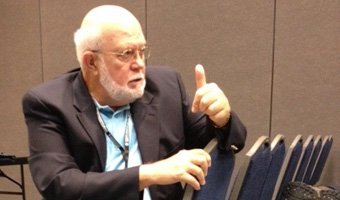
James Pope discusses chaplaincy during a workshop at the CBF General Assembly in Fort Worth.

Many have to be reminded that "we are not 'clergy lite,'" said James Pope, associate for military ministry for CBF, and a retired Navy captain and chaplain.

Addressing about 30 chaplains, including 10 in military uniforms, Pope and Randy Gardner said chaplains are in the best position ever in CBF.

They are being featured more often in denominational communications and are growing in numbers.

Pope estimated there are more than 600 endorsed CBF chaplains today compared to about half that number a decade ago.

Gardner, the outgoing chairman of the CBF council on chaplain endorsement, said the group is also enjoying more recognition since last year's assembly.

"We're being noticed, and that's as it should be," Gardner said.

But that isn't always the case among other ministers, either in Baptist or wider Christian circles, Pope said. Many see chaplains as ministers who couldn't cut it as pulpit pastors.

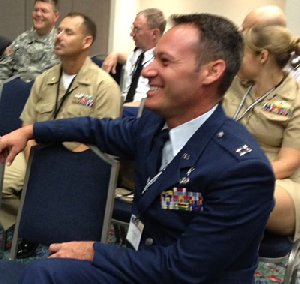
Air Force Capt. Charles Seligman participates in a discussion about military chaplaincy at the CBF General Assembly in Fort Worth.

Those comments hit home for Tim Hunter, a prison chaplain for 11 years with the Texas Department of Corrections. When Hunter left church ministry for chaplaincy, he recalls, "it was 'Oh, you left the ministry.'"

A balm for the resulting frustration is getting together with other chaplains at events like the chaplaincy workshops at assembly, Hunter said.

The workshop addressed practical issues for the participants. Gardner held a break-out with hospice, hospital and law enforcement chaplains while Pope held a listening session with the Air Force, Army and Navy chaplains.

Air Force Capt. Charles Seligman said Pope functions as his pastor through regular phone and email communication. He also can confide in other chaplains. Being at Thursday's workshop was also a big stress reliever, he said.

"Chaplains — we chaplain each other," he said.


CBF to vote on identity plan

The Cooperative Baptist Fellowship votes June 22 on a new model for identity, governance and financial support intended to guide the moderate Baptist group formed in 1991 for the next 20 years.

2012 Task Force report seeks to make Cooperative Baptist Fellowship live up to its name.

The recommendations are result of a two-year study that included more than 100 listening sessions conducted by a blue-ribbon 2012 Task Force chaired by Alabama pastor David Hull.

“You have spoken. We have listened,” Hull, pastor of First Baptist Church of Huntsville, Ala., said in a presentation Thursday morning. “Together we have tried to imagine a future of life and vitality for Cooperative Baptists.”

The new plan seeks to pull together a myriad of national, state and regional CBF organizations into “a seamless cooperating community,” while doing a better job of sharing resources that already exist and reducing duplication of effort among CBF and partner organizations.

“Our future lives in our ability to live into our name,” Hull said. “We are cooperative Baptists.”

It also for the first time suggests a way for churches desiring to identify publicly with CBF mission and values to do so beyond financial contributions.

“Congregations may embrace their identity by sending a letter that outlines the details of their partnership with CBF,” the report recommends. Such a letter might list or describe ways the congregation participates in CBF, including but not limited to affirming its identity, values and mission; praying for CBF; including CBF ministries – state/regional and/or national – in church budgets; promoting and collecting the Global Missions Offering; participating in regional or national CBF ministries and attending their state or national General Assembly.

During a business breakout session, that section of the report was amended to clarify grammatically the intent is not to force the issue of CBF affiliation within churches where it might be divisive.

Hull said the task force heard from many churches requesting a way to highlight their CBF identity above and beyond giving money.

“There is nothing required by this at all,” Hull said. “Some churches said, ‘Give us a way to identify with CBF apart from just sending money to you.’ Many churches will choose not to do this. That’s fine. This is for churches who want to say in a public sense, ‘This is who we are.’”

The new plan also calls for more communication in the process of developing budgets for state/regional and national CBF organizations. Currently the budgets for various CBF entities are developed separately, sometimes with little or no communication between the two. The new plan recommends that regional and national bodies negotiate cooperative agreements about not only division of funds but also responsibilities for ministry resources.

“We heard a desire that the CBF be more seamless,” said task force member Ray Higgins. Higgins, coordinator for Arkansas CBF, said one supportive pastor put it this way: “Should I give my offering to Daniel or Ray?’ referring to national CBF executive coordinator Daniel Vestal.

Connie McNeill, task force member and coordinator of administration for the CBF Atlanta staff, said the plan affirms both the national organization’s role in missionary and resource work and the geographical proximity offered in the state and regional CBFs.

The plan will “create a process for national, state and regional organizations to work together more closely, while respecting the autonomy and uniqueness of each,” she said.

Ruth Perkins Lee, vice chair of the 2012 Task Force, said while much attention the last few years has been on budget shortfalls at the national level, the listening sessions actually revealed an abundance of resources that aren’t being fully tapped.

She called for “a paradigm shift that recognizes we are the best resources CBF has.”

“We have done great things together, and we can do infinitely more,” said Lee, minister of students at Auburn First Baptist Church in Auburn, Ala.

Many questions raised in the breakout session about the proposal won’t be answered until a separate implementation phase. Governance changes including reducing the size of and renaming the Coordinating Council and creating new and more task-focused bodies for missions and church resources will require constitutional changes that must be approved by due process.

Keith Herron, the incoming CBF moderator who assumes the gavel at the end of this week’s General Assembly, said nothing will change dramatically when the clock strikes midnight if the document is approved Friday, but he would work within the current system in anticipation of changes that would take effect in the future.

“We see this next year as being very transitional, organizing Coordinating Council members as we have done, but transitioning toward the new model,” said Herron, pastor of Holmeswood Baptist Church in Kansas City, Mo.


Baptist leaders in London prepare for Olympics

LONDON—When Doug Shaw stands on the hill just outside Olympic Park in London, he can barely hear himself think.

Construction buzzes and roars in preparation for the Summer Olympic Games, which start July 27. The work's been going strong for years. Shaw can relate. He hasn't stopped in ages, either.

As Olympics volunteer coordinator for Southern Baptists' International Mission Board, he's been in motion for months preparing Baptists to meet the tens of thousands of sports fans coming to the United Kingdom this summer.

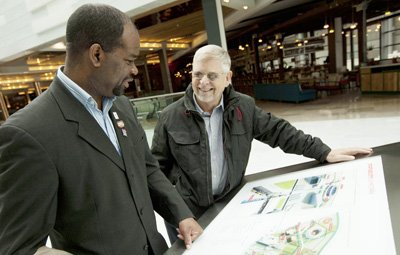
David Pile (left) of the London Baptist Association and Doug Shaw of the IMB chat over a diagram of the Olympic Park in London's Stratford area. Pile and Shaw have been working for months on strategy and volunteer coordination for ministry during the 2012 Summer Olympics in London. (BP PHOTO/International Mission Board)

"We are praying that many people from all over the world who may not have an opportunity to hear or respond to the gospel without being persecuted by their neighbors might have that opportunity while they're here in London," Shaw said.

David Pile shares that hope. He and others are praying "that there will be lots of local events and lots of community engagement, and we'll be able to share and shine the love of Jesus with a bunch of people that we otherwise wouldn't have come in contact with," said Pile, Olympic and Paralympic church engagement coordinator for the London Baptist Association.

Shaw expects the help of about 400 Baptist volunteers from the United States, and Pile anticipates the parti-cipation of hundreds of churches in England.

Volunteers will help with festivals, face painting, distributing water and a range of other tasks. Some will assist churches in hosting big-screen events in parks, and sports teams will help with basketball and baseball events in neighborhoods around churches.

All these efforts fall under the banner of More Than Gold, a joint effort of Christian churches of many denominations worldwide. More Than Gold helps Christians collaborate for ministry during major international sporting events such as the Olympics or the World Cup.

And its most famous ministry—pin trading—will be in full force during the 2012 games.

"Pin trading is the biggest of the unofficial Olympic sports," Shaw said, noting thousands participate in the hobby.

Volunteers trade a More Than Gold pin that helps start gospel conversations in the area surrounding the Olympic Park, where blatant evangelism is not allowed, Shaw said.

"During the Olympics, you won't be able to do literature distribution or any kind of obvious evangelism within a mile of any of the venues in London or anywhere else in the U.K. These areas are closed off to direct evangelism," he said.

But pin trading is a traditional part of the Olympics atmosphere. And, Shaw said, "There's nothing wrong with talking with people."

Many local Baptists also are participating with a "big silent Christian witness" during the games, serving as official Olympic volunteers, or "Games Makers," Pile said. These volunteers serve as chaplains, drivers and part of the field setup crew and in a range of other roles.

"They would have had to apply two or three years ago for these kinds of roles, but they will put them in direct contact with athletes and other people involved in the games," Pile said.

Christian families in the U.K. also are opening their homes to the families of athletes during the Olympics.

Many athletes don't find out until the last minute they have qualified for the games, Shaw explained. And "many families come from places where a week in London would be prohibitively expensive, even in normal times," he explained.

Relationships built between host and visiting families often last well beyond the Olympics, he said.

Pile expressed thanks to Baptists in the United States for their long history of help during the Olympics.

"People have saved up money, taken time off work, come over here, with prayer support from their home church and have supported us in our historic moment so that the glory of Jesus can be shared with as many people as possible," he said.

For hopeful volunteers late jumping on the bandwagon, opportunities to serve in the U.K. still are available, but they "will come at a premium" for anyone who isn't local, Shaw said. He noted most mid-range hotels in the London area are fully booked.

He and Pile are asking for prayer support—and for potential volunteers to consider planning to serve at the 2016 games in Rio de Janeiro.

Abel Santos, a Brazilian Baptist, is spending this year in England with More Than Gold to learn how it works and take the ministry back to Brazil for three back-to-back events—the Confederations Cup in 2013, the World Cup in 2014 and the Summer Olympics in 2016.

"It would be great to have people coming in from the States to help us with missions teams and sports events," Santos said.

For more information, visit morethangold.org.uk.


Pray for Olympic athletes by name

As Athletes in Action prepares for multiple outreach opportunities during the 2012 London Olympic Games, the organization not only has requested general prayer for the Road2London Olympic Project, but also has begun enlisting prayer partners to pray for athletes by name.

Tourists in the background snap photos of Olympic Park from a viewing deck in Westfield Shopping Centre. The viewing deck, along with the shop selling Olympics souvenirs such as the stuffed mascot Wenlock, was built especially for the 2012 Olympics. (BP PHOTO/International Mission Board)

"I wanted to break it down into specific names that we can send to a person," said John Klein, coordinator for this year's Olympic project. "Ideally, we would have about four people to pray for daily."

About 12,000 athletes competed at the last Olympics, and if the same number participate in London, Athletes in Action will need 3,000 people to handle the prayer duties at four athletes each, Klein said. With the games beginning July 27, the organization hopes to have all the partners in place by mid-July with names assigned.

Prayer partners will receive the names of athletes, the country and sport in which they are competing and any other pertinent information that might help them pray specifically. Bible verses and specific dates of competition will help provide focus to prayer efforts.

In addition to the thousands praying for Olympic athletes by name, Athletes in Action will deploy about 180 people at the London Games, ministering at the Olympic Village as chaplains or in other ministry roles throughout the competition venues and surrounding community.

To participate as an Olympic prayer partner, either:

• Log onto the AIA Facebook Page at www.facebook.com/athletesinaction and enter as "Going" to the event called "Olympic Prayer Partners."

• Visit the AIA Website http://olympics.athletesinaction.org and click on the "Prayer Strategy" box.

• Email prayer@athletesinaction.org.


Catholic, mainline churches losing great proportion of childhood adherents

WASHINGTON (RNS)—A growing tide of young Americans is ebbing away from the religions of their childhood, and most are ending up in no religion at all.

One in four young adults choose "unaffiliated" when asked about their religion, according to a new report from the Public Religion Research Institute and Georgetown University's Berkley Center for Religion, Peace & World Affairs.

But most within this unaffiliated group—55 percent—identified with a religious group when they were younger.

"These younger unaffiliated adults are very nonreligious," said Daniel Cox, the institute's research director. "They demonstrate much lower levels of religiosity than we see in the general population," including participation in religious rituals or worship services.

Some will return to their faiths as they age, "but there's not a lot of evidence that most will come back," added Cox, who said the trend away from organized religion dates back to the early 1990s.

The study of 2,013 Americans ages 18-24 focused on the younger end of the cohort commonly known as the "millennials" or "Generation Y," which generally includes young adults as old as 29. Interviews were conducted between March 7 and 20.

Across denominations, the net losses were uneven, with Catholics losing the highest proportion of childhood adherents—nearly 8 percent—followed by white mainline Protestant traditions, which lost 5 percent.

Among Catholics, whites were twice as likely as Hispanics to say they are no longer affiliated with the church.

White evangelical and black denominations fared better, with a net loss of about 1 percent. Non-Christian groups posted a modest 1 percent net increase in followers.

But the only group that saw significant growth between childhood and young adulthood was the unaffiliated—a jump from 11 percent to 25 percent.

The study also posed a wide range of questions to the group, from their views on the Tea Party to labor unions to same-sex marriage.

It also delved into more philosophical territory, questioning whether younger millennials' moral views are more universal (there is always a right and wrong) or contextual (it depends on the situation).

The researchers found a morally divided generation, with 50 percent of respondents placing themselves in the contextual category and 45 percent believing in universal rights and wrongs.

Answers to questions on the nature of morality varied widely depending on political party affiliation, education and religion, with the most dramatic differences correlating with religion.

An overwhelming majority of white evangelical Protestants (68 percent) said they believe some things always are wrong, compared to 49 percent of black Protestants, 45 percent of Catholics and 35 percent of the unaffiliated.

More specifically, on social issues such as abortion and same-sex marriage, younger millennials hardly think as a group.

"We see some really stark divides," said Cox, which he said belies the conventional wisdom that bills this as the "Kumbaya" generation, in which everyone understands each other and gets along.

"It's something to watch as these folks start moving through society and start to vote regularly," he said.

Specifically:

• A sweeping majority of the religiously unaffiliated (82 percent) said abortion should be legal in all or most cases. More than two-thirds of religiously affiliated non-Christians agreed.

• White evangelical Protestants were most opposed to abortion, with nearly 9 in 10 (88 percent) saying it should be illegal in all or most cases. Among Latino Protestants, 71 percent shared this belief. Catholics were more divided, with 48 percent saying abortion should mostly be legal and 51 percent disagreeing.

• On same-sex marriage, nearly six in 10 younger millennials (59 percent) approved, with distinctions among religious groups generally mirroring those on abortion.


Interfaith relations focus on friendship, pastors say

JACKSONVILLE, Fla. (ABP)—Interfaith dialogue is on the rise—not just in formal conversations led by religious leaders, but also in local communities where friendships form as ministers of various faiths work together for common goals amid increasing religious diversity in the Bible belt.

Imam Joe Bradford (left) and Pastor Kyle Reese share a light moment at Hendricks Avenue Baptist Church in Jacksonville, Fla. Reese counts Bradford–along with a local rabbi and Greek Orthodox priest–among his best friends. (ABP PHOTO/Jeff Brumley)

Kyle Reese, pastor at Hendricks Avenue Baptist Church in Jacksonville, Fla., has been front-and-center in community interfaith efforts, especially in his dialogue with Muslim and Jewish spiritual leaders. He refers to Imam Joe Bradford as "best friend"—as he does a rabbi and an Orthodox Christian priest.

Steve Jones, who worked with Jews and Muslims to tackle social injustice in Birmingham, Ala., said the same about Rabbi Jonathan Miller. "I am closer to these guys than I am with many other Baptist ministers," said Jones, pastor of Southside Baptist Church.

The emergence of a more grassroots, relational interfaith movement can be attributed to 9/11 and its aftermath, said Antonios Kireopoulos, who oversees interfaith issues for the New York-based National Council of Churches.

The attacks generated both suspicion and curiosity about Islam that raised interest in dialogue "10, 20 and 100 fold," he said. He noted a growing "Baptist-Muslim dialogue" in the form of pulpit swaps and practical alliances on local issues.

Mitch Randall, pastor of NorthHaven Church, a Baptist General Convention of Texas-affiliated congregation in Norman, Okla., is among the participants. Randall noted he once had little use for the historic interfaith model and its focus mostly on annual prayer breakfasts or worship services. All that changed shortly after 9/11, when a motorist gave him a rude gesture.

"I'm a quarter Native American and fairly dark-skinned, and he probably mistook me for a Middle Eastern individual," Randall reported. "I thought, 'What must that feel like for people who truly are Muslims?'"

The result was "a quest to befriend people who are Muslim … to break down those barriers and stereotypes." He since has developed friendships with Muslim religious leaders in Oklahoma.

"We began doing things together," Randall said, "like feeding the poor or working on immigration issues."

But the interfaith movement isn't out of the woods yet.

"That word still scares a lot of people," said Paul Chaffee, founder and editor of TheInterfaithObserver.org, based in California. Many Christian conservatives see interreligious communication as an effort to blend all faiths into one.

However, Chaffee said, even some conservative evangelicals have seen the value of working with conservatives of other denominations and faiths on social issues like same-sex marriage and abortion opposition.

Meanwhile, the progress being made in interfaith work slowly is spilling over into ecumenical outreach, which experts say is a more difficult field.

"The closer you get in the family, the more the temperature goes up in the room," said Chaffee, who also serves on the board of the North American Interfaith Network.

Steven Harmon, adjunct professor of Christian theology at Gardner-Webb University, said he's seen that phenomenon first-hand. Ecumenical dialogue "does not have the kind of excitement or urgency there was a few decades ago," he said.

Harmon, who served on a Baptist World Alliance team that held exploratory talks with leaders of the Orthodox Church, said dialogue must focus on more than symbolic and theological meanings.

"Whether it's ecumenical or interfaith, ultimately there needs to be more emphasis on what happens on the grassroots level," he said.

As Chaffee put it: "As soon as you start making friends, it changes everything."

In Jacksonville, Reese said his relationships with Bradford, Rabbi Joshua Lief and Greek Orthodox Priest Nicholas Louh have provided him spiritual and emotional solace.

The four hang out together, gather with their wives for dinner and speak to each others' congregations.

Their friendship became so well known, they were invited to speak on local public radio monthly as "the God Squad."

"We just have such a strong rapport and we can kind of rib each other," Bradford said of the foursome's behavior on and off the air.

Reese often jokes with Bradford about growing up in a Baptist home until he became a Muslim as a teenager.

Reese noted getting to know Bradford and his community has deepened his appreciation for the persecuted, minority origins of the Baptist tradition.

"I would argue that I am a better Christian because I know Joe," said Reese, former pastor of First Baptist Church in San Angelo.

In Birmingham, Jones received complaints about his relationship with the Jewish community and its rabbi. "We were really criticized because we weren't preaching the gospel to them or trying to win them to Christ," he recalled.

For him, however, participation is simply a way of being a good Christian.

"As a Baptist, my idea of evangelism isn't 'winning anyone to Jesus' but being a good neighbor and showing respect," Jones said. "And you can't do that if you don't get together."
Seminary archaeology team makes key find

KARME YOSEF, Israel (BP)—A recent archaeological discovery by a New Orleans Baptist Theological Seminary team never will be displayed in a museum, but it is as significant as many from the Holy Land that fill the finest antiquity halls around the world. And it is much, much larger.

Jim Parker (left) and Dan Warner of New Orleans Baptist Theological Seminary talk to Tsvika Tsuk (right), chief archaeologist at the Israel Nature and Parks Authority, discussing features of the natural cavern at the end of the Gezer Water System in Israel. (BP PHOTO/Gary D. Myers)

The team, under the direction of the seminary's Center for Archaeological Research, located a large open section in a cave at the eastern end of the ancient water system at Tel Gezer in Israel.

The discovery marks a major milestone in the seminary's three-year exploration at Gezer and sets the stage for future research, helping scholars understand the cultural context in which the Bible was written.

The team still plans to locate the water source for the system and explore the entire cave, seeking a possible rear exit and pottery evidence to help date its construction in future digs.

The dig leaders believe the rock-hewn water tunnel was cut by the Canaanite occupants of Gezer between 2000 and 1800 B.C.—around the time of Abraham. Other scholars date the system to the time of the Divided Kingdom after Solomon.

The site is mentioned numerous times in the Bible, including in 1 Kings 9, when the city was given to Solomon by the Egyptian pharaoh. Solomon rebuilt and fortified the city with a massive wall and unique gate system.

The latest discovery could help archeologists date the Tel Gezer water system and understand how it works, which would offer valuable information to students of the Bible.


Funderburk completes 40 years of South Plains College ministry

LEVELLAND—The first person Arlano Funderburk met when he began leading the Baptist Student Union at South Plains College was Debbie Bridges, then student president of the campus ministry.

They sat and talked, getting to know each other and gaining a better understanding of what each believed God wanted to do through the collegiate ministry.

Arlano Funderburk

In the 40 years since then, Funderburk has participated in many similar conversations. Through a one-person-at-a-time approach, he's grown to know multitudes through the Baptist Student Ministries at South Plains College, investing his life in students, faculty and staff.

"I think if you're going to invest in students, there has to be a level of trust. And that's something that has to be earned. It's never an automatic thing," Funderburk said. "I think all of us have to earn it one person at a time."

Funderburk plans to retire in August. But the impact of the conversations and relationships he had with students will continue.

That legacy particularly is strong in interns who have served at the BSM in the last decade. Funderburk devoted hours upon hours to each student, equipping them for leadership. Nearly all went on to attend seminary after serving as an intern with Funderburk.

Ashley Roberts, South Plains BSM's first intern, calls Funderburk "family." They still regularly communicate and see each other. His ability to care about people is amazing, his willingness to trust Christ, inspiring, she said.

"Arlano is one of the most influential people in my life," she said. "He helped broaden my scope of faith. I hope I can trust Jesus as much as Arlano along my journey."

When Funderburk visits with a person, it's like that person is the only person in the room—even in the midst of a busy event such as the BSM's weekly free lunch, Roberts noted.

"It's like he's having that lunch for you, and all those other 200 people just happened to show up," she said.

Corbin Lambeth, an intern last school year, said Funderburk nurtures the interns he serves alongside.

He helps them grow in their faith by encouraging them, challenging them and giving them increasing responsibilities, Lambeth noted. Under Funderburk's tutelage, interns teach, preach and lead mission trips each year.

"When it comes down to it, he focuses on Christ," Lambeth said. "Christ is his true north."

Funderburk's calling from God led him to serve 40 years at South Plains College and to take college students on numerous mission trips through the years.

God's pull on Funderburk's heart also pushed him to serve in Mexico, where he continues to minister regularly, even though it has grown increasingly dangerous in the area.

Bruce McGowan, director of collegiate ministry with the Baptist General Convention of Texas, praised Funderburk's ongoing influence in students' lives. How he has invested his life in the lives of others has carried the gospel far beyond the city limits of Levelland, he observed.

"Arlano will be missed in Texas BSM," McGowan said. "But his legacy will continue through students and former interns. What a blessing Arlano is to all of us who serve college students across the world."

John Pearce, collegiate ministry regional director for the BGCT, marvels at the way Funderburk was able continously to rebuild student leadership at a two-year school.

"He's was one of the most servant-hearted people you've ever met," Pearce said.

"He's fun to be around, in the sense he really cares about the people he works with and spends time with. When you spend time with Arlano, you always feel better."

BGCT Associate Executive Director Steve Vernon, who served as Funderburk's pastor nearly 18 years at First Baptist Church in Levelland, called the BSM director a "campus fixture." School administrators trusted him. Staff trusted him. Most important, students trusted him as he led them to Christ, Vernon said.

"I appreciate that he has lived in a very Christ-like way in all his life," he said. "He has exemplified the presence of Christ."


Faith Digest

Catholic groups file suit. Dozens of Catholic universities, dioceses and other institutions filed lawsuits in courts around the country recently in a coordinated effort, spearheaded by the U.S. hierarchy and Catholic conservatives, to overturn the Obama administration's contraception mandate plan. The 43 plaintiffs, including 13 dioceses and the University of Notre Dame, say the mandate forces religious employers to provide contraceptive and sterilization services to employees that violate their beliefs. They say that infringes on First Amendment religious freedom protections and charge the federal government's exemption for religious organizations is too narrow. The Obama administration and its allies reject those assertions and say a proposed compromise to the mandate effectively bypasses any entanglement in birth control coverage by faith-based groups.

Crystal Cathedral to move into smaller church. In a building swap, the Crystal Cathedral has announced it will move its congregation to a smaller Roman Catholic church after the iconic Protestant megachurch was sold to the Catholic Diocese of Orange, Calif. Last fall, a bankruptcy judge approved the diocese's $57.5 million purchase of the glass-walled building in Garden Grove. The cathedral's congregation is exercising an option in the sales agreement that permits it to move to St. Callistus Catholic Church in June 2013. The Catholic congregation at St. Callistus, and later the administrative offices of the diocese, will move to the Crystal Cathedral site. The Cathedral congregation will pay $25,000 in monthly rent for two years starting January 2014, with the cost escalating in a predetermined formula after that. The cathedral said the length of the lease agreement has not been determined.

Sikh TSA agent wins lawsuit. A Sikh security officer at New York's largest airport won a $30,000 settlement against the Department of Homeland Security, which had forbidden him from displaying his kara—a wristband Sikhs wear to remind them of the divine. Kulwinder Singh called it a violation of his religious rights and took his case to the U.S. Equal Employment Opportunity Commission. The EEOC decided the case in March and required the TSA to allow employees to wear the kara freely, and to post a notice of the violation by mid-June.

Photographer to appeal decision. Attorneys for a Christian wedding photographer say they will appeal a New Mexico court decision that ruled she violated anti-discrimination laws by refusing to photograph a lesbian commitment ceremony. The controversy began in 2006 when Elaine Huguenin, co-owner of Elane Photography, refused to photograph a "commitment ceremony" for Vanessa Willock and her partner. Huguenin claims her refusal was rooted in her Christian faith that views marriage as a sacred union between one man and one woman. The decision by the New Mexico Court of Appeals upholds a 2008 ruling by the New Mexico Civil Rights Commission in favor of the same-sex couple that subsequently was upheld in district court.

Compiled from Religion News Service


DBU students find hugs, attention cross language barriers in Brazil

DALLAS—A 21-member student group from Dallas Baptist University who participated in a weeklong mission trip to Atibaia, Brazil, learned language creates no barrier to being the hands and feet of Christ.

Justin Halferty, a graduate student at Dallas Baptist University, plays with children in Brazil. (PHOTO/Courtesy of Jon Dooley)

"The DBU students started learning Portuguese words but found that special attention and hugs are universal signs for showing love," said Jon Dooley, trip sponsor and camp-sport ministry director at DBU.

The missions team worked at a camp for children ages 5 to 12. The camp is connected to the Word of Life headquarters in Brazil, a retreat and training center for pastors and missionaries.

In addition to leading recreation, the students also led worship, performed skits and presented the gospel.

After fulfilling their assigned roles during organized activities, students also found time to play a game of soccer or paint fingernails, giving the children time and individualized attention.

"Each person played a vital role," said Justin Halferty, a graduate student at DBU. "It was neat to see the body of Christ work together and utilize our strengths to minister to others."

Trip sponsors marveled at the way the students gave so much of themselves to their mission.

"The students all jumped in and loved the kids with all the energy they had," Dooley said.

Tyler Walker, a student at Dallas Baptist University, befriends a boy from a children's camp in Brazil. (PHOTO/Courtesy of Jon Dooley)

"It was such an incredible sight to see the love of Christ being shared with kids all over the campground at the same time."

To prepare for the trip, students leading music learned three worship songs in Portuguese. But even with limited language skills, the students discovered God could use them.

"The language barrier caused us to make sure the Lord's love was displayed through our actions, not just our words," senior Lindsay Sanders said. "God allowed those kids to feel his love through our actions. This is what we had prayed for, and God was faithful to fulfill it."

As Edi Morris, a senior music major at DBU, led music throughout the week, she realized the reason she had been called to the trip was to use her musical gifts to glorify God.

"By being flexible and willing to serve, God provided our team with the opportunity to lead worship in many different settings—from a church service to singing songs on the streets," Morris said.

God's faithfulness proved to be the theme of the week for team members as they saw needs met and prayers answered. From having a team member who spoke fluent Portu-guese to receiving visas just days before leaving for the trip, the DBU team was encouraged by how details fell into place for a successful trip.

"I learned that God is exalted among the nations," Sanders explained. "God is God of all nations, and he is greater than we can imagine."


Former bar became home to Red River Cowboy Church

BURKBURNETT—Kerry Finley had no intention of starting a cowboy church in an empty glass-front bar and liquor store. But God had other plans.

Pastor Kerry Finley keeps his sermons brief, simple and down-to-earth, and worshippers at Red River Cowboy Church respond favorably. (BGCT PHOTO)

Driving past the empty bar one day in September, a "For Rent" sign caught Finley's eye. After pulling into the parking lot, Finley began praying. That day, he rented the building and placed an ad in the local newspaper publicizing the church that would start the next Sunday.

The first Sunday, 38 people showed up. On the third Sunday, there were 64 people. Finley's preaching focuses on transformation from the inside out—a message the church's meeting place exemplifies.

Just minutes from the Oklahoma border, people come from across the Red River and from Wichita Falls and Iowa Park to the church in Burkburnett. One man even rides his bicycle from Electra to Burkburnett—35 miles each way—every Sunday.

"God took something that was evil, and he made it good," said Finley, pastor of the Red River Cowboy Church, a congregation started with the help of gifts to missions through the Cooperative Program, Texas Baptists' primary giving channel.

The congregation reached a high of 97 people one Sunday. Seventy chairs were crammed into the small space, while children sat on the floor in front of Finley. The congregation celebrated five baptisms in a water trough. Finley asked his congregation if they were ready for a bigger space, and worshippers all replied affirmatively.

By 5 p.m. that day, Finley had another building rented. Since then, the attendance has been running in the 100s.

"I never thought about the number of people that would show up," Finley said. "It seems anything we do, the Lord just grows it."

Many of the new converts never have stepped inside a church before. Some, like Max Dula, even frequented the bar where the church met later. Now Dula works with the youth of the church.

Worshippers take notes and listen attentively during at Bible study at Red River Cowboy Church. (BGCT PHOTO)

In April, he was baptized with his father, Michael Dula, and 13-year old son, Stephen Dula.

Going through some difficult times, Max Dula was searching for guidance and decided to come to the church.

"There is a family atmosphere here," he said. "Besides my marriage and kids, it's the best thing I've ever done. There are no judgments here; come as you are."

That seems to be a resounding theme among the members, including Dula's mother, Dorothy.

She has attended Red River Cowboy Church since its first Sunday—even though she never had consistently attended a church before. But after seeing the newspaper ad, she decided to try out the cowboy church.

"I've never felt comfortable anywhere else. I love it here, and the teaching is wonderful. Everything is so down-to-earth. The people are loving and caring. It's just a special place," she said.

Debbie Kalb and her family have been a part of the church since the first Sunday. Kalb works with the young children and seeks to show them the love of Christ by teaching them to love one another and performing acts of kindness such as mowing lawns or cleaning houses.

Dick West, who was invited to the church by the Kalb family, has attended for two months after having his lawn mowed by the church.

West, a trick roper for 65 years, doesn't consider himself a cowboy—not that anyone seems to mind.

"You don't have to be a cowboy to come here. Everybody lives a different life, but here people think and pray on the same level. No differences," West said.

Finley seeks to reach the cowboy culture. For him, that means there's no Sunday school, the church only meets for an hour at a time, and he preaches short sermons.

"The method changes—how it's presented—but the message stays the same," Finley said.

Kalb believes there still is much more in store for Red River Cowboy Church.

"God has a plan to reach more people. It's all about him, not us. It's not about the number. It's about reaching more with Christ and relying on him," Kalb said.