Hispanic builders make mobility easier for disabled 6-year-old girl

SEAGOVILLE—Hispanic Texas Baptist Men builders typically work on large-scale construction projects. But a grandmother's plea led the men to work on a smaller job that made a huge difference in a little girl's life.

Mike Tello, coordinator of the Hispanic TBM builders, said a grandmother, who lives in the Rio Grande Valley, called to ask the group to construct a ramp so her 6-year-old granddaughter could enter and exit her home in Seagoville independently.

Laurel Escochea, age 6, finds it much easier to enter and exit her home after a Hispanic Texas Baptist Men builders crew constructed a ramp. (PHOTO/Eduardo Escochea)

Laurel Escochea was born with a physical handicap that made her left leg shorter than the right. She already has begun a series of corrective surgeries that will be necessary as she grows. Laurel can use a walker now, but still employs a wheelchair for longer distances.

"Usually, we don't do ramps, but from time to time, the situation is such that we do," Tello explained.

He contacted two churches in the area where the Escocheas live, but they were unable to help.

Then he recalled the men at Primera Iglesia Bautista in Jacksonville. Although the church is hours away from the Escocheas' home, Hispanic TBM builders had constructed a kitchen and two bathrooms earlier this year.

"They had told me that if there was ever a way they could help someone else, they would be ready," Tello said.

Dallas Ramp not only supplied the materials for the project, but also gave the construction crew guidance on the proper installation.

Later, a crew from the Escocheas' church stained the ramp and added non-skid treads.

Laurel's father, Eduardo Escochea, expressed gratitude to all who had a part in the project.

"It has been a huge blessing, and I can't imagine her going over the old stairs with her walker at this point," he said. "The ramp is so much easier and safer for her.

"It's so amazing how so many people from various groups have come together to help us through this time in our lives."


Children’s sermons here to stay–but not without critics

ORANGE PARK, Fla. (ABP)—Judging from the absence of squirming and giggling, Holly Smith's children's sermon at Island View Baptist Church in Orange Park, Fla., was a hit.

Five little girls gathered on the steps leading to the pulpit and choir loft and listened intently to a brief message about the differences between fictional literature and Scripture.

Holly Smith, ministry director for children at Island View Baptist Church in Orange Park, Fla., delivers a children's sermon. (ABP PHOTO/Jeff Brumley)

They stayed focused during the reading of Hebrews 4:12 and perked up when Smith, the congregation's children's ministry director, held up a copy of Green Eggs and Ham followed by a Bible.

After she finished, the girls marched off to children's church, and the rest of the congregation got down to the business of worship. For Smith, it was another challenging but meaningful sermon delivered.

"I think the kids really relate to it," she said. "They need to have an understanding of the biblical perspective that they don't get in a lot of places."

The children's sermon has its share of critics in sanctuaries and seminaries across the country, with some calling for an end to a tradition they consider to be ineffective and inappropriate in the 21st century church. Critics insist the sermons do little more than placate adults and relegate kids to secondary status within congregations.

Others say the sermons can be effective, but it would be better if churches addressed children's spiritual growth in the context of regular worship.

"If I had my perfect world, if I had my way, there would not be a children's sermon," said Janice Haywood, childhood ministry specialist and adjunct professor of Christian education at Campbell University Divinity School. Instead, the regular Sunday sermon "would be inclusive of the children in the congregation."

Even so, Haywood continues to teach the practice to her divinity students because so many churches use it. "The children's sermon is here to stay. Even the bad ones the adults love," she said.

The tradition is widespread and spans denominations.

"It's prevalent," Haywood said. "Theological position doesn't seem to figure into it."

Critics say children's sermons are often preached at the children's expense in order to provide humorous moments for adults. At other times they are awkward exchanges resulting in confusion among the children and discomfort for adults.

Haywood noted she's heard of others using the children's sermon as a way of preaching to parents, with the message going way over the youngsters' heads.
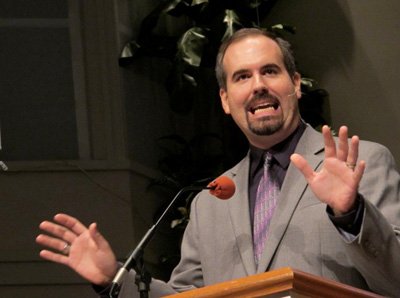
Kevin Collison, pastor of Island View Baptist Church in Orange Park, Fla., said the church is intentional in keeping its children's sermons. (ABPnews photo by Jeff Brumley)

"I have all kinds of anecdotal stories about the things that went haywire—and they go bad more than they go good," she said. "It's really painful."

As a result, some seek an end to the children's sermon. Methodist bishop Will Willimon has argued children's sermons are inappropriate because they reduce the gospel to moralistic mush and subdivide worship generationally.

"We wouldn't interrupt the congregation's worship with, 'And now I would like all those of you who are over 65 to come down front while I say something sentimental and sappy to all of you old folks,'" Willimon wrote on his "A Peculiar Prophet" blog.

Ultimately, he added, his problem with children's sermons boils down to two points: "They are not for children and are usually not sermons."

But they can be if taken seriously by the preacher, said Leslie Rosencrans, minister of congregational life at Seventh and James Baptist Church in Waco.

Rosencrans acknowledges the shortcomings identified by critics of the practice but said many of those faults result from incorrect assumptions that they are easy to deliver because they are short and for children. The truth is those factors make the sermons difficult to properly prepare and deliver, she said.

"The hard thing about children's sermons is you have a shorter time to get your message across, and your audience is a lot more wiggly than your congregation might usually be."

Rosencrans spends three to five hours on a children's sermon that might last three to five minutes. The goal is to distill Scripture and theology into a short message that keeps children's attention and edifies them.

The preacher also must be aware of children's developmental stages at different ages, and always avoid metaphors and allegories.

"Otherwise there's a real danger of it becoming entertainment or not being taken seriously," Rosencrans said.

Despite the challenges, Rosencrans said she's an advocate for children's sermons, because they are often the only way children are actively included in worship.

"It's important to teach them what's important in our faith," Rosencrans said. "With the children's sermon we are able to do that in the context of our service."

That's why children's sermons are an intentional part of worship at Island View, Pastor Kevin Collison said.

On some mornings, the children's sermon or the children's church—or both—are canceled to give youngsters a chance to experience important moments in worship.

"What we try to do is strike a balance between including children in worship and having a focused time for the younger children."

Otherwise, the sermon function's to give children that touch point in worship, he said.

"Holly and I agree the children's sermon should be a sermon, not just a cute story," he said. "They're not good when they veer off into moralisms and generalities."

And a children's sermon done correctly can often move adults, too, Smith said.

"Adults will come up to me and say it opened an avenue for them to understand things better," she said. 


Texas Baptist Men deployed for New York City in wake of Sandy

DALLAS – Texas Baptist Men deployed several units – including a feeding unit capable of serving up to 30,000 meals a day – to serve in New York in the aftermath of Superstorm Sandy.

Texas Baptist Men volunteers prepared to deploy to New York to help with disaster relief after superstorm Sandy.

The organization's state feeding unit and a shower/laundry unit departed Dallas Nov. 2. Mud out and chainsaw teams are expected to leave Texas for New York on Nov. 3. TBM leaders expect to continue responding for "several months" in the wake a storm that killed 92 people in the U.S. and caused between $30-50 billion in damage. Millions of people remain without electricity, and food is running in short in some areas.

Terry Henderson, who coordinates TBM's disaster relief efforts, will be serving in New York City helping coordinate the Baptist relief effort. TBM also has been asked to coordinate childcare in the area.

Ray Gann, blue cap of the feeding unit, said TBM volunteers are motivated to minister following disaster because they desire to share the love of Christ with people in need. The meals and services TBM will provide will give practical assistance to people. The hope of Christ that TBM will share will have an eternal impact.

"We're going to go and feed and provide food for people," Gann said. "In the spiritual [side], we desire to go and show the presence of God to them and love in that. That will feed them longer forever than a hot meal in one day."

TBM disaster relief relies entirely on donations to make the ministry possible. There are two ways to support Texas Baptist Men. Individuals can give directly to Texas Baptist Men by visiting www.texasbaptistmen.org or sending a check designated "disaster relief" to Texas Baptist Men, 5351 Catron, Dallas 75227.

Individuals also can give through Texas Baptists by visiting www.texasbaptists.org/give. Gifts through Texas Baptists help TBM as well as the extended disaster recovery efforts that will take place of the initial relief stage is finished.


Youth need safe place to wrestle with hard questions

ARLINGTON—Connect with students through authenticity, making churches places where they can express doubt, wrestle through hard answers about God and understand God delights in them, author Kara Powell told participants at Texas Baptists Youth Ministry Conclave in Arlington.

"Part of what we get to be for each other and with our students is to be a safe place where we can say, 'I don't get this about God, but will you talk with me about it and wrestle with me?'" said Powell, co-author of Sticky Faith and executive director of the Youth Institute at Fuller Seminary.

Kara Powell, co-author of Sticky Faith and executive director of the Youth Institute at Fuller Seminary.

Much of Powell's research efforts have focused on helping churches create ministries for students that are more intergenerational. But more is needed for faith to stick with students past their school days, she stressed.

"I've had a lot of conversations with you about sticky faith, and you've said how you're trying to get your churches to be more intergenerational, and how you're trying to partner with parents. Those are awesome, and those are things about sticky faith that have really spread far and wide. But something that is equally important is this whole role of doubt," Powell said.

Through her research, Powell found students' doubts about faith were related directly to a mature and constant faith.

"When students felt the freedom and had the opportunity to explore and express their doubts, that was actually related to more mature faith in high school and college," Powell said.

This is important when at least 75 percent of students who grew up in the church leave once they enter college, she noted.

When a church isn't willing to talk about difficult questions, students falsely begin to sense that God isn't big enough for their problems, Powell said.

"What our young people are learning is not only the church isn't big enough to handle their tough questions about God, but God isn't big enough to handle their tough questions about him," Powell said.

Powell found students wrestle with four main questions about faith: Does God exist? Is Christianity the only way to God? Does God love me? Am I living the life that God wants?

The first two are classic apologetic questions, while the last two are quite personal, dealing with a foundational belief about self and God.

"If Jesus isn't bigger than our mistakes, then we need a new Jesus. But he is bigger than our mistakes," Powell said.

And when students and ministers alike believe this at the heart of their being, they will begin to obey God out of gratitude rather than an obligation to a list of dos and don'ts.

"Friends, God is not distant from us. God delights in us, so much that he sent his Son to save us by grace. So, yes, we obey, but the moment we slip to make behavior the center of our faith, we no longer have Jesus the center of our faith," Powell said.

Moving away from a list of things to do or not do also can come from a vibrant example of a relationship with Christ from multiple generations within the church. For the past year, this has been a focus for Tallowood Baptist Church in Houston.

Jerome Smith, the church's student minister and coordinator of the Devoted Hearts and Homes effort, realized reaching students must start with the parents and other adults in their lives. If they live out a devoted life to Christ, then much of this will trickle down to their students.

"The crisis is that parents are not living out their faith at home, if they have a faith," Smith said. "There is a disconnect with parents who take their kids to church, go to a Sunday school class, but the rest of the week there is no conversation about the Lord—just ones about good grades and getting into college."

Smith shared about the church's Devoted Hearts and Homes effort during a Conclave breakout session. He stated that the campaign is based on Deuteronomy 6:4-9 where the Israelites were called to love the Lord with all their heart, soul, mind and strength.

"We are doing our best just to be conscious of the thought to live our faith at home," Smith said. "We have had a couple of campaigns we've focused on—pray at home and read God's word at home."

Families were challenged to prayer seven times a week personally, five times a week as a family and once a week with a spouse or best friend. Although everyone in the church didn't follow the effort exactly as prescribed, the church began to pray more and spend more time in Scripture.

The effort also focuses on all adults in the church taking a role in the students' lives. The congregation must see the children and students as their own and be willing to invest in them. These adults also need to be modeling a passionate relationship with Christ, Smith said.


Worship reflects God’s work in people’s lives

CORPUS CHRISTI—It's time to change the way churches talk about worship, said Tom Webster, minister of music and worship at First Baptist Church in Longview and dean of the school of fine arts at East Texas Baptist University.

Tom Webster, minister of music and worship at First Baptist Church in Longview and dean of the school of fine arts at East Texas Baptist University, leads a workshop on worship. (PHOTO/Eric Guel/BGCT Newsroom)

Many churches want to discuss what style of music they will use, but that conversation misses the heart of worship, Webster told a workshop held in conjunction with the Baptist General Convention of Texas annual meeting. Structure and taste are not the most important facets of worship, he insisted.

"People seem much more concerned about what we do in worship rather than why we do it," he said.

Worship is reflects God's work in the lives of a church, Webster said. It happens as a result of the overflowing of God's dealings with a person.

The process of having an authentic worship service requires congregations to include their members, he continued. It's critical that each person realizes they are involved in worship-ping God during a service.

"Everyone in the room is a worship leader," Webster said. "When people understand that role, it changes what they do in that room."

To include people throughout the church, Webster has tried several approaches. He's instructed choir members to begin the service in the pews and move forward with their families as they sang. When they did, other members came forward as well.

"The singing was remarkable, and the Spirit was strong that day," he said.

For a Memorial Day service, First Baptist Church in Longview asked members to write names of friends and family who died in military service as well as friends and family who are deployed or have relatives deployed. The act empowered people to pray to God about those they knew, he noted.

When two talented musicians were about to graduate from high school, Webster turned a portion of a worship service over to them to lead.

Webster encourages people to read Scripture during the service. He involves them in the worship planning process and gives them the freedom to share verses they feel called to read.

"If your worship service reflects what the Lord is doing in their lives, your worship will be meaningful," Webster said.


New initiative uses marketplace to advance gospel outreach

ALLEN (BP)—In the mountains of Ecuador, Scott Tye's small office serves as more than just a satellite for his business, based in Allen. And it does more than provide an income for eight of his employees.

Scott Tye's small office in the mountains of Ecuador is more than just an extension of his Texas-based business. It is a way of using his expertise in the global marketplace to advance the gospel throughout the world, much the same way the first-century church spread it into their known world. (BP PHOTO/Matt Miller )

Recently, Tye hired a young Ecuadorian couple to manage the office. Their goal is eventually to serve as missionaries in another country.

"They were looking for several businesses that they could use to provide a part of their support," said Tye, a member of The Heights Baptist Church in Richardson.

By hiring them, he is helping to do just that, as well as expanding his business in other countries—all for the sake of kingdom work.

Tom Elliff, president of the Southern Baptist Convention's International Mission Board, sees Tye's efforts as recapturing the first-century model that led to the expansion of the early church throughout their known world.

"Traveling along sea-lanes and roads, on the back of commerce, followers of Christ began to carry the message far and wide," Elliff said.

The IMB has established a new office called Global Strategic Mobilization to assist Tye and others like him who work in the global marketplace. Global Strategic Mobilization focuses on identifying, connecting and equipping Southern Baptists for greater involvement in fulfillment of the Great Commission through their work across the globe.

"We want to do all we can to get the gospel to the nations through whatever doors God opens," said Scott Holste, IMB vice president in charge of this new endeavor. He wants to make sure "marketplace professionals in our churches are poised to join with IMB missionaries and others to help finish the task."

Elliff sees Global Strategic Mobilization as a way of advancing the mission board's purpose of helping churches fulfill their mission of reaching the world for Christ.

Global Strategic Mobilization "will become IMB's means of challenging corporate leaders and employees—as well as other marketplace professionals—to place their lives, businesses, resources, international connections and their energies on the altar for the fulfillment of the Great Commission," Elliff said.


Christians should speak words of blessing, author insists

CORPUS CHRISTI – Christians should bless people around them—particularly children and young people, said John Trent, author of The Blessing Challenge and founder and president of Strong Families.

Christians should speak words of blessing–particularly to children and young people, John Trent, author of The Blessing Challenge and founder and president of Strong Families, told the Baptist General Convention of Texas annual meeting. (PHOTO/Eric Guel/BGCT Newsroom)

Words can bring either life or death to an individual—a blessing or a curse, Trent told the Baptist General Convention of Texas annual meeting.

Trent referenced Deuteronomy 30:19, where God provides the Hebrews with a choice either to follow him or to disobey his commandments. The choice, according to Scripture, was between life and death, between a blessing and a curse, he said.

The Hebrew definition of life in this passage means a "movement toward someone or something," while death means a "step away into isolation," Trent explained. Likewise, the blessing means "to add a coin to a scale," while curse means "to dam up a stream."

"When you choose to bless someone, you are choosing to add value to their life," Trent said. "When you curse someone, you dam up the living water in someone's life."

Looking to Jesus as the great example, Trent said Christ refused to keep living water away from someone and instead, in the case of the Samaritan woman at the well, poured living water into her life.

To engage in a culture of blessing, Trent suggested several steps.

First, begin a blessing with an appropriate, meaningful touch. In Scripture, the one giving the blessing embraces the other.

After meaningful and appropriate physical contact, an individual's blood pressure is lowered and hemoglobin goes up, Trent reported. Even babies born prematurely who have continuous, appropriate touch gain weight 47 percent faster than children who are not touched, he noted.

"Physiologically, even before you say a word, an appropriate touch blesses a person," he said.

Second, Christians should offer praise through a spoken word.

"There are so many of us that grew up and maybe we knew we were loved, but we never heard it," Trent said.

Third, when the words of praise are given, they need to be attached with high value. False or empty praise does not convey the blessing; instead it needs to be heartfelt and personal.

Trent suggested a fourth aspect— the need to picture specific future for the person when the blessing is conveyed.

"It is with our words, spoken and verbalized, that attach high value when an individual begins to realize that they have special futures and no matter what, you are going to give that blessing to them," Trent said.

Finally, when the blessing is given, Christians need to maintain a genuine commitment to the individual. It doesn't work to give a blessing and then leave, he said. A commitment to nurturing and continuing the blessing is needed to make a lasting impact.


Singing Men of Texas see God work powerfully in Ukraine

More than 10,000 people crowded into venues across Ukraine during the Singing Men of Texas' recent nine-concert tour.

International evangelist Michael Gott preached in Ukraine in conjunction with concerts by the Singing Men of Texas. (PHOTO/Antonina Kreposniak)

As waves of music poured over the audiences, choir members said they could see people's faces change. The Texas Baptist musicians saw countenances transformed as listeners let go of their pain, sadness and troubles and handed their lives to Christ.

"The people in Ukraine were so engaged," said Nathan Woodward, who participated in the tour. "They were engaged in everything that happened on the platform. I literally saw nothing but eyes."

God's presence was so strong, Singing Men of Texas members struggled to describe it. In all, the evangelistic concert series recorded 4,305 decisions for Christ.

"I had no idea I'd experience everything I got to experience," said Steven Dotson, worship arts minister at First Baptist Church in Mineola. "To see him move in the hearts of people who don't know him like that, I'm still speechless."

Dan Baker, minister of music at First Baptist Church in Amarillo, added: "People responded in droves. I've never been a part of something like that."

The Singing Men of Texas performed before more than 10,000 people in venues across Ukraine during a recent nine-concert tour. (PHOTOS/Antonina Kreposniak)

During the third song of each concert, the choir sang portions in Russian, which helped the Texans connect with audiences, said Tim Studstill, director of Texas Baptists' Music and Worship Team. Ukrainians saw Texas Baptists attempting to reach out to them, and they responded.

"When you watch their faces, they realize we were singing in Russian a few stanzas in. They would change and spontaneously stand and sing," Studstill said.

The latest trip to the Ukraine is the third Singing Men of Texas choir tour through a partnership with evangelistic group Michael Gott International. Singing Men of Texas, a statewide group of music ministers and leaders started by the Baptist General Convention of Texas, also sent a smaller team to minister through music there as well.

Through the months of planning and ministering together, the Singing Men of Texas and Ukrainian Christians bonded through the common goal of bringing people to Christ, Studstill said. Each trip was better than the last, and the overarching project may have been the strongest overseas effort in the history of the Singing Men of Texas.

More than 4,300 recorded commitments to Christ resulted from a recent nine-concert tour of Ukraine by Singing Men of Texas. (PHOTO/Antonina Kreposniak)

"I knew it was going to be good," he said. "I had no idea it was going to be this great when we first started."

Singing hymns and praise choruses, the choir connected with people through music in a way that helped them be open to receiving the preached gospel, Studstill said. Music has a way of breaking down barriers to help people respond to the good news of Christ.

"Our music is not just for the church," Studstill said. "It's for the world. It's a great medium."

Derrick Arellano, music minister at Central Baptist Church in Hillsboro, said the experience in Ukraine always will remain with him. He was inspired, encouraged and challenged as he witnessed the power of God.

"It's the highlight of my ministry," he said. "It's amazing to see so many people come to Christ through the Singing Men of Texas."


Father-and-son pastors offer generational lessons

CORPUS CHRISTI—Visually, Ed Seay and his son, Chris, are a little like Windows 95 and Apple iOS 6.

Speaking to the Baptist General Convention of Texas annual meeting, the father wore a pressed blue shirt, tie and crisp gray suit of an established, 60-something Baptist preacher. His bearded son sported faded slim-cut blue jeans, a broken-in blue shirt and a rumpled gray jacket befitting an emergent church starter.

Chris Seay, pastor of Ecclesia in Houston, and his father, Ed Seay, pastor of First Baptist Church in Magnolia, address the Baptist General Convention of Texas annual meeting. (PHOTO/Robert Rogers/Buckner University)

Chris Seay is pastor of Ecclesia, an emergent church in Houston. Ed Seay is pastor of First Baptist Church in Magnolia.

A third-generation pastor who grew up steeped in Texas Baptist culture, Chris Seay described the generational differences between the men of God in his life. Their styles may differ, but their goals are the same.

"Where my dad I would describe as a Chuck Swindoll-esque Bible teacher, my grandfather, Bob Baldwin, was the moderator of the association, a faithful Baptist pastor —and he was a little more hellfire and brimstone. If he was here now, he'd turn up the heat, preach on hell, and some of you Baptist pastors would walk the aisle just to make sure one more time," he said.

Seay shared the story of the time he damaged his intimidating Baptist grandfather's only two valuable possessions—his new car and his house—in one unfortunate accident. As a 16-year-old, Chris stood trembling in the driveway, waiting for his grandfather's wrath to rain down. But it never came. Instead, his grandfather put his hand on the teenager's neck, kissed him on the forehead and said: "Son, it's OK. It's just a thing. It's just a thing."

At that moment, Seay said, he knew that his grandfather loved him more than that car.

That, he said, was the first thing Texas Baptists do when they're at their very best. "Whatever you do, whatever you're up to, whatever your church has been called to, make sure that love is the dominant activity in what we do and who we are," he said.

The second greatest lesson from Texas Baptists is their passionate and deep love for Scripture, he said. The important things he learned, to read the Bible 'well and often,' also requires reading them humbly, he added.

"You read it with a sense that God is teaching you something, and I'm afraid that often as Baptists, as Christians, as people or denominations, we get caught up reading the Bible ready to fight with other people," he said. "We're reading it to justify how right we are. And it doesn't work well. … The Bible was meant to be a sword, but not one we hack other people with—one that's intended to do surgery on our own hearts."

The final quality of Texas Baptists that had a profound impact on Seay's life was a penchant for risk-taking. He told the story of making an appointment with the church starting center at the BGCT at the ripe age of 23. He had served as pastor at a handful of small, rural churches and had come to the BGCT with a vision.

"I said, 'I've got this friend, we've been playing in a band, and his name is David Crowder and we want to start a church together.' And (the church starting center representative) should have said, 'You come back to me in 10 years when you've figured something out.'  But he didn't. He said, 'I think the Lord's leading you and I want to invest in you.' And through the Cooperative Program, through your work together, we planted a church that continues to thrive in a university context."

He encouraged listeners to continue taking risks, to not be afraid of change and to think about getting smaller in order to become more effective.

He also delivered two challenges—to not assume that reaching more people means adding "contemporary" features to the way churches do things, and to be mission-minded.

What people crave is authenticity, he said. Seay described his Houston church, Ecclesia, that is thriving in an area of Houston where churches normally don't do well. He noted 90 percent of their worship songs are hymns, their services rely heavily on liturgy and they celebrate the Lord's Supper every week.

"We read these responsive prayers together in a way that is not contemporary in many ways," he said. "And yet, what it is is authentic. I believe ultimately that friendships are formed and relationships happen out of weakness. So my prayer is that you would be people that are authentic in your communities. Acknowledge your sin, your brokenness, your weakness. It's in those places that God moves significantly."

Finally, the emerging generation craves the thrill of a challenge and connection with a mission, he said.

"Paint a picture of the kingdom of God and call them to affect it, to bring it into reality, and they are ready for that challenge," he said. "They don't want to fund a building that's going to be used two hours a week. They don't. They won't get excited. But if you tell them about communities in desperate need that need clean water, they'll respond and they'll do it."

Ed Seay closed the presentation with advice for empowering the next generation of church leaders.

"Bless them in the Lord," he said. "Then set them free and don't expect them to live up to our expectations or traditions, but to follow Christ alone. Let the expression of the gospel be lived out in the context of the culture they're called to reach, and we'll see many come to faith because of that blessing."


Minor league catcher keeps ‘close connection’ to Christ

SEVIERVILLE, Tenn.—As Chad Noble travels through the Southern League, he carries a backpack filled with symbols of his father's journey against a foe that doesn't play games.

Chad Noble–now a catcher for the Tennessee Smokies–graduated in 2010 from Northwestern University with a degree in economics. (PHOTO/Northwestern Athletics)

Dave Noble gave his son wooden crosses signifying different steps in his eight-year battle with cancer, and he wrote Psalm 23 on each of the palm-sized crosses.

"Those mean a lot to me," said Chad Noble, a 24-year-old catcher for the Tennessee Smokies, the Double-A affiliate of the Chicago Cubs.

Noble was 16 when his father was diagnosed with cancer of the mouth, tongue and neck. He was in remission for a year and a half before a different kind of mouth cancer returned.

"He is dealing with that now," Noble said. "It's been tough. He has definitely had his highs and lows, especially when it came back this last time. We thought he was clear. I've been scared.

"I have never seen my dad cry before, and that was pretty eye opening. When my mom (Leslie Noble) and dad were in their room, I could hear them crying. That was pretty tough. But he is a fighter and a big believer in Christ. That helps a lot with all of us. He has a huge faith."

Dave Noble led his son to faith in Christ when Chad was 12.

"My dad by far is the biggest influence I have had with my walk with Christ," he said.

As he and his younger brothers, John and Nick, grew up, the family would have devotionals that included prayer and Bible reading on Tuesday and Thursday nights. Those helped them get through, Noble said.

The practice continues as Noble keeps a "close connection" with Christ by attending baseball chapel, studying the Bible and prayer.

"If I am having a bad day and it's hard for me to get through it, I get down on my knees and pray and ask God to help me and for forgiveness. Immediately, it makes me feel better and makes me feel cleansed," he said. When he's not traveling with the team, Noble attends Lake Pointe Church in Rockwall.

When WWJD—"What Would Jesus Do?"—bracelets first became popular, he wore one. While it's off his wrist now, it's still on his mind.

Chad Noble, who attends Lake Pointe Church in Rockwall during the off-season, seeks to keep a close connection with Christ by attending baseball chapel, studying the Bible and prayer as he seeks to make his mark in Minor League Baseball. (PHOTO/ Scott Jontes/Daytona Cubs)

"I have learned that I have a lot more faults than I want to admit. Every time I do something, I am like, 'Wow, would Jesus have really done that?'"

One of Noble's role models is Texas Rangers outfielder Josh Hamilton, who has battled substance abuse during his baseball career. Hamilton, the American League Most Valuable Player in 2010, credits his faith in Christ as helping him deal with addiction.

When Noble was on the baseball team at Northwestern University, he attended chapel and saw a telecast of Hamilton speaking about Christ at a church.

"He talked about his faith that he has had ever since his addictions and how he has been helped through that. I believe that is very manly of him. That is good to see that he has Christ in his heart," Noble said.

Noble hopes through his own demeanor, attitude and speaking about Christ, he can be a witness to teammates.

"There are a lot of guys in the clubhouse that have the same faith. There are a lot that don't. You have to keep helping people as much as you can," he said.

Smokies shortstop Dustin Harrington calls Noble "a great Christian" who "is always trying to do the right thing; just really following the Lord. He treats everybody with respect."

Matt Cerda, Tennessee third baseman, said Noble's positive attitude "helps everybody."

Noble graduated in 2010 from Northwestern University with a degree in economics.

While he wants to play Major League Baseball, "if that doesn't work," he plans to be a private equity analyst at a large firm.

Noble was drafted in the 37th round of the 2010 MLB June Amateur Draft. He has played for Cubs' minor league teams in Boise, Peoria and Daytona. In 2011, Daytona won the Florida State League championship.

"That was a great thrill," said Noble, whose athletic ability has been passed down through three generations.

His father swam for the University of Iowa. His grandfather Dudley, from whom Chad gets his middle name, played football for the Hawkeyes. His great-grandfather ran track at Iowa.

In addition to the crosses, Noble also carries a marker in his backpack. He uses it to write the word "DAD" on his baseball cap.

"No matter what happens in life, however hard it is for the people you love, keep faith in Christ and it will help you through," Noble said.

"I've gotten used to dealing through the pain. Life won't always give you great things. But through Christ, it will always be great."


Churches urged to create a culture of calling

CORPUS CHRISTI—A crisis looms on the horizon, said George Mason, pastor of Wilshire Baptist Church in Dallas.

"In the year 2000, a Pew study determined that the percentage of clergy in Protestant churches in America under the age of 35 was between 2 percent and 7 percent in almost every denomination," Mason said. "In other words, almost all the clergy—95 percent, roughly—in almost every denomination was over the age of 35."

George Mason, pastor of Wilshire Baptist Church in Dallas, leads a workshop explaining how churches can create a culture of calling. (PHOTO/Eric Guel/BGCT Newsroom)

During a Baptist General Convention of Texas annual meeting workshop, Mason outlined three steps churches and pastors need to take in order to cultivate the next generation of clergy—notice, name and nurture.

"Notice" means paying attention to the children and youth who have the qualities needed to succeed in vocational ministry, he explained. Rather than targeting the "popular kid" who may be a leader in the church's youth group, congregations need to be looking for young learners with a deep inner life.

Drawing from his newly released book, Preparing the Pastors We Need: Reclaiming the Congregation's Role in Training Clergy, Mason said youth who are best-suited to become the next generation of pastors will have a sense of wonder, an appreciation of ritual, an understanding of the importance of human connection and relationship, and an enthusiasm for seeing healing in the world.

While it's one thing to notice young people, it's another to tell them they have attracted notice, Mason said.

"I would guess that if you are anything like me and most people in ministry that I've talked to, you have a story about someone sometime saying to you, 'You know, I don't know if God is calling you into ministry, but I see something in you that makes me think you ought to think about that.' In one way or another, somebody probably has named you for this work."

Churches have a responsibility to nurture young people, especially through informal and formal internships.

"There's nothing wrong with asking a sixth grader that you think has something going on to offer a prayer in worship on Sunday morning. Or the kid who is asked in high school, 'Why don't you lead the Bible study this Wednesday night?' Now there's a whole crisis of, 'I have to figure out how to do this.' Now you get some personal conversation.

"Sometimes we have gotten so professional in our approach to ministry that the only people that we trust to be up there leading in worship are the people you can count on to do it beautifully and perfectly," he continued.

"In other words, this is all about the pros doing for the people. That's not a Baptist thing at all. We need to have more kids playing the offertory on the piano or the flute. We need more kids praying and leading Bible studies to give them a feel, a sense for this life."

When students come home from college, he said, rather than working at the local Dairy Queen, churches should be asking students if they'd like to help out in the church. It offers young people the chance to be a part of a ministry team.

"That's where they really start to imagine themselves in that world," Mason said.


Seek and find hope in the Lamb’s agenda

CORPUS CHRISTI—Samuel Rodriguez, pastor of New Season Christian Worship Center in Sacramento, Calif., urged Texas Baptists to find hope not in the agenda of donkeys or elephants but in the agenda of the Lamb of God, Jesus Christ.

The Lamb's church is at its core a Spirit-powered church, Rodriguez said at the Baptist General Convention of Texas annual meeting.

Samuel Rodriguez, pastor of New Season Christian Worship Center in Sacramento, Calif., urged Texas Baptists to seek and find hope in the agenda of the Lamb of God. (PHOTO/Robert Rogers/Baylor University)

Rodriguez recalled obstacles that stood in the way of God's people in the Bible—Egypt's pharaoh, Goliath the Philistine and Jezebel the pagan queen. The spirit of those challenges remains, he added.

"Yet I do have news for you this morning," Rodriguez said. "There is a Spirit more powerful than all of these spirits combined. The most powerful Spirit in America and on the planet today is still the Holy Spirit of almighty God."

Churches should hold up a counter-narrative to today's prevailing sense of loss, hopelessness and spiritual apathy by boldly proclaiming the Lamb's agenda, he insisted.

The agenda of the Lamb is complete freedom, he said.

"Why is there so much bondage in the world?" Rodriguez asked. "Because the enemy understands that the most powerful human on the planet is a person set free by the blood of the Lamb, Jesus Christ."

Free individuals boldly stood up to Pharaoh, Goliath, Jezebel and others in Scripture, he said. They broke the chains of tyranny. Ultimately, one free man took the sins of the world upon himself and declared, "He whom the Son sets free is free indeed," Rodriguez said.

The Lamb's agenda is the message of the cross, Rod-riguez continued, pointing out many American churches forget the essence of the cross.

"Simply stated, the cross is both vertical and horizontal. It is both redemption and relationship, holiness and humility, covenant and community, kingdom and society, righteousness and justice, salvation and transformation, ethos and pathos, John 3:16 and Matthew 25, Billy Graham and Martin Luther King Jr., prayer and activism."

The Lamb's agenda activates the worshipper, instilling confidence to proclaim the name of Jesus boldly, regardless of circumstances.

"There is power in the name of Jesus," he said. "That is the name that still sets captives free."

The Lamb's agenda activates a kingdom-culture perspective, he said. Pointing to what he views as a new and exciting Christian movement, Rodriguez said the coming spiritual awakening must be characterized as a multiethnic movement, using cultural expressions of every tribe and tongue. Instead of churches viewing the world according to their cultural context, they need to view it through the "compassionate lens of their kingdom citizenship," he said.

The Lamb's agenda produces overcoming, he concluded.

"According to some, we shouldn't even be here right now," Rodriguez said. Naming so many who predicted the end of Christianity, he looked at the assembled Texas Baptists and said, "Well, here we are in Corpus Christi, Texas, in 2012, and the church of Jesus is still alive and well."

"I encourage you to rise up and speak truth," he said. "Rise up with the Lamb's agenda, living out hope and healing in his name. And when that broken soul in Texas says no one can open the book of my deliverance, no one can heal me; when the world cries out for an answer, let this convention stand up and say: 'There is one who can do it. There is one who is worthy. Behold the Lamb!'"