Alternative gifts counter holiday-related consumerism

ANDERSON, S.C. (ABP)—When it began nearly a decade ago, the Alternative Christmas Gift Fair at Boulevard Baptist Church attracted barely 100 church members and generated a few thousand dollars for participating nonprofits and mission groups.

But since then, it has generated $200,000 and drawn more than 300 each year from around Anderson, S.C. Organizers say they’re challenging Black Friday and holiday-related consumerism.

“Our joke is that department stores don’t have anything on us,” said Ellen Sechrest, minister of spiritual formation and missions at Boulevard Baptist Church.

Sechrest and faith-based nonprofit leaders say Boulevard’s experience reflects national and global trends in alternative gift giving.

The practice involves making contributions toward the purchase of goods and services for people in need domestically or internationally. A donation may provide books for at-risk children in Florida or a water well for an African village.

Donors also can give to different classes of ministry, such as disaster relief, health care and combating hu-man trafficking, or to support an individual missionary.

The donation then is made in the name of a friend or loved one, which is making the practice one of the most popular forms of charitable giving nationally, nonprofit leaders say.

Local, state and global ministries and nonprofits report that an increasing number of donors are asking for the ability to make their donations into such gifts.

They also are seeing more churches wanting to facilitate such giving among their members and communities with annual fairs like Boulevard’s.

“We participate in three to four of these things a year, and they seem to be growing yearly,” said Bill Stanfield, chief executive officer of Metanoia, a North Charleston-based Cooperative Baptist Fellowship ministry that serves impoverished children and families.

At Boulevard’s fair, Metanoia offers gift packages for varying prices. One includes $50 to provide one child’s books during summer camp.

Alternative giving “benefits us from a financial standpoint … and it keeps our name out there, which helps our ability to do our work,” Stanfield said.

Missionaries and others who see the end result of the alternative gift trend also are big fans of it, said Nell Green, a Texas-based CBF missionary with extensive global experience.

Green has seen human trafficking victims benefit for targeted gifts of clothing and money. Overseas, she’s seen impoverished communities benefit from businesses created from donations used to provide micro financing.

“It’s a small sum of money for us, but it makes a significant difference in their lives,” Green said.

{mosimage}The donors, both in name and in fact, also are strongly affected—especially when letters and photos begin arriving from recipients, Green said.

“Once you make that investment, you will learn about the person or project, and you’ll put that somewhere and be reminded to pray for them,” Green said.

“I think that goes a long way beyond ‘here’s a new shirt for Christmas,’” Green said. “It does give back on a very deep, spiritual level.”

And it doesn’t take a lot to do that, said Devin Hermanson, director of marketing for World Vision.

The agency’s gift catalogue alone generates $35 million year with items like five ducks for $30, a goat and two chickens for $100, an array of clean water gifts and more.

“I’ve seen them change lives and even generations of lives,” he said.

That ability to make a major impact for just a few dollars likely fueled the increase of that kind of giving even during the worst years of the recession, Hermanson said.

“During that period our revenue increased 20 percent, and we have never had a down year,” he said.

The agency’s own polling found that in addition to stretching their dollars, consumers saw alternative gifts as a way to teach children about sacrificial giving.

“People are hungry for a different way of celebrating Christmas,” he said. “Eighty-three percent said they would rather receive a meaningful gift.”

Buckner International likewise offers a gift catalog, but it is an undated online catalog available year-around—one of many giving options available to donors, explained Russ Dilday, director of communications at the Texas Baptist-related agency.

“When it comes to alternative giving, Buckner gives donors alternatives,” Dilday said. “We ask people to give where their heart and passion lies, and then we offer them options.”

Buckner uses multiple strategies. Development officers cultivate personal relationships with major donors. Special events such as golf tournaments and sporting clay-shoots raise funds. Direct mail appeals and peer-to-peer donor-directed events bring in contributions.

Likewise, Buckner offers tailored giving options, with 14 designated funds—“not unlike an investment portfolio,” Dilday explained—that allow donors to di-rect gifts to areas of specialized interest such as adoption services, foster care, community development, education, international ministries or eldercare.

“Far and way, the most-given-to fund is ‘where needed most,’” he noted. “Probably as many as three out of four gifts are directed that way by people who say, ‘We trust you. Use the gift where you need it.’”

Word continues to spread through Ander-son about the Alternative Christmas Gift Fair at Boulevard Baptist Church and how good it feels to give and receive alternative gifts, Sechrest said.

The result is more people from outside the congregation shopping at the fair each year, and more visitors from other churches wanting to start their own, she said.

“It goes back to that feel-good purchase,” Sechrest said. “It’s a win-win because you made somebody really happy in a much more meaningful way.”

-With additional reporting by Managing Editor Ken Camp


On the Move

Colby Benavidez to First Church in Mathis as youth minister.

Paul Boyer has resigned as youth director at First Church in?Refugio.

Justin Cross to Wooster Church in Baytown as minister to students.

Gregorio Gomez has completed an interim pastorate at Primera Iglesia in Mathis.

Brandon Henderson has resigned as pastor at Denton County Cowboy Church in Ponder.

Bob Knowles to First Church in Albany as pastor.

Kenny Robison has resigned as co-pastor at Life Fellowship Church in Denton. He is available for supply and interims.

Scott Townsend to Oakville Church in Oakville as youth minister.

Greg Trotter to Friendship Church in Lewisville as pastor, where he had been interim pastor.

Chris Walker to Whitsett Church in Whitsett as interim pastor.

Daniel Woods has resigned as youth minister at Life Fellowship Church in Denton.


Faith Digest: Church of England rejects female bishops

Rowan Williams, archbishop of Canterbury, at the Church of England's General Synod.

Church of England rejects female bishops. Many of the 470 members of the Church of England’s three-tiered General Synod—bishops, clergy and laity—were stunned when the House of Laity couldn’t garner a two-thirds majority in favor of women bishops. The vote to allow women bishops failed by just five votes, after easily passing the bishops and clergy. Both the Archbishop of Canterbury, Rowan Williams, and his successor, Justin Welby, had urged the General Synod to vote for women bishops, 18 years after the church opened the priesthood to women. About 3,000 women priests serve in the Church of England—roughly 40 percent of all clergy. The church cannot consider the matter again until at least 2015, when a new General Synod comes into being.

{mosimage}Judge blocks Nativity displays in Santa Monica. A federal judge denied a bid by churches to force city officials in Santa Monica, Calif., to reopen spaces in a city park to private displays, including life-sized Christmas Nativity scenes. The city shut down the six-decade tradition last year after a dispute between religious groups and atheists, who overwhelmed the city’s auction process for display sites, winning most of the 21 slots. William Becker, an attorney representing a group of Christian churches, said he would appeal.

Kenyan church leaders oppose marriage law. Church leaders in Kenya insist proposed new marriage bills will weaken marriage by allowing cohabitating couples to register as married. One bill would bring Christian, Hindu, Muslim, civil and customary marriages under one law, and another would give spouses and children more rights to property. The twin bills were approved by the cabinet Nov. 9 and are scheduled to be debated by Parliament before Christmas.

Anti-Jewish incidents decline. Anti-Semitic incidents in the United States dropped by 13 percent in 2011, according to a report released by the Anti-Defamation League, which tracks assaults and other attacks on Jews. There were 1,080 incidents against Jews last year, according to the ADL, the lowest tallied by the nonprofit civil rights group in two decades. The league’s annual Audit of Anti-Semitic Incidents for 2011 included 19 physical assaults, 731 cases of harassment and threats, and 330 incidents of vandalism. The report highlighted particular concern about anti-Semitic bullying in schools and cyber-bullying by students.

Woman files complaint against Muslim barber. A Toronto woman has lodged a complaint against a barber who refused to cut her hair because he is Muslim. Faith McGregor requested a man’s haircut at the Terminal Barber Shop in downtown Toronto. Co-owner Omar Mahrouk told her his Muslim faith prohibits him from touching a woman who is not a member of his family. All the other barbers in the shop said the same thing. She filed a complaint with Ontario’s Human Rights Tribunal of Ontario because the incident made her feel like a “second-class citizen.” McGregor is not seeking monetary damages, but wants the tribunal to force the shop to offer men’s haircuts to both genders.

Compiled from Religion News Service


Baptist Briefs: British Baptists downsize national staff


British Baptists downsize national staff. The Baptist Union of Great Britain will downsize its national staff from 46 to 32 employees and change the way it works with associations and Baptist colleges to improve how it serves local churches in the 21st century. Changes approved by the Baptist Union Council followed a yearlong study prompted by financial concerns but broadened to re-examine mission structures designed for the 20th century. The driving vision for the shift, which also includes reducing the size of the governing council, is to create a more flexible structure that moves decisions closer to the local church. In March, the Baptist council received report of a deficit of more than $1 million in the Baptist Union’s Home Mission Fund, attributed to declines in giving by churches.

Gilbert elected BTSR dean. Timothy D. Gilbert, longtime professor at Tarrant County College in Fort Worth, has been elected dean at Baptist Theological Seminary at Richmond, a post he will assume July 1. For nearly 30 years, Gilbert has been a professor of philosophy at Tarrant County College, where he also has served as divisional dean and associate vice chancellor for academic affairs. He is a graduate of Oklahoma Baptist University and holds master of divinity and doctor of philosophy degrees from Southwestern Baptist Theological Seminary in Fort Worth. He is married to Karen Grubb Gilbert, who works contractually for the Cooperative Baptist Fellowship. The Gilberts—members of Broadway Baptist Church in Fort Worth—have two daughters: Katie Lacey is director of college and young adults at First Methodist Church in Birmingham, Ala., and Mary Beth Foust is a BTSR student.

Longtime seminary professor Tate dies. Marvin Embry Tate Jr., professor of Old Testament interpretation at Southern Baptist Theological Seminary from 1960 until 1995 and senior professor until 2003, died Nov. 16. He was 87. Tate taught at Wayland Baptist University before joining the Southern Seminary faculty. He wrote numerous books, including several biblical commentaries, and he helped with Hebrew translation for the New International Version of the Bible. He is survived by his wife of 55 years, Julia; five children—Sarah McCommon, Martha Kent, Betsey Tate, Andrew Tate and Virginia Phelps; and five grandchildren.

CBF names manager of congregational services. The Cooperative Baptist Fellowship hired Ruth Perkins Lee as manager of congregational services and has begun to organize staff in the missional congregations department around changes called for in the 2012 task force report. Perkins Lee, who currently serves as minister of students at First Baptist Church, Auburn, Ala., will begin work at the CBF resource center in Atlanta Jan. 1. A graduate of Mercer University’s McAfee School of Theology, Perkins Lee served as a member of CBF’s 2012 task force and is part of the implementation team.


Around the State

A Christmas dinner theater production, “Oh Holy What?” will be performed Dec. 4 at 6:30 p.m. at Heart of Texas Camp. The comedy is written and directed by Nicholas Ewen, Howard Payne University theater professor. A banquet buffet will be served. The requested minimum donation is $10. All proceeds will go toward completion of the summer camp recreation pavilion. For more information, call (325) 784-5821.

The Delta Pi Theta chapter of East Texas Baptist University distributed food baskets to local families on Thanksgiving evening. From left to right, Kristopher Picarella, Jessica Harrison, Madison Kauffman, Kasey McLendon and Blake Cherry delivered baskets loaded with items essential for a complete Thanksgiving meal.

The Howard Payne University team of Jake Aschmutat and Charity Chambers won the South Texas College of Law Moot Court Tournament in Houston. The pair defeated a team from the U.S. Air Force Academy 5-0 in the final round. Aschmutat and Chambers were awarded a $1,000 cash prize each for their victory.

East Texas Baptist University students James Fugate of Spring and Kellie Ann Thompson of Crandall have received the Bob and Gayle Riley Servant Leadership Award. ETBU gives the award annually to two students who exhibit exceptional servant leadership. Each recipient received a cash reward and a replica of Max Greiner’s sculpture of Jesus washing the feet of Simon Peter.

Dallas Baptist University students Chris La, Kathryn Cryer and Amanda Vines each received a $3,000 scholarship by the Campus to Community Coalition of Texas. The scholarship addresses the shortage of science, technology, engineering and math graduates and advocates service learning. This is the first time all scholarship recipients have been females and from the same university.

Baylor University was recognized by the Professional Grounds Management Society for exceptional grounds maintenance among universities and colleges in the society’s 2012 Green Star Awards competition.

Anniversaries

Ed Walker, 10th, as pastor of Granite Mountain Church in Marble Falls, Nov. 4.

Mark Newton, 10th, as pastor of First Church in San Marcos, Dec. 1.

Retiring

Leonardo Cantu, after 28 years as pastor of Templo Emanuel in Pawnee.

Abel Sosa, after 12 years as pastor of Primera Iglesia in Sinton.

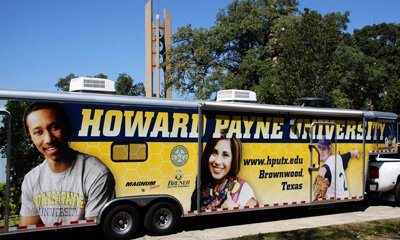
Howard Payne University received a grant to purchase a 42-foot trailer equipped with laptop computers, satellite Internet and other equipment that will allow the university to go to prospective students. It will provide information on HPU and the general college-search process with the goal of increasing enrollment. It will travel to schools, community events, festivals and churches across the state.

Jerry Raines, after 16 years as pastor of Hampton Road Church in DeSoto and 41 years in ministry. His previous pastorates include First Church in Lometa, Live Oak Church in Gatesville and Canyon Creek Church in Temple. He also has been active in volunteer mission projects in Germany, Romania, Moldova, Spain, Mexico and Brazil. He and his wife, Sue Ann, have three children, two serving with the International Mission?Board of the Southern Baptist Convention.

Deaths

Pete Tippen, 93, Nov. 26 in Abilene. A 1939 graduate of Hardin-Simmons University, he was instrumental in the origin of the school’s Six White Horses team. A member of the Cowboy Band, he preceded the band in a parade on a white horse carrying the Texas flag as another man carried the American flag. From this grew the idea of female students on horseback carrying the six flags that have flown over Texas. During World War II, he was stationed in England, Panama, Trinidad, Brazil and India. During the Korean War, he flew 52 bombing missions over North Korea, was stationed at the Pentagon and was awarded the Distinguished Flying Cross. After retiring from the Air Force as a lieutenant colonel, he returned to Abilene where he served as director and board chairman of Hendrick Medical Center. He also served on HSU’s board of development from 1997 to 2005. He was a member of First Church in Abilene, where he served as chairman of deacons and later as deacon emeritus. He was preceded in death by his wife, Minnie Alice, and brother, Bill. He is survived by his sons, Peter and Philip; daughter, Susan Montgomery; sister, Norma Sue McCann; seven grandchildren; and two great-grandchildren.

Zig Ziglar, 86, Nov. 28 in Plano. The motivational speaker and author of more than 30 books died after suffering from pnuemonia. He published his first book, See You At the Top, at age 49, but his full-time speaking career began prior to that. Making a profession of faith in Jesus Christ as Savior at age 42, Christianity became a focal point of his life. He served as first vice president of the Southern Baptist Convention in 1984-85. He was a member of Prestonwood Church in Plano. He was preceded in death by his daughter, Suzan Witmeyer. He is survived by his wife of 66 years, Jean; daughters, Julie Norman and Cindy Oates; son, Tom; seven grandchildren; 12 great-grandchildren; and one great-great-grandson.

Event

Memorial Church in Taylor will bring Bethlehem to life Dec. 16. Church members will re-enact the hustle and bustle of the day Mary and Joseph arrived. Shop-keepers will open their stores at 5:30 p.m. to sell food and crafts. The pageant and music begins at 6:30 p.m. “Come and See What’s Happening at the Barn” will be held at the home of Pastor Dudley Marx, located on FM 486. From Highway 79, turn south at the traffic light in Thorndale, travel 2.5 miles and turn left on CR 450.

Ordained

Asa Cole, Kerry Gunn, Daniel Rexford, Derrick Wade and Ray Ward as deacons at Wooster Church in Baytown, Nov. 11.

Jim Kenesek and Jimmy Cass as deacons at Friendship Church in Caldwell, Nov. 18.


Angels from Texas minister to New Jersey church

PORT MONMOUTH, N.J.—Members of a small storm-damaged church in New Jersey considered Texas Baptist Men disaster relief volunteers more than a welcome sight.

“I don’t know how they heard of us, … but they are angels sent from God,” Wanda Wohlin, ministry assistant to the pastor at Port Monmouth Community Church, wrote on her Facebook page.

{mosimage}Pastor Don Magaw reprinted Wohlin’s social media post as part of his column in a recent church newsletter.

Hurricane Sandy severely damaged Port Monmouth Community Church, ripping off a portion of the facility’s exterior wall and exposing the sanctuary to a 13-foot storm surge.

“All furnishings floated in the water, and we lost our organ, two pulpits, our electronic sound system, a piano, stove, refrigerator, hot water heater, hymn books, Bibles and many books, several of which were very old and cannot be replaced,” Wohlin wrote.

“Last Saturday morning, we met at the church to begin the cleanup. We were walking around in shock trying to figure out where to start when the Texas Baptist Men pulled up in their pickup trucks with their long trailer filled with tools and supplies and introduced themselves, telling us they were the mud-out group here to clean out our church for us.”

The TBM volunteers spent three days washing and sanitizing any salvageable contents, removing damaged sheetrock and power-washing interior walls and floors.

“They even retrieved our utility shed that floated across the street fully loaded and placed it back where it belongs,” Wohlin wrote.
Before the crew returned to Texas, they replaced an electrical meter and storm-damaged electrical wiring.

“Truly, God was working. (The TBM volunteers) don’t get paid for their work and do it simply to spread the love of Jesus. They wouldn’t even let us help, as they wanted us to save our strength for the rebuilding still to be done,” Wohlin wrote.

Magaw added his own postscript to his assistant’s observations: “On Saturday, I actually saw the remains of the church for the first time in person. I really had to hide it and hold back the tears. Then when I went home, I thanked the Lord for sending these people to us—and then the tears of joy began to flow. We are a very small group, but we love the Lord with all our hearts. Flood insurance or not, we will rebuild, and we will be on fire for Christ even more than ever before.”


Film revives questions about Lincoln’s faith

WASHINGTON (RNS)—There is a moment in Steven Spielberg’s new movie Lincoln when the 16th president asks the kind of big question usually tackled by religion: Why are we here?

“Do you think we choose the times into which we are born,” Daniel Day-Lewis, as Abraham Lincoln, asks two young workers in the telegraph office. “Or do we fit the times we are born into?”


That’s as close as the film comes to probing the faith of Abraham Lincoln. But the nature of Lincoln’s faith —or the lack thereof—has remained one of the most fascinating aspects of the man who freed the slaves, preserved the Union and carried the wounded nation through its bloodiest war.

Beginning almost immediately after his assassination 147 years ago, hundreds of books, articles and essays have appeared, many claiming Lincoln was—if not in fact, then in sentiment—a Christian, Catholic, Jew, Mormon, psychic, spiritualist, agnostic and atheist.

Their titles range from Lincoln, the Freethinker to Lincoln’s Christianity. Recently, Christian publisher Thomas Nelson released Lincoln’s Battle With God: A President’s Struggle With Faith and What It Meant for America by popular biographer Stephen Mansfield. The Jewish Journal ran a story asking if Lincoln was “‘Jewish’ in his temperament, values and actions.”

Both religious believers and nonbelievers have set up websites or composed blog posts full of Lincoln quotes they believe support their own versions of Lincoln’s God. Sometimes it’s the same quote— illustrating, perhaps, that facet of Lincoln that Freethinkers author Susan Jacoby calls his unique balance “between belief and unbelief.”

“What makes Lincoln a compelling figure to religious believers and nonbelievers alike,” Jacoby writes, “is that his character was suffused with a rare combination of rationalism and prophetic faith in almost perfect equipoise.”

What is the truth about Lincoln’s faith? And what does it say about Americans that we seem to need to pinpoint his beliefs and claim them as our own?

Authors Jennifer Weber & Stephen Mansfield find conflicting evidence about Lincoln’s faith.

“Lincoln, in many ways, is a cipher to us,” said Jennifer Weber, an associate professor of history at the University of Kansas and a Lincoln scholar. “He was not forthcoming at all about his interior life, his emotions, his experiences as a child. So we don’t know what he felt about a lot of things. There are a lot of holes there.”

What do we know about Lincoln’s faith?

• He was raised in a fundamentalist Christian home, and he could quote much of the Bible by heart.

• In his youth he wrote an anti-religious pamphlet that his friends burned, and he steadfastly declined to become a member of any church.

• The deaths of two of his sons and the horrors of the Civil War took a huge toll on Lincoln and brought about some kind of spiritual crisis.

• As president, he wrote and delivered speeches that contain the most elegant references to God and American destiny in our history, but he did not mention Jesus in those speeches and only rarely in his private life.

While researching Lincoln’s writings through the 1850s for her book Copperheads: The Rise and Fall of Lincoln’s Opponents in the North, Weber said she did not find a single reference to God or Jesus.

But by the 1860s, something may have changed within the president.

“There are a couple of arguments about what happens to Lincoln when he is president,” she said. “One is that he employs religious language because it is a language that Americans understand and is reassuring to them. The other is that Lincoln himself undergoes a metamorphosis in terms of his own belief while he is president and is facing the enormous crisis of the Civil War and the loss of his second son—his favorite son—to die in childhood. He may well have come to have a belief in a hard, a vengeful God, given the circumstances he was working under.”

That is the general thrust of Mansfield’s new book, although he concludes the president became a God-fearing Christian.

“Though he never joined a church and seldom spoke of Jesus Christ publicly,” Mansfield writes, “he became our most spiritual chief executive, sometimes more prophet than president.”

In his landmark second inaugural address in 1865, Lincoln professed that the Civil War was God’s punishment for the sin of slavery.

“Until every drop of blood drawn with the lash shall be paid by another drawn with the sword, as was said 3,000 years ago, so still it must be said, ‘The judgments of the Lord are true and righteous altogether,’“ he said.

But don’t look for any of that to stop people of different religious persuasions from trying to claim Lincoln as a fellow traveler. Earlier this year, in an interview with an Indian newspaper, the evolutionary biologist and outspoken atheist Richard Dawkins claimed Lincoln was an atheist.

Weber calls this embrace of the 16th president as a fellow religionist “getting right with Lincoln.”

“If you can claim to have Lincoln on your side, you are golden,” she said. “It gives people an extra sense of legitimacy. It’s sort of like having the Good Housekeeping seal of approval.”

That’s why, she continued, we have Lincoln Savings Bank, the Lincoln Continental, the Lincoln Snacks Company, the Lincoln Mattress Company and Lincoln Electric.

“He was a religious man always, I think,” his widow Mary Todd Lincoln reportedly said after his death, “but he was not a technical Christian.”


Fort Worth professor elected Richmond seminary dean

RICHMOND—Timothy D. Gilbert, longtime professor at Tarrant County College in Fort Worth, has been elected dean at Baptist Theological Seminary at Richmond , a post he will assume July 1.

For nearly 30 years, Gilbert has been a professor of philosophy at Tarrant County College, where he also has served as divisional dean and associate vice chancellor for academic affairs.

Timothy Gilbert

Tarrant County College is a nearly 50-year-old two-year institution enrolling more than 50,000 students on five campuses

“Tim brings a wealth of experience to his new responsibilities,” BTSR President Ron Crawford said. “He is a gifted administrator and teacher. He is a splendid churchman.”

Gilbert was elected during a board of trustees conference call Nov. 20. He succeeds Israel Galindo, who completed a five-year term as dean and has chosen to return to the classroom, Crawford said.

Gilbert is a graduate of Oklahoma Baptist University and holds master of divinity and doctor of philosophy degrees from Southwestern Baptist Theological Seminary in Fort Worth, Texas.

He co-authored Christian Ethics—A Primer and contributed a chapter on Christian ethics to Has Our Theology Changed? Southern Baptist Thought Since 1845.

Gilbert is married to Karen Grubb Gilbert, who works contractually for the Cooperative Baptist Fellowship. The Gilberts have two daughters: Katie Lacey is director of college and young adults at First Methodist Church in Birmingham, Ala., and Mary Beth Foust is a BTSR student.


Obama emphasizes religious liberty in Burma

RANGOON, Burma (ABP)—President Obama stressed religious freedom in a historic speech Nov. 19 in Burma, a country long beset by military conflict and regarded as one of the world’s worst oppressors of minority faiths.

President Barack Obama walks with Burmese Opposition Leader Aung San Suu Kyi following their statements to the press at her home in Rangoon, Burma, Nov. 19, 2012. (Official White House Photo by Pete Souza)

Obama, the first sitting U.S. president to visit the Asian nation, also known as Myanmar, defended “the freedom to worship as you please” in a speech at the University of Yangon in Rangoon, Burma’s largest city and the former capital.

“This country, like my own country, is blessed with diversity,” Obama said. “Not everybody looks the same. Not everybody comes from the same region. Not everybody worships in the same way. In your cities and towns, there are pagodas and temples and mosques and churches standing side by side. Well over a hundred ethnic groups have been a part of your story. Yet within these borders, we’ve seen some of the world’s longest running insurgencies, which have cost countless lives, and torn families and communities apart and stood in the way of development.”

Prior to his trip, groups including American Baptist Churches USA and the U.S. Commission on International Religious Freedom urged the president to emphasize religious freedom in meetings with Burma’s president. President Obama described Monday’s bilateral meeting with Burmese President Thein Sein as “a very constructive conversation.”

While encouraged by recent progress that includes democratic elections and the release of political prisoners, human-rights advocates want the U.S. to insist on greater protection of religious freedom before increasing trade with Burma. Last year, Secretary of State Hillary Clinton visited the country, the first visit from a U.S. secretary in 50 years, and the U.S. rewarded Burma's reform gestures by restoring full diplomatic relations.

Burma remains on the State Department’s list of Countries of Particular Concern for “egregious, ongoing and systematic” abuses of religious freedom, a designation first earned in 1999 under the International Religious Freedom Act.

In a Nov. 17 letter to President Obama, American Baptist leaders said “we continue to be gravely concerned by human-rights violations, particularly as they pertain to ethnic nationalities.”

Katrina Lantos Swett, chair of the U.S. Commission on International Religious Freedom, sent a similar letter drawing particular attention to the plight of minority Muslim and Christian communities in the Rakhine, Kachin and Shan states of Burma.

According to official statistics, approximately 90 percent of Myanmar’s population practices Buddhism, 4 percent practices Christianity and 4 percent practices Islam. Among ethnic groups including the Kachin, Chin and Naga, however, Christianity is dominant, the legacy of western missionaries.

Baptist ties to Burma date back nearly two centuries to 1813 when Adoniram and Ann Judson landed in Rangoon as the first American missionaries in the country. The following year, the first national organization of Baptists in the United States formed to unite autonomous Baptist congregations in support of foreign missions. Commonly called the Triennial Convention because it met every three years, the organization split over slavery in 1845 into separate bodies known today as American Baptist Churches USA and the Southern Baptist Convention.

In his speech, President Obama encouraged Burma to view its diversity “as a strength and not a weakness.”

“I say this because my own country and my own life have taught me the power of diversity,” Obama said. “The United States of America is a nation of Christians and Jews, and Muslims and Buddhists and Hindus and non-believers. Our story is shaped by every language; it’s enriched by every culture. We have people from every corners of the world. We’ve tasted the bitterness of civil war and segregation, but our history shows us that hatred in the human heart can recede; that the lines between races and tribes fade away. And what’s left is a simple truth: e pluribus unum — that’s what we say in America. Out of many, we are one nation and we are one people. And that truth has, time and again, made our union stronger. It has made our country stronger. It’s part of what has made America great.”


Hobby Lobby must cover morning-after pills

OKLAHOMA CITY (ABP)—A federal judge ruled Nov. 19 that the Christian owners of Hobby Lobby cannot be exempted from providing emergency contraceptives in their group health plan on religious grounds.

U.S. District Judge Joe Heaton in Oklahoma City denied an injunction blocking enforcement of the Affordable Care Act, signed into law on March 23, 2010, which requires employers to provide coverage free of cost for preventive services including “morning after” birth-control pills and intra-uterine devices.

Hobby Lobby CEO Steve Green, a Southern Baptist who belongs to Council Road Baptist Church in Bethany, Okla., and other members of the Green family objected to the Health and Human Services mandate to provide coverage for what they view as abortion-inducing drugs as a violation of their religious liberty.

Judge Heaton ruled that the Constitution’s protection of the free exercise of religion applies to individuals and not corporations. While the HHS mandate exempts certain religious organizations, Hobby Lobby is a for-profit, secular corporation that does not meet the law’s definition of a “religious employer” eligible for the safe-harbor provision.

The Becket Fund for Religious Liberty, which represented the Greens and Hobby Lobby in the lawsuit, pledged to immediately appeal the ruling. “Every American, including family business owners like the Greens, should be free to live and do business according to their religious beliefs,” said Kyle Duncan, general counsel for the Becket Fund.

The judge said the question of whether the Greens as individuals can establish a free-exercise case over requirements imposed on general business corporations is less defined than their right to sue as a corporation, but they did not meet a legal standard requiring “a probability of success” to warrant a preliminary injunction.

If Hobby Lobby, which operates 514 arts and crafts stores in 41 states with 13,240 full-time employees, fails to provide mandated coverage beginning Jan. 1, the company faces fines of up to $1.3 million dollars per day, the lawsuit claims.

The case is one of 40 lawsuits challenging health-care reform commonly known as Obamacare. Some, including East Texas Baptist University, Houston Baptist University and Louisiana College, don’t qualify as religious employers because they hire non-Baptists and serve a purpose larger than the inculcation of religious values.

Tyndale House Publishers won a legal battle Nov. 16, when a judge in the District of Columbia granted an injunction protecting the Christian publishing company in Carol Stream, Ill., from the contraceptive mandate. U.S. District Judge Reggie Walton said the government failed to demonstrate a “compelling interest” for substantially burdening the company’s religious freedom.


Assistance sought for displaced people in Congo

WASHINGTON—Baptists in Goma, in the eastern Democratic Republic of the Congo, appealed to the Baptist World Alliance to help people displaced by the conflict in their country.

Baptists in Goma informed the BWA Nov. 20 their city was in the hands of the March 23 Movement, a rebel group that had been advancing on the provincial capital from North Kivu several weeks.

“I can confirm that the town is under the control of rebels,” Mike Musafiri, director of development and relief ministry for the Community of Baptist Church in Eastern Congo, reported to the BWA.

Christians were unable to gather for worship on Nov. 18 due to the intensity of the fighting, Musafiri reported.

“It was not possible to reach the church due to the bombs and gunshots between the rebels and the regular army,” he said.

Describing conditions  in Goma, he added, “The humanitarian situation is pitiful.”

Many residents of Goma, including people living in internally displaced camps, have crossed the border into Rwanda seeking safe haven.

Pascal Ndihokubwimana, aid and development director of the Union of Baptist Churches in Congo, said that the Kanyaruchinya IDP camp—which housed about 16,000 displaced families—had been emptied as its residents were told to leave.

On Nov. 18, a female resident of the camp—about 10 kilometers north of Goma—informed him police and camp administrators told residents on loudspeakers to leave the camp as M23 rebel fighters advanced toward Goma, he said. As the panic-stricken people fled, many families were divided in the process, she said, noting she had been separated from three of her eight children.

Several Baptist churches served as shelters for residents and internally displaced people, including Hekima Baptist Church, which housed up to 150 people. Many were from the Kanyaruchinya camp, as well as residents from areas in and around Goma, such as Kibati, Kanyandja and Munigi.

Baptist families also are housing displaced people. Musafiri is housing two displaced families at his home.

The March 23 Movement was formed in April when several hundred soldiers turned against the armed forces in the Democratic Republic of the Congo, citing poor conditions in the army and the unwillingness of the government to implement an agreement signed on March 23, 2009.

That agreement, from which the group took its name, integrated the National Congress for the Defense of the People into Democratic Republic of the Congo’s armed forces.

An estimated 5.4 million people have died as a result of the conflicts in the Democratic Republic of the Congo since 1998.

The nation has the second-largest Baptist membership in Africa, with more than 2.1 million members in 15 BWA member organizations.


Strong religious families less involved in civic activities, researcher discovers

WACO—Blending religion with a strong commitment to lifelong marriage and childbearing dampens secular civic participation, according to research by a Baylor University sociologist.

“Strong family and strong religion: What happens when they meet? Is that good for the larger society? It is not always as it seems,” said Young-Il Kim, postdoctoral fellow in Baylor’s Institute for Studies of Religion .

Coupling of strong religion and strong family may hinder civic involvement, Baylor study shows. (iStockphoto)

His study—“Bonding alone: Familism, religion and secular civic participation”—is published online in Social Science Research. The findings are based on analysis of data from the first wave of the National Survey of Families and Households, a survey of more than 10,000 individuals age 19 and older designed by the Center for Demography and Ecology at the University of Wisconsin-Madison.

The findings are significant because no studies have shown that traditional family ideology discourages people from involvement with the secular world—or whether the relationship varies by levels of religious commitment, Kim said.

Previous studies have shown religion reinforces ties within a family, and religious involvement promotes civic engagement. But Kim said he wanted to examine the interaction of familism and religion—including such activities as church attendance—on secular civic activities.

Kim found that as religious participation increases, the negative influence of familism on civic participation tends to become larger.

Young-Il Kim

Young-Il Kim, postdoctoral fellow in Baylor’s Institute for Studies of Religion

The reason is uncertain for why the merging of traditional family ideology and religion insulates a family within its own members and religious social groups, according to the study, which Kim wrote with W. Bradford Wilcox, director of the National Marriage Project at the University of Virginia.

One cause might be that the modern secular world causes feelings of insecurity for people who hold traditional family values—so that there is a desire to protect one’s family from secular influences. Or it may be that familistic Americans who are devoted to their religion and places of worship “probably have little time and energy to devote to secular organizations,” Kim said.

Researchers examined whether respondents reported at least one membership in such secular voluntary organizations as political groups, labor unions, sports or cultural groups, hobby clubs and professional societies.

The study noted the boundary between “religious” and “civic” spheres in the United States often is blurred.

“Several secular organizations have religious origins, or certain civic activities that appear to be secular may be sponsored by religious organizations,” with the Catholic Knights of Columbus an example, according to the study.

The study’s implication is that while putting value on families is a good thing, too much involvement with “birds of a feather”—those within the family and religious community—may hinder people from benefitting society at large, Kim said.

Even so, familistic people are still joiners, he said.

“I do not say that they are asocial. What I want to say is that their social life is somewhat limited to religious groups, and this may hinder social integration in broader society,” he explained.

“That’s why some sociologists of religion dream of multi-ethnic congregations—to be a more inclusive and more vibrant society.”