Baptist Briefs: Mayberry Bible Conference

Mayberry Bible conference set at Ridgecrest. “Life Lessons from Mayberry: It’s All There in Black and White” will be the theme of a Bible study built around the class Andy Griffith Show, offered Sept. 24-26 at Ridgecrest Conference Center in North Carolina. Breakout sessions will feature episodes of the 1960s TV show and the scriptural lessons they teach, authentic bluegrass music, worship, country-style meals and two nights lodging in the conference center hotel for an inclusive price of $219 per person, based on double occupancy. For more information, click here or contact Debbie Whisenant at (615) 251-2487. To register, contact Ridgecrest Conference Center at (800) 588-7222.
george pickle130George PickleCBF chaplain endorser announces retirement. George Pickle, the Cooperative Baptist Fellowship chaplaincy and pastoral counseling specialist, will retire June 30 after 12 years in the role. Pickle, a native Texan, joined the CBF staff in 2001 as chaplaincy and pastoral counseling endorser after serving in a similar role with the Southern Baptist Convention’s North American Mission Board. Prior to becoming an endorser, Pickle spent seven years as a chaplain at the Brotman Medical Center in Culver City, Calif. Under his leadership, CBF doubled the number of endorsed chaplains and pastoral counselors, created a structure for the council on endorsement and secured a seat for the chair of the council on the CBF Coordinating Council.

Ministers’ tax guide available from GuideStone. The 2013 edition of GuideStone’s annual Tax Return Preparation and Federal Reporting Guide is available. The guide provides current and retired ministers step-by-step help in understanding the latest tax laws, along with sample tax forms to assist in preparing 2012 federal tax returns. Richard Hammar, a noted CPA, attorney and widely published author who specializes in legal and tax issues for ministers, wrote the guide. GuideStone’s compliance staff edited the material to ensure it addresses tax issues directly affecting Baptist pastors. The tax guide, which also includes a special section detailing federal reporting requirements for churches, can be obtained in PDF format here.  GuideStone participants can order a free printed copy by calling (888) 984-8433 between 7 a.m. and 6 p.m. CST Monday through Friday.

CBF office relocation considered. The Cooperative Baptist Fellowship Coordinating Council authorized staff leadership to renegotiate terms of the CBF Resource Center’s lease with Mercer University as part of implementing a new structure approved last summer following a two-year revisioning by a blue-ribbon task force. Pat Anderson, who served as interim executive coordinator of the Atlanta-based CBF, noted the staff is smaller than five years ago, when it moved into 19,000 square feet on the first floor of a building on Mercer’s Atlanta campus, formerly housing offices of the Georgia Baptist Convention. CBF officers authorized staff leaders to explore other options, including relocation to new space in the Atlanta area that would provide greater visibility to the 22-year-old organization.

OKC medical ministry to grow with grant. Good Shepherd Ministries, an extension of First Baptist Church of Oklahoma City, recently landed a $7.7 million grant from the Butterfield Memorial Foundation that will transform its medical and dental services for the uninsured from part time to full time. The clinic provided 1,117 medical appointments in 2012 and expects to double that number this year. The ministry anticipates providing 5,300 appointments by the time the grant expires in 2015. The grant will enable Good Shepherd to offer enhanced medical and dental care, X-rays, lab work, pharmacy and physical therapy. Overall, Good Shepherd expects the number of dental patients it sees to increase from 223 last year to 2,500 in 2014.




Christian ethics more than guidelines for making decisions, professor says

BROWNWOOD—Christians err when they treat decision-making—rather than spiritual formation and character—as central to ethics, theologian and ethicist Jeph Holloway said.

Biblical spiritual formation and character development encompass much more than guidelines for making decisions—and render some decision-making unnecessary, Holloway insisted.

“The moral life cannot be reduced to the isolated moment of decision,” he explained.

Holloway, a professor at East Texas Baptist University, spoke on the practice of Christian moral discernment at the sixth annual Currie-Strickland Distinguished Lectures in Christian Ethics at Howard Payne University.

Break the habit

“That we habitually think about ethics as focused on making the right decision is itself a modern habit. When we recognize that such is the case, we can at least entertain the prospect that is a habit we might be able to break,” he said.

Ethical models that present a step-by-step procedure for decision-making lean on scientific rationalism and certain aspects of the Protestant Reformation theology that make a rigid distinction between justification and sanctification. Those factors—compounded by a cultural context many view as in serious moral decline—have contributed to evangelical Christians’ emphasis on ethical decision-making based on fixed moral codes, he asserted.

“To reduce moral life merely to matters of moral choice might seem to simplify things. Such a move, though, is more problem than solution,” he said.

Biblical commands pertain to God’s people—not the population at large, Holloway insisted.

Covenant demands

“The Ten Commandments do not offer moral absolutes. They are covenant demands for a people who know both grace and calling,” he said.

Of course, Holloway added, God does not intend only a small segment of humanity to enjoy the kind of life he intended for all people from the beginning.

“It is never God’s will that generations be divided by contempt, that human life become cheap, that families suffer breakdown, or that community be threatened by impoverishment and deception. The critical question is what God is doing about these evils that hover ominously over human well-being and infect even the most treasured relationships,” he said.

“The answer cannot be reduced to an appeal to law—even divine law—without regard to a broader inquiry into matters of human capacity for moral action. God is not simply the giver of divine law to satisfy our code-fixation. God is also the author of a gospel that provides for new possibilities of human moral agency.”

Who, not what or why

In contrast to an emphasis on the “what” and “why” of moral living, in the New Testament, the Apostle Paul gives attention to the “who,” Holloway said.

“The ‘who’ of Pauline moral discernment is not the disembodied, disinterested, unencumbered self of modernity that simply gathers the facts in some objective fashion, but is rather an agent qualified by commitments, dispositions, affections and desires pointed in one direction versus another,” he explained.

Paul emphasizes the individual’s capacity to discern God’s will in the context of concrete, practical daily life, not just an isolation moment of decision, he asserted.

“In particular, Paul routinely expresses his concern for the moral agent’s capacities for perception, capacities which must know the transformative work of renewal made possible by new life in Christ,” Holloway said.

Furthermore, Paul affirms the necessity of Christian community where moral vision is sharpened and the Holy Spirit is at work, bringing about reconciliation, he said.

A communal context

Paul’s call to discern God’s will is “thoroughly embedded in a communal context in which such discernment only takes place as believers of even different ethnic and cultural backgrounds find ways in which they can worship together,” he said.

“This offers a setting in which the pretentious assumption that discernment is an individualistic affair is checked by the necessary contributions of those variously gifted within the body of Christ.”

The distinctive Christian community offers a counter-cultural alternative to conventional wisdom of the world and gives Christians a new language to describe the moral life, he added.

“In the setting of communal worship and mutual service, believers learn a new way of saying that enables a new way of seeing. To live in the world faithfully, we must learn to see it truthfully,” he said.

“To see the world truthfully, however, requires a capacity for proper description. To describe properly requires the necessary linguistic skills—skills we only learn through participation in a community itself shaped by a truthful story. If we are going to understand what the will of the Lord is, we must learn to ‘speak to one another in psalms, hymns and spiritual songs.’”


Lawmaker files bill to make payday, auto title lenders comply with laws

AUSTIN—Former Texas House Speaker Tom Craddick filed a bill in the Texas Legislature that would apply standards already in place for some small-dollar consumer lenders to the payday and auto title industry.

The Texas Baptist Christian Life Commission has urged lawmakers for several years to craft legislation that would make payday and auto title lenders abide by the same laws as other loan makers.

“HB 2019 would create a level playing field by applying the same fair rate and fee structure on all consumer loans,” said Stephen Reeves, CLC public policy director. “It upholds Texas’ longstanding opposition to usury in its financial markets—replacing the overreaching fees charged by payday and auto title lenders with a fairly structured loan product.”

Preying on the vulnerable

Numerous Texas Baptist leaders have voiced concern about auto title and payday lenders, who they accuse of preying on vulnerable people in their communities and congregations.

Payday and auto title loans as currently offered trap people in debt in two ways, critics assert. Single-payment loans create a cycle of debt by high fees and payments that roll over the loan without decreasing the amount a borrower owes. Installment loans from payday and auto title lenders charge high rates that lead the average loan of $576 to cost someone $1,553 in 98 days—equivalent to rolling over a traditional loan 7.4 times.

 “The state’s turning a blind eye to payday lenders’ usurious practices has shifted the burden to faith institutions and charities to help payday borrowers escape the escalating debt that accrues from failing to pay off payday loans in full,” said Jeff Patterson, director of the Texas Catholic Conference.

Usury limits

Interest and fees caps for consumer loans currently regulated under Texas law average 80 percent annual-percentage-rate—a high rate but much less than what payday and auto title businesses charge. HB 2019 makes payday and auto title lenders—also known as credit access businesses—subject to the same longstanding state usury limits that apply to other lenders.

Under Craddick’s bill, Texas would not be putting these lenders out of business. These same companies operate profitably under rates regulated similarly in other states. According to the Consumer Financial Services Association, the typical fee charged by payday lenders in other states ranges from $10 to $15 per $100 borrowed for a two-week loan. In Texas, according to state data collected by the Office of the Consumer Credit Commissioner, these businesses often charge twice those rates or more.

“The impact of the 500 percent APR charged on payday loans in Texas is overwhelming,” Craddick said. “House Bill 2019 will bring relief to borrowers by ensuring consumer lenders are all operating under the same rates and fees. The legislature cannot stand back any longer while these businesses take advantage of people in need.”


Christian faith stands or falls on truth of incarnation, theologian insists

WACO—A small and timid doctrine of Christ represents the deepest and most serious problem facing the practice of ministry today, Scottish theologian Andrew Purves said at Baylor University’s Truett Theological Seminary.

“Who is the incarnate Savior of the world?” Purves asked as he delivered the Wilson-Addis Endowed Lecture, held in conjunction with the Winter Pastors’ School at Truett Seminary.

“In this question, we are trying more faithfully to understand who God is—(the one) who has revealed himself to us, encountered us and brought us into relationship with himself precisely in, through and as this man, Jesus of Nazareth.”

How God became flesh

The question of how God became flesh in Jesus, revealing himself to humanity, is central to Christianity, said Purves, a professor at Pittsburgh Theological Seminary.

“The church and the Christian faith stand or fall on the reality and truth of the incarnation. The human baby of Bethlehem is God,” he said. “The incarnation is the event in which faith associates the eternal God with contingent history, and attributes saving significance to it.”

Incarnation involves miracle and mystery that demands a worshipful response, he insisted, saying: “We do our Christology on our knees. … Revelation is received in faith, and the mode of reception is gratitude and wonder.”

Filled with amazement

Confronted by the miracle of God in Jesus, he said, “We find ourselves like little children practicing the piety of becoming bug-eyed, for we are filled with amazement.”

God wants to be known by humanity, but it is knowledge involving the mystery of Christ as fully divine and fully human.

“Christ, clothed with his humanity, proclaims his message in word, life and deed,” Purves said. “Christ is in his humanity not only the author and agent of our salvation, but is in himself in our flesh the source and substance of it. … Christ himself is the atonement.”

Mystery of atonement

The mystery of atonement begins with the miraculous conception and birth of Jesus and is crowned by resurrection and ascension, he said.

“As at the birth the Son is veiled in flesh, at the resurrection the Son is unveiled, bodily resurrected out of human sin and death to the glory of his perfect union,” he said.

The virgin birth underscores the truth of redemption and salvation as entirely at God’s initiative, he emphasized.

Incarnation

“Incarnation was the entry of eternity into time, grounded in God alone. … Out of Mary, a sinner, comes the sinless man, who bears upon himself the sin of the whole world,” Purves said.

“And as Mary is sanctified by her son, so too, we are given to share in his holiness through union with Christ. Thus the redeeming grace is revealed. God takes the initiative to do what for us is impossible to do, as we are given to share in the life of Christ and thereby in the new creation, which he inaugurates.”


Witherington: Worship focuses on God, not worshippers

WACO—A narcissistic, consumer-oriented, entertainment-focused culture makes proper worship of God challenging, New Testament scholar Ben Witherington told the Winter Pastors’ School at Baylor University’s Truett Theological Seminary.

Three biblical visions of God—in Isaiah 6, Ezekiel 1 and Revelation 4—reveal the nature of heavenly worship—“not doing an end-zone dance drawing attention to ourselves but bowing before a holy God,” said Witherington, professor of New Testament interpretation at Asbury Theological Seminary.

“Worship happens when the creature recognizes he is not the Creator,” he said.

Contrary to a “me-oriented” culture, worship makes it clear God is high and holy, while the worshipper becomes aware, “I am so not the holy one,” he said.

Fellowship exists among equals, but worship represents the communion between beings of a different order, he emphasized.

Danger of idolatry

“We worship the one who made us, not ourselves,” Witherington said. “God is the only one worthy of our absolute adoration and true worship. When we give unconditional adoration to anything less than God, it is idolatry.”

True worship focuses on God, not the worshipper, he emphasized.

“We are not in it for what we can get out of it,” he said, rejecting what he called a “consumer approach” to worship.

“Worship is not and never was intended to be a spectator sport or a performance by people on the platform for the benefit of the coach potatoes in the pews. … Worship is not about giving people what they want and crave. Worship is giving God what he deserves and requires.”

End and means

Churches need to understand the difference between ends and means, Witherington asserted.

“Salvation is not the chief aim of the church. The goal is for all creation to worship God,” he said. “Salvation is the means. Worship is the ends.

“Have you ever considered that worship is the thing that most prepares you for life in heaven? … Salvation is intended to lead to an everlasting relationship with God—and worship.”


Texas House honors Suzii Paynter

The Texas legislature honored incoming Cooperative Baptist Fellowship leader Suzii Paynter Feb. 28 with a House resolution recognizing her advocacy work on numerous social issues during more than a decade of service with Texas Baptists.

Rep. Rafael Anchia presents a resolution honoring Suzii Paynter on the floor of the Texas House of Representatives. Paynter, standing directly behind Anchia on the dais, is surrounded by family members and leaders of the House of Representatives.The resolution introduced by Rep. Rafael Anchia (D-Dallas) marked an end to Paynter’s job as director of the Texas Baptist Christian Life Commission, which she has held since 2006. March 1 she took office as executive coordinator of the Cooperative Baptist Fellowship, an Atlanta-based network of about 2,000 churches.

Since 2011, Paynter, the first woman to head the Texas Baptist CLC, has also led the Baptist General Convention of Texas Advocacy and Care Center, overseeing the work of 700 chaplains. She is also the first woman to be named CEO of the Fellowship, a missionary-sending organization formed in 1991.

The House resolution recognized Paynter’s efforts on wide-ranging concerns including food policy, hunger, child and maternal nutrition, foster care, juvenile justice, predatory gambling, predatory lending practices, immigration, human trafficking, education and energy.

“She has done all this with an amazing amount of grace, good cheer and tireless devotion,” Anchia said. “I’m proud to have worked with Suzii for the past seven years, and I wish her well in her new journey.”

Prior to becoming executive director of the CLC, Paynter worked five years as director of public policy behind the leadership of Phil Strickland, longtime executive director of the Texas CLC who died from cancer in 2006.


Volunteers for China building relationships ‘the China way’

(ABP)—Retirement for David and Ann Wilson looks a little bit different than it does for most. For them, it means going to China – and trying to get others to go with them.

china wilsons130David and Ann WilsonThe Wilsons are the founders of the nonprofit Volunteers for China, a Christian ministry that sends English language teachers to that country. Since 2003, VFC, which is accepting volunteers for the summer of 2013, has placed 20 to 50 native English speakers a year throughout China.

At a time when the debate over which type of denominational mission strategy works best, VFC has set itself apart from denominationalism. Although it works closely with the Cooperative Baptist Fellowship, the organization avoids replicating American denominational models in China.

Church, the Chinese way

That mission is in line with advice given to American churches by Xi Lian, an expert on the church in China. He contends that in order for Christianity to thrive abroad, it must adapt in its own way.

china baker450Hilary Baker with a Chinese student“One lesson the church might have to learn … that regardless of our desire, our intention, our hope, at some point we have to let go and let the church in those lands develop in its own way,” he told Faith and Leadership.

For VFC, following that principle stems from a simple desire to live out the gospel in China in a way that makes sense to Chineses, David Wilson says.

“In our Christian world today, do we want Christians to be like we Baptists or do we want Christians to be followers of Jesus?” he asked.

‘Preach through action’

VFC has also sought to prevent its volunteers from simply doing a stint in China then moving on – a criticism sometimes leveled at short-term missionaries.

Instead, they are trained to build long-term relationships with Chinese citizens by reflecting the love of Christ in their daily actions. Ann Wilson said it’s the group’s conscious effort to follow St. Francis of Assisi’s saying: “Preach the gospel at all times. When necessary, use words.”

One way that’s done is to encourage repeat participation, which three-time VFC volunteer and recent college graduate Hilary Baker said has been key to her spiritual growth in the program.

Baker said the Wilsons have relationships in China that date back 20 years, predating the launch of VFC in 2003. The couple has passed on to her the importance of connecting with people and building long-term relationships.

Baker has even been able to stay in contact with Chinese friends she met over the past three summers via Skype and e-mail.

Building relationships

”We are all searching for the same things,” Baker said of her Chinese friends. “It doesn’t matter where you are. God made people all the same.”

alan schneider130Allan SchneiderTexas public school teacher Allan Schneider is preparing for his fourth consecutive summer volunteering for VFC.

Schneider of San Marcos, Texas, said it provides him an evangelism opportunity by trying to live his faith for others. Then, if the Chinese notice a difference in character or attitude because of the light of Christ, they are more apt to initiate spiritual conversations.

“The most rewarding part is the friendships I’ve developed with Chinese citizens,” Schneider said. “It’s more like a friendship than someone I just see once a year.”

Volunteers for China is currently recruiting particpants for this July. “We really need volunteers — college students and adults — as we are going to have to cancel some teaching locations if we do not find volunteers soon,” Ann Wilson said.

Information about how to volunteer is available at the ministry website, volunteersforchina.org.


Friends say Baptist faith was first for Cliburn

(ABP)–News reports of Van Cliburn’s Feb. 27 death in Fort Worth extolled the internationally acclaimed pianist as one of history’s greatest classical musicians. Friends at Broadway Baptist Church in Fort, Worth, however, remember him as a great Baptist whose Christian faith came before his career.

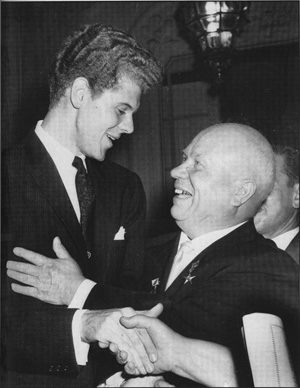
vancliburn kruschev300Van Cliburn is greeted by Nikita Khrushchev in Moscow, 1958 (Courtesy of Van Cliburn Foundation).Cliburn shot to fame at age 23 by winning the 1958 International Tchaikovsky Competition – and with it the hearts of Nikita Khrushchev and the Russian people. It was said the accomplishment did more to ease Cold War tensions than any diplomacy could.

The man who was 78 when bone cancer claimed his life is also recalled as a great humanitarian, philanthropist and friend. His generosity included a sizable donation to help Broadway Baptist Church purchase the Rildia Bee O’Bryan Cliburn Organ, with 191 ranks and 10,655 pipes — the largest organ in Texas — named after Cliburn’s mother and completed in 1996.

“We have lost a giant,” said long-time friend Tom Stoker, who was the minister of music at Cliburn’s home church in Fort Worth in the 1990s. “People of this generation do not understand that Van did as much as anybody to thaw the Cold War – and he did that carrying Christ in his heart.”

‘Spiritual beacon’

Later generations may not know it, but Cliburn was an international sensation in his 20s. It was six months after the Soviet Union launched Sputnik that he arrived in Moscow for the first-ever Tchaikovsky competition. With much the same fanfare that comes today with “American Idol,” he captivated Russians and Americans alike as he won round after round.

He was met with a ticker tape parade in New York City upon his return and soon graced the cover of Time Magazine as “The Texan Who Conquered Russia.”

His fame and success didn’t stop there. He performed for heads of state around the world, his concerts were sell-outs and public sightings of him reportedly caused riots. His recording of a Tchaikovsky piano concerto sold so many copies it went platinum.

Several news obituaries quote Cliburn describing classical music as “a spiritual beacon for people all over the world.”

‘A quiet person’

vancliburn medalVan Cliburn is awarded the Presidential Medal of Freedom by George W. Bush in 2003 (Courtesy of the Van Cliburn Foundation)Those who knew Cliburn best say the similarities between the spiritual and musical was no passing metaphor for the life-long, devoted Baptist. But it’s also little known, at least publically, because Cliburn was not one to boast about matters of faith.

“When he was in town he showed up here on Sunday mornings – but not in a way that called attention to himself,” said Brent Beasley, pastor of Broadway Baptist Church.

“He would just slip in the back,” Beasley said. “He was a quiet person.”

Cliburn worshiped at Broadway since 1995 after moving to Fort Worth from New York City. He kept a low profile in the congregation, preferring to contribute financially to music and other ministries rather than being a performer.

“When we would have a large orchestra in worship, most of our ability to do that was from Van’s generosity,” Beasley said. “He provided for a lot of classical music to have a presence in our worship.”

‘Pray without ceasing’

Stoker said Cliburn’s faith wasn’t the kind that came later in life, or even with his cancer diagnosis in August 2012. When studying at Julliard he played the organ at Calvary Baptist Church in New York – and even lived upstairs from the church in the hotel it owned.

“He prayed before every concert, and there was never a meal in Van’s house that was not blessed,” Stoker said. “He lived his life out of his faith, and he lived life large.”

Shortly after his diagnosis last summer, Cliburn told Beasley that prayer was holding him up after getting the news. “He said one of the most profound truths is … to ‘pray without ceasing – that is how I lived my life.’”

Just a day before his death, Cliburn was praying and reading scripture, Beasley said.

“He said he wasn’t afraid of death because of his faith,” Beasley said. “He jokingly said he’s more afraid of living than dying.”

Cliburn the evangelist

Cliburn learned that approach to faith growing up Baptist in Texas and Louisiana, said Al Travis, director of music ministries and organist at Broadway Baptist.

Cliburn was born Harvey Lavan Cliburn Jr. in Shreveport in 1934 and moved to Kigore with his family when he was 6. There, his father was the Sunday school superintendent at First Baptist Church and his mother the organist.

“He spoke of his gratitude for growing up the son of parents who loved each other and for being raised in the church,” Travis said. “He was grateful for the old hymns of the church .”

Cliburn’s love of music cannot be understood apart from his Baptist faith, because he saw his talent the same way he saw his money — as temporary gifts from God, Travis added.

In that way, Travis said, Cliburn’s music and performances were his way of doing evangelism. “He had a sense of responsibility of sharing that gift with the world and thought his gift would make the world a more humane place.”

Cliburn was also Broadway’s most famous gay member, though little was said about his private life except for a palimony lawsuit brought against him in 1996 that was eventually dismissed. In 2009, the Southern Baptist Convention revoked the church’s membership after an unprecedented investigation by SBC leaders into whether media reports about the congregation’s inclusiveness placed it in violation of a policy banning churches that “act to affirm, approve or endorse homosexual behavior.”

Funeral services for Van Cliburn will begin at 3 p.m. Sunday, March 3, at Broadway Baptist Church. A public viewing will be held from 4 to 6 p.m. Saturday, March 2, at the church.


Fred Luter to speak at DBA conference

dba logo150Fred Luter Jr., pastor of Franklin Avenue Baptist Church in New Orleans and president of the Southern Baptist Convention, will speak at the March 4 Dallas Baptist Association Pastor’s Conference.

The noon meeting will be held at Lakeside Baptist Church, 9150 Garland Road, in Dallas.

The meeting is open to everyone, and the cost of lunch is $7.


Solar panels for TBM benefit orphans in Haiti

A recent gift to Texas Baptist Men provided solar panels that not only will supply volunteer builders the power they need to build cottages for Haitian orphans, but also will provide the orphanage an ongoing source of electricity.

solarpanels check300Bart Mills (left), representing the board of directors of A Better World Foundation, presents a $130,000 grant to Mickey Lenamon, associate executive director of Texas Baptist Men, to provide solar-generated electricity for an orphanage under construction in Haiti. (PHOTO/Courtesy of A Better World Foundation)A Better World Foundation, a Dallas-based nonprofit humanitarian organization, granted $130,000 for an emergency power unit that contains more than 130 advanced-technology solar panels. Clean Energy Constructors of Arizona, manufacturer of the solar units, made its product available to the foundation for TBM’s use.

The solar unit was developed as a prototype for military use in rugged areas of Iraq and Afghanistan, so it will provide a low-maintenance power source for the orphanage in Haiti, said Terry Henderson, TBM state disaster relief director.

solar panels settup400Texas Baptist Men volunteers assemble an emergency power grid that will provide electricity to make possible construction of a home for orphans in Haiti and supply ongoing power for the orphanage. (PHOTOS/Courtesy of Texas Baptist Men)TBM volunteers are building 12 cottages for children orphaned by the earthquake that devastated Haiti three years ago—the first phase in a plan to build 35 homes for children and widows, as well as dormitory space for teachers. Progress on the building project has been slow in part due to lack of electricity for power tools—a problem the solar panels should solve.

The January 2010 earthquake resulted in more than 220,000 deaths, and it left 50,000 children orphaned and about 1.5 million people homeless.

Long-term, TBM plans to help Haiti’s recovery by providing leadership and guidance in education, micro-enterprise, agriculture and medicine.


Board OKs committee to study sale of Baptist Building

DALLAS—The Baptist General Convention of Texas Executive Board voted to create a committee to study the potential sale of the Baptist Building in Dallas.

The board authorized the BGCT president, along with the chair and executive director of the Executive Board, to serve on and appoint the committee, which also will include two board representatives and three at-large members. The associate executive director and the treasurer/chief financial officer will serve as ex officio members of the committee to study a possible building sale and staff relocation.

“The executive director has been approached about the possibility of selling the Baptist Building. The potential buyer seems to have a serious interest. Based on this, the formation of an ad hoc committee to study any offer and to study possible relocation possibilities seems advisable at this time,” the board’s administration support committee reported.

Baylor interested

Executive Director David Hardage told the board Baylor University had expressed interest in the BGCT Executive Board property as a possible site for its expanded Louise Herrington School of Nursing.

According to the recommendation approved by the board, the study committee will provide periodic progress reports and a final report as soon as possible to the Executive Board through its administration support committee.

The $11.5 million Baptist Building was constructed in 1988 at 333 N. Washington on land leased from Baylor Health Care System. The BGCT Executive Board used proceeds from the sale of property in downtown Dallas, combined with trust funds, to finance construction without using any Cooperative Program mission money. Ten years later, the health care system’s board of directors voted to give the land, valued at $2.5 million, to the BGCT Executive Board.

Forgive BUA debt

In other business, the Executive Board approved a plan to forgive debt Baptist University of the Américas owes the BGCT. Pointing to BUA’s primary mission to train Hispanic Baptist pastors and church leaders, Richard Rogers of Huntsville, chair of the administration support committee, called the debt-forgiveness plan “a chance to invest in the future of a changing Texas.”

BUA carries $9.8 million in debt, with more than $3 million owed to the BGCT. The plan offers a dollar-for-dollar forgiveness of every dollar BUA raises from donors toward debt the school owes the BGCT.

Also, when the school sells its old campus property, each dollar used to retire debt BUA owes Frost Bank will earn the school a dollar of debt forgiveness from the BGCT toward the amount owed on loans to the state convention. The BGCT guaranteed more than $3.4 million in loans from Frost Bank to BUA.

The BGCT Executive Board anticipates BUA should be able to retire loans from the BGCT in three to four years.

Honored Suzii Paynter

The board honored Suzii Paynter for her service as director of the Christian Life Commission, director of public policy and leader of the BGCT Advocacy/Care Center. She recently was elected executive coordinator of the national Cooperative Baptist Fellowship.

In her final legislative update to the board, Paynter introduced Stephen Reeves, Austin-based legislative counsel for the CLC, as director of public policy.

The board also voted to:

• Establish a missions mobilization coordinating team to advise and assist in development, implementation and promotion of state, national and international missions initiatives. The team will include at least three representatives from the BGCT Executive Board, with one appointed as chair by the board’s executive committee.

The team—approved by the BGCT Executive Board—also will include representatives from Texas Baptist Men, Woman’s Missionary Union of Texas and the Go Now Missions student missions program, along with an associational director of missions, a BGCT institution whose responsibilities include missions, the BGCT Executive Board staff liaison to associations and two at-large members from BGCT-affiliated churches.

• Use $250,000 from the J.K. Wadley Mission Fund to replace funds from the Southern Baptist Convention’s North American Mission Board that are being phased out and redirected to church-starting efforts in parts of the United States where Southern Baptists do not have a strong presence.

The board also directed the BGCT Executive Board staff to request that half of the funds the BGCT provides be designated to the Minnesota-Wisconsin Baptist Convention and half to the Baptist Convention of New England, longtime partners with the BGCT.


Texas’ changes require Baptists to do ‘whatever it takes,’ Hardage insists

Texas Baptists must be willing to do “whatever it takes” to share Jesus’ message of life with their fellow Texans, David Hardage told leaders from across the state Feb. 25.

Hardage described the state of the state and then focused on the future during the Baptist General Convention of Texas Executive Board’s winter meeting in Dallas.

David Hardage“Texas is changing—probably faster than we could have ever imagined,” noted Hardage, the BGCT’s executive director. “From 2000 to 2010, the population increased by 4.3 million—a 21 percent increase in 10 years.”

That’s equivalent to adding the entire state of Kentucky to Texas in just one decade, he said.

During those 10 years, the Hispanic population increased almost six times as fast as the Anglo population, he noted, adding Houston already is the most culturally diverse city in the nation.

Across the past decade, “we’ve not done poorly,” he said of Texas Baptists. “Our numbers increased by 203,000. That’s a 6 percent increase. But a 6 percent increase in our numbers, and a 21 percent increase in the population—that stands out to me.”

Meanwhile, Texas Muslims increased by 211,000 adherents, he said.

The proportion of Baptists in the state population has fallen steadily—from 19 percent in 1990, to 17 percent in 2000, to 15 percent in 2010.

“I don’t particularly care for that trend,” Hardage acknowledged.

By 2018, Texas’ population will increase another 4 million—equivalent to “bringing everybody from Oregon here,” he predicted. And the demographics will continue to shift, with Hispanics comprising 45 percent of the overall population, followed by Anglos, 39 percent; African-Americans, 10 percent; Asian-Americans 4 percent; and the balance “a wide variety of ethnicities, nationalities and people groups.”

“Texas is changing rapidly,” Hardage said. “It’s an enormous issue for us. So, we’ve got … challenges.”

Despite changing population, demographics and religions, some things never will change for Texas Baptists, he stressed.

“Our mandate never will change,” he said. “In the Great Commission, we are expected to go. We are instructed to do two things—baptize and teach. But what are we commanded to do? Make disciples of all nations.

“It strikes me as an amazing thing God is doing—making it easier to make disciples of ‘all nations’ by bringing them to our doorstep,” he added, pointing to the state’s widening racial and ethnic diversity.

In addition to an unchanging mandate, Texas Baptists’ message will not change, Hardage insisted.

“I’m going to sum up that message in one word,” he said. “Our message is ‘life.’”

That includes everlasting, eternal life with God through belief in Jesus, Hardage noted. But it also involves abundant life in the here-and-now.

Still, Texas Baptists must acknowledge change and ask, “What’s next?” Hardage advised.

“The future of Texas Baptists and the future of Texas lay in the balance of what’s next,” he said. “Probably, some things must change.”

Hardage noted the convention’s Executive Board is involved in institutional change. He presented a new organizational chart—to be implemented within the week—that eliminates one level of management. He advocated cooperation among Texas Baptists, which can enable them to “do more … as a team than any of us can do alone.” He called for them to embody generous spirits. And he referenced an expected study committee that will consider whether the convention should sell its Baptist Building in Dallas and move the Executive Board staff elsewhere.

But those changes may be only the beginning of what is required to share life in Christ with all Texans, he conceded.

“Going forward, I’m not sure what else might need to change. But for me, everything is on the table,” he said.

“When I look at those (demographic) statistics and drive through our state and look at Texas, I cannot look without saying, ‘Whatever it takes.’ The stakes are too high for us as Texas Baptists not to have that spirit. …

“Would you join me in praying: ‘God, show us what is next. What do we do? Where do we go?’ The stakes are too high. … I’m excited about the future.”