Indigenous leaders sue under Texas religious liberty act
December 11, 2024
AUSTIN (RNS)—For Gary Perez and Matilde Torres, like their ancestors before them, the river bend in Brackenridge Park in South Texas is more than the oak trees along the riverbank, the slow-moving water and the stars arrayed above at night. It is a sacred place, where the resident cormorants, they believe, take their prayers to the heavens.
That is why, when the city of San Antonio decided to remove 69 of 83 trees and prevent bird nesting in the river bend to allow the remodeling of a wall, Perez and Torres, ceremonial leaders of the Lipan-Apache Native American Church, sued to protect it on religious grounds.
Last week, the Texas Supreme Court heard their lawsuit challenging the city’s actions under a state constitutional amendment approved by Texas voters in 2021 to deal with restrictions on religious services imposed by local officials during the COVID-19 pandemic.
The Religious Services Amendment to the Texas Constitution says the state or a political subdivision of the state “may not enact, adopt or issue a statute, order, proclamation, decision, or rule that prohibits or limits religious services.”
John Greil, an attorney and professor at the University of Texas law school’s Law & Religion Clinic, represents Perez and Torres in Perez v. City of San Antonio. He noted Perez and Torres are the first claimants to bring a suit under the Religious Services Amendment, giving the court’s decision in the case significant weight as a precedent.
“If 20 years down the road, there’s some emergency and cities start putting in new orders that would affect religious services, this case will determine how that amendment gets applied in the future,” Greil told RNS.
Perez and Torres perform their ceremonies at a part of the park known as Lambert Beach, they explained, because of their people’s ancestral connection to the land.
They consider the waters, birds, trees and constellations above a “sacred ecology” and a tenet of the Native American Church. They believe that the San Antonio River bend is central to their creation story, which combines Indigenous and Christian traditions.
“Imagine removing the Old Testament and trying to surmise what happened within the New Testament,” Perez said. “By removing the trees and the birds, and destroying this spiritual ecology, there’s no reference back to the Old Testament. There is no hope.”
The two appellants’ brief asserts that for thousands of years, Indigenous peoples in Texas have worshipped at this river bend, a sacred site where hieroglyphics more than 4,000 years old have been discovered.
The brief argues worship cannot be done elsewhere, because the specific attributes to the place are crucial to their ceremonies. If the trees are obstructed, if the birds are removed, Perez and Torres’ ability to worship would be gone forever.
“The city of San Antonio has chosen a construction design that will remove all but 14 of the 83 trees at the bend … without any consideration of the plaintiffs’ religious exercise,” Greil said before the Texas Supreme Court on Dec. 4.
A spokesperson for the city of San Antonio said the city’s current plan includes “a reduction in the number of trees planned for removal from 105 trees to 77 trees for Phase I and II of the project. Forty trees will be relocated rather than removed altogether and approximately 270 trees will be planted on site.”
At the hearing, Texas Deputy Solicitor General William Cole argued that the amendment was “not a Swiss Army knife of religious liberty,” and “the amendment’s scope is designed to protect the right to gather.”
Around the State: HPU earns top Model UN honors
December 11, 2024
The Howard Payne University Model United Nations team recently took home three of the top five honors, including the top team at the Northwest Model United Nations Conference in Seattle, Wash. The HPU team won outstanding delegate in the beginner committee, outstanding delegate in the intermediate committee and the “Outstanding Delegation” award. Model U.N. is a simulation in which students from various schools participate as delegates of assigned countries. They then advocate for their country’s perspective on an issue. The goal is for students to experience how countries with different viewpoints would attempt to reach peaceful solutions to international issues. Sophomore Maddie Duncan, Guy D. Newman Honors Academy and psychology major, was named the Outstanding Delegate in the General Assembly, out of 50 students. Senior Hannah Parnell, Honors Academy and psychology major, was named Outstanding Delegate in the Economic and Social Committee, comprised of 36 students who all had competed in Model U.N. conference before. Senior Sadie Willie, Honors Academy and jurisprudence major, coach and head delegate of the team, helped prepare the team for the competition, half of whom never had competed before. Additional HPU team members include Andrew Mathis; Kellen McKee; Hannah Jordan; Michael Jones; and Madison Jenkins. There were 132 students from multiple countries and 10 other universities who participated in the conference, including the eight students from HPU.
East Texas Baptist University has been awarded a $2,208,000 grant from the U.S. Department of Education’s Strengthening Institutions Program. The Title III grant will be dispersed over the next five years to enhance ETBU’s academic support initiatives and student success programs. (ETBU photo)
East Texas Baptist University has been awarded a $2,208,000 grant from the U.S. Department of Education’s Strengthening Institutions Program. This Title III grant, titled Project G.P.A.—Grow! Perform! Achieve!, will be dispersed over the next five years to enhance ETBU’s academic support initiatives and student success programs. The Strengthening Institutions Program is designed to help eligible higher education institutions become self-sufficient and expand their capacity to serve low-income students. By providing funds to improve and strengthen academic quality, institutional management and fiscal stability, the program enables universities like ETBU to deliver a transformative education while addressing the unique challenges faced by their student populations. The funding will allow ETBU to implement initiatives to improve student retention and success, with a particular focus on first-year students, student-athletes and Pell Grant recipients. Plans include renovating the Jarrett Library to create a centralized academic supportspace, equipping students with a collaborative environment designed to foster learning and development. The university also will expand its academic support services by hiring additional peer tutors and academic coaches for student-athletes to improve academic performance and increase four-year graduation rates. One hundred percent of these initiatives will be funded by the grant.
Houston Christian University’s inaugural Narrative Arts Conference is scheduled Jan. 18, 2025, in HCU’s Morris Family Center for Law & Liberty. The conference will feature guest speakers who explore the craft of storytelling in fiction, film, video games and more. With acclaimed songwriter and novelist Andrew Peterson opening the conference and featured sessions with bestselling author Bret Lott, Emmy Award-winning actor Tony Hale, and groundbreaking game designer Chris Skaggs, the Narrative Arts Conference will help writers and artists explore how to develop narrative skills, navigate creative industries and pursue excellence in community. Anchored by a shared Christian foundation, the department of narrative arts and conference guests hope to inspire and encourage a new generation of storytellers. Bret Lott will also give a free public reading in Belin Chapel at 7 p.m. on the Friday evening before the conference begins. For further information, visit https://hc.edu/narrative2025 or call 281-649-3600.
Hardin-Simmons University’s Cowgirl basketball team won the 200th game of head coach Kendra Whitehead’s career on Wednesday night, defeating Pacific University 78-73 in overtime. The Cowgirls fell behind heading into the half 39-31 to the Pacific Boxers. HSU came back in the second half and pushed the game to overtime 65-65. The Cowgirls outscored Pacific 13-8 in overtime to win 78-73. Aiken Semones scored 14 points for HSU, including six points in overtime. Jacqueline Berry led the team in scoring with 20 points and had 11 rebounds. Transfer Caroline Croft had 11 points for HSU and led with four assists. MaeSyn Gay led the Cowgirls in rebounding with a career-high 19 rebounds. Whitehead won No. 200 in her ninth season as a head coach and seventh year back at HSU with an overall record of 200-52.
Wayland Baptist University hosted the Greater Plainview community for “Lighting Up Wayland,” Dec. 5, for an evening of holiday cheer. (Wayland photo)
Wayland Baptist University hosted the Greater Plainview community for “Lighting Up Wayland,” Dec. 5, for an evening of holiday cheer. The celebration immediately followed Plainview’s lighted downtown Christmas parade. The university joined the parade with a float featuring Micah Rodriguez Vega, Miss Wayland 2025, and Wayland PresidentDonnaHedgepath. The float led those at the parade to the Wayland campus. “Lighting Up Wayland” festivities included Hedgepath reading the Christmas story from the Bible to children and the ceremonial lighting of historic Gates Hall. The university’s choirs and staff led Christmas carols. Additional highlights included a visit from Santa Claus, delicious treats and hot cocoa, and plenty of festive photo opportunities around the illuminated campus.
Fall commencement
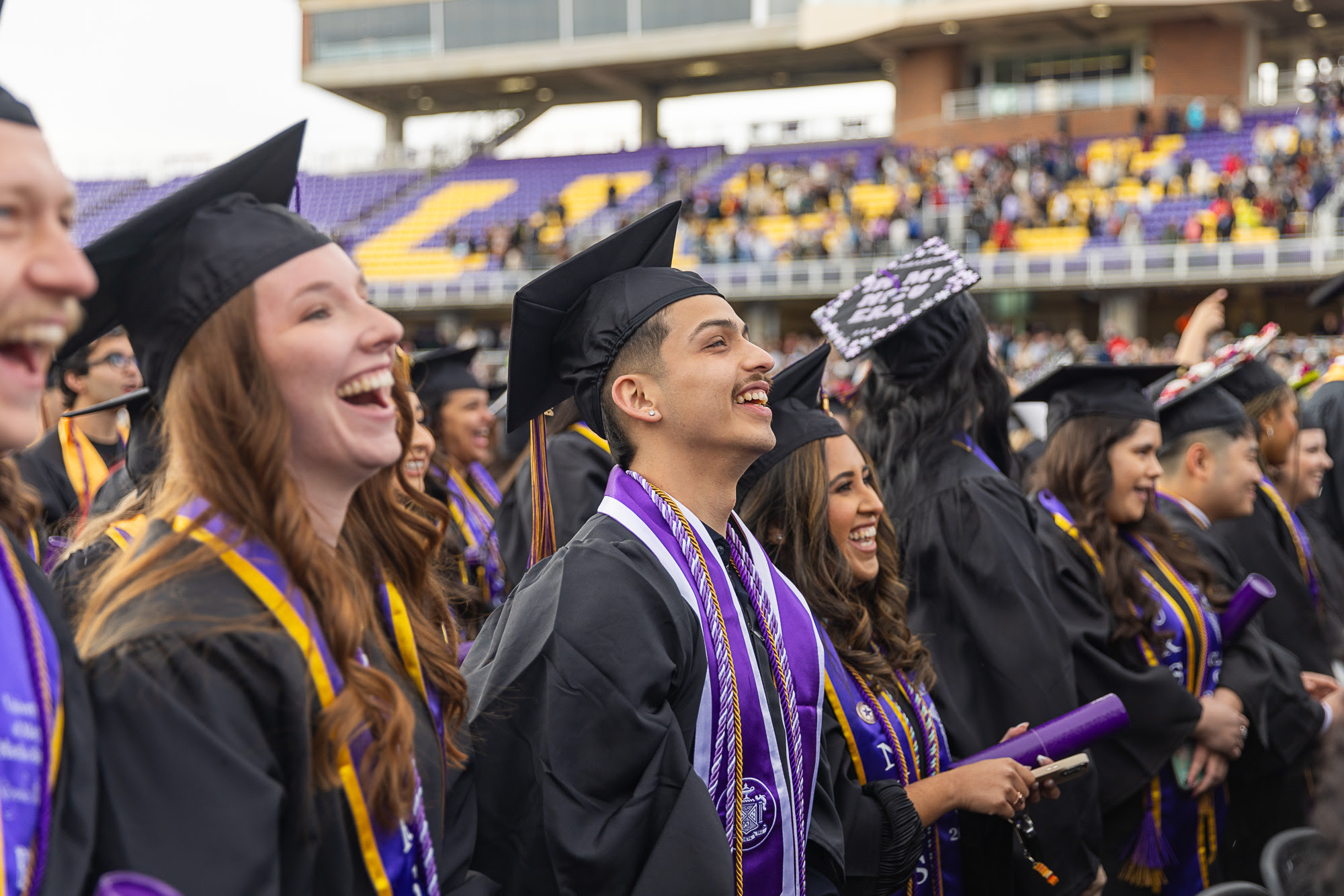
UMHB graduates celebrating during commencement ceremony. (UMHB photo)
The University of Mary Hardin-Baylor held commencement services for the Fall 2024 semester at Crusader Stadium. This was the university’s 168th graduating class, and an estimated 411 students were awarded degrees, including 295 baccalaureate degrees, 79 master’s degrees, and 37 doctoral degrees. Student recognitions during the ceremony included the Provost Medal for highest overall GPA, which was awarded to nine students who each graduated with perfect 4.0 grade point averages: Caroline Allen of San Antonio; Selah Marie Bentz of Fallbrook, Calif.; Gerald Adam Brady of Temple; Andrew Huneycutt of Leander; Rachel Leslie of Temple; Robert Benjamin Mills of Longview; Elise Ott of Cedar Hill; Emma Noelle Vaught of League City and Presley Shane Wall of Decatur. Yanelle Licona of Taylor received the President’s Award, presented to the graduating senior who has provided meritorious service to the university. The Loyalty Cup, awarded to the student most representative of the university’s ideals, traditions and spirit, was given to two students—Victoria Hernandez of Robstown and Isabella Ross of Katy.
Scholar and educator Karen O’Dell Bullock was awarded an honorary doctorate during the second commencement ceremony, where she also delivered the keynote address. (ETBU photo)
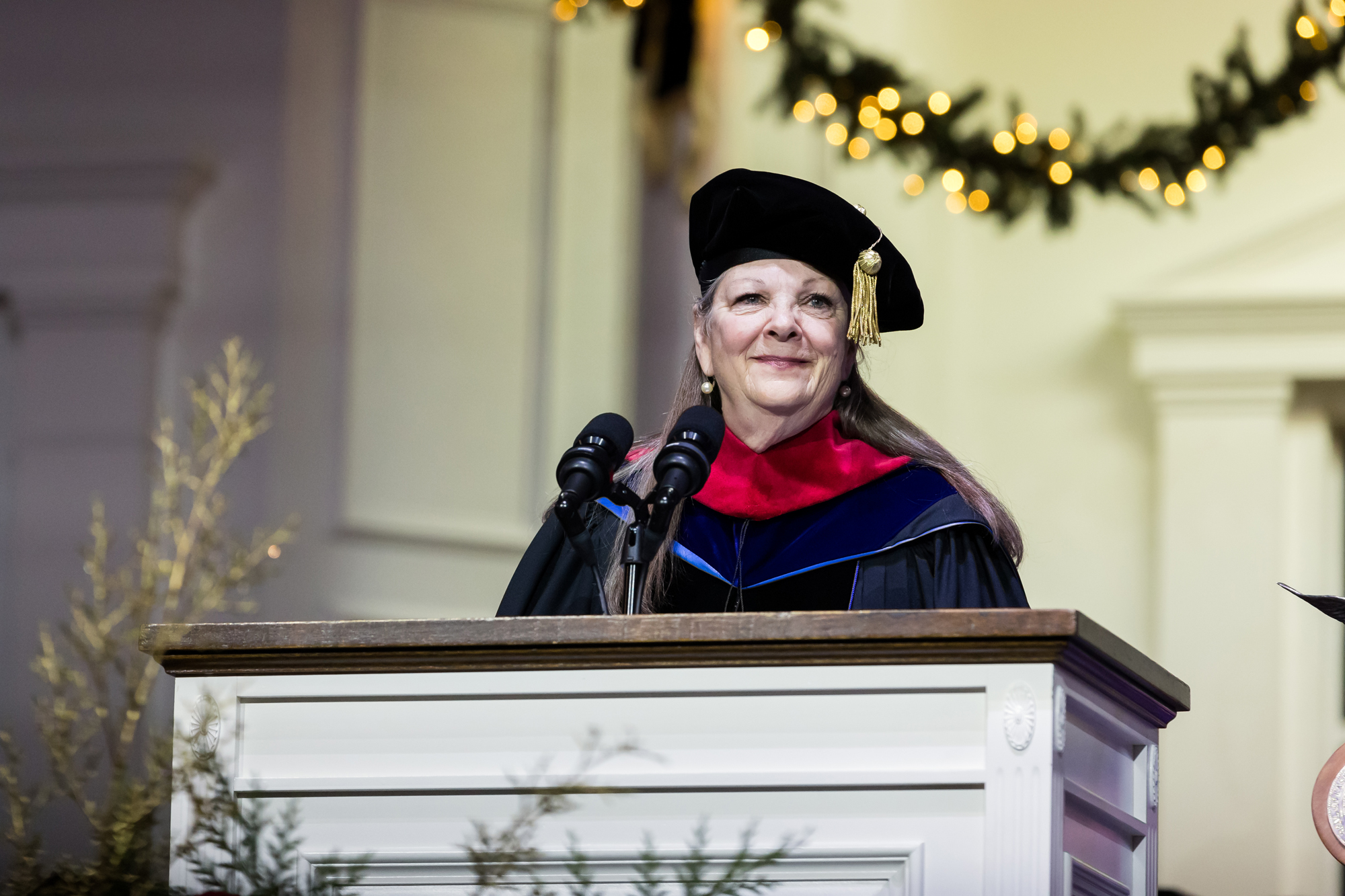
East Texas Baptist University celebrated 202 graduates at its commencement ceremonies, conferring degrees to 140 undergraduate and 62 graduate students. The December 2024 graduating class marked the largest fall class in ETBU history. U.S. Sen. Joe Manchin from West Virginia delivered the commencement address during the morning ceremony, urging graduates to embrace their calling and approach life with a spirit of unity and collaboration. In the afternoon ceremony, Karen O’Dell Bullock was awarded an honorary doctorate and delivered the keynote address. Bullock has taught at the undergraduate, master’s degree and doctoral levels for more than 30 years. She held leadership roles at Southwestern Baptist Theological Seminary, Dallas Baptist University and B.H. Carroll Theological Seminary, where she recently retired but continues teaching and mentoring doctoral students. Bullock serves as executive vice president of the Baptist Center for Global Concerns, addressing global inequities through leadership training, agricultural projects and medical clinics. She is a passionate advocate for Christian heritage, missions and justice, and also chairs the Baptist World Alliance Commission Council. Each semester, ETBU President J. Blair Blackburn presents an award to a graduate who represents a Christian leader, scholar and servant on campus and in the local community. Hannah Hobson, a Bachelor of Arts graduate in worship studies, was honored with the President’s Award for the Fall 2024 graduating class. A native of Shreveport, La., Hobson maintained a perfect 4.0 GPA throughout her time at ETBU and has been a cornerstone of ETBU’s Chapel Bands for the past three and a half years.
Hardin-Simmons University will host its December commencement ceremonies at the Abilene Convention Center at 10 a.m. and 2 p.m. on Dec. 16. The College of Health Professions, Holland School of Sciences and Mathematics, and the Patty Hanks Shelton School of Nursing will be included in the morning ceremony. Kelley College of Business and Professional Studies, the College of Arts and Media, and the Cynthia Ann Parker College of Liberal Arts will be included in the afternoon ceremony. A livestream will be available on the day of commencement on the university’s YouTube page.
Sixty-one Wayland Baptist University students are scheduled to participate in commencement ceremonies at 2 p.m., Dec. 14, at Hutcherson Center on the university’s Plainview campus. Candidates for graduation include two students scheduled to receive doctoral degrees, 20 students set to receive master’s degrees, 38 students planning to receive bachelor’s degrees and one student set to be awarded an associate’s degree. Livestream coverage of the ceremony will be available here.
Prayer and neighborliness key to Sanderson’s recovery
December 11, 2024
In the six months after tornadoes struck Sanderson, residents of the small West Texas town have “pulled together” and made strides toward rebuilding, Pastor Mike Ellis said.
Ellis, pastor of First Baptist Church in Sanderson, credited two factors in the successful recovery and rebuilding efforts—“neighbors helping neighbors” and the prayers of God’s people around the state.
The June 2 tornadoes destroyed or seriously damaged multiple buildings in town, but the First Baptist Church facility escaped without even a broken window.
Jessica and Chase McCrory, members of First Baptist Church in Sanderson, stand outside their home that was hit by a tornado on June 2. (Photo / David Vela / Texas Baptists)
Jessica and Chase McCrory and their two young sons lost their home to the tornado, but they are “on the road to recovery,” Ellis said.
The McCrory family—members of First Baptist Church—have been working with their insurance company and a contractor not just to rebuild the home they lost, but to construct the home their young family dreamed of having.
Before the contractors hung drywall in their home, the McCrory family of Sanderson invited members of their church to use permanent markers to write Bible verses and other words of blessing on the boards between studs. (Courtesy Photo)
The couple enlisted a contractor to build a barndominium—a structure blending traditional barn architecture with modern living areas—set back 10 feet further from the road than their previous home had been.
“Chase McCrory would be the first to say: ‘God is good. God had a plan,’” Ellis said.
When McCrory decided to install all of the insulation in the house himself as a cost-cutting measure, volunteers from First Baptist Church helped him, Ellis noted.
Before the contractors hung drywall in their home, the family invited members of the church to use permanent markers to write Bible verses and other words of blessing on the boards between studs, he added.
Ellis serves First Baptist Church bivocationally, working as an electrical, plumbing and building contractor.
As the self-described “only licensed electrician in town,” he and his grandson worked 16-hour days for the first month after the tornado, helping their neighbors restore power to their homes.
“My grandson had been talking about wanting to become an electrician. I think he may have reconsidered,” Ellis said.
The local coffee shop plans its grand reopening in two weeks, and other businesses in town either have reopened or plan to in the near future, he noted.
Ellis, who served in “tornado alley” during his 20 years working in the Texas Panhandle and Oklahoma, had extensive experience with natural disasters and was trained in emergency management.
“In all that time, I had never seen a group of people who jumped in and started helping each other quite like the folks here,” he said. “Everybody pulled together. It’s neighbors helping neighbors.”
In the days immediately after the tornado hit, members of First Baptist Church worked side-by-side with volunteers from other local churches to provide meals to families affected by the tornadoes.
The Buena Vista Independent School District in Imperial sent two busloads of student volunteers to help clear debris on a Saturday soon after the tornado struck Sanderson.
“We had people from as far away as Stephenville who sent trailers filled with building materials,” Ellis said. “And people are still helping one another.”
Ellis credits the resilience of local residents in large part to the prayer support they received from Christians throughout Texas.
“Those prayers were felt,” he said. “They’re still being felt, and the answers to those prayers are still being seen.
“God’s grace has been on us. He was with us through it all.”
Hartford: Most congregations avoid discussing politics
December 11, 2024
(RNS)—Despite the incessant tracking of evangelical Christian, Latino Catholic, Muslim and other religious groups through the recently ended election season, a study released on Election Day by the Hartford Institute for Religion Research showed that most congregations are politically inactive, with nearly half actively avoiding discussing politics at their gatherings.
The Hartford report, “Politics in the Pews? Analyzing Congregational Political Engagement,” focused on how congregations as a whole deal with politics, not religious individuals or their clergy alone.
“Congregations often get left out of conversations about religion and politics but are inferred to be influential,” the report states.
Even if members are politically active and many leaders are often outspoken about issues and candidates they support, most congregations make great efforts to keep politics out of the church.
“When they come together as a spiritual community, they don’t want politics directly involved. There’s a lot of pushback from the people in the pews,” said Scott Thumma, director of the Hartford Institute for Religion Research, who co-wrote the report with Charissa Mikoski, an assistant research professor.
The study’s data was drawn from a larger project developed by the institute to track congregational change, Faith Communities Today. It relies on surveys of 15,278 congregations conducted in early 2020. Responses were given by congregation leaders on behalf of their assemblies.
According to the report, 23 percent of congregation leaders identified their congregation as politically active, but only 40 percent engaged in what the report calls “overtly political activities” over 12 months, mostly infrequently.
The report measured congregations’ level of political engagement by looking at seven categories of political activities, including distributing voter guides, organizing protests in support or opposition of a policy, and inviting a candidate to address the congregation.
A minority of congregations engage in any of the above; 22 percent handed out voter guides; 7 percent asked a candidate to speak to the congregations; and 10 percent lobbied for elected officials.
Pastors see political discussion as tricky business
In nearly half of congregations—45 percent—their leaders thought most participants didn’t share the same political views, making politics a sometimes treacherous topic. Discussing politics is also tricky for pastors, the report found, as they risk offending members whose views don’t align.
Not surprisingly, “purple congregations,” in which both political parties are represented in the pews, were more likely to avoid political discussion than politically homogenous ones, per the report. Congregations where politics previously spurred conflicts—the case in 10 percent of the congregations surveyed—were less likely to engage in any of these activities again.
The results clash with the general narrative about Christians’ political engagement, especially stories of evangelicals’ avid political engagement. According to Hartford’s report, however, Catholic and Orthodox parishes are more engaged than Protestant churches.
“Further, the congregations who are engaged in these kinds of political activities do not fit the broader narrative of Evangelical Protestants being more politically active,” the report said. “While these connections are present at the individual level, it does not appear to be happening at the organizational (congregational) level.”
Instead of directly addressing political issues, the closest most congregations get to political discussion tends to be sermons that uphold specific values associated with particular political issues, such as immigration or abortion.
Congregations whose membership is more than 50 percent Black or African-American are more likely to be politically active, reflecting Black churches’ historical political involvement, especially in the fight for racial justice.
“It’s almost built into the DNA of an African American congregation to have that kind of activism approach,” Thumma said.
Since these congregations are more homogenous, members may also feel more comfortable addressing politics, assuming other congregants have the same politics.
The survey sample included 2,000 multi-ethnic congregations and churches, where 20 percent of participants were not of the dominant race. Their results were similar to those of non-multiracial churches, with 60 percent reporting having no involvement in politics.
Dan Darling: Ukrainian church and people resilient in war
December 11, 2024
KYIV, Ukraine (BP)—Ukrainian Christians are resilient in the lingering war with Russia and yet optimistic of “a just peace,” Southern Baptist Dan Darling said on the heels of a weeklong tour of Ukraine and Poland.
“I was inspired by the resilience of the church in Ukraine,” Darling told Baptist Press. “I talked to one pastor who said that God is doing really good work. Their churches are growing, even in the midst of war.”
Darling, director of The Land Center for Cultural Engagement at Southwestern Baptist Theological Seminary, was among a dozen evangelical leaders and religious freedom advocates invited on the tour sponsored by Defenders of Faith and Religious Freedom in Ukraine Dec. 1-7, focused on encouraging the Church in Ukraine.
A church is destroyed by Russian shelling in Orikhiv, Zaporizhzhia region, Ukraine, on May 20, 2024. (Photo by Ukrinform/NurPhoto via AP)
Just two months from the war’s third anniversary, Russia has destroyed, damaged, seized or looted at least 640 houses of worship in Ukraine, according to Defenders of Faith Ukraine research.
Not a single evangelical church remains in Russian occupied territories, the group said, and believers are banned from worship.
Even so, the church is seeing new growth, planting new congregations, helping displaced Christians and drawing new believers.
“Church leaders made a really strong moral case for Ukraine’s survival,” Darling said. “They view Ukraine—and I think it’s an accurate view—in many ways as the Bible belt of eastern Europe. They actually feel that Russia’s attack on Ukraine, that there’s a spiritual dimension to it.
“It’s trying to shut down really good evangelistic work around eastern Europe. They made a really strong case for Ukraine.”
Ukraine’s victory is crucial in saving evangelism’s presence in the region, pastors believe.
Darling and others in the delegation met with numerous evangelical and Christian leaders, including Igor Bandura, vice president of the All-Ukrainian Union of Churches of Evangelical Christians-Baptists; representatives of the multidenominational Ukrainian Council of Churches and Religious Organizations; representatives of Ukrainian Baptist Theological Seminary in Lviv; and leaders of Save Ukraine, a ministry serving families and children damaged by the war.
Darling delivered remarks, along with Ukrainian President Volodymyr Zelenskyy, at the first Ukrainian Military Prayer Breakfast at the Refectory Church of the Kyiv-Perchersk Lavra on Dec. 5.
He also met with leaders of Ukraine’s Parliament, the Verkhovna Rada, and with evangelical leaders in Krakow, Poland, where Ukrainian refugees have been received warmly by evangelical churches.
Darling found the trip important because of Southern Baptist missionary work in Ukraine, including individual church missions and the work of Send Relief and the International Mission Board, as well as the importance of religious freedom advocacy in the region.
“I do think it’s in America’s interest to have a free and democratic Ukraine,” Darling said.
Among others taking the trip were Galen Carey, vice president of government relations for the National Association of Evangelicals; Tim Goeglein, vice president of external and government relations for Focus on the Family; Eric Patterson, president and CEO of the Victims of Communism Museum Memorial Foundation; Peter Burns, International Religious Freedom Summit executive director; Ken Blackwell, senior fellow for human rights and constitutional governance with the Family Research Council; Kelly Currie, U.S. ambassador-at-large for global women’s issues under the first Trump Administration; and Annabelle Rutledge, communications coordinator with Concerned Women for America.
Retired pastor on a mission to spread the message
December 11, 2024
Don English spent more than four and a half decades as a pastor on mission, taking more than 50 volunteer mission trips to 14 countries.
After being turned down by what was then the Southern Baptist Foreign Mission Board because of their age, English and his wife Nancy served three years in Ukraine and made 22 trips to Armenia in a dozen years.
Now in their 80s, they still are as committed as ever to mission work, opening their Dallas home to exchange students.
“I always wanted to go to Mongolia. Then Mongolia came to us,” English said.
But now, English feels like God has given him another mission. He wants to share with others what he believes God taught him through an exhaustive verse-by-verse study of Revelation, referring only to other Scriptures—not any commentaries—for guidance.
Bible study, not speculation
Since his early years growing up on a Texas dairy farm, English heard preachers speculate about the End Times.
Many predicted Jesus would return on or before 1988—40 years after the birth of the modern nation of Israel. They were wrong.
Others speculated about the identity of the Anti-Christ, using “666” as their guide and trying to apply it to the names of prominent individuals. They were mistaken.
Some even set dates for Christ’s return, linking current events directly to what they saw as signs of the times in Scripture. Each was proven wrong.
“Some of it is just plumb crazy,” English said.
Nevertheless, he was convinced God gave Revelation for a reason. So, beginning in May 1986, he set out to discover what God revealed in the New Testament’s final book. He was interested in “Bible study, not speculation,” he said.
English—who was pastor of three Texas Baptist churches and one in the Pacific Northwest—set aside the charts, the timelines and the speculation.
Instead, he concentrated solely on the biblical text of Revelation, and then compared it to other prophetic passages in the Old Testament.
After unsuccessful attempts to find a professional writer to record his insights, he finally committed to write a book himself, producing The Message: Mankind’s Final Destiny.
Approach defies easy categorization
“It’s controversial,” English said.
His analysis of Revelation doesn’t fit neatly into any of the typical approaches to understanding the End Times. His perspective is premillennial but not dispensational.
English believes in a Rapture of the church—although he acknowledges the term is not found in Scripture—and a seven-year Tribulation. However, he tends to think Christians will be “caught up” to be with Jesus halfway through the seven years, not prior to its beginning.
He completely rejects the notion of trying to connect the dots between current events and biblical signs in an effort to determine the date of Christ’s return.
“It’s not about calendar dates but about conditions,” he said.
When the family of God—the people of God in the Old Testament era and believers since the time of Jesus who have been redeemed by Christ—is complete, that’s when Christ will return, he concluded.
So, the mission enterprise to which English devoted most of his life and the mission of studying Revelation are more closely linked than they might seem at first glance.
And in spite of its symbols and signs that believers view differently, the final word of Revelation is a message of assurance for Christians in any age.
“Satan and his fallen angels are on death row,” English said. “And God is on the throne.”
Less than half of Americans attend church at Christmas
December 11, 2024
BRENTWOOD, Tenn.—As Americans make their Christmas plans, slightly less than half say they usually attend a church service during the holiday season.
A Lifeway Research study finds U.S. adults are split on whether they’ll be at church sometime this Christmas—47 percent say they typically attend church at Christmastime, while 48 percent say they do not, and 5 percent aren’t sure.
“The very name ‘Christmas’ originates in the church’s celebration of Jesus Christ’s birth. In the mid-14th century, the words ‘Christ’s Mass’ were first merged as a single term for this celebration,” said Scott McConnell, executive director of Lifeway Research.
Pastors plan for larger crowds during the Christmas season. In 2023, Lifeway Research found U.S. Protestant pastors say they usually plan four events or activities at their churches to celebrate Christmas.
About 4 in 5 pastors (81 percent) say Christmas is one of their three highest attendance worship services, according to a 2024 Lifeway Research study. Specifically, 28 percent say Christmas draws the most people to their church.
During the season, churches see more people at their Christmas Eve service than other worship services, a 2022 Lifeway Research study revealed.
Who is most likely to attend?
This Christmas season, 47 percent of Americans say attending church is part of their usual holiday traditions, but some are more likely to show up than others.
Not surprisingly, those who attend church most often—more than once a week—are the most likely (95 percent) to be there for Christmas.
Protestants (57 percent), Catholics (56 percent) and those from other religions (53 percent) are more likely than the religiously unaffiliated (21 percent) to report usually attending a church service. The religiously unaffiliated are the most likely to say no (71 percent).
Americans with evangelical beliefs are far more likely than those without such beliefs to show up to church during Christmas (72 percent v. 40 percent).
What prompts Christmas church attendance?
Most of those attending church at Christmastime say they do so primarily because of their faith. Three in 5 (60 percent) of those who typically attend church during this season say they do so to honor Jesus.
Fewer say their church attendance comes from a desire to observe tradition (16 percent), to be with family and friends (15 percent) or to get in the Christmas spirit (8 percent). Few (1 percent) aren’t sure what motivates their attendance.
“While church services draw more people in the Christmas season, their prime motivation isn’t unified. The majority are drawn to celebrate the birth of Jesus, honoring him as the Christ or promised Messiah. But others mostly join in because of the importance of family, their embrace of Christmas church tradition or to jumpstart Christmas vibes,” McConnell said.
Christians who attend church less often are more likely to say their Christmas attendance comes from tradition. Those who rarely or never attend (22 percent) and those who attend once or twice a month or only on religious holidays (27 percent) are more likely than those who attend about once a week (10 percent) and those who attend more than once a week (6 percent) to say they show up to observe tradition.
Americans with evangelical beliefs are more likely than other Americans to say they attend services to honor Jesus (74 percent v. 53 percent). The religiously unaffiliated are the most likely to say they attend to be with family and friends (42 percent) and to get in the Christmas spirit (21 percent).
Some are just waiting to be invited
Those who don’t typically show up at Christmas may simply be waiting on an invitation. Most (56 percent) say they likely would attend church if someone they know invited them to attend with them at Christmas time, including 17 percent who are very likely.
Around a third (36 percent) say they’re unlikely, including 24 percent who are very unlikely. Another 8 percent say they’re not sure.
“More than 1 in 8 Americans are convinced they would not attend a Christmas service if an acquaintance invited them. However, the majority of Americans who do not typically attend church at Christmastime say they probably would if they were invited by someone they know,” McConnell said.
“But anticipating a positive response may not be the best motivation for a churchgoer to invite people to a Christmas service. A different motivation in the chorus of an African American spiritual appeals to everybody: ‘Go tell it on the mountain that Jesus Christ is born.’ This chorus suggests that the Hallelujah-inspiring good news of Jesus being born is reason enough to tell it on the mountain or on the city wall.”
Catholics (71 percent), Protestants (65 percent) and Americans of other religions (58 percent) who don’t typically attend during Christmas are more likely than the religiously unaffiliated (40 percent) to say they’re likely to attend a service if invited. The religiously unaffiliated are the most likely to say they are unlikely to attend if invited (55 percent).
Christians who already attend church at least occasionally are more likely to show up this time of year if invited. Christians who attend a worship service about once a week (76 percent) and those who attend once or twice a month or only on religious holidays (69 percent) are more likely than those who rarely or never attend (52 percent) to say they’re likely to show up if invited.
Christmas invitations also may be effective for women (61 percent say they’re likely to attend), Hispanics (72 percent), those in Midwest (65 percent) and Northeast (60 percent) and those with evangelical beliefs (69 percent).
Older Americans who don’t typically attend aren’t looking for an opportunity to start. Those 65 and older (48 percent) are the most likely to say they are unlikely to go to a church service with a friend if invited during Christmas.
The online survey was conducted Aug. 14-30, 2024, using a national pre-recruited panel. Researchers used quotas and slight weights to balance gender, age, region, ethnicity, education, religion and evangelical beliefs to reflect the population more accurately. The completed sample is 1,200 surveys, providing 95 percent confidence the sampling error from the panel does not exceed plus or minus 3.3 percent. Margins of error are higher in sub-groups.
Indian Baptist church worker arrested for ‘magical healing’
December 11, 2024
Assam state police arrested a Baptist church worker Nov. 22 on charges of violating a new law intended to curb “magical healing.” The arrest came after he prayed for villagers in the northeastern India state.
Pranjal Bhuyan, was arrested and remanded to judicial custody for 14 days for violating the Assam Magical Healing (Prevention of Evil) Practices Act, 2024, and attempting to convert people to Christianity, the Union of Catholic Asian News reported.
International Christian Concern reported, “locals grew concerned that Pastor Bhuyan had been preaching the Bible to children during sessions, so they prevented their children from going to his house for studies,” a few months ago.
Those parents “filed a complaint with the village police, and Pastor Bhuyan was detained under the Assam Magical Healing (Prevention of Evil) Practices Act.”
Bhuyan is the first person to be arrested since the act came into effect, ICC noted.
History of the bill
On Feb. 26, the Legislative Assembly of Assam passed the Assam Healing (Prevention of Evil) Practices Bill, 2024. The bill’s preamble states its aim is to “bring social awakening in the society and to create healthy, science-based knowledge and safe social environment to protect human health against evil and sinister practices,”
Additionally, it aims to “eradicate non-scientific healing practices with ulterior motives for exploiting the innocent people.”
However, The Hindu news outlet reported the bill was introduced by the “Parliamentary Affairs Minister Pijush Hazarika on behalf of Chief Minister Himanta Biswa Sarma, who had earlier said it was needed to ban magical healing practices with the explicit goal of curbing evangelism.”
The Assam Christian Forum, an interdenominational Christian body, strongly countered the chief minister’s “misguided and misleading” statement that magical healing equals proselytization when the bill was introduced.
“Healing in our context is not synonymous with proselytization. It is a compassionate response to human suffering, irrespective of religious affiliation,” the Assam Christian Forum chief said, according to The Hindu.
Despite opposition from Christian groups, the governor of Assam assented to the legislation March 15.
The Hindu Bharatiya Janata Party of Prime Minister Narendra Modi runs the state government.
“The BJP and its supporters oppose Christian missionary work, considering it a challenge to their aim of establishing Hindu hegemony in India,” according to UCA News.
Prayers for peace amid rising attacks
On March 15, the same day the governor assented to the anti-magical healing act, an interdenominational prayer gathering was held to “unite people from diverse backgrounds under the common goal of fostering peace and harmony,” Matters India reported.
More than 25,000 Christians representing various denominations and from different ethnic and linguistic communities gathered at Udalguri town in Assam and prayed for 90 minutes.
“Troubles began for the Assam Christians in early February when a Hindu group gave Christian schools in Assam an ultimatum to remove from them Christian symbols including religious habits and cassocks.
“Addressing a press conference on Feb. 7, Satya Ranjan Borah, president of the Kutumba Surakshya Parishad (family protection council) threatened dire consequences for Christian schools that defied their 15-day ultimatum.
“After the deadline ended, threatening posters began to appear in front of Christian educational institutions,” the Matters India report said.
ICC noted, “The Assam Christian Forum chief and the Archbishop of Assam have strongly condemned the ‘wrongful arrest’ (of Bhuyan).
“The leaders have unequivocally said that the law’s cognizable and non-bailable offenses grant police the broad authority to arrest and detain anyone without due process, compromising citizens’ rights, even to go to their own relative’s house for prayer.”
Under Section 6(a) of the prevention of magical healing legislation, a person convicted of violating the provisions of the act may be punished with imprisonment for up to one year for a first offense—which can extend to three years—or with a fine of 50,000 rupees (about $600) or both.
While Bhuyan is the first Christian yet to have been arrested under the Assam Magical Healing (Prevention of Evil) Practices Act, 2024, the Assam Christian Forum spokesman explained other Christians have been booked under false accusations under the older Drugs and Magic Remedies (Objectional Advertisements Act), 1954.
Although in force since 1954, “no case was filed against Christians under this act until now,” he explained.
Bhuyan has been released after posting bail, but the serious charges brought against him must be contested in court. Once police register and submit cases on arrests made under either the 1954 act or the 2024 act, the cases are charged to the court and will begin.
Assam Christian Forum is involved in the cases and “standing with the victims, while helping them through the legal process,” a spokesman for the group explained.
Other reports classify Bhuyan as a pastor, but the Assam Christian Forum spokesman clarified by text that Bhuyan is a church worker serving as “Project Incharge” with the Gologhat Baptist Church, one of the largest and oldest Baptist churches in Assam state, established in 1898.
In a release dated Nov. 28, Assam Christian Forum noted: “The Christian community in Assam has made significant contributions to nation-building, education, health, media, literature, social service, skill development and more. Despite this, they are being targeted for their faith.”
The release highlighted attacks on institutions, police investigations, false accusations and the Assam Magical Healing (Prevention of Evil) Act, 2024, as the areas of major concern for attacks against Christians in Assam state over the past year.
UCA News reports, “Christians comprise 3.74 percent of Assam’s 31 million people, above the national average of 2.3 percent.”
Indian Christians told to renounce faith or leave home
December 11, 2024
CHHATTISGARH, India (BP)—At least 40 members of New Bethesda Jesus Tribal Ministry in Michwar Village remain sheltered at the church two weeks after the village council banned them from the community unless they renounce their faith.
The Christians are among 100 impacted by a joint resolution adopted Nov. 17 by eight village councils in the Sukma District of Chhattisgarh State. Christians who don’t denounce Jesus must leave the villages, or their fields, belongings and property will be looted, the joint resolution threatened.
When the Christians in Michwar Village tried to file a police complaint on Nov. 18, they returned home to find a mob of at least 1,500 individuals looting their agricultural harvests and demanding they either renounce their faith or flee the village, Christian Solidarity Worldwide reported.
Police left the area without intervening, despite the guarantee of freedom of religion or belief under Article 25 of the Indian Constitution.
Mervyn Thomas, CSW founding president, condemned the village councils’ actions.
“We call on state authorities to intervene as a matter of urgency, ensuring that reparations are made for any loss of or damage to property since the resolution was passed,” Thomas said Nov. 28, “and that Christians in these villages are free to return to their lives and livelihoods without fear of further threats, harassment or intimidation.”
Chhattisgarh is also among eight states in India where anti-conversion laws are enforced, and such treatment of Christians is a common scenario in areas that oppose conversion, CSW’s India team told Baptist Press.
“Christian activities are constantly met with resistance. Today in India, particularly in rural areas, Christians are exposed to danger just for being Christians,” the India team said in written remarks.
“They never know quite when an attack might happen. The triggers could even be something as simple as Christians gathering in a home for a private prayer meeting or Bible study.”
Christians sheltered at the church are receiving daily meals and provisions from local international organizations, CSW said.
But, India team members say a “concerning pattern … in such situations is that when families are driven away from their villages, they lose their base and have to start all over again. Many do not return due to fear of hostility or further attacks.”
Ongoing violence
No word was available on the 60 Christians in the remaining seven villages impacted by the joint resolution. And while the village councils did not threaten bodily harm, villagers are virtually free to mistreat Christians without consequence from law enforcement, CSW’s India team said.
The remaining villages impacted by the joint resolution are Dabba, Doodhiras, Gonderas, Gurli, Jagadlanar, Kundanpal and Kunna.
Christians in India suffered 687 incidents of violence in 2023, the U.S. Commission on International Religious Freedom wrote in its 2024 Annual Report.
These incidents include Christians in Chhattisgarh being detained under anti-conversion laws and Hindu mobs attacking Christians, destroying and vandalizing churches and attempting to “reconvert” individuals to Hinduism.
An estimated 30 people were beaten for refusing to renounce their faith.
USCIRF long has recommended the U.S. State Department name India a Country of Particular Concern for “engaging in systematic, ongoing, and egregious violations of religious freedom, as defined by the International Religious Freedom Act,” but the State Department has failed to do so.
About 18.5 million Christians live in India, comprising about 2.4 percent of the population, based on India’s 2011 Census, the Pew Research Center reported in 2021. Hindus comprise the majority of the religious in the country, with 615.6 million adherents, or 81 percent of the population.
In 2023, NGOs reported 687 incidents of violence against Christians, who continued to be detained under various state-level anti-conversion laws.
In January, Hindu mobs attacked Christians in Chhattisgarh in eastern India, destroying and vandalizing churches and attempting to “reconvert” individuals to Hinduism. The same month, two Christians were detained without bail, accused of forcibly converting individuals of Scheduled Tribes and Scheduled Castes.
But Christians there are resilient, CSW said, worshipping openly albeit often in fear of reprisal. They worship in church buildings and in homes, often attending independent churches that lack the support of denominational groups.
STCH Ministries students on mission in Dominican Republic
December 11, 2024
Over the summer, three students from STCH Ministries Boothe Campus went on a mission trip to the Dominican Republic.
For many, it was their first time venturing beyond Texas, making the experience surreal as they navigated the bustling airport on their way to serve abroad. It was a journey that would open their eyes and deepen their faith in ways they never imagined.
STCH mission trip team at the airport preparing to leave the Dominican Republic. (Courtesy Photo)
The students, selected through an application process, participated thanks to funding from Women’s Missionary Union of Texas and the Mary Hill Davis Offering for Texas Missions.
Since 2001, STCH Ministries has applied for the grant, enabling students to alternate between U.S.-based trips and international mission trips, providing opportunities for discipleship and service.
On this trip, the students worked alongside two church groups.
Christopher, a high school junior, was inspired by a pastor’s words to apply. Under the guidance of Benjamin Brewer, STCH Ministries student ministries coordinator, the students prepared by learning about Dominican culture, developing their testimonies and studying the book Go Well.
Christopher being fitted for a new custom shirt. (Courtesy Photo)
“The people we were going to serve were what mattered most,” Brewer explained. “At the end of the day, the relationships we build are the primary focus.”
Upon arriving, the students were struck by the stark differences between Dominican life and Texas life.
“We couldn’t believe that people lived like this,” Christopher remarked. Their time at an orphanage in Santiago was particularly eye-opening. Sometimes joking about being “orphans” back home, the students realized they were not.
“We actually have it pretty good,” they reflected.
Close bonds built
The students bonded deeply with the children at the orphanage. Mary, a high school senior, was brought to tears by a little girl who clung to her, pleading: “I love you, Mary. Please take me home with you.”
Game time at the orphanage in Santiago. (Courtesy Photo)
Christopher developed close relationships playing sports with a child who eagerly awaited his return each day. “When I came back, he ran to me and jumped into my arms,” Christopher recalled. “It was hard to leave that kind of love behind.”
Journie, another student, helped with Vacation Bible School alongside her housemom, Brandy. “Seeing the kids sing Christian songs and participate was amazing,” she said.
Journie also learned valuable lessons about contentment. “God helped me know that even when we don’t have something, we can still make the best of what we do have,” she said.
The mission trip was not just about service, but also skill development and the joy of giving. Under the guidance of projects coordinator Russell Jerez, the students helped build playground equipment for the orphanage.
Housepop Terry Burtchell shared his expertise. Passionate about woodworking, he helped the students create something that would bring children joy.
The generosity of the Dominican community left a lasting impression. One family, supported by STCH Ministries Samuel’s Fund, invited the mission team to dinner at their home. Samuel’s Fund is a sponsorship program that helps orphans and at-risk children in the Dominican Republic and El Salvador.
Ezell to host BGCT information sessions in early 2025
December 11, 2024
ALPHARETTA, Ga. (BP)—North American Mission Board president Kevin Ezell will host a series of information sessions in early 2025 to answer questions raised by Southern Baptist pastors whose churches are affiliated with the Baptist General Convention of Texas.
“Our desire is to connect with Southern Baptist pastors in the BGCT whose churches are most engaged and interested in partnering in national missions efforts,” Ezell said.
The sessions, hosted by Southern Baptist churches affiliated with the BGCT, tentatively are scheduled for Dallas-Fort Worth on Jan. 13, Houston on Jan.14, Austin on Jan. 21 and San Antonio on Jan. 22, Ezell told the Baptist Standard. A West Texas session also is planned, but the date and location are not set yet.
Union Baptist Association confirmed sessions at two Houston-area locations on Jan. 14: 9:30 a.m. at First Baptist Church in Pasadena and 2 p.m. at Chinese Baptist Church.
“We are still finalizing the details,” Ezell stated. “We will share times and specific locations soon.”
North American Mission Board President Kevin Ezell responds to a question from Texas pastor Dustin Slaton. (Photo by Van Payne / The Baptist Paper)
“I am grateful for what Texas Southern Baptist churches that are connected with the BGCT invest in missions through the Annie Armstrong Easter Offering, Lottie Moon Christmas Offering and the Cooperative Program,” he said.
“NAMB desires a continued partnership with these churches, and these gatherings will help us clearly communicate that and also to address questions pastors may have.”
In response to questions from the Baptist Standard about who will participate in the information sessions and whether reporters would be allowed to attend, Ezell responded by email: “In order for pastors to feel complete freedom to share and discuss openly, there will only be associational leaders, pastors and staff of churches invited to attend.”
“The meetings are intended for all Southern Baptist churches affiliated with the BGCT,” as well as associational leaders, a further clarification stated.
“The pastors we have heard from are very supportive of NAMB but are confused about how NAMB can partner and not partner with Southern Baptist churches that are affiliated with the BGCT,” Ezell wrote.
“I am thankful for the investment that many Southern Baptist churches connected with the BGCT make toward supporting our missionaries. I want to make sure they have access to accurate information about our relationship and the opportunities we have to partner,” he continued.
Partnership ‘could look very different’
“NAMB’s partnership with the BGCT might have some limitations, but how we partner with Southern Baptist churches that relate to the BGCT could look very different,” Ezell said.
In response to a follow-up question about how the partnerships between BGCT churches and NAMB might take shape, Ezell stated: “We have said earlier that the purpose of our meetings with Southern Baptist pastors in the BGCT and with BGCT leadership is to work toward continued partnership. We’re hopeful these ongoing discussions will bring us closer to that. NAMB also relates directly with many churches, so that would always be an option.”
Beginning in 2010, NAMB started shifting more resources to regions outside the South where church-to-population ratios are much higher and lostness much greater.
In partnership with leaders of South state Baptist conventions, NAMB transitioned funding in the South to an annual $300,000 grant to be used for church planting. The change resulted in several million additional dollars being channeled to needs outside the South in the ensuing years.
NAMB’s doctrinal standard is the 2000 Baptist Faith & Message, and NAMB only provides financial support for church plants that affirm the same standard.
Question raised at SBC annual meeting
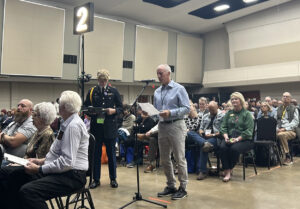
Dustin Slaton, pastor of First Baptist Church in Round Rock, asks North American Mission Board President Kevin Ezell to clear up the “murky” relationship between NAMB and Texas Baptists. (Photo by Pam Henderson / The Baptist Paper)
Dustin Slaton, pastor of First Baptist Church in Georgetown, questioned the policy during Ezell’s report to this year’s Southern Baptist Convention annual meeting.
“NAMB has gladly accepted my church’s financial investment in the North American Mission Board for decades without asking which version of the BFM we have in our documents or concern about which state convention we’re a part of,” Slaton said at the SBC annual meeting.
“So, can we now count on the North American Mission Board to reciprocate that investment by partnering with us to plant genuinely Southern Baptist churches in Texas and invest in us with the same resources, training, guidance, relationships and financial opportunities you would provide to a church who partners with our other wonderful state convention?”
Ezell explained NAMB can come alongside a BGCT-affiliated Southern Baptist church that wants to plant a church outside the state of Texas in states where conventions affirm the 2000 Baptist Faith & Message.
“I would love for you to consider and for your state convention to adopt the Baptist Faith & Message 2000,” Ezell concluded in response to Slaton.
BGCT messengers reject affirmation of 2000 BFM
While some BGCT-affiliated churches affirm the 2000 statement, the BGCT explicitly affirms the 1963 version of the Baptist Faith & Message. At the 2024 BGCT annual meeting, messengers decisively defeated a motion to affirm the 2000 Baptist Faith & Message.
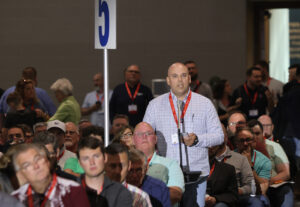
Long lines quickly formed at each microphone on the floor of the convention center hall as pastors and other messengers prepared to present arguments for and against the motion calling on the BGCT to affirm the 2000 Baptist Faith & Message. (Photo/ Ken Camp)
Ezell told the Baptist Standard the information meetings were planned after the vote at the BGCT annual meeting.
“I heard from several Southern Baptist pastors and directors of missions who are committed to NAMB and also connected to the BGCT,” he stated. “Their advice was that the best option for communicating accurate information was to do it in person.”
When the Baptist Standard asked for a response from BGCT Executive Director Julio Guarneri, he expressed appreciation for the opportunity to engage in ongoing dialogue with NAMB leaders.
Guarneri said Ezell accepted his invitation “to another in-person meeting here at our Texas Baptists offices early in the new year to continue the conversation.”
He also noted his appreciation for Ezell’s desire to connect directly with Texas Baptist pastors to clarify options available to them.
“As dates and locations are confirmed, we will gladly provide whatever support is needed,” Guarneri stated. “Time spent in Texas with Texas Baptist churches is an investment I’m sure he won’t regret.
“We share a Great Commandment/Great Commission task that is bigger than any one of us can achieve alone. Cooperation is essential.”
Both Guarneri and Ezell emphasized their shared desire to find a way for Texas Baptist churches that want to partner with NAMB in church planting to do so.
“Since June I have had several conversations with pastors who lead Southern Baptist churches affiliated with BGCT. In August I met with pastors and BGCT leadership with the goal of working toward ways we can partner most effectively,” Ezell said.
Several pastors who were part of the August meeting offered their thoughts on recent developments regarding NAMB and the BGCT.
Jeff Williams, pastor of First Baptist Church in Denton, made a motion “that the Baptist General Convention of Texas affirm the 2000 Baptist Faith & Message.” (Photo / Calli Keener)
Jeff Williams, pastor of First Baptist Church in Denton, introduced the motion at Texas Baptists’ annual meeting in Waco to affirm the 2000 Baptist Faith & Message.
“The reason I made the motion at the meeting was to get NAMB leadership and BGCT leadership talking about the relationship between the two entities,” Williams told the Baptist Standard. “I think that was accomplished.”
When asked whether messengers voting to reject the motion affected his church’s relationship to the BGCT, he said, “My church is as committed as we have always been to the BGCT and the Southern Baptist Convention.”
Slaton, who questioned Ezell at the SBC annual meeting, said he raised the query to “bring clarity” to the issue of how BGCT churches can partner with NAMB in church planting.
“In the previous meeting we had with Dr. Ezell back in August, he clarified that all of the planting resources that are available to other states are also available to BGCT and its churches. The only difference between BGCT and a convention that is a Send Network convention, (like the SBTC) is how funding happens,” Slaton wrote in an email.
“In that case, the NAMB funding comes through a grant to the BGCT, and the BGCT distributes it. This is similar to how NAMB has partnered with many other southern states for many years, and is not unique to the BGCT.”
Slaton noted his church’s relationship with the BGCT did not change after messengers turned down the motion to affirm the 2000 Baptist Faith & Message.
“However, I do not think a ‘yes’ outcome of the vote would have affected our relationship with the BGCT either,” he added.
Dan Newburg, pastor of First Baptist Church in Devine, offered a somewhat different perspective.
“The allegiance and loyalty of FBC Devine is to Jesus Christ. With this said, we have found the BGCT to be an exceptional kingdom partner and the annual meeting did not change this,” he stated.
“All of the messengers we sent to Waco stood and were counted among those who were in opposition to the motion for the BGCT to affirm the BF&M 2000. We affirm the BF&M 1963, like the BGCT.”
Events in recent months have, however, caused his church to question whether it can continue to partner with NAMB.
“In no way does our congregation give with an expectation of return, but we are a growing congregation who recognizes that church planting in Texas is a need that [First Baptist Church in Devine] can and should seek to address as we seek to be obedient to the Great Commission,” he stated.
“We are also historically Baptist and interested in preserving historic Baptist distinctives, such as the distinctive of local church autonomy. As my congregation has become better informed about NAMB’s processes and expectations, it’s not clear that we can partner with them without sacrificing our autonomy, nor actually better reaching our community for Christ.”
Based in part on a Baptist Press report by North American Mission Board communications, with additional reporting by Calli Keener and Ken Camp.
EDITOR’S NOTE: This story was corrected after receiving further clarification of who may attend the meetings. The fourth paragraph with information about Houston-area meetings was added after receiving confirmation by Union Baptist Association.
Associate pastor from Plano nominated for HUD secretary
December 11, 2024
PLANO (BP)—An associate pastor at Prestonwood Baptist Church in Plano is poised to return to the White House as part of the Trump administration with the nomination of Scott Turner for secretary of Housing and Urban Development.
Turner and his wife Robin have been members at Prestonwood for 18 years, where he has served as associate pastor the last four. The couple have a grown son, Solomon.
During Donald Trump’s first term, Turner was executive director for the White House Opportunity and Revitalization Council.
In 2021, he returned to Texas and founded the Community Engagement and Opportunity Council, which works toward revitalization in communities “through sports, mentorship and economic opportunity.”
“Thank you, Mr. President,” Turner posted on X after Trump’s Nov. 22 announcement. “I am thrilled to continue the outstanding work we began in your last administration at HUD with an incredible team. I am deeply humbled by your confidence in my nomination.”
Turner went on to express gratitude to his mentor, Ben Carson, who served as Trump’s HUD secretary during the first term.
“Few people are as compassionate and gracious as he is, and I am aware that I have big shoes to fill,” Turner said. “The forgotten men and women of this great country over the past four years will be honored in the Trump administration.”
A native of the Dallas area, Turner played football and ran track at the University of Illinois. He was drafted as a cornerback by the Washington Redskins in 1995 to begin an eight-year NFL career that included stops with the San Diego Chargers and Denver Broncos. He continues to serve as a senior advisor to the NFL’s executive vice president of Football Operations.
Prior to working at the White House, Turner was a two-term member of the Texas House of Representatives.
“Scott Turner is a beloved pastor at Prestonwood and a dear friend,” said Senior Pastor Jack Graham. “I met Scott when he was 17 and the football teammate of one of my sons. He is a man of impeccable character and dynamic leadership skills. This is truly his calling, as he brings much experience and passion to this role.
“Scott loves the Lord, he loves people, and he will be a mighty instrument for God in this new role, serving and elevating local communities and blessing America with compassionate conservatism.”



 His analysis of Revelation doesn’t fit neatly into any of the typical approaches to understanding the End Times. His perspective is premillennial but not dispensational.
 A
A