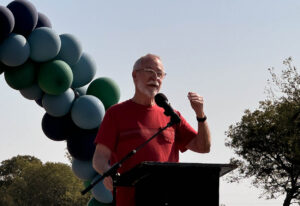
Dallas church brings new meaning to hybrid worship

As a bivocational pastor, Tedrick Woods demonstrates versatility in service. But his church’s hybrid worship model takes that versatility to a different level.

Three out of four Sundays each month, Woods preaches to the church he pastors in Dallas, from 200 miles away in Austin. On the first Sunday of every month, Wood comes to Dallas, and the congregation meets together in person.

Woods with his family. (Courtesy Photo)

Woods serves as senior pastor to Living Word Fellowship Church in Dallas.

The church was founded in 2015, in Hurst, at the suggestion of Larry Sanders, senior pastor of Keller Springs Baptist Church in Carrolton, where Woods served on staff as an associate pastor.

Woods prayed and considered the suggestion. Then, he decided to pursue it by beginning the process of requesting church planting assistance through Dallas Baptist Association and the Baptist General Convention of Texas, he said.

He received their approvals, with the Exciting Singing Hills Baptist Church in Dallas designated as the sponsoring church.

Woods noted the senior pastor of Singing Hills, Howard Anderson, was well known to him since childhood. He recalled growing up where Anderson “lived just two houses down from me in the community of Singing Hills, in Dallas.”

Within 18 months, the new church plant had grown from its five founding members to about 30 people. Things were going well, Woods said.

Then “church life happened.” The building where Living Word Fellowship was meeting, graciously provided by the late Pastor R.L. Rogers of Fort Worth, was listed for sale.

“The church thought it was not a wise purchase because we were still young. So, we moved to Dallas,” where the late Billy Bell of Dallas Baptist Association had offered the use of his church’s fellowship hall.

However, that meant the loss of several church members who lived too far away from Dallas for the move to make sense when other congregations were available nearer to their homes. After the relocation, the congregation numbered about 23 members, Woods explained.

Membership remained consistent from the 2018 move to the new Dallas location until 2020, when a new obstacle came along.

The bivocational minister had an opportunity to work for the state in Austin, and he took it, not knowing what was about to hit the country in March of that year.

Pandemic pivot

When COVID struck, like most churches during that time, Living Word transitioned to online meetings. They met by Zoom exclusively from March through July of 2020.

“Then, by faith, we started meeting in person on the first Sunday of each month, keep in mind that my family are now residing in Central Texas,” Woods note. “The members of the church wanted to stay together.”

The congregation decided this hybrid model wasn’t just a workable model for church during a pandemic, but it was how they wanted to continue to relate as a body of believers in the unique position of having a pastor who lives 200 miles away, Woods explained.

Woods pointed out “hybrid” church is the new norm for many congregations post-COVID, with numerous congregations offering live-streaming of in-person services.

“However, for us, Living Word Fellowship Church, we are truly a hybrid church in a unique way,” he said. “We do not forsake the assembling of ourselves together, as Hebrews 10:25 states. … We meet every first Sunday in person to worship.”

And when they meet in-person every first Sunday, they use social media to go live.

Tedrick Woods serves as pastor, CLC chair and as a state employee. (Courtesy Photo)

However, on the other Sundays, they hold worship services strictly by Zoom.

Woods explained they embrace this model “because of our location and the level of engagement and support from our members. This requires loyalty and faithfulness from members, and it’s not for the faint of heart.

“We don’t simply record services and play them back” Woods noted. “We are actually a full-fledged online ministry.”

Woods said in order for this model to work, members agree to be fully focused on the worship or Bible study for the times they are on Zoom. And to respect members’ time commitments, he keeps the sessions within the allotted time.

“This model allows us to share the worship experience within one hour with our members. We also have prayer and Bible study every Tuesday for 30 minutes,” he said, noting the Bible study is a six-week emphasis with two weeks off in between each module. And guests join the congregation, either in-person or by Zoom, at least three times a month, Woods noted.

On remote worship Sundays, Woods usually delivers his Zoom message from the basement fellowship hall of the historic Sweet Home Baptist Church in Austin.

After Living Word Fellowship’s service, from 10 to 11 a.m., Woods heads upstairs to assist Pastor Steve Manning with Sweet Home’s service.

Typically, Manning asks Woods to preach at least once a month. “It’s a sweet ministry partnership,” Woods said and recommended everyone visit this traditional Black, yet multicultural, Baptist church located in the historic Clarksville neighborhood of Austin.

Hybrid model challenges

Woods acknowledged the hybrid model can be challenging.

“Creating a genuinely hybrid service means prayer, preparation, and purposefully engaging with the members.” Woods said to do this effectively, requires contemplating the members’ lives to identify ways to serve their spiritual needs and creating a seamless church experience.

Engagement is not limited to Zoom, as members also connect by text message at least twice a week “with words of comfort, short prayers and announcements.

“For us, online works because we build in workable alerts, a schedule of teaching, and accessible resources.” Church members prepare for the Bible study beforehand, so they are ready for the brief discussion time.

Additionally, Woods sometimes receives requests for speaking engagements, which his congregation supports, often by attending or offering their prayers. These preaching engagements offer another opportunity for in-person worship for the church.

Living Word Fellowship describes itself as “mission-led” instead of “location-based,” which allows its leaders to think creatively and explore outlets for accomplishing the mission of bringing the lost to Christ.

The church seeks to demonstrate that “resurrection is a lifestyle, and whatever is dead in our lives, God can bring it back to life, if it needs to be,” Woods said.

Living Word’s hybrid model aims to overcome geographical limitations, accommodate diverse needs and preferences—including those with mobility issues or health concerns—and reach a wider audience.

However, hybrid services require careful planning and technological investment to ensure a seamless and engaging experience for both in-person and online participants.

“By leveraging technology and adapting to changing societal trends, our model aims to create a more inclusive and accessible environment for faith exploration and spiritual growth,” Woods concluded.

Living Word Fellowship Church currently meets in Dallas on first Sundays at the New Creation Bible Church. The church mailing address is P.O. Box 530922, Grand Prairie, TX 75053. Woods can be reached by email at tedrickwoods@yahoo.com.


Pastors burned out and exhausted, but that can change

(RNS)—America’s pastors are tired.

The decline of organized religion, the aftermath of a worldwide pandemic, political polarization—and the burden of caring for their congregation’s soul—have left many clergy feeling burned out and wondering how long they can hang on.
The title of a 2024 report from the Hartford Institute for Research summed up what clergy are saying: “I’m Exhausted All the Time.”

Small wonder that about half of clergy had thought about leaving their congregation—or the ministry altogether—in recent years.

“This is a challenging time for all congregations. They’re getting smaller, they’re getting older, they’re not as vital as they once were, and then the pandemic traumas of closing and opening,” said Scott Thumma, director of the Hartford Institute and leader of a five-year study of how COVID-19 affected congregations.

Racial divides and political issues have disrupted faith communities, Thumma said. All these factors have undermined the relationship between religious leaders and their congregations, leading to clergy burnout and discouragement.

Pay attention to mental health

That has made it crucial for clergy to pay attention to their mental health, experts say.

While burnout and poor mental health for clergy may often be gradual, the recovery process requires a lot more intentionality, said Rae Jean Proeschold-Bell, director of the Duke Clergy Health Initiative at Duke University.

That’s why it’s important for clergy to monitor feelings of being overwhelmed so they can be addressed before becoming a larger issue, she said.

Making plans for incorporating intentional practices can help clergy decrease stress and regain spiritual well-being. During the pandemic, the Duke Clergy Health Initiative partnered with the United Methodist Church for a study on mindfulness practices.

Clergy took eight classes on mindfulness techniques. They participated, on average, for 28 minutes a day for six months. They saw a reduction in stress and an improvement in their heart rate variability—the heart’s ability to recover.

Proeschold-Bell recommended clergy try a practice called the Daily Examen, which has been practiced by Catholics and other contemplative Christians.

“There’s a little bit of gratitude. And then review the last 24 hours of the day with gratitude, but also to notice what emotions came up for them during that review,” Proeschold-Bell said.

“Pray on that with God, and if they felt like they needed forgiveness for anything, to ask for forgiveness from God. And if they needed guidance, pray for that guidance. And then they closed it out with, again, gratitude for the day.”

Other intentional practices include exercise, taking time to eat nourishing foods and getting enough sleep. The most important thing is taking time away from work and its stressors so clergy can connect and meet their physical and psychological need, experts say.

Therapy can be helpful

Therapy also can help, said Gary Gunderson, professor of faith and the health of the public at the Wake Forest School of Divinity. Therapists can be great resources for clergy to talk about the issues they are facing without judgment for struggling.

“Pastors and priests, people in ministry, people in caring professions, they carry a lot of suffering,” said Mary Beth Werdel, director of the Pastoral Mental Health Counseling program at Fordham University.

“It becomes heavy, and we can’t hold that alone. Having a person or community to talk to is really important,” said Werdel.

Thumma said clergy who were experiencing poor mental health often overlooked spiritual practices such as making time for prayer.

“Rather than run to God or to spiritual practices, they retreated from them,” he said.

Having a clear plan for an intentional health or well-being practice can lead to flourishing when it comes to mental health for clergy. Clergy dealing with poor mental health may feel a lack of agency within their work life, Gunderson said. Engaging in these practices can bring back a sense of agency and the capacity to choose good things for themselves.

Make time for fun

This includes making time for things that are fun. It’s easy to remove a movie night with a friend from your busy schedule, but to be proactive against burnout, it’s important to have time away from work and invite play into your life, Werdel said.

Conflict between clergy and their congregation can also lead to poor mental health.

“There’s a real strong relationship that, in some ways, is probably more than many other vocations, between what’s going on at work and how well the person feels,” Thumma said.

Having a space where the congregation and the clergy can be honest about their feelings and process issues together can help repair the relationship between them. Conflict around the pandemic in many congregations has not been resolved.

“I think there’s some compensatory grieving that needs to happen and rebuilding of people’s trust,” Thumma said.

This can be for other issues the congregation is facing as well.

“The most important thing a congregation can do is to create a safe culture,” Gunderson said. “The congregation should be healthy for everyone in the congregation, including clergy, to find a voice and to be able to talk about what’s actually going on in their life.”

It is particularly healthy for the clergy person to be able to voice doubts and stresses, instead of being viewed as the mascot.

“What is healthy for the clergy is healthy for everyone else in the congregation,” Gunderson concluded.

Find better ways to collaborate

Post-COVID, clergy and their congregations may need to reevaluate their relationships—and find better ways to collaborate. That might include a shift in expectations, Werdel said.

“There’s a sense that you are the one that’s going to fix everything, that you are the one… that you alone are essential in solving all the problems of the world,” Werdel said. That is too much pressure on one person.

“Have you lost the ability to delegate? Are you micromanaging? These experiences will lead to burnout because they have to do with the belief of control that is not healthy,” she said.

Therapy can help identify these expectations, and having a supportive team within the leadership of the ministry can also help remove some of those beliefs by sharing the load of the labor.

Werdel cautions clergy not to ignore their emotional well-being.

“Our emotional worlds matter, they matter deeply, and they’re connected right to our spiritual experiences,” she said. Pushing through feelings of overwhelm and burnout will affect both your mental and spiritual health.


Commission reports worsening religious freedom in India

Religious freedom conditions worsened considerably in India this year—particularly in the months prior to and immediately following a national election.

The U.S. Commission on International Religious Freedom offered that assessment in an October update on India that provided an overview of religious freedom violations occurring in 2024.

“In addition to the enforcement of discriminatory state-level legislation and propagation of hateful rhetoric, the ruling Bharatiya Janata Party (BJP) government made a concerted effort to implement election promises that negatively and disproportionately impacted religious minorities and their ability to practice their faith,” the commission report states.

From January to March, 161 reported incidents of violence against Christians in India occurred. They ranged from violent attacks on churches and prayer meetings to physical assault, harassment and false allegations of forced conversions.

“In March, a group of U.N. experts raised alarm about the level of violence and hate crimes against religious minorities in the leadup to the national elections, including vigilante violence, targeted and arbitrary killings, demolition of property and harassment,” the commission report states.

Anti-conversion laws target minorities

Local authorities in 12 of India’s 28 states use anti-conversion laws—often punishable by significant fines and prison terms— to target religious minorities, the commission report notes.

“Since the beginning of the year, authorities have arrested dozens of Christians on allegations of conducting or participating in forced conversions,” the update states.

In June, police in Uttar Pradesh detained 13 Christians, including four pastors. The following month, seven Christians were accused of violating the state’s anti-conversion law in two separate incidents.

Top government officials have fomented violence against religious minorities, the report notes.

“In the leadup to the June 2024 elections, political officials increasingly wielded hate speech and discriminatory rhetoric against Muslims and other religious minorities,” the commission update states.

Prime Minister Modi referred to Muslims as “infiltrators” and repeatedly asserted the opposition party would “wipe out” the Hindu faith in India and make Hindus “second-class citizens in their own country.”

Modi and the BJP continued to support a Uniform Civil Code to overrule existing personal laws integrated with religious beliefs, including matters such as marriage, divorce, adoption, inheritance and succession.

In February, the legislative assembly of Uttarakhand passed a state-level Uniform Civil Code, “widely considered to represent a template for other states to adopt,” the commission update states.

‘Cow vigilantism’ occurred

Twenty states in India enforce laws that prohibit the slaughter of cows and calves, considered sacred by Hindus.

“Vigilante groups and self-proclaimed ‘cow protectors’ frequently exploit such laws to target religious minorities, including Muslims, Christians and Dalits,” the update states.

About a dozen attacks involving “cow vigilantism” occurred following India’s elections in June. In August, a vigilante group beat to death a Muslim migrant worker after falsely accusing him of eating beef and violently attacked a 72-year-old Muslim man because they thought he was carrying beef in a bag.

That same month, “cow protectors” shot and killed a 19-year-old Hindu student because they mistakenly thought he was a Muslim smuggling cows.

Government-sanctioned destruction of non-Hindu places of worship also continued in 2024, the commission update notes.

“Since the beginning of 2024, Indian authorities have facilitated the expropriation of places of worship, including the construction of Hindu temples on the sites of mosques,” the update states.

In January, Prime Minister Narendra Modi fulfilled a campaign pledge by leading in the construction of the Hindu Ram Temple in Ayondhya. The temple was built on top of the ruins of the Babri Masjid mosque, which a Hindu mob demolished in 1992.

In February, the Delhi Development Authority demolished the 600-year-old Akhoondji Mosque, and it announced plans to demolish 20 religious buildings—including 16 Muslim shrines—in Sanjay Van. That same month, police and government officials demolished a mosque and Muslim seminary in Uttarakhand.

Citizenship laws exclude Muslim refugees

In May, the government published rules for implementing the Citizenship (Amendment) Act, which critics assert “violates the Indian constitution’s principles prohibiting religious discrimination and its guarantees of equal protection under the law.”

The amended citizenship rules established a religious criterion for non-Muslim immigrants fleeing neighboring Muslim-majority countries, including Afghanistan, Bangladesh and Pakistan. Only individuals who lived or worked in India prior to Dec. 31, 2024, can apply.

“The law excludes Muslim refugees, including Rohingya Muslims from Burma and Ahmadyya Muslims from Pakistan and Afghanistan, as well as Tamil Hindus from Sri Lanka,” the update states.

The update also expresses concern about India’s National Register of Citizens, first piloted in Assam in 2018. It requires residents to prove they or their ancestors entered Assam prior to March 24, 1971, or face expulsion from the register.

Human rights advocates assert the National Register of Citizens and Citizenship (Amendment) Act “would allow the Indian government to expel those it deemed noncitizens, posing particular risk to the country’s Muslim population,” the commission update states.

Antiterrorism laws exploited

Indian authorities also “continued to exploit antiterror and financing laws … to crack down on civil society organizations, religious minorities, human rights defenders, and journalists reporting on religious freedom,” the commission update notes.

This year, several religious minorities and human rights activists faced detention without trial under the Unlawful Activities Prevention Act, which allows the government to designate individuals as “terrorists” without due process.

The commission update concludes religious freedom conditions in India have continued “to follow a deteriorating and concerning trajectory” in 2024.

“The Indian government continues to repress and restrict religious communities through the enforcement of discriminatory legislation like anti-conversion laws, cow slaughter laws and antiterrorism laws,” the update states.

“In doing so, authorities have arbitrarily detained individuals highlighting violations of religious freedom, including religious leaders, journalists and human rights activists, without due process—in some cases for years.

“Indian officials have repeatedly employed hateful and derogatory rhetoric and misinformation to perpetuate false narratives about religious minorities, inciting widespread violence, lynchings, and demolition of places of worship.”

Election impact remains to be seen

The U.S. Commission on International Religious Freedom in its most recent annual report recommended the U.S. Department of State designate India as a Country of Particular Concern for systematic, ongoing and egregious violations of religious freedom.

The commission issued its update on India at a time when elections were taking place in India’s northern Jammu and Kahmir areas. Modi had tripped Jammu and Kahmir of statehood and reorganized the area as two union territories under the control of the central government.

International Christian Concern—a human rights organization focused on the persecution of Christians—noted the election handed the BJP “a surprising defeat” and placed the local legislature under the control of a coalition of the National Conference Party and National Congress Party.

“Still, the BJP-led national government will maintain much control over the area through its centrally appointed governor,” ICC stated.

In an Oct. 11 email to supporters, ICC observed Modi’s influence “was tempered by a surprisingly tepid performance in national elections earlier this year,” but the threat of discriminatory policies remains “as Modi settles into his third term as prime minister.”

“How effectively an electorally reduced Modi will be able to continue his nationalist persecution of Christians remains to be seen, but conditions remain grim for religious minority communities across India,” ICC stated.


Scholars share new findings on evangelicalism and mission

Scholars from around the globe met virtually to discuss their research of evangelicalism and mission. The virtual conference on evangelicalism—held Oct. 2-4 this year—is an annual event hosted by Baylor University’s Institute for Studies of Religion.

David Bebbington, emeritus professor of history at the University of Stirling in Scotland and acting nonresident director of Baylor ISR’s Evangelical Studies Program summarized key findings of the presentations.

David Bebbington summarizes key points of new scholarship at the Baylor Institute for Studies of Religion’s Evangelicalism Conference, Oct. 2-4. (Screenshot / Calli Keener)

Bebbington defines evangelicals according to four commitments or emphases, what has been called the “Bebbington quadrilateral”: the Bible as authoritative for faith and practice, Jesus Christ and the cross, the necessity of conversion, and actively communicating the gospel.

Three papers demonstrated the early supporters of missions—beginning in 1817—as well as those who made missionary appeals were evangelicals, Bebbington noted. He also pointed to research that revealed the term “evangelical” originally was used by Presbyterians and Congregationalists, but not Baptists or Methodists.

Changes in missions

Two papers considered changes in missionary strategy.

Aminta Arrington, of John Brown University in Arkansas, examined a policy change related to the Lisu people in rural China in the early 20th century, in which the mission agency agreed to allow people to convert as families instead of as individuals.

Community was and is a defining trait of the Lisu people. So, they expressed their faith not individually, but together through hymns, Arrington explained.

She pointed out the success of hymns and the introduction of four-part harmony to this culture by missionary musicians was central to the proliferation of the gospel in Lisu communities. Their villages are remote, but they have practiced Christianity corporately through hymns for more than 100 years.

Lisu theology is shaped considerably by their hymnal, which is considered a “closed canon,” though they do write new Christian pop songs without harmony.

Karl Dahlfred, of Chiang Mai Theological Seminary, Thailand, demonstrated a shift from direct to more indirect methods of evangelism, when missionaries with the American Presbyterian Mission in Thailand began to prioritize education over conversion.

The result was “something like a secularizing effect on missionary work,” though the aim had been to permeate society with Christian values, Bebbington noted.

Bebbington suggested the papers by Arrington and Dahlfred taken together show evangelical missionary work across the 20th century changed in practice, “and that’s a very important contention, because it undermines the very frequent supposition that one finds in the literature that evangelical missionaries used constant, unchanging methods. How false that is,” Bebbington explained.

Evangelical influence

Other research summarized by Bebbington included:

Dana Robert, of Boston University, showed evangelicals “included married couples as central to the enterprise.”

Mark Smith, of Kellogg College, Oxford, UK, demonstrated that “missionary promotion was central to [William] Wilberforce’s career” and that evangelicalism provided a motivating theology for him.

Boone Aldridge, with Wycliffe Bible Translators, highlighted a constant tension between the academic world of Bible translation, which became more focused on the science of linguistics, and the popular evangelical world of Wycliffe, which was more concerned with providing understandable translations.

“Evangelical biblicism conditioned missions,” Bebbington summarized.

The work of Amos Chewachong, of Newport-on-Tay, Scotland, examining Nigerian Pentecostal missions to Cameroon disputes the assumption that missions is a Western scheme, Bebbington pointed out.

Together, these works clearly show mission among evangelicals wasn’t uniform. It changed. “For that reason, it needs to be studied in detail at each point in time,” he said.

Books will be published soon on several of the scholars’ findings.


Hoogstra led Christian higher ed through decade of change

WASHINGTON (RNS)—After 10 years of leading the Council for Christian Colleges and Universities, Shirley Hoogstra has a new title: president emerita.

One of her last tasks as president involved her frequent role as a speaker in a higher education setting.

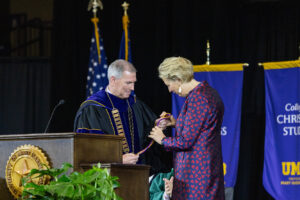
Randy O’Rear presents Shirley V. Hoogstra, J.D., 7th president of the Council for Christian Colleges & Universities, with a Distinguished Service Award for her many years of service to Christian higher education. (UMHB Photo)

“You often don’t know what God is up to until later,” Hoogstra recalled saying at the recent convocation for a new class at Michigan’s Handlon Correctional Facility that was participating in a program of Calvin University.

“And I said to the inmates: ‘Pay attention. This particular opportunity to be a college graduate may be something that in your rearview mirror turns out to be very clear that God had a particular purpose in giving you this opportunity.”

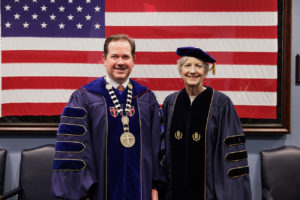
Shirley V. Hoogstra, president of the Council for Christian Colleges & Universities, received an honorary doctorate from Dallas Baptist University. She is pictured with DBU President Adam C. Wright. (DBU Photo)

In an Oct. 2 interview in the building housing the new headquarters of the Christian college association, Hoogstra said she looks back herself and sees how her former career as a Connecticut law firm partner prepared her to lead CCCU through a decade of high-profile religious freedom fights around LGBTQ rights on campuses.

Hoogstra, who has been succeeded by David A. Hoag, former president of Warner University in Florida, said she has “no regrets” about her shift from litigator to aiding 180 CCCU member institutions worldwide as they pivoted to hybrid classes and continue to determine effective ways to finance education and encourage the faith of their students.

Shirley Hoostra speaks at Dallas Baptist University. (Photo / Ken Camp)

Hoogstra, who is in her 60s, spoke with RNS about leading CCCU over the last decade, supporting diverse leadership in Christian education and increasing interfaith dialogue among officials of faith-based colleges and universities.

The interview was edited for length and clarity.

How is the period of transition going as you work with your successor, David Hoag, before retiring on Oct. 31?

Well, of course, you don’t get a playbook for these things. Early on in the year of 2023 I proposed a formal three-month transition period. I thought I would remain the president during those three months, and (my successor) would be president-elect. But on the day of Dr. Hoag’s appointment, July 7, I realized no, we need to have him step into the president role after 30 days, and then I’ll be president emerita. Two salaries, right? The board approved that budget.

David has already made good changes in terms of meeting structures and new promotions. But we’re walking side by side in meetings, before and after meetings, and I am able to give him play-by-play insights and play-by-play conversations as they are in real time.

You have overseen a decade of leadership for the Council for Christian Colleges and Universities. How would you sum up the state of Christian higher education, especially in North America?

Christian higher education is a growing sector because Christian higher education has a distinctive, which is the education with a moral compass. It’s also growing, because there’s been a huge equalizing effect amongst colleges and universities.

With the internet and with people offering online, in-person, graduate, undergraduate, parents and students have lost the need for the hierarchy of institutions generally, unless it’s maybe the top 10, and are now going for fit. So families of faith or students who want a particular major or minor or student experience feel freer to pick a campus that matches their values.

Is there any specific action CCCU has taken since an appeals court in August upheld the Hunter v. U.S. Department of Education decision in a lower court that dismissed claims by LGBTQ students? They unsuccessfully sought removal of a religious exemption in Title IX gender discrimination rules for federally funded religious institutions.

The Title IX exemption is more secure today than it’s ever been. The importance of the case cannot be understated. This was a unanimous decision, and the decision found that the Title IX exemption is fully constitutional. The plaintiffs in this case may, in fact, try to get a further review in the 9th Circuit. We are hopeful that, because it was a unanimous decision, they will not take it up for review.

Do you consider this one of the successes of your time leading CCCU? And why or why not?

Yes. It’s a success. The Title IX exemption, which allows religious institutions—Christian colleges and universities prime among them—to live according to their mission, is a cornerstone of our work. And the CCCU, under my leadership, has had a three-part strategy. We had the court strategy, where we have been a leading voice in amicus briefs around religious freedom. The second one was this legislative effort (leading to the 2022 Respect for Marriage Act) where we have basically been part of changing the dynamic of a both/and approach: If you’re going to do LGBTQ civil rights, you’ve got to do religious freedom. And then this is an executive branch strategy. And in the executive branch, the Title IX exemption and other religious exemptions found in other titles allow the day-to-day operation to go unimpeded.

There have been, it appears, some CCCU member institutions that have been caught between conservative stakeholders, like parents and donors, and faculty who’ve expressed support for gay marriage or been accused of being “woke.” How does CCCU advise or take a role in those situations?

CCCU does not advise campuses on HR matters. And the cases that happen always have more to the story than is ever revealed in newspaper articles. That being said, the CCCU has been long on the record about saying that diverse views in classroom situations are important.

Compared to other private higher education institutions, we have more diverse conversations and more and different perspectives are more often raised in Christian college campuses than in secular campuses. So I think our campuses are doing a good job in making sure our students are prepared for world-class conversations.

In the wake of the death of George Floyd, Christian colleges got pushback for statements about racial justice by critics who said prayers and panel discussions were not sufficient. At the time, you committed yourself to help keep the “next generation of leaders” from giving up the possibility of concrete actions. Are there ways CCCU and its institutions have sought to address concerns about diversity and inclusion?

Yes, since George Floyd’s murder, there has been an intentional effort to make sure leaders of color are fully supported in our Multi-ethnic Leadership Development Institute, a key support mechanism where leaders of color come together, talk about their situations, learn from peers and come away refreshed and encouraged.

In our (quadrennial) 2022 International Forum, our speaker array reflected the CCCU’s commitment to have voices of leaders of color on the plenary stage to make sure this could be a central conversation in the very important set of conversations following George Floyd’s murder and the subsequent tragedies of other men and women of color.

Since 2019, you have worked to bring together presidents and other leaders of colleges and universities who have a different faith perspective than CCCU, which is an evangelical organization. What have been some specific outcomes of those gatherings with leaders of institutions affiliated with Catholics, Mormons, Jews and Muslims?

This ability to convene national voices with institutions that have common cause is one of the more significant successes of the CCCU in the last 10 years. Prior to 2014 there was an insider’s approach to Christian education, and since 2015 there has been a larger aperture about finding partners and allies who believe faith matters in higher education.

One of our newest outgrowths of early panels, which happened at the (CCCU) Presidents Conference, is a new Commission on Faith-based Colleges and Universities out of the American Council on Education, where members across higher education can be part of a group that is thinking concretely about the value of religious education in America.

What’s ahead for you when your retirement officially begins on Oct. 31?

I’m going to be writing the history of this decade at the CCCU. I am going to be doing some speaking and moderating of some conversations, which I have loved doing since my role at “Inner Compass” (a public television series) at Calvin University years ago, and I would like to spend more time understanding how prison education can advance the Matthew 25 imperative: “When I was sick you looked after me and when I was in prison you came to visit me.”


Conclave NextGen equips leaders for ministry

SAN ANTONIO—More than 700 children, youth, college ministers and pastors from across Texas and beyond gathered in San Antonio, Oct. 7-8, for worship, training and networking at Conclave NextGen.

Jana Magruder, strategic initiatives director of Lifeway NextGen, discussed discipling the next generation and teaching “a counter-cultural identity message that helps kids and students know who they are because of who God is.”

She challenged attendees to create relationships that build belonging in students, so they understand their identity in Christ better.

“When we connect these two things together, belonging and identity, we are doing two really important things,” Magruder said.

“Number one, we are meeting the cultural need that this generation has to feel seen and known. And number two, we are answering the big cultural question that they have about who they truly are.”

Magruder provided a tool to help create relationships so the next generation feels like they belong. She offered the acronym ‘FLIP’—making sure children and youth have a Friend, Leader, Influencer and Pastor investing in them.

“Everyone is called to the urgent work of reaching the next generation,” Magruder said. “I want us as the church to fight for them, because we want them the most, because we know that the Father wants them the most. … You have the most strategic seat in the church to lead this fight, and to rally every generation of your church and mobilize them around reaching [the next] generations.”

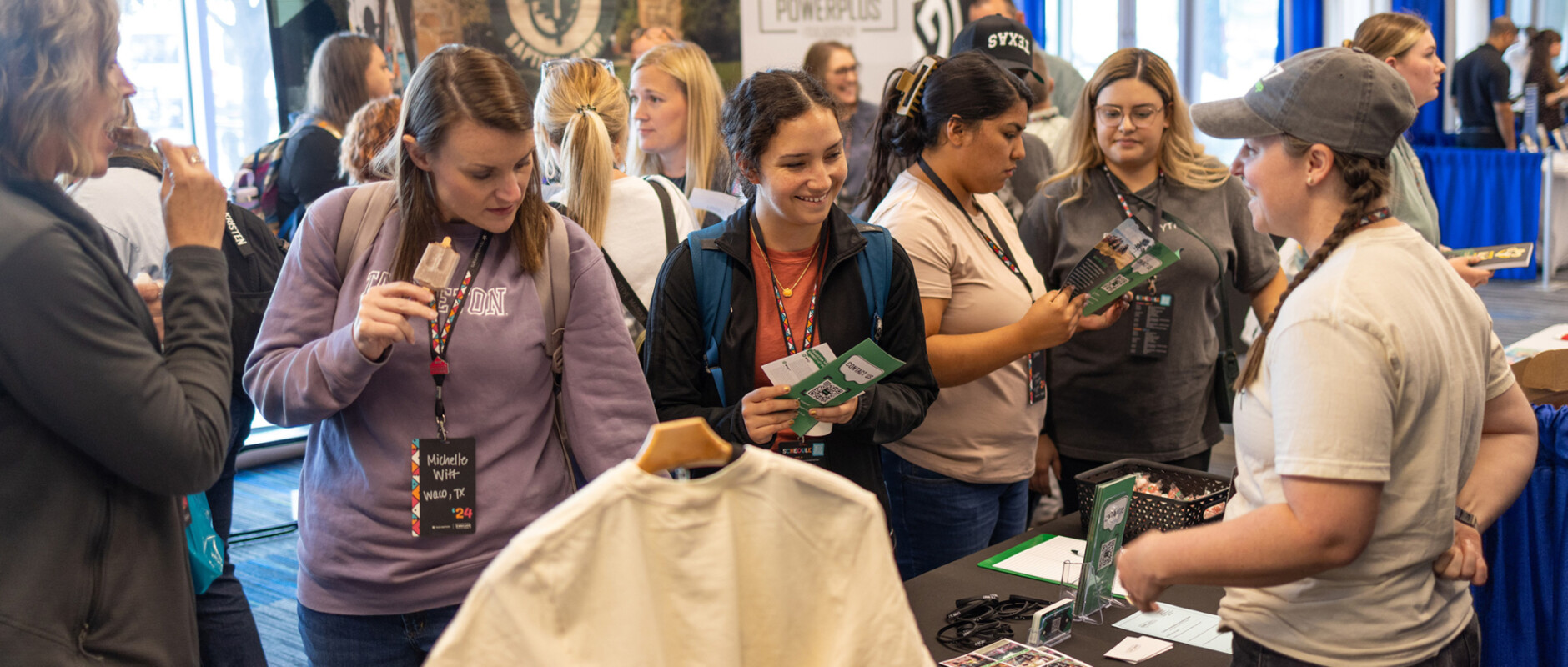
Conclave attendees visit a ministry booth in the exhibit hall. (Texas Baptists Communications Photo)

Conclave attendees had the opportunity to choose from more than 30 breakout sessions on topics such as family ministry, evangelism, ministering to mental health, empowering volunteers and navigating social media.

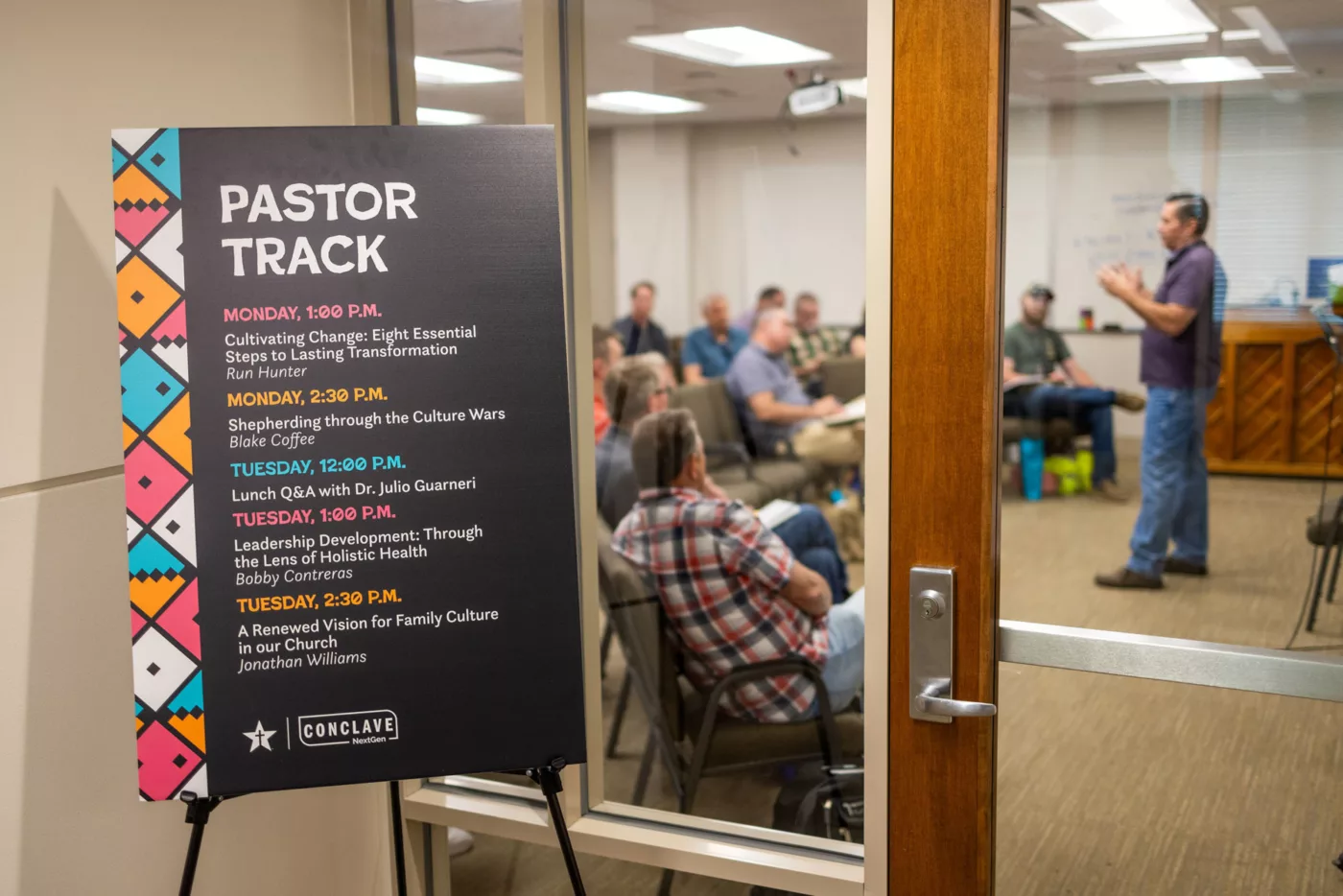
A specialized “Pastor’s Track” was offered for senior church leaders to learn from and form community with other pastors.

David Gonzalez, Congreso coordinator at Texas Baptists, led a breakout session on “Bridging Generations: Expanding Church Outreach to Connect with a Diverse and Growing Church.”

Leaders can bridge the gaps between generations by empowering students to be involved in ministry and embracing the change that comes with it, Gonzalez said.

Students “want somebody to come tap on the shoulder and say, ‘I think you are capable of being in X, Y, Z ministry.’ And I think it’s a step of faith in you taking the leap of faith and saying, ‘I’m going to put trust in you’ and loosen the reins just a little bit,” he said.

“Sometimes change has to be done for growth to happen … bridging the gap is embracing change. We need to make sure that our younger generation also has a seat at the table.”

Joining God in ministry by looking to the cross

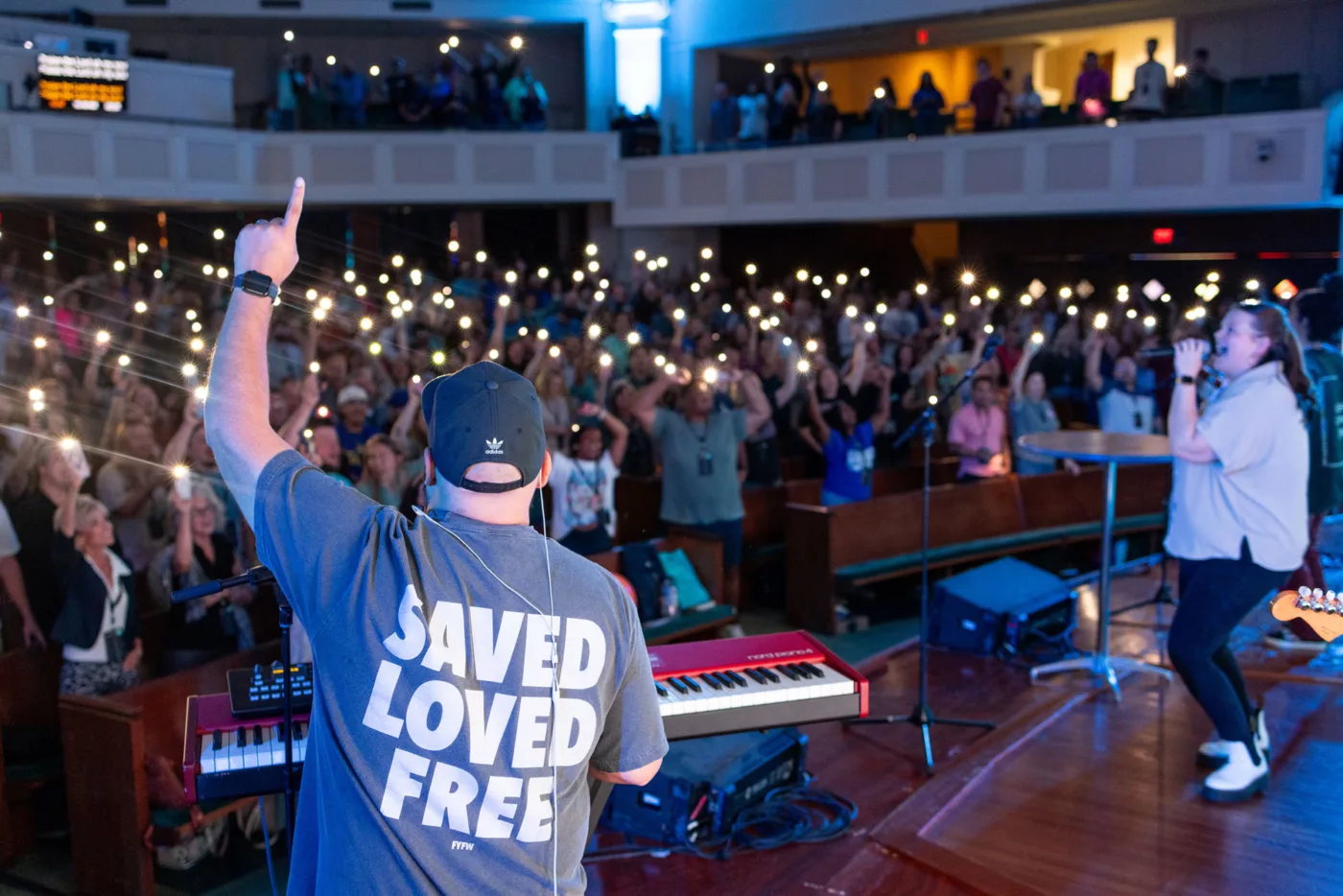
Chris Benites and the worship band lead worship at Conclave NextGen, Oct. 7-8. (Texas Baptists Communications Photo)

Mike Satterfield, founder of Field of Grace Ministries, encouraged leaders with a sermon based on John 19:30. He explained the Greek word tetelestai, meaning “it is finished,” is a word that helps us understand “the past completed act with present, ongoing, permanent effect for all eternity.”

 “It was in John 19 … I learned Jesus tasted bitter vinegar, completely sour, so we can taste the best victory in being completely saved. I’ve been bought with a price. I’m no longer my own. I have been set free,” Satterfield asserted.

Satterfield encouraged Conclave attendees to lay down everything hindering them from resting in Jesus’ words, “it is finished,” and join him where he already is leading their ministry.

“Stop trying to help God, when all you have to do is join him where he’s already at work,” he said.

Displaying the friendship of Jesus

Justin Whitmel Earley, author of Made for People: Why We Drift into Loneliness and How to Fight for a Life of Friendship, spoke about “the holiness and the importance of friendship in ministry.”

He referenced Genesis 2-3, encouraging NextGen ministry leaders to understand they were made for people, and John 15:13-16, emphasizing Jesus showed what it means to be a friend.

“Jesus is demonstrating here not just how to be the best friend that you can be. He is also showing that one way to summarize the gospel is that God has taken the lonely, broken people and made them friends again—friends with God, and thus friends with the world,” said Earley.

Earley asserted friendship is at the center of “what the gospel calls us to,” and encouraged ministers to allow themselves to be fully known and loved by someone, so they can, in turn, fully know and love others in ministry.

“If the call of the New Testament, think of Ephesians 5:10, is ‘to be imitators of God,’ well, if Jesus is friendship made flesh, then to become more and more like him is necessarily to become more and more like a friend,” Earley said.

“So, go into your ministry knowing you were made for people, don’t do it alone, and put the friendship of Jesus on display.”

Investing in holistic church health

A specialized “Pastor’s Track” was offered for senior church leaders this year. (Texas Baptists Communications Photo)

Bobby Contreras, pastor at Alamo Heights Baptist Church in San Antonio, led a “Pastor’s Track” breakout session on pursuing holistic church health by investing in spiritual, physical, mental/emotional, financial and relational health. He held an open discussion on these five areas.

“Healthy pastor, healthy family equals a healthy gospel community,” Contreras said.

He reminded pastors “using a dull ax requires great strength, so sharpen the blade,” (Ecclesiastes 10:10), challenging them to treat Conclave as an opportunity to “sharpen the blade.” That way they return to their ministry “more intentional and more biblical in how we are leading and how we’re living within our ministry context.”

Contreras gave pastors resources, including pastoral and church health reports from the Baptist Health Foundation and social media pages for Scripture intake, such as ‘The Daily Gaze.’ He invited Olga Harris, director of counseling services at Texas Baptists, to let ministers know about counseling options available for pastors and their families.

“I want you, and Texas Baptists wants you in your ministry context for the long haul … so what we do now matters,” he asserted.

Being a vessel of the Holy Spirit

Ed Newton, lead pastor of Community Bible Church in San Antonio, preached on 2 Kings 4 and charged attendees to empty themselves before the Lord daily, so they can be used as vessels by the Holy Spirit to carry out the Great Commission.

“The oil of heaven flows with empty vessels,” Newton said.

To live in the “overflow of heaven,” Christians must abide in Jesus daily, he said.

“Your daily commitment, every day, John 3:30, ‘You must increase, I must decrease,’” Newton said. “Your daily checklist—every day, put on the full armor of God. Your daily covenant—you’ve got to remind yourself who you are in Christ Jesus … be first with Jesus and [then] ‘Come, follow me,’ (Matt. 4:19).”

Conclave NextGen 2025 is scheduled Oct. 6-7 at First Baptist Church in Arlington. To learn more about Conclave NextGen, visit txb.org/conclave.


Obituary: Alton Elwood Breedlove

Alton Elwood Breedlove, who pioneered the family aid programs at Buckner International, died Aug. 12 in Fort Worth. He was 90. He was born Aug. 19, 1933, to Loyd Otis and Maudie Ethel (Boyd) Breedlove. He grew up in Troup as part of the Walnut Grove community, near Whitehouse. He graduated from Texas A&M University in 1955 as a member of Corps of Cadets. He married Peggy Ann Hall on July 26, 1957. They were married for almost 64 years and had three children. He served in a variety of roles during his career at what was then Buckner Baptist Benevolences, including working at Buckner Boys’ Ranch in Burnet and Buckner Children’s Home in Dallas. He was instrumental in developing and directing a Buckner family assistance program initially called the Mother’s Aid program. It later came to be known as Family Aid and then as the Client Assist program. His Christmas program each year provided thousands of toys, abundant food, clothing and much more to the families in his care. He once visited a former Buckner client in the hospital, showing up in clown suspenders to cheer her up. The ministry he pioneered laid the groundwork for Buckner’s current domestic humanitarian aid program. He and his wife Peggy volunteered in various church nurseries for 47 years. The Breedloves were longtime members of Eastridge Baptist Church in Red Oak. He was preceded in death by his wife, Peggy, and his sister, Juanita Ruth. He is survived by son Al Jr. and his wife, Patsy; son Marshall and his wife, Susann; daughter Ann and her husband, Lee; seven grandchildren; and eight great-grandchildren.


Texans on Mission volunteers respond to two hurricanes

Texans on Mission sent key disaster relief equipment to Florida this week in advance of Hurricane Milton’s landfall. The Dallas-based ministry now is seeking more volunteers to respond to what has become a two-hurricane disaster.

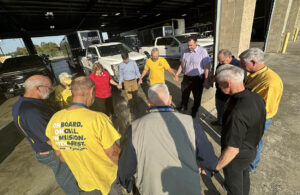
Texans on Mission volunteers gather to pray before sending a mobile mass feeding kitchen, large generator, shower/laundry unit and flood recovery unit to Florida in advance of Hurricane Milton’s landfall. (Texans on Mission Photo / Russ Dilday)

Texans on Mission sent a mobile mass feeding kitchen, large generator, shower/laundry unit and flood recovery unit to Florida Wednesday, while many Texas volunteers are still in North Carolina and Tennessee responding to Hurricane Helene devastation.

“We timed the deployment from Texas to ensure teams were on the ground quickly” after Hurricane Milton, said Mickey Lenamon, CEO of Texans on Mission. “With a storm of this magnitude, we anticipate people will be reeling, and we want to begin meeting needs quickly.

“Back-to-back hurricanes of this size are stretching the volunteer corps of ministries across the country. Texans on Mission volunteers are stepping up in incredible ways to minister in multiple locations.”

Texans on Mission has created a special website to facilitate recruitment of more volunteers—TexansOnMission.org/serve.

New volunteers can select dates and locations to plan for serving, Lenamon said.

“You can even hop a weekly shuttle we’re running from Dallas to Tennessee,” he added. “As always, we’ll take care of your lodging, meals and shower/laundry. All you need to do is minister in the name of Christ.”

Teams continue work in N.C. and Tennessee

In North Carolina and Tennessee, “disaster relief teams continue ramping up ministry as the reality of the situation sets in across the region,” Lenamon said. “Electricity is slow to come back. Entire towns have been washed away. People have lost their belongings and, in some cases, their livelihood. Hopelessness is widespread.

“In the midst of it all, Texans on Mission volunteers are delivering help, hope and healing in the name of Christ. Teams are cleaning out flooded homes, moving fallen trees and providing roughly 3,500 meals a day and counting.”

Lenamon thanked those who are praying for the people impacted by the hurricanes and for volunteers meeting needs.

“Your prayers and support make a profound impact,” he said. “You are bringing help, hope and healing to people experiencing some of their most difficult days.”

Texans on Mission’s work is built on three pillars—volunteers, prayer and financial giving, he continued. And all three are “critical in our responses to these two hurricanes, not to mention Hurricane Francine’s devastation in Louisiana last month.”

To donate to Texans on Mission’s hurricane response, click on TexansOnMission.org/hurricanes.


West Texas A&M BSM serves from a temporary home

Macie Groomer, a senior at West Texas A&M University, came to campus her freshman year searching for a community of like-minded believers.

At the invitation of a friend, Groomer participated in Baptist Student Ministry “Welcome Week” events and made strong connections. She decided to stick around.

Groomer said she wouldn’t have learned to take her faith seriously, if the new friends she met there didn’t dive into Scripture with her on a weekly basis that year.

“That first year, anytime we were at the BSM, we were digging into Scripture super deeply, and I was being encouraged by all the people around me [to] spend time in the word and not neglect that and keep going to church,” said Groomer.

“If I hadn’t had that experience of all of these people around me [encouraging me], I wouldn’t have taken my faith as seriously coming to college, because it was my first time on my own, and I [had to choose to] make this faith my own. And so, I think that was really special and really unique. And it just gave me a lot of boldness going into the years after that.”

Groomer learned how to share the gospel for the first time in her freshman year at the BSM, and she said it gave her the boldness to meet new students during Welcome Week in the following years.

“I think that foundation gave me something to stand on now, talking to freshmen and new people, just the willingness and boldness to share the gospel,” Groomer said.

Knowing, following and sharing Jesus

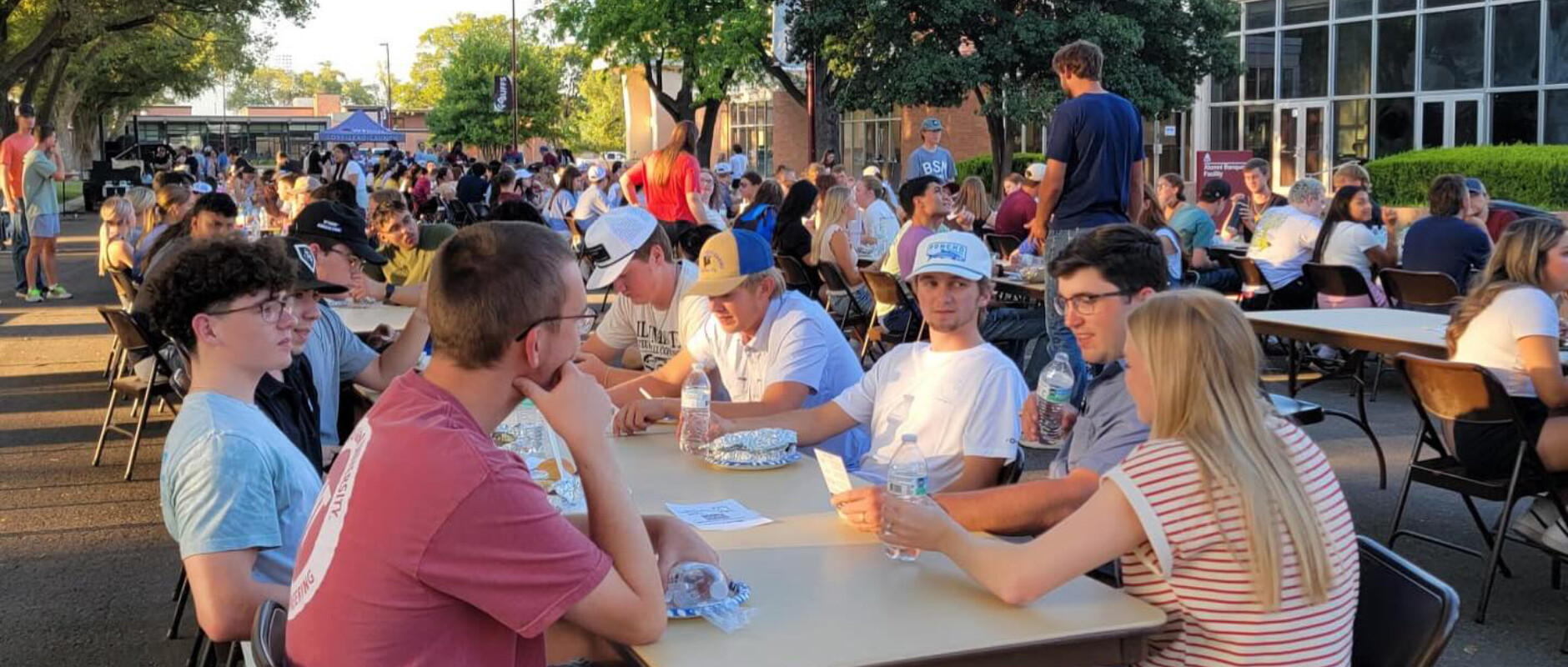
West Texas A&M BSM hosts 99 Cent Steak Night during Welcome Week. (Texas Baptists Photo)

Every August, the West Texas A&M University BSM participates in the campus’ Welcome Week—hosting events each night of the week including Karaoke Night, 99 Cent Steak Night, 806 Worship, and this year’s big finale, the Welcome Dance—to connect with new West Texas A&M University students.

This year, Welcome Week looked a little different for the West Texas A&M BSM, in light of its new building project.

Eric Hunter, director of the BSM, said being in a smaller, temporary building was logistically challenging, but “we enjoy being on campus. It’s good. I think it’s even better to be on-campus [than in the building].”

Welcome Week is the most important week of the year because it sets the tone of the organization with new students, he said.

Current BSM students follow up for the rest of the year with new students they meet during Welcome Week, building relationships and sharing the gospel, hoping to “see multitudes come to Christ, to go from death to life.”

“Our heart and prayer is that … we would see revival; students who come to Christ, turn to Christ, get serious about their faith, that God would move mightily in the lives of believers that they would have a renewed passion and desire to know Jesus, to follow Jesus,” said Hunter.

“And then I think more than anything, that they would have a desire to share with other people.”

Sharing the gospel

Tirzah Miranda, a senior student leader at West Texas A&M BSM, was drawn to the organization after transferringto the school by its unified goal to share the gospel. She said through discipleship and routinely going on campus to share the gospel with her peers, she had learned to make it a priority.

“Through everyone [at the BSM] coming together as a community and going to share the gospel as a normal thing, because that’s what we’re called to do as Christians, I just grew in learning how to evangelize,” said Miranda.

“[Sharing the gospel] was super uncomfortable for me—and it’s still actually kind of uncomfortable for me. It’s a challenging thing. But it’s important, and it’s necessary.”

Miranda said it has been encouraging to see her nonbelieving friends who “maybe wouldn’t necessarily step into the BSM, be interested in the Lord because of how I was equipped through the BSM of just how to share and how to equip other people.”

“They’ve given us the tools, so it’s not like everything is contained in this building. It’s not like: ‘We need to get them into this building so that they can hear the gospel.’ It’s like: ‘No, we’re sending you out so that the campus can hear the gospel.’”

Feeling valued on campus

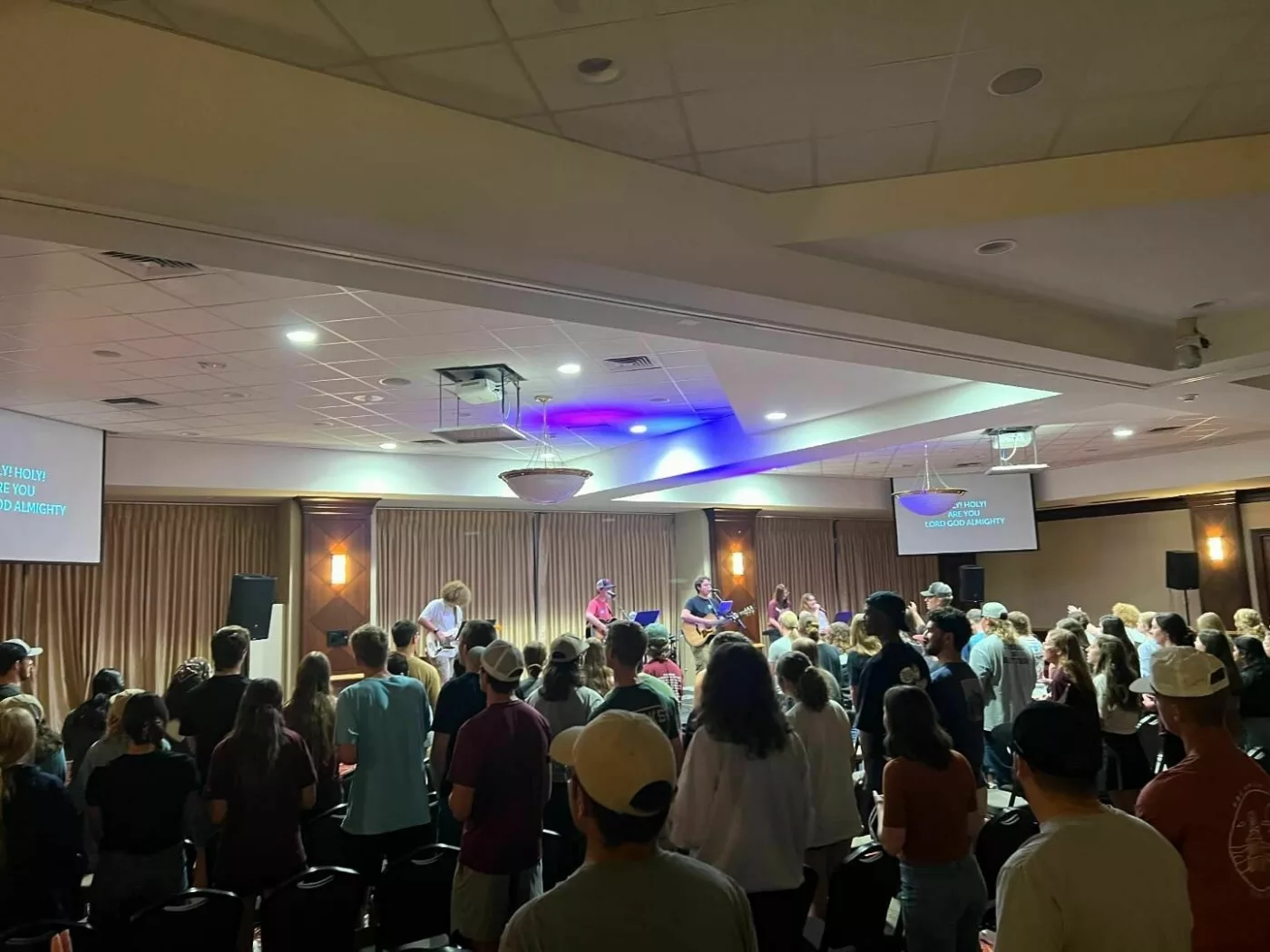
BSM students participate in worship during West Texas A&M’s Welcome Week. (Texas Baptists Photo)

Hunter said the BSM hopes students will glean two things during Welcome Week: first, that the BSM exists and exists to serve them, and second, that they would “find their people,” hopefully among believers.

West Texas A&M freshman Ally Wilson said she is looking to plug in to an organization that will help her grow stronger in her faith. Throughout Welcome Week, she said she has been drawn to the BSM because she feels pursued by its students.

“What’s making me interested [in the BSM] is them knowing my name, pursuing me, making me feel wanted here,‘cause other ministries on campus are good, but they’re not actively seeking out, wanting me to grow, wanting me to be here with them,” said Wilson.

“I think that’s definitely something that I latched onto and really appreciated—being wanted here.”

Miranda advised West Texas A&M freshmen hoping to invest in their faith in college to be “faithful to Jesus first.”

“We are called to be obedient, but we’re also called to be faithful to him. So, I would just encourage them to be faithful to Jesus first and as they are poured into by the Lord, to pour out,” she said.

“But it comes first from spending time with Jesus, the word [of God], worshipping, being in community, and from that place of being filled, we get to pour out into other people.”

Reaching more students with the gospel

Groomer said she is excited to see how God will use the BSM’s temporary space and on-campus presence to reach more students with the gospel.

“I just expect for the Lord to move in really big ways, being more of an on-campus presence. Not that we weren’t already, but now we’re kind of forced to be there, so I’m hopeful that that will draw people in—and also give us boldness since we’re already there—to just go and reach more people and bring more people, not just to the BSM, but [also] encouraging people to know God and to love God and to worship God.”

The West Texas A&M BSM currently is raising funds to build a new BSM building to fulfill its vision to love, lead and launch students who will form community, hear and respond to the gospel, and become equipped and mobilized as disciple-makers.

To learn more about Texas BSM and the Texas Baptists’ Center for Collegiate Ministry, visit txb.org/collegiate.


Around the State: UMHB hosts annual Touchdowns event

The University of Mary Hardin-Baylor hosted its annual Touchdowns event, Oct. 5, during the football game against East Texas Baptist University. This tradition began in 2017. All members of the local special needs community and their families were invited to attend the game free of charge. There were opportunities for the esteemed guests to participate in scoring touchdowns at halftime with the help of UMHB student-athletes and in cheering on the Cru football team alongside the UMHB cheer and dance teams. This year, more than 100 members of the special needs community registered to participate.

ETBU’s Learning and Leading classes organized and hosted annual fall festivals for all five of Marshall ISD’s elementary schools, Sept. 30. (ETBU Photo)

East Texas Baptist University’s Learning and Leading classes organized and hosted the 13th annual fall festivals for all five of Marshall Independent School District’s elementary schools, Sept. 30. The events provided an evening of fun and community engagement for almost 1,000 elementary students and their families. Over the last 13 years, the fall festivals have become a beloved tradition for both ETBU and Marshall ISD, fostering a connection between the university’s students and the local community. This year, more than 350 ETBU freshmen played a vital role in planning, organizing and executing the festivals as part of their Learning and Leading course, a required class for all first-year and transfer students. ETBU’s Learning and Leading course is designed to acclimate new students to college life while encouraging leadership development. Taught by faculty and staff, the class meets once a week and culminates in at least one service project per semester. The fall festivals serve as a signature service project, providing freshmen with a chance to engage with the community practically and positively.

Hardin-Simmons University received a $500,000 donation from a long-time benefactor in support of the university’s Equine Therapy program and student scholarships. (HSU Photo)

Hardin-Simmons University received a $500,000 donation from a longtime benefactor in support of the university’s Equine Therapy program and student scholarships. This gift is dedicated to expanding therapeutic services and providing more opportunities for students. “We are very excited to launch the first phase of our equestrian program at HSU. We are currently setting up a temporary arena to allow us to provide hippotherapy services to adults and children throughout West Texas,” said Wendy Anemaet, director of Equine Therapy at HSU. “As we work toward securing full funding for our facility, this gift allows us to begin offering services right away and sets the foundation for future growth. Our long-term plans include expanding the program to serve more therapists and patients, offering mental health services, therapeutic riding (horseback activities and riding instruction for individuals with disabilities), and college-level certificates and degree program.” While fundraising for a permanent facility continues, the program will launch this fall with students providing hippotherapy—the use of horses in speech, physical and occupational therapies to improve gait, improve balance, reduce spasticity and enhance trunk control.

Rudy González, director of Proclama, (seated); Abe Jaquez, president and CEO of BUA, (middle); and Fernando Hill, assistant to the director of Proclama (left). (BUA Photo)

On Sept. 27-28, Baptist University of the Américas hosted Proclama, a BUA initiative funded by a grant from the Lilly Endowment. Proclama is dedicated to training pastors in delivering Scripture-centered sermons. The event featured Rudy González, director of Proclama and a BUA professor, as the principal speaker, focusing on the theological aspects of convincing preaching. Pastor Tony Miranda discussed best practices for pastoral efficiency. Abe Jaquez, president of BUA, welcomed a chapel filled with Spanish-speaking pastors from South Texas and as far as New Mexico, expressing gratitude for the strong turnout. Fernando Hill, assistant to the director of Proclama, helped coordinate the two-day event. BUA student volunteers also played a key role, serving throughout the weekend. Proclama is an ongoing initiative, offering talleres (workshops) throughout the year in various regions of the state. The initiative also provides mentorías (mentorships) for registered participants, led by González, a professor at Midwestern Baptist Theological Seminary. He brings nearly five decades of experience in pastoral and theological education, with a career that has spanned churches in New Mexico, Texas and California, as well as academic roles at Golden Gate (now Gateway) Seminary and Southwestern Baptist Theological Seminary. Several of the pastors in attendance were trained at BUA. With Proclama fully conducted in Spanish and featuring materials designed by González, this initiative continues to strengthen the future of Hispanic pastors in South Texas, building on BUA’s long-standing commitment to pastoral leadership development.

Howard Payne University invites alumni, prospective students and other friends of the university to Homecoming, Oct. 18-19. (HPU Photo)

Howard Payne University invites alumni, prospective students and other friends of the university to Homecoming, Oct. 18-19. The event will also include Yellow Jacket Preview and Family Weekend. Registration for Homecoming events is available at www.hputx.edu/homecoming. Some events require payment, while many are free of charge. Prospective students interested in attending Yellow Jacket Preview can register at www.hputx.edu/yjp. All Yellow Jacket Preview events are free of charge. The Stinger Pass includes admission into a choice of breakfasts, the HPU Family Picnic and the HPU Football game. During the weekend, alumni and friends are invited to participate in traditional Homecoming events—including the Alumni Banquet, Cobbler on the Campus—featuring cobbler from Underwood’s Bar-B-Q and a music performance by The Remedy—a pep rally, a parade, a picnic, the arts and sporting events. The HPU Yellow Jacket football team will play UMHB at 2:30 p.m. at Gordon Wood Stadium, with the Homecoming Court to be announced at halftime.

Students at Houston Christian University kicked off October with Ignite, the university’s fall spiritual emphasis week. (HCU Photo / Lily Clardy)

Students at Houston Christian University kicked off October with Ignite, the university’s fall spiritual emphasis week. Across six special worship gatherings during the week, the campus community heard messages from John Avant and Andrew Osakue, who spoke on topics developing the 2024-2025 convocation theme, “True.” TC Chambers and the worship team from Midtown Community Church in Knoxville, Tenn., led worship. Students participated in nine prayer gatherings and in various workshops on relationships and worship leadership throughout the week. Toward the end of each service, students were invited to share their spiritual responses on a digital card. Nineteen reported first-time decisions to follow Christ, 27 requested to meet with someone about their spiritual questions, and 145 surrendered completely as Christians. Students who made a first-time decision to follow Christ will be invited to be part of a new believer study meeting weekly on campus. Students trained by Nathan Mahand, director of HCU’s BSM, will have gospel conversations with those students seeking further answers. Students seeking Christian community will be offered the chance to join a local church tour, when student leaders in various campus ministries will bring their peers to the churches where they are members.

2024 Distinguished Alumni Award honorees Thomas Valenzuela (left) and Michelle Garcia Holmes (right), pictured with Teresa Young from the Wayland Development Office (center). (WBU Photo)

Wayland Baptist University honored two alumni Oct. 1 in Albuquerque, N.M. Michelle Garcia Holmes was named the 2024 Distinguished Alumni Award winner from the Albuquerque campus, and Thomas Valenzuela was named winner from the Clovis campus. A 2005 graduate of Wayland, Garcia Holmes is retired chief of staff for the New Mexico attorney general’s office, where she worked on the creation of the first New Mexico Government Corruption Investigative Division. She also managed statewide education on internet predators and the dangers of methamphetamine and prescription drug overdose issues, as well as a teen dating violence outreach. She served as liaison to the Joint Terrorism Task Force and worked on national human trafficking issues, leading to passage of New Mexico’s first anti-trafficking bill. She also worked on money laundering issues in collaboration with national organizations. An Albuquerque native, Garcia Holmes came to the attorney general’s office after retiring as detective from a 20-year career with the Albuquerque Police Department. Married to husband Earl for 23 years, Garcia Holmes is an ordained senior chaplain and a mother to five children. Valenzuela was raised in Albuquerque and joined the U.S. Air Force after high school graduation in 1997. During his 20 years of service, he participated in multiple deployments in support of Operation Northern Watch, Operation Allied Force, Operation Iraqi Freedom and Operation Enduring Freedom. He received numerous commendations and service medals during his time, including the Air Force Commendation Medal, the National Defense Service Award and the Global War on Terrorism Service Medal. He retired in December 2017. During his service, Valenzuela earned his bachelor’s degree at Wayland-Clovis, graduating with honors in 2017. He started his graduate degree just a few months later, earning his Master of Arts degree in counseling in November 2019. Valenzuela returned to Albuquerque after retiring from the Air Force and began working as a clinical mental health therapist at Southwest Family Guidance Center while finishing his master’s degree. He continued after graduation, focusing his work on school-based therapy for children ages 5-18. He also worked at A Child’s Voice as a community support worker in 2023. Working closely with school administrators, teachers and counselors inspired Valenzuela to change his counseling focus, so he currently is studying for the licensure exam and serving as a substitute teacher. Valenzuela and wife Michelle, also a mental health counselor, have three children.

On Sept. 25th, at 7:00 a.m., Dallas Baptist University students gathered at the Quad on campus to pray. (DBU Photo)

Dallas Baptist University students, faculty and staff gathered at 7 a.m. on Sept. 25 at the Quad on campus to pray over the world, nation and university. Kristi Coleman, director of the Rogers Intercessory Prayer Ministry, greeted those who gathered and thanked the Student Government Association for hosting See You at the Quad this year. Coleman handed out papers with prayer points for the world, the nation and the student body of DBU. An SGA member led in prayer, before having students divide into small groups to pray for international brothers and sisters in Christ. Students prayed for the safety of others, for peace, for hearts to turn to the Lord, and for a revival to begin. Students who were strangers before joined together to pray for the grace and love of God to be given to the people beyond the campus and the nation. Zach Hampton, a member of DBU Chapel Worship, led the crowd in a song of worship. Students prayed for protection and peace for everyone in the nation, about the upcoming election, the safety of schools and for sparks of revival. Coleman noted most revivals occur on college campuses with students in their 20s. “A revival typically begins with two students who have a fire in their hearts for God and are seeking a revival to begin,” she stated. Students continued to gather and fellowship with one another after worship, as the DBU Coffeehouse served everyone.

Retirement:

Clint Davis from First Baptist Church in Mount Pleasant, where he served for 32 years as pastor. Davis has served as chair of the BGCT Executive Board and on the Missions Funding Council. First Baptist Mount Pleasant consistently is a top giver among mid-size churches to the BGCT Cooperative Program.


Mission Waco answers homelessness with community

Mission Waco has taken the first steps to create a transformational community for previously unhoused people, and the organization is inviting area churches to be part of the transformation.

“Housing alone will not end homelessness, but community will,” said John Calaway, president and executive director of Mission Waco.

Jimmy Dorrell (left), pastor of the Church Under the Bridge in Waco, joins other community leaders at a groundbreaking ceremony for Creekside Community Village, envisioned as “a transformative community” for the previously unhoused. (Photo / Ken Camp)

With that principle in mind, Mission Waco broke ground Oct. 8 for Creekside Community Village, a development of micro-homes and other affordable housing options.

When the community reaches full capacity, it will offer more than 300 formerly unhoused people an opportunity to find permanent housing in an encouraging environment.

Residents—who are required to have lived in McLennan County at least one year and to pay rent for their homes—will be provided opportunities to earn income and will have access to “wrap-around services” and public transportation.

Micro-homes, which do not have plumbing but are accessible to individualized central bathroom facilities, cost about $25,000. Other home styles—including the “park model” which is fully plumbed and capable of housing a family—are more expensive, but all are less than $50,000.

‘On holy ground’

Before he offered the prayer of dedication at the groundbreaking ceremony, Pastor John Durham of Highland Baptist Church in Waco told the crowd: “I’m not going to ask you to take your shoes off. But we are on holy ground. … This is sacred space.”

Jimmy Dorrell, co-founder and president emeritus of Mission Waco, presents the vision for Creekside Community Village, an affordable housing community designed to serve the previously unhoused. (Photo / Ken Camp)

When Jimmy Dorrell, co-founder and president emeritus of Mission Waco, invited area churches to sponsor individual homes, Highland Baptist was among the first, committing funds for three houses.

“God has called us to be part of this effort to care for the poor and the marginalized,” Durham said in an interview. “We see this as an act of biblical obedience.”

First Woodway Baptist Church also committed to provide funds for Creekside Community Village, as did the congregation where Dorrell is pastor—Church Under the Bridge, which includes a significant number of people who live on the streets of Waco.

“We are excited for the impact this project will have on many of our own congregation in the months and years ahead,” Dorrell said.

Other Waco congregations that made significant early financial commitments include Mosaic Church and Antioch Community Church, as well as Austin Christian Fellowship.

Based on conversations with congregational leaders, Dorrell expects at least another five churches to commit funds to the project soon.

In addition to major contributions from several families, individuals and businesses, Christian Mission Concerns and the Christ Is Our Salvation Foundation also provided grants.

‘It’s not just a home. It’s a community.’

This wall hanging appears in a demonstration micro-home at the future site of Creekside Community Village. (Photo / Ken Camp)

Modeled in part after Community First! Village in Austin, launched by Alan Graham’s Mobile Loaves & Fishes ministry, Creekside Community Village will serve the chronically unsheltered who are living in the streets, in a shelter or in low-budget motels.

In June, Mission Waco secured 68 acres for Creekside Community Village less than two miles southeast of the Baylor University campus with the support of the City of Waco and the Don Behringer family.

 “We arrive at this point after three years of praying, planning, plotting and maybe a little panicking,” Megan Snipes, chair of the Mission Waco board, said at the groundbreaking ceremony.

“We want to offer permanent supportive housing with lifegiving community engagement. It’s not just a house. It’s not just a home. It’s a community.”

When it is fully developed, Creekside Community Village will include parks and green space, health care services, a general store, community kitchens, individual centralized bathrooms and a community garden.

In addition to homes for the previously unhoused, 20 percent of the homes will be reserved for “missional residents” who are not formerly homeless but choose to live in community with those who are.

Billy Davis of Waco, chair of the fund-raising leadership team, said Phase One of the project—which will provide housing for 40 individuals—should be completed in less than a year.

The $12 million first phase included the initial land purchase and it includes $6 million to develop infrastructure for the community. About 80 percent of the infrastructure costs already have been raised, he noted.

The development will benefit Waco and McLennan County as a whole, he noted.

“It will be an asset to our community,” Davis said. “It will be transformational for its residents.”


Evangelicals for Harris ad prompts threat of lawsuit

CHARLOTTE, N.C.(RNS)—The political ad begins with a clip of renowned evangelist Billy Graham, wearing glasses, a gray suit and tie, leaning in toward a pulpit.

“But you must realize that in the last days, the times will be full of danger,” Graham declares. “Men will become utterly self-centered and greedy for money.”

Suddenly, a clip of former President Donald Trump is spliced in. Standing before a row of American flags at a campaign rally in Des Moines, Iowa, Trump says: “My whole life I’ve been greedy, greedy, greedy. I’ve grabbed all the money I could get. I’m so greedy.”

For the next few seconds, the ad, which has racked up over 30 million views, flips between Graham’s 1988 sermon, contrasting his points with shots of Trump using violent language, claiming to be “the chosen one” and talking about kissing women without their consent.

That ad, the result of a $1 million ad campaign by Evangelicals for Harris, is now the subject of a potential lawsuit from the Billy Graham Evangelistic Association, a Charlotte-based nonprofit that supports the ministries of Billy Graham’s son and grandson.

‘Cease and desist’ letter sent

In late September and early October, Evangelicals for Harris, a grassroots campaign of the political action committee Evangelicals for America, said it received multiple letters from lawyers representing the association, including a “cease and desist” letter.

An Oct. 2 letter, sent from outside counsel and obtained by RNS, threatened to sue Evangelicals for Harris on the basis of copyright infringement.

In a statement to RNS, the Billy Graham Evangelistic Association said they do not generally comment on potential disputes, but they acknowledged having communicated with Evangelicals for Harris regarding their concerns about the “unauthorized, political use of BGEA’s copyrighted video,” and said they would continue to address the matter.

“It may be worth noting that, in all of his years of ministry and across relationships with 11 U.S. presidents, Billy Graham sought only to encourage them and to offer them the counsel of Christ, as revealed through God’s Word. He never criticized presidents publicly and would undoubtedly refuse to let his sermons be used to do so, regardless of who is involved,” said the statement.

In August, Franklin Graham, president and CEO of the Billy Graham Evangelistic Association,  turned to the social platform X to voice his displeasure at Evangelicals for Harris’ use of his father’s sermons.

“The liberals are using anything and everything they can to promote candidate Harris. They even developed a political ad trying to use my father @BillyGraham’s image. They are trying to mislead people,” he wrote.

“Maybe they don’t know that my father appreciated the conservative values and policies of President @realDonaldTrump in 2016, and if he were alive today, my father’s views and opinions would not have changed.”

In response to the threatened lawsuit, Evangelicals for Harris released a statement saying Franklin Graham is taking a page from Trump’s playbook by trying to silence the group through legal action.

“Franklin is scared of our ads because we do not tell people what to do or think. We merely hold Trump’s own words up to the light of Scripture, the necessity of repentance, and Biblical warnings against leaders exactly like Trump,” they wrote in a post on X.

Group defends use of video clips in ad

The lawyers representing Evangelicals for Harris also released their formal legal response to the threatened lawsuit.

Originally sent on Sept. 28, the letter asserts that the ad does not constitute copyright infringement or violate the Billy Graham Evangelistic Association’s right.

They write that the public discussion of Trump’s moral failings is “essential First Amendment expression,” and the use of Billy Graham’s sermon is protected under the Copyright Act.

“EFH will not be removing the ‘Keep Clear’ advertisement in response to your demand. The advertisement is a transformative, noncommercial use of less than two percent of a widely disseminated video, aimed at a market that BGEA (Billy Graham Evangelistic Association) was prohibited from targeting,” the letter says.

Evangelicals for Harris was founded by Jim Ball, an evangelical minister and former head of both the Evangelical Environmental Network and Evangelicals for Biden.

Since its launch in August, the group has had more than 300,000 people sign up for information about the campaign, according to Ball. Jerushah Duford, Billy Graham’s granddaughter; Bishop Claude Alexander of The Park Church in Charlotte, N.C.; and Texas Baptist pastor Dwight McKissic of Arlington are among the group’s ranks.

Ball said the “Keep Clear” ad, named after Graham’s admonishment to “keep clear of people like that,” was inspired by a desire to rely on the biblical wisdom of Billy Graham, whom Ball considers a personal hero, and to reintroduce young people to the evangelist.

“We’ve never had a situation where a single individual has threatened democracy and the rule of law like Mr. Trump has,” said Ball. “We’re also hoping to provide a witness to others that love should be at the heart of how we look at politics.

“How are we called to love our neighbors in the public square? We think hands down that Kamala Harris is the candidate that everyone should be voting for on that regard.”