Judge cancels Sills jury trial and calls for new trial date
December 16, 2025
NASHVILLE (BP)—Federal Judge William Campbell has canceled the jury trial between David and Mary Sills and the Southern Baptist Convention set for Feb. 10, 2026, calling for it to be rescheduled.
Campbell’s order came late Dec. 15, citing eight pending motions for summary judgment in the case.
“On or before January 15, 2026, the parties shall file a joint notice with agreed proposed trial dates in second half of 2026,” the order said.
Sills filed suit in November 2022, alleging “defamation, conspiracy, intentional infliction of emotional distress, negligence and wantonness concerning untrue claims of sexual abuse.”
Sills carried on a long-term sexual relationship with a former student, Jennifer Lyell. Lyell, a former Lifeway executive, alleged the relationship was abusive. Sills claims it was consensual.
Sills named in Guidepost Solutions report
Guidepost Solutions named Sills in a May 2022 report, based on its investigation of alleged mishandling of sexual abuse claims by the SBC Executive Committee.
Lyell, 47, died in June, days after she suffered a stroke at her home in Tennessee.
Guidepost Solutions also is named as a defendant in the suit, along with Southern Baptist Theological Seminary, its president Al Mohler, former SBC presidents Ed Litton and Bart Barber and former SBC Executive Committee representatives Willie McLaurin and Rolland Slade.
Around the State: HPU student awarded scholarship
December 16, 2025
Howard Payne University student Alexandria Martinez has been awarded a scholarship by the Independent Colleges and Universities of Texas and the Council of Independent Colleges and United Parcel Service. Martinez is a senior nursing major from Lubbock. She is a member of Delta Chi Rho, a Christian sorority on campus.
B.H. Carroll Theological Seminary at East Texas Baptist University announced the establishment of its first endowed scholarship, made possible through an estate gift from longtime Texas Baptist pastor, educator and friend of the seminary, Jimmie Nelson. The Jimmie Nelson Endowed Scholarship will support students enrolled in Carroll’s Ph.D. program, continuing Nelson’s lifelong investment in ministerial education. Nelson, remembered widely for his decades of pastoral leadership, teaching ministry and dedication to theological preparation, served Texas Baptist churches more than 60 years. He pastored congregations across the state, taught future ministers, and devoted his life to strengthening the church through faithful preaching and mentoring.
Houston Christian University celebrated 325 graduates in three commencement ceremonies on Dec. 13. At the ceremonies, 181 bachelor’s, 132 master’s and 12 doctoral degrees were awarded, bringing HCU’s total degrees granted to 27,899 in its 65-year history. In addition to prayers, special music and Scripture readings led by graduates, HCU President Robert Sloan delivered a commencement sermon from Luke 2:4–14. He commissioned the graduates to remember the sense of joy and relief they experience in the celebration of their commencement and in their celebration of Christmas to prepare them for a life of joyful faithfulness in anticipating Christ’s return.
Early religious experiences shape why people stay or leave
December 16, 2025
(RNS)—Americans who had a positive religious experience as kids are most likely to keep the same faith as adults. Those who had negative experiences are most likely to change faiths or give up on religion.
And while a majority (56 percent) of Americans still identify with their childhood faith, a third (35 percent) have switched—including 20 percent who now say they have no religion.
Those are among the findings of a new report from Pew Research Center, based on data from Pew’s 2023-24 U.S. Religious Landscape Study and a survey of 8,937 American adults conducted between May 5 and May 11.
Researchers asked Americans what religion they’d been raised in as well as their current religion, then asked those who switched or left their childhood faith about why things changed. They also asked Americans who are religious why they remain part of that faith.
Nine percent indicated they weren’t raised in a religion and don’t have one today either.
For this study, released Dec. 15, changing from one brand of Protestantism to another did not count as switching faiths.
Childhood experiences matter
The study found 86 percent of Americans were raised in a religion, but those who stayed tended to have a different experience from those who left.
“Our data shows that the nature of their religious experiences as children—that is, whether they were mostly positive or negative—plays a significant role in whether they stay in their childhood religion as adults,” the study’s authors wrote.
Eighty-four percent of those who had a positive experience as children stayed in the same faith when they became adults, while 69 percent of those who had a negative experience now have no religion, according to the report.
Americans who grew up in what Pew called “highly religious” homes were more likely to keep their childhood faith (82 percent) than those raised in homes with “low levels of religiosity” (47 percent).
Those most likely to keep their childhood faith were Hindus (82 percent), followed by Muslims (77 percent), Jews (76 percent), those with no religion (73 percent), Protestants (70 percent), Catholics (57 percent), Latter-day Saints (54 percent) and Buddhists (45 percent).
Most who change religion do it early
Most switching between faiths comes before people turn 30 years old, according to the report. Of those who switched religion, 85 percent did so before age 30, including 46 percent who switched as teenagers or children.
About half of Americans (53 percent) who no longer claim a religion, known as nones, after growing up religious did so by age 18. Of those who switched religions, about 3 in 10 did so as teenagers.
Americans who stick with their childhood faith do so because it works for them, according to the report.
Many cited their faith’s beliefs (64 percent) as the top reason they retained their faith, along with having their spiritual needs met (61 percent) or finding meaning in life (51 percent) through faith.
Only about a third (32 percent) said the faith’s social or political teachings are important reasons to keep their faith.
Those who find spiritual fulfillment tend to stay
Protestants (70 percent) and Catholics (53 percent) were more likely to indicate their faith’s teachings were an important reason to stay, compared to Jews (45 percent).
Protestants (65 percent) and Catholics (54 percent) were also most likely to say their faith fulfills their spiritual needs.
Jews were more likely to cite a sense of community (57 percent) or their faith’s traditions (60 percent) as why they stay with their religion.
Few Americans say they stay in their childhood faith out of a sense of religious obligation, including 33 percent of Jews, 30 percent of Catholics and 24 percent of Protestants.
What prompts the nones to leave?
Many of those who left their childhood faith and now have no religion say they don’t need religion and don’t believe, the survey suggests.
Among the most important factors were they stopped believing their faith’s teachings (51 percent), religion was no longer important to them (44 percent), and they gradually drifted away (42 percent).
Scandals involving religious leaders (34 percent), unhappiness about social and political teachings (38 percent) or the way the religion treats women (29 percent) were also factors.
Researchers also asked those who have no religion about why they are not affiliated with a faith.
Among the most important reasons were they feel they can be moral without a religion (78 percent), they question religious teaching (64 percent), and they don’t need religion to be spiritual (54 percent). About half said they don’t trust religious organizations (50 percent) or religious leaders (49 percent).
About 30 percent of Americans say they have no religion—a figure that has remained constant since 2020.
The report found about 3 percent of Americans who were raised without any religion now identify with a faith—largely for the same reasons as religious Americans. They embrace their new faith’s beliefs (61 percent), say the faith meets their spiritual needs (60 percent) and say the faith gives their life meaning (55 percent).
Parents polled about practices
As part of the study, researchers also looked at the religious practices of children in the United States from the viewpoint of their parents. Just under half of parents with kids under 18 said their children say prayers at night (46 percent), say grace at meals (43 percent), read religious stories (43 percent), or attend services at least monthly (43 percent).
Protestant parents (61 percent) were most likely to say their children attend services monthly. They are also most likely (35 percent) to say their children are being raised in a highly religious household.
Nones are least likely to say their children attend services monthly (7 percent) or are being raised in a highly religious household (1 percent).
Mothers (39 percent) are about twice as likely as fathers (17 percent) to say they play the primary role in teaching their kids about religion, according to the study.
Texas no longer national leader in executions
December 16, 2025
Texas no longer is the national capital of capital punishment, but it still is among the handful of states responsible for about three-fourths of the executions carried out in 2025, a report from the Death Penalty Information Center revealed.
With 18 executions carried out this year and another scheduled this week, Florida was responsible for more than one-third of the executions nationwide, according to the center’s report, “The Death Penalty in 2025: Year End Report.”
Florida, Alabama, South Carolina and Texas combined accounted for 72 percent of all executions in the United States in 2025, the report noted.
The Death Penalty Information Center reported 46 prisoners executed in 11 states in 2025, with two more scheduled: Stacey Humphreys in Georgia on Dec. 17 and Frank Athen Walls in Florida the following day.
“The increase in this year’s execution numbers was caused by the outlier state of Florida, where the governor set a record number of executions,” said Robin Maher, executive director of the Death Penalty Information Center.
“The data show that the decisions of Gov. DeSantis and other elected officials are increasingly at odds with the decisions of American juries and the opinions of the American public.”
The center reported public support for capital punishment at the national level is at its lowest point in five decades at 52 percent. Polls also show generational differences, with a majority of people younger than 55 disapproving of the death penalty.
Texas put five prisoners to death in 2025
Texas executed five Death Row prisoners in 2025: Steven Nelson, Richard Tabler, Moises Sandoval Mendoza, Matthew Johnson and Blaine Keith Milam.
Two other men—David Wood and Robert Roberson—were scheduled to be put to death but received stay of execution orders from the Texas Court of Criminal Appeals.
“After decades as the nation’s death penalty pariah, Texas was not the lead executioner this year. … Yet the state continues to waste millions of taxpayer dollars in the pursuit of capital punishment while glaring problems with its application persist,” the report states.
This year, Texas judges set the fewest execution dates in at least 30 years, and prosecutors increasingly waived the death penalty in capital murder trials due to costs and the lengthy and uncertain legal process, the coalition reports.
Embracing ‘mercy and reverence for human life’
John Litzler, public policy director for Texas Baptists’ Christian Life Commission, said he was encouraged by “what appear to be declines across the board of both executions and new death penalty sentences in Texas.”
John Litzler
“The history of capital punishment in Texas is fraught with prejudice, disproportionality and error,” Litzler said. “For that reason, the reduction of capital punishment sentences carried out in Texas shouldn’t be viewed as a rejection of justice, but a state that embraces both mercy and reverence for human life.
“As Texas Baptists continue to share their beliefs that all human life is sacred because every person is made in the image of God, I expect the number of executions in our state to continue to decrease. That’s because living in a community and state that values human life compels us to approach potential death sentences with humility and restraint.
“This is reflected in the practices of our district attorneys who are seeking the death penalty as a punishment less often and also in the decisions of our juries who are more often choosing life without parole as a criminal sentence, even with capital punishment as an option.”
This year, prosecutors in only two Texas counties pursued death sentences, the coalition report notes.
“In Texas, whether a person receives a death sentence continues to be driven not by the underlying crime, but by geography,” the report states. “Only prosecutors in Harris and Tarrant counties pursued new death sentences in 2025, with juries sending three men to death row while rejecting the death penalty in a fourth case.”
‘Past time to kill the death penalty’
Death sentences in Texas have fallen from 48 in 1999 to single digits each of the past 11 years, the report notes.
The coalition report urges policy makers “to examine the collective costs of capital punishment and to follow the lead of Texans who are increasingly abandoning the death penalty as a path to justice.”
Stephen Reeves
“It is well past time to kill the death penalty,” said Stephen Reeves, executive director of FaithWorks, formerly known as Fellowship Southwest. “While the decrease in executions and new sentences in Texas is encouraging, it only highlights the arbitrary and capricious nature of the punishment.
“Even seldom and random state vengeance carried out on the poor, unlucky, marginalized and forgotten members of society does nothing to make us safer and is simply cruel and unjust. Let’s finally abolish the death penalty and get Texas out of the ineffective, expensive and immoral business of killing our citizens.”
Nan Tolson, director of Texas Conservatives Concerned About the Death Penalty, called the death penalty, “a wasteful and expensive system with life or death consequences.”
Costs involved in carrying out an execution—including investigations, trials, appeals, prolonged incarceration and the execution itself—make the death penalty two to three times more expensive than a sentence of life without parole, said Tolson, a Baylor University graduate.
“Texas should embrace a vision of justice that leaves the death penalty behind and reallocates limited public resources to measures proven to improve public safety,” she said.
Texas policymakers need to “examine the collective costs of capital punishment”—including the moral cost of people being executed for crimes they did not commit, she added.
“As conservatives, we don’t trust the government to deliver our mail on time, much less get convictions right all the time in death penalty cases,” Tolson said.
Obituary: Ben W. Mieth Jr.
December 16, 2025
Ben W. Mieth Jr., supporter of global missions and Wayland Baptist University, died Dec. 8 in Glen Rose. He was 92. He was born on May 9, 1933, in Fort Worth to Ben and Ruth Mieth. His first experience in international missions came when he participated in a short-term, church-to-church partnership mission trip to Japan. The four teams from Baptist churches in West Texas saw 1,000 people make professions of faith in Jesus Christ. Mieth was convinced the same approach would work in Mexico. So, he worked with pastors in the Ojinaga area to partner with Texas Baptists in Vacation Bible Schools and evangelistic outreach. The initial mission trip resulted in 1,500 professions of faith in Christ and led to subsequent invitations to other areas in Mexico. Mieth and others at First Baptist in Seminole established the global missions and evangelism initiative as a nonprofit organization, forming International Crusades. The organization rebranded itself as International Commission in 2000. Mieth served on the Wayland Baptist University board of trustees from 2018 to 2022. His philanthropic gifts to the university included a $2.5 million donation to Wayland’s nursing education program in San Antonio and a $1 million commitment to improvements in Wayland’s Plainview campus. “Ben Mieth was an extraordinary man whose life reflected deep faith, strong character, and servant leadership,” said WBU President Donna Hedgepath “Wayland is a better place because Ben followed the Lord’s call with boldness and obedience. We praise God for his life and the eternal impact of his ministry.” He was a longtime member of First Baptist Church in Glen Rose. Mieth was preceded in death by his sister, Nellie Helen Mieth Flanary, and by his wife of 71 years, Bertha Dell Mieth on April 9, 2025. He is survived by daughter Debra Cavett and her husband Rodney; daughter Miki Martin and her husband Woody; son Bennie Mieth and wife Elaine; nine grandchildren; and 20 great-grandchildren. Visitation with the Mieth family is scheduled from 1 p.m. to 3 p.m. on Dec. 20 at First Baptist Church in Glen Rose. A memorial service will be at 10 a.m. on Dec. 27 at First Baptist in Glen Rose. In lieu of flowers, memorial gifts can be made to the First Baptist Church Glen Rose Building Fund or to the International Commission.
Clergy Act advances from House committee
December 16, 2025
DALLAS—The House Ways and Means Committee unanimously voted to advance the Clergy Act, H.R. 227, which would provide ministers who opted out of Social Security a one-time window to opt back in.
The bipartisan legislation was reintroduced in the U.S. House of Representatives by California Congressmen Vince Fong and Mike Thompson, and has gained the support of several co-sponsors.
The legislation is supported by GuideStone Financial Resources of the Southern Baptist Convention and other leaders from a wide variety of large and historic denominational benefit boards.
“At GuideStone, we believe this is a positive step honoring those who faithfully serve in our churches and communities by helping them prepare for a more secure future,” GuideStone President Hance Dilbeck said.
Create a two-year window
The Clergy Act would create a two-year window beginning in 2029 that would allow eligible ministers who have opted out of Social Security to revoke their exemption and begin contributing.
Ministers still must meet the standard 10-year contribution requirement to earn full retired-worker benefits, receiving benefits proportional to their contributions.
The bill would require both the Internal Revenue System and Social Security Administration to submit a plan to Congress outlining their strategy to inform ministers of their eligibility to re-enroll.
Many ministers, against their best interest, choose to opt out of Social Security, often due to immediate financial concerns and inaccurate advice, Dilbeck noted.
“Ministers who opt out of Social Security trade the short-term benefit of lower taxes for the security of ongoing retirement and insurance benefits, including benefits for their families should they die young,” he said.
“GuideStone supports this legislation and will work to inform our members and ministry partners of how to opt back in should this legislation become law.”
Rep. Fong’s office reported the last time Congress offered an opt-in window for ministers who had previously opted out of Social Security was in 1999. Periodically, Congress has approved these limited re-enrollment windows with bipartisan support.
Companion legislation has been proposed in the U.S. Senate with Alabama Sen. Katie Britt and New Hampshire Sen. Maggie Hassan as co-sponsors.
Doug Wilson demonstrates growing national influence
December 16, 2025
MOSCOW, Idaho (FāVS News)—In 1977, Doug Wilson stepped behind the pulpit of a small Pullman, Wash., church for the first time. The 24-year-old Navy veteran, now armed with a guitar, had been leading worship at the 2-year-old congregation when the church’s lead preacher left unexpectedly.
Wilson had no grand vision of building a movement, or that Christ Church, as it came to be called, would one day be the most scrutinized congregation in America.
“There’s no real objective explanation for it,” Wilson, now 72, said of his church’s moment in the national spotlight in a recent interview. “I think it’s the hand of God.”
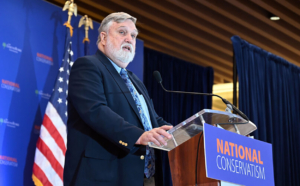
Pastor Doug Wilson addresses the National Conservatism conference, Thursday, Sept. 4, 2025, in Washington. (RNS photo/Jack Jenkins)
But critics say that Christ Church’s renown has less to do with the Almighty than with Wilson’s dedication to Christian nationalism and his ties to like-minded officials in the Trump administration and among its allies.
Secretary of Defense Pete Hegseth has attended a Christ Church-affiliated congregation in Tennessee and has amplified Wilson’s most controversial views, including his argument that women should not be allowed to vote. In the space of a month in April 2024, Wilson was interviewed by Tucker Carlson and Charlie Kirk on their respective podcasts.
Christ Church has also had a powerful effect on its own community, drawing approximately 3,000 of Moscow’s population of 25,000, as well as on the conservative Christian world, through a network of affiliated churches, schools and media platforms spanning the globe.
“What’s happening here is we’re punching way above our weight class,” Wilson said. “And so if you looked at everything on paper, none of this should be happening.”
Gradual change in theology
When Wilson began pastoring in 1977, he embraced the theological framework of his Jesus People roots—contemporary worship. That changed in 1988, when he encountered what he considered a dangerous theological drift in the congregation.
“Someone in the community started teaching what’s called openness of God theology,” Wilson recalled, referring to a view that God doesn’t fully know the future. “That appalled me.”
His search for a theological response led him to Reformed theology and John Calvin’s teachings on God’s sovereignty.
“I started reading … went down the wormhole and became a Calvinist in ’88,” Wilson said. The congregation followed his shift.
By 1993, Wilson had also embraced paedobaptism—baptizing infants—and Presbyterian church governance.
In 1998, he formalized relationships with two sister congregations in Washington state to create what became the Communion of Reformed Evangelical Churches, which has grown to approximately 170 congregations as far away as Eastern Europe, the Philippines and Japan.
Extending influence, sparking controversy
Pastor Doug Wilson speaks before communion as Christ Church meets in the Logos School gymnasium on Oct. 13, 2019, in Moscow, Idaho. (RNS photo by Tracy Simmons)
Wilson extended his influence through the Logos School, founded in 1981, launching what became the nationwide classical Christian education movement. The Association of Classical Christian Schools, which emerged from that effort, now represents hundreds of schools across the country.
In the 1990s, Wilson established Canon Press, a publishing house; New St. Andrews College, a Reformed Christian liberal arts institution; and Greyfriars Hall, a ministerial training program.
Wilson came to national attention in 2003, when he organized a conference at the University of Idaho at Moscow about revolutions throughout U.S. history.
Some in the community picked up on a booklet titled “Southern Slavery, As It Was” that Wilson had co-authored some years earlier arguing that slavery, besides being allowed for in the Bible, was not as harsh in the antebellum South as is commonly portrayed.
Soon the campus and downtown Moscow were plastered with flyers referring to Wilson’s university event as a “slavery conference.”
Pattern of taking provocative stands
The national media picked up the story, sparking protests, but Wilson showed an unwillingness to back down from controversy, and in the decades since he has established a pattern of provocative statements on race, gender and sexuality.
He made national news again during the COVID-19 pandemic, when he and other church members gathered maskless at Moscow City Hall in what Wilson termed “civil disobedience” against public health orders. His blog readership expanded dramatically, and his views on politics, culture and theology became more widely known.
“It was COVID that sort of kicked us into the mainstream across topics,” Wilson said.
Christ Church’s profile in the national debate is at odds with its relationship with its neighbors. The church has steadily acquired properties along Moscow’s Main Street, drawing protests from residents. Church members, meanwhile, own restaurants, coffee shops, a brewery and other establishments.
Local resistance
In May, library board candidates who espoused Christ Church values lost decisively. In November, three candidates backed by Liberty PAC—a political action committee funded primarily by Christ Church elder Andrew Crapuchettes’ company, 3100 Capital LLC—were defeated in races for mayor and City Council.
One council candidate, John Slagboom, who attends All Souls Christian Church, took offense at suggestions he was tied to Christ Church.
“What Liberty PAC did was totally out of my control,” Slagboom said.
Wilson responded by saying, “Basically, anybody who’s even mildly conservative and a Christian is going to be tagged as a kirker, whether they are or not,” using the local term for a member of the church.
Civil rights group voices concern
Moscow’s resistance may reflect an inherent weakness in Wilson’s strategy, said Kate Bitz, a senior organizer at the Western States Center, a civil rights organization that tracks organized bigotry in the Pacific and Inland Northwest.
Wilson’s Christian nationalism, said Bitz, “is an inherently anti-democracy movement that does not care for religious freedom, and that, in fact, would like every church in town to bend to their exact interpretation of the Bible.”
The Western States Center has tracked organized bigotry in the region since the 1980s—from Aryan Nations compounds to paramilitary movements to today’s Christian nationalist organizing. Wilson fits within that continuum, Bitz said, pointing to his history of defending aspects of chattel slavery and his statements about LGBTQ+ people and gender roles.
Wilson’s rhetoric about “bringing faith into the public square” or “defending religious freedom” may obscure authoritarian aims, she said, but once voters understand that ultimate goal, the message loses appeal, even in conservative areas.
Wilson explains his strategy
But Wilson explains his strategy through a concept he’s promoted for years: “assuming the center” or “acting with authority before you actually have any,” he explained. It’s a move that capitalizes on what Wilson sees as a vacuum created by faltering mainstream institutions.
Never has the strategy seemed to pay off more than now.
“If Kamala (Harris) had been elected, there would have been virtually no evangelical Christians in the administration,” Wilson said. “With (Donald) Trump in the White House, the administration is crawling with them.”
To maximize his footprint in Washington, Wilson planted a church there this year, introducing what Wilson critic Kevin DeYoung called “the Moscow mood”—cultural engagement “with a spirit of … having fun while you’re doing it.”
Wilson maintains that he is focused more on changing the culture of the capital, rather than partisan campaigning.
“We have a political agenda, but not a partisan, right-this-minute agenda,” he said. “We believe the church is inescapably political, but we also believe it ought not to be partisan in a ‘vote for Murphy’ kind of way.”
‘Serve as a warning for all Americans’
Rabbi Daniel Fink, retired from Boise’s Congregation Ahavath Beth Israel, said Wilson’s national influence represents a troubling trend.
“For many years, I hoped that Idaho would moderate to grow more like the rest of America,” Fink wrote in a recent column in the Idaho Statesman. “Instead, America is becoming more like Idaho.”
Fink, who has lived in Idaho for 32 years, sees Wilson as a leading figure in a movement to “replace democratic governance with fundamentalist rule.” He pointed to Idaho’s abortion ban, attacks on LGBTQ+ rights and efforts to funnel taxpayer dollars to religious institutions.
“I’ve seen what this agenda has done to Idaho,” Fink said in an interview with RNS. “It should serve as a warning for all Americans.”
Looking ahead
After nearly 50 years, Wilson shows no signs of slowing down. He preaches regularly, writes prolifically on his “Blog & Mablog” and travels to speak at affiliated churches.
But with a tentative plan calling for Wilson to step aside as senior minister at 75, transition plans have begun to take shape. His son, N.D. Wilson, who is an elder in the church, won’t take over.
“He’s more of a prophet than I am,” Wilson said. “His gifts would be—he needs to be doing what he’s doing.”
Instead, the next senior minister will likely come from within the community’s “deep bench” of capable leaders, Wilson said. He expects to share preaching duties for a time and rotate through different church plants in the area.
“I want to preach until I die, or as long as I’m able,” he said.
This article originated with FāVS News and was distributed by Religion News Service to its subscribers.
Baylor receives major Lilly grant for Truett Seminary
December 16, 2025
WACO—Baylor University received a $9.76 million Lilly Endowment grant to launch and provide financial support for the Ministry for Life initiative at Baylor’s Truett Theological Seminary.
The Ministry for Life initiative is funded through Lilly Endowment’s Pathways for Tomorrow Initiative. The grant to Baylor University is one of 45 approved in this competitive round of Lilly Endowment funding to support theological schools as they lead large-scale collaborations with other seminaries, colleges and universities, and church-related organizations.
Truett Seminary’s Ministry for Life initiative is based on a collaborative, comprehensive approach to pastoral formation intended to span the ministerial lifecycle.
The program is organized around four related pillars:
Shaping cultures of call.
Educating the called.
Placing the educated.
Supporting the placed.
The grant-funded effort aims to build reciprocal relationships among leaders, congregations, denominations, educational institutions and church-related organizations through the Ministry for Life Center with a view to equipping healthy ministers to lead healthy churches over the long haul.
Addressing a ‘systemic concern’
Todd Still (Baylor Photo)
“For a number of years now, several of my Truett colleagues and I, along with many of our ministerial partners, have grown increasingly concerned about a decreasing number of people embracing and preparing formally for vocational ministry and an increasing number burning out and dropping out of the same,” Dean Todd Still said.
“This generous, indeed transformative, grant from Lilly Endowment, which is the largest such gift Truett Seminary has received to date, enables us to collaborate with others to address this systemic concern.
“At scale, we are convinced that Ministry for Life will have a considerable impact and will help to create and establish virtuous ministerial cycles that will extend the gospel and strengthen congregations.”
Truett’s Ministry for Life program—which is due to become an endowed, permanent center at the seminary—will be supervised by Truett faculty and staff members Angela Reed, associate dean of academic affairs and director of spiritual formation; Jack Bodenhamer, assistant dean of external affairs; and Michael Mauriello, associate clinical professor of youth and family ministry. The five-year grant will allow for staff hires to support the initiative’s work.
Collaborative effort, holistic approach
“We are beyond grateful for this opportunity to build upon the work of teaching and encouraging those with a call to ministry by developing new collaborative degrees and academic certificates, mentoring young people drawn to ministry leadership and walking alongside pastors already serving for the long haul,” said Reed, who is the grant’s principal investigator.
“No theological school does this work alone, and we are very pleased to collaborate with denominations, educational institutions, and nonprofit organizations in this project to support faithful, healthy congregations for God’s purposes in the world.”
Additionally, Bodenhamer, co-investigator on the grant, said Truett Seminary is confident the grant “will help shape the landscape of the church in North America for generations to come.”
“Its holistic approach—supporting ministers, churches, denominations, educational institutions and para-church ministries—positions us to serve individual pastors and congregations while also fostering meaningful change at a broader systemic level,” he said.
Strengthen churches and their leaders
The Ministry for Life initiative reflects Baylor’s “abiding commitment to the church in North America and to equipping future leaders for vibrant, lifelong ministry, not least through our seminary,” President Linda A. Livingstone said.
“We are deeply grateful for the Lilly Endowment’s continued partnership with Baylor University and for their faithful investment in the renewal of the church and support of congregations. We look forward to continuing this good work together to strengthen the church and support its leaders, both for today and for future generations.”
Lilly Endowment launched the Pathways for Tomorrow Initiative in 2021 to help theological schools across the United States and Canada as they prioritize and respond to the most pressing challenges they face while preparing pastoral leaders for Christian congregations now and into the future.
Since then, it has provided grants totaling more than $700 million to support 163 theological schools in efforts to strengthen their own educational and financial capacities and to assist 61 schools in developing large-scale collaborative endeavors.
BUA organiza el retiro ‘Llamados al Ministerio’
December 16, 2025
Bajo la dirección del presidente de BUA, el Dr. Abe Jaquez, el campus de la Universidad Bautista de las Américas en San Antonio, Texas, se llenó de energía y ánimo los días viernes 5 y sábado 6 de diciembre, cuando los bautistas de Texas se reunieron para el retiro “Llamados al Ministerio”.
Este evento de dos días ofreció un espacio acogedor para que los participantes exploraran, afirmaran y respondieran al llamado de Dios a través de sesiones de enseñanza, talleres y tiempo de compañerismo.
Uno de los momentos más destacados del retiro se vivió el sábado, cuando la Dra. Debbie Potter, recientemente elegida presidenta de la Baptist General Convention of Texas y miembro de largo tiempo del cuerpo docente de BUA, dirigió unas palabras a los asistentes y entregó una beca de $500 a John Mendoza, un estudiante prospectivo.
Con entusiasmo, Potter entregó el certificado de la beca, marcando un momento memorable del retiro y subrayando la importancia continua de la educación, el liderazgo y la respuesta fiel al llamado de Dios en todos los ámbitos de la vida.
Presentada por Jaquez, Potter compartió un mensaje que combinó testimonio personal, ánimo y sabiduría práctica para quienes están discerniendo el llamado de Dios.
“Esta es mi primera tarea oficial como presidenta de la Baptist General Convention of Texas, y no podría estar más emocionada de estar aquí porque también es mi hogar”, dijo Potter.
“He enseñado en BUA durante 10 años, de manera intermitente. Mi esposo empezó a enseñar aquí primero, y volvía a casa todos los lunes por la noche comentando sobre los estudiantes y lo increíbles que eran; estaba tan emocionado con ellos.
“Varios de esos estudiantes vinieron a trabajar conmigo en mi iglesia y todavía trabajan conmigo, 10 años después, en Trinity Baptist. Los estudiantes de este campus y los líderes son tan importantes, y eso marca la diferencia. Eso es lo que me encanta de la Baptist General Convention of Texas: que valoramos la educación”, agregó.
Basándose en sus reflexiones sobre el valor de la educación y el impacto de los estudiantes de BUA, Potter animó a los asistentes a confiar en el plan de Dios para sus vidas, sin importar su edad o experiencias pasadas:
“No importa cuántos años tengas, ni lo joven o lo viejo que seas, ni lo que hayas hecho en tu vida, Dios tiene un plan para ti, y esos planes pueden cambiar,” dijo Potter.
“Mi primer llamado fue hacia la educación. Soy educadora. Me encanta enseñar, ya sea a niños o a estudiantes universitarios. Él me pidió que enseñara, y lo hice.
“Así que hoy solo quiero animarte: no dejes que nada te detenga de seguir el plan de Dios para tu vida. Puede que no sepas cuál es; puede que tome varios giros y curvas. Solo di que sí, y Dios abrirá la puerta para ti.
“Solo mira alrededor de esta sala y piensa en lo que puede suceder en nuestro estado si todos decimos sí al llamado de Dios y comenzamos a trabajar en nuestras comunidades y nuestras iglesias.”
El retiro también contó con un programa completo de sesiones generales y talleres. La tarde del viernes comenzó con Victor Rodríguez dirigiendo la sesión “¿Qué significa ser llamado?”, en la que destacó que Dios no necesariamente llama a los más calificados, sino a los dispuestos, y que el llamado puede darse en cualquier área de la vida: la iglesia, el trabajo, la familia o los negocios.
Rodríguez animó a los participantes a asumir la tarea de Dios con fidelidad, recordándoles que las Escrituras reflejan no solo tareas, sino el propósito que Dios tiene para cada persona.
Las sesiones del sábado incluyeron a Bobby Contreras con la enseñanza “Protegiendo tu llamado”, enfocándose en hábitos y disciplinas que sostienen el ministerio, y a Jesse Rincones con “Llegando lejos en tu llamado”, destacando la perseverancia y la resiliencia.
Los talleres estuvieron dirigidos tanto a pastores como a quienes están discerniendo un llamado, abordando temas desde el papel de la iglesia en el desarrollo de líderes emergentes hasta el discernimiento personal y el impacto en el Reino.
Durante todo el fin de semana surgió un tema recurrente: Dios llama a personas de todas las edades y contextos para servir, y responder fielmente puede tener un impacto duradero. Para muchos, la combinación de enseñanza, compañerismo y ver a líderes como Potter en acción brindó tanto inspiración como ánimo tangible para sus propios caminos.
BUA hosts Called to Ministry retreat
December 16, 2025
Texas Baptist youth gathered Dec. 5-6 on the Baptist University of the Américas campus in San Antonio for a Called to Ministry retreat.
Organizers planned the two-day event to offer a welcoming space for participants to explore, affirm and respond to God’s calling through teaching sessions, workshops and fellowship.
In her first official task as president of the Baptist General Convention of Texas, Debbie Potter presented a $500 scholarship to prospective student John Mendoza.
Potter, children’s pastor at Trinity Baptist Church in San Antonio, told retreat participants about her personal involvement with BUA.
“I’ve been teaching at BUA for 10 years on and off. My husband first started teaching here, and he would come home every Monday night and talk about the students and how incredible the students were. He was so excited about them,” Potter said.
“Several of them came and started working for me at my church and still work for me, 10 years later, at Trinity Baptist. The students on this campus and the leaders are so important, and that’s what makes the difference. And that’s what I love about the Baptist General Convention of Texas—it’s that we value education.”
‘God has a plan for you’
Potter urged attendees at the retreat to trust God’s plan for their lives, regardless of their age or past experiences:
“No matter how old you are, no matter how young you are, no matter what you have done in your life, God has a plan for you, and those plans can change,” she said. “My first calling was to education. I am an educator. I love teaching, whether children or college students. He asked me to teach, and I did it.
“So, I just want to encourage you today. Don’t let anything deter you from doing God’s plan for your life. You may not know what it is. It may take several different turns and curves. Just say ‘yes,’ and God will open the door for you.
“Just look around this room and think about what can happen in our state if we all say ‘yes’ to God’s calling and start working in our communities and our churches.”
Victor Rodriguez, evangelism associate and discipleship specialist with Texas Baptists, led a session focused on the question, “What does it mean to be called?”
God calls not necessarily the most qualified but the willing, Rodriguez said. God’s calling can come in any area of life—from the church to the workplace, family or business, he added.
Rodriguez encouraged participants to embrace God’s assignment with faithfulness, reminding them Scripture reflects not just tasks, but the purpose God has for each person.
Bobby Contreras, pastor of Alamo Heights Baptist Church in San Antonio, led a session on “Guarding Your Calling.” Jesse Rincones, executive director of the Hispanic Baptist Convention of Texas, presented a session on “Going the Distance in Your Calling,” emphasizing perseverance and resilience.
Wisdom-Martin announces WMU retirement plans
December 16, 2025
BIRMINGHAM, Ala.—Sandy Wisdom-Martin, executive director-treasurer of national Woman’s Missionary Union, announced Dec. 10 she will retire in January 2027, marking 36 years of ministry service.
Sandy Wisdom-Martin, executive director of WMU, SBC, talks about lives transformed by God through gospel conversations and the importance of sharing Christ at every opportunity during a report to the Southern Baptist Convention in Anaheim, Calif., in June 2022. (Photo / WMU, SBC)
Wisdom-Martin has led national WMU, an auxiliary of the Southern Baptist Convention, since October 2016. Previously, she was executive director-treasurer of Woman’s Missionary Union of Texas.
She announced her intention to retire to the national WMU general board—comprised of state WMU presidents and executive directors—during a called meeting and then with the staff of WMU, SBC.
“After much prayer, reflection and conversation with my family, I am asking the WMU executive board to begin the search for a new executive director-treasurer as I will retire January of 2027,” Wisdom-Martin said.
“Faithfulness in this season calls me to be present with my family in a way that cannot be sustained by the obligations of my current ministry role.
“Our mission remains unchanged because it is rooted in God’s calling, not in one individual. God’s plan for this organization is bigger than any single person’s role. I have every confidence the Lord will guide and undergird WMU. His faithfulness does not change.”
Next steps
Wisdom-Martin voiced gratitude for national WMU staff and presented next steps.
“I am proud of how you serve others so selflessly and with excellence,” she said. “I am more confident than ever in WMU’s future because of you and our valued stakeholders. I do not intend to slow down. Together, we will continue to serve faithfully.”
Wisdom-Martin said she and WMU President Connie Dixon believe God already is preparing the right person to lead WMU forward. Dixon will appoint a search committee soon.
“It is the board’s role to find the next executive director,” Wisdom-Martin said. “They will seek the Lord’s direction, confident that he will make the path clear. We will move forward with gratitude for what has been and hope for what is to come. This will not be a disruption, but a continuation of God’s unfolding story of this ministry.”
‘Passion for missions’
Jeff Iorg, president of the SBC Executive Committee, called working with Wisdom-Martin “a delight.”
“Her passion for missions, personal devotion to Jesus and determination to lead Woman’s Missionary Union to make a kingdom impact has inspired and motivated me to be a better leader,” Iorg said.
“Sandra’s genuine humility is a model for all of us. She has served with honor, and we will miss her contributions to the Great Commission Council and other national leadership platforms.”
During WMU’s January Board Meeting last year, Kevin Ezell, president of the North American Mission Board, said: “Missions in the SBC would not be what it is if it were not for WMU and if it were not for Sandy Wisdom-Martin. We are very grateful for her, and we are grateful for how you support our missionaries. They are overwhelmed with gratitude when we tell them all that you do.”
In her role, Wisdom-Martin led WMU to help raise more than $513.5 million for the Annie Armstrong Easter Offering and more than $1.4 billion for the Lottie Moon Christmas Offering since 2017.
In addition to helping raise funds for these two offerings, Wisdom-Martin has promoted giving to the SBC’s Cooperative Program and to the WMU Foundation to advance the gospel, as well as practical ways to involve more believers in evangelism.
Focused on mandate to make disciples
In the past 10 years, Wisdom-Martin has led WMU to be focused on its mandate of making disciples of Jesus who live on mission.
“We are failing to do the one thing Jesus told us to do, and that is to make disciples,” she said. “It is incumbent on every Christ follower to proclaim the gospel. This responsibility cannot be abdicated.
“We have church members who get married in the church and get buried in the church and live their entire life without once sharing their faith. This is the greatest tragedy of our generation, that we would not personally take responsibility for the sacred task entrusted to each of us.”
‘Sought to build bridges and strengthen relationships’
That conviction led Wisdom-Martin to seek partnerships in which WMU could provide practical resources for discipleship and evangelism. She also wrote countless articles, conferences and public addresses designed to encourage and equip others to share their faith.
“Sandy is a dynamic leader, one of the most creative thinkers I have ever known and a dedicated woman of God,” WMU President Connie Dixon said. “She has sought to build bridges and strengthen relationships with all SBC entities and leaders.
“Her genuine love for others is so apparent. Whether speaking on a national platform, writing inspiring articles, serving on a missions trip, or leading children’s Sunday school in her church each week, Sandy inspires all ages to grow stronger in their spiritual walk.”
Linda Cooper, who served as president of national WMU from 2015 until 2021 alongside Wisdom-Martin, agreed.
“A great leader is one who is both strong and kind,” Cooper said. “They lead compassionately and confidently as they inspire others. Sandy Wisdom-Martin is the epitome of a great leader.
“Her leadership has never been about her title or position. It was simply about one life influencing another to make disciples of Jesus who live on mission. Sandy certainly influenced my life and countless others whom her life touched as she has humbly led national WMU. I was honored to serve alongside her.”
Leadership during a global pandemic
During her tenure, Wisdom-Martin led the organization through a global pandemic that she described at the time as a crisis that negatively affected WMU’s bottom line, but positively amplified its mission.
Knowing church attendance and giving would be down during the COVID-19 pandemic, Wisdom-Martin engaged WMU leaders across the country in 2020 to handwrite more than 18,000 letters asking churches to support the Lottie Moon Christmas Offering.
With plummeting sales during a time when churches were closed and missions groups were not meeting, WMU increased efforts to engage others in missions in different ways.
Examples included reaching out to SBC seminary presidents with an offer to help international students stranded on campuses, sending daily prompts via email encouraging prayer for pastors and missionaries, working with IMB and state WMUs to help with a surge in requests for missionary housing and launching a podcast that grew to 63 episodes.
Around the State: HCU holds ceremony for new STEM facility
December 16, 2025
Houston Christian University hosted a ceremony Dec. 2 marking the completion of the structural phase of the Smith Engineering Science and Nursing Building. The multidisciplinary building will expand space and learning opportunities for the next generation of science, technology, engineering, mathematics and nursing professionals. Slated to open in fall 2026, the building will be home to innovative laboratory and learning spaces for the College of Science and Engineering and the Linda R. Dunham School of Nursing. Those in attendance were invited to take part in the traditional signing of a beam to commemorate the occasion.
Baylor University has named media and brand executive and former athletics administrator Doug McNamee as the Bears’ next vice president and director of intercollegiate athletics, Baylor President Linda A. Livingstone announced. McNamee returns to Baylor after serving as president of Waco-based Magnolia, the nationally recognized lifestyle and media company founded by Baylor alumni Chip and Joanna Gaines, and most recently as president of Field & Stream. A two-time Baylor graduate, McNamee spent nearly a decade at his alma mater, rising to senior associate athletics director for external affairs before departing in 2018 for the corporate sector.
Thomas Sanders, provost and vice president for academic affairs, announced East Texas Baptist University’s Level VI accreditation from the Southern Association of Colleges and Schools Commission on Colleges. ETBU now has authority to award four or more doctoral degrees. ETBU awarded its first Ph.D. to Arcadis Silvera and Doctor of Ministry to Jason Horine. “Level VI is the highest designation,” Sanders said. “We are educating and training the people who will be the next graduate and undergraduate students across Christendom. In a sense, it is a bigger kingdom impact. We are training future educators who will be educating other professionals.”
The Gary Cook School of Leadership at Dallas Baptist University will host a Zoom presentation on “Sabbath Rest for Leaders” on Thursday, Dec. 11, at noon. The candid conversation will include discussions on the biblical understanding of Sabbath rest and how it can be prioritized without diminishing work. Those interested can sign up online.
The University of Mary Hardin-Baylor Arts Academy is excited to present its Christmas Festival on Saturday, Dec. 13, at 2 p.m. The event is free and open to the public and will take place inside the Sue & Frank Mayborn Performing Arts Center on the UMHB campus.
Howard Payne University surpassed this year’s Giving Tuesday goals of raising $750,000 from 400 supporters. The total on Dec. 2 was $1.2 million from 425 supporters across 21 states. Donations during the one-day giving event were provided by alumni, friends, faculty, staff and community partners. Gifts will support a wide range of student-experience initiatives, including student scholarships, academic programming, campus improvements, athletics and the Howard Payne Fund.
Raúl Josué Valerio has been named the new director of Hispanic initiatives at Baylor University’s Truett Theological Seminary. As Valerio begins this new position, he will play a vital role in advancing Truett’s ongoing commitment to serving and partnering with Hispanic ministers and ministries across Texas and beyond.
 “Our data shows that the nature of their religious experiences as children—that is, whether they were mostly positive or negative—plays a significant role in whether they stay in their childhood religion as adults,” the study’s authors wrote.
 Among the most important factors were they stopped believing their faith’s teachings (51 percent), religion was no longer important to them (44 percent), and they gradually drifted away (42 percent).