Hawaii trip a dream come true for STCH Ministries student

When Chris, a student at South Texas Children’s Home Ministries’ Boothe Campus, traveled to Hawaii in December, it marked the culmination of months of preparation, fundraising and anticipation.

Chris, an All-American cheerleader, was invited to perform in the Pearl Harbor Memorial Parade in Waikiki.

He considered the trip a remarkable opportunity to honor history, experience a new culture and witness God’s handiwork in his life.

His journey to Hawaii began with a dream and an unrelenting determination to make it happen.

“As soon as I decided to make this trip a reality, I started searching for fundraising ideas everywhere,” he said.

With the support of STCH Ministries, his community, teachers, house parents and even his boss, Chris launched multiple fundraisers—selling kolaches, creating a unique Tic-Tac-Toe donation board on social media and other fun ideas.

‘Showed relentless drive’

His efforts were so successful, he even helped cover a portion of the expenses for his chaperone on the trip, Benjamin Brewer, student ministries coordinator at STCH Ministries.

“Watching Chris’s hard work come to life was inspiring,” Brewer said. “Many kids start with enthusiasm but lose momentum. Not Chris.

“He showed relentless drive, organizing fundraiser after fundraiser for months without giving up. It was amazing to witness his dedication and determination.”

The trip itself was filled with moments of awe and gratitude. As Chris stepped onto the island, he was struck by the natural beauty that surrounded him and God’s goodness in bringing him there.

“The landscapes, the water and the sky—it all felt like a reflection of God’s incredible creation,” he said. “It hit me that this entire experience was possible because he wanted me to be here.”

The highlight of the trip was the Pearl Harbor Memorial Parade on Dec. 7, held in honor of the veterans and in remembrance of the Pearl Harbor attack.

Chris joined cheerleaders from across the country, many of whom he had befriended online, in a unique performance that brought the community together.

“When the music started, and I lined up for the parade, it finally sank in. I was about to cheer in front of everyone,” Chris recalled. “It was an unforgettable mix of excitement and pride.”

For Brewer, the parade was equally powerful.

“Seeing the crowd’s reaction, especially to the military members, was incredible. One of the last Pearl Harbor survivors, over 100 years old, was in the parade,” he said. “It reminded us of the significance of this event and the lives it represents.”

Beyond the parade, Chris and Brewer immersed themselves in the Hawaiian experience. They visited the USS Missouri, toured the Pearl Harbor memorial, attended a traditional luau and hiked two miles up a mountain to enjoy breathtaking views.

Growth and resilience

Throughout the trip, they observed, God’s faithfulness and provision shined through every moment.

Brewer, who has known Chris since he was 4 years old, reflected on his growth and resilience.

“Chris has faced so much in his life—losing his mom at a young age, his dad’s absence and the challenges of growing up on the Boothe Campus,” he said.

“Yet, he hasn’t let those hardships define him. He has grown into a young man with a deep faith and incredible determination. It’s a testament to how God has worked in his life through the love and care of our ministry.”

Chris shared his gratitude for the role STCH Ministries and the larger community played in making this trip possible.

“There are so many people I want to thank for making this opportunity possible. Knowing I had so many people supporting me every step of the way meant the world to me,” he said. “Words can’t fully express how grateful I am for their encouragement and belief in me.”

Reflecting on his time at STCH Ministries, Chris added: “They’ve helped shape me into a more effective leader, someone who values responsibility, kindness and thoughtfulness. I’ve also learned to be genuinely grateful for everything I have.”

Brewer also reflected on the meaningful experience.

“We preach normalcy all the time in our office. We want our kids to feel normal—not to be treated abnormally,” he said. “Trips like this help reinforce that idea—showing them they can have experiences just like anyone else, that they are loved and cared for, and that they are part of something bigger.”

Chris described the trip as life-changing.

“I had such a great time and made so many new friends. Cheering in that parade was such a unique and unforgettable experience,” he said. “It’s a feeling I’ll carry with me forever.”



Fear, misinformation, preparation after ICE policy change

WASHINGTON (RNS)—About 1 million TikTok users have viewed a video posted on the social media platform Jan. 22 warning people away from the Manna Food Center distribution at Glenmont United Methodist Church, just outside the nation’s capital in Maryland, claiming the U.S. Immigration and Customs Enforcement agency had been present there.

The problem? It isn’t true.

Kelly Grimes, pastor of the multicultural church, which shares its sanctuary with Spanish- and French-speaking congregations, told RNS it took a few days to track down the truth.

A man confessed he had spotted what he thought were unmarked law enforcement vehicles and panicked. He had no indication ICE had been there. Another man made the TikTok video, leaving Grimes and food distribution leaders to deal with the fear and fallout.

Grimes is one of several leaders of houses of worship who spoke to RNS about fighting misinformation about potential ICE raids, trying to walk with their congregants, even as attendance is taking a hit.

Asylum-seeker arrested at Georgia church

The Trump administration has promised to end a policy preventing ICE from arresting immigrants at houses of worship, schools and hospitals. So far, the only reported ICE arrest at a house of worship came during a worship service at Iglesia Fuente de Vida (Fountain of Life Church) in Tucker, Ga.,

Wilson Velásquez, an asylum-seeker who entered the United States in September 2022 with his wife and kids after facing threats from gangs in Honduras, was attending the church when his ICE ankle monitor began beeping, according to the Atlanta Journal-Constitution. When he stepped outside to avoid disturbing the service, he was arrested by ICE agents.

ICE did not immediately respond to an RNS request for information about why Velásquez was arrested.

Besides Velásquez, at least 20 others were arrested in the Atlanta area Sunday, all of them asylum-seekers with ankle monitors who had arrived in the United States between 2021 and 2023, according to Atlanta-area Spanish-language journalist Mario Guevara, who spoke to the Atlanta Journal-Constitution. Many of those arrested had valid work permits.

“We’re all in shock,” said Agustin Quiles, a director of community affairs and government relations for the Florida Fellowship of Hispanic Councils and Evangelical Institutions.

Quiles said his group was still working on a response, but that they were most concerned about children who would be impacted by the policy change.

“What are we going to do with the thousands of children that are left behind?” he asked.

Megachurch pastor seeks to assure worshippers

Samuel Rodriguez, president of the National Hispanic Christian Leadership Conference, who advised President Donald Trump on immigration during his first term, told RNS he had been assured by “those that know” that churches will not be raided by ICE and suggested anyone arrested in a church would be “the worst of the worst.”

Samuel Rodriguez

“I’ve seen Tom (Homan) cry regarding the loss of immigrant lives, especially little kids,” Rodriguez said of the White House border czar’s “great heart.”

Rodriguez said he is trying to address misinformation, as some pastors who are members of the conference have reported lower Sunday attendance.

At his own megachurch in Sacramento, Calif., Rodriguez assured attendees ICE raids “will not happen in our church.” Despite his media appearances supporting Trump’s actions against illegal immigration, Rodriguez told the church, “I do not need to know who is documented or undocumented.”

He added he would continue to fight for a pathway to citizenship for “Dreamers,” people without legal status brought to the country as children, and to legalize “those who have been here for decades, those who have worked hard, who are not dependent on government subsidies, who have never even received a parking ticket, who love Jesus, and who love this country.”

Coalition helps immigrants know their rights

Gabriel Salguero, president and founder of the National Latino Evangelical Coalition, held a webinar on Trump’s executive orders attended by 500 evangelical Christian leaders, a much higher turnout than the coalition’s webinars typically draw.

The coalition shared guidance, advising congregations to train a spokesperson to communicate clearly and respectfully to deescalate with ICE agents and to train children’s pastors on how to respond if a raid happens while children are separated from their parents for the service.

The group is also distributing “Know Your Rights” cards in multiple languages for congregants and teaching congregations themselves about their legal rights, clarifying they have to allow ICE to enter into public worship spaces, even when they don’t have a warrant, but not church schools.

But Salguero said pastors’ concerns don’t stop at the church property line.

“Even if there are not raids in churches, one of the concerns is that ICE agents will be parked near churches waiting,” Salguero said.

Salguero also said, in addition to supporting congregations, the coalition would continue its advocacy for immigration enforcement that targets violent criminals instead of families.

Quakers file lawsuit over policy change

Five Quaker groups have taken a different tack, filing a lawsuit against the Department of Homeland Security and newly confirmed Homeland Security Secretary Kristi Noem over the change in the sensitive-locations policy.

The suit charges the court should declare unconstitutional any policy allowing immigration enforcement at or near houses of worship without strict limits. The groups argued the policy change placed a substantial burden on their religious exercise.

Catholic bishops have made public statements in support of immigrants, advocating for policy changes and announcing that they are spreading know-your-rights information, but RNS inquiries to diocesan offices about any further preparations were declined or went unanswered.

Imam Musa Kabba, who leads Masjid-ur-Rahmah, a large multicultural mosque in the Bronx with a majority West African immigrant population, told RNS the mosque is educating immigrant members in their rights.

He added: “We’re praying to our creator, our God Allah. We pray more that he might protect us. He might show us a way to get out of this, all terrible.”

Kabba is also advising his members to “do the right things,” to continue going to the masjid and work.

“We don’t have any bad people in our mosque,” he said, but, he acknowledged, “you can’t stop the government.”

Kabba is calling on the “good people who are close to” Trump to remind him of his immigrant roots in his own family and all of the immigrants who have come to the United States because “their country is hard.”

“He might listen to them,” he said.

‘The fear is real’

Whether Trump will hear anything from his allies in Congress is unclear.

When asked by Migrant Insider, a Substack that reports on migration issues on Capitol Hill and the White House, whether churches should “be sanctuaries from immigration agents,” several Democratic senators and Alaska Republican Sen. Lisa Murkowski expressed support for the previous policy that had prevented arrests at churches.

Five other Republican senators seemed to indicate they needed to give the matter more thought, while others expressed strong support for the policy change.

Just across the border in Maryland, where Grimes is working to pick up the pieces from the TikTok misinformation, she emphasized “the fear is real,” explaining her congregation knows those who have been detained who are in the country legally.

 “As the United Methodist Church, we have social principles that welcome the stranger. So what ICE is doing, and especially their methodology, just totally goes against what we as the United Methodist Church believe,” she said.

ICE is not welcome on her campus.

“We’re following the mandate we’ve been given by Christ,” she said.

“There’s always going to be people who as soon as they hear ICE, they’re never going to that space again. And I don’t blame them.”


Senate committee considers cost of school vouchers

The Legislative Budget Board estimates the cost of the Texas Senate’s school voucher bill could increase from $1 billion in 2027 to more than $3.75 billion in 2030.

But some Christian advocates for public education told a Senate committee the cost could be even greater in terms of the damage school vouchers would do to the principle of separation of church and state.

In a Jan. 28 fiscal note, the Legislative Budget Board reported the estimated impact of Senate Bill 2 would create an education savings account program designed to help parents pay for their children’s private-school education with public funds.

Both Gov. Greg Abbott and Lt. Gov. Dan Patrick have expressed strong support for the education savings account program.

Jerry McGinty, director of the Legislative Budget Board, reported the Senate bill could have a cumulative $11 billion negative impact on general revenue funds over four years.

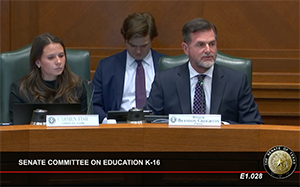
McGinty directed the fiscal note to Sen. Brandon Creighton, chair of the Senate Committee on Education K-16 and sponsor of Senate Bill 2, shortly before his committee heard about eight hours of testimony on the bill.

The fiscal analysis of the program projects half of Texas students currently in private schools would apply for the education savings accounts.

Senate sponsor insists program promote ‘education freedom’

Sen. Brandon Creighton, chair of the Senate Committee on Education K-16 and sponsor of Senate Bill 2, presided over a committee hearing about the bill, which would create an education savings account program. (Screen Grab)

Creighton dismissed the Legislative Budget Board estimate as a “fairy tale” projection, insisting lawmakers would have the power to control costs of the education savings account program through the appropriations process.

The proposed education savings account program would offer “expanded education freedom to our students and our families” in Texas, Creighton asserted.

The program differs from school voucher programs in many states since funds would not go directly to parents but would be disbursed through the state controller’s office directly to eligible education providers, he insisted.

“This is an education savings account with the strongest anti-fraud provisions in the country,” he said.

Of the $1 billion allocated for the program in the proposed budget, $200 million would be available to any students, and $800 million would be earmarked for special-needs children and “low-income” families.

The Senate bill broadly defines “low-income” families as those making five times the federal poverty level. That means a single parent making $105,000 a year—or a family of four making more than $150,000 a year—would qualify.

Violates ‘bedrock constitutional principle’

“Vouchers subsidize the wealthy at the expense of the poor,” Charles Foster Johnson, a Baptist minister and executive director of Pastors for Texas Children, stated in testimony before the Senate Committee on Education K-16.

Charles Foster Johnson

Johnson characterized the bill as providing “a handout from the public treasury that flings the door wide open to misuse, greed and corruption.”

A program that would redirect public funds to private religious schools violates the separation of church and state, said Johnson, interim senior pastor of Second Baptist Church in Lubbock.

“The state of Texas has zero authority to underwrite religious private schools, nor to intrude into the operation of those schools. Vouchers do both,” he said. “All genuine faith is voluntary and neither needs nor should accept public funding.

“Universal education for all God’s children is a basic human right according to all people. It is provided and protected by the public and is constitutionally guarded by Texas law. The responsibility of this Senate is to ‘public free schools,’ not private schools.”

Charles Luke, coordinator of the Coalition for Public Schools, similarly asserted the education savings account program “violates the separation of church and state by allowing the transfer of taxpayer funds to private religious schools.”

“This is a bedrock constitutional principle, which protects religious freedom in our country by ensuring that the state does not establish a favored religion through funding or any other means and guarantees the free exercise of religion without government intervention,” Luke continued.

Luke, the director of advocacy with Pastors for Texas Children, also pointed to the fiscal costs of similar programs in other states, pointing to Florida, Indiana and Arizona as examples.

Arizona’s voucher experiment has since caused a budget meltdown,” he said. “The state this past year faced a $1.4 billion budget shortfall, much of which was the result of the new voucher spending.”

Three-fourths of the “universal empowerment savings account” vouchers in Arizona go to students who already were attending private schools and never previously attended public schools, he added.


Around the State: UMHB opens Arctic art exhibit

The University of Mary Hardin-Baylor announces the opening of “Off the Map,” an art exhibit that begins with a public reception Jan. 30 at 5 p.m. The reception and exhibit will be in the Baugh Center for the Visual Arts art gallery on the UMHB campus. UMHB Art Department Chair Stephanie Chambers left behind civilization this past October for a transformative voyage to one of the Arctic Circle’s most untouched corners. Her mission was to convey what she saw and experienced through painting. “Words can never convey the impact of witnessing such a remote location of the world. The act of painting on-site encapsulates for me the entirety of my presence in that space,” Chambers said. “Beyond the visual cues, sounds, temperature and emotions, both fear and awe are all translated through mark, color and shapes on the canvas.” The exhibit will stay up until February 27.

“The World Famous” Cowboy Band, an ensemble rich in history and tradition, entertains the crowd at a Hardin-Simmons University football game. (HSU Photo)

The Hardin-Simmons University School of Music announced its spring calendar of events. The Cowboy Band will be the opening act for the Sons of the Pioneers at the Paramount Theater on Jan. 29 at 6 p.m. The Cowboy Band also will perform at men’s and women’s basketball games at Mabee Complex on Jan. 30 and Feb. 6 from 5 p.m. to 9:30 p.m., provide the Golden Lariat performance at Cowboy Band Hall on April 7 at 5 p.m. and perform for Western Heritage Day by the reflection pond on April 24. The HSU Concert Band will be in concert with McMurry University at the Paramount Theater on March 24 at 7:30 p.m. The band also will participate in a hymn sing performance at Logsdon Chapel on April 8 at 2 p.m. and at their spring concert with the Cowboy Band at Van Ellis Theater on April 29 at 7:30 p.m. The HSU Jazz Ensemble will have a spring concert at Van Ellis Theater at 7:30 p.m. on April 24.

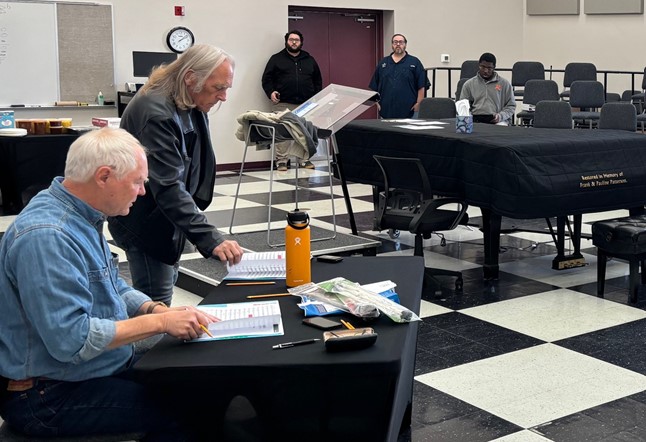
HPU hosted a UIL pre-contest listening session for area school band directors in rural areas. (HPU Photo)

The Center for Rural and Small School Music Education at Howard Payne University, in cooperation with Tarpley Music of San Angelo, sponsored a University Interscholastic League pre-contest listening session for area school band directors on Jan. 19. The panel of respondent-clinicians included James Bode, Barry Hunt and Jonathan Kraemer, assistant professor of music and director of bands at HPU. Directors provided recorded rehearsals of their ensembles and received verbal and written comments to improve the performance of the students. Richard Fiese, professor of music education and the director of the center, noted this session is one service the center provides for area music educators and an example of how HPU supports quality music education for all students, including those in rural and small schools. Directors from Rotan, Jayton, Seymour, Comanche, Hamlin, Coleman, Early and Goldthwaite applied to participate in the listening session.

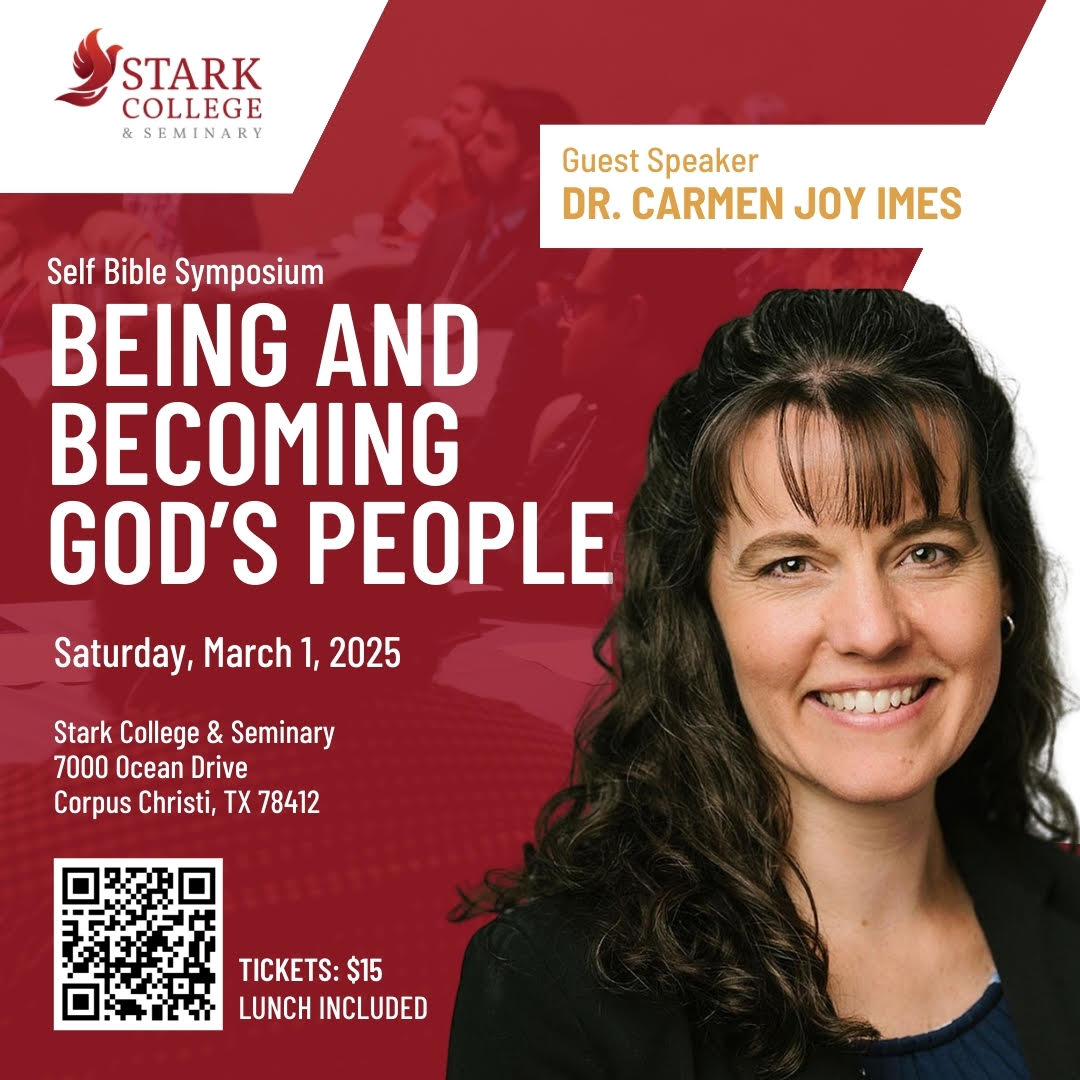
Stark College and Seminary will host the Self Bible Symposium on March 1 from 9 a.m. to 2 p.m. at its Corpus Christi campus. The theme is “Being and Becoming God’s People.” Carmen Joy Imes will be the speaker. Renowned for her books and YouTube series, Imes inspires learners to explore the Old Testament and its significance to Christian identity and mission. The cost is $15, and lunch is included. Register here.

Wayland Baptist University announces the 2024 alumni award recipients, honoring individuals who have made significant contributions in their respective fields. Recipients will be honored at the annual Blue and Gold Banquet during Homecoming 2025, which takes place Feb. 5-8 on Wayland’s Plainview campus. The honorees include:Distinguished Alumni Award, Lee Baggett; Distinguished Alumni Award, John Blevins; Young Alumnus Award, Jovanna Duffy; Benefactor of the Year, Jolene Gary; and Lifetime Service Award, Danny Murphree.

San Antonio Baptist Association will host North America Arabic Pastors Network for a pastors’ conference in its San Antonio offices, Feb. 18-22. To sponsor an individual pastor’s conference costs or for flights, hotel, transportation, meals and educational tools, click here or email Raid al Safadi at Raid@NAAPN.net for more information. Watch his short video about the Arabic Pastors Network here.

Paul Armes, president emeritus of Wayland Baptist University, will be the featured speaker for the 72nd annual Willson Lectures, Feb. 25-26. The event includes a dinner Tuesday evening at 6:30 p.m. in the McClung University Center, UC 211, on the Plainview Campus. Reservations are required. Seating is limited. Call 806-291-3427 to RSVP by Feb. 7. The following morning, Armes will lecture on “Some Implications of Imago Dei” during chapel in the Harral Memorial Auditorium. Chapel is at 11 a.m. and is free and open to the public.

Anniversaries

Anderson Baptist Church in Anderson celebrated 180 years Jan. 16. Early in 1844, a small group of Baptists began meeting in a log schoolhouse four miles northwest of Anderson. Seven members of the group organized the Antioch Baptist Church on Nov. 11, 1844, which was renamed Anderson Baptist Church in 1852, when it relocated into town. In 1848, messengers from 34 of the 73 Baptist churches in the state assembled at the church for the first Texas State Baptist Convention. The organization later became the Baptist General Convention of Texas. Kyle Childress is pastor.


Rincones: Guidelines leave churches open to intrusion

An immigration enforcement guideline change that allows officers to make arrests in “sensitive locations” including churches means Hispanic churches are “susceptible to disruption and intrusion,” the executive director of Convención Bautista Hispana de Texas stated.

“As a family of churches committed to serving vulnerable populations and ministering in our communities, we are deeply grieved by the recent decision to revoke the policy prohibiting immigration enforcement actions at sensitive locations, including places of worship,” Jesse Rincones said in a statement from Convención.

Benjamine Huffman, acting secretary of the U.S. Department of Homeland Security, issued a directive Jan. 20 rescinding the Biden administration’s guidelines for Customs and Border Protection and for Immigration and Customs Enforcement officers.

The directive removed a prohibition on officers taking immigration enforcement actions in “sensitive areas” such as churches, schools and hospitals.

“This action means that our congregations are susceptible to disruption and intrusion during worship services, Bible studies, community ministries, outreaches and other ministries that serve the community,” Rincones stated on behalf of Convención.

On Jan. 26, Immigration and Customs Enforcement officers took into custody a man attending worship services at a Hispanic church in Tucker, Ga., Pastor Luiz Ortiz told CNN.

‘Continue ministering boldly and faithfully’

“While we affirm the importance of public safety, we reject any action that undermines the ability of churches to provide spiritual, emotional and physical care to vulnerable individuals,” Ricones stated.

“This policy shift risks driving immigrant communities further into the shadows, cutting them off from essential spiritual, social and physical support that churches and other sensitive locations provide.”

The Convención statement calls on the Trump administration to “reconsider this harmful policy and to reinstate the sensitive locations guidelines that have allowed churches to remain safe and accessible to all, regardless of immigration status.”

The statement also encourages churches to “continue ministering boldly and faithfully.”

“Do not allow fear to deter you from serving the vulnerable, the marginalized and the stranger in our midst,” the statement reads.

“Together, let us advocate for a more compassionate approach that honors the dignity of every individual and safeguards the church’s ministry and the sanctity of our spaces of worship and service.

“We will continue to pray for wisdom for our leaders and for protection and provision for the communities we serve.”


Pastor: Make America great again by welcoming refugees

Jalil Dawood, pastor of the Arabic Church of Dallas, understands the plight of refugees. He wishes President Donald Trump—for whom he voted three times—understood, as well.

Trump issued an executive order suspending the U.S. Refugee Admissions Program “until such time as the further entry into the United States of refugees aligns with the interests of the United States.”

Jalil Dawood, pastor of Arabic Church of Dallas. (Photo / Heather Davis)

Dawood—who fled Iraq to escape violence and persecution before he resettled in the United States as a refugee in 1982—sees that as a missed opportunity for the United States to be the “shining city on a hill” President Ronald Reagan envisioned.

“Be a voice for the voiceless, the persecuted and the oppressed. … That will make America great again,” Dawood said.

He still considers himself “an enthusiastic supporter” of Trump. Dawood applauded the conservative judicial appointments Trump made in his first term as president, and he supports Trump’s positions on abortion, gender identity, national security and illegal immigration.

However, he believes the United States has a responsibility to welcome properly vetted victims of persecution—particularly persecuted Christians.

“The leader of the world can execute the justice and mercy of God,” said Dawood, founder of World Refugee Care, a small Texas-based nonprofit organization that offers spiritual and physical aid to refugees.

Refugees  can ‘be blessed and be a blessing’

Trump’s executive order states: “The United States lacks the ability to absorb large numbers of migrants, and in particular refugees, into its communities in a manner that does not compromise the availability of resources for Americans, that protects their safety and security, and that ensures the appropriate assimilation of refugees.”

Churches can help reduce the burden on the government by sponsoring refugees, providing them with short-term support until they are able to provide for themselves and their families, Dawood said. But they need a system that offers them that opportunity.

He agrees refugees have a responsibility to become assimilated, and he sees the need for “balance” in considering security issues and compassion for people escaping persecution.

However, refugees who work hard, pay their taxes and obey the laws can “be blessed and be a blessing” to the United States, rather than a drain on society, Dawood asserted.

Trump and other elected leaders need to be reminded refugee policies “have human consequences,” a statement the Burma Advocacy Group released on Jan. 24 said.

The group—which focuses particularly on displaced Burmese nationals who have fled Myanmar after a military coup in February 2021—asserted Trump’s executive action ignores the “solid contributions” refugees have made to the United States.

“Burma adult refugees have created new businesses across our country and have provided a trustworthy workforce in the communities where they live,” the group stated. “They bring with them core religious values rooted in their Christian, Buddhist and Muslim faiths that strengthen our moral fiber as a nation.”

‘Light of hope has been extinguished’

The Burma Advocacy Group—led by Roy Medley, executive director emeritus of the American Baptist Churches USA—noted refugees “are subjected to a thorough vetting by U.S. Homeland Security before they are approved for resettlement” and undergo cultural orientation to help them assimilate.

Rohingya refugees cry while praying during a gathering to mark the fifth anniversary of their exodus from Myanmar to Bangladesh, at a Kutupalong Rohingya refugee camp at Ukhiya in Cox’s Bazar district, Bangladesh, in this 2022 file photo. (AP File Photo/ Shafiqur Rahman)

“Just two year ago, a light of hope shone again in Thailand when the Thai government, the United Nations High Commissioner for Refugees and the U.S. government agreed to again resettle Burma nationals—Rohingya, Christian, Buddhist and other, who have been in the camps there,” the group stated.

“The Burma Advocacy Group was there to witness the thorough effort of all three bodies to vet those eligible for resettlement.”

However, “that light of hope has been extinguished” by Trump’s executive order, the group stated.

“Families that have bought tickets for their resettlement flights awoke on Jan. 22 to the news that all flights had been cancelled and no new arrangements were to be made,” the group stated. “This is a blow to those on the cusp of long-awaited resettlement who had been thoroughly vetted and approved for entry.”

The executive order also directly affects the level of care provided in refugee camps. The Karen Information Center reported health care services were suspended Jan. 27 in refugee camps operated by the International Rescue Committee along the Thailand-Myanmar border.

The Burma Advocacy Group also pointed to the impact of another executive order halting Temporary Protected Status for migrants who seek to enter the United States to escape violence and persecution.

“Not only do these presidential executive actions lead to despair within Malaysia, India and the camps in Thailand; it also leads to despair among the Burma nationals here in this country, whose hope has been to be reunited with family members in the promise of freedom and security that America offers,” the group stated.

When refugee resettlement was curtailed during the first Trump administration, resettlement agencies had to lay off staff and close offices.

The Burma Advocacy Group pointed to the long-term impact the latest executive orders will have on the United States’ future ability to respond to the urgent needs of refugees in crisis.

“We have seen in the past four years how difficult it is to rebuild the components for the regulated, compassionate and carefully vetted resettlement of those who have fled persecution and war waged against them by despotic, anti-democratic forces that are guilty of war crimes and crimes against humanity,” the group stated.


Missionary to Gaza recalls serving in the Baptist Hospital

Jolyne Wallace was 38 in 1974, when her name first appeared in the Baptist Standard. She was named along with special project physician Clarence Jernigan and his wife as Southern Baptist missionaries to Gaza Baptist Hospital.

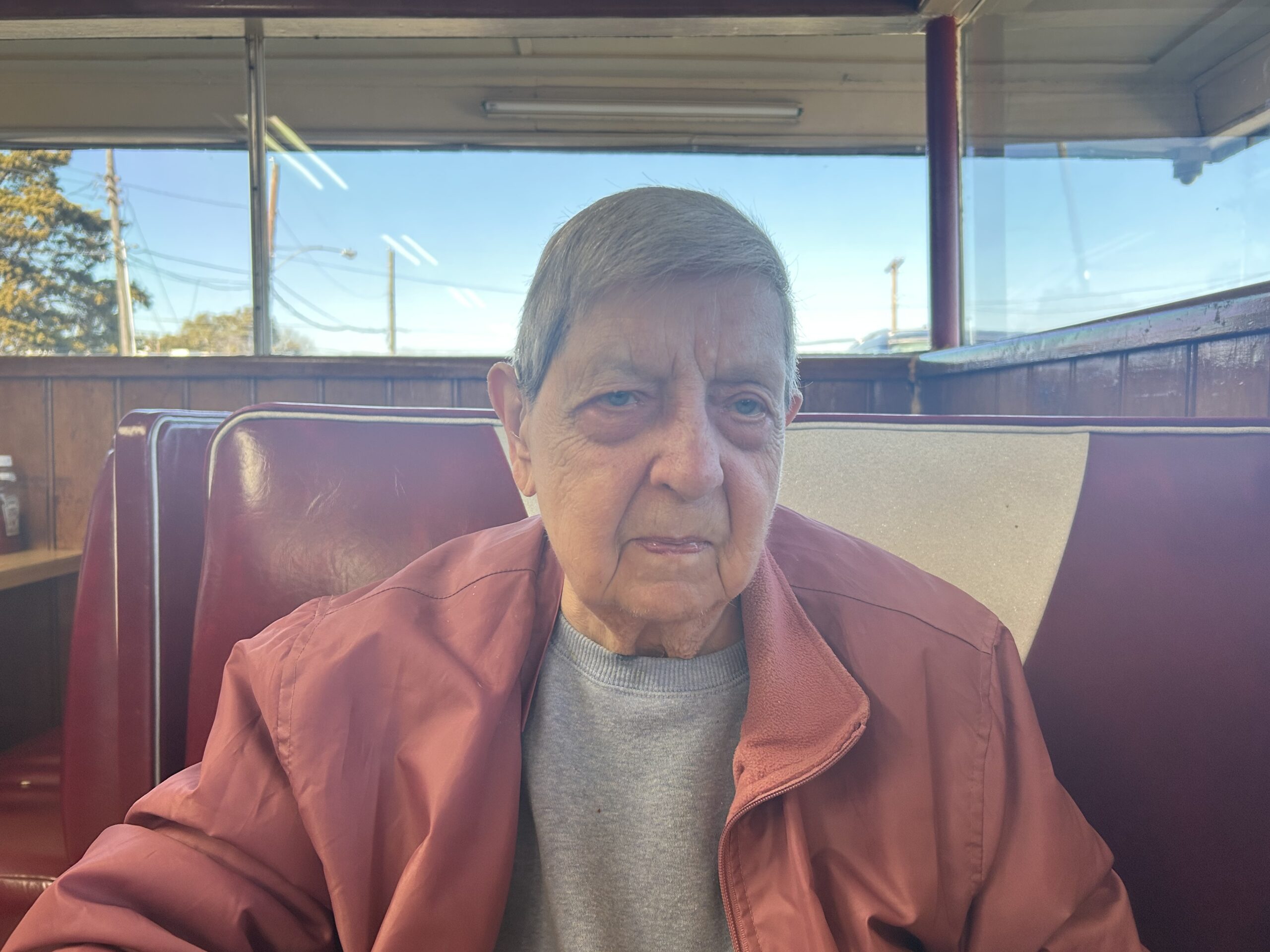
Jolyne Wallace recalls serving with the SBC Foreign Mission Board at Gaza Baptist Hospital from 1974 to 1982. (Photo / Calli Keener)

Wallace, the first X-ray technologist appointed by the Southern Baptist Convention’s Foreign Mission Board, was heading to Gaza Baptist Hospital to serve refugees living in extreme poverty through training, improving X-ray technology and usage, and discipling new believers.

While medical doctors serving with the FMB had many options of where they would serve, few opportunities were available to X-ray technologists, Wallace noted. Gaza was the only hospital looking for her skillset when she was approved to serve.

But the need there was great, as Wallace soon would learn.

She said before arriving in Gaza, she lacked knowledge of the region or the circumstances there. She gained understanding about the longstanding conflict in the region through eight years of living and serving in Gaza.

But, Wallace pointed out, “people here [in the United States] need to know the situation in Gaza better.”

It’s important to know more about situations not just in Gaza, but any foreign field, she said. Wallace pointed out missionaries can offer valuable knowledge about the regions where they serve, when they share in churches about the mission work they are doing.

Much to learn

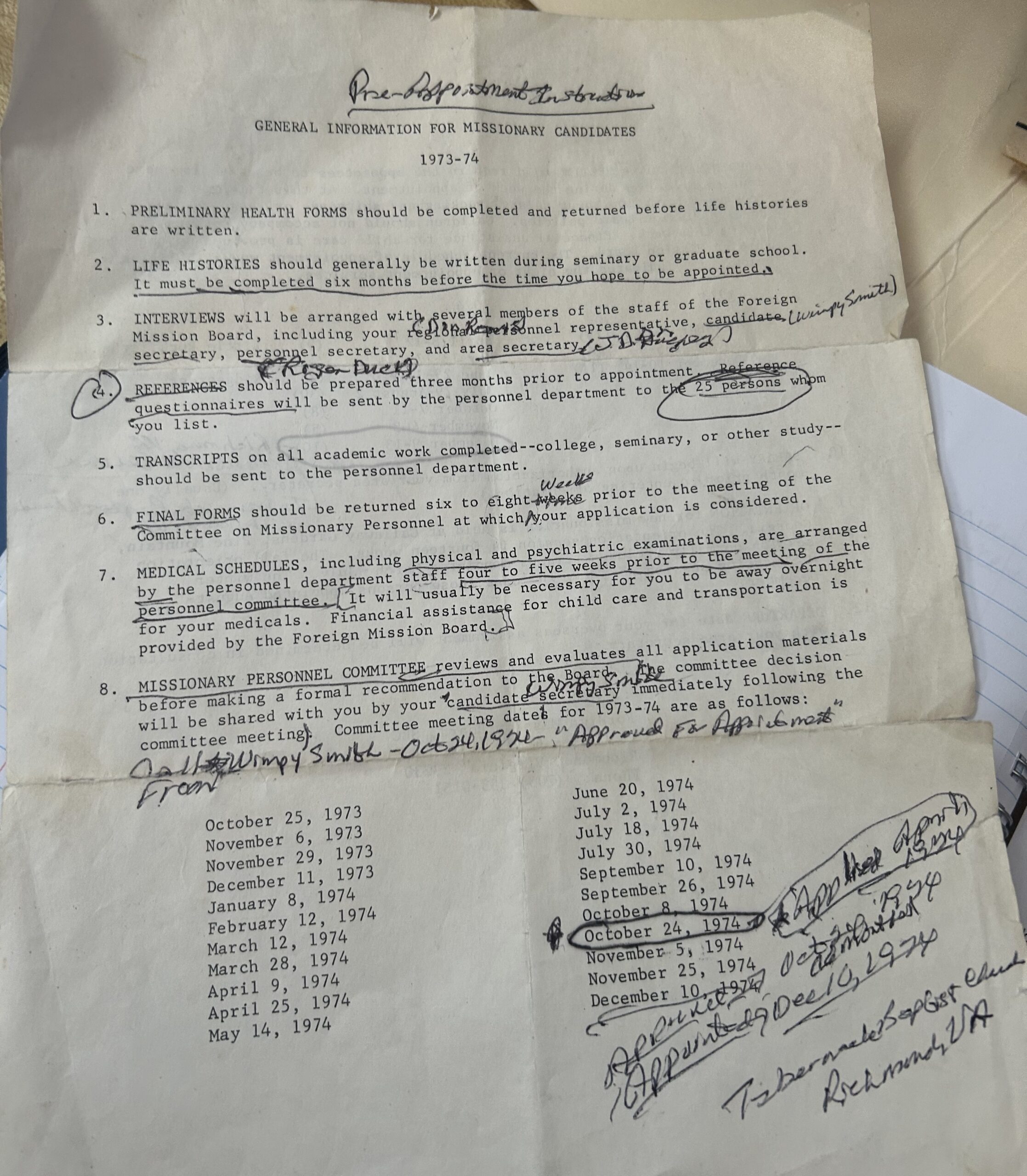
Wallace’s application checklist for appointment with the SBC Foreign Mission Board. One requirement was to provide 25 names as references. (Photo / Calli Keener)

When she arrived in Gaza, Wallace said she was struck by the extreme poverty experienced by its residents.

“I had no preconceived ideas when I went there, but it was a pretty poor situation,” she said.

Driven out of family lands with the 1948 establishment of the State of Israel, the majority of the people Gaza Baptist Hospital served lived in refugee camps, which were “hardly fit for human occupation,” she observed.

During her service in Gaza, the region was under Israeli occupation, creating dis-ease for the civilians, whatever their ethnic or religious identities.

Heavily armed Israeli soldiers patrolled the area around the hospital, refugee camps and airport. “Which I’m sure was traumatic for the children” to not be able to move about freely, she observed.

While the Israeli military wasn’t supposed to be on private property, Wallace recalled a specific incident where things got a little heated between her and a trooper who was not abiding by this order.

She said she doesn’t remember too many instances where she felt especially threatened. Hamas did not yet exist. Her American look and her gender meant that when she was stopped by Israeli guards, she generally was considered harmless and allowed through.

But at the airport, “we almost always had to undress,” [in submitting to searches]. When they entered the airport they had to stop and leave their driver’s license, she explained.

One time she did not stop her car driving, when the guard initially waved her through. But when he saw her Gaza license plate, the guard yelled, “Rega! Rega!”

“I didn’t know what it meant,” she said. “But I knew he had a gun, so I backed up.”

That incident turned out OK, Wallace said, but the prejudice she witnessed with her.

She noted, “It’s just a situation that a lot of people here don’t understand, and I wouldn’t expect them to. I didn’t know either until I got there.”

Working at Gaza Baptist Hospital was “like working in a hospital anywhere,” Wallace said. She was responsible for leading the X-ray department, staffing and ensuring optimum quality X-rays were provided.

“Bad practices had been the norm,” Wallace explained, so she had to retrain staff to utilize the equipment they had more effectively and consistently.

Wallace started a school to train young people in X-ray technology. Most of the staff she trained were from the refugee camps. Few lived in private homes.

Meaningful opportunities

Providing these young people with skills to help them find gainful employment was one of the most meaningful things she did there, Wallace said.

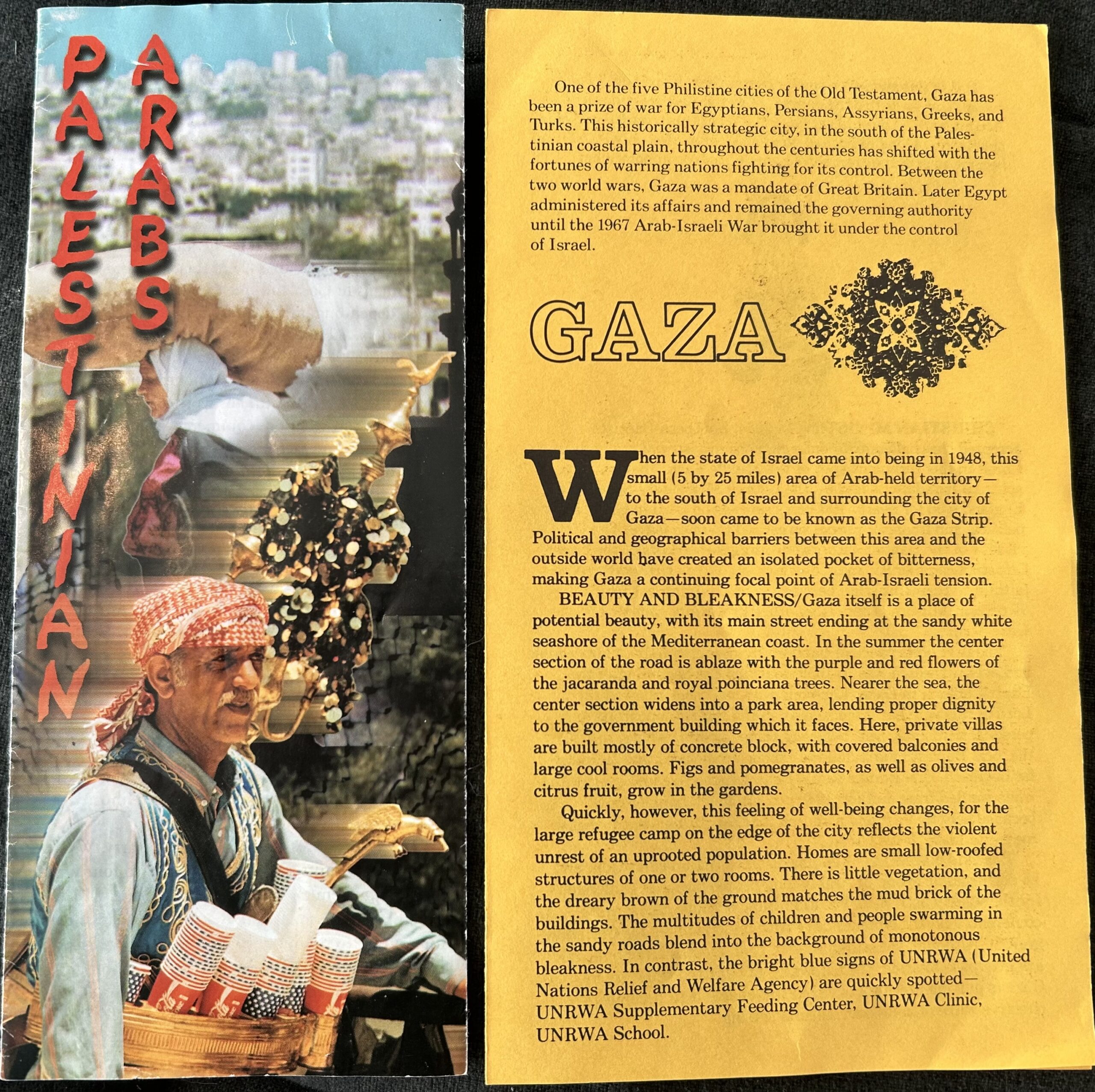
Brochures about Gaza printed by the Foreign Mission Board for missionaries to share with churches about their work there. (Photo / Calli Keener)

Opportunities to work were limited by ongoing conflict and restrictions implemented during Isreal’s occupation. Whereas Gaza residents had been able to travel into Israel for work in the past, they were not able to during the eight years Wallace lived in Gaza. Unemployment was high then, and remains so today, she noted.

Since individuals in the Gaza Strip struggled to make ends meet, there was great demand for the training she offered at Gaza Baptist Hospital.

Many people applied each year hoping to get a spot in her classes, she noted.

Hanna Massad, who served as a Baptist pastor in Gaza and now leads Christian Mission to Gaza from his home in Connecticut, has described the difficulties faced by Christians in Gaza through the years.

Massad grew up in the refugee camps and worked as an assistant in the laboratory with Wallace as a young man, before he felt called to be a pastor and came to the United States to study, she noted.

The hospital, now known as Al-Ahli Hospital, was founded in 1882 by the Church Mission Society of the Church of England.

It was managed by SBC Foreign Mission Board missionaries from 1954 to 1982. In January of 1982, financial concerns saw the hospital transfer ownership back to Church Mission Society of the Church of England, Wallace said.

Wallace sent a letter to the editor of the ‘Baptist Standard,’ published in the Jan. 12, 1977, edition.  She noted a critical need for doctors in Gaza and asked supporters back home to pray for God to send workers. (Screengrab from the Baptist Standard Archives)

She didn’t return to Gaza Baptist Hospital after her furlough in 1983, due to reports of layoffs after the management transfer and because her mother’s health was failing.

The hospital—which was struck several times during the conflict which began with Hamas’ invasion of Israel on Oct. 7, 2023—currently is operated by the Episcopal Church.

Early reports said it sustained a direct hit on Oct. 17, 2023, claiming almost 500 staff, patients and displaced individuals sheltering there were killed. Later reports indicate a much lower number of casualties and that the building itself was not hit. Amos Trust reports, “it continues to open everyday,” seeing 700 patients daily.

Wallace said she would go back and serve again, if she could.

Her faith grew there, through Bible study, prayer and the support of the church, as it has continued to grow throughout her life.

Wallace said she would advise missionaries today to “stay open to new ideas that don’t compromise your convictions,” and “if God is calling, don’t let being a woman deter that call.”

An estimated 800 to 1,000 Christians are said to be remaining in Gaza, down from 3,000 counted in 2007, Al-Jazeera reported in a 2023 article.

Few Baptists were left in Gaza, even before the war.

Editor’s note: The article was edited for clarification after it initially was posted and to correct a date and an identifier. A further clarification was made to the sixth paragraph from the bottom regarding reports about an explosion at the hospital.


GOP leaders renew pro-life vows at March for Life

WASHINGTON (RNS)—The first March for Life in the second Trump administration roared their approval as President Trump appeared by video and Vice President JD Vance spoke to them live from a stage erected on the National Mall on Jan. 24.

“I want more babies in the United States of America,” Vance told a chilly but enthusiastic crowd sprinkled with red MAGA hats. “I want beautiful young men and women who are eager to welcome them into the world and eager to raise them.”

Vance said the new administration would focus on making “it easier for young moms and dads to afford to have kids.” He also touted Trump’s pardon Thursday of 23 anti-abortion activists, some of whom had been prosecuted for blockading an abortion clinic and sentenced for violating the Freedom of Access to Clinic Entrances Act.

Trump, in a pre-recorded video, said, “It was my honor to grant a full and complete pardon to Paula (Harlow) and many others who were the victims of this horrific weaponization.”

Many at the march gave Trump and Vance glowing reviews for the administration’s opposition to abortion and belief in two distinct genders.

“I would give (the new administration) an A-plus-plus-plus-plus,” said Nabil Nour, a Lutheran Church-Missouri Synod minister who said he had frequently raised money for a crisis pregnancy center with a long-distance bicycle campaign.

“They have the vision, not on earthly living, but on heavenly living,” he said of the Republican politicians who spoke at the rally.

GOP ‘slipped a little bit’

Trump and Vance have supported government funding for in vitro fertilization and continuing the availability of mifepristone, a drug used in medical abortions as well as some types of high blood sugar, and said during the 2024 campaign that Trump would veto a national abortion ban if it landed on his desk.

Addressing the crowd, Lila Rose, the president of advocacy group Live Action, who last year said she would not vote for Trump because of his abortion views but later endorsed him, renewed her call to “abolish abortion” but did not criticize Trump or Vance. Instead, she praised Trump for the pardons of anti-abortion activists.

In an interview, Patrick Stanton, an activist who stands outside Philadelphia abortion clinics “every day” to preach “the message of chastity and pro-life,” said that Vance “ just needs to be educated” on IVF.

Nevertheless, Stanton expressed concern the anti-abortion plank was removed from the Republican Party platform at the GOP convention in July, saying they “slipped a little bit.”

He said that concern prompted him to come to Washington for the march, even as he and others from Immaculate Conception Catholic Church in Jenkintown, Penn., have been demonstrating at the statehouse in Harrisburg to influence Pennsylvania lawmakers to ban abortion in the state.

Stanton, who said he knows a few of those pardoned personally, had enthusiastic praise for Trump’s pardons.

Since the U.S. Supreme Court overturned Roe v. Wade in the Dobbs decision in 2022, March for Life organizers also have encouraged anti-abortion activists to focus their attention on statehouses, where decisions over the legality of abortion are now being made.

As protesters arrived at the national march, they had to contend with an extensive security screening by the Secret Service around the perimeter of the rally. Once inside, they heard from a series of Republicans, with organizers noting that this year was the first time the Senate Majority leader and the Speaker of the House both addressed the marchers.

‘Entering a new era’

“Now we have President Donald J. Trump back in the White House, we are entering a new era,” Johnson told the crowd. “I don’t know if you saw his executive order on gender, but it defines life as beginning at conception rather than birth.”

He touted the House’s passage of the Born Alive Survivors Protection Act on Thursday, which would require medical personnel to sustain an infant’s life if it survived an attempted abortion. It had earlier failed to pass a cloture vote in the Senate, with Democrats holding the bill would not increase protections for infants while increasing risk for providers.

Florida Gov. Ron DeSantis, whose state is one of the few to have defeated an abortion rights ballot amendment since the fall of Roe, told the crowd: “ We were told since Dobbs by people, political consultants, pundits, many people that are more establishment Republicans, that standing for the right to life was somehow terrible politics, you wouldn’t get elected, all this other stuff. Well, I can tell you, I’m proof that that’s not true.”

Some prominent religious leaders in the crowd were cautious in their judgments of the new administration. Metropolitan Tikhon, who leads the Orthodox Church in America, told RNS, “It’s a little too soon” to evaluate the new administration’s approach, but “it does seem like the direction that they’re going in is to be positive for the pro-life movement.”

Bishop Joseph Strickland, who led the Diocese of Tyler before being removed by Pope Francis after a formal investigation of his management, told RNS, “It’s a real opportunity with the new administration, we have some hope.”

But he cautioned that “we still have a lot of hearts that need to be changed. I hope that’s what we focus on.”

Kristen Day, executive director of Democrats for Life of America, told RNS that partisan flavor of the rally was unproductive. “We need to bring people into the pro-life fold,” Day said. “It pushes people the other direction.”

Day praised Trump for his pardons of anti-abortion activists and urged the administration to bolster the social safety net and to make lowering the cost of giving birth “a major priority,” explaining she was worried that some of those programs would be cut. Day also said the organization would be pushing for paid leave.

Many participants and speakers expressed hope that abortion rights advocates’ minds would change if they were given the right information.

“These people aren’t inherently evil, they’re just being fed lies. And the more they hear these lies, the more they believe them,” said Bethany Hamilton, a surfer who lost her arm to a shark attack and who was a keynote speaker at the march.

Hamilton encouraged attendees to find ways to support pregnant women.

Heather Lawless, who works with Reliance Ministries to provide a range of services to pregnant women in northern Idaho, told RNS she lives that out.

“It’s the church’s job, not the government’s job, to take care of these women,” she said.


BSM sees expanded opportunity to help leaders grow

JT Norcross considers helping students develop as Christian leaders an important part of his role as director of Baptist Student Ministry at Navarro College in Corsicana, but he knows the clock is ticking.

He recognizes leadership development takes time and experience, and serving at a two-year community college inherently limits how much he can accomplish.

So, when he met Preston Cave at Conclave NextGen last October and learned about LeaderTreks, he saw the opportunity for a partnership enabling student leaders to “accelerate their growth.”

As Cave and Norcross talked, they discovered a shared passion to develop the next generation of Christian leaders for service in God’s kingdom now and in the years ahead.

Intensive hands-on summer experience

LeaderTreks offers a variety of resources, curriculum and training opportunities to help students discover their leadership potential and grow as leaders. Norcross particularly became interested in its Leadership Residency Program, an immersive summer experience.

“It’s an opportunity for students to flex their spiritual muscles and work out some of the kinks in a hands-on leadership laboratory,” said Cave, who served as missions and discipleship coordinator for high school and college students at Texas Baptist Men, now Texans on Mission, before joining the LeaderTreks staff.

“It offers a safe place to fail, while setting them up for success in the future.”

Students who are accepted for the program begin at a base camp, where they undergo a series of leadership assessments, attend workshops and participate in mentoring sessions.

After completing training, they are assigned to one of 14 ministry sites around the country. They spend most of the summer working as leaders with a series of visiting short-term church mission teams, planning and facilitating those mission experiences.

 “They leave with a personalized leadership profile unique to them, identifying their strengths and areas for growth, leaving them better equipped for a life of ministry,” Cave said.

Norcross acknowledged the LeadersTreks approach and the summer program is “not for everybody.”

Even so, he looks forward to seeing the impact it has on a select group of students he plans to recommend for the Leadership Residency Program—students he already recognizes as leaders among their peers.

“In the short season I have with them, I want to do as much as I can with them,” he said.

Norcross views the summer program as offering students opportunities to gain leadership experiences beyond what they could get at the BSM or through short-term mission trips.

“It’s more than just going somewhere and serving. They will be setting up an experience for others to serve—planning, organizing and doing the dirty detail work of administration,” he said.

BSM fertile ground for leadership development

Students at the Navarro College Baptist Student Ministry lead Bible study and prayer gatherings. (Photo courtesy of JT Norcross)

Norcross considers BSM fertile ground for developing leaders. During his years in church youth ministry, he observed many students participated because they were compelled to do it—by peer pressure, parental insistence or the prodding of a boyfriend or girlfriend.

“BSM is vastly different. Students genuinely don’t have to be here,” he said. “It brings out students who are naturally leaders and willing to make a commitment.”

Norcross purposefully identifies students with leadership potential and gives them opportunities to lead in the BSM’s ongoing programs.

“These are students who want to grow,” he said. “They already are stepping up and being leaders.”

Norcross sees the LeaderTreks summer program as an opportunity for them to “accelerate their growth” through intensive, hands-on experience.

“I like the practical ministry component,” he said. “In that kind of setting, they’ll learn a little about the pain and stress of being a leader in ministry. In the process, it offers an opportunity for them to learn to rely on the Lord.”

Cave and Norcross believe the partnership between Navarro College BSM and LeaderTreks not only will make a long-lasting impact on students at the Corsicana campus, but also at other schools.

Participants in the residency program become part of a supportive community and network of young Christian leaders dedicated to making a difference in the world, Cave noted.

Norcross anticipates the students who participate in the residency program inspiring other students to seek out opportunities to grow as leaders.

He considers the potential impact even greater at four-year universities, where underclassmen can be led by trained and experienced student leaders over an extended time.

“It gives them something to aspire to,” he said.


Iranian Christians suffer sixfold increase in prison time

LONDON (BP)—Christians in Iran suffered combined prison sentences amounting to a sixfold increase over time levied in 2023, all as punishment for their faith, London-based religious advocacy group Article 18 said in its latest annual report.

The courts sentenced 96 Christians to a combined 263 years in prison in 2024 on faith-related charges, compared to 22 Christians sentenced in 2023 to a combined 43.5 years, Article 18 said in the report released Jan. 20 in collaboration with Open Doors, CSW and Middle East Concern.

The arrests were made by agents of the Islamic Revolutionary Guard Corps, a group U.S. President Donald Trump mentioned Jan. 22 in redesignating the Houthis of Yemen as a foreign terrorist organization.

The Islamic Revolutionary Guard Corps supports the Houthis among several terrorist groups, Trump said in flagging the Houthis for attacks on shipping in the Red Sea and on Israel during its war with Hamas.

“The Houthis’ activities threaten the security of American civilians and personnel in the Middle East, the safety of our closest regional partners, and the stability of global maritime trade,” Trump said, but religious liberty in either Yemen or Iran was not noted as a motivator of the designation.

Regarding religious liberty, Article 18 said Iran’s Christians—who number an estimated 800,000 among the country’s nearly 90 million people—suffered emerging trends including lengthy prison sentences, hefty financial fines and the confiscation of property.

Combined sentences also included 37 years of exile and nearly $800,000 in fines, the highest annual financial penalty to date, Article 18 reported.

At year’s end in 2024, at least 18 Christians were still serving prison time, the report said. During the year, at least 139 Christians were arrested, 80 were detained, 661 were directly affected by the sentences, and 25 endured imprisonment. Individual sentences were a lot longer, the report said, with five Christians receiving 10-year prison terms and another a 15-year sentence on charges related to their faith.

Financial transactions of Christians and their lawyers were scrutinized in 2024 to uncover any funds received from friends, family members or Christians abroad, the report said.

 “Authorities have even told some Christian detainees that ‘foreign hostile states’ including ‘Zionist groups’ are actively supporting Christian organizations in Iran, rationalizing the severe measures taken against Church finances as a matter of ‘national security,’” Article 18 reported.

Iran’s Revolutionary Courts have criminalized tithes, donations and offerings given to support Christian church activities, although such gifts are not criminalized in churches that exclusively serve Armenian and Assyrian-speaking members, the report said.

“While Iran invests in expanding its influence across the region in places like Iraq, Syria, Yemen and Lebanon,” Article 18 reported, “officials interpret any expansion of Christianity within Iran as an analogous threat, justifying further financial suppression.”

Leaked files reveal systemic persecution

The report, “The Tip of the Iceberg,” is so titled because Article 18 contends much persecution against Christians is undocumented, evidenced by newly leaked documents showing persecution of more than 300 Christians in the Tehran region between 2008 and 2023, not included in previous reports.

The 2025 reports detailed the leaked files, offering key insights into systematic persecution of Christians in Iran.

“The documents covered a wide range of judicial proceedings—from criminal cases involving ordinary citizens, to case files of political or religious prisoners of conscience,” Article 18 reported, “which shed light on the darkest corners of the Islamic Republic’s judicial system, offering researchers, experts and members of the public insights into the mindset, decision-making processes, and operational procedures of Iran’s security and judicial apparatus.”

Christians were vilified as members of a sect and a security threat, Christianity was criminalized, Christians were interrogated about their beliefs and forced to recant, the Bible was treated as contraband and evidence of a crime, and charges were brought against Christians for ordinary activities and religious practices such as singing worship songs, the leaked files revealed.


On the Move: Bernstein, McWilliams, Painter and Stewart

Blaine Bernstein to Second Baptist Church in Levelland as pastor, from First Baptist Church in Monahans, where he was associate pastor for students.

Walker McWilliams to First Baptist Church in Lufkin as interim pastor, where he serves as associate pastor.

Adam Painter to First Baptist Church in Blanco as senior pastor, from Riverside Community Church in Bulverde, where he was community pastor.

Dan Stewart to Coulter Road Baptist Church in Amarillo as pastor, from First Baptist Church in Stamford, where he was pastor.


Obituary: Salvador Castorena Bernal

Salvador Castorena Bernal of Vernon, pastor of Primera Iglesia Bautista in Lockney, died Jan. 19 in Wichita Falls. He was 64. He was born Dec. 25, 1960, in Tepezala, Aguascalientes, Mexico, to Luis Bernal and Francisca Castorena Reyes. He married Dalia Luna on Dec. 5, 1981, in Lockney. He was ordained as a deacon March 25, 1984, at Primera Iglesia Bautista in Lockney. He subsequently felt God’s calling to preach and was ordained to the gospel ministry June 14, 1998, at Iglesia Bautista “La Trinidad” Church in Quitaque, where he was pastor eight years. He served six years as pastor at Primera Iglesia Bautista in Altus, Okla., before he was called to Primera Iglesia Bautista in Lockney in 2022. He was preceded in death by his father Luis Bernal; a brother, Jose Luis Bernal; and a granddaughter, Taya Marie Davis. He is survived by his wife Dalia Bernal; daughter Angelica Salazar and her husband Tony; daughter Lucy Hernandez; daughter Cathy Bernal; son Salvador Bernal Jr. and his wife Raquel; son Caleb Bernal; 10 grandchildren; three great-grandchildren; and nine siblings. Funeral services will be at 1 p.m. on Jan. 24 at Primera Iglesia Bautista in Lockney. Memorial gifts can be made to the American Cancer Society, Hospice of Wichita Falls, Rathgeber Hospitality House and Texas Oncology of Wichita Falls.