International community castigated for ignoring terrorism in Nigeria

FALLS CHURCH, Va.—The international community has ignored terrorist violence and attacks in Nigeria, insisted Samson Ayokunle, president of the Nigerian Baptist Convention.

The Nigerian convention is the largest Baptist World Alliance organization in Africa, with about 3.5 million members in 10,000 churches.
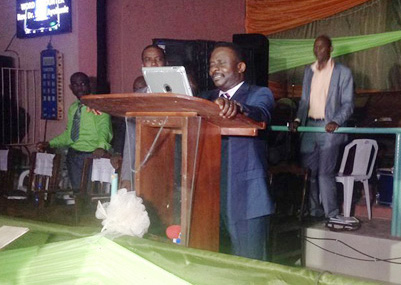
nigeria ayokunle425Samson Ayokunle (at podium), president of the Nigerian Baptist Convention, accused the world community of devaluing Nigerian lives in its lack of response to attacks by Boko Haram, a jihadist group that seeks to establish Sharia law in the West African nation.“My consternation is in the attitude of the international community toward the huge destruction going on in Nigeria,” Ayokunle said. “The earnestness with which they intervened in the ISIL attacks in Syria and Iraq, or the Taliban problem in Afghanistan, etc., is not shown in the case of Nigeria.”

He accused the world community for devaluing Nigerian lives.

“Does it not matter to the rest of the world if Boko Haram continues to kill hundreds of people every week? Are these people less human than those being killed in other places where they have gone to directly intervene? My people are being killed like animals, and the whole world is just watching.”

Ayokunle was responding to the latest spurt of attacks by Boko Haram, a jihadist group that seeks to establish Sharia law in the West African nation.

Thousands killed

Boko Haram conducted the Baga massacre in northeastern Nigerian in early January, causing an unknown number of deaths. Estimates range from dozens to more than 2,000. In April 2013, more than 185 people were killed and more than 2,000 homes were destroyed as a result of fighting between the Nigerian military and Boko Haram.

Up to 2014, the group killed more than 5,000 civilians in Nigeria. Since 2009, Boko Haram has abducted more than 500 people, including 276 schoolgirls in April 2014. An estimated 1.5 million Nigerians have fled their homes because of threats and attacks.

“The situation is pathetic,” Ayokunle declared. “The main targets in all these attacks are the Christians first and any other person that opposes them. Any town they enter, after killing the Christians there, they go ahead to bring down all the churches there, sparing the mosques.

“Major Christian cities such as Gwoza and Mubi, among others, have fallen to them. Christians in cities such as Michika and Baga are also on the run.”

Church ‘under siege’

“The church is under siege of severe persecution,” he said.

Baptists have been directly affected, he added “No Christian church is standing anymore in Mubi, where more than 2,000 Baptists fled the city through Cameroon when Boko Haram attacked.”

These Baptist Christians returned to Nigeria through another town, Yola, but never reached their homes.

“They have become displaced and are now living in displaced people’s camps scampering for food, without decent accommodation and naked,” Ayokunle said.

Baptist buildings were burned, and Baptist homes were vandalized, he reported.

The conference president and Baptist pastors have fled Plateau state, another region attacked by Boko Haram, he said. “Our Baptist high school in Mubi has been closed, while our Baptist pastors’ school in another neighboring town, Gombi, was indefinitely shut down.”

Ayokunle expressed appreciation for the prayerful support of Baptists and other Christians and requested financial support to assist those who have been displaced by the terrorist attacks.

“Continue to join us in prayer so that the gates of hell might not prevail against the church of Christ in Nigeria,” he urged.
LifeWay moves forward with possible property sale

NASHVILLE (BP)—Based on the positive results of a feasibility study, LifeWay Christian Resources is moving forward with the possible sale of its Nashville headquarters property.

thom rainer130Thom RainerFive months ago, LifeWay announced a preliminary study of the feasibility of selling the ministry’s 14.5-acre campus in downtown Nashville that would allow the organization to relocate.

“The results of the study confirmed there was interest favorable enough for us to take another step,” LifeWay President Thom Rainer said.

LifeWay has talked with local, regional and national organizations about selling the property and accepted offers through mid-January.

LifeWay’s campus includes nine buildings, with more than 1 million square feet of office, warehouse and parking space.

Reasons to sell

Rainer said reasons to consider selling the property include:

• Changes over the last 50 years in how LifeWay does ministry have created a need for workspaces that support LifeWay’s technologies, strategies and culture now and in the future.

• LifeWay uses only one-third of its current space.

• The opportunity to build a new facility designed specifically for the ministries LifeWay provides now and in the future.

“Most of our current space was designed and built in the middle of the last century and for a much different work environment,” Rainer said. “We need a workplace designed to support the technologies, collaboration and culture needed for today’s and tomorrow’s successful national and international ministry.”

Hope to stay in downtown Nashville

If the property does sell, Rainer said, his “very strong preference is for the ministry to stay in downtown Nashville.” LifeWay is looking at several pieces of property in the downtown area as potential sites to construct a new building.

Rainer said planners estimate construction of a new building would take at least two years.


Baptist church finds downtown niche in shower ministry

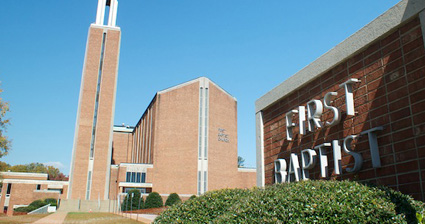
Downtown churches struggling to find their niche in ministry may want to try what First Baptist Church in Chattanooga, Tenn., has done—look and listen.

mustardtree fbc425Besides dinner and Bible study (above), First Baptist Church in Chattanooga, Tenn., offers the homeless showers, laundry facilities and even occasional massages.Paying attention to young voices within its membership and to underserved needs downtown, the congregation launched a shower ministry in October 2013 that has surprised and inspired the members of the congregation.

Since then, the ministry has become the launching point for a number of other services the downtownchurch never dreamed of, Pastor Thomas Quisenberry said.

“It just continues to blossom as we’re shown new ways to help, and thankfully, the congregation is responding,” he said.

‘We weren’t even sure’

It all started four or five years ago in Colorado and Arizona, where First Baptist college students on a mission trip saw shower ministries in action.

Back home, they met with life deacon Herb Hooper and suggested the idea as ideal for the Tennessee Cooperative Baptist Fellowship congregation and the homeless people around it. The church is located just blocks from a homeless shelter and other services for that population in Chattanooga.

thomas quisenberry130Thomas Quisenberry“They pitched it, and I said, ‘OK, but what kind of interest is there?’” Hooper said.

They soon found out.

A fund-raising campaign paid for the installation of showers just off the church gymnasium. The goal was $104,000, but $107,000 was raised in 12 months for eight showers. However, enough money was raised by July 2013 to start the work then, Hooper said.

Hitting those fund-raising marks so soon was a surprise, he said.

“We weren’t even sure that we could raise it in two years, much less in one,” Hooper said.

Expanding ministries

The surprises just kept on coming, and right from the beginning.

Three college students committed to volunteer at the shower each Thursday, when it’s open from 2 p.m. to 5 p.m.

“Then the church just sort of caught on to it,” he said.

“The college students are no longer with us, … but members of the church and the college and youth ministries assist with that,” Hooper said.

More than a year later, some workers in the shower ministry are homeless people who have availed themselves of the service.

fbc chattanooga425First Baptist Church in Chattanooga, Tenn., found a unique way to minister to the homeless in it’s city.The ministry expanded when a local politician donated two washing machines and two dryers to the ministry, which were added to the units the church already had. This enables someone to shower and have laundry done at First Baptist.

Six months ago, the church started offering haircuts by volunteers from a local cosmetology school.

“And we have one guy who comes in to provide massages,” Hooper said. “Last Thursday, we had 18 haircuts, 12 showers, 13 who did laundry and three to four who got massages.”

‘It’s given me a respect’

The church has found its shower and laundry ministry dovetails with another program held at the church on Thursday nights.

It’s an ecumenical ministry called Mustard Tree, which uses the First Baptist gym to serve dinner and hold a Bible study for homeless people Thursday evenings. Different churches serve as the host each night, with First Baptist taking responsibility once a month.

“And it’s all in our gym,” Hooper said.

Hooper, a member of the church 52 years, said his involvement with the shower ministry has inspired him in numerous ways.

The college students who originally pitched the shower idea taught him to think big about projects.

“They wanted to do more than go to Bible studies,” Hooper said. “They wanted to be the hands and feet of Jesus wherever they could.”

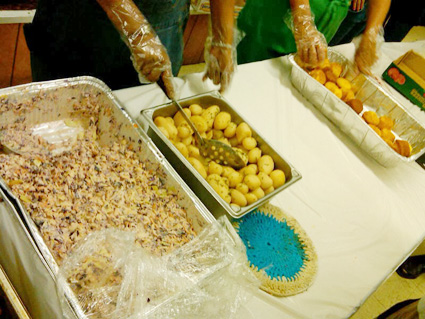
mustardtree serving meals425The homeless are fed in the gym at First Baptist Church in Chattanooga, Tenn.They set an example of how a church can look around it to find opportunities to serve.

“Since we are an inner-city church, it lent itself to helping people who just don’t have much,” he said.

Hooper took that approach with a truck ministry he and others from the church began within the past year. Participants use their trucks to move furniture for those who cannot afford to do so themselves.

“It’s allowed me to identify with a population that I knew very little about,” Hooper said of the shower ministry. “It’s given me a respect in many cases for people in that circumstance.”

It’s a good feeling to see someone be able to shower for a job interview.

“Spiritually, it’s something I felt led to do,” he said. “It wasn’t something I sought out in anyway.”

‘The best way is listening’

Nor was it something the church sought out, Quisenberry said.

The congregation already had an openness to reaching out to those in need, especially through its annual Christmas brunch.

The event features more than 150 volunteers serving holiday meals to more than 300. Guests have an opportunity to get their photo with Santa, and each receives a goody bag.

“The showers are just the latest step working with the folks downtown,” he said.

It was from its working relationships with other churches and nonprofits downtown that First Baptist came to learn of the need for a shower ministry.

Knowing many other downtown churches are struggling to find their niches, Quisenberry said he doesn’t recommend shower ministries as the answer.

It’s the paying attention to their surroundings that matters, he said.

“I don’t know what we’re doing has to be mimicked,” he said. “But I do think congregations can find ways to be a positive influence on their community, and maybe the best way is having contact and listening.”


SBC leader sees ‘chasm’ between liberals, evangelicals

Rather than representing two points on a spectrum of Christianity, evangelical Christianity and liberal Protestantism are different and competing religions, Albert Mohler, president of Southern Baptist Theological Seminary in Louisville, Ky., asserted in a podcast.

He said two recent scandals demonstrate “the depth of the chasm that separates evangelical Christianity from more liberal Protestant denominations, in particular the Episcopal Church.”

j gresham machen425In a recent podcast, Albert Mohler referenced early 20th century Presbyterian theologian J. Gresham Machen (above), whose book Christianity and Liberalism argued that liberalism was essentially a different religion than Christianity.One involves Suffragan Bishop Heather Cook, one of the highest-ranking officials in the Episcopal Diocese of Maryland, charged with manslaughter and drunk driving following a hit-and-run crash that killed a bicyclist in December.

A Jan. 9 New York Times story raised the question of whether in a rush to name a female bishop, church leaders failed to properly vet Cook, who pleaded guilty to drunk driving in 2010.

Mohler acknowledged evangelical Christians have their own share of moral scandals but said the two groups hold to a “different moral code,” further evident in a Religion News Service story about an openly lesbian and pro-choice seminary dean stepping down over conflicts with faculty and financial challenges.

“What is really scandalous in this situation is that this president didn’t lose her job because of her very prominent homosexuality advocacy nor her very open and ardent advocacy for abortion,” Mohler said. “Indeed, she didn’t lose her job because of those things. She probably got her job because of those causes.”

‘Different types of thought and life’

Mohler said he drew attention to the stories “not particularly to dwell upon the Episcopal Church” but rather to repeat a point made in the early 20th century by Presbyterian theologian and Bible scholar J. Gresham Machen.

Machen was a professor at Princeton Seminary who led a conservative revolt against modernist theology that resulted in formation of the Orthodox Presbyterian Church and Westminster Theological Seminary. In 1923, Machen wrote a book titled Christianity and Liberalism arguing that controversies of the day were not between two varieties of the same religion but two essentially different types of thought and life.

Machen is regarded among the last of the great leaders of Princeton theology, a Calvinist form of evangelical Christianity with followers including James P. Boyce, a Southern Baptist pastor, theologian and founder and first president of the Southern Baptist Theological Seminary in 1859.

In the 20th century, some observers believed the flagship seminary of the Southern Baptist Convention drifted into more modern theologies until a course correction in the 1980s and 1990s called the “conservative resurgence” required all seminary professors teach the Bible is without error and literally true.

That prompted massive turnover in the faculties of SBC seminaries, which in turn led to formation of a number of alternative theology schools aligned with the Cooperative Baptist Fellowship, an SBC breakaway group formed in 1991.

‘Two rival religions’

Mohler, elected as the ninth president of Southern Seminary in 1993, is a high-profile leader of a movement seeking return to the denomination’s Calvinist roots that goes by names including Neo-Calvinism and Young, Restless and Reformed.

“When you’re dealing with orthodox Christianity and Protestant liberalism, we are not dealing with two variants of the same religion,” Mohler said. “As Machen correctly said, judged by orthodox Christianity, we’re actually looking in this case at two rival religions, and these headlines, not to mention the stories behind them, make that point all too evident.”


Around the State: Baylor names Wolf to religious freedom chair

Former U.S. Rep. Frank Wolf has been named the Jerry and Susie Wilson Chair in Religious Freedom at Baylor University. Wolf served his Virginia district from 1981 until his retirement Jan. 3. As the Wilson Chair, he will lead Baylor’s efforts in Washington, D.C., and throughout the world to address significant issues of freedom of conscience and worship, as well as Christianity’s enduring role in promoting human freedom.

Baptist Child & Family Services has named Patricia Stelter director of patricia stelter130Patricia Stelterlearning and development. She will create learning initiatives aimed at increasing organizational effectiveness, improving individual skills and supporting the system’s strategy for growth and culture for the future.

Dallas Baptist University will hold previews for prospective students and their parents Jan. 31 and Feb. 16. Both events include a tour of the campus, meetings with faculty and administrators, and information about admissions, financial aid and campus life. The events are free for the students and up to two guests. For more information, click here.

Howard Payne University will begin offering classes for a master of education in sport and wellness leadership degree program in August. Informational sessions for people interested in the program will be held Feb. 5 and Feb. 19 at 6 p.m. at the Brownwood Coliseum. Most classes will be held in the evening to accommodate work schedules, and graduate assistantships will be available to offset the cost of tuition. For more information, click here.

Anniversary

Scott Mescher, fifth, as associate pastor at First Baptist Church in Salado.

Ordained

Jeff Byrd, David Hill, Todd Kunders, Mike Ratliff, Lance Read and Adam Ward as deacons at First Baptist Church in Belton.


Texas Baptists celebrate MLK Day by packing 23,000 meals

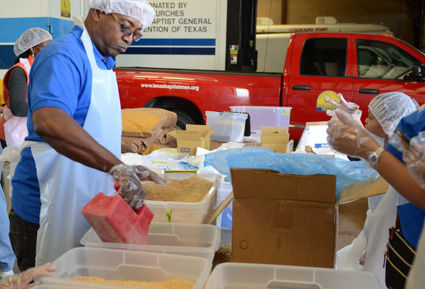
DALLAS—The words “Vitamins!” “Protein!” and “Vegetables!” echoed across the concrete walls of Texas Baptist Men’s Dixon Mission Equipping Center as 175 Texas Baptist volunteers packed 23,000 meals on Martin Luther King Jr. Day to send to Liberia.

meals pastormanuel425Pastor Tommy Manuel of Ministry of Light Baptist Church in Huntsville, refills bins with protein to put in food packets that will be shipped to Liberia.The event served as part of a Texas Baptists Disaster Recovery initiative to send food packets to Ebola-stricken nations in West Africa, where starvation has become a crisis.

Volunteers came from all across Texas, including Schertz, Lawn and Huntsville, to pack boxes of food packets. Each packet contained enough vitamins, protein, vegetables and rice to feed six people, totaling 23,000 meals.

Meals4Multitudes, a nonprofit organization in Athens that helps churches and organizations pack nutritious meals for Third World countries, donated the food and supplies and taught the volunteers how to pack the plastic bags.

The nonprofit began as an initiative to provide food to Ethiopia, but Joel Palmer, CFO of Palmer Ministries and co-founder of Meals4Multitudes, said when the Ebola crisis surfaced, they felt a need to expand the ministry.

meals multitudes package425Meals4Multitudes, a nonprofit organization in Athens, donated the food and supplies.“When the Ebola crisis hit in West Africa, it hit during the growing season,” Palmer said. “People quit working the fields. The fields weren’t planted the next planting time. The area where Ebola hit is now in a severe food crisis.”

Palmer said many of the volunteers who came to Dallas intend to set up similar packing events at their home churches.

Members of Ministry of Light Baptist Church in Huntsville attended with that in mind as well as to take the opportunity to serve on MLK Day.  

“We are looking for every opportunity we can to expand in areas of ministry, and we think this is a great ministry,” said Tommy Manuel, pastor of Ministry of Light. “Also, we came today because this is Martin Luther King Day. He was about giving. Rather than just hear from speeches or go to a parade, we thought this was a great opportunity for us to give back and provide service.”

Texas Baptists Disaster Recovery has sent 1.5 million meals to West Africa. Once enough boxes to fill a 40-foot container are assembled, McLane Company in Houston will cover the cost to ship the next crate to Liberia.

The MLK Day event provided enough boxes to cover two pallets. Eighteen more pallets will fill the 40-foot container. Churches and organizations can provide the remaining needed packets by sponsoring food-packing events. Contact Marla Bearden at (214) 537-7358 or Gerald Davis at (214) 924-6401 or click here for more information.


Retired Texas teacher plants church, baptizes 60 in 2 years

AURORA, Colo. (BP)—Mike Alexander never attended seminary. He never had served as pastor of a church. He didn’t even know what a church planter did—that is, until he became one.

mike alexander hug425Mike Alexander welcomes guests to Living Hope Fellowship, a church he started after seeing the need while on a mission trip. The Aurora, Colo., church plant is a part of Send North America: Denver, the North American Mission Board’s strategy to help Southern Baptists plant churches in metro Denver. (Photo by Erik Stenbakken/NAMB)About two years after arriving in Aurora, Colo., and about 23 months after he began learning what church planters do, the church Alexander started has baptized more than 60 people.

The retired Texas teacher visited Aurora on a mission trip in the summer of 2012. During the trip, 16 children began a relationship with Christ. As exciting as that was, Alexander couldn’t help but wonder where those children—all from one mobile home community in the town—would be discipled through a local church.

“There wasn’t anyone out here to disciple them, to move them along,” Alexander said. “That really touched my heart. I overheard the manager of the (community) talking to someone else on our team, saying ‘What we need is an older couple to come here and live here and minister to the people.’

“My wife and I are ex-schoolteachers, and we could do that,” Alexander told the manager.

“Well, come on,” the manager told Alexander with a smile.

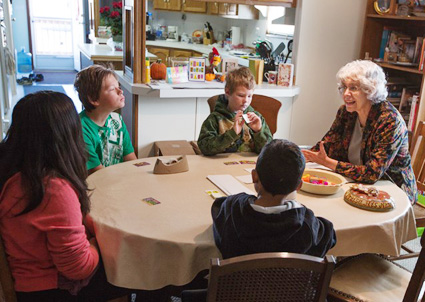
rosemary alexander table425Rosemary Alexander (right) teaches children as part of the ministry of Living Hope Fellowship, a new church plant in the Denver suburb of Aurora, Colo. Rosemary’s husband, Mike, started the church after retiring as a school teacher and administrator in Texas. On most weekends 35 to 40 people attend the worship service. (Photo by Erik Stenbakken/NAMB)What started with God gently tugging Alexander’s heart and a short exchange with the mobile home community manager soon became a full-fledged missionary call. In the next few days, he told his wife, Rosemary, who had stayed behind in Texas, what he believed God was telling him about moving to Colorado. He looked at the house he’d one day purchase. He also found his first ministry partner in the state.

“As I left the house, the first person I met was a guy named Jimmy,” Alexander said. “He’s a Native American with tattoos all over him.”

“What are you doing?” Jimmy asked Alexander.

“Well, Jimmy, I think God wants us to move here to minister to this community,” Alexander said.

“If you do that, I’ll help you,” Jimmy said.

Eight weeks later, the Alexanders moved to Colorado. It wasn’t until he went to church planters’ training through the Colorado Baptist General Convention a few days after arriving in Aurora that he began to understand what it meant to be a church planter.

“I moved here to knock on doors and tell people about Jesus,” Alexander said.

mike alexander turkey425Mike Alexander, who started Living Hope Fellowship in Aurora, Colo., hands out a turkey to a local resident during a Thanksgiving outreach. The Southern Baptist Global Hunger Relief Fund has helped Alexander provide food for needy neighbors as part of his outreach efforts. Alexander, a former Texas school teacher and administrator, started Living Hope to minister to the people of Foxridge Farm Mobile Home Park. (Photo by Erik Stenbakken/NAMB)Soon Alexander had a vision for building a church among the 481 units in the community. Six people—one family—attended the church’s first worship service in the couple’s home. Today, Living Hope Fellowship has 35 to 40 people in a typical worship service. Alexander says if everyone came at one time, the church’s attendance would be around 100.

“I never know who is going to be there,” Alexander said. “Most of the work happens one on one. It’s visitation. It’s talking to people. It’s taking the opportunity to visit. And then, you can’t just lead people to the Lord and leave them alone. There’s discipleship. There’s Bible study.”

Alexander has learned ministry never stops. Sometimes that means giving people rides to work. Sometimes that means buying a bag of groceries for a friend.

“Physical needs are really important here,” Alexander said. “This is not a rich community. This is a pretty low-income place. It’s hard to find a job, and if they find a job, they don’t have transportation.”

During the past two years, Alexander has become so identified with the community, even people not connected to his church come to him for pastoral needs, such as weddings. When one young couple wanted to get married last year, someone recommended they visit Alexander. As he sat down with them for premarital counseling before the first wedding he ever performed, he discovered the prospective groom never had committed his life to Christ.

“I’m not a Christian,” the young man told Alexander. “I’ve done terrible, terrible things. God doesn’t like me.”

“That’s not true. God does love you,” Alexander said before opening up his Bible and taking him through the gospel. The young man became a follower of Christ and, for a couple of months before moving to San Diego, he and his wife were active members of the church.

Two years after answering God’s call to Aurora, Alexander knows what a church planter does—because he is doing it.


Supporters say Muslim prisoner’s beard a win for religious liberty

Religious liberty advocates said a U.S. Supreme Court decision Jan. 20 affirming a devout Muslim prisoner’s right to grow a beard for religious reasons is a win for the religious liberty of all Americans.

gregory-holt130Gregory Holt. (Photo courtesy of Religion & Ethics Newsweekly, via Arkansas Corrections)The unanimous decision written by Justice Samuel Alito says an Arkansas Department of Corrections policy prohibiting inmates to grow beards except for medical reasons does not satisfy demands of a federal law that prohibits a state or local government from substantially burdening the religious exercise of institutionalized persons without a compelling interest and by the least restrictive means.

The case argued in October, Holt v. Hobbs, pitted the religious freedom of Arkansas inmate Gregory Holt, also known as Abdul Maalik Muhammad, against security concerns about prisoners hiding contraband in prison or avoiding capture if they escape and change their appearance quickly by shaving off their facial hair.

Holt claimed his religion teaches men should not cut their beards at all but offered a compromise of keeping his trimmed to one-half inch in length. The policy allows for beards of one-quarter inch if there is a skin problem that would be aggravated by shaving.

Lower courts said a half-inch beard did not appear to pose a major concern but decided to defer to prison officials in matters of security and control of inmate populations. Alito, however, said the Religious Land Use and Institutionalized Persons Act of 2000 does not allow such “unquestioning acceptance” of policies that infringe on religious liberty.

Failed to prove ‘compelling interest’

While recognizing the state has a compelling interest in regulating contraband, the justices said the Department of Corrections failed to prove the grooming policy furthers that interest. They said the department could not demonstrate why a one-half-inch beard for religious reasons is more significantly more dangerous than a quarter-inch-beard for medical reasons, nor explain why there isn’t a similar restriction on hair length, which likely is a better place to hide a weapon or drugs and could also be cut off to quickly alter appearance in the event of escape.

Even if prison officials had met that burden, the justices said, a complete ban on facial hair is not the least restrictive means of furthering those interests. Prisons could, for example, photograph prisoners clean-shaven when they enter prison and then later take another photo showing how they look both with and without facial hair.

Eric Rassbach, deputy general counsel for the Becket Fund for Religious Liberty and co-counsel in the case, called the Supreme Court ruling “a huge win for religious freedom and for all Americans.”

Victory ‘for every American’

“What the Supreme Court said today was that government officials cannot impose arbitrary restrictions on religious liberty just because they think government knows best,” Rassbach said. “This is a victory not just for one prisoner in Arkansas, but for every American who believes and wants the freedom to act on those beliefs.”

Russell Moore, president of the Southern Baptist Convention’s Ethics & Religious Liberty Commission, said the Supreme Court did the right thing in the case.

“Religious liberty isn’t a prize earned by those with the most political clout,” Moore said. “Religious liberty is a right given by God to all people. The court here respected liberty of conscience and free exercise.”

The Baptist Joint Committee for Religious Liberty, which worked with dozens of religious and civil liberties organizations to secure passage of the Religious Land Use and Institutionalized Persons Act 15 years ago, also signed a brief siding with the Muslim prisoner in May.

“Everyone’s religious liberty is precious, but that of incarcerated persons is particularly fragile,” said Brent Walker, executive director of the BJC. “Both RLUIPA and the court’s opinion appropriately balance that right with the need of penal institutions to preserve prison safety and security.”

In its friend-of-the-court brief with the American Jewish Committee and three other organizations, the Baptist Joint Committee said part of the law’s intended purpose was to elevate religious needs to a similar level as other considerations.

“In light of the high degree of protection that RLUIPA gives to inmates’ religious rights, it is illogical for the same institution to provide an almost identical accommodation for medical reasons, while denying that same accommodation for religious purposes,” the filing said.


Obituaries: Verl Capps, Mike Gresham

Verl Capps, 89, Jan. 18 in Waxahachie. A graduate of Southwestern Baptist Theological Seminary, he was a minister of music 42 years, building comprehensive music programs from preschool to adults, training singers to be leaders in worship. Verl CappsHe served churches in Oklahoma and North Carolina in addition to Wilshire Baptist Church in Dallas, Highland Baptist Church in Dallas and Fairview Baptist Church in Grand Prairie. He also taught at Dallas Baptist College, where he led the chorale. He served as national sales manager for E.R. Moore Company, leading its church choir robe sales division. One of his favorite pastimes was watching his children play basketball and yelling at referees. He was preceded in death by his wife of 54 years, Helen, and his brother, Onzel. He is survived by his sisters, Norma Stephenson and Oma Gean Holt-Geis; son, Buddy; daughters, Kimberly Alexander, Christie Siar and Cheryl Hawkins; nine grandchildren; and six great-grandchildren. Visitation will be Jan. 21 from 5 p.m. to 7 p.m. at Sparkman Hillcrest Funeral Home in Waxahachie. A memorial service will be held Jan. 22 at 2 p.m. at First Baptist Church in Waxahachie.

mike gresham130Mike Gresham

Mike Gresham, 61, Jan. 19 in Port Lavaca. A graduate of Howard Payne University and Southwestern Baptist Theological Seminary, he was pastor of First Baptist Church in Port Lavaca, where he had served more than 12 years. He previously was pastor to congregations in Schulenburg, Bellmead, Electra, Holliday, Jean and Mother Neff. An avid runner, he also enjoyed fishing from a kayak in local bays. He is survived by his wife, Glynda; daughter, Tara Gresham; and brothers, Pat and Kim. Visitation will be from 6 p.m. to 8 p.m. Jan. 22 at the First Baptist Church in Port Lavaca Family Life Center. The funeral will be Jan. 23 at 10 a.m. at First Baptist Church.


Supreme Court will decide fate of state bans on gay marriage

WASHINGTON (RNS)—The U.S. Supreme Court has agreed to resolve the national debate over same-sex marriage once and for all.

The justices will consider four cases from Michigan, Ohio, Kentucky and Tennessee. They will be consolidated and heard together.

The court likely will hear oral arguments in April and issue a ruling before its term ends in late June.

A split among federal appellate courts forced the justices’ hands after the federal 6th Circuit Court of Appeals upheld marriage bans in those four states last November. While homosexuals can marry in 36 states, the practice is banned in those four states, along with 10 others.

russell moore preaching425Russell Moore, head of the Southern Baptist Ethics & Religious Liberty Commission, said the court’s ruling “could potentially transform the cultural landscape of America.” The court sidestepped the issue in October, when it let stand appeals court rulings striking down gay-marriage bans in Virginia, Indiana, Wisconsin, Oklahoma and Utah. Those rulings and a later appeals court decision affecting Idaho and Nevada drew in neighboring states as well. As a result, more than 70 percent of Americans live in states where gay marriages are legal, and thousands of couples have tied the knot.

Russell Moore, head of the Southern Baptist Ethics & Religious Liberty Commission, predicted a far-ranging outcome.

“This case could potentially transform the cultural landscape of America,” Moore said in an ERLC release. “We should pray for the court, that they will not seek to redefine marriage. Marriage was not created by government action and shouldn’t be re-created by government action.

“Even more than that, we should pray for churches who will know how to articulate and embody a Christian vision of marriage as the one-flesh union of a man and a woman in the tumultuous years to come.”

Both sides happy, for now

The high court’s long-awaited decision to intervene pleases both sides in the debate. National gay-rights groups have been pressing for a 50-state solution. The National Organization for Marriage, which opposes gay and lesbian unions, also wanted the court to step in.

The new challenge is destined to become even more of a landmark case than those decided by the court in 2013—United States v. Windsor, which forced the federal government to recognize gay marriages, and Hollingsworth v. Perry, which made California the 13th state to allow them.

Those rulings, while historic, did not resolve the threshold questions in the debate—whether gays and lesbians have a constitutional right to marry, or whether states have the right to ban the practice.

Justices remain divided

Since the gay-marriage movement gained steam in the 1990s, 30 states have passed constitutional bans. Eleven states and the District of Columbia legalized same-sex marriage by legislative action or voter initiatives. In 33 more states, judges have made the same call, although some of those decisions were delayed or overruled.

Most of the progress by gay-rights groups has come in the last two years: The number of states where gays and lesbians can marry has nearly doubled since October and tripled since the court’s 2013 rulings.

The justices appear as split today as they were then, when Justice Anthony Kennedy wrote the 5-4 decision striking down a key part of the federal Defense of Marriage Act. In dissent, Justice Antonin Scalia predicted it would lead to exactly what has happened since—a flurry of court rulings using the high court’s equal protection reasoning to strike down state bans.

But while divided, the justices have made a series of procedural moves that allowed same-sex marriage to proliferate, particularly by refusing to hear five states’ appeals in October. They even refused to halt gay and lesbian marriages in Idaho while the state challenges the verdict of the 9th Circuit Court of Appeals—something they did last year in Utah and Virginia.

The swing vote remains Kennedy, who has written the last three major rulings advancing the cause of gay rights. On one hand, he has defended voter-approved constitutional amendments, most recently in a Michigan case last year that upheld the state’s ban against racial preferences in university admissions. But he struck down the federal same-sex marriage ban as an affront to the constitutional rights of gays and lesbians.

Pivotal question: Equal protection

Since then, dozens of federal and state court judges have toppled marriage bans for the same reason the Supreme Court ruled against the Defense of Marriage Act, mostly citing gay and lesbian couples’ right to equal protection or due process under the Constitution. Since September, however, three federal courts have gone the other way—in Louisiana, Puerto Rico and the four-state 6th Circuit.

Circuit Judge Jeffrey Sutton issued that 42-page appellate decision, with fellow GOP nominee Deborah Cook concurring. He said lower court judges’ hands are tied by a one-sentence Supreme Court ruling in 1972 that “upheld the right of the people of a state to define marriage as they see it.”

In response, couples in all four states asked the Supreme Court to hear their appeals. State officials in Michigan, Ohio and Kentucky, though victorious, agreed the justices should weigh in. Gay couples and state officials in Louisiana sought to have their case considered before the 5th Circuit Court of Appeals rules, but the justices denied that request.

Other states where same-sex marriage remains illegal include Alabama, Arkansas, Georgia, Louisiana, Mississippi, Missouri, Nebraska, North Dakota, South Dakota and Texas.


Around the State: Five Kent daughters ETBU graduates

All five daughters of Jill and Kevin Kent of Mount Pleasant now are graduates of East Texas Baptist University.  The newest alumni are Kaitlyn and Karson Kent, who both received their bachelor of science in business administration degrees during fall commencement (see photo above).

East Texas Baptist University has scheduled four days for prospective students to visit the campus and meet current students and faculty. Premiere Mondays are set for Jan. 26, Feb. 23, April 13 and May 11. There is no cost, but registration is required. For more information, e-mail admissions@etbu.edu.

Houston Baptist University has named Michael michael weeks hbu130Michael WeeksWeeks dean of its business school. He most recently served as an associate professor of management at the University of Tampa.

Three unApologetic conferences have been scheduled, the first set for Hunters Glen Baptist Church in Plano Jan. 30-31. Similar events are planned for Feb. 27-28 at Trinity Baptist Church in San Antonio and March 6-7 at Tallowood Baptist Church in Houston. The conferences will address how to remove obstacles to evangelism. For registration information, click here.

Literacy Connexus will hold two training events at Second Baptist Church in Houston next month. A session on pronunciation for teachers of all levels of adult English-as-a-Second-Language students will be held Feb. 20 from 6:30 p.m. to 9:30 p.m. A higher-level course will be taught the next day from 8:30 a.m. to 12:30 p.m. Registration by Feb. 13 is required. To register, e-mail eagermcdade@yahoo.com.

Anniversaries

Larry Caldwell, 20th, as pastor of Mount Zion Baptist Church in Caldwell.

Kevin Mahr, fifth, as pastor of Lee County Cowboy Church in Lexington.

Jack Meeker, fifth, as pastor of Cowboy Church of Brenham.

Tim Cheatham, fifth, as pastor of San Gabriel Baptist Church in Caldwell.


‘Holy irritant’ can move Baptists beyond comfort zones, Warnock says

ATLANTA (BNG)—The pastor of Martin Luther King Jr.’s spiritual home challenged the New Baptist Covenant to move beyond comfort zones of race and theology toward a “covenant community” characterized by “creative and redemptive agitation” necessary for substantive change.

nbc logo 300Raphael Warnock, senior pastor of Atlanta’s historic Ebenezer Baptist Church, closed the opening worship session of the Jan. 14-15 New Baptist Covenant Summit in Atlanta with a sermon using the analogy of an oyster, irritated by a grain of sand, ending in the production of a precious pearl.

“There are no pearls without agitation, without irritation, without aggravation,” Warnock said. “As we gather these couple of days, my prayer is that God grant us the courage to get under each other’s skin, to have honest dialogue, holy irritation, to push and be pushed until the Pearl of Great Price that’s genuine transformative community — not tokenism but real community — emerges among us.”

Religious people enjoy their comfort zones more than anything, Warnock said. But he reminded his audience, “Jesus comes to comfort the afflicted and to afflict the comfortable.”

God’s plan is bigger than we think

“God’s plan is bigger than our clan, bigger than our nation, bigger than our tradition, bigger than our church,” he said. “The things that matter so much to us mean very little to God.”

Warnock described the New Baptist Covenant, an initiative former President Jimmy Carter started in 2007 to find common ground for Baptists in the United States divided by race, theology and geography, as a “harbinger of hope” that “bears witness to God’s kingdom and view of love and justice that portends the realization of what Dr. King called the beloved community.”

Among many problems facing the nation, Warnock said, racism is still “America’s original sin and its most intractable social evil.”

“Dr. King used to say that 11 a.m. Sunday morning is the most segregated hour in America, and the degree to which that is still true suggests that despite our anthems, our preachments, our creeds, I have a sneaking suspicion that our sociology is far more important than our theology,” he said.

“Our sociology is far more instructive and far more determinative about what we actually do than our theology. When we gather on Sunday, we ought to at least ask ourselves, particularly if the gathering is utterly homogeneous, we ought to ask ourselves, ‘What brought us here, sociology or theology?’”

Getting under each other’s skin

One test of whether the church is a “comfort zone” or a “covenant of community,” Warnock said, is “Do we have the courage and do we love one another to get under each other’s skin?”

“That is not an easy question,” he said, “because addressing the issue of race is about far more than standing together on a Sunday morning, or even a Wednesday afternoon, and singing Kum Ba Yah” but also asking hard questions that penetrate beneath the surface.

“Race still matters in America,” Warnock said. “It doesn’t just matter when black folk raise the question.”

That truth is most evident in America’s criminal justice system, Warnok said.

“When we consider the meaning of our commitment and our covenant to one another, surely we must ask ourselves: What does that witness look like and sound like—what ought we to be doing right now—in an American moment when the racial contradictions in our criminal justice system are deeper and wider in their impact than they were before the civil rights movement?” he said.

Warnock said during Dr. King’s lifetime and ministry, no one could have imagined a “burgeoning and bulging prison industrial complex that continues unabated regardless of actual crime rates, across Republican and Democratic administrations, over the last 30 years.”

Incarceration capital of the world

“America has a greater percentage of its black population in prison than in South Africa at the height of apartheid,” he said. “We warehouse more people than anybody, including the regimes whose human rights records we love to hate. We’ve got North Korea beat. The land of the free has become the incarceration capital of the world. What does it mean for Baptists to come together in that context?”

Warnock said that is the reason young people are wearing T-shirts with the last words of an African-American man who died in police custody repeating the phrase, “I can’t breathe.”

“Wall Street bankers come to destroy the wealth of millions of American families, almost caused our entire economy to sink into the abyss, and not one banker went to prison,” he said. “Eric Garner was accused of selling a few loose cigarettes on a street corner, and had his life choked out of him. God is not pleased.”

“If we do not stand with him, our Christian witness has no real credibility, no matter how harmonious our anthems,” Warnock said.