Congress more diverse, but most identify as Christian
January 6, 2025
WASHINGTON (RNS)—A new Pew Research Center report on the religious composition of the 119th session of Congress reveals the majority of its members identify as Christian and 75 are Baptist.
The “Faith on the Hill” report draws on data gathered by CQ Roll Call, a publication that compiles congressional data and provides legislative tracking. For every new session, the website sends questionnaires to new members and follows up with reelected members on their religious affiliation.
“Christians will make up 87 percent of voting members in the Senate and House of Representatives, combined, in the 2025-27 congressional session,” reads the report.
Though the share of Christian members of Congress slightly decreased since the last session, 88 percent, and from a decade ago, 92 percent, the House and Senate are still significantly more Christian than the American public, which has dropped below two-thirds Christian (62 percent).
Less than 1 percent of Congress members identify as religiously unaffiliated, also called “nones,” though they account for 28 percent of the American population. Three Congress members reported being religiously unaffiliated, two more than in the previous session.
The new session includes 71 non-Christian members—six more than the 118th Congress—including 32 Jews, four Muslims, four Hindus, three Unitarian Universalists, three Buddhists, three unaffiliated and one humanist. All but five of the non-Christian members are Democrats.
More Baptists than any other denomination
The new Congress will have a total of 461 Christian members, including 295 members who identify as Protestant.
As in previous sessions, Baptists are the most represented denomination, with 75 Baptist members, eight more than in the last session. The report doesn’t specify which Baptist group members affiliate with.
The other most represented Protestant denominations are Methodists and Presbyterians, with 26 members each; Episcopalians, with 22 members; and Lutherans, with 19 members.
These four denominations have had dwindling memberships in recent decades and have also seen their share shrink in Congress. The report’s first edition, published in 2011 for the 112th Congress, counted 51 Methodists, 45 Presbyterians, 41 Episcopalians and 26 Lutherans.
The share of Baptists is slightly higher in the House, 15 percent, than in the Senate, 12 percent. Catholics, too, will be more present in the House than in the Senate, respectively 29 percent and 24 percent; whereas, there is a higher percentage of Presbyterians, Episcopalians and Lutherans in the Senate than the House.
Among the 295 Protestant members, 101 didn’t specify which denomination they affiliated with. The report noted that many gave “broad or vague answers” like “Protestant” or “evangelical Protestant.”
Over the last decade, more members of Congress have given similar answers. In 2015, when the 114th session of Congress started, only 58 members reported being “just Christian” without specifying a denomination.
Of the 218 Republican representatives and senators, 98 percent identified as Christians. Only five Republican members are not Christians—three are Jewish, one is religiously unaffiliated and one person responded “refused/don’t know.”
While congressional Christians on either side of the aisle are more likely to be Protestant than Catholic, Democrats have a higher percentage of Catholics (32 percent) than Republicans have (25 percent).
Congressional Democrats are significantly more religiously diverse than Republicans. Though three-quarters are Christian, there are also 29 Jews, three Buddhists, four Muslims, four Hindus, three Unitarian Universalists, one humanist and two unaffiliated. Twenty congressional Democrats responded “refused/don’t know.”
The 119th session includes 150 Catholics and six Orthodox Christians. It also includes nine members of the Church of Jesus Christ of Latter-Day Saints and one Republican member who identifies as a Messianic Jew.
The religious affiliation of 21 members remains unknown, as they either declined to disclose it or couldn’t be reached.
The analysis didn’t take into consideration Ohio Senator JD Vance, who will become vice president on Jan. 20, Representative Matt Gaetz, who resigned amid sexual misconduct allegations, and Representative Michael Waltz, who announced he would resign on Jan. 20 to serve in the Trump administration as a national security adviser. They all reported being Christians.
Parolee’s baptism tells of redemption outside prison walls
January 6, 2025
Anansi Flaherty, a backup fullback on Katy High School’s 2000 State Championship team, gave his life to Christ in prison. On Dec. 19, 2024, he was baptized—“raised to walk in new life”—outside those walls.
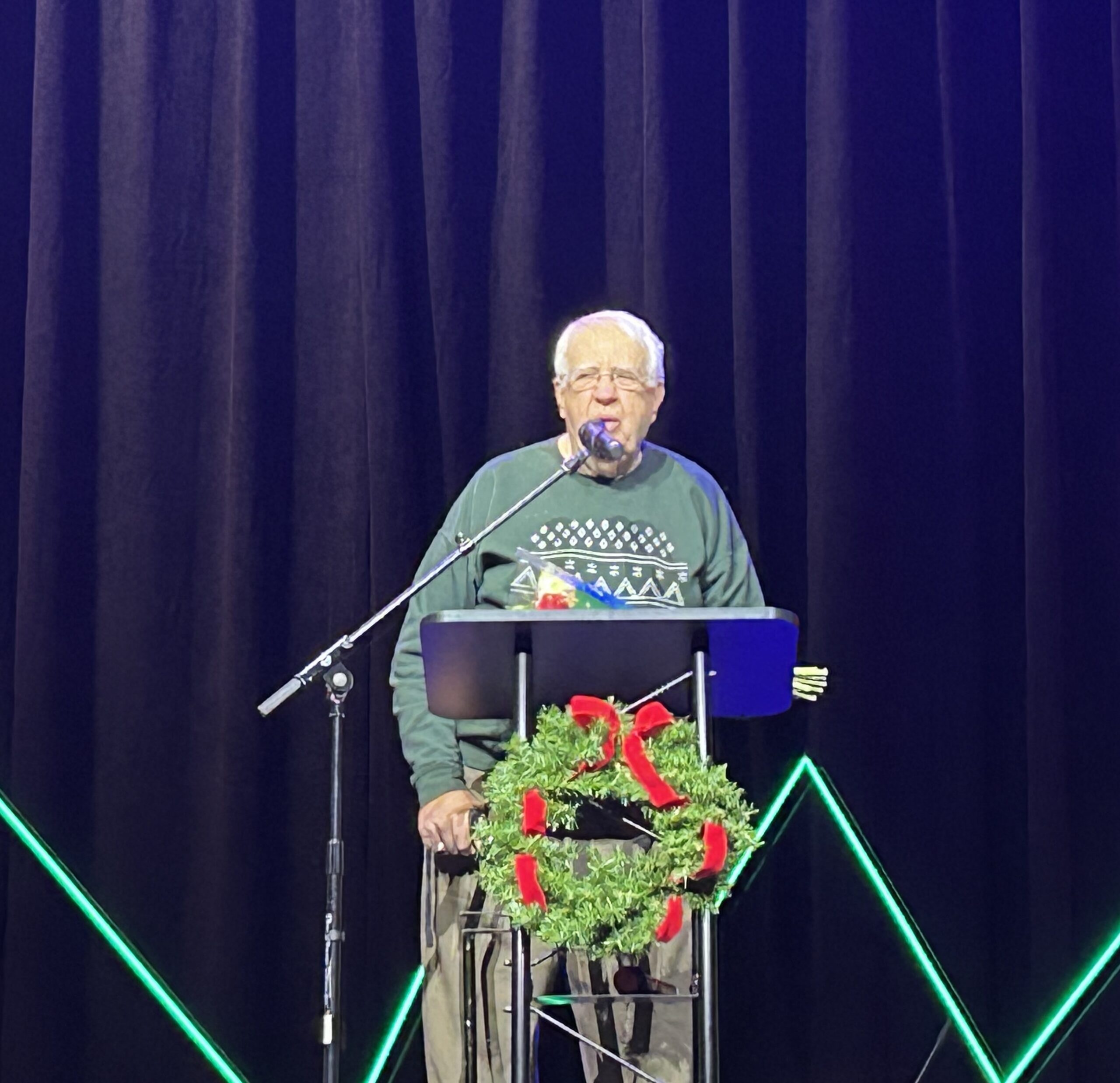
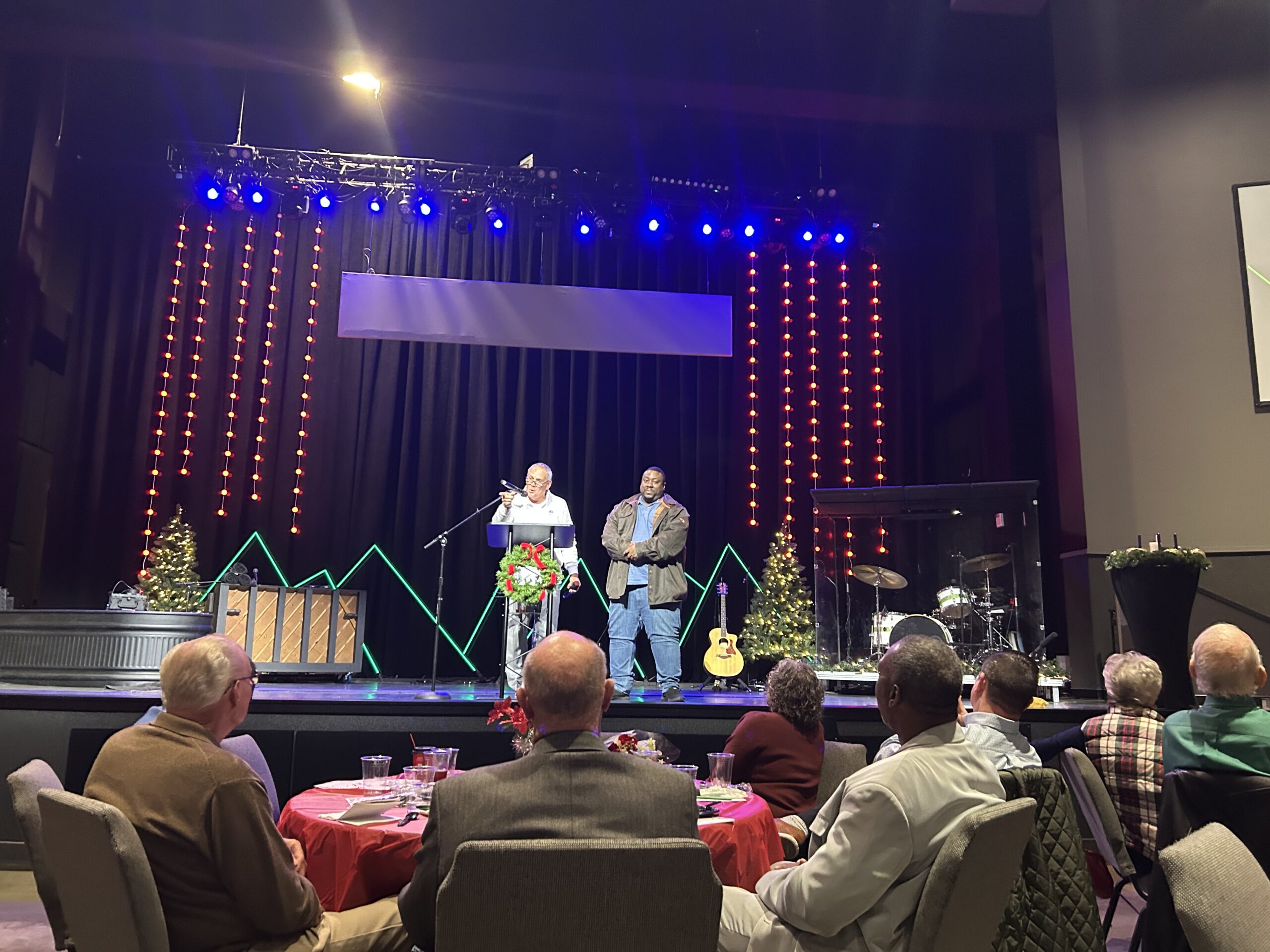
In the presence of the First Baptist Church in Burleson’s Primetimers senior adult ministry and Don Newbury, retired HPU president and retiring co-director of senior adults at the church, Flaherty participated in the luncheon program—featuring his faithful coach and him. Then he climbed into a metal trough to make his faith commitment clear.
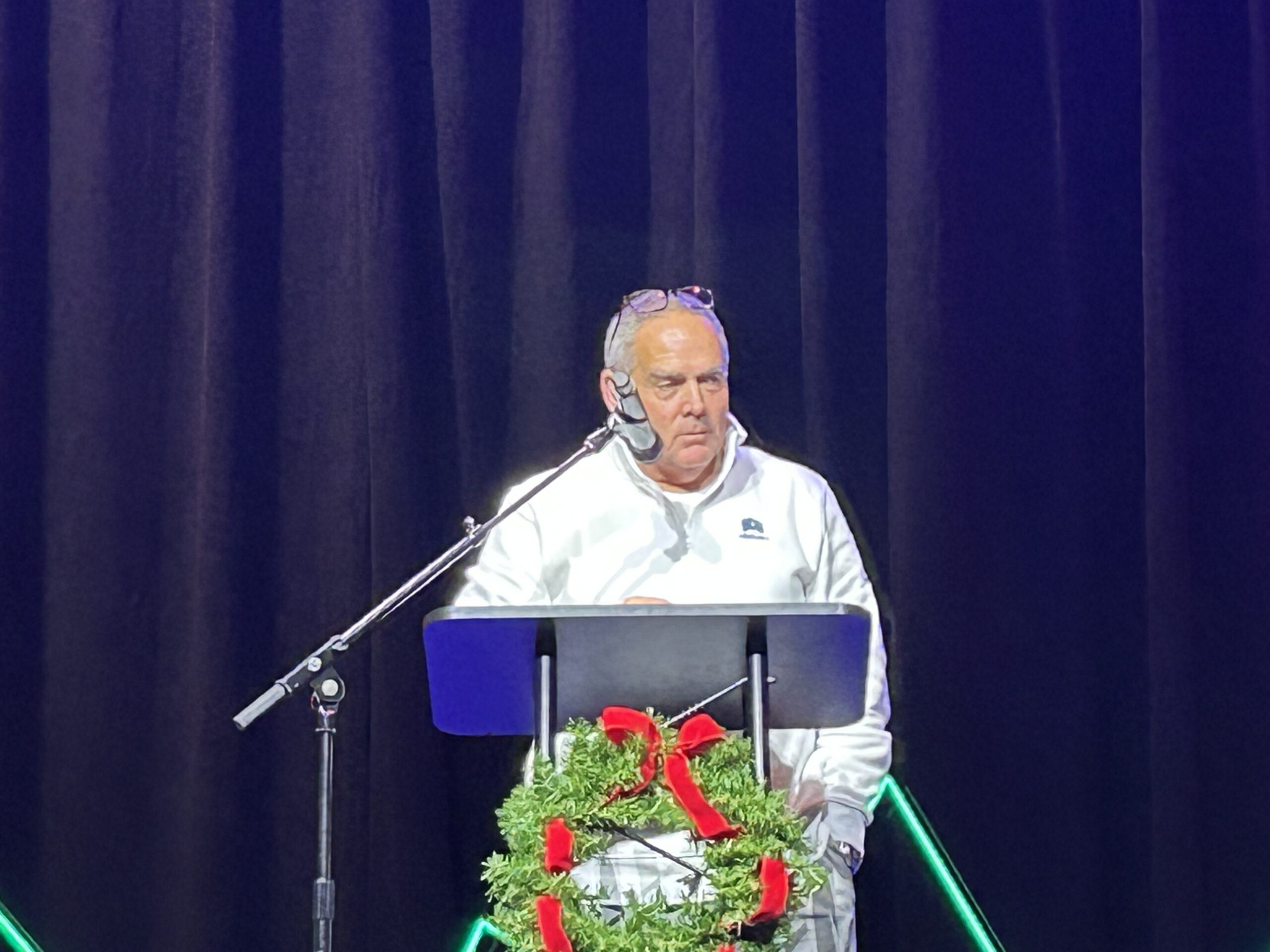
Flaherty’s high school coach, Jeff Dixon—who has provided support and familial care since first seeing reports of the terrible crime that led to Flaherty’s incarceration—knelt beside the trough. Jack Crane, pastor of Truevine Missionary Baptist Church in Fort Worth, dipped Flaherty beneath the water.
“God is at work here,” Dixon noted at multiple points in his presentation leading up to the celebrated redemption symbol. Those who could stood and clapped after the baptism.
Don Newbury, retired HPU president and retiring co-director of senior adults at First Baptist Church in Burleson, introducing the luncheon program. (Photo / Calli Keener)
Many in the room, Newbury noted, had followed Flaherty and Dixon’s story along with him, praying and supporting the young man whose life had taken such a tragic turn, now bearing witness to his redemption this Christmas season.
It was in the Christmas season of 2002 when the Fort Bend County sheriff’s department received a call about a “suspicious male walking down the street.” A witness described large amounts of blood on this clothing and body, a 2003 article reported.
That day was not discussed in the Primetimers’ luncheon program, apart from the handout, and little about it is publicly available or clear. According to several reports, Flaherty remembers few details of that day.
Reports say he recalled being high on drugs, and when he was approached by officers, the 19-year-old said he had killed his mother.
In a plea deal, Flaherty was sentenced to 40 years for first-degree murder, eligible for parole in 2022.
The hero of the story
“God’s the hero of every story,” Dixon began his message to the Primetimers’ luncheon. “And he is most certainly the hero of this one.”
Dixon—whom Newbury described along with his wife Mandy as being among the most notable Howard Payne graduates—explained in his early coaching career, he was “in hot pursuit of me,” rather than attuned to God’s leading.
His early years as an assistant coach, under Bob Ledbetter at Southlake Carroll, led to assisting Coach Mike Johnston in his hometown of Katy. Then he moved to Ennis, where he and his family intended to stay.
In Ennis, the Dixon family lived within walking distance of the church, and, Dixon noted, he and Mandy became more serious about prayerfully listening to God.
When Johnston called him about returning to Katy to assist, which, Dixon explained, would have been seen as a coveted opportunity under a highly respected and successful coach, he initially turned Johnston down.
Jeff Dixon recalls how God has been at work in his shared history with Flaherty, at FBC Burleson’s Primetimers’ luncheon, Dec.19, 2024. (Photo / Calli Keener)
The family loved Ennis, and Dixon loved to teach. The position in Katy was for P.E. and assistant football coach, but Dixon taught math and didn’t want to give that up, he said.
Johnston understood but “asked me to remain in prayer over it,” so Dixon and his wife did.
Johnston called back just before the end of the year to explain a math teacher unexpectedly was leaving, so if Dixon came to Katy, he’d be able to coach and teach.
“We were convinced because of prayer that God called us to Katy,” Dixon said, noting when “you find yourself in God’s will, he turns you to where he wants you to be.”
They still cried when they pulled away from Ennis, the little town they’d loved so much, but “God was at work,” he said.
Back in Katy, Flaherty played a position Dixon coached, fullback. He recalled Flaherty being a kid everyone liked. Even during disciplinary-type drills designed to “get your attention,” Flaherty kept smiling when anyone else would have been miserable, Dixon said.
Dixon explained assistant coaches were held responsible for the eligibility of the players in their position. Flaherty struggled with math, so he spent many days in Dixon’s office for tutoring. At this time, Flaherty lived by himself in an apartment near the school.
His family would come to check on him often. But at 16 years old and recently released from juvenile detention, he was essentially on his own. Dixon noted if it wasn’t for football, Flaherty would have been in a lot of trouble, musing, “Can you imagine being by yourself like that?”
Sometimes coaches would buy him groceries. Weekly, the Dixon family hosted a meal for running backs at their home. The family got to know Flaherty and care about him, Dixon recalled.
When he graduated, Flaherty went to Texas A&M in Kingsville to continue playing football but came home for Christmas break in 2002. Dixon and his wife, on break themselves, turned on the news—where in the mugshot accompanying a tragic story, they saw a familiar face, Dixon said.
The impact of faithful friendship
Years of letters between the two men that Dixon has held onto, along with a ‘Dallas Morning News’ article telling Flaherty’s story. (Photo / Calli Keener)
Dixon went to see Flaherty in the Fort Bend County jail and continued to visit him weekly for a year. Dixon noted he was present in the courtroom when Flaherty was sentenced to 40 years.
Then the Dixon family went to work praying for Flaherty. Flaherty refers to his time in the penitentiary as being “in the belly of the fish” in a reference to Jonah. All during Flaherty’s incarceration the two men exchanged letters.
Dixon often traveled to visit Flaherty, as he was moved around the state to various penitentiaries. For 22 years, the men stayed in touch, and Flaherty shared in his letters how God was working in his life, signing the letters with “In His grip” and “Your Second Son, Anansi.”
When Dixon asked Flaherty whose grip that was, his answer was, “Yahweh’s.”
For 22 years, Dixon said his conversations with Anansi were through thick glass by a phone with a bad connection.
When he got word in November of Flaherty’s parole and that he was being released to a halfway house in Houston, the family headed there, not realizing there still were restrictions that normally would prevent them from seeing him.
When they arrived, they were permitted to see him and hug him. God was at work there, too, Dixon said, because the parole officer happened to be there and explain Flaherty needed a plan for when his remaining 20 days in the halfway house concluded.
They made a plan, and Flaherty now lives in the Fort Worth area.
Crane, who baptized him, has been handling Flaherty’s transportation to weekly Bible studies at Truevine, until Dixon teaches him how to drive his first car, a standard transmission, gifted to him through a ministry that provides cars to parolees.
Dixon sees that story too as proof “God is at work here.”
Dixon and Flaherty participate in a question and answer. (Photo / Calli Keener)
In the question and answer with Dixon, Flaherty explained he began to understand the power of forgiveness as an adult in prison.
Flaherty noted in his youth he had anger issues, believing he had to fight back against “the man” and racial injustice. But he learned in prison if he could “let it slide” when a guard upset him, that guard might stick up for him when he needed it.
“You know when someone is really for you,” Flaherty said, when Dixon asked him about friendship. True friendship should be unconditional, not circumstantial, Flaherty asserted.
Just before the baptism Flaherty asked, “Can I leave with an acrostic? G-O-S-P-E-L—God’s Obedient Son Providing Eternal Life.”
Obituary: Robert Owen Rachuig
January 6, 2025
Robert Owen Rachuig, Texas Baptist pastor and home missionary, died Dec. 19 in Garland. He was 85. He was born Feb. 24, 1939, in Clifton to A.W. and Lurlyne Coker Rachuig and spent his early years in Fairy on the Duncan ranch, where his father served as manager. After he graduated from Fairy High School, he began preparing for ministry by attending the University of Mary Hardin-Baylor before transferring to Howard Payne University, where he met Joyce Ruth Pesnell. The two married on Aug. 7, 1959. He became pastor of Mosheim Baptist Church while continuing his education at Baylor University and working as manager of a grocery store. In 1982, the Rachuigs were appointed as missionaries with the Southern Baptist Convention Home Mission Board. He helped establish churches in Bullhead City, Ariz., and Elephant Butte, N.M., and also was a pastor in Oberlin, Kan., and at Westwood Baptist Church in Palestine. In his later years, he lived at Abba Care Assisted Living in Garland, where he preached regularly and ministered to other residents. He was a member of South Garland Baptist Church. He is survived by his wife of 65 years, Joyce Rachuig; daughter Sheri Hein and her husband Layton of WaKeeney, Kan.; son Russell Rachuig and his wife Missy of Dallas; daughter Dawn Bowers and her husband Rick of Rowlett; seven grandchildren; 12 great-grandchildren; one great-great-granddaughter; and a sister, Gale Hicks. Memorial gifts may be made to Abba Care Assisted Living at 1201 High Grove Dr., Garland, TX 75041.
New Orleans ministers respond after terror attack
January 6, 2025
NEW ORLEANS (BP)—In an eclectic New Orleans ministerial mix, a second line jazz band belted gospel favorites in the footsteps of pastors prayerwalking Bourbon Street hours after the carnage of a New Year’s Day terrorist attack was cleared.
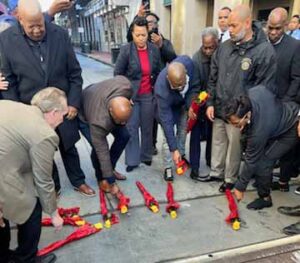
Southern Baptist pastors and chaplaincy leaders were among clergy who joined city elected officials in the 10-block procession at noon Jan. 2, praying for New Orleans after an attacker drove a truck past barricades and into a crowd of predawn New Year’s celebrants, killing 14, injuring at least 30, and himself dying from police gunfire.
Vieux Carre’ Baptist Church, meeting at 433 Dauphine St., was one block over from the attacker’s path and perhaps only yards from where the truck came to rest after it barreled three blocks down Bourbon Street, an area packed with revelers in the city known for its ability to host large parties.
Police identified the attacker, now deceased, as Shamsud-Din Jabbar, a 42-year-old U.S. citizen from Texas who served in the military and praised ISIS in advance of the attack.
Vieux Carre’ Baptist Church Pastor Alex Brian, who participated in the prayerwalk, was awaiting the opportunity to check on his church’s meeting location when he spoke with Baptist Press Jan. 2.
There’s no indication members of Vieux Carre’ were injured in the attack, Brian said of the congregation that serves the community that spans the homeless and the wealthy, but that could change.
“Thus far, no one in the ministry of the church has been affected, although our church has historically been deeply involved in work in the homeless community, and word there travels more slowly,” he said.
“And we’re trying to figure out who if anybody connected to the ministry of the church was affected by the attack, and of course praying and mourning for all those who were affected, even if they weren’t connected to the church.”
Supporting the ministry of chaplains
Col. Page Brooks (left), state command chaplain for the Louisiana National Guard and pastor of Canal Street Mosaic Community Church, at the Jan. 2 Bourbon Street prayerwalk with chaplains Ken De Soto, center, and Larry Johnson, pastor of Celebration Church. (Photo from Page Brooks)
Brian is praying for and supporting chaplains in the locked-down area around the scene of the attack. They include those under the command of Col. Page Brooks, state command chaplain for the Louisiana National Guard and pastor of Canal Street Mosaic Community Church, a Southern Baptist congregation that collaborates with Brian on various ministry outreaches.
The National Guard deployed 100 soldiers and two chaplains in response to the attack, said Brian, who was walking the streets of the French Quarter to provide counseling and check on soldiers and first responders.
“It’s been tragic for them,” Brooks said. “Many of them live here in the New Orleans area, and so I think it’s the shock having an incident happen like this in New Orleans. We’re so focused on Mardi Gras and tourism … you wouldn’t think anything would happen like a terrorist event down here in the French Quarter. That’s been a lot of my conversation.”
Much of the chaplaincy ministry has been focused on the soldiers and police who have responded to the scene, he said.
“Most everyone kind of in the area is still in shock,” Brooks said. “I think people feel secure because there’s a lot of police presence down here, but I think people are still just in shock at what has happened.
“I try to tell them that God is still in control,” he said. “And, of course, none of this took him by surprise.”
Celebration Church Senior Pastor Dennis Watson (bowing at far left) and Shiloh Christian Fellowship Pastor Michael Raymond (standing at left) place yellow roses on Bourbon Street in advance of a noon prayerwalk Jan. 2 after a terrorist attack killed 14 and injured at least 30 before police killed the suspected attacker. New Orleans Mayor LaToya Cantrell stands at center. (Photo from Page Brooks)
Still, Brooks expressed surprise at the many tourists who still crowd the parts of the Quarter that remained open to traffic in advance of the Sugar Bowl, postponed until 3 p.m. Thursday from an original game time of 7:45 p.m. Jan. 1.
Brooks and Brian will hold a joint service Sunday at 10 a.m. at Canal Street Mosaic Church dedicated to healing in the aftermath of the tragedy.
Former Southern Baptist Convention President Fred Luter was among prayerwalkers, pleading for the peace of God to permeate the city.
“We did not have any members directly impacted by this tragedy,” said Luter, senior pastor of Franklin Avenue Baptist Church. “However, our entire city has been impacted because of this terrorist attack.
“New Orleans is used to hosting major events like the Super Bowl, Sugar Bowl and Mardi Gras, all without incident,” Luter said, lamenting the attack “where a number of people have been killed and injured. Therefore, prayers for our city and the families who lost loved ones are truly needed.
“This incident will only draw our public officials and citizens together to continue to make New Orleans a popular tourist destination for people from around the world.”
Brooks also participated in the prayerwalk, which together with the second line created a vibe he described as unique to New Orleans.
“We had a second line band behind us, that as we were praying they were singing, ‘I’ll Fly Away’ and ‘When the Saints (Go Marching In),’” he said. “In New Orleans, it’s that weird mixture of lament, but also joy in the middle of things like this.
“It’s the lament of the death that’s happened and the people that have passed. But it’s also the strength of coming together as a city that is symbolized in that very act of” prayer accompanied by a second line.
“This is part of the rhythm of New Orleans.”
New church plant cultivates vision for missional community
January 6, 2025
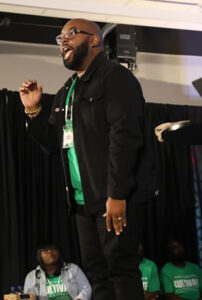
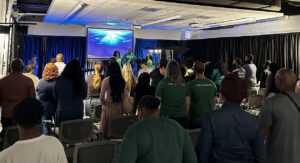
THE COLONY—Since launching a new Texas Baptist church plant in September and holding worship services inside a state-of-the-art office and meeting space area, Jamael Graves, lead pastor of Cultivate Church in The Colony, realizes the mission field surrounding his congregation.
Since feeling called to establish Cultivate Church in The Colony, Pastor Jamael Graves notes how God’s hand was guiding and providing in preparation for the new church plant. (Courtesy Photo)
“When I realized that 40,000 people come to Grandscape and walk through this destination each day, I realized that it’s a mission field and thought about Matthew 9:38, ‘Ask the Lord of the harvest, therefore, to send out workers into his harvest field,’” Graves said. “We are believing God for the laborers.’”
The church plant is strategically placed inside Grandscape—a distinctive outdoor entertainment, dining and shopping destination that includes world-class restaurants, family-friendly experiences and technology-driven entertainment and events.
“We didn’t choose Grandscape for our location. Grandscape chose us,” Graves said. “We thought we’d be in the Galleria square and called to find out how we could host an interest meeting. That’s when their leadership asked us if we’d be interested in using the Grandscape facility.
“We never thought we’d be able to afford it, but they took a drastic decrease off the rent to negotiate with us. That’s a God-thing right there.”
Since feeling called to establish Cultivate Church, Graves notes how God’s hand was guiding and providing in preparation for the new church plant.
Word to the wise: ‘Don’t give up’
However, he acknowledges the journey of planting a church certainly hasn’t been easy. Graves said if he could offer church planters a piece of advice, it would be: “Don’t give up.”
Throughout the church-planting process, Graves noted he often felt inadequate for the task at hand, and some situations seemed impossible. But that is when Graves said God showed up the most.
Graves said church planting has been on his heart for some time, but the timing hadn’t been right—until now.
“Nine years ago, my mom died from HIV because of drug abuse. And the week that she died, I met my father and discovered the reason she never wanted him to be around me was because of his drug addiction,” Graves said.
“I was a school principal, and my dad that I had just met suffered a relapse and was back on drugs. Even though I was sensing that the Lord was calling me to start a church back then, I remember being filled with so many questions, doubts and uncertainties surrounding my life.
“I remember asking the Lord: ‘How am I supposed to lead? Why do you want me to do this?’ I’m coming from a dysfunctional family, and I felt disqualified to plant a church. I felt like I was going through a midlife crisis. So, I needed some time away from the idea of planting a church.”
God gave a new vision
Over the past year, Graves sensed God was stirring in his heart and giving him a new vision.
“I was at a conference and texted my wife that I felt called to plant a church,” Graves recalled. “I didn’t hear anything back from her. So, I assumed she thought I was crazy.”
Later, he discovered the Lord had already been working on his wife’s heart and preparing her for this moment.
“My wife said: ‘God already told me that he called you to this, but I knew you were too hard-headed. So, I didn’t say anything to you. I was just waiting for you to realize when the time was right.’”
Cultivate Church in The Colony meets inside Grandscape—a distinctive outdoor entertainment, dining and shopping destination that includes world-class restaurants, family-friendly experiences and technology-driven entertainment and events. (Courtesy Photo)
Last February, Graves took a giant leap of faith as he quit his job and started putting the plans into motion to launch the church.
By sharing his testimony and life experiences, Graves hopes it will help connect with people from all walks of life and remind those who are hurting about God’s redemption story.
“I’ve learned to trust God and trust the process,” Graves said. “This is God’s plan, not ours. You know it’s from God when it seems impossible. That’s when it shows his power and his plans that are not our own.”
The church takes the inspiration for its name from 1 Corinthians 3:6-9, where the Apostle Paul wrote: “I planted the seed, Apollos watered it, but God has been making it grow. So neither the one who plants nor the one who waters is anything, but only God, who makes things grow. The one who plants and the one who waters have one purpose, and they will each be rewarded according to their own labor. For we are co-workers in God’s service; you are God’s field, God’s building.”
“We want to see hearts turn back to God,” Graves said. “Through the storms and pain of life, God has been faithful every step of the way. There have been so many hard times, but without a doubt, I know this is what God has called me to do.”
“We are believing God for the laborers.”
Obituary: Gene McLain
January 6, 2025
EuGene “Gene” Euell McLain of Plainview, Baptist deacon and former trustee of Wayland Baptist University, died Dec. 25, 2024. He was 89. He was born July 25, 1935, in Fox, Okla., to Woodie Albert and Blanche Shrader McLain. While growing up, his family moved between Oklahoma, Texas and California. He made his profession of faith in Jesus Christ during a tent revival in Bakersfield, Calif., and was baptized in a nearby irrigation canal. He graduated from Chillicothe (Texas) High School in 1956. He and classmate LaNeta Morris married April 19, 1957. After a brief time in Dalhart working at a Ford dealership, the couple moved to Plainview in 1962 to join LaNeta’s brother Ronald in the cottonseed delinting business. The McLains eventually owned Plainview Acid Delinting, where he was president of the business until they retired and closed the operation in 2007. They continued to warehouse the seed for farmers for another decade. The McLains were members of College Heights Baptist Church in Plainview, where he was the most longstanding member of record and a deacon. For decades, he also was the church treasurer, served on numerous committees and taught Sunday school. He served four terms as a trustee of Wayland Baptist University from 1981 to 1989, including a term as secretary of the board. “Gene McLain was a man of exceptional faith, integrity and humility,” said Wayland President Donna Hedgepath. “He brought a quiet strength to the board of trustees and an abiding dedication to advancing Wayland’s mission of Christian higher education. His impact is woven into the fabric of this institution, and his legacy of service will continue to inspire us all.” He was preceded in death by his wife of 65 years, LaNeta Morris McLain; and brothers Caril Andrew, Larry Earl and Waylan Alvin McLain. He is survived by son Jeffery; son Kevin and his wife Lana; daughter LaGena Horak and her husband Paul; five granddaughters; six great-grandchildren; and one great-great-granddaughter. Memorial gifts may be made to the Gene and LaNeta McLain Scholarship at Wayland Baptist University. Contributions can be sent to 1900 W. 7th Street, CMB 1295, Plainview, TX 79072, or online at give.wbu.edu.
Texans on Mission serve 80,000 meals in Israel in 2024
January 6, 2025
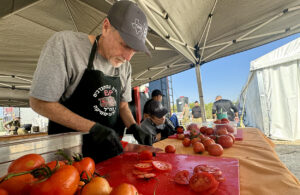
Texans on Mission volunteers served more than 80,000 meals in Israel in 2024.
Texans on Mission volunteers work in partnership with Israel’s Emergency Volunteer Project. Currently, Texans on Mission has 165 people trained in kosher protocols. (Texans on Mission Photo / Taryn Johnson)
The Texas-based missions organization works in partnership with Israel’s Emergency Volunteer Project, which provided more than 800,000 using equipment and facilities Texans on Mission helped develop.
“We now have 10 feeding trailers/units, each with a generator, that can be deployed anywhere,” said John Travis Smith, Texans on Mission associate executive director. “We can house 40 volunteers in Israel and expand that number if we need to.”
Texans on Mission organizes disaster relief training trips to Israel throughout the year, and it deployed teams a year ago after Hamas attacked Israel. It held its last 2024 training session in November.
“We now have 165 people trained in kosher protocols” required for food service in Israel, said Gary Finley, Texans on Mission Israel volunteer coordinator. “This would staff all 10 kitchens for two weeks. We are continuing training in 2025.”
More trained volunteers are still needed, Finley added.
“If there were a major disaster, we would run short of trained volunteers. So we need more,” he said.
A ‘roller coaster year’ in Israel
Finley called 2024 a “roller coaster year” in Israel. The year began with the emergency response when multiple Texans on Mission teams served, which was followed by regular training trips, and then the entire team was placed on standby when the conflict in Lebanon escalated.
In a Dec. 18 email to trained volunteers he said: “For now we will remain on alert. I ask that you continue to pray for peace and safety for our partners over there.”
Monthly training trips will resume in March 2025 and then skip April as Jews worldwide observe Passover.
In November, the last training of 2024, Texans on Mission volunteer trainees prepared, cooked and served more than 3,000 meals alongside EVP workers. They trained to cook kosher meals to prepare for any future deployments to deliver relief when needed.
Texans on Mission volunteers said they also found the work in Israel inspiring.
It was “very humbling for me to serve a people who are fighting for their very existence,” said Texans on Mission volunteer Cheryl Terry.
“I absolutely feel that I receive a blessing each time I serve. Everyone that can physically go would see and experience the people of Israel and the resilience of spirit. They have been an inspiration to me personally.”
Volunteers also had opportunities to explore historic sites. “To be able to possibly walk where Jesus did is just inspiring to me,” said Texans on Mission volunteer Jerry Ickes.
Texans on Mission volunteer Kelton Gunter said: “You just have to see it and live it a bit to get any sense of it. I highly recommend people take this opportunity, not only to help during the training mission, but to be qualified to serve when the next emergency happens.”
The training efforts did not go unnoticed by the people of Israel. “When they see us working very hard, … they know we have traveled thousands of miles to help them and prove that we care,” Gunter said.
Taryn Johnson, Texans on Mission social media strategist, said it was a blessing to see “such humble servants eager to help those in need. A trip to Israel is one that requires flexibility and determination, and every volunteer exuded these traits with a smile. They highly recommended others volunteer for mass feeding in Israel, and for that we are grateful.”
A new registration process for Israel training trips has been implemented. Visit the Texans on Mission webpage, TexansOnMission.org/Israel, to learn more details about the trips and to register.
Eleven killed in airstrike on Baptist church in Sudan
January 6, 2025
An airstrike on a Baptist church in Sudan less than a week before Christmas killed at least 11 people, including eight children, an organization focused on international religious freedom reported.
A Sudan Armed Forces airstrike hit Al Ezba Baptist Church in Khartoum North on Dec. 20. It damaged the worship facility, the church’s nursery—which was occupied at the time—and several residential buildings, CSW reported (Photo courtesy of CSW)
The Sudan Armed Forces airstrike hit Al Ezba Baptist Church in Khartoum North on Dec. 20. It damaged the worship facility, the church’s nursery—which was occupied at the time—and several residential buildings, Christian Solidarity Worldwide reported.
Less than a week after the airstrike on the mosque, more than 100 civilians were killed when the Sudan Armed Forces hit a crowded marketplace in Kabkabiya in western Darfur.
“We pray for God to give the two warring parties the wisdom to stop the war. The longer it continues, the more innocent children and civilians will die,” Pastor Philemon Hassan of Al Ezba Baptist Church said.
“In Al Ezba area, people are dying either in this way or for the lack of basic humanitarian needs. Some can’t afford to leave the area, and those who can, are afraid to leave because they could be arrested for falsely being affiliated with the RSF.”
In October, more than 100 members of the Sudanese Church of Christ moved from Al Ezba to Shendi in River Nile State, seeking to escape the violence. In Shendi, 26 men were arrested by the Sudan Armed Forces Military Intelligence Unit and accused of being affiliated with the Rapid Support Forces.
Khataza Gondwe, advocacy director for CSW, expressed condolences to the families of those killed and injured in the Dec. 20 airstrike.
“It is particularly deplorable that most of the fatalities were children who died in a place where they should have been safe. The high number of child casualties illustrates the continuing disregard for civilian lives by both warring parties throughout this conflict,” he said.
“In addition, the persistent targeting of places of worship violates international humanitarian and human rights law egregiously, and may constitute a war crime, especially when these premises are being used to meet the sharp rise in humanitarian needs generated by the ongoing conflict.
“CSW continues to call on both the SAF and the RSF to agree to an immediate and unconditional ceasefire, to ensure the protection of civilians, and to bring an end to the severe human rights and humanitarian crises in the country.”
EDITOR’S NOTE:Attacks on houses of worship continued after Christmas. On Dec. 30, Sudan Rapid Support Forces attacked a Sudanese Church of Christ in Al Hasaheisa, Gezira State, during a prayer service, forcing the 177 Christians who had gathered to leave, CSW reported. At least 14 people were assaulted and insured.
Biden commutes sentences of 37 on federal death row
January 6, 2025
WASHINGTON (RNS)—Prior to Christmas, President Joe Biden commuted the sentences of all but three people on federal death row, converting their sentences to life in prison.
It represented a victory for religious advocates who have pressured the president to make the move during his final days in office—even as they call on him to “finish the job” by commuting the remaining three.
Biden, who campaigned on the promise of abolishing the federal death penalty, announced the move Dec 23. He framed the action partially as a response to remarks by President-elect Donald Trump, who has pledged to restart executions upon assuming office.
“Guided by my conscience and my experience as a public defender, chairman of the Senate Judiciary Committee, vice president and now president, I am more convinced than ever that we must stop the use of the death penalty at the federal level,” Biden stated. “In good conscience, I cannot stand back and let a new administration resume executions that I halted.”
The news comes 10 days after Biden announced he would commute the sentences of roughly 1,500 people who were released from prison and placed on home confinement during the pandemic, as well as pardoning 39 people convicted of nonviolent crimes—the largest single-day act of clemency in modern history.
The White House explained Biden believes “America must stop the use of the death penalty at the federal level, except in cases of terrorism and hate-motivated mass murder—which is why today’s actions apply to all but those cases.”
Praised as an ‘act of mercy’
Archbishop Timothy P. Broglio, president of the United States Conference of Catholic Bishops, celebrated the move as an “act of mercy” that brings the country “a step closer to building a culture of life.” He also called on lawmakers to eliminate the death penalty entirely.
“My brother bishops and I unite in expressing our gratitude that President Biden has commuted the federal death sentences of 37 men,” Broglio stated. “The bishops’ conference has long called for an end to the use of the death penalty. This action by the president is a significant step in advancing the cause of human dignity in our nation.”
Similarly, Gabe Salguero, head of the National Latino Evangelical Coalition, noted while he and other Latino evangelicals “grieve for the victims and unequivocally condemn these murders,” he nonetheless welcomed the news.
“Today’s Advent season decision by President Biden to commute the death sentences of 37 federal inmates is a reminder that as a nation we must still grapple with the inequities that plague this system,” Salguero said, noting NALEC became the first national evangelical group to call for an end to the death penalty in 2015.
The Catholic Mobilizing Network also celebrated the decision as “unparalleled.”
“Today’s historic decision by President Biden advances the cause of human dignity and underscores the sacred value of every human life,” read a statement from the group. “Praise God!”
’37 is good, but 40 is better’
But some of the advocates, including Shane Claiborne, a Christian activist who has spent years protesting the death penalty, noted that while the announcement allows 37 people facing capital punishment to instead serve life in prison, three men will remain on death row.
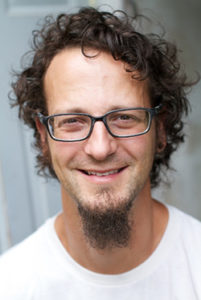
Shane Claiborne
They are Dzhokhar Tsarnaev, convicted in the 2013 Boston Marathon bombing; Robert Bowers, convicted in the 2018 Tree of Life Synagogue attack in Pittsburgh, Penn.; and Dylann Roof, who killed nine Black worshippers in 2015 at Emanuel African Methodist Episcopal Church in Charleston, S.C.
“The death penalty does not heal the wounds of violence, it just creates new wounds,” Claiborne said in a text message to Religion News Service. “We can honor the victims of violence without killing more people. It’s time to stop killing to try to show that killing is wrong.”
He added: “37 is good but 40 is better. No one—not even Dylann Roof—is beyond redemption.”
Claiborne was echoed by fellow advocate Sharon Risher, whose cousins and mother, Ethel Lance, were among the nine church members killed in the 2015 shooting at Mother Emanuel Church.
“Every time this case comes up, I am brought back to the day my mother and cousins were murdered, and I need that to stop,” Risher said.
“Politics has gotten in the way of mercy. You can’t rank victims, Mr. President. I am begging you to finish the job, not only with the three men left on federal death row, but also with those on the military death row. There’s still time. Finish the job.”
Anti-death penalty activist Jeff Hood did not consider commuting the death sentences of 93 percent of the inmates on federal death row a passing grade.
“Just when I thought Joe Biden was going to give our nation some ethical clarity, he has presented us with a new nightmare—the ranking of murder victims. Either Biden finishes the job and commutes all federal death sentences or we are left in the same place we were before—a moral abyss of federal sentencing that only pursues death sentences in rare cases, prioritizing some murder victims above all others,” Hood wrote on social media.
“This is not time for celebration. We are in the same moral abyss we were in before. Regardless of how many death sentences President Biden just commuted, by not commuting them all he has made sure that the killing will continue.”
Urged to act by faith leaders
Biden’s announcement comes after a blitz of public and private advocacy by faith leaders and activists.
In mid-December, a group of religious leaders, activists and law enforcement officials traveled to Washington to stage a day of advocacy around the issue. Members of the group held a vigil outside the White House and spoke at a hearing on Capitol Hill alongside lawmakers such as U.S. Rep. Ayanna Pressley, D-Mass., who has cited her own Christian faith as part of the inspiration for her involvement.
The effort also got a high-profile boost from Pope Francis—who changed the catechism of the Catholic Church in 2018 to declare the death penalty “inadmissible”—when he devoted a section of a homily earlier this month to the subject. He asked Catholics to pray that Biden, a Catholic, would commute the death sentences of those on death row.
“Think of these brothers and sisters of ours and ask the Lord for the grace to save them from death,” Francis said.
In a letter sent to Biden last week, Risher, who also serves as chair of Death Penalty Action, expressed concern Trump would restart federal executions upon taking office next month.
“It is vital that you deny him that opportunity by commuting every death sentence remaining on federal and military death rows,” Risher wrote.
‘All lives are sacred’
Marshall Dayan, a retired federal public defender living in Pittsburgh and cochair of the board of Pennsylvanians Against the Death Penalty, said he was pleased with Biden’s 37 commutations but disappointed he didn’t commute all 40 death-row inmates.
“All lives are sacred. We’re all created with ‘t’zelem elohim,’ in the image of God. And yet, the message this sends is that there’s a hierarchy of values,” he said. “I don’t think the president believes that. But it is the message that he sends by saying, ‘I’m going to treat these three people differently.’”
But Dayan said he was aware that many in the Pittsburgh community did not want the sentence of Robert Bowers commuted, as views regarding the death penalty for the three men left on death row are not uniform.
Last year, Pennsylvania Gov. Josh Shapiro explained his own opposition to the death penalty by citing conversations he had with the families of those killed in the Tree of Life shooting and members of the worship community, indicating several do not support capital punishment.
Even so, seven of the nine families involved have previously indicated support for the death penalty, and the sons of Joyce Fienberg, who was killed in the shooting, sent a letter to Biden this month asking the president not to commute Bowers’ sentence, arguing the shooter did not show remorse.
“In Judaism, T’shuvah—repentance, or a return to righteousness—requires confession, regret, and seeking to right the wrongs committed,” read the letter, signed by Anthony and Howard Fienberg. “Absent that, forgiveness is not even possible.”
Similarly, some parents of children who were killed and wounded during the Boston bombing publicly voiced opposition to the death penalty in the case, but others have suggested support for it.
Biden declared his desire to abolish the federal death penalty while campaigning in 2019, and placed a moratorium on federal executions in 2021. But he did not ultimately eliminate the death penalty, nor did he stop the Department of Justice from prosecuting capital punishment cases during his tenure, frustrating many advocates.
But religious activists who oppose the death penalty say they will continue to pressure Biden to commute the sentences of those still on death row, arguing their cause is ultimately a matter of faith.
“Rather than asking, ‘Do they deserve to die,’ we should be asking ‘Do we deserve to kill?’” Claiborne said. “As Jesus said, ‘Let the one without sin cast the first stone.’”
With additional reporting by Bob Smietana of RNS and Baptist Standard Managing Editor Ken Camp.
Report ranks countries where religion faces hostility
January 6, 2025
WASINGTON (RNS)—A report by Pew Research Center on international religious freedom named Egypt, Syria, Pakistan and Iraq as the countries where both government restrictions and social hostility most limit the ability of religious minorities to practice their faith.
Governmental attacks and social hostility toward various religions usually “go hand in hand,” said the report, the 15th annual edition of a report that tracks the evolution of governments restrictions on religion.
The report uses two indexes created by the center in 2007, the Government Restrictions Index and the Social Hostilities Index, to rank countries’ levels of government restrictions on religion and attitudes of societal groups and organizations toward religion.
The GRI focuses on 20 criteria, including government efforts to ban a faith, limit conversions and preaching, and preferential treatment of one or many religious groups.
The SHI’s 13 criteria take into account mob violence, hostilities in the name of religion and religious bias crimes.
Study examines 198 countries
The study looks at the situation in 198 countries in 2022, the latest year for which data are available from such agencies as the U.S. Commission on International Religious Freedom, the U.S. Department of State and the FBI.
The report also contains findings from independent and nongovernmental organizations, including the American Civil Liberties Union, the Anti-Defamation League, Human Rights Watch and Amnesty International.
In total, 24 countries received high or very high GRI scores (4.5 or higher on a scale of 10) and high or very high SHI scores (higher than 3.6 out of 10). Close behind the four countries that scored very high on both scales were India, Israel and Nigeria.
Thirty-two other countries, including Turkistan, Cuba and China, scored high or very high on government restrictions, but low or moderate on social hostility. Most were rated as “undemocratic” and “authoritarian” by The Economist magazine’s Democracy Index.
“Such regimes may tightly control religion as part of broader restrictions on civil liberties,” reads the report. Many Central Asian countries and post-Soviet countries fell into that category, noted Samirah Majumdar, lead researcher of the report, part of the Pew-Templeton Global Religious Futures Project.
Besides ranking countries where religions were under the most pressure, the team that put together the report tried to determine “whether countries with government restrictions tend to be places where they also have social hostilities; Do countries with relatively few government restrictions also tend to be places where they have relatively few social hostilities?” explained Majumdar.
Majumdar said the results were inconclusive.
“We can’t exactly determine a causal link, but there are some patterns we were able to observe in the different groupings,” she said. “A lot of those countries have had sectarian tensions and violence reported over the years. In some cases, government actions can go hand in hand with what is happening socially in those countries.”
Countries with low or moderate scores on both indexes—a GRI no higher than 4.4 out of 10 and an SHI between 0 and 3.5—usually had populations under 60 million inhabitants.
The index factors the same criteria over the years, and the team relies on the same sources, allowing for comparisons from one year to another. From 2021 to 2022, median GRI and SHI scores stayed the same, but in sub-Saharan Africa, the GRI rose from 2.6 to 3.0 out of 10. In Middle Eastern and North African countries, the index went from 5.9 to 6.1.
High levels of government, social hostility in Nigeria
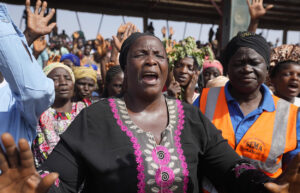
Victims of a gunmen attack pray for peace at the internal displaced camp in Bokkos, north central Nigeria, Wednesday, Dec. 27, 2023. Victims of a gunmen attack react at the internal displaced camp upon the arrival of Nigeria Vice President Kashim Shettima, in Bokkos, north central Nigeria, on Wednesday, Dec. 27, 2023. Musa Ashoms, commissioner of information and communication for Plateau State, reported 195 deaths due to the attacks. (AP Photo/Sunday Alamba)
Among the 45 countries that presented high or very high SHI scores, Nigeria was the first of the seven countries with very high levels, a result linked to gang violence against religious groups and violence by militant groups Boko Haram and ISIS-West Africa, which rages in the Sahel desert.
Iraq, which ranks among the countries with both high GRI and SHI, also finds itself among the countries with the highest social hostilities, and has seen its social hostility score increase. The report attributed this to violence against religious minorities imprisoned by Iran-backed Popular Mobilization Forces.
It also cited a 2024 Amnesty International report on outbreaks of gender-based violence in Iraqi Kurdistan, with many occurrences of women being killed by male family members, sometimes for converting to another religion.
According to the report, physical harassment against religious groups by government or social groups peaked in 2022. This category covered acts from verbal abuse to displacements, killings or damage to an organization’s property.
The study highlighted 26,000 displaced people from Tibetan communities in China and continued gang violence targeting religious leaders by Haitian gangs.
Overall, the number of countries where physical harassment took place increased to 145 in 2022, against 137 countries in 2021.
Jimmy Carter, beloved Sunday school teacher, ex-president, dead at 100
January 6, 2025
(RNS)—Jimmy Carter, who died Sunday, Dec. 29, at age 100, was known most as the 39th president of the United States. But he also will be remembered as the world’s most famous Sunday school teacher.
Carter, who spoke openly about his Baptist faith while campaigning for the White House in 1976, earned the votes of many evangelical Christians when he called himself “born again.”
“My father was a hero, not only to me but to everyone who believes in peace, human rights, and unselfish love,” said his son Chip Carter in the statement. “My brothers, sister, and I shared him with the rest of the world through these common beliefs.”
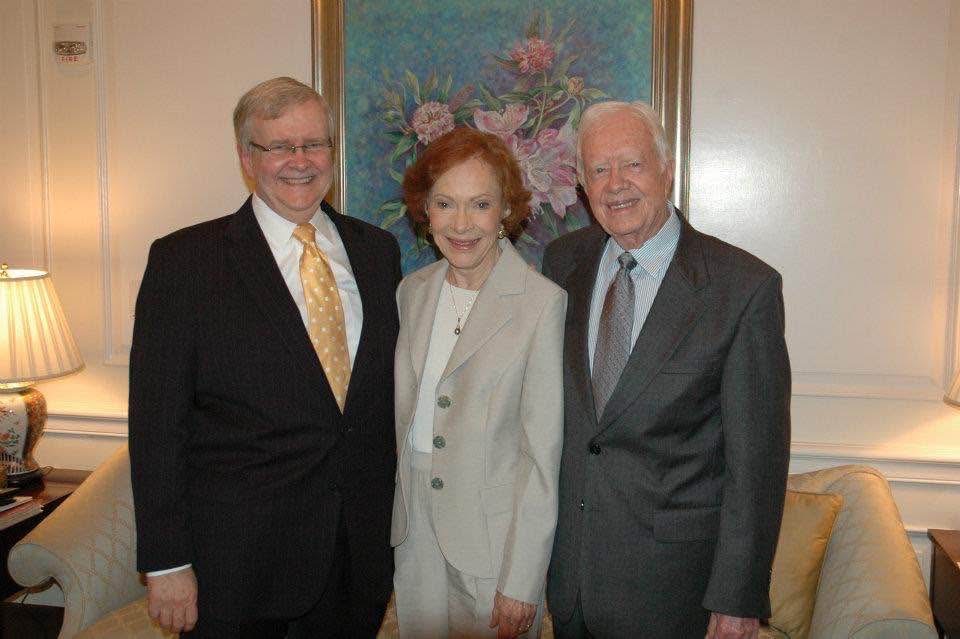
Former President Carter and Rosalynn, pictured with David Sapp, then pastor of Second-Ponce de Leon Baptist Church in Atlanta, at a New Baptist Covenant meeting held at the church in 2011. (Courtesy Photo)
After leaving the White House in 1981, Carter spent decades as a humanitarian and advocate for peace—building houses with Habitat for Humanity, monitoring elections in dozens of countries, helping fight against Guinea worm disease.
Still, more Sundays than not, the former president had a regular appointment: teaching Sunday school in his rural Georgia Baptist church, Maranatha Baptist Church.
His wife of 77 years, Rosalynn Carter, died at the age of 96 on Nov. 19, 2023.
“Jimmy Carter’s identity is inseparable from his almost lifelong vocation—60, 70 years—as a Sunday school teacher,” said historian Bill Leonard, professor of divinity emeritus at Wake Forest University School of Divinity. “He has lived every week of his adult life in the study and teaching of the Scriptures.”
Only US president to teach Sunday school while in office
Carter was the only U.S. president to have taught Sunday school while in office, according to the White House Historical Association. William McKinley and Theodore Roosevelt taught Sunday school before entering the White House, and Benjamin Harrison led a Bible study class after his presidency at First Presbyterian Church in Indianapolis.
Carter, a Nobel Peace Prize winner, spoke matter-of-factly about his long-term Bible teaching in a 2014 appearance at the LBJ Presidential Library.
“I belong to Maranatha Baptist Church and that’s where I teach Sunday school every Sunday—last Sunday and this next Sunday as well—about 35 times a year,” he said.
“I had been teaching Bible lessons since I was a midshipman in Annapolis, 18 years old.”
His practical lessons attracted hundreds to his rural Georgia church on a Sunday as he related the verses of the Bible to the challenges of modern times.
“What I try to do each Sunday is begin my lesson for about 10 or 15 minutes discussing current events, the recent experiences that I have had or where I’m going next week,” he told Religion News Service, in 2011. “And then seeing how that applies to biblical principles, basic moral values that apply to every human life.”
Through the Year with Jimmy Carter: 366 Daily Meditations from the 39th President, published that year, featured summaries of the 45-minute lessons he taught over the years, including at First Baptist Church in Washington when he was in the White House in the 1970s.
Born Oct. 1, 1924, in Plains, Carter graduated from the U.S. Naval Academy in 1946 and served as a naval officer until 1953, including duty aboard the USS Pomfret, a submarine, according to his biography on the Carter Presidential Library website. He retired from active duty after the death of his father.
He returned to Georgia with his wife—whom he married the same year he earned his naval commission—and took over the family farm supply business. He also began a steady rise in Georgia politics, serving in several local roles before being elected to the Georgia Senate and moving to the governor’s mansion in 1971.
Five years later, he was elected the president. Abandoned by evangelical voters—who objected to his liberal stands on some issues—and dogged by a poor economy and the Iranian hostage crisis, he lost his bid for reelection in 1980 to Ronald Reagan. With Reagan’s election, the evangelical Christian bloc moved to the Republican Party.
Throughout Carter’s political career, he remained active in local church life.
Break with SBC
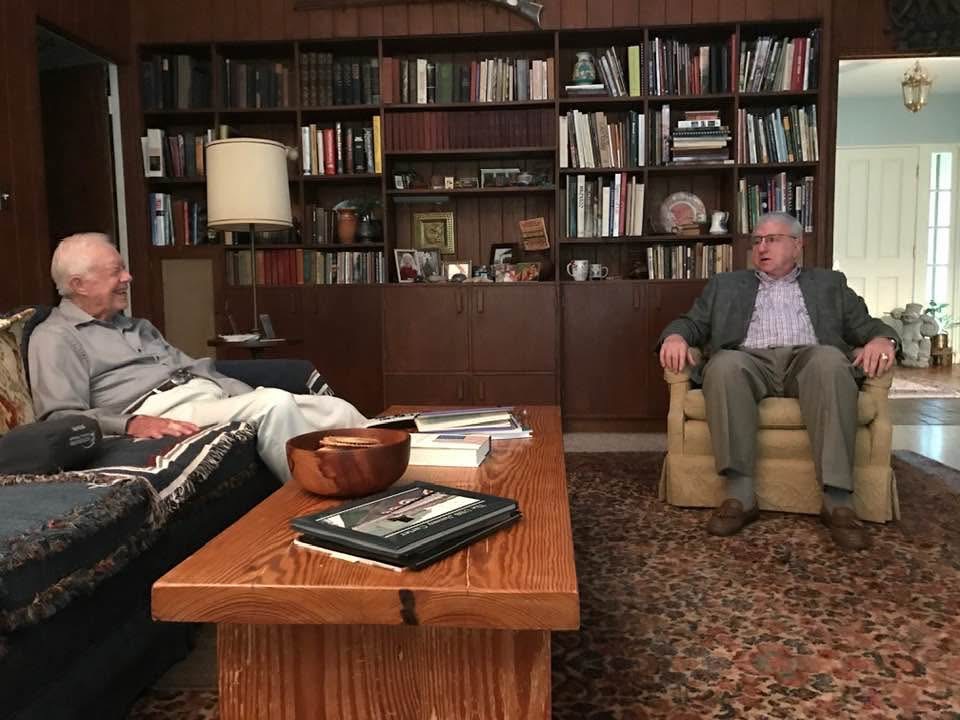
Former President Carter pictured in his home with Marion Aldridge, who was considering serving as interim pastor of Maranatha Baptist Church. The landlady at the boarding house where Aldridge stayed was good friends with the Carters. “That morning, before the Sunday school (which he taught, of course), she asked him if they wanted to invite me over for a meal. He responded, ‘Let’s hear him preach first.’ Apparently, they approved,” he recalled. (Courtesy Photo)
He eventually would make a public break with the Southern Baptist Convention after the denomination revised its statement of faith to call for women to submit to their husbands and banning women from serving as pastors. Still, he continued to attend Maranatha Baptist, which is affiliated with the Cooperative Baptist Fellowship.
Despite their significant theological disagreements, leaders of Carter’s former denomination admired his commitment to the teaching of Scripture.
“History will record that no president of the United States demonstrated a greater long-term commitment to identifying with the Christian faith and with even the teaching of the Bible than Jimmy Carter,” said R. Albert Mohler Jr., president of the Southern Baptist Theological Seminary in Louisville, Ky., in a 2019 interview.
The small Plains church, which seats 300, drew its largest crowd to see Carter—878—in the 2000s. That’s more than the town’s population.
On such occasions, there was overflow seating in a fellowship hall.
“We stacked them wherever we could put ’em,” Maranatha member Jan Williams recalled of the day when nine motorcoaches arrived with the record number of attendees and some only heard audio piped into rooms outside the sanctuary. “Some of ’em just heard him. They didn’t see his face until after church.”
Maranatha members sometimes added chairs to the choir loft.
“People want this opportunity, and you don’t want to send them away,” Williams said.
Though the curious came to see him, Williams said Carter’s intention was that they leave with more than a photo with the former first couple.
“This has been part of his identity,” said Randall Balmer, author of Redeemer: The Life of Jimmy Carter. “He’s very proud of this. He numbers all of his lessons, so he knows how many he taught.”
Steven Hochman, who served as assistant to Carter and director of research at the Carter Center, said in 2019 that the former president had taught more than 2,000 Sunday school lessons.
Tony Lowden, former pastor of Maranatha Baptist Church, told Religion News Service in June 2022 that Carter was no longer attending in person at that time, but “I bring church to him,” ministering to the former president and his wife during the week.
“He’s more than Sunday school,” Lowden added. “His walk is every day with the Lord.”
BWA mourns his loss
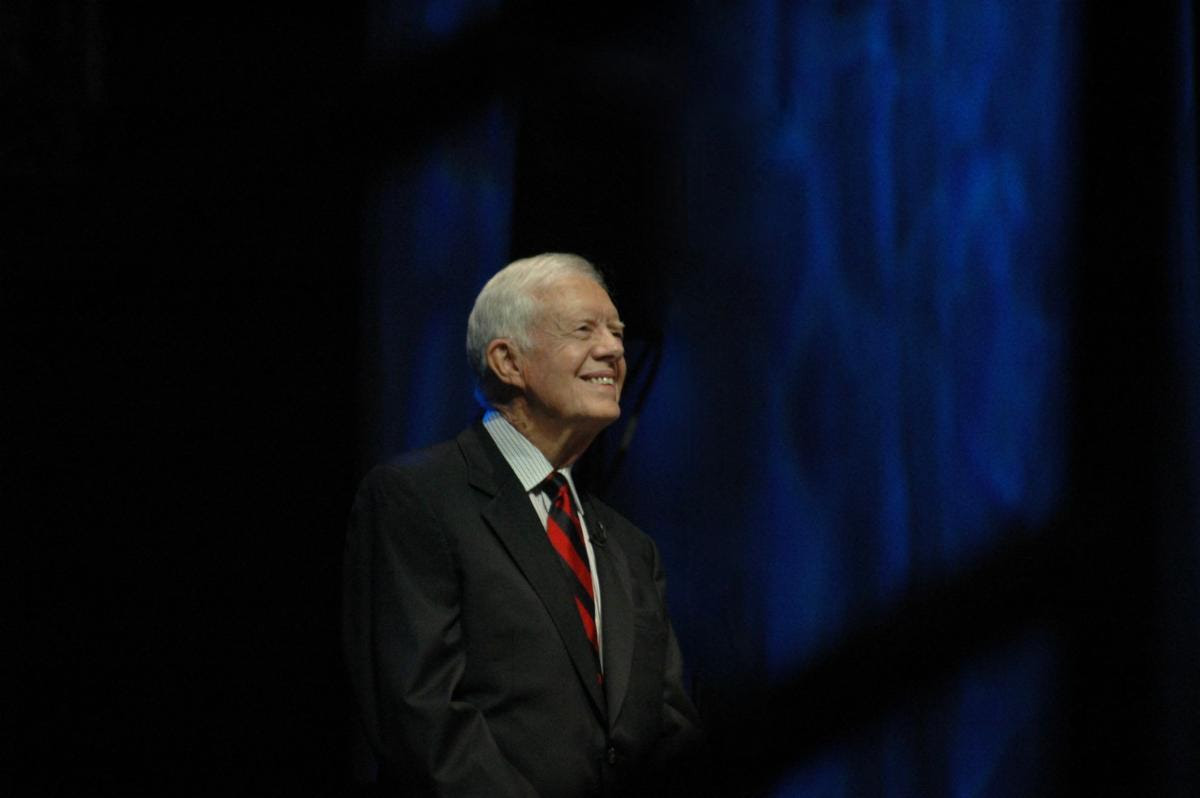
President Jimmy Carter is pictured moments before speaking at the Baptist World Congress in Birmingham, England, in 2005. (BWA Photo)
In a release, the Baptist World Alliance spoke of Carter’s “long history of involvement with the Baptist World Alliance” and “his remarkable work for justice and peace around the world.”
He served as Honorary Chair of the BWA’s Special Commission of Baptists Against Racism in 1992, and he was the recipient of the first BWA Congress Quinquennial Human Rights Award in 1995.
Former BWA General Secretary Denton Lotz presented the award to Carter during the Baptist World Congress in Buenos Aires, Argentina, “in recognition of his outstanding contributions to the cause of human rights around the world and his commitment to Christian peace and justice.”
In his acceptance speech, Carter noted: “I’m proud to be part of the BWA—one hundred million men and women around the world who don’t let political values separate us from one another. We see ourselves as brothers and sisters, regardless of our ethnic or racial differences, our political philosophies. We are joined together in a common faith, and I’m proud to be a part of it.”
“On behalf of the BWA, we give thanks for the life of President Carter and his tireless work for human rights around the globe,” Elijah Brown, BWA General Secretary and CEO, noted in a statement on his passing. “Carter was a living embodiment that politics is not the pinnacle of public service.
“As a believer in the Baptist tradition, his faith was a call to all of us to remain deeply rooted in a local church community while working for peace and serving our neighbors with the good that each one of us can do.”
Brown concluded, “We hold the Carter family in our prayers, and we commit to honor the legacy of our brother in Christ by continuing our work for human rights and religious freedom worldwide.”
With additional reporting by Calli Keener.
Report: Texas use of death penalty low but racial bias high
January 6, 2025
For the 10th consecutive year, death sentences in Texas remained in single digits—a historically low use of capital punishment, a year-end report from the Texas Coalition to Abolish the Death Penalty noted.
“Even as use of the death penalty remains historically low in Texas, it continues to be imposed disproportionately on people of color and dependent largely on geography,” said Kristin Houlé Cuellar, executive director of the coalition that produced the report.
Texas executed five prisoners in 2024: Ivan Abner Cantu on Feb. 28, Ramiro Felix Gonzales on June 26, Arthur Lee Burton on Aug. 7, Travis James Mullis on Sept. 24 and Garcia Glen White on Oct. 1. Two were Black, two were Hispanic, and one was white.
Individuals receiving death sentences in 2024 were Victor Godinez on Jan. 31, Paige Terrell Lawyer on April 24, Jerry Elders on May 2, Gregory Newson on Nov. 13, Christopher Turner on Nov. 20 and Jason Thornburg on Dec. 4. Five of the six who were sentenced to die are people of color.
‘Inequity based on race’
John Litzler
John Litzler, director of public policy for Texas Baptists’ Christian Life Commission, called the information in the report “disheartening but not surprising.”
“The adage ‘justice is blind’ is a common way to refer to a sense of fairness in our judicial system, but since its inception, capital punishment in Texas has been fraught with issues of inequity based on race,” Litzler said.
The disparity is based not only on the race of the perpetrator, but also on the race of the victim, he noted.
“A defendant is four to five times more likely to receive a death sentence when the victim is white than when the victim was Black,” Litzler said.
The report notes of the 591 executions Texas has carried out since 1982, 115 involved Black people convicted of killing white victims. Only six have involved white people convicted of killing Black victims.
“Overall, 411 of the 591 executions in Texas have involved white victims,” Cuellar noted in response to a question from the Baptist Standard.
Litzler commented: “These statistics and those in the report are in direct contrast to the values and beliefs of Texas Baptists who have repeatedly affirmed that alllife is inherently valuable and precious.”
“We should be compelled by both our Christian faith and the American pledge of ‘liberty and justice for all’ to take action,” he said.
“The CLC encourages all Texas Baptists to be knowledgeable and informed about the criminal justice practices in their district, to vote, to participate in jury duty, and to advocate for legislation aimed at removing racial inequality from our system of justice.”
‘Arbitrary nature of the system’
While both the number of death sentences handed down and the number of executions carried out in the state dropped precipitously in recent years, Texas has executed more than any other state since 1982.
Texas was one of nine states that carried out executions in 2024, with Alabama accounting for the most, with six people put to death. Alabama, Texas, Missouri and Oklahoma were responsible for more than three-fourths of the executions. The other states that performed executions were Florida, Georgia, Indiana, South Carolina and Utah.
Texas juries sent six individuals to Death Row in 2024, with three of those sentences handed down by Tarrant County juries. Since 1974, Tarrant County juries have sentenced 76 people to be executed.
Stephen Reeves
One-third of all death sentences in the past five years have come from Tarrant County and Harris County. Juries in only 13 of the state’s 254 counties have imposed new death sentences in the last five years.
“The TCADP annual report for 2024 makes me wonder when the state of Texas will finally decide that maintaining the machinery of death is just not worth it. It is not worth the threat to innocent life, the racially unjust application of the system, and just not worth the cost,” said Stephen Reeves, executive director of Fellowship Southwest.
“While I’m glad there are so few death sentences handed down, and so few executions, it only highlights the arbitrary nature of the system.”
Wrongful convictions
The report also highlights the problem of wrongful convictions.
In death penalty cases involving Melissa Lucio and Kerry Max Cook, courts made determinations of “actual innocence.” Cook was exonerated by the Texas Court of Criminal Appeals nearly 50 years after his conviction. In Lucio’s case, the appeals court is considering whether to accept the trial court’s recommendation to overturn her conviction.
Ivan Abner Cantu was executed in spite of recanted testimony by a key witness and evidence another witness lied at his 2021 trial. Questions about the case prompted the foreman of the jury that convicted him to call for a halt in his execution.
However, the Texas Board of Pardons and Paroles unanimously denied Cantu’s clemency application, and the 5th U.S. Circuit Court of Appeals denied his request for a stay of execution.
James Harris Jr., who was scheduled for execution in March, received a stay of execution from the Texas Court of Criminal Appeals. He and his attorneys asserted the jury selection process was tainted because it dramatically reduced the likelihood of Black potential jurors being called to serve.
Ruben Gutierrez received a last-minute stay of execution from the U.S. Supreme Court in July. Gutierrez and his lawyers assert DNA testing will confirm he did not kill Ecolastica Harrison in Cameron County in 1998.
The most high-profile case involved Robert Roberson, who faced execution in October before receiving a last-minute temporary stay from the Texas Supreme Court. Roberson was convicted of killing his 2-year-old daughter Nikki, based largely on the discredited “shaken baby syndrome” hypothesis.
Roberson’s attorneys point out new medical and scientific evidence indicates the chronically ill child died of serious health issues, including undiagnosed pneumonia, not homicide.
The case drew attention from a bipartisan group of state lawmakers who took the unusual step of issuing a subpoena for Roberson to appear before the Texas House Committee on Criminal Jurisprudence.
“The fact that two former death row inmates were declared actually innocent this year alone ought to be enough to stop the march towards state-sponsored killing,” Reeves said.
“The Roberson case proves that even when laws are written to try and stop executions based on bad science, the system still fails the innocent.
“It is well past time that Texas ends this barbaric and unjust practice.”