Find Black history, family devotions and recipes in one book

NASHVILLE (BP)—When the 18th century church planter, evangelist and foreign missionary George Liele was imprisoned in Jamaica, he spread the gospel in prison, reminiscent of the apostle Paul.

Liele is among historical African American Christians author Trillia Newbell invites families to center dinner table devotions around in her book, Celebrating Around the Table: Learning the Stories of Black Christians Through Readings, Fellowship, Food, and Faith.

“It’s my family tradition in book form,” said Newbell, a former director of community outreach with the Southern Baptist Ethics & Religious Liberty Commission. “Yes, it’s for Black History Month, but you can use it any time.”

She began the tradition perhaps a decade ago with her family, discussing famous and not-so-famous African American trailblazers around the kitchen table with her family over traditional dishes, with prayer and devotions.

“You can use the book anytime,” she said. “We don’t want to just study history in a certain month. We want to study it all the time. And so, any time you can gather around the table and start a discussion, and look at the Bible verses together, and talk about people and learn about what God says in his word, you want to do it.”

Learning Black history

Liele rose from slavery, was granted freedom and began preaching in Georgia during the American Revolutionary War. He borrowed $700 on an indentured servitude agreement to travel to Jamaica, arrived there in 1782, and—after earning his freedom from bondage—planted a house church with three other Americans.

George Liele, a former slave, not only was the first ordained African American Baptist preacher in America, but also was the world’s first Baptist missionary. His ministry in Jamaica predated the missionary work of William Carey in India.

Liele is remembered as the first foreign Baptist missionary. While preaching in Kingston in 1797, he was charged falsely with inciting a rebellion through his sermons and ended up in jail. Acquitted, he still served time in jail for a debt he owed on a church he pastored. He remained in jail until the debt was paid, preaching while imprisoned, Newbell pointed out in her narrative.

Newbell tells Liele’s story alongside 11 trailblazing African American Christians including Frederick Douglass, Betsey Stockton, Charlotte L. Forten Grimké, Lemuel Haynes, Ruby Bridges, Mahalia Jackson and others, offering original Bible-based devotions for each.

“In the book, I feature … godly characteristics that each of them displays,” Newbell said. “The devotionals kind of feature those characteristics. So, whether someone was brave, humble, forgiving, loving, … all sorts of biblical characteristics that I found as I learned about the people, I pulled out. And then, I wrote a devotional based on what I learned about the people.”

Dinner table conversations build family unity

The dinner table is important to Newbell’s family, she said, and she advocates for the dinner table as a prominent place to build unity in all family units.

And while the book is built around family, including photos of cherished moments of Newbell with her husband Thern and their son and daughter, she presents the book as a useful tool for singles and includes “children’s corner” resources for those 6 and older.

She encourages families and individuals to try the practice to learn about a variety of cultures, continuing beyond Black History Month.

Unique to the book are recipes for Southern favorites learned in her mother’s kitchen, family traditions and personal contemporary tweaks.

Cornbread, homemade butter, baked ribs, black-eyed peas, greens, salmon croquettes, shrimp and grits, sweet potato pie, apple pie and banana pudding are among recipes presented as approachable by most cooks in modestly appointed kitchens.

“The recipes are meant to give you a taste of common southern African American cuisine. But remember, I am not a chef,” Newbell writes in the book, “and none of the meals will be gourmet.

“These recipes are for the everyday cook. And although the recipes have modern ingredients, I intentionally didn’t add complicated ingredients or require special equipment. So, you won’t need an air fryer.”

Only, no microwaves, she’s quick to add.

“I said easy, but not that easy!”


BSM and church key to discerning call to ministry

As a child, Ethan Hollis never dreamed of a life in vocational ministry, but Baptist Student Ministry, an internship and a church-based Calling Out the Called program changed that.

Hollis grew up with inconsistent attendance in church and little understanding of the gospel.

However, after a friend invited him to youth group, he became more engaged with both.

Hollis recalled accepting Christ at a youth camp in middle school, but he said, “The things of the world really choked up my faith.”

Halfway through his first semester at Sam Houston State University, Hollis encountered God in his dorm room after he “hit rock bottom” from years of living a worldly lifestyle.

“I remember praying to God, crying and saying, ‘God, I don’t have anywhere else to go. I don’t have any other reason for life. I need help, and I need you,’” Hollis said.

Gradually ‘fell in love with doing ministry’

A few days later, Hollis received an invitation to the Baptist Student Ministry from a family friend and attended a Thursday night worship service there. He was “immediately welcomed” into the BSM by three “godly young men who are still some of my best friends today.”

“I sat with them week after week, ended up getting discipled, and they just taught me what it looks like to follow Jesus and that being a Christian means accepting forgiveness and loving God and pursuing him,” said Hollis. “My life really changed after that.”

Hollis said he was deeply impacted by how the BSM modeled discipleship and Christ-like community.

“I grew up in a church that was mainly older folks. There just weren’t a lot of young people who were genuine Christians. So, it was hard to follow the Lord during my high school years, [because] I just didn’t know what it was like,” Hollis said.

“But being able to see it modeled … it deeply impacted me. With just one semester, I think everything changed because of the intentionality that they had.”

Gradually, during his time at the BSM, Hollis said he “fell in love with doing ministry.”

Church-based programs formative

Hollis transferred to Stephen F. Austin State University in August 2021 for his sophomore year. His friend Jackson VanDover, now youth minister at First Baptist Church in Center, told him First Baptist Church in Nacogdoches was searching for a youth ministry intern.

Hollis felt God had given him a desire to teach the Bible, so he seized the opportunity and served as the youth ministry intern from January 2022 to April 2024.

He now considers his role as youth ministry intern as formative in further discerning the call he felt God had given him to vocational ministry.

After his time as youth ministry intern, Hollis began the Calling Out the Called program at First Baptist in Nacogdoches.

The program allows young adults who feel called to pastoral ministry to attend seminary fully funded, be discipled and trained by the church’s leadership to eventually be sent out to pastor their own congregations.

Hollis said God has used his time being mentored by Pastor Noel Dear and Associate Pastor Mark McLendon to spur on his desire for pastoring.

“I think that God has used great models like them, church leader models, to create in me a deep desire to [preach],” Hollis said.

“It’s just crazy that God can do something like that in a person and just completely change around everything that you want to do. And [preaching] is the only thing I want to do.”

Making contacts with veteran ministers

Last August, Hollis and a couple of his Calling out the Called classmates attended Discipleship Collective in Mount Pleasant, a ministry of Texas Baptists’ Center for Church Health.

 “One of the greatest [takeaways] was I got to hear [about] the importance and effectiveness of the small-groups settings in churches,” Hollis said.

He also was grateful for the connections he made with seasoned pastors at the event.

“I feel that I can reach out to [these pastors] one day when I become a young, inexperienced pastor … [to] get their wisdom on what to do in certain situations,” he said.

Hollis said he would advise other young people discerning a call to vocational ministry to meditate on Scripture “day and night, so that you may be careful to do everything written in it” (Joshua 1:8 NIV). He also encouraged others to take the time to learn how to be faithful to Christ and the church.

“I think [this] especially [applies to] people who are aspiring to be ministers, because … we can’t lead a church in any capacity if we are not soaked and marinated in God’s word,” Hollis said.

“Take your time. Not all of us should be teachers, but we should all be exemplary Christians. I think one way to learn to do that is just be a faithful member of the church, be a faithful Christian. It takes time to grow and [discern] those desires.”

Hollis also said it is essential for aspiring ministers to seek God and pray for the Lord to build them up in the character and integrity of a “biblically qualified” minister.

He expressed gratitude to all who helped shape his faith and help him discern his call to ministry.

“I’m thankful for Texas Baptists and everything that they do. I’m thankful for the BSM and for the way it has changed so many lives on campuses,” he said.


No family in Altadena churches untouched by fire

ALTADENA, Calif. (RNS)—George Van Alstine recalls having to evacuate his Pasadena, Calif., home as flames from the Eaton fire drew closer. He’d been assured Altadena Baptist Church, where he is associate pastor, still was standing.

But by the following morning, his grandson sent him video of the church building engulfed in flames.

The footage was “dramatic and sad,” Van Alstine said. He could hear his grandson crying as he captured flames emerging out of a church window.

“We never expected the fire to sweep across the center of Altadena like that,” said Van Alstine, 88, whose home survived.

On Jan. 24, Van Alstine walked past the rubble and charred debris of the church. He observed the bell tower that remained intact, and approached the gutted Altadena Children’s Center, which served as a day care on the church property for more than 40 years.

He pointed to what used to be his office, where he stored a vast collection of books and where he spent time writing the church newsletter.

The Eaton fire consumed the sanctuary of Altadena Baptist Church, one of at least a dozen houses of worship destroyed in the Eaton and Palisades fires in Los Angeles County.

The fire also destroyed the homes of about 20 church families and forced approximately 20 others to vacate their houses due to ash and smoke exposure.

“The family journeys are going to be hard. We have some older people whose family wealth is tied up in their houses. Rebuilding in Altadena is going to be a lot more expensive. … Property taxes are going to be a lot higher,” Van Alstine said. “Rebuilding is going to be fits and starts.”

‘A test  of faith’

Debra Blake, the deacon chair for Altadena Baptist, lost her home of nearly 30 years to the Eaton fire.

Deacon Chair Debra Blake (left) and Pastor George Van Alstine visit the property of Altadena Baptist Church, Jan. 24, 2025, in Altadena, Calif. (RNS Photo / Alejandra Molina)

“This is life, and for me, I don’t even see it as a step back. It’s actually a test. He tests those he loves. I just have the faith. There’s a purpose for this, and we’re going to grow and move on from this,” Blake said.

Included in the destruction was a vault chronicling the history of Altadena Baptist Church, a merger with a Swedish Baptist church that dates back to 1920. The church is part of an interfaith network that administered a food pantry and did outreach for the unhoused.

“It’s a test of faith, right? We’ve said for years: ‘The church is not the building. It’s the people.’ Now’s our chance to prove it,” Van Alstine said.

In historically diverse Altadena, where more than 9,000 structures were destroyed in the fire, clergy and faith leaders are reeling from the scale of devastation.

Some are mourning the loss of their buildings. Others are trying to reach a dispersed and demoralized congregation. Most have multiple congregants who have lost homes. All are facing tough questions about their future.

First AME Pasadena still stands but the homes of at least 54 of the church’s families burned to the ground. Another 12 families can no longer live in their fire-damaged homes. Church leaders were still trying to locate a number of their seniors who only had landlines, Senior Pastor Larry E. Campbell said.

“Our first service that we had (after the fire), we questioned God. Then we came to the conclusion (that) it was OK to question God and even be mad at God,” Campbell told RNS. “We had to really go through that as a congregation.”

The city’s first African Methodist Episcopal Church, founded in 1887, First AME Pasadena has about 425 members, Campbell said.

Since the Eaton Fire wreaked havoc to the east of the parish, the church has hosted a free legal clinic with representatives from the Federal Emergency Management Agency on hand and has served as a distribution center for those affected by the fires.

A day of service was held outside the church on Saturday, with hygiene kits and grocery bags arranged by a range of organizations such as the South Los Angeles Muslim Council and the Halal Project.

Focus on serving and rebuilding

The Council of Bishops of the African Methodist Episcopal Church held a news conference on Thursday at the Pasadena parish to express its commitment to help rebuild parishioners’ homes.

Bishop Francine Brookins said that while their focus is on the Black community, they are committed to a “redevelopment process that encompasses the entire community.”

Brookins said the council was in Southern California for a previously scheduled meeting and decided to tour Altadena after realizing that many church families were impacted.

“I could see brand-new homes being built. I could see intentional community developments where grocery stores and gardens and intergenerational community partnerships are built, and where Altadena goes back to its dream,” Brookins said.

“Altadena was a dream community … and it was intentional about bringing people of all backgrounds and all faiths together.”

At the news conference, attendees such as Drexell Johnson of the Young Black Contractors Association urged FEMA to be more transparent in how it selects developers and contractors because “it’s almost impossible for Black people and Black contractors to get a fair shake.”

NAACP Pasadena Branch President Brandon Lamar also attended the news conference and stressed that funding should go to Black families.

“These are not just homes. These are generational homes. This is generational wealth, and they are gone.

“We must make sure that we come together as a community and make sure that every house … is rebuilt into the capacity that we will be here for generations to come,” Lamar said.

Lamar said the NAACP Pasadena Branch is advocating locally and nationally “to make sure that everybody understands that we will not accept any vultures in our community.”

Campbell, the pastor of First AME in Pasadena, said he knows “we are going to lose some people.” Campbell noted some seniors likely will go live elsewhere with their children. That’s why, he said, they’re looking for ways to connect their members with senior housing in the community.

“There are some who are not going to be able to rebuild, but we want to keep them in the area,” Campbell said.

Center the needs of community residents

Connie Larson DeVaughn, lead pastor of Altadena Baptist, sees rebuilding efforts as an opportunity for the church to center the needs of Altadena residents.

Decades ago, the church addressed the need for child care with the Altadena Children’s Center.

With rents soaring in Los Angeles, Larson DeVaughn said, church members will discuss a range of possibilities, including providing low-income housing on their property to be proactive.

For now, the church is accepting financial donations to help church members who were displaced and to go toward the rebuilding of their new structure.

In a Sunday worship service, Larson DeVaughn read notes of encouragement from children and announced donations from other churches during the service, held in the bottom floor of nearby Highlands Church in La Crescenta.

Church members grieved as one recalled visiting his childhood homes that were all lost in the fire. They also highlighted good news, with one member sharing she found an apartment after losing her home to the fire.

In tears, Larson DeVaughn delivered a prayer for those whose lives have been disrupted.

“We pray for all the children who are scared and have nightmares from fleeing in the night. We pray for the elders who struggle with changes and for everyone in between,” Larson DeVaughn said.

“We pray for our own Altadena Baptist Church for direction and vision. We pray for the decisions that need to be made and the resources needed.”

Parishioners stood up, raised their arms and recited lyrics of “Jesus, Draw Me Ever Nearer.”

“As I labour through the storm/ You have called me to this passage/ And I’ll follow, though I’m worn,” they sang.


‘God does not show favoritism,’ João Chaves asserts

BROWNWOOD—“God does not show favoritism,” João Chaves, assistant professor of history of religion in the Américas at Baylor University, reminded Howard Payne University students in chapel on Jan. 29.

Taking as his text the story of Peter and Cornelius in Acts 10:34-35, Chaves read: “Then Peter began to speak, “I now realize how true it is that God does not show favoritism, but accepts from every nation, the one who fears him and does what is right.”

In his first presentation on “Faith Crossing Borders: How Immigrant Churches are Shaping the Future of Christianity” for the Currie-Strickland Lectures in Christian Ethics at HPU, Chaves challenged students to consider the interplay of faith and culture.

Attempting to “mix both lecture and sermon” for the chapel crowd, he said, Chaves provided historical, theological and personal background for his discussion before unpacking the text.

One of the more radical elements of Christianity, Chavez noted, is that “Christians are called to live as people on the move, people whose identity is grounded in a reality that transcends our world.

“Christians are challenged to live as strangers on earth, even though they are tempted to live as if they are legacies,” he said.

Philippians 3:20 says “Our citizenship is in heaven,” Chaves emphasized.

Yet the tendency of Christians to see themselves as “legacies” on Earth instead of “strangers” leads to entitlement, contributing to conflict among Christians.

These specific conflicts among Christians—differences or prejudices relating to how they view ethnicity, class, gender or otherwise—aren’t primarily about “who gets into heaven,” but about “how we live our lives together here,” Chaves pointed out.

Major theological conflicts have centered around these issues relating to diverse ways of understanding how to live out Christianity here and now, Chaves continued.

But, “God often surprises God’s followers by welcoming people they could not,” he said.

Diversity of Christianity worldwide

Christianity worldwide is radically diverse, dynamic and growing, he said. Chaves noted the shifting of Christianity’s center from Europe and the United Sates to the Global South in African, Asian and Latin American countries where more than 78 percent of the world’s Christians now reside.

While the United States still maintains the largest number of Christians, that’s partly from the many Christians who have immigrated to the nation and revitalize the faith here, diversifying U.S. Christianity, too, Chaves said.

The diverse groups are informed by ancestral traditions and the exchange of religious ideas among differing Christian traditions and other religions, “opening up spaces for cross-pollination and introducing innovations that shape Christian forms and meaning.”

Despite the explosive growth of Christianity in other areas, some groups of Christians reject other self-described Christians because they practice Christianity in forms that are different from their own.

However, creativity and diversity in Christian belief and practice is not new. In fact, it’s very old, Chaves said.

Multiracial, multinational exchanges between religious imaginations have been part of Christianity’s growth and development since ancient times.

Diversification of Christianity in the United States is fueled by immigrants and informed by believers’ diverse cultural heritages and ancestral traditions, he noted.

And in the first century, the church was comprised of Christians from many ethnicities, races, classes and cultural backgrounds, yet they coexisted in a complex arrangement.

Transnational theologians, including Augustine, the “mestizo son of a Roman father and Berber mother, who was often torn between his Roman and African roots and traditions,” developed theologies Christians look to still today in multicultural environments.

The Christian Diaspora saw the gospel message sometimes disputed, yet it spread in this setting. As Christianity spread and indigenized, many did not recognize God in “the other,” even when they claimed to worship the same God, he said.

“The gospel, nevertheless, grew amid disagreement.”

The indigenizing principle means the gospel should be “at home anywhere”—for the gospel message to grow, it must be adaptable and accessible to local people of any background—yet it “is never really entirely at home. It challenges individuals to look beyond our culture because it points to a kingdom that is not of this world,” Chaves said.

God calls his people to look beyond their own cultures to relate to people of other cultures for the mission of spreading the gospel. Scripture is replete with examples of God’s people “being called to leave their places of comfort in order to fulfill God’s call for their lives.”

In the Old Testament, “stranger” is a common element in several passages Chaves cited: Genesis 12:1 and 39:1-6; Exodus 2:22; and Joshua 6:25.

God’s command to “love the foreigner among you” weren’t just theoretical. It was given after the Hebrew exile in Egypt, pointing God’s people back to the experience of being strangers in exile for 400 years.

Scripture repeatedly indicates “God’s welcome is more extensive and complex than even God’s followers might like,” Chaves said.

He acknowledged as an immigrant to the United States from Brazil, where he grew up in a Baptist church after coming to Christ through the witness of a charismatic street preacher, his reading of the Peter and Cornelius story is not objective.

Being a Baptist in predominantly Roman Catholic Brazil, at that time, was countercultural, he said.

Immigrating to the southern United States to study and teach often has meant continuing to feel like a stranger.

He has seen the phenomena of “strangers like [him]” being either sincerely celebrated or subjected to extreme pressure by the majority culture to adjust to its preferences, so Peter’s interaction with Cornelius is personal for him, Chaves explained.

Seeing God in diversity

In Acts 10, God challenges Peter, telling him: “do not call anything impure that God has made clean.” God proves Peter wrong by compelling him to encounter a person from another culture and see God in him, Chaves said.

Though Peter continued to struggle with this tension at times, he does seem to realize in the key passage what God has been doing all along. “God is much bigger” than Peter’s ethnic or religious identity had allowed, Chaves noted.

“God will not allow Peter to confuse ethnocentricity for divine truth,” he said. “God is a God whose work in nature pours forth diversity, and complexity in unity.”

The mystery of God’s triune nature—three persons in one essence—is itself a challenge for Christians to strive to find unity with other believers in their diverse ways of viewing and being in the world.

Peter’s interaction with Cornelius also points to the danger that even leaders in the Christian community can fail to realize “our cultural expectations of the people whom God should accept can keep us from seeing who God actually is.”

The story of Peter teaches “we have much to learn about God by understanding that relationship with people from other places and cultures.”

Before Peter arrived at the home of Cornelius, “he was completely sure that people like Cornelius—uncircumcised Gentiles—were beyond God’s reach unless they changed into who Peter wanted them to be.”

But Cornelius taught Peter “he had too little a God,” Chaves explained.

He encouraged chapel students to be open to encountering and learning from each other.

“God calls us to be a beautiful celebration of diversity … in the hope that we can endure. It is a strange hope. Praise the Lord. God have mercy. Amen.”


Great Commission Center offers service opportunities

MARSHALL—From ministering to local children with dyslexia to leading sports camps internationally, East Texas Baptist University’s Great Commission Center offers students “on-the-job training” in Christian service.

ETBU students who receive financial aid from the university are required to serve 12 hours per semester with a community partner. The center prepares students for service by offering support, guidance and training in community ministries and cross-cultural missions.

The Great Commission Center coordinates service learning projects, volunteer opportunities and mission experiences. It maintains a list of approved nonprofit organizations, churches, schools and agencies where students can serve.

The center’s core ministries would not be possible without its partnerships, including the Baptist General Convention of Texas and Woman’s Missionary Union of Texas, said Lisa Seeley, director of the Great Commission Center and Global Education.

Last fall, ETBU partnered with Region 7 Education Service Center to host Dyslexia Day in Northeast Texas, an event designed to empower students with dyslexia and their families.

Texas Baptists and WMU of Texas provided funds through the Mary Hill Davis Offering to purchase copies of the Grace Bible for Kids—a special edition of the Christian Standard Bible designed with a distinctive font to enhance readability for children with dyslexia.

At the Dyslexia Day event, ETBU distributed more than 300 copies of the Bible, developed by the B&H Publishing Group of Lifeway Christian Resources, in partnership with 2K/Denmark and Cambridge University.

‘Life-changing’ event for students with dyslexia

During the event, ETBU students with dyslexia talked to younger students, letting them know a university education is possible for individuals with learning disorders.

For some parents and children who attended the event, it became a turning point in their lives, Seeley said.

“It was life-changing. It was amazing,” she said.

She recalled the example of a mother with two children who have dyslexia.

“The older child told her he couldn’t go to college, because there would be no help for him there,” Seeley said. “And then he went to that event, and when he went home, he wanted to start talking about college.”

In addition to local community service, the Great Commission Center also works with Global Study and Serve Trips and with the Tiger Athletic Mission Experience.

“One is more education-heavy. One is more mission-heavy,” she said.

Global Study and Serve trips provide students opportunities for students to participate in international learning experiences led by ETBU faculty. Students not only complete a curriculum in a subject such as history or a foreign language, but also participate in cross-cultural service opportunities.

Spreading the gospel through sports

The East Texas Baptist University hockey team went to Sweden in December, as part of ETBU’s Tiger Athletic Mission Experience.  (ETBU Photo)

The athletics department at ETBU collaborates with the Great Commission Center to offer the Tiger Athletic Mission Experience. This mission trip allows student athletes to spread the gospel through sports.

For instance, the ETBU baseball team has served twice in the Dominican Republic, a country “where baseball is king,” and many children dream of becoming professional baseball players as a way to escape poverty, Seeley said.

The ETBU student athletes led sports camps, using them as opportunities to share the gospel with children and teenagers, she explained.

Recently, the ETBU hockey team traveled to Sweden, where they used pick-up floor hockey games with young people as an avenue to connect with them and share their faith in a largely post-Christian culture, Seeley said.

“They got to sit down afterward, have pizza, and get to know each other,” she explained. And in the process, the ETBU student athletes told them about Jesus.

Faith Pratt, a student at East Texas Baptist University, is serving as an intern with the Baptist Standard this semester.


George Liele: The world’s first Baptist missionary

George Liele, a former slave, not only was the first ordained African American Baptist preacher in America, but also was the world’s first Baptist missionary.

In 1750, shortly after the end of the Great Awakening in America’s British-controlled colonies, Virginia Loyalist Henry Sharp’s slave, Nancy, gave birth to George, a son who took his slave father’s name, Liele.

Baby George became one of Virginia’s 101,000 African slaves, a result of the 1705 Virginia General Assembly Declaration.

Slaves were “real estate” to their Virginia owners, and they suffered a life of cruelty and punishment—whipping, branding, severing ears, maiming and hanging. If a slave’s “correction” caused death, the master was declared “free of all punishment … as if such accident never happened.”

America’s African slave trade proved prosperous during the 1730s and 1740s, a time of spiritual revival encouraged by ministers like Jonathan Edwards, George Whitefield, David Brainard and others.

The religious movement awakened the colonists’ declining lukewarm faith, bringing them face to face with a living, personal Christ and triggering an avalanche of Baptist growth.

Sometime before 1770, Henry Sharp moved George with him to St. George’s Parish (later Burke County) in Georgia. In 1735, the British prohibited black slavery there, but on Jan. 1, 1750, the House of Commons decided to permit slavery.

In fewer than 30 years, Georgia’s slave population grew from 500 slaves to 18,000. The slaves’ hard work made the Lowcountry’s white plantation owners wealthy.

Answered God’s call

In Georgia, Sharp became a deacon in the Buckhead Creek Baptist Church, a white congregation led by Pastor Matthew Moore, who encouraged George to attend worship services.

During one Sunday service in 1773, God touched the 23-year-old’s heart, calling him to a life of love and ministry to the other slaves on Master Sharp’s plantation. George enthusiastically gave his life to Jesus and answered his call to Christ’s ministry.

Moore baptized George, accepting him into the church. Sharp’s plantation became George’s new mission field. He taught the slaves to sing hymns, share the Bible and explain the gospel’s saving message.

Impressed by George’s innate ministry skills, Buckhead Creek Baptist Church licensed him to preach, and Henry Sharp granted him freedom from slavery.

George soon became a minister and preacher to slaves in Silver Bluff, S.C., south of Augusta, Ga., forming a 30-member congregation of new African American believers. In December 1773, Liele organized the First African Baptist Church in Savannah, Ga., the oldest Black church in North America.

Four of his converts—Andrew Bryan, Hannah Bryan, Kate Hogg and Hagar Simpson—formed the church’s early membership. When Liele was ordained, he became the first ordained African American Baptist preacher in America.

A few years earlier, on March 22, 1765, Britain passed the Stamp Act, imposing unfair taxes on angry colonists. When British troops landed in Boston to enforce the act, their actions resulted in the 1770 Boston Massacre, a deadly incident that triggered America’s rebellion against Britain.

Five years later, on April 19, 1775, the first shots of the Revolutionary War were fired at Lexington and Concord in Massachusetts. The British freed tens of thousands of Black slaves who agreed to fight against the colonists.

Journey to Jamaica

George’s former owner, Henry Sharp, fought with the British, dying of battle-sustained injuries in 1783. Fortunately, Sharp had given Liele his manumission papers, documentation that saved Liele from long-term imprisonment when Sharp’s children tried to re-enslave him.

Moses Kirkland, a British colonel, helped him after his release from prison. A grateful Liele repaid Kirkland by working for him as an indentured servant. When Kirkland escaped to Jamaica in 1782-1783, George, his wife Hannah and their four children accompanied him.

Kirkland and the Liele family landed in Kingston, Jamaica, where George discovered a ripe mission field of hundreds of thousands of African slaves working the sugar cane plantations. The slaves suffered with cruel owners, back-breaking work and little food. Thousands were starving to death.

George planted a church, baptizing hundreds of professing converts in a nearby river every three months. He never accepted payment, supporting his family through farming and hauling goods by wagon.

For “preaching sedition” and “agitating the slaves,” George frequently was imprisoned by Jamaican authorities, once for three years.

By the end of his life, George Liele, referred to as “the Negro slavery’s prophet of deliverance,” helped found three Baptist churches: First Bryan Baptist Church and First African Baptist Church in Savannah, Ga., and the first Negro Baptist Church in Jamaica. He also established schools to educate Jamaica’s slaves.

Liele encouraged and taught his new converts to preach the gospel to the world.

Author David Shannon wrote: “The Christianity practiced by Liele was not limited to one nation, colony, or ethnic group, but was a faith found and spread through interaction with colonists and national leaders in the Americas and England.

“In turn, this broad vision of Christianity shaped and spread a variety of Christian experience that became widespread and influential in black, white and integrated congregations in Georgia, South Carolina, Jamaica, Nova Scotia, Sierra Leone and beyond.”

Liele died in 1828 in Kingston, Jamaica, and is buried there in an unmarked grave.

Baptist missionary William Carey often has been called “the father of the modern missionary movement.”

But George Liele left America to preach Christ in Jamaica a decade before Carey departed from England to preach in India, earning the title of “the world’s first Baptist missionary.”


Nickelball provides evangelism opportunities for seniors

AUSTIN—As a senior adult in his late 70s, Bear Banks liked the overall concept of the game of pickleball, but he recognized that he needed a less strenuous version to prevent injuries. In his quest to alter the game a bit, he ended up creating a variation that he refers to as “nickelball.”

In addition to being a fun pastime and offering a way to stay fit, Banks also realized the tremendous opportunity for evangelism. He and his wife Diana have been able to develop relationships with people on a weekly basis and share the gospel at the Northwest Family YMCA in Austin.

“Nickelball is played with the same basic rules and equipment as pickleball, with the exception that we use special soft foam balls called miracle balls,” Bear Banks explained.

“It is cooperative rather than competitive play, a friendly game of all ages and a godly way to ‘nickel and dime’ to total fitness. The balls are exactly the same as regulation pickleballs, but they are 50 percent quieter and do not hurt if you get hit by them. They also play just as well with cheap paddles.”

Banks believes the game offers participants a way to develop better reflexes, enjoy aerobic exercise and make new friends.

“The main benefit is having many opportunities of sharing my testimony of how God has been working in my life, but most of all, having more opportunities to share the gospel with all who show an interest in hearing it,” he said.

Diana Banks agreed, saying: “Playing nickelball has enabled me to become more physically fit and having fun doing it. Playing a less aggressive style of pickleball has prevented me from falling while playing, which is paramount at my age.”

Bear Banks noted nickelball is designed for all ages, from 9 to 99.

“So far, we are appealing to mostly seniors who have played tennis and racquetball in their youth and want to get back to regular play of a less strenuous game,” he said. “Many have tennis elbow or knee problems from playing too hard and too long. Our gentle version fits in well.”

The Banks had no previous history of participating in sports, but they joined the YMCA to improve their health and fitness, and they learned to play pickleball there.

“As more and more Y members came back from COVID and pickleball began its rise in popularity, we noticed a significant increase in injuries. Some, like broken bones from falls, were serious. Back in January of 2022, we started experimenting with a much safer variation,” Bear Banks said.

“We worked out most of the bugs and made it as fun as possible. By January 2023, we felt confident that our variant was ready to introduce at our YMCA. So, we began promoting and signing up members who were interested in playing a more recreational, safer and friendly game. At the YMCA, we play Monday, Wednesday and Friday for two hours each day on one to two courts.”

Hillcrest Baptist in Austin shares facilities

In addition to playing several hours each week at the YMCA, Banks and his wife also use the gym at Hillcrest Baptist Church in Austin.

“I was pleasantly surprised to find Hillcrest Church had pickleball and many welcoming members,” he said. “We have recently been given permission to add our nickelball and train others how to play on Saturday afternoons. Hillcrest is the first of hopefully many churches to take an interest in sharing their facilities for this outreach.

“We have plans to recruit more trainers in both nickelball and share the gospel at the same time. We viewed the YMCA as a ‘pool’ to ‘fish’ in and to make disciples from the get-go.”

People are hearing about the game and being connected through personal invitations within their local community.

“We invite folks to try out our version, give out the rules and demonstrate how it is played,” Bear Banks said. “Growth is only coming through word of mouth, so far. We have yet to be led to print a guidebook or promote more aggressively, but it seems to be on the horizon.

“We are regularly sent neighbors, family members and friends of the pickleball players and of our team members. People who want to learn both versions of pickleball and have heard good things about how we train.”

The Banks accept no compensation for training people.

“As more and more folks give our game a try, we have faith that God will bless this game and lives will be changed,” Bear Banks said. “My wife and I are both retired and have been followers of Jesus for over 40 years. You could say that we are local missionaries reaching out to family, friends and neighbors. Our passion is to make disciples as our Lord leads.”

By combining fitness, friendship and faith, the couple sees the Lord moving in powerful ways.

“We have been playing nickelball for a little over one year,” Diana Banks said. “It has been a great time of getting to know those who play with us on a deeper level.

“I’ve been able to speak more on spiritual matters with those who are Christians and to those who have indicated atheism and also to those who have been churchgoers in the past, but do not show outwardly a changed heart. It is the best way I know to be involved with non-Christians in order to share the gospel as led by the Holy Spirit.

“We have a woman in the group who became a widow a short time ago and was having a hard time adjusting. When her friends heard about nickelball at the YMCA, they encouraged her to get out of her gloom and check us out. This is a great testimony of God’s agape love, ministry and healing power.”


Trump directives on education draw strong reaction

President Donald Trump’s executive orders directing public funds to support “educational choice” and ending funding for curriculum perceived to promote “anti-American ideologies” drew swift and strongly worded responses.

“It is the policy of my Administration to support parents in choosing and directing the upbringing and education of their children,” Trump stated in his executive order, “Expanding Educational Freedom and Opportunity for Families,” issued Jan. 29.

The order—issued during “School Choice Week”—directs the Secretary of Education within 60 days to issue guidance about how states can use federal funds to “support K-12 educational choice initiatives.” It also instructs him to prioritize “education freedom” in discretionary grant programs.

The directive also includes orders to the secretaries of Health and Human Services, Defense and the Interior related to “education choice.”

The order to the Secretary of State specifically instructs him to review ways military-connected families can use Department of Defense funds “to attend the schools of their choice, including private, faith-based, or public charter schools.”

Trump’s executive order praises states that have “enacted universal K-12 scholarship programs, allowing families—rather than the government—to choose the best educational setting for their children.”

He issued the order one day after the Texas Senate Committee on Education K-16 heard testimony on—and endorsed—a bill that would create an educational savings account program designed to help parents pay for their children’s private-school education with public funds.

‘Public funds … for public uses’

Amanda Tyler

Amanda Tyler, executive director of the Baptist Joint Committee for Religious Liberty, said her agency “adamantly opposes” the Trump executive order, “which purports to divert taxpayer funds away from public schools and other federally funded programs to private schools, including to private religious schools.”

“Students across the country rely on public schools as the only education system where their freedom of religion and other civil rights are guaranteed,” Tyler said.

“Public funds should be for public uses. The government should not compel taxpayers to furnish funds in support of religion, regardless of whether they adhere to that religion or not.”

Rather than meeting the nation’s educational needs, she characterized the executive order as “another example of the Trump administration making a grab for power that puts specific private interests over public interest and violates our constitutional order.”

“As people of faith, we celebrate our country’s freedom of religion and oppose attempts to entangle government in religious matters in this way,” Tyler said.

“Religious education is best left to houses of worship and other religious institutions that are funded with the voluntary contributions of adherents of those faiths, free from federal funding and the accompanying strings.”

‘Part of the Project 2025 playbook’

Similarly, Rachel Laser, president and CEO of Americans United for Separation of Church and State, emphasized the need to direct public funds to public schools, not private religious schools.

“Rather than funding private religious schools that can discriminate and indoctrinate, Trump should focus on providing adequate resources to our country’s public schools that are open to all students and serve 90 percent of America’s children,” Laser said.

School voucher programs “only provide ‘school choice’ for a select few, primarily wealthy families whose children never attended public schools in the first place, and for the private, predominantly religious, schools that can pick and choose which students to accept,” she said.

Expanding private school voucher programs is “part of the Project 2025 playbook for undermining our public education system and our democracy,” she asserted.

“Christian nationalists want to divert public money to private religious schools, even as they continue to strive to impose their narrow religious beliefs on public schoolchildren,” Laser said.

“Parents who care about their children’s education and taxpayers who care about quality public schools that are the building blocks of our communities should vehemently oppose this scheme.”

‘White Christian nationalist disinformation’

Laser also strongly criticized another Trump executive order, “Ending Radical Indoctrination in K-12 Schools.” The order asserts “parents have witnessed schools indoctrinate their children in radical, anti-American ideologies while deliberately blocking parental oversight.”

Laser called the executive order “an attack on our public schools” that “seeks to turn them into re-education camps for white Christian nationalist disinformation.”

The executive order calls for the creation of a strategy for eliminating federal funds “for illegal and discriminatory treatment and indoctrination in K-12 schools, including based on gender ideology and discriminatory equity ideology.”

It also calls for reestablishing the President’s Advisory 1776 Commission to promote “patriotic education.” The commission was created during the first Trump administration and terminated by President Joe Biden.

Laser asserted the order would “advance narrow Christian nationalist beliefs about gender and a white-washed American history.”

“We know from last time that this commission is bent on tearing down the separation of church and state instead of lifting it up as an American original, a founding principle of this nation,” she said.

In contrast, Terry Schilling, president of the American Principles Project, insisted “America’s public education system is a disaster,” and Trump’s order helps to “bring sanity back to America’s schools.”

“What has happened in American education is a travesty that calls for a powerful and decisive response. Fortunately, President Trump has shown he is up to the challenge,” Schilling said.

“Our tax dollars should only go towards providing kids with a real education, not teaching them to discriminate based on race or confusing them about basic biology.”


Hispanic Baptists: ‘Sensitive locations’ rule change hurts

FORT WORTH (BP)—The loss of a rule that prevented officials from entering churches to arrest immigrants accused of being in the United States illegally has hurt the church’s witness, the National Hispanic Baptist Network said Jan. 29 in calling for the rule’s reinstatement.

The network, a group representing more than 3,300 Southern Baptist churches, released its statement in Spanish and English nine days after the Department of Homeland Security overturned a 14-year-old rule that had prevented such arrests at and near sensitive locations including churches and schools.

Attendance at Hispanic congregations already has declined since Homeland Security revoked the protections Jan. 20, National Hispanic Baptist Network Executive Director Bruno Molina said.

“People are rightly concerned. They think they’re going to get arrested at church,” Molina told Baptist Press. “That’s why we’re asking DHS to revoke the revocation, as it were, because people should be allowed—even if they are considered criminals—to seek spiritual guidance.

“And there’s no reason why, if they are looking to arrest somebody, they can’t wait until they exit the Bible study or church service and arrest them at least a block from the church location.”

Allow churches to fulfill ‘God-given mission’

A statement posted on the network’s website says the National Hispanic Baptist Network recognizes a need for community safety, proclaims a biblical authority of law enforcement and concurrently embraces the religious liberty Southern Baptists also extol.

“We recognize that, on the one hand, government ‘does not bear the sword for nothing; for it is a minister of God, an avenger who brings wrath on the one who practices evil (Romans 13:4).’ On the other hand, we also recognize that God is ‘not wishing for any to perish but for all to come to repentance (2 Peter 3:9),’” the statement reads.

“Consequently, it grieves us deeply that our churches are no longer protected and that anyone would be denied their opportunity to receive spiritual guidance in our churches for fear of being arrested. We respectfully and strongly exhort DHS to reinstate the ‘Sensitive Locations Protections’ for churches so that we can fulfill our God-given mission to minister to the least of these and the stranger among us.”

‘Fix the system’ without hindering the gospel

Brent Leatherwood, president of the Southern Baptist Ethics & Religious Liberty Commission, has said that while the immigration system needs revisions, the revocation of the sensitive locations protections causes problems that are best avoided.

“No church that I’m aware of harbors criminal actors, whether they’re here legally or illegally, and no church leader wants that,” Leatherwood told Baptist Press shortly after DHS revoked the protections.

“President Trump is right to fix our broken immigration system—something we’ve long called for—but it must be done so without turning churches into wards of the state or expecting pastors to ask for papers of people coming through their doors.

“The unintended impact of this change will be that many law-abiding immigrants will be fearful to attend our churches, and our central mission of gospel proclamation and biblical formation will be inhibited.”

Leatherwood also offered general remarks on a better way to achieve intended goals.

“The best way to go about this is a comprehensive approach that rids our country of dangerous illegal criminals, sets up strong protections at our borders and welcomes those who are fleeing persecution,” Leatherwood said.

“Not only can this be done in a way that respects religious liberty, it is something that would be strongly supported by our churches.”

Leatherwood described the revocation of sensitive locations protections as “the type of move that leads to more questions and confusion than anything.”

‘It’s a kingdom issue’

Molina appreciates Southern Baptists are hearing the concerns that more adversely impact Hispanic churches.

“We’re all Southern Baptists,” he said. “I think this is something that needs to be brought to the forefront so that, first of all, it’s addressed because it’s a kingdom issue—our ability to get the gospel out—and also so that Hispanic Southern Baptists particularly who are disproportionately impacted by this know that the denomination does have their back.”

Molina described the Homeland Security revocation and the applicable protocol as very fluid, with some national news reports indicating law enforcement officers are looking only for individuals with outstanding warrants for criminal charges, and others indicating they simply are looking for those suspected of being in the country illegally.

Documented immigrants “are also anxious,” Molina said, “because you see the reports on TV, on both English and Spanish networks, where the people who are detained are sometimes even citizens or have legal status, but they get kind of caught up in the dragnet—they ask for their papers and things of this nature—and intimidated, and then they’re let go.

“But it has also raised the level of anxiety among legal immigrants.”

Southern Baptist messengers to at least six annual meetings have adopted resolutions on immigration, most recently the 2023 resolution “On Wisely Engaging Immigration.”

While no resolution has necessarily broached the subject of arrests during worship, a clause in the latest resolution states that messengers “commend the good work of Southern Baptists among immigrants and refugees and encourage pastors and their congregations to continue sharing the gospel and providing Christlike care for the countless men, women, and children in harm’s way.”


Poiema Foundation continues anti-trafficking fight

Poiema Foundation, a Dallas-area organization focused on human trafficking prevention and survivor care, has been working to educate the public on human trafficking, engage communities and empower survivors through the work of their safe house since 2012.

Natalie Alonzo, education and outreach director at Poiema Foundation, said she first got to know the organization when she volunteered with its community outreach in high school.

She volunteered through her church, LakePointe Church in Rockwall, which is where Poiema began in 2012. Alonzo said before she volunteered, she didn’t really know much about human trafficking.

But participating in outreach allowed her to see “right in [her] own community” what human trafficking looks like, even at hotels she drove past every day. The knowledge she gained grew into a passion.

After college, Alonzo worked directly with child victims of sex trafficking, until things came full circle, and she got the opportunity to join the staff of the Poiema Foundation.

Work with 4theOne

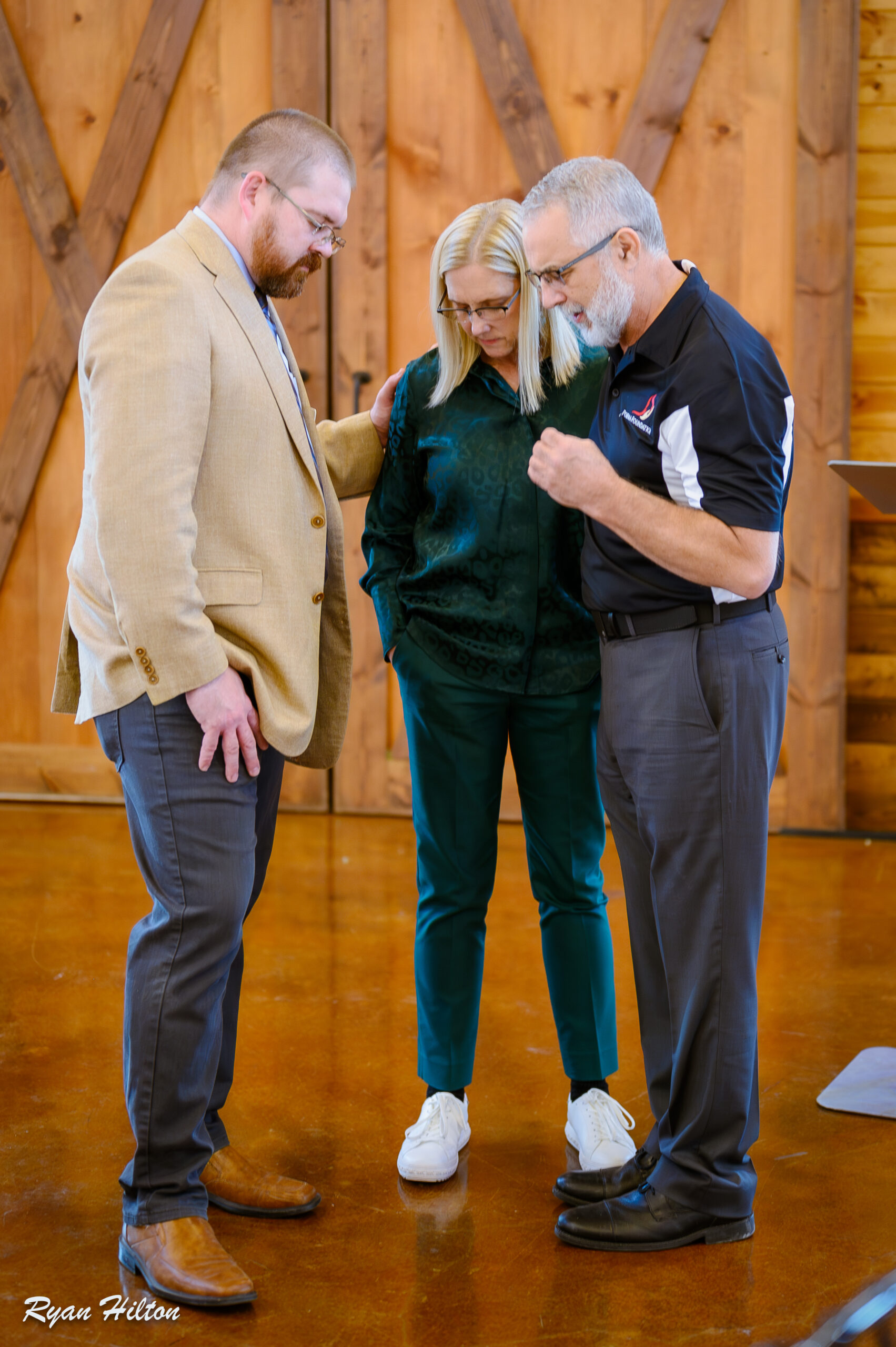
A group gathers to prayer at last year’s Trauma to Triumph gala for Poiema Foundation. (Photo / Ryan Hilton)

The foundation partners with 4theOne, a nonprofit organization dedicated to the location and recovery of missing and exploited teens. Volunteers from about 20 church campuses throughout the Dallas-Fort Worth area and one in South Carolina, go out on Saturdays to hand out missing persons posters, hoping to find teens before traffickers do.

The volunteers make note of suspicious people and report any other concerns they observe to private investigators who volunteer with 4theOne, when they canvas an area, Alonzo explained. Statistics show the risk of missing teens being trafficked is high, she said, with most likely to be approached by a trafficker within 72 hours of hitting the streets.

Tipline calls from the flyers go directly to private investigators, so Poiema has no way of knowing for sure if a poster they handed out directly leads to a recovery, she said. But they do know the recovery rate from this partnership is high—492 minors have been recovered by 4theOne since the partnership began.

More than half of the recovered teens, 272 of them, were identified as having been victims of sex trafficking or some sort of sexual exploitation. Alonzo noted those numbers prove the statistics that missing and runaway kids are at risk from sexual predators.

Alonzo recalled one volunteer experience in which a young girl featured on the poster had been a frequent missing person due to her difficult homelife.

The lead private investigator on her case thought they should take a day and “scour the community” for this young girl.

So, he gathered up a troop of volunteers to flood the area and try to find her after praying.

“Prayer is very important to us,” Alonzo noted.

Within 10 minutes of beginning the search, a volunteer spotted the missing girl.

“They were able to get her. And the private investigator knew her from working her case,” so she was compliant with being recovered.

“It’s amazing to see the power of the Lord,” in the work that they do, Alonzo said.

The staff gently and lovingly speak about faith and invite survivors to know the Lord, Alonzo explained. “And it’s been amazing to see. A lot of the [safe house] residents have come to faith in Jesus because of that, … and it’s just beautiful.”

Community trainings

National Human Trafficking Prevention Month has been observed every January since 2010, when President Obama first established the emphasis by presidential proclamation.

While estimates on the number of people globally impacted by human trafficking vary, U.S. Customs and Border Protection reports “an estimated 40.3 million people are in modern slavery, including 24.9 million in forced labor and 15.4 million in forced marriage.”

Those numbers break down to 5.4 victims of modern slavery for every 1,000 people in the world, with 1 in 4 victims of modern slavery under the age of 18, the U.S. Customs and Border Protection website states.

Poiema frequently offers human trafficking awareness training by Zoom. These trainings for the general public are free of charge but require registration.

A few years ago, Alonzo explained, the State of Texas began requiring all healthcare providers to be trained in human trafficking awareness, because there is a high likelihood of victims seeing a healthcare provider during the time they are being trafficked.

So, the organization began to offer a specialized training for health care professionals. These classes, which comply with state stipulations, have a small fee.

Alonzo noted Poiema is passionate about providing medical professionals with human trafficking awareness training. By the end of 2024, the foundation had provided training to more than 4,550 healthcare professionals.

Aftercare for survivors

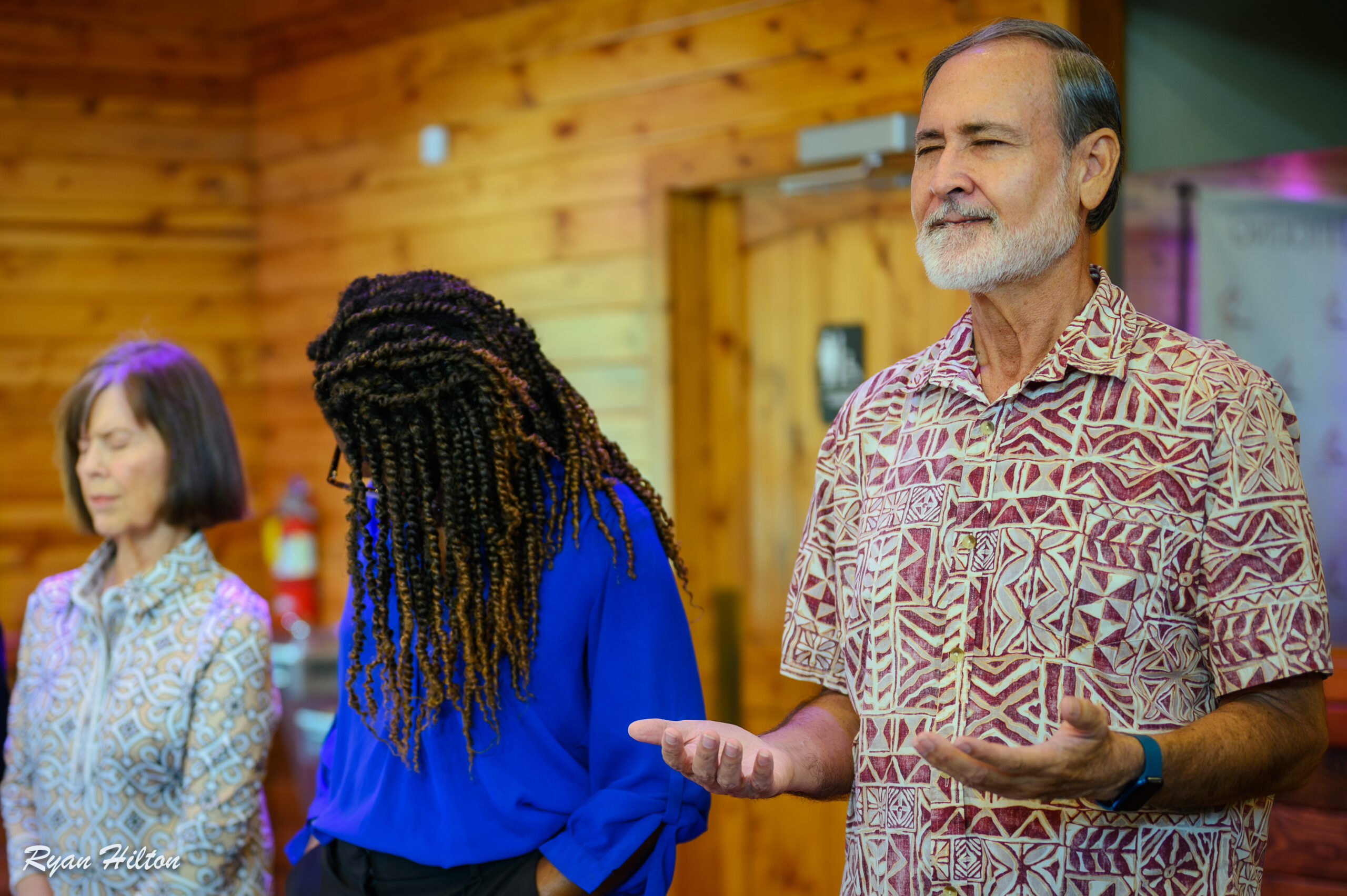
Volunteers and staff pray at the 2024 Trauma to Triumph gala for the Poiema Foundation. (Photo / Ryan Hilton)

In addition to its community-focused initiatives, the foundation maintains a safe house where women who have escaped human trafficking can receive the care they need to reclaim agency over their lives and heal.

The length of time each woman resides at the house depends on her individual needs and can last from a few months to a few years. Since the safe house opened, it has provided 33 women who have escaped human trafficking with residential support.

Volunteers who support the work of the safe house are extensively trained, including in the realities of aftercare for survivors of human trafficking.

The overview of that training, Alonzo noted, is, “the realities of the aftercare of a survivor are much more complex and strenuous than most people realize.”

Alonzo said she highlights in her trainings that movies and media often portray the healing of an individual who has been trafficked as: “‘Hey, I’m going to come in. I’m going to rescue you. I’m going to take you back home and kind of wipe my hands of it.

“[Because] Great! You’re safe. You’re stable. You’re back home. You can start over.”

Sadly, however, that is “not at all what the healing journey looks like, because of all the trauma that the men, women and children have accrued during the time that they’re being sold,” Alonzo explained.

She said the terrible abuses against these individuals require extensive counseling, and impacted individuals need help “in learning how to rewire their brain.”

Being home is not the conclusion of the injustices of their exploitation, instead “it’s just the beginning of healing,” Alonzo explained.

At the safe house, the foundation helps survivors learn how to live on their own again. They help with things like goal setting, which might seem easy, she confessed.

“But it’s something where—they haven’t had a voice in their own life. Their pimp has taken control of everything.”

So, goal setting helps survivors remember they have the decision, that “this is your life. What do you want it to look like?”

Counseling is essential, but there are many types of therapy, Alonzo noted. In addition to talk therapy, women at the safe house may utilize art therapy or equine therapy, which has been proven to be very beneficial to trauma victims.

Not every story is a happy story. Survivors often are pulled back into trafficking, when they leave a care setting, but Poiema Foundation is careful to make sure the women they serve know support for them always is available.

Additionally, several women who have come out of Poiema’s safe house have gone on to start their own anti-human trafficking organizations or have moved into advocacy roles through speaking publicly about their experience in human trafficking.


Ukraine Army chaplain offers frontline insights

The war in Ukraine has changed the lives of many people significantly.

Before the full-scale war began in 2022, Dmytro Semko taught Greek and New Testament at Odesa Theological Seminary and was in charge of the seminary library. Now, he serves in the Ukrainian army as a brigade chaplain.

The following interview has been edited for length.

What prompted you to become a chaplain?

Chaplaincy is the natural outcome of all my previous life experience. I served in the army, received higher secular education and graduated from the seminary.

When the war broke out in 2022, I was still working at the seminary, but I was almost certain sooner or later I would serve in the army. Several times, I had the opportunity to communicate with active volunteer chaplains and sometimes thought about becoming a chaplain myself.

When I was drafted into the army, I was an ordinary soldier at first, but later the commanders found out I had technical education and the necessary military training and offered me an officer position.

I said chaplaincy service was closer to my heart, because that’s what I had studied for and what I would like to do in life. They agreed, and the church gave its blessing to this ministry.

I really like my job. I serve God, and at the same time, this is exactly what the state and my military unit expect from me.

Please tell us more about your work, its challenges, joys and sorrows.

As for my duties, the state expects four things from me:

  1. Meeting the spiritual and religious needs of military personnel. This may include either conducting or organizing religious events that would meet the different needs of soldiers who worship God regardless of tradition or perhaps even religion.
  2. Religious educational activities, which means, from time to time, I have to conduct seminars or discussions on various topics.
  3. Advising our command on certain issues—for example, how various religious factors can affect our combat operations.
  4. And lastly, social activities.

Sometimes our churches or church associations help military units. For example, last year, a church from the Odesa Baptist Association sent small New Year’s gifts to the military. One of the soldiers still tells me about a flashlight given to him last year he still uses. These are small things, but for some people, such help communicates love and that others are thinking of them.

I really love helping people, cheering them up and inspiring them. I want people to know their chaplain is a smiling guy. When I come to my people with a smile, they start to smile themselves, and as they say, a small ray of light penetrates their everyday life.

Sometimes, people come and tell me about their difficult personal situations. Sometimes, they ask me to talk to their buddies, who later make confessions to God. Sometimes, soldiers seek family counseling.

There have been cases when I blessed new couples, and there have been times when soldiers have invited me to celebrate the Lord’s Supper.

As for regrets, there is the realization you are changing and becoming more reserved. Because the longer this war goes on, the more losses, deaths and injuries become commonplace, and you start reacting to them differently than you did at the beginning of the war. Unfortunately, this becomes a norm of life for you. It’s not that you stop being hurt, but you already perceive this reality as an ordinary thing.

Your attitude and perception of life changes. Before the war, when you faced death, it was usually because a person’s life was naturally coming to an end due to age or illness. But when a young man dies of wounds in the war in front of your eyes, you realize he has a family, a wife and children who must now live without him.

An hour ago, there was a person, and now he is gone. You begin to realize the life you imagine may be much shorter than you think. And this changes your view of life and your relationship with God.

How do soldiers at war discover God? How is their faith formed?

The guys say when they sit in the trenches, they pray in a way none of them has ever prayed before.

And then I ask them, “Why do you have such great faith in the trenches, but when you come back, you leave this faith behind?”

The war does not differ from the classic stress in a person’s life, but unfortunately, it lasts longer and affects a much larger number of people. Whenever there is anxiety, they turn to God. As the anxiety goes away, so does faith.

However, there are those who start to think and ask questions. Then, they turn to me and try to find out some things for themselves. My task is to guide them to God, to tell them about him and introduce God to them.

Faith is formed in soldiers as it is in all people. It’s just that war is a stressful factor that can accelerate the process of a person’s conversion to God or not affect this process at all.

How has your seminary education helped you in your work and ministry? What has been most helpful or meaningful to you?

First of all, thanks to my seminary education, I can officially serve as a chaplain, because my diploma was officially recognized by the state.

As for what has been most useful, I have to say I perceive education as a whole package. It’s like a military first aid kit. It contains many different items, but they all may be needed at one time or another. The same is true for education.

What would you like people to pray for you?

When Charles Spurgeon was teaching students, he preached two sermons. One was extraordinary, almost exquisite. But it had no effect on people. The other sermon was very ordinary. But many people repented.

Then Spurgeon took the students into the basement and showed them a group of people who were simply standing and praying for him.

Perhaps this is what I would ask those who would like to pray for me to do: Keep me in your prayers as I am fulfilling my duties, so the Lord would work through me by the Holy Spirit and use me as he wishes with maximum benefit for his kingdom.


Hawaii trip a dream come true for STCH Ministries student

When Chris, a student at South Texas Children’s Home Ministries’ Boothe Campus, traveled to Hawaii in December, it marked the culmination of months of preparation, fundraising and anticipation.

Chris, an All-American cheerleader, was invited to perform in the Pearl Harbor Memorial Parade in Waikiki.

He considered the trip a remarkable opportunity to honor history, experience a new culture and witness God’s handiwork in his life.

His journey to Hawaii began with a dream and an unrelenting determination to make it happen.

“As soon as I decided to make this trip a reality, I started searching for fundraising ideas everywhere,” he said.

With the support of STCH Ministries, his community, teachers, house parents and even his boss, Chris launched multiple fundraisers—selling kolaches, creating a unique Tic-Tac-Toe donation board on social media and other fun ideas.

‘Showed relentless drive’

His efforts were so successful, he even helped cover a portion of the expenses for his chaperone on the trip, Benjamin Brewer, student ministries coordinator at STCH Ministries.

“Watching Chris’s hard work come to life was inspiring,” Brewer said. “Many kids start with enthusiasm but lose momentum. Not Chris.

“He showed relentless drive, organizing fundraiser after fundraiser for months without giving up. It was amazing to witness his dedication and determination.”

The trip itself was filled with moments of awe and gratitude. As Chris stepped onto the island, he was struck by the natural beauty that surrounded him and God’s goodness in bringing him there.

“The landscapes, the water and the sky—it all felt like a reflection of God’s incredible creation,” he said. “It hit me that this entire experience was possible because he wanted me to be here.”

The highlight of the trip was the Pearl Harbor Memorial Parade on Dec. 7, held in honor of the veterans and in remembrance of the Pearl Harbor attack.

Chris joined cheerleaders from across the country, many of whom he had befriended online, in a unique performance that brought the community together.

“When the music started, and I lined up for the parade, it finally sank in. I was about to cheer in front of everyone,” Chris recalled. “It was an unforgettable mix of excitement and pride.”

For Brewer, the parade was equally powerful.

“Seeing the crowd’s reaction, especially to the military members, was incredible. One of the last Pearl Harbor survivors, over 100 years old, was in the parade,” he said. “It reminded us of the significance of this event and the lives it represents.”

Beyond the parade, Chris and Brewer immersed themselves in the Hawaiian experience. They visited the USS Missouri, toured the Pearl Harbor memorial, attended a traditional luau and hiked two miles up a mountain to enjoy breathtaking views.

Growth and resilience

Throughout the trip, they observed, God’s faithfulness and provision shined through every moment.

Brewer, who has known Chris since he was 4 years old, reflected on his growth and resilience.

“Chris has faced so much in his life—losing his mom at a young age, his dad’s absence and the challenges of growing up on the Boothe Campus,” he said.

“Yet, he hasn’t let those hardships define him. He has grown into a young man with a deep faith and incredible determination. It’s a testament to how God has worked in his life through the love and care of our ministry.”

Chris shared his gratitude for the role STCH Ministries and the larger community played in making this trip possible.

“There are so many people I want to thank for making this opportunity possible. Knowing I had so many people supporting me every step of the way meant the world to me,” he said. “Words can’t fully express how grateful I am for their encouragement and belief in me.”

Reflecting on his time at STCH Ministries, Chris added: “They’ve helped shape me into a more effective leader, someone who values responsibility, kindness and thoughtfulness. I’ve also learned to be genuinely grateful for everything I have.”

Brewer also reflected on the meaningful experience.

“We preach normalcy all the time in our office. We want our kids to feel normal—not to be treated abnormally,” he said. “Trips like this help reinforce that idea—showing them they can have experiences just like anyone else, that they are loved and cared for, and that they are part of something bigger.”

Chris described the trip as life-changing.

“I had such a great time and made so many new friends. Cheering in that parade was such a unique and unforgettable experience,” he said. “It’s a feeling I’ll carry with me forever.”