On The Move: Sharp
Joshua Sharp to First Baptist Church in Chappell Hill as senior pastor, from Trinity Baptist Church in Orange, where he was senior pastor.
Joshua Sharp to First Baptist Church in Chappell Hill as senior pastor, from Trinity Baptist Church in Orange, where he was senior pastor.
BRENTWOOD, Tenn.—Evangelicals in the United States want both secure borders and laws that provide avenues for certain illegal immigrants to obtain legal status, according to a recent Lifeway Research study.
They want to deport dangerous illegal immigrants but aren’t as concerned about those who arrived as children and have lived peacefully in the United States.
Additionally, evangelicals overwhelmingly recognize personal and national responsibilities to care for refugees and others fleeing their nation of origin.
The Lifeway Research study finds evangelical voters are predominantly Trump voters and politically conservative. They also see their faith as a primary influence on their views of immigration and related political issues.
Studies over the past four years show stability among the perspectives and priorities of evangelicals concerning immigration. The 2025 study was sponsored by the Evangelical Immigration Table, World Relief, the National Latino Evangelical Coalition and the National Association of Evangelicals and was conducted by Lifeway Research.
“Over the past several years, through all the rhetoric of a tumultuous political season, evangelicals’ views on immigration issues have actually been remarkably stable,” said Matthew Soerens, vice president of advocacy and policy for World Relief.
“The big news here is how little has changed despite the prominence of immigration-related rhetoric in the presidential campaign. Most evangelicals—whether the majority who voted for President Trump or the minority who voted for Vice President Harris— still want the same common-sense things from immigration policy they wanted in past surveys.”
Soon after taking office, Trump indefinitely suspended the U.S. Refugee Admissions Program saying the nation “lacks the ability to absorb large numbers of migrants, and in particular, refugees, into its communities in a manner that does not compromise the availability of resources for Americans, that protects their safety and security, and that ensures the appropriate assimilation of refugees.”
Additionally, the U.S. State Department suspended funding to groups that assist refugees.
Evangelicals have been a consistent voting bloc supporting Trump during his three presidential campaigns.
Most evangelicals voice support for refugees. Seven in 10 (70 percent) say the United States has a moral responsibility to accept refugees, including 34 percent who strongly agree. Around a quarter (23 percent) disagree. That number is statistically unchanged from a January 2024 Lifeway Research study.
Around 3 in 4 evangelicals (74 percent) say they would support a bipartisan Senate bill that would allow Afghan allies evacuated by the U.S. military to apply for permanent legal status after undergoing additional vetting.
“Evangelicals’ care for refugees and immigrants is as steady as their political preference, but some leaders may not be listening,” said Scott McConnell, executive director of Lifeway Research.
Evangelicals are more split over reintroducing a “zero tolerance” policy along the U.S.-Mexico border that led to the separation of children from parents. The policy was terminated by the first Trump administration in June 2018. Currently, 45 percent of evangelicals would support reintroducing the policy, while 43 percent oppose such a move and 12 percent are not sure.
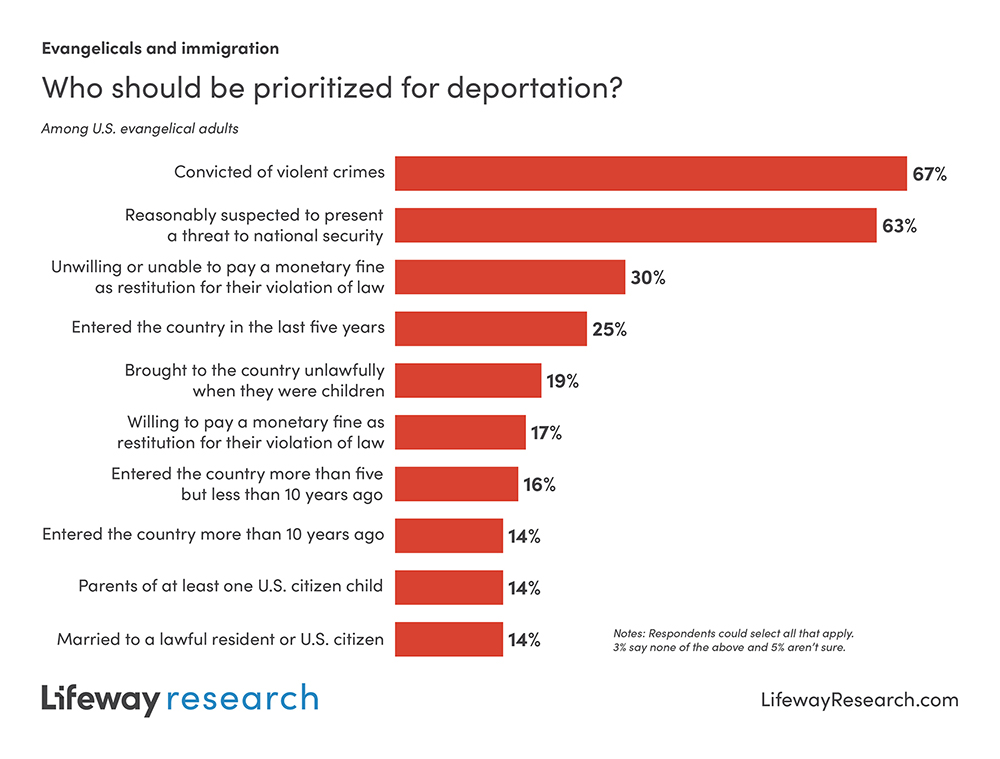
As Trump moves on his campaign promise of deporting illegal immigrants, evangelicals say those efforts should prioritize criminals and security threats.
Most want deportations to focus on individuals who have been convicted of violent crimes (67 percent) or those reasonably suspected of presenting a threat to national security (63 percent).
Fewer believe enforcement should prioritize those who are unwilling or unable to pay a monetary fine as restitution for violating the law (30 percent) or those who entered the country in the last five years (25 percent).
Fewer than 1 in 5 evangelicals believe deportation should focus on those who were brought to the country unlawfully as children (19 percent), would be willing to pay a monetary fine as restitution (17 percent), entered the country more than five years ago but less than 10 (16 percent), entered the country more than 10 years ago (14 percent), are the parents of at least one U.S. citizen child (14 percent) or those who are married to a lawful resident or U.S. citizen (14 percent).
“A large majority of evangelicals do not want immigrants unlawfully in the country to be prioritized for deportation except if they have been convicted of violent crimes or pose a threat to national security,” McConnell said.
“Less than 1 in 6 evangelicals value deporting undocumented immigrants whose immediate family has legal status or who have been in the country for more than five years. These are their neighbors and families they don’t want to see divided.”
Evangelicals in the United States believe legislative steps should be taken to address the immigration issue.
Four in 5 (80 percent) say it’s important that Congress passes significant new immigration legislation this year. Most want to make it harder for new immigrants to enter the country illegally but easier for some of those already here to earn citizenship.
Around 3 in 4 (76 percent) say they would support changes to the U.S. immigration laws that would both increase border security measures and establish a process so immigrants unlawfully in the nation could earn permanent legal status and eventually apply for citizenship if they pay a fine, complete a criminal background check and complete other requirements during a probationary period.
If a political candidate supported those dual changes, evangelicals say they would be more likely to vote for them in future elections. Around 2 in 3 (64 percent) say supporting reform with both of those aspects makes them more likely to vote for a candidate. Far fewer (12 percent) say they would be less likely to back a candidate who supported such reforms.
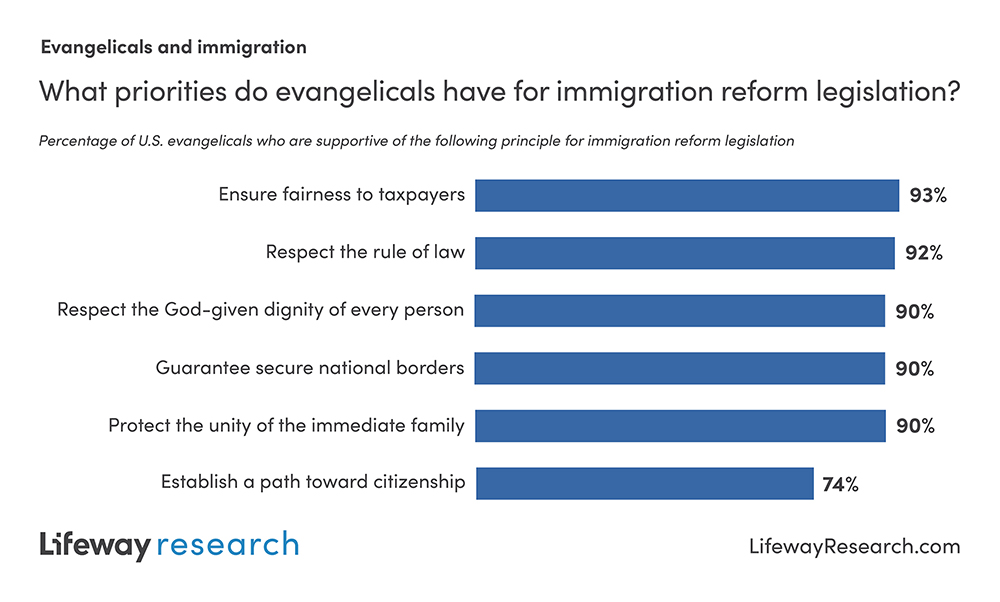
Considering immigration reform legislation, evangelicals want lawmakers to keep several priorities in mind.
Around 9 in 10 believe reform should ensure fairness to taxpayers (93 percent), respect the rule of law (92 percent), respect the God-given dignity of every person (90 percent), guarantee secure national borders (90 percent) and protect the unity of the immediate family (90 percent).
Three in 4 support potential legislation that establishes a path to citizenship for those who are here illegally, are interested in becoming legal citizens and meet certain qualifications (74 percent).
Support for each of those priorities has increased among self-identified evangelicals since a 2015 Lifeway Research study but has remained stable since a 2022 study.
Four in 5 evangelicals (81 percent) would support Republicans and Democrats working together on a combination of immigration reforms that strengthen border security, create a pathway to citizenship for undocumented immigrants who came to the United States as children, known as “Dreamers,” and provide a reliable number of screened, legal farmworkers.
“A large majority of evangelicals want increased border security, Dreamers to be able to apply for citizenship and farming needs to be met with enough screened immigrant farmworkers each year,” McConnell said. “Evangelicals want a system that is both fair and alleviates potential threats to national security.”
Overall, evangelicals in the United States see legal immigration as helpful to the country. A quarter (26 percent) say legal immigration is helpful and the nation should increase the number approved in a year. Around 2 in 5 (40 percent) believe it is helpful and we should maintain the current number of legal immigrants approved.
One in 5 (20 percent) agree it’s helpful but want to decrease the number approved. Fewer say legal immigration is harmful and we should decrease those who are approved (8 percent) or that we should completely stop approving legal immigrants (6 percent).
Many evangelicals worry specifically about the recent number of immigrants that have come to the United States. More than 2 in 5 say that amount is a drain on economic resources (44 percent) and a threat to the safety of citizens (43 percent).
Additionally, 37 percent say the number is a threat to law and order, and 29 percent believe it’s a threat to traditional American customs and culture.
Positively, many evangelicals say the number of recent immigrants presents an opportunity to introduce them to Jesus Christ (42 percent), an opportunity to show them love (37 percent), an improvement to America’s cultural diversity (25 percent) and a boost to entrepreneurial activity (16 percent).
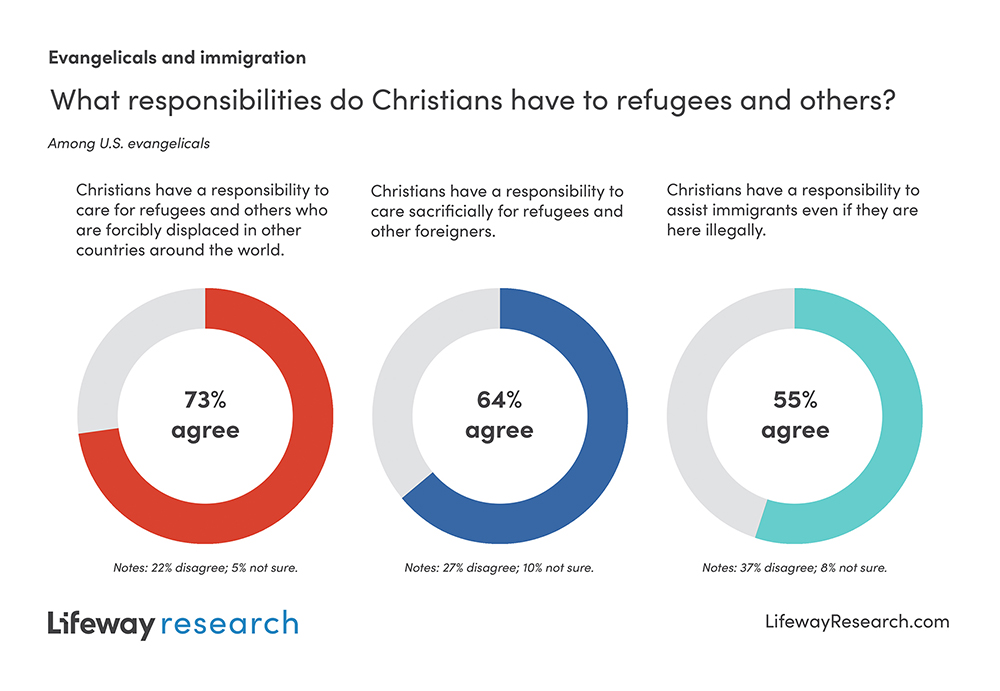
Thinking about moral responsibilities, about 2 in 3 evangelicals (64 percent) believe Christians have a responsibility to sacrificially care for refugees and other foreigners.
Asked specifically about refugees and others who are forcibly displaced in other countries, beyond the United States, 73 percent said Christians have a responsibility to care.
Most (55 percent) also say Christians have a responsibility to assist immigrants even if they are here illegally.
“It’s easy to presume the loudest evangelical voices on television or social media—who tend to advocate the extreme positions of either mass deportation and shutting out refugees on one hand or open borders and amnesty on the other—are the majority opinion, but this polling confirms my anecdotal experience in local evangelical churches across the United States,” said Soerens, who also serves as the national coordinator for the Evangelical Immigration Table.
“There’s a clear consensus for secure borders and for sustained or increased levels of legal immigration, particularly for refugees fleeing persecution. Evangelicals advocate for deporting violent criminals but also for establishing an earned path to citizenship for undocumented immigrants able to pass a background check and meet other appropriate requirements.”
When asked what has most influenced their thinking on immigration, evangelicals primarily say the Bible (23 percent). Other significant influences include immigrants they have observed (16 percent), the media (14 percent), immigrants they have interacted with (11 percent) and friends and family (10 percent).
Fewer say they have been most influenced by the positions of elected officials (8 percent), their local church (5 percent), national Christian leaders (4 percent) or teachers or professors (2 percent).
Influences included most often among evangelicals’ top three most influential sources on the topic of immigration are immigrants they’ve observed (42 percent), friends and family (40 percent), the Bible (38 percent), the media (37 percent) and immigrants they’ve interacted with (35 percent).
“The care for immigrants and refugees expressed by the responses of the majority of evangelicals in this survey correlates with actions the Bible commands. Yet not all evangelicals are familiar with these numerous biblical statements, nor do all have compassion for such people today,” McConnell said.
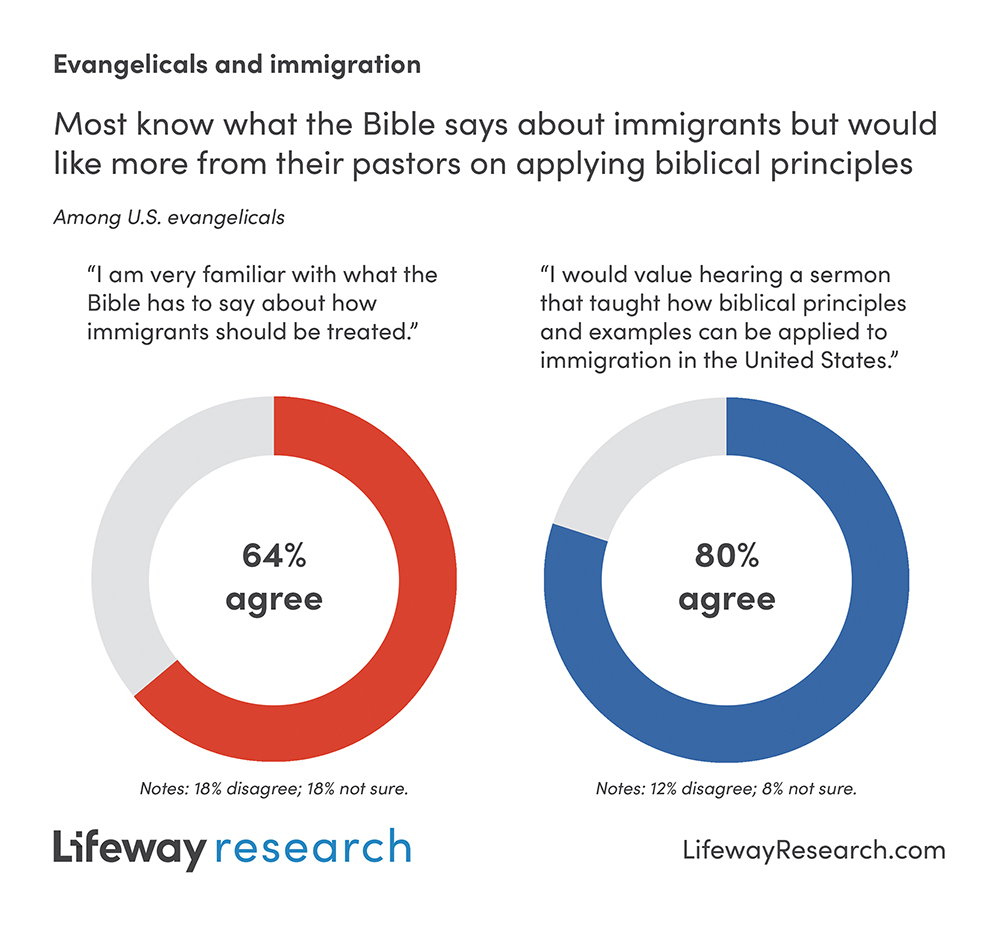
Most evangelicals (64 percent) say they are very familiar with what the Bible has to say about how immigrants should be treated. Still, 4 in 5 (80 percent) say they would value hearing a sermon that teaches how biblical principles and examples can be applied to immigration in the U.S.
Around 1 in 4 evangelicals (28 percent) say they have heard immigration discussed in their local church in a way that encouraged them to reach out to immigrants in their community, while 64 percent disagree.
Almost 7 in 10 evangelicals (69 percent) say they have never been involved in a ministry that served refugees or other immigrants. Around 3 in 10 say they have, including 13 percent currently and 18 percent in the past.
“I hope this research will give courage to pastors,” Soerens said. “Not only do their people crave biblical teaching on this topic, but the likelihood that the immigration policy ramifications of biblical principles will upset their congregants is slim, since super-majorities of evangelicals already support commonsense, compassionate principles on immigration rooted in Scripture.”
Still, evangelicals believe caring for these individuals is a responsibility of the church. Almost half (46 percent) say churches in the United States should be at the forefront of responding to the increase of people forced to flee their homes due to persecution or conflict.
Another 28 percent say the church should be concerned with the increase but it is not a top priority. Fewer say the church should leave it to governments to address the issue (12 percent) or that they are unsure (13 percent).
U.S. evangelicals rate many of the issues related to displacement as one of the three most urgent global issues that need the attention of churches in the U.S., while the issue itself ranks closer to the bottom.
Almost half say one of the top issues the church should give attention to is war and violent conflict (45 percent) and human trafficking (45 percent). More than a third point to orphans and vulnerable children (36 percent) and religious persecution (35 percent).
“At a time when 120 million people around our world have been forced from their homes, we believe the refugee and displacement crisis should be a priority of the American church,” said Soerens.
“While American evangelicals seem to be less focused on displacement than on some of the underlying causes of displacement, such as war, conflict and religious persecution, we hope the church will increasingly take the lead in responding to this global crisis.”
The study was sponsored by the Evangelical Immigration Table, World Relief, National Latino Evangelical Coalition, and the National Association of Evangelicals. The online survey was conducted Jan. 13-21, 2025, using a national pre-recruited panel.
Analysts used quotas and slight weights to balance gender, age, region, ethnicity and education to reflect the population more accurately.
The completed sample is 1,004 surveys, including 525 surveys completed by those with evangelical beliefs and 920 completed by self-identified evangelicals. The sample provides 95 percent confidence that the sampling error does not exceed plus or minus 3.1 percent. Margins of error are higher in sub-groups.
WASHINGTON (RNS)— Faith-based groups that partner with the federal government to resettle refugees are facing widespread layoffs and furloughs after President Donald Trump’s administration suspended the refugee program.
And according to one of the faith groups, the administration refuses to reimburse the organizations for humanitarian work performed before the president assumed office.

Matthew Soerens, vice president of advocacy and policy at World Relief, an evangelical Christian group that resettles refugees, said his organization continues to reel from several actions taken by Trump over the past two weeks.
The president all but froze the U.S. refugee program, save for rare exceptions, in an executive order shortly after taking office, a move that outraged the 10 groups that help the government resettle refugees—seven of which are faith-based.
Soerens said his office also received communication from the government on Jan. 24 stating World Relief no longer would be reimbursed for any work beyond that day.
The news was devastating, Soerens said, because his organization typically maintains a 90-day commitment to every refugee it resettles, helping pay for rent, basic supplies and other resources during that time.
The sudden halt on funding meant World Relief staffers were left scrambling to figure out how to support the roughly 4,000 people the group had resettled over the past 90 days.
“For some, it was only another few weeks where we would have been covering rents,” Soerens said. “But for some that arrived a week before, we have three months’ worth of rent to figure out.”
Soerens said his group also is impacted by Trump’s executive order pausing foreign aid efforts, which halted work World Relief does abroad in partnership with local churches through an agreement with the U.S. Agency for International Development.
The combined result of the administration’s actions was a roughly $8 million shortfall for the group, and while World Relief has managed to raise $2 million in recent days—an effort, Soerens said, that was “like nothing we’ve ever done”—staff remains unsure how the organization will fund the rest.
“We’re having to make very difficult decisions, because we are going to prioritize rent checks over staffing,” he said, noting there have been furloughs throughout the organization in recent days.
Representatives for Church World Service, one of the other faith-based refugee resettlement agencies, said the federal government is also refusing to reimburse their organization for work done prior to Trump assuming office.
“We’ve been unable to access federal reimbursements for critical program costs, and that includes costs that were incurred prior to the issuance of the executive order,” said Mary Elizabeth Margolis, a spokesperson for Church World Service.
“We still have outstanding reimbursements for services rendered under contract with the federal government that are not being paid back to us.”
Margolis said, as at World Relief, the result has been furloughs throughout the organization, with administrators hoping the money saved will allow the remaining staff to care for resettled refugees. That includes making sure they are “not left homeless or without access to medical care”—very real concerns for some families they work with, she said.
At a rally outside the White House in support of the refugee groups on Feb. 4, several furloughed Church World Service workers joined the protest. Speakers, such as Sharon Stanley-Rea, the head of Church World Service’s national office, said more than two-thirds of its national staff had been furloughed, including 100 percent of the D.C. office. She also pointed out that some of the staff were refugees themselves.
On Feb. 3, Elon Musk, the billionaire head of the Department of Government Efficiency and owner of the social media platform X, quoted a post from another X user detailing a grant provided to Church World Service that appeared geared toward assisting refugees abroad with their applications.
Legal immigrants are typically vetted over the course of years, but Musk suggested in his post, without evidence, the Church World Service grant was part of a broader redirection of funds—“billions of dollars,” he claimed—for “facilitating illegal immigration.”
“Is this America, when we’re cutting off refugee aid for just rental assistance and food for three months?” said Rep. Jamie Raskin, D-Md., who also spoke at the protest.
He then noted the Trump family’s own immigration history.
“The Trump administration has decided to slam the door shut on refugees,” Raskin said. “What a betrayal of America and our values. Nobody slammed the door shut in the face of the Trump family from Germany. Nobody slammed the door shut in the face of Melania Trump, who got an O1 and EB1 visa for extraordinary ability.
“Nobody slammed the door on Elon Musk, who came from racist, apartheid South Africa, who came here on an F1 student visa,” the congressman added, before referencing a Washington Post report indicating Musk also worked in the United States illegally as he launched his entrepreneurial career.
The State Department did not respond to a request to confirm claims by Church World Service and the other agencies, or explain the rationale behind the halted funds.
In an emailed statement, Noel Andersen, the national field director for Church World Service, said the financial woes hinder the ability to do work inspired by his faith.
“Part of living out my faith is through advocating for welcoming policies alongside immigrants and refugees, consistent with the Christian tradition and sacred texts,” he said.
“As our organization goes through furloughs, our capacity to fulfill our mission has been severely undercut, which will have a long-lasting harmful impact to those refugees who desperately need services that will reverberate across our communities and congregations.”
The story is the same at several other refugee resettlement groups, with some faring worse than others. Reached via text message, Mark Hetfield, head of HIAS, a Jewish group, said his organization has laid off staff or terminated their positions to handle the financial strain.
Hetfield framed the efforts as an attempt to scrape together whatever resources HIAS still has for the refugees it has committed to, while also voicing frustration with the Trump administration’s actions.
“For resettled refugees the government must live up to that obligation, as must we,” Hetfield said.
Episcopal Migration Ministries, a smaller refugee resettlement group, announced significant layoffs Friday. Episcopal Church Presiding Bishop Sean Rowe announced 22 staff members whose positions were funded by federal grants would be laid off, leaving the ministry with just 14 staff to carry out services for “forced migrants” who arrived just before Trump took office.
Sarah Shipman, director of Episcopal Migration Ministries, told RNS: “The end of federal funding for Episcopal Migration Ministries does not mean an end for EMM. While we do not know exactly how this ministry will evolve in our church’s future, we remain steadfast in our commitment to stand with migrants and to our congregations who serve them.”
The agencies stressed the staff reductions are ultimately a symptom of a much larger issue: the refugees they work with, many of whom have fled violence and religious persecution for a new life in the U.S., will go underserved.
“They are the people who have pending asylum cases that may lose access to their lawyers,” said Margolis of Church World Service. “They are families who need emergency rental support, who may end up homeless. They are kids who come to our offices to get coats and hats because it’s cold outside.”
Now, she said, those families “might not have access to those basic supplies.”
Catholic Relief Services, which is the top recipient of funding from the U.S. Agency for International Development, urged supporters to contact members of Congress to ask them to intervene with Trump to ensure the Catholic agency would be able to provide clean water, food assistance and medical assistance normally funded through the U.S.’ foreign aid program.
“This freeze will be detrimental to millions of our sisters and brothers who need access to lifesaving humanitarian, health and development assistance,” the organization, an arm of the U.S. Conference of Catholic Bishops, wrote regarding major changes to USAID announced in recent days. “U.S. foreign aid is not a handout. It has real impact on human life and dignity and advances U.S. national interests.”
The organization assured supporters that “constituents’ voices have significant influence on congressional members’ decision-making,” especially when messages are personalized.
Despite the cool temperatures in December, it was all smiles among the group of men who publicly gave testimony of their faith in Jesus Christ before an intimate crowd of friends, family and supporters. Dallas Baptist University men’s soccer player and junior Nicolas Barros baptized five of his teammates at the new Pool of Bethesda Prayer Garden, which recently opened on DBU’s campus. The baptisms were the culmination of a movement of God that began this fall when the soccer team chose 1 Corinthians15:58 as their theme about remaining steadfast. Barros spearheaded many spiritual conversations with his teammates throughout the season, often volunteering to lead prayer before and after training sessions. Ultimately, five men accepted Christ as their Savior at the end of the season, and a plan was made to be baptized on campus at the newly opened Pool of Bethesda. Two other players, Cason Berg and Gavyn Rosales, decided to get baptized at their home church with their family. Barros’ mom and his dad, who is a pastor in Brazil and a former professional soccer player, joined their son at the baptism event at the Pool of Bethesda. Pastor Barros shared his testimony in Portuguese as his son translated. Other students heard about the impromptu baptism service and helped lead an informal time of praise and worship as the sun set over the horizon. “I think there are lots of students who need prompting to take those next steps in their faith,” said Jess Jobe, head coach of the men’s soccer team. “We were just blown away by God’s faithfulness. As coaches, we know this is a priority for our athletic department—to be discipling our student athletes in this way and having these kinds of conversations. It was just really cool to see all that play out. It’s been a team effort.”

Paul Armes, president emeritus of Wayland Baptist University, returns to campus Feb. 25-26 as the featured speaker for the 72nd annual Willson Lectures. His subject will be current understandings of “In the Image of God.” The lectures will kick off on Tuesday, Feb. 25, with dinner at 6:30 p.m. in the McClung University Center. Reservations are required and seating is limited. Call Teresa Young at (806) 291-3427 to register. Armes will speak on “Some Implications of Imago Dei” from Genesis 1:26-27 the next day in chapel at 11 a.m. in Harral Memorial Auditorium. This event is free and open to the public. Also on Feb. 26, he will be speaking in select classes during the day and speaking at First Baptist Church in Plainview that evening.
Pursue, Woman’s Missionary Union of Texas’ annual meeting and missions celebration, is scheduled April 4-5 at the Waco Convention Center. Pursue is a gathering for women, men, young adults and students to be equipped and encouraged to make disciples who make disciples. Attendees will receive missions discipleship resources and experience leadership development, Bible study, fellowship and hands-on ministry opportunities. The cost is $85 for adults. Children and students are free. Online registration will close on Mar. 15. Onsite registration will be available April 4, but seats at the meal functions may be full. Please register early.
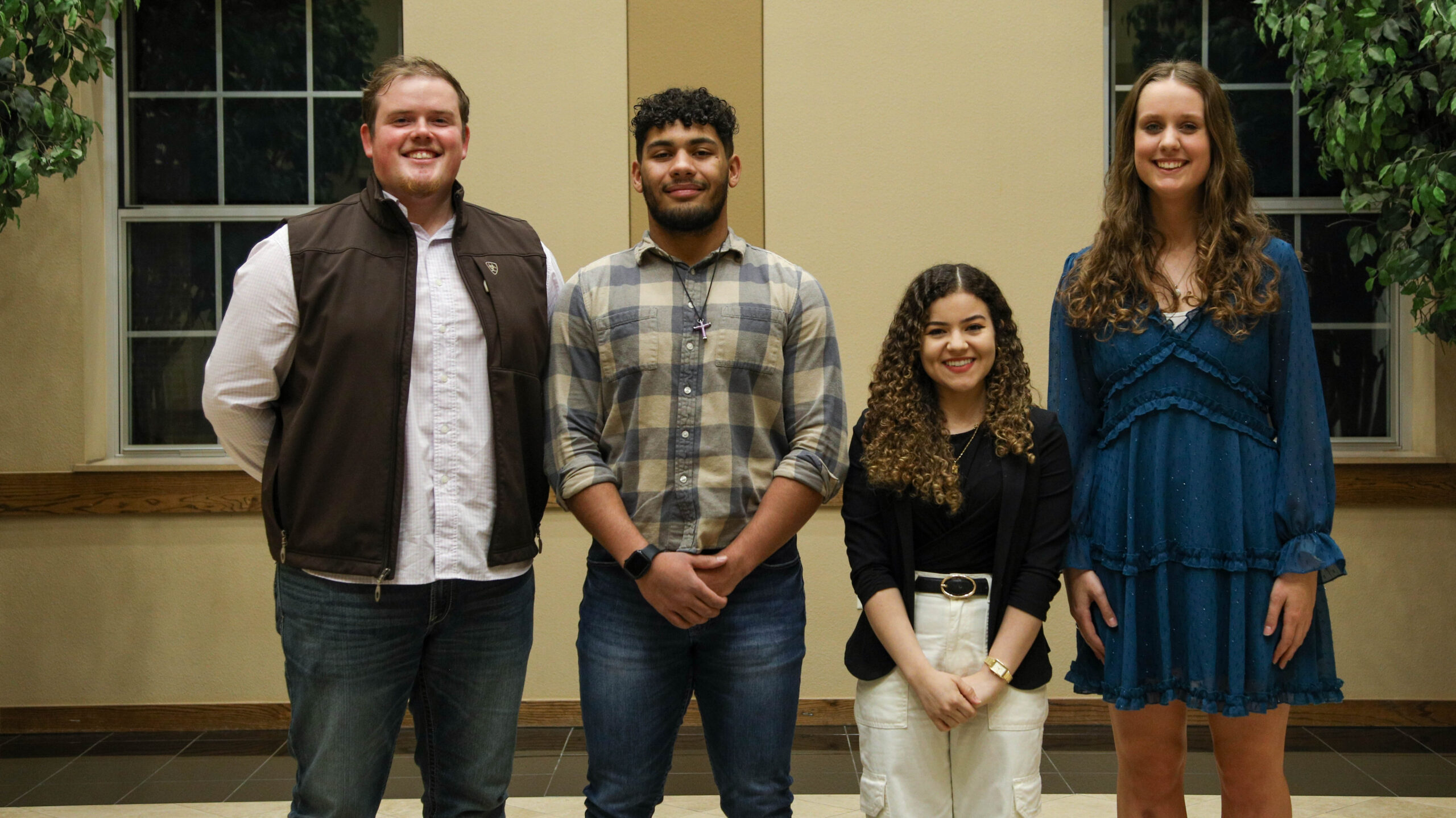
Howard Payne University named four students as Currie-Strickland Scholars during the 17th annual Currie-Strickland Distinguished Lectures in Christian Ethics, on Jan. 30. The award recognizes students who have shown leadership in Christian ethics. Students recognized were Vitória de Sales Biazi, a junior Bible major from São Paulo, Brazil; Brayden Folkers, a senior Christian education major with an emphasis in ministry leadership from College Station; Julie Ivy, a junior Christian education major with an emphasis in ministry leadership from Shiner; and Diondray Parker, a junior double-majoring in youth ministry and kinesiology from Borger. The event—featuring João Chaves, assistant professor of history of religion in the Américas and co-director of the Baptist Scholars International Roundtable in the department of religion at Baylor University—was coordinated by Jordan Villanueva, instructor of Christian Studies and assistant to the president for Hispanic relations.
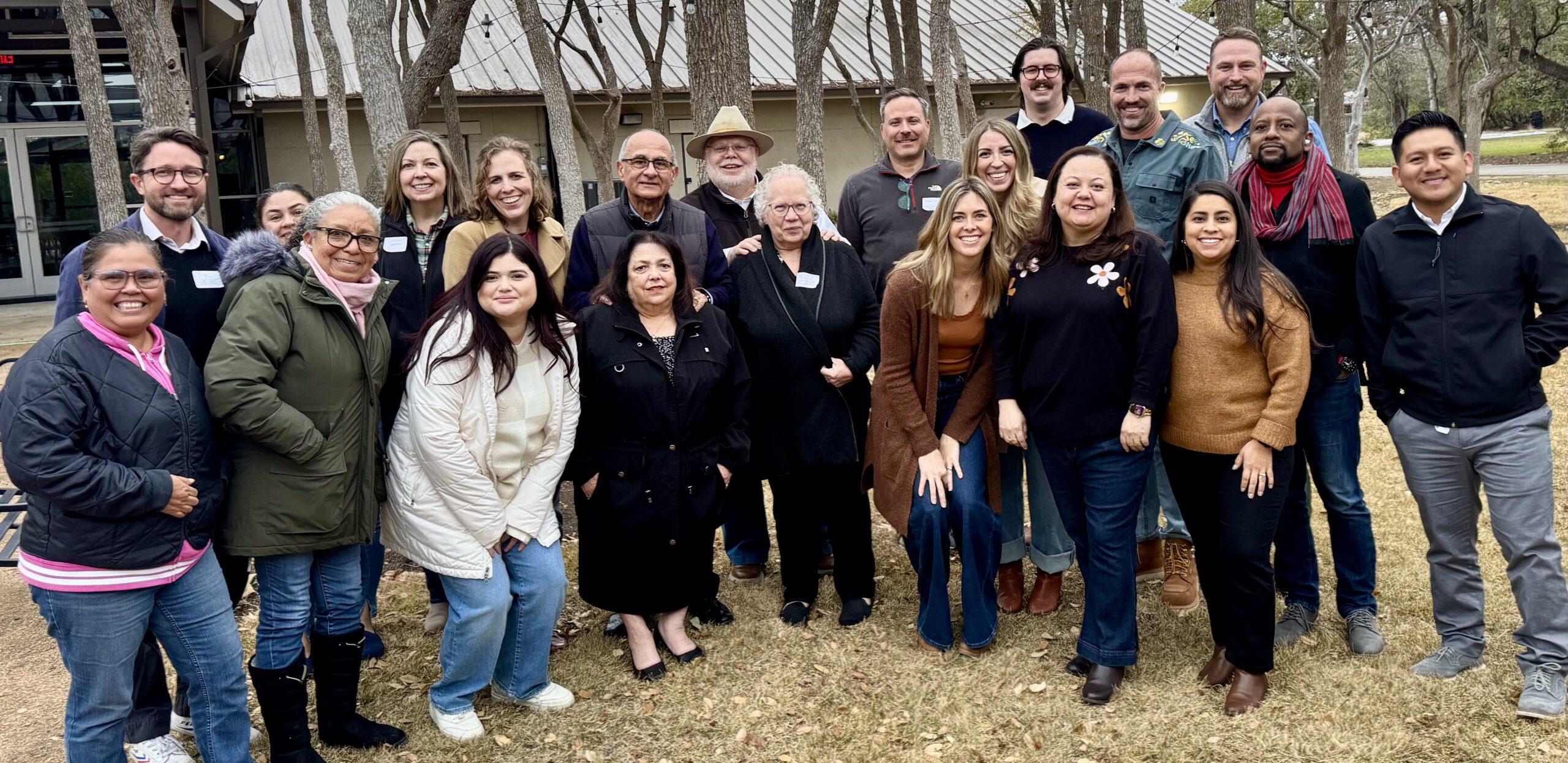
Fellowship Southwest introduced its first cohort of Thriving Congregations Immigration Ministry churches: Austin Heights Church in Nacogdoches; DaySpring Baptist Church in Waco; First Baptist Church in Austin; Iglesia Bautista West Brownsville in Brownsville; Iglesia Bautista Victoria en Cristo in Fort Worth; Primera Iglesia Bautista in Piedras Negras, Mexico; Royal Lane Baptist Church in Dallas; and San Antonio Mennonite Church in San Antonio. The churches represent a diversity of language, ethnicity, theology and types of immigration ministry. Two are churches along the border. All are committed to growing the life of their congregation through serving immigrants in compassionate hands-on ministry or through justice work. Last year, Fellowship Southwest received a $1.25 million grant from Lilly Endowment Inc. to invite churches into immigration ministry as a way to help their congregations flourish. In October 2024, Cintia Aguilar joined Fellowship Southwest as immigration ministry manager and to run the grant program. As an immigrant from Nicaragua with a master’s degree in social work and a Master of Divinity from Baylor University, Aguilar is uniquely situated to help churches discover their place in the immigration ministry landscape. She convened the first cohort Jan. 27-28 in person at Woodland Church in San Antonio. She invited experts and authors to lead workshops for the group about storytelling, immigration processes and policies, social work, cultural intelligence and trauma care. In the fall, applications will open for the second cohort, which will convene in December. If a church is interested in applying or for more information, please contact Cintia Aguilar at cintia@fellowshipsouthwest.org.
Houston Christian University’s annual Theology Conference hosted by HCU’s Houston Theological Seminary, will be held on Feb. 20-21 in Belin Chapel. This year’s conference themed, “Proclaiming the Parables,” will include presentations by professors and pastors to offer a variety of perspectives on the power of preaching the parables. The conference’s keynote speaker will be distinguished homiletician Thomas G. Long. Other speakers include Jeannine Brown of Bethel Seminary, Renjy Abraham of the Bible Project, David Capes of The Lanier Library and Duane Brooks of Tallowood Baptist Church, as well as HCU professors Scot McKnight, Lynn Cohick and Paul Sloan. Registration for the conference is open to the public and participation is available both in person and virtually. To find the Theology Conference schedule and to register, please visit https://hc.edu/school-of-christian-thought/events-in-the-college/hcu-theology-conference/.
Paul Sands on Feb. 2, from First Baptist in Woodway where he was senior pastor. Sands served for nine years in Woodway and a total of 49 years in ministry. He also taught at Truett Theological Seminary at Baylor University and at Southwestern Baptist Theological Seminary. A retirement celebration for the Sands family was held at First Baptist in Woodway on Feb. 2.
Emmanuel Baptist Church in Waco ordained Joshua West and Rahab Felix to ministry in the church and for chaplaincy. Marcelo Oliveira is pastor.
BROWNWOOD—João Chaves, a historian of religion, told Howard Payne University students and guests, “We must contend with our past to consider our future.”
Chaves, assistant professor of history of religion in the Américas at Baylor University, delivered the Currie-Strickland Lectures in Christian Ethics on “Faith Crossing Borders: How Immigrant Churches are Shaping the Future of Christianity.”
On the second day of the lecture series, Chaves emphasized the subtitle to his lecture was misleading if it set the expectation that he would try to “reflexively predict what will happen,” “offer an overly romanticized picture of immigrant Christianity,” or intentionally enter into debates that can be inflammatory or heavily politicized—however important those debates may be.
As a historian with training in the sociology of religion, Chaves said he was trained “to look at patterns behind us.”
But Chaves said he had learned “that our outlook on the past shapes—sometimes hides—what we’re able to see on the horizon. How one imagines the future has much to do with how one understands the past.”
In order to consider how migration might shape the future of Christianity, people first must contend with how they understand the past, he said.
To highlight the “entanglement” at the heart of his lecture, Chaves told a story about an old-time evangelist home missionary. The evangelist was set to preach at a church where he needed a translator to interpret his message for the congregation.
The translator was very good, Chaves said. When the preacher went one way, the interpreter went that way. When the preacher emphasized something, the interpreter emphasized something too.
When the sermon concluded, an altar call was given with many people coming forward to respond, Chaves said.
But when the preacher found the translator to thank her for translating his sermon for him, she looked at him, confused, and said: “Translating? You preached your sermon. I preached mine.”
Chaves said the story illustrates how “often Western missionaries were given and even took credit for what was accomplished by immigrants and locals.”
When Christians think about migration, they only rarely think about missions, he explained.
Baptists, in particular, “have long seen themselves as a missionary,” he asserted, beginning with William Carey, who is considered the father of modern missions.
The Triennial Convention, the first national body of Baptists in the United States, formed in 1814, was triggered by the influence of Adoniram and Ann Judson, some of the first missionaries to be sent out from the United States.
During the 1800s, Baptists from Sweden, Germany and other European countries also were immigrating to the United States and impacting the development of Baptist cooperation and work here.
In 1845, missions was at the core of the formation of the Southern Baptist Convention, when tensions over whether slave-owners would be appointed as missionaries led to a split from the Triennial Convention.
Since then, “Northern and Southern Baptists in the U.S. have invested heavily in foreign missions, mostly by separate mission boards,” Chaves explained.
He noted the legacies of Northern and Southern Baptist missionaries continue to be explored and preserved by denominations who have their own history intertwined with mission work that can be translated into offerings.
But the way Baptist missionary endeavors are told isn’t static, he said. “Approaches to the history of missions continue to develop.”
The legacies of Baptist missionaries from the Global North, United States and Europe increasingly are found in conjunction with other actors in Christianity’s expansion—migrants and locals.
“A shift in how the history of Baptist missions is traditionally told is ongoing,” Chaves explained, including a new focus on the ways often neglected actors and sources contributed to Christianity’s expansion. This can be applied to other denominations, as well, he noted.
Missions scholars continue to learn how central migration has been to the expansion of Christianity.
Outsized importance has been given to traditional Western missionaries sent from missionary boards as the de facto driving force of missions.
But these assumptions continue to be challenged, Chaves noted. And migration and local agency’s centrality to the Christian story can be acknowledged, without harming the legacy of Baptist missionaries.
Understanding who is a missionary and who is a migrant helps in understanding the shift, Chaves said.
Christian missionaries often are seen as people sent by organizations to save the souls of the lost worldwide, but there is more to consider, Chaves asserted.
“On the one hand, traditional missionaries sent by Christian agencies to foreign countries are technically migrants,” he said.
Their visas might be classified as religious, business, tourism or something else, “and missionary agencies have been very creative regarding how to circumvent immigration laws.”
“On the other hand, Christianity advances by immigrants who move from one place to another without necessarily being sent by missionary agencies or even seeing themselves as missionaries.”
These immigrants inspire Christian locals or missionary agencies in host countries to broaden their horizons and often serve as antecedents of organized missionary work.
“Christianity developed as a religion in which missionaries are immigrants, and immigrants are missionaries” Chaves noted.
There is an overlap between migration and Christian mission, Chavez noted, “especially when the latter is understood as an endeavor that entails crossing national, linguistic, cultural and existential borders.”
Understanding how migration factors into the development and expansion of Christianity requires “unlearning” traditional ways of thinking about missions—as missionaries being primarily white and male. It demands learning how local agencies and migration “were and are vital to the growth and vibrancy of Christianity worldwide,” he said.
Chaves noted histories of the modern missionary movement have obscured the role of migration as “a common driver” of Baptist missionary efforts or subordinated the roles of migrants and locals in Christianity’s expansion.
Chaves cited a quote from Baptist historian David Bebbington’s Baptists Through the Centuries and the whole of Kenneth Scott Latourette’s seven-volume series A History of the Expansion of Christianity as examples where the impact of migrants and locals in the story of missions is either downplayed or largely overlooked.
Many scholars now focus on non-Western actors in Christianity’s expansion and growth, but Chaves acknowledged the difficulty in locating primary sources or accounts of what local, non-Western Christians said about themselves that are not heavily redacted.
Chaves explained large waves of immigration to the United States, the top migration destination, have consistently been met with anti-immigrant sentiment. That includes when immigrant groups were European (Irish in the 1800s)—when “xenophobia became an American tradition”—and the current rise in anti-immigrant sentiment and policy.
However, Christian migrants to the United States are revitalizing northern denominations and contributing to reevangelizing the country.
Migration has spread Christianity since the start of the Jesus movement, Chaves noted.
Christian exiles and refugees shared their faith wherever they went, and migrants continue to take their God with them wherever they go.
Immigrant churches will continue to shape the future of Christianity by continuing to be a space for religion to thrive in new places, offering solace for those in need and functioning as mediating structures that help migrants adapt to their new countries.
“For good or ill, migrants are essential to the mission,” he said.
Migrant joys, struggle and laughter will continue to be the seeds of Christianity’s growth, he said.
Harold Wayne Temple of Plainview, longtime professor at Wayland Baptist University and onetime pastor of Old Rock Baptist Church in Somerset, died Jan. 27. He was 86. He was born Nov. 2, 1938, in Corpus Christi to Ralph Lee and Maudie Christine Ashley Temple. After graduating from Bishop High School in Bishop, he spent a summer working on a bee farm in North Dakota before enrolling at Southwest Texas State College, where he earned both his bachelor’s degree in chemistry and a master’s degree. While in college, he met Audrey Jean Bosak, and they were married in Old Ocean on Sept. 2, 1960. They soon moved to Arlington, where she taught elementary school and he taught at Arlington State University while working on his Ph.D. at Texas Christian University. After receiving his doctorate in 1969, the Temples moved to Beaumont, where he worked for Dupont Chemicals. Deciding corporate life was not what he aspired to do, the family moved to Pleasanton, where he continued his teaching career at Pleasanton High School. While they lived in Pleasanton, he was pastor of Old Rock Baptist Church in nearby Somerset. In 1976, the Temples moved to Plainview, where he was a professor of chemistry at Wayland Baptist University. During his time at Wayland, he taught every chemistry course in the curriculum—as well as other science courses—and was dean of the graduate program from 1983 to 1988. More than half of his students went on to attain post-graduate or professional degrees, including three who went on to become chemistry professors at Wayland. In addition, he taught at Wayland campuses in Lubbock, Wichita Falls and Anchorage, Alaska. In 2007, at his retirement, he was named emeritus professor of chemistry. He served as a guest preacher at many churches in South and West Texas. He and his wife taught Sunday school classes for young married couples and were involved deeply with the students at Wayland, mentoring them and hosting them at their home. Temple also was involved with foreign missions and befriended Southern Baptist missionaries throughout the world. He was a member of the Hi-Plains Gem and Mineral Society and loved searching for rocks, arrowheads, gems and minerals. He was an active member of the Lion’s Club for many years and volunteered with Meals on Wheels in Plainview. He was preceded in death by his brother Herman Temple and his sister Opal Zamzow. He is survived by his wife of 64 years, Audrey Temple; daughter Joli Temple Storm and her husband Greg; son Ladd Temple and his wife Robin; seven grandchildren; and one great-granddaughter. A celebration of life is scheduled at 10 a.m. on Feb. 15 at Harral Memorial Auditorium on the Wayland Baptist University campus in Plainview. In lieu of flowers, memorial gifts can be made to the Harold and Audrey Temple Endowed Scholarship at Wayland Baptist University.
WASHINGTON (RNS) —Nace Lanier was at home watching a movie with his family when he received an emergency text from Washington’s Ronald Reagan National Airport, where he is senior chaplain.
After years of preparing for a rare and forbidding moment, the Southern Baptist minister headed to Reagan National. He joined a team responding to the midair collision of a regional passenger jet and a U.S. Army Blackhawk helicopter, killing 67 people on the two aircraft, with no survivors.
“We have trained and prepared for an incident through the years,” Lanier wrote in an email to RNS. “Working with the staff and communicating with the Emergency coordinators allowed us to quickly set up a location that was safe, quiet, and as comfortable as possible for the friends and family.”
The impromptu arrangements are aimed at giving family members dealing with unexpected personal tragedy a place to “gather physically and emotionally” and have some privacy as they confronted the suddenness of personal tragedy, he explained.
“You listen far more than say anything,” Lanier said.
As an airport chaplain, he offers pastoral care in an array of mostly unforeseen circumstances.
“Being present is the key ministry gift we give to those we minister,” he said.
He declined to discuss particulars about his conversations, but said he was working with a team of people of other religions whom he could contact when he received a request for support from people who did not share his faith.
“I was a part of a team to holistically care for the hurting and confused,” he said. “I was able to pray with those who requested prayer. It was an honor to serve with their permission by holding their hands and praying to our God who was present but at that time silent.”
Training for the what-ifs of air travel is a constant part of an airport chaplain’s professional life.
Sometimes they use a “tabletop exercise,” where trainees talk through scenarios, said Michael Zaniolo, the senior chaplain at Chicago O’Hare International Airport and the president of the National Conference of Catholic Airport Chaplains.
Other times, airports hold full drills, in which fire officials set an airplane-shaped simulator on fire and volunteers portray passengers who receive aid from first responders, including chaplains.
“Every time they have this, they ask us to bring our chaplaincy team in order that we can train some of our chaplains,” Zaniolo said. It allows them to pinpoint how they might help if a disaster occurs. “What do you do at the rescue site? What do you do with the fire personnel or the morgue people? How does a chaplain fit into that?”
Rodrick Burton, president of the St. Louis Airport Interfaith Chaplaincy, said other traumatic situations can help chaplains also prepare for aviation disasters.
Called to help the family of a student killed in a 2022 school shooting, he counseled them on having a spokesperson to help handle media requests as well as unwelcome social media posts.
More recently, he’s assisted flood victims in his area when police chaplains sought additional aid.
“You can actually go and be present in other places that can also prepare you,” he said.
In the same way, Burton said he can count on other local first-responder chaplains.
“God forbid if this were to happen to St. Louis. There’s not enough of the airport chaplains,” said Burton, who hosted the International Association of Civil Aviation Chaplains when it met in his city in 2023. “So, we would call on the other hospital chaplains and police chaplains in the area to man that center 24 hours.”
All three chaplains spoke of the need to work in teams, helping fellow responders and fellow chaplains in the times of greatest need, usually in a center that has been set up to assist those who have become disaster victims, their families and friends.
Burton said other airport workers may also need a listening ear, whether of the airport chaplain or clergy of another faith to whom the chaplain can refer them.
“There’s the baggage crew that was waiting for the plane to land,” he said. “Other employees at the airport will be affected.”
Some may reach out for help, he said, long after the ambulances and fire trucks have left and an airport has returned to a sense of normalcy.
Lanier, who also directs the chapel at Dulles International Airport, said he is working with the part-time chaplain at Dulles to support family and friends of the crash victims.
“But we are just now turning our attention to the direct care of first responders and the many airport workers that have been tirelessly supporting this crisis,” he said.
“We have been working alongside them but will now be more available to them as they begin to process all that has occurred.”
Airport chaplains also are prepared for passengers who die from natural causes while traveling, and other more ordinary situations.
“I have been called in to help the airport with prior emergency situations such as when people have passed away at the airport,” said Lanier, who pastored two congregations before becoming Reagan National’s chaplain. “But it does not compare to a mass casualty event of this nature and size.”
Zaniolo, who didn’t hear of the midair collision until he woke up Thursday, said he planned to check in with staffers at his airport who may be affected by the crash over the Potomac River.
“Like any family, when there’s a tragic accident or sudden death, it’s a traumatic thing, and people need to talk and process it, some more than others,” said Zaniolo, who is in his 25th year at O’Hare.
“They might know some of the people that were on board, or they might know some of the people in the crew.”
The chaplains know to train, too, to take care of themselves so they can better take care of others.
“You have to learn about managing your own emotions in these crises,” Burton said. “Because if you’re not well, or you’re overwhelmed, you can’t help people that are overwhelmed.”
Zaniolo said chaplains at Chicago’s airports have both a “chaplaincy team” reflective vest and a “go-kit” that has holy oil, prayer books and rosary beads to share with Catholics should a crisis arise. But the small knapsack also includes space for a snack and some water for the chaplain.
“That’s the No. 1 thing that they tell everybody who responds to something: Make sure you’re hydrated, make sure that you’re not running on empty, because then you become a victim,” he said.
Lanier said he already has been putting advice of that sort into practice.
“I listened to the Emergency Coordinator at 6 a.m. to go home,” he said. “I was able to take a nap and shower, then arrive back at 11. I was more refreshed and able to attend to the needs of others—plus encourage others to do the same.
“I have been in constant prayer throughout, so I believe God has strengthened me during this time.”
NASHVILLE (BP)—When the 18th century church planter, evangelist and foreign missionary George Liele was imprisoned in Jamaica, he spread the gospel in prison, reminiscent of the apostle Paul.
Liele is among historical African American Christians author Trillia Newbell invites families to center dinner table devotions around in her book, Celebrating Around the Table: Learning the Stories of Black Christians Through Readings, Fellowship, Food, and Faith.
 “It’s my family tradition in book form,” said Newbell, a former director of community outreach with the Southern Baptist Ethics & Religious Liberty Commission. “Yes, it’s for Black History Month, but you can use it any time.”
She began the tradition perhaps a decade ago with her family, discussing famous and not-so-famous African American trailblazers around the kitchen table with her family over traditional dishes, with prayer and devotions.
“You can use the book anytime,” she said. “We don’t want to just study history in a certain month. We want to study it all the time. And so, any time you can gather around the table and start a discussion, and look at the Bible verses together, and talk about people and learn about what God says in his word, you want to do it.”
Liele rose from slavery, was granted freedom and began preaching in Georgia during the American Revolutionary War. He borrowed $700 on an indentured servitude agreement to travel to Jamaica, arrived there in 1782, and—after earning his freedom from bondage—planted a house church with three other Americans.

Liele is remembered as the first foreign Baptist missionary. While preaching in Kingston in 1797, he was charged falsely with inciting a rebellion through his sermons and ended up in jail. Acquitted, he still served time in jail for a debt he owed on a church he pastored. He remained in jail until the debt was paid, preaching while imprisoned, Newbell pointed out in her narrative.
Newbell tells Liele’s story alongside 11 trailblazing African American Christians including Frederick Douglass, Betsey Stockton, Charlotte L. Forten Grimké, Lemuel Haynes, Ruby Bridges, Mahalia Jackson and others, offering original Bible-based devotions for each.
“In the book, I feature … godly characteristics that each of them displays,” Newbell said. “The devotionals kind of feature those characteristics. So, whether someone was brave, humble, forgiving, loving, … all sorts of biblical characteristics that I found as I learned about the people, I pulled out. And then, I wrote a devotional based on what I learned about the people.”
The dinner table is important to Newbell’s family, she said, and she advocates for the dinner table as a prominent place to build unity in all family units.
And while the book is built around family, including photos of cherished moments of Newbell with her husband Thern and their son and daughter, she presents the book as a useful tool for singles and includes “children’s corner” resources for those 6 and older.
She encourages families and individuals to try the practice to learn about a variety of cultures, continuing beyond Black History Month.
Unique to the book are recipes for Southern favorites learned in her mother’s kitchen, family traditions and personal contemporary tweaks.
Cornbread, homemade butter, baked ribs, black-eyed peas, greens, salmon croquettes, shrimp and grits, sweet potato pie, apple pie and banana pudding are among recipes presented as approachable by most cooks in modestly appointed kitchens.
“The recipes are meant to give you a taste of common southern African American cuisine. But remember, I am not a chef,” Newbell writes in the book, “and none of the meals will be gourmet.
“These recipes are for the everyday cook. And although the recipes have modern ingredients, I intentionally didn’t add complicated ingredients or require special equipment. So, you won’t need an air fryer.”
Only, no microwaves, she’s quick to add.
“I said easy, but not that easy!”
As a child, Ethan Hollis never dreamed of a life in vocational ministry, but Baptist Student Ministry, an internship and a church-based Calling Out the Called program changed that.
Hollis grew up with inconsistent attendance in church and little understanding of the gospel.
However, after a friend invited him to youth group, he became more engaged with both.
Hollis recalled accepting Christ at a youth camp in middle school, but he said, “The things of the world really choked up my faith.”
Halfway through his first semester at Sam Houston State University, Hollis encountered God in his dorm room after he “hit rock bottom” from years of living a worldly lifestyle.
“I remember praying to God, crying and saying, ‘God, I don’t have anywhere else to go. I don’t have any other reason for life. I need help, and I need you,’” Hollis said.
A few days later, Hollis received an invitation to the Baptist Student Ministry from a family friend and attended a Thursday night worship service there. He was “immediately welcomed” into the BSM by three “godly young men who are still some of my best friends today.”
“I sat with them week after week, ended up getting discipled, and they just taught me what it looks like to follow Jesus and that being a Christian means accepting forgiveness and loving God and pursuing him,” said Hollis. “My life really changed after that.”
Hollis said he was deeply impacted by how the BSM modeled discipleship and Christ-like community.
“I grew up in a church that was mainly older folks. There just weren’t a lot of young people who were genuine Christians. So, it was hard to follow the Lord during my high school years, [because] I just didn’t know what it was like,” Hollis said.
“But being able to see it modeled … it deeply impacted me. With just one semester, I think everything changed because of the intentionality that they had.”
Gradually, during his time at the BSM, Hollis said he “fell in love with doing ministry.”
Hollis transferred to Stephen F. Austin State University in August 2021 for his sophomore year. His friend Jackson VanDover, now youth minister at First Baptist Church in Center, told him First Baptist Church in Nacogdoches was searching for a youth ministry intern.
Hollis felt God had given him a desire to teach the Bible, so he seized the opportunity and served as the youth ministry intern from January 2022 to April 2024.
He now considers his role as youth ministry intern as formative in further discerning the call he felt God had given him to vocational ministry.
After his time as youth ministry intern, Hollis began the Calling Out the Called program at First Baptist in Nacogdoches.
The program allows young adults who feel called to pastoral ministry to attend seminary fully funded, be discipled and trained by the church’s leadership to eventually be sent out to pastor their own congregations.
Hollis said God has used his time being mentored by Pastor Noel Dear and Associate Pastor Mark McLendon to spur on his desire for pastoring.
“I think that God has used great models like them, church leader models, to create in me a deep desire to [preach],” Hollis said.
“It’s just crazy that God can do something like that in a person and just completely change around everything that you want to do. And [preaching] is the only thing I want to do.”
Last August, Hollis and a couple of his Calling out the Called classmates attended Discipleship Collective in Mount Pleasant, a ministry of Texas Baptists’ Center for Church Health.
“One of the greatest [takeaways] was I got to hear [about] the importance and effectiveness of the small-groups settings in churches,” Hollis said.
He also was grateful for the connections he made with seasoned pastors at the event.
“I feel that I can reach out to [these pastors] one day when I become a young, inexperienced pastor … [to] get their wisdom on what to do in certain situations,” he said.
Hollis said he would advise other young people discerning a call to vocational ministry to meditate on Scripture “day and night, so that you may be careful to do everything written in it” (Joshua 1:8 NIV). He also encouraged others to take the time to learn how to be faithful to Christ and the church.
“I think [this] especially [applies to] people who are aspiring to be ministers, because … we can’t lead a church in any capacity if we are not soaked and marinated in God’s word,” Hollis said.
“Take your time. Not all of us should be teachers, but we should all be exemplary Christians. I think one way to learn to do that is just be a faithful member of the church, be a faithful Christian. It takes time to grow and [discern] those desires.”
Hollis also said it is essential for aspiring ministers to seek God and pray for the Lord to build them up in the character and integrity of a “biblically qualified” minister.
He expressed gratitude to all who helped shape his faith and help him discern his call to ministry.
“I’m thankful for Texas Baptists and everything that they do. I’m thankful for the BSM and for the way it has changed so many lives on campuses,” he said.
ALTADENA, Calif. (RNS)—George Van Alstine recalls having to evacuate his Pasadena, Calif., home as flames from the Eaton fire drew closer. He’d been assured Altadena Baptist Church, where he is associate pastor, still was standing.
But by the following morning, his grandson sent him video of the church building engulfed in flames.
The footage was “dramatic and sad,” Van Alstine said. He could hear his grandson crying as he captured flames emerging out of a church window.
“We never expected the fire to sweep across the center of Altadena like that,” said Van Alstine, 88, whose home survived.
On Jan. 24, Van Alstine walked past the rubble and charred debris of the church. He observed the bell tower that remained intact, and approached the gutted Altadena Children’s Center, which served as a day care on the church property for more than 40 years.
He pointed to what used to be his office, where he stored a vast collection of books and where he spent time writing the church newsletter.
The Eaton fire consumed the sanctuary of Altadena Baptist Church, one of at least a dozen houses of worship destroyed in the Eaton and Palisades fires in Los Angeles County.
The fire also destroyed the homes of about 20 church families and forced approximately 20 others to vacate their houses due to ash and smoke exposure.
“The family journeys are going to be hard. We have some older people whose family wealth is tied up in their houses. Rebuilding in Altadena is going to be a lot more expensive. … Property taxes are going to be a lot higher,” Van Alstine said. “Rebuilding is going to be fits and starts.”
Debra Blake, the deacon chair for Altadena Baptist, lost her home of nearly 30 years to the Eaton fire.

“This is life, and for me, I don’t even see it as a step back. It’s actually a test. He tests those he loves. I just have the faith. There’s a purpose for this, and we’re going to grow and move on from this,” Blake said.
Included in the destruction was a vault chronicling the history of Altadena Baptist Church, a merger with a Swedish Baptist church that dates back to 1920. The church is part of an interfaith network that administered a food pantry and did outreach for the unhoused.
“It’s a test of faith, right? We’ve said for years: ‘The church is not the building. It’s the people.’ Now’s our chance to prove it,” Van Alstine said.
In historically diverse Altadena, where more than 9,000 structures were destroyed in the fire, clergy and faith leaders are reeling from the scale of devastation.
Some are mourning the loss of their buildings. Others are trying to reach a dispersed and demoralized congregation. Most have multiple congregants who have lost homes. All are facing tough questions about their future.
First AME Pasadena still stands but the homes of at least 54 of the church’s families burned to the ground. Another 12 families can no longer live in their fire-damaged homes. Church leaders were still trying to locate a number of their seniors who only had landlines, Senior Pastor Larry E. Campbell said.
“Our first service that we had (after the fire), we questioned God. Then we came to the conclusion (that) it was OK to question God and even be mad at God,” Campbell told RNS. “We had to really go through that as a congregation.”
The city’s first African Methodist Episcopal Church, founded in 1887, First AME Pasadena has about 425 members, Campbell said.
Since the Eaton Fire wreaked havoc to the east of the parish, the church has hosted a free legal clinic with representatives from the Federal Emergency Management Agency on hand and has served as a distribution center for those affected by the fires.
A day of service was held outside the church on Saturday, with hygiene kits and grocery bags arranged by a range of organizations such as the South Los Angeles Muslim Council and the Halal Project.
The Council of Bishops of the African Methodist Episcopal Church held a news conference on Thursday at the Pasadena parish to express its commitment to help rebuild parishioners’ homes.
Bishop Francine Brookins said that while their focus is on the Black community, they are committed to a “redevelopment process that encompasses the entire community.”
Brookins said the council was in Southern California for a previously scheduled meeting and decided to tour Altadena after realizing that many church families were impacted.
“I could see brand-new homes being built. I could see intentional community developments where grocery stores and gardens and intergenerational community partnerships are built, and where Altadena goes back to its dream,” Brookins said.
“Altadena was a dream community … and it was intentional about bringing people of all backgrounds and all faiths together.”
At the news conference, attendees such as Drexell Johnson of the Young Black Contractors Association urged FEMA to be more transparent in how it selects developers and contractors because “it’s almost impossible for Black people and Black contractors to get a fair shake.”
NAACP Pasadena Branch President Brandon Lamar also attended the news conference and stressed that funding should go to Black families.
“These are not just homes. These are generational homes. This is generational wealth, and they are gone.
“We must make sure that we come together as a community and make sure that every house … is rebuilt into the capacity that we will be here for generations to come,” Lamar said.
Lamar said the NAACP Pasadena Branch is advocating locally and nationally “to make sure that everybody understands that we will not accept any vultures in our community.”
Campbell, the pastor of First AME in Pasadena, said he knows “we are going to lose some people.” Campbell noted some seniors likely will go live elsewhere with their children. That’s why, he said, they’re looking for ways to connect their members with senior housing in the community.
“There are some who are not going to be able to rebuild, but we want to keep them in the area,” Campbell said.
Connie Larson DeVaughn, lead pastor of Altadena Baptist, sees rebuilding efforts as an opportunity for the church to center the needs of Altadena residents.
Decades ago, the church addressed the need for child care with the Altadena Children’s Center.
With rents soaring in Los Angeles, Larson DeVaughn said, church members will discuss a range of possibilities, including providing low-income housing on their property to be proactive.
For now, the church is accepting financial donations to help church members who were displaced and to go toward the rebuilding of their new structure.
In a Sunday worship service, Larson DeVaughn read notes of encouragement from children and announced donations from other churches during the service, held in the bottom floor of nearby Highlands Church in La Crescenta.
Church members grieved as one recalled visiting his childhood homes that were all lost in the fire. They also highlighted good news, with one member sharing she found an apartment after losing her home to the fire.
In tears, Larson DeVaughn delivered a prayer for those whose lives have been disrupted.
“We pray for all the children who are scared and have nightmares from fleeing in the night. We pray for the elders who struggle with changes and for everyone in between,” Larson DeVaughn said.
“We pray for our own Altadena Baptist Church for direction and vision. We pray for the decisions that need to be made and the resources needed.”
Parishioners stood up, raised their arms and recited lyrics of “Jesus, Draw Me Ever Nearer.”
“As I labour through the storm/ You have called me to this passage/ And I’ll follow, though I’m worn,” they sang.
BROWNWOOD—“God does not show favoritism,” João Chaves, assistant professor of history of religion in the Américas at Baylor University, reminded Howard Payne University students in chapel on Jan. 29.
Taking as his text the story of Peter and Cornelius in Acts 10:34-35, Chaves read: “Then Peter began to speak, “I now realize how true it is that God does not show favoritism, but accepts from every nation, the one who fears him and does what is right.”
In his first presentation on “Faith Crossing Borders: How Immigrant Churches are Shaping the Future of Christianity” for the Currie-Strickland Lectures in Christian Ethics at HPU, Chaves challenged students to consider the interplay of faith and culture.
Attempting to “mix both lecture and sermon” for the chapel crowd, he said, Chaves provided historical, theological and personal background for his discussion before unpacking the text.
One of the more radical elements of Christianity, Chavez noted, is that “Christians are called to live as people on the move, people whose identity is grounded in a reality that transcends our world.
“Christians are challenged to live as strangers on earth, even though they are tempted to live as if they are legacies,” he said.
Philippians 3:20 says “Our citizenship is in heaven,” Chaves emphasized.
Yet the tendency of Christians to see themselves as “legacies” on Earth instead of “strangers” leads to entitlement, contributing to conflict among Christians.
These specific conflicts among Christians—differences or prejudices relating to how they view ethnicity, class, gender or otherwise—aren’t primarily about “who gets into heaven,” but about “how we live our lives together here,” Chaves pointed out.
Major theological conflicts have centered around these issues relating to diverse ways of understanding how to live out Christianity here and now, Chaves continued.
But, “God often surprises God’s followers by welcoming people they could not,” he said.
Christianity worldwide is radically diverse, dynamic and growing, he said. Chaves noted the shifting of Christianity’s center from Europe and the United Sates to the Global South in African, Asian and Latin American countries where more than 78 percent of the world’s Christians now reside.
While the United States still maintains the largest number of Christians, that’s partly from the many Christians who have immigrated to the nation and revitalize the faith here, diversifying U.S. Christianity, too, Chaves said.
The diverse groups are informed by ancestral traditions and the exchange of religious ideas among differing Christian traditions and other religions, “opening up spaces for cross-pollination and introducing innovations that shape Christian forms and meaning.”
Despite the explosive growth of Christianity in other areas, some groups of Christians reject other self-described Christians because they practice Christianity in forms that are different from their own.
However, creativity and diversity in Christian belief and practice is not new. In fact, it’s very old, Chaves said.
Multiracial, multinational exchanges between religious imaginations have been part of Christianity’s growth and development since ancient times.
Diversification of Christianity in the United States is fueled by immigrants and informed by believers’ diverse cultural heritages and ancestral traditions, he noted.
And in the first century, the church was comprised of Christians from many ethnicities, races, classes and cultural backgrounds, yet they coexisted in a complex arrangement.
Transnational theologians, including Augustine, the “mestizo son of a Roman father and Berber mother, who was often torn between his Roman and African roots and traditions,” developed theologies Christians look to still today in multicultural environments.
The Christian Diaspora saw the gospel message sometimes disputed, yet it spread in this setting. As Christianity spread and indigenized, many did not recognize God in “the other,” even when they claimed to worship the same God, he said.
“The gospel, nevertheless, grew amid disagreement.”
The indigenizing principle means the gospel should be “at home anywhere”—for the gospel message to grow, it must be adaptable and accessible to local people of any background—yet it “is never really entirely at home. It challenges individuals to look beyond our culture because it points to a kingdom that is not of this world,” Chaves said.
God calls his people to look beyond their own cultures to relate to people of other cultures for the mission of spreading the gospel. Scripture is replete with examples of God’s people “being called to leave their places of comfort in order to fulfill God’s call for their lives.”
In the Old Testament, “stranger” is a common element in several passages Chaves cited: Genesis 12:1 and 39:1-6; Exodus 2:22; and Joshua 6:25.
God’s command to “love the foreigner among you” weren’t just theoretical. It was given after the Hebrew exile in Egypt, pointing God’s people back to the experience of being strangers in exile for 400 years.
Scripture repeatedly indicates “God’s welcome is more extensive and complex than even God’s followers might like,” Chaves said.
He acknowledged as an immigrant to the United States from Brazil, where he grew up in a Baptist church after coming to Christ through the witness of a charismatic street preacher, his reading of the Peter and Cornelius story is not objective.
Being a Baptist in predominantly Roman Catholic Brazil, at that time, was countercultural, he said.
Immigrating to the southern United States to study and teach often has meant continuing to feel like a stranger.
He has seen the phenomena of “strangers like [him]” being either sincerely celebrated or subjected to extreme pressure by the majority culture to adjust to its preferences, so Peter’s interaction with Cornelius is personal for him, Chaves explained.
In Acts 10, God challenges Peter, telling him: “do not call anything impure that God has made clean.” God proves Peter wrong by compelling him to encounter a person from another culture and see God in him, Chaves said.
Though Peter continued to struggle with this tension at times, he does seem to realize in the key passage what God has been doing all along. “God is much bigger” than Peter’s ethnic or religious identity had allowed, Chaves noted.
“God will not allow Peter to confuse ethnocentricity for divine truth,” he said. “God is a God whose work in nature pours forth diversity, and complexity in unity.”
The mystery of God’s triune nature—three persons in one essence—is itself a challenge for Christians to strive to find unity with other believers in their diverse ways of viewing and being in the world.
Peter’s interaction with Cornelius also points to the danger that even leaders in the Christian community can fail to realize “our cultural expectations of the people whom God should accept can keep us from seeing who God actually is.”
The story of Peter teaches “we have much to learn about God by understanding that relationship with people from other places and cultures.”
Before Peter arrived at the home of Cornelius, “he was completely sure that people like Cornelius—uncircumcised Gentiles—were beyond God’s reach unless they changed into who Peter wanted them to be.”
But Cornelius taught Peter “he had too little a God,” Chaves explained.
He encouraged chapel students to be open to encountering and learning from each other.
“God calls us to be a beautiful celebration of diversity … in the hope that we can endure. It is a strange hope. Praise the Lord. God have mercy. Amen.”
MARSHALL—From ministering to local children with dyslexia to leading sports camps internationally, East Texas Baptist University’s Great Commission Center offers students “on-the-job training” in Christian service.
ETBU students who receive financial aid from the university are required to serve 12 hours per semester with a community partner. The center prepares students for service by offering support, guidance and training in community ministries and cross-cultural missions.
The Great Commission Center coordinates service learning projects, volunteer opportunities and mission experiences. It maintains a list of approved nonprofit organizations, churches, schools and agencies where students can serve.
The center’s core ministries would not be possible without its partnerships, including the Baptist General Convention of Texas and Woman’s Missionary Union of Texas, said Lisa Seeley, director of the Great Commission Center and Global Education.
Last fall, ETBU partnered with Region 7 Education Service Center to host Dyslexia Day in Northeast Texas, an event designed to empower students with dyslexia and their families.
Texas Baptists and WMU of Texas provided funds through the Mary Hill Davis Offering to purchase copies of the Grace Bible for Kids—a special edition of the Christian Standard Bible designed with a distinctive font to enhance readability for children with dyslexia.
At the Dyslexia Day event, ETBU distributed more than 300 copies of the Bible, developed by the B&H Publishing Group of Lifeway Christian Resources, in partnership with 2K/Denmark and Cambridge University.
During the event, ETBU students with dyslexia talked to younger students, letting them know a university education is possible for individuals with learning disorders.
For some parents and children who attended the event, it became a turning point in their lives, Seeley said.
“It was life-changing. It was amazing,” she said.
She recalled the example of a mother with two children who have dyslexia.
“The older child told her he couldn’t go to college, because there would be no help for him there,” Seeley said. “And then he went to that event, and when he went home, he wanted to start talking about college.”
In addition to local community service, the Great Commission Center also works with Global Study and Serve Trips and with the Tiger Athletic Mission Experience.
“One is more education-heavy. One is more mission-heavy,” she said.
Global Study and Serve trips provide students opportunities for students to participate in international learning experiences led by ETBU faculty. Students not only complete a curriculum in a subject such as history or a foreign language, but also participate in cross-cultural service opportunities.

The athletics department at ETBU collaborates with the Great Commission Center to offer the Tiger Athletic Mission Experience. This mission trip allows student athletes to spread the gospel through sports.
For instance, the ETBU baseball team has served twice in the Dominican Republic, a country “where baseball is king,” and many children dream of becoming professional baseball players as a way to escape poverty, Seeley said.
The ETBU student athletes led sports camps, using them as opportunities to share the gospel with children and teenagers, she explained.
Recently, the ETBU hockey team traveled to Sweden, where they used pick-up floor hockey games with young people as an avenue to connect with them and share their faith in a largely post-Christian culture, Seeley said.
“They got to sit down afterward, have pizza, and get to know each other,” she explained. And in the process, the ETBU student athletes told them about Jesus.
Faith Pratt, a student at East Texas Baptist University, is serving as an intern with the Baptist Standard this semester.