On the Move: Summers
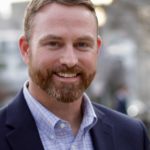
Aaron Summers to Texas Baptists as coordinator for pastorless churches starting Feb. 17, from First Baptist Church in Crowley, where he was senior pastor.
Aaron Summers to Texas Baptists as coordinator for pastorless churches starting Feb. 17, from First Baptist Church in Crowley, where he was senior pastor.
Dallas immigration attorney Jered Dobbs has seen an uptick in people seeking his services since the Trump administration resumed power three weeks ago.
Fear is “the driving factor” in almost all these calls, he said.
Dobbs recently spoke with a Dallas-area church—and in a couple other places that serve immigrants—to allay some of these fears and to help provide clarity on the blitz of executive actions related to immigration.
The Baptist Standard asked him about the types of questions people are asking.
Dobbs said a lot of questions are being asked relating to the executive orders and church.
“One of the big ones is, ‘Can ICE come into a church or look for somebody while they’re at church?’”
One of the executive orders “was essentially to lift a Biden-era policy” preventing ICE from entering certain sensitive areas like churches and hospitals, Dobbs explained.
So, the answer is yes, “technically ICE could do that.” However, “they do have to have a supervisors’ approval to do anything along those lines. And realistically, I think it’s going to be very rare that we would see anything like that.”
Beyond the requirement of supervisor approval, other legal restrictions might prevent ICE from entering a house of worship, he explained.
“Generally speaking, a private entity does not have to permit ICE entry unless they have a criminal warrant signed by a federal judge. They cannot just force their way in without the proper documentation by a federal judge, which is going to be a fairly rare thing.”
Overall, while it is legally possible and “might occur in limited circumstances, particularly if you have someone who is extremely dangerous,” Dobbs said he did not think ICE entering churches is “super likely” to become a common occurrence.
The same policy was in effect under Trump’s last administration, so it’s not new policy, Dobbs said. “It’s just a rehash of an old policy, and even then, I don’t ever recall hearing about ICE entering a church forcibly or anything like that.”
He noted he can’t say it “definitely won’t happen,” but “ICE knows it’s bad optics to be physically bursting into churches.”
“People, including many of the president’s supporters, aren’t going to stand for that,” Dobbs explained.
Even with one arrest outside a church in Georgia having been reported in recent weeks, Dobbs still would encourage immigrants to continue attending church—while exercising increased caution in general and being sure to know their rights.
“What I have been telling most of my clients is: ‘I think it’s OK. Don’t be afraid to go to church.’ I think that the likelihood of anything happening is fairly slim, overall,” even though the policy does technically mean that it could.
In the event ICE does show up, churches need to have policies in place on what to do, especially migrant-majority churches.
They need to have decided what their response is going to be with their own security teams and what personnel should do in terms of permitting entry.
Having some sort of plan in place would be wise, so that “they aren’t scrambling in the moment.”
To be prepared, churches and their members need to know their legal rights in terms of permitting entry or denying entry.
An example of one such policy might be asking ICE to wait outside until the service is over, and then they could do whatever they need to do.
Dobbs explained in terms of immigration enforcement—permitting ICE to try to enter churches or hospitals—what Trump has done is within the law.
What is not within the law, Dobbs noted, is “the attempt to unilaterally end birthright citizenship. That is almost certainly outside of the law, and at least one or two federal judges have already ruled accordingly.
“That action is definitely unconstitutional, and it’s never been held otherwise,” he said.
In terms of enforcing the laws that exist or allowing ICE more latitude to enforce immigration laws and make more detentions Trump’s actions are legal, “but the birthright citizenship, certainly not.”
Churches can support immigrants by being a resource for accurate information. “There’s a lot of misinformation out there right now,” Dobbs noted, “which is stirring up a lot of anxiety in the immigrant community.”
Making sure the church either has accurate information or knows where to point immigrant members to find accurate information is important, he noted.
Dobbs said immigration attorneys are an obvious resource to recommend. Also, churches can encourage church members not to believe everything they see on social media.
Immigrants should be encouraged to avoid working with what are called “notarios”—people who are not attorneys but who market themselves as “immigration assistants.”
Many notarios are “engaged in the unauthorized practice of law,” Dobbs said. “Aside from having incorrect or incomplete information, sometimes they’ll file an incorrect document.”
Churches can help migrants in their congregations by helping them understand how to distinguish between notarios and licensed immigration attorneys.
In addition to private immigration attorneys, parachurch organizations that support immigration also can be good resources and partners.
In Dallas, For the Nations Refugee Outreach has a qualified immigration specialist on staff. In general, for immigration specific advice, Catholic Charities is a reliable source of immigration council and support.
Additionally, Texas Baptists’ Center for Cultural Engagement created a brief document outlining “what federal government agencies can and cannot do legally as well as the freedoms, rights and obligations of churches,” Executive Director Julio Guaneri noted in his weekly email.
The executive orders relating to immigration have impacted Texas Baptist churches. Dobbs said he has heard of members from Spanish-speaking backgrounds, in his own church and a number of other Texas Baptist churches, who are afraid to come to church.
Majority-culture churches can help support churches largely comprised of immigrants by knowing who in their churches might have knowledge and skills that could be valuable to immigrants and capable of helping at immigrant churches nearby.
“What I’ve tried to tell people is, I think the Spanish-speaking community, the immigrant community, certainly need to exercise more caution now that we have these new orders than under the prior presidential administration, but I also have told them I don’t think they necessarily need to hit the panic button either.”
The rhetoric about mass deportations and ICE or the military sweeping through the streets, “we’re not seeing a lot of that.”
Dobbs said that’s because ICE, like any bureaucratic organization, has limited resources. They have limited numbers of enforcement agents, limited places to hold detainees and limited airplane capacity for deportations.
“And in fact, they have already, just in these two weeks, already maxed out all of their bed space in the United States. They’ve already filled up.
“They’re at 109 percent capacity, and they’ve already started to release immigrants that they have detained because they don’t have anywhere to put them,” Dobbs noted.
Dobbs said he had predicted when the administration first put the focus on deportations, this is what would happen. He thought “they would pick up a lot of people for a few weeks, and then they’re going to have nowhere else to put them, and that’s exactly what’s happened,” Dobbs recalled.
Yes, exercise caution, but “the best thing most immigrants can do is stay out of trouble with the police.” Immigrants who get arrested are the ones who will most likely find themselves in detention.
Immigrants should be careful about who they’re around and avoid “troublemakers,” he said. Doing so will help avoid being included in an enforcement action by being in the wrong place at the wrong time.
Dobbs noted a recent enforcement trend of ICE “focusing on easily locatable people, including those who have ICE ankle monitors and those coming to ICE check-ins.”
These tend to be “recent entrants to the U.S. or those who have already been placed into the deportation process, also known as Immigration Court.”
“I have seen increased detentions by ICE for both of those populations in the last two weeks, though not in or near churches,” Dobbs said.
Immigrants need to understand their chances of preventing deportation can only improve if they’re already on the pathway to legal status.
While “simply showing that you’re working with an immigration attorney toward lawful status will not necessarily prevent ICE from taking enforcement action,” depending how far along the path toward lawful status the case has progressed, being in-process might make a difference.
It could help convince ICE to release a person on an immigration bond pending an immigration court case, or it might make defending the person in immigration court an easier prospect.
“It’s never a bad thing to be on the pathway to legal status,” Dobbs said.
DALLAS—“Leadership is disappointing people at a rate they can absorb,” author Tod Bolsinger said, attributing the definition to adaptive leadership experts Ronald Heifetz and Marty Linsky.
Bolsinger gave Dallas Baptist University’s Nexus Leadership Conference participants few assurances the work of leading churches and other Christian organizations in a changing world would be successful.
However, he said, leadership in troubled times is essential no matter the result.
“This is the big surprise when you stepped into leadership. This is what nobody told you when they gave you that promotion … They never told you that you are actually going to become the chief disappointment officer,” saidBolsinger, co-owner and principal of AE Sloan Leadership.
When an organization chooses a new leader, it expects the new leader will “make life better,” whereas “what you understood is that God wanted them to make their lives new, that God’s going to use you to transform them,” Bolsinger explained.
Working with people through transformation is the big challenge of leadership, he said, and what makes leadership unique.
But the Bible doesn’t have much in the concordance about “leadership,” he noted. Instead, the Bible talks about management, described as stewardship—“taking care of the things entrusted to your care.”
“Paul even describes this as the work of the gospel, being stewards of the mystery of God,” he noted.
However, he said there’s a difference between stewardship and leadership, which can be seen with Moses. The “manager” would make calculations and surmise it should take six weeks of marching to get to the Promised Land, but “the leader knows it’s going to take 40 years, and not everybody is going to make it.
“Because it’s going to require transformation. And people resist transformation.”
Bolsinger recalled when he taught seminary, ministry colleagues told him, “You know, seminary didn’t prepare me for this—this thing that I have.”
Ministers “love holding people’s hands,” praying for them and caring for them, pulling people together, working out ideas with people on a whiteboard, but they weren’t prepared for the challenges of COVID-19, for example—where “people became deeply divided over things that you didn’t expect.”
Yet, leadership is “energizing the community of people toward their own transformation in order to accomplish a shared mission.”
Bolsinger noted, in times of crisis, “there’s actually an opportunity to become more transformed.”
The United State has been through a lot since 2001, Bolsinger said, listing a series of crises beginning with 9/11 and the 2008 financial crisis. 2020 brought a pandemic “that led to a lingering economic crisis that has led to a political crisis that reverberates through our culture and through our pews.”
There have been harder times to lead through than these, he said, but where the country is now, “it’s complicated,” and “nobody has prepared us” for this.
People are good in “acute crises,” Bolsinger noted. When there’s a hurricane or fire, as in Altadena, Calif., where Bolsinger is from, people and churches scramble.
In a crisis, people know what to do. Congregations figured out how to adjust to the constraints of COVID-19. In an acute crisis, “you come together, you stabilize, you protect, you buy time.”
But the second phase to the crisis, what Heifetz and Linsky called the adaptive phase, is where “you have the opportunity to address the underlying issues that have been revealed by the crisis. The things that were there all along, but that we didn’t have the will to confront,” Bolsinger said.
In a crisis, the focus is on getting out of the crisis. The sole focus of someone in an emergency room is getting home or “back to normal,” he explained.
When “you’re trying to lead people through a time of transformation that’s disruptive,” remember “family” and “familiar” share the same root word.
“It means that when we feel unfamilied, when we’re in an unfamiliar place. … you don’t just feel disrupted, you feel alienated. You feel abandoned. You just want to get back.”
Bolsinger noted a lot of churches feel this way. They want to get back to normal and how things were. But, Bolsinger asked, “Back to what?”
Do they want to go back to a church that has been losing Millennials and Gen Z at the rate of 100,000 per month for 20 years?
“We want to go back to that which is familiar to us, when the mission of God calls us forward,” he said.
Adaptive leadership requires leaders to address the issues a crisis revealed and lead a congregation through transformation.
Bolsinger said the issues in the culture and in churches are “deep, complicated issues” that aren’t going to be solved by getting a “kicking” worship band or “changing your name from First Baptist to The Flood.”
Edwin Friedman, a Jewish researcher, put it this way: “When any relationship system is imaginatively gridlocked, it cannot get free simply through more thinking about the problem. Conceptually stuck systems cannot become unstuck simply by trying harder.”
“For a fundamental reorientation to occur, that spirit of adventure which optimizes serendipity and which enables new perceptions beyond the control of our thinking processes must happen first,” Bolsinger said.
But in times of crisis, the default is to one’s training, Bolsinger emphasized.
To lead adaptively, leaders must learn a different way of leading by asking whether the problem to be solved is a technical challenge that can be solved by an expert, or whether the problem is adaptive with no clear answers to be solved by experts.
With an adaptive challenge, transformation comes through learners who are experimenting, like 19th century explorers Meriwether Lewis and William Clark.
Lewis and Clark are the subjects of Bolsinger’s book Canoeing the Mountains. Though they were hired to be water guides, the men learned when they arrived at the top of the Lehmi Pass their canoes were not the answer to the mountains that lay ahead.
Leading through transitions sometimes requires leaders to “face unchartered territory,” and go forward into a future totally different from the world behind, Bolsinger said. These leaders must help those they lead lay down the “canoes” that don’t work in the “mountains” ahead of them.
Leadership on mission is “wholehearted.” It is dedicated not to preserving the past, which is what the people fear—loss—when leaders think they fear change, but to forge into the future where God is leading, he concluded.
Bolsinger also encouraged chapel students, through the story of Jehoshaphat in 2 Chronicles 20, to know their “superpower”—or the thing they do really well. But when “the thing you do well stops working,” don’t just try harder.
Instead, Bolsinger said, “Stop. Look. Listen, then go (love).”
Before leading his people into battle, Jehoshaphat called them together and made them stop and look at God, he noted.
To be prepared for difficult times, follow that example and “do a deep, deep apprenticeship with Jesus.”
In difficult times, don’t rely on a superpower, Bolsinger said. Doing the wrong thing harder will not work. Instead, do something that requires dependence on God.
Listen to “the pain around you.” Find the “ones God wants you to hear,” and meet their need.
Live Galatians 5:6, he urged. “Love the people in front of you,” he said. To be a real Christian is to do what love demands.
NASHVILLE, Tenn. (BP)—Protestants, seen as “a fringe” sect in mostly Orthodox Ukraine, have gained traction and respect for their humanitarian aid during Russia’s war on Ukraine, a delegation of governmental and religious leaders said.
“The general public has always viewed the Protestant church as fringe or unimportant. But things have changed a lot in the past three years because I have seen a real openness,” Ukrainian congressman Oleksandr Shkuridin said in a meeting hosted by the Southern Baptist Convention’s Ethics & Religious Liberty Commission and SBC Executive Committee in Nashville.
“I’m not grateful to God for the war, but I’m grateful to God to have used the situation to reveal the strength of the Protestant churches,” said Shkuridin, citing the church’s largescale humanitarian and gospel outreach to Ukraine.
Since the beginning of the war, Protestant-sponsored organizations both locally and internationally have been main drivers of humanitarian relief, Shkuridin said.
But the leaders from Chernivtsi, a southwestern Ukrainian city bordering Moldova and Romania, expressed confusion after meeting with congressional leaders in Washington, D.C., to discuss U.S. support for Ukraine during a suspension in U.S. Agency for International Development spending.
“Alarmed,” Vyacheslav Nahirniak, pastor of First Baptist Church in Chernivtsi, said of the delegation’s reaction. “We don’t understand what stage we’re at.
“People were eagerly anticipating the American presidential elections. President Trump promised to end the war in the first 24 hours. Then we had been waiting for the inauguration. And we don’t really know what to wait for now.”
Miles Mullin, ERLC vice president and chief of staff, received the three-person Chernivtsi delegation.
“The Russian invasion of Ukraine has resulted in suffering and religious persecution for so many of our fellow Baptists,” Mullin told Baptist Press.
“Ukraine has the largest Baptist population in Eastern Europe, and we lament the cruelty and evil that has been displayed by invading Russian forces towards them and other Ukrainians.”
Mission Eurasia, a Tennessee-based Christian educational and charitable organization operating in Ukraine and 14 other countries, arranged the delegation’s visit to the United States Feb. 8-11 just as USAID was suspended.
Delegation members attended the International Religious Freedom Summit, where they heard an address by U.S. Vice President JD Vance; met with various officials including Ambassador Kurt Volker, former U.S. special representative for Ukraine negotiations; met with U.S. Congressman Joe Wilson (R-N.C.), chair of the U.S. Helsinki Commission and a member of the House Committee on Foreign Relations, and other leaders.
USAID had designated $130.1 billion in humanitarian aid to Ukraine since February 2022, according to UkraineOversight.gov, and had disbursed $86.7 billion before Trump halted spending in one of a flurry of executive orders issued in his first days in office.
Ukraine is hurting, Mission Eurasia President Sergey Rakhuba said, introducing the delegation to offer firsthand accounts of the atrocities suffered during the war and to counteract Russian propaganda.
The delegation described an Ukraine resolute in continuing its fight, despite an interruption in U.S. humanitarian aid and an uncertainty in the continuation of U.S. weapons assistance seen in the Biden administration.
“We will continue to do what we’ve been doing for the past three years,” said Oleksii Boiko, head of the Chernivtsi Supreme Regional Council and speaker of the Congress of the Chernivtsi Province. “People may be tired of war in Ukraine. People may be tired of war overseas, but this doesn’t stop the war.
“When we talk about the neighboring country trying to seize more and more of our land, it’s not just some made up things. This is a real thing. ‘Ukraine will just give up and put its hands down’—it’s a mistake to think that way.”
“We’ll continue to defend,” Shkuridin added. “Without this help it will be extremely difficult. We will not be as successful as we have been, but we’ll continue to do it.”
But the United States should find a way to continue to support Ukraine’s war effort, the delegation said, because Ukraine’s victory would be a victory for religious liberty.
“America is an example of democracy and freedom,” Shkuridin said. “We have always looked up to America as such. We would like to receive support so that the Ukrainian people could just have the same freedom of self-expression and freedom of faith.”
Mullin and Jonathan Howe of the SBC Executive Committee presented the delegation with a framed copy of the resolution “On the War in Ukraine,” which messengers to the 2022 Southern Baptist Convention annual meeting adopted.
“Our convention of churches has spoken clearly in the 2022 SBC resolution, ‘On the War in Ukraine,’” Mullin said, “condemning Russian aggression and standing in solidarity with ‘our Ukrainian brothers and sisters in Christ as well as the people of Ukraine.’
“As we did then, we continue to call for a cessation of hostilities, the withdrawal of the Russian military, and the end of the war. And we commit to redouble our prayers for those, like the leaders of the Ukrainian Baptist Theological Seminary, who continue to minister and share the gospel in the midst of the death and destruction it has caused.”
Seminary President Yaroslav “Slavik” Pyzh also attended the meeting, hailing the work of ERLC that brings a gospel witness to the marketplace and recommending such an organization for Ukraine.
“There is a big gap between church and church life and political life public life,” Pyzh said. “And I think it would be great to come up with a platform where we can combine politicians with churches. Pastors with politicians, where they would be held accountable to each other.
“Preaching the Gospel is one thing when you’re preaching it in the church building,” Pyzh said. “But when you step outside the church building into the marketplace, it starts being a little bit different. And so I think we have to keep these two elements together—marketplace and the church.”
DALLAS (BP)—The National Hispanic Baptist Network has elevated its executive director, Bruno Molina, from a part-time role to a new full-time role to oversee the organization’s diverse offering of support to Hispanic churches and leaders across the Southern Baptist Convention.
“I’m thrilled that, after two years of serving in this role on a part-time volunteer basis, I can focus full-time on reaching the Hispanic community and through them realizing our vision ‘that all the peoples of the earth may know that the Lord is God (1 Kings 8:60),’” Molina said.
Jesse Rincones, chairman of the network’s board of directors, said he is glad the network now has Molina serving as executive director on a full-time basis.
“He not only had the vision of what [the National Hispanic Baptist Network] can and will become, but his life-long service to Hispanic Baptists will serve him well as he serves Hispanic Baptists all across the United States,” said Rincones, who also is the executive director of the Convención Bautista Hispana de Texas and the pastor of Alliance Church in Lubbock.
“The work of the National Hispanic Baptist Network is needed now more than ever. The 3,400 Hispanic churches in the SBC need a network like this at the national level. It’s exciting to see how God is already working to bring unity, collaboration, and culturally contextualized resources and experiences that is so needed in our churches,” Rincones said.
Molina added: “I’m grateful to God for a grant from the Lilly Foundation, in collaboration with the Hispanic Baptist Convention of Texas, that has made my full-time service possible, along with our communications coordinator, David Inestroza, Hispanic consultant for the Alabama Baptist Convention.”
Molina will oversee the network’s daily operations. This includes its 11 current ministry teams: prayer, evangelism, discipleship, missions mobilization, emerging leaders, revitalization, finance, education, women’s ministry, pastoral care and church planting.
He served bivocationally with the Navigators ministry, and for the last 16 years Molina has been the language and interfaith evangelism associate for the Southern Baptists of Texas Convention.
In addition to being a former pastor, church planter and human resources manager, he is an adjunct professor of apologetics, theology and world religions at Southwestern Baptist Theological Seminary.
He also teaches at Midwestern Baptist Theological Seminary, taught at Louisiana Baptist University, the Baptist Seminary in Havana, Cuba, and Baptist Seminary in Nogales, Mexico.
Molina earned his bachelor’s degree from New York University in International Relations and Spanish, and both his Master of Arts in Theology and Ph.D. in World Christian Studies from Southwestern Seminary.
La Convención Bautista Hispana de Texas y Fellowship Southwest se unieron a más de dos docenas de organizaciones religiosas en una demanda que cuestiona un cambio de política que permite a los funcionarios de inmigración entrar en iglesias y otros lugares sensibles.
El 20 de enero, una directiva del Departamento de Seguridad Nacional de EE. UU. rescindió las directrices para los funcionarios de Aduanas y Protección Fronteriza y de Inmigración y Control de Aduanas que anteriormente restringían la aplicación de la ley en lugares sensibles como lugares de culto, escuelas y hospitales.
La demanda afirma que el cambio de política para la aplicación de la ley de inmigración viola tanto la Primera Enmienda como la Ley de Restauración de la Libertad Religiosa.
La demanda alega que permitir la aplicación de la ley de inmigración en lugares de culto impone una carga sustancial al libre ejercicio de la religión de los demandantes y no refleja los «medios menos restrictivos» para lograr «un interés gubernamental imperioso».
«Una acción de control de inmigración durante los servicios de culto, el trabajo ministerial u otras actividades congregacionales sería devastadora para sus prácticas religiosas», afirma la demanda.
«Destrozaría los espacios consagrados del santuario, frustraría el culto comunitario y debilitaría el alcance de los servicios sociales que son fundamentales para la expresión religiosa y la práctica espiritual de las congregaciones y los miembros de los demandantes».
El Instituto para la Defensa y Protección Constitucional de la Facultad de Derecho de Georgetown presentó la demanda (Iglesia Menonita de EE. UU. y otros contra el Departamento de Seguridad Nacional de EE. UU. y otros) el 11 de febrero en el Tribunal de Distrito de EE. UU. para el Distrito de Columbia en nombre de una amplia coalición cristiana y judía.
«Las acciones extremas de nuestro gobierno nos llaman a dar un paso adelante al reconocer que nuestra práctica de amar al prójimo supera nuestra postura tradicional de no resistencia», dijo Iris de Leon-Harshorn, de la Iglesia Menonita de EE. UU., en una llamada al mediodía con los medios de comunicación después de que se presentó la demanda.
Entre los demandantes se encuentran 12 organismos y representantes denominacionales nacionales, cuatro organismos denominacionales regionales y 11 asociaciones denominacionales e interdenominacionales.
Someter los lugares de culto a medidas de control de inmigración «sin orden judicial o circunstancias apremiantes» interfiere con la libertad de las congregaciones para practicar libremente su religión, dijo la abogada principal Kelsi Corkran.
La demanda es similar en muchos aspectos a una demanda anterior presentada por un grupo de congregaciones cuáqueras en el Tribunal de Distrito de los Estados Unidos para el Distrito de Maryland. La Cooperative Baptist Fellowship se unió a esa demanda la semana pasada.
La última demanda afirma que el cambio en la política de lugares sensibles ya está suponiendo una carga sustancial para el libre ejercicio de la religión de los demandantes y su derecho a la «asociación expresiva».
«Las congregaciones están experimentando una disminución de la asistencia a los servicios religiosos y de la participación en los servicios sociales debido al temor a las medidas de control de la inmigración», afirma la demanda.
«Para los congregantes vulnerables que siguen asistiendo a los servicios religiosos, las congregaciones tienen que elegir entre exponerlos a ser arrestados o adoptar medidas de seguridad que están en tensión con sus deberes religiosos de acogida y hospitalidad».

La Convención Hispana Bautista de Texas es una «familia de iglesias dedicadas a servir a las poblaciones vulnerables y a ministrar a nuestras comunidades», dijo Jesse Rincones, director ejecutivo de la Convención.
«Valoramos profundamente el compromiso de larga data de nuestra nación de proteger el derecho constitucional de la iglesia local a llevar a cabo su misión bíblica sin interferencia del gobierno», dijo Rincones, que es pastor y abogado.
«La erosión de estas protecciones deja a nuestras congregaciones vulnerables a la intrusión del gobierno, interrumpiendo los servicios de culto, los funerales, los estudios bíblicos y otros ministerios vitales que sirven a nuestras comunidades».
Fellowship Southwest fomenta y fortalece «la misión compasiva y el trabajo profético de abogacía» de sus iglesias asociadas, dijo Stephen Reeves, director ejecutivo de Fellowship Southwest.
«Apoyamos una red activa que sirve a los migrantes todos los días, porque nos tomamos en serio las palabras de Jesús», dijo Reeves, que también es abogado.
«Toda iglesia debería poder seguir los mandatos divinos de amar a nuestro prójimo y acoger al extranjero sin temor a las intrusiones del ICE en espacios sagrados o a las represalias de funcionarios gubernamentales que no comparten nuestras convicciones religiosas».
«Todas las iglesias deben poder seguir los mandatos divinos de amar a nuestro prójimo y acoger al extranjero sin temor a las intrusiones del ICE en espacios sagrados o a las retribuciones de funcionarios gubernamentales que no comparten nuestras convicciones religiosas».
J. Melburn Sibley of Grapevine, a Texas Baptist pastor and denominational worker, died Dec. 16. He was 89. He was born Sept. 12, 1935, in Perryton to J.M. Sibley Sr. and Iva Crutcher Sibley. He attended Hardin-Simmons University before earning both an undergraduate degree and a Master of Arts degree at Baylor University. He also earned a Master of Divinity degree at Southwestern Baptist Theological Seminary. During college and seminary, he was pastor of Little River Baptist Church in Cameron. From 1961 to 1967, he was pastor of First Baptist Church in Karnes City. He became superintendent at South Texas Children’s Home in Beeville in 1967, serving there until he was called as pastor of First Baptist Church in Eagle Lake in 1973. From 1990 to 1995, he was a vice president of the Southern Baptist Convention Stewardship Commission in Nashville, Tenn. He later worked as a consultant with Cargill Associates in Fort Worth and as an interim pastor of several churches. Sibley served on the Executive Board of the Baptist General Convention of Texas and on the BGCT Committee to Nominate Institutional Board Members. He also served on several library boards and was the past president of three Rotary Clubs. He is survived by his wife of 64 years, Martha Sibley; daughter Michele Riddle and her husband Ken; son Michael Sibley and his wife Hanna; two granddaughters; and one grandson. Memorial gifts in his memory can be made to Baylor University’s Truett Theological Seminary or First Baptist Church of Keller.
Jerry R. Stratton, a Texas Baptist minister, associational director of missions and retired U.S. Army officer, died Jan. 18. He was 91. He was born Jan. 4, 1934, in Boone County, Ark., to John Robert and Lola Pearl Stratton. While attending Ouachita Baptist University, he met, fell in love with, and married Dotse Mae Benson in 1954. He earned a Bachelor of Science degree and was commissioned as a Second Lieutenant in the U.S. Army. He later earned a Master in Education degree from Baylor University. His military career as an officer and aviator spanned 30 years, from 1954 to 1984. His assignments included service stateside and in Panama, two tours in Vietnam, two tours in Korea and in Germany. His honors and achievements include Master Aviator Wings, Jump Wings, 24 Air Medals, two Bronze Stars and numerous other service medals. In 1986, He sensed and answered God’s call to vocational ministry. He served as minister of education and administration at First Baptist Church of Copperas Cove and was director of missions for the Tri-Rivers Baptist Area, working with 65 churches in Central Texas. In this role, he helped churches plan mission projects, organized training for church leaders and assisted churches in calling new pastors. He also served in pastoral roles for several churches including Adamsville Baptist Church and Buchanan West Baptist Church. He wrote Bible devotions that eventually were published in three volumes, God’s Daily Word. He was preceded in death by his wife of 66 years Dotse Mae Stratton and by his sister Barbara Stratton Sutton. He is survived by daughter Laura Nolen and her husband Michael; son Larry Stratton and his wife Kimberly; six grandchildren; five great grandchildren; and his brother David Stratton.
Pursuing a college education at Houston Christian University is easier with the launch of the Guaranteed Admission Program. The program enables qualifying students at Alief, Fort Bend, Katy and Lamar Consolidated independent school districts and YES Prep Public Schools with a 3.0 GPA to bypass the traditional admissions process and be enrolled automatically at HCU. James Steen, vice president for enrollment management at HCU, said the program allows the university “to accept qualified high school seniors based on their cumulative GPA, as well as guarantee them a scholarship offer before they officially submit an application. Those who are interested then fill out an onboarding form that can make them eligible for even more institutional aid.” Under a memorandum of understanding with each institution, HCU identifies eligible students for the program and assigns an admissions counselor to work with students to facilitate the enrollment process and ongoing communications. The program’s aim is to reduce the stress and expense high school students experience applying at multiple educational institutions during the college search. For more information, visit the Guaranteed Admissions landing page.

In celebration of Black History Month, the University of Mary Hardin-Baylor’s Kingdom Diversity Office, together with K. Zamore Enterprises, is hosting a “Unified Praise” gospel gathering. This night of worship will emphasize God’s word conveyed through dramatic narratives, expressed in dance, and surrounded by inspiring praise and worship. The celebration of gospel music will be held in the Sue & Frank Mayborn Performing Arts Center at 7 p.m. on Friday, Feb. 21. General admission tickets are $30 each, and UMHB alumni and employees can purchase tickets for a reduced price of $20. Admission is free for UMHB students. The general public can purchase tickets online at Unified Praise “A Gospel Gathering” | KerryAnn Zamore. Before the performance, UMHB’s Kingdom Diversity Office will host a panel discussion entitled “The Importance of the Black Church in the Black Community,” a conversation around the Black church’s importance and quintessential voice in the Black community, at 5 p.m. on Feb. 21. It will open with an oration featuring David Holcomb, UMHB history and political science professor. This event is free and will be held in the Manning Chapel at UMHB’s Paul and Jane Meyer Christian Studies Center. “We are committed to our students’ preparedness in their chosen fields of study. The social experiences that shape their attitudes and ability to connect with those around them is also a primary focus for us,” explained Sanfrená Britt, director of the Kingdom Diversity office. “We understand that the quintessential pillars within the various ethnic communities shape the core values of each student before they ever step foot on our campus. We are careful to hold these foundational elements of their lives as treasured parts of our university. Cultural awareness events such as this are how we continuously do this.” To learn more about these events, visit Kingdom Diversity.

During the university’s Homecoming week, Wayland Baptist University’s School of Humanities and Leadership hosted the annual Festival Hispano de Cultura y Lengua (Hispanic Language and Culture Festival) on Feb. 6. The event welcomed approximately 200 students from regional high schools to the Plainview campus for a day filled with cultural celebration, educational experiences and artistic expression. “We are thrilled to host this special event, which not only celebrates the beauty of the Hispanic culture and language but also brings together young students to experience the university environment,” said Erin Heath, associate dean. Attendees participated in interactive sessions highlighting the richness of Hispanic language and culture, engaged with peers from across the region and enjoyed a showcase of student artwork. The Festival Hispano de Cultura y Lengua is one of the many ways Wayland Baptist University continues to support education, diversity and cultural enrichment within the local community.

Howard Payne University’s Moot Court team competed in two tournaments in the fall. During a competition, students are given a problem with constitutional issues to determine. This year, there were two major constitutional issues to argue—the Fifth Amendment right against self-incrimination and the Free Speech clause of the First Amendment. The students must read 20 legal cases and develop constitutional arguments for both sides. Then, they argue before a panel of judges, similar to a Supreme Court case where the judges ask the competitors legal questions directly. In October, they competed at Colorado Christian University, where senior jurisprudence and Guy D. Newman Honors Academy majors Amber Williams and Sadie Willie placed in the top 16. In December, the Moot Court team competed at the American Moot Court Association Regional Tournament at the College of the Holy Cross in Worcester, Mass. Katelynn Turner, junior history and Academy major, placed 20th out of 60 competitors in the individual category. Amber Williams and Sadie Willie made it to the Top 16. Alli Harvey, senior jurisprudence and Academy major, also participated. For more information about Moot Court at HPU, visit www.hputx.edu/mootcourt.

Coming off their 10th consecutive appearance in the NCAA Regional, the DBU baseball team kicks off the 2025 season ranked No. 17 in the nation in Perfect Game’s Preseason Top 25. Under the guidance of Head Coach Dan Heefner, the Patriots have solidified their place among college baseball’s elite programs. DBU is one of just five teams nationally to reach the NCAA postseason each of the past 10 years, joining powerhouse programs like Florida, LSU, Oklahoma State and Vanderbilt. Additionally, the Patriots have averaged 43 wins per season since 2015, ranking as the third-highest win total in the nation over that span. The Patriots will open their 2025 season at home on Feb. 14 against North Dakota State. Their schedule features 14 games against teams that advanced to the postseason in 2024. As DBU enters its third season in Conference USA, the Patriots are coming off a strong year, having clinched the conference tournament championship after winning the league’s regular season title in their inaugural season in 2023.
Country music stars Cross Canadian Ragweed and Turnpike Troubadours will co-headline a live show at McLane Stadium in Waco on Aug. 23. The concert event also will feature special guests Shane Smith and the Saints, Wade Bowen and American Aquarium. One of the most influential indie country rock bands of the late 1990s and early 2000s, Cross Canadian Ragweed—based out of Stillwater, Okla.—disbanded in 2010. They will reunite in April for four sold-out nights at Boone Pickens Stadium at OSU, followed by the Aug. 23 concert at McLane Stadium. The Turnpike Troubadours—another Oklahoma band with roots in Tahlequah—have resided at the forefront of the Red Dirt music scene since their 2005 debut. Ticket pre-sales for fans with a pre-registration code will go live on Feb. 18. General public tickets go on sale on Feb. 21, if inventory remains. Fans may sign up to get a pre-sale password at www.theboysfromoklahoma.com. Pre-registration closes at noon on Feb. 16. Tickets are only available for purchase online in advance and may not be purchased by phone or in person. For more information, contact Luke Holcomb with Baylor Sports Properties at luke_holcomb@baylor.edu.

East Texas Baptist University continues to see strong enrollment for the spring 2025 semester, marking the second highest spring enrollment in the university’s history. The spring 2025 enrollment stands at 1,612 students, following last year’s record-setting spring enrollment of 1,657 students. This marks the first time in ETBU’s history that spring enrollment has exceeded 1,600 students in consecutive years. Undergraduate enrollment remains strong at 1,440 students, making it the second highest in ETBU history, following last year’s record of 1,481 students. Additionally, dual enrollment totals 258 students, the second highest for a spring term. The returning student retention rate is 91 percent, tying the highest on record for fall-to-spring retention. Additionally, freshman cohort retention stands at 87 percent, while transfer cohort retention is 86 percent. Prospective students and families interested in joining the ETBU community are invited to attend Preview Day on Feb. 17 or Tiger Day on March 29. More information about campus visits is available at www.ETBU.edu/visit.
Hardin-Simmons University College of Health Professions launched a new online degree program to better serve professionals in the ever-changing health industry. The Doctor of Medical Science degree is a 30-hour degree entirely online, allowing working physician assistants/associates to manage work-life balance while furthering their education. “Following the implementation of the entry-level physician assistant program offered at the master’s degree level at HSU approximately eight years ago, the Doctor of Medical Science degree was a perfect segue to advancing the skills and knowledge of today’s physician assistant,” said Janelle O’Connell, dean of the College of Health Professions. “The two-semester online program is designed for flexibility to meet the needs and interests of each student, and the College of Health Professions is proud to add this doctoral degree to its outstanding educational opportunities.” The curriculum equips physician assistants to publish their work, elevate their clinical practice, and broaden their understanding of medicine through the lens of medical humanities and wellness. The degree will provide the skills and momentum for next-level advocacy, leadership and participation in teaching opportunities. Currently in its first semester, the program has eight students enrolled, with 60 percent of the first cohort being alumni of the Master of Physician Assistant program at Hardin-Simmons. For more information on HSU academic programs, visit www.hsutx.edu.
Texas Baptists will host the State Bible Drill for children and regional Bible Drill & Speakers Tournament for youth and high school on April 5, from 8 a.m. to 4 p.m. at First Baptist Church in Allen. For more information contact Jennifer Howington at jennifer.howington@texasbaptists.org or call (214) 828-5287.
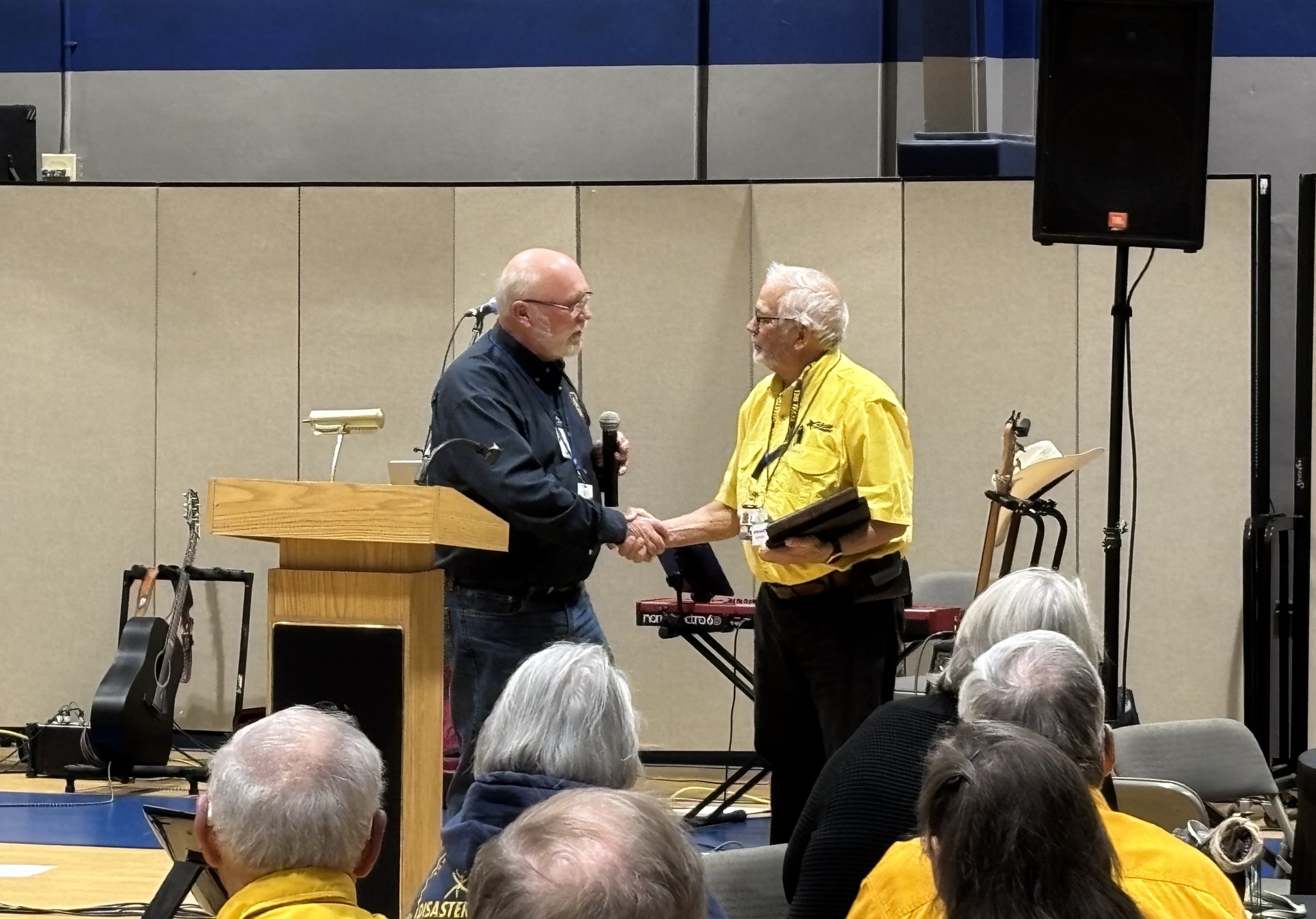
Southern Baptist disaster relief honored Texans on Mission volunteer Wendell Romans of Farmersville last week with its Joel Phillips Award. “This is like the most valuable player award in sports,” said David Wells, Texans on Mission disaster relief director. The steering committee for Southern Baptist relief receives recommendations from the state directors and then selects the award recipient. Romans, a member of First Baptist Church in Farmersville, is involved in multiple leadership roles with Texans on Mission disaster relief. He is state leader of Texans on Mission’s chainsaw work, serves on the Incident Management Team for varied disaster efforts and trains new volunteers in multiple categories. “Wendell served over 160 days in service this past year. He is willing to go where the need is and discover where God is at work and join him in that work,” Wells said. Already this year, Romans has volunteered in California after the devasting wildfires there. Texans on Mission hosted Southern Baptist disaster relief for its annual meeting last week in San Antonio. Both Wells and Mickey Lenamon, Texans on Mission chief executive officer, addressed the group.
First Baptist Church in Gustine celebrated 125 years on Feb. 9. Emmanuel Jimenez is pastor.
Danny Pickens, director of missions, retired Dec. 31, 2024, after 25 years with Smith Baptist Association in Tyler. Pickens served in ministry for 46 years. He served in several churches in East Texas—First Baptist in Winona; First Baptist in Hallsville; First Baptist in Kilgore; Southern Oaks Baptist in Tyler and First Baptist in Canton—before moving to Tyler to join the staff of Smith Baptist Association. Pickens graduated from East Texas Baptist University in 1984, then obtained master’s and doctorate degrees from Southwestern Baptist Theological Seminary. He was recognized and honored for his years of service at the Smith Baptist Association annual meeting Feb. 10.
Convención Hispana Bautista de Texas and Fellowship Southwest joined more than two dozen religious organizations in a lawsuit challenging a policy change allowing immigration officers to enter churches and other sensitive locations.
On Jan. 20, a U.S. Department of Homeland Security directive rescinded guidelines for Customs and Border Protection and for Immigration and Customs Enforcement officers that previously restricted enforcement in sensitive locations such as houses of worship, schools and hospitals.
The lawsuit asserts the change in policy for immigration enforcement violates both the First Amendment and the Religious Freedom Restoration Act.
The suit claims allowing immigration enforcement at places of worship imposes a substantial burden on the plaintiffs’ free exercise of religion and does not reflect the “least restrictive means” to accomplish “a compelling government interest.”
“An immigration enforcement action during worship services, ministry work, or other congregational activities would be devastating to their religious practices,” the lawsuit states.
“It would shatter the consecrated spaces of sanctuary, thwart communal worship, and undermine the social service outreach that is central to religious expression and spiritual practice for Plaintiffs’ congregations and members.”
The Institute for Constitutional Advocacy and Protection at Georgetown Law School filed the suit—Mennonite Church USA et al v. United States Department of Homeland Security et al—Feb. 11 in the U.S. District Court for the District of Columbia on behalf of a broad-based Christian and Jewish coalition.
“The extreme actions of our government call us to step up as we recognize that our practice of loving our neighbor outweighs our traditional stance of nonresistance,” Iris de Leon-Harshorn with the Mennonite Church USA said in a noon call with news media after the suit was filed.
Plaintiffs include 12 national denominational bodies and representatives, four regional denominational bodies and 11 denominational and interdenominational associations.
Subjecting places of worship to immigration enforcement actions “without judicial warrant or exigent circumstances” interferes with congregations’ freedom to freely practice their religion, lead counsel Kelsi Corkran said.
The suit is similar in many respects to an earlier suit brought by a group of Quaker congregations in the U.S. District Court for the District of Maryland. The Cooperative Baptist Fellowship joined in that suit last week.
The latest lawsuit claims the change in the sensitive locations policy already is placing a substantial burden on the plaintiffs’ free exercise of religion and their right to “expressive association.”
“Congregations are experiencing decreases in worship attendance and social services participation due to fear of immigration enforcement action,” the lawsuit states.
“For the vulnerable congregants who continue to attend worship services, congregations must choose between either exposing them to arrest or undertaking security measures that are in direction tension with their religious duties of welcome and hospitality.”

Convención Hispana Bautista de Texas is a “family of churches dedicated to serving vulnerable populations and ministering to our communities,” said Jesse Rincones, executive director of Convención.
“We deeply value our nation’s longstanding commitment to protecting the local church’s constitutional right to carry out its biblical mission without government interference,” said Rincones, who is both a pastor and an attorney.
“The erosion of these protections leaves our congregations vulnerable to government intrusion, disrupting worship services, funerals, Bible studies and other vital ministries that serve our communities.”
Fellowship Southwest encourages and strengthens “the compassionate mission and prophetic advocacy work” of its partnering churches, said Stephen Reeves, executive director of Fellowship Southwest.
“We support an active network serving migrants every day, because we take the words of Jesus seriously,” said Reeves, who also is an attorney.
“Every church should be able to follow the divine mandates to love our neighbors and welcome the stranger without fear of ICE intrusions into sacred spaces or retribution from government officials who don’t share our faith convictions.”
WASHINGTON (RNS)—President Donald Trump issued an executive order reinstating his version of the White House Faith Office and once again placing Florida pastor and longtime supporter Paula White-Cain in charge of the initiative.
Trump already announced both moves during a speech related to the National Prayer Breakfast on Feb. 6 but issued a formal executive order on Friday evening, Feb. 7.
“The executive branch wants faith-based entities, community organizations, and houses of worship, to the fullest extent permitted by law, to compete on a level playing field for grants, contracts, programs, and other Federal funding opportunities,” the executive order read.
“The efforts of faith-based entities, community organizations, and houses of worship are essential to strengthening families and revitalizing communities, and the Federal Government welcomes opportunities to partner with such organizations through innovative, measurable, and outcome-driven initiatives.”
The order appeared to acknowledge that the Trump administration is essentially replacing the existing White House Office of Faith-Based and Community Initiatives, which was created by former President George W. Bush’s administration and used by former presidents Barack Obama and Joe Biden.
Trump left that office vacant for most of his first term before creating the White House Faith and Opportunity Initiative in 2018 and appointing White-Cain to lead it in late 2019.
The new office, according to the order, is tasked with various projects, such as making recommendations to the president, advising various federal agencies and consulting with faith leaders who hold expertise in a broad range of areas, such as “strengthening marriage and family,” “lifting up individuals through work and self-sufficiency,” and “defending religious liberty.”
The order also mentioned prioritizing faith leaders with expertise in “combatting anti-Semitic, anti-Christian, and additional forms of anti-religious bias.” It stated the Faith Office would work with the attorney general to “identify concerns raised by faith-based entities, community organizations, and houses of worship about any failures of the executive branch to enforce constitutional and Federal statutory protections for religious liberty.”
The lines may be references to two other recent announcements from Trump—the creation of a task force on “anti-Christian bias,” which he mentioned on the campaign trail, as well as a new presidential task force dedicated to religious freedom.
In addition, the order encouraged the office to promote grant opportunities for religious organizations, “especially those inexperienced with public funding but that operate effective programs.”
In a separate statement, the White House announced White-Cain will resume leadership, and Jennifer S. Korn will serve as deputy assistant to the president and faith director of the office. White-Cain and Korn have spent the past few years working with the National Faith Advisory Board, a group founded as an attempt to continue work done by the faith office during Trump’s first term.
Several of Trump’s evangelical supporters celebrated the reestablishment of the office and the appointment of White-Cain, with Georgia megapastor Jentezen Franklin congratulating her in a post on social media site X.
Others, however, were quick to criticize the move. Americans United for Separation of Church and State condemned White-Cain’s appointment, saying she “was unfit to serve in the White House when Trump first appointed her in 2019 and she’s still unfit today—particularly in a position that could focus on combatting discrimination and advancing religious freedom for all.”
Americans United also accused White-Cain of being a “Christian Nationalist powerbroker” who’s spent much of her career operating in the shadows to influence public policies that discriminate against women, LGBTQ people and religious minorities, and the nomination of partisan judges who will support those policies.
The White House also announced Jackson Lane, who worked on Trump’s faith outreach team during the campaign, will serve as special assistant to the president and deputy director of faith engagement.

On social media, the White House promoted the new office alongside a photo of Trump surrounded by religious supporters as they prayed over the president. It was not immediately clear when the photograph was taken, but some in the picture were evangelical leaders who, like White, served as advisers during his first term, such as Franklin and Johnnie Moore, who is credited with organizing the informal but influential group of evangelical leaders who advised Trump during his first term.
Moore, a close confidante of White-Cain who was involved in Trump’s 2016 campaign, told Religion News Service via email in August 2023 he was focusing on projects trying to reduce polarization in the U.S. and had no plans to participate in Trump’s 2024 White House bid, saying he was “trying to avoid partisanship.”
However, during a faith-focused Trump campaign event just a week before Election Day, Moore appeared onstage alongside White-Cain, Korn and several other religious leaders as they prayed over Trump.
Reached by email after the announcement of the re-instated White House Faith Office, Moore did not immediately respond to questions about whether he plans to be involved with the second Trump administration.
The Faith Office announcement came as the Trump administration has spent its first three weeks publicly feuding with some religious groups that have criticized his early executive orders, which have included freezing the U.S. refugee program and cutting off international aid funds used by numerous religious organizations that do humanitarian work abroad.
Additionally, a group of Quakers and the Cooperative Baptist Fellowship are suing the Trump administration. They assert, among other things, the administration violated the Religious Freedom Restoration Act when it rescinded an internal government policy developed in 2011 that discouraged immigration raids on “sensitive locations” such as hospitals, schools and churches.
Meanwhile, Vice President JD Vance, a Catholic, has been locked in a war of words with the U.S. Conference of Catholic Bishops. After the prelates issued statements expressing concern about Trump’s executive orders, the vice president falsely accused the bishops of resettling “illegal immigrants” and of being more concerned about their “bottom line” than humanitarian work.
Similarly, billionaire Elon Musk, who runs the Department of Government Efficiency that has rapidly winnowed the federal government and all but shut down the U.S. Agency for International Development, recently described federal funds for Lutheran aid groups as “illegal,” sparking a fiery rebuttal from the head of the Evangelical Lutheran Church in America debunking his claim.