Behind the Chutes Cowboy Church plants gospel seeds

When Steve Belote moved to Amarillo in 2020 to plant and pastor Behind the Chutes Cowboy Church, his love for rodeo and Western culture inspired him to serve as a member on the fair board for the Tri-State Fair & Rodeo.

“I grew up [doing] rodeo. I was a cowboy for a long time [before] I went into the military. So, I had rodeo in me from a young age. And then when I got involved with Cowboy Church ministries, [my love for rodeo] overflowed into it,” Belote said.

Later, in Sept. 2021, Belote encouraged his congregation to get involved in reaching the rodeo attendees for Christ by setting up a booth where church members pass out “literature, handouts, [promotional materials] about the church, and give away Bibles and daily devotionals” that relate the gospel to each rodeo event.

Kay Archer, a Behind the Chutes Cowboy Church founding member, said “everything changed” when she started attending Behind the Chutes.

“I went to churches my whole life, but once I came to the cowboy church, it’s like everything changed … [and I understood that] God is open to all [people],” Archer said.

Since 2022, she has volunteered at the booth. She said each year she is surprised by how curious young people are about Jesus.

“They [say], ‘I don’t know how God is involved in this in the rodeo,’ [and] we just get to talking on that topic, and it just keeps on going and going,” Archer said. “They’re just curious. They want to know [and we get to] plant that seed.”

While his church members man the booth, Belote is behind the chutes, to “take care of the roping boxes and [other needs] back there with the ropers, and then on the other side with the bucking chutes where they have the bucking events.”

He takes that opportunity to “talk to the cowboys [about Jesus] and pray with the [rodeo] clowns.”

“It’s fun trying to put Jesus in a rodeo … [and showing cowboys that] you can worship God anywhere,” Belote said.
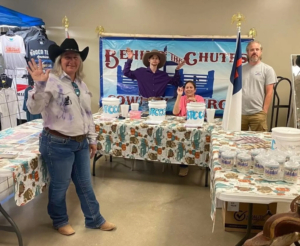
Behind the Chutes Cowboy Church’s booth, set up with literature, handouts, promotional materials about the church, and give away Bibles and daily devotionals for church members to engage the Tri-State Fair & Rodeo attendees with the gospel (Texas Baptists photo)

Cowboy church ‘opens up a different door’

Cowboy church ministry “opens up a different door to minister to these [cowboys] where you wouldn’t have a chance with them otherwise,” Belote said.

“You get cowboys back in the back, and they kneel down and pray [before their event]. You pray whether [you’re] religious or not,” Belote explained. “[So, by ministering to them], we’re actually making that door [to get to Jesus] wider.”

Belote recalled how a church member and high school friend, Marty, has been impacted by “the cowboy church movement.”

“I reached out, and he was just getting out of jail again, and we took him in. I got him involved with the ministry, and we got him involved in church, and for the last three years now, he’s been clean. He’s dedicated his life back to Christ,” Belote said.

“If it wasn’t for the cowboy church movement, I don’t think he’d have ever come to Christ.”

Marty volunteers at the church’s Tri-State Fair & Rodeo booth and shares his testimony with those he encounters, Belote said.

“Now, he’s got a purpose, and because he knows that Christ is with him and has helped him get through this, he’s sharing that through [our] ministry, being up there and talking to those guys while he works that booth [at the rodeo],” Belote said.
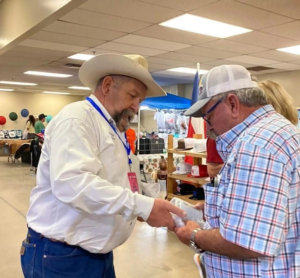
Behind the Chutes Cowboy Church member and volunteer gives Tri-State Fair & Rodeo attendee branded coffee mug (Texas Baptists photo)

Planting seeds, making disciples

Behind the Chutes has grown by having a presence at the Tri-State Fair & Rodeo, Belote said.

“I do get some locals, they come out to church because of [the booth], just to check it out because a lot of people haven’t heard about the cowboy ministry. They don’t know it’s out there,” Belote said. “So, it’s about getting the word out to people [about the ministry].”

Belote shared that another church member and volunteer has particularly contributed to growth.

“She knew a lot of barrel racers. So, with her knowing the people that she knew, she’s able to go [to the rodeo] and work that booth and share the word of Christ with [barrel racers] and bring a few to church that way,” Belote said.

The heart behind the church’s presence at the rodeo is to “go out and make disciples,” he said.

“People think Cowboy Church is just about cowboys. It’s not. It’s about Christ, and it’s about bringing everybody, no matter who they are, [to Christ],” Belote said. “We can’t save anybody, but we can sure[ly] plant a bunch of seeds.”


Celebrating Churches: FBC Olney holds groundbreaking

Celebrating Churches is a new feature column to celebrate Texas Baptist church and minister anniversaries, baptisms, ministries of local churches, and other items and events of note for BGCT-affiliated churches. To learn more about this new column and/or to submit an entry for inclusion, email news@baptiststandard.com.

The First Baptist Church of Olney held a groundbreaking on Sunday, Jan. 18, for a new educational facility. The project involves the construction of a state-of-the-art facility designed to replace aging infrastructure. Chad Edgington is senior pastor.

DaySpring Baptist Church of Waco was selected as the Christians Caring for Creation Church of the Year for 2025. Christians Caring for Creation recognizes congregations that demonstrate exceptional leadership in caring for God’s creation through faithful action, creative stewardship, and community engagement. The church’s property is now designated a National Wildlife Federation Certified Wildlife Habitat. Eric Howell is pastor.

We celebrate those churches throughout Texas and elsewhere across the United States who will serve their communities amid the anticipated hazardous winter weather this weekend. Thank you for caring for people in need in Jesus’ name.

Part of celebrating churches is helping them grow and develop. The Baptist Standard’s Equip column is full of resources for the growth and development of the church.


Racism and greed related, Baylor leader contends

A member of Baylor University’s President’s Council addressed the relationship between racism and greed during Church Under the Bridge’s Annual Racial Reconciliation Worship Service during the Martin Luther King Jr. Day weekend.

This year’s theme focused on “why the love of money is the root of all evil” and “how the church can create a new way forward.”

Malcolm Foley, author of the book The Anti-Greed Gospel and special adviser to the president for equity and campus engagement at Baylor University, spoke to a crowd under Interstate 35 in Waco, explaining race and racism is more than about identity and hate. It’s also about greed.

In his book and Sunday’s message, Foley suggested, “The strongest principality in American life is money, and race and racism are a perfect case study for understanding how that works.”

Members and guests of Church Under the Bridge in Waco. (Photo/Kendall Lyons)

“The argument is race and racism are not fundamentally issues of identity, hate, or ignorance,” Foley said. “Rather, it is about greed.”

“If a community wants to be truly anti-racist, it must be anti-greed, inspired by the Holy Spirit to resist the death-dealing and imagination-strangling wiles of racialized capitalism. Race’s historical and social purpose is to justify systems of economic exploitation. So, it can only be resisted by communities that bear witness to Christ’s call for us to share,” Foley said.

“The body of Christ is supposed to be a place where money doesn’t matter,” which makes Church Under the Bridge so pivotal for Waco and the surrounding community, Foley added.

“What is most inspiring about the Church Under the Bridge is the economic solidarity and diversity present in the congregation. In this country, the primary mode of segregation has always been along the lines of money and opportunity,” Foley said.

Modeling anti-greed

Jimmy Dorrell, pastor and founder of Church Under the Bridge and Mission Waco, said his ministry work targets the issue of need and helplessness daily by meeting people with the gospel and service.

“We’ve been doing this for 25 years and it continues to grow,” Dorrell said. “We believe the church needs to be intercultural and break down barriers. We deal with the poor and the unchurched, and we get to be creative and do things we believe are important for the kingdom.”

Dorrell said his goal was not to blame but instead empower Christians to respond to community needs.

“I believe in the church. I love the church. But I believe we lost our way in some ways,” Dorrell said. “My goal is not to blame people and point fingers but show how the church can do something about these things.”


DBU cancels classes, evacuates after receiving threats

DALLAS—Dallas Baptist University cancelled classes and evacuated after several threats were made ahead of Thursday morning’s visit by U.S. Housing and Urban Development Secretary Scott Turner.

Turner is a former DBU trustee. He also was an associate pastor at Prestonwood Baptist Church in Plano when he was nominated to be HUD secretary.

Kim Soto, assistant director of media and public relations, confirmed DBU was made aware of the unverified threats and is responding with an abundance of caution.

“Dallas Baptist University has been made aware of several unverified threats involving the campus. While there is no confirmed indication of immediate danger, university leadership is proactively assessing the situation and working closely with law enforcement officials to ensure the safety of our community,” Soto said.

“The safety and well-being of our students, faculty, and staff remain our highest priority. Additional updates will be shared as appropriate, as the situation continues to be monitored,” Soto added.

DBU issued an “emergency response” on Facebook announcing the cancelation of classes for Thursday, Jan. 22, “out of an abundance of caution.”

The Dallas Morning News reported the Dallas Police Department is investigating the reported threats.

DBU released a statement Thursday afternoon announcing the campus will reopen Friday, Jan. 23, HUD Secretary Turner’s visit will be postponed, and cooperation will continue with Dallas Police and the FBI on the investigation.

“We are grateful to share that the Dallas Police Department and the FBI worked alongside our DBU Police Department to investigate the matter, and we can now issue an all-clear. There is no active or ongoing threat to our campus community. Classes and normal University operations will resume tomorrow, Friday, Jan. 23,” DBU Communications said.

DBU, in coordination with local law enforcement officials, said no credible threat was confirmed.


Texans on Mission responding to winter storm

UPDATED, Jan. 26, 1:30p.m

Texans on Mission is gearing up for the approaching winter storm that may result in widespread power outages, broken tree limbs, and dangerous below freezing temperatures.

Texans on Mission released a statement on social media verifying they are “on alert” after a winter storm watch was issued for the North Texas region.

“Texans on Mission feeding and chainsaw teams are on alert to serve after a winter storm watch was put in place for North Texas. Feeding teams are also preparing to cook meals for those braving below freezing temps. Please pray for volunteers and for Texas residents as they prepare for the weather,” the Texans on Missions Facebook post reads.

“This is what we are called to do. We’re here to be the hands and feet of Christ to serve those in need. By providing hot meals, we hope to show the love of Christ to those sheltering from the cold,” David Wells, Texans on Mission director of disaster relief, said.

Campus closures

As the winter weather grips the majority of Texas, college campuses are taking an abundance of caution, closing campuses and cancelling classes.

Baylor University is providing updates online with modified hours for varying campus facilities and parking.

Dallas Baptist University announced they will be closed Saturday, Sunday, and Monday. Saturday and Monday classes will take place online, and on-campus facilities like the library, the coffeehouse, and fitness center will open for modified hours.

Houston Christian University will be closed Monday, and all classes and campus activities have been canceled.

East Texas Baptist University cancelled activities for the weekend but will be open for remote online learning Monday.

Hardin-Simmons University cancelled classes on Friday and encouraged their students, faculty, and staff to check their HSU emails, online resources, and campus text notifications for further bulletins.

University of Mary-Hardin Baylor released a statement, closing campus Monday.

Feeding at Fair Park, Dallas

Texans on Mission is coordinating a large-scale relief effort at Fair Park in Dallas, where they will serve two meals per day, totaling 1,800 meals per serving, for a total of 3,600 meals daily.

Meals will be prepared at Texans on Mission headquarters and transported to Fair Park.

Two shower trailers will be deployed to provide hygiene services for those staying on location.

Meals will be scheduled from Saturday evening through Tuesday.

During the storm, Our Calling and Austin Street are providing temporary housing for the unhoused at Fair Park. Texans on Mission will partner with both organizations to provide meals and showers.

Showers were excluded in the provisions due to city code.

The National Weather Service is forecasting a weekend-long winter storm with the majority of North Texas anticipating freezing rain, snow, ice, and sleet.

Temperatures Friday through Sunday are expected to be in the 10s and 20s.

Church property insurers have urged churches to implement protective safeguards ahead of the storm.

This report will be updated.


La preparación de las iglesias crucial ante la inminente ola de frío

Mientras el norte de Texas se prepara para otro importante sistema meteorológico invernal, las iglesias de toda la región se enfrentan a mayores riesgos operativos, de seguridad y de daños a la propiedad.

Los pronósticos indican una mezcla invernal de nieve, aguanieve y lluvia helada a partir del viernes por la tarde, con el mayor impacto previsto en el área de Dallas-Fort Worth alrededor de las 9 p.m.

El Servicio Meteorológico Nacional en Fort Worth pronostica condiciones climáticas invernales peligrosas para el norte de Texas entre el 23 y el 25 de enero. (NWS Fort Worth, captura de pantalla)

Las temperaturas descenderán a menos de 0 °C el viernes por la noche y se prevé que se mantengan bajo cero durante todo el fin de semana, lo que aumenta la probabilidad de cortes de energía, condiciones de viaje peligrosas, como carreteras resbaladizas, y daños a la propiedad. Se insta a los residentes de estas áreas a evitar las carreteras y proteger sus tuberías de posibles daños.

Según un artículo de Associated Press, los meteorólogos predicen que Texas podría ser parte de una tormenta potencialmente catastrófica durante el fin de semana, con fuertes nevadas y lluvia helada peligrosa como resultado del choque entre el aire frío y la lluvia, formando una masa de aire frío ártico.

Los meteorólogos advierten que este sistema podría ser parte de una tormenta más amplia y de alto impacto que afectaría a varios estados, con peligrosa acumulación de hielo e interrupciones en el transporte. Para las iglesias, las implicaciones van más allá de las molestias. Implican la administración de recursos, la seguridad y la continuidad del ministerio.

La concienciación es fundamental

Jacob Robb, meteorólogo de Risk Theory Loss Control, enfatizó que las iglesias se benefician más cuando la información meteorológica es proactiva en lugar de reactiva.

“Es posible que las iglesias no tengan la infraestructura [que necesitan]. Queríamos ayudarlas a [prepararse] de cualquier manera posible, comenzando con avisos de heladas”, dijo Robb.

A través de KingsCover, las iglesias inscritas en el programa para iglesias de Risk Theory reciben avisos anticipados de heladas y condiciones meteorológicas adversas. Estas alertas están diseñadas específicamente para las instalaciones y los equipos de liderazgo de las iglesias, proporcionando pronósticos concisos, expectativas de impacto y orientación práctica para la preparación.

En lugar de depender únicamente de la cobertura general de los medios de comunicación, las iglesias reciben comunicaciones específicas centradas en cómo las próximas condiciones meteorológicas pueden afectar los sistemas de plomería, los equipos de climatización, los techos y la infraestructura hídrica.

“Les enviamos avisos, básicamente explicando lo que pueden esperar, y tratamos de desglosar [la información] para brindarles solo la información que necesitan”, explicó Robb.

Cuando las puertas de la iglesia permanecen abiertas

Las iglesias, que a menudo permanecen abiertas durante condiciones climáticas adversas para servir a la comunidad, pueden correr un mayor riesgo de sufrir daños.

Durante una helada que ocurrió el domingo en San Antonio, organizaciones sin fines de lucro e iglesias locales abrieron sus puertas a las personas sin hogar de la comunidad, ofreciendo refugio, ropa y comidas calientes a quienes lo necesitaban.

Según el sitio web del bufete de abogados Voss, especializado en seguros en Houston, las iglesias pueden ser especialmente vulnerables a las inclemencias del tiempo invernal debido al uso irregular de sus edificios.

Las iglesias no suelen estar abiertas los siete días de la semana ni permanecen abiertas durante las heladas, lo que hace que las tuberías sean más susceptibles a congelarse cuando no están en uso.

Operar en estas condiciones climáticas plantea problemas de responsabilidad, lo que podría exponer a demandas a las iglesias que no cuentan con un seguro de propiedad adecuado.

En muchos casos, la estructura del edificio no puede soportar grandes cantidades de nieve o hielo. Esto es especialmente cierto en los edificios antiguos, que a menudo no cuentan con la infraestructura o los sistemas de calefacción adecuados para prevenir daños.

Las iglesias antiguas pueden sufrir el deterioro de los materiales, métodos de construcción obsoletos y el desgaste general asociado con el paso del tiempo.

Consejos para prevenir daños

John Murphy, vicepresidente sénior de KingsCover, explicó que muchas pérdidas materiales son prevenibles si las iglesias comprenden y siguen los requisitos básicos de seguridad.

“En casi todas las pólizas de seguro comercial actuales, encontrará una sección de requisitos de seguridad. Esa sección dirá: ‘Exigimos que mantenga la calefacción en sus edificios durante una helada’”, dijo Murphy.

“La calefacción debe estar encendida a una temperatura mínima de, generalmente, entre 55 y 60 grados Fahrenheit. No se puede apagar la calefacción del edificio y no tomar las medidas de seguridad básicas para evitar que las tuberías se congelen”, agregó Murphy.

Estos requisitos suelen incluirse en lo que las aseguradoras denominan una “cláusula de protección”, lo que convierte su cumplimiento en una condición para la cobertura.

Precauciones adicionales, como dejar correr un poco de agua en los puntos clave de la red de plomería, monitorear las salas de máquinas y revisar los edificios desocupados, reducen aún más la probabilidad de fallas en las tuberías.

“Si sabe que se avecina una helada intensa, debe dejar correr un poco de agua en al menos un grifo de cada edificio, para que el agua siga fluyendo. El agua en movimiento generalmente no se congela”, aconsejó Murphy.

Muchos de los problemas que enfrentan las iglesias durante las heladas se deben a la falta de monitoreo rutinario: “El principal problema específico de las iglesias que observamos es que, con frecuencia, la gente no visita muchos de sus edificios con regularidad”, afirmó Murphy.

Según Murphy, las reclamaciones de seguros pueden empeorar considerablemente si el personal o los voluntarios de la iglesia no prestan atención a los posibles problemas en ciertas partes del edificio.

“Podría reventar una tubería de agua y nadie se enteraría durante varios días. Podría inundar varios pisos y causar mucho más daño que si se detectara de inmediato”, dijo Murphy.

La antigüedad también es un factor importante que afecta a las iglesias, ya que muchas iglesias históricas siguen en uso hoy en día.

“Otro problema común es que muchas iglesias utilizan edificios antiguos. Están construidos con menos aislamiento”, dijo Murphy.

Dado que muchas iglesias no cuentan con instalaciones modernas, es fundamental que el personal o los voluntarios supervisen las tuberías y los sistemas de calefacción y aire acondicionado con la mayor frecuencia posible. Esto incluye los edificios anexos, como las guarderías y los salones de usos múltiples.

Murphy señala que muchas iglesias excluyen la cobertura de propiedad de ciertos edificios debido al costo, lo que hace que sea crucial mantener las medidas de seguridad básicas para prevenir daños en estas áreas.

“En los últimos cinco años, más iglesias han optado por excluir la cobertura de propiedad de ciertos edificios debido a preocupaciones por el costo”, dijo Murphy. “Es más importante que nunca, si no se tiene seguro en un edificio y se sabe, tomar las medidas básicas para prevenir daños”.

Servir a la comunidad con confianza

Ante las bajas temperaturas, muchas iglesias optan por mantener sus puertas abiertas, brindando refugio a las personas necesitadas. Si bien esto plantea preocupaciones de responsabilidad civil, Murphy anima a las iglesias a mantener sus puertas abiertas para quienes lo necesiten.

Durante condiciones climáticas adversas, las iglesias a menudo se sienten llamadas a abrir sus puertas para servir a las poblaciones vulnerables. Si bien esto conlleva un riesgo inherente, Murphy enfatizó que los programas de seguros para iglesias bien estructurados pueden respaldar las iniciativas de ayuda.

“Un buen programa de seguros puede brindar cobertura de responsabilidad civil para estas actividades. Sería conveniente asegurarse de tener una póliza específica para iglesias que no excluya nada relacionado con las labores de ayuda en casos de desastre”, dijo Murphy.

“Siempre existe cierta responsabilidad cuando acogemos a personas para ayudarlas. Pero sin duda es algo que animamos a las iglesias a hacer. Si tienen la oportunidad de ayudar a la comunidad, háganlo y compartan el evangelio al mismo tiempo”, dijo Murphy.

La fe y la responsabilidad no son mutuamente excluyentes, continuó Murphy. Cuando una iglesia está preparada, puede servir con confianza, sabiendo que ha tomado las medidas adecuadas para proteger tanto a las personas como a la propiedad, concluyó.


Obituary: Jim Houser

James Lawrence “Jim” Houser, missionary to Africa and Baylor University professor, died Monday, Jan. 19, 2026, at his home. He was 92. He was born Oct. 19, 1933, in Philadelphia, Pa., the third of four sons born to Myra and Delbert Henry Houser. After the family moved to Mesquite, Jim attended Mesquite High School, where he was active in sports. He later attended Baylor University, where he met Molly Alice Rogers. They married on Aug. 28, 1953, and were married 67 years when Molly died in Nov. 2020. Following Baylor, he earned a master’s in counseling from Golden Gate Baptist Theological Seminary, an additional degree from the University of Utah on a National Science Foundation grant, and then a master of education degree from Texas Wesleyan University in 1959. After hearing a missionary speak about their work in East Africa, he and his family began serving in many towns in Kenya and Tanzania. Jim and Molly left Africa in 1993 but continued their involvement in missions at the church and county level in Texas. During their post-Africa years, Jim was hired by Baylor University to teach Swahili, which he did for about 18 years. In July 2025, he moved to Missouri, where he married Carol Ann (Wallace) Brubeck, a former missionary in Tanzania. He was passionate about Africa and preaching, making at least ten return trips to Africa after leaving in 1993. He is survived by his wife, Carol; five children, Stacy Houser and wife Tami, Mona Entwistle and husband Dave, Bryan Houser, Scott Houser and wife Ana, and Bill Houser and wife Lisa; stepchildren, Dan Brubeck and wife Angela, Clint Brubeck and wife Ruth, Jessica Eisenhauer, Linda Brubeck, Maria Brubeck, and Mario Brubeck; three brothers, Charles, Don, and Paul Houser; 18 grandchildren, and 23 great-grandchildren. He was preceded in death by his parents and first wife, Molly Alice Rogers.


Villagers destroy homes of Christian families in India

MIDAPALLI, India—Villagers in Midapalli, located in the Gadchiroli District of India’s Maharashtra State, demolished the homes of four Christian families Jan. 12, amid an ongoing campaign of threats and violence against the village’s Christian community.

Christian Solidarity Worldwide reported tensions rose on Jan. 11, when 25 villagers confronted four families and two others to force them to renounce their faith.

Reports go on to say a mob of at least 20 villagers attacked the families, demanding the victims renounce their faith as they demolished the houses of those families.

On Jan. 13, victims tried to file a complaint at the Kawande Police Station, but police took the side of the mob, according to the report. The officer in charge threatened Christian families, “questioned their decision to embrace Christianity as members of a tribal community,” and warned “their unique identity cards and ration supplies would be cancelled.”

Mervyn Thomas, founder and president of CSW, called for intervention over the incident.

“It is deeply concerning to witness the grave and unacceptable assault and humiliation these families have been subjected to on account of their religion,” Thomas said. “Even more alarming is the failure of the police to protect these vulnerable citizens, which has emboldened the perpetrators.”

“We call upon the district administration and state authorities to intervene as a matter of urgency, ensuring the safety of the affected families, restoring their rights, compensating them for the loss of their homes, and holding those responsible to account under the law,” Thomas added.

Call to come alongside

Wissam al-Saliby, president of 21Wilberforce, called on churches around the world to come alongside their Christian brothers and sisters in India

“Anti-conversion laws have been on the books for decades in several Indian states. However, communal relations have worsened since 2014, even in states where Christians enjoyed greater freedom and good relations with their neighbors,” al-Saliby said.

“We call on churches that enjoy freedom in the United States, the Western Hemisphere, Latin America, and elsewhere to come alongside brothers and sisters in India. Listen to them and support their efforts toward greater freedom and peacemaking among communities,” al-Saliby continued.

The support from the officers emboldened the villagers who continued to launch threats toward the families.

Police working the case requested to speak to the local pastor, but during questioning, officers declared the pastor’s ministry “‘andhashradha’ (superstition)” and “prohibited the pastor from visiting families in the village.”


Church preparedness crucial with upcoming freeze

As North Texas prepares for another significant winter weather system, churches across the region face heightened operational, safety, and property risks.

Forecasts indicate a wintry mix of snow, sleet, and freezing rain beginning Friday afternoon, with the greatest impact expected in the Dallas-Fort Worth area by 9 p.m. 

The National Weather Service in Fort Worth forecasts hazardous winter weather for North Texas, Jan. 23-25. (NWS Fort Worth, screenshot)

Temperatures will drop into the 20s Friday night and are projected to remain below freezing through the weekend, increasing the likelihood of power outages, hazardous travel conditions such as slick roads, and property damage. Residents in these areas are urged to stay off roads and protect their pipes from potential damage. 

According to an Associated Press article, forecasters predict Texas may be part of a potentially catastrophic storm over the weekend, resulting in heavy snow and treacherous freezing rain resulting from cold air clashing with rain and forming a cold, arctic air mass.

Meteorologists warn this system could be part of a broader, high-impact storm affecting multiple states, with dangerous ice accumulation and travel disruptions. For churches, the implications extend beyond inconvenience. They involve stewardship, safety, and continuity of ministry.

Awareness is critical

Jacob Robb, meteorologist with Risk Theory Loss Control, emphasized churches benefit most when weather intelligence is proactive rather than reactive.

“Churches may not have the infrastructure [they need.] We wanted to help them [prepare] in any way we could, starting off with freeze notices,” Robb said. 

Through KingsCover, churches enrolled in the Risk Theory church program receive advance freeze and severe weather notices. These alerts are designed specifically for church facilities and leadership teams, providing concise forecasts, impact expectations, and actionable preparation guidance.

Rather than relying solely on general media coverage, churches receive targeted communications focused on how upcoming weather conditions may affect plumbing systems, HVAC equipment, roofs, and water infrastructure.

“We send them notices, basically explaining what they can expect, and we try to break down [the information] so that we are giving them just the information they need,” Robb explained. 

When the church doors stay open

Churches, which often remain in operation during adverse weather conditions to serve the community, may be at higher risk of suffering damage.

During a freeze that occurred on Sunday in San Antonio, local nonprofits and churches opened their doors to homeless members of the community, offering shelter, clothes, and warm meals to those in need. 

According to the Voss Law Firm website, an insurance attorney in Houston, churches may be especially susceptible to winter weather due to irregular use of church buildings. 

Churches may not operate seven days a week or remain open during wintry weather, making pipes more susceptible to freezing while not in use.

Operating during these weather conditions raises liability concerns, potentially exposing to lawsuits churches that do not have proper shelter insurance in place.

In many cases, the building’s structure is unable to withstand large amounts of snow or ice. This is especially true of older buildings, which often don’t have the proper infrastructure or heating systems to prevent damages. 

Older churches may suffer from deteriorated materials, outdated construction methods, and general wear and tear associated with age. 

Tips for preventing damage

John Murphy, KingsCover senior vice president, explained many property losses are preventable when churches understand and follow basic safeguard requirements.

“In almost every commercial insurance policy that you see today, you’re going to see a required safeguards section. That section will say, ‘We require you to maintain heat in your buildings during a freeze,’” Murphy said. 

“The heat needs to be turned on a minimum of, generally, 55 to 60 degrees. You cannot turn the heat off in your building and not do the basic safeguard that will prevent your pipes from freezing,” Murphy added.

These requirements are often included in what insurers call a “protective safeguards endorsement,” making compliance a condition of coverage.

Additional precautions—such as allowing water to flow slightly in key plumbing locations, monitoring mechanical rooms, and checking unoccupied buildings—further reduce the likelihood of pipe failures. 

“If you know a deep freeze is coming, you should have the water run a little bit out of at least one faucet in each building, so that water is continuing to flow. Flowing water will not generally freeze,” Murphy advised. 

Many issues churches face during freezing weather involve a lack of routine monitoring: “The biggest thing specific to churches that we see as far as a problem, is that so often people don’t go into many of their buildings on a regular basis,” Murphy stated.

Insurance claims, according to Murphy, can get much worse as a result of church staff or volunteers not attending to potential issues in certain parts of the building. 

“You could have a water pipe burst, and nobody [would] know about it for several days. It can flood through many stories and do much more damage than if it was caught immediately,” Murphy said.

Age is also a major factor that affects churches, with many historical churches still in use today. 

“Another common issue is that so many [churches] use old buildings. They’re built with less insulation,” Murphy said. 

Because many churches do not have updated facilities, it is crucial for staff or volunteers to monitor pipes and heating and A/C units as much as possible. This extends to ancillary buildings, such as child care facilities and fellowship halls. 

Murphy notes many churches exclude property coverage from certain buildings due to cost, making it crucial to maintain basic safeguards to prevent damage in these areas. 

“More churches over the last five years have chosen to exclude property coverage from certain buildings because of concerns with cost,” Murphy said. “It is more important than ever, if you don’t have insurance on a building and you know it, that you do the basics to prevent damage.”

Serving the community with confidence

As churches experience freezing temperatures, many choose to keep their doors open, providing shelter to individuals in need. While this raises liability concerns, Murphy encourages churches to leave their doors open to those in need.

During severe weather, churches often feel called to open their doors to serve vulnerable populations. While this carries inherent risk, Murphy emphasized that properly structured church insurance programs can support outreach efforts.

“A good insurance program can provide liability for [outreach.] It would be worthwhile to make sure you have a church specific policy that doesn’t exclude anything like disaster relief efforts,” Murphy said.

“There is some liability assumed always whenever we take people in to try to help. But it’s certainly [something] we encourage churches to do. If there’s a chance for you to help the community, do it, and share the gospel while you’re at it,” Murphy said.

Faith and responsibility are not mutually exclusive, Murphy continued. When a church is prepared, it can serve confidently, knowing it has taken appropriate steps to protect both people and property, he concluded.


Cities Church considering legal options after anti-ICE protest

Leaders of Cities Church, the Minneapolis congregation whose worship service was disrupted by anti-ICE protesters, are considering legal action against the activists, saying the group that invaded the church on Sunday, Jan. 18, “jarringly disrupted our worship gathering.”

In a statement issued Tuesday, the church leaders said the protesters “accosted members of our congregation, frightened children, and created a scene marked by intimidation and threat. 

“Such conduct is shameful, unlawful, and will not be tolerated. Invading a church service to disrupt the worship of Jesus—or any other act of worship—is protected by neither the Christian Scriptures nor the laws of this nation,” the statement reads.

The church also called on federal officials to protect all houses of worship from similar protests.

Protests targeted ICE affiliated pastor

Nekima Levy Armstrong, a minister, lawyer, and activist, told The Washington Post activists were protesting against David Easterwood, a lay pastor and elder at the Southern Baptist church who also works for U.S. Immigration and Customs Enforcement. Armstrong said she was angered at seeing a video of Easterwood defending his work with ICE.

“I don’t understand how as a pastor he thinks that that’s acceptable,” Levy Armstrong told the Post.

Easterwood is one of several ICE officials, including Homeland Security Secretary Kristi Noem, named in a federal lawsuit filed by protesters in Minnesota who have accused federal officials of trying to suppress their free speech. 

“They have pepper-sprayed, violently subdued, and aimed assault rifles at protesters and observers, and even followed observers home to scare them in a tactic lifted straight from the mafia,” the lawsuit alleges. 

Easterwood, the acting field director of an ICE office in St. Paul, has denied the allegations.

Videos circulating online

Videos of the protest were shared widely on social media over the weekend, leading to outrage from Southern Baptist and other evangelical Christian leaders. SBC President Clint Pressley, in an interview with Religion News Service, said the scene was “just unbelievable.”

Pressley said he was thankful the protest ended peacefully, given how recent shootings and acts of violence at houses of worship have put congregations on edge. “It scared me to death to think about what might happen in a church if you had intruders like that,” he said.

No matter what people think about ICE, he said, disrupting a church service is wrong.

In a message on the Cities Church website, pastor Jonathan Parnell wrote: “Rejoice in the trial. See God’s blessing. Keep doing good.”

Cities Church was planted by Parnell in 2015 and worships in a former Episcopal church known as St. Paul’s on the Hill. An article on the church’s website notes the church is “neither a gym nor a theater,” unlike many modern evangelical churches. 

Through the SBC’s North American Mission Board, church leaders declined a request for an interview.

The congregation has a more formal liturgy than many SBC churches, including a weekly confession of sin and “assurance of pardon,” as well as Communion at every service. 

The church also has ties to Bethlehem College and Seminary, a school started by John Piper, a bestselling author and pastor, and Joe Rigney, an author and professor known for his belief that empathy is sinful and his critique of “woke” Christians.

On X on Monday, Rigney called himself a founding pastor of Cities Church. He is now a pastor at Christ Church DC, where Secretary of Defense Pete Hegseth attends, a congregation “which faces weekly protests by vile leftwing activists.”

Department of Justice conducts investigation

The U.S. Department of Justice is investigating Sunday’s protest for possible civil liberty violations or violations of the 1994 Freedom of Access to Clinic Entrances Act, which protects access to both abortion clinics and houses of worship. 

The FACE Act also bans protesters from intentionally “injuring, intimidating, or interfering with, or attempting to injure, intimidate, or interfere, any person by force, threat of force, or physical obstruction.”

John Greil, a law professor at the University of Texas who co-teaches a religion and law clinic, said the protesters had claimed they wanted to disrupt a worship service and that videos of the incident seem to show at least some activists appear to have intimidated worshippers.

“There’s a pretty touching image of a child who’s being consoled by her parents, and at least some of those individuals who went into the church were going into people’s faces, shouting,” he said. “I think that that satisfies intimidation or interferes with worship.”

Greil also said one protester appeared to threaten a worshipper who asked him to leave.

Though protesters could invoke a First Amendment right to protest at the church, Greil said, that would hold true only if the protest had taken place on the sidewalk or in another public forum.

In a 2011 ruling, the U.S. Supreme Court reversed a $5 million award for damages against members of Westboro Baptist Church who had been sued for protesting at a veteran’s funeral, ruling the church members had protested from the sidewalk outside the funeral, not on private property.

A protest on private property is different from a public setting, Greil said.

“I think we could very easily imagine the real harms that would happen if Black churches were interrupted by white supremacists just to chant public slogans, if Jewish services were interrupted, if Muslim prayer services were interrupted,” he said. “I think it’d be a pretty scary world to imagine.”

Greil said the church could sue protesters for trespassing on its property.

Police department further investigating

The St. Paul Police Department is also investigating the incident, in which 30 to 40 protesters entered the church, though most of them had left the building and were walking away when the officers arrived about 10:40 a.m. local time.

“This incident is an active & ongoing disorderly conduct investigation,” public information officer Alyssa Arcand told RNS in an email. “Because this is an open investigation, no additional public information is available at this time.”

The Baptist Joint Committee, a pro-religious freedom group, declined to comment specifically on the protest but issued a statement on Tuesday criticizing the Trump administration for undermining religious liberty in its immigration policies. 

“In Minneapolis and across the country, the threats to the religious freedom of all people are not the people standing up for and participating in civic life but the people who wield state power in a manner that undermines it,” the statement read. 

The statement also called on officials to “respect places of worship as spaces of conscience and community.”

Immigration issues cause fear

Trey Turner, executive director of the Minnesota-Wisconsin Baptist Convention, said Baptist churches in both states have been struggling to respond to ICE enforcement and the issue of immigration. Many of the churches in the convention, he said, including about a third of those in the Twin Cities, serve immigrant congregations.

“There are Hispanic churches that are not meeting right now because they are afraid of what’s happening in our part of the world, in part, because of the interaction between the federal government and the state government,” said Turner.

Even church members who have legal status fear ICE could raid churches, he said, causing a great deal of concern in the immigrant community. He said churches in the convention don’t all agree on how best to deal with the issue of immigrants.

This week, Turner hopes to meet with Baptist leaders from the Southeast Asian Hmong community to talk about ways SBC churches in Minnesota can work together to support one another.

Turner cautioned not all Southern Baptists hold the same view on immigration, but many other pastors in the area had reached out to offer their support. Turner said his first thought after hearing about the protest was, “How can I serve this congregation going through this trauma?”

“Because they’re going to try to get together this coming Sunday, and what will be the response?” he said.

He said Sunday’s protest felt like something sacred had been violated. People go to church to seek sanctuary from the outside world, he said. They don’t expect the kind of chaos and disruption that occurred on Sunday.

“It’s shocking to us,” he said.


Over 100 Christians abducted during worship in Nigeria

Nearly 175 worshippers were abducted Jan. 18 from three churches in Kaduna State in Nigeria’s Middle Belt, Christian advocacy groups reported, after at least 35 were killed in separate attacks on villages in the Middle Belt and eastern Nigeria.

Approximately 167 Christians remained captive today, Jan. 20, according to reports from Christian Solidarity Worldwide and International Christian Concern, with witnesses and others attributing the abductions to bandits and Fulani militants, although no group has claimed responsibility.

Fulani herdsmen are blamed for killing at least 12 Christians in various attacks in several Plateau State villages Jan. 1–9, killing 13 Christians in several attacks in Benue State Jan. 5–12, and 10 Christians in four villages in Taraba State in eastern Nigeria Jan. 10, Christian Daily International-Morning Star News said in three separate reports.

“Two Christians who are members of our community were attacked by a group of armed Fulani herdsmen in broad daylight,” Christian Daily International-Morning Star quoted Yohana Thomas, head of the Plateau Youth Council of the Gyel District in Jos South County in Plateau. “One of the victims was stabbed to death, while the second victim suffered life-threatening injuries.”

The killings and kidnappings are separate from the murder of 58 individuals in Christian villages in Niger State, Nigeria, Dec. 29–Jan. 3.

Jan. 18 attack

In the Jan. 18 abductions, attackers divided themselves into three groups and captured worshipers from three churches in the Kurmin Wali community of the Kajuru Local Government Area, including the Evangelical Church Winning All, Albarka Cherubim and Seraphim 1, and Haske Cherubim and Seraphim 2.

Yunusa Sabo Nmadu, chief executive officer of CSW Nigeria, lamented the attacks while applauding military successes he said occurred in the past few months to counter the violence.

“CSW condemns the repeated attacks on the vulnerable people in Kurmin Wali and surrounding communities,” Nmadu said in a CSW press release. “We urge the security agencies to ensure the prompt release of those abducted and to enhance security for all other vulnerable areas.

“We also call on the government to strengthen the local capacity of these villagers to serve as the first line of defense against terrorists who are increasingly emboldened by each unchallenged abduction.”

While some Nigerian federal authorities denied the kidnappings, several elected officials confirmed it, Christian Daily International-Morning Star reported.

Access denied

A ministry team of CSW Nigeria tried to visit the Kurmin Wali community to verify the kidnappings, but Nigerian military officials told them of a standing order not to let them enter the area, the group reported.

“However, several local sources who later spoke to CSW [Nigeria] on the basis of anonymity said a large number of Fulani militia men had stormed the area on foot and on motorcycles at around 9 a.m. (Jan. 18) as members of the community were attending their respective church services,” CSW said in a press release.

Sources told CSW Nigeria they were compiling a list of the names of those still held, believed to be 167 individuals.

Among the captives are Baptist church leader Daniel Bagama, CSW said, who was abducted from Tudun/Bussah village in the Chikun Local Government Area of Kaduna, Jan. 18, with his three daughters.

Call for accountability

CSW Founder and President Mervyn Thomas expressed high concern for attempts to obscure the abductions, calling on the government to do all it can to secure the captives’ release.

“The government of Nigeria at both state and federal levels must be transparent about the scale and severity of the security crisis the country is experiencing,” Thomas said, “and specifically about the asymmetry with which Christian communities are being targeted, in order to ensure an effective response to the terrorism that has blighted the lives of vulnerable citizens across central Nigeria for far too long.”

A group of 24 to 30 worshippers abducted in Kogi State in December were freed in poor condition in three separate incidents Jan. 1–13, CSW said.

The Nigerian government classified bandits and Fulani militants as terrorist groups for the first time in December 2025.

Nigeria is among the U.S. State Department’s countries of particular concern for committing and/or tolerating systematic, ongoing, and egregious violations of religious freedom.

In its 2026 World Watch List, Open Doors ranks Nigeria as 7th among the 50 most dangerous countries for Christians, and the deadliest, accounting for 3,490 of the 4,849 Christians killed for their faith in the 2026 reporting year spanning 2025.


Christian persecution at all-time high, report says

International Christian nonprofit and ministry Open Doors released its World Watch List for 2026 confirming Christian persecution is at an all-time high in 15 nations, including Nigeria and Syria.

The data released needs to be understood within a broader context, Wissam al-Saliby, president of 21Wilberforce, said.

“Around the world, violent conflict, domestic unrest, and human rights violations are increasing,” al-Saliby said. “When peace and security are threatened, when freedoms of expression and assembly are curtailed, freedom of religion is inevitably violated, and faith communities face greater pressure, discrimination, and threats of violence.”

“This dynamic is especially pronounced in countries where churches and Christian communities are growing,” al-Saliby said. “For Christians, it is essential to understand this bigger picture of where the world is heading in order to respond wisely and effectively.”

Open Doors’ 2026 World Watch List

Ryan Brown, CEO of Open Doors, told Baptist Press the increase in attacks on the church throughout the world is the result of the church advancing and the enemy’s work toward fighting the church.

The World Watch List ranks countries by their persecution scores. The score is a point system measuring from 0 to 100 with higher scores indicating severe persecution and danger for Christians residing in a specific country.

To compile the score, the World Watch Research Unit works with researchers to measure freedom of worship across six areas: private life, family life, community life, national life, church life, and violence. A score of 81-100 is considered “extreme persecution,” 41-60 “high,” and 61-80 is “very high.”

The World Watch List, according to Baptist Press, ranked North Korea first for the 24th year, with Somalia, Yemen, Sudan, Eritrea, Syria, Nigeria, Pakistan, Libya, and Iran ranked second through 10th.

Baptist Press also reported the following from Open Doors’ 2026 World Watch List:

  • 224,129 Christians were forced to leave their homes and go into hiding or leave their respective country.
  • 67,843 Christians were beaten, threatened, or physically or psychologically abused, 163 of whom were in Mexico.
  • 5,202 Christians were sexually assaulted, harassed, or forced to marry non-Christians, with an estimated 1,000 of those in the Democratic Republic of the Congo.
  • 25,794 attacks were made on Christian homes, shops, and businesses.
  • 4,849 Christians were killed for faith-related reasons, 3,490 of them in Nigeria.
  • 4,712 Christians were detained without trial, arrested, sentenced, or imprisoned, with more than 1,600 of these incidents occurring in India.
  • 3,302 Christians were abducted.
  • 3,632 churches or public Christian properties were attacked or closed, with about 1,000 of those in China.

Open Doors’ World Watch List is “an important tool for awareness,” al-Saliby said. Advocating for religious freedom, peace, and security can be built on that awareness, he explained.

“At 21Wilberforce, our advocacy for religious freedom and for peace and security is always shaped by country-specific contexts and developed in close dialogue with local Christian leaders,” al-Saliby explained.

“We listen carefully to understand their capacity, their margin of maneuver, and their sense of calling—where they believe God is leading them to advocate.”