Report notes lack of progress in global religious liberty
March 26, 2025
WASHINGTON (RNS)—The U.S. Commission on International Religious Freedom issued its annual list of countries it considers to be the most egregious violators of religious liberty and urged the new Trump administration to appoint a new ambassador-at-large for international religious freedom.
The commission’s 2025 report, released March 25, included a list of countries nearly identical to its 2024 list—a reflection, according to the report, that in most of those countries, things have not improved but often have worsened.
“The administration of President Donald J. Trump faces a complex international environment in which to build on its previous success of centering religious freedom as a cornerstone of foreign policy and global leadership,” the report states.
“Confirming this commitment to advancing freedom of religion or belief will require calibration and joint action with like-minded governments.”
The eight current commissioners of the bipartisan, independent agency asked Congress to halt the visits it receives from representatives of countries designated as the most egregious religious freedom violators.
“Lobbyists paid to represent the interests of governments that kill, torture, imprison, or otherwise persecute their populations because of what religion they practice or what beliefs they hold should not be welcome in the halls of Capitol Hill,” they stated.
The 2025 report also sought a successor to Rashad Hussain, whose ambassador-at-large post ended with the Biden administration. Hussain was recently announced as a distinguished senior fellow at the Institute for Global Engagement, a think tank that seeks to foster partnerships to build religious freedom.
“I think what’s critical here is an ambassador who has access, not only to Secretary (of State Marco) Rubio, but has access to the White House directly,” USCIRF Chair Stephen Schneck told RNS in an interview.
“It needs to be somebody, I think, of that level, given the surge of, the big uptick in violations of freedom of religion or belief around the world that we’re seeing right now.”
Recommended nations for CPC designation
The bipartisan, independent commission, reauthorized last year by Congress through September 2026, annually recommends to the State Department a list of countries to designate as “of particular concern” for committing “systematic, egregious, and ongoing” religious freedom violations.
The 2025 report seeks the redesignation of 12 countries: Burma, China, Cuba, Eritrea, Iran, Nicaragua, North Korea, Pakistan, Russia, Saudi Arabia, Tajikistan and Turkmenistan.
It also seeks designation of four others: Afghanistan, India, Nigeria and Vietnam.
The commission sought the same redesignations and designations last year, with a request to add Azerbaijan.
This year, it requested that Azerbaijan remain on the State Department’s second-tier special watch list, along with Algeria.
The commission also sought these countries to be added to the special watch list: Egypt, Indonesia, Iraq, Kazakhstan, Kyrgyzstan, Malaysia, Sri Lanka, Syria, Turkey and Uzbekistan.
US Commission on International Religious Freedom recommendations. (Courtesy image via RNS)
‘It’s become much worse’
Schneck, who was appointed by President Joe Biden, said the repetition in its requests about Countries of Particular Concern reflects the troubled state of religious liberty across the globe.
“It’s become much worse in several places, including Iran, Nicaragua and, frankly, Russia,” he said, adding that key drivers are often authoritarian governments like those, and religious nationalism in countries such as Myanmar (also called Burma), India and Turkey.
“We’re not seeing progress. In fact, in most of the countries on this list, we’re seeing regress.”
For the second year in a row, the commission also requested that the presidential administration appoint an envoy for Nigeria and the Lake Chad region, as northern portions of Nigeria have seen violence against Christians as well as Muslims.
Schneck said he was disappointed the State Department did not, as expected, announce its latest designations for its lists of religious liberty violators before the conclusion of the Biden administration, nor since the start of the Trump administration.
Concerns about USAID and refugees
The report noted the Biden administration’s funding of hundreds of millions of dollars of humanitarian aid through the U.S. Agency for International Development for religious groups facing genocide and persecution, such as Muslim Rohingya refugees located in and around Bangladesh and for the people of Syria.
But Schneck said those programs are part of the pausing of USAID funds that has occurred since Trump took office.
“As I understand, all of the freezes are still in place that affect those USAID programs,” Schneck said.
“We’re very hopeful that the new administration will act quickly to resolve some of these situations, so that some really needed programs to protect religious freedom on the ground in different parts of the world can be funded appropriately.”
Likewise, Schneck said the commission is worried about the plight of refugees whose temporary status in the United States is in jeopardy due to recent administration decisions.
“We are concerned about anything that makes it more difficult for refugees to flee from religious persecution to find safe haven,” he said.
In its new report, the commission requested its own permanent reauthorization, as well as that of the bipartisan Lautenberg Amendment that provides a legal process to resettle religious minorities from Iran and countries in the former Soviet Union.
The commission’s report also includes examples of people who have held to their religious beliefs even amid antisemitism, Islamophobia and other forms of religious hostility.
“One of the most heartening things that we see around the world is the resilience of people to stand up for their faith or their lack of faith, for that matter, their principles,” Schneck said, pointing to young people in Iran and congregants in churches in authoritarian countries.
“But the larger picture doesn’t change. We are concerned about what looks like a decaying picture for freedom of religion.”
‘Divine appointment’ awaits volunteers in Missouri
March 26, 2025
POPLAR BLUFF, Mo.—Three Texans on Mission disaster relief leaders motored down a country road in southeast Missouri where a tornado had devastated homes and trees. Then they had what Paul Henry later called a “divine appointment.”
Jacob Moneybrake, Texans on Mission’s new associate director of disaster relief, was in the truck with Henry and Wendell Romans.
“I had never seen anything like it, the devastation,” Moneybrake said of the scene in southeastern Missouri. “The further we went, the worse it got. I thought, ‘We’re here to take trees off homes, but the houses were beyond saving.’”
Henry, the Texans on Mission incident commander, said: “As we neared the end of the damaged area, a man named Jake was sitting in his pickup truck by the side of the road next to a driveway and waved us down.
“He was curious about what we were doing in the area,” Henry said. After the Texans on Mission team explained, Jake “pointed and shared that his brother had been killed in his home, and his sister-in-law had crawled out of the rubble that was once their house.”
A tornado devastated homes and trees in southeast Missouri. (Texans on Mission Photo / Jacob Moneybrake)
No damaged trees threatened what structures remained, so Wendell Romans suggested the Texans on Mission team “follow Jake to his brother’s homesite and assess what he wanted us to do,” Henry said.
“As Jake explained the trees that needed to be cut and removed, he became visibly emotional.” Henry said. “Through it all, we were able to guide Jake to accept the Lord.”
Earlier in the day, the team had experienced various delays in getting to the scene of the worst damage.
“What made this experience even more profound for us was reflecting on how the events of the day had initially gone wrong, delaying our trip to Jake’s brother’s property. It was clearly a divine appointment.”
Moneybrake walked away from the others to retrieve mail from the mailbox for Jake. It had been a difficult morning for the team, and he had an “honest conversation with the Lord” as he walked.
Moneybrake was focused on the work that needed to be done but the challenges that day made it difficult to plan what work to do. When he got back to the others, Jake had made his profession of faith in Christ.
“Then I prayed: Lord, give me your heart for these survivors,” Moneybrake said. “It was a life-changing experience. … I went on a work trip and came home from a mission trip.”
After the team returned to the command center at Temple Baptist Church in Poplar Bluff, wind gusts reached 55 mph and “blew the back steps of the command center across the parking lot,” Henry said. “Later, another gust of wind caught one of the church’s double glass doors—the doors we use to access the building—slammed it open, and tore it off its hinges.
“I’m still trying to understand the deeper meaning behind these disturbances in the otherwise quiet tranquility of this disaster,” he said.
Moneybrake said he and Romans returned the next day to the property where Jake’s brother had died. “We went back to the valley of death. I watched the Lord, with our ministry, wrap arms around these people.”
As of Sunday, March 23, 59 Texans on Mission volunteers were working in the Poplar Bluff area, with multiple pieces of equipment from around Texas.
Around the State: UMHB awards visionary leadership
March 26, 2025
The University of Mary Hardin-Baylor presented Kathy and Ted Floca of Temple with the John and Mary Hardin Visionary Leadership Award at the university’s annual donor event. John and Mary Hardin were prominent Texas philanthropists in the early 20th century. As the former owners of the Temple Bottling Company, the Flocas built a successful business and invested deeply in their community. Their commitment to supporting education and student success is evident in their many contributions to UMHB. Through the years, their generosity has helped shape the future of UMHB’s students, providing scholarships through the Central Texas Scholarship Fund, supporting the Isabelle Rutherford Meyer Nursing Education Center, the Sue & Frank Mayborn Performing Arts Center, the Marek-Smith Center for Teacher Preparation, and the Jane and Mac Hickerson Crusader Golf Club.
HPU hosted the National Christian Collegiate Forensics Invitational tournament, March 7-9, in Brownwood. (HPU Photo)
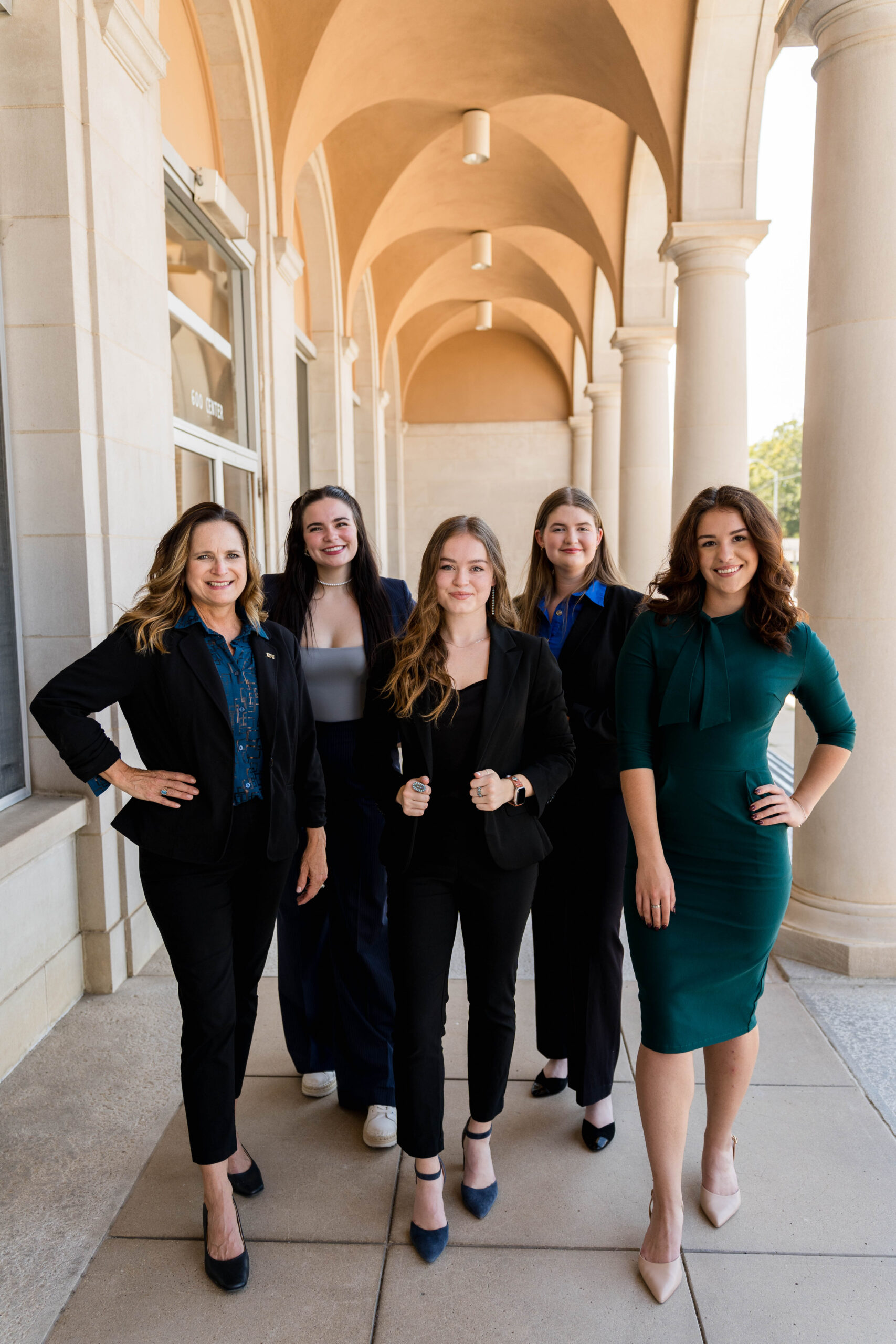
Howard Payne University Student Speaker Bureau speech and debate team hosted the National Christian College Forensics Association invitational on March 7-9. HPU has attended the tournament every year since 2005. The tournament included teams from 13 universities from across the United States. More than 130 students gathered on the HPU campus to compete in speaking and debate events over the course of the three days. This is the first time the tournament has been hosted by a Texas university. Freshman Rylie Burden, a jurisprudence and Guy D. Newman Honors Academy major from Nederland, won second place in novice extemporaneous speaking, fifth place in novice homiletics, and fifth place in novice impromptu speaking. She was also in the top 10 debaters in the junior varsity division. Katie Richards, freshman strategic communication and theatre major from Brownfield, placed sixth in faith interpretation. Katelyn Sims, team captain and junior Guy D. Newman Honors Academy and global studies major from Cleburne, and Adrielle Sloan, junior Guy D. Newman Honors Academy and strategic communication major from Blue Ridge, also competed.
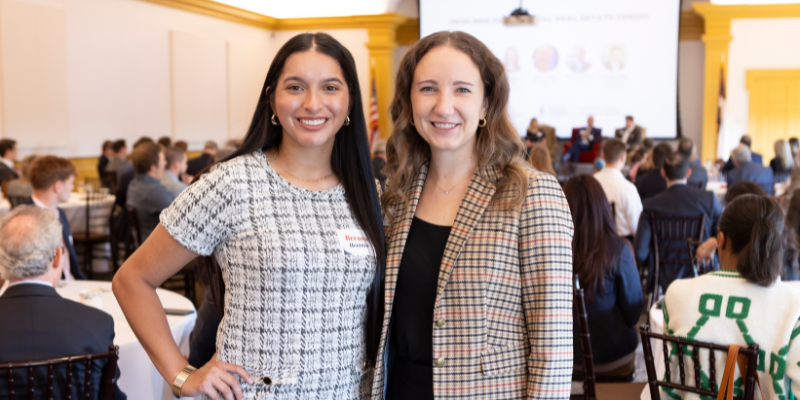
Houston Christian University partnered with Risk Management Association to launch a commercial real estate certificate program in the fall of 2024 to prepare students to pursue internships and future careers in commercial real estate. (Photo / HCU / Archie W. Dunham College of Business)
Houston Christian University partnered with Risk Management Association to launch a commercial real estate certificate program to prepare students to pursue internships and future careers in commercial real estate. The five-week online program consists of eight self-paced courses, available through the Risk Management Association Ignite platform. Nine students were awarded certificates last fall, and 17 students have applied for admission for the Spring 2025 semester with up to 10 to be selected for the competitive program. Students receive an overview of the commercial real estate industry, gain insights on the basics of commercial lending and learn to evaluate risk areas. The program aims to help students gain a comprehensive overview of commercial real estate, including understanding market trends, applying appraisal techniques and gaining the requisite skills to work in an industry expected to grow in 2025. Seven of the nine students who completed the program in fall 2024 secured internships with various companies including Weitzman/United Real Estate, Arthur D. Little, FosterDeck, and Fitts, Roberts, Kolkhorst & Co. Two additional students were offered internships at HCU. The certificate provides students with the foundation and knowledge to begin entry-level roles in the commercial real estate industry as property management assistants, real estate analysts, leasing consultants, marketing coordinators or entry-level realtors.
As Baylor rapidly grows its collegiate esports program, the university hosted the Fall 2024 Texas Esports League Fall Finals, which brought more than 500 competitors to the Mark and Paula Hurd Welcome Center. (Baylor Photo / Matthew Minard)
Baylor University continues the development of its collegiate esports program by hiring Adam Stanley as the Bears’ first esports director and coach. Stanley comes to Baylor after developing Brewton-Parker College into a national esports powerhouse in which his teams won nine conference championships. Baylor will host the Texas Scholastic Esports Federation’s Undisputed State Championships May 1-3 at the Mark and Paula Hurd Welcome Center, which will attract more than 1,500 high school competitors from across the state. Last December, Baylor hosted the Texas Esports League Fall Finals, which included more than 500 competitors. Stanley, who earned a Master of Divinity degree from Baylor’s Truett Theological Seminary, noted: “Esports and gaming culture can be a powerful tool for students to thrive—socially, emotionally, academically, competitively and spiritually. I’m thrilled that the institution I love recognizes the transformational potential of this massive, yet largely unengaged student population.”
Hardin-Simmons University has named Jill Jumper as the next dean of the College of Health Professions. She will assume the role in June 2025, following the retirement of Janelle O’Connell. Jumper has been a faculty member at HSU since 2017. Since 2022, she has served as program director and associate professor for the Doctor of Physical Therapy program. Before this role, she was an assistant professor and director of clinical education for HSU’s Doctor of Physical Therapy program. As she steps into this new leadership role, Jumper’s vision is to continue fostering a culture of servant leadership within the College of Health Professions, providing a prayerful and supportive environment for faculty, staff, students and the broader community. “I see a bright future of growth and development in the College of Health Professions,” she said. “I can’t wait to see how God uses our faculty, staff and students for his glory.”
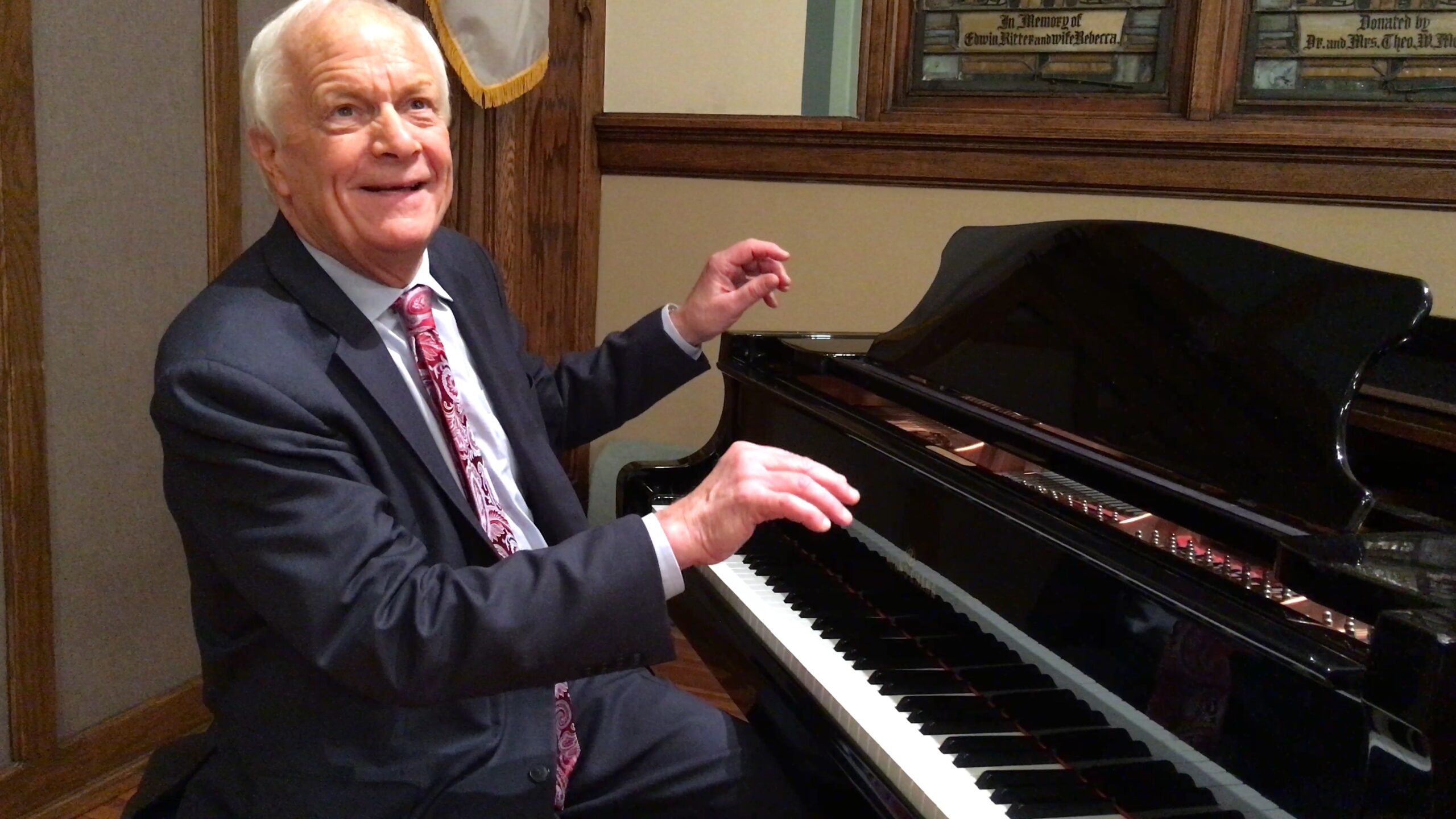
Christian singer-songwriter Ken Medema will join Wayland Baptist University and area high school choirs for an April 5 concert. (Wayland Photo)
Christian singer-songwriter Ken Medema will join Wayland Baptist University and area high school choirs for an April 5 concert, concluding the 2025 Clay and Freada Warren Memorial Music Symposium. The performance is set for 7 p.m. in Harral Memorial Auditorium on Wayland’s Plainview campus. Admission is free. The symposium, originally established by Mark and Freada Warren in memory of their son, Clay, was recently renamed to also honor Freada, who died in November 2024 after a 14-year battle with Cystic Fibrosis. Clay, a Plainview High School graduate and choir member, had a deep love for music before his life was tragically cut short in 2002 at age 18 due to an automobile collision. The symposium is a day-long event featuring Catalyst, a clinic designed for area high school choral students, followed by a concert.
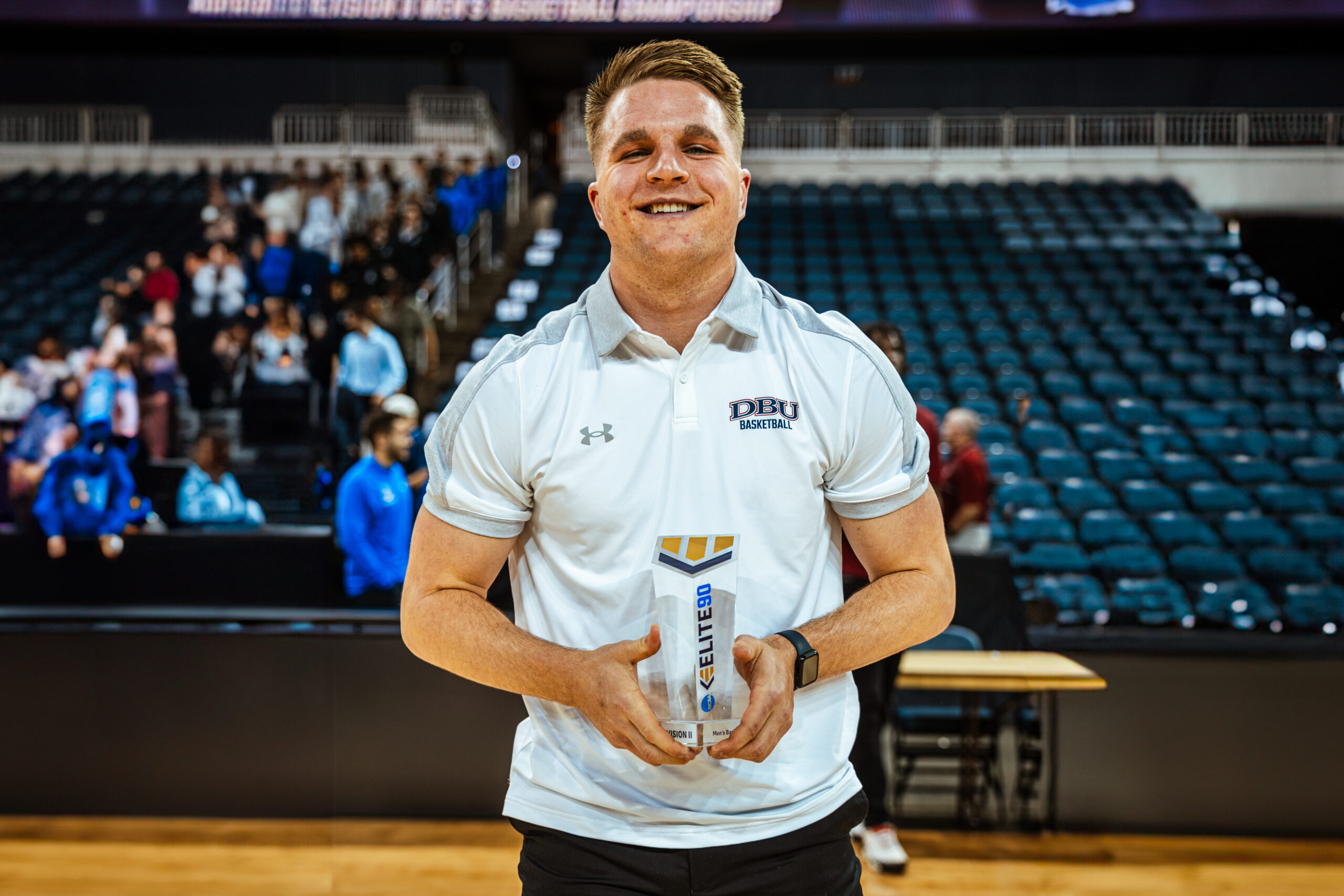
Graham Kroll was awarded the prestigious NCAA Elite 90 Award for the 2025 NCAA Division II Men’s Basketball Championship. (DBU Photo)
Graham Kroll was awarded the prestigious NCAA Elite 90 Award for the 2025 NCAA Division II Men’s Basketball Championship. Kroll, a math and computer science major with a 3.97 GPA, boasts the highest academic standing among all participants in the Elite Eight. He was honored with the award at the NCAA Men’s Basketball Awards Banquet, on the eve of DBU’s participation in the Division II Elite Eight in Evansville, Ind. Kroll makes history as the first student-athlete from the men’s basketball program to earn an Elite 90 honor, and he is also the first student-athlete from the Lone Star Conference to receive the Elite 90 award in men’s basketball. The Elite 90 Award is given to those who not only have excelled at a national championship level in their sport but also have achieved the highest academic standards among their peers. Eligible student-athletes are sophomores or above academically who have participated in a sport for at least two years with their school.
Save the date: Texas Baptists Intercultural Ministries will host Camp Fusion Rallies in Dallas-Fort Worth and Houston. The rallies offer youth from intercultural churches a chance to experience a “day at Camp Fusion.” The Dallas-Fort Worth rally will be held on May 3 at Vietnamese Baptist Church of Garland, from 3-6 p.m. The Houston location is TBD on May 17, from 3-6 p.m.
Anniversary
Del Sol Church in El Paso celebrated 45 years on March 23. Ariel N. Martinez is pastor. The local association bought the land for Del Sol’s original location. A group brought in by the Baptist General Convention of Texas built the congregation’s first building, and another local BGCT church sent people to begin the church in 1980.
Cooperation bridges 500-mile gap for mutual benefit
March 26, 2025
More than 500 miles separate First Baptist Church in Grapevine and the Valley Baptist Retreat and Conference Center. Texans on Mission helped bridge the gap, facilitating a project that mutually benefitted the North Texas church and the South Texas retreat center.
Joe Crutchfield, a member of First Baptist in Grapevine and disaster relief volunteer with Texans on Mission, said God put together multiple partners to be “the hands and feet of Christ for his ministry.”
After First Baptist Church in Grapevine built a new worship center in the 1990s, its old sanctuary was remodeled as a children’s ministry facility, complete with indoor playground equipment.
Growing ministries need space
About a year ago, Gabriel Nuñez, missions minister at First Baptist in Grapevine, launched a Spanish-language ministry to meet the changing needs of the community, Associate Pastor Jonathan Cook said.
“That ministry is growing, and it needed space for worship,” Cook said.
At the same time, the children’s ministry has grown to a point where the church is working with a design firm to renovate a building to accommodate its needs, he added.
So, the church decided to restore the old sanctuary to its original purpose as a worship center for the Spanish-language ministry and as a secondary worship space for other events, Cook said.
To make the worship space available, the children’s playground equipment needed to be disassembled and removed, and ministry leaders hoped to find a new home for it.
“Our church asks, ‘Where is there a need, and how can we help?’” Cook said.
God put the pieces together
Scott Williamson, a member of First Baptist in Grapevine, had the answer.
Williamson has served more than a decade on the board of the Valley Baptist Missions Education Center in Harlingen. He knew Valley Baptist Retreat and Conference Center in Mission—a ministry of the missions education center—could put the playground equipment to good use.
However, he recognized the logistical challenge of transporting the disassembled equipment to the Rio Grande Valley, getting it unloaded and reassembling it.
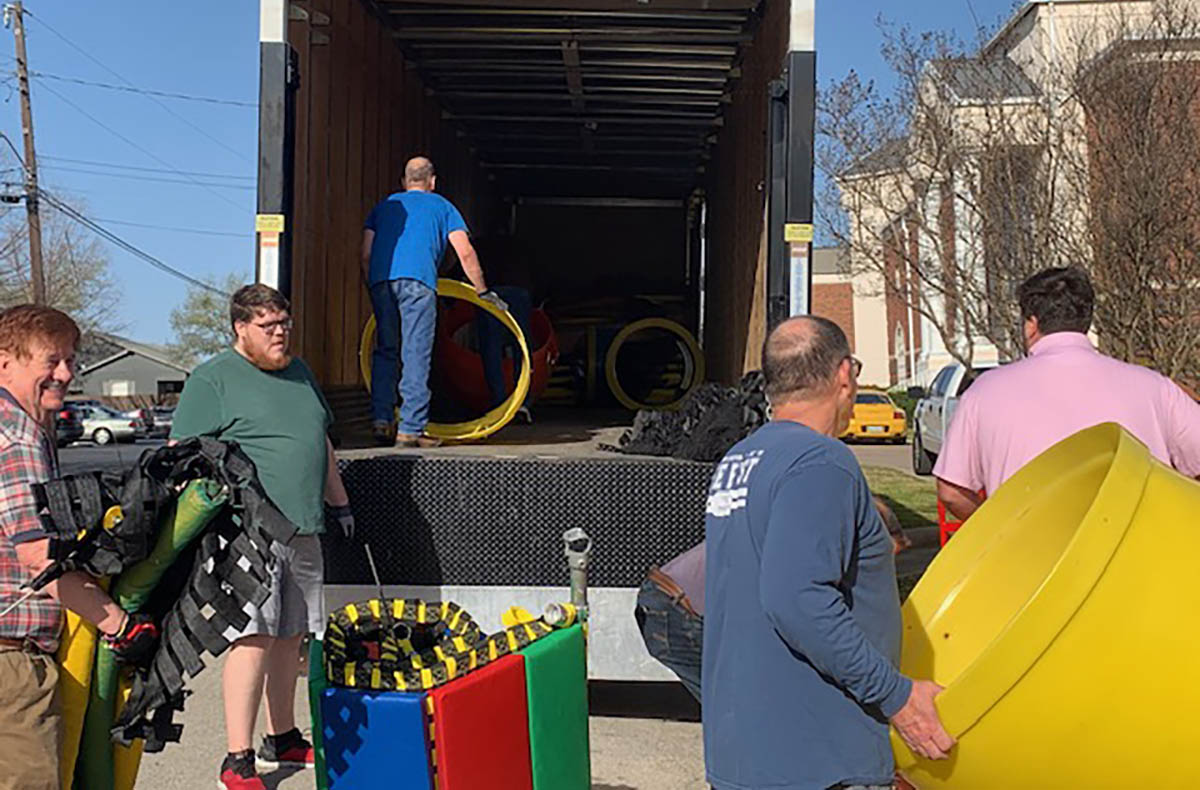
Volunteers at First Baptist Church in Grapevine load a Texans on Mission tractor-trailer rig with playground equipment the church is donating to Valley Baptist Retreat and Conference Center. (Photo courtesy of Joe Crutchfield)
Williamson discussed the matter with fellow board member Bill Arnold, former president of the Texas Baptist Missions Foundation, who connected him to Texans on Mission.
The missions organization agreed to make available an 18-wheel tractor-trailer rig to transport the playground equipment from Grapevine to the Rio Grande Valley.
About 50 volunteers from the church worked on Feb. 22, disassembling the 30-foot-tall structure and preparing it to be transported to South Texas.
Then the church’s men’s ministry enlisted about two dozen volunteers to load the disassembled playground equipment onto the Texans on Mission tractor-trailer rig on Saturday morning, March 22.
Work together to help each other
Othal Brand Jr., acting president of Valley Baptist Missions Education Center, enlisted volunteers from the Rio Grande Valley to unload the 18-wheeler on Monday, March 24.
“It’s remarkable to see how all these different groups and organizations can work together to help each other,” Williamson said.
Like-minded Christian groups—even those that are part of the same Texas Baptist family—tend to “stay in [their] own lanes a lot of the time,” he observed.
Christians can accomplish much more when they cooperate, and it begins with communication, he noted.
“We don’t do it often enough,” Williamson said. “We’re all on the same team. But sometimes we’re sitting on opposite ends of the bench, and we forget to talk to each other.”
Obituary: Clifford Dane
March 26, 2025
Clifford Dane, a Southern Baptist missionary emeritus who served in Belize and Brazil, died Jan. 7. He was 86. Dane was born July 1, 1938, in Weatherford to Henry and Ruth Dane. He came to faith in Christ as a child and was active in church life alongside his parents and siblings. During his 11th-grade year, he surrendered his life to special service for God, and the following year he surrendered to preach and began preaching at various church services. During his last year of high school, he met Peggy Delano. They were married Aug. 16, 1959. Over the next several years, Dane served as a pastor, earned a Bachelor of Science degree from Wayland Baptist University and taught fourth grade. Feeling led by God to foreign missions service, the Danes moved to Fort Worth, where he earned a Master of Religious Education degree from Southwestern Baptist Theological Seminary. In 1972, the Southern Baptist Foreign Mission Board—now the International Mission Board—appointed the Danes as missionaries to Brazil. He established a school of religious education, planted churches and opened a recreational learning camp. Dane earned a Doctor of Philosophy degree from Caribbean College of the Bible International in San Juan, Trinidad and Tobago, and taught courses in theology, archeology and religious education at Baptist Theological Seminary in North Brazil. The Danes later served in Belize, where he worked to strengthen churches, hosted volunteers from the U.S. and continued planting churches. He is survived by his wife of 65 years, Peggy Dane; children Brent Dane, Troy Dane, and Gwenann Sprecher; eight grandchildren; and seven great grandchildren. Donations in his memory may be made to the Lottie Moon Offering, IMB, 3806 Monument Avenue, Richmond, VA 23230, or online at Generosity Resource Center – IMB Generosity.
Spiritual adviser counseled man executed by firing squad
March 26, 2025
COLUMBIA, S.C. (RNS)—When 67-year-old Brad Sigmon was put to death March 7 in South Carolina for the murder of his then-girlfriend’s parents, it was the first time in 15 years an execution in the United States had been carried out by a firing squad.
Hillary Taylor, a United Methodist minister, served as Sigmon’s spiritual adviser since 2020. The multifaceted, months-long effort to save Sigmon’s life, and provide emotional and spiritual support for his legal team has been a “whirlwind,” said Taylor, director of South Carolinians for Alternatives to the Death Penalty.
Her organization has advocated for three other death row inmates in the state over the past six months, as South Carolina ramps up executions after a 13-year hiatus.
The delay was caused in part by legal challenges to the lethal injection method. In 2021, a state bill gave those on death row the simplified options of electrocution or death by firing squad, which has had the effect of expediting executions.
After Sigmon chose the firing squad, Taylor said, “I got catapulted into the movement to save his life.”
She was introduced to anti-death penalty organizers around the country, and, in time, what had been a volunteer position with the anti-capital punishment group became a paid position.
First involvement a decade ago
Taylor was introduced to the work 10 years ago when she joined an unsuccessful campaign to save the life of Kelly Gissendaner, a Georgia prisoner convicted of persuading her lover to kill her husband in 1997.
Gissendaner, who had taken theology courses offered by Emory University while on death row, sang “Amazing Grace” on the way to her execution.
Taylor, then a first-year student at Emory University’s Candler School of Theology, learned about Gissendaner while working with women in solitary confinement at Lee Arrendale State Prison, where Gissendaner had spent time before being transferred.
Taylor learned Gissendaner “had sobered up, become a Christian and reconciled to her children.” When other inmates had suicidal episodes, Taylor had heard, they would be placed in a cell next to Gissendaner, who would “literally preach and counsel them back to life.”
The more Taylor reflected on Gissendaner’s faith, the “more it reminded me of people in my own life who could have ended up on a similar path if they didn’t have access to power and privilege.”
‘We’re more than the worst thing we have done’
Over time, she came to a realization: “We’re more than the worst thing we have done, or the worst thing that ever happened to us, and that the worst thing is not the last thing.”
Despite Gissendaner’s execution, Taylor is proud of the faith leaders and others who organized to save her life. “It’s possible not to just say sorry, but to ‘do sorry,’” she said.
When Taylor arrived in South Carolina in 2020 to pastor two United Methodist congregations, she called a local justice reform organization and asked them if they needed a spiritual adviser or a pen pal for an inmate on death row.
A few months later, she was connected to Sigmon, who had taken a Bible college course at Broad River Correctional Institution, where he died.
He “had kind of exhausted the spiritual resources available to him,” she said. “That began our pen pal connection,” recalled Taylor.
Like Gissendaner, she said, Sigmon, who became an “informal chaplain” to other prison inmates, tried to become a different person.
After his prison conversion, she said, “he loved to share with people the ways the love of Jesus changed him. His objective was to save the other prisoners, who were like his brothers,” she said.
One of his last requests was to share a last meal with his friends. It was denied.
In the years before his execution, Sigmon and Taylor only met four times in person but exchanged a multitude of letters.
As they got to know one another, Taylor said, she was able to confide in him about the challenges of pastoring two small rural churches during COVID-19, “which was, at the time, a lonely and isolating experience. He was the person who could hold a lot of my fear and my anger. That was a gift I will treasure.”
They teased each other about their affection for rival football teams, Clemson versus South Carolina. “He was always making me laugh,” she said.
She learned from Sigmon, she said, about mercy, compassion and forgiveness, particularly the realization that “even when you are mad, you can come back to a place of kindness, compassion and humanity.”
As the end neared, he was at peace, Taylor said, able to seek reconciliation with some of the people he had harmed.
Took Communion together
In her last in-person encounter with Sigmon, on Ash Wednesday, March 5, they both took Communion, and she was able to anoint his head with ashes, the symbol of repentance and mortality many Christians receive on the first day of Lent.
“When I delivered ashes to him, I got to hug him for only the second time.” As she pressed her forehead, already imprinted with ashes, against his, she told him how grateful she was that he knew the power of love in Jesus.
Being a spiritual companion to a condemned person can be traumatic, particularly when the prisoner loses their final appeal.
Shane Claiborne, an evangelical Christian anti-death penalty activist, wrote in an email interview, “It is a terrible thing to accompany someone as they are executed,” but added that the only thing worse is being executed without accompaniment.
“That’s why we do this holy work, and it is also why we are working so hard for alternatives to the death penalty. The closer you are to the system that executes, the more convinced you become that violence is the problem, not the solution.”
Sister Pamela Smith, a member of the congregation of Saints Cyril and Methodius, has participated in anti-death penalty vigils on the state capitol steps since South Carolina resumed executions.
Smith, who directs the office of ecumenical and inter-religious affairs for the Catholic Diocese of Charleston, is also a board member of South Carolina Alternatives.
“I see this as another way of taking public action to try to raise consciousness to help people understand what actually goes on with the death penalty. Because I live in a state where executions are unfortunately becoming commonplace, you know, I have a passion as part of my overall pro-life commitment to try to do something about it.”
Though not directly involved in prison ministry, the nun was on hand when South Carolina’s first execution in more than a decade took place.
“You know the clock is approaching the hour, even though you don’t hear something happening. There’s just something chilling about the fact that you’ve got a scheduled time of death for this person for whom you’ve been praying and sending letters and presenting petitions.”
Powerful effects of spiritual witnesses
Taylor said the most painful part of her work “is just how ready people are to say things like ‘a firing squad is too merciful for him’—as though those folks were not victims of somebody else’s violence first, and didn’t have anybody to intervene on their behalf. There are ways we can hold people accountable. That’s part of what rehumanizing is.”
There is also, said Taylor, a reward in introducing outsiders to someone who is kind and compassionate—“telling a story that maybe hasn’t been told before.”
Former death row prisoners talk about the powerful effects of spiritual witnesses. Sentenced to death as a 20-year-old for killing a man and wounding another during an armed robbery, Jimmy MacPhee was re-sentenced to life with the possibility of parole during a brief national death penalty hiatus in the 1970s. After 45 years in prison, he is now free, ordained and married.
He spends a lot of time on the road sharing his story—and that of Frankie San, the man MacPhee credits with transforming a furious, violent young man into a writer, speaker and mentor and finally a minister. A Japanese immigrant, now in his 90s, San began visiting McPhee when he first arrived in prison.
MacPhee said his personal experience of redemption inspires him to help others to transition back to life outside the cell block: “We all were washed by the blood. There’s none of us beyond the reach of God’s power. I know [I’m] blessed to be one of them. I know the transformative power is grace, how powerful it can be, and I’ve witnessed it in so many others.”
As it became more likely that the execution would move forward, recalled Taylor, Sigmon told her that if she saw a bird, she would know he was nearby.
“That’s too many birds, Brad,” she said.
“How about a finch,” he suggested.
This week, Taylor said, she is going to go out to buy a bird book.
In Texas, Christian right grows confident and assertive
March 26, 2025
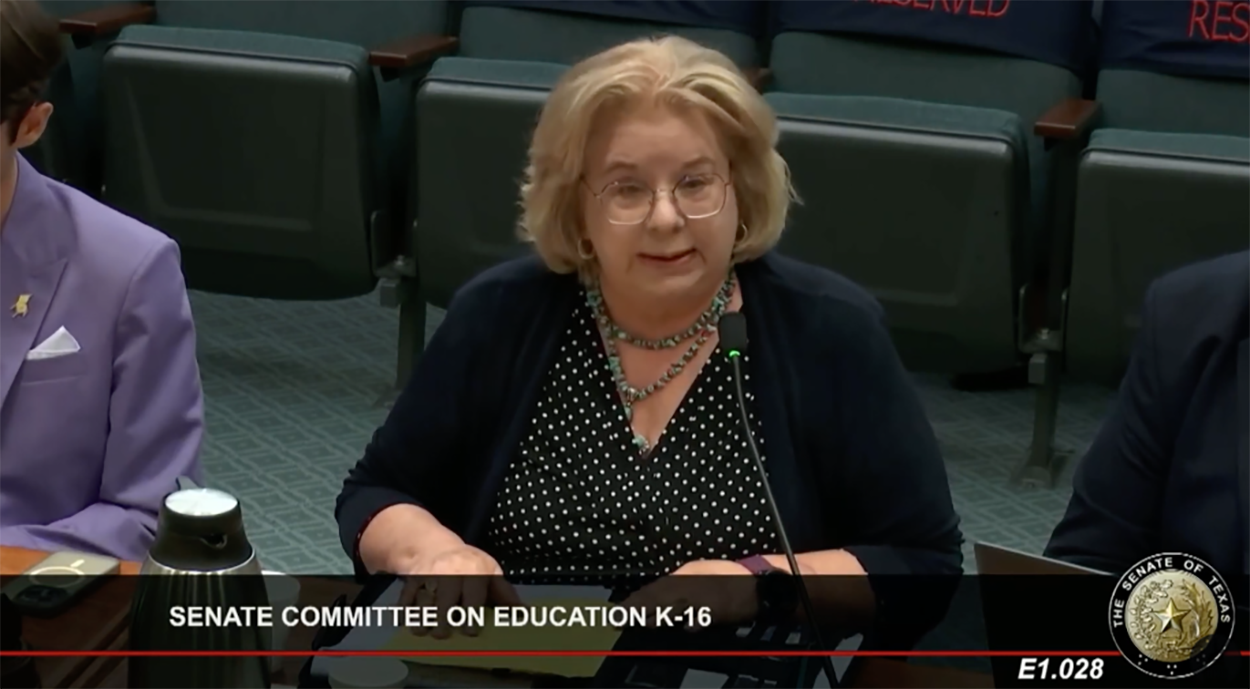
Testifying this month against bills that would put more Christianity in Texas public schools, Jody Harrison—an ordained Baptist minister—invoked the violent persecution of her Baptist forefathers by fellow Christians in colonial America.
Harrison, a retired hospital chaplain, hoped the history lesson would remind Texas senators of Baptists’ strong support for church-state separation and that weakening those protections would hurt people of all faiths.
Instead, she was rebuked.
“The Baptist doctrine is Christ-centered,” Sen. Donna Campbell, R-New Braunfels, responded sharply. “Its purpose is not to go around trying to defend this or that. It is to be a disciple and a witness for Christ. That includes the Ten Commandments. That’s prayer in schools. It is not a fight for separation between church and state.”
Jody Harrison, a retired hospital chaplain and ordained Baptist minister, testifies before the Texas Senate Committee on Education K-16. (Screen capture image)
Harrison was not allowed to reply, but in an interview said she was stunned that a lawmaker would question a core part of her faith. The exchange, she said, perfectly encapsulated why she has fought to preserve church-state separations—the same religious protections that Campbell said are a distraction from bills that might bring school kids to Christ.
“It was a wake-up call,” she said. “I don’t think people—even many churches—realize that this is going on right now, and that is alarming.”
Efforts by the Christian Right to put more of their religion in public schools are not new. But the tone of those debates in Texas has shifted this session, with bill supporters and some lawmakers openly arguing that such legislation is crucial to combating dropping church participation rates and what they say is a directly related decline in American morality.
Church-state separation called ‘a myth’
Last month, a Texas Senate education committee advanced two bills that would require the Ten Commandments to be displayed in public classrooms and allow school districts to set aside optional prayer time during school hours.
That committee also recently heard testimony on a bill to mandate schools to teach an anti-communist curriculum—which supporters said is crucial to reaffirming that America is a Christian nation.
Throughout those hearings, lawmakers and bill supporters frequently said church-state separation is a myth meant to obscure America’s true, Christian roots. They argued many of America’s ills are the natural consequence of removing biblical morality from classrooms. And they framed their legislation as an antidote to decreasing church attendance, communism or eternal hellfire.
“To realize that only 25 percent of our kids in schools today have been in a church is absolutely horrific and something that we all need to work on to address,” said Sen. Tan Parker, R-Flower Mound, repeating a statistic offered by one bill supporter during testimony. “That should make everybody listening absolutely scared to death.”
Such statements have struck even longtime scholars and observers of the Religious Right as setting a new, more strident tone after years in which terms like “religious freedom” were the norm.
Many in the movement had avoided explicitly centering Christianity in bills because doing so could prompt court challenges and discrimination complaints.
The shift, experts said, reflects a Religious Right emboldened by recent U.S. Supreme Court decisions, the second Trump administration and the broader normalization of Christian nationalism in the GOP.
“Christian nationalist leaders think they’ve been handed the keys to the kingdom,” said Mark Chancey, a religious studies professor at Southern Methodist University who focuses on movements to put the Bible in schools. “Now they’re trying to unlock as many locks as they can.”
The growing influence
Recent polling from the Public Religion and Research Institute found about 10 percent of all Americans adhere to Christian nationalism and 20 percent sympathize with aspects of it.
Experts say, despite accounting for a small segment of the broader country, Christian nationalists and their allies have been able to incrementally accumulate power through a long-term political strategy and a well of deep-pocketed donors.
In Texas, the Christian Right’s rising influence has coincided with the state GOP’s alignment with two West Texas oil billionaires, Tim Dunn and Farris Wilks, who have given tens of millions of dollars to push their far-right religious and social views.
And groups like Project Blitz, a coalition of Christian groups with deep Texas ties, have used that long-term approach to steadily normalize their views and chip away at church-state separation without drawing widespread opposition.
Amanda Tyler
“Part of their legislative strategy is to be additive,” said Amanda Tyler, executive director of the Baptist Joint Committee for Religious Liberty, which advocates for a strong church-state wall.
“The idea is that you start lawmakers out with what appear to be lower-stakes legislation, and then once they take votes on that, they will move to more and more extreme versions of the legislation.”
“What we’re seeing now is that strategy really coming to bear in Texas,” she added.
In 2010, the State Board of Education approved a sweeping curriculum overhaul in order to weed out what it called “liberal bias.”
Influenced by amateur historian
With advice from prominent evangelicals such as David Barton, a Project Blitz leader and self-described “amateur historian” who has popularized the idea that church-state separation is a “false doctrine,” conservative board members framed the move as a way to reaffirm “that this was a nation founded under God.”
In 2022, the Texas Legislature approved a law that required classrooms to display “In God We Trust” signs donated by Patriot Mobile, a self-described Christian nationalist cellphone company that also funds school board candidates.
The law quickly drew controversy—at one Dallas-area school district, the board declined to also display donated “In God We Trust” signs in Arabic, saying it already had enough for all its buildings.
In 2023, state lawmakers allowed school districts to replace mental health counselors with untrained religious chaplains, overriding a proposed amendment that would have barred them from evangelizing to students.
Ahead of the vote, The Texas Tribune reported a main backer of the bill had run an organization that, until a few months prior, was open about using classrooms as a way to recruit children to Christianity. Barton also testified in favor of the bill.
By 2024, the theories espoused by Barton and his allies were mainstream in the Texas GOP. Prominent figures—including Lt. Gov. Dan Patrick, Texas GOP Chair Abraham George and numerous state senators—have called church-state separation a “myth.”
And at the state party’s convention that year, lawmakers framed themselves as engaged in an existential struggle with communists, socialists and others trying to indoctrinate children. Delegates called for the state to require instruction on the Bible, and state education board Chair Aaaron Kinsey vowed in a speech to fight for “these three-letter words: G-O-D, G-O-P and U-S-A.”
A few weeks later, state education leaders proposed new curriculum that paired grade-school teachings with lessons on the Bible and other religious texts.
The curriculum was approved late last year despite concerns by religious historians and other experts who said it whitewashed the role many white Christians played in opposing Civil Rights, upholding slavery and persecuting religious minorities, including Baptists and other fellow believers, during the country’s founding period.
Call for ‘spiritual warfare’
The 2025 legislative session began with some Republican lawmakers calling for “spiritual warfare” against political opponents, and leading worship inside the Capitol to ward off demonic spirits they believe control the legislature.
In addition to the Ten Commandments and school prayer bills, state senators also approved sweeping legislation that would allow taxpayer money to be directed to religious and other private schools.
Tyler, the Baptist leader and church-state wall advocate, said the last 15 years in Texas show how successful Religious Right groups can be in steadily mainstreaming their political views and advancing their agenda.
“We have seen, over several years, a definite strategy to target public schools,” she said. “Now they have become bolder and have been emboldened, and are being more explicit about their aims.”
The new rhetoric
For decades, David Brockman has closely monitored the rise of Christian nationalism in Texas for Rice University’s Baker Institute for Public Policy, where he is a nonresident scholar.
A few years ago, he said, he wanted to quantify how many adherents or sympathizers worked in the Texas Legislature by analyzing their comments and speeches for tell-tale signs of Christian nationalist rhetoric.
Even then, he said, it was difficult to find many concrete examples of the ideology, or of bills that explicitly privileged Christianity.
But that’s changed.
“What they were doing instead was either carving out exceptions for ‘sincerely-held religious beliefs’ or protecting religion overall,” Brockman said. “Now, it’s a new landscape for them.”
Central to that shift has been a series of recent U.S. Supreme Court decisions, including 2022’s Kennedy v. Bremerton School District. In that case, the court ruled with a high school football coach whose employer, a public school, asked that he stop leading prayers at midfield after games.
In a 6-2 decision, the court found the coach’s prayers were within his First Amendment rights and his actions did not amount to government support of religion.
The ruling neutered the so-called Lemon Test, which for decades had been used by courts to determine if a law or practice amounted to an unconstitutional government act establishing or preferring a religion.
‘Crying out for moral clarity’
Conservative Christians have taken the 2022 ruling as a greenlight to put more Christianity into public schools, arguing things such as the Ten Commandments are the basis for American law and governance, and therefore have educational value.
This session, lawmakers and their supporters also have argued such legislation is imperative to reverse what they say is a decades-long moral decline.
“I think our kids are just crying out for moral clarity,” said Sen. Phil King, a Weatherford Republican who authored the Ten Commandments bill. “I think they are crying out for a shared heritage.”
Other lawmakers have explicitly said they have a duty to bring kids to Christ.
“There is eternal life,” said Campbell, the senator who rebuked Harrison. “And if we don’t expose or introduce our children and others to that, when they die they’ll have one birth and two deaths. Because they will know nothing about the afterlife, the eternity with God.
“But exposing them or introducing them to Ten Commandments, prayer—it asks other questions and they then have a choice in their future: Two births and one death.”
Combat godless ideologies
Last week, a Texas Senate panel heard testimony on a bill that would require public schools to adopt anti-communist curriculum.
On its face, the bill does not seek to put more Christianity in classrooms. But supporters argued the bill is crucial to combating godless ideologies they say have crept into American education and undermined the nation’s true, Christian heritage.
Such fears have been a driving force of Christian Right movements since the 1950s, when Christians, believing their faith a key bulwark against Red influence, successfully lobbied to add “under God” to the pledge of allegiance and to make “In God We Trust” the national motto.
Those fears are still pronounced today. Lawmakers recently heard testimony from Rafael Cruz, a pastor who is the father of U.S. Sen. Ted Cruz and an adherent of Christian dominionism, which argues Christians must dominate society to usher in the End Times.
Cruz repeatedly argued America—and thus, Christianity—are under threat from communist and socialist forces who seek to indoctrinate children through Critical Race Theory, diversity initiatives and other things Republicans have targeted in recent years.
“In many instances our classrooms are failing us, because they’re following an agenda,” Cruz said. “It is not our agenda. It is a communist agenda that has, like tentacles, immersed itself into our education system. So, we need to retrieve our educational system from that evil agenda.”
Throughout his testimony, Cruz took aim at a litany of things he said are quietly advancing communist influence in America, be it atheism, evolution, college professors or campus protesters who “don’t like it here” and should be deported. Fighting that menace, he said, required lawmakers to legislate Christianity into public schools across the nation.
“America is a Christian country,” said Cruz, who was invited by lawmakers to testify. “And we need to build upon that foundation, because if we build that foundation in our children, everything else will fall into place.”
Texas has for years been an incubator for Christian Right policies that are exported to other states or codified into federal law by courts. Lawmakers and their supporters have said they are confident the current slate of Christian-centric bills will pass and then survive expected court challenges—though some legal experts are less sure.
Harrison, meanwhile, said she has frequently ruminated on her recent exchange with Sen. Campbell, and what it portends for Americans who are not conservative Christians. To her, it’s so much more than a debate about schools or the church-state wall.
“I believe we preach the gospel of Jesus Christ most powerfully without words, and for me, that means to follow the example of the way of Jesus,” she said. “Often the most powerful example we can set for others in preaching the gospel as Christians is by our actions. We are called to love one another, and that means speaking up for those whose voices are not heard and/or silenced.”
Disclosure: Rice University’s Baker Institute for Public Policy and Southern Methodist University have been financial supporters of The Texas Tribune, a nonprofit, nonpartisan news organization that is funded in part by donations from members, foundations and corporate sponsors. Financial supporters play no role in the Tribune’s journalism. Find a complete list of them here.
Mission partnerships take shape at Ascent gathering
March 26, 2025
(ALEXANDRIA, Va.)—A “movement” focused on reengaging North America with the gospel that has been brewing for almost a decade is beginning to take a more defined shape, and Texas Baptists have quite a few seats at the table.
Dennis Wiles, pastor of First Baptist Church in Arlington and chair of the Ascent council, welcomed around 200 invited participants—called curators—to the second formative gathering of Ascent.
When asked when the movement began, Wiles said he “would say it began when Jesus ascended into the heavens and gave the church this message and this mission.” However, the Ascent council, a group of eight at the time, first began conversations in 2016.
The initial group included Texas and Virginia Baptists, who felt like they’d lost their denominational home beyond their local and state affiliations—particularly the national and international missions agencies of their denomination.
Chris Backert provides background on the Ascent movement at the network’s second curators gathering. (Photo / Calli Keener)
It became clear in the years of dreaming about this new network, a sense of disenfranchisement from denomination was not limited to moderate Baptists in two states, Wiles explained.
Centrists across denominational lines were finding themselves in a similar place of loss.
Wiles said he’d been praying God would use the gathering—this new group assembled from orthodox, centrist Christians from a variety of denominational backgrounds—to discern together what God is up to in this time.
And like the “200 sons of Issachar” in 1 Chronicles 12:32, “who understood the times and knew what Israel should do,” he hoped the curators would understand the times and know what it is God wants them to do to “re-evangelize North America, and ultimately take the gospel to the world.”
Chris Backert, senior director of Ascent, explained when the group who envisioned Ascent began meeting to talk about a new way to cooperate for the gospel mission, they recognized the world was heading into a time of rupture.
They observed this era of upheaval was evident in social-political shifts and uneasiness. And the council began to wonder if this upheaval might be the sort of upheaval God sometimes uses to bring in a new season of revival in the church.
Starting with the gospel
Backert said they asked themselves: “What if we don’t start with the church? What if we started with the gospel?”
The early council decided to look at things from the perspective not of what does the church need, but of what does the gospel need in order to re-evangelize North America, “and we worked backwards from there.”
As they began to talk about that, “a great unity came around the idea that we really need a fresh evangelization, reengagement, awakening, whatever word you prefer. We really need a fresh outpouring of the Holy Spirit to see new generations come to faith in Christ all over North America. That’s the gospel need.”
COVID-19 slowed Ascent’s development but accelerated centrist believers’ sense of loss of ecclesial identity for the sake of the mission, Backert said. “People feel not home in their own home … and yet we feel this need, we really want to re-engage North America with the gospel.”
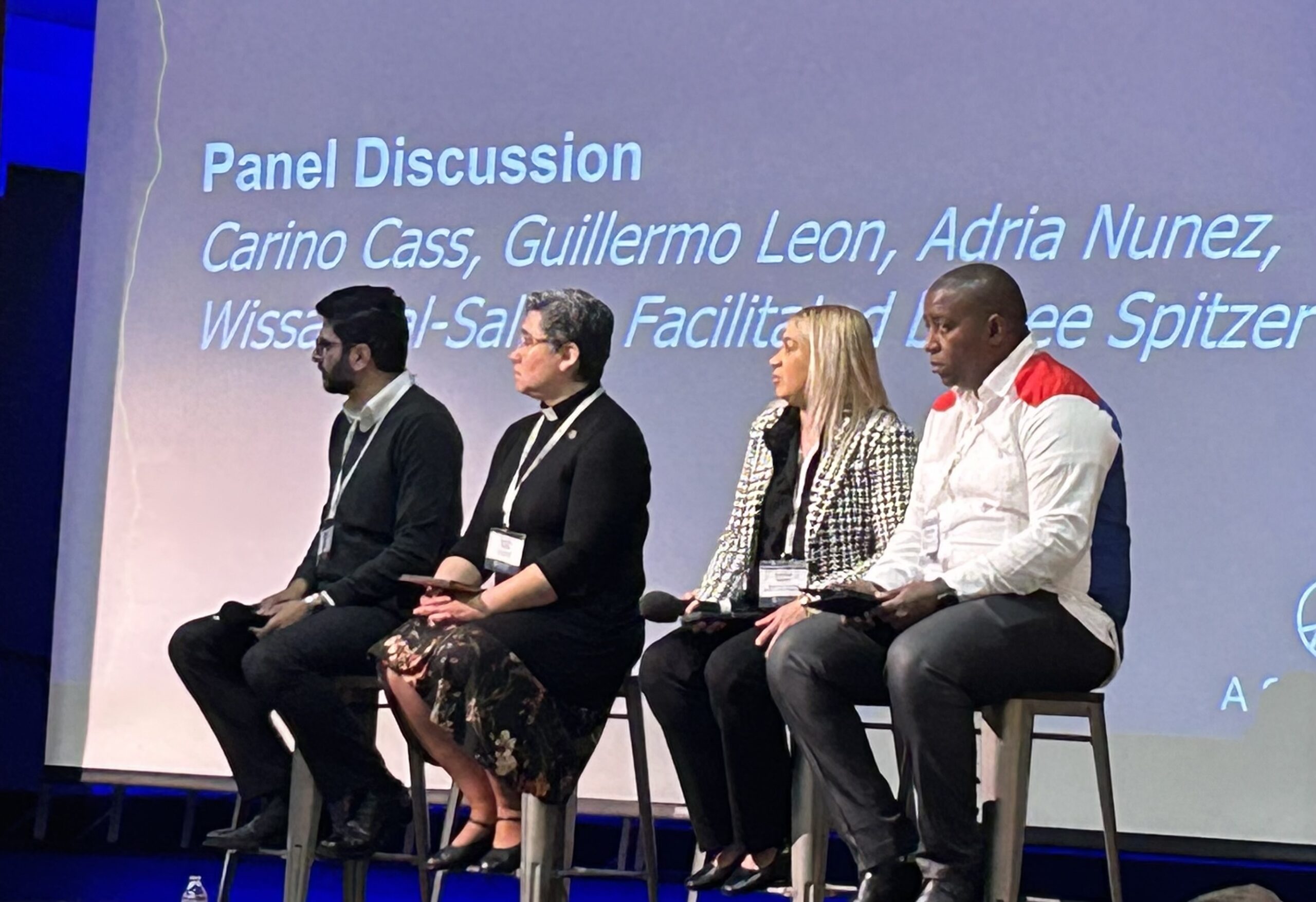
Wissam al-Saliby of 21Wilberforce; Cariño Cass, executive director of Churches Ministry Among Jewish People; and Adria Nunez and Guillermo Leon who lead Church Planters/Network, discuss sowing the gospel amidst opposition. The panel was facilitated by Lee Spitzer, retired general secretary of American Baptist Churches USA. (Photo / Calli Keener)
Backert said coming out of the season of rupture exacerbated by COVID, “we’re in a season of realignment—and you can see this playing out all over the world—and we’re in a season of ecclesial realignment.”
The gathering of individuals of diverse ecclesial backgrounds with a common gospel goal “couldn’t even have been conceived of 10 years ago,” Backert noted, but “in 2025, it makes perfect sense.”
As in J.R.R. Tolkien’s Lord of the Rings, “the old alliances have died.” And in this time of realignment, “it’s time for new alliances that make sense for the days ahead,” he asserted.
Backert explained Ascent is a voluntary, or “opt-in” network—“a cooperation of the willing”—but with the framework of a covenant to provide stability. The guiding covenant comes from the Capetown Commitment of the Lausanne Movement.
Based on the “connectionalism” that led to conventions, conferences, dioceses or other forms of association, Ascent aims to provide a common future for previously disparate groups—cooperating to re-evangelize North America and beyond.
“We’re trying to walk and work together for the sake of the Great Commission,” Backert said.
But Ascent is not going to look like what has been seen before, because it’s composed of individuals who may share a common future, but who do not share a common past, Backert said.
Texas connections
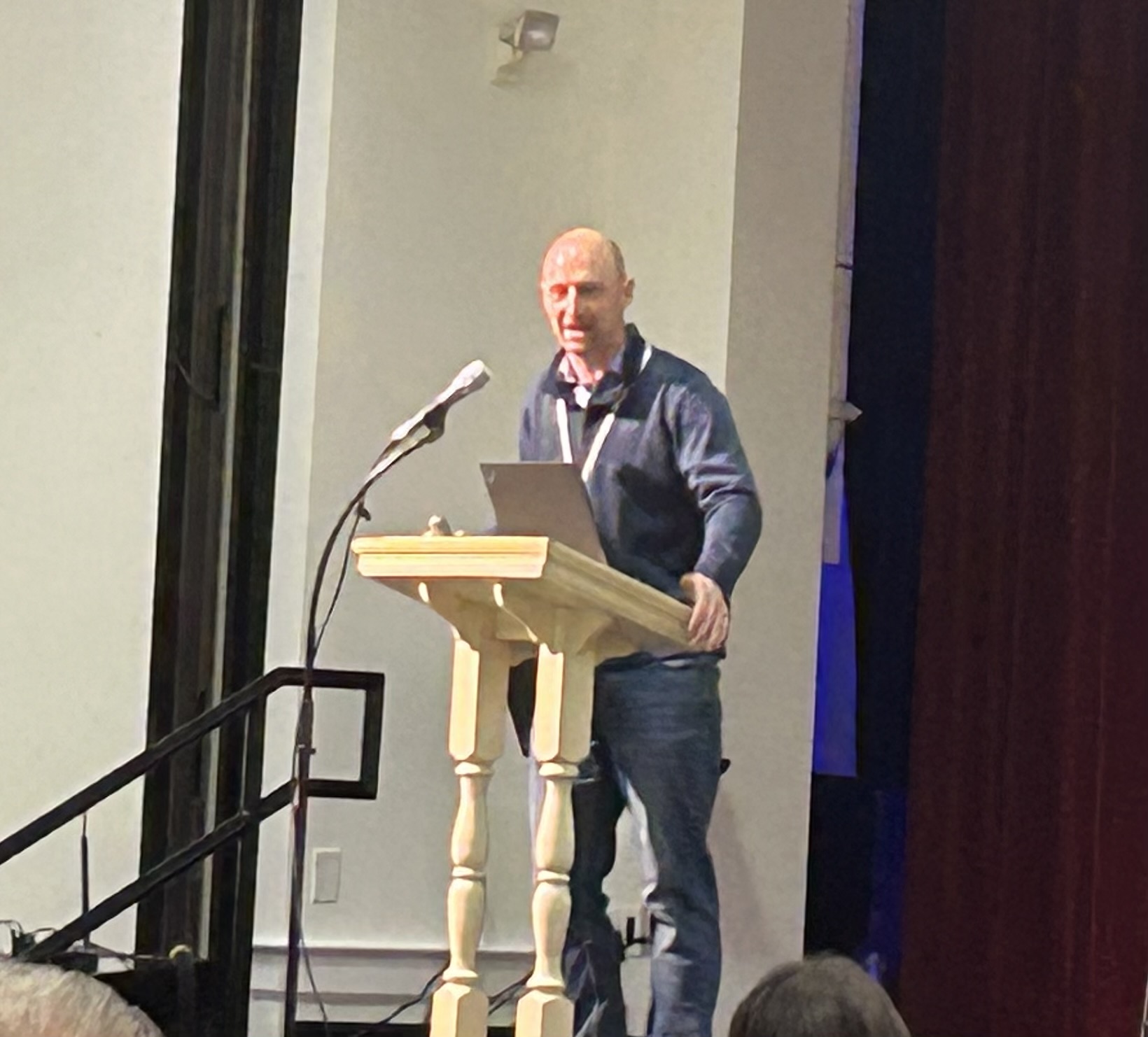
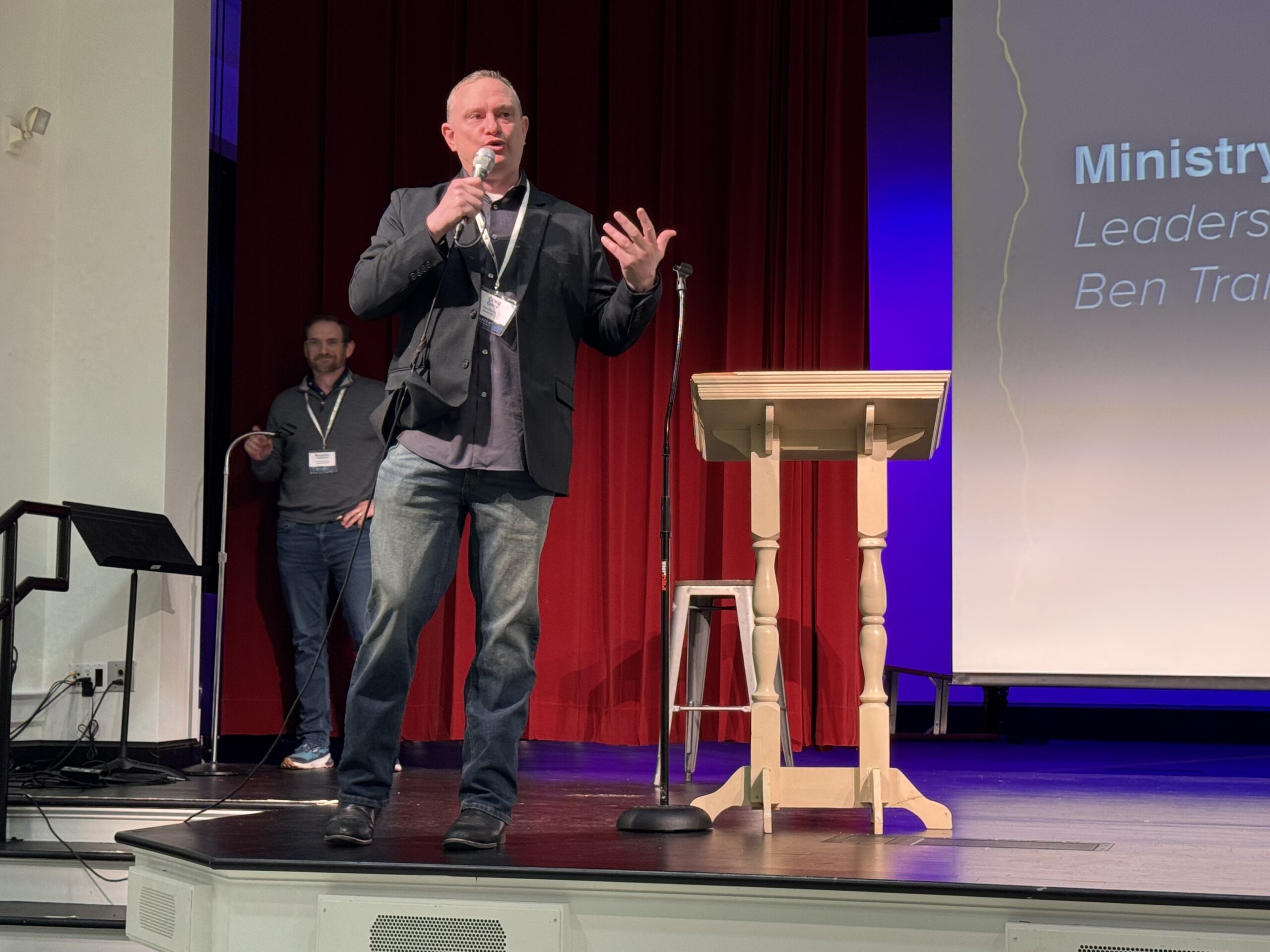
Craig Curry of Plano speaks at the Ascent curators gathering at First Baptist Church in Alexandria, Va. (Photo / Eric Black)
Texas Baptists participated in or moderated several panel discussions, highlighted the ministries they lead and led breakout sessions. Those sessions were treated as “task force” opportunities both to discuss how curators’ ministries currently meet needs in the subject area under discussion and to envision how Ascent can continue developing and/or supporting ministries.
Wissam al-Saliby, president of Baptist World Alliance-connected 21Wilberforce, spoke about the organization’s work to advocate for religious freedom during a panel about “sowing the gospel in the face of opposition.”
Al-Saliby noted sowing the gospel brings persecution. The good news is “churches are present, active and engaging all over the world,” he said, but with that comes challenges of persecution, as well as lower-level forms of discrimination and opposition.
In India in 2023, conflict among tribal groups in Manipur claimed the lives of 200 Christians, destroyed 300 churches and left 28 missionaries without salaries, he noted. The violence there and similar violence in other countries has led to “a hardening of the church’s heart towards the Muslim population,” and that’s also opposition to the spread of the gospel.
Al-Saliby explained 21Wilberforce was founded 11 years ago in Texas, to work with churches “to address the plight of religious persecution” and advocate for religious freedom for everyone, “because either everyone has religious freedom, or no one has religious freedom,” he noted.
Additionally, the organization seeks to strengthen the transfer of advocacy knowledge to locals around the globe so they can advocate for religious freedom in their contexts. Al-Saliby urged Ascent curators to be sure to factor in the mission work being done locally to fight for religious freedom, as the movement continues to take shape.
Todd Still, dean of Baylor University’s Truett Theological Seminary, moderated a panel discussion on sowing the gospel through preaching and developing preachers of the gospel.
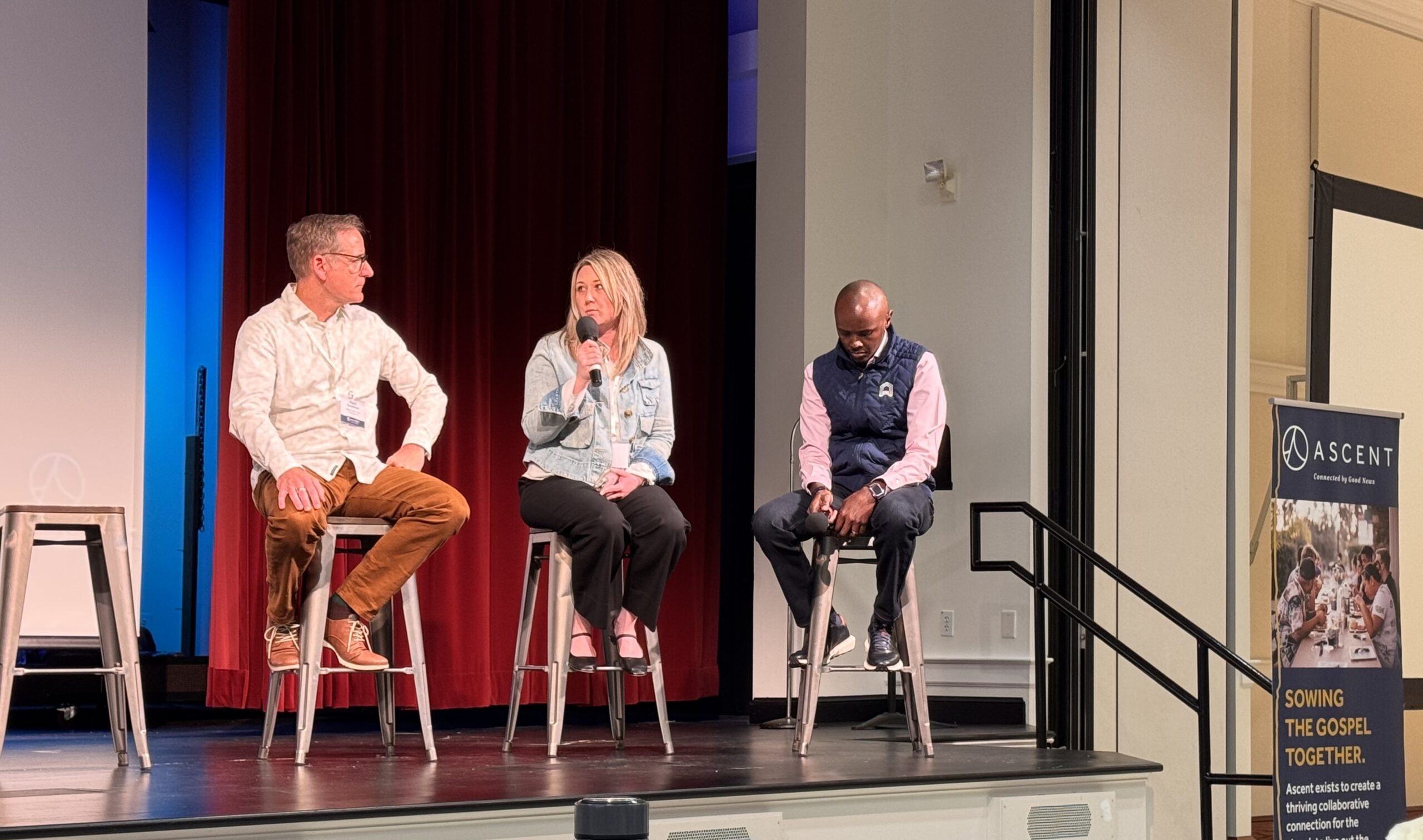
Mark Goodman, Ashley Berryhill and Kevin Nderitu participate in a panel on sowing the gospel through the local congregation at the Ascent curators gathering in Alexandria, Va. (Photo / Eric Black)
Kevin Nderitu, executive pastor of District Church in Washington, D.C.; former Texan Mark Goodman, lead pastor of Rabbit Creek Church in Anchorage, Alaska, a congregation recently removed from the Southern Baptist Convention; and Ashley Berryhill, director of Global Engagement at First Baptist Church in Arlington, participated in a panel discussion on “sowing the gospel through the local congregation.”
Cindy Wiles, of First Baptist Church in Arlington, director of the Restore Hope mission organization; Jim Ramsay of TMS Global; and Jennifer Lau of Canadian Baptist Ministries participated in a panel on “sowing the global gospel … beyond the local congregation.”
John Upton, retired executive director of the Baptist General Association of Virginia, facilitated the discussion on how to do global missions responsibly—out of love, with humility and with a “round table” approach, based in mutuality that breaks down barriers between local and global missions.
Other Texans who presented included: Rand Jenkins, chief strategy officer with Texans on Mission/On Mission Network; Arthur Jones, pastor of St. Andrews Methodist Church in Plano; Craig Curry, pastor of First Baptist Church in Plano; and Bruce Webb, pastor of First Baptist Church in The Woodlands.
Carey Sims explains the work she will be leading with Junia Network. (Photo / Calli Keener)
Carey Sims of Cliff Temple Baptist Church in Dallas will be project lead for the Junia Network, a yearlong Ascent cohort initiative offering a place for women in ministry to share, learn and resource one another.
The initiative is named after Junia, who Paul affirms along with her husband in Romans 16:7 as being “in Christ” before he was and outstanding among all apostles.
The gathering also included a celebration service recognizing curators who had been ordained or licensed by their churches during the past year and anointing minsters who had assumed new ministry roles. Several current Texas Baptists and others who previously served in Texas were among those recognized or anointed.
Gelsinger hopes to make AI a force for good and for God
March 26, 2025
(RNS)—Pat Gelsinger longed has believed faith and technology can be forces for good in the world. Now the former Intel CEO hopes to put AI to work for God.
On March 24, Gelsinger was named executive chair and head of technology for Gloo, a Christian tech platform that seeks to “catalyze the faith ecosystem through AI and other breakthrough technologies.”
Gelsinger, an investor and board member for about a decade, will take a more hands-on role now, Gloo said in a press release. The CEO from 2021-2024 of Intel, a major computer chip manufacturer, Gelsinger said the timing was right to bring his tech leadership experience and his faith together.
“I think it’s a critical phase for Gloo’s growth, but also a critical phase for technology and shaping AI as a force for good,” Gelsinger told Religion News Service. “I’ve lived my life with the two pillars of faith and technology, and Gloo allows me to unify them in a powerful and profound way.”
Gelsinger said faith leaders often have taken a backseat when new technologies, like the internet or cell phones, were adopted and had little to say about how such technologies could be used in an ethical or helpful way. He hopes to change that when it comes to AI.
“We believe that how AI is shaped is even more important, because fundamentally, technology is neutral,” he said. “It can be used for good or bad, it can be shaped for good or bad, and we believe that this is the moment to make sure it’s shaped as a force for good.”
Benchmarks for ethical use of AI
Last month, Gloo announced what it calls “Flourishing AI Standards,” which were developed with research from the Global Flourishing Study, a collaboration between the Harvard Human Flourishing Program, the Baylor Institute for Studies of Religion, Gallup, and the Center for Open Science. The idea was to provide benchmarks for ethical use of AI.
“Trust in AI is twofold,” Gelsinger said in announcing those standards. “It requires technology that is high-performing, dependable and secure, while also aligning with users’ values and ethically advancing collective human flourishing.”
Along with his work with Gloo and leadership roles at Intel, Gelsinger also has been the longtime board chair of Transforming the Bay with Christ, a “coalition of business leaders, pastors, and nonprofit leaders” in the San Francisco Bay area. That has allowed him to be both a leader and a customer of Gloo, he said.
Founded in 2013, Gloo raised $100 million in investments last summer to expand offerings like its Discover platform, which offers churches access to free and premium services. The company also recently invested in Barna Group, an evangelical research company, and in a communications company owned by Carey Nieuwhof, a Canadian author, pastor and podcaster.
In an interview, Scott Beck, co-founder of Gloo, said the company offers churches and faith groups access and connection through its cloud-based services.
Churches can sign up and get access for clips from “The Chosen,” the hit series about the life of Jesus, or use Gloo’s texting service to reach church members or read stories about church trends. They also can order products, like sermon series kits and choir materials, and access paid services.
The idea is to give every congregation—large or small—access to the same kinds of services, Beck said. So far, about 100,000 Christian leaders have signed up with Gloo.
“We do not sell technology to a church,” he said. “We never talk to the technology department. That’s not what we do. We have a platform. They go on it, they sign up, they get things that they want.”
Beck said Gloo starts with an evangelical Christian perspective but is able to customize services for different denominations and congregations. He pointed to a service called “Faith Assistant,” which allows the church to have a chatbot that answers questions based on a church’s beliefs and content from the Bible.
“We use AI to help answer those questions with the body of biblical content, but we lay on top of it all the sermons that have been preached at that church and the content that’s come out of that church to actually be able to customize all the way down to the church level,” Beck said.
“These capabilities are very powerful, and we’re super excited to be able to be bringing them to the church.”
Beck said Gloo wants to be seen as a trusted alternative to Big Tech companies and a place that shares the values of its customers. That’s important with AI, especially when people are looking for spiritual answers.
“We look at what the internet and the Big Tech companies are doing, and we do not think they service this ecosystem,” he said. “When you ask the open AI model, ‘Tell me about God,’ we’re going to make sure that we’re giving an answer that our community is happy with.”
Greenville pastor Mann nominee for SBC 2nd VP
March 26, 2025
GREENVILLE (BP)—A Northeast Texas director of missions has announced his plans to nominate Greenville pastor Tommy Mann to serve as SBC second vice president at the 2025 SBC annual meeting this summer.
Hunt Baptist Association director of missions Jim Gatliff said Mann’s “refreshingly strong expository preaching, positive ‘can-do’ leadership style … (and) his amazing ability to cast compelling vision,” have helped Highland Terrace Baptist Church in Greenville in its revitalization process.
Mann is originally from Orlando, Fla., and has served churches in Georgia, South Carolina and Texas since 2004, according to the Highland Terrace website.
He holds a bachelor’s degree from Arlington Baptist University, a master’s degree from Southwestern Baptist Theological Seminary and a Th.D. and D.Min. from Covington Theological Seminary.
“Dr. Mann has a great passion for all aspects of the Southern Baptist Convention,” Gatliff told Baptist Press. “He is a strong biblical conservative and a man with a tremendous vision for the future of our convention.”
In its 2024 Annual Church Profile, Highland Terrace reported 28 baptisms and undesignated receipts of $1,599,789, of which $182,750 (11.42 percent) was given through the Cooperative Program.
The church also reported $64,218 given to the Lottie Moon Christmas Offering and $13,805 to the Annie Armstrong Easter Offering, as well as 467 people in average worship attendance.
Mann and his wife Alicia have two children.
“The Mann family in my estimation is a model of what a pastor’s family should be,” Gatliff said. “His kids are simply wonderful, and his wife is beloved by the congregation.”
Nominations for SBC offices may be received up until the time of voting at the 2025 SBC annual meeting in Dallas June 10-11 at the Kay Bailey Hutchison Convention Center.
Are evangelical clergy outliers on science?
March 26, 2025
(RNS)—For years, studies have suggested many white evangelical Christians reject the scientific consensus that human actions are driving climate change. A just-published study of clergy in America confirms it.
The National Survey of Religious Leaders reveals 78 percent of white evangelical clergy reject the assertion human actions are the cause of climate change. By contrast, only 27 percent of Black Protestant clergy and 21 percent of liberal or mainline Protestant clergy reject it.
The study of 1,600 U.S. congregational leaders across the religious spectrum was conducted in 2019 and 2020, and some findings have been released over the years, but the entire report was just published.
While white evangelical clergy reject the idea humans are responsible for climate change, they are not always anti-science, the study reveals.
“I think there’s very little reason to think anything’s changed much in the last five years,” said Mark Chaves, the study’s principal investigator and a professor of sociology at Duke University.
Most clergy, including white evangelicals, endorsed a medical approach to treating depression in addition to a spiritual approach. The study found 87 percent of evangelical clergy said they would encourage their congregants to seek help from a mental health professional when suffering from depression. The study showed 85 percent of Black Protestants, 97 percent of mainline Protestants and 99 percent of Catholics agreed.
“Clergy overwhelmingly adopt either a wholly medical or a combined medical and religious view of depression,” the study concluded.
Likewise, 69 percent of all clergy, and 64 percent of white evangelicals in particular, endorse palliative care at the end of life, agreeing in some circumstances, patients should be allowed to die by withholding possible treatments, suggesting an underlying support for a medical science approach.
The contrast between the two views of science—the rejection of climate science but the acceptance of medical science—is striking, and researchers suggest one motivating factor: politics.
“Differences among clergy about the more recent issue of climate change suggest a connection to partisan politics more than to theology,” Chaves said.
White evangelicals overwhelmingly vote Republican—Donald Trump won the support of about 80 percent of white evangelical Christian voters in 2016, 2020 and 2024, according to AP VoteCast. And the Republican Party has become opposed to any policy reforms on climate change in recent decades.
When it comes to climate change, white evangelicals may be driven by their politics more than their religion. Republicans, at least prior to the pandemic when the study was fielded, have not been steadfastly opposed to medicine—which may be one reason evangelicals are more likely to accept it.
“It used to be the thinking that religion always came first and people’s religious commitments drove their politics,” Chaves said. “There’s been more recognition lately of how it goes in the opposite direction, and this is kind of a version of that too.”
Robert P. Jones, the president of Public Religion Research Institute, agreed.
“Climate change has been politicized in a way that mental health has not,” Jones said.
“So, it’s not that (evangelicals) don’t believe in climate science and they do believe in the science behind medications and psychological counseling. It’s that rejecting climate change has been established as a necessary tribal partisan belief in a way that rejecting mental health treatment has not.”
The National Survey of Religious Leaders, though fielded before the coronavirus pandemic, offers a detailed picture of the country’s clergy with demographic data on clergy age, sex, congregation size, compensation, health and well-being. It is considered the largest, most nationally representative survey on clergy available.
Additional findings from the survey include:
In 2019-20, the median primary congregational leader was 59 years old, seven years older than the median clergy age of 52 in a similar 2001 survey. Most U.S. clergy of all faiths (66 percent) found their calling as a second career.
Women accounted for only 17 percent of congregations’ primary leaders, though up from 11 percent in 2001 when a similar study of clergy was published. Most of those women clergy leaders were concentrated in liberal mainline traditions; 32 percent of those churches are led by women.’
Among the clergy leading congregations (890 of the 1,600 surveyed), 66 percent were white, 26 percent Black, 5 percent Hispanic and 3 percent Asian. Catholic priests were the most diverse racially, with 21 percent who were Hispanic.
The median primary clergy leader was paid $52,000 for working full time. The study showed 7 percent of full-time primary clergy earned $100,000 or more, while 20 percent earned less than $35,000 a year.
Most congregations no longer provide their leader with housing. Only 21 percent reported that they lived in a manse, parsonage or rectory, a drop from 39 percent in 2001.
U.S. clergy are pretty happy and physically healthy. Only 5 percent of clergy said their health was poor or fair, compared with 12 percent in the general population, according to a Centers for Disease Control study. Mainline clergy were somewhat less happy and satisfied in comparison with other religious traditions.
The vast majority of clergy—97 percent—were very or moderately satisfied with their work, and 85 percent felt satisfied with their life almost every day. The survey was conducted before the coronavirus pandemic, and some studies post-pandemic have shown an increase in clergy burnout and stress.
The survey, funded by a grant from the John Templeton Foundation, had a margin of error of 3.5 percentage points.
Obituary: Lurae ‘Looie’ Biffar
March 26, 2025
Lurae “Looie” Biffar, who served Texas Baptists and Woman’s Missionary Union of Texas more than a half-century as a graphic designer, died March 21 in Chico. She was 79. She was born June 30, 1945, to Clyde and Elva Attaway Biffar and grew up in Big Spring. She earned her degree in graphic design from the University of North Texas in 1967. She served four and a half decades as a graphic designer in the public relations and communications office at the Baptist General Convention of Texas. After retiring from the BGCT, she served in a similar role with WMU of Texas. When she began work with Texas Baptists, she used a drawing board, rapidograph pen, utility knife and T-square. By the time she retired, she was proficient in multiple types of graphic-design computer hardware and software. She served with six BGCT executive directors—T.A. Patterson, James Landes, Bill Pinson, Charles Wade, Randel Everett and David Hardage—and worked at three Baptist Building locations. For more than three decades, she coordinated and supervised the set-up of the exhibit hall at Texas Baptists’ annual meeting. Along the way, she received numerous graphic design awards from the Baptist Public Relations Association/Baptist Communicators Association. She was preceded in death by her brother Glenn Biffar and her sister Elaine Shuffler. She is survived by her nephew Aaron Biffar; her niece Andrea Jones and husband J.D.; niece-in-law Laurie Watkins; sister-in-law Patti Biffar; and great-nieces and great-nephews who thought of her as a grandmother. The family will receive guests from 6 p.m. to 8 p.m. March 25 at Hawkins Funeral Home in Bridgeport. Her memorial service will be at 1 p.m. March 26 at Hawkins Funeral Home in Bridgeport, with burial at Chico Cemetery.