Around the State: Baylor Nursing School dedicates academic center in renovated Baptist Building

The building that formerly housed the offices of the Baptist General Convention of Texas Executive Board staff in Dallas is now Baylor University’s Louise Herrington School of Nursing Academic Building. (Photo/Morty Ortega/Baylor University)

Baylor University’s Louise Herrington School of Nursing recently dedicated its newly renovated four-story academic building, formerly the offices of the Baptist General Convention of Texas Executive Board staff. Features of the renovated campus include a central atrium for students to congregate and collaborate, active learning classrooms that foster group interaction and allow for innovative teaching, an auditorium, a chapel and a Learning Resource Center. The previous campus located a block from the academic building now focuses exclusively on clinical practice and simulation laboratories for Baylor nursing students and faculty. Baylor raised $28 million to make the renovation possible. Participants in the building dedication included Linda Livingstone, president of Baylor University; lead donor Louise Herrington Ornelas; and Shelley F. Conroy, dean of the School of Nursing. “We are humbled and blessed by the Christian symbolism reflected in this facility, such as the glass support system at each end of the atrium that forms a cross, the stone floor in the atrium that symbolizes the solid foundation of our faith and the open skylight access to our heavenly Father,” Conroy said. “Each time we look at them, we will be reminded of our mission and calling. We want to be counted worthy to carry on the good work that the Lord has begun through the BGCT in this building.”

Wayland Baptist University launched Impact 2020, a capital campaign to raise $30 million for student scholarships and campus improvements. The university already raised more than $15 million toward the total goal during the silent phase of the campaign. Specific objectives of the campaign include promoting Wayland’s 13 campuses across the United States, adding $4 million in scholarships to benefit students on the Plainview campus and throughout the Wayland system, restoring parts of the 107-year-old Gates Hall and renovating the Moody Science Building, and building a $2.5 million athletic training facility for student athletes.

The Great East Texas Hymn Sing is scheduled at 1 p.m., Sept. 14, in Baker Chapel of the Ornelas Spiritual Life Center on the East Texas Baptist University Campus in Marshall. The event will include two hours of the hymns of the Christian faith, accompanied by organ, piano and orchestra. The event includes a performance by the ETBU University Chorus. A fellowship reception follows immediately after the Great East Texas Hymn Sing in the Edwards Conference Center. Admission to the Great East Texas Hymn Sing is free. For more information, call (903) 923-2024 or email music@etbu.edu.

Houston Baptist University’s music department will host the History & Hymns Concert beginning at 7:30 p.m., Sept. 24, in the Morris Cultural Arts Center on the HBU campus. The choir and audience will sing favorite hymns including “Holy, Holy, Holy,” “Amazing Grace” and “When I Survey the Wondrous Cross,” along with a selection of spirituals, shape-note hymns and modern adaptations of traditional hymn texts. Admission is free.

Walter Abercrombie, formerly of the National Football League, spoke in a chapel service at the University of Mary Hardin-Baylor.

Walter Abercrombie, associate athletic director at Baylor University and former player in the National Football League, spoke in a Sept. 5 chapel service at the University of Mary Hardin-Baylor. Abercrombie told students how a knee injury in high school could have ended his dreams of playing professional football. With the doctors’ help, Abercrombie began a dedicated rehabilitation process that would put him back on the path to recovery. He began the next season as starting running back on his high school team in Waco, went on to become a leading rusher on the Baylor Bears, and was drafted in the first round of the NFL draft by the Pittsburg Steelers. “I remember thinking how blessed I was to have come back from an injury, and God remained faithful to me, and I tried my best to remain faithful to him,” Abercrombie said.

The Baptist General Convention of Texas donated $10,000 to assist Houston Baptist University students affected by Hurricane Harvey. Ernest Dagohoy, Texas Baptists’ area representative, presented the check to HBU President Robert Sloan. The gift helped enable a group of students to continue their studies at HBU.

Eric Hernandez, former instructor at Magdiel Bible Institute, joined the Baptist General Convention of Texas Great Commission Team as leader in apologetics and specialist in Millennials. Hernandez holds an associate’s degree from San Jacinto College, a bachelor’s degree from Next Level Institute and currently is enrolled in a joint master’s degree and doctoral program at Trinity College of the Bible and Theological Seminary.

Bob Roberts, founding senior pastor of NorthWood Church in Keller, will participate in a panel discussion at an Oct. 11 conference in Houston on “Jerusalem: What Makes for Peace?” with Jim Wallis, founding president of Sojourners in Washington, D.C.; James Forbes, senior minister emeritus of Riverside Church in New York; and James Zogby, co-founder and president of the Arab American Institute. Other featured speakers at the one-day conference include Jim Winkler, president and general secretary of the National Council of Churches; Mitri Raheb, president of Bright Stars of Bethlehem and Dar al-Kalima University of Arts and Culture in Bethlehem; Mae Cannon, executive director of Churches for Middle East Peace; and Iva Carruthers, general secretary of the Samuel DeWitt Proctor Conference. For more information, click here.


Baylor study: Death of mother impacts religious life of child

WACO—Bereaved children whose late mothers were very religious are likely to be less religious after their mother dies than youths who did not suffer a maternal loss. On the other hand, children whose late mothers placed no importance on religion are more likely to become religious—especially when it comes to praying often.

But overall—while youths who experienced a mother’s death are less likely to attend church—they are more likely to say that religion is important in their lives as young adults, a Baylor University study has found.

“These findings suggest that there is a complex relationship between mother loss and religiosity, and it is one that may depend on maternal religiousness,” said researcher Renae Wilkinson, a sociologist and doctoral candidate at Baylor University.

Wilkinson’s study, “Losing or Choosing Faith: Mother Loss and Religious Change,” is published in the Journal for the Scientific Study of Religion.

“For children dealing with a mother’s death, the loss is not only distressing, but also likely to violate beliefs about the timing of life transitions and to challenge ideas about the fairness of the world,” Wilkinson said.

“This is a disruptive event at an already disruptive time of life—the transition from adolescence to young adulthood involves role changes related to education, family and romantic relationships that experiencing the death of one’s mother may complicate.”

Norms break down when mother dies

Past studies have shown that in general, children tend to mirror their parents in matters of faith over time, whether that be religiosity or atheism. A study from the Pew Research Center suggests mothers have more influence on their children’s religious upbringings than fathers, especially in families with parents of mixed religious backgrounds.

But a mother’s death during one’s childhood is “an off-time death, when our norms break down,” Wilkinson said.

“A child may wonder why God chose to take the mother away so soon and could turn away from God—or turn toward God as a compensatory figure,” she said.

For her research, she analyzed data from two waves of the National Longitudinal Study of Adolescent to Adult Health. The first was conducted in 1994 and 1995 with in-depth interviews of a nationally representative sample of American adolescents in grades 7-12. The other wave was conducted in 2008, when participants were young adults ages 24 to 34. The final sample was limited to 10,748 of the initial respondents, allowing comparison of those whose mothers were alive and those whose mothers were dead.

Wilkinson focused on adolescents whose biological mothers responded to the parent questionnaire at the first wave.

The study assesses four aspects of both mothers’ and children’s religiosity—affiliation with a religious tradition, attendance at religious services, prayer and how important religion was to an individual. To assess mother’s religiosity, prayer was not included because it is considered private and likely to be less observable to children.

“This study is an initial contribution to an understudied topic,” Wilkinson said.

Future research could compare the effects of the loss of a mother versus the loss of a father and how those results might differ by the gender of the bereaved child, she said. In addition, research should examine other outcomes following experiencing a parental death over the transition to adulthood, such as psychological well-being and physical health.


Will Graham hopes ‘Unbroken’ sequel changes lives

NASHVILLE (BP)—Will Graham can do a convincing impersonation of his late grandfather Billy Graham. But for his role in Unbroken: Path to Redemption, Graham received strict orders: Don’t do an impression.

“The director said: Don’t imitate your grandfather,” Graham said. “My grandfather back then preached extremely fast. But the director said: ‘Don’t preach fast. Preach slow and be yourself.’”

Sequel tells the rest of the story

The movie, scheduled to hit theaters Sept. 14, follows the story of Olympian and World War II prisoner Louis Zamperini, who returned home a hero but nearly saw his life and marriage ruined due to PTSD, thoughts of revenge against his captors, and dependency on alcohol.

A visit to the 1949 Billy Graham Crusade in Los Angeles changed Zamperini’s life forever. He accepted Christ, later became an evangelist and founded Victory Boys Camp, an outreach for at-risk youth.

The PG-13 movie is a follow-up to the 2014 release Unbroken, which focused on Zamperini’s war heroics. The new movie stars Samuel Hunt of Chicago Fire and Chicago P.D. as Zamperini and Merritt Patterson of The Royals as his wife Cynthia. Will Graham plays Billy Graham.

Matthew Baer, who produced both movies, said he was “blown away” by the similar cadence of Billy Graham’s voice and Will Graham’s voice. The younger Graham, though, said any similarities were not intentional.

“He and I, we sound alike, but he says a few words different than I would,” said Graham, a vice president and associate evangelist for the Billy Graham Evangelistic Association who earned his master of divinity from Southeastern Baptist Theological Seminary. “What you’re seeing there is actually not a Billy Graham impersonation. That’s just me.”

Story of redemption and forgiveness

Will Graham grew up hearing about Zamperini’s conversion at the 1949 evangelistic crusade, but it wasn’t until he read the bestselling book by Laura Hillenbrand about Zamperini’s life that he fully appreciated the story’s depth.

“It’s one of the greatest stories of forgiveness outside of the Bible,” Graham said. “Louis received forgiveness, his life was restored, his marriage was restored, his nightmares went away, his drinking went away.”

Just as significantly, Graham added, Zamperini then extended forgiveness to others.

“Louis said he didn’t know if what God did in his life was just a fad or if it really changed him,” Graham said. “And he said he wouldn’t know that until he went back to Tokyo to meet his former captors.”

(Universal Studios / The WTA Group)

Unbroken: Path to Redemption recreates that key moment in Zamperini’s life when he came face to face with the Japanese men who had tortured him—the men who had hit and whipped Zamperini and the other prisoners regularly.

Hillenbrand’s book says Zamperini and the other prisoners were beaten for folding their arms, for cleaning their teeth, for talking in their sleep and for not understanding orders. One “favorite punishment” according to the book, was to force prisoners to do the “Ofuna crouch,” which involved standing for hours with knees “bent halfway and arms overhead.” Prisoners who stopped or who fell were clubbed and kicked. The beatings are recreated in the 2014 film Unbroken.

Mutsuhiro Watanabe—the Japanese corporal nicknamed “the Bird”—singled out Zamperini for his Olympic fame and took a personal satisfaction in torturing him. The Bird beat the prisoners daily, “fracturing their windpipes, rupturing their eardrums, shattering their teeth, tearing one man’s ear half off and leaving men unconscious,” according to Hillenbrand’s book.

Zamperini was a prisoner of war two years.

“Zamperini hated these men—he hated them,” Graham said, referencing Zamperini’s time without Christ. “But when he stood before them after the war, he said his heart melted in love for them. He said he no longer hated them. And he said, right then he knew what God had done in his life was real. And because of that, he was able to forgive them. … He formerly wanted to kill these people, and now he wanted to love on them and tell them about Christ and how Christ can change your life.”

The Bird never agreed to meet him, so Zamperini mailed him a letter.

L.A. Crusade changed Billy Graham’s ministry

The 1949 crusade also was a life-changing event for Billy Graham. Prior to the Los Angeles event, few people in the United States had heard of the evangelist, who was only 30 and was serving as president of Northwestern Bible College in Minneapolis. Newspaper publisher William Randolph Hearst made a decision that would change history by sending a note to editors to “puff” Graham.

“In other words, go write nice things about Billy Graham,” Will Graham said, explaining Hearst’s note. “And so the next day, my granddaddy showed up and there was like 100 reporters. He’s like, ‘I couldn’t get one,’ and now he’s got like 100 of them. He says: What happened? Why are you guys all here? And one of the guys replied to my granddaddy and said: You’ve been kissed by William Randolph Hearst.”

Hearst died two years later and never met Billy Graham. The evangelist never knew why Hearst liked him so much. Nevertheless, it was a “watershed moment,” Billy Graham would say.

“The 1949 crusade is what made Billy Graham famous,” Will Graham said.

Unbroken: Path to Redemption shows the famous tent that housed the crusade, which originally was scheduled for three weeks and was extended to eight weeks. More than 350,000 people attended. One of those was Zamperini, who was invited by his wife.

Will Graham said he hopes the movie makes an impact on moviegoers in a similar way the crusade affected Zamperini.

“My first and primary reason for doing this is that people would give their life over to Jesus Christ,” Graham said. “There’s going to be a lot more Louis Zamperinis out there. They’re struggling in their marriage. Their marriage is broken, their life’s falling apart. They’re addicted, trying to drown their sorrows away with drugs or alcohol, and they don’t know what to do. I want them to be like Louis.”

It’s also “a great love story,” he added.

“It’s a great story of survival and turning one’s life around, but ultimately it’s about Jesus Christ changing a couple, a husband and a wife,” Graham said. “I hope people see the real story behind it where they’re the Louis, and they can give their life to Christ, too.”

Unbroken: Path to Redemption is rated PG-13 for thematic content and related disturbing images. It contains no coarse language or sexuality.


Baptist Nursing Fellowship elects executive director

TALLADEGA, Ala.—Launching a new era of leadership while celebrating 35 years of ministry, Baptist Nursing Fellowship elected Lori Spikes as the organization’s new executive director.

The fellowship elected Spikes, a longtime missionary to Chile with the Southern Baptist Convention’s International Mission Board, during its annual meeting Sept. 7-9 at Shocco Springs Baptist Conference Center.

Lori Spikes is the newly elected executive director of the Baptist Nursing Fellowship. (WMU Photo / Pam Henderson)

Spikes is a registered nurse with 40 years of experience in a variety of settings. She currently is a volunteer triage nurse at Mission First, a primary care clinic for low-income, uninsured individuals and families in Jackson, Miss.

Baptist Nursing Fellowship, established in 1983 as a ministry partner with national Woman’s Missionary Union, provides continuing education, missions opportunities and fellowship for Baptist nurses serving in the United States and on mission fields around the world.

This year’s annual meeting, which highlighted the theme, “Glorifying God with Mind and Voice,” involved more than 50 participants from 16 states.

Missionary experience

Baptist Nursing Fellowship President Kaye Miller announced Spikes’ nomination as executive director, noting the group’s executive committee unanimously endorsed her. The committee had compiled a needs list, a want list and a dream list for determining the new leader, Miller added.

“On that dream list, there was one item, and it was ‘missionary,’” she noted.

Spikes, who holds a Bachelor of Science in Nursing degree from Samford University, served as an IMB Journeyman nurse in Honduras from 1980 to 1982. She and her husband, Jim Spikes, served 20 years in Chile, where she was a parish nursing volunteer, coordinator of volunteer medical teams and administrative assistant.

They also served with the American Peoples Diaspora in Europe and Canada for five years before returning to the United States in 2015. She most recently served as chair of BNF’s resource development committee.

Miller described Spikes—who is bilingual in Spanish and English—as possessing skills in team leadership, budgeting and finance, verbal communications and global strategy experience.

“It’s been rather daunting to see what the task is ahead, but also knowing it is a God thing, God is going to provide what is necessary in all areas,” Spikes said.

Spikes added she views her new leadership role as “a way I can continue my missionary desire and experience to reach out to those in need and to encourage and help this group go forward.”

She said her goals for the organization include organizing and hosting annual international and stateside medical mission trips, as well as “reaching out to nursing students to give them that desire and dream that God has given them this gift of nursing to help their fellow man and to share the love of Jesus Christ.”

Citing the need to make more nurses and other healthcare professionals aware of the resources and benefits available through the Baptist Nursing Fellowship, Spikes said, “There are a lot of Christian nurses who could benefit from the fellowship and who could change their world where they live.”

Glorifying God

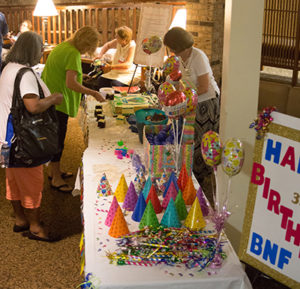
Baptist Nursing Fellowship, a ministry partner with National Woman’s Missionary Union, was established in 1983. As part of BNF’s recent annual meeting at Shocco Springs Baptist Conference Center, members marked the organization’s 35thanniversary with an opening night birthday party. The annual meeting and celebration attracted Christian nurses from 16 states. (WMU Photo / Pam Henderson)

The three-day meeting included a Baptist Nursing Fellowship birthday party, as well as worship and Bible study sessions, missionary field reports, continuing education sessions and hands-on missions projects such as writing notes of encouragement to student nurses, prayer walking and assembling activity books for chemotherapy patients.

Wanda Lee, former president and retired executive director of National WMU, led Bible studies highlighting the meeting theme of glorifying God.

“Your life is a reflection of your thoughts,” Lee said. “What consumes your mind controls your life.”

Affirming that “our minds are wonderful gifts from God,” she added, “They can be used for much good. … We’re commanded to love God with all of our selves, including our minds. You make up your mind about what you believe and then you have to allow it to impact your life.”

Citing Philippians 4:7-8, she said, “The peace of God will guard our hearts and minds when we fill them with the things of Christ.”

Concerning glorifying God with one’s voice, Lee said, “What we allow our minds to dwell on ultimately comes out of our mouths. We are called to glorify God with one voice.”

Emphasizing the need for believers to seek common ground and glorify God in one accord, she said Ephesians 4:5 declares that “the one thing that can bring us together is when we acknowledge this one Lord, one faith, one baptism.”

Marking a milestone

Ellen Tabor, the founding president of Baptist Nursing Fellowship, was among participants who gathered to celebrate the organization’s 35th anniversary of ministry. (WMU Photo / Pam Henderson)

Ellen Tabor, the founding president of BNF, was among participants who gathered to mark the organization’s 35-year ministry milestone. She and her husband, Charles Tabor, served for 20 years as Southern Baptist missionaries to Korea and Macau.

Tabor, who will celebrate her 90th birthday in October, noted her initial dream for Baptist Nursing Fellowship, “which we have kept the whole time, was that we would invite nurses who have a calling from God to use their nursing skills to advance his work whether in America or on the mission field.”

“My approach is see wherever you’re working with your health skills, see where you can help that person’s life be better in managing their health and being able to live healthy lives,” she explained. “Also, if they do not have the dimension of spiritual health, that they will want to be connected to the salvation experience of knowing Christ.”

Future Baptist Nursing Fellowship ministry projects include a medical missions trip to “God’s Love from a Diaper Bag” ministry to single mothers and families in Jenkins, Ky., in May 2019 and an international missions trip to Thailand in October 2019. For more information about Baptist Nursing Fellowship, click here. (http://www.wmu.com/?q=article/national-wmu/baptist-nursing-fellowship)

Trennis Henderson is national correspondent for Woman’s Missionary Union of the Southern Baptist Convention.


Homeless man’s new life follows couple’s compassion

By Roger Alford/Kentucky Today

CORBIN, Ky. (BP)—A series of bad decisions left James Price’s life in shambles. He had no money, no car, no home and no hope. But a seemingly chance encounter with retired businessman Ronnie Neal is changing the trajectory of his life.

Living under a bridge on the outskirts of Corbin, Ky., Price, 24, had taken a walk along a rural stretch of highway when he saw Neal loading sheet metal onto a truck. Perhaps, Price thought, that man would be willing to hire him to help.

Neal, 64, saw in Price a young man who needed a hand up, and he was willing to provide it.

“James kind of reminded me a lot of me when I was young,” Neal said. “The only reason I wasn’t homeless after my parents divorced is that my sister married into a family who took me in and let me stay with them when I was a teenager. … I could have very well been under a bridge myself.”

On the right path

Neal’s quality of life had improved since those early years. He and his wife Janet, members of West Corbin Baptist Church, credit Christ for that. For Neal, getting on the right path led to a loving wife, a successful career in grocery store management and, most importantly, a close relationship with God.

Neal accepted Price’s offer to work for him that day. They talked as they worked, and Neal learned Price’s circumstances. When the workday ended, Price thought he would get a few dollars and they would go their separate ways, never to meet again.

“He looked at me and said, ‘There isn’t any man working for me going to live under a bridge,’” Price recalled. “He said, ‘Go get your stuff, because you’re going home with me.’ I broke down right there. I had never had anyone be so kind to me.”

For Ronnie and Janet Neal, talking about Jesus is as natural as talking about their two sons. At the Neals’ home, Price got heaping helpings of the gospel along with country cooking that would pack weight back on the hungry young man.

When the first Sunday rolled around, the Neals didn’t have to ask Price if he’d like to go to church. Price asked if he could go along.

“It hit home with me,” Price said. “I went back with them on Wednesday. The following Sunday is when I got in my heart to go up to the altar and give my life to Christ.”

‘Start over again’

Price, who has an extensive rap sheet, was baptized Sunday, Sept. 1, during the 100th anniversary celebration of West Corbin Baptist Church. Now he says he regrets all his wasted years when, in his words, he laid around drunk, not knowing there was a better way.

“I know now there’s more to life than that; I learned it from that man,” Price said, pointing to Neal as the two of them stood beneath the bridge where a mixture of rocks, dirt, beer cans, campfire ashes, weeds and poison ivy mingled together.

Price’s parents died when he was a teen. He dropped out of school and has been living on his own since he was 16, working at whatever jobs he could find.

“James was basically dropped off in the world and told to do the best you can,” Neal said. “The conversation James and I have had is this: ‘You chose the wrong fork in the road years ago. You have to go back to the fork where you lost your way and start over again.’”

A year before he met Neal, Price crashed a motorcycle and spent weeks in the hospital. During that time, he was evicted from his rental home.

“When I left the hospital, I didn’t really have anywhere to go,” he said. “I had various friends I could stay with from day to day. But I had no transportation. No way to get back to work.”

Through the winter, he lived in a motel in Corbin that offered cheap weekly rates. When his money ran out, he moved in under the bridge.

‘I’m not going to give up on him’

Neal said the details of Price’s life are heartbreaking.

“I’m not going to give up on him,” Neal said, looking squarely at the young man wearing new clothes and a smile.

West Corbin Pastor Albert Jones said his church has seen a redemption story play out in the life of Price, and they’ve watched the Neals live out the gospel message.

“God reached out by his grace, and a life was changed,” Jones said. “Ronnie and Janet Neal are living out the gospel in vivid color.”

Price said he’s pondered his meeting with Neal on Friday, July 13, his “lucky” day. Price said he arrived at a firm conclusion: “We met by the grace of God.”

Helping Price was simply the right thing to do, Neal said.

“The Lord could have sent anybody James’ way,” Neal said. “I just happened to be the one.”


Cincinnati shooting spurs Baptists to bring hope

CINCINNATI (BP)—A Sept. 6 shooting rampage in Cincinnati that left four dead and two others injured led a city councilman to request aid from the community. Within minutes, Cincinnati Baptists began responding.

An unidentified gunman entered Cincinnati’s 30-story Fifth Third Center through a loading dock at 9:10 a.m. local time and opened fire in the lobby, according to media reports. He killed three people and injured others before police shot and killed him.

In the aftermath, a Baptist who works at a local news station heard city councilman Jeff Pastor say donations of water and snacks would be appreciated for the crowds standing outside after streets were closed. The news employee called his pastor, Josh Carter of Clough Pike Baptist Church in Cincinnati, who also serves as evangelism catalyst for the Cincinnati Area Baptist Association.

He contacted Mark Snowden, the association’s director of missional leadership, and church planter Josh McKinney was dispatched to buy snacks and water and head to the scene. The association’s prayer team was alerted to pray, as well.

“Cincinnati is a mission field with one million people not claimed by any religious organization,” Snowden wrote in an email. “When we hear of tragedies like the shooting today, I believe beyond the shared grief and need for ministry to affected families, the Lord uses horrific events like this to spur us onward as intentional disciple-makers.

“Who do we know? What do they need? And how can they embrace the gospel for spiritual transformation? We draw close to Jesus at times like this. And his heartbeat continues to pound out anguish for a fallen world. How can we not be our brother’s keeper when his blood is splattered all over the ground?”

Witnesses told the Cincinnati Enquirer “there was definitely a lot of blood,” and up to 15 shots were fired.

Prayer, water, snacks and the gospel

McKinney, who lives two blocks from the site of the shooting, assembled a team of four people to offer prayer, water and snacks, and a gospel witness for first responders and others at the scene. McKinney is a North American Mission Board church planter working in cooperation with the State Convention of Baptists in Ohio and the local Baptist association.

“Brokenness is pervasive,” McKinney said in an interview, fighting back tears. “We shouldn’t lose sight of our time we have here to engage a culture that is hurting and bring a hope for something better. We can talk voting, we can talk justice, we can talk social justice. But unless we engage the hurt behind it all, these kinds of things aren’t going to change.”

Carter, the pastor who helped launch the ministry reaction, wrote on Facebook to the church he leads” “Please be in prayer for the families affected by the active shooter situation which happened at the 5th/3rd building by Fountain Square this morning. I want you to know that I have been in contact with those that I know of that work on or near the site of the shooting, and that, as far as I know, no members of Clough were injured. However, … undoubtedly, our church family has friends and co-workers that were involved in this tragedy.”

Snowden offered suggestions for other churches and associations that find themselves positioned to respond to mass shootings and other local tragedies.

“My counsel to pastors wanting to help in situations like this is to check with church members immediately to see who might be affected. Send an email blast to church members saying how grieved you are, a few facts based on current news reports (or links), and express that you’re monitoring the situation. Your associational office can help by coordinating ministry opportunities,” Snowden said.


Anne Graham Lotz diagnosed with cancer, seeks prayer

RALEIGH, N.C. (BP)—Anne Graham Lotz has breast cancer, she announced Sept. 4, and she is seeking prayers for healing that would glorify God.

“Each day since the diagnosis, God has given me promises and encouragement from his word,” Lotz said at AnneGrahamLotz.org. “God has been … and is … my refuge and strength, an ever-present help in this trouble. Therefore, I will not fear,” she said, evoking Psalm 46:1.

“But he also has made it very clear that my healing will be in answer to not just my prayer, but the prayers of others for me.”

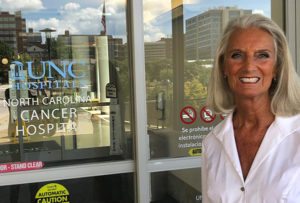
Lotz, founder and president of AnGeL Ministries, has surgery scheduled Sept. 18 to treat the illness at North Carolina Cancer Hospital in Chapel Hill.

Anne Graham Lotz, daughter of late evangelist Billy Graham, posted this photo on Facebook in announcing her upcoming surgery to treat an August diagnosis of breast cancer. (Photo from Facebook via BP)

“Would you pray for me?” she asked. “Pray for God to heal me in whichever way he deems would bring him the most glory. Healing without surgery, with surgery, with surgery and follow-up treatment, or through the greater miracle of the resurrection.”

Lotz was diagnosed on the afternoon of Aug. 17, she said, noting the date was three years after the death of her husband Daniel Milton Lotz.

“When I realized the strange ‘coincidence’ of the timing, I came to the chilling conclusion that it was an assignment from the enemy,” she wrote.

“But just as that thought was forming, I heard the soft, gentle whisper of the Spirit, reminding me that it was on a Friday, during that very same time … between 3:00 and 3:30 in the afternoon … that God’s Passover lamb was sacrificed.”

Evangelist Billy Graham was quoted widely in describing his daughter as “the best preacher in the family,” and the New York Times has named her one of the five most influential evangelists of her generation.

The 70-year-old Lotz speaks internationally and is a best-selling, award-winning author of several books. She blogs at AnneGrahamLotz.org.


One in seven Texas households lacked reliable access to food

One in seven Texas households had limited or uncertain access to food in recent years, a new study from the U.S. Department of Agriculture revealed.

The report showed 14 percent of Texas households experienced food insecurity in 2015-17, higher than the national rate of 12 percent during the same time period. The study showed significant improvement since 2012-14, when 17.2 percent of Texas households were food-insecure.

However, Feeding Texas—formerly the Texas Food Bank Network—noted Texas still had 1.4 million food-insecure households, more than any other state except California.

“Despite claims to the contrary, hunger is still a major issue facing too many Texans,” said Celia Cole, chief executive officer of Feeding Texas.

Prevalence of severe food insecurity reported

In food-insecure households, which lack consistent access to enough food for everyone to enjoy a healthy diet, families frequently cut back on groceries to pay for lodging, utilities or medicine. Nationally, the typical food-secure household spent 23 percent more on food in 2017 than the typical food-insecure household of the same size and composition, the report noted.

In addition to tracking general food insecurity—which means at some point, a household lacked access to food to provide healthy nutrition for all its members—the USDA also registered the rate of more severe “very low” food security.

Nationally, 4.8 percent of households reported “very low” food security in 2015-17; in Texas, 5.8 percent of households fell in that category during those years. That showed marked improvement over the 6.2 percent of Texas households that experienced “very low” food security in 2012-14, but it was higher than the 5 percent average in 2005-07, prior to the period economists identified as the Great Recession.

“We are encouraged that the food insecurity rate in Texas continues to decline. Over that last several years, organizations and leaders across the state have collaborated to address food insecurity, and we’ve made important strides,” said Kathy Krey, research director of the Texas Hunger Initiative at Baylor University.

“Still, we have not reached pre-recession levels, and close to 2 million Texas households are food insecure, and that number is far too high. We need to continue to work together to build a system wherein individuals and families can access the food they need.”

‘Lots and lots of work to do’

Signs of improvement give Texans reason to celebrate progress in fighting hunger, but the significant number of households that continue to experience food insecurity point to a need for continuing effort, said Ferrell Foster, director of ethics and justice with the Texas Baptist Christian Life Commission.

“Those of us who hurt for the malnourished in Texas see in these numbers that we still have lots and lots of work to do,” Foster said. “We are doing better, but there are still more than a million Texans who are uncertain about being able to eat healthy meals. They suffer today, and their malnutrition will have long-term consequences for them, their families and their communities.”

The USDA reported 10 states with a food insecurity rate higher than Texas—New Mexico, 17.9 percent; Arizona, 17.4 percent; Louisiana, 17.3 percent; Mississippi, 17.2 percent; Alabama, 16.3 percent; Oklahoma, 15 percent; West Virginia, 14.9 percent; Kentucky, 14.7 percent; and both Maine and North Carolina, 14.4 percent.

At 7.4 percent, Hawaii had the lowest food insecurity rate in the nation, followed by New Jersey at 8.6 percent and Colorado at 9.2 percent.

In addition to Texas, 11 other states had a higher prevalence of “very low” food security than the national average—Alabama and Louisiana, 7.1 percent; Mississippi and New Mexico, 6.6 percent; Arkansas, 6.5 percent; Maine and Oklahoma, 6.4 percent; West Virginia, 6.2 percent; Ohio, 6.1 percent; and Tennessee, 5.7 percent.

Congress debates future of federal nutrition programs

The USDA released its report at a point when members of Congress were debating the future of federal nutrition programs such as SNAP, the Supplemental Nutrition Assistance Program, formerly known as Food Stamps.

President Trump’s Council of Economic Advisers issued a report in July declaring the War on Poverty is “largely over and a success,” and the council recommended more stringent requirements for nondisabled adults who receive assistance.

The USDA reported about 58 percent of food-insecure households participate in one or more of the three largest federal food and nutrition assistance programs—SNAP; WIC, the Supplemental Nutrition Program for Women, Infants and Children; or the federal school lunch program.

“Our elected leaders should reject any proposal to cut programs like SNAP that help so many Texans make ends meet,” Cole said. “Taking food away from these families by cutting SNAP, or reducing resources for food banks to meet the need of their communities, will only increase food insecurity. … The best way to help our neighbors is not to take food off the table, but put more opportunities on it.”

Any effort to make households more food secure demands the cooperation of multiple institutions, Foster noted.

“Put simply, people need food for today and jobs for their tomorrows. And those who cannot work need our ongoing help,” he said. “Churches, schools and governments must work together to address these issues, and that is being done in more and more places in Texas. We are all in this together.”

EDITOR’S NOTE: The 8th and 9th paragraphs were added Sept. 7, after this article initially was posted Sept. 6.


Belle & Sparrows is standing in the gap for marginalized women

Tiffany Savage and Lynde Griggs are co-founders of Belle & Sparrows, a “by women for women” nonprofit seeking to stand in the gap for marginalized women in North Texas and around the world. Both women, while on separate mission trips, realized the need for others to advocate on behalf of women and children who are victimized through abuse and trafficking. In teaching women about their God-given worth, Savage and Griggs now take other women on mission trips and teach victimized women important life skills for success outside abusive relationships.

The following is an interview with Savage, the granddaughter of a Baptist preacher and church planter. She was raised in a Southern Baptist church and served a Baptist church for several years. Belle & Sparrows, the organization she co-founded with Griggs, is intentionally nondenominational.

Though we don’t want to acknowledge it, women and girls face two particular problems: sex trafficking and domestic violence. This is not only a global problem; it is also a local problem. Just how many girls experience sex trafficking in North Texas?

There are about 400 girls being trafficked on the streets of Dallas each night with their average age being 13 years old. “On the streets” means girls are literally placed on street corners, stadium parking lots and similar locations around the Dallas-Fort Worth Metroplex.

In addition to sex trafficking of women and girls, how many women in the DFW Metroplex face domestic violence?

In the DFW Metroplex, I have stats from 2013, and the numbers have increased since then.

In 2013, the Dallas Police Department Family Violence Unit reported 13,007 family violence calls resulting in 1,215 aggravated assaults, 23 murders, 10,812 reported offenses, 91 sexual assault offenses, 180 violations of protective orders and 5,782 arrests.

  • As a result of domestic violence, 246 women go to shelters in the Metroplex each night with many others being turned away for lack of space.
  • One in four women faces domestic abuse from a partner.
  • A woman is beaten every nine seconds in the United States and 15 calls a minute are made to hotlines for domestic violence.

And that’s just the DFW Metroplex. Do you have statistics for some other places in Texas?

Last year, the state of Texas served more than 70,000 families in family violence programs. Texas family violence programs received 172,573 hotline calls in 2016. The National Domestic Violence Hotline received 16,045 calls and 1,206 chat requests from Texas in 2016.
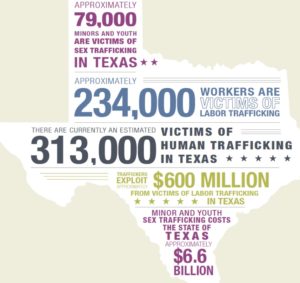
Infographic of human trafficking in TexasHow does sex trafficking tie into addiction, domestic violence, and incarceration? 

The U.S. State Department showed that “almost 70 percent of adult female trafficking victims experienced domestic violence prior to being trafficked.”

If a drug-addicted parent loses his or her job and other supports, he or she can spiral downward into addiction. With nothing left to sell or steal, the addict often decides to sell his or her partner—or child—for drugs or money.

Oftentimes, a girl falls into the trap of a trafficker, and before she finds her voice, he has her addicted to drugs so she can’t leave because she has to fuel her addiction.

Domestic violence can lead to drug use, and drug use can lead to prostitution, and prostitution often leads to incarceration or trafficking. Jails and prisons are becoming the new hunting grounds for traffickers. As soon as women are arrested and charged, they are becoming targets for human traffickers. Grooming begins with letters once they are targeted.

What is grooming, and what does it look like in the context of trafficking?

Grooming takes place when sex traffickers target vulnerable women, girls and boys and then execute a psychological and physical grooming process aimed at transitioning them to a dependent role. Using violence, substance abuse, false promises and manipulation, traffickers then abuse the dependency and soon have physical and mental control over their victims.

You alluded to a woman’s need for financial stability and the promises traffickers make to that provide that. What is the relationship between a woman’s ability to earn a fair wage and the likelihood of her being trafficked?

Trafficking victims are lured by false promises of decent jobs and better lives. The inequalities women face in status and opportunity worldwide make women particularly vulnerable to trafficking. If a woman cannot earn a fair and equitable wage, she often feels trapped with no other choice but to follow the lead of a trafficker.

Why can’t women make a fair wage to feed, clothe and provide housing for themselves and their children?

Women in the U.S. who are faced with being abused, who have come out of a violent relationship, who have been incarcerated previously or who are trying to overcome addiction struggle to find jobs that afford them a wage to provide for themselves and their children.

Minimum wage jobs or jobs that will hire someone with a record will not be enough to sustain a family of more than one. This leaves a mom with undesirable options, but when backed in a corner, she will do whatever it takes to feed and clothe her children.

Clearly, there is a need for advocacy for vulnerable women and children. Since there are already governmental initiatives underway, is there a need in North Texas for a nonprofit organization that empowers marginalized women?

There are many local organizations doing great things; however, there still seems to be a gap when it comes to empowering women to feel accomplished and worthy as women by learning a trade or skill and also giving them a decent wage for the work they do.

This is where Belle & Sparrows comes in. We seek to fill this gap by helping with economic sustainability, social justice and social enterprise.

We want to help more women find and act on opportunities to start and maintain small businesses with earning potential for their families.

We want to see the message of worthiness repeated in as many places and to as many people as the Lord will allow. The hope that is sparked by the message of worthiness can flourish into a flame for these women and for their generations to come!

I’m intrigued by this “message of worthiness.” Where does that idea come from?

God says very clearly several times in his word that he even cares for a tiny sparrow. How much more important or “worthy” of his love are we?

We are called to be image bearers of Christ. The more you believe you have inherent value and something important to contribute to the world, the more confidently you can move into your calling!

This is hard to grasp for many women who have faced abuse, addiction, incarceration, etc. Failing to believe these truths is often a result of a deeply rooted sense of inadequacy. To fight against these lies, we need to remind women of these truths of worthiness!

Churches may think trafficking doesn’t affect them. What are churches missing, and what can they do to help?

There are girls sitting in church pews each Sunday who are being trafficked by their boyfriends the other six days of the week. Often times church is the only place traffickers will let their girls go unsupervised.

How can the local church be the hands and feet of Jesus Christ if we aren’t being his eyes and ears, too? How can we love someone if we don’t even know they exist? Fighting human trafficking can begin with an act as simple as listening to someone’s story. Our congregations should take the time to get to know one another and build deeper relationships, this puts us in a better place to recognize and respond when not only our hearts but our eyes are wide open.

Some people may be concerned about starting a relationship with a woman or child they suspect is being trafficked. They don’t want to make that person’s situation worse. What is your advice for getting to know a person who may be a victim of trafficking? What sorts of things are okay to do, and what kinds of things should be avoided?

We use the following tool in our training to help people gain a trafficking victim’s perspective.

  • Think about things from our point of view. Never say you “understand” because you haven’t been there. Even so, try to put yourself in our shoes.
  • Language counts. The words you use make a difference. Calling us “prostitutes” hurts us.
  • Kindness and empathy go a long way. Even if we appear high, angry, homeless or dressed a certain way—don’t make assumptions. Showing us you care lets us know we can come to you for help.
  • We might/will probably mess up again. There are lots of things that push us back into the life. Give us many chances. At some point, we will hit rock bottom, and we will need your help.
  • We are good at reading people. We have to be. So we can tell if you really want to help us because you care or if you’re just saying you want to help us so we can help your case.
  • We know things. Sometimes we might want to tell you. A lot of times, we won’t—at least not right away.
  • We know more than you do about this life.
  • We don’t want to be out there doing what we’re doing. You have to understand that. We’re just doing this for survival. We’re homeless, or we just need some way to keep going.
  • We may act “hard,” but we have to have that “wall” up for survival. Deep down, we know we need help.
  • Most of us didn’t get rescued as little girls. That doesn’t mean we don’t need your help now as adults.
  • We have experienced more fear than you can imagine. Putting your pimp away doesn’t always get rid of that fear.
  • We are good mothers. Give us multiple chances, give us the tools, give us time to get our lives together. Sometimes, the only thing worth fighting for is our kids—they’re the reason we get out. When you take away our kids, you take away our reason to fight.
  • Listen to us. You may be “educated” and “professionals,” but even with your good intentions, you don’t know how things work in reality.
  • Don’t just ask us for our “stories”—we are not on display! You need our input and feedback; so give us ways to be involved and have a voice before you start passing laws.

How can individuals and churches help Belle & Sparrow accomplish its mission of advocating for and empowering marginalized women?

Individuals and churches can help by recognizing that there is a need and then educating yourselves. Go with us to serve. Help us with funding our programs. Share our organization with your friends, family, neighbors, colleagues and others.

We would love to speak to your church, women’s organization, small groups, Bible studies, MOPS, etc.

Attend our upcoming (un)GALA on Sept. 21, and hear more about the work we are doing locally and globally. The event will be at the Art Centre of Plano, and tickets can be purchased here.

What future plans does Belle & Sparrows have?

Belle & Sparrows is in the beginning stages of opening a place for women not only to live and learn how to become self-sustaining but also giving them a skill or trade while paying them decent wages to take care of their family.

We realized we need to implement a multi-phase initiative in the local area to help bridge another gap in serving marginalized women, which is a social enterprise program to include housing, manufacturing and retail space in the future.

The Stella Projects will be a comprehensive, holistic model across several modalities with the first phase being the development and implementation of a consumable line of products.

We believe this project will introduce our services to an extremely underserved population of women. As a result, we anticipate a rise in awareness of the need in our own backyard, as well as becoming a beacon of hope to women in other situations around the U.S.

We want to change a culture that still allows human beings to be bought and sold. The Stella Projects, after all phases are complete, will meet a universal call for healing that echoes under bridges, in jail cells and on the streets of our communities.

Survivors of trafficking, prostitution, abuse and addiction share a story that has been universal since the beginning of time. It takes communities to place individuals in these situations, and it takes community to provide healing and empowerment to survivors. We are this community.

To learn more about Belle & Sparrows, you can attend their un(GALA) on Sept. 21 or visit their website.


On the Move: Slaughter and Summers

Michael Slaughter to Columbus Avenue Baptist Church in Waco as associate pastor of music and worship.

Aaron Summers to First Baptist Church in Crowley as pastor from Coulter Road Baptist Church in Amarillo, effective Sept. 9.


Around the State: Houston church donates 7,000 pairs of shoes

South Main Baptist Church in Houston donated 7,000 pairs of shoes to Buckner International’s Shoes for Orphan Souls program. While members work and plan for months in preparation for the annual shoe drive, volunteers packed all the shoes into boxes and loaded them into trucks in less than 90 minutes. South Main is Buckner’s largest church-based shoe drive each year. Steve Wells is pastor.

The University of Mary-Hardin Baylor held a dinner for freshmen who are the first members of their families to attend college. (UMHB Photo)

Of the 875 freshmen enrolled at the University of Mary Hardin-Baylor, the largest freshman class in the university’s history, 370 are the first members of their families to attend college. On Aug. 30, UMHB President Randy O’Rear recognized those “First to Go” students during a F2G dinner at his home.

Georgia Risenhoover of Granbury was sworn in as the first female chaplain in the 195-year history of the Texas State Guard, entering as a first lieutenant assigned to the Medical Reserve Corps. Risenhoover, a Baptist General Convention of Texas-endorsed chaplain, also is coordinator of Texas Baptists’ Hands On Ministry spiritual caregiving training and is the first chaplain coordinator of the BGCT Native American Missions Initiative. She also is congregational chaplain for The Church on Thistle Ridge in Granbury, where her husband C.C. Risenhoover is senior pastor.

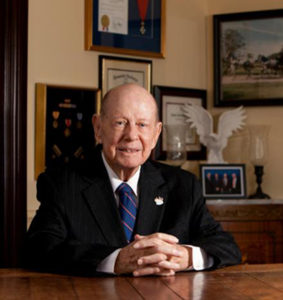
Stewart Morris

Houston Baptist University received a $10 million gift from Stewart Morris Sr. to establish the Morris Family Center for Law and Liberty and fund construction of a classroom building modeled after Independence Hall. “The Morris Family Center for Law and Liberty will teach American founding principles, constitutional government, free enterprise and all of the related political, social and economic implications of a nation truly committed to liberty and justice for all,” HBU President Robert Sloan said. The gift makes Morris, who serves both on the HBU board of trustees and the president’s leadership council, the university’s largest lifetime donor.

Christian composer and pianist Fernando Ortega will present a concert at Baylor University’s Truett Theological Seminary at 7 p.m., Oct. 1, in Powell Chapel. In a career that spans more than 25 years, Ortega has received three Gospel Music Association Dove Awards and a Billboard Latin Music Award. Sponsored by Truett Seminary and the music and worship office in Texas Baptists’ Great Commission Team, the concert is free, but registration is requested. To register, click here.


CommonCall: Christians have ‘Hearts4Kids’ in Valley

Jorge Zapata couldn’t help but notice the lack of resources in the Rio Grande Valley, but instead of looking for wealth to respond to the community, he thought creativity would be a better approach.

Zapata, founder of Hearts4Kids, was founding pastor of New Wine Church in La Feria, and he knew his congregation had to respond to needs. While poverty was important to address, the lack of churches responding to the needs of families also was alarming, he said.

While other organizations provided some of the resources the community needed, many families could not access them because they lacked transportation, Zapata said.

Although some churches were located near families’ homes, they were open only for worship and Bible study on Sundays.

“Churches did not have community centers, and community centers lacked the spiritual component,” Zapata said.  “Those churches had to be asked, ‘What do you do during the week?’”

Church-based community centers reach residents

Heart4Kids ministers both to the physical and spiritual needs of children and their families in the Rio Grande Valley. (Photo courtesy of Jorge Zapata)

Since he launched Hearts4Kids, Zapata helped start five churches with community centers that enabled the congregations to open their doors to other agencies to reach out to local residents.

“The church becomes the bridge between the community and the other organizations,” he explained.

As the churches interact more and more with the community, Zapata said, ministers become pastors to the community—not because people “become members of the church, but because those pastors are in their lives.”

A report released last year showed 68 percent of children in the Rio Grande Valley live in high-poverty neighborhoods. The Center for Public Policy Priorities’ study also reported children facing poverty in the Valley “often lack the most basic necessities for living (potable water, sewer systems, electricity, paved roads, safe housing, etc.)”

“Poverty creates those living conditions,” Zapata said.

Even though communities are challenged by the lack of resources, Zapata noticed resilient residents manage to survive and cleverly find new sources of income.

“They are entrepreneurs,” he said. “They learn and start new opportunities.”

Emphasis on collaboration and cooperation

But as creative as a family may be, Zapata said, he knows it is difficult to move forward when the household income of the families he works with is between $7,000 and $13,000 a year.

Many of the houses in which these families live have dirt floors or no running water, he noted.

Most parents work between two and three jobs, he observed.

“Every aspect of the family is affected by this,” Zapata said.

Poverty is such a challenge, Zapata—now coordinator of missions and Hispanic ministries at the Cooperative Baptist Fellowship of Texas—also has opened the door to collaborate with non-Baptist churches.

Through those partnerships, Zapata said, he has been able to find churches of other denominations that are willing to provide wheelchairs, medicine and school supplies to families.

“It is not about doctrine,” Zapata said. “It’s about providing help.”

Providing food to families in need

Those partnerships recently helped create food pantries in Hidalgo County. Iglesia Cantico Nuevo in Donna and Iglesia Vino Nuevo in San Carlos are the only food aid locations for many families in the area.

Iglesia Vino Nuevo in San Carlos began a food pantry in 2016 through Heart4Kids. (Photo courtesy of Jorge Zapata)

Zapata helped Vino Nuevo partner with Park Cities Baptist Church in Dallas to become a food distribution center two years ago, with financial assistance made possible by the Texas Baptist Hunger Offering.

More recently, Cantico Nuevo also partnered with Park Cities to also become a food distribution center. The church began offering food to low-income families this summer.

Through those partnerships, Cantico Nuevo and Vino Nuevo are part of the more than 80 hunger ministries the Baptist General Convention of Texas helps fund across the state.

Ministries like community centers and food pantries exist in response to the poverty ministers have seen as they interact with the people in their neighborhoods, said Victor Ramirez, pastor of Vino Nuevo.

“We realized there was a high percentage of children who lived in extreme poverty here.” Ramirez said. “These children did not have access to food after school.”

But opening the door to these ministries brings large unforeseen costs to the churches.

“We are a small church, and we don’t have the funds to make a large investment,” said Manuel Gonzalez, the pastor of Cantico Nuevo.

‘We have seen the extreme need’

For Gonzalez, the partnerships and cooperation Cantico Nuevo has received through Hearts4Kids and Texas Baptists offers a reminder of the work God does through someone who is willing.

“Just like Jesus used five loaves and two fish to feed the 5,000, he is asking us for what it is we have right now,” Gonzalez said. “He says to us, ‘Put what you have in my hand, and I will multiply it.”

Gonzalez said Cantico Nuevo knows the expanded ministry will significantly increase the congregation’s utility bills, and everyone in the church will have to volunteer their time to serve.

“It will be a challenge to us,” he said. “But we have seen the extreme need around here, and we cannot ignore it.”

‘God is certainly working here’

Ramirez founded Vino Nuevo in 2011. Through the church, Zapata has been able to incorporate classrooms for the community, a basketball court, a playground, and the storage room for the food bank through partnerships with churches and other organizations.  The church and its partners currently are working to build a park for children in the community, Ramirez said.

Because of the facilities and the ministries the church has created, families attend Vino Nuevo throughout the week.

“Even though we are not preaching to them every time the children are at our playground or the parents come to the food bank, God is certainly working here,” Ramirez said. “We have taught the church that our worship to God is not just done through singing. Our worship to God has to be through service.”

Christians are required to commit their lives to service, Zapata said. While that commitment demands a lot of effort from the church, other churches with more resources are meant to help, he added.

“Churches that want to help need to be committed as well,” he said. While financial assistance is important, churches also need to visit the ministry locations and bring people to help there more than once a year, he insisted.

“Otherwise those churches will not see the transformation happening in the community,” Zapata said.

“It is when churches do this, that they become part of the community. They become part of a strong ministry in this way, and that is what responds to the big need we see in the Valley.”

Read more articles like this in CommonCall magazine. CommonCall explores issues important to Christians and features inspiring stories about disciples of Jesus living out their faith. An annual subscription is only $24 and comes with two free subscriptions to the Baptist Standard. To subscribe to CommonCallclick here.