Pakistan among worst religious freedom violators

WASHINGTON—U.S. Secretary of State Michael Pompeo added Pakistan to a list of the world’s worst violators of religious freedom, while removing Uzbekistan from the list and singling out nine Islamist groups as Entities of Particular Concern.

For the first time since 2006, Uzbekistan did not appear on the list of Countries of Particular Concern, a category for governments that have committed or tolerated “systematic, ongoing and egregious violations of religious freedom.”
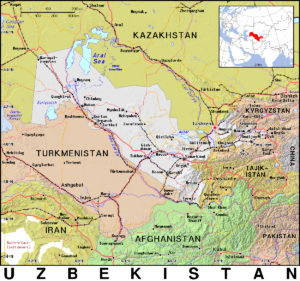
Uzbekistan is a Central Asian nation bordered by five landlocked countries: Kazakhstan to the north; Kyrgyzstan to the northeast; Tajikistan to the southeast; Afghanistan to the south; and Turkmenistan to the southwest.(Public Domain)

Instead, Uzbekistan was added to a “Special Watch List” along with Russia and Comoros.

Pompeo announced the lists Dec. 11, after officially making the designations Nov. 28—three days after military personnel and plainclothes police reportedly raided and ransacked an unregistered Baptist church in Tashkent, Uzbekistan’s capital.

In addition to Pakistan, other nations on the list of Countries of Particular Concern are Burma (also known as Myanmar), China, Eritrea, Iran, North Korea, Sudan, Saudi Arabia, Tajikistan and Turkmenistan.

Entities of Particular Concern are al-Nusra Front in Syria, al-Qa’ida in the Arabian Peninsula, al-Shabab in East Africa, Boko Haram in West Africa, the Houthis in Yemen, the Islamic State of Iraq and Syria (also known as the Islamic State of Iraq and the Levant or Daesh), ISIS-Khorasan in Afghanistan and Pakistan, and the Taliban in Afghanistan. The 2016 Frank R. Wolf International Religious Freedom Act created the EPC designation for non-state actors that commit systematic, ongoing and egregious violations of religious freedom.

“In far too many places across the globe, individuals continue to face harassment, arrests or even death for simply living their lives in accordance with their beliefs. The United States will not stand by as spectators in the face of such oppression,” Pompeo stated.

“Safeguarding religious freedom is vital to ensuring peace, stability and prosperity,” he continued. “These designations are aimed at improving the lives of individuals and the broader success of their societies. I recognize that several designated countries are working to improve their respect for religious freedom; I welcome such initiatives and look forward to continuing the dialogue.

“The United States remains committed to working with governments, civil society organizations and religious leaders to advance religious freedom around the world.”

Pakistan criminalizes blasphemy
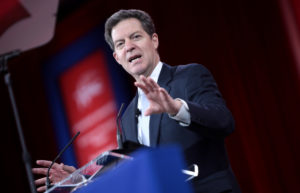
Sam Brownback, U.S. ambassador at large for international religious freedom.(File Photo / Gage Skidmore / CC BY-SA 2.0)

In a Dec. 11 teleconference briefing for reporters, Sam Brownback, U.S. Ambassador at Large for International Religious Freedom, noted Pakistan’s laws that criminalize blasphemy as one reason for designating the South Asian nation as a Country of Particular Concern. Of all people in the world who are imprisoned for blasphemy, half are in Pakistan’s prisons, he noted.

On Oct. 31, a Pakistani court overturned the blasphemy conviction of Asia Bibi, a Christian mother, and released her from death row. However, at this point, she has been blocked from leaving the country.

Brownback also noted the Pakistani government “often fails to hold accountable perpetrators of killings and violence against members of religious minorities targeted on account of their religious beliefs or affiliations.”

In recent days, Pakistan expelled 18 aid organizations, including World Vision, Catholic Relief and other Christian groups, as well as secular nongovernmental organizations. Umair Hasan with the Pakistan Humanitarian Foundation said the move will affect more than 11 million aid recipients, resulting in a loss of more than $130 million in aid annually for healthcare, education and other humanitarian concerns, according to CBS News and other media outlets.

Brownback highlighted China and its detention of between 800,000 and 2 million Uighurs as one of the “worst human rights situations in the world.”

“China isn’t backing away from the religious persecution. It seems to be expanding” to include ethnic Kazakhs and other ethnic groups, he said.

Brownback: ‘Substantial changes’ in Uzbekistan

Regarding Uzbekistan’s removal from the Countries of Particular Concern, Brownback said: “They’ve made substantial changes, and they’re doing it because they want to grow their nation. They want to see less terrorism, and they see this as a key route to really improving the livelihood of people throughout their nation, which we agree with, and we’re working with them.”

The U.S. Commission on International Religious Freedom, which issues its own recommended list of Countries of Particular Concern, ascribed Tier 1 CPC status to Uzbekistan in its 2018 report.

The report notes “the Uzbek government has not yet embarked on a major deviation from its overall policy of severe restriction of religious freedom.”

Tenzin Dorjee, chair of the commission, praised Pompeo for including Pakistan on the Countries of Particular Concern “after years of reporting systematic, ongoing, egregious violations of religious freedom.”

“While the State Department named Pakistan to the Special Watch List last year, the Pakistani government continued to harass its religious minorities, carry out state-sanctioned discrimination against groups such as the Ahmadis, and tolerate extrajudicial violence in the guise of opposing blasphemy,” Dorjee stated. “Today, approximately 40 individuals in Pakistan are incarcerated on charges of blasphemy.”

However, the commission’s chair raised concern about Uzbekistan’s removal from the Countries of Particular Concern list, saying, “We question whether Uzbekistan has sufficiently improved to be moved from the CPC list to the Special Watch List.”

In addition to the nations the Secretary of State Pompeo designated as Countries of Particular Concern, the commission also had recommended the designation be applied to the Central African Republic, Nigeria, Russia, Syria and Vietnam.

Pointing to Russia’s inclusion on the Special Watch List, Brownback pointed to “widespread suppression of religious expression” and persecution of Muslims, in particular. He noted of the 145 prisoners in Russia currently jailed for their religious beliefs, 106 are Muslims.

The Trump Administration has placed sanctions on several of the Countries of Particular Concern, generally both due to violations of religious freedom and other causes such as violations of arms control agreements, Brownback said.

Sanctioned countries included Burma, China, Eritrea, Iran, North Korea and Sudan. The administration waived sanctions on Saudi Arabia, Pakistan, Tajikistan and Turkmenistan due to “national interest,” he said.


Report ties Southern Seminary founders to slaveholding

LOUISVILLE, Ky. (RNS)—Founders of one of the nation’s largest seminaries owned more than 50 slaves and said that slavery was morally correct.

But an internal investigation found no evidence the school was directly involved in the slave trade, according to the seminary’s president.

A 71-page report released Dec. 12 from Southern Baptist Theological Seminary, the Southern Baptist Convention’s flagship seminary, says its early trustees and faculty “defended the righteousness of slaveholding.”

“They argued first that slaveholding was righteous because the inferiority of blacks indicated God’s providential will for their enslavement, corroborated by Noah’s prophetic cursing of Ham,” the report reads. “They argued second that slaveholding was righteous because southern slaves accrued such remarkable material and spiritual benefits from it.”

The seminary was founded in 1859 in Greenville, S.C., but suspended operations in 1862 during the Civil War and reopened in Louisville in 1877.

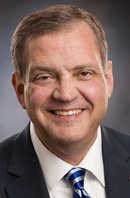
albert mohler130
Al Mohler

The Southern Baptist Convention was founded in 1845 when its members defended the right of missionaries to own slaves. Southern Seminary President R. Albert Mohler Jr. said the investigation expanded the knowledge and truth of what that defense meant.

“What we did not know and should have known was the degree to which open expressions of white racial supremacy were a part of the defense of slavery even on the part of some of the founding faculty of this school,” he said.

The report demonstrates how interwoven Southern Seminary’s history has been with the wider racial and political history of the denomination and the nation. It follows a 1995 resolution passed by Southern Baptists on the 150th anniversary of the denomination in which they said “we lament and repudiate historic acts of evil such as slavery” and “we genuinely repent of racism of which we have been guilty.”

Brantley Gasaway, chair of Bucknell University’s religious studies department, said the report, like the earlier resolution, is “symbolically significant.” It shows that some Southern Baptist leaders have grown in their sensitivity to diversity and racial reconciliation, he said.

But he said it did not point to substantive policy or structural changes.

“The leaders of Southern Seminary confess and lament their racist heritage, but they pledge only to continue to welcome and celebrate racial diversity at their institution,” said Gasaway, whose research focuses on evangelicals. “Such an approach reflects most evangelicals’ view that racial reconciliation does not necessarily include any reparations or recompense for the injustices suffered by minorities.”

Mohler said his decision to call for a one-year investigation by a team of six faculty—three African-American and three white—was prompted by actions of other institutions of higher education, specifically Princeton University, which released a report last year on its ties to slavery, including the sale of slaves on its campus.

Southern Seminary was not found to be involved in the slave trade as an institution, Mohler said.

‘Institutional sorrow’ but no apology

Asked if the seminary will apologize for its founders’ stances, Mohler said he could offer “a very clear statement of institutional sorrow,” but it is not possible to apologize for the dead.

“We certainly want to make very clear that we are a very different institution than we were then,” he said, noting its more recent history of inviting Martin Luther King Jr. to the school in 1961. That visit prompted white Southern opponents in the Baptist denomination to withhold money from the school and the seminary’s president at the time to issue an apology.

Asked if the seminary is repenting for its ties to slavery, Mohler said “to the extent that repentance rightly applies, we surely repent.”

“The problem is theologically repenting for the dead,” he said.  “We cannot repent for the dead.”

Mohler’s insistence that neither he nor the seminary can apologize nor repent for the founders “seems to run counter to celebrating the accomplishments of those men for bringing the seminary into existence and for shaping it and the larger Southern Baptist Convention,” Baptist Standard Editor Eric Black said.

“One might wonder how it is possible to separate from the past when called to apologize for predecessors while claiming connection to a rich heritage from the same past,” Black said.

In his written introduction, Mohler said he rejoices in the “new humanity” now demonstrated on his campus. He expressed appreciation for the school’s black students, alumni, trustees and faculty. In its 2017-18 academic year, the seminary had 228 blacks enrolled, comprising 4.26 percent of the total student body of 5,354.

“Right here, right now, we see students and faculty representing many races and nations and ethnicities,” he wrote. “Our commitment is to see this school, founded in a legacy of slavery, look every day more like the people born anew by the gospel of Jesus Christ, showing Christ’s glory in redeemed sinners drawn from every tongue and tribe and people and nation.”

Among other findings: 

  • Seminary faculty sought to preserve slavery after the election of President Lincoln. James Boyce, the seminary’s first president, “believed that sudden secession would be disastrous, and that negotiation with the Republicans would produce guarantees of protection for slavery.” Boyce was the only one of the four founding professors who served in the Confederate Army, where he was a chaplain.
    • John A. Broadus, another founding faculty member, presented resolutions at the 1863 meeting of the Southern Baptist Convention that pledged Southern Baptist support for the Confederacy. They were adopted unanimously. He later supported a possible move to a new location for the seminary that was “in a white man’s country.”
    • Joseph E. Brown, whom the report described as “the seminary’s most important donor” and its trustee board chairman from 1883 to 1894, earned a substantial part of his fortune from the exploitation of mostly black convict-lease laborers. His iron furnaces and coal mines, once described as a possible “hell on earth,” used torture and other harsh punishments that were similar to those exercised by slave drivers. Brown gave a gift of $50,000 to the seminary that helped save it from financial collapse.
    • In some instances, seminary faculty urged humane treatment of blacks. But before the 1940s, faculty members “construed the Old South as an idyllic place for both slaves and masters” and “claimed that the South went to war to uphold their honor rather than slavery.” They also supported black theological education as long as it was segregated.
    • The support of white superiority, which was taught by seminary faculty, was exemplified in the writings of Edgar Y. Mullins, president of the seminary from 1899 to 1928: “It is immoral and wrong to demand that negro civilization should be placed on par with white. This is fundamentally the issue.”
    • The seminary refused requests by blacks for admission for decades. When the seminary had its first black graduate, Garland Offutt, who earned a master’s of theology in 1944 (and later a doctorate in 1948), it did not permit him to participate in the regular commencement festivities. He instead was awarded his degree during the term’s final chapel service. Blacks first participated in graduation services in 1952.

The report concludes with a statement about the seminary’s eventual rejection of white supremacy.

“This report documents the contradictions and complexities of the experience of Southern Baptists and race in America,” it reads. “We have not overcome all the contradictions, but we are committed to doing so.”


Houston-area Latino association broadens its vision

The Asociación Bautista Latino Americana knows its efforts now can prepare Houston-area churches for better outcomes later.

With expectations Hispanics will make up 60 percent of Houston’s population in 2050, the association met recently at Baptist University of the Américas in San Antonio to cast a vision for the future.

Since Hispanics already make up a large portion of Houston’s diverse population, the 52 Hispanic Baptist churches that are part of ABLA need to do more, said Bulmaro Luna, elected this year as the association’s executive director.

ABLA officially was organized as an independent association distinct from Union Baptist Association in 2003. The association has its own board of directors and budget, and it creates its own resources, Luna explained.

Many churches in the association already have developed networks to serve the community, but ABLA must do more to facilitate collaboration, he insisted.

Focus on discipleship and church starting

The association plans to focus on two areas—making disciples and planting churches, he said.

Pastor Johnnie Musquiz teaches a Christian ethics class at the Baptist Bible Institute at Iglesia Bautista Houston. (Photo / Isa Torres)

“The motto of ABLA is ‘to make disciples,’ and with more disciples, we should also plant more new churches,” Luna said.

Through theological institutes in Houston—like the ones he and pastor Johnnie Musquiz lead—the association can prepare more people for Christian service, with a particular focus on discipleship and starting churches, Luna said.

The association also wants to respond to pastors’ emotional, physical and financial needs, he noted. A new ministry for pastoral care ABLA plans to implement this year will offer resources for pastors to find health insurance through networks like GuideStone, and also will coach ministers to budget for emergencies, retirement and other savings, he said.

Modeled after Texas Baptists, ABLA has created a network of ministry departments that range from missions and evangelism to pastoral counseling and the regional Unión Femenil Misionera, he said.

“The association is essential for Houston, a very big city where there are a lot of Hispanics,” Luna said. “If the purpose of the association is to work together, then we must come together as churches, as an association.”

Catalyst for collaboration

To broaden the association’s vision, Luna scheduled its most recent board meeting in San Antonio, so members could learn more about BUA, the Hispanic Baptist Convention and Unión Femenil Misionera.

“Hispanic churches like to collaborate together, but sometimes someone needs to start the process,” Luna said. “This is what we must do to be able to do the work we have been called to do.”

As executive director of ABLA, Luna believes it is his responsibility to enhance communication and establish connections between available resources and Houston area churches involved in a variety of effective ministries.

“We do have to start from the relationship we have with God and from the vision God has given us,” Luna said. “Everything begins there, and if we seek to have a good relationship with God, then we will also seek to have a good relationship with others.”


Around the State: Baylor philanthropy class presents grants

Twenty students in Baylor University’s Philanthropy and the Public Good class presented $62,500 in grants to eight nonprofit organizations. A gift of $50,000 from anonymous Baylor graduates and $12,500 from the Fort Worth-based Philanthropy Lab provided the funds for this fall’s class grants. Students awarded $15,000 to the Waco Family Abuse Center, including funds for its Healthy Outcomes through Prevention and Early Support program, and $10,000 to CASA (Court Appointed Special Advocates) for remodeling of its facility to accommodate more advocates. Other grant recipients were Elijah Rising in Houston for its Kendleton Farms residential facility for survivors of sex trafficking to receive restorative care; the Jordan Elizabeth Harris Foundation in Dallas to launch a Hope Squad, a national school-based peer-to-peer suicide prevention program, at two schools; Caritas in Waco to update its technological infrastructure; the Talitha Koum Institute in Waco to purchase equipment for a sensorimotor lab, gym and infant playground; the One Acre Fund in Kenya to help 100 family farms move toward becoming self-sustaining; and start-up funds for SHE is Freedom in Waco as the organization seeks to provide a safe house and comprehensive restoration for survivors of domestic minor sex trafficking. In the last four years, students in Baylor philanthropy courses have given 98 grants totaling $612,785 to 52 organizations.

Abi Brown

Howard Payne University named Sarah Abigail “Abi” Brown, a junior from May, as the first recipient of the Jack White Character Scholarship. Brown, a member of the Gamma Beta Phi honors organization, is involved in the HPU Baptist Student Ministry, serving on the BSM leadership team and as a leader of the Pray and Do ministry. She also serves First Baptist Church in May as a youth leader.

At fall commencement, the University of Mary Hardin-Baylor presented the President’s Award for meritorious service to Jenna Forrester of Weatherford. During her time on campus, Forrester served as a University Ambassador and took active roles in the Miss Mary Hardin-Baylor Pageant, Easter Pageant and Crusader Knights. UMHB recognized Shelby Rogers of Round Rock as recipient of the Loyalty Cup, awarded to the student who is most representative of the ideals, traditions and spirit of the university. Forrester and Rogers were among nine graduates who received the Provost Medal for highest overall grade point average. Other Provost Medal recipients were Mackinzie Browning of Pflugerville, Cody Cowan of Belton, Maci Davies of Marble Falls, Breanna Etheredge of Smithville, Allison McKeown of Saginaw, Kelsey Newton of Joshua, Kyle Revis of Temple, Warren Sanders of Kempner and Rhondalynn Tyler of Lawrenceville, Ga. Each graduated with a perfect 4.0 GPA.

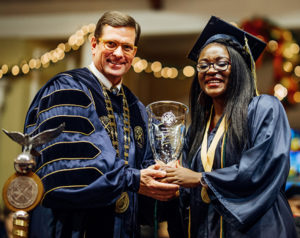
J. Blair Blackburn, president of East Texas Baptist University, presents the President’s Award to Mpanga Chanda of Lusaka, Zambia. (ETBU Photo)

Mpanga Chanda from Lusaka, Zambia, received East Texas Baptist University’s President’s Award at fall commencement. ETBU presents the award to a graduate who is considered an excellent example as a Christian leader, scholar and servant. At ETBU, Chanda has been involved in Enactus, where she serves both the campus and the community through business-related projects. She also served as a supplementary instruction tutor in accounting and economics, and was a member of Mobberly Baptist Church.

George Newman

Due to on-campus space limitations and the renovation of Behrens Auditorium, Hardin-Simmons University will hold its graduation ceremonies at the Convention Center in downtown Abilene on Dec. 14. Graduates of the Logsdon School of Theology, along with the Cynthia Ann Parker College of Liberal Arts, the Holland School of Science and Mathematics and the Patty Hanks Shelton School of Nursing, will attend a 10 a.m. ceremony. Graduates of the Kelley College of Business, the College of Human Sciences and College of Fine Arts will attend a 2 p.m. ceremony. George Newman, Taylor County judge and chair of the HSU board of trustees, will deliver the charge to graduates in both ceremonies.


Former minister at Houston church admits embezzlement

HOUSTON (BP)—A former pastoral staff member at Houston’s First Baptist Church has admitted to embezzling more than $800,000 from the congregation, according to media reports.

Jerrell Altic, 40, was indicted Dec. 10 for first degree felony theft of more than $800,000 from 2011-17, Houston’s First said in a statement by Pastor Gregg Matte and deacon Chairman Craig Bloodworth.
Altic surrendered to law enforcement Dec. 11 and has “admitted fully to the offense,” his attorney James Alston said according to The Houston Chronicle.

Altic is “working with the church, he’s trying to make amends for everything that he possibly can,” Alston said. “He feels horrible for what has happened and the pain that it’s caused everyone at the church, and his family members and friends. He would want me to tell everyone that he’s sorry.”

Alston declined to say how the money was stolen or whether it was spent.

‘Lavish’ purchases and cash advances

Dane Schiller, a spokesman for the Harris County District Attorney’s Office, said Altic allegedly used his church credit card to make “lavish” purchases and secure cash advances.

Houston’s First Baptist Church said it discovered “a limited set of suspicious financial activity” in November 2017 and approached Altic about it.

“He immediately tendered his resignation,” and the church reported the matter to law enforcement in addition to launching its own “thorough investigation,” church officials said.

“We have learned through the investigation process that, acting alone, Jerrell engaged in multiple deceptive and difficult-to-detect techniques to carry out this theft,” the church stated. “That said, though his fraudulent activities involved missions funds, all of Houston’s First ministry partners received their designated monies, as his actions did not prevent our church from providing resources to local ministries, church plants or other strategic partners.

“Nevertheless, we have already enacted additional policies to help ensure all donations and expenses are protected and handled properly moving forward. The outside expertise we sought helped us not only to determine the extent of this serious violation of trust, but also provided recommendations on how our financial controls might be improved or strengthened,” the church stated.

Due to “the sensitive nature of the legal and investigative procedures,” the church’s leaders have not been able until now to inform the full church body of the allegations against Altic, Houston’s First Baptist Church said.

Insurance has reimbursed the church $500,000, and “our church leadership approved using unallocated contingency funds to replace the balance,” the church announced.

“As challenging as this discovery has been for everyone involved, we have also been encouraged by the continued generosity and passion for missions work from our congregation—including through generous, unsolicited financial gifts from those who have come to know of his wrongdoing,” the church stated.

“We pray for God’s work to continue to be done at Houston’s First, and for Jerrell and his family. … We understand and take seriously our responsibility to properly steward the resources God gives us through the generosity of our church family.”


Chinese Christians pledge to persevere

SICHAUN PROVINCE, China (BP)—As China continues to hunt down and arrest members of a house church in Sichuan Province, many of the 100 or more Christians arrested reportedly pledged in advance to persevere even until death.

Gina Goh, Southeast Asia regional manager for International Christian Concern, said many leaders of Autumn Rain Covenant Church counted the cost and pledged faithfulness in advance of arrests at homes, workplaces and on the streets that have continued since Dec. 9.

“I think a lesson we can learn from them is they continue to say that: ‘No matter what may come, we will continue to serve the Lord. We will continue to stand strong in our faith,’” Goh said. “As was demonstrated in this church, … their pastor, a lot of elders, actually wrote letters to their congregation saying that: ‘We will not bend, even if it means jail, even if it means death. We will continue to preserve our faith.’”

Those arrested are being beaten, tortured and denied food and restroom accommodations, Goh said, according to accounts and photos from four released to house arrest or police surveillance. Among abuse, Christians were dragged, stepped on and tied to chairs and had handfuls of hair pulled from their scalp. In many cases, no charges have been filed or announced.

Escalated persecution

The continuing arrests are the latest in government persecution of Christians that has escalated under President Xi Jinping’s ramped-up efforts to “Sinicize” religion, bypassing religious freedom that is guaranteed in the country’s constitution.

Church elder Li Yingqiang, who evaded arrest until 2 a.m. Dec.11 by hiding, wrote a letter before his arrest to other members in seclusion, World Magazine reported.

“Beloved brothers and sisters, I am writing this letter in hiding,” World quoted the communication. “May you all be filled with joy in the gospel of Christ. May you welcome, filled with hope, the even heavier cross and more difficult lives that lie ahead of you. Christ is Lord. Grace is king. Bear the cross. Keep the faith.”

The government tactic of arresting church members and leaders while they conduct their daily lives is not new to China, Goh said. But the latest incident, he said, represents an escalation in scope.

“This is not completely new, but for something that is this largescale, it is new for sure,” Goh said. Intimidating church members and leaders, she said, is designed to make the churches dismantle and force allegiance to the Three-Self Church controlled by the Chinese Communist Party. Three-Self congregations must display government flags, sing patriotic songs and praise government leaders.

Preempting constitutional protection

Xi’s religious restrictions enacted in 2017 and tightened in February are preempting China’s constitution.

“The constitution should be the highest law that everyone expects. And this set of rules cannot override (the) constitution,” Goh said. “But China claims to be a country that follows the rule of law, when in reality it doesn’t. It just kind of does things as it wants.

“A lot of Christians even before this set of rules was enacted, they were prepared that the colder winter was coming, and they actually braced themselves for it,” Goh said.

Underground congregations and house churches have been meeting in smaller groups of five or 10 to avoid detection. But the Rain Covenant congregation has countered persecution by remaining visible. Its leaders have been vocal opponents of religious persecution.

“Autumn Rain Covenant Church—they are actually very brave,” Goh said. “They continue to push for being able to worship in public. Once their venue was cracked down, they actually brought their worship to the streets. … This really irked the authorities.

“They basically want to crack down on (Autumn Rain) to serve as an example to smaller churches.”

Autumn Rain has several locations that comprise a membership of a thousand or more, she estimated.

The international community should continue to advocate for religious freedom in China, Goh said. And individual Christians, she noted, should support American churches and missionaries trying to help and encourage those persecuted.

“I know of initiatives that are also trying to reach out to these underground churches and Christians, trying to teach them how to react spiritually but also legally,” she said. “They need this kind of help as well. Other than praying for them, if there is a way for you to support this type of initiative … and asking them how we can pray, I think that will be helpful as well.”

In September, government officials disrupted services at five or more churches in at least four provinces in central, southern and southwestern China, removing crosses, blocking entrances, disbanding worship and harassing members.

International Christian Concern, China Aid founder and president Bob Fu and other international religious watchdog groups have described Chinese government persecution as comparable to Maoism.


Dispute pits religious freedom against claims of ‘stealth jihad’

FORT WORTH (RNS)—Lisa Grimaldi Abdulkareem describes herself as a conservative Republican who believes in freedom and prosperity.

“Less bureaucracy, lower taxes and stronger national security—it is simple for me,” said Abdulkareem, the Tarrant County GOP’s vice chair for precinct recruitment and volunteers.

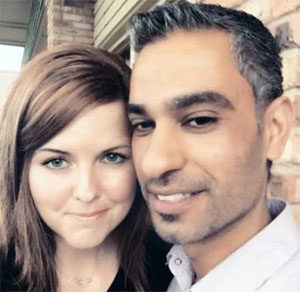
Lisa Grimaldi Abdulkareem and her husband, Hadi. (Courtesy photo via RNS)

However, some Republican activists in the Lone Star State’s most conservative urban county want Abdulkareem removed from the party’s leadership.

The reason: She’s married to a Muslim.

Abdulkareem, a nondenominational Christian, has been caught up in a political civil war that has raged in the Tarrant County GOP for months, pitting Republicans who see the need for diversity in the party against those who see any follower of Islam as a soldier in a “stealth jihad.”

Appointment of regional VP draws fire

The skirmish first erupted in July, when the county’s Republican chairman, Darl Easton, named Shahid Shafi, a two-term city councilman in suburban Southlake, as one of the party’s two regional vice chairs. Shafi is also a trauma surgeon who is Muslim.

Abdulkareem drew fire for supporting Shafi’s appointment.

“I spoke up publicly for Dr. Shafi and was immediately targeted because of my husband’s religious affiliation,” said Abdulkareem. Her husband, Hadi, is a naturalized U.S. citizen who served as a translator for U.S. Marines in his native Iraq from 2006 to 2009.

“They also say I am a Democrat, although I have never voted as a Democrat or for one,” Abdulkareem said.

Bob Roberts

Dorrie O’Brien, a Republican precinct chairwoman in Grand Prairie, leads a group of activists who have pushed for Shafi to be removed based on his religious affiliation.

O’Brien made news in 2011 when she criticized Bob Roberts, pastor of NorthWood Church, a Baptist megachurch in suburban Keller, for inviting Muslims to a “Building Bridges with Fellow Texans” event sponsored by the church. O’Brien called the idea of Christians and Muslims becoming friends or having fun together “repulsive and impossible.”

Seven years later, Roberts is among those defending Shafi’s right to serve as a Tarrant County GOP vice chair.

“I oppose those opposing Dr. Shafi because they do so on the basis of him being a Muslim,” Roberts said. “This is America—religious freedom matters, regardless of the religion.”

Group seeks to purge Muslims from GOP leadership

In recent weeks, O’Brien’s group has moved to oust others, including Abdulkareem and Easton, who have espoused the Muslim party members’ cause, according to emails anonymously delivered to the Fort Worth Star-Telegram.

On Facebook, O’Brien repeatedly has warned of the supposed dangers of Islam, which she argues is “spread now far more by lies, deception and concocted perception than it is by physical jihad.”

“This is where we are in Tarrant County today,” O’Brien wrote in a recent post. “Divided by those who won’t see the stealth jihad and by those who do. Those who’ve drunk the Islamic Kool-Aid and those who haven’t.”

Many of the county GOP’s precinct chairs have been invited to a Dec. 29 training meeting with former FBI agent John Guandolo, who is known for his anti-Muslim positions, to discuss whether the U.S. Constitution and Islamic law, called Shariah, are compatible, according to other emails obtained by the Star-Telegram.

“Given Guandolo’s history of anti-Muslim bigotry, this training will inevitably incite hatred of Muslims and Islam,” said Ekram Haque, acting executive director of the Dallas-Fort Worth chapter of the Council on American-Islamic Relations.

Shafi, who emigrated from Pakistan in 1990 to train as a surgeon and is now a U.S. citizen, said he won’t allow “this small group of closed-minded people to damage our party that I’ve supported and served for several years.”

“The call to remove me from the party of Lincoln and Reagan because of my religion is wrong for several reasons,” Shafi said in a Facebook post in which he denied any association with the Muslim Brotherhood, CAIR or any terrorist organization.

O’Brien and others raised their concerns about Islam at a meeting last month of the Tarrant County GOP executive committee. A vote on Shafi’s status is scheduled for Jan. 10.

‘Embarrassing’ to the Republican Party

“The very fact that this is in the news at all is embarrassing for the county Republican Party,” said Matthew Wilson, a political scientist at Southern Methodist University in Dallas. “I would be stunned if the party collectively actually chooses to remove these people, but the fact that they even have to have a hearing about it … doesn’t do the party any good.

“What’s not clear is how much grassroots support they have behind them,” added Wilson, who studies the voting patterns of religious people.

The anti-Islam sentiment—which some say has been fueled by President Trump’s exclusionary rhetoric about immigrants from Muslim-majority nations—has historical echoes, Wilson said.

“Once upon a time, there were people who would argue that Catholicism was incompatible with American values, and because Catholics had allegiance to Rome, that meant you couldn’t be a faithful Catholic and a good American at the same time,” he said.

Now, Texas has a conservative Republican governor—Greg Abbott—who is Catholic. “And who I’m quite sure wants nothing to do with this ordeal,” the SMU professor said of the Tarrant County dispute.

Republicans across the state have spoken out against Tarrant County’s campaign to remove Shafi.

“I urge the Tarrant County GOP to stop this attempt to remove a hardworking county party official based on religious beliefs,” Texas Land Commissioner George P. Bush, a grandson of the late President George H.W. Bush, said in a tweet. “We must move towards a more inclusive Republican Party and stop tearing down our own if we are to keep Texas red.”

In a similar tweet, Texas House Speaker Joe Straus called the effort to oust Shafi because of his religious faith “disgraceful and un-American” and said “Republicans in Tarrant County should defeat it handily.”

Republican U.S. Sen. Ted Cruz added his own tweet, saying “Discrimination against Dr. Shafi b/c he’s Muslim is wrong.”

Earlier this month, the Texas GOP executive committee passed a formal resolution supporting Shafi, affirming “every American’s right to practice their religion” and recognizing “the contributions of Republicans of every faith who advance conservative policies and ideals.”

Bud Kennedy, a Star-Telegram news columnist and longtime observer of Tarrant County politics, said he expects Shafi to prevail in a close vote, but Kennedy suggested any action taken at the state level supporting Shafi could inflame the critics further.

“There is this entrenched opposition that feels like nobody understands what they want, and everybody is trying to guilt them into voting the way the party at large wants them to vote,” Kennedy said.

‘Bunker mentality’

In November’s midterm elections, Republicans prevailed in Texas’ statewide races, including Cruz’s narrow victory over his Democratic opponent, Beto O’Rourke. But in Tarrant County, O’Rourke edged Cruz by a few thousand votes.

Tarrant County Republicans are worried, said Kennedy: “If they lose control of Tarrant County, they lose control of Texas, and they lose the electoral votes. And they have a real bunker mentality that it’s Tarrant County Republicans against the world.”

As Abdulkareem sees it, Easton made a “brilliant” move by appointing Shafi and Chris Garcia, a Hispanic businessman, as vice chairs this past summer.

“This shows the diversity in our party and (is) something that is imperative for Republicans to do moving forward,” she said.

She praises Shafi as someone who works tirelessly for the Republican Party because he believes in the values it espouses—and who never even asks to be noticed or thanked for his hard work.

“He does it because he feels in his heart it’s important to keep the Republican values at the front,” Abdulkareem said. “Our party should not exclude other religions or races but embrace everyone whose core values align with our platform.

“Nowhere in our platform does it state you must be Christian to participate,” she said. “As a Christian, I was always taught to love everyone as Jesus loved us. We all fail at this task, but we should strive to work hard at it so that when we see him on that day that he knows we truly in our heart strived to live in his image.”


Most Americans still say they want more Christ in Christmas

NASHVILLE, Tenn.—Most Americans want more religious meaning to the Christmas season. For about one-third, that includes the way seasonal greetings are expressed.

A new study from LifeWay Research found two-thirds of Americans (65 percent) say, “Christmas should be more about Jesus.”

Those looking for more Christ in Christmas in 2018 are proportionately fewer than four years ago, however. According to a 2014 LifeWay Research study 79 percent of Americans at that time said Christmas should be more about Jesus.

While similar numbers disagreed in 2014 and 2018 (18 and 19 percent respectively), the percentage who said they were unsure if Christmas should be more about Jesus jumped from 3 percent four years ago to 16 percent today.

“Saying Christmas should be more about Jesus is a little like saying Thanksgiving should be more about giving thanks. It’s in the name of the holiday,” said Scott McConnell, executive director of LifeWay Research. “Yet, it appears there is less cultural expectation for celebrations of the Christmas holiday to include the religious aspect.”
Much of the shift came from non-Christians. In 2014, a majority of members of other faiths (63 percent) and almost half of the non-religious (46 percent) agreed that Christmas should be more about Jesus. Today, those numbers have been cut in half.

In 2018, around a third of Americans of other religious persuasions (35 percent) and slightly more than a quarter of the non-religious (28 percent) believe Christmas needs more Christ.

Fewer Christians also say Christmas should be more about Jesus. In 2014, 92 percent agreed, while 81 percent agree today. Still, 97 percent of those with evangelical beliefs agree today.

Some say ‘Bah, Humbug’ to ‘Happy Holidays’

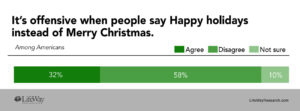
One of the ways some want to see more recognition of Jesus in the celebrations this time of year is in our greetings. Around a third of Americans (32 percent) say it is offensive when someone says “Happy holidays” instead of “Merry Christmas.” A similar number (33 percent) say the same about using “X-mas” instead of “Christmas.”

Those numbers are similar to four years ago. In 2014, 39 percent found “X-mas” offensive and 29 percent said the same about “Happy holidays.”

Today, 40 percent of Christians find “Happy holidays” to be offensive, compared to 12 percent of members of other religions and 15 percent of the non-religious. Around two-thirds of those with evangelical beliefs (65 percent) say they are offended by “Happy holidays” being used instead of “Merry Christmas.”

Americans 50 and over are almost twice as likely to say they find “Happy holidays” offensive than those under 50—42 percent to 22 percent.

“It’s likely that Christians and older Americans are nostalgic for previous years or reluctant to acknowledge that not everyone celebrates Christmas this time of year,” McConnell said.

“Many have the idea that most Americans are the same or that we share one culture of baseball, apple pie and Christmas, but that’s not the case. And when we encounter someone who believes differently from us, that can be jarring and even seem offensive for some.”

Frequent religious service attenders are more likely to be offended by “Happy holidays.” Almost half of those who attend a worship service once a week or more (47 percent) say the substitute greeting is offensive, compared to 35 percent who attend once or twice a month, 32 percent of those who attend a few times a year, 23 percent of those who attend once a year or less, and 21 percent of those who say they never attend.

“Instead of refusing to accept there are other belief systems in our country today, Christians may be better served finding a way to wish their non-Christian friends and family would experience all the blessings possible during the season in which believers celebrate God blessing Earth with his Son,” McConnell suggested.

LifeWay Research conducted the study of 1,004 Americans, Sept. 21-23. Analysts used sample stratification and base weights for gender, age, race/ethnicity, region, metro/non-metro, home ownership, education and income to reflect the most recent U.S. Census data. The sample provides 95 percent confidence that the sampling error does not exceed plus or minus 3 percentage points. Margins of error are higher in sub-groups.


Wheaton summit focuses on evangelicals and sexual abuse

CHICAGO (RNS)—For years, Nancy Beach had no idea other women had stories similar to hers.

Beach, the first woman to serve as a teaching pastor at Willow Creek Community Church, said her boss acted sexually inappropriately toward her in the late 1990s.

Willow Creek Community Church in South Barrington, Ill., has been in turmoil since sexual misconduct allegations came to light against its founder, Bill Hybels. (RNS Photo/Courtesy of Willow Creek Community Church)

Instead of speaking out, she said she went silent, like so many other women, wanting to protect the church and families involved and thinking her situation was an isolated case.

When she learned other women said they had similar encounters with Willow Creek founder Bill Hybels, she decided to speak out earlier this year. Eventually, Hybels, who has denied the allegations against him, retired early after about 10 women accused him of misconduct.

Honest conversation

Like others who have shared their stories of sexual harassment and abuse this year, Beach hopes other women won’t have to wait so long to speak out. It’s time, she said, for evangelical churches to have an honest conversation about sexual misconduct.

She plans to tell her story at Reflections: A GC2 Summit on Responding to Sexual Harassment, Abuse and Violence, a one-day evangelical gathering around the topic Dec. 13 hosted by the Billy Graham Center at Wheaton College, an evangelical Christian school in the Chicago suburbs.

There’s never been a more important time to address the topic of sexual misconduct in the church, according to Beach.

“I think this is just an opportunity to, instead of avoiding the conversation, open it up and to hear from many different voices coming from different areas of expertise,” she said.

#SilenceIsNotSpiritual image courtesy of SilenceIsNotSpiritual.org

The summit comes just over a year after artists Emily Joy, who does not use her last name professionally, and Hannah Paasch first appended the hashtag #ChurchToo to their tweets, giving survivors of sexual violence, abuse and harassment within the church a place to share their stories. They had been inspired by the #MeToo movement started by activist Tarana Burke, which brought to light accusations against a number of powerful men, particularly in media and entertainment.

Accusations against high-profile figures

Since then, several high-profile leaders in the evangelical world have been accused of sexual misconduct.

Andy Savage, a teaching pastor at Highpoint Church in Memphis, resigned in March after Jules Woodson accused him of sexually abusing her when she was a teenager and he was a youth pastor in Texas. Her story was one of the first to bring national attention to the #ChurchToo movement.

In April, an investigation by the Chicago Tribune revealed decades of alleged misconduct by Hybels. That investigation rocked not just Willow Creek but also the thousands of churches that had modeled themselves after the suburban Chicago megachurch.

Southwestern Baptist Theological Seminary trustee chairman Kevin Ueckert (left) addresses trustees at a special called meeting at the Fort Worth campus May 22. The board met to discuss the controversy surrounding Paige Patterson (right), then president of the seminary. (Photo by Adam Covington/SWBTS via BP)

Then this summer, the Southern Baptist Convention grappled with how to address the issue after Paige Patterson was ousted from Southwestern Baptist Theological Seminary amid reports he mishandled rape allegations by students.

Laurie Nichols, director of communications for the Billy Graham Center and one of the organizers of the event, said Reflections aims to give churches the tools they need to respond to victims of sexual harassment and abuse.

“We really want to equip churches in this area,” Nichols said. “A lot of pastors just don’t feel equipped to deal with this issue, and church leaders don’t feel equipped and a lot of women in the church don’t feel like they know how to share their stories.”

This is the center’s third GC2 summit, which is a reference to the Great Commission—“Go and make disciples of all nations”—and Great Commandment, Jesus’ command to love God and love one’s neighbor. Previous summits have focused on the refugee crisis and mass incarceration.

Let survivors’ voices be heard

Organizers also want survivors to have a voice and to know the church cares about them, Nichols said.

The schedule of the summit includes time for lament and prayer, as well as panel discussions and keynote addresses with titles like “Dear Church Leaders, Here’s How You Ought to Respond to Survivors in Your Church,” “When Jesus Heals” and “Seeking Accountability and Integrity.”

Licensed and trained team members will be on site to offer attendees support and referrals to further counseling, in partnership with the school’s counseling center and school of psychology. Proceeds from ticket and livestream sales will go to New Name, a local faith-based outreach to women in the adult industry.

Beth Moore, author and speaker, Russell Moore, president of the Ethics & Religious Liberty Commission, and Matt Carter, pastor at Austin Stone Community Church in Austin, discuss preventing and dealing with sexual abuse within the church at the Cooperative Program’s booth in the exhibit hall at the Kay Bailey Hutchison Convention Center June 11 prior to the two-day Southern Baptist Convention June 12-13. (Photo / Kathleen Murray / SBC Newsroom)

Among the speakers are Beth Moore and Christine Caine, two popular authors and speakers who have spoken out about their experiences of sexual abuse and support for the #MeToo movement.

Other speakers from Wheaton bring backgrounds in psychology and counseling: Nancy Nealious, a trauma recovery specialist and licensed clinical psychologist in the college’s counseling center; Tammy Schultz, a trauma and sexual abuse counselor and professor of counseling; Jenny Hwang, managing director of the college’s Humanitarian Disaster Institute; and Wheaton College Provost Margaret Diddams, a psychologist who is part of an advisory group currently investigating allegations against Hybels.

Nichols said speakers come from diverse backgrounds, but all hold evangelical beliefs.

Some critique evangelical perspective

But critics say it’s important for evangelicals to hear from voices outside the church. Those voices are missing from the conference, said Emily Joy, who left evangelicalism and now attends an Episcopal church.

She asserted evangelical teachings about sex—including the belief sex should be reserved for a man and woman within the context of marriage—form a “bedrock of sexually dysfunctional culture in conservative evangelicalism, and these speakers are not interested in dismantling it.”

She, Paasch and a few others plan to host their own teachings on social media offering “alternative information” during Wheaton’s summit, she said.

“My idea is not to just critique this—which deserves critique—but also to offer something constructive and proactive as well,” she said.

Emily Joy also is concerned the summit doesn’t have enough survivors or experts in dealing with issues of sexual abuse in its speaker lineup.

At least four of the 17 speakers listed on the summit website are survivors of sexual harassment or abuse, according to Nichols, who also identifies as a survivor. However, only one of the speakers, Jeanette Salguero, chief operating officer of Calvario City Church in Florida, is identified as a survivor in her summit bio.

Both a sin and a crime

Woodson, who identifies as Christian, is concerned about its inclusion of Caine, who has ties to Hillsong, an Australian megachurch whose founder, Brian Houston, is under fire for his handling of allegations his father had sexually abused several children.

She said evangelicals need to recognize sexual abuse is a problem within the church, and it is not just a sin but also a crime. They also need to listen to survivors, advocates and organizations like GRACE—Godly Response to Abuse in the Christian Environment—that were working to bring the issue to light before it was trending.

“We need to be having this conversation. Absolutely, we need to be equipping people and educating them about this topic. All of that is so important,” Woodson said. “But this (summit) just seems to me really lacking depth.”

Still, Emily Joy said the fact such an event is being held at an evangelical institution this year is “proof that we’re making progress insofar as we’re forcing them to confront these things.”

Hwang agreed evangelicals need to have a healthy conversation about sexuality. Many treat sex as a taboo topic, related to guilt and shame, according to the head of the Humanitarian Disaster Institute. That is unhealthy, she said, and can make it even harder to discuss sexual abuse.

Beach, the leadership coach once on staff at Willow Creek, worries that churches will react to the sexual abuse crisis by creating more rules that restrict women from leadership roles—in order to reduce the risk of misconduct. She believes God created men and women to work shoulder to shoulder together in ministry, she said. She’s experienced it, too—and that’s the story she wants to tell now at Reflections.

She said the summit is “only the beginning.”

“It’s just one day. It’s not going to solve everything,” Beach said. “But I think it’s a step in the right direction. That’s my hope.”


Palm Beach Atlantic founder Jess Moody dies at 93

WEST PALM BEACH, Fla. (BP)—Jess Moody, a visionary evangelistic pastor who influenced the field of education and the entertainment industry, died Dec. 7 in West Palm Beach, Fla. He was 93.

Moody was the founder of Palm Beach Atlantic College (now University) in West Palm Beach in 1968 and later, in the Los Angeles area, a witness to Hollywood.

He also was one of three nominees for Southern Baptist Convention president in 1992. He served as the 1965 president of the SBC Pastors’ Conference and addressed its sessions in 1964 and 1972.

‘Visionary dreamer’

William M.B. Fleming Jr., Palm Beach Atlantic’s president, said in a Dec. 8 tribute to Moody on the school’s website, “As the university celebrates its 50th year, we give thanks for a giant of a Christian crusader, a Bible preacher, a visionary dreamer and our founding president.

Jess Moody led in the creation of Palm Beach Atlantic College while serving as pastor of First Baptist Church in West Palm Beach (now Family Church) from 1961 to1976. He concurrently served as the school’s president from 1968 to 1972. (Photo / Palm Beach Atlantic University)

“Dr. Moody’s mark is on every Palm Beach Atlantic graduate and student. His sweet love and unlimited devotion to young people is legendary. Stories will continue to be written and told about Dr. Jess Moody, a servant for all seasons and all mankind.”

Moody led in the school’s creation while serving as pastor of First Baptist Church in West Palm Beach (now Family Church) from 1961 to1976. He concurrently served as PBA president from 1968 to 1972.

The university, which was affiliated with the Florida Baptist Convention for an extended time, now has 3,706 students in undergraduate and graduate courses in West Palm Beach, at a campus in Orlando and online.

Moody and his wife Doris initiated the school’s “Workship” program requiring all 2,000-plus full-time undergraduate students to volunteer at least 45 hours annually at nonprofit agencies, schools or churches.

Pastor to Hollywood stars

Moody left West Palm Beach in 1976, turning his sights to California as pastor of the Los Angeles-area First Baptist Church in Van Nuys. He led the church into cooperation with the SBC “after considerable resistance,” as described by the Los Angeles Times in a 1997 article.

In the mid-1980s, Moody led the church to relocate to Porter Ranch, Calif., where it was renamed Shepherd of the Hills Church.

“Jocular and garrulous, Moody attracted a number of entertainment figures to his church,” the Times‘ 1997 article noted. “He performed the wedding of actor Burt Reynolds and actress Loni Anderson. The annual Passion Play at Shepherd of the Hills draws thousands every Easter.”

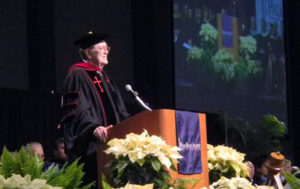
Jess Moody, founder of Palm Beach Atlantic University, spoke at a 2010 graduation ceremony. (Photo courtesy of Palm Beach Atlantic University)

He was a religious consultant for 20th Century Fox, an article in MissionsUSA of the SBC Home Mission Board reported in 1984.

The church created an Act I ministry in 1982 that grew to about 125 actors, directors, producers and others in the film industry, according to MissionsUSA. Act I’s meetings included presentations by such LA luminaries as producer-writers Harry and Linda Thomason, two-time Academy Award-winning composer Al Kasha and radio disc jockey Rick Dees.

Phil Boatwright, a veteran movie reviewer, was a member of the church from 1977 until Moody’s retirement in 1995.  Boatwright described an example of Moody’s influence involving the re-filming of a major motion picture.

“In 1976, Hollywood had a hit with The Omen, about the coming of the Antichrist. As Hollywood is prone to do, they made several follow-ups,” Boatwright recounted. “The producer (or director, I can’t remember which) of the 1981 sequel The Omen II:  The Final Conflict, concerning an adult Antichrist plotting to eliminate his future divine opponent, showed a rough-cut to Dr. Moody.

“Doc (as Boatwright called Moody) praised the production’s strengths but made it clear the sensationalized conclusion wasn’t scriptural. Due to Moody’s kindness and scriptural knowledge, the filmmaker said, ‘If you’ll rewrite the ending, I’ll film it.’ Doc did. The producer did. And to this day, I tell people, skip through the film to get to the ending. It’s spiritually rewarding. (I wouldn’t bother with the rest of the film.)

“Knowledge and kindness. That’s part of the armor we should all clothe ourselves in. Doc did.”

Boatwright also noted Moody’s “appreciation for every soul.”

“Like our beloved Billy Graham, Jess had a love for the lost and a great ability to make each person feel important. When these men said, ‘God loves you,’ you felt it—you believed it,” he said.

Nominee for SBC president

Moody ran for SBC president in 1992, seeking to be a unifier amid the conflict among Southern Baptists.

Ed Young, senior pastor of Second Baptist Church in Houston, received 62 percent of the messengers’ vote at the annual meeting in Indianapolis. Moody received nearly 22 percent while a third nominee, Nelson Price, pastor of Roswell Street Baptist Church in Marietta, Ga., received 16 percent.

Jess Moody

Moody was nominated by Mississippi comedian Jerry Clower, who said Moody loved people on both sides of the SBC controversy and that the witness of Southern Baptists would be helped by the election of a pastor who was not from the South.

Clower also said he constantly met laypeople in his travels who didn’t want a pastors’ fight, as he called it.

“There are 39,000 of y’all (pastors), but there are 15 million of us, and we want it stopped,” Clower said.

Moody had said prior to the annual meeting: “My feeling is if there is hope for reconciliation in our convention, then one last-ditch stand … ought to be done. I believe every word of the Bible. As far as the Bible goes, I am as conservative as you can get. I also believe in freedom. I love my denomination. I want to bring us together.”

Fermin Whittaker, retired executive director of the California Southern Baptist Convention, said Moody was “willing to listen to my storyline” as a native of Panama serving as the leader of the state’s Baptists.

“He was not the kind of leader who said, ‘I don’t have time for you.’ He was never negative. He was always encouraging and always a friend, sincere in his heart to reach the lost for Christ,” Whittaker said.

Moody also was among 11 nominees for SBC president in 1966, when messengers in Detroit elected Nashville pastor Franklin Paschall to the post.

Founding member of Youth for Christ

A native Texan, born in Paducah, Moody sensed a call to preach at age 17. As a student at Baylor University, he flew a Piper Cub airplane to lead evangelistic meetings across the Southwest and Midwest, leaving after class on Fridays and returning on Sunday nights.

As a founding member of Youth for Christ at age 22, Moody preached to thousands of students across the Southwest and, in 1946, led a YFC team to war-torn northern Europe while Billy Graham led a team to southern Europe.

After earning a Master of Divinity degree from Southern Baptist Theological Seminary in Louisville, Ky., in 1956, Moody was called as pastor of First Baptist Church in Owensboro, Ky., serving there nearly five years. In 1961, Moody was part of a Graham team in West Palm Beach when members of First Baptist were drawn to his preaching and called him as their pastor.

A movie was made of Moody’s life in 1967 by Gospel Films titled Riding the Pulpit. He was the author of several books, including 1999’s Club Sandwich: Goes Great with Chicken Soup in which he told a number of his favorite stories, some of which involved Burt Reynolds and Randy and Dennis Quaid.

Moody was preceded in death by his wife of 64 years. He is survived by a son, Patrick, and daughter, Martha; and three grandchildren.


Income and education affect church shopping

Highly educated and affluent Americans are more likely than others to search for a new church—and chances are good they will do their homework before joining a different congregation, according to findings from Pew Research Center.

Recent Pew Research Center analysis of survey data collected in 2015 reveals education and income levels relate directly to whether Americans look for a new religious congregation and how they look for another place to worship.

‘Where people look, think and act like me’

To a large degree, income and education not only affect whether Americans shop around for a place to worship, but also tend to define the type of church they select, a Baylor University sociologist noted.

“People choose churches where they feel comfortable. … Often, that means a church where people look, think and act like me,” said Kevin Dougherty, associate professor of sociology at Baylor.

While many churches continue to be segregated by race and ethnicity, Dougherty noted, many worshippers today also gravitate toward congregations that are largely homogenous in terms of income, education and political affiliation.

About half (49 percent) of American adults have searched for a new church at some point. However, the Pew researchers’ analysis shows a sharp contrast between the 59 percent of college-educated Americans who have sought a new church and the 38 percent with a high school education or less who have looked for a new congregation.

Doing their homework

Among those Americans who have looked for a new place to worship, 44 percent of those with an annual family income of $75,000 or more checked online to gain information about a congregation. Among those with family income in the $30,000 to $74,999 range, 37 percent did online research. Fewer than three in 10 (28 percent) of Americans with family income less than $30,000 checked the Internet for more information about a church.

The percentage of Americans who talked with friends or colleagues about a particular congregation to learn more also relates to family income—71 percent for those with family income of $75,000 or more, 67 percent for those in the $30,000 to $74,999 range and 65 percent with family income of $30,000 or less.

“The Pew findings look consistent with what I know of the literature and follow an accepted logic; that is, people with higher socio-economic status have more time, money and resources to invest in thinking deeply about their life choices—because they can,” said Paul Froese, professor of sociology and research fellow for Baylor’s Institute for Studies of Religion.

The link to education is even stronger. Researchers discovered 71 percent of Americans who graduated from college talked to church members before choosing a new place to worship, compared to 63 percent of those with a high school education or less.

“This goes against the argument that higher educated individuals are leaving the church. Those with higher education and higher income have not necessarily given up on organized religion. They are just making different choices,” Dougherty said. Factors other than denominational affiliation tend to enter into the selection, unlike previous generations, he noted.

Location and worship style are key factors that determine where college graduates choose to worship, with 77 percent saying those matters played an important role in their choice, Pew researchers discovered.

Fewer than two-thirds (64 percent) of Americans with a high school education or less said location was a major consideration when they chose a church, while 71 percent said worship style was important.

Religious education for children ranked higher among those with a high school education or less (62 percent) than among college graduates (51 percent) as a reason for choosing a church.

Eager to serve? Maybe not.

Neither a majority of Americans with a high school education or less or those with college degrees cited opportunities to volunteer as a major factor in selecting a church, but opportunities to serve ranked higher among those with less formal education (46 percent) than among those with a college degree (39 percent).

Three-fourths of Americans with family income of $75,000 or more cited location as a major factor in choosing a church, compared to 67 percent of those with an income less than $30,000.

A majority of Americans with family income less than $30,000  (55 percent) said having friends of family in a congregation played an important role in selecting a church, compared to 47 percent of those with a family income of $75,000 or more.

Almost half of Americans with family income less than $30,000 (48 percent) named opportunities to volunteer as a key factor in choosing a church, compared to 39 percent of those with a family income of $75,000 or more.

Location, location, location

Generally, Americans are much more willing to travel significant distances to attend a place of worship than people in other countries, Dougherty noted.

Kevin Dougherty

“To a large degree, that is a reflection of the free market approach in religion here in the United States, where there’s a plethora of congregational choices,” he said.

Nearly half (47 percent) of churchgoing Americans live six minutes to 15 minutes from their place of worship, and nearly one-fourth (23 percent) travel 16 minutes to 30 minutes to church, Dougherty noted, reporting findings from the Baylor Religion Survey.

Not surprisingly, suburban mega-churches tend to attract families in higher socio-economic groups because they have a wide selection of high-quality programs to offer, and those families have the time and resources to drive a significant distance to a church that provides what they want, Dougherty said.

At the same time, race and ethnicity may increase the distance worshippers are willing to travel, while income tends to limit the distance, he observed. For instance, among African-American Protestants, 40 percent report commuting 16 to 30 minutes, and 19 percent say they drive more than 30 minutes to attend a place of worship.

“A significant number of religious commuters drive from the suburbs and exurbs to attend the historic family church,” Dougherty said.

However, people with limited income and time constraints are least able to drive a significant distance to worship, he observed.

“Certainly, people with higher income have higher mobility,” Dougherty said. “On the other hand, someone who has to report to work on Sunday afternoon at a convenience store can’t afford to drive 45 minutes and then go out to eat afterward. It’s just not practical.”


Mudding and drinking truck thrives on new path

GORDO, Ala. (BP)—A couple of years ago, Terry Billings saw his old truck sitting in the field, weeds growing up through it. Then he heard God’s instruction—to take that old truck and make something new out of it.

“At that point, it was worthless,” Billings said.

A couple of years ago, pastor Terry Billings saw his old truck sitting in the field, weeds growing up through it. Then he heard God whisper that he could take that old truck and make something new out of it—and use it to help share the gospel. (Photo / The Alabama Baptist / Distributed by Baptist Press)

He had spent a lot of years in that truck going mudding and drinking out in the country. He’d lived a lot of his life far from the shadows of any church, except maybe to some weddings and funerals.

But when his son accepted Christ as Savior, the boy invited his dad to attend his baptism.

“I figured that was a good dad move to go see my son get baptized,” he said. “I went, and it was kind of nice to be there. But by 1 o’clock, I was drinking again.”

The next Sunday, his son invited him back, and Billings went.

“I’d kind of enjoyed getting dressed up that last Sunday,” he said.

A third Sunday rolled around, and Billings went to church again.

“I left after church that day, and my plan was to go back to the restaurant and chill out and drink for the rest of the day,” said Billings, who ran Billy’s BBQ in Gordo, Ala. “But boy, did God have something waiting for me—at Walmart.”

As he walked the aisles of the store, he said he felt the conviction of God press on his heart.

“All of a sudden, I felt so visible, like everything I’d ever done was so visible,” Billings said. “His eyes were on me. I tell everyone I had a Damascus Road experience that day, but it was a blue light special—I got saved right there in Walmart at 45 years old. And my life has never been the same.”

Traded mudding and drinking for preaching

He gets choked up talking about it. When God’s light broke through his darkness, he parked the old farm truck and traded his mudding and drinking for a pastorate.

Terry Billings’ “Heaven Bound Mud Bogger” turns heads wherever it goes. (Facebook Photo)

For six years now, he has served at Forest Baptist Church, Gordo, in Pickens Baptist Association—a church that’s been among some of the top in Alabama for baptisms in recent years.

God made something new out of him, Billings said. And as he looked at that old truck that day, he knew God had plans for it too.

“God gave me this vision to reach out to people who are getting ignored—the good ol’ boys. I’ve always been one of them,” Billings said. “I was an alcoholic, and God reached out and touched me. If he hadn’t and if people hadn’t, I wouldn’t have been saved. So there’s nowhere that’s too far for me to go to reach them.”

He towed that old truck out and began the process of rebuilding the whole thing, to be used for God’s glory and to help others meet Jesus. He recruited some friends to help. And as he stepped out on faith, God provided donations for the rebuild.

“Over two years, God provided $100,000,” he said. “When people heard what we wanted to do, they just kept writing us checks. People from California, Florida, Tennessee—they would stop in at the restaurant and leave us with a donation for the truck.”

(Facebook Photo)

And so the Heaven Bound Mud Bogger was born—a massive truck with a picture of a cross on the side and verses about finding eternal life in Jesus. On the tailgate it says, “Covered in mud, but washed in the blood.”

It turns heads everywhere it goes.

Once the truck had new life, Billings and his ministry partners formed a nonprofit ministry, and they take the truck to parades and events to share the gospel. They set up tents, share tracts and then connect with the local Baptist association so they can do follow up.

“We’re booked almost every weekend from now to Christmas,” he said.

But even if they weren’t, attracting people would be no problem.

“Every time I stop anywhere, everybody in the gas station or Dollar General unloads and goes out to look at it. Then I get to tell them my story and what Jesus did for me,” Billings said. “All it takes is a trip to Hardee’s, and we have church.”

Reaching a different segment of people

Sammy Gilbreath, director of the office of evangelism for the Alabama Baptist State Board of Missions, said Billings’ ministry is an “incredible way to reach a different segment of people.”

“Early on in our ministry in the evangelism office, we began to push event evangelism,” Gilbreath said. “People raised their eyebrows when they thought about motorcycle ministry.”

But now motorcycle ministry is huge, and later the same thing happened with horse whisperer events, he said.

“Mud bogging is a classic example. It becomes a great evangelistic tool reaching into a segment of our culture that is not being touched by any other phase of evangelism,” Gilbreath said. “I’m thrilled Terry is doing it. I think it will draw attention and spark ideas and creativity for other people too, and that can cause a domino effect.”

Billings said he’s grateful, but no one is more surprised than him at how God has directed his path.

“This old truck I had, it probably wasn’t worth $100,” he said. “But it’s amazing when you give something to God, what he can do. We’re just in awe.”