Joseph Adams nominee for BGCT first vice president
June 20, 2025
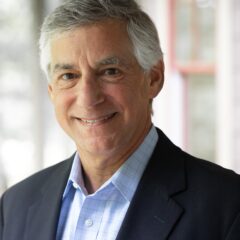
Joseph Adams, pastor of First Baptist Church in Hughes Springs and Texas Baptists’ incumbent second vice president, will be nominated for first vice president of the Baptist General Convention of Texas.
Bill Skaar, pastor of First Baptist Church in Grand Prairie, announced his intention to nominate Adams at Texas Baptists’ annual meeting in Abilene, Nov. 16-18.
“Joseph Adams is one of the outstanding young servant leaders in our convention—part of the group of young leaders the Lord is raising up,” Skaar said.
Adams has “a heart for missions and evangelism” and a “love for people,” Skaar said.
While his church is in a small East Texas town, First Baptist in Hughes Springs is a leader in baptisms and missions giving, he added.
“He is the pastor of a mission-minded church that is committed to the GC2 challenge of loving God, loving people and sharing the gospel,” he said.
Listening and learning
Adams expressed appreciation to Texas Baptists for allowing him to serve this past year as second vice president.
“It has stretched me as an individual, and I feel like I have grown and learned by working with leaders from all over the state,” he said.
“It’s not so much about wanting to have a voice in the room as having the privilege of listening to all the other voices in the room.”
He particularly offered thanks to BGCT Associate Executive Director Craig Christina and CFO Ward Hayes for leading in the development of the Texas Baptists Indemnity Program. The program was created to provide affordable insurance coverage for Texas Baptists’ churches.
The carrier that had provided insurance for his church “dropped us like a junior high girlfriend,” Adams recalled.
First Baptist in Hughes Springs ended up having to absorb a $70,000 increase to maintain property and liability insurance coverage—a burden many churches would not bear, he observed.
“That’s a staff member’s salary. That’s a mission project. That’s money that could go to the Cooperative Program,” he said. “If we can help assist our churches in the area of insurance, we need to do it.”
If elected as first vice president, Adams said, he hopes to help strengthen and connect rural churches and bivocational pastors, who he describes as “the real heroes.”
Church spending 50,000 hours in prayer
Adams voiced his belief “the future is bright” for Texas Baptists if churches stayed focused on loving God, loving people and sharing the gospel.
He underscored his church’s commitment to the GC2 movement, with its emphasis on Christ’s Great Commission and Great Commandment.
First Baptist in Hughes Springs committed to spend 50,000 hours this year in prayer for revival, missions opportunities and the salvation of neighbors and co-workers.
Year to date, church members have spent 27,000 hours praying, and the church has baptized 28 new believers with two more awaiting baptism soon, he noted.
“The mission field is coming to us. If we can reach Texas for the Lord, we can reach the United States for the Lord,” he said.
“There’s room here for all of us in Texas Baptists life if we lay aside our personal agendas and keep Christ at the center.”
Adams was born to missionary parents in Germany, and he grew up primarily in New Mexico, where his father was a pastor.
Before First Baptist in Hughes Springs called him as pastor eight years ago, he served eight years as associate pastor of Mountain Springs Baptist Church in Albuquerque, N.M.
He has served several years on Texas Baptists’ Mission Funding Council.
Adams earned his undergraduate degree and Master of Leadership in Biblical Counseling degree from Liberty University.
He and his wife Lindsay have five children—Elliott, Noah, Emma, Parker and Walker.
Court upholds ban on transgender care for minors
June 20, 2025
In a 6-3 decision June 18, the U.S. Supreme Court upheld Tennessee’s ban on puberty blockers and hormone therapy for the purpose of gender transition for minor children.
Chief Justice John Roberts wrote the majority’s opinion—the Tennessee law banning puberty blockers and hormone treatments for transexual minors doesn’t violate the Constitution’s Equal Protection Clause.
The decision’s impact is far-reaching, as 26 other states—including Texas—have similar laws.
Tennessee passed Senate Bill 1 in 2023, “restricting sex transition treatments for minors by enacting the Prohibition on Medical Procedures Performed on Minors Related to Sexual Identity” bill, the opinion syllabus explains.
The legislation does not prevent hormonal therapy or puberty blockers in minors for reasons other than gender identity.
Regarded by many as a setback for transgender rights, many Baptists view the decision favorably.
Texas Baptists’ Christian Life Commission noted on Facebook: “We celebrate the 6-3 decision in U.S. v. Skrmetti as being in line with Christ’s teaching for his followers to care for the vulnerable among us.”
The case was argued not on the basis of science, but on the basis of scrutiny.
Understanding Standards of Review
John Litzler, CLC director of public policy, explained in equal rights cases, there are standards of review—or levels of scrutiny—that must be applied to determine the constitutionality of a law—strict, intermediate and rational basis.
The lowest level, rational basis, applies to most laws. Where rational basis applies, the government only must demonstrate the law is rationally related to a legitimate government interest.
Intermediate scrutiny is used for laws that discriminate based on gender. In these cases, the government must show that a law in question serves an important government objective and substantially relates to achieving that objective.
Strict scrutiny, the highest level, applies to laws affecting fundamental rights or suspect classifications, such as race or national origin. When strict scrutiny applies, the government must prove the law is narrowly tailored to achieve and serve a compelling state interest, he explained.
The case brought against the Tennessee ban, by three transgender minors and a doctor, challenged the law under the Equal Protection Clause.
The district court partially enjoined the law, identifying transexual as a “quasi-suspect class,” holding SB1 discriminates on the basis of sex and transgender status and that it was not likely to survive intermediate scrutiny, the opinion syllabus explains.
But, the Sixth Circuit Court of Appeals reversed the finding of the lower court, holding the law did not trigger increased scrutiny or fail rational basis review.
So, the opinion syllabus explains, the Supreme Court heard the case to consider whether Tennessee’s SB1 violates the Equal Protection Clause of the Fourteenth Amendment.
Plaintiffs argued SB1 warranted heightened scrutiny because it relies on sex-based classifications, but the court determined transgender does not qualify as a quasi-suspect group and the age and medical use classifications of the bill do not merit strict scrutiny.
Siding with the Sixth Circuit ruling, the Supreme Court found only rational basis review was required for the law before them, since the law applies to opposite sex minors equally and allows for hormonal medical treatments for purposes other than gender identity.
“This case carries with it the weight of fierce scientific and policy debates about the safety, efficacy, and propriety of medical treatments in an evolving field. The voices in these debates raise sincere concerns; the implications for all are profound,” Roberts wrote.
“The Equal Protection Clause does not resolve these disagreements. Nor does it afford us license to decide them as we see best,” he continued.
The court’s role is limited to deciding constitutionality of the law not its “wisdom, fairness or logic,” Roberts concluded. “We leave questions regarding its policy to the people, their elected representatives, and the democratic process.”
The dissenting opinion
Justice Sonia Sotomayor wrote the dissenting opinion.
She wrote: “Tennessee’s law expressly classifies on the basis of sex and transgender status, so the Constitution and settled precedent require the Court to subject it to intermediate scrutiny.
“The majority contorts logic and precedent to say otherwise, inexplicably declaring it must uphold Tennessee’s categorical ban on lifesaving medical treatment so long as ‘any reasonably conceivable state of facts’ might justify it.”
She asserted: “By retreating from meaningful judicial review exactly where it matters most, the Court abandons transgender children and their families to political whims,” noting, “In sadness, I dissent.”
Prior to the ruling, the Texas Baptists CLC team met Tennessee Attorney General Jonathan Skrmetti, defendant in the case, at the SBC annual meeting, where they were able to “hear his heart about why he believes this law protects children,” their Facebook page said.
Jonathan Skrmetti participates in an ERLC panel discussion at the SBC annual meeting in Dallas. (Screengrab)
Background from ERLC panel
Skrmetti participated in a panel discussion at the annual meeting last week, moderated by Ethics and Religious Liberty President Brent Leatherwood.
In the discussion, Skrmetti explained the importance of Christian voices weighing in on judicial proceedings by way of amici, or “friend of the court” briefs.
He noted the state is limited in the kinds of arguments it can make and must be extremely selective in what it includes in court filing documents due to length restrictions.
However, amici serve as important additions to the state’s arguments, because they allow faith-based, religious arguments about a law to be considered alongside the government’s arguments.
Skrmetti noted the reality of gender dysphoria and urged Christians not to minimize the difficulty of facing gender dysphoria for those who face it.
“We should be compassionate,” he said, and gender dysphoria “should not be made light of.”
Yet, he asserted, overwhelming evidence shows the majority of children who experience gender confusion outgrow it.
He also cited a growing number of European countries embraced these medical treatments but now are reckoning with the permanent effects they have on the adults who underwent the treatments as children.
Children cannot give informed consent, he asserted.
When asked how the bill came to pass, Skrmetti explained, “The legislature thought, ‘this is a really important issue where we have to protect kids from this unchecked momentum from an unproven approach.’”
Though he was not involved in the bill becoming a law, Skrmetti said he was proud to defend Tennessee’s law before the Supreme Court.
While the CLC was not involved directly in this case, they signed onto an amicus brief in Texas case Free Speech Coalition, Inc. v. Paxton, also being argued on the basis of level of scrutiny.
The Paxton case relates to a law requiring age verification to access online pornographic material.
The outcome in the Skrmetti case has implications for the Free Speech Coalition, Inc. v. Paxton case, on which the Supreme Court’s decision is expected soon.
‘Lift Every Voice and Sing’ celebrates 125 years
June 20, 2025
WASHINGTON (RNS)—“Lift Every Voice and Sing” is a hymn many African Americans of older generations just know.
They’d sung it in church, learned it in school and stood for what is dubbed the unofficial Black national anthem just like they might for “The Star-Spangled Banner.”
“Lift every voice and sing/’Til earth and heaven ring/Ring with the harmonies of Liberty,” it begins.
“Let our rejoicing rise/High as the list’ning skies/Let it resound loud as the rolling sea.”
Courtney-Savali Andrews, an assistant professor at Oberlin College’s Conservatory of Music in Northeast Ohio, was born in the mid-1970s in Seattle, where the song—which turns 125 years old this year—was a staple at her Baptist church and in the wider Black community.
Pastor Ovella Davis of Always in Jesus’ Presence Ministries in Detroit presented a workshop on the Hammond organ during a symposium on “Lift Every Voice and Sing” at the Museum of the Bible on June 12. (RNS Photo / Adelle M. Banks)
“It was impressed upon me, particularly from the ministers of music and the pastor, that not only did I have to sing the song with a full-heartedness, I also had to memorize all of the words,” she recalled in mid-June at the Museum of the Bible in Washington, D.C.
“And so, it was one of those items that you did not want to be caught, specifically by your peers, looking into the hymnal.”
Andrews, who studies African American and African diasporic music, was one of a dozen speakers at a daylong symposium on “Lift Every Voice and Sing,” on June 12 at the museum.
Background of the song
The song first was publicly by a group of 500 Black schoolchildren in 1900 in Jacksonville, Fla., to commemorate the birthday of President Abraham Lincoln.
Its words were written by educator and civil rights activist James Weldon Johnson for the occasion, and his brother, J. Rosamond Johnson, set them to music.
“They both saw artistic and cultural excellence as a major key to Black advancement in America,” said Theodore Thorpe III, a Virginia church musician and high school choral director, and the symposium’s keynote speaker.
“The hymn continued to resonate and reverberate, even beyond the expectations of the Johnson brothers.”
In its early years, it was pasted on the back of hymnals, Bibles and schoolbooks and was sung regularly at NAACP and other organizational gatherings.
Words from its second stanza were recited in the benediction of President Barack Obama’s first inauguration in 2009, and in the sermon at the inaugural prayer service the next day: “God of our weary years/God of our silent tears,/Thou who has brought us thus far on the way.”
During his remarks, Thorpe ticked off a range of artists who have recorded versions—some known for gospel music and some not—Ray Charles, Aretha Franklin, Alicia Keys and Mary Mary.
“‘Lift Every Voice and Sing’ remains one of the most powerful symbols of the Civil Rights Movement,” he said. “It is featured in over 40 different Christian hymnals and sung in churches all across America, not just during Black History Month or Juneteenth.”
The Howard University Gospel Choir performs during the Lift Every Voice and Sing event. (RNS Photo / Adelle M. Banks)
Anthem presentations
Over the course of the day and evening, some 200 audience members heard the song performed by a wind ensemble, sung in an array of arrangements by choirs, played on the Hammond B-3 organ and featured in a spoken-word performance.
“It resonates not only in different genres, but it resonates in even different generations,” said Bobby Duke, the museum’s chief curatorial officer, in an interview.
“We have seen people that are very much senior citizens, when they heard the Duke Ellington (School of the Arts) choir start singing, they stood. We see college students and then even students that are still in secondary school singing this.”
Duke collaborated with Bishop David D. Daniels III, a scholar of historical African and Black Pentecostal contributions to Christianity, who envisioned the symposium before his death on Oct. 10, 2024.
The event—dedicated in memory of Daniels—received funding from the Phos Foundation, which is co-directed by Virginia Gov. Glenn Youngkin and his wife, Suzanne.
The Washington Performing Arts Children of the Gospel Choir was one of several choirs to perform as part of the event. (RNS Photo / Adelle M. Banks)
The symposium featured discussions of the three-stanza text—often all three are sung in churches and performances—and the music that accompanies it.
Words of ‘hope and lament’
Religious leaders and scholars, including Joy Moore, president of Northern Seminary outside of Chicago, discussed its words of hope and of lament.
“The text of this song doesn’t just say, as African Americans, we are in pain,” she said. “But it says, from this experience of pain, we hold this hope passed down to us, and we pass it on so that we are faithful to who we are and to the God who has created us and called us and not given up on us.”
One audience member, E. Daryl Duff, a retired Navy musician, described an instance where the song was not accepted by a white member of a chorus he directed at Fort Belvoir in Virginia.
“She was a solid choir member until February, when I would program this song, ‘Lift Every Voice and Sing,’ and she saw it as a divisive song,” Duff, who is Black, told the panelists.
“How do we as a people—Black, white, Jewish, Chinese, Japanese—make this song ubiquitous, which I believe that’s what God wants?”
Chelle Stearns, a white professor at Seattle School of Theology & Psychology and a symposium panelist, said in response: “Two words come to mind: curiosity and friendship. And I think we need a lot more of that.”
Journalist Kevin Sack, author of a new book about Mother Emanuel African Methodist Episcopal Church in Charleston, S.C.—where nine church members, including their pastor, were murdered by a white supremacist in 2015—wrote about being moved by two particular lines of the song.
Back in 2019, he stood next to a septuagenarian church member, whose eyes filled with tears as congregants sang: “We have come over a way that with tears has been watered/We have come, treading our path through the blood of the slaughtered.”
“It just blew me away at how directly relevant it was to what had happened, literally one floor below where we’re standing,” Sack recalled in an interview with Religion News Service the day after the symposium.
Kevin Sack. (Photo courtesy of Sack)
Sack, who is Jewish and has spent many Sundays at Mother Emanuel, said he considers the song the nation’s best anthem.
“I give the Johnsons credit, because obviously I don’t know that it was their intent, but I do think that it is a piece of music that communicates powerfully to white listeners as well as to Black listeners,” Sack said.
Symposium organizers and participants noted their desire for the anthem to continue to bridge ages as well as races.
“It’s transferable to not only many genres, but it’s transferable to the generations,” said Stephen Michael Newby, a music professor at Baylor University in Waco, pointing to the popular concert version of the anthem arranged by musician Roland Carter and performed across Europe and America, including by the Duke Ellington high schoolers at the symposium.
Prince Francis, 13, sang with the Washington Performing Arts Children of the Gospel Choir during the event. (RNS Photo / Adelle M. Banks)
Prince Francis, 13, a member of the Washington Performing Arts Children of the Gospel Choir, which sang a gospel-style version, agreed.
After the event, he said he liked the “powerful meaning” of the song.
“To me, when it says, “Lift every voice and sing ’til earth and heaven ring,’” he said, “you want people to sing with you and come together.”
Texas Baptists Ministers’ Dinner at SBC hears updates
June 20, 2025
Texas Baptists welcomed 200 attendees, June 9, to a ministers’ dinner, held in conjunction with the Southern Baptist Convention annual meeting in Dallas.
Those present heard from Julio Guarneri, executive director of Texas Baptists, and Larry Mayberry, church planter and pastor of Queens Church in Queens, N.Y.
After dinner, Guarneri highlighted Texas Baptists ministries, providing updates.
He also told attendees about the new Texas Baptists Indemnity Program and GC2 Strong Initiative.
Texas Baptists Executive Director Julio Guarneri highlighted different Texas Baptists ministries and provided updates at the SBC Annual Meeting Ministers’ Dinner on June 9. (Texas Baptists Photo)
The indemnity program will provide insurance for churches who have been affected by dropped coverage and premium increases.
“We’re developing a plan that is affordable for churches to have the insurance that they need and to free [up] money to do ministry and to do God’s mission,” Guarneri said.
“We’re not trying to sell insurance because we’re insurance people. We’re trying to provide insurance because we’re church people. We’re for the church, and we believe in God’s mission.”
Values guide the work of the ministry staff, he noted, asserting Texas Baptists is biblically faithful, gospel-centered, historically rooted, future-thinking, beautifully diverse, servant-hearted and kingdom-collaborating.
He told attendees that Texas Baptists’ missional theme “for the next couple of years or so” is “strengthening a multiplying movement of churches to live out the Great Commandment and the Great Commission in Texas and beyond.”
Guarneri explained a new initiative called GC2 Strong being launched by Texas Baptists. The initiative will focus on three key areas: churches, ministers and missions.
“We want to strengthen churches. … We want to connect, develop, encourage ministers so they can [be about GC2], and we believe that when churches are strong and when ministers are strong, they will want to be strong in the area of missions,” he said.
“At the end of the day, that’s why the convention exists, is to do missions together.”
Guarneri said the initiative is in the design process, which will include “a discovery plan for churches to figure out where they are in God’s call in their lives, living out the Great Commandment and Great Commission.”
Guarneri noted: “It’s a personalized, customized discovery process. We want to customize our resources to come alongside churches, help them get to where God has called them to be.
“Then we’ll launch a small group of this in 2026. We believe that sometimes small is big—a little leaven leavens the whole dough.
“We’ll start small, and we’ll watch God at work. And if it’s his, he’ll make it grow.”
Kingdom collaboration from Texas to New York City
Guarneri introduced Mayberry by announcing him as the new executive director of the Metropolitan New York Baptist Association. He asked Mayberry to share with attendees how Queens Church began and give an update on its ministry, which is supported by Texas Baptists.
Guarneri introduced Larry Mayberry, pastor of Queens Church and executive director of the Metropolitan New York Baptist Association, to share the story of his church and a ministry update at the Ministers’ Dinner on June 9. (Texas Baptists Photo)
Mayberry said across their collection of neighborhoods in western Queens, there are 80 mosques and Muslim schools, but only 13 English-speaking, gospel-centered churches, “so there’s not a church within easy walking distance of everyone in our neighborhood.”
He told attendees an interaction with a woman in their neighborhood inspired the planting of Queens Church in 2012.
“We were doing some ministry outreach work … where me and my wife live, and a woman asked us, ‘What are you guys doing?’”
He said they replied, “‘We’re just picking up trash to show the love of Jesus to our neighborhood.’”
“And she said: ‘That’s crazy! I’m the tenant association president here, and I didn’t even know that you guys were around. What are your plans?’”
He recalled answering: “One day, we might plant a church in this neighborhood.”
“She said, ‘If you plant a church, I’ll be there.’ And [she] was at our church every day, every Sunday until she died a couple of years ago,” Mayberry noted.
Mayberry said his team has labored and seen the harvest be plentiful as a result.
He said Queens Church has around 200 people in attendance each week and “71 of those people have been saved and baptized at Queens Church” in the past five years, also noting 15 of those 71 were over the age of 65 when they accepted Christ.
“There are people who lived their whole lives in this area, in the United States of America, with access to everything you and I have access to, except they do not have a church within easy walking distance of them, and so they didn’t know Christians,” said Mayberry.
“But there are people in Queens who are hungry for the church. The fruit is ripe for the picking.”
Mayberry said the Metropolitan New York Baptist Association, founded in 1965, is made up of 250 churches who are trying to reach a region of 20 million people.
Ministers’ Dinner attendees extend a hand to pray over Mayberry, as he and his team continue to share the gospel in New York City. (Texas Baptists Photo)
He expressed gratitude for the support of Texas Baptists and the around “10 or 15 different small towns’ [churches] across Texas” who partner with Queens Church.
Mayberry noted some challenges he has faced and opportunities he has seen to share the gospel in Queens that Texas Baptists could pray for and support.
He said one of the biggest challenges of church planting in New York City is indigenous leadership.
“We’ve been there for 14 years. That is very rare. Generally, transplant church planters did not last in our city more than three to five years,” said Mayberry.
“We need New York City kids to be raised in New York City churches and then stay and plant more New York City churches. That is one of our biggest challenges, which is raising up a pipeline of planters and pastors and ministers and leaders in churches.”
On the Move: Broyles
June 20, 2025
Matthew Broyles to First Baptist Church in Plainview as lead pastor, from First Baptist Church in Abilene where he was pastor for college and young adults.
Around the State: Wayland choir sings in Carnegie Hall
June 20, 2025
Wayland Baptist University choir members, alumni and friends joined forces June 7, to present Gabriel Faure’s Requiem and Cantique de Jean Racine on the Ron Perelman Stage at Carnegie Hall. The performance was part of an afternoon concert that included other schools for part one, Wayland’s group and others for part two, and the symphonic ensemble with a guest violinist for part three. The portion featuring Wayland’s choral students and alumni also included students from Hughes Middle School in California, Liberty High School in Texas and the Saratoga Voices community choir in New York. Saratoga Voices director Noah Palmer conducted the Cantique piece, while Sarah Herrington, Wayland’s director of choral programs, conducted the Requiem, a seven-movement piece that also featured guest baritone and soprano solos. The large chorus was accompanied by the New England Symphonic Ensemble.
Tiffany Charles was named named Admissions Officer of the Year by the North American Coalition for Christian Admissions Professionals. (HCU Photo / Michael A. Tims / Creative Director)
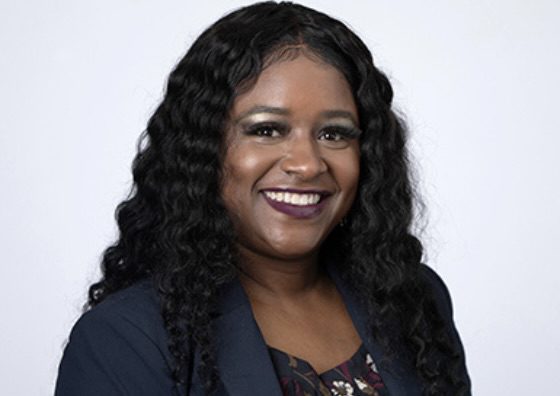
Tiffany Charles, director of undergraduate admissions at Houston Christian University was named Admissions Officer of the Year by the North American Coalition for Christian Admissions Professionals during the coalition’s annual conference May 28–30 on the HCU campus. Awardees have been nominated by their peers and colleagues, acknowledging their significant impact within their institutions and the broader Christian education community. Charles received the award from Willem de Ruijter, vice president of enrollment and marketing at Geneva College. Charles graduated Magna Cum Laude from Kaplan University with an associate’s degree in interdisciplinary studies. She received an undergraduate degree in secondary education with an emphasis in English and a Master of Business Administration degree from Grand Canyon University.
Howard Payne University announces new branding updates. (HPU Photo)
Howard Payne University announced a branding update for the university’s main logos and corresponding brand identity across campus departments. The new main logo features a prominent HP and new fonts, with an updated color palette that stays consistent with the school colors of old gold and navy blue. The athletic logo features an outlined HP in gold and the wording “Howard Payne Athletics.” Corresponding logos have been developed for each of the university’s athletic teams. The academic logo will be used for promotion and communication within the university’s schools and academic departments. It features a new shield with the Old Main Tower displayed in the center. The tower, a notable structure in the center of campus, is a replica of the entrance of Old Main—the first building built on campus in the late 1800s that stood for almost 100 years.
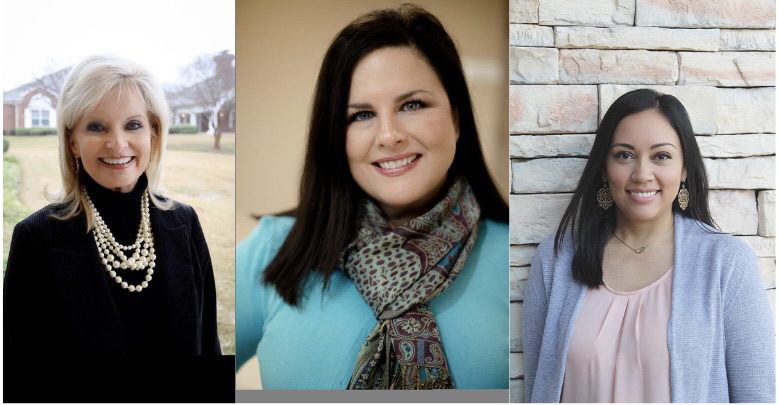
Debbie Sceroler, Samela Macon, and Rocío López, pictured left to right, assume new roles at Buckner Children and Family Services. (Buckner Photos)
Buckner International announced several leadership promotions with Buckner Children and Family Services. Samela Macon was appointed as vice president and chief operating officer of Buckner Children and Family Services; Rocío López was promoted to associate vice president overseeing international operations; and Debbie Sceroler was promoted to associate vice president overseeing domestic operations. In Macon’s new role, she will develop domestic and international strategies to improve key performance indicators, drive innovation and operational efficiency, build and strengthen strategic partnerships and position Buckner for long-term operational excellence and scalability. With nearly 20 years of nonprofit experience and 15 years at Buckner, López will oversee strategic endeavors across all international operations in her new role. Sceroler—who has more than 25 years in child welfare, 23 of which have been at Buckner—will lead initiatives in all domestic programs for Buckner Children and Family Services as associate vice president.
SBC Great Commission Resurgence Task Force files unsealed
June 20, 2025
The voices on the Aug. 11, 2009, audio recording of the Southern Baptist Convention’s Great Commission Resurgence Task Force exhibit enthusiasm and excitement as well as intrigue and concern.
The people behind the voices seemed to embrace the motivational messages that resulted in seven major components intended to turn Southern Baptists back into evangelistic powerhouses.
In the end, only two of the items were completed fully, but the process to get to the initial proposal of seven was no less intense.
The discussions highlighted the latest difficulties in helping autonomous churches cooperate within autonomous associations and autonomous state conventions—and how the national entities and seminaries fit into the mix.
‘Unprecedented moment’
Twenty of the 23 members serving on the 2009–2010 Great Commission Resurgence Task Force were present that opening day—a day task force chair and then-Arkansas pastor Ronnie Floyd described as the start of “an unprecedented moment.”
“We’ve got to seize this moment,” he told the group. “This is a moment in our history that is powerful.”
Items in the collection
Few paper documents are included in the collection. (Photo / Jennifer Davis Rash / The Baptist Paper)
The audio files from the task force’s 10 months of work were sealed for 15 years, the agreed-upon time by the group.
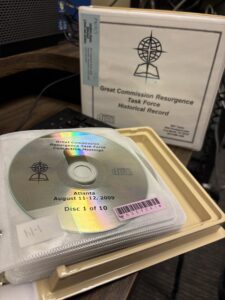
The collection includes 57 compact disc recordings, one DVD recording, a few printed blog posts from the pray4gcr.com website (which is no longer functional) and the printed Great Commission Resurgence Task Force progress report from February 2010.
Leaders of the task force did not transfer any other paper documents or notebooks, even though, on the audio file, Floyd refers to a comprehensive manual and directory each member had received.
According to the introductory remarks in the audio files, the resurgence concept related to the Great Commission started with Thom Rainer, then-president and CEO of Lifeway, a few years prior to Georgia pastor Johnny Hunt being elected president of the Southern Baptist Convention.
While Hunt ultimately ran with the idea, it was Danny Akin, president of Southeastern Seminary in Wake Forest, N.C., who served as the conduit between Rainer and Hunt.
Akin had been chatting with Rainer in the fall of 2008 about concerns they both saw within the SBC—membership and baptisms were down, and the SBC entity leaders seemed to be living in some type of “dysfunctional” relationship.
“Thom Rainer coined the term Great Commission resurgence. He said that’s what we need,” Akin shared with the task force members during that initial meeting in 2009.
“I said it was a great way to phrase it. He said, ‘Then run with it.’”
According to The Alabama Baptist newspaper, South Carolina pastor Frank Page also used the phrase “Great Commission resurgence” in his outgoing presidential address to SBC messengers in June 2008 in Indianapolis. Page urged Baptists to “fall in love with Christ all over again.”
‘Axioms of the Great Commission’
Still, it was Akin who developed, along with consultation from others, a chapel message known as “Axioms of the Great Commission” that ultimately became the foundational—and often controversial—mantra for those championing the cause.
“Brother Johnny asked for ownership, to work with folks to adjust it a bit, to post it on the website and see what happens,” Akin shared with the task force members to bring them up to speed on how the resurgence idea had developed.
For and against
The proposal—written and delivered by Al Mohler, president of Southern Seminary in Louisville, Ky.—called for creating a task force “to cast a compelling vision for Southern Baptists for the foreseeable future,” Akin said, adding it received 95 percent affirmation at the 2009 annual meeting in Louisville.
Audio files from the meetings in 2009 and 2010 are archived on 57 compact discs. (Photo / Jennifer Davis Rash / The Baptist Paper)
Of course, how can anyone vote against the Great Commission? Chuck Kelley, president emeritus of New Orleans Seminary, later asked.
Kelley has been outspoken about his concerns about the task force report through the years and has called out the branding as unfair and a way to prevent pushback.
His latest blog post also mentions a comparison of SBC stats between 2025 and 2010, when the Great Commission Resurgence Task Force recommendations were adopted.
“The downward trend is unmistakable,” Kelley writes. “Compare those same stats with the statistics from 1990, and the differences are even more stark.”
But in August 2009, Great Commission Resurgence Task Force leaders believed they could turn the declines around with the work they were doing.
‘End game’
Akin shared with the task force members: “My prayer is that … we will have a greater passion for the Lordship of Christ, a greater understanding of the gospel, a greater desire to love our neighbor as ourself, and to reprioritize our entire lives—from my life all the way up to our national entities—to really get after the fulfilling of the Great Commission. That’s my passion, that’s my heart, that’s the end game for me.”
Hunt also spent time describing his vision during that initial task force meeting.
“We flat need God to do something. … I prayed. I earnestly, earnestly, earnestly prayed. And Southern Baptists [have a desire] for someone to speak into their lives. If you study the Old Testament, … you’ll come on those occasions where the people were asking the prophets, ‘Is there a word from the Lord?’ People in times of desperation just want to know, ‘Is God still saying anything?’”
Hunt added he believed Crossover 2010 would have 10,000-plus volunteers (fewer than 2,000 showed up) and the 2010 annual meeting would see more than 18,000 messengers registered (a little more than 11,000 registered).
‘Guiding coalition’
Jennifer Davis Rash of The Baptist Paper and The Alabama Baptist listens to audio files on the first day of the collection being unsealed June 16. (The Baptist Paper photo)
As Floyd guided the task force through its opening agenda in August 2009, he noted: “We’ve got to rally people to a better future. That’s what we’ve got to do. That’s getting what we are doing down to a nutshell. We are going to rally people to a better future.
“We believe there’s a better future than where we presently are headed, and we are going to rally them to that future,” he said. “We’ve got to create it first, then we’ve got to rally them, and we’ve got to create this guiding coalition all the way to Orlando.”
Rainer’s message
Rainer’s role during the initial task force meeting was to share data points and define the reality of where the SBC was at that moment.
Following about 45 minutes of sharing research about a variety of declines in SBC life, Rainer wrapped on a final thought:
“Ultimately, any revitalization of any true Christian group has happened at the local congregation up and not on a task force down,” he said.
“So, the best thing that I would hope for anything that would happen is that we would remove the barriers so the local church can do its work. Almost any emphasis we’ve had in the SBC, even if it had initial success, has not lasted.”
2010 results
During the 2010 SBC annual meeting in Orlando, the task force’s recommendations were approved by messengers with one amendment by Pastor John Waters of First Baptist Church in Statesboro, Ga.
The amendment added language that says Southern Baptists will “continue to honor and affirm the Cooperative Program as the most effective means of mobilizing our churches and extending our outreach. We affirm that designated giving to special causes is to be given as a supplement to the Cooperative Program and not as a substitute for Cooperative Program giving.”
Those speaking against the recommendations included then-SBC Executive Committee president Morris Chapman, who retired in September 2010.
Task force members
The Southern Baptist Historical Library and Archives is on the fourth floor of the SBC Executive Committee building in downtown Nashville. (Photo / Jennifer Davis Rash / The Baptist Paper)
Along with Floyd, Akin, Mohler and Page, the other task force members were Hunt as an ex-officio member; Tom Biles, then-executive director of Tampa Bay Association in Florida; Pennsylvania pastor John Cope; David Dockery, then-president of Union University in Jackson, Tenn. (now president of Southwestern Baptist Theological Seminary in Fort Worth); John Drummond, layman from Panama City, Florida; Donna Gaines, pastor’s wife and popular women’s speaker from Cordova, Tenn.; North Carolina pastor Al Gilbert; Georgia pastor Larry Grays; North Carolina pastor (and future SBC president) J.D. Greear; Texas evangelist Ruben Hernandez; Harry Lewis, then-senior strategist with the North American Mission Board; Kathy Ferguson Litton, pastor’s wife, church staff member and popular conference leader, who has served in several states; Florida pastor Mike Orr; Jim Richards, then-executive director of the Southern Baptists of Texas Convention; California pastor Roger Spradlin; Florida pastor Ted Traylor; Simon Tsoi, executive director of Chinese Baptist Fellowship of the U.S. and Canada; Bob White, then-executive director of the Georgia Baptist Mission Board; and Florida pastor Ken Whitten.
To schedule an appointment to listen to the Great Commission Resurgence Task Force audio files and review the collection items, call 615-244-0344. The Southern Baptist Historical Library and Archives is open from 8 a.m. to 4 p.m. Monday through Friday. Taffey Hall serves as director and archivist.
200 displaced Nigerian Christians slaughtered
June 20, 2025
YELEWATA, Benue (BP)—The 500 Christians already had fled terrorism at home and found temporary shelter in storefronts transformed into living quarters in downtown Yelewata. But as they slept overnight June 13, men identified as militant Fulani attacked from multiple sides.
Shouting “Allahu Akhbar (God is great),” militants commenced an ungodly attack, using fuel to burn the small living quarters, shooting people and attacking with machetes any who tried to escape, multiple international religious liberty advocacy groups reported.
Within two hours, 200 were dead in what Aid to the Church in Need labeled the “worst killing spree” in the region to date.
Ukuma Jonathan Angbianbee, a local Catholic priest, told Aid to the Church in Need he survived by dropping to the floor as the gunshots began.
“What I saw was truly gruesome. People were slaughtered. Corpses were scattered everywhere,” the organization quoted Angbianbee. “When we heard the shots and saw the militants, we committed our lives to God. This morning, I thank God I am alive.”
Christian Solidarity Worldwide reported “the attack followed several days of terrorist violence in Guma.”
The organization listed several lead-up attacks: on June 8 two farmers were killed and a third was wounded seriously working in their fields in Udei in the Nyiev Council Ward when gunman opened fire.
Then, “on June 11 two people were killed in a machete attack in Tse Ivokor, Unongu, and the following day five people were killed in an ambush on farmlands in Daudu as they were searching for the bodies of those who had been killed in the previous day’s attack,” CSW said in a press release.
The vast majority of those sheltered at the site had fled violence in Nasarawa and Benue, International Christian Concern reported.
Local law enforcement arrived hours too late, a leading priest in the Diocese of Makurdi told Aid to the Church in Need.
“Where were they the previous evening when we needed them?” the group quoted the priest. “This is by far (the) worst atrocity we have seen. There has been nothing even close.”
Local law enforcement managed to stave off an attempted attack on St. Joseph’s Church in Yelewata, where 700 displaced persons were sheltered, preceding the downtown Yelewata slaughter. Seeing the resistance, militants retreated to the second site that was unguarded.
Entire families were killed, including babies and the elderly, witnesses said.
‘A crisis of global conscience’
While initial reports indicated a death toll of 100, an investigation by the Diocese of Makurdi Foundation for Justice, Development and Peace found 200 people were killed, a total confirmed by Wissam al-Saliby, president of international religious freedom organization 21Wilberforce.
On the same night as the Yelewata attack, Fulani militants killed between two and five Nigerian soldiers at a military post near Daudu town, ICC reported, referencing Benue’s Leadership News as a source.
“Our tactical teams responded swiftly, and some of the attackers were neutralized,” Deputy Superintendent of Police Sewuese Edet told Leadership News, adding that several civilians were killed and wounded in the attack.
The Yelewata attack comes weeks after Palm Sunday and Easter attacks in Benue and Plateau that killed 240 Christians, many of them as they sheltered in a church.
“This is not just a Nigerian crisis—it is a crisis of global conscience,” al-Saliby noted in an email.
He said the organization had issued the following warning a decade ago in its report, “following a fact-finding mission to Nigeria. Tragically, the situation has only worsened.”
“If immediate action is not taken, religious minorities in northern Nigeria will continue to face policies and practices that seek to remove their very presence. Terrorist violence will further compound one of the worst humanitarian crises in the world.
“The accelerating aggression of Fulani militants in the Middle Belt, right in the heart of the country, will create one of the most significant security risks in West Africa—while solidifying religion as a primary identifier, further fracturing an already destabilized Nigeria,” al-Saliby noted their 2016 report read.
Yet today, “we are again bearing witness to devastating violence,” he noted, confirming the brutal nighttime murders, on June 13–14, of the nearly 200 internally displaced persons sheltering in a Catholic mission in Yelewata, Benue State.
Al-Saliby said 21Wilberforce “has been in close communication with Nigerian Christian leaders and secular human rights groups, all confirming that the security situation is deteriorating.”
He noted the team also received “an unpublished report from a trusted local leader detailing another massacre that predates this latest atrocity.”
Standing with Nigerian Christians
Nigerian law enforcement and national security long have been accused by Nigerians and members of the international community of inadequate or no intervention to stop militant and terrorist attacks against Christians and civilians.
Following the weekend’s attacks, the U.S. Commission on International Religious Freedom renewed calls June 18 for the Department of State to designate Nigeria a Country of Particular Concern.
“The abhorrent violence in Nigeria’s Middle Belt and the systematic, ongoing, and egregious attacks throughout Nigeria against Christians and Muslims are indications that government prevention efforts are failing and not protecting vulnerable religious communities,” commission Chair Vicky Hartzler said in a release.
“U.S. government foreign assistance to Nigeria should efficiently and effectively support efforts to protect religious freedom,” she noted.
More Christians are killed for their faith in Nigeria than anywhere else in the world, Open Doors reports annually in its World Watch List of the 50 most difficult places for Christians to live, with 3,100 Christians killed there in 2024.
Yet, al-Saliby said: “21Wilberforce remains committed to long-term partnership. We are investing in and directing resources to empower local leadership in Nigeria to raise their voices, engage with their government, and represent their communities before international bodies.”
Attacks against Christians have escalated in Nigeria’s Middle Belt and nationwide. Attacks by radicalized Islamic ethnic Fulani militia are a main driver of violence there.
Fulani militants attack farming communities heavily populated by Christians, killing many hundreds, Open Doors reported, adding to attacks elsewhere in Nigeria by Jihadist groups such as Boko Haram and Islamic State in West Africa Province, among others.
Fulani are predominantly Muslim and comprise numerous clans totaling millions in Nigeria and across the Sahel. Most do not hold extremist views.
“While international advocacy has often failed to produce sustained results, we believe that domestic Nigerian advocacy—led by courageous local leaders—is essential for lasting change,” al-Saliby said.
He asserted, “They must not stand alone.”
With additional reporting by Calli Keener. Editor’s note: the 8th, 9th and 10th paragraphs from the end were added when new information became available after the article was published.
Christ for the Nations denounces alum’s ‘hateful actions’
June 20, 2025
(RNS)—In the Buick sedan Vance Boelter left on a rural road outside Minneapolis, law enforcement found a letter addressed to the FBI identifying himself as “the shooter at large in Minnesota.”
Police also found a Ford SUV belonging to Boelter, filled with weapons, notebooks full of website names and other resources suggesting he stalked his victims, and a list of some 70 politicians that authorities say he also targeted.
But nowhere have they found an explanation for why Boelter allegedly killed state lawmaker Melissa Hortman and her husband and wounded two others, according to federal charges brought by the Department of Justice June 16.
Some, including Utah Sen. Mike Lee, have tried to tie the killings to radical left elements.
“This is what happens when Marxists don’t get their way,” Lee posted on social media.
Others have portrayed Boelter as a Christian nationalist.
There are hints in the 57-year-old Boelter’s resume to suggest he might have been motivated by radical opposition to abortion and a distorted belief in violence as an extension of spiritual warfare.
Influenced by New Apostolic Reformation
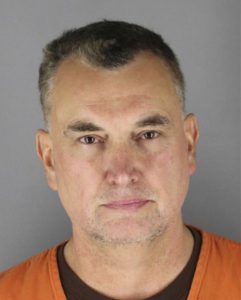
This booking photo provided by the Hennepin County Sheriff’s Office shows Vance Boelter in Green Isle, Minn., on June 16, 2025. (Hennepin County Sheriff’s Office via AP)
An ordained minister who has preached at an evangelical Christian church in Congo, Boelter inveighed against abortion and claimed that “the enemy” caused people to switch genders.
Matthew Taylor, author of The Violent Take It by Force: The Christian Movement That Is Threatening Our Democracy, said he had listened to some of Boelter’s sermons from overseas.
Taylor said he did not hear any calls for violence but did hear influences of the New Apostolic Reformation, a movement of independent charismatic apostles and prophets that seeks to have Christians dominate all elements of society, including the government.
Taylor said opposition to abortion—common in NAR and other charismatic Christian circles—has spiritual overtones, with abortion often depicted as a kind of child sacrifice.
“I think it is significant that he has apparently spent most of his life in and around communities and channels through which pretty radical ideas are flowing,” he said.
Attended Christ for the Nations in Dallas
The search for a motive has put a spotlight on Christ for the Nations Institute, an influential Dallas-based Bible college for nondenominational charismatic Christians, where Boelter graduated in 1990.
But school officials, who have confirmed Boelter attended the school, said they have had no contact with him since he left three decades ago.
“We are completely unaware of what led to this kind of mental, emotional, social, and spiritual bankruptcy since he left CFNI,” the school said in a statement posted to its website.
In addition, the statement denounced the “hateful actions” of the Minnesota shooter.
“CFNI unequivocally rejects, denounces, and condemns any and all forms of violence and extremism, be it politically, racially, religiously or otherwise motivated. Our organization’s mission is to educate and equip students to spread the Gospel of Jesus Christ through compassion, love, prayer, service, worship, and value for human life,” the Bible college said in a statement.
“These core Christian values and principles, which we highly esteem and embrace, are in stark contrast to the hateful beliefs, behavior and actions now being attributed to Mr. Boelter.”
Emphasis on spiritual warfare
Christ for the Nations, founded in 1970 by charismatic preacher and missionary Gordon Lindsay and his wife, Freda, claims 40,000 alums from 170 nations, according to its annual report.
Gordon Lindsay grew up in Zion, Ill., a failed Christian utopia founded by John Alexander Dowie, and then became a follower of faith healer and preacher William Branham before launching out on his own, according to a short film on his life produced by the ministry.
Lindsay eventually started his own printing company and a magazine called The Voice of Healing.
He was known for telling his students, “Everyone ought to pray at least one violent prayer each day,” an idea still promoted by the school in promoting the power of prayer.
That quote has gained attention since last weekend’s attacks, with some seeing it as a sign of hostile intent. But Taylor said that quote from Lindsay is a reference to the belief in spiritual warfare.
“They aren’t saying a prayer to do violence against people, but it’s spiritual violence,” said Taylor.
In its statement, the school essentially agreed, saying that Lindsay’s quote encourages students to “incorporate passion in their prayers as they contend for what God has for them and push back against evil spiritual forces in our world.”
“Christ For The Nations does not believe in, defend or support violence against human beings in any form,” the statement read.
Alumni linked to New Apostolic Reformation
The school does have ties to leaders of the New Apostolic Reformation, including several evangelical supporters of President Donald Trump: Dutch Sheets, the school’s former executive director; speaker and prophet Cindy Jacobs; and Lance Wallnau, a preacher who prophesied that Trump would become president.
A 2013 edition of Voice, the school’s magazine, features an interview with Wallnau, where he discusses the 7 Mountain Mandate—a belief evangelical Christians should dominate all aspects of culture, including the government, media and education.
Jenna Ryan, who was convicted in the Jan. 6, 2021, attack on the U.S. Capitol and later pardoned by Trump, is also a former student at Christ for the Nations, attending the school in 2003 and 2004, according to The Washington Post.
However, Ryan also told the Post she had dropped out of organized religion and had become a spiritual healer.
But Christ for the Nations is equally known for its influence on missions and Christian worship music.
Its alums include hymn writer Marty Nystrom, whose 1984 song “As the Deer” is popular in a wide range of churches; megachurch worship leader Kari Jobe; and Christian music artists Nicole C. Mullen, Russ Taff and Tommy Walker, according to a 2023 issue of Voice, which highlighted the school’s music programs. Since the 1970s, the school has released its own annual recording of live worship music.
School leaders said the school will be praying for the victims of the attacks.
“We extend our condolences and deepest sympathies to the immediate families, friends, coworkers and acquaintances who have been affected by this tragedy. We continue to lift up Democratic State Senator John Hoffman, and his wife Yvette who were both wounded, and are undergoing medical care. This should have never happened!”
Obituary: Larry Johnson
June 20, 2025
Larry Johnson, former missionary to Peru and Mexico, died April 28. He was 90. He was born Oct. 9, 1934, in Veribest to Jean S. and Wynama Johnson. He received the Associate of Arts degree from Angelo State University in San Angelo. On April 18, 1953, he married his high school sweetheart, Joy Clark. He farmed, worked as a traveling feed salesman, and was a real estate broker throughout the rest of the 1950s. He then returned to farming full time. The Johnsons were members of First Baptist Church in San Angelo. While seeking missionary appointment he wrote: “I became personally interested in the mission field during my trip to Fortaleza, Brazil, in the winter of 1981. I have since sought the Lord’s will in my life in regard to the mission field and have been led to this point.” In 1984, the Southern Baptist Convention’s Foreign Mission Board (now International Mission Board) appointed Larry and Joy Johnson as missionaries to Peru. They served in agricultural evangelism, digging wells, building roads, developing schools and churches, supporting and aiding community orphanages, and creating high-altitude tree planting. They later served in Mexico. He was preceded in death by his son, David Johnson. He is survived by his wife of 72 years, Joy; his children, Lucy Johnson of Cajamarca, Peru, and Lucky Clark Johnson of Mexico; two grandchildren; and three great-grandchildren.
Many churchgoers participate in more than one
June 20, 2025
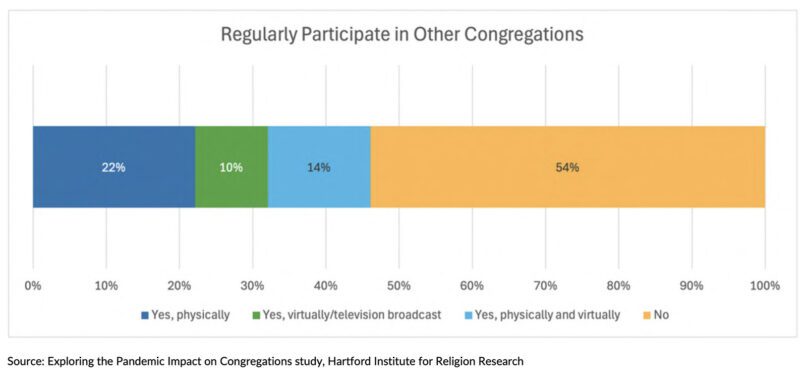
(RNS)—Five years after the start of the COVID-19 pandemic, almost half of churchgoers are regular participants in congregations other than their primary one, either attending in person, watching online or on TV, or taking part in both physical and virtual offerings.
Researchers for the multiyear Hartford Institute for Religion Research study found 46 percent of about 24,000 churchgoers responding to their survey reported active engagement with more than one church.
Engaging in other congregations did not prevent these churchgoers from giving and volunteering at the primary church in their lives, said Scott Thumma, principal investigator of the Exploring the Pandemic Impact on Congregations study.
“(P)articipating in multiple services regularly did not detract from one’s commitment to one’s home church,” he said. “Rather, it was as if these highly committed religious persons wanted/needed more spiritual sustenance than their one church provided and sought out this nourishment elsewhere while remaining as involved in their home church.”
Of the tens of thousands surveyed, half were evangelical Protestant (50 percent), one-third were Catholic or Orthodox (32 percent), and 18 percent were mainline Protestant. About 7 in 10 worship at churches with 250 or more attendees (71 percent), the majority attend churches that offer online services (85 percent), and one-fifth are part of multiracial congregations (19 percent).
“Regularly Particpate in Other Congregations” (Graphic courtesy HIRR via RNS)
Project researchers, who have previously surveyed congregational leaders, said the most recent research, released June 16, looks at the behaviors and attitudes of those most likely to be attending church.
“From the perspective of the 24,000 church attenders we surveyed, the picture that emerges is largely positive,” reads the introduction to the 36-page report, “This Place Means Everything to Me: Key Findings from a National Survey of Church Attenders in Post-Pandemic United States.”
“Many more respondents said their religious faith and spirituality had strengthened since the pandemic. Likewise, financial giving has increased, as has involvement and volunteering,” according to the report.
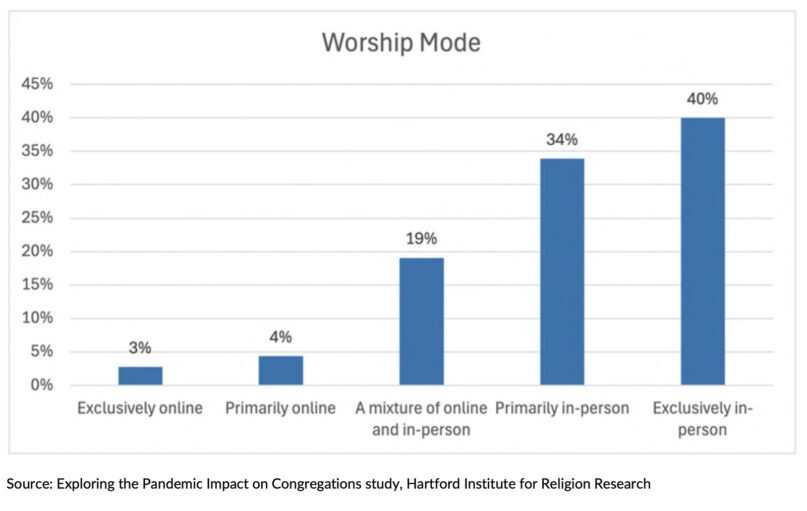
Researchers found 3 out of 4 churchgoers say they take part in worship services primarily or exclusively in person. About one-fifth (19 percent) say they attend a mixture of online and in-person services, and 7 percent say they exclusively or primarily attend online.
“Worship Mode” (Graphic courtesy HIRR via RNS)
“When comparing the respondents who attend in person with those who tune in virtually, the former are more likely to volunteer with the congregation, attend more frequently, and have more close friends in the congregation,” the report reads.
While evangelical church attenders were more likely than people in other faith groups to be virtual participants, Black church participants were less likely than those of other races to attend in person.
Catholic and Orthodox churchgoers were much more likely to opt for in-person attendance, with the centrality of the weekly Eucharistic ritual a likely factor.
About two-thirds (64 percent) of online worshippers acknowledged they multitask while watching or listening to services, but almost all (95 percent) say they pray or meditate during the service and most read or sing along (79 percent and 71 percent, respectively) with in-person congregants.
“What Online Worshippers Do During the Service” (Graphic courtesy HIRR via RNS)
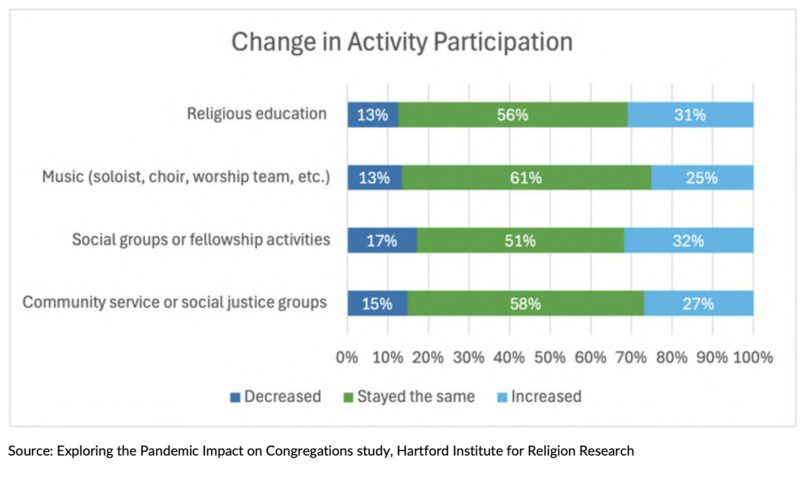
Overall, besides worship services, participation in other religious activities and programs—such as religious education, music, social groups or fellowship activities—has increased or remained the same in the last five years.
A majority maintained their engagement level in the wake of the pandemic, while 25 percent to 32 percent of respondents increased their participation and 13 percent to 17 percent have decreased.
Evangelical church attenders reported high attendance in most of the programs except community service, an activity in which mainline church congregants were more likely to note increased participation.
Black church attenders reported higher levels of participation in all the activities than congregants at other churches.
Although Black church attenders are less likely to worship in person, this subgroup of congregants is nevertheless among those who have considerable small group participation.
A sizable percentage—38 percent—of respondents said they had started attending their current church within the last five years.
“Interestingly, among the new attenders in the survey, 22 percent report not having attended a congregation for years and 8 percent indicate they never participated in a congregation before the one they currently attend,” the report notes.
“This combined 31 percent of new attendees represent former religious ‘nones’ or congregational converts who are embracing organized religion for the very first time in their lives or returners who have been ‘re-churched’ after a lapse in participation.”
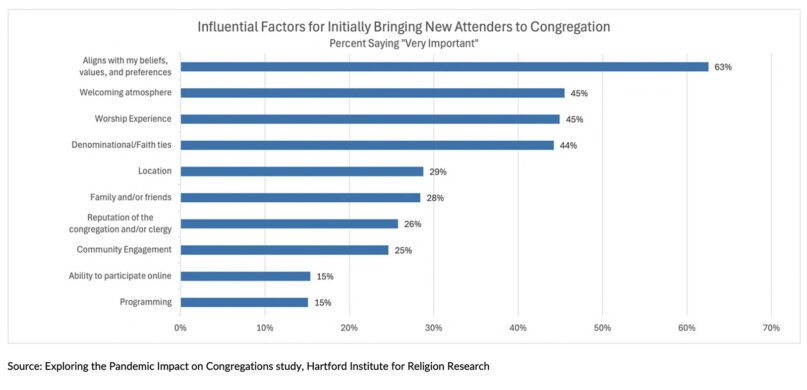
“Influential Factors for Initially Bringing New Attenders to Congregation” (Graphic courtesy HIRR via RNS)
By far, the most influential factor that drew new congregants to a church was an alignment with their values, beliefs and preferences (63 percent). More than 4 in 10 cited a welcoming atmosphere (45 percent), the worship experience (45 percent) and the denominational/faith ties (44 percent).
Almost two-thirds (61 percent) of those surveyed were women, 73 percent were white and 10 percent were immigrants (and 27 percent were children of immigrants).
Thumma cautioned that the survey results likely paint a rosier picture because they are based on the views of active participants.
A survey of church leaders, he said, may offer a broader sense of the state of a congregation, including the very committed members and people who are less so. He also noted five years past the start of the pandemic, churchgoing patterns—from attendance to giving to religious education—continue to shift.
“So far, no two surveys we have done record a static ‘back to normal’ reality has been established,” he said in an email to Religion News Service.
“Things are still in flux. The impact of the pandemic on congregational life has a long tail of influence.”
The findings are from a survey of a total of 24,165 adults representing more than 80 denominations, with an overall margin of error of plus or minus 0.6 percentage points.
They were based on responses from congregations requested by the Faith Communities Today partnership (12,658) and supplemented by responses to two other panels, Survey Monkey Audience (2,784) and Prolific (8,723).
“Change in Activity Participation” (Graphic courtesy HIRR via RNS)
Respondents from the latter two sources were selected and screened based on church attendance of at least a few times a year, not counting funerals or weddings.
Churches targeted in Russian-occupied Ukraine
June 20, 2025
Authorities in the Russian-occupied Luhansk region of Ukraine raided an unregistered Baptist church during a Pentecost Sunday worship service, an Oslo-based news service focused on international human rights and religious freedom reported.
Forum 18 reported police and a deputy prosecutor raided the Council of Churches Baptist congregation in Krasnodon—also known as Sorokyne—on June 8. Officials took a copy of every religious publication they could find and photographed all the rooms in the church building.
When the Krasnodon police duty officer was asked to explain why law enforcement officers raided the church, Forum 18 reported the officer simply replied, “We can’t.”
However, the news service noted, Pastor Vladimir Rytikov said: “The main issue is the registration of the church. I explained that for a number of reasons, we do not register. One of the reasons is the duty of the pastor to report to authorities about the life of church members and about the service of the church, and this is betrayal.”
Rytikov was jailed by Soviet authorities from 1979 to 1982 for his involvement in a Christian summer camp for children.
Religious freedom violated in Russian-occupied Ukraine
The June 8 raid is part of a larger campaign to crack down on unregistered churches and enforce “anti-missionary” laws in Russian-occupied areas of Ukraine.
Police raided the Council of Churches Baptist congregation in Luhansk’s Artyomovsky District on May 30.
On May 23, the pastor of another unregistered Council of Churches Baptist congregation in Donetsk was fined for alleged missionary activity. Pastor Vladimir Rudomyotkin was fined several days’ average wage, Forum 18 reported.
Two days earlier, the Budennovsk Inter-District Court in Donetsk similarly punished the city’s Roman Catholic parish.
The U.S. Commission on International Religious Freedom has pointed to extensive violations of religious freedom related to the issue of registration in Russian-occupied Ukraine.
“Upon registration, religious communities must adhere to Russian law, which prohibits certain forms of religious activities and speech,” the commission reported.
“In Donetsk, Russian soldiers have searched churches, seized equipment and church documents, and removed religious literature deemed ‘extremist.’”
Russian troops destroyed the library of Tavriski Christian Institute in Kherson, Ukraine. However, the school is committed to continuing its mission. (Courtesy Photo)
Since Russia launched its full-scale invasion of Ukraine in February 2022, at least 500 houses of worship and religious sites have been damaged or destroyed.
In its most recent annual report, the commission recommended the U.S. Department of State re-designate Russia as a Country of Particular Concern for its systematic, ongoing and egregious violations of religious freedom.