Anti-trafficking ministry goes global

LAKELAND, Fla. (BP)—From the National Palace in Guatemala to the Oval Office in Washington, leaders of the Florida Baptist Children’s Homes have found themselves advocating for child sex trafficking victims on international and national platforms.

This year, they have led a conference for Guatemalan government officials on child trafficking and were present at the White House in January when President Trump signed an anti-trafficking bill.

‘Seeing the whole person’

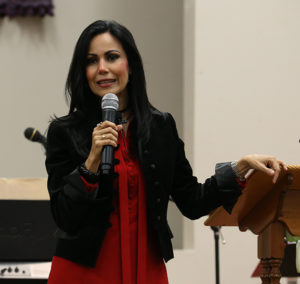
Christa Hicks, executive director of anti-trafficking at One More Child, talks with a group of Guatemalan children and teenagers who attended a portion of Guatemala’s national anti-trafficking conference led by One More Child. (One More Child photo via BP)

In battling child sex trafficking, “we really focus on seeing the whole person,” said Christa Hicks, executive director of anti-trafficking at the Florida Baptist Children’s Homes, a ministry also known as One More Child to better reflect its national and international scope.

“That includes a spiritual life and a life with God. We always are looking at how to reach trafficking victims with the gospel but first … meet their tangible needs and look at safety and a way out.”

One More Child is among at least 21 Baptist children’s homes affiliated with some 19 Baptist state conventions. Though Baptist children’s homes are known primarily for their ministries related to adoption, foster care and residential care, anti-trafficking work has emerged among the major initiatives at One More Child.

Hicks and One More Child President Jerry Haag said their ministry’s anti-child trafficking initiative has sought to communicate across the world that children exploited in the sex trade are victims to be rescued, not criminals to be punished.

Economically disadvantaged children in particular, they said, are vulnerable to being propositioned for sex in exchange for basic necessities like money, food, shelter and school supplies. Such children need care and a way out, according to One More Child, before they reach their late teen years and resign themselves to a life as adult sex workers.

Guatemala developing plan to fight trafficking

In late January, One More Child took that message to the Guatemalan National Palace in Guatemala City for a two-day conference at the invitation of Guatemalan First Lady Patricia de Morales. The conference’s first day focused on educating some 150 government leaders about child sex trafficking. The second day was geared toward Guatemalan church leaders and community members concerned with the problem.

Jerry Haag, president and CEO of One More Child, speaks to Guatemalan government officials Jan. 30 at a national anti-trafficking conference led by One More Child at the National Palace in Guatemala City. (One More Child photo via BP)

In the conference’s wake, Guatemalan President Jimmy Morales is continuing to develop a plan to fight child sex trafficking, said Haag, former president of South Texas Children’s Home.

The Guatemalan president and first lady “are Christians, so they have surrounded themselves with other Christians,” Haag said. “And they realize that the greatest impact we can make is a spiritual impact.”

The leader of a Guatemalan home for trafficked girls attended the conference, Hicks noted. “With tears in her eyes,” she said that “everything we were saying that day about generational problems and complex trauma and vulnerabilities and the need to stop the cycles—every bit of it was stuff she had wholeheartedly prayed that Guatemalans would come to begin understanding.”

Closer to home, One More Child has worked with the Trump administration to develop anti-trafficking legislation. Between Dec. 21, 2018, and Jan. 9, 2019, Trump signed four anti-trafficking bills. Haag and Hicks were in the Oval Office for one bill signing ceremony.

The U.S. and other countries “have welcomed us to the table as a faith-based organization,” Haag said. Governments aren’t necessarily seeking “to incorporate a Christian mindset” into their anti-trafficking efforts, “but they recognize the excellence with which we do programs. And they say, ‘We want you to come be a part.’”

Last year, One More Child affected the lives of more than 249,000 children and adults with its full range of ministries, Haag said, including a safe home for child trafficking victims, mobile units to help trafficked children and advocacy and prevention programs.

Haag recalled one girl who had been trafficked and came to faith in Christ. “She was running down the aisle at a ministry event and running down the steps and just kept yelling out: ‘I’m free! I’m free!’”


Around the State: Perot speaks at DBU event

Ross Perot Jr.(center), keynote speaker at the Christian Business Owner’s Conference, is pictured with Dallas Baptist University President Adam Wright (left) and philanthropist Ted Skokos. (DBU Photo / Efrain Carbajal

Ross Perot Jr., chair of The Perot Group, was the keynote speaker at the annual Christian Business Owner’s Conference on the Dallas Baptist University campus. The event is designed to encourage servant leaders in business to continue to integrate their faith with their vocation. “Good business means that you are taking care of everybody, you are fair with everybody, and you treat everybody like you want to be treated,” said Perot, chair of Hillwood, a Texas-based global real estate development company. “If you do that right, you have a better business.” Perot was the 1999 recipient of DBU’s Russell H. Perry Free Enterprise Award.

Carlos Francis, youth pastor at Bethlehem Baptist Church in Mansfield, addresses East Texas Baptist University students during Spiritual Renewal Week. (ETBU Photo)

Carlos Francis, youth pastor at Bethlehem Baptist Church in Mansfield, and Shawn Smith, senior pastor of Immanuel Baptist Church in Marshall, were guest speakers during Spiritual Renewal Week at East Texas Baptist University. “Defeating Distractions,” based on Hebrews 12:1-3, was the theme of on-campus worship experiences.

Mark Tew is leaving his role as Howard Payne University’s provost and chief academic officer to become the 23rd president of Judson College in Marion, Ala. He assumes the post March 25. Tew, who joined HPU’s administration as vice president for academic affairs in September 2007, previously served at Judson College in a variety of administrative and academic capacities including senior vice president, vice president for institutional advancement, chief financial officer and professor of religious studies. Celeste Church, assistant vice president for retention, research and accreditation at HPU, will become acting provost at HPU, effective March 18. Church joined HPU’s music faculty in 2004 and progressed through the ranks from instructor to full professor. She also served as chair of the faculty assembly, co-chair of the general education review committee and dean of institutional research and effectiveness.

The Academy at Houston Baptist University will sponsor an open house from 6:30 p.m. to 8:30 p.m. on March 21 in the Cullen Parlor on the HBU campus. The event also will recognize students from The Academy and recent essay contest award winners. The Academy offers a classical Christian education at the secondary school level for eighth-graders and high school students. Dual-credit courses allow students to earn college credit at a reduced tuition rate. In its seventh year, The Academy serves area homeschool families and partner schools. Students learn from faculty on HBU’s campus or at partner school locations. For more information, click here. To make a reservation for the open house, click here.

Wayland Baptist University will offer a Hispanic Christian Leadership Scholarship beginning with the 2019-20 school year. The scholarship covers 100 percent of student tuition and full room and board for a student throughout his or her undergraduate degree. Recipients must be active members of a church affiliated with the Hispanic Baptist Convention of Texas. Wayland Baptist University will select a recipient based on merit and achievement. For more information and access to an online application, click here.

A ribbon-cutting ceremony marked the opening of the Buckner Family Hope Center of Lubbock. (Buckner Photo)

A ribbon-cutting ceremony marked the grand opening of the Buckner Family Hope Center of Lubbock. Angelina Rodriguez is director of the center. Buckner International operates 28 Family Hope Centers around Texas and in six countries. Services offered typically include parent education classes, job skills training, family coaching, spiritual enrichment and a variety of programs for children.

The Hodge-Martin-Chatfield Museum recently dedicated a Texas Historical Marker commemorating the 1868 organization of the Baptist General Association of Texas at Chatfield in Navarro County. The association drew most of its affiliated churches from North Texas and East Texas. In 1886, the Baptist General Association of Texas merged with the Baptist State Convention to form the Baptist General Convention of Texas.

Anniversary

20th for Gary Singleton as pastor of The Heights Church in Richardson.

Ordinations

First Baptist Church in Belton ordained to the gospel ministry Logan Reynolds, minister for college; Les Williams, associate youth/recreation minister; and Matthew Levant, lead pastor of Renewal Church.


Hispanic ministry demands multicultural awareness

Terms like “Hispanic” or “Latino” may suggest a group of people who share a common language and culture, but leaders of Hispanic Texas Baptist churches know better.

The Pew Research Center reported in 2012 only about one-fourth of adult Hispanics identify themselves as “Hispanic” or “Latino,” preferring instead to identify by their family’s nation of origin—Mexico, Cuba, Honduras, El Salvador or elsewhere.  Only 29 percent said all Hispanics in the United States shared a common culture.

Of the total U.S. Hispanic population, Pew researchers reported people of Mexican family origin accounted for 63 percent in 2015—a clear majority, but down from the high of 66 percent in 2008.

Let individuals tell their own stories

Many pastors of Hispanic congregations in Texas increasingly recognize the need for multicultural awareness.

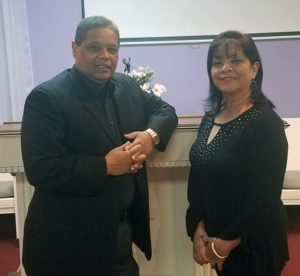
Oscar and Margoth Camacho serve at Iglesia Hispana Antioch in Farmers Branch. (Photo / Isa Torres)

“As Christians, we must go through cultural barriers in order to connect with people,” said Oscar Camacho, pastor of Iglesia Hispana Antioch in Farmers Branch.

Camacho and his wife, Margoth, are from Colombia. Their church includes families from Mexico, Honduras, Puerto Rico, El Salvador, Colombia and other Latin American countries.

“Our stories as Hispanics can be very similar, but there are not two people who are the same in this world,” Camacho said. “We must hear individuals tell their own story.”

Cultural differences can be an issue, but Iglesia Hispana Antioch seeks to help believers recognize their primary identity in Christ, Camacho said.

“That is why we call ourselves an embassy of worship and praise,” he explained. “We want to establish our identity as (a group of people) that worships and praises God.”

(Design by Alan Paul)

To help the congregation pursue that identity, Camacho said, he understands he must let go of his own culture in some regards to improve communication with people from other cultures. As communication improves, relationships grow, he said.

“As a pastor, I can be a mentor and help people develop their faith when I have a close relationship with them,” he said.

But learning to communicate with individuals and with the congregation as a whole is a continuous process, Camacho acknowledged.

“We grew up in a church where we had constant interaction with the pastor, and we were able to develop our leadership skills,” he said. “That is what we aim to do here, too.”

Reaching people from different cultures

Past experiences confirm how God prepares people to serve where they are now, said Kevin Harris, pastor of First Baptist Church in Los Fresnos.

Olga and Kevin Harris moved to Los Fresnos when he became pastor of First Baptist Church there. (Photo courtesy of Kevin Harris)

Although Harris is not Hispanic, his wife Olga is from Venezuela. They met in seminary, and since then, he has grown to understand more what it means to serve people from other cultures, he said. He has been involved in Hispanic churches and learned Spanish throughout the years.

Harris noted he and his wife have talked extensively about the differences between Hispanics from different places and how a church can offer a multicultural ministry that reaches people of varied backgrounds.

While Harris initially served in lay ministry, God prepared him to become pastor of First Baptist in Los Fresnos, he believes.

His experiences with Hispanic congregations in the Dallas-Fort Worth area were different than those in Los Fresnos, a city close to the border with Mexico, he noted.

“As a pastor, I know that means I need to take the time to learn the culture of the congregation,” Harris said. “I must move slowly, take the time to talk to people and understand the way they do things.”

Develop a missional mindset

He also pointed to a book he found helpful, A Future for the Latino Church: Models for Multilingual, Multigenerational Hispanic Congregations by Daniel Rodriguez.

Like the community it serves, First Baptist in Los Fresnos includes both Hispanic families with ties to Mexico and Anglo families.

Due to the town’s proximity to the border, the majority of Hispanic families in Los Fresnos are from Mexico.

In a cross-cultural congregation, members must make a conscious effort to try to understand each other, Harris emphasized.

“Language and culture can be a natural divide unless the leadership of the church is intentional in breaching that divide and bringing healing,” he said. “That’s why we must bring a cross-cultural mindset—a missional mindset.”

He learns from and works alongside his wife, who has a background in marriage and family counseling and has worked with Mexican populations more than 20 years.

Both Harris and Camacho noted the type of Spanish spoken by people from different areas varies widely. Words can carry different meanings, depending on locale.

However, a willingness to learn and to keep an open mind allows people of varied educational backgrounds and cultures to communicate with each other, Harris said.

“We know we must be fully fluid in a multilingual and multigenerational church,” Harris noted. “We must balance well the mix of the cultures.”

Through contextual communication, a pastor can speak effectively of the calling God has given to the church, Harris said.

“It is then we can help the church turn toward the outside,” rather than focusing internally, he said.

Read more articles like this in CommonCall magazine. CommonCall explores issues important to Christians and features inspiring stories about disciples of Jesus living out their faith. An annual subscription is only $24 and comes with two free subscriptions to the Baptist Standard. To subscribe to CommonCallclick here.


Baptists join call to increase public school funding

AUSTIN—A Baptist pastor from Houston joined teachers and administrators at a March 11 rally on the steps of the Texas Capitol, urging lawmakers to increase funding for public education.

Ogletree 150
John Ogletree

Schoolteachers and preachers alike plant “seeds of hope” in young lives, said John Ogletree, pastor of First Metropolitan Church in Houston and school board president for the Cypress-Fairbanks Independent School District.

“You plant seeds of hope in our children,” Ogletree told public educators before offering an invocation at the rally. “You plant these seeds no matter the socio-economic background; no matter the race, creed or color; no matter the dysfunction that they’ve come from in their homes; no matter whether they have limited abilities, physically or emotionally or intellectually. You still do the job and plant seeds of hope.”

Ogletree, who serves on the board of the Pastors for Texas Children advocacy group, noted the challenges public schoolteachers face, but encouraged them to remain hopeful.

“We urge you to remain diligent, remain patient, but whatever you do, remain confident, because we will win this fight,” he said, as reported by EthicsDaily.com. “I’m here to tell you that the seeds of hope that you plant will one day produce a harvest of hope that we’ll see all across this state from the children that you educate.”

Among the governor’s emergency items

In his biennial State of the State address Feb. 5, Gov. Greg Abbott named school finance reform, teacher pay raises and property tax relief as emergency items for the Texas Legislature.

“Texas must recruit and retain the best and brightest teachers to educate our students. This session, we must pay our teachers more,” Abbott told legislators.

In response, lawmakers in both the Texas Senate and the state House of Representatives have introduced bills addressing school finance reform and pay increases for public schoolteachers.

SB 3, introduced by Sen. Jane Nelson, R-Flower Mound, authorizes $4 billion over two years, providing $5,000 annual pay raises for full-time classroom teachers and school librarians. The bill passed unanimously in the Senate.

SB 4, filed by Sen. Larry Taylor, R-Friendswood, offers money for teacher merit pay, as well as incentives for districts to improve third-grade reading performance. It also provides funds for full-day pre-kindergarten and increases funding for low-income students.

HB 3, filed by Rep. Chair Dan Huberty, R-Houston, chair of the House Public Education Committee, and supported by Speaker Dennis Bonnen, R-Angleton, provides $6.3 billion for public education and $2.7 billion for property tax reform.

‘Called to pursue the common good’

Kathryn Freeman 150
Kathryn Freeman

Kathryn Freeman, director of public policy for the Texas Baptist Christian Life Commission, particularly expressed appreciation to Huberty and Bonnen for their efforts “to reform the broken school finance system.”

“HB 3 invests $9 billion into the future of Texas through an investment in our public school children. We are called as Christians to give special attention to the poor and vulnerable, so we are pleased HB 3 targets resources to children most at-risk for failing to obtain a high school diploma, such as students with learning disabilities and living in poverty,” Freeman said.

“The vast majority of Texas school children will attend a Texas public school. As Christians called to pursue the common good, we support HB 3 because we believe it is a step toward ensuring all children—even those in impoverished neighborhoods—have access to quality neighborhood schools.”

‘A step in the right direction’

In a public statement released the day of the rally for public education in Austin, Pastors for Texas Children likewise expressed support for HB 3.

“While still short of what our children need, $9 billion is a significant step in the right direction,” said Charles Foster Johnson, founding executive director of Pastors for Texas Children.

Charles Foster Johnson 140
Charles Foster Johnson

“A budget is an intrinsically moral document, not merely a financial one. We pray that our Texas House and Senate will produce a final school finance plan that puts our children, and the ones who teach them, in the place of highest priority where they belong.”

In a March 12 email, Johnson noted Texas remains about $40 billion behind in funds required “to bring us to the middle of the pack nationally in per pupil funding,” but both the House and Senate bills represent real progress.

While both call for teacher pay raises and include plans for full-day pre-kindergarten classes, he pointed to two significant differences.

“First, the House version does not tie their funding to performance outcomes on standardized tests, like the Senate version does. Second, the Senate version makes some of the pay increases for teachers contingent upon ‘merit’—this is, the academic performance of their students,” he wrote.

“We disagree on our provision [of funds] having strings attached. We will seek to reconcile these two versions into a plan that funds our schools without conditions. It’s our moral duty to do so, especially when we are so far behind.”


Rapid church growth through conversions uncommon

NASHVILLE (BP)—Many churches in the United States are not seeing new faces in the pews, a new study reveals.

Six in 10 Protestant churches are plateaued or declining in attendance, and more than half saw fewer than 10 people become new Christians in the past 12 months, the study shows.

LifeWay Research conducted the study for Exponential, a Virginia-based organization focusing on resources for church planting and multiplication.

“Growth is not absent from American churches,” said Scott McConnell, executive director of LifeWay Research. “But rapid growth through conversions is uncommon.”

State of Protestant American churches revealed

The research gives a clear picture of the state of Protestant churches in America today. Most have fewer than 100 people attending services each Sunday (57 percent), including 21 percent who average less than 50. Around one in 10 churches (11 percent) average 250 or more in worship.

Three in five (61 percent) pastors say their churches faced a decline in worship attendance or growth of 5 percent or less in the last three years. Almost half (46 percent) say their giving decreased or stayed the same from 2017 to 2018.

More than two in five churches (44 percent) only have one or fewer full-time staff members. Nearly nine in 10 pastors (87 percent) say their church had the same or fewer number of full-time staff in 2018 as they had in 2017, including 7 percent who cut staff.

In 2018, 32 percent of churches were involved in some form of planting a new church; 3 percent added new multi-site campuses. Around one in 10 (12 percent) say they were directly or substantially involved in opening a new church in 2018, including 7 percent who were a primary financial sponsor or provided ongoing financial support to a church plant.

“The primary purpose of this study was to obtain a set of objective measures on churches’ reproduction and multiplication behaviors today as well as to understand their core context of growth,” said Todd Wilson, chief executive officer of Exponential. “By combining these measures, we can help churches think about multiplication.”

Growing or not?

Twenty-eight percent of Protestant pastors say their church has seen worship attendance shrink by 6 percent or more compared to three years ago.

Another 33 percent say their church has remained within 5 percent, while 39 percent say their congregation has grown by at least 6 percent since the first quarter of 2016.

More than half of 18- to 44-year old pastors (55 percent) say their church is growing, while 33 percent of pastors 45 and older say the same.

Evangelical churches are more likely to be growing (42 percent) than their mainline counterparts (34 percent).

Less than a quarter (23 percent) of churches with an average worship attendance of fewer than 50 say they are growing, while most churches with 250 or more in attendance (59 percent) are growing.

Holiness (56 percent) and Baptist (45 percent) pastors are more likely to say their churches are growing than Methodists (33 percent) and Lutherans (25 percent).

Evangelistic concerns

The lack of growth in worship attendance in most churches is matched by a lack of new commitments to Christ last year.

Fifty-four percent of pastors say fewer than 10 people indicated a new commitment to Jesus Christ as Savior in 2018, including 8 percent who had none.

In some ways, however, those numbers mask deeper evangelistic concerns. When evaluating churches based on the number of conversions per 100 attendees, 67 percent had fewer than 10 per 100 people attending their church. Around a third (35 percent) had fewer than five new commitments for every 100 people attending their worship services.

Among churches of 250 and above, 18 percent say they had 10 conversions or more for every 100 in attendance.

While there are no major differences between evangelical and mainline churches in terms of new converts, denominational differences do exist.

A majority of Pentecostal pastors (57 percent) say they saw 10 or more new commitments to Christ in their church last year per 100 attendees. The next closest denominations are Lutherans (39 percent), Holiness (38 percent) and Baptists (35 percent).

A quarter of Methodist (25 percent) and Presbyterian or Reformed pastors (23 percent) say they had 10 or more new commitments to Jesus in 2018 per 100 attendees. Half of Methodist pastors (50 percent) had fewer than five new commitments last year.

“Much work has been done to go deeper on measuring church health,” said McConnell. “But it is still helpful to look at the observable factors of ‘noses, nickels and new commitments.’ Strategies, programs and rules-of-thumb work differently depending on the trajectory of a church.”

LifeWay Research conducted a phone survey of 1,000 Protestant pastors Jan. 14–30, using a  random sample stratified by church size, drawn from a list of all Protestant churches. Researchers used quotas to maintain the correct proportion of each church size. Analysts weighted responses by region to reflect the population more accurately.

The sample provides 95 percent confidence the sampling error does not exceed plus or minus 3.2 percent. Margins of error are higher in subgroups.


Lack of dynamism creates decadence, Ross Douthat asserts

WACO—If Western civilization is mired in decadence, it has less to do with orgies and overindulgence than with sterility and stagnation, conservative Catholic commentator Ross Douthat told a Baylor University crowd.

Douthat, author and New York Times columnist, participated in a public dialogue about “Decadent Societies” moderated by Alan Jacob, distinguished senior fellow at Baylor’s Institute for Studies of Religion.

Flagrant sin and moral depravity are symptomatic of decadence but do not define it, Douthat suggested. While some view a decadent society as one that has failed or faces imminent failure, he sees a society’s decadence and its failure as related but not identical.

“Decadence creates certain vulnerabilities to failure but is not synonymous with failure,” he said.

‘Drift, stagnation and repetition’

Instead, Douthat considers a decadent society as the opposite of a dynamic society. “Drift, stagnation and repetition”—as opposed to dynamism, creativity and originality—characterize a decadent society, he asserted.

The 150-year period from 1825 to 1975 represented a time of dynamic technological change that coincided with revolutionary change in morality, exploration and artistic expression, he observed.

While there is not necessarily a cause-and-effect relationship between economic, technological, moral and artistic dynamism, he believes “some suggestive correlation” exists.

“I don’t think it’s crazy to suggest that there are feedback loops” of creative energy, he said.

‘Simmering discontent’

For most of the last four and a half decades, Western society has appeared “stuck” in a sustainably decadent phase, endlessly repeating without resolving essentially the same arguments, Ross Douthat (right) observed. (Photo / Ken Camp)

A century and a half of dramatic technological advancement created an “expectation of change,” but “the promise that tomorrow will be better than today” failed to materialize significantly in the last four and a half decades, he asserted.

Consequently, Western society is burdened with “the costs of modernity”—including a lack of grounding in tradition—“without its promised benefits,” Douthat said.

“What you’re left with is a simmering discontent,” he said.

The post-World War II era of expansion, particularly the 1960s and early 1970s, marked the last great dynamic period in the United States, he said, pointing to the Apollo space program as its defining symbol.

While not all the “moral revolutions” that occurred in that time had positive outcomes, the creative energy of the era is undeniable, he noted.

‘The stability of the grave’

Dynamism carries an element of danger, whereas decadence offers stability, he asserted.

“It is a stability that is kind of sterile … like the stability of the grave,” he said.

The most pervasive technological advance since the mid-1970s—the Internet—seems to offer both “perpetual stimulation” and the “perpetual illusion of activity,” he suggested.

“It’s possible that the Internet is just play-acting” that leaves users “over-stimulated to the point of numbness,” he said.

On the other hand, it could set the stage for destabilizing change, he added. History will determine whether social media and the Internet generate real change and reflect reality or just offer a substitute for it, he noted.

‘Desire for something better’

For most of the last four and a half decades, Western society has appeared “stuck” in a sustainably decadent phase, endlessly repeating without resolving essentially the same arguments, Douthat observed.

“Even if people have a sense of moral imagination, if they become frustrated with the institutions, that moral imagination curdles,” he said.

Ironically, both Alexandria Ocasio-Cortez’s Green New Deal democratic socialism and Donald Trump’s “Make America Great Again” populism reflect a visceral reaction against decadence, Douthat asserted.

In different ways, both appeal to the idea that the United States “used to do big things” and reflect a desire to “get back to that,” he noted.

“As a conservative, I think there are deep moral problems with the left’s vision. As a Christian, I think there are deep moral problems with Donald Trump’s vision,” he said.

However, both reflect the “desire for something better,” he added.


Baptists who split from SBC have own sex abuse policies

WASHINGTON (RNS) — A “Safe Churches and Ministers” video features a woman recalling how, from the first day she worked as an interim youth minister, the senior pastor of a prestigious Baptist church began making inappropriate sexual advances.

“Is her story familiar?” asks a narrator after the woman describes too-long hugs, inappropriate conversations and an offer to share a hotel room at a denominational meeting.

“Have you considered that Michelle’s story can happen in churches today?”

The eight-minute video from the Cooperative Baptist Fellowship is an example of how some Baptist organizations, faced with a #MeToo culture and news accounts of sexual abuse by clergy, have worked to prevent and react to allegations that arise in local churches.

As the Southern Baptist Convention grapples with how to address sex abuse allegations, three other Baptist networks that split from it over the years have already taken steps to educate and assist their congregations should they face similar situations.

Religion News Service asked 10 Baptist groups if they had any policies or procedures related to sex abuse allegations. One of those three that responded was the American Baptist Churches USA, formerly known as the Northern Baptists, from which the SBC split when the more conservative denomination began in 1845 as it defended slavery. A fourth, the historically black National Baptist Convention, USA, also responded by March 6.

American Baptists have policies and procedures

ABC communications director Bridget Lipin told RNS that “every ABC region has a policy and procedure for responding to allegations of sexual misconduct of clergy, and these policies include care for the abused.”

She added that regional gatherings of American Baptist Churches have offered sex abuse prevention training “that includes keeping spaces safe for children.”

The denomination also has a database of convicted or credibly accused offenders who have been affiliated with it, Lipin said.

“Persons who have been flagged because of clergy misconduct are indicated as such in a national database that all regions have access to,” she said.

National Baptist Convention, USA, responds

The National Baptist Convention, USA, said it “does denounce sexual abuse in the church and in our country” but its independent congregations determine policies about their leaders.

“To date we have not been involved in any cases where any survivor of sexual abuse has requested any specific outreach from the convention,” the group said.

The National Baptist Convention, USA, said it does not have a database of convicted or credibly accused offenders but it recommends criminal background checks be used by member churches before they hire staffers. It said it has planned training for its June conference on preventing the hiring of sex offenders. National Baptist lawyers also have been asked to create forms to guide churches’ hiring processes.

“The National Baptist Convention does not allow anyone to serve in a leadership capacity within the organization that has been credibly accused of any sexual impropriety when that information comes to its attention,” it said.

What about databases?

The Southern Baptist Convention and other Baptist organizations that have autonomous congregations have said that their structures had prevented having a database.

But David Pooler, a scholar who has written about clergy sexual abuse and interviewed survivors, said he believes databases nevertheless are necessary.

David Pooler is an associate professor in Baylor University’s Diane R. Garland School of Social Work. (Photo / Baylor University)

“We need to have lists and databases because I honestly don’t know how else to record and have a record of the fact that someone has perpetrated this abuse and misused their position,” said Pooler, an associate professor of social work at Baylor University.

Pooler has served on a task force in which Cooperative Baptist Fellowship and Baptist Women in Ministry focused on addressing clergy sexual misconduct. He said the local autonomy of Baptist churches is fraught with quandaries when an abuse situation arises.

“I just think that there are multiple challenges to the very system that created the problem and enabled the problem and may have been complicit in the problem,” he said. “The very vulnerability that created the problem is now then trying to solve it.”

Pooler’s research has shown an absence of policies to assist survivors. In his 2015 survey of 165 survivors of clergy sexual abuse, Baptist women were among the three most predominant groups.

Overall, more than 60 percent of respondents strongly disagreed with the statement “My church had a policy in place to help support me.” Close to half strongly disagreed with the statement “The church/denomination thoroughly investigated the report.”

The other two Baptist groups that responded were the Alliance of Baptists and the Cooperative Baptist Fellowship. Both split from the Southern Baptist Convention in the latter part of the 20th century over differences about biblical interpretation and women’s ordination, which the SBC does not support.

Alliance allows survivors to tell their stories

The Alliance of Baptists issued a 2018 “Statement on Sexualized Violence” that provided a link to a website where survivors could share their stories.

Toya Richards, the Alliance’s communications specialist, said the Tucker, Ga.-based faith group has clergy sexual misconduct policies that apply to chaplains and pastoral counselors that it endorses.

She said it does not have a database of convicted or credibly accused offenders.

“During our 32-year history there have been no cases of sexual abuse reported to the Alliance that would warrant any official action,” she said.

Richards said the Alliance offers training to chaplains and counselors around the time of the Alliance’s annual meetings.

“With deep awareness of the dangers inherent in the Baptist principle of local church autonomy, the Alliance strives to raise awareness of the need for accountability for clergy and church leaders regarding sexual misconduct,” she said. “The necessity for each church to establish safe sanctuary policies within the local congregation and to enact those policies is critical.”

CBF, BWIM formed task force in 2016

The Cooperative Baptist Fellowship formed the task force with Baptist Women in Ministry in 2016 that has included pastors, victims, scholars and attorneys. They have helped create a package of resources, in English and Spanish, that includes videos that explain the terminology of abuse and share survivors’ stories. The package also includes guidelines for creating policies about computer and social media use and for mobilizing a response team to respond to allegations.

Leaders of the partnering organizations said they chose to focus on abuse of adults in churches because child protection policies are more prevalent.

Stephen Reeves, who coordinates CBF’s advocacy and partnerships, said the Decatur, Ga.-based fellowship does not have a database of convicted or credibly abused sex offenders who might have been affiliated with the organization.

Although the hiring of ministers happens at the local level, national leaders are nevertheless mulling possible next steps.

“We’re currently working on that,” Reeves said, “on trying to figure out a system where credibly accused folks would be somehow flagged, or otherwise people would have notice of those accusations.”

Pam Durso, executive director of Baptist Women in Ministry, served as the narrator in the video. She said the resources she and Reeves have developed often lead to personal, private one-on-one responses from victims.

“I have never once done a presentation on clergy sex abuse—I’ve never once done it—without a response of ‘This happened to me’ or ‘This happened in my church or in my family,’” she said.


Around the State: UMHB dedicates Lord Hall; Baylor names provost

The University of Mary Hardin-Baylor dedicated Lord Hall, the school’s newest and largest residential facility, on March 1. At the dedication and ribbon-cutting ceremony, UMHB President Randy O’Rear noted the school will open the building at the same time it welcomes the largest freshman class in its history. The 49,614-square-foot, 214-bed residence hall includes a large central lobby, a common area with a kitchen, study rooms on two floors, computer kiosks throughout the building and two laundry rooms on each floor. The residence hall is named in honor of Griff and Kathy Lord, Michael and Sharon Lord Daggett, and their families, who have made frequent personal gifts and family foundation grants to UMHB through the years. Katelyn Blackhurst, a sophomore at UMHB whose parents serve as missionaries in Taiwan, spoke at the dedication ceremony. She is a recipient of the Ida Myrtle Roberts Manning Endowed Scholarship, established by the Lord family.

Baylor University named Nancy W. Brickhouse of Saint Louis University as provost following a national search. She will assume her new role May 1. Brickhouse previously served as provost at Saint Louis University, a Jesuit research university with 8,000 undergraduate students and 6,000 graduate students at its main campus in St. Louis. She received her bachelor’s degree in chemistry magna cum laude from Baylor and both her master’s degree in chemistry and her doctorate in science education from Purdue University. “Our aspirations are great as we grow Baylor’s research impact while maintaining our strong tradition of undergraduate education in an unambiguously Christian environment,” Baylor President Linda Livingstone said. “Dr. Brickhouse not only understands this distinctiveness, but embraces the belief that the world—and higher education in particular—needs a Baylor. We look forward to benefiting from her experiences as an academic leader, scholar and advocate for Christian higher education.”

Houston Baptist University has established the Gideon Institute of Christian Psychology and Counseling within its College of Education and Behavioral Sciences. Eric L. Johnson, founding director of the Society for Christian Psychology, heads the institute. Johnson, author of God and Soul Care: The Therapeutic Resources of the Christian Faith, taught undergraduate psychology for 10 years at University of Northwestern, and Christian psychology and counseling for 17 years at Southern Baptist Theological Seminary. Pending approval by the Southern Association of Colleges and Schools’ Commission on Colleges, HBU plans to offer Master of Arts degrees in Christian psychology and Christian counseling through the institute. The institute also will include a Christian counseling clinic on or near the HBU campus to provide counseling both to students and the surrounding community.

Wayland Baptist University is launching an accelerated five-year Master of Divinity degree program in the fall semester. It allows undergraduate juniors and seniors to earn graduate-level credit that transfers directly to the master’s degree program. “The accelerated program allows students the opportunity to trim up to two years off the traditional seven-year college and seminary path,” said Stephen Stookey, dean of Wayland’s School of Religion and Philosophy. “We did a thorough examination of trends in theological education as well as an examination of the needs of our constituent churches and students. We went into this process with the idea of how can we best serve our students and our churches.” The program is available at all Wayland campuses and online. For more information, email christianstudies@wbu.edu.

Baylor University, in conjunction with the Baylor Line Foundation, announced the slate of alumni-elected regent candidates presented for election this spring. They are Suzii Paynter of Austin, David Slover of Dallas and Lindsey Davis Stover of McLean, Va. Information about the candidates will be provided to alumni in the spring issue of Baylor Magazine, on the Baylor website here, the Baylor Line Foundation website here and through the university’s social media channels. Credentials for voting will be provided to all degree-holding Baylor alumni by mail and/or email in advance of the voting period. The election will be conducted by an independent third party from April 29 through May 9. The candidate receiving the most votes will serve a three-year term on the Baylor board of regents. The candidates, whose nominations were supported by the signatures of at least 50 other Baylor graduates or who were nominated by official advisory and advocacy boards and groups associated with the university, were considered by a nominating committee. The committee was comprised of two sitting alumni-elected regents not up for re-election and two other regents. A full list of guidelines for the election can be found here.

Buckner Southeast Texas received a $35,000 grant from The Edaren Foundation. It includes $10,000 applied toward 13 educational scholarships for young adults who have aged out of foster care and received transitional support from Buckner. While the state pays tuition for any foster care alum who attends a state university, the Edaren Foundation scholarship provides funds for books, room and board or rent, school supplies, school fees or other educational needs. The grant also includes a $25,000 matching gift for the Buckner Family Pathways program for single mothers.

Anniversary

10th for Leslie Hollon as pastor of Trinity Baptist Church in San Antonio.

Editor’s Note: The item regarding Baylor’s alumni-elected regents candidates was edited after it originally was posted when the university announced the dates of the voting period.


Alabama Baptists clearing debris after deadly tornadoes

BEAUREGARD, Ala. (BP)—As a tornado ripped through Baptist deacon Barry Gullatte’s home in eastern Alabama, he and his family could feel themselves being sucked out of the bathroom where they took shelter.

Thankfully, the entire family emerged from the tornado uninjured, said their pastor, John Meadows of Pleasant Grove Baptist Church in Salem, Ala. And “almost immediately” upon exiting their house, he noted, their church was there to help.

“We’re just out there on the spot” with all three Pleasant Grove families who had their homes damaged, Meadows said in an interview. Volunteers from the church have “been bringing in food (and) giving not only moral and spiritual support, but physical support,” he said. A fellow church member even allowed the Gullattes to live in a spare house she owned while theirs is repaired.

Such reports of ministry and cleanup continue to emerge in the wake of a deadly system of tornadoes in Alabama on March 3. The storms killed at least 23 people, including four children, and others are still missing, according to media reports.

Four tornadoes in Alabama have been confirmed. The strongest was some 1,600 yards wide and stayed on the ground nearly 27 miles, according to media reports, devastating the small community of Beauregard.

Disaster relief teams on the job

In addition to local church ministry efforts, Alabama Baptist Disaster Relief volunteers have been on the ground since Sunday. Though the hardest-hit area of Beauregard has been closed, disaster relief teams have put tarps on roofs in outlying regions, used chainsaws to clear people’s property and, in one case, went into the restricted zone to help search and rescue workers clear debris, said Alabama Baptist Disaster Relief Strategist Mark Wakefield.

Local officials have asked the Alabama disaster relief teams to provide laundry units in Beauregard and possibly in nearby Smiths Station in the days to come, Wakefield said. Feeding units also may be called into service.

“Sometimes tornado survivors just need to talk or need somebody to pray with them—somebody to listen to their story. Chaplains are looking for that,” he said.

About 70 disaster relief workers were on the field March 4, Wakefield said, and about 50 the following day.

Churches provide ministry

Yet even “before we had any relief” from trained teams, Meadows said, “we had members of the church out boarding up windows and helping try to get things sort of halfway straightened again—just doing everything we can to try to help.”

Providence Baptist Church in Beauregard served as a Red Cross shelter and reunification point for families in the community.

Bill King, director of missions for the local Tuskegee Lee Baptist Association, described the Beauregard area as “just total devastation.”

“Pray for those who’ve lost their homes,” King said, “that they’ll be able to find housing or rebuild.”

Although the heaviest damage was in Alabama, a tornado touched down March 3 near the South Carolina Baptist Building in Columbia, S.C., as well.

“Fortunately we did not have any damage other than some limbs and leaves in our parking lot,” South Carolina Baptist Convention Executive Director Gary Hollingsworth said March 4 via email. “I literally just heard about 20 minutes ago that the national weather folks have officially said an EF-1 touched down ‘north of the zoo!’ That’s pretty much us! I think there was some tree damage about three blocks from the building, so that is likely where it touched down.”


More concerns aired as SBC sex abuse discussion unfolds

NASHVILLE (BP)—Amid ongoing discussion of sexual abuse in the Southern Baptist Convention, one SBC Executive Committee leader has resigned from the committee and another has noted some “stumbling out of the gate” as the convention seeks to confront abuse.

Meanwhile, two other SBC Executive Committee members, including Vice Chairman Rolland Slade, have been seeking to hear abuse victims’ personal testimonies. Additionally, statements continue to be issued by victims of sexual abuse and churches named by SBC President J.D. Greear in his Feb. 18 report on abuse.

Bylaws workgroup chair resigns

Georgia pastor Ken Alford resigned March 1 both from the SBC Executive Committee and his chairmanship of the bylaws workgroup, citing a desire “to show that I am not insensitive to the concerns of victims of sexual abuse and their advocates.”

In a March 2 statement, Alford noted claims the workgroup’s Feb. 23 report amounted to a “whitewash” and a “rush to judgment.” Alford also responded to criticism he should not chair a workgroup examining the “moral failure” of sexual abuse since he had a personal moral failure 17 years ago.

Baptist Press reported in 2002 that Alford resigned his then-Florida pastorate and his then-chairmanship of the North American Mission Board trustees because of an “improper relationship.”

Despite being a “forgiven child of God” with a restored marriage and ministry, Alford said: “I understand why critics of the bylaws workgroup report would question why someone who had a personal moral failure in his past would chair a group dealing with another type of moral failure, namely the horrific crime of sexual abuse. I truly ‘get it.’”

In his 1,700-word statement, Alford also clarified: “The bylaws workgroup actually conducted no investigation, because we were not authorized to do so, and we did not ‘clear’ any churches, because that determination was not a part of our responsibility. We simply sought to ascertain if the information that President Greear had shared with us was sufficient to warrant further inquiry” concerning any church.

No churches were ‘cleared’

SBC Executive Committee Chair Mike Stone, in a column published in Baptist Press, acknowledged missteps by various groups of Southern Baptists “in our zeal, emotion and righteous anger” over sexual abuse.

“But there is one thing that is beyond dispute in my mind: we seek the same goal,” wrote Stone, pastor of Emmanuel Baptist Church in Blackshear, Ga. “I haven’t spoken to a single member of the EC that isn’t willing to do all we can to address this evil and to seek the convention’s approval to do some additional things we currently don’t have authorization to do.”

A perception by some that the bylaws workgroup’s Feb. 23 report “appeared ‘rushed’” was “an inaccurate but fair perception,” Stone wrote.

The bylaws workgroup “doesn’t have the authority to do an investigation and did not claim to do one,” Stone wrote. “And given the limited scope of authority and information, the preliminary report to the EC was as thorough as it could have been. But an on-looking world, especially victims, doesn’t necessarily understand the limits of the workgroup’s authority and shouldn’t be expected to do so.”

Stone, himself a survivor of childhood sexual abuse, added that “no churches were ‘cleared’ even though media reports characterized the study that way. … In fact, if additional information comes to the committee, as has already occurred, it may indicate further inquiries are in order to determine if the actions of the church reflect the faith and practice of Southern Baptists.”

Thomas Hammond, executive director of the Georgia Baptist Mission Board, said in a March 3 news release he has obtained new information on at least one of the churches listed by Greear—Trinity Baptist Church in Ashburn, Ga.

“With respect to Trinity Baptist, Pastor Rodney Brown confirmed to me yesterday what he’d stated to Baptist Press: that a staff member allegedly admitted to being a sexual abuser, and furthermore, remained in a leadership position at Trinity. Today, I also learned from the pastor that the perpetrator has been dismissed and instructed not to return. It is my expectation that there is more work to be done at Trinity and more healing to be experienced by the victims; I am committed to both efforts.”

Desire to hear from survivors

Slade and fellow Executive Committee member Jared Wellman each said they have been seeking to ensure the Executive Committee hears from sexual abuse survivors.

Slade, pastor of Meridian Baptist Church in El Cajon, Calif., spoke with five sexual abuse survivors the week before the Houston Chronicle published a series of articles on sexual abuse and Southern Baptists last month, he said. Then on Feb. 26, Slade tweeted his support of Greear’s “10 calls to action on sexual abuse” and invited victims to share their stories via email.

“The testimonies that have come,” Slade said, have left him “amazed at the strength, courage and grace” of survivors. “It really strengthened my resolve to make sure that … victims’ and survivors’ voices are heard.”

Slade tweeted March 3 that his wife Adrienne “joined me in the pulpit” that day “and shared her testimony of survival from sexual abuse in the church.”

Wellman, pastor of Tate Springs Baptist Church in Arlington, also noted his support of Greear on Twitter Feb. 26, shared his email address and invited victims to share their testimonies. Wellman said he was seeking to address what he perceived as “a growing gap between the EC and sexual abuse survivors.”

“The response has been incredible,” Wellman said in an email. “I am doing my best to read and respond to each person individually, but it’s taking time because I want to make sure each victim receives a personal response. I feel they deserve that. Those who have reached out are sharing their stories with the hope for SBC leadership to implement real change to protect cases like theirs from ever happening again. I want to stress how graceful and generous the emails have been. There is hope for real change.”

Kentucky church ‘eager to have this issue resolved’

Another church on Greear’s list, Sovereign Grace Church in Louisville, Ky., has expressed “disagreement with being included on the list” and said it is “eager to have this issue resolved in order to remove the suspicion surrounding our church and the godly people the Lord has gathered here.”

Sovereign Grace supports an SBC constitutional amendment on abuse recommended by the SBC Executive Committee Feb. 19, “including the four criteria that would evidence indifference in addressing sexual abuse and in caring for survivors of abuse,” the church stated. “Sexual abuse is a grievous sin that does unspeakable harm to its survivors and their families, and we are grateful for the attention being brought to this issue by the SBC.

“We believe just as strongly that Sovereign Grace Church of Louisville and its leaders are in full compliance with this proposed amendment. We were surprised to find our church’s name on the list produced by the SBC president. We had not been contacted by anyone in SBC leadership concerning this issue, nor are we aware of any credible evidence that supports our inclusion on this list,” the church stated, noting it is eager to dialogue with the bylaws workgroup.

The bylaws workgroup stated Feb. 23 it believes “further inquiry is warranted” regarding Sovereign Grace based on the information Greear provided.

Within the larger Sovereign Grace Churches network, the Louisville congregation stated, “we are not aware of a single pastor guilty of—much less charged with or convicted of—sexual abuse or conspiring to cover up abuse.”

Southern Baptist Theological Seminary President Al Mohler told the Chronicle last month he “erred” in previous support of Louisville Sovereign Grace pastor C.J. Mahaney, former leader of the Sovereign Grace network, which was alleged in a lawsuit to have covered up sexual abuse.

“I wrongly believed that an investigation had been done,” Mohler said in a Feb. 15 release, “and relied on that assurance and the court dismissal of the civil suit, along with my personal knowledge of C.J., when I issued my statement of support in 2013. I deeply regret this.”

Meanwhile, Debbie Vasquez, who asserts she was abused as a teen by the pastor of another church on Greear’s list, refuted that pastor’s statements to Baptist Press. Texas Pastor Dickie Amyx told BP previously he and Vasquez had a consensual relationship when she was 17 and he was about 30, leaving her pregnant. Vasquez told the Chronicle she was molested by a pastor when she was 14, the first of many assaults that she said ruined her teenage years.

The SBC Executive Committee’s next scheduled meeting is June 10 in Birmingham, Ala.


Brad Waggoner named acting president and CEO of LifeWay

NASHVILLE (BP)—LifeWay Christian Resources Executive Vice President Brad Waggoner has been named acting president and chief executive officer of the Southern Baptist entity until a new president is elected.

Waggoner will serve in the role previously held by Thom Rainer, who announced his retirement plans in August 2018.

LifeWay trustee board Chairman Jimmy Scroggins shared his appreciation for Rainer and his “courageous leadership over the past 13 years.”

“Since announcing his retirement, he has continued to serve during the presidential search process with unwavering determination to prepare the way for the next leader,” Scroggins said, noting Rainer recently expressed his desire to “move ahead with his retirement” effective Feb. 28.

“I cannot begin to express my respect and appreciation for Dr. Rainer,” said Scroggins, pastor of the Family Church in West Palm Beach, Fla. “He has led LifeWay through some challenging times and difficult circumstances, and he has done so with integrity and wisdom. His leadership has allowed LifeWay to expand its reach to the global church. Our prayers are with him as he begins a new season of ministry.”

Rainer has served since February 2006 as the ninth president of LifeWay.

“I love LifeWay and the incredible men and women who serve the Lord with joy, purpose and hard work as they provide resources for churches and biblical solutions for life,” Rainer said. “I am looking forward to the new era of LifeWay and what God will do with new leadership. I have full confidence the 10th president of LifeWay will lead this organization into its greatest era.”

Scroggins noted the “search committee’s work is on track,” and the committee hopes to name a new president “in the near future.” According to LifeWay’s bylaws, in the absence of a president, the executive vice president is to serve as acting president, he noted.

“I’m excited to announce Dr. Brad Waggoner has agreed to fill this role as the presidential search process continues,” Scroggins said. “LifeWay is fortunate to have an experienced leader like Dr. Waggoner already in place to guide the organization during this transition.”

Since 2010, Waggoner has served as LifeWay’s executive vice president and chief operating officer, overseeing daily operations and helping provide strategic leadership of the organization.

“It is an honor and privilege to take this role, even for a short season,” Waggoner said. “I’m thankful for the opportunity to have served alongside Dr. Rainer these past several years. The courage he has displayed to make difficult decisions during his tenure and do the right thing for this organization has been a source of encouragement to me.

“LifeWay is in an incredible time of transition but also a time of great opportunity. LifeWay is a global leader in providing relevant, trustworthy, biblical resources and events for all ages. We will continue to fulfill LifeWay’s mission, build on the path set before us and serve to the glory of God.”


Speaker challenges Latinas to back up prayers with action

SAN ANTONIO—Unión Femenil Misionera of Texas held its yearly reunion apart from the Hispanic Baptist Convention in San Antonio annual meeting for the first time. However, the focus remained the same—support for missions.

“We are doing more today than before. We are doing more missions than before,” UFM Executive Director-Treasurer Bea Mesquias said.

The group’s work is evident throughout the state, across the country and in other nations, she added.

Raise voices against injustice

Texas Baptist Women in Ministry Coordinator Anyra Cano invited UFM to be more involved in community ministry and act on issues that affect their communities.

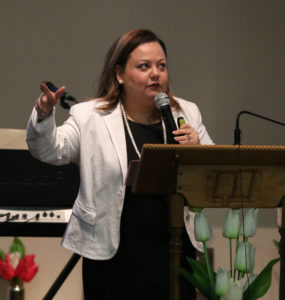
Texas Baptist Women in Ministry Coordinator Anyra Cano urge Latinas to take action to stand against injustice.

In addition to praying, Christians must take action for liberation to happen, Cano insisted. When God places a concern in the hearts of his people, they should recognize it as a call to action.

“If the church just prays without taking action, then it is not effective,” Cano said. “Instead, praying should lead us to take action.”

Churches must pay attention when others suffer and stand up to defend them, she added.

“We have to look at God’s heart and realize we have been invited to raise our voices,” she said.

Letting the voices of marginalized people be heard is not taking a political stance, but it is standing against injustice, Cano said.

When Christians stand up against injustice, they are following biblical examples such as Moses, Esther, the daughters of Zelophehad and Jesus, she noted.

Whether in schools, influencing parents or teachers, or in businesses or government, there is a place for everyone in the church to speak up against injustice, she said.

Jesus sets the example for every Christian in Luke 4:18-19, when he said he came to set the oppressed free, Cano said.

In addition to seeking God’s guidance through prayer, Christians also have a responsibility to become informed and collaborate with others, Cano said.

God can do a lot with a little

Yani de Gutiérrez from Iglesia Bautista Horeb in Mexico City spoke to the Unión Femenil Misionera of Texas reunion. (Photo courtesy of Eder Ibarra)

Those who call upon God need to recognize God’s call on their lives to sacrificial service, said Yani de Gutiérrez from Iglesia Bautista Horeb in Mexico City.

“Those of us who follow God call to him when we are in need,” Gutiérrez said. “But God has also called us to give and to serve.”

All four Gospels present the account of Jesus feeding the 5,000, she noted. After the disciples had ministered in other towns, they found a multitude who demanded more of their time, she said. Since the 5,000 only accounts for the men in the crowd, the number of people probably was at least twice as large, she added.

Feeding a big number of people seemed impossible, but Jesus wanted the disciples to have compassion for these people and trust God would use them if they wanted to serve, she said.

“The disciples had not eaten, or had any rest, and yet the Lord wanted them to serve,” Gutiérrez explained. “And that is when the miracle happens, when they start serving.”

Jesus prayed first and then gave the food to the disciples. When the disciples went to give out the food, they found there was enough for everyone, she pointed out.

Even though feeding thousands of people with five loaves and two fish seemed impossible, Jesus showed people must only be willing to serve in order to see God do the impossible, she said.

“Though what we have to offer might be little, God turns that into a blessing,” Gutiérrez said, encouraging Texas UFM to continue to be faithful with the little they may have and see the miracles God will do.