Supreme Court says WWI cross can stand on government land

WASHINGTON—The U.S. Supreme Court ruled a 40-foot cross erected as a World War I memorial can remain on government property in Bladensburg, Md.

In a 7-2 decision, the Supreme Court reversed a lower court decision in The American Legion v. American Humanist Association.

Holly Hollman, general counsel for the Baptist Joint Committee for Religious Liberty, noted the Supreme Court’s decision “relies heavily on the particular history of that memorial.”

She further observed, “The splintered decision shows how difficult it is to reconcile the government’s promise of religious liberty for all while upholding a massive Latin cross on government land.”

Cross as secular symbol?

The Fourth Circuit U.S. Court of Appeals had ruled the “Peace Cross”—dedicated in 1925 to honor local veterans who died in World War I—violated the Establishment of Religion Clause of the First Amendment. However, Chief Judge Roger Gregory filed a dissenting opinion, asserting the cross could be interpreted in a nonreligious way as a war memorial.

The Baptist Joint Committee joined in a friend-of-the-court brief that took issue with Gregory’s assertion.
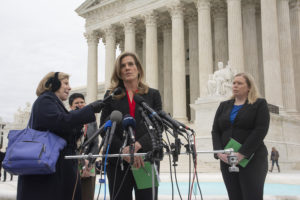
Holly Hollman (center), general counsel at the Baptist Joint Committee for Religious Liberty, responds to questions from Nina Totenberg (left) of National Public Radio and other reporters after the U.S. Supreme Court heard oral arguments involving the constitutionality of a 40-foot cross on government property. Also pictured are Amanda Tyler (2nd from left), BJC executive director, and Jennifer Hawks (right), BJC associate general counsel. (Photo/ Baptist Joint Committee)

“Our brief makes plain what should go without saying: The cross is the most recognizable symbol of the central promise of Christianity,” Hollman said in February, when the court heard oral arguments on the case.

“While Christians commonly display the cross to promote Christian teachings as revealed in Scripture, the government should not. The cross is a symbol that is specific to Christianity, and the government’s efforts to claim otherwise are hollow and offensive.”

The Southern Baptist Convention’s Ethics & Religious Liberty Commission signed onto a brief arguing the presence of the Bladensburg Cross does not violate the First Amendment’s Establishment Clause. The brief asserted questions of establishment “should be discerned by looking to historical practices and understandings at or near the founding period.”

“A government action should be sustained against an Establishment Clause challenge unless history confirms that the founding generation understood such an action as an establishment of religion outright—such as the official formation of a national church—or as a legal attribute of a religious establishment—such as a law intruding into a church’s ecclesiastical affairs,” the ERLC brief argued.

Focus on historical significance

In overturning the Fourth Circuit decision, the Supreme Court did not completely annul the so-called “Lemon test.” Based on the court’s 1972 Lemon v. Kurtzman opinion, the three-pronged test evaluates whether government action violates the Establishment Clause of the First Amendment. To pass muster, it must have a secular purpose, not primarily promote or restrict religion, and not create “excessive entanglement” with religion.

“After our earlier victory, our opponents took this case to the post-Kennedy Supreme Court hoping for a complete upheaval of the separation of church and state,” said Monica Miller, senior counsel at the American Humanist Association. “Fortunately, the Lemon test and decades of precedent have not been overruled in the vast majority of relevant instances.”

Instead, the Supreme Court’s majority focused on historical significance and avoiding the appearance of hostility toward religion.

“Retaining established, religiously expressive monuments … is quite different from erecting or adopting new ones,” Associate Justice Samuel Alito wrote.

“The fact that the cross is undoubtedly a Christian symbol should not blind one to everything else that the Bladensburg Cross has come to represent: a symbolic resting place for ancestors who never returned home, a place for the community to gather and honor all veterans and their sacrifices for this nation, and a historical landmark,” Alito wrote. “For many, destroying or defacing the Cross would not be neutral and would not further the ideals of respect and tolerance embodied in the First Amendment.”

Michael Carvin, lead counsel for the American Legion, praised the decision as a “historic victory for the First Amendment.

“The decision simply affirms the historic understanding of the First Amendment that allows government to acknowledge the value and importance of religion,” Carvin said.

The Baptist Joint Committee “is pleased that the court did not accept the extreme arguments put forth by the government and its allies,” Hollman said.

“The court did not abandon the First Amendment’s promise of neutrality among faiths. It also specifically acknowledged the cross as a Christian symbol, not a universal symbol of sacrifice,” she said. “Important for our pluralistic society, the decision does not support the constitutionality of Christian-only monuments sponsored by government today.”


La Convención Hispana se enfoca en discipulado financiero

McALLEN—“Abundancia” es el tema de la reunión anual que la Convención Hispana Bautista de Texas tendrá este  23-25 de Junio en McAllen, la cual marcará el principio de un énfasis anual en discipulado financiero.

Las Iglesias bautistas hispanas serán desafiadas a abandonar una teología de escasez y tomar una de abundancia—la cual no es la misma que la del “evangelio de la prosperidad, dijo Jesse Rincones, director ejecutivo de la Convención.

La Convención ofrecerá materiales para sermones y estudios bíblicos para que los líderes de las iglesias puedan enfocarse en el discipulado financiero, los cuales también servirán para guiar a familias e individuos a tomar control de sus finanzas, mencionó Rincones.

Trabajando en conjunto con Andres Gutierrez y su programa “Paz Financiera,” la junta anual sostendrá talleres para que las iglesias puedan después compartir esos entrenamientos en las congregaciones.

Al ir adoptando las familias una nueva perspectiva en sus finanzas, las iglesias y la Convención entonces continuarán creciendo, dijo Rincones. Los cristianos que se comprometen a un discipulado financiero también son más generosos y fieles con lo que tienen, él notó.
En la sesión de negocios, mensajeros de las iglesias hispanas bautistas considerarán una resolución acerca del abuso sexual en las iglesias, dijo Rincones. La resolución propuesta “llamará a nuestras iglesias a adoptar procedimientos y pólizas para proteger a menores de edad,” él dijo.

La Convención Bautista del Sur adoptó una nueva iniciativa llamada Caring Well—la cual es un programa para aumentar y mejorar esfuerzos para prevenir el abuso, así como también ofrecer cuidado a sobrevivientes de abuso—será traducida al español y disponible para las congregaciones bautistas hispanas de Texas, él dijo.

El entrenamiento y currículo para que las iglesias  tomen parte de Caring Well Initiative será accesible a través de la página Church Cares.

En la reunión anual, el grupo de Young Latino Leaders también recomendará la creación de una plataforma a través de la cual podrían seguir trabajando.

La propuesta se enfocará en desarrollar a los futuros dirigentes y educar a pastores de primera generación para que incluyan más a las generaciones jóvenes en el ministerio, dijo Rincones .

Los 15 miembros de Young Latino Leaders se reunirán después en San Antonio para continuar el trabajo y alcanzar las metas indicadas.


TBM responds after storms hit North Texas

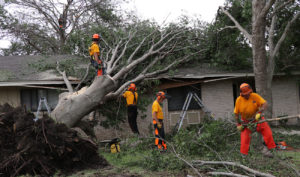
DALLAS—When high winds hit North Texas on consecutive weekends, Texas Baptist Men disaster relief volunteers responded with chainsaws and heavy equipment to remove fallen trees from homes.

The first severe thunderstorm hit the Dallas area June 9, packing 70 mph wind gusts and initially leaving about 350,000 homes without electricity. TBM disaster relief crews deployed quickly to assist affected families and individuals.

One week later on Father’s Day, another storm hit North Texas. Straight line winds of 60-plus mph and three confirmed tornadoes in Tarrant County and one in Dallas County caused widespread damage and more power outages.

A Texas Baptist Men chainsaw crew from Collin County works to remove a fallen tree and broken limbs from a home in Dallas. (TBM Photo courtesy of Rand Jenkins)

Seven TBM chainsaw crews, along with heavy equipment operators, food-service teams and shower/laundry unit volunteers, continue to work throughout the region.

At one house in Dallas, TMB volunteers removed a fallen tree that had blocked a woman’s front door, making entry and exit almost impossible. The woman told members of the chainsaw team they were “truly a Godsend.”

“I’m so grateful for what you all were able to do,” she said when the volunteers completed their work. “I’m going to have a great story to tell my Sunday school class next week.”

Through June 16, TBM crews already had donated 1,886 volunteer hours, completing 38 chainsaw jobs and logging 100 heavy equipment hours. Three days later, the number of volunteer hours had risen to 2,973, crews had completed 73 chainsaw jobs and logged 152 heavy equipment hours.

Other TBM personnel deployed to Greenville July 19 to provide temporary roofing after high winds—possibly one or more tornadoes—caused widespread damage in Hunt County, including ripping off a significant portion of the roof from the sanctuary of Highland Terrace Baptist Church. TBM delivered a pallet of tarps for the church to distribute in the community.

Disaster relief in North Texas could take up to one month.

Meanwhile, a TBM incident management team deployed to Arkansas to assist with disaster relief after flooding there. The team is housed at Southside Baptist Church in Pine Bluff, Ark.

To contribute financially, send a check designated “disaster relief” to Texas Baptist Men, 5351 Catron, Dallas, TX 75227, call (214) 275-1116 or click here.

Rand Jenkins, communications director for TBM, contributed to this report.

EDITOR’S NOTE: This article, originally posted before noon on July 19, was updated on July 20.


CBF Governing Board looks to future prior to general assembly

BIRMINGHAM, Ala.—The Cooperative Baptist Fellowship Governing Board met June 18 ahead of the 2019 CBF General Assembly in Birmingham, Ala., to hear reports and welcome new Executive Coordinator Paul Baxley and incoming Moderator Kyle Reese.

“There’s much to celebrate in the life of CBF. The Spirit is doing beautiful things through us,” said Baxley, who reflected on his travels during the first three months of his service as executive coordinator.

Baxley reported that since March he has traveled more than 14,00 miles, visited 12 states and participated in the spring gatherings of eight CBF state and regional organizations, and met with or spoken in 48 congregations.

“After 15 years of pastoring a congregation, it has been invigorating to worship with others in their congregations,” Baxley said. “It’s been beautiful to see the way the Spirit is at work.”

When Baxley was called to be the executive coordinator for the Fellowship, he outlined a vision for CBF focused on strengthening partnerships through strengthening congregations, as well as reaffirming CBF’s unique commitment to global missions.

“There has been widespread energy in response to my vision I laid forth when I began my service,” Baxley noted, emphasizing the importance of cooperation.

“Everywhere I go, I see fruit, I see consequence, I see return—because of decisions that have been made around a table like this for years.”

‘Be the presence of Christ’

CBF Moderator Gary Dollar centered his remarks to the governing board on their collective purpose—citing the purpose of the church in Acts 2.

“In this chapter of Acts, there was a purpose to the movement of the Spirit,” Dollar said. “As a governing board, we have a purpose. We have a point. I would argue to you that our purpose is not to keep an organization running … it is to empower individuals and churches to be the presence of Christ.

“We have to be open to experience a wild and free Spirit, so that we would become generous,” said Dollar, affirming that the Spirit moved among the church in Acts so that everyone could hear the gospel in their own language.

“They heard the gospel from their situation,” Dollar said. “This is our role as a board—that we are to speak the gospel in their language that they might hear it, gathered together that we might do good work—doing things that allow the wild and free Spirit to move through us.”

Incoming CBF Moderator-Elect Carol McEntyre, pastor of First Baptist Church in Columbia, Mo., offered the board a prayer of gratitude for the wind of the Spirit that blew on Pentecost and continues to blow through CBF, asking that the governing board be granted wisdom, courage and creativity.

Kyle Reese, who will succeed Dollar as CBF Moderator at the conclusion of the 2019 General Assembly, shared his joy for the upcoming year.

“We have an exciting year ahead,” said Reese, former pastor of Hendricks Avenue Baptist Church in Jacksonville, Fla., and deputy director of the OneJax Institute at the University of North Florida. “And we must begin to think strategically about how we move forward as the Cooperative Baptist Fellowship and bring more people around the table to pray and dream and strategize. Thank you for calling me to serve.”

The governing board also heard committee reports and recognized outgoing board members.

They also welcomed the following nominees to serve on the governing board, who will be voted on by the assembly on June 21:

  • Courtney Allen, senior pastor, Grace Baptist Church, Richmond, Va.
  • Larry Decuir,  Ernst & Young; member of Smoke Rise Baptist Church, Stone Mountain, Ga.
  • Jewel London, pastoral assistant/campus minister, The Church Without Walls, Houston.
  • Emmanuel McCall, pastor, First Baptist Church, East Point, Ga.
  • Mike Oliver, senior pastor, Trinity Baptist Church, Madison, Ala.
  • John Scott Jr., partner with Starnes Davis Florie, Birmingham, Ala.; member of Mountain Brook Baptist Church, Birmingham, Ala.


Hispanic Convention focuses on financial discipleship

McALLEN—“Abundancia” is the theme of the Hispanic Baptist Convention of Texas annual meeting June 23-25 in McAllen, which marks the beginning of a yearlong emphasis on financial discipleship.

Hispanic Texas Baptist churches will be challenged to abandon a theology of scarcity and develop a theology of abundance—not to be confused with the so-called “prosperity gospel,” said Jesse Rincones, executive director of Convención.

Convención will offer sermon materials for pastors and Bible study materials for church leaders focused on financial discipleship, along with practical help to teach individuals and families to take control of their finances, Rincones noted.

Working in conjunction with Andres Gutierrez and his “Paz Financiera” program, the annual meeting will offer workshops so churches can provide training to their congregations.

As families adopt a new perspective on finances, churches and Convención will continue growing, Rincones said. Christians who commit to financial discipleship become more generous and faithful with what they have, he noted.

In business sessions, messengers from Hispanic Texas Baptist churches will consider a resolution regarding sexual abuse in the churches, Rincones said.  The proposed resolution would “challenge our churches to adopt procedures and policies to help protect children,” he said.

Southern Baptist Convention’s newly adopted Caring Well Initiative—a program to enhance efforts to prevent abuse and provide care for abuse survivors—will be available in Spanish, and it will provide a valuable resource for Hispanic Texas Baptist congregations, he said.

Training and curriculum for churches taking part in the Caring Well Initiative is accessible on the Church Cares website.

Also at the Convención annual meeting, the Young Latino Leaders group will recommend the creation of a platform through which they could continue working.

The proposal focuses on the development of up-and-coming young leaders and education for first-generation pastors and churches so they can include younger generations in their ministries, Rincones said.

The 15-member core group of Young Latino Leaders will meet at San Antonio in October and continue working toward the suggested goals.


Around the State: Texas Baptist student groups study and minister globally

Jacob Chesser, a student at the University of Mary Hardin-Baylor, works with children at a YMCA afterschool program on Cayman Brac. (UMHB Photo)

Students from the University of Mary Hardin-Baylor College of Christian Studies led worship and served in a variety of settings during a trip to the Cayman Islands. Ten students and two faculty from the UMHB College of Christian Studies traveled to the Cayman Islands for a weeklong trip that involved students preaching, serving and leading worship in seven churches and schools. Student participants were Kaitlin Anderson of Cibolo, Rozzell Barber-Harris of Houston, Sammy Castaneda of Mesquite, Jacob Chesser of Boerne, Rebekah Graff of Dripping Springs, Cory Joe Martin of Manvel, Hannah Murray of Arlington, Audrey Smith of Harker Heights, Zach Welch of Flower Mound and Don Williams of New Orleans.

Six representatives of Howard Payne University’s Baptist Student Ministry—(left to right) Madison Zardiackas, Destiny Ramirez, Keith Platte, TJ Shands, Tyler Dingle and Ryan McCord—recently traveled to New York City to serve with area churches. (HPU Photo)

Six representatives from the Howard Payne University Baptist Student Ministry recently traveled to New York City to serve with churches in the city. During the 10-day trip, the team spent three days at Graffiti Church helping with the church’s afterschool program and served meals to people in local parks through the Free Lunch in the Park program. They attended a Sunday worship service at First Polish Baptist Church and helped clean around the church building. They also visited Maranatha Romanian Baptist Church. Tyler Dingle, a junior from Bellville, preached at both churches. Other HPU students were Ryan McCord, a sophomore from Round Rock; Destiny Ramirez, a senior from Odessa; TJ Shands, a freshman from Stanton; and Madison Zardiackas, a sophomore from Lockhart. BSM Director Keith Platte led the student group.

Priscilla Selvaraj, associate professor of psychology and counseling at Hardin-Simmons University, led six students to India to study the family structures of a different culture. She also wanted to introduce students to her home country. “I wanted them to experience cultural learning in a place that is new and uncomfortable with a new language, different customs, traditions and family values,” she said. As the group toured the slums in Chennai, several students were affected by the level of poverty they saw among the Indian people. One student, Jenny Shaw, said she initially questioned how God could allow such suffering until a friend reminded her of biblical admonitions to “defend the rights of the poor and needy” (Proverbs 31:8-9) and to provide for the vulnerable.

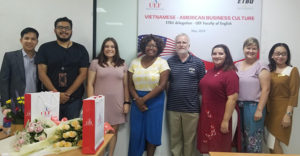
Barry Evans, dean and professor of business administration at East Texas Baptist University, and Jenny Hoover, assistant professor of history, and their students participate in a joint forum with faculty and students of the University of Economics and Finance. As a part of the Global Study and Serve Program, students in the the ETBU Fred Hale School of Business and Department of History and Political Science traveled to Vietnam. (ETBU Photo)

A student group from the East Texas Baptist University Fred Hale School of Business and department of history and political science traveled to Vietnam as a part of the university’s Global Study and Serve Program. Barry Evans, dean and professor of business administration at East Texas Baptist University, and Jenny Hoover, assistant professor of history, led the group. Students earned academic credit as they studied and served in cities across Vietnam, including Hanoi, Dien Bien Phu, Hue, Da Nang, Hoi An and Ho Chi Minh City. From ministering at a Christian orphanage and teaching English at an interdenominational church to visiting historical sites and museums, students learned about local history and culture while sharing their faith with the people of Vietnam. In Hanoi, the ETBU group also worshipped with women at Naomi’s House, a ministry focused on helping women overcome drug addictions.

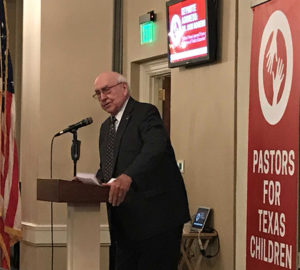
Pastors for Texas Children presented its Heroes of Children Award to Don Rogers, executive director of the Texas Rural Education Association. (Photo / Ken Camp)

Pastors for Texas Children presented its Heroes of Children Award to Don Rogers, who has announced his retirement as executive director of the Texas Rural Education Association. Rogers served 17 years as superintendent of the Eanes Independent School District. Charles Foster Johnson, executive director of Pastors for Texas Children, presented the award to Rogers during a luncheon at Wilshire Baptist Church in Dallas.

Janelle and Dennis O’Connell, professors of physical therapy at Hardin-Simmons University, received the Humanitarian Award from the American Physical Therapy Association. The national association presents the award to members “who exemplify the compassionate nature of the physical therapy profession by actively expressing a commitment to humanity and exhibiting admirable degrees of selflessness in addressing key health concerns.” The O’Connells started the HSU physical therapy ministries in 1999. In addition to engaging students in service locally and around the state, they have led student mission trips to Mexico, Guatemala, South Texas, Haiti, Peru and Thailand.

Rachel Myers, a senior at Howard Payne University, was named the first recipient of the Robert G. and Cheryl Mangrum Endowed Scholarship. She is pictured with the Mangrums. (HPU Photo)

Rachel Myers from Buffalo Gap, a senior at Howard Payne University majoring in cross-cultural studies, was named the inaugural recipient of the Robert G. and Cheryl Mangrum Endowed Scholarship. The scholarship was created by the Mangrums to assist HPU students from Dallas or Taylor counties or who are history or music majors. Both Robert and Cheryl Mangrum have served more than 30 years in numerous capacities at HPU. He holds the Coley Chair of History and is both university historian and sponsor of HPU’s chapter of Kappa Kappa Psi, a national honorary band fraternity. For 13 years, he was the director of the Guy D. Newman Honors Academy. He has served as associate dean of the School of Humanities and chair of the history department. She is associate director of admissions. She was named an honorary band alumna and member of HPU’s chapters of national honorary band sorority Tau Beta Sigma and of Kappa Kappa Psi. She was recognized as the university’s Outstanding Staff Member for the 1999-2000 academic year.

East Texas Baptist University entered a Christian Education Partnership Agreement with Hawaii Baptist Academy. This agreement, signed by ETBU President Blair Blackburn and HBA President Ron Shiira, ensures a smooth transition for HBA students to pursue higher education at ETBU. Hawaii Baptist Academy is a Christian college-preparatory school in Honolulu. Established in 1949 by Southern Baptist missionaries, the academy now has more than 1,000 students enrolled. “An education with a biblical foundation is the best gift a child can receive,” Shiira said. “Through this partnership with ETBU, we are pleased that our students will continue to have their values and world views shaped by Christian educators, which will ultimately impact the next generation of leaders of his kingdom.”

Hardin-Simmons University will offer two sessions of Threshold, its summer program designed to provide “challenge and enrichment” to advanced and gifted learners, July 8-12 and July 15-19. A three-hour half-day program is offered for students entering kindergarten through the fifth grade. A full-day program, with lunch provided, serves students in the sixth through tenth grades. For more information, click here.


Atheist group drops challenge to clergy housing allowance

WASHINGTON (RNS)—The Freedom From Religion Foundation has dropped its long-running fight against the clergy housing allowance permitted by the U.S. government.

“We have full confidence in the legal merits of our challenge of the discriminatory pastoral housing allowance privileges,” the Wisconsin-based atheist watchdog announced June 14. “We did not feel the same confidence, however, in how the current Supreme Court would rule in our case, had we appealed. After ‘counting heads,’ we concluded that any decision from the current court would put the kibosh on challenging the housing allowance for several generations.”

The Freedom From Religion Foundation said it hopes its strategy will allow the issue to be reconsidered when the high court has a different makeup.

In March, the 7th U.S. Circuit Court of Appeals ruled that the allowance was constitutional. A lower court had ruled in the atheist group’s favor. But a three-judge circuit panel reversed a Wisconsin judge’s decision.

“Any financial interaction between religion and government—like taxing a church, or exempting it from tax—entails some degree of entanglement,” wrote Judge Michael Brennan. “But only excessive entanglement violates the Establishment Clause.”

He added that the allowance also is not forbidden by the free exercise clause of the First Amendment.

Texas Baptist ForumUnder IRS regulations that date to 1954, clergy do not have to pay taxes on housing that is supplied in a parsonage by their congregation or on the portion of their salary that they use for housing expenses.
The Freedom From Religion Foundation also challenged the housing allowance in 2013, winning in a lower court. But an appeals court also overturned that ruling.

Becket, a nonprofit law firm that focuses on religious liberty, celebrated the The Freedom From Religion Foundation’s dropping of its legal fight over the parsonage issue. It had represented a Chicago church and religious leaders who supported the allowance.

Luke Goodrich, Becket’s vice president and senior counsel, said the tax code exempted ministers as well as members of the military and others in special categories.

“The court rightly recognized that providing this kind of equal treatment to churches is perfectly constitutional, and churches should be allowed to serve the neediest members of their communities without the tax man breathing down their neck,” he said.


New report urges congregations to aid family caregivers

WASHINGTON (RNS)—A new report on family caregivers details how congregations can play a role in supporting the increasing number of members caring for elders.

“Whether their care journey feels like a roller coaster, the deep end, or a long marathon, family caregivers are at risk of emotional, financial, and spiritual exhaustion as they balance both work and care and are tempted, often by necessity, to journey alone,” writes the report’s author, Lutheran pastor Amy Ziettlow.

“Called to Care: Honoring Elders & the Family Care Journey,” released June 11 by the Center for Public Justice, a nonpartisan Christian organization focused on civic education and policy research, proposes ways houses of worship, employers and the government can assist caregivers.

“We need congregations, workplaces, and public policies that honor and support these superhero caregivers,” Ziettlow writes.

Ziettlow, a former hospice chaplain, says that the overall number of unpaid caregivers to the elderly—about 41.3 million—is expected to increase significantly as baby boomers age. Citing the Bureau of Labor Statistics and AARP, she said the average caregiver spends three hours a day aiding an elder and $7,000 a year on out-of-pocket related costs.

Congregations encouraged to support caregivers

The report, which quotes the biblical commandment to “honor your father and your mother,” offers examples of how congregations can stand by those whose loved ones suddenly or gradually can no longer live by themselves or handle day-to-day responsibilities.

It suggests that congregations can provide paid family leave to clergy and employees, noting such action is “honoring paid work and family work as equally dignified and holy.”

The report recommends that houses of worship provide volunteers to help care recipients navigate their health decisions or give respite to caregivers. And it urges congregations to offer a warm welcome back to elders who may return to a congregation after being away for a period of time.

“Congregational ministry creates an environment where the potential for companionship and mutual support thrives,” writes Ziettlow, who now leads an Evangelical Lutheran Church in America congregation in Decatur, Ill. “And it is a space to raise and grapple with existential questions regarding death and end-of-life wishes.”


Casa Bethesda—Answering God’s call

Thirty-three years ago, Paulino Esquivel received a call he was reluctant to answer.

He responded as most do when faced with a similar circumstance, saying, “Please God, send someone else.” Or in his case, “Por favor, Dios, mande alguien más.”

During a recent mission trip, members of First Baptist Church in Charlotte working with Operation Christian Love, a ministry founded by Frio River Baptist Association, visited with Esquivel in Piedras Negras. He sat at the head of the table and thanked the group for coming.

From the beginning

Esquivel took a deep breath and told them he was going to share his testimony—from the beginning. His guests could see the pain in his eyes as he struggled with his words.

Esquivel was 24 when he began helping families in his neighborhood. Parents either worked or were in prison. Children needed a place to go while their guardian was at work. Wanting to help and spread God’s love to kids, he and his wife Gilberta opened their doors to these children.

During the initial five years, the Esquivels received no governmental aid or church support. They used their own money to feed and care for visiting children, with some support from those who served alongside them.

Paulino Esquivel intended to keep children safe and off the streets where crime was rampant. Even 5-year-old children were being used as go-betweens for drug sales. Taking them in gave them the chance to play without fear and to hear the gospel.

Special needs

Paulino Esquivel felt God calling him to minister to children and youth in Piedras Negras. In time, that calling focused particularly on children and youth with physical, mental or developmental disabilities. (Photo courtesy of Jeff S. Bray)

As word spread about what Casa Bethesda was doing, parents with disabled children started to show up. Not having the ability to care for children with special needs, Esquivel politely declined. But he felt he must do something. He searched for someone to help through other churches and ministries, but no one would help. Yet, the parents continued to come.

Esquivel prayed for five months. However, his prayer was not for the ability. He prayed, “Por favor, Dios, mande alguien más.”

But those he contacted gave him the same excuses he was using. There’s not enough room. I don’t know how to care for them. There are no resources. Some just flat out acknowledged they did not want to do it. They felt it wasn’t their problem, and the answer was always “no.”

Life-changing visit

Then one day, Esquivel received a visitor who would bring a dramatic change to his life.

In 1995, an hour south of Piedras Negras, a woman cared for a 5-year-old with cerebral palsy. One night, she knocked at Paulino’s long white gate.

Paulino Esquivel, who leads Casa Bethesda in Piedras Negras, visits with Diana and Alex Aburto with Vines and Branches Ministry. (Photo courtesy of Jeff Bray)

“I am bringing you my grandson,” she told him. “I don’t know what to do. I have no experience with his condition. His mother is an addict and living a bad life.”

She went on to explain that she was old, sick and no longer able to care for his needs.

Esquivel’s first reaction was to respond as he had, but this time was different. He asked her, “How did you find out about me?”

Her answer changed his life forever.

“I was at home, and a man knocked on my door,” she said. “He told me to find Paulino Esquivel in Piedras Negras. He said you would help me.”

At that moment, Esquivel knew he could no longer resist. He took the child in—the first permanent resident of many.

God ‘placed me in the middle of his work’

For the next three years, Esquivel struggled with his calling.

“I did not say ‘yes’ to the Lord. He just placed me in the middle of his work,” he said.

Being in unfamiliar territory, he prayed, trying to negotiate with God.

Volunteers lead residents of Casa Bethesda in a time of praise and worship. (Photo courtesy of Jeff S. Bray)

“I told God two things. First, I wasn’t going to tell people what I do. It was up to God to send people,” he said. “Second, I told God I wasn’t going to look for resources. He would have to provide them.”

God delivered.

Three years and several children later, a pastor from a church in Atlanta contacted Esquivel, asking how his congregation could assist Casa Bethesda.

“How did you hear about us?” Esquivel asked.

After serving in California, the pastor and his team had been working on another project in Del Rio. Since it was nearing completion, they were praying for another ministry to serve. One night a man knocked on the pastor’s door.

“Go to Piedras Negras. Paulino Esquivel needs you,” the visitor said.

That pastor was the first of many whose churches now assist Casa Bethesda.

Current opportunities, current challenges

Twenty-four years later, Casa Bethesda cares for 28 people. All of them, 15 men and 13 women, have special needs. Their conditions vary: mental illnesses, down syndrome, cerebral palsy, deafness and epilepsy. Eleven are wheelchair bound, and nine are completely disabled, requiring assistance with even simple tasks.

Many residents have been there most of their lives. Eight are orphaned, 20 were abandoned, and two kids were taken in after their parents signed paperwork renouncing all claim to them. One father dropped off his son to find work. The man never returned.

Casa Bethesda is the only home in the Piedras Negras area that cares for children with special needs. One doctor visits monthly, giving minimal care to residents.

Esquivel next spoke about issues Casa Bethesda faces now. The first is his health. Esquivel has an unknown condition affecting his white blood count. Due to his health, he and his wife “retired” about a year ago, but they still are active in the ministry. He is training two men, Omar and Pablo, who will one day take over.

He also expressed concern about an incident that occurred at Casa Bethesda and what it could mean for the home’s future. Esquivel said it involved a male resident and a female resident, and it was reported to the proper authorities. However, some asserted it involved a staff member abusing a resident, and he fears government authorities may close the home.

‘You cannot deny your calling’

For 33 years, Esquivel has helped children. For 24 of those years, he has been involved with the well-being of those with special needs. Only two of the 28 residents have parents whose location is known.

After he finished talking, Esquivel took his guests on a tour. They visited with residents. Three women were working hard to get lunch ready. At the same time, they were taking those in wheelchairs to an outside pavilion to sing praise and worship songs.

Esquivel greeted each child—shaking hands, giving hugs, receiving kisses and acknowledging each of his kids.

“When you are a pastor, you expect to be over a church, not a home. But you cannot deny your calling. God convicts, knowing that we will always follow him,” Esquivel said. “Even though sickness comes, his work will continue.

“Whatever comes my way, I will be here, serving him.”

Jeff S. Bray is a freelance writer and a member of First Baptist Church in Charlotte, Texas.


Logsdon student learns from mentors, learns to mentor others

ABILENE—As a student at Logsdon Seminary and youth minister at Potosi Baptist Church in Abilene, Hunter Brown knows what it means to be mentored by professors and church leaders, while at the same time learning to mentor the next generation.

Brown earned his undergraduate degree in ministry from Hardin-Simmons University in 2016, and he anticipates graduating from Logsdon with his Master of Divinity degree in December.

He credits Mike Auten, associate pastor at First Baptist Church in Clyde, with teaching him many of the practical aspects of ministry.

“I had a great mentor who taught me things about engaging with people,” he said. “Now I’m breaking away from having mentor/mentee relationships into a place where I’m by myself.”

New ideas

Brown is not afraid to try new things. When Rodney Watson, pastor of Lytle South Baptist Church suggested a collaborative DiscipleNow weekend, Brown agreed wholeheartedly. Before long, four other churches joined them in the student ministry event, and the Baptist General Convention of Texas provided financial assistance.

“We had the plan of making it an associational-based D-Now,” he said. “We got funding from the BGCT, and they said we’re the only association in the state of Texas who has done anything like this.”

Brown has introduced his congregation to new experiences such as the flowering of the cross at Easter.

“My church had never seen it before, and we had a large amount of people say how unique and cool they found it,” he said.

As part of Holy Week observances, Brown also created an experience similar to the stations of the cross. Church members went through three rooms including the Lord’s Supper, three crosses to reflect on the crucifixion, and a video about the resurrection.

Serving in a variety of roles

When the pastor at Potosi Baptist left earlier this year, Brown gained more responsibilities. He has preached some weeks and helped with administrative duties. With all the responsibilities of school and ministry, Brown remains optimistic.

“It’s been great with me,” he said. “My mentor taught me that sometimes ministry means doing kids’ stuff on Wednesdays, helping out with the youth, taking the van to get inspected, knowing when to clean up and be the janitor and when to participate in worship. I’m used to needing to be in different roles.”

While Brown knows church members can differ about many things, he sees some biblical principles as straightforward.

“Jesus’ love is really simple. It’s very clear in the Bible—love other people,” he said.

Brown shows this love to his students by spending time with them outside of Bible study.

“One of the most enjoyable things is hanging out with students, when we get to go places and spend time together,” he said. “It’s really easy to get down in ministry, and it’s really hard to remember the good parts of church. When we do things at my church that are fellowship-based, and they shine through, that’s really helpful to me.”

Influence of Logsdon professors

In addition to his church mentor, Brown has found his professors at Logsdon to be especially uplifting.

“All of them care about you, and they ask more about your life than just the academic part. They’re really helpful with the ministry part too,” he said. “There have been several instances where I’ve felt defeated with church, and going to those different mentors and asking their advice is really helpful.”

Brown also has learned to recognize the connections between his classes and his ministry.

“The Bible courses are helpful to understand how we read and interpret Scripture in new ways,” he said. “There are definitely things that I want my congregation to learn. In small-town West Texas, even though lots of people say they are Christians, there’s not much knowledge about the Bible. Logsdon has helped me prepare to teach these things.”

He also says his theology classes have been helpful in his spiritual formation.

“Christian philosophy was really great in helping me frame out what I think about God and to help me realize that I don’t have all the answers,” he said.

Brown said his ethics courses have helped him engage with his context and in the wider context of the church. He also said his general ministry classes encourage him to keep pursuing his calling.

“Church history has helped me see how we’ve moved from one point to another in Christianity,” he said. “There are some things that we need to focus on, and there are some things that we need to move on from and learn from.”


More than 70 compete in Bible Drill, Speakers’ Tournament

ALLEN—Three students from Allen and Alice received first place in individual events at Texas Baptists’ 2019 State Bible Drill and Speakers’ Tournament.

Riley Smith, a junior from First Baptist Church in Allen, took first place in high school Bible Drill. Caroline Kemp, a junior from First Baptist in Allen, placed first in Speakers’ Tournament. Kristen Aguirre, a freshman from West Main Baptist Church in Alice, won first place for Youth Bible Drill. Seventy-one students representing 26 Texas Baptist churches participated in the state finals.

‘Treasure God’s word in my heart’

Smith, a homeschooled student, has been involved in Bible Drill since 4th grade. One of the best components of Bible Drill for Smith is the emphasis on knowing and memorizing Scripture.

“I have a love for God’s word and want to learn more, always wanting to treasure God’s word in my heart, like Psalm 119 describes,” Smith said.

Kemp attends Allen High School and also has participated in Bible Drill since 4th grade. In her speech, “Why I Exist,” she shared recent experiences at a summer camp where she learned about how she was created to glorify God.

‘To glorify God and not myself’

“A lot of my life, I’ve been seeking to glorify myself and try to impress people,” Kemp said. “Over the summer, it dawned on me that my purpose is to glorify God and not myself. As I tried to change, I realized how incapable I am of doing that apart from him.”

Bible Drill has taught her the importance of memorizing Scripture, she noted.

“This year, I started to memorize on my own, finding verses that were important to me,” she said. “As I’ve grown older, those verses have meant more to me and really helped me in my walk with God.”

Pam Davis, Youth Bible Drill and Speakers’ Tournament coordinator for First Baptist in Allen, has worked with both Kemp and Smith several years and witnessed great growth among the students.

‘Teaches lifelong lessons’

“What’s more exciting to me than seeing Riley and Caroline succeed is seeing how it’s changed their character,” she said. “This ministry helps mold the character of students and teaches them lifelong lessons.”

Aguirre, a freshman at Alice High School, has been involved in Bible Drill five years. She not only enjoys how Bible Drill helps her learn God’s word, but also how it has allowed her to build a strong connection with her fellow Bible Drill participants at her church.

“Through Bible Drill, you learn how to spread God’s word with others,” she said.

Her Bible Drill leader, Wanda McDaniel, emphasized Aguirre’s commitment to the program and dedication to learning Scripture.

“Kristen stands out in the group,” said McDaniel. “She sees the good in everything.”

Kemp, Smith and Aguirre will compete at the National Invitational Tournament for Bible Drill and Speakers’ June 13-14 at Parkwood Baptist Church in Concord, N.C.

“We know personal Bible engagement contributes to growing disciples of Jesus. That’s why so many churches value Bible Drill and Speakers’ Tournament,” said David Adams, director of discipleship for Texas Baptists.


African American Fellowship Conference emphasizes unity

“Together We Will Succeed” is the theme of the 2019 Texas Baptist African American Fellowship Conference, scheduled July 8-11 at First Woodway Baptist Church in Waco.

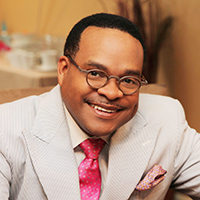
Elmo Johnson

“We are family, and we work together,” said Elmo Johnson, president of the statewide fellowship and pastor of Rose of Sharon Missionary Baptist Church in Houston.

The African American Fellowship Conference offers more than 30 workshops for pastors, church staff and lay leaders. Topics include “The Triumphs of Teamwork,” “Mistakes Successful Pastors Don’t Repeat,” “Understanding Millennials and Generation Z” and “Effective Outreach Resources.”

‘Learn from each other’

“We learn from each other,” Johnson noted. “We are a diverse people. We are not offering cookie-cutter approaches. You can do ministry within your own culture.”

The four-day conference begins at 7 p.m. on July 8 with a “Sweet Hour of Prayer” service led by Louis Rosenthal, pastor of The McKinney First Baptist Church in McKinney.

Johnson plans to emphasize “unity and family” in his presidential address at a pastors’ luncheon on July 9. Representatives from several regional groups the statewide fellowship has launched around the state also will bring reports to the pastors.

Special events planned

Michael Evans, president of the Baptist General Convention of Texas and pastor of Bethlehem Baptist Church in Mansfield, is featured speaker at the James W. Culp Banquet at 7 p.m. on July 9. The banquet is named in memory of the long-time coordinator of black church development for Texas Baptists.

Roy Cotton, Texas Baptists’ director of African American ministries, noted more than 100 predominantly black congregations affiliated with the BGCT in the last two years, and an orientation luncheon is scheduled for representatives of newly affiliated congregations July 10.

Conference leader Michelle Fergus of DeSoto will speak at the Sisters Who Care luncheon for Women on Mission on July 10.

Breonus Mitchell

Breonus M. Mitchell, senior pastor of Mount Gilead Missionary Baptist Church in Nashville, Tenn., is keynote speaker at worship services at 7 p.m. on July 10 and 11 a.m. on July 11.

Patrick Bradley, minister of worship and creative arts at Westside Baptist Church in Lewisville, will direct a mass choir Wednesday evening and lead in worship.

Dennis Young, pastor of Missouri City Baptist Church near Houston and chair of the BGCT Executive Board, will lead an observance of the Lord’s Supper at the concluding worship service.

Registration cost is $125 per individual or $1,000 for a group of 10 or more until July 1. Beginning July 2, cost per person is $165. For more information, click here.