Adam Dooley to Englewood Baptist Church in Jackson, Tenn., as senior pastor from First Baptist Church in Sunnyvale, where he was senior pastor.
Brad Martin to Northside Baptist Church in Weatherford as worship pastor from Shady Oaks Baptist Church in Hurst, where he was senior pastor.
Religious freedom leader applauds unalienable rights group
July 16, 2019
WASHINGTON (BP)—The U.S. State Department’s new Commission on Unalienable Rights underscores the nation’s commitment to religious rights internationally, Tony Perkins said in his new role as chairman of the U.S. Commission on International Religious Freedom.
“We applaud the creation of this commission as another way of ensuring that the protection of these fundamental rights—the most foundational of which is freedom of religion or belief— is a core element of strategic policy discussions,” Perkins said.
The diverse bipartisan commission will advise U.S. Secretary of State Mike Pompeo on human rights, Pompeo said in announcing the group in a July 8 press briefing.
“It’s a sad commentary on our times that more than 70 years after the Universal Declaration of Human Rights, gross violations continue throughout the world, sometimes even in the name of human rights,” Pompeo said. “The time is right for an informed review of the role of human rights in American foreign policy.”
Scholars and advocates named to group
Harvard law professor Mary Ann Glendon, a pro-life advocate and former U.S. ambassador to the Vatican, will chair the 12-member group. Pompeo described Glendon as a “world-renowned author, beloved professor, an expert in the field of human rights, comparative law and political theory.”
Other commission members are Stanford professor Russell Berman, Stanford political scientist Peter Berkowitz, Notre Dame law professor Paolo Carozza, Sunni leader Hamza Yusuf Hanson, Harvard sociologist Jacqueline Rivers, Orthodox Rabbi Meir Soloveichik, former USCIRF chair Katrina Lantos Swett, philosopher Christopher Tollefsen and University of California professor David Tse-Chien Pan.
Kiron Skinner, the state department’s director of policy planning, is the committee’s executive secretary, and attorney Cartright Weiland will serve as the commission’s rapporteur, Pompeo said.
“These individuals will provide the intellectual grist for what I hope will be one of the most profound reexaminations of the unalienable rights in the world since the 1948 Universal Declaration,” Pompeo said. “I hope that the commission will revisit the most basic of questions: What does it mean to say or claim that something is, in fact, a human right? … Is it, in fact, true, as our Declaration of Independence asserts, that as human beings, we—all of us, every member of our human family—are endowed by our creator with certain unalienable rights?”
Support pledged for advisory group
Tony Perkins
Perkins, at the helm of international religious freedom commission since June 17, pledged to support the new commission by providing advice and recommendations regarding international religious freedom. Perkins is an ordained Southern Baptist minister and head of the Family Research Council.
USCIRF Vice Chair Gayle Manchin also applauded the group.
“To the degree that this new commission within the State Department can help further communicate from Washington to the department’s farthest outposts the importance and urgency of religious freedom concerns as a fundamental human right, we believe this will lead to higher impact negotiations on behalf of the more than 70 percent of the world’s population that is currently suffering persecution or abuse,” Manchin said.
The advisory group is expected to meet at least monthly, and at other times as needed, according to the U.S. government daily journal, The Federal Register.
Laredo minister benefits from previous pastor’s preparation
July 16, 2019
LAREDO—John Delgado knows from experience that pastors who look forward help their churches prepare for the future when they no longer are on the scene.
When Delgado first arrived at United Baptist Church in Laredo, he knew the previous pastor, Jonathan Aragon, had prepared the church to continue moving forward with the next pastor.
Aragon announced his retirement at the end of last year, so United Baptist initially prepared to call an interim pastor for a prolonged time, Delgado said.
But by December, the church and Delgado were finalizing their interviews. And by January, he and his family moved to Laredo.
“The previous pastor retired. It wasn’t like he left poorly or on a bad note. He is actually missed. The church loved him and still loves him,” Delgado said.
United Baptist and First Baptist Church of Laredo are the only Baptist churches in the city founded as English-speaking churches from the beginning, Delgado noted.
Foundation laid to move forward
However, United Baptist offers services in both English and Spanish.
Under Aragon’s leadership, the church transitioned to a more contemporary worship style and focused more on young families. So, the foundation to move forward had been set by the time a new a pastor arrived, Delgado said.
Delgado, who has a background of ministry to college students and young adults, quickly saw United Baptist’s investment in young adults and realized God was calling him there.
“It really was like all the ministry experiences I’ve had were preparing me to come here,” Delgado said.
Before coming to United Baptist Church, Pastor John Delgado noticed the congregation’s desire to serve a multicultural and bilingual community, and he noted their willingness to welcome the input of young families. (Photo courtesy of United Baptist Church)
Transition in ministry may prove difficult for both the minister and the church, but when pastors help churches prepare for what will come before they leave, then those who will follow can hit the ground running, he added.
“A lot of the hard work in creating a culture that wants to reach out to young families had already been done before I got here,” Delgado said.
In the months since he arrived, Delgado said the church continues showing him the commitment they have by inviting new people to join them in church. And when someone new visits the church, they quickly receive a follow-up call from a church member or an invitation to another church event, he noted.
Always in transition
While Delgado is thankful for all the work Aragon did and the church’s desire to serve God in Laredo, he said the good things he shares about United Baptist Church only demonstrate the faithfulness of God.
As pastor of United Baptist, Delgado said he must walk humbly and constantly remind himself that only God makes the calls.
“Sometimes my prayer is: ‘Lord don’t let me mess it up. You’re at work here, so don’t let me be the stumbling block,’” he said.
Delgado said he yearns to continue to help the church prepare for the future. That only happens when a pastor reminds the church of its goal, and it means the church always will be in transition, he noted.
Transition requires sacrifice, and sometimes it takes the strenuous effort to restructure how churches have organized, he said. But churches and pastors should see transitions as “opportunities to grow and become more of what God called us to be,” he said.
In many ways, Laredo could provide one example of what cities in the state will look like in the near future—an increasingly multicultural and bilingual community where churches must adopt a multicultural and bilingual approach, he said.
While worship style preferences may change, what cannot change is the church’s focus towards others, Delgado added.
While it may be easier for a church to become inwardly focused, an externally focused church “is where we need to be,” because the church’s purpose is to reach those who are outside its walls, he said.
Brownback defends religious freedom summit
July 16, 2019
WASHINGTON (RNS)—As he prepared for the State Department’s second summit on global religious liberty, Sam Brownback, the U.S. ambassador-at-large for international religious freedom, defended the event against critics who say that the first summit failed to accomplish more than creating new statements about helping religious minorities.
In a July 12 telephone briefing with reporters, Brownback cited efforts in Iraq, where a partnership that includes the U.S. Agency for International Development has begun to assist “the redevelopment and repopulating of northern Iraq by Yazidis and Christians that had been run out during ISIS.”
He also pointed to the International Religious Freedom Fund, established at last year’s ministerial to help religious persecution victims, for which the department has collected millions of dollars from donors. Money from that fund was “offered in Sri Lanka after the Easter bombings,” in which more than 250 people were killed in terrorist attacks on churches and hotels, he said.
Catalytic role of summit emphasized
The ambassador painted the summits as catalysts for interfaith understanding and support.
“Our effort is to stir actions. We want to see really a global grassroots movement around religious freedom,” Brownback said. “We want to get the various faiths to bind together and to stand for each other’s freedom of religion.”
He said the focus of the July 16-18 Ministerial to Advance Religious Freedom will be on mutual respect but not a common approach to theology.
“There is no common theology in this discussion, but it is towards a common human right,” he said. “And that human right is that everybody is entitled to be able to practice their faith peacefully and without fear.”
Brownback said the summit will be “the biggest religious freedom event ever held in the world,” with two days of discussions among religious leaders and civil society activists and a final day with as many as 115 invited foreign ministers.
The gathering, a successor to a first-time event last July, will also feature first-person stories of survivors of religious persecution, including Nadia Murad, a Yazidi and former Islamic State group captive from northern Iraq who was a co-recipient of the Nobel Peace Prize, and Pastor Andrew Brunson, an American who was freed this year after a two-year detention in Turkey.
Not everyone is convinced
The plans have so far failed to convince some religious freedom watchdogs, who say the first gathering failed to live up to its billing, that the summit will lead to substantive results.
Shaun Casey, director of Georgetown University’s Berkley Center for Religion, Peace & World Affairs, said the first ministerial appears to have “made no difference” in U.S. foreign policy for persecuted religious minorities around the globe.
“You look at what’s happened to Rohingya and you look at what’s happening to Uighurs in China,” said Casey, the special representative for religion and global affairs at the State Department during the Obama administration. “There’s been no attempt to address the mass migration, if not the genocide, of Muslims in Myanmar.”
H.A. Hellyer, a senior associate fellow at the Royal United Services Institute, a think tank on international security, said the success or failure of the ministerial will relate to the State Department’s current policies.
“The new commission on ‘unalienable rights’ is simultaneously being cast as another step in the administration’s culture wars,” said Hellyer, who also is the nonresident senior fellow of the Washington-based think tank Atlantic Council. “As such, I am not convinced this ministerial is going to deliver on any promises it may make.”
It will take time
Nadine Maenza, a commissioner of the independent U.S. Commission on International Religious Freedom, argued that the first ministerial “raised the level of conversation” about global religious liberty far beyond Washington. In the last year, she has spoken with government officials in Egypt and civil society leaders in Indonesia, Thailand and Bahrain, where dialogue has become “just a natural thing” and less confrontational.
But she thinks Brownback and Secretary of State Mike Pompeo are seeking long-lasting results from the ministerials and that it will take time.
“I really see them looking for long-term changes and how to help countries to want to move toward religious freedom,” she said. “But it is hard to measure in a year.”
The ministerial comes less than a month after the State Department released its 2018 international religious freedom report. At that time, Pompeo announced that his department is elevating both the office for the envoy addressing anti-Semitism and the Office of International Religious Freedom. He said the reorganization would provide the offices with additional resources and staff and “empower them to better carry out their important mandates.”
Persecuted church draws passionate advocates
July 16, 2019
WASHINGTON (BP)—One is a former FBI intelligence analyst supervisor, the other a longtime missionary. In their respective ways, they are intent on raising awareness of Christians facing persecution across the world.
Patrick Carberry, who was with the FBI 17 years, worked on intelligence matters in the Middle East war zones of Iraq and Afghanistan.
Nik Ripken has served with his wife Ruth as International Mission Board missionaries for 35 years.
Films highlight plight of the persecuted
And each of the men, through their nonprofit organizations, has produced a film.
Recently in Washington, Carberry premiered Christians in the Mirror, focusing on members of persecuted and displaced Christian communities in the Middle East, Asia and Africa.
Ripken adapted his autobiographical book, The Insanity of God—A True Story of Faith Resurrected, into a dramatic movie released in 2016 recounting his family’s experiences as they ministered in the Middle East and Africa.
Producer-director Jordan Allott, on location in Juba, South Sudan, aims for “Christians in the Mirror” to stir the church’s concern for believers in regions of intense persecution. (Photo submitted)
Observing persecution among Christians in Iraq and Afghanistan compelled Carberry to establish Joshuacord, based in Valrico, Fla. The nonprofit’s name refers to the red rope mentioned in the Old Testament book of Joshua, chapter 2. It was a symbol of support—a lifeline—for the family of Rahab, the ancestor of Jesus who helped the Israelite spies escape from Jericho.
While working in Mideast war zones, Carberry said he saw “the travesty that’s been happening to so many minority religions, including Christians” who have been persecuted by ISIS and other anti-Christian factions.
“So, when I got back, I asked, ‘What are we doing as a community—the big ‘C’ church—in helping these Christians?’”
Carberry said he found little being done to raise awareness of what he said was often “basically genocide.”
‘A wakeup call to the churches’
In this “an epiphany of sorts … I believed I had to do something” as “a wakeup call to the churches,” he said.
Joshuacord encourages prayer for the persecuted, as well as support through donations, volunteerism and participation in the annual Joshua 1:9 Freedom 5K Run, an event established in 2013, which collects entry fees.
Carberry forwards donations and other financial support to four organizations in Joshuacord’s countries of primary focus: Afghanistan, Egypt, Iraq, Nigeria, Somalia and Syria. He said he carefully vetted these partners: Good Shepherd Academy in South Sudan; the American Foundation for Relief and Reconciliation in the Middle East; Syriac Orthodox Church for the Little Angels Orphanage; and Coptic Orphans.
To create the documentary, Carberry contacted producer-director Jordan Allott of In Altum Productions, whose work includes documentaries on human rights and religious freedom. The project partnership also includes financier Paul Jallo, a Florida oil distributor.
First-person accounts of persecution
Christians in the Mirror tells the first-person stories of Christians in war-ravaged cities of Aleppo, Syria, and northern Iraq and in rural villages of India, South Sudan and Egypt. The title challenges Christians to look in their “Christian mirror” to see who is reflected back.
Allott said in a phone interview that since the documentary’s Washington premiere: “We’ve gotten a lot of interest in the film for screening it in different venues. … I think that a lot of people realize there is this crisis of Christian persecution globally that is at a point that people are starting to take notice.”
The goal, Allott said, is for every church in the nation to screen the film, as well as getting the film and free study guides to Christian student groups at universities and Christian high schools of all denominations so students “can have their own mini-screenings and start to get educated. This might be the only film or documentary they ever see about this issue or about Syria for example, or Egypt or Sudan.
“And so, for the rest of their life, when they hear about this part of the world, they’re going to hopefully think back to the film, and it’s going to guide their view of these issues in a really, really important way. So, for 10, 20 years, I hope that the film is still bearing fruit in that way.”
Lessons learned from persecuted believers
Ripken, in a phone interview from his home in Kentucky, said he experienced persecution firsthand during a 35-year missions career.
Longtime missionary Nik Ripken is focused on stirring Christians to learn from the persecuted church. Those who fail to share their faith, he says, can be like persecutors of those who are perishing without the gospel. (Photo submitted)
“I’ve been shot at. I’ve been held for half a day at a time, just people trying to shake me down for money. And there’s been a lot of dangerous situations,” he said. Also, in 1997, the Ripkins’ son Timothy died in a Nairobi, Kenya, hospital of cardiac arrest from an asthma attack.
The couple plans to retire from IMB service in March 2020 but will continue their work through Nik Ripken Ministries, which produces and distributes materials “to challenge believers to boldly follow Jesus, sharing their faith with others—no matter the cost,” the ministry’s website states.
Its stated mission is “to expand the kingdom of God by sharing truths and practices learned from believers in persecution.”
“We’re booked through 2020,” Ripken said. “We’re speaking at least two to three times a month.” And for the first time, Ripken said, he is “actively trying to raise support so we can continue doing what we’ve been doing for a long, long time. I’m 66, and we’ll do this as long as we’re healthy, but there’s such a hunger for this message.”
The ministry’s website states: “From the world’s point of view, the cross of Jesus will always be a stumbling block. … Today, as throughout all of history, a God who ‘so loves the world that he gave his only begotten Son’” is seen as having committed “an act of insanity.”
And “for those of us who know Jesus, we want to model such insanity,” which, Ripken said in the interview, “believers in persecution have modeled for us.”
“The western church has taught that the way we identify with believers in persecution is through prayer and advocacy,” which are “unbelievably important to believers in persecution.”
But, he continued, “the hardest thing we ever say to churches, civic organizations or whoever is that when I keep my faith to myself—I don’t share with my family, my friends, my boss, whoever—not only do I fail to identify with my brothers and sisters in chains, I am absolutely identifying with their persecutors, the ones that chained them.
“So I either identify with the persecuted church or I identify with the persecutors. A failure to witness across the street and across the oceans is to condemn people to eternity without Jesus, and that indeed would make us a persecutor.”
That message is “central to the Bible,” Ripken said. “It’s not western, and it’s not eastern. It’s not Chinese, and it’s not North Korean. It’s just central to the biblical message.”
Mansfield church provides affordable senior housing
July 16, 2019
MANSFIELD—After a dozen years of planning, Bethlehem Baptist Church in Mansfield opened an affordable housing complex for senior adults across the street from the church campus.
“There was a lot of fasting and praying that went into this,” Pastor Michael Evans added. He described the project as “too big for us” but “big enough for God.”
The church celebrated the grand opening of Bethlehem’s Pioneer Place—a 130,000 square-foot, 130-unit complex—on July 7.
Only 15 of the new residents are members of Bethlehem Baptist Church, Evans noted. The complex has drawn interest from senior adults from as far away as Lubbock and Chicago, but the church designed it particularly with its community in mind.
No longer can afford to live in a city they built
The average apartment rent in Mansfield is $1,500 per month, but Pioneer Place offers units on a sliding scale from $325 to $900 per month.
Michael Evans
“Some of these senior adults are the people who helped build Mansfield, and now they can no longer afford to live in this city. To us, that seems sinful,” Evans said.
Leaders of Bethlehem Baptist talked with other Texas Baptist churches that launched similar housing ministries, said Evans, president of the Baptist General Convention of Texas.
“A friend in Amarillo said, ‘It’s going to take time,’” Evans said. “I thought he meant a year or so. I didn’t know it would be 12 years. God did not give me the spiritual gift of patience.”
‘God sent us people’ to help
But along the way, “God sent us people” with expertise in finance, legal issues and low-income housing tax credit programs, he added.
Aerial view of Bethlehem’s Pioneer Place in Mansfield
After the church raised $20 million for the project, Pioneer Place received $15 million in assistance from the 9 Percent Tax Credit Program for Affordable Housing from the Texas Department of Housing and Community Affairs.
Bethlehem’s Pioneer Place offers a wide range of amenities, such as a fitness center, a library, a wellness clinic and a business center. A retired chaplain from East St. Louis is coordinator of services and activities.
Bethlehem Baptist will hold regularly scheduled chapel services at the complex, and volunteers from the congregation will provide transportation to the grocery store or a local discount center for residents who are unable to drive.
‘What God wants us to do’
Evans described the opening of the complex as the fulfillment of a vision God placed on his heart.
“It grew out of looking into the eyes of senior adults, crying with them when they didn’t know how they could afford to stay in their homes. It came from missing them when they had to move away,” he said. “We believed we could help senior adults live out their golden years in comfort and security. …
“We believe this what God wants us to do in the place where we are planted.”
South Texas church budgets carefully to feed the elderly
July 16, 2019
FREER—When Don Smith goes grocery shopping, he looks for sales. He knows senior adults at a low-income housing unit in Freer depend on the help they receive from Casa Real Housing Ministry, and he wants to make every penny count.
Every month, First Baptist Church in Freer receives a check for about $55, made possible by the Texas Baptist Hunger Offering. Casa Real Housing Ministry uses those funds to buy frozen chicken, hamburger or other protein for elderly residents at the housing complex.
“Sometimes it’s a little more—sometimes a little less. But I only buy store specials and make it go as far as possible. I budget carefully,” said Smith, a deacon and church custodian at First Baptist in Freer.
Monthly food deliveries to senior adults
Brothers Don and Dee Smith deliver food to Casa Real Housing unit residents. (Courtesy Photo)
Smith, with the help of his brother Dee and church member Charlene Kuenstler, pick up the food and make the delivery.
“In this low-income housing unit, these people look forward to the monthly supplement,” he said.
Freer, with its estimated population of 2,684, is located on Hwy 44, about 60 miles from the Mexican border. Laredo is about an hour’s drive west, and Corpus Christi is a little more than an hour to the east. San Antonio is about a two-hour drive to the north.
“This ministry was started when a former pastor, Tim Walshe, received an email from the Texas Baptist Hunger Offering ministries,” said Shirley “Sugy” Martinez, who serves as program director for Casa Real Housing Ministry. “We applied and received funding.”
All of the residents who benefit from the ministry are at least 65 years old or have a disability. They live in single, one-bedroom units, with one person per apartment. No vehicles are available for shopping. The 23 apartments are always filled, and there is a waiting list.
First Baptist in Freer called Daryl Hall as pastor in February.
“With only 25 active adult members, the church is unusual in the number of ministries they serve,” he said. “Our Vacation Bible School enrolled 30 children. We took 21 youth to camp this summer. From these two groups, seven made professions of faith (in Christ) and will be baptized. We seek to find different ways to serve, such as the Casa Real Housing Ministry.”
God opens doors to serve
Hall sees God at work in many different ways. Recently, his car was in the shop, and his wife needed her vehicle to drive to work. So, he walked to the church office each day.
Along the way, Hall was able to engage in conversations with neighbors and build relationships in the predominantly Catholic community. He sees God opening the door to serve him and others.
“Due to the hot, dry climate of South Texas, there are no farming operations and very few gardens,” Smith said. “This is the oil field and cattle country.”
Freer has an annual average rainfall of 24 inches, compared to the national average of 38 inches. So, few residents have gardens to supplement their diet with vegetables.
Meeting a need
A few years ago, seniors in the low-income Casa Real housing unit received supplements from a food bank in Corpus Christi. When this program ended, First Baptist picked up the program. The local Civic Center provides one meal a day to these elderly men and women.
“The community helps out during special holidays,” Martinez noted. “During the Thanksgiving season, the 4-H Club prepares small packages of food to accompany the meat provided by Texas Hunger Offerings. During Christmas holidays, the Junior High National Honor Society collects 23 bags of nonperishable food items and delivers to the elderly.”
Freer has only one grocery store and a dollar store.
“This is where we purchase food,” Martinez said. “At one time, we tried to buy cans of vegetables, but realized that giving the people in the housing project meat was a better choice. “And there are occasions when we’ve over-spent, and the $54.80 just isn’t there. So, we may skip a month. That month, we don’t have the money to purchase food.”
God provides, Martinez insisted. The owner of the local grocery helps by telling them about upcoming sales and specials.
“Because the people need small portions, the butcher will divide larger items into individual packages for freezing. These can be stored in their small freezer/refrigerator and used throughout the month,” she explained.
Between 11:00 and 11:30 a.m. on the first Wednesday of each month, Smith and his helpers arrive at Casa Real Housing. As they deliver meat, the volunteers remind residents that Jesus loves them and First Baptist in Freer is praying for them.
“They smile and thank me,” Smith said. “This gives me an opportunity to take a church bulletin and invite them to worship with us. Often, they want to talk about personal problems. I listen and pray with them.”
Carolyn Tomlin writes for the Christian market and teaches the Boot Camp for Christian Writers.
This is part of an ongoing series about how Christians respond to hunger and poverty. Substantive coverage of significant issues facing Texas Baptists is made possible in part by a grant from the Prichard Family Foundation.
African American Fellowship hears call to ‘move on’
July 16, 2019
WACO—The inability to “move on” beyond a painful past and “let go” of resentment plagues the nation in general and churches in particular, a Tennessee pastor told African American Texas Baptists.
Breonus Mitchell, pastor of Mount Gilead Missionary Baptist Church in Nashville, Tenn., was keynote preacher at the annual African American Fellowship Conference, July 8-11, at First Woodway Baptist Church in Waco.
Robbed of birthright and blessing
“It’s not easy to move on,” Mitchell said, recounting the story of Esau and Jacob from the Old Testament book of Genesis.
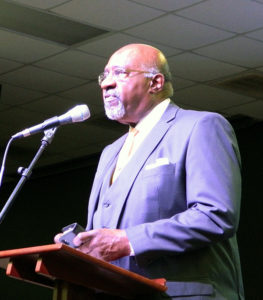
Breonus Mitchell, pastor of Mount Gilead Missionary Baptist Church in Nashville, Tenn., preaches to the African American Fellowship Conference in Waco. (Photo / Ken Camp)
“Esau was robbed of both his birthright and his blessing,” he said. “Everything Esau thought he had coming to him he had taken away from him by his own brother, Jacob.”
Esau understandably wanted retribution, and Jacob fled to the home of his uncle, Laban, for refuge for an extended time at the insistence of his mother, Rebekah.
“Rebekah wanted to protect Jacob from getting what he deserved. In the process, she protected Esau from what he desired,” Mitchell said.
For three and a half chapters in Genesis, the narrative focuses exclusively on Jacob. But during that time, God changed the heart of Esau.
“While God was dealing with Jacob in the spotlight, he was working on Esau behind the scenes,” Mitchell said. “God does some of his best work behind the scenes. … Jacob got a crippled hip (from wrestling with an angel of God). Esau got a changed heart.”
Before Esau and Jacob met again, Jacob sent a peace offering ahead, but Esau said he did not need what Jacob offered.
“God had put something in his hands. God didn’t need a birthright and a blessing to bless Esau. God can work beyond the scenes and around the systems,” Mitchell said.
Learn how to ‘let go’
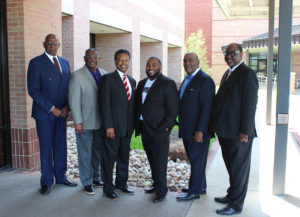
Roy Cotton (third from left), director of African American ministries with the Baptist General Convention of Texas, welcomes newly elected officers of the African American Fellowship (left to right), President Kenneth O. Jackson, pastor of New Light Baptist Church in Lubbock; Vice President Edward Wagner, pastor of Cornerstone Baptist Church in Harker Heights/Killeen; Secretary Samuel J. Doyle, pastor of Greater New Light Missionary Baptist Church in Waco; Treasurer Leonard Hornsby, executive pastor of Bethlehem Baptist Church in Mansfield; and Assistant Treasurer Michael Joseph, pastor of Marvelous Light Church in Houston. Not pictured is Assistant Secretary Gregory Trotter, pastor of Friendship Baptist Church of The Colony, who was traveling internationally. (Photo / Eric Black)
When Esau and Jacob met face to face, Esau greeted his brother with a warm embrace and a kiss, telling him, “Let us move on.”
“There comes a time in life when we need to learn to move on, not remain stuck in the circumstances and situations of the past,” Mitchell said. “We have to learn how to let go.”
Rather than looking in the rearview mirror at past offenses, God’s people need to look ahead and live in grace, he insisted.
“We serve a God who is in the business of giving us grace after grace after grace after grace,” Mitchell said.
As recipients of grace, God’s people need to extend grace to others, he asserted.
“God doesn’t want us to herald what has been done to us. God wants us to herald what he has done for us,” Mitchell said.
New officers of the African American Fellowship installed at the conference were President Kenneth O. Jackson, pastor of New Light Baptist Church in Lubbock; Vice President Edward Wagner, pastor of Cornerstone Baptist Church in Harker Heights/Killeen; Secretary Samuel J. Doyle, pastor of Greater New Light Missionary Baptist Church in Waco; Assistant Secretary Gregory Trotter, pastor of Friendship Baptist Church of The Colony; Treasurer Leonard Hornsby, executive pastor of Bethlehem Baptist Church in Mansfield; and Assistant Treasurer Michael Joseph, pastor of Marvelous Light Church in Houston.
Pence and Pompeo address Christian pro-Israel summit
July 16, 2019
WASHINGTON (RNS)—Vice President Mike Pence and U.S. Secretary of State Mike Pompeo both addressed a Christian pro-Israel group July 8, lifting up the U.S. ally as a bastion of inclusivity and railing against Iran.
Pence and Pompeo delivered their remarks at the annual summit of Christians United for Israel, a conservative Christian organization led by John Hagee, founding pastor of Cornerstone Church in San Antonio. Christians United for Israel claims more than 6 million members.
Both politicians used the opportunity to defend the administration and champion what they argued were President Trump’s successes.
Pence fires back at AOC
Pence spoke first, taking time to push back against recent comments by Rep. Alexandria Ocasio-Cortez comparing detention facilities used to house undocumented immigrants to concentration camps.
“To compare the humane work of the dedicated men and women of Customs and Border Protection with the horrors of the Holocaust is an outrage,” Pence said. “This slander was an insult to the 6 million killed in the Holocaust, and it should be condemned by every American of every political party everywhere.”
Pence also framed the United States’ support for Israel in theological terms.
“We stand with Israel because we cherish that ancient promise that Americans have always cherished throughout our
Anti-Zionism equated with anti-Semitism
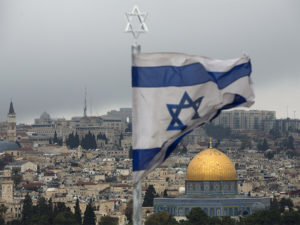
The Dome of the Rock and Jerusalem’s Old City is seen from the Mount of Olives. President Trump recognized Jerusalem as Israel’s capital and instructed the State Department to begin the multi-year process of moving the American embassy from Tel Aviv to the holy city. (AP Photo via RNS/Oded Balilty)
The vice president was followed later in the day by Pompeo, who, like Pence, championed the Trump administration’s various actions on Israel, such as recognizing Israel’s annexation of the Golan Heights and moving the U.S. embassy to Jerusalem.
“Thank God we have a leader in President Trump and an immovable friend like Israel,” he said, adding that his own job as secretary of state is “to turn that commitment into real action.”
Pompeo also condemned anti-Semitism and echoed other speakers at the conference by arguing that “anti-Zionism is indeed anti-Semitism. Period. Full stop.”
Similarly, he said the Trump administration had put the United Nations “on notice” for what he called “anti-Israel bias.”
As Pompeo closed, the crowd rose to its feet in a standing ovation.
Pence and Pompeo’s religious references resonated with Garmon Smith, a summit attendee from Oklahoma.
“They both are strong Christian men, and they receive what the Bible has to say about blessing Israel,” he said.
Marylin Henretty, who said she got to know Pence and his wife before he became the governor of Indiana, also lauded the appeals to Scripture.
“Mike has always shown up at all the events supporting Israel. What he’s saying we have heard many times,” she said. “We believe what the Bible says concerning Israel. To have a president openly professing that the land belongs to Israel—that’s what Scripture says.”
Injustices against Palestinians
In a guest opinion article published by Religion News Service, a rabbi and a Protestant minister offered a significantly different view.
More than 60 Palestinian protesters died and about 2,700 were injured in demonstrations along the Israel-Gaza border. (Screen Capture from Australian Broadcasting Corporation, courtesy of BP)
Lynn Gottlieb, board chair of the Interfaith Movement for Human Integrity and member of the Rabbinic Council of Jewish Voice for Peace, and Graylan Hagler, senior pastor of Plymouth Congregational United Church of Christ in Washington, D.C. and director of Faith Strategies, said organizations such as Christians United for Israel and the policies the group promotes “pose a grave danger to the safety and well-being of both Jews and Palestinians.”
“How can a political and theological agenda refuse to see the humanity, sacredness, and suffering in the other and yet still claim to be religious?” they asked.
“This is what CUFI does. It supports Israel at all cost, without question or criticism, while ignoring the great injustices against Palestinians in Israel and the occupied territories based upon the anti-Semitic theological/political idea that Jews must be restored to ‘their homeland’ in order for the Second Coming of Jesus to occur.
“As clergy and people of deep faith and conscience, we do not know a God that ignores or justifies the suffering of one group of people for the security and comfort of others. We do not know a God that justifies in any form or fashion the oppression and subjugation of others. We call on Americans of all beliefs to stand in support of Palestinians struggling for their long-denied freedom and against the kind of dangerous pseudo-religious extremism that CUFI represents.”
VA revises policies on displays of religious symbols
July 16, 2019
WASHINGTON (RNS)—In the wake of a Supreme Court decision permitting a cross on public land, the Department of Veterans Affairs has revised its policies on religious symbols in displays at VA facilities.
VA Secretary Robert Wilkie announced July 3 the new policies will reduce inconsistencies among VA facilities.
“We want to make sure that all of our veterans and their families feel welcome at VA, no matter their religious beliefs. Protecting religious liberty is a key part of how we accomplish that goal,” he said in a statement.
“These important changes will bring simplicity and clarity to our policies governing religious and spiritual symbols, helping ensure we are consistently complying with the First Amendment to the U.S. Constitution at thousands of facilities across the department.”
The revised policies “allow the inclusion in appropriate circumstances of religious content in publicly accessible displays at VA facilities.”
They also permit patients to request and be provided with sacred texts, symbols and religious literature during treatment at facilities or visits to VA chapels. And they allow the VA “to accept donations of religious literature, cards and symbols at its facilities and distribute them to VA patrons under appropriate circumstances or to a patron who requests them.”
Impact of Supreme Court decision on WWI cross
A 40-foot Latin Cross stands on government land at a busy intersection in Bladensburg, Md. (BJC Photo)
The announcement noted the Supreme Court’s June 20 decision, in which it permitted the “Peace Cross,” a World War I monument in Bladensburg, Md., to remain in a traffic circle. The VA said the case “reaffirmed the important role religion plays in the lives of many Americans and its consistency with Constitutional principles.”
The policy revisions come two months after a U.S. Air Force veteran filed suit against the director of the Manchester (New Hampshire) VA Medical Center, seeking the removal of a Bible from a POW/MIA table at that facility.
“As a Christian, he respects and loves all his military brothers and sisters and does not want to be exclusionary by the placement of the Christian Bible,” the suit states.
Competing views expressed about policy
The Military Religious Freedom Foundation, which the suit says received complaints from 14 other veterans about the display, decried the VA’s revamped rules.
“These brand-new VA policies—clearly based upon the U.S. Supreme Court’s recent, idiotic decision in the Bladensburg Cross case—are nothing more than a transparent and repugnant attempt to further buttress and solidify fundamentalist Christianity as the insuperable official religion of choice for the VA, our Armed Forces, and this country,” said Mikey Weinstein, president of the Military Religious Freedom Foundation.
His organization has previously complained about similar Bible displays at other locations, such as a naval hospital in Japan and a Wyoming Air Force base.
First Liberty Institute, a nonprofit legal organization that sent a letter in May to Wilkie requesting “a VA-wide policy that permits Bibles to be included in POW/MIA remembrance displays,” applauded the VA’s revamped policies.
“This new VA policy is a welcome breath of fresh air,” said Mike Berry, director of military affairs for First Liberty Institute, which also helped defend the Maryland cross monument.
“The Supreme Court recently upheld the constitutionality of religious displays with historic roots such as those commonly found in VA facilities. We commend the VA for taking this necessary and positive action.”
Reports allege China commits atrocities against Uighurs
July 16, 2019
WASHINGTON (RNS)—Two new reports conclude that China is engaging in organ harvesting and a child separation campaign against the country’s Uighur Muslim minority.
China’s ambassador to the U.K., Liu Xiaoming, has denied a BBC investigation’s findings, which concluded Muslim children in the Uighur-majority region of western Xinjiang are being systematically separated from their parents.
The extensive investigation, commissioned by the BBC and led by leading German researcher Adrian Zenz, has found more than 400 Uighur children in a single township have lost both their parents to prison or China’s vast network of internment camps.
‘Intergenerational separation’
Chinese authorities have described the camps as vocational education training centers aimed at curbing terrorism. But U.S. officials say that between 1 million and 3 million Uighurs have been arbitrarily imprisoned in “concentration camps” where detainees are indoctrinated and even tortured.
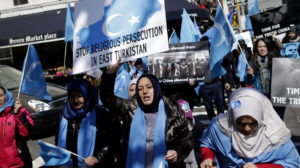
Uighurs and their supporters march to the United Nations to protest in New York. Members of the Uighur Muslim ethnic group held demonstrations in cities around the world to protest a sweeping Chinese surveillance and security campaign that has sent thousands of their people into detention and political indoctrination centers. (AP Photo via RNS / Seth Wenig)
Just as China began detaining Uighur adults en masse, authorities also began rapidly rolling out construction of thousands of military-style full-time boarding schools for Uighur children, Zenz found.
This “weaponization of education and social care systems” is critical to “the region’s hair-raising political re-education and transformation drive,” he wrote, and seems to be a pre-emptive measure against the potential fallout of China’s “war on terror” against Uighur resistance.
“Increasing degrees of intergenerational separation are very likely a deliberate strategy and crucial element in the state’s systematic campaign of social re-engineering and cultural genocide in Xinjiang,” Zenz wrote.
In southern Xinjiang, Chinese authorities have spent about $1.2 billion on building and upgrading kindergarten facilities, including large-scale expansions of dormitory space and extensive security measures.
In 2017, the number of children enrolled in Xinjiang’s kindergartens spiked by more than half a million. Muslim minority children comprised more than 90 percent of that jump, per publicly available government statistics.
In these schools, Uighur and other local languages are largely banned. State directives order schools to focus on “thought education.”
“Xinjiang’s schools have become like the colonial boarding schools used by the United States, Canada or Australia, to assimilate native ethnic populations,” Zenz concluded in his report.
‘China has declared war on faith’
“China has declared war on faith,” Sam Brownback, ambassador-at-large for International Religious Freedom, said June 21 at an event introducing the 2018 International Religious Freedom Annual Report. “We’ve seen increasing Chinese government abuse of believers of nearly all faiths and from all parts of the mainland.”
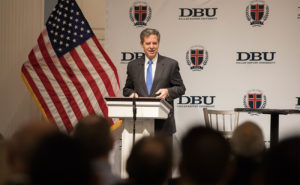
Sam Brownback, U.S. ambassador-at-large for international religious freedom, speaks at Dallas Baptist University as part of the Institute for Global Engagement’s leadership lecture series. (DBU Photo)
Brownback also excoriated reports that Chinese authorities have subjected prisoners of conscience to forcible organ harvesting, which he said “should shock everyone’s conscience.”
The reports came from an independent tribunal initiated by the International Coalition to End Transplant Abuse in China, which confirmed long-standing allegations that China is forcefully harvesting the organs of marginalized people in prison camps, sometimes when patients are still alive.
“It is no longer a question of whether organ harvesting in China is happening. That dialogue is well and truly over,” said Susie Hughes, the group’s executive director.
On June 17, the tribunal reported that “forced organ harvesting has been committed for years throughout China on a significant scale,” making practitioners of the beleaguered Falun Gong spiritual movement one of the country’s main sources of organs. China banned the Falun Gong in the 1990s and has smeared the meditative discipline as an “evil cult.”
Organs involuntarily harvested and sold
While Chinese officials announced the country would stop taking organs from executed prisoners in 2014, the tribunal concluded that the practice is still taking place.
The tribunal found that it was possible that Uighur Muslims’ organs have been sold against their will to the billion-dollar transplant industry.
Citing a lack of evidence that China has dismantled the infrastructure used for its organ transplantation industry, as well as the country’s inability to explain its organ sourcing, the tribunal said, the massive scale of the “concerted persecution and medical testing” of Uighurs suggests that “evidence of forced organ harvesting of this group may emerge in due course.”
The tribunal determined that it was “beyond reasonable doubt” that China is committing “crimes against humanity” and urged international courts to investigate whether the crimes rose to the level of genocide.
Forced organ harvesting, the tribunal wrote, “is of unmatched wickedness even compared—on a death-for-death basis—with the killings by mass crimes committed in the last century.”
Cooperation stressed at African American conference
July 16, 2019
WACO—Cooperation, remembrance and thanksgiving emerged as key themes during the first day of the African American Fellowship Conference.
“We are called to cooperate,” said Pastor Michael Evans of Bethlehem Baptist Church in Mansfield, president of the Baptist General Convention of Texas. “We all need one another.”
Evans pointed to the contributions African American churches make as full partners in Texas Baptist life, alongside other racial, ethnic and language groups. He described the BGCT as a network of “transformational churches” working together to transform communities and advance God’s kingdom.
‘Rich in our diversity’
“We are rich in our diversity,” Evans told attendees at the 26th annual James W. Culp Banquet at First Woodway Baptist Church in Waco, 8. The event is named in memory of the longtime coordinator of black church development for Texas Baptists, who died last year.
Bethlehem Baptist in Mansfield was among the top giving African American churches to the BGCT Cooperative Program recognized at the banquet. Others were: New Beginnings Baptist Church in Lewisville, Pastor Joseph Fields; Community Missionary Baptist Church in DeSoto, Pastor Oscar Epps; Fort Bend Baptist Church in Sugar Land, Pastor Byron Stevenson; Cornerstone Baptist Church in Harker Heights, Pastor Edward Wagner; and The Church Without Walls in Houston, Pastor Ralph Douglas West.
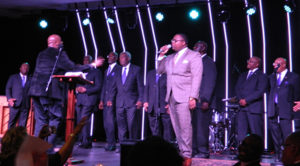
The men’s chorus from Bethlehem Baptist Church in Mansfield led in worship at the James W. Culp Banquet, held at the African American Fellowship Conference. (Photo / Ken Camp)
Evans urged believers spanning generations to learn from each other. Older Christians need young Christians to “fan the flames, igniting a passion for service,” he said.
At the same time, the rising generation needs to learn values—including distinctive Baptist principles such as soul competency and biblical authority—from their elders.
“You cannot move forward until you know where you’ve come from,” Evans said.
Pioneering presidents recognized
In that spirit, the African American Fellowship Conference recognized the organization’s first seven presidents, who served from 1993 to 2007.
Three former fellowship presidents from that era were present at the banquet—the first president, Joseph Samuel Ratliff, pastor of Brentwood Baptist Church in Houston; the second, Howard E. Anderson, pastor of Singing Hills Baptist Church in Dallas; and the fifth, Dennis W. Young, pastor of Missouri City Baptist Church near Houston and chair of the BGCT Executive Board.
The fellowship recognized two former presidents posthumously—Paul McBride, pastor of Friendship Baptist Church in The Colony, and Ronald G. Edwards, pastor of Minnehulla Baptist Church in Goliad.
The conference also recognized two past presidents who were unable to attend—Milton Walker, pastor of Community Baptist Church in El Paso, and Jerry William Dailey, pastor of Macedonia Missionary Baptist Church in San Antonio.
Record the legacy
Joseph Parker, pastor of David Chapel Missionary Baptist Church in Austin, to preserve the stories of early presidents of the African American Fellowship Conference. (Photo / Ken Camp)
Joseph Parker, pastor of David Chapel Missionary Baptist Church in Austin, referred to the early conference presidents not only as pioneers but as “the repositories of our tradition and heritage.”
African Americans have a strong oral tradition that honors storytellers, but they often neglect to preserve the history contained in the stories, he noted. Parker challenged the BGCT to lead an effort to protect that legacy by recording those stories.
Elmo Johnson, pastor of Rose of Sharon Missionary Baptist Church in Houston, who completed his term as president of the African American Fellowship, addressed pastors at a luncheon earlier in the day.
Reflecting on the first verse of Psalm 107, Johnson called on the pastors to give thanks. Like the people of Israel who were returning to Jerusalem after exile, God’s people need to “discover thanksgiving all over again,” he insisted.
Thanksgiving must be demonstrated, and the people of God express thanks to him by giving, Johnson said.
Believers should direct thanks to the right source, noting that God’s disposition provides reason for thanksgiving “for he is good,” he said.
And the duration of gratitude should match God’s grace, “for his mercy endures forever,” Johnson concluded.




 Hall sees God at work in many different ways. Recently, his car was in the shop, and his wife needed her vehicle to drive to work. So, he walked to the church office each day.