Around the State: TBM offers relief after storms; ETBU honors law enforcement
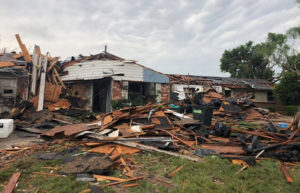
An EF-2 tornado hit the west part of Abilene, causing extensive damage. (Photo / Grace Mitchell)

Texas Baptist Men volunteers are responding to needs after a series of tornados touched down in West Texas on May 18. In Abilene, area TBM volunteers have cleared debris from 55 homes.  So far, crews in Abilene have donated more than 1,100 volunteer hours, completing 54 chainsaw jobs, logging 41 heavy equipment hours and installing temporary roofs on four homes. In San Angelo, a TBM emergency food-service crew provided 1,200 meals for families in shelters. Meanwhile, TBM disaster relief volunteers from around the state continue to work in Longview, removing downed pine trees from the homes of residents after 90 mph straight line winds hit the area on May 8. TBM chainsaw crews, heavy equipment operators and others have donated more than 5,300 volunteer hours in the community. To date, the volunteers have completed more than 70 chainsaw jobs, logged 270 heavy equipment hours, made 800 personal contacts and distributed more than 50 Bibles. To contribute financially, send a check designated “disaster relief” to Texas Baptist Men, 5351 Catron, Dallas, TX 75227, call (214) 275-1116 or click here.
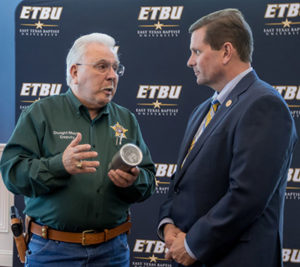
East Texas Baptist University President Blair Blackburn talks with Harrison County Deputy Dwight May during the annual Law Enforcement Appreciation Luncheon. (ETBU Photo)

East Texas Baptist University celebrated the 2019 National Police Week by hosting its annual Law Enforcement Appreciation Luncheon. ETBU presented a certificate of appreciation to Harrison County Sheriff Tom McCool, Marshall Police Department Chief Cliff Carruth and Texas Department of Public Safety Cpl. Kevin Arnold. The university also distributed to each attending officer a travel mug inscribed with the ETBU logo and Matthew 5:9, which reads, “Blessed are the peacemakers, for they will be called children of God.” At the event, ETBU President Blair Blackburn announced the university would donate $5,000 to the Harrison County Sheriff’s Department to purchase enough tourniquets to have one available for every deputy. The Marshall Police Department had received a federal grant to purchase 50 tourniquets and used two of them to save the life of Zachary Lastra, an officer injured on duty. However, the Harrison County Sheriff’s Department did not have any of the life-saving devices. Deputy Dwight Mays said he prayed God would provide a way for his department to secure them. At the ETBU event, he was seated at a table with Carruth and Blackburn, who were discussing the injured officer and how access to the tourniquets saved his life. Blackburn asked Mays if the sheriff’s department also had tourniquets available, and he learned the department lacked funding to secure them. Blackburn subsequently announced that ETBU would provide the necessary funds. “I have never had a prayer request answered that quickly,” Mays said.

Wayland Baptist University trustees recently voted to change the name of the university’s School of Religion and Philosophy to the School of Christian Studies. The name change, along with a redesign of curriculum, reflect the school’s desire to offer the type of education that ministry students are seeking, Dean Stephen Stookey said. The School of Christian Ministry will offer a Bachelor of Arts in Theological Studies degree that prepares students for service in the church or careers that are outside traditional vocational ministry, as well as a Bachelor of Christian Ministry degree aimed at students who will serve smaller congregations and/or serve in bivocational ministry. In February, Wayland announced an accelerated program that allows students to earn both a Bachelor of Christian Ministry degree and a Master of Divinity degree in as little as five years. The School of Christian Studies also will offer accelerated Bachelor of Christian Ministry degree programs that lead to a Master of Divinity/Master of Business Administration degree, offered jointly with Wayland’s School of Business; a Master of Arts in Theological Studies degree; and a Master of Arts in Christian Ministry degree. For more information, call (806) 291-1165 or by email stookeys@wbu.edu.

Donalyn Alexander

The Patty Hanks Shelton School of Nursing, an intercollegiate consortium of Hardin-Simmons University and McMurry University, named Donalyn Alexander as dean, effective June 1. Most recently, Alexander was associate dean and associate professor at the Shelton School of Nursing. Previously, she was director of education and professional development at Hendrick Medical Center. She earned her undergraduate degree from the University of Central Oklahoma, her Master of Science in Nursing degree from the Shelton School and her doctorate from Oklahoma City University.

Raquel Contreras

At spring commencement ceremonies, Dallas Baptist University awarded honorary doctorates to Raquel Contreras, general director of the Spanish Baptist Publishing House in El Paso; Shirley Hoogstra, president of the Council for Christian Colleges and Universities; and Roberto Silvado, president of the Brazilian Baptist Convention and senior pastor of Bacacheri Baptist Church in Curitiba, Brazil.

The Center for First-generation Student Success named Baylor University to its inaugural cohort of First Forward institutions. The designation recognizes institutions of higher education that demonstrated a commitment to improving experiences and advancing outcomes of first-generation college students. Baylor’s First in Line program is an on-campus support unit that provides scholarships, directed programming, mentoring and a network of faculty and staff to assist first-generation student success.

East Texas Baptist University will host its 24th annual tribute to Sam B. Hall Jr., the late congressman and U.S. District Court judge, at 7 p.m. May 27 at the historic Harrison County Courthouse Square in downtown Marshall. The Sam B. Hall Memorial Celebration: A Patriotic Concert is a free event that will feature patriotic live music performed by the East Texas Symphonic Band and a salute to those who gave their lives in U.S. military service.

Anniversaries

130th for Elliott Baptist Church in Hearne. A homecoming celebration is scheduled June 9. After Sunday school at 10 a.m., the 11 a.m. worship service will include a sermon by guest preacher Harold Cook, former director of missions for FIRM Baptist Area. A program featuring congregational singing and special music is scheduled at 1 p.m. Dale Wells is pastor.

70th for Trinity Baptist Church in San Antonio. A luncheon is scheduled June 22 for founding members, charter members and individuals who have been members of Trinity Baptist more than 60 years. A barbecue dinner is scheduled from 5 p.m. to 6:30 p.m. on June 22 in the dining room and gym at Trinity Baptist. Tickets for the barbecue are $7 each and can be purchased online here. An anniversary celebration featuring videos, music, memories and special recognitions is scheduled after the dinner from 7 p.m. to 8:30 p.m. in the Mulberry Sanctuary. A joint worship service is scheduled from 10:30 a.m. to 12 p.m. on June 23. Pastor Leslie Hollon will speak.

50th for Toby Irwin in the ministry. He is pastor of Belmore Baptist Church in San Angelo.

Retirement

Lee Fuller after 43 years in pastoral ministry and seven years as pastor of River Oaks Baptist Church in River Oaks, effective Aug. 25.


Board OKs changes to fund helping clergy sex abuse survivors

DALLAS—The Baptist General Convention of Texas Executive Board voted to revise and rename an underused fund set aside to help subsidize counseling for survivors of clergy sexual abuse.

At the recommendation of its finance committee, the board lifted a $1,000 cap on counseling assistance to any individual survivor from a $100,000 endowment fund the BGCT Administrative Committee created in 2005.

“Our experience in the past few years indicates that more resources for each survivor are typically needed,” the written recommendation from the finance committee stated. “Additionally, there has been low utilization of these funds so additional resources are available.”

The board also renamed the fund, previously designated as the “victim of clergy sexual abuse” board-designated endowment. In keeping with contemporary best practices of counseling professionals, it now refers to a “counseling subsidy for survivors of clergy sexual abuse.”

Grants from the fund will be agreed upon by Texas Baptists’ director of counseling services and the BGCT treasurer/chief financial officer. Amounts will be based on the survivor’s needs, other resources to which the individual has access and funds available.

The board-approved recommendation also stipulates, “Churches will be encouraged to provide matching funds for counseling to the survivor if possible.”

MinistrySafe Training offered

During the Executive Board’s May 20-21 meeting, many of the directors participated in a two-hour overview of the MinistrySafe training to prevent child sexual abuse.

The BGCT partners with MinistrySafe to provide free regional workshops to help Texas Baptist churches reduce the risk of child sexual abuse. Upcoming workshops are scheduled May 30 at Tallowood Baptist Church in Houston, Sept. 10 at First Baptist Church in Georgetown and Oct. 29 at Second Baptist Church in Corpus Christi.

In a panel discussion following the video presentation to the board, several ministry leaders who have participated in the workshops discussed the importance of creating a safety system in churches to protect children and youth—even when that means turning away some potential volunteers.

“We are not there to protect people’s feelings. We are there to protect children’s futures,” said Fernando Rojas, pastor of Azle Avenue Baptist Church in Fort Worth.

‘We are on watch’

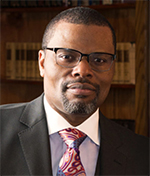
Michael Evans

In his remarks to the board, BGCT President Michael Evans, pastor of Bethlehem Baptist Church in Mansfield, cited Ezekiel 3:17. He reminded church leaders God made each of them “a watchman” over God’s people.

“As believers, we have a responsibility,” he said. “We are on watch.”

“Long gone are the days” when church leaders can turn a blind eye to issues such as sexual abuse, Evans insisted. When church leaders do nothing about a problem, they become “silent partners” in the offense, he asserted.

“When you see something, you ought to say something,” he said. “God has called us to speak up and speak out.”

In other business, the BGCT Executive Board:

  • Approved a recommendation to invest the convention’s reserve fund—currently valued at about $8.1 million—in an index fund allocation through HighGround Advisors. The finance committee will monitor results of investments in the index fund, comparing them with other BGCT funds HighGround Advisors manages.
  • Authorized a $60,000 expenditure to implement new accounting software.
  • Elected Mitchell Thomas from Park Cities Baptist Church in Dallas to serve on the Institutional Audits Council.

Vernon announces plan to retire

Steve Vernon

At the conclusion of the board meeting, Steve Vernon announced his intention to retire effective Jan. 3, 2020, as associate executive director of the BGCT, a position he has held since September 2008.

Vernon was pastor of First Baptist Church in Levelland from 1991 to 2008. Previously, he was pastor of First Baptist Church in Panhandle, First Baptist Church in Kress and First Baptist Church in Ames, Okla.

He was a former president of the BGCT and served on a variety of Texas Baptist boards, committees and commissions during his time in the pastorate.


Hispanic scholarship recipients graduate from DBU

DALLAS—Bethany Morales and Harold Aguirre encountered challenges when they began their studies at Dallas Baptist University. But with diplomas in hand, they look back on each one as a God-given opportunity to grow and mature.

Morales and Aguirre, who graduated with baccalaureate degrees last week from DBU, were the first recipients of DBU’s Hispanic Young Baptist Leaders Scholarship.

DBU established the scholarships in 2015, working in cooperation with the Convención Bautista Hispana de Texas and the Hispanic ministries office at the Baptist General Convention of Texas. The scholarship provides coverage of half of student tuition and the full cost of room and board for two students throughout their undergraduate studies.

Other Texas Baptist schools followed, and now Convención promotes several scholarships.

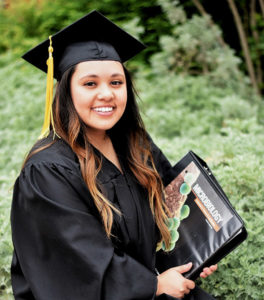
Bethany Morales, one of the first recipients of the Hispanic Young Baptist Leaders Scholarship at Dallas Baptist University, earned her undergraduate degree. She plans to teach and coach in her hometown, Floydada. (Photo courtesy of Bethany Morales)

Morales, who is from Floydada, felt homesick at times. Aguirre grew up much closer, in Fort Worth, but he still found the culture at the university different from what he had known.

In time, however, both students said they found a home at DBU.

Aguirre graduated with a double major in communication theory and intercultural studies.

“The majority of people have also lived in a bubble. It was just a different one” from the one he had known, Aguirre said. “Being here has allowed me to grow and do more for myself. So in terms of community, I’ve made some of my closest friends here.”

Professors Curtis Lee and Debra Hinson “really challenged me and pushed me to be the best I can be,” Morales said.

Her major in biology will take Morales back home to teach biology and anatomy, as well as coach several sports, for the Floydada school district.

Students note support of church and family

Both Morales and Aguirre also recognize the support church and family offered before starting at DBU.

Morales’ father, Armando, is the pastor of Calvary’s Cornerstone Fellowship in Floydada. After father and daughter heard about the scholarship at Congreso, they sought to learn more about the opportunity.

Harold Aguirre graduated from Dallas Baptist University with a double major in communication theory and intercultural studies. He begins work next month in the admissions office at DBU while he begins work on his master’s degree in bilingual education. (Photo / Isa Torres)

Aguirre’s mother, Magaly, pushed him to look at schools and apply for scholarships, he said. His home church, Iglesia Bautista Victoria en Cristo in Fort Worth, also continuously urged him to pursue an education, he added.

On the basis of his undergraduate academic success, Aguirre was admitted into a master’s degree program at DBU, and the school offered him a job in the admissions office.

“Harold is an example of the education DBU is committed to give,” said David Reyes, director of student life. Reyes hopes other Hispanic students will find in Aguirre a guide to carry them through academic challenges.

The graduation of the first students to receive the Hispanic Young Baptist Leaders Scholarship marks a significant milepost—as well as a significant accomplishment for Morales and Aguirre, said Convención Executive Director Jesse Rincones. Since 2015, DBU has continued to award two Hispanic Young Leaders Scholarships every academic year, he noted.


Nigeria violence prompts broad-based religious liberty outcry

ABUJA, Nigeria (BP)—Escalating violence that has killed thousands of Christians in Central Nigeria must be addressed by the international Christian community and by a Nigerian government that has harassed victims, a global religious liberty coalition noted after its 2019 consultation in Abuja.

The frequent attacks no longer can be blamed on a centuries-old land dispute between Christians and Fulani herdsmen, the Religious Liberty Partnership of 40 advocacy and aid groups said.

Instead, the violence is initiated by a militant faction of Fulani herdsmen and others intent on killing Christians, the group said in affirming a sentiment various advocacy groups voiced as early as 2017.

The Religious Liberty Partnership drafted a public statement after its consultation in Abuja, where it discussed strategic issues and collaboration aimed at international religious liberty.

‘Stand with our brothers and sisters’

The Religious Liberty Partnership “calls on the worldwide church to stand with our brothers and sisters in Nigeria in prayer, and to provide long-term practical humanitarian support, pastoral care and trauma counselling particularly (to) those who have lost family and loved ones, livestock and livelihoods,” the group’s statement reads.

“We urge Christians worldwide to respond to this appeal for prayer and action in recognition of the biblical injunction that we are one body, and that ‘if one part suffers, every part suffers with it’ (1 Corinthians 12:26).”

Among the most recent attacks, as many as 280 Christians were killed over several weeks spanning February and March.

Christians in Nigeria face crisis beyond the attention of the West
Christians in Nigeria face intense persecution, but few in the West have noticed, said Benjamin Kwashi, an Anglican archbishop from Nigeria who spoke at Dallas Baptist University as part of the Speak Freedom Summit in 2016. (DBU Photo/Taggert Corn)

The Religious Liberty Partnership acknowledges apart from militant herdsmen several “peaceable Fulani herders and communities” and “the ongoing plight of Hausa and Fulani communities in northwest Nigeria which are also suffering kidnappings, murder and extortion by armed gangs.”

Religious Liberty Partnership Chair Mervyn Thomas, chief executive of Christian Solidarity Worldwide, released the statement to media on May 16.

“The Abuja Statement highlights disturbing allegations that while members of the militia ‘are neither traced nor prosecuted, members of victim communities who articulate their concerns experience an array of repercussions that include threats, arbitrary arrests and judicial harassment,’” Thomas said.

Among other requests, the statement calls on the worldwide church to pray for strength, protection and wisdom for religious leaders in Nigeria; raise awareness of violence in central Nigeria; and petition national governments to assist targeted communities in Nigeria.

Not just the central part of Nigeria

In addressing concerns in central Nigeria, the Religious Liberty Partnership laments terrorism in northeast Nigeria. There, the group urges the Nigerian government to facilitate the release of schoolgirl Leah Sharibu, kidnapped by Boko Haram in February 2018 and held only because of her Christianity; humanitarian worker Alice Ngaddah, held by the Islamic State West Africa Province since March 2018; and 112 Chibok schoolgirls still held by the Shekau faction of Boko Haram since being kidnapped in April 2014.

The statement references nine elders of the Adara tribe from Kajuru in southern Kaduna state, Thomas said, who have been detained since February and are facing “dubious charges” of incitement and culpable homicide.

The Religious Liberty Partnership “calls on the government to ensure an end to this ‘judicial harassment and arbitrary detention,’ while also regretting the emergence of ‘periodic retributive violence, as communities conclude they cannot depend on government for protection or justice,’” Thomas said.

The Religious Liberty Partnership includes the Alliance Defending Freedom, China Aid, International Christian Concern, Jubilee Campaign, Middle East Concern, Open Doors, Voice of the Martyrs, the 21st Century Wilberforce Initiative and the World Evangelical Alliance Religious Liberty Commission.

“We are also concerned by the violence that continues to devastate farming communities in Adamawa, Bauchi, Benue, southern Kaduna, Nasarawa, Plateau and Taraba states, and a concomitant proliferation of small arms that contributes to a general rise in insecurity,” the statement declares. Well-armed Fulani militia have killed and displaced thousands, the Religious Liberty Partnership said.

Open Doors ranked Nigeria 12th in its 2019 World Watch List of the 50 countries where it is most dangerous to live as a Christian. Of the 4,136 Christians killed in 2018, Nigeria accounted for 3,731, Open Doors said.


SBC churchgoers split on existence of more clergy sex abuse

NASHVILLE, Tenn.—About one-third of Southern Baptist churchgoers believe more revelations of sexual abuse and misconduct by Protestant ministers remain to be exposed. But few know of specific individuals in their church whose misconduct still is hidden, according to a new LifeWay Research study.

The 2019 Sexual Misconduct and Churchgoers Study by LifeWay Research explored the perceptions and experiences of Southern Baptist and Protestant churchgoers.

“Protecting people from abuse of any kind should be of utmost importance to churches and our convention,” said Brad Waggoner, acting CEO of LifeWay Christian Resources. “LifeWay decided to sponsor this research because it’s imperative we make our churches safe places for people to hear the gospel and grow in their walk with Jesus Christ.”

Undiscovered abuse?

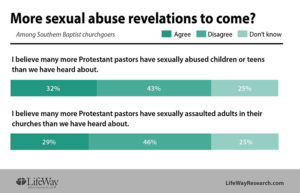
The study found one in three Southern Baptist churchgoers (32 percent) believe many more Protestant pastors have sexually abused children or teens than have been exposed to date. More (43 percent) disagree, while 25 percent say they don’t know.
Fewer (29 percent) Southern Baptist churchgoers say there are many more undiscovered instances of Protestant pastors who have sexually assaulted adults, while 46 percent disagree and 25 percent don’t know.

Relatively few say they know someone attending their church who has sexually assaulted someone (3 percent) or sexually abused a child (3 percent), but it has not yet come to light.

“Perceptions are reality,” said Scott McConnell, executive director of LifeWay Research. “When almost a third of churchgoers sense there is an avalanche of abuse and assault cases coming, churches must address this head on even if few say they actually know someone whose abuse is still hidden.”

Prevalence of sexual misconduct

More than a third of Southern Baptist churchgoers (37 percent) say they have been victims of the following types of sexual misconduct—unwanted sexual joking, unsolicited sexual messages, unwanted compliments and inappropriate glances.

Researchers asked those victims where the misconduct took place. Seven percent say the misconduct occurred at church.

Six percent of those Southern Baptists who say unwanted sexual joking was directed at them say it happened at church. The same is true for 7 percent of those who received unwanted compliments that implied the person viewed them sexually, 3 percent of those who received unwanted pictures or sexual advances via text or direct message, and 6 percent of females who experienced prolonged glances or staring at their chest.

When asked if they received compliments that implied the person viewed them sexually, 6 percent of SBC churchgoers say they heard such remarks as a child and 15 percent did as a teenager. When asked from where they knew the person giving the sexually-insinuating comments, 36 percent say school, 34 percent say their home or family and 10 percent say church.

Similar issues continued in adulthood. Southern Baptist churchgoers are more likely to say inappropriate behavior occurred in settings other than the church, but some still reported occurrences in church.

Unwelcome physical greetings?

Some churchgoers expressed wariness over the greetings they receive from others at church. Around one in six (18 percent) say some attendees express physical greetings in ways that seem to go beyond a simple gesture.

A 2018 LifeWay Research study found one in eight Protestant pastors said a church staff member had sexually harassed a member of the congregation at some point in the church’s history. One in six pastors said a staff member had been harassed in a church setting.

Overall, in the 2019 study, most SBC churchgoers (86 percent) say the church is a better environment when it comes to encountering sexually inappropriate comments compared to other places where they socialize with people. That’s slightly better than the 75 percent of all Protestant churchgoers who say the same.

Few Southern Baptist churchgoers (1 percent) believe the church is a worse environment, while 6 percent say it is the same as other places and 7 percent aren’t sure.

“The findings of this study are similar to previous research through the years,” McConnell said. “Churchgoers and the church setting have statistically fewer cases of immoral behavior, but those issues still have a very real presence.”

Prepared to respond?

Most Southern Baptist churchgoers believe their church is prepared to handle issues of sexual abuse and trust their congregation to respond appropriately if confronted with instances of misconduct.

A majority of SBC churchgoers say their church would respond to someone who had experienced sexual abuse, sexual assault or rape with respect (73 percent), sympathy (70 percent), privacy (62 percent) and protection (56 percent).

Few believe their church would ignore the person who shared their experience (2 percent), see them as an attention-seeker (2 percent) or view them as partly to blame (2 percent).

About three-fourths of Southern Baptist churchgoers (76 percent) consider their congregation at least somewhat prepared to help someone who has experienced sexual assault, with 38 percent saying their church is very prepared. Fewer than one in 10 (7 percent) believe their church is unprepared. Eighteen percent aren’t sure.

Is the church a safe place?

The vast majority of SBC churchgoers (95 percent) agree their church is a safe place where adults are actively protected from sexual assault in the church; 3 percent aren’t sure and 1 percent disagree.

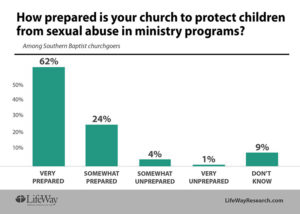
More than eight in 10 (86 percent) believe their church is at least somewhat prepared to protect children from sexual abuse in ministry programs, with 62 percent saying their church is very prepared. One in 20 (5 percent) say their church is unprepared and 9 percent are unsure.

Virtually all Southern Baptist churchgoers (96 percent) say their church is a safe place where children and teenagers are protected from sexual abuse. Few aren’t sure (3 percent) or disagree (1 percent).

Southern Baptist churchgoers believe safety measures have improved in the last decade. Around three in four (74 percent) believe their church is more prepared to protect children from sexual abuse than 10 years ago. Few say their church has had no additional preparation (6 percent) or was doing well then and now (7 percent). Thirteen percent say they don’t know.

“Those in the pews are noticing progress in the prevention efforts at their own church,” McConnell said. “Additional steps need to be taken and clearly communicated, however, so that more can say their congregation is very prepared to protect those who attend from sexual assault and child sexual abuse.”

Is the church a place of healing?

If someone did experience sexual abuse, Southern Baptist churchgoers feel confident their church would be a safe place for victims.

More than nine in 10 (92 percent) say someone who experienced sexual abuse as a child or teenager would find healing at their church; 4 percent disagree. Similarly, 94 percent say their church would be a place of healing for adult victims of sexual assault; 2 percent disagree.
Eight in 10 Southern Baptist churchgoers (80 percent) say an adult attending their church could share that they have experienced sexual assault by a fellow attendee and be believed. Fourteen percent aren’t sure and 6 percent disagree.

“When a church communicates it is a safe place for those who are hurting to find healing, it teaches truths about the identity and worth of every individual,” McConnell said. “More importantly, it answers the fundamental question of whether God cares.”

If sexually inappropriate things happened within the church, 5 percent believe church leaders would try to cover it up. Nine in 10 (90 percent) say their church is likely to report suspicions of abuse or neglect to the appropriate authorities.

Will leaders do the right thing?

Churchgoers also have faith in their leaders to correctly address sexual misconduct that may occur in the church even if it is costly or hurts the congregation’s image. Around eight in 10 (83 percent) agree their church would respond appropriately, regardless of the cost.

If sexual misconduct allegations were made against a pastor, most Southern Baptist churchgoers say they would want a careful investigation of the facts (79 percent), the truth to be made known (66 percent) and the alleged victim protected (54 percent). Four in 10 (40 percent) would want the police involved. Fewer say they would want the pastor protected (17 percent), doubt the validity of the accusation (11 percent) or want the situation dealt with quietly (9 percent).

Most Southern Baptist churchgoers feel safe attending their church. Few current churchgoers say they have ever attended less frequently because of advances from other attendees (2 percent). A similar number of churchgoers say they have ever stopped attending a church because they felt sexual misconduct was not taken seriously (3 percent) or because they didn’t feel safe from sexual misconduct (2 percent).

“Among people who are currently attending church, few said they stopped attending because of issues related to sexual misconduct,” McConnell said. “This does not measure, however, any who left due to these problems and have not returned to any church since.”

The research indicates churches are suffering from negative perceptions with many churchgoers bracing for more pastor-related sexual abuse stories to emerge, McConnell said. That hasn’t worsened churchgoers’ opinions of their own church or caused them to attend less frequently, but they still see areas church leaders should prioritize.

“From the perspective of the pew, there is room for churches to improve their process to prevent sexual abuse and assault, their communication of what is being done, and their handling of investigating accusations,” McConnell said.

The online survey of 1,815 Americans was conducted Feb. 27 to April 8, 2019. Respondents were screened to only include adults whose religious preference is Protestant and who attend church services once a month or more. Southern Baptists were oversampled to provide reliable estimates for this subgroup. Analysts used maximum quotas and slight weights for gender, region, age, ethnicity, education and Southern Baptist affiliation to reflect Protestant churchgoers more accurately, using statistics published by Pew Research.

The completed sample is 1,815 surveys, providing 95 percent confidence that the sampling error does not exceed plus or minus 2.9 percent. Margins of error are higher in sub-groups.


Baylor committed to apply current LGBTQ policy

WACO—While some Baylor University donors and alumni publicly have urged the school to recognize an LGBTQ student organization, the university’s board of regents took no action regarding a policy change.

Gamma Alpha Upsilon—formerly the Sexual Identity Forum—applied to be chartered as an official student group at Baylor. The university’s statement on human sexuality includes the expectation that Baylor students will not participate in “advocacy groups which promote understandings of sexuality that are contrary to biblical teaching.”

‘Love and care’ for all students

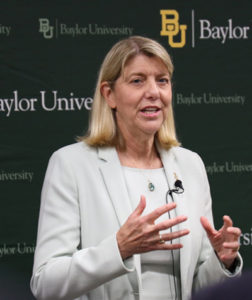
In response to a question at a news conference immediately following the regents’ May 17 meeting, President Linda Livingstone emphasized Baylor’s desire to “love and care” for all students, while at the same time continuing to “to make decisions consistent with our vision and our existing policies.”

“It came up in a couple of our committee meetings as we talked—particularly student life, because this is really a student life issue in terms of how we support and care for our students, and certainly our students in the LGBTQ community,” Livingstone said.

“In the context of that, we really talked about how we love and care for all our students, to ensure that they have a healthy and safe and nurturing learning environment so they can be successful educationally in that process.”

At the same time, Livingstone noted Baylor has “existing policies in place that continue to be the policies that we apply when we make decisions about student groups.”

Baylor President Linda Livingstone responds to questions during a news conference after the board of regents May 17 meeting. (Baylor Photo / Matthew Minard)

“We will continue to apply those (policies) consistently with how we have in the past and in the context of making sure that we really are fulfilling our Christian mission and loving and supporting our students in appropriate ways,” she said.

Baylor’s statement on human sexuality says: “Baylor University welcomes all students into a safe and supportive environment in which to discuss and learn about a variety of issues, including those of human sexuality. The university affirms the biblical understanding of sexuality as a gift from God. Christian churches across the ages and around the world have affirmed purity in singleness and fidelity in marriage between a man and a woman as the biblical norm. Temptations to deviate from this norm include both heterosexual acts outside of marriage and homosexual behavior. It is thus expected that Baylor students will not participate in advocacy groups which promote understandings of sexuality that are contrary to biblical teaching.”

The university’s student conduct policy states that Baylor “expects that each Baylor student will conduct himself or herself in accordance with Christian principles as commonly perceived by Texas Baptists.”

Online open letters

About 3,000 individuals signed an online open letter in recent weeks asking Baylor to “reconsider its exclusion of student organizations that are designed to provide a community for individuals in the lesbian, gay, bisexual, transgender, questioning (LGBTQ) and allied community.”

The letter encourages Baylor administrators to make changes so the university will not “look back in a few years and realize that we were on the wrong side of an issue of basic compassion and human dignity.”

Signers include major donors, former regents, retired faculty and current faculty including Jackie Baugh Moore, Barbara ‘Babs’ Baugh, Ray Perryman, Oswin “Os” Chrisman, Robert Baird, Blake Burleson, Robert Darden, Preston Dyer and former Congressman Chet Edwards.

In response, another group posted its own online petition titled “Save Baylor Traditions,” that urges the university to “stand strong and refuse to abdicate the traditional Christian values for which it has historically stood.”

Disagreement noted

George Mason, senior pastor of Wilshire Baptist Church in Dallas, wrote an open letter to Livingstone published in the Dallas Morning News, urging Baylor “to take the small yet significant step of granting LGBTQ student groups official status on campus.”

“The step is small, because the school would not be taking an affirming stance on a matter that continues to be contested among Christians of goodwill,” Mason wrote. “It would be significant, because it would signal Baylor’s commitment to welcome and serve all students equally by providing safe space for LGBTQ students to support one another as they pursue their education and discover more about themselves.”

Baylor Provost Emeritus Donald Schmeltekopf sent a letter to the board of regents on May 6 calling on the governing board to “help make Baylor unambiguously Christian in word and deed alike” by retaining its “historic stance on Christian sexuality.”

Schmeltekopf, former provost and vice president for academic affairs, urged the university to maintain a policy “biblically grounded and in full accord with two millennia of clear Christian teaching: We approve no other sexual practices than lifelong celibacy among singles and lifelong fidelity in marriage between a man and a woman.”

It’s no surprise that the issue has generated significant public and private debate, Livingstone noted.

“Obviously, there is going to be a lot of robust discussion around this topic. And that’s what universities are about—it’s bringing people together, talking about issues that really matter and learning from each other,” she said.

“And in the context of this, we have a lot of people who love Baylor and love our students that care deeply about this issue from a variety of perspectives. We will continue to work with them as we continue to make decisions consistent with our vision and our existing policies.”

Regents approve budget, expenditures

During their spring meeting, Baylor’s board of regents approved a $698.4 million operating budget, $4.1 million for the first phase of a planned renovation of the Tidwell Bible Building and $1.815 million for regulatory corrective action along the Brazos Riverwalk near the university’s athletic complex.

The 2019-20 operating budget, which takes effect June 1, includes an additional $13.4 million for both need-based and merit-based scholarships and graduate assistantships.

Baylor University announced a $15 million lead gift from The Sunderland Foundation of Overland Park, Kan., to help renovate and restore the Tidwell Bible Building. (Baylor University Photo)

Funds approved for the Tidwell Bible Building project include design costs for the renovated building and build-out of space on the fourth floor of the Cashion Academic Center, which will house temporary offices for religion and history faculty during the renovation.

Construction on Tidwell—built in 1954—likely will begin in late 2020, with anticipated reopening in 2022. The renovation is made possible by a $15 million lead gift from the Sunderland Foundation.

The board approved funds for regulatory corrective action to improve and prevent future landfill erosion issues on the south bank of the Brazos.

Baylor’s Highers Athletics complex facilities are built within the borders of a closed and capped Waco city landfill that contains wood, brick and glass from buildings destroyed by the 1953 Waco tornado.

Board elect officers, affirms new regents

Regents elected Jerry Clements, an Austin-based attorney, as chair to succeed Joel Allison of Waco, former Baylor Scott & White Health chief executive officer. Clements is a member of First Baptist Church in Spicewood.

Newly elected vice chairs are Mark Hurd of Redwood Shores, Calif.; Melissa Purdy Mines of Austin; and Randy Lee Pullin of Houston.

The board elected three new at-large regents—Sarah Gahm, senior vice president of Baylor Scott & White Health and a member of Park Cities Baptist Church in Dallas; William Mearse, retired Accenture resources group operations officer and member of Second Baptist Church in Houston; and Manny Ruiz, president and senior lending officer of TexStar National Bank and member of First Baptist Church in San Antonio.

The board welcomed David Slover, senior vice president and chief strategy officer of HighGround Advisors in Dallas, to a three-year term as alumni-elected regent.

The board approved Mark Petersen of Arlington as the regent nominated by the Baylor Bear Foundation, Randall Umstead from the Baylor School of Music as faculty regent and Malcolm Foley, a doctoral candidate from Rockville, Md., as student regent.

Regents reappointed by the Baptist General Convention of Texas at its 2018 annual meeting and confirmed by the board of regents are Mark Rountree of Dallas and Randy Lee Pullin of Houston.

The board of regents re-elected to three-year terms Shelly Giglio of Atlanta, Ga.; Larry Heard of Houston; and Julie Hermansen Turner of Dallas.


CommonCall: ‘Now they are our kids’

TYE—On night patrol, Officer Jay Strong grew accustomed to unusual sights.

“A city changes at night when the vampire people come out—the ones you only see after dark,” he said.

However, nothing prepared Strong for the horror he witnessed outside a busy truck stop in Tye, a small community a few miles west of Abilene.

He saw a teenager digging through a trashcan. While that drew his attention, it didn’t alarm him initially. Then he saw the 14-year-old boy begin to eat food scraps he found in the garbage.

Responding to needs

The police officer took the young man into the truck stop, bought him a snack and asked why he was scavenging.

“He told me: ‘My parents go out every night, and there’s no food in the house. … I think my dad loves the bottle more than he loves me,’” Strong recalled.

Strong gave the teenager a ride home. In the weeks that followed, he and his wife, Debra, began taking food to the boy’s house on a regular basis.

Eventually, the young man and his family moved away, and Strong moved on to other jobs—first as a school resource officer in nearby Merkel and then back to Tye as chief of police.

In his new role, he learned about another situation that demanded attention—a single mother who was caring both for her own children and the children of her incarcerated sister. The woman was working a minimum-wage job, but she was having trouble paying her utility bills and providing for the children.

Again, Jay and Debra Strong took on the responsibility of helping the struggling family meet basic needs—often on their own and sometimes with the help of the manager at a local truck stop who donated meals.

“Before school started, I took a little girl shopping for clothes at the mall,” Debra Strong recalled. The child told her it was the first time she ever had shopped at a store other than a supermarket or discount center.

Connecting with Tye Baptist Church

Jay Strong, chief of police in Tye, keeps donated pairs of winter gloves in his patrol car to distribute to homeless children and teenagers he encounters. (Photo / Ken Camp)

One year ago, Pastor Bill Murphy at Tye Baptist Church invited Strong to speak to his congregation on a Sunday morning to raise awareness about child abuse and neglect.

“At that time, our Child Protective Services cases were off the charts, averaging a couple a day in a town of 1,500,” Strong said.

He described the needs in the community and his vision for addressing at least one problem—providing a daily meal for children during the summer who receive free or reduced meals during the school year.

“We didn’t know about some of the things going on right in our neighborhood until he told us about the needs of the children,” said Linda Parsons, a member of Tye Baptist Church and former Tye City Council representative.

After Strong spoke, the church collected an offering to help start a program to feed children in need. They also elected a committee to provide volunteer leadership for what soon became Operation Brown Bag.

‘Let’s feed those kids’

The next morning, Murphy called Strong and asked him to drop by his office at church.

Volunteer Nancy Moore and Pastor Bill Murphy from Tye Baptist Church sort and stuff food bags for children in their community, meeting needs through Operation Brown Bag. (Photo / Ken Camp)

“I thought: ‘Uh oh, I’m in trouble. I talked too long. I said something I shouldn’t have said,’” Strong said.

Instead, the pastor handed Strong a check for about $2,000.

“Chief, let’s feed those kids,” Murphy said.

Soon, other individuals and businesses in the community and the surrounding area began contributing to Operation Brown Bag.

“We planned to feed children three or four days a week in the summer. It turned out to be five times a week,” Debra Strong said. “The Lord blessed us with money, and we opened our bank account with about $7,000.”

Volunteers began assembling food bags at Tye Baptist Church, and Strong would deliver many of them himself.

“I pull up in a police car at a house. Instead of running away, the kids run out to see me. They can’t wait,” Strong said.

Operation Brown Bag began by serving 17 children during the summer, and it has continued to grow. At the end of the summer, the women at Tye Baptist who had been assembling the food bags asked Strong if the program could be expanded to provide students with food for the weekends throughout the school year.

“This is a great group of people here, and I learned these ladies are persistent,” he said.

Making a difference in the community

Ongoing contact with at-risk children in the community provided Strong access to homes that otherwise would have been closed to law enforcement.

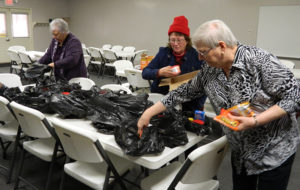
Volunteers Nancy Moore, Sammie Donaldson and Linda Parsons work at Tye Baptist Church to sort and stuff food bags for children in their community, meeting needs through Operation Brown Bag. (Photo / Ken Camp)

“As a police officer, it has changed the way we are viewed by these families. Before, the parents of some of the kids were my best customers,” he said. “Now, we have eyes and ears all over town. I call the kids my hawks. They know if they see something, they need to say something. It’s like our own little crime watch.”

Since Operation Brown Bag launched last May, Child Protective Services reported a 43 percent decrease in their caseload in Tye. Strong noted a drop in every category of criminal offenses during the same time.

At the same time, the community also has grown to view Tye Baptist Church in a new light.

Months ago, 27 members of the congregation—which typically draws 60 to 70 worshippers on Sunday morning—attended an evangelism training event at Wylie Baptist Church in Abilene.

They returned to Tye with a renewed commitment to knock on every door in their community and meet every family, asking their neighbors if they could pray with them about anything.

“The focus of our church became the kids in our community and their families,” Murphy said. “The focus is not on us and ours. It’s about Tye.”

‘Think about how Jesus treated children’

Members of the church volunteered at a back-to-school event sponsored by the city. They also made the church facility available when Debra Strong, associate dean of the Texas Tech Health Sciences Center’s School of Pharmacy Abilene campus, and her husband needed a place to provide children with vaccinations.

“It’s all about, ‘What would Jesus do?’ Think about how Jesus treated children,” Strong said.

The women at Tye Baptist keep Strong’s police car stocked with hand-knitted winter caps and gloves he can give to children in need, as well as bags filled with hygiene items and snacks for homeless people.

‘A safe place’

Families in Tye began to identify the church as a “safe place” for their children and themselves, where they would be accepted and not judged.

“They may not fill the pews, but the church’s influence is felt all over town. People know it’s a place where they can go for help and not be hurt,” Strong said.

On the Sunday before Christmas, Murphy baptized nine people, including five members of one family. Overall, the church baptized 24 new believers last year.

Since last May, members of the church and the community as a whole have grown to view at-risk children in a new light.

“At first, people would ask me, ‘How are your kids doing?’” Strong said. “That changed. Now they ask, ‘How are our kids?’ All the children in Tye are ours. Now they are our kids.”

Read more articles like this in CommonCall magazine. CommonCall explores issues important to Christians and features inspiring stories about disciples of Jesus living out their faith. An annual subscription is only $24 and comes with two free subscriptions to the Baptist Standard. To subscribe to CommonCallclick here.

This is part of an ongoing series about how Christians respond to hunger and poverty. Substantive coverage of significant issues facing Texas Baptists is made possible in part by a grant from the Prichard Family Foundation.


Turmoil leaves stained glass artists picking up the pieces

FORT WORTH (RNS)—Stained glass is fragile. So, too, are the fortunes of a stained glass artist.

Don and Debora Young were reminded of that lesson last month with the abrupt cancellation of a lucrative, once-in-a-lifetime commission to produce a series of stained glass windows for the MacGorman Chapel and Performing Arts Center on the Southwestern Baptist Theological Seminary campus.

The project, launched in 2013, was to take a dozen years or more and could have brought the Youngs, who run a small studio out of their Fort Worth home, as much as $2 million in income. A job of that size and scope “just doesn’t happen” to somebody “in our line of work,” Young said in an interview.

“It was like a dream. And then, just like that, we went from a dream job with a regular paycheck to nothing,” he said.

The windows, more than 60 in all, were to honor titans of the self-described “conservative resurgence” in the Southern Baptist Convention. That movement began in the late 1970s with the stated goal of reversing what its proponents perceived as a liberal drift away from an unbending, unambiguous adherence to biblical inerrancy.

In early April, the seminary’s board of trustees announced that it was removing the 32 windows that the Youngs had already completed, “in the best interest of the institution.”

Southwestern Baptist offered no further explanation for the decision. A seminary spokesman, after initially saying he would respond to a written request from RNS for comment, did not do so.

Allegations of impropriety

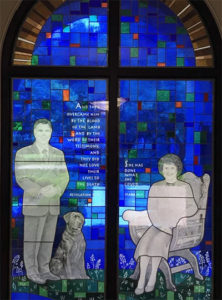
A stained glass window of Paige and Dorothy Patterson from Southwestern Baptist Theological Seminary. (RNS Photo courtesy of Don Young Glass Studio)

One of the windows paid homage to Paige Patterson, former president of Southwestern Baptist who was fired last year.

A June 1, 2018, written statement from Kevin Ueckert, chairman of Southwestern’s board of trustees, said the board unanimously concluded that Patterson ignored or mishandled female students’ complaints of sexual assault, both at the Fort Worth seminary and at Southeastern Baptist Theological Seminary in Wake Forest, N.C., where Patterson had previously served as president.

Patterson steadfastly has declined to comment on his firing or on the allegations that the trustees said compelled it.

Another of the Youngs’ windows depicted Paul Pressler, a Southern Baptist leader from Houston who became the subject of a 2017 lawsuit alleging decades of sexual abuse. Pressler denied the allegations of abuse in court filings. Those abuse claims against Pressler, a former Texas legislator and state appellate judge, were dismissed last November.

Frank Page, a former SBC leader depicted in a window, resigned last year after admitting to improper conduct.

Southwestern Baptist said it would “safely store” the windows until it figured out what to do with them.

Falwell decries ‘new regime’ in the SBC

On May 10, Jerry Falwell Jr., president of Liberty University in Lynchburg, Va., announced he’d brought two of the windows—one depicting his father, Liberty’s founder, and the other depicting Jerry Vines, who delivered the school’s baccalaureate address— to the university, where they’ll be displayed in the Jerry Falwell Museum.

Paul Pressler (right) is depicted in a stained glass window that has been removed from Southwestern Baptist Theological Seminary. (RNS Photo courtesy of Don Young Glass Studio)

Falwell rebuked what he called “a new regime” within the Southern Baptist Convention that’s turning away from “the high view of Scripture” advanced by his father and others.

“We will continue to honor the conservative leaders who reformed the Southern Baptist Convention,” Falwell told graduating students at Liberty. “And we place our hope in your generation to be the ones to step up and provide better leadership for the future.”

The stained glass project was conceived and organized six years ago by Dorothy Patterson, the wife of Paige Patterson. She led efforts to raise money to pay for the windows.

“My dream was to portray the 20-year history of the conservative resurgence of the Southern Baptist church,” she told the Fort Worth Star-Telegram in December 2013.

‘Dorothy’s pet’ project

But her dream was not shared by the seminary’s trustees, Debora Young said.

“It was Dorothy’s pet,” she said. “The trustees were never really in favor of it. But Dorothy wanted it done, so everyone just sort of went along with it.”

Paige and Dorothy Patterson—along with their black Labrador—were the subjects of one of the windows installed by the Youngs.

Other Baptist luminaries immortalized in etched and colored glass included Rick Warren, O.S. Hawkins, W.A. Criswell, Jimmy Draper and Richard Land.

Patterson, a former president of the Southern Baptist Convention and the Fort Worth seminary’s president for 15 years, was a leading architect of what critics called the “fundamentalist takeover” of the Southern Baptist Convention.

At a Southwestern chapel service in 2015, he said he recalled a time in the late 1970s when he asserted just 16 professors in Southern Baptist seminaries believed in biblical inerrancy.

“Now, just a few years later, you can go to any one of our six theological seminaries, and you will not find one single professor who does not believe in the inerrancy and the infallibility of God’s Word. That is a phenomenal act of God,” he said.

‘That was going to be our retirement’

Debora and Don Young (RNS photo / Bruce Tomaso)

Don Young, a Texas native, said he was raised as a Baptist but described himself and his wife as “spiritual” but “bohemian.”

The Youngs had planned to complete “about three dozen” windows before the project was cancelled. Don Young said no one from Southwestern told him or his wife that the windows were coming down. They learned about it after the fact from an online news story.

“We were taken totally by surprise. No one from there has contacted us about the removal—including Mrs. Patterson,” he said.

“When people ask me if I’m sorry about what happened, I tell them, ‘Honestly, I’m sorry about the money.’ We have no complaints. We did really well for these past few years. We made enough to pay off our house 10 years early.

“But we were counting on working on this for several years more. That was going to be our retirement.”


TBM clears downed trees in Longview

LONGVIEW—Texas Baptist Men disaster relief volunteers helped remove massive fallen pine trees from the homes of Longview residents after straight line winds swept through several neighborhoods.

Brian Gibson from Bull Creek Cowboy Church in Lone Oak moves logs cut by Texas Baptist Men chainsaw volunteers working in Longview. (Photo / Ken Camp)

Initially, observers attributed the widespread damage to a tornado, but the National Weather Service determined 90 mph straight line winds on May 8 caused the destruction and power outages. The storm’s path was about 17 miles long—although not continuous—and about 2,500 yards wide, the weather service said.

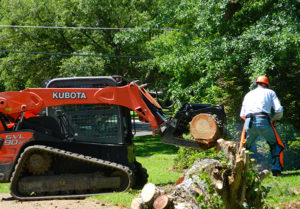
TBM mobilized volunteers who set up a base of operations at Greggton First Baptist Church in West Longview. After trained assessors surveyed affected neighborhoods, chainsaw crews and heavy equipment operators fanned out across the northern half of the city to remove downed trees.

No charge

Janet Spiekermann, a member of First Baptist Church in downtown Longview, was out of town caring for her hospitalized mother when the winds hit her neighborhood.

Texas Baptist Men volunteers remove fallen timber from the front yard of Janet Spiekermann, a member of First Baptist Church in Longview. (Photo / Ken Camp)

“Neighbors said it didn’t last long at all, but they heard trees snapping all around,” she said.

When Spiekermann returned to her home, she discovered a large tree down in her front yard.

She was grateful for the work of the TBM crew who promptly cut it down to manageable-sized logs and moved the debris to the curb—all free of charge. She already had received a bid from a commercial tree-trimmer.

“He would have charged $1,000,” she said.

Several TBM volunteers noted residents often were surprised to learn they provide their services free to anyone in need. One disaster relief volunteer commented a fellow chainsaw crew team member had the best response when asked how much the men charge for removing downed trees.

“We don’t charge anything. Jesus paid it all,” he said.

Working from Greggton First Baptist

A Texas Baptist Men chainsaw crew from Lake Pointe Church in Rockwall works in Longview. (Photo / Ken Camp)

In addition to the chainsaw crews and heavy-equipment operators and chaplains who accompanied them, additional volunteers staffed the incident management command post or worked with the mobile shower and laundry unit from Green Acres Baptist Church in Tyler, both located at Greggton First Baptist Church.

Volunteers from Denton Baptist Association arrived May 13 to set up a smartphone and electronics charging center and install security cameras to support the work of the asset protection team.

James Pierce, pastor of Greggton First Baptist Church, reported about a half-dozen member families in his congregation had trees down, but he had not learned of any who sustained damage to their homes.

Quite a few members were without electricity for an extended period, but several stayed in the homes of family members who were not affected by the storm, Pierce said.

To contribute financially, send a check designated “disaster relief” to Texas Baptist Men, 5351 Catron, Dallas, TX 75227, call (214) 275-1116 or click here.


Obituary: Mary Annette Hall

Mary Annette Hall of Longview, a church organist for nearly 60 years, died Oct. 9. She was 85. She was born to Eston Maurice Hill and Curtis Ocel Bass Hill on June 12, 1933, in Tyler. She began her organ studies at Tyler Junior College. She majored in organ at Southern Methodist University, where she earned the Viola Cassidy Award, presented annually to the outstanding organ student. She was organist and music associate at First Baptist Church in Odessa for 13 years, organist and music associate at First Baptist Church in Longview for 27 years, and organist at Central Baptist Church in Carthage for 10 years. While at First Baptist in Longview, she also directed handbell choirs. She also served Methodist and Christian churches in Tyler as organist. She accompanied the Singing Men of East Texas and The CenturyMen on domestic and international tours. She was preceded in death by two sisters, Dorothy Perdue and Ruth Burks. She is survived by her husband of 62 years, Harlan Hall, music minister emeritus at First Baptist in Longview; daughter Diana Sue Rice and her husband Mark; son Dale Eston; and grandson Justin Rice.


Around the State: Decatur alumni gather at DBU; Teaff and Torres to receive Legacy Awards

Dallas Baptist University President Adam Wright presented the Decatur Distinguished Service Award to Mila Wilson Smith. (DBU Photo)

Dallas Baptist University recently hosted the annual spring reunion of Decatur Baptist College. Founded in 1898, Decatur Baptist College relocated to Dallas in 1965, where it became Dallas Baptist College until achieving university status in 1985. At a luncheon during the reunion, DBU presented the Decatur Distinguished Service Award to Mila Wilson Smith and the Decatur Honorary Alumnus Award to Martin Woodruff, mayor of Decatur.

Isaac Torres

Grant Teaff

Former Baylor Bears Head Football Coach Grant Teaff and retired missionary/evangelist Isaac Torres will receive Texas Baptists’ Legacy Awards for lifelong Christian service. Texas Baptists will present the awards June 2 at the historical Independence Baptist Church, near Brenham. Teaff was head football coach at Baylor 21 years, leading the Bears to Southwest Conference championships in 1974 and 1980. Teaff was executive director of the American Football Coaches Association 22 years, and he was named executive director emeritus in 2016. Teaff, a nationally known Christian motivational speaker, is the author of six books. He is a deacon and Sunday school teacher at First Baptist Church in Waco. Torres—hailed as “Mr. Evangelism” by friends and colleagues—served seven years as a missionary in Mexico City, and he was a church planter and pastor in Australia. He was instrumental in helping to establish Texas Baptists’ missions partnerships with Baptists in Mexico, Australia and Venezuela. During his extensive international travel, he led revivals, conferences and Experiencing God weekends. At age 92, he continues to serve as an assistant pastor of a church in Benavidez. He and his wife of 71 years, Norma, live in Kingsville. The Texas Baptist Legacy Awards will be presented during a 10 a.m. worship service at Independence Baptist Church. Lunch will follow. To make meal reservations, contact Becky Brown at becky.brown@texasbaptists.org or call 214-828-5301.

The Singing Men of North Central Texas completed a mission trip to Hungary and Romania. Combined attendance for 10 concerts was 8,800. Following an evangelistic message at each location by Michael Gott, 3,903 individuals registered commitments to Christ. Trent Blackley, minister of music at First Baptist Church in Rockwall, conducted the Singing Men in the absence of his father, Don Blackley, worship leader for the classic worship service at Lake Pointe Church in Rockwall, who was hospitalized.

Michele King Doud

Howard Payne University’s Social Work Advisory Board recently presented its Spirit of Social Work Award to Michele King Doud. The award is presented annually to an individual whose career reflects an outstanding contribution to the social work profession or to the field of human services in general. Doud graduated from HPU in 1982 with a Bachelor of Science degree in social work. After graduation, she began work at Brownwood Regional Medical Center, where she served 20 years. She also spent six years in home health, one year at a Brownwood-area nursing home and 11 years at Solaris Hospice. She now serves as a social worker in Kaufman.

East Texas Baptist University President Blair Blackburn presents the President’s Award to Reid Adams. (ETBU Photo

At spring commencement, East Texas Baptist University presented the President’s Award to Reid Adams, who graduated with a Bachelor of Science degree in athletic training. ETBU presents the President’s Award to the student who is considered the best representation of a Christian leader, scholar and servant. Adams received the American Southwest Conference East Division Sportsmanship Athlete of the Year as a freshman on the ETBU tennis team, led a Bible study for the tennis team, served as student body president, was involved in the Fellowship of Christian Athletes, and was a resident assistant for two years and a mentor in a freshman dorm. He is a member of New Beginnings Baptist Church and volunteers at Hallsville Elementary School. ETBU conferred an honorary doctorate on Ben G. Raimer, a 1969 alum who has held numerous positions at the University of Texas Medical Branch over the past three decades and who serves as president of the Texas Pediatric Association. Sandy Hoover, chair of the ETBU department of history and political science, received the Professor of Distinction Award. Hoover is pastor of Athey Baptist Church in Harleton and president of the ETBU Faculty Senate. The university also presented honorary Bachelor of Science degrees to the families of Darrian Anthony McClintock Jr. and Norvontre LaShawn Harrison, both members of the ETBU Tigers football team who drowned April 28, 2016.

The T.B. Maston Foundation will honor Emmanuel McCall, a noted pastor/educator/civil rights leader and former vice president of Baptist World Alliance, at an Oct. 4 award dinner at Dallas Baptist University. Featured speaker is Daniel Carro, professor at the John Leland Center for Theological Studies. Individual tickets are $60, and sponsorships are available at varied levels to support scholarships, retreats and lectures in Christian ethics sponsored by the T.B. Maston Foundation. To register, call (214) 228-3518 or email joyce.kokel@gmail.com.


Baptist church ordination study shows room for improvement

PIKEVILLE, Ky. (BP)—The ordination process of Southern Baptist churches is a weak spot when it comes to protecting congregations from sexual predators, according to a report released May 9.

The report, “Above Reproach: A Study of the Ordination Practices of SBC Churches,” was conducted by Jason A. Lowe, an associational mission strategist in Kentucky, in response to a Feb. 10 Houston Chronicle report on sexual abuse among Southern Baptist churches.

Lowe began polling pastors and other Baptist leaders across the Southern Baptist Convention on Feb. 20, two days after SBC President J.D. Greear presented 10 calls to action from the Sexual Abuse Presidential Advisory Study, one of which was to enhance the ordination screening process.

A ‘sacred responsibility’

Southern Baptist Convention President J.D. Greear reported recommendations from a sexual abuse advisory committee to the SBC Executive Committee. (BP Photo / Morris Abernathy)

The screening process is a “sacred responsibility” that needs to be taken seriously, Greear said, the Illinois Baptist reported. He explained that ordination candidates should have no hint of sexual abuse or cover up in their past and asked why background checks are often more rigorous for children’s ministry volunteers than people being ordained to lead.

Ordination, a process that sets a person aside for ministerial service, is left up to each individual Southern Baptist congregation in keeping with the SBC’s policy of local church autonomy.

Churches may review a person’s salvation experience, pastoral call, qualifications and potentially his experience or seminary training to determine if he’s an appropriate candidate, according to the SBC’s website.

But Lowe wrote in his article that up until now, no one had a good snapshot of what was happening across the SBC when it came to ordination practices. “Very little study” has been done on this topic, he said.

“No one knows how thoroughly candidates for ordination are being examined,” wrote Lowe, associational mission strategist for the Pike Association of Southern Baptists in southeastern Kentucky as well as executive pastor for First Baptist Church of Pikeville.

“No one knows how many ordination councils require candidates to complete a background check,” he wrote. “No one knows how many ordination councils examine a candidate’s sexual purity.”

So in late February and early March, Lowe gathered 555 survey responses from pastors (60 percent), associational and denominational leaders (17 percent), deacons (9 percent), retired or former pastors (5 percent) and others (9 percent) across 34 states to find out how their own ordination processes were conducted.

He released his findings in a 42-page report and noted five significant points of interest:

  • SBC ordination practices have significant room for improvement.

In addition to Greear, other SBC leaders had spoken out about weaknesses in the ordination process ahead of Lowe’s report.

Al Mohler, president of Southern Baptist Theological Seminary, wrote on his blog in February that “lackadaisical ordination will produce doctrinally dubious and morally corrupt pastors.”

That kind of trend “must end and churches must take responsibility for those men they ordain for ministry,” he wrote.

Thom Rainer

Thom Rainer, former president of Lifeway Christian Resources, also wrote that because of the weak process, “we ‘bless’ new pastoral candidates who may not be ready for ministry at the least, and who are sexual predators at worst.”

Lowe said his report confirmed their observations.

“While there are some encouraging trends, (Southern Baptist) churches need to improve our current ordination practices in a number of ways,” he said.

For example, only 30.2 percent of ordained ministers were required to have a background check and only 29.4 percent were asked about their sexual purity. Also in roughly 60 percent of cases, the ordination service was publicized before screening took place, and the screening council happened on the same day as the service.

  • Discussions regarding a candidate’s sexual purity are sparse, but on the rise.

Even though sexual purity is not discussed most of the time, the report found that there has been a “significant uptick (40.5 percent) since 2010.”

  • SBC ordination practices are changing in both positive and negative ways.

Lowe’s survey garnered ordinations spanning every decade since the 1960s, and across the years, a number of trends emerged.

Some were positive—for instance, more churches are requiring theological training, and more are conducting background checks and asking candidates about sexual purity.

On the other hand, the role of the ordination council seems to be decreasing in importance. Screening periods have gotten shorter as a whole, and councils involve fewer ordained pastors.

  • Ordaining churches in more populated areas set higher standards for their ordination candidates.

The report data showed urban and suburban churches handling the process differently than churches in less-populated areas. The former checks in more often with candidates both before and after ordination and requires training more often. The latter is more likely to publicize the ordination service before a candidate is approved, then conduct the screening on the same day as the service.

  • Larger churches are more thorough in their examination of ordination candidates.

Churches with a larger membership are more likely to cover more topics during the screening process, require a background check and require training.

Lowe didn’t make any specific recommendations for improvements, but he wrote that he shared the findings “with the hope of generating productive conversations among Southern Baptists as we seek ways to improve our ordination practices in the days ahead.”