Research shows mixed picture of American Christianity

The percentage of Americans who identify as Christian has dropped significantly in recent years and overall worship attendance by Americans declined, but worship service attendance among Christians remained steady, a new study reported.

Meanwhile, giving increased in about half of the nation’s houses of worship, another study showed.

Two-thirds of Americans call themselves Christians

Pew Research Center surveys completed in 2018 and 2019 revealed about two-thirds (65 percent) of American adults describe themselves as Christian. In 2009, more than three-fourths (77 percent) identified as Christians.

Pew released its report, “In U.S. Decline of Christianity Continues at Rapid Pace,” on Oct. 17.

In the most recent surveys, 43 percent describe themselves as Protestant and 20 percent identified as Catholic, compared to 51 percent and 23 percent, respectively, a decade ago.

The share of the adult American population that identifies as religiously “unaffiliated” grew from 17 percent in 2009 to 26 percent in the recent surveys. Of that group, 4 percent now identify as atheist, compared to 2 percent in 2009; 5 percent call themselves agnostic, compared to 3 percent in 2009; and 17 percent say they are “nothing in particular,” compared to 12 percent a decade ago.

Pew Research reported growth in the latter group, often identified as “nones,” cut across multiple demographic groups—Anglos, Hispanics and African Americans; men and women—and occurred in all regions of the United States.

The share of adherents to non-Christian faiths rose slightly, from 5 percent in 2009 to 7 percent in the most recent surveys.

Number of Christians in U.S. down

Pew Research analysts noted the data suggests the actual number of adult American Christians declined in the last decade, as well as their share of the U.S. adult population. The U.S. Census Bureau estimated 233 million adults in the nation in 2009. If 77 percent of the population identified as Christian, that means there were about 178 million Christian adults in the United States a decade ago.

Today, the U.S. Census Bureau estimates there are 256 million American adults. If 65 percent identify as Christian, that means the total number of adult American Christians is about 167 million—a drop of about 11 million.

Age factors into that decline. Today, 84 percent of American adults born between 1928 and 1945 identify as Christian. More than three-fourths—76 percent—of Baby Boomers (born 1946 to 1964) and two-thirds—67 percent—of Generation X (born 1965 to 1980) identify as Christian.

In comparison, less than half—49 percent—of Millennials (born 1981 to 1996) identify as Christian.

Other analysis by Pew Research revealed the overall share of Americans who attend religious services at least once or twice a month dropped 7 percentage points in the last decade.

However, Americans who describe themselves as Christian report they regularly attend religious worship services at about the same rate today (62 percent) as they did in 2009 (63 percent).

Currently, 44 percent say they attend services at least weekly, and 18 percent report attending once or twice a month. In 2009, 46 percent reported attending services at least weekly, while 17 percent said they attended once or twice a month.

Giving increases in about half of churches

Furthermore, a study released by the Lake Institute on Faith & Giving revealed growth in a significant share of congregations—both in the number of participating adults and in the amount of money the churches receive.

The National Study of Congregations’ Economic Practices showed 39 percent of congregations reported they had a greater number of participants than three years before, and 48 percent of the congregations said they received more money than three years earlier.

Among African American Protestant churches, 62 percent reported an increase in regularly participating adults, and 59 percent reported increase in revenue.

Houses of worship continue to receive the largest share of charitable giving in the United States—29 percent of all charitable funds or $124.5 billion in 2018.

However, giving to congregations represents a smaller proportion of overall charitable giving than it did in the past. Faith-related giving now is less than 30 percent of all charitable contributions. In the 1980s, it represented more than half of the total.

The study also noted:

  • On average, spending on missions causes represents 11 percent of a congregation’s budget. Most (61 percent) of the missions budget is spent locally, but 20 percent is dedicated to missions nationally and 19 percent to international causes.
  • More than three-fourths of congregations receive some revenue both from individual donations and special fund-raisers, and six out of 10 (62 percent) receive revenue from renting their facilities.
  • Nearly one-fourth (24 percent) of people who attend church gave at least once in a digital form in the past year. Congregations received 22 percent of their giving digitally, on average.
  • More than one-third (34 percent) of congregations have an endowment. African American Protestant churches and evangelical congregations are less likely than others to have endowments.


Church feeds hard-hit neighborhood from family’s lawn

RICHARDSON—When God protected her family and spared their home from a tornado that destroyed houses up and down her street, Amanda Pritchard knew what God wanted her—and her church—to do.

“We just want to make sure everybody is nourished—emotionally and physically,” she said.

So, grills set up in her family’s front yard became the place where members of First Baptist Church in Richardson cooked meals and delivered them door-to-door throughout the storm-devastated neighborhood.

“I’m so thankful we didn’t have to focus on our own home, so we can be can be there for our neighbors—to walk with them through the experience and share their pain,” she said.

‘A tornado came tearing down my street’

Pritchard, marketing director at First Baptist Church in Richardson, had returned to her home near Richland College about 8:45 p.m. on Oct. 20 from a fund-raising event at church.

When she saw an initial weather alert on her cell phone, she dismissed it, thinking it was about a thunderstorm somewhere else in the Dallas-Fort Worth area.

“I was busy. I had pictures from the event I needed to post” on social media, she recalled.

A few minutes later, her husband, Scott Geddie, called to her attention a more urgent weather warning about a possible tornado.

Within a matter of minutes, the couple, their 12-year-old son and their 8-year-old daughter were huddled in a bathroom, with the children covered in a bathtub.

About 20 minutes after Pritchard received the first weather alert on her phone, “a tornado came tearing down my street,” she said.

She tried to comfort her terrified children.

“I told them: ‘What do we do when we are scared? God wants us to take our fears to him and put our trust in him.’ So, that’s when I started praying. I told our lead pastor later that’s when I learned about a whole new kind of praying—crazy scared mama prayers,” she said.

Assessing damage

Once the storm passed, Pritchard and her husband checked outside. The entire area was eerily dark, left without electricity.

“It was dark, so we couldn’t see much. But we knew it was bad,” she recalled. “We didn’t sleep much that night. The first thing the next morning, we went outside. It was far worse than we ever anticipated.”

An overturned car was in one neighbor’s front yard. One house had collapsed. Another house lost a roof. Trees had fallen on most homes.

“We were spared. There was not one shingle off of our house,” Pritchard said.

She noted one other bright spot in an otherwise dismal scene.

“Texas Baptist Men were on the spot, clearing debris,” she said.

‘Our community is broken’

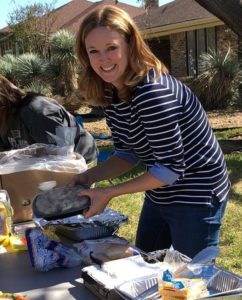
Amanda Pritchard and her family turned their front lawn into a ministry center—grilling hamburgers, distributing food and offering comfort to neighbors whose homes were hit by a tornado. (Facebook Photo)

As she and her husband gained their bearings, they began to take stock of their own experiences and to think about what their neighbors must have been feeling.

“We wanted coffee. We were desperate, tired parents. So, we could only imagine the overwhelming anxiety of other families who were waking up to far worse situations than we faced,” she said.

Her husband tried to pick up enough coffee and donuts at a nearby store to deliver to people on their street, but he discovered the shop was closed, due to lack of electricity.

Pritchard knew many of their neighbors would need meals later in the day. So, she contacted First Baptist in Richardson.

“I said: ‘We want to do a cook-out for our neighbors. Our community is broken,’” she recalled. She placed an order at a warehouse club for enough food to provide lunch for all the neighborhood. Student pastors from First Baptist delivered a large grill to their home, and they all went to work grilling hamburgers, hot dogs and vegetable burgers.

They served more than 150 people from the family’s front lawn.

‘Being the hands and feet of Jesus’

TBM chainsaw crews who were working in Richardson lined up for water and snacks outside Amanda Pritchard’s home. (Courtesy Photo)

At the church’s request, a local restaurant donated enough pizzas to serve all the residents in the neighborhood—as well as volunteers and laborers working in the area—the next meal.

“Our lead pastor was delivering pizza to men working on rooftops,” Pritchard said.

Others donated additional food, and church members helped cook and serve.

For the noon meal on Tuesday, the ministerial staff from First Baptist in Richardson arrived to grill hamburgers and hot dogs for 120 people.

“I knew we had an incredible church, but it’s amazing to see them in action,” Pritchard said. “It’s wonderful seeking so many people being the hands and feet of Jesus, serving our community.”

While Pritchard provided some coordination for the church’s involvement, the ministry developed organically.

“We didn’t have any kind of contingency plan,” she said. “I already have a checklist in mind for the next time anything like this happens.”

On Oct. 22, plans already were in place for the next day’s meals. Beyond that, Pritchard and her fellow church members just wanted to continue to be “a comforting presence” in their community—whatever that might involve.

“We’re just taking it one day at a time,” she said. “Each day is a new day.”


Conclave encourages collaboration and relational ministry

RICHARDSON—If young lives are not shaped by caring Christians who build relationships with students, those lives will have character formed by technology and society at large, a leadership expert told a Texas Baptist conference.

Young people want to feel they truly are understood and valued, Mark Matlock, president of Wisdom Works Ministries told attendees of the 2019 Texas Baptists Conclave.

Matlock encouraged ministers to disciple youth and children by first getting to know them personally. Only after that trust has been established will they be open to spiritual guidance, he said.

“We have the power of Jesus in us, and we have a generation in front of us that wants to change the world,” Matlock said.

Conclave—sponsored by the Baptist General Convention of Texas—is designed to offer training and networking opportunities for youth, family and NextGen ministers from around the state, organizers explained.

Participants at Conclave, held Oct. 14-16 at First Baptist Church in Richardson, heard from nationally known speakers such as Matlock about how to raise a generation of resilient disciples. Conclave also featured breakout sessions that offered participants the opportunity to explore in-depth topics designed to further their ministries.

Need to collaborate

Several breakout sessions emphasized the need for collaboration between ministries.

Conclave attendees participate in breakout sessions designed to further their ministries. (BGCT Photo)

In a workshop on “Ideas for Multi-Generational Ministry,” Cory Liebrum, minister to families at First Baptist Church in Rockwall, stressed the importance of fostering strong bonds between age groups within the church.

Multi-generational ministry creates a sense of family at church, and it allows different groups to glean wisdom and advice from the others, he said.

Liebrum suggested having senior adults sponsor youth by praying for them during mission trips and making them care packages. The youth could, in turn, teach technology classes or host dinners to give back to the adults.

Walter Ballou, student pastor at Green Acres Baptist Church in Tyler, also focused on collaboration in his session on “The Hand-Off: Effectively Moving Age Groups from One Ministry to the Next.” Ballou taught family ministers how to work together to ensure that students have smooth transitions throughout their time in church. Failing to do so, Ballou explained, could lead students to slip out of the ministry.

Ballou encouraged family ministers to create a consistent message or mission statement that is reiterated in all age-groups, from preschool to high school ministry.  By working together, different ministries build a strong foundation on which students can base their faith.

Pastor Delvin Atchison of Westside Baptist Church in Lewisville and Jimmy McNeal, worship leader at Austin Stone Community Church, led general worship times at Conclave.

Atchison reminded participants of the importance of their work in the lives of students.

“God has a purpose for your life,” he said. “Don’t let anyone tell you it’s not important… because there are lives you’re touching.”

Reggie Joiner, founder and CEO of Orange, closed the conference, underscoring the importance of building genuine bonds with youth, children and preschoolers. Jesus came to earth to demonstrate that God is personal, and ministers should follow Jesus’ model, Joiner explained.

He recounted the story of Zacchaeus from Luke’s Gospel. Jesus’ ability to see Zacchaeus as a beloved child of God changed Zacchaeus’ life, Joiner said. Likewise, family ministers can have a huge impact on the students they teach.

“The way you see the kids and teenagers changes the way the whole community sees them and how they see themselves,” Joiner said. “What you do matters, because everyone needs somebody who sees them like Jesus does.”


MacArthur blasts Beth Moore, accuses SBC of rejecting biblical authority

SUN VALLEY, Calif. (RNS)—Conservative Reformed pastor John MacArthur weighed in on an ongoing debate in the Southern Baptist Convention over women preachers, claiming the denomination has lost faith in the authority of the Bible.

Speaking at a celebration of his 50th year in pulpit ministry, MacArthur asserted the SBC had taken a “headlong plunge” toward allowing women preachers at its annual meeting this summer. He pointed to it as a sign the denomination no longer believed in biblical authority.

“When you literally overturn the teaching of Scripture to empower people who want power, you have given up biblical authority,” MacArthur said.

During the “Truth Matters Conference,” held Oct. 16-18 at Grace Community Church in Sun Valley, California, where he is pastor, MacArthur and other panelists were asked to react to one- or two-word phrases. Asked to respond to the phrase “Beth Moore,” a well-known Southern Baptist Bible teacher, MacArthur replied, “Go home.”

Sounds of laughter and applause could be heard in response during a recording of the session, posted online.

MacArthur—a leading proponent of Reformed theology and of complementarianism, the idea that women and men have different roles to play in the church and in society—apparently was responding to a controversy this past summer when Moore noted on Twitter that she spoke at a megachurch on a Sunday morning.

Her tweet led to accusations that Moore was undermining Southern Baptist teaching, which bars women from holding the office of pastor in churches.

MacArthur went on to criticize Paula White, a prosperity gospel preacher known as a spiritual advisor to President Trump, saying that he found these women preachers troubling because, “I think the church is caving in to women preachers.”

The pastor went on to say that the #MeToo movement was a sign the culture was taking over the church and accused feminists of wanting power rather than equality. He also seemed to compare women preachers to salespeople who hawk jewelry on TV.

When asked if the Southern Baptists were now moving toward “soft complementarianism,” MacArthur replied, “I don’t know about terms. I just know women are not allowed to preach.”

MacArthur also criticized the Southern Baptist Convention for passing a resolution that was supportive of critical race theory and intersectionality, seeing it as a sign that “liberalism” was taking over. He also dismissed calls for more ethnic diversity on Bible translation committees.

His comments provoked a spirited response on social media.

Stephanie Tait, a Christian author and speaker, said on Twitter that she was “heartbroken, angry, and honestly just exhausted.

“I’ll keep preaching, but this still hurts,” she added.

Micah Fries, a Southern Baptist megachurch pastor in Chattanooga, Tenn., objected in his Twitter response to MacArthur’s “derisive, divisive manner” and called his comments “devastatingly dismissive of the inherent dignity, value and self-worth of women.”

J.D. Greear, president of the SBC, responded good-naturedly on Twitter, saying Moore was “welcome in our home any time,” adding a hashtag referring to the Baptist Faith & Message, a statement of SBC beliefs.

Beth Moore has not posted a comment on her Twitter feed in response. Instead, she continued tweeting her thoughts on reading through the book of Job.


Baptists meet needs in wake of North Texas tornado

In the immediate aftermath of a tornado that swept through North Texas on Oct. 20, leaving behind a 17-mile path of destruction, Texas Baptist Men disaster relief volunteers offered rapid response and Christian compassion.

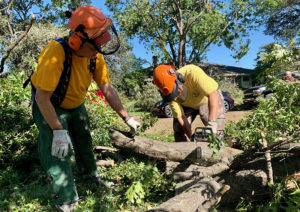
TBM chainsaw volunteers respond the morning after a tornado hit northern Dallas County. (TBM Photo / John Hall)

The first of many TBM chainsaw crews gathered at daybreak the morning after the storm hit to begin helping residents clear fallen trees and large limbs from their homes. The initial crew worked in a hard-hit residential area north of Richland College in northeast Dallas County.

“The Dallas tornado tore a hole in our hearts as it ripped through the city,” TBM Executive Director Mickey Lenamon said. “It rocked people’s world.

“We’re providing help, hope and healing in Jesus’ name to people and families affected by this tragedy.”

The storm left more than 150,000 Dallas-area residents without electrical power much of the night, caused many schools throughout the area to cancel classes the next day and forced multiple road closures. By 7 a.m. on Oct 21, more than 65,000 Dallas County residents still lacked electricity in their homes.

At least two churches seriously damaged

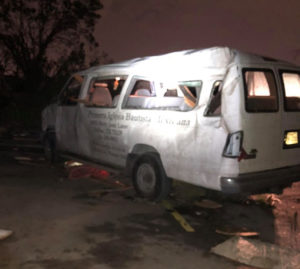
At least two churches in Dallas Baptist Association sustained serious damage to their facilities—Northway Church and Primera Iglesia Bautista of Dallas. No injuries were reported at either church site.

“Last night the church building suffered a direct hit from a tornado that came through northwest Dallas,” Northway Church posted on Facebook the morning after the storm hit. “We mourn the loss of our building, but remember that the church is bigger than a building as we turn to see how we can serve our community.”

A second post on social media noted the need for volunteers who could help “knock on doors in the neighborhood and help to remove debris, cut and remove trees, pick up trash, etc.”

The tornado directly hit Primera Iglesia Bautista in Dallas, destroying its fellowship hall and the sanctuary where the congregation met for worship the last four decades. See a related story here.

Ricardo Brambila, pastor of Primera Iglesia Bautista in Dallas, also is director of the Buckner Family Hope Center at Bachman Lake—a neighborhood that is 93 percent Hispanic and one of the most economically challenged areas in Dallas.

Personnel from Buckner International were assessing needs of clients in the area the day after the tornado hit. The Family Hope Center

TBM disaster relief ministries are made possible by gifts from individuals and churches. All gifts designated for disaster relief through TBM are used for disaster relief ministry. To contribute financially, send a check designated “disaster relief” to Texas Baptist Men, 5351 Catron, Dallas, TX 75227, call (214) 275-1116 or visit TBMtx.org/donate.

This article will be updated as new information becomes available.  


Tornado destroys Primera Iglesia Bautista building in Dallas

When severe weather swept through North Texas Oct. 20, a tornado destroyed the Primera Iglesia Bautista de Dallas building in northwest Dallas.

A member of the congregation—Francisco Flores—was at the building Sunday evening preparing for the class he planned to teach on Wednesday when the building began falling apart, Pastor Ricardo Brambila said.

Flores found safety in an area of the sanctuary by leaning against one of the few walls that survived the storm, Brambila reported.

“We are still in shock after our 40-year-old sanctuary was gone in less than a couple of minutes,” Brambila said.

The church, which is more than a century old, had met in that building for the past 40 years, and many families have been members of the church for decades, he said.

While the church has insurance, Brambila was unsure how much of the damage to the building and other loss of property would be covered.

Documents and photos telling some of the church’s history cannot be replaced if lost, Brambila said, but he added he is thankful to God no lives were lost.

Standing on the promises of God

Leaders of Primera Iglesia Bautista in Dallas began early on Oct. 21 assessing damage to church property after a tornado hit the night before. (Photo courtesy of Primera Iglesia Bautista in Dallas)

Earlier in the day, Brambila preached a sermon from Numbers 14. The Old Testament passage tells about a time when Israel rebelled against Moses and God after wandering in the desert for years. Brambila pointed out how God reminded Israel of his promise and of what awaited them.

After the tornado that hit later that same day, Brambila said, he trusts the congregation also will hold to the promise of God’s fidelity.

“We know that all things work together for good for those who love God,” said Brambila as he quoted Romans 8. “We love God, and this will serve for our good.”

As Brambila and members of his church assess damage and seek to determine  the path forward, he noted several other churches and Baptist leaders already had offered their support and prayers.  First, he noted, his congregation will need to make decisions about where to meet for worship.

“We are thankful for churches who have shown their support,” Brambila said. “We do not know what will be next, but we’re glad others want to offer us help.”

Pastor Ricardo Brambila and his wife Janeth serve Primera Iglesia Bautista in Dallas. (Courtesy Photo)

Jesse Rincones, executive director of the Hispanic Baptist Convention of Texas, expressed the concern of Convención for the Dallas congregation.

“We’ll do whatever we can to help them continue their ministry,” he said.

He commended Brambila for his comforting and calming presence through a traumatic event.

“Ricardo’s leadership has been extraordinary at this time,” Rincones expressed.

Pastor Carlos Valencia of Iglesia Victoria en Cristo in Fort Worth, who also is coordinator of Faith Community Health, noted the need to consider the emotional needs of Primera Iglesia Bautista in Dallas and its leaders. While concerned Christians are quick to offer immediate relief in times of disaster, he noted the need for support through the long-term process of recovery.

“PIB Dallas will need others walking alongside them later on as they begin the process of healing and growing after the disaster,” Valencia said.


Historic Hispanic Texas churches persevere and adapt

Geographic distance separates three Hispanic Texas Baptist churches established in the 19th century, but a shared commitment to making necessary adjustments to reach people for Christ unites the congregations in Laredo, San Antonio and El Paso.

Churches must “move with the times without watering down the gospel,” said Dorso Maciel, pastor of Primera Iglesia Bautista de Laredo.

Beginnings of Hispanic Baptist work in Texas

His congregation was founded as Primera Iglesia Bautista Mexicana de Laredo 47 years after Texas gained its independence from Mexico in 1836.

In a document marking the church’s centennial, the Laredo congregation asserted that while the name included “Mexicana,” most of its founding members were American citizens who selected the name to show pride and recognition of “their Mexican roots.”

In the 1800s, Southern Baptist missions to Mexico also included South Texas. In 1880, the Southern Baptist Convention’s Foreign Mission Board commissioned John Westrup as a missionary. Along with his brother Thomas, the Westrups served in both Mexico and Texas.

One year after John Westrup began Baptist missionary work in Laredo, he was killed on his way to a preaching engagement in Musquiz in Coahuila, Mexico. Thomas Westrup continued the work, and Primera Iglesia Bautista de Laredo was established in 1883.

Five years later and more than 150 miles to the north, Primera Iglesia Bautista de San Antonio was established. Manuel Treviño, a former Methodist deacon, was ordained to the ministry and became the church’s pastor three months later. During his time in San Antonio, Treviño helped start several other churches including Primera Iglesia Bautista de San Angelo.

Differing accounts

Historical accounts differ regarding the beginning of Baptist work in El Paso.

In his 1981 book, A History of Mexican Baptists in Texas, Joshua Grijalva reports Alejandro Marshand—a former Catholic priest—was pastor of a Methodist mission in El Paso. However, in a Bible study with the pastor of Second Baptist Church, a black congregation, Marshand became convinced Baptist views on baptism and Lord’s Supper were true to Scripture.

Marshand preached his newfound convictions at his Methodist mission and then announced it was his last sermon as a Methodist minister. The pastor of Second Baptist Church subsequently baptized Marshand and 28 others in the Rio Grande in July 1892, and those newly baptized believers formed Primera Iglesia Bautista Mexicana de El Paso, Grijalva wrote.

Other sources refer to the church’s founding pastor as Alejandro Marchand and indicate he was Presbyterian rather than Methodist. Some question whether he ever became Baptist, and reports vary regarding how long he remained at Primera Iglesia Bautista in El Paso.

By the beginning of the 20th century, nine Hispanic Baptist churches in Texas totaled about 360 members. They ranged from El Paso to Floresville and from San Angelo to Laredo, Juan Martinez noted in his book, Los Evangelicos: Portraits of Latino Protestantism in the United States. In 1910, representatives from those churches met in San Antonio and formed the Mexican Baptist Convention of Texas, later renamed the Hispanic Baptist Convention of Texas.

Pioneering churches persevered

Although they faced social and economic challenges, Hispanic Baptist churches persevered, and by the 1940s, they started several important ministries like the Mexican Children’s Home and the Mexican Bible Institute in San Antonio, now Baptist University of the Américas.

In 1980, Leo Samaniego—then pastor of Primera Iglesia Bautista in Laredo—removed a plaque to expose a time capsule placed at the building in 1946 by Pastor Andres Cavazos. (Courtesy Photo)

The pioneering Hispanic Baptist churches in Laredo, San Antonio and El Paso bear witness to God’s work in Texas among and through Hispanics, Maciel remarked.

Out of his 60 years of experience as a pastor, Maciel has served 27 years at Primera Iglesia Bautista de Laredo.

One change he has observed is the growth in multicultural ministries. Like many other Hispanic churches, Primera in Laredo responds to the needs of younger generations who grew up in the United States and whose background is shaped by intersecting cultures.

Just as Hispanics learned to thrive in different settings, churches realized they needed to adapt to more than one culture to reach rising generations of Hispanics, he added.

People representing varied educational and economic levels—as well as language preferences—must still find a place to come together under Christ at the church, Maciel said.

He regrets the spirit of competition too-often evident among congregations that seek their own growth rather than the growth of God’s kingdom.

“They’re all after the same fish,” Maciel said.

Moving and adapting

Alfonso Flores has led Primera Iglesia Bautista Mexicana de San Antonio as pastor for 29 years. During his tenure, the church has grown and relocated in 2000 from Alamo Street to the former location of Manor Baptist Church on Meredith Drive.

When Manor Baptist faced a decline in its membership, church leaders contacted Flores, offering their property—appraised at $1.1 million—to Primera Iglesia Bautista Mexicana for $350,000.

“We saw that as a blessing from the Lord,” Flores said.

Primera offers two services weekly—one in Spanish and the other in English. Flores views bilingual ministry as essential.

“It is vital, I think. It is indispensable if you live in Texas, where the language is English,” he said. “We have to stay up to date and minister to our younger generations. Even many adults now prefer English.”

Hispanic churches also must communicate in culturally contextualized ways, he added. That requires ministers to stay up-to-date in their knowledge of societal changes and responding accordingly.

Reaching the rising generations

In the case of Primera in San Antonio, that involves seeking to connect with young Hispanics from nominal Catholic backgrounds who left their parents’ church behind.

A key way to connect is to find common ground—starting points for communication—and establishing personal relationships that allow those who have distanced themselves from religion to see Christ at work in the lives of believers, Flores noted.

Primera Iglesia Bautista de El Paso worked hard to minister in its community in the 1960s. By the 1980s and 1990s, about 500 people attended its services every Sunday. (Courtesy Photo)

Pastor Josué Trejo just arrived at Primera in El Paso this past May. Originally from Mexico, Trejo moved to Texas with his parents and grew up in the Rio Grande Valley.

In the late 1980s and early 1990s, the El Paso congregation enjoyed its golden years when membership in the church reached more than 500 people, Trejo said.

“Now the Hispanic community is strong here, but newer generations present new challenges for the Hispanic church,” Trejo said. “The ways in which younger people perceive the role of the church in the community is different.”

Hispanics constitute a majority in El Paso, and for many years, Primera was the only Hispanic Baptist church in the community, Trejo noted. Now, he said, he is glad other strong congregations like Del Sol Church are able to minister to people Primera might not be able to reach.

Like his fellow pastors in Laredo and San Antonio, Trejo believes reaching new Hispanic generations ultimately depends on preaching God’s word faithfully.

Worship styles continue changing, so a church’s identity cannot be found in style, Trejo insisted. Instead, a church must find its identity in Christ, as revealed in the Bible.

“We must create an environment where people can ask questions about the faith.” Trejo said. “People here were hungry for the word (of God), and they are now still hungry for the word.”

While remaining grounded in the Bible, ministers must never close the door to change, he added. Pastors have to be versatile, he said, because pastors are involved in the lives of all kinds of people.

“There will always be something to change, something that needs improvement,” Trejo said. “But all changes must come from God’s will first. That is the only change that will bless the church.”

Call to commitment

Looking to the future, Hispanic Texas Baptist churches need to be filled with believers who commit the entirety of their lives to serve Christ wherever they are, Trejo said.

Committed Christians must be obedient to Christ’s command to make disciples among all people, Flores added.

“Success for a church is when a church is committed to Christ and committed to fulfill the Great Commission,” Flores noted. “We are to preach this every day. The priority of our preaching should be the fulfillment of the great commission.”

Likely, the future in Texas will continue to become more and more Hispanic, Maciel remarked. For that reason, Texas churches must continue to pay attention to the needs of their communities, he added.

While meeting needs demands resources, history shows God is faithful to provide, Trejo added.

“While the church has gone through changes and difficulties, I know God still has a plan for us because we are still here,” Trejo said. “That tells me God is not done working with the Hispanic community.”


Christians call for the Golden Rule to guide political discourse

Several Baptist groups have endorsed an interdenominational call to pray for revival on Nov. 3—a revival of respect and civility in politics.

Exactly one year before the next national election, the National Institute for Civil Discourse is working with Christians across the denominational spectrum to promote “Golden Rule 2020: A Call for Dignity and Respect in Politics.”

Organizers of the initiative are urging churches across the country to take time in worship services on Nov. 3 to pray for the nation and to promote practical application of the Golden Rule to political discussions.

Groups involved in developing Golden Rule 2020 included the Southern Baptist Convention’s Ethics & Religious Liberty Commission, the American Baptist Churches USA and the National Association of Evangelicals, along with several mainline Protestant denominations, the U.S. Conference of Catholic Bishops and the National Council of Churches. The Cooperative Baptist Fellowship also is promoting the emphasis as a faith community partner.

‘Christians should lead the way’

stephen reeves130
Stephen Reeves

“If our country is going to rise above our current intractable divisions, we believe Christians should lead the way by modeling better political dialogue,” Stephen Reeves, associate coordinator of partnerships and advocacy at CBF wrote in a recent blog post.

The intent of the emphasis is not to blame others but to challenge churches to “strive to bear witness to a better way,” he added.

“By promoting this effort, we are not pointing the finger at the speck in our neighbors’ eye and demanding others change their ways. We all fall short of the ideal at times, so we are asking more of ourselves,” he wrote.

Reeves, former public policy director for the Texas Baptist Christian Life Commission, noted Christians should work for justice, which sometimes involves confrontation.

At the same time, he added, “hateful rhetoric and dehumanizing language only escalates and never produces progress or resolution.”

In the months following the Nov. 3 call to prayer, both CBF and the American Baptist Churches will offer follow-up activities and resources.

Organizers of Golden Rule 2020 have created online resources for churches to use on Nov. 3, including Bible study lessons for children and youth about the Golden Rule, sample sermons, practical ways to apply the Golden Rule in political discussions, and suggested Scriptures and a responsive reading.


‘Compelled to Serve’ theme of BGCT annual meeting

WACO—“Compelled to Serve” is the theme when Texas Baptists gather for the 134th Baptist General Convention of Texas annual meeting, Nov. 17-19 at the Waco Convention Center.

Texas Baptists will emphasize the theme through keynote speakers, workshops on evangelism and discipleship, worship times and business sessions.

David Hardage

“Our annual gathering is such a special time for the Texas Baptist family to join together in fellowship,” BGCT Executive Director David Hardage said. “This year’s focus on evangelism and discipleship is much needed and will strengthen our churches, ministry partners and convention staff for important ministry in the days to come.”

Victor Rodriguez

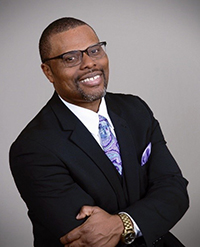
Featured speakers include Duane Brooks, pastor of Tallowood Baptist Church in Houston; Victor Rodriguez, Hispanic evangelism associate and discipleship specialist for Texas Baptists; and Michael Evans, BGCT president and pastor of Bethlehem Baptist Church in Mansfield.

Duane Brooks

Worship leaders include the Singing Men of Texas; Dan Baker, minister of music at First Baptist Church in Amarillo; the Texas Country Boys, a country gospel music band; and Jared Billups and the worship team from Highland Baptist Church in Waco.

Pastor Michael Evans

Texas Baptists’ Hispanic and African American ministries will host worship rallies on Sunday evening. The Hispanic Rally will be at First Baptist Woodway, and the African American Rally is hosted by Greater Ebenezer Baptist Church.

During business sessions, messengers will elect officers and vote on the 2020 proposed budget, nominations for affiliated boards and ministries, resolutions and other matters. For more information on items of business, click here.

About two dozen workshops will be offered on topics including evangelism, preaching, missional culture, foster care ministry, new believer discipleship and church revitalization.

Attendees who visit exhibit halls throughout the three-day event can learn more about Texas Baptists resources, partnering ministries and institutions, as well as enjoy opportunities for networking and fellowship.

Multiple meals and receptions will be hosted by Texas Baptists’ ministries and partners.

During the Texas Baptist Missions Foundation Awards Luncheon on Nov. 18, awards will be presented to Lee and Ruthie Baggett; Faith in Action Initiatives at Baylor Scott & White Health; and Mission Waco – Mission World.

Texas Baptist churches can pre-register messengers online here. Additionally, messenger cards can be requested by calling (888) 244-9400. All sessions are open to visitors, who can register on-site at the registration desk.


Around the State: UMHB hosts TouchDOWNS event

Twenty young people with Down Syndrome served as honorary members of the UMHB cheerleader squad at the Oct. 12 game in Belton. (UMHB Photo)

The University of Mary Hardin-Baylor athletic department hosted its third annual TouchDOWNS event on Oct. 12 in conjunction with Down Syndrome Awareness Month. Families and caregivers of individuals with special needs received free admission to a football game between the UMHB Cru and the East Texas Baptist University Tigers. Prior to the game, TouchDOWNS participants met for a tailgate party in the Bawcom Student Union. At halftime, 60 athletes with Down Syndrome took to the playing field, and 20 served as honorary members of the UMHB cheerleader squad.

Texas Baptists’ annual Hispanic Leadership Conference will be held Oct. 25-26 at Dallas Baptist University. The conference theme, En Sus Manos (In Your Hands), is inspired by Jeremiah 18:6. “What makes this conference unique is that it will focus on two areas—training and equipping,” said Rolando Rodriguez, director of Hispanic ministries with the Baptist General Convention of Texas. “Attendees will receive training at the conference, and when they leave, they will be equipped to put the things they learned into action.” Topics include personal growth, conflict resolution, evangelism, missions, church planting and discipleship. The Hispanic Leadership Banquet immediately follows the conference in the Great Hall of DBU’s Mahler Student Center. Registration cost is $15 per participant for the conference and an additional $10 for the banquet. For more information or to register online, click here.

Texas Baptist Men disaster relief volunteers and ministry partners from Missouri, Florida, New Mexico, Tennessee, Kentucky and Alabama have completed relief operations in the Golden Triangle area of Southeast Texas after Tropical Storm Imelda. They donated more than 23,000 volunteer hours and made more than 2,900 personal contacts. Volunteers prepared more than 33,700 meals, distributed 4,000 boxes for affected residents to gather and store their possessions, and treated 182 homes to mitigate the growth of mold. They also provided access to more than 2,000 showers and washed more than 1,000 loads of laundry. Volunteers distributed 352 Bibles and recorded 41 professions of faith in Christ.

Charles “Rusty” Walton

The Baptist General Convention of Texas recognized Charles “Rusty” Walton as outstanding interim pastor of the year. Walton, currently interim pastor of First Baptist Church in Sour Lake, received the Maples-Williamson-Daehnert Award Oct. 10 at a banquet at Dallas Baptist University. Walton was pastor of First Baptist Church in Duncanville and First Baptist Church in Conroe before entering into interim ministry in retirement. “Dr. Walton embodies the best of interim pastors as he provides grace, a non-anxious presence, and sound wisdom,” said Karl Fickling, coordinator of Interim Ministry for Texas Baptists. E.L. “Skip” McNeal, a prior recipient, presented the award to Walton.

Lane Craig and Helen Sperling, seniors at East Texas Baptist University, received the Bob and Gayle Riley Servant Leadership Award. ETBU President Emeritus Bob Riley and his wife Gayle presented the students a replica of the “Divine Servant” statue, created by Max Greiner. (ETBU Photo)

East Texas Baptist University presented the Bob and Gayle Riley Servant Leadership Award to seniors Lane Craig of Marshall and Helen Sperling of Quitman. Peers, faculty and staff at ETBU nominate students for the award in recognition of their commitment to Christ’s model of servanthood. Craig, a religion major, is involved in Baptist Student Ministry, Kid’s Club, Tiger Camp, Rec-Team and Men’s Ministry. He also volunteers at Travis Elementary School, at Price T. Young Elementary and with Mission Marshall and other community organizations. He also has served in churches as a student ministry volunteer and student intern. Sperling, a mass communication major, has served as a resident assistant, Tiger Camp leader, Titus discipleship leader and mentor to other students.

Wayland Baptist University President Bobby Hall and Flying Queens Foundation President and former Flying Queen Linda Price participate in an induction ceremony into the Naismith Memorial Basketball Hall of Fame in Springfield, Mass. (Photo courtesy of WBU)

The Flying Queens women’s basketball program at Wayland Baptist University was inducted into the Naismith Memorial Basketball Hall of Fame on the strength of its history, impact on the game and continued success over an extended period of time. The Flying Queens were named to the Hall of Fame by a veterans’ direct-elect committee. The Hall of Fame officially inducted the program from 1948 to 1982, when the Queens were instrumental in changes made to women’s basketball. Wayland Baptist University was the first college to offer women athletic scholarships, decades before Title IX. The Queens hold the record for the still-standing longest winning streak in basketball at 131 games, accomplished in a five-year span from 1953 to 1958. Dozens of former Flying Queens and their families, plus other representatives of the university and the Flying Queens including WBU President Bobby Hall and Head Coach Alesha Ellis, traveled to Springfield, Mass., for the ceremony and related events. Linda Price, who played for the Flying Queens from 1966 to 1969 and current president of the Flying Queens Foundation, represented the Flying Queens at the Hall of Fame jacket presentation and other ceremonial functions.

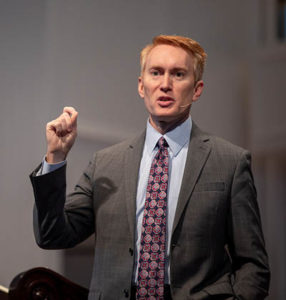
Sen. James Lankford

Speaking in chapel on Oct. 2, Sen. James Lankford, R-Okla., challenged Dallas Baptist University students to be willing to follow Christ into unexpected places. Lankford served in youth ministry 22 years before he ran for Congress. “For months, I kept telling God what a crazy, dumb idea that was. Nobody in my family had been in politics. I had no background in politics,” he said. Once he felt certain God was leading him to pursue elected office, he encountered people who asked why he was leaving ministry to go into politics. “After a while hearing that, I got sarcastic enough to say: ‘Yes, I know, it’s terrible. It seems so odd for God to send light into dark places.’” Lankford encouraged students to be open to God’s leadership, even if it means entering occupations outside the typical notions of Christian vocation. “If our Father calls you to go there, why don’t you follow him, and see what the mission is when you get there?” Lankford said. “The decision we make is not what we’re going to do one day. It’s who we’re going to follow that day when we get there. That’s the real decision.”

Lisa Morris Simon, chair of Morris Strategic Investments and president of the Joella and Stewart Morris Foundation, will speak during the Prince-Chavanne Distinguished Lecture Series at 6:30 p.m., Oct. 23, in Belin Chapel at Houston Baptist University. The lecture series highlights the role of Christian ethics in business. The event is free and open to the public.

East Texas Baptist University presented Hal and Joyce Cornish of Marshall with a Founders Society Award during an Oct. 9 chapel service. ETBU recognized the couple for their recent donations that made possible additional enhancements to the Cornish Soccer Field. Originally built in 2000, the field was initially upgraded in 2007 with funds also provided by the couple, and the current soccer facilities were named in their honor.

Baylor University’s School of Engineering and Computer Science has been awarded a five-year, $1 million grant from the National Science Foundation’s Scholarships in Science, Technology, Engineering, and Mathematics. The grant will support scholarships and activities for 22 students who are pursuing Bachelor of Science degrees in engineering, electrical and computer engineering, mechanical engineering, computer science and bioinformatics. Students in the Engineering and Computer Science Scholars program will participate in varied activities, including an orientation, a monthly seminar series and faculty mentoring. The purpose of the program is to increase STEM degree completion of high-achieving undergraduates with a demonstrated financial need. Through the course of the program, ECS Scholar progress will be tracked and documented in addition to using predictive analytics toward achieving benchmark goals in retention, graduation rates, internships, undergraduate research experiences and job placement.

Anniversary

150th for Clearwater Baptist Church in Scroggins. Bill Holmes is pastor.


Days spent in prayer enabled Brunson to endure Turkish prison

KANSAS CITY, Mo. (BP)—Two years in filthy Turkish prisons reaped for pastor Andrew Brunson a spiritual “hunger, desperation and running after God” that he hasn’t felt since his release.

“I find that I don’t miss prison. I wouldn’t want to go back,” Brunson told Baptist Press after nearly a year of freedom. “But the conditions there drove me to seek God with such desperation. And now that I’m out, and I don’t have those things driving me, then there’s a lessening, a slackening of that hunger and desperation and running after God, and I actually miss that from prison.

“I prayed a lot more because of that desperation, and I ended up structuring my day around prayer.”

His newly released book, God’s Hostage: A True Story of Persecution, Imprisonment, and Perseverance, chronicles his 735-day ordeal that began after 23 years of spreading the gospel in Turkey.

Brunson was arrested in October 2016 solely because of his faith and American nationality, the United Nations Working Group on Arbitrary Detention concluded nearly two months after his Oct. 11, 2018, release, he noted.

‘A matter of spiritual survival for me’

“The conditions of my imprisonment—the fear and the isolation and the anxiety—they really tested me,” Brunson said. “But what they also did is they tested me to seek God as never before. I was just running after him with desperation, because it was a matter of spiritual survival for me.”

Brunson and his wife Norine had been arrested under false pretenses that they were being deported to the United States, but their anticipated departure turned into a prison sentence for him on false charges including espionage and undermining the constitutional order of the state. She was released, but his ordeal intensified with 50 days of solitary confinement.

“When they want to break people, they isolate them and they deprive them of sleep. Isolation and sleep deprivation are very potent weapons,” Brunson said. “My body deprived me of sleep because I was so stressed out that the adrenalin and cortisol were just rampaging through my body all the time and I couldn’t sleep. So, I was exhausted and isolated and just going crazy.

“And what saved me in those 50 days of solitary confinement was structuring my day around prayer.”

Brunson used a prayer and Scripture booklet guards mistakenly allowed him to keep, Prayers to Strengthen the Inner Man by Mike Bickel.

“Those were like gold to me, those Bible verses, because I didn’t have a Bible with me,” Brunson said. “I would just memorize those and repeat them and pray those Bible verses and then pray the prayers … and structure my whole day around them.”

Daily battle to conquer fear and anxiety

Brunson encourages pastors and other struggling Christians to hold on to their faith and their calling.

“No matter how restricted you are and how terrible the situation, you have a choice to make with your will, not your emotions,” he said. “But with your will, you make a decision to turn your face toward God and not away from him.”

It was a battle for Brunson that began anew each day, he said, each evening’s hard-fought victory slipping away the next dawn.

“I’d wake up in the morning with fear and grief and anxiety, and I would begin to focus in, fighting through hours and hours,” he recalled.

Recounting his daily struggle, he recalled praying often to God: “I want to serve your purpose and not mine. If your purpose is for me to be in prison for whatever reason, then I want to submit to your purpose and embrace you, even in the midst of the difficulty.”

“And by the end of the day,” Brunson said, “I usually had reached the point of submission and that would bring me the greatest sense of peace that I had in prison.

“Then the next morning I would wake up with the same fear and anxiety and grief. The previous day’s victory did not carry over to the next day, and then I’d begin that fight again, until the end of the day when I’d reached that point of submission, day after day after day.”

Standing on the promises of God

His wife endured the ordeal by standing on promises God had given the couple through years of spiritual service.

“I realized that this was a situation that was beyond me, and I really needed to be pressing into the Lord,” she said. “There are promises in the word (of God), and then sometimes God would highlight some of those for us specifically. I tried … to claim them, to proclaim them, to keep speaking them out. That’s one of the ways to pray.”

On the week of their arrest, the couple sensed God telling them it was time to come home.

“We didn’t know what it would look like. We didn’t know how, when. But I took that and I kept saying, ‘Lord, you said it’s time to come home, so take us home,’” Norine Brunson said. “Because as Andrew says, when it comes to persecution, there are no guarantees.”


One Christian killed and 12 kidnapped in Nigeria

KADUNA, Nigeria (BP)—A Baptist woman is dead and 12 Christians including church members, school students and teachers remain kidnapped in two successive incidents in Kaduna, Nigeria, widely attributed to militant Fulani herdsmen.

In the latest incident, herdsmen killed Ezra Haruna of Godiya Baptist Church in Ungwan Barau village and kidnapped four of her fellow church members, while many residents fled into nearby bushes, Morning Star News reported Oct. 10.

Days earlier, suspected militant herdsmen kidnapped six female students and two teachers from Engravers College, a Christian boarding school in a remote area of Kaduna state in Nigeria’s Middle Belt, the news service reported.

While Boko Haram terrorists are known for kidnapping Christian school girls in particular, the location of the incidents in the Middle Belt instead of the Boko Haram-heavy northeast has led some religious liberty advocates to attribute the crimes to herdsmen.

“Boko Haram became infamous worldwide after they kidnapped over 270 girls from Chibok Nigeria in a similar fashion,” International Christian Concern said in an Oct. 11 public statement. “They also then kidnapped more than 100 girls last year from Dapchi, Nigeria. They do not often do this in the Middle Belt though. This makes it more likely that Fulani militants were responsible.”

‘Shooting indiscriminately’

In the attack on Ungwan Barau village, militant herdsmen stormed the community around 4 a.m. and shot indiscriminately into houses, witnesses told Morning Star. Gunmen kidnapped Jummai Ido, whose husband is pastor of Godiya Baptist, although the pastor’s name was not reported. Gunmen kidnapped Luka Auta and Sale Auta, brothers, and Yakubu Audu.

A witness quoted in The Guardian said many gunmen “were shooting indiscriminately when they came and people started running for safety.”

No one has claimed responsibility for the attacks, neither the Oct. 7 church attack nor the Oct. 3 school kidnapping, according to many news reports. Police have said they don’t know who committed the crimes but have speculated the culprits might be “bandits” possibly affiliated with Boko Haram.

“No matter what the source of these attacks is, the government in Nigeria is again proving to be completely ineffective in their fight against lawlessness and violence,” International Christian Concern said. “Boko Haram has seen a resurgence despite continued military actions, and the militant crisis throughout the Middle Belt of Nigeria has been continually ignored.”

Call to pray

The watchdog organization encouraged Christians to pray for believers in Kaduna who have been targeted in numerous attacks especially in 2019.

“Hundreds of Christians and others have been killed during these attacks. There have also been dozens of kidnappings of pastors and other Christians that have led to tens of thousands of dollars in ransoms,” International Christian Concern said. “Please pray for the safety of those living in this violent and unpredictable area. Also, please pray for the six girls and two teachers who have been taken from their family and friends.”

Boko Haram is blamed for killing as many as 30,000 people and displacing two million from northeast Nigeria in the past decade, with violence spreading to neighboring nations of Niger, Chad and Cameroon.

Militant herdsmen are blamed for thousands of deaths in attacks that have escalated since 2016.

Open Doors ranked Nigeria 12th in its 2019 World Watch List of the 50 countries where it is most dangerous to live as a Christian. Of the 4,136 Christians killed in 2018, Nigeria accounted for 3,731, the organization reported.

Christians are 51.3 percent of Nigeria’s population, while Muslims living primarily in the north and middle belt account for 45 percent.