Are all background checks of equal value to churches?

WASHINGTON (RNS)—Since they first were offered an opportunity to pool resources and buy background checks on volunteers and employees at a discount 11 years ago, about a third of Southern Baptist churches have signed up for the OneSource program from LifeWay Christian Resources.

Earlier this year, LifeWay reported that 16,000 congregations and other church organizations ran background checks on men and women it hired through a service called  backgroundchecks.com. The Southern Baptist Convention has so far resisted calls to set up a database of its own, saying the national registry was more dependable.

Other denominations are also increasingly using searchable databases on prospective employees as the #churchtoo movement begins to shift church attitudes toward sexual abuse and prevention.

What background checks can and cannot do

Most background checks sift through more than 600 million felony, misdemeanor and traffic records. Perhaps most importantly, they also check the nationwide sex offender registry.
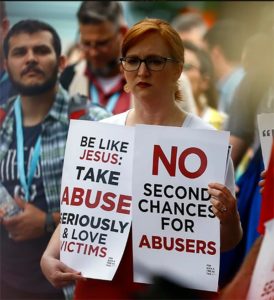
A woman holds signs about abuse during a rally outside the annual meeting of the Southern Baptist Convention in Birmingham, Ala. (RNS Photo / Butch Dill)

But that may give churches and other religious groups a false sense of security about preventing abuse, experts say.

“We make it clear to folks you will have to do a more in-depth search,” said Josh Weis, executive vice president of Ministry Brands, a provider of church management software that also sells screening products for some 30,000 congregations, mostly Protestant. “Not all background checks are created equal.”

Federal law requires all 50 states to implement sex offender registries. But the law does not address lower-level sex abuse convictions and state laws regarding sex abuse vary from state to state.

That means some sex offenders can slip through the cracks.

Jeffrey Epstein, the New York financier charged with sex trafficking underage girls, is a good example.  Epstein was registered as a sex offender in Florida. But in New York, where he owns a residence, he was not required to show up for periodic check-ins required by law after he changed his address to the Virgin Islands, The New York Times reported.

And in New Mexico, where Epstein owned a 26,700-square-foot mansion south of Santa Fe, he was able to avoid inclusion in the state’s registry altogether because his conviction involved a 17-year-old. That is the age of consent in New Mexico.

Deeper background searches needed

Churches need to invest in deeper background searches for employees and volunteers and not settle for less expensive searches in the state where the congregation is located, Weis and representatives of other background check companies insist.

Ministry Brands recently released an audit of the 29,768 churches that have used its “Protect My Ministry” brand, a product for churches. It showed that 40 percent of those church and ministry clients do not take advantage of deeper, more thorough searches of each of the 50 states.

The report also recommended that congregations require applicants to provide Social Security numbers for background checks so it can detect people using false names or aliases.

Recently, the Sarasota County (Florida) Sheriff’s Office charged Charles Andrews, a minister, with 500 felony counts of possession of child pornography. Andrews, who served Osprey Church of Christ in Osprey, Fla., is registered as a sex offender in Alabama.

Officials said Andrews used email addresses and a social media account that were not reported to the Florida Department of Law Enforcement, the Orlando Sentinel reported. It was not clear if church members knew Andrews was a registered sex offender in Alabama. The church’s telephone number was disconnected.

Elizabeth L. Jeglic, a professor of psychology at John Jay College, City University of New York, who studies sex offender registries, said such cases are pretty rare. Only 5 percent of people on the sex offender registry are repeat offenders, according to a recent study in New York state. The vast majority are first-time sex offenders.

Sex offender registry useful but data is limited

Running potential employees through the sex offender registry is useful, said Jeglic. But the data it provides is limited.

The national registry became law after a series of child rapes and murders, perhaps the most famous being that of Megan Kanka, a 7-year-old girl from New Jersey who was raped and murdered by her neighbor in 1994. Her murder led to a series of bills requiring a sex offender registry, with a database tracked by the state and community notification of registered sex offenders moving into a neighborhood. President Clinton signed Megan’s Bill into law in 1996, making sexual offender registries required by all 50 states.

But in recent years, the effectiveness of the national sex offender registry has been called into question. For one thing, the database is not updated in real time. It can take months or years before the database is updated with people who have been released from prison on sexual offenses. For that reason, companies providing churches with database searches recommend that all employees be screened every year.

“Churches have this idea of one-and-done,” said Weis. “We recommend they do it annually.”

In addition, a 2010 South Carolina study showed that many sex offenders plead down charges to a nonsex crime so they aren’t included in the registry.

Need for improved policies and procedures

That, plus the variability of state laws on sex abuse, leads researchers to conclude that screening people through databases such as the national sex offender registry or the state’s criminal database won’t guarantee a sex-abuse-free church environment.

“We’re spending a lot of time and money on enforcing restricted policies that don’t prevent recidivism instead of working on prevention,” said Jeglic.

She recommended that congregations work on policies or procedures to reduce the incidence of sex abuse. That could mean, first and foremost, establishing clear training protocols that forbid church workers to be alone with a child, even in the bathroom, and submitting all new hires to a period in which they are shadowed.

“As a woman and as a mother, it feels nice to be able to look (someone) up and know,” Jeglic said. “But as a researcher the data doesn’t help prevent any future sex crimes. A lot of the information on the registry is incorrect. It gives us a false sense of security.”

EDITOR’S NOTE: The Baptist General Convention of Texas makes training and resources from MinistrySafe available to Texas Baptist churches. The MinistrySafe system includes awareness training, a “Skillful Screening” process for churches as they evaluate job applicants and volunteers, recommended policies and procedures for congregations, background checks, and tools for monitoring and oversight. 


HSU grad ‘just a guy’ who saw a need and responded

MITYANA, Uganda—When Joseph Eunice learned about a need in Uganda, he knew he had to respond to orphaned and vulnerable children there.

Children in Uganda express their appreciation to Just a Guy Ministries and Hardin-Simmons University.

Eunice, a graduate of the physical therapy program at Hardin-Simmons University, is director of operations for Just a Guy Ministries. In that role, he raises funds to provide food, school fees, wells, homes, livestock and vaccinations for orphans in Mityana, Uganda.

The ministry began in 2017 when Eunice was reading his Bible. He could not shake the idea of working with orphanages. Although he had no idea how to make it happen, he committed to praying about the ministry.

Soon after, a friend connected him with Pastor Patrick, a Ugandan minister who was caring for 38 orphans in Mityana. When Eunice realized that Pastor Patrick had no steady income to provide for the children, he decided to begin Just a Guy Ministries.

The organization draws its name from Acts 4:13, a New Testament verse that says people recognized the apostles Peter and John as ordinary people who had been with Jesus.

“The name is to remind everyone that God still uses ordinary people to do amazing things. We just have to say yes,” Eunice said. “When I first started putting everything together, people would always say things like: ‘That’s so cool. I wish I could do something like that!’ And I would always respond with, ‘Well, I’m just a guy who said yes to a need, so there is nothing stopping you.’”

Joseph Eunice credited a trip to Peru with the physical therapy program at HSU in helping him develop a servant’s heart. In Peru, Eunice cared for individuals with special needs and their families.

In addition to accepting year-round donations, Eunice plans three large fundraising events a year.

“I knew nothing about fundraising, nonprofits or really anything that was being asked of me when God put it on my heart to stand up and provide for these orphans,” he said. “I’ve just been learning on the go—just trusting God to show up and be faithful in what he has called me to do.”

A trip to Peru with the physical therapy program at HSU helped Eunice develop a servant’s heart, he said. In Peru, Eunice cared for individuals with special needs and their families.

Working with Joni and Friends and Wheels for the World, Eunice was able to share the gospel and fit mobility devices for those in need.


Baptists cooperate to help flooded Rio Grande Valley churches

HARLINGEN—As churches in the lower Rio Grande Valley recover from devastating floods, neighboring congregations and Baptists around the state continue to respond to their needs.

The National Weather Service called it “déjà vu all over again.” Little more than a year—367 days—after the Rio Grande Valley endured a major flood, more than 15 inches of rain fell in six hours on June 24. Floodwaters destroyed or seriously damaged more than 1,100 homes, and about 45,000 people lost electricity.

Steven Parker, pastor of First Baptist Church in Weslaco, remembers the 2018 flood vividly.

“My home flooded last year,” he said. “It gives a whole new meaning to ministry after a flood when you’ve experienced it yourself.”

TBM offers disaster relief

The summer 2018 flood was one in a series of disasters Parker experienced since he became senior pastor at the Weslaco church in February 2008, about five months before Hurricane Dolly hit South Texas.

“I’ve developed a good relationship with Texas Baptist Men and their disaster relief ministry through the years,” he said. “It’s become far too common an occurrence, but it’s always a blessing to work with those folks.”

Within days after the most recent storm, TBM disaster relief volunteers set up an incident command center at First Baptist Church in Weslaco, which provided housing for the crews.

“TBM volunteers worked on about 150 homes,” said Dwain Carter, TBM state disaster relief director. TBM crews—working alongside South Carolina Baptist Men—tore out damaged drywall, removed soaked flooring, and treated surfaces to mitigate mold.

Baptist disaster relief volunteers prepared more than 1,000 meals and distributed 1,500 boxes to allow flood-affected families to collect and store their belongings. The volunteers washed about 150 loads of laundry and provided access to more than 250 showers. They also distributed more than 30 Bibles.

Flood-damaged churches discovered

TBM assessors and Jorge Zapata, associate coordinator of missions and Hispanic ministries for the Cooperative Baptist Fellowship in Texas, discovered several flood-damaged churches in the area. The first church they identified was Iglesia Bautista Avondale in Harlingen.

Laney Lopez from First Baptist Church in Weslaco works on Iglesia Bautista Avondale in Harlingen. (Courtesy Photo)

Pastor Roberto Reyes and his wife, Lorena, live half a block from Iglesia Bautista Avondale. When Reyes waded from his home to the church building the morning after the storm, he discovered the facility filled with floodwater.

“I surrendered it to God,” he said in a video posted on Facebook. “I told him: ‘You know our situation. You know our finances. It’s in your hands.’ God began to send all kinds of help.”

Zapata had coordinated a mission trip for a group from First Baptist Church in Murfreesboro, Tenn., who planned to work in colonias along the border. The group was housed at Cone Oasis Baptist Camp in La Feria when the flood occurred.

The young people from Tennessee helped Cone Oasis staff deal with rising water that threatened to damage the encampment kitchen, Zapata noted. Then, since the group was unable to travel to the colonias where they planned to serve, Zapata redirected them to Avondale.

The youth group from Tennessee removed wet carpet and water-damaged furniture from the building, and TBM volunteers removed buckled paneling and soaked insulation from interior walls.

Helping sister congregations

Parker and Jose Aguilar, pastor of First Baptist Weslaco Español, recognized an opportunity to help a neighboring congregation. So, they planned a weekend project to replace the interior walls at Avondale, using drywall and other supplies TBM provided.

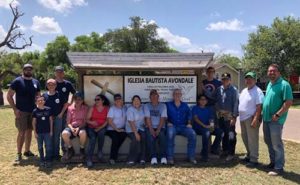
Volunteers from First Baptist Church in Weslaco and New Beginnings Fellowship in Sinton helped members of Iglesia Bautista Avondale in Harlingen. (Courtesy Photo)

Joined by volunteers from New Beginnings Fellowship in Sinton and working in partnership with Christian Aid Ministries, a Mennonite organization, the Weslaco crew hung sheetrock throughout Avondale’s facility.

In the weeks ahead, First Baptist Weslaco hopes to work with Zapata on several “other projects on a smaller scale,” Parker noted.

In addition to Avondale, Zapata identified three other Hispanic churches in the area that sustained significant damage and lacked flood insurance.

The storm damaged the roofs of both the parsonage and worship facility of Iglesia Bautista Emanuel in Harlingen, resulting in damage to their interiors. The storms and subsequent flooding also damaged Iglesia Bautista Getsemane in Elsa and Iglesia Bautista Sublime Gracia in Progreso.

Continuing assistance

CBF Disaster Response provided $10,000 to help the churches, and CBF Texas contributed an additional $1,000 grant. Fellowship Southwest is seeking to raise $25,000 to cover the cost of repairing what the churches lost and replenishing the CBF Disaster Response emergency fund.

In addition to providing financial assistance, Zapata also is coordinating mission teams to help with construction projects at the affected churches.

For more information about the Fellowship Southwest Rio Grande Valley flood-recovery effort, click here.

To contribute financially to TBM disaster relief, send a check designated “disaster relief” to Texas Baptist Men, 5351 Catron, Dallas, TX 75227, call (214) 275-1116 or click here.


Americans find identity in family and accomplishments

NASHVILLE—Most Americans say they find their identity in relationships and achievements, according to a new study.

LifeWay Research asked more than 1,000 Americans about their sense of identity and what matters most about themselves.

Few Americans say religion in general or faith in Christ specifically is at the forefront of their identity.

Who do you think you are?

Researchers asked the open-ended question, “When you think about who you are, what are the first three things that come to mind?” Only 8 percent say Christian. Fewer say religious/spiritual (2 percent), child of God (2 percent) or blessed (1 percent).

More Americans mention being a parent (25 percent), intelligent (12 percent), their job (11 percent), compassionate (11 percent), husband (10 percent), kind (10 percent), trustworthy (10 percent), wife (8 percent), friend (8 percent), hardworking (8 percent) and honest (8 percent).

Most characteristics volunteered were positive or merely factual. However, some Americans chose potentially negative traits as one of the first things that came to mind about themselves, such as lonely (4 percent), anxious (2 percent), overweight (1 percent), angry (1 percent), bored (1 percent) or poor (less than 1 percent).

“There is no single lens or identifier Americans use to think of themselves,” said Scott McConnell, executive director of LifeWay Research. “Ironically, that means the personal identity people have or seek may not be what others see in them.”

What is most important to your identity?

When given a list of potential facets that could be “very important” to their identity, most respondents point to their role in their family (73 percent) and the good they do (57 percent). Around half say what they have achieved (51 percent) and their role as friend (49 percent) is vital to their identity.
Fewer choose their interests or hobbies (44 percent), what they have endured (39 percent), their religious faith (37 percent), their talents (35 percent), their job (32 percent) or their education (29 percent).

Even fewer point to their country of birth (26 percent), political views (18 percent), looks (17 percent), ethnic group (16 percent), sexuality (12 percent) or favorite sports team (7 percent) as a very important part of their identity.

When asked to choose the most important part of their identity, Americans are most likely to say their familial role (44 percent) is top among those characteristics that are very important.

Around one in six (18 percent) name religious faith as the most important part of their identity. For 10 percent of Americans, the good they do is most vital. Fewer than one in 10 chose any of the other options.

Identity and behavior

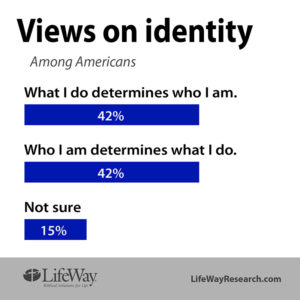
The LifeWay Research survey also found Americans evenly split on the relationship between identity and behavior.
When asked which statement best described their opinion, 42 percent say, “What I do determines who I am,” and 42 percent say, “Who I am determines what I do.” Around one in seven (15 percent) aren’t sure.

“These two equally common perspectives on life have very different assumptions,” McConnell said. “Working to achieve a reputation presupposes you have less value unless you do. Seeking to genuinely live who you are assumes you had value from the start.”

LifeWay Research conducted the study September 21-23, 2018. Analysts used sample stratification and base weights for gender, age, race/ethnicity, region, metro/non-metro, home ownership, education and income to reflect the most recent U.S. Census data.

The completed sample is 1,010 surveys, providing 95 percent confidence that the sampling error does not exceed plus or minus 3.1 percentage points. Margins of error are higher in sub-groups.


Texas Baptist schools prepare for Hispanic growth

In a state where the majority of students in public schools are Hispanic and where Hispanics are projected to outnumber Anglos in the general population within the next three years, Texas Baptist universities are preparing for change.

During the 2017-18 academic year, Hispanics represented a majority of the student population at one school that partners with the Baptist General Convention of Texas—Baptist University of the Américas in San Antonio, where they comprise 54.9 percent of total enrollment.

Two other universities—Houston Baptist and Wayland Baptist—qualified as Hispanic Serving Institutions, a designation reserved for schools that reach at least 25 percent Hispanic enrollment. Hispanics represented 35.7 percent of the total enrollment at HBU and 32.3 percent at Wayland.

Universities and colleges know they become more attractive to Hispanic students if they achieve the HSI label, and schools will not spurn the grants following that label, either. Eligible universities classified as Hispanic Service Institutions qualify for federal grants to provide academic and social support to Hispanic students.

Five Texas Baptist schools—the University of Mary Hardin-Baylor, Howard Payne University, Hardin-Simmons University, Dallas Baptist University and Baylor University—qualified as Emerging Hispanic Serving Institutions.

Hispanic students represented 21 percent of total enrollment at UMHB, 20.7 percent at Howard Payne, 18.9 percent at Hardin-Simmons, 15.9 percent at DBU and 15.2 percent at Baylor, according to the Hispanic Association of Colleges and Universities.

Baylor seeks to support first-generation students

Although 51 percent of all students in the state’s public schools are Hispanic, only 27 percent of Hispanics in Texas have college degrees. That percentage goes down to 22 in the nation, said Mito Diaz-Espinoza, program manager of Student Success-First in Line at Baylor University.

Hispanics represent a significant segment of first-generation college students, he noted. At Baylor, about one-fifth of the students are first-generation students. More than one-third—36 percent—of the first-generation students at Baylor are Hispanics.

“We’re a support unit for first-generation college students,” Diaz-Espinoza said. “This is for any students whose parents have not received a four-year bachelor’s degree.”

First in Line offers scholarships, programs that match students with peer leaders, as well as faculty, staff and mentors who wish to support first-generation students, he said.

“We have to go after first-generation students if we want to make any kind of real difference in our changing demographics,” Diaz-Espinoza observed.

Coaching students through the ‘rough patches’

College life requires meeting deadlines, jumping through hoops and balancing five things at once—including finances, Diaz-Espinoza commented.

(Photo/ Baylor University)

“We tell them, ‘This is the game of college, and these are the steps you take.’ So, we teach them what it means to navigate this place and then coach them through the rough patches,” he said.

First-generation students need support since they struggle finding a home when universities already have terminology unfamiliar to the students, he noted. Terms like “provost,” “credit hours,” or even “dining hall” seem so foreign back home, students feel they cannot share all of what they experience in college with their families, Diaz-Espinoza said.

Many of the first-generation students came from academic programs where they excelled, and at college, they find themselves in a setting where they feel alienated, he noted.

“In their family, they are typically seen as kind of the smart ones or the good ones because they always did very good in class and succeeded easily in high-school,” he said.

“So, for them to fail a chemistry class when they never got anything lower than a 99 in high school chemistry, then that attacks their identity a little bit more. They may say, ‘Maybe I’m not smart enough for college,’ or ‘Maybe I don’t belong here,’ or ‘Maybe there’s a reason no one in family ever went to college.’”

Not only do first-generation college students need lessons on the different cultural nuances they find while studying at the university, but sometimes faculty and staff need lessons on cross-cultural communication, Diaz-Espinoza added.

“I try to help professors understand that at some point, they were the first ones to do something in their family,” he said. “Maybe their parents did go to college, but they were the first ones to pursue graduate school, first to be a college professor or first to do research for a living.”

Mary Herridge, senior director of Baylor’s admissions counseling, pointed out how vital it is for recruiters to connect in language and culture with the groups that make up the majority of public school students. Almost a third of the admissions recruitment team now speaks Spanish, she said.

Diaz-Espinoza also noted the need for more diversity among university faculty and staff. More faculty and staff who look like the students they serve must be the next step, he insisted.

Howard Payne University connects with Hispanic alumni

BGCT-related educational institutions have adopted a variety of approaches to attract Hispanic students and respond to their distinctive needs.

Cory Hines, new president at Howard Payne University, visits with members of the local community during his first day in office. (HPU Photo)

When Cory Hines became president of Howard Payne University, the school renewed its efforts to support Hispanic students, said Kevin Kirk, associate vice president for enrollment management.

“Hispanic students have historically been a part of Howard Payne,” Kirk said, noting HPU has produced a significant number of Hispanic Texas Baptist leaders through the years.

Soon after Hines arrived as president, he scheduled meetings with Hispanic alumni and Hispanic Baptist leaders who are also friends of the university, Kirk noted.

The meetings served as starting points for the university to improve understanding of ways in which HPU can connect with Hispanic students and offer them support as they pursue their degree, Kirk said.

“It’s always been such an important part of our culture, to be that Christian higher education choice for Hispanic students,” Kirk said. “With Dr. Hines’s arrival, there’s been a renewal of that sense of identity in order to be involved in all we can be, make the connections we need so Texas Baptist Hispanic students are aware of us and the opportunities they have here.”

Over the past decade, students of non-Anglo backgrounds at the university increased from 26 percent to 54 percent, he said. He added 27 percent of the 246 incoming students starting last academic year were Hispanic.

A close-knit Christ-centered academic community like Howard Payne can be the type of environment many Hispanic students look for, Kirk commented.

“We want to be the right choice for Hispanic students,” he insisted.

DBU wants Hispanic students to thrive

Dallas Baptist University has a similar aspiration—“to be the premier school for Hispanic students,” according to David Reyes, director of student life at DBU.

Harold Aguirre graduated from Dallas Baptist University with a double major in communication theory and intercultural studies. He went to work in the admissions office at DBU while he pursues his master’s degree in bilingual education. (Photo / Isa Torres)

The vision began when Gary Cook was DBU president and sought to increase the number of Hispanic students. Cook transitioned to chancellor of DBU in 2015, but the vision continued to flourish when Adam Wright became the university’s president in 2016, Reyes noted.

“The goal is not only to see how we can welcome more Hispanic students here. But once they’re here, we want to see how they can thrive,” Reyes said.

DBU’s vision for Hispanic students requires cultural awareness, Reyes said.

“We understand we are not only recruiting the individual students, but we are also recruiting their families,” he commented.

In 2015, DBU began awarding two scholarships every year to Hispanic students, covering 50 percent tuition and 100 percent room and board. The first students who received the scholarships, Bethany Morales and Harold Aguirre, graduated from DBU in May.

DBU hired Aguirre as soon as he graduated to work with the admissions office. Reyes hopes

other Hispanic students find in him the support they need to understand what college education demands and the support DBU could offer them.

“Harold is an example of the education DBU is committed to give,” Reyes said. “With him and through our partnerships, we just want to be at the forefront of what is happening.

“Our heart is just to support students starting school, getting involved, developing their leadership skill, finishing school and using their skills for the church.”

‘A direct reflection of God’s kingdom’

Several schools echoed the idea that the desire for an increasingly diverse student body grows out of the institution’s Christian mission.

“At East Texas Baptist University, we believe that a diverse community is a direct reflection of God’s kingdom,” said Kevin Caffey, ETBU’s vice president for enrollment and administrative affairs.

“We devised a comprehensive plan to enhance the institution’s efforts to expand the Hispanic campus population,” Caffey said. “We recognized that this vision would necessitate a campus-wide commitment to support Hispanic student success.”

That means providing a welcoming atmosphere where students feel at home—where they experience familia.

“Hispanic students at ETBU can expect to be surrounded by faculty, staff, and peers, who appreciate the Hispanic culture,” said Ana Asencio, ETBU freshman admissions counselor. “They will be welcomed by mentors, who encourage Hispanic students to embrace and utilize their culture and diversity to contribute to the richness and blessing of ETBU’s colorful campus fabric.”

Logsdon seeks to serve underserved population

Since its beginning, Hardin-Simmons University’s Logsdon Seminary in San Antonio has prioritized reaching underserved populations—particularly Hispanics.

Bob Ellis, dean of Hardin-Simmons University’s Logsdon Seminary, offers a prayer of dedication for the Logsdon Seminary in San Antonio campus at Trinity Baptist Church. (Photo / Isa Torres)

Wally Goodman, director of Logsdon Seminary programs in San Antonio, started his position in 2010 after working at Baptist University of the Américas. At BUA, Goodman learned about generational and cultural differences among Hispanics. That knowledge has served him well at Logsdon’s San Antonio campus, where a third of the student population is Hispanic.

Since 2011, Logsdon in San Antonio has grown to offer the three master’s degrees offered at the main campus in Abilene, as well as the Doctor of Ministry degree.

At first, the growth came with some challenges in terms of class scheduling and location of the campus, Goodman said. But now students face a different challenge in terms of education in a multicultural setting, with a student body that is one-third Hispanic, one-third African American and one-third Anglo.

“The students get along well and they love each other,” Goodman said. “They love the diversity, and I think it’s helped them be more sensitive.”

His background at BUA and now at Logsdon in San Antonio give Goodman an appreciation for the multicultural setting in which the church will exist, he said. But that also means universities and seminaries most prepare students to function and minister in multicultural settings, he remarked.

For the first time last year, the majority of students at both Logsdon Seminary campuses consisted of non-Anglos, said Meredith Stone, associate dean for academics and assistant professor of Scripture and ministry at Logsdon Seminary. Across all campuses of Logsdon seminary, 21 percent of the students identified as Hispanics, she noted.

Because of its student diversity, the Association of Theological Schools invited Logsdon and 19 other schools to be part of a project called Cultivating Educational Capacity Dissemination Conference. The two-year program aims at increasing the effectiveness of ATS schools in educating racial/ethnic students and all students in cultural competence.

Baptist universities and seminaries benefit when they prepare for students of multicultural backgrounds who plan to work in multicultural settings, Goodman observed.

“We are all well served when we learn to relate beyond our cultural background,” he said.


Obituary: Jerry Bob Taylor

Jerry Bob Taylor of Brownwood, former Baptist encampment manager and Texas Baptist Men leader, died July 15. He was 84. He was born in Brownwood on Jan. 24, 1935, to Bob and Mildred Taylor. He accepted Christ as his Lord and Savior during a campus revival at Howard Payne University. Taylor graduated from HPU in 1966, and went on to become pastor of churches in Brady, Blanton, Lohn, Brownwood, Midkiff, Big Spring and San Marcos. From 1970 to 1981, he served on the TBM staff, where he was instrumental in developing the disaster relief ministry that became a model for Baptists nationally. As a volunteer, he assisted with the recovery process after the 9-11 terror attacks, and he served in Africa feeding refugees from Rwanda’s civil war. The disaster relief communications room at the TBM headquarters in Dallas is named for him. After he retired from TBM, he became camp administrator for Circle Six Ranch Baptist Camp in Stanton. Under his direction from 1981 to 1995, the camp served more than 69,000 guests, and Taylor witnessed 1,739 give their lives to Christ. After returning to Brownwood to retire, the Taylors opened the Tuf Times Art Gallery. Taylor—an acclaimed woodcarver and sculptor—was a member of several artist associations through the years. He participated in numerous judged art shows, and he designed and created the Will Rogers Award that is given annually at the Academy of Western Artists awards ceremony. He was preceded in death by his son, Stephen Taylor. He is survived by his wife, Audrey Laverne Taylor of Brownwood; daughter Lori Hurt and husband Doug of Brownwood; two grandsons; a great-granddaughter; and a sister, Jo Ann Ricker of San Angelo.


River Ministry responds to increased needs along the border

Missionaries with Texas Baptists’ River Ministry are at work along the Texas/Mexico border, partnering with churches and organizations to meet the needs of immigrants, deportees, refugees and asylum seekers.

But the greatest need along the Rio Grande is prayer, said Daniel Rangel, director of River Ministry.

“There are great spiritual needs that our River Ministry missionaries and churches witness each day,” he said. “Pray for opportunities to share the gospel with each person we minister to.”

Rangel invited churches and individuals to donate financially to purchase food, toiletries, clothing, basic necessities, Bibles and evangelistic materials to provide to immigrants.

He also encouraged churches to send mission groups and vision teams to work alongside churches in Texas and Mexico who are engaged in daily ministry.

“When someone goes to the border to serve and sees the needs, they can’t help but go back,” Rangel said, noting the opportunity for long-term partnerships.

Hospitality in Laredo

Ruth Ortiz, Texas Baptists’ River Ministry missionary, and her family are caring for 80 to 100 immigrants per day at their home in Laredo. (Photo / Jeremy Sharp)

Ruth Ortiz serves as a River Ministry missionary in Laredo, meeting needs in the community and working with church groups in mission opportunities.

She and her parents, Lorenzo and Aralia, care for 80 to 100 immigrants a day at their home in Laredo.

When immigrants are released by U.S. Customs and Border Protection from detention centers, they are dropped off at the Catholic Charities facility in Laredo. Volunteers from Catholic Charities register each person and family unit and then drive the immigrants to the Ortiz home.

Ruth Ortiz helps coordinate travel logistics for individuals in need of tickets to travel by bus or air to their family members somewhere in the United States.

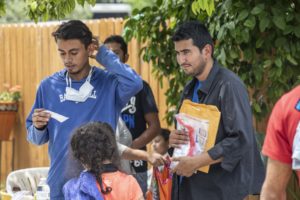
Aralia Ortiz prepares hot meals from the family’s small kitchen and serves everyone who passes through. Several shower units, donated by TBM, are set up in the backyard. The immigrants and refugees also receive a toiletry kit and a clean set of clothes, if they are available.

Byron traveled 17 days from his home in Guatemala to arrive in Laredo. Upon entry into the United States, he received care at the home of the Ortiz family. (Photo /Jeremy Sharp)

Since 2014, the Ortiz family has cared for immigrants and refugees on the border of Laredo and Nuevo Laredo. Since April, they have opened their home for ministry as needs increased and other space was unavailable.

“God continues to provide daily for our needs,” Ruth Ortiz said.

Each person who passes through the Ortiz house hears about Jesus.

“We pray with them, share the gospel with them,” said Lorenzo Ortiz, pastor of Iglesia Bautista Emanuel in Laredo. “We have had services here as a home church. It’s a special moment for people— when they get out of the detention centers and they have that connection again, that encounter with God, it’s just amazing.”

The gospel spreads as the immigrants connect with their families, he added.

River Ministry work in Laredo is supported through gifts to the Texas Baptists’ Worldwide Giving, along with partner churches, individuals and national organizations such as the Salvation Army and Samaritan’s Purse.

Providing aid in Del Rio

Since May, around 100 immigrants passed through Del Rio each day. Due to overflow issues in McAllen, one to two times a week, immigrants are transported to Del Rio.

In addition to serving as a Texas Baptists’ River Ministry missionary and as associate pastor for missions and youth at City Church in Del Rio, Shon Young chairs the Val Verde Border Humanitarian Coalition, helping to meet the needs of immigrant families.

River Ministry Missionary Shon Young has worked alongside several churches and community organizations to start the Val Verde Humanitarian Coalition to serve the increasing number of immigrants passing through Del Rio.

In the last three months, the coalition has served more than 5,000 people from Central America, the Democratic Republic of Congo, Haiti and other regions, providing basic necessities to individuals and families passing through Del Rio. The group has partnered with Samaritan’s Purse, the Salvation Army and several other humanitarian organizations to provide meals, shower trailers, tents for overnight guests and supplies such as shoes and backpacks.

Several Texas Baptist churches have worked with the coalition through the summer, providing assistance with the immigrants and also showing love to the Del Rio community.

“These teams are making connections that will stay along the border long-term,” Young said. “It is a chance to see the border, get a feel for it and open their eyes to new ministry opportunities.”

Young encouraged Texas Baptists churches to continue to pray for their ministry along the border and to consider sending small teams of four to eight people to help relieve volunteers at the Val Verde Humanitarian Coalition. The ministry serves immigrants and also provides care to city officials, civil servants and other volunteers in the community.

McAllen Respite Center

Vanessa Quintanilla-Lerma, who serves with Texas Baptists’ River Ministry, has met and helped hundreds of immigrants every month for the past four years. (Photo / Isa Torres)

In the Rio Grande Valley, River Ministry missionary Vanessa Lerma has seen a steady flow of immigrants over the summer, with as many as 900 people passing through on some days.

Through her work with the McAllen Respite Center, she coordinates church mission teams who volunteer and give donations to the ministry.

“This is a 24/7 ministry going on, and when someone comes from outside and relieves the volunteers, they can feel that relief and refreshing while someone else is taking care of the area of ministry that is needed in the center,” Lerma said.

Many churches have sent teams to work in the Valley this summer, providing much-needed support. Lerma encouraged Texas Baptists to consider sending teams this fall and into next year. Since June 2014, tens of thousands of immigrants have passed through the Rio Grande Valley and on to their final destinations around the country. The ministry at the Respite Center has seen ebbs and flows but has been continuous more than five years.

Lerma asked for prayer for volunteers and leaders at the Respite Center who continue to show love and compassion to each person who receives care at their facility.

“Personally, I ask that you pray for our strength and for a sensitive heart,” she said. “Pray that this doesn’t become work, but that it is an opportunity to minister, love others and show God’s love. Pray that we would be God’s hands and feet in everything we do.”

Helping in El Paso

For the last four months, Jesus Galarza has coordinated River Ministry efforts in El Paso. He serves the overflow from the city shelter.

In addition to helping people purchase bus tickets and other travel arrangements, he assists with housing immigrants overnight who are in the midst of transition.

The El Paso border crossing has been closed to immigrants for the last three weeks, but when the bridge is open, Galarza coordinates feeding 100 to 200 people through donations.

Galarza works with Iglesia Bautista Tierra de Oro and Iglesia Bautista Caminos de Vida to provide food and other necessities to those in need.

Additionally, students from the University of Texas-El Paso Baptist Student Ministry and several other churches have volunteered in ongoing border ministry.


On the Move: Jackson, Muskrat, Still and Tarpley

Dale Jackson to Second Baptist Church in Abilene as pastor.

Andy Muskrat to First Baptist Church in Waco as associate pastor for music and worship from Memorial Baptist Church in Spring, where he was worship and praise pastor.

Samuel Christian Still to First Baptist Church in Elm Mott as music minister. He served previously as a music associate at First Baptist in Waco.

Ross Tarpley to First Baptist Church in Austin as minister of music from Lake Shore Baptist Church in Waco, where he was minister of music.


Around the State: Students on mission throughout summer

Students from Texas Baptist-affiliated universities, as well as students at state universities serving through Baptist Student Ministries and Go Now Missions, are on the state, domestic and global mission fields this summer. Others are working with recreation teams at Christian encampments. More than 230 students are serving through Go Now Missions in locations ranging from Mission Arlington in North Texas to sports camps in New York to work among indigenous people groups along the Amazon River in Brazil. Students also are part of Texas Baptist churches’ summer mission trips. Cynthia Shirley, a student at Hardin-Simmons University, served in Peru with Beltway Park Baptist Church in Abilene. In partnership with other churches, the missions team set up medical clinics for five days, caring for more than 600 patients. Team members distributed more than 400 Bibles, and more than 200 people professed faith commitments to Christ.

A Grandparenting Matters seminar is scheduled Sept. 7 at First Baptist Church in Marble Falls. Sponsored by the Legacy Coalition, the seminar is designed to equip and encourage grandparents to stay connected and involved with their grandchildren in positive, powerful ways and to pass on a legacy of faith. Sessions are open not only to grandparents, but also to pastors or adult ministries leaders who want to learn how to provide grandparents the encouragement and resources they need. The seminar begins at 9 a.m. and concludes at 3 p.m. Cost is $25 per individual or $40 for a married couple. The fee includes a workbook for each participant, a continental breakfast, lunch, snacks and door prizes. To register, click here. For more information, contact Associate Pastor Weldon French at weldon@fbcmf.org or (830) 693-4381.

GuideStone Financial Resources is sponsoring a Church Security and Awareness seminar at Crossroads Christian Church in Grand Prairie from 8 a.m. to 4 p.m. on Aug. 22. Barry Young, vice president of Strategos International will talk about recognizing physical indicators of suspicious behavior, approaching armed individuals, verbally de-escalating conflict and implementing lockdown procedures. The cost is $99 per participant. To register, click here.

Jason Palmer

The University of Mary Hardin-Baylor named Jason Palmer as dean of spiritual life and university chaplain. Palmer, an ordained Baptist minister, will begin working part-time on Aug.14 and will transition to full-time status on Nov. 4. He is retiring from the U.S. Army after 25 years of service. He currently serves as assistant division chaplain for 1st Cavalry Division at Fort Hood. He supervises 35 chaplains and 37 religious affairs specialists, providing religious support to 18,900 soldiers deployed worldwide, as well as their families. Palmer earned his undergraduate degree from the University of Florida. He completed his Master of Divinity degree at New Orleans Baptist Theological Seminary in 2008. Palmer and his wife Christie have been married for 20 years and have four sons: Joshua, Eli, Caleb and Nathan.

Hardin-Simmons University hosted Trauma-Informed Care training for about 60 professionals from HSU, Abilene Christian University and McMurry University on Aug. 24. Police officers, student life coordinators and counselors learned from specialists during the three-hour course. “As reporting rates increase, our campuses are realizing just how many students are impacted by trauma, either present or historical, and this offers us a specific tool to care for our students holistically,” said Nikki Rhodes, HSU director of counseling services.

Thomas Sanders (left), provost and vice president for academic affairs at East Texas Baptist University, and Rebekah Grigsby (right), dean of the ETBU School of Nursing, congratulate nursing students (left to right) Colby Simmons, Stacie Simmons and Joshua Hartley, recipients of the Polly Cargill Scholarship.

Three East Texas Baptist University nursing students—Joshua Hartley, Colby Simmons and Stacie Simmons—received the Polly Cargill Nursing Scholarship on behalf of the Cargill family and Christus Good Shepherd Foundation. Jerry and Jack Cargill established the scholarship to honor their mother’s memory and in recognition of the care she received from nurses at a local hospital. Since its inception 17 years ago, the Polly Cargill Nursing Scholarship has provided financial aid to about 60 nursing students from schools across East Texas. This year, six students at ETBU, the University of Texas at Tyler, Kilgore College and the University of Texas at Arlington received the scholarship.

Stark College and Seminary in Corpus Christi signed a memorandum of understanding with B.H. Carroll Theological Institute to create an academic relationship between the two institutions. It ensures ease of transfer for Bachelor in Ministry degree graduates of Stark to enroll in one of several advanced track master’s degree programs at Carroll, using undergraduate credit hours completed at Stark toward the master-level degrees. In addition, the agreement ensures ease of transfer for Stark Master of Arts in Ministry degree students to reach Master of Divinity degree equivalency or complete a Master of Divinity degree at Carroll. It also provides an avenue for Stark students to complete additional studies and enroll in the Carroll Doctor of Ministry degree program. Students will be able to participate face-to-face in a physical classroom at one of the network teaching churches, in live video conferencing broadcasts delivered over the Internet or online courses.

Texas Baptists’ Hispanic Education Initiative sponsored a Hispanic Education Fair at East Texas Baptist University. High school participants attended workshops such as “Keeping God First in College” and “Academic and Emotional Success.” College-age participants learned about financial aid and other aspects of higher education. Eighteen students who attended the education fair received $500 scholarships from the Hispanic Education Initiative.

Retirement

Jack Staples after 60 years in music ministry, including the last 40 years as minister of music at Second Baptist Church in Abilene.


Christians stand against Christian nationalism

A national coalition of Christians has launched a campaign labeling Christian nationalism as “a distortion of the gospel of Jesus Christ and a threat to American democracy.”

More than 3,000 people of faith signed an online statement, “Christians Against Christian Nationalism,” as of July 30. Baptists who signed the statement identified themselves as relating to the Cooperative Baptist Fellowship, Southern Baptist Convention, Baptist General Convention of Texas, Alliance of Baptists and American Baptist Churches USA.

‘Provides cover for white supremacy’

“Christian nationalism seeks to merge Christian and American identities, distorting both the Christian faith and America’s constitutional democracy,” the statement reads. “Christian nationalism demands Christianity be privileged by the State and implies that to be a good American, one must be Christian. It often overlaps with and provides cover for white supremacy and racial subjugation. We reject this damaging political ideology and invite our Christian brothers and sisters to join us in opposing this threat to our faith and to our nation.”

The statement goes on to affirm the right and responsibility of people of all faiths and no faith to participate in the public square and to declare that government should not prefer one religion over another.

“Conflating religious authority with political authority is idolatrous and often leads to oppression of minority and other marginalized groups as well as the spiritual impoverishment of religion,” the statement reads.

“We must stand up and speak out against Christian nationalism, especially when it inspires acts of violence and intimidation—including vandalism, bomb threats, arson, hate crimes and attacks on houses of worship—against religious communities at home and abroad.

“Whether we worship at a church, mosque, synagogue or temple, America has no second-class faiths. All are equal under the U.S. Constitution. As Christians, we must speak in one voice condemning Christian nationalism as a distortion of the gospel of Jesus and a threat to American democracy.”

Baptist Joint Committee spearheads campaign

Baptists signing or endorsing the statement include Paul Baxley, executive coordinator of the Cooperative Baptist Fellowship; Jeffrey Haggray, executive director of American Baptist Home Mission Societies; Marv Knox, field coordinator for Fellowship Southwest; and Mitch Randall, executive director of the Baptist Center for Ethics.

“The church of Jesus Christ exists by the power that parted the Red Sea and raised Jesus from the dead, and that power and authority is still at work within us and among us even as empires rise and fall. To suggest that the church needs the protection of the state in order to flourish and thrive is idolatrous,” Baxley said.

The Baptist Joint Committee for Religious Liberty joined other Christian groups in launching the campaign to raise awareness about the dangers of Christian nationalism.

Amanda Tyler

“Christian nationalism is not new. It has ebbed and flowed over many decades, but we seem to be stuck at high tide now,” Amanda Tyler, executive director of the Baptist Joint Committee, wrote in an article for ethicsdaily.com.

“For Christian nationalists, to be a true American is to be a Christian. Of course, that conclusion is at odds with our constitutional principles. The First Amendment protects religious freedom for everyone, and Article VI states that there will be no religious test for public office.

“Christian nationalism threatens religious freedom for all. It asks the government to show preference for Christianity over other religions or religion over nonreligion.”

Initially, Tyler noted, the Baptist Joint Committee approached the campaign as a proposed interfaith project.

“But we quickly learned that our partners did not have the same level of comfort in calling out Christian nationalism that we—as Christians—do,” she wrote. “That makes sense, though it is unsettling to think that by calling out a Christian nationalist, a Jewish or Muslim person may be placing themselves in harm’s way.”

The Baptist Joint Committee has produced a 10-week podcast on Christian nationalism, beginning July 31 and continuing through Oct. 2. The agency, in partnership with EthicsDaily.com and others, also is posting a series of YouTube videos on the subject.

EDITOR’S NOTE:  The 2nd paragraph was edited to provide updated information after the article originally was posted.  As of 8 a.m. on July 30, the total number of signers was 1,111.  By 4 p.m., the total had topped 3,000.


The Village Church faces lawsuit over alleged sexual assault

FLOWER MOUND (BP)—A woman has sued The Village Church in North Texas for more than $1 million, alleging she was sexually assaulted at age 11 in 2012 by Matthew Tonne, whom the church employed as a minister and counselor.

Identified in the lawsuit as “Jane Doe One,” the plaintiff accuses The Village Church of negligently breaching its duty to care for her, failing to “implement reasonable policies and procedures to detect and prevent the sexual abuse of Jane Doe One by Tonne,” and failing “to adhere to the policies and procedures it had in place at the time” to prevent the alleged abuse.

The church had filed no court response to the lawsuit as of July 29, according to Dallas County court records. The church did not respond to Baptist Press’ request for comment by its daily publication deadline but said in January that the church fired Tonne in June of 2018 for a matter unrelated to the case.

Tonne was indicted by a Dallas County grand jury in January with indecent contact with a child involving sexual contact. He was released on $25,000 bond and is awaiting trial in August, according to Dallas County District Court public documents.

In the lawsuit filed July 26 in Dallas County, the plaintiff alleges Tonne sexually assaulted her at the Mount Lebanon Retreat and Conference Center, a Baptist encampment in Cedar Hill.

The Southern Baptist Convention addressed the issue of sexual abuse extensively at its 2019 annual meeting June 11-12, passing constitutional and bylaw amendments, conducting panel discussions and releasing new resources to equip churches to combat abuse, submit perpetrators to criminal justice and minister to victims.

Church ‘double reported’ abuse

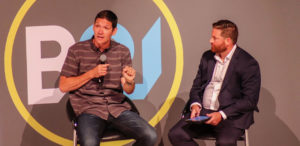
Matt Chandler (left) answers questions posed by Nate Akin during the Baptist 21 luncheon held during a break in the annual meeting of the Southern Baptist Convention in Birmingham, Ala., on June 11, 2019. (RNS photo by Adelle M. Banks)

During and following a panel discussion at an ancillary event held during the SBC annual meeting, Matt Chandler, lead pastor at The Village Church, discussed the church’s handling of the case. The church did not handle the case perfectly but did “the best (it) knew how,” Chandler said in June.

Church leadership “double reported” the abuse, Chandler said, by helping the family report the incident to police and communicating the report to all parents whose children attended the 2012 summer camp.

Chandler said in June he was in a “period of introspection.”

“We are an imperfect church with imperfect people. We make mistakes; I am painfully aware of my limitations. They are numerous,” he said. “But when it comes to reporting as soon as we heard, taking our cues from the detective and family, I’m not sure how we could have done it differently.”

In January, the church said that there were “no persons of interest in this investigation that have access to children at The Village Church. We would not let anyone who is under investigation for a crime like this be near any of our children at (The Village Church).”


SBC leaders note ‘urgent need’ along the border

TIJUANA, Mexico (BP)—Two adult sisters risked their lives in a months-long journey from Cameroon in Central Africa to Tijuana, Mexico. Southern Baptist pastor Marshal Ausberry was surprised to see them at the southern U.S. border seeking asylum.

Marshal Ausberry, first vice president of the Southern Baptist Convention, traveled to the Mexican border to learn how Baptist pastors there are ministering to immigrants and migrants seeking safety in the United States. (BP screen capture)

“It’s just not people from Central America and South America that are coming,” said Ausberry, first vice president of the Southern Baptist Convention, following his recent trip to the border. “There are people from Africa and Haiti that have migrated to Mexico in attempts to come through the border to the United States.”

‘Modern-day diaspora’

Ausberry met the immigrants at a Baptist church in Mexico as he was on a fact-finding mission on border ministry with Todd Unzicker, an associate pastor at The Summit Church in Raleigh-Durham, N.C. The Christian sisters fled persecution in Cameroon, he noted.

“That was just one story, and there are thousands of those kinds of stories,” said Ausberry, senior pastor of Antioch Baptist Church in Fairfax Station, Va. “I kind of see it as a modern-day diaspora, that God is shifting the population around for his purposes. When people are willing to endure such great hardships to come to the United States from Mexico for their personal safety, it just moves your heart.

“We don’t get into the politics of it, but as believers in Christ Jesus, we’re burdened to do that basic level of care,” Ausberry said. “We still need to show them that human dignity of food, clothing and shelter, that care … as they go through the political process of getting asylum and access to the United States and Mexico.”

SBC President J.D. Greear, pastor of The Summit Church, asked Ausberry, Unzicker and SBC Second Vice President Noe Garcia, pastor of North Phoenix Baptist Church, to make the trip. Garcia was unable to participate.

Love for neighbor, not politics

Ausberry and Unzicker met July 16-18 in Tijuana with leaders of the National Baptist Convention of Mexico, Baptist pastors, Southern Baptist pastors from California and Southern Baptist workers in Mexico to learn about ministry to those caught in the crisis on the border.

“As Pastor J.D. says, most of us are not called or competent to make policy decisions on the border, but we are commanded by Jesus to love our neighbors and those who are hurting,” Unzicker said. “And this, what is a crisis, I think could actually be an absolute win for the kingdom (of God).

“Nobody could doubt that God is moving the nations all around the globe right now, in ways that history has not seen before. We were able to go and share the gospel with people who literally had nothing.”

Todd Unzicker, associate pastor at The Summit Church in Raleigh-Durham, N.C., encountered two Christian sisters at the Mexican border who had fled persecution in Cameroon and are seeking asylum in the United States. (BP Photo from Twitter)

The sisters from Cameroon were staying and serving at a church while awaiting an immigration hearing in the United States, Ausberry said.

“They really have the joy of Christ in them,” he said, and prefer their current situation to Cameroon. “Their love for Christ, their hopefulness, is just tremendous. It touched our hearts, and we’re thankful for the church opening their doors to give them a place to stay, a place to serve while they’re waiting to go to the hearing to continue their path to seeking asylum.”

Ministering with meager resources

Ausberry and Unzicker visited five sites where aid is being administered. Baptist churches there do much with few resources, the two said. At one church, about 30 immigrants were housed on cots stacked to the ceiling. Churches were feeding, clothing and ministering to those who had fled home with nothing.

“One pastor had such a burden,” Unzicker said, that he asked his leadership for permission to house immigrants in the church’s Sunday School classrooms.

“His leadership team said, ‘OK, you can make room for five people.’ So, he went out and brought back 30. And so they made bunks that just went all the way up to the ceiling,” Unzicker said.

“It’s happening all along (the border) from Brownsville to Tijuana,” he added. “We want to catalyze that, and see all Southern Baptist entities and churches working together for one cause.”

Greear will use information gathered on the trip to Mexico to formulate ideas for ministry through Southern Baptists and partners, Unzicker and Ausberry said.

Greear could not make the trip to Tijuana because he was in Asia in July, meeting with 51 missionaries from The Summit Church serving in Thailand and Malaysia.

Ausberry noted there is “an urgent need here to show the love of Christ, and it’s in real terms of food, shelter, clothing, a bath, a bed, just basic needs you and I take for granted.”

Ausberry and Unzicker described the situation as an optimum opportunity tangibly to show the love of Christ.

“The nations are coming to our front doorstep,” Unzicker said. “We want to certainly welcome them with arms that are full of blankets and food, and most importantly the love of Jesus.”