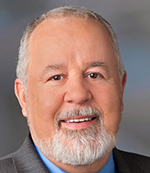
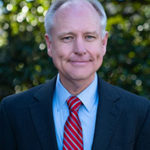
River Ministry adapts to changes along closed border

When the United States/Mexico border was closed March 20 to help slow the spread of the COVID-19 virus, it marked significant changes for Texas Baptist River Ministry missionaries who have been seeking to share God’s love with immigrants, refugees and local residents along the Rio Grande.

In El Paso, when a “Stay Home, Work Safe” order led to the temporary closure of schools and nonessential businesses and travel limitations, River Ministry missionary Jesus Galarza saw a huge shift in his work.

Normally, Galarza runs a feeding ministry out of a local school. With the schools closed, Galarza has been unable to continue this ministry. Furthermore, mission trips Galarza had planned with churches had to be canceled or postponed. At this time, he is unsure when these trips will be able to resume.

Galarza asked churches to pray for him and his ministry during this difficult time. Spiritual help is the most important thing churches can give right now, he explained. Pray also for the mission trips that will take place later in the year, after the virus has passed, and that they will be fruitful, he asked.

Serving at-risk individuals

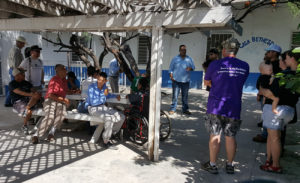
Volunteers minister to residents of Casa Bethesda in Piedras Negras. (Photo courtesy of Jeff Bray)

Gloria de la Pena is River Ministry missionary in Piedra Negras, Mexico, who works with women’s prisons, orphanages and migrant camps, coordinating mission trips with churches to serve these at-risk people.

With mission trips no longer happening, de la Pena asked churches to pray for the people in these facilities. One of the orphanages, Casa Bethesda, houses 26 special-needs children, some of whom could be more susceptible to COVID-19.

She expressed hope that during the time of social distancing and working from home, people will turn to God and then find ways to minister safely to those in their immediate surroundings. De la Pena encouraged churches to ask God to turn setbacks into blessings.

“Pray that everyone can use this quiet time working at home to look to the Lord, learn to have more gratitude and a happy heart, and love our families, friends and all the people who need to know about Jesus,” she said.

Unable to enter immigrant camps

River missionary Cristina Lambarria serves in Matamoros, Mexico, where she works in immigrant camps, providing food, clothing and other resources, including English classes. However, she and her team have been unable to enter the camps because of the risk of infection. It is both unsafe for them because of the crowded living conditions and unsafe for the immigrants, who could be exposed to the virus, she explained.

“Nobody can go into the camps right because we want to protect them. If one gets sick, everyone will get it. They are in communication all the time. They cannot be like us in their homes. The restrooms are outside, and they have to cook in a communal kitchen. So, we decided not to go in the camp right now,” Lambarria said.

Lambarria asked churches to lift up the immigrants in prayer, asking God to protect them from the virus. She also asked for prayer as workers look for ways safely to get food and other resources to the immigrants in the camps.

A vulnerable context

Shon Young is a River missionary in Del Rio, where he is the president of Val Verde Border Humanitarian Coalition. Val Verde was formed in April 2019 when Border Patrol agents approached local churches about ways to respond to the increased number of immigrants passing through Del Rio.

The coalition provides supplies and helps immigrants reach their final destination in America. Val Verde has served thousands of immigrants, asylum seekers and refugees, but with the border closure, both needs and strategies to meet those needs have grown more complex.

“There are so many variables, and we are really trying to keep our eyes and ears open to the chance to minister to those in crisis,” Young said. “Please pray for the border and the congregations on both sides of the river. It is already a vulnerable context with problems that vary from the rest of Texas and adding an extra layer on it will be difficult. Please pray for pastors of the churches that already run on a tight budget and that their churches will continue to support their work even in an atmosphere that people are not able to work or are working less.”


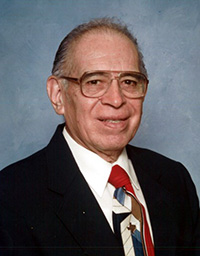
Obituary: Santiago Garcia Jr.

Santiago Garcia Jr., retired pastor/evangelist, died April 3. He was 89. Garcia was born April 27, 1930, in San Antonio to Sotera and Santiago Garcia. After answering the call to the gospel ministry at age 18, he studied theology at Mexican Baptist Bible Institute, now Baptist University of the Américas, where he was one of three in the school’s first graduating class. As a student, he was pastor of Memorial Baptist Church in Pleasanton, a mission of First Baptist Church in Pleasanton, which licensed him to preach. He established ministry points in Christine, Charlotte, Poteet and Jourdanton. In 1950, he started a mission of South San Antonio Baptist Church, which ordained him. The mission constituted as Iglesia Bautista Sur San Antonio in 1952. The congregation was self-supporting from its inception, a feat highly uncommon at the time among Texas Baptist Spanish-speaking congregations. He joined the Houston-based Gene Williams Evangelism Association as an associate evangelist and led revivals in Texas, Mexico, Central America and Puerto Rico. During five decades in ministry, he was pastor of Iglesia Bautista Buen Pastor in Del Rio, Westlawn Baptist Church in San Antonio, Bonita Gardens Baptist Church in Houston, Seacroft Baptist Church in San Antonio, Northeast Hispanic Baptist Church in Converse and Iglesia Bautista in Somerset. In retirement, he continued to serve part-time as pastor of churches in Sutherland Springs, Elgin and Waelder. He served Texas Baptists on several denominational boards, including Baptist Memorial Hospital System in San Antonio. He was a member of the Convención Bautista Mexicana de Texas Committee of Seven, which recommended the convention’s historic unification agreement. He is survived by his wife of 72 years, Delia Pachecano Garcia; seven children; 13 grandchildren and 17 great-grandchildren.


Inner-city Dallas ministry stretched during COVID-19

DALLAS (BP)—People who lined up for meals recently at Cornerstone Baptist Church in South Dallas had not been able to shower in a month and had no place to call their own while the city of Dallas is under a shelter-in-place order.

Moving through the line while keeping six feet apart, each received a hot meal from church volunteers wearing protective gear and then wandered back into unsanitary conditions on the streets.

“Our numbers have doubled within the last couple of weeks because a lot of places that were feeding are now shut down,” Cornerstone Pastor Chris Simmons said. “Yesterday, to be honest with you, with the homeless not taking a shower in almost a month … it just broke our hearts. So, we’re trying to figure a way to be able to allow them to come in and take showers.”

Cornerstone serves the homeless six times each week, offering two meals each Sunday and daily meals every Tuesday, Wednesday, Thursday and Saturday. Last week, Cornerstone served about 450 people at each meal. The church also operates a free laundromat as an essential service exempt from the Dallas County stay-at-home order, but the church’s clothing closet and twice-weekly showers are closed temporarily.

‘In danger every day of their lives’

For the homeless population, Simmons surmises, the strain of the COVID-19 pandemic is life as usual.

“I think they feel like they live in danger every day of their lives,” Simmons said. “I think they’re concerned, but I think their daily life is a struggle like this. And I think what’s happened now is the whole world is realizing what they go through on a daily basis.”

During the COVID-19 pandemic, Cornerstone Baptist Church in Dallas has extended the hours of its free laundromat facility to community residents including the homeless. (Cornerstone photo)

Ten fellow churches in Dallas Baptist Association are partnering with Cornerstone to serve the homeless community during the COVID-19 pandemic, including Park Cities Baptist Church in Dallas.

But the increased need among the homeless comes as Cornerstone’s financial receipts are down about 75 percent, Simmons said. In 2019, the congregation averaged 750 in Sunday worship from a membership of about 1,700.

With the church closed for congregational worship during the pandemic, worship services streamed on Facebook Live have attracted a larger audience, Simmons said, but he added that many members are elderly and not comfortable with online giving.

Many Cornerstone members are employed in service and retail jobs, and they are taking a financial hit as their jobs are no longer available.

Prepared for the challenge

Simmons thanks God that the church was prepared for a financial challenge such as this.

“Praise the Lord, thankfully, I was around in ‘08 when … we went through the recession,” Simmons said, “and was determined that if we ever go through [an event] like that again, we wanted to make sure we had savings. And so, we have always tried to be very frugal in our expenses. We’ve had to dip into savings, but thankful we had savings to dip into.

“Now, if it goes a lot longer, then we might feel the crunch of that.”

Simmons said he wasn’t familiar with the details of the CARES Act stimulus bill but was looking into the opportunities provided by the legislation to relieve financial pressure on churches and other faith-based nonprofits.

Park Cities Baptist Church is assisting Cornerstone by providing hot meals on Thursdays from a barbecue restaurant owned by a Park Cities member, Park Cities missions pastor Damon Berry said. Beginning April 7, Berry said, the church will begin offering sack lunches each Tuesday.

“It’s become harder for homeless people to find the resources they need, harder for homeless ministries to get the resources they provide, because their supply chains are limited from what they normally have,” Berry said. “Since stores are selling more of their products, less is going to nonprofits that would normally distribute that.”

Homeless shelters have smaller capacities because of social distancing guidelines, and the Kay Bailey Hutchison Convention Center of Dallas is housing overflow at night. Homeless persons must leave the center each day, returning at night. Many sleep in tents, cars or vacant buildings, Simmons said.

Of some 25,000 homeless people in Texas, about 4,500 of them live in Dallas and about 1,600 are considered unsheltered, the Metro Dallas Homeless Alliance said in March, based on numbers gathered in January. The 500,000 homeless people in the United States are among the most vulnerable as the COVID-19 death toll rises.

In the United States, COVID-19 has killed more than 7,600 out of more than 304,000 confirmed cases of infection, the Centers for Disease Control and Prevention reported.

In Texas, COVID-19 has infected more than 6,800 and claimed 127 lives. On April 5, Dallas County officials reported 1,112 confirmed cases and 18 deaths.


UMHB livestreams unconventional Easter pageant

BELTON—For 80 years, the University of Mary Hardin-Baylor has held its annual Easter pageant during Holy Week. Regardless of weather or other circumstances, the pageant—which typically draws thousands to the Belton campus—never has been cancelled.

When it became obvious restrictions related to COVID-19 would make a traditional pageant impossible, organizers began brainstorming how—rather than cancel the event—they might make it extraordinary.

“We didn’t want this tradition that has gone on for 80 years to just not happen,” Precious Anselm, this year’s pageant director said.

Organizers decided the 2020 Easter pageant would be presented online, featuring footage from past productions and testimonials from people who have been involved in the pageant over the years.

‘Look a little different’ this year

The website for the 81st Annual Easter Pageant Experience promised the event would “look a little different” this year. It stated a special production would be livestreamed April 8 at 5:30 p.m.

UMHB posted a video inviting anyone who has ever taken part in the Easter pageant to submit stories about their experiences. While organizers were not sure how much footage to expect, the response was overwhelming, with dozens of submissions sent within the first few days.

“It’s been really eye-opening and inspiring to see how many videos we’ve gotten,” Anselm said. “We’ve heard from people who were involved more than 30 years ago.”

The University of Mary Hardin-Baylor presented its 79th annual Easter pageant in 2018. (UMHB Photo)

The pageant organizers not only received videos from students and alumni who served as cast members or helped with productions, but also heard from members of the community for whom the pageant has become a cherished Holy Week tradition.

“It goes to show that at every Easter Pageant, seeds are being planted,” Anselm said. “We are hearing stories of people who found salvation or came closer to God through this tradition.”

Anselm acknowledged the 2020 pageant was not the production she first imagined last year, but she expressed faith it would be powerful.

“It was easy to get into the mindset of being upset, but it’s clear that the Lord is doing something here,” Anselm said. “He has a plan that is bigger than mine.”

Emma Spellings, who was cast in the role of Mary this year, agreed. While “stay at home” orders meant this year’s pageant would not draw crowds physically as in years past, it also meant more people would be at home and able to watch it live together.

“I have a very strong feeling that all of this is going to be used by the Lord for kingdom growing,” Spellings said. “That’s been really sweet to think about that.”

For more information about this year’s Easter Pageant Experience, visit the event’s official website: umhb.edu/easter-pageant.


Hospital chaplains offer hope in challenging environment

With the rise of COVID-19, Texas Baptist hospital chaplains face new challenges as they minister to healthcare workers, patients and families, sharing God’s love and hope in difficult circumstances.

Beaumont reported its first confirmed positive case of COVID-19 March 18 and its first coronavirus-related death April 1.

Even before the virus was widely present in the region, hospitals began treating every person who walked through their doors as a potential carrier, said David Cross, director of Pastoral Care for Baptist Hospitals of Southeast Texas and a chaplain endorsed by Texas Baptists. Visitors were restricted and allowed to enter only in extreme circumstances.

Chaplains are unable to have direct contact with any patients who may have the virus due to insufficient supplies of personal protection equipment, such as masks.

Chaplains care for caregivers

These circumstances have led to a heavier emphasis on healthcare worker ministry, as they are the individuals on the front lines in battling COVID-19, Cross noted. Healthcare workers face a difficult workplace environment, in addition to adjusting to the same rapidly changing circumstances affecting everyone.

David Cross

“There is a great deal of stress in our caregivers as they help the patients with professionalism, while also dealing with personal crises like kids at home, spouses out of work and other new difficulties,” Cross explained.

Cross has seen God’s provision. Harmony Baptist Church in Vidor donated to the hospital 19 cases containing 4,560 masks the church had on hand from Hurricane Harvey clean-up. Cross urged local Baptist associations and churches to look through their own stocks to see if they have any medical supplies that could be donated to hospitals.

In addition to the supplies, Cross also asked churches to pray for the chaplains and healthcare workers during this stressful time. He urged people to remember to thank and reach out to hospital workers—not only doctors and nurses, but also technicians, custodians and administration. They are all risking exposure to COVID-19 as they continue to serve patients, he noted. He particularly requested prayer for the senior hospital administration, who face new problems in the uncharted days ahead.

‘Real people are hurting’

In the Dallas area, COVID-19 cases already have inundated the hospitals. Mark Grace, chief of mission and ministry at Baylor Scott and White Health, explained the outbreak has moved along as it was predicted.

While many individuals are exceptionally open to spiritual conversations, Grace expressed deep regret about the reason behind that openness.

Mark Grace

“Real tragedy is happening now, and I feel the weight of it. Real people are hurting. And I believe we are called to join God in responding to these tragedies with compassion and love,” he said.

Ministry to COVID-19 patients is limited to telephone calls and video visits because of infection risks. Many of the new spiritual meetings are with staff, who are facing new challenges, both at work and home. Grace explained that the situation is isolating for patients, healthcare workers and even chaplains.

“They’re engaging in a work that has become significantly more dangerous” in recent weeks, he said. “On the one hand, I’ve had lots of people reaching out and asking what they can do to help. Emails, texts and other consistent reminders of your love and prayers are needed more now than ever.

“But I’ve talked to some chaplains whose extended family members or friends are asking them not to come to their house anymore [because of the risk of infection], and are not expressing any support or concern.”

Offer prayer support

Above all, Grace asks churches to remain prayerful and engaged. The power of prayer is strong, he said, and it is a great way to minister to the community without risking infection.

Furthermore, Grace wants Christians to be a strong network of support. Instead of “social distancing,” Grace prefers the term “physical distancing,” explaining that people should be physically far apart, but more connected through social and spiritual means than ever before.

“We’re called upon to be physically distant, but be more socially available than ever before, just through different means,” Grace said. “The best, practical help is prayer and reaching out to people.”

Texas Baptists’ Cooperative Program supports a wide range of ministries in Texas, including four hospitals/health systems providing care to thousands—Baylor Scott & White Health, Hillcrest Baptist Health Care System, Hendrick Baptist Health Care System and Southeast Texas Baptist Hospital. In addition to the work of doctors and nurses, these facilities offer care through a team of chaplains working to meet the spiritual needs of their patients.

“Texas Baptist churches can find comfort in knowing that even in an international crisis, their investment in the Cooperative Program is working hard to minister to those affected by the COVID-19 pandemic,” said Chris Liebrum, director of Texas Baptists’ Cooperative Program ministries.


Interim final rule clarifies CARES Act includes churches

NASHVILLE (BP)—An Interim Final Rule published by the U.S. Small Business Administration provides assurance that churches and other ministries are in fact eligible to receive loans as part of a massive financial stimulus bill passed by Congress.

Some experts view the interim final rule as providing assurance faith-based nonprofits will not face potential conflict with religious liberty protections.

The Paycheck Protection Program—enacted as part of the $2 trillion Coronavirus Aid, Relief and Economic Securities Act to relieve economic hardship caused by the COVID-19 pandemic— set aside $350 billion to guarantee loans to businesses employing fewer than 500 employees for expenses like payroll, utilities and rent or mortgage payments.

Nonprofits, including churches and other religious ministries, are eligible to receive funds covering up to 2.5 times their average monthly payroll, with a cap of $10 million per loan.

Before the interim final rule was issued, concerns had been raised that federal regulations associated with loans guaranteed through the SBA could require recipients to comply with nondiscrimination regulations in categories including religion and sex.

Worked to provide clarification

Although churches would be constitutionally protected, organizations including the Ethics & Religious Liberty Commission of the Southern Baptist Convention, as well as legislators from both political parties, worked to clarify the issue.

The interim final rule provided guidance stipulating: “All loans … will be made consistent with constitutional, statutory, and regulatory protections for religious liberty …”

It reiterates an SBA regulation that states: “Nothing in [SBA nondiscrimination regulations] shall apply to a religious corporation, association, educational institution or society with respect to the membership or the employment of individuals of a particular religion to perform work connected with the carrying on by such corporation, association, educational institution or society of its religious activities.”

Additional guidance was expected to be issued by the SBA. Its intent is two-pronged: To help lenders understand the program does not exclude faith-based organizations; and to help churches and other faith-based nonprofits understand the religious liberty protections.

Travis Wussow, the ERLC’s general counsel and vice president for public policy, said he was grateful for the resolution and expressed gratitude for the work of the Trump Administration throughout the process.

“It is significant that SBA’s new regulations state that the religious freedom rights of houses of worship and faith-based nonprofits will be upheld in this new loan guarantee program,” Wussow said. “We look forward to further guidance from the Administration, and we’re grateful for the hard work being done to ensure that this new program works for houses of worship.”

‘Clear huge hurdles’

Before the interim final ruling was issued, Jonathan Whitehead, an attorney specializing in First Amendment law, said he had advised churches seeking his counsel “to wait and see” what the SBA guidance would say before applying for a loan under the program.

By Thursday evening, the concerns about religious liberty protections had been resolved, Whitehead believed.

“I’m thrilled to see the ERLC and others working to make sure the paychecks of all Americans are protected, without changing the religious beliefs of employers,” Whitehead said after the interim final rule had been released.

“This will clear huge hurdles for many ministries. I hope to see additional guidance that would make clear services provided by some religious groups, like weddings, retain their full, First Amendment protections.”

While work was underway to assure religious liberty protection, several members of Congress pushed the SBA to issue guidance to lenders that nonprofit organizations, including churches and religiously affiliated organizations, were eligible to apply for loans.

Bipartisan support

In a letter to SBA head Jovita Carranza, Senator Josh Hawley (R-Mo.) noted the expanded access of the CARES Act as compared to section 7(a) loans from the SBA which “exclude some organizations because of their principal religious purpose.”

Hawley wrote in support of churches and other religious organizations claiming they should be eligible for the Paycheck Protection Program as it “instructs lenders to consider only organization size, whether the organization was operational on February 15th, and whether the organization paid salaries and payroll taxes at that time” instead of disqualifying certain applicants based on their “principal purpose” as might be the case with other SBA section 7(a) loans.

This intent for the eligibility of churches was echoed by a quartet of congressmen from both sides of the aisle.

Cedric Richmond (D-La.), Mike Johnson (R-La.), James E. Clyburn (D-S.C.) and Steve Scalise (R-La.) wrote in a separate letter to Carranza, Treasury Secretary Steven Mnuchin and Labor Secretary Eugene Scalia that “while the definition of non-profit organization in Section 1102 explicitly applies only to the paycheck protection program under Section 7(a) of the Small Business Act established by that section, we can assure you that Congress did not intend to require non-profits to possess an exemption determination letter to be eligible for assistance through any other section of the CARES Act either.”

The letter also stated that “many houses of worship and their congregations would suffer great harm if they are not eligible to receive the assistance Congress intended for them to receive.”

While the issue regarding nondiscrimination requirements has been resolved, it highlighted concerns of some pastors and other religious leaders who say they are leery of accepting governmental aid because of potential entanglement with the state.

Even if churches were to choose not to apply for the loans, Whitehead noted that the Paycheck Protection Program could still provide indirect aid to churches, since some church members who own small businesses might participate.


GuideStone offers one-time option to change health coverage

DALLAS (BP)—With many churches reporting strained budgets due to the fallout from the COVID-19 pandemic, GuideStone is offering a one-time opportunity for both group plans and personal plans to step down to a lower-cost health care plan for the remainder of 2020.

Generally, the option to change plans is available only during re-enrollment.

“We understand that we live in a very different economic reality than we did when most churches made their health plan elections for 2020,” GuideStone President O.S. Hawkins said.

“This one-time step-down opportunity may be able to help churches and ministries find some much-needed breathing room in their budget.”

Churches can elect to move from a standard PPO plan to an HSA-qualified high deductible health plan or to GuideStone’s lowest-cost option, Secure Health 3000.

Ministries and churches that change plans as part of this one-time step-down will be able to change plans again at re-enrollment for 2021.

Churches legally must provide staff with 60 days’ notice of a change. GuideStone will provide churches that make a change with all the needed notifications.

Click here for more information.


Most churches stopped gathering, few plan to meet on Easter

NASHVILLE, Tenn.—The coronavirus outbreak has had ripple effects on churches across the country, according to a new study of pastors.

LifeWay Research asked Protestant pastors how the pandemic has impacted their congregations and what their plans are for the near future.

While nearly all pastors say their church held in-person worship services at the beginning of March, the situation had changed radically by the end of the month.

On the weekend of March 1, 99 percent say they gathered, while 95 percent held services the next weekend. By March 15, that number dropped to 64 percent. And by March 22, 11 percent of pastors say their churches gathered in person. On March 29, only 7 percent of pastors say their congregations met in person.

“Gathering for worship as a local church is a fundamental expression of the body of Christ, but so are valuing life and loving others,” said Scott McConnell, executive director of LifeWay Research.

“As mitigation guidance first impacted large churches, the majority of churches with 200 or more attendees were not meeting by March 15, and only 1 percent of them met March 22 as guidance continued to shift.”

By the end of March, pastors of almost half of churches (47 percent) said they had decided they will not meet in person for Easter. A small number (3 percent) said they will have an in-person gathering no matter what.

A significant number said they are in a wait-and-see situation. Close to one in five (18 percent) said they will have an in-person gathering if authorities allow gatherings of that size. Another 15 percent said they will do so if local authorities do not recommend against it. Fewer (7 percent) say they will have an in-person Easter gathering if in their own judgement they feel it is safe. One in 10 said they’re not sure.

Online services and groups

As churches have moved away from in-person gatherings during the crisis, most were able to transition to some form of an online video replacement.

Fewer than one in 10 Protestant pastors (8 percent) said they did not provide any video sermons or worship services this past month. By contrast, a fall 2019 survey of Protestant pastors found 41 percent of pastors at that time did not provide any video content for their congregation.

About one in five pastors (22 percent) say their churches were already livestreaming worship services before the coronavirus pandemic hit, and they continued doing so. More than two in five (43 percent) say they don’t typically livestream their sermon or worship service, but they did so in the last month because of the coronavirus. Another 27 percent say they didn’t livestream their service but did post a video sermon online for their congregation to view anytime.

More than half of congregations (55 percent) say they’ve also moved their adult groups online, while 6 percent say they’ve continued to meet in person. Meanwhile, 40 percent say their groups have not met in any capacity during the coronavirus disruption.

“The rapid adoption of providing video content has been just as abrupt as ceasing in-person meetings,” McConnell said. “Churches who never would have considered offering a streaming or video option, have quickly done so. Their pastors were compelled to stay connected and to continue to provide spiritual guidance during this trying time.”

Impact to the church

Protestant pastors say the outbreak has brought both difficulties and opportunities to their congregations.

Most say they’ve seen church attendees help each other with tangible needs (87 percent) or meet coronavirus-related needs within the community (59 percent). More than half (55 percent) say an attendee at their church has been able to share the gospel through this time, with 4 percent seeing someone make a commitment to follow Christ. Many (44 percent) say an attendee has counseled someone crippled with fear.

Three in 4 pastors (75 percent) say someone within their church has had their income impacted by reduced hours at work. Around two in five (42 percent) say one of their church attendees has lost their job. And 5 percent of pastors say they have someone at their church who has been diagnosed with COVID-19.

Pastors in the West (16 percent) and Northeast (13 percent) are more likely than those in the South (2 percent) or Midwest (1 percent) to say an attendee has been diagnosed with COVID-19. Pastors in the Northeast (69 percent) are also most likely to say someone at their church has lost their job.

As members have lost income, churches are struggling as a result. Half of pastors (52 percent) say giving has decreased compared to earlier this year. One in five (18 percent) say giving has continued at similar levels, while 2 percent say it has increased. Around a quarter of pastors (28 percent) aren’t sure.

Among those who say giving is down at their church, 60 percent say it has decreased by 25 percent or more, including 30 percent who say it has dropped by at least 50 percent.

This may be due in part to many churches’ hesitancy to adopt online giving. A 2017 LifeWay Research survey found 30 percent of churches used a website to facilitate online giving, while more than half of Americans said they paid bills online.

“Churchgoers can still mail in a check,” McConnell said. “But this crisis has driven churches to technology. Many are now adding online giving capabilities when they’ve been reluctant to do so in the past.”

Pastoral pressure points

When asked for areas in which they are under the most pressure or ways in which they could use some support, more Protestant pastors say staying connected with their congregation is a concern (30 percent).

Pastors also say they worry about finances (26 percent), the technological challenges of the current situation (16 percent), offering pastoral care from a distance (12 percent) and members without access to technology to help keep them connected (11 percent).

Other concerns pastors say are weighing on them include figuring out how to be strategic (9 percent), the pressure around deciding not to meet (7 percent), the well-being of their members (7 percent), needing prayer (6 percent), being personally exhausted or stressed (6 percent), the time-consuming nature of the changes (6 percent), meeting tangible needs while socially distanced (5 percent), helping with the fears and hurts of others (5 percent), how to counsel from a distance (5 percent) and helping to find gospel opportunities (5 percent).

Few pastors (6 percent) say they are doing well and don’t have any current pressure points.

“Social distancing is not normal. Humans are relational by nature, and churches are a community of Christ followers,” McConnell said. “The lack of presence pains many pastors and their congregations, but they are utilizing technology like never before to stay connected until they can meet again.”

The online survey of 400 Protestant pastors was conducted March 30-31. The sample provides 95 percent confidence that sampling error does not exceed plus or minus 5.5 percent. Margins of error are higher in sub-groups.


CBF transitions 2020 general assembly to virtual event

ATLANTA—In light of the COVID-19 pandemic and public health concerns, the Cooperative Baptist Fellowship’s annual general assembly will be a virtual event rather than in-person gathering this summer, CBF Executive Coordinator Paul Baxley announced.

Paul Baxley

Baxley issued a statement April 2 saying the CBF Governing Board approved his recommendation that the June 24-26 event—originally scheduled at the Hyatt Regency in Atlanta, Ga.—transition to “a series of virtual experiences of worship, inspiration, education, fellowship and business.”

“These are highly unusual times,” Baxley stated. “The ministry of congregations and the pursuit of God’s mission in the world have never been more important than they are right now. But these moments require a faithful agility unlike any we have seen before.”

The CBF general assembly is the latest Baptist summer gathering affected by the COVID-19 pandemic. The Southern Baptist Convention announced March 24 it was canceling its annual meeting for the first time in 75 years. Two days later, the Baptist World Alliance announced it was postponing the international Baptist World Congress until summer 2021.

Rather than cancel its general assembly outright, CBF leaders decided to pursue a virtual alternative, Baxley noted.

“The CBF general assembly is not a religious or political convention. Instead, from our inception, it has been imagined as a gathering for worship, inspiration, education, fellowship and business. While we cannot gather in the ways we have become accustomed this year, it is essential that our Fellowship do what each of your congregations is doing; namely find ways to carry out our ministry with faithful agility in the midst of this pandemic,” Baxley wrote to CBF-affiliated churches.

Individuals already registered for the general assembly will receive instructions about how to access the virtual event, and CBF also will accept new registrations, he noted.

“While we grieve that we will not have the opportunity to be together in person this year, we are seeking ways to invite many more Cooperative Baptists into our assembly experience, believing that in every season of challenge there are new opportunities for faithfulness not because of our creativity but rather the resurrecting character of the Triune God,” Baxley wrote.

“We believe God is calling us to find ways to come together for worship, hear the stories of our larger mission in the world, learn more about the calling we are receiving toward bold faithfulness, and create opportunities for us to support one another and learn from one another in this time of extraordinary need and challenge.”


Baptists offer varied views on COVID-19 relief

WASHINGTON—Federal COVID-19 relief for nonprofit organizations—presumably including churches—likely would pass muster constitutionally but raise understandable concerns about the church-state separation and the advisability of financial entanglements with the government, a Baptist constitutional attorney asserted.

However, a Southern Baptist ethicist questioned whether government-backed loans for churches—even if forgiven—really amount to government entanglement.

Holly Hollman

Holly Hollman, general counsel for the Baptist Joint Committee for Religious Liberty, and Russell Moore, president of the Southern Baptist Convention’s Ethics & Religious Liberty Commission, took somewhat different views regarding COVID-19 relief in articles on their agencies’ websites.

“As Baptists, we don’t and shouldn’t look first to the government for how to overcome most difficulties. Our commitment to the separation of church and state is rooted in our theology and our history, neither of which is changed by government efforts to provide relief in a time of crisis or shifting standards of constitutional law,” Hollman wrote in an article posted on the BJC website.

Baptists affirm principles of church-state separation “not primarily because of legal requirements, but because of our theological commitments,” Hollman insisted.

“The benefits of separation between religion and government for religious liberty have been undeniable, and we believe the risks of eroding that separation are significant,” she wrote.

Russell Moore 150
Russell Moore

Moore likewise affirmed the traditional Baptist commitment to separation of church and state and agreed government funding for churches or ministries should be opposed.

However, he questioned whether government-backed small-business loans for nonprofits might be seen more as “a safety net for banks” than a “bailout of churches.”

“The government’s role is simply to guarantee to the banks these loans, in case of default. That does not privilege or penalize any religion in any way different from any other entity,” Moore wrote in an article on the ERLC website.

Families First Coronavirus Response act examined

In her article, Hollman analyzed two laws enacted after the COVID-19 stimulus package—the Families First Coronavirus Response Act and the Coronavirus Aid, Relief and Economic Security Act. Both laws apply to nonprofits, and several members of Congress were on record as saying they intended for churches to be included.

“Neither the statutes nor any implementing regulations to date expressly cover or exclude churches,” Hollman wrote. “Both churches and other employers should be aware of new requirements they must meet in order to comply and potentially utilize these new federal programs for the benefit of their employees.”

FFCRA extends coverage of the Family Medical Leave Act by temporarily requiring employers “engaged in commerce,” including those with fewer than 50 employees, to offer paid family and medical leave and paid sick leave to all employees for reasons related to COVID-19, she explained.

“‘Engaged in commerce’ is a broad standard that could include many churches,” Hollman wrote. “Even if a church operates under a more stringent state-law standard or voluntarily provides benefits similar to FMLA, this law could create a new mandate for churches. This new government requirement on employers is intended to be refunded by a payroll tax credit against the amounts due from the employer for paid FMLA and paid sick leave.”

Hollman raised no great caution about church-state issues related to FFCRA.

“A payroll tax credit to cover a new, quickly implemented government mandate of paid sick leave, for example, does not raise the same concerns as general economic assistance to a church,” she said.

CARES Act loan program analyzed

The CARES Act includes a $349 billion Paycheck Protection Program—a temporary expansion of a small-business loan program to help both businesses and nonprofits with 500 or fewer employees, she explained.

“Government-backed loans of up to $10 million are available to cover expenses such as payroll, mortgage payments, rent and utilities for up to two months. These loans will be forgiven, in whole or in part, for employers who keep their employees on the payroll or rehire by June 30,” Hollman wrote.

The program probably is within bounds constitutionally but could create unintended consequences, she noted.

“With the information available now, we think it unlikely that the federal assistance provided in the Paycheck Protection Program is an unconstitutional establishment of religion. The purpose of the program is to maintain employment during an economic and health crisis in the country, not to advance or prefer religion. Nor are churches preferred in any way over other nonprofits. The assistance is not provided through a government grant program, but rather through bank loans that are forgivable in whole or in part,” Hollman wrote.

“Still, depending on its specific terms and application, a general loan forgiveness program may raise unintended practical problems for a church. Qualifying for the payroll tax credit or government-backed loan will inevitably require some form of certification regarding the church’s financial condition and some accounting for the proper use of taxpayer funds.

“Other government requirements to ensure accountability may conflict with a church’s mission. For example, the application includes two pages of boilerplate language that applicants agree to, including references to requirements that prohibit religious discrimination in how the applicant provides goods, services and accommodations.”

Moore not as concerned

Moore offered fewer concerns about the government-guaranteed loans for churches.

“The government, in this case, recognizes the precarious state of the economy and is seeking to get ahead of possible defaults and foreclosures and skyrocketing unemployment. While other actions may come to light that would be different, so far what we can see is not in any way a ‘bailout’ of churches but a safety net for banks, to incentivize banks to continue the flow of money so that people are not unemployed,” he wrote.

For legitimate public safety and public health reasons, the government is “essentially shutting down almost all of normal American life,” Moore noted.

“The CARES Act is a way to mitigate this in order to spare the public and governmental agencies from overwhelming the system that we have. This, in my mind, would be similar to a government reimbursing a business or a nonprofit for taking land in an eminent domain case,” he wrote.

“Almost no one would see such reimbursement as an endorsement of the views represented by that business or nonprofit, much less as a public-private partnership. This is, in my view, a similar situation.”

Moore dismissed concerns that if churches take out the government-guaranteed loans, it could invite the government to dictate how the church carries out its ministries or establishes its policies.

“We have no indication that such would be the case, and, were any future governing authority to seek retroactively to restrict the First Amendment on such grounds, I believe such a move would be successfully repudiated in court,” he wrote.

“Right now, a church that catches fire would call the local fire department. This is not ‘government support’ of that church. It’s the government’s interest in keeping people from being killed in a conflagration. A similar dynamic is at work here. The government would no more be entangled in your church’s ministry as a result of this than your bank is now.”

Other aspects of the CARES Act are less controversial. For example, it includes increased incentives for charitable giving in 2020, providing a new deduction of up to $300 for all taxpayers, including those who take the standard deduction. Those who itemize deductions will be able to deduct contributions of up to 100 percent of their adjusted gross income.

In her article, Hollman emphasized she neither was seeking to encourage nor discourage churches regarding whether they should apply for federal assistance. Rather, she wanted to help church leaders make informed decisions.

“As every church responds to the crisis, decisions should be made in prayerful consideration, relying on the best information available, consistent with each congregation’s needs and theological commitments,” she wrote.

Additional resources

For more information on how federal coronavirus relief bills affect nonprofits, click here.

For more information on the Families First Coronavirus Response Act, click here and here.

For more information on the CARES Act and its Paycheck Protection Program, click here


National council raises concerns with HSU trustees

A national organization committed to academic freedom and institutional accountability has raised questions about rising administrative costs, perceived lack of shared governance and possible violation of donor agreements at Hardin-Simmons University.

“Highly informed and highly engaged trustees are essential for Hardin-Simmons to move forward in what appears in the media to be a most perilous financial and reputational crisis,” the American Council of Trustees and Alumni wrote in a March 27 open letter to the HSU board of trustees.

Noting that a university’s ability to access Title IV federal aid and subsidized student loans depends on regional accreditation, the council emphasized “trustees must be vigilant to prevent even the appearance of operating outside of accreditor standards.”

Trustees have a fiduciary responsibility to “ask the questions that need to be asked and exercise due diligence,” the council’s letter stated.

“Decisions regarding school restructuring, program prioritization and termination, tenure and faculty management have lasting effects on the school community and its reputation,” the letter stated. “While delegating management and implementation to the administration, an institution’s governing board still has the ultimate legal authority behind these choices and responsibility for them.”

ACTA serves a watchdog role, regularly communicating with university administrations and trustees concerning academic freedom issues and best practices regarding governance.

HSU issued this statement April 1 in response to questions about the ACTA letter: “The topics raised in the letter sent to the trustees are important, and that is why we have been engaging all of our stakeholders about the changes the university has announced. In the coming days and weeks, we’ll be sharing more about how our strategic plan will benefit not only our HSU family, but also the communities in which we live and serve, as we stand united in our mission of providing an education enlightened by Christian faith and values.”

The HSU board of trustees on Feb. 7 voted to close Logsdon Seminary. It was part of a reorganization that also involved cutting faculty and eliminating 11 of the university’s graduate degree programs, five undergraduate majors, four undergraduate minors and two certificate programs to address a more than $4 million operating deficit.

Questions raised about costs

HSU President Eric Bruntmyer told the Baptist General Convention of Texas Executive Board on Feb. 17 the school’s administration had spent four years examining all university programs to determine their financial sustainability prior to the trustees’ action at their February meeting.

While ACTA said HSU “made some laudable efforts to articulate to stakeholders the financial exigencies that necessitate its recent restructuring decisions, the information that is publicly available gives an understandable basis for skepticism,” the council’s letter to trustees stated.

The council specifically pointed to rising administration costs and a significant spike in management, business and financial operations salary expenditures, particularly compared to faculty salaries.

The ACTA letter to trustees cited statistics from the human resources survey in the National Center for Education Statistics’ Integrated Postsecondary Education Data System. HSU employed 48 administrators in management, business and financial operations in 2012-13 at a cost of $2.66 million. During the next five years, salaries grew a modest $219,550, or 8.2 percent.

However, in the subsequent two years, annual salary outlays in those categories jumped an additional $861,401—a 29.9 percent increase, the letter stated.

In a seven-year period, annual salary outlays in management, business and financial operations categories increased by 40.6 percent—more than $1 million, ACTA noted. During that same timeframe, expenditures on faculty salaries increased 3.5 percent, from $8,520,525 to $8,819,531.

“While year-to-year fluctuations in reported data may occur for a variety of reasons, they are nonetheless worth investigating,” the letter stated.

The letter to trustees added the stated figures do not take into account the elimination of faculty in the 2020 and 2021 fiscal years, “which will almost certainly push salary outlay for faculty well below its 2012–13 level.”

The council’s letter to trustees also pointed to a 2018 finance survey that indicated construction in progress at HSU was valued at more than $11.8 million, noting expenditures on building projects “merit the board’s scrutiny.”

Questions about lack of faculty input

The ACTA letter also raised serious questions regarding whether the HSU faculty was given sufficient opportunity to participate in decisions regarding the process of evaluating academic programs for possible elimination.

“Campus perception seems to be that the processes developed to assess, revise, prioritize, and, in some cases, close academic programs (including HSU’s general education program) did not appropriately encourage faculty participation,” the letter stated. “It would be wise for the board to address this perception by communicating clearly with the community at large and describing in detail the board’s deliberative process for academic program review.”

The letter cited examples of how other institutions that faced massive budget deficits demonstrated “a high level of transparency” by hosting open forums and engaging faculty in decision-making.

“Best practices require engaging faculty at every step so that they understand the need for the program prioritization. Working closely with faculty also raises the level of confidence and buy- in for the resulting recommendations,” the letter to HSU trustees stated.

“We encourage board members to ensure that the recent assessment and prioritization of academic programs, and ongoing revisions to HSU’s general education program, not only adhere to accreditor standards but also reflect best practices.”

The ACTA letter acknowledged the challenge in “maintaining high levels of faculty morale in times of financial pressure,” but the council insisted “hardly anything … is more vital to the university’s success.”

“When institutions of higher learning face daunting challenges, especially budget challenges, university leaders must work to strengthen shared governance. This requires a high level of transparency about the problems facing the institution, persistent communication with stakeholders, and the diligent adherence to established policies and procedures,” the letter stated.

Failure to explain decisions well or appearing to veer from established policies not only causes faculty morale to deteriorate, but also endangers academic freedom, the council asserted.

“Academic freedom and an engaged professoriate are the lifeblood of a university. As such, we strongly encourage HSU’s leaders—senior administrators and board members—to attend assiduously to cultivating norms of shared governance and raising faculty morale,” the letter to trustees stated.

Questions about honoring wishes of donors

The ACTA letter also raised concerns about relations to donors and a perceived lack of adherence to honor the wishes of donors, particularly in regard to Logsdon Seminary.

Two former deans of the Logsdon School of Theology—Vernon Davis and Don Williford—have asserted the HSU trustees’ actions in closing the seminary and scaling back the remaining undergraduate religion programs appear to contradict the original intent of donors who established the theology school and seminary.

“As I know you are aware, some donors believe that HSU’s closure of the Logsdon Seminary, in conjunction with its choice to retain the corpus of funds that constitute its endowment, runs contrary to the terms of donors’ gift agreements with HSU. This perception on the part of donors and friends of the University is a matter that calls for close board attention,” the letter from ACTA stated.

“Proper stewardship of these gifts—and even returning them if the terms of the gift agreements can no longer be met—will reflect on the values of your institution. It is also sacrosanct to the notion of trusteeship, which is why ACTA’s Fund for Academic Renewal exists to advise higher education donors on how to safeguard their intent.

“I urge each board member, if you have not done so already, to review the exact terms of any gift agreements connected with the Logsdon Seminary so as to ensure that HSU will always be viewed by its donor base as the most dependable of partners.”

Leaders of the “Save Hardin-Simmons” group expressed appreciation to ACTA for writing the university’s trustees.

“This letter highlights so much of what inspired the group Save Logsdon Seminary, and now Save Hardin-Simmons. HSU’s survival is in question unless further action is taken,” an April 1 news release from the organization stated.

The group noted the trustees’ actions “blindsided students and faculty,” and it affirmed ACTA for pointing out it is “imperative for trust between the university and donors to make sure agreements have not been breached.”

With respect to the concerns ACTA raised regarding rising administrative costs and construction expenditures, the news release stated: “Save Hardin-Simmons has repeatedly asked for a forensic audit with the results released to the public. The financial numbers do not add up. We will continue to ask for financial transparency from HSU administration.”


TBM delivers protective supplies to Baylor Scott and White

Texas Baptist Men delivered 1,200 pairs of protective glasses and four pallets of plastic sheeting April 2 to Baylor Scott & White Health to help healthcare workers battle the COVID-19 pandemic.

The glasses can be worn by medical professionals on the frontlines of the growing situation. TBM leaders delivered the supplies to the Baylor Scott & White Health Faith in Action Initiatives, which will distribute them.

Don Sewell (right), director of Faith in Action Initiatives at Baylor Scott & White Health, expresses gratitude to TBM for the protective glasses and plastic sheeting the missions organization donated. Pictured with Sewell are Russell Schieck, TBM volunteer, and Dwain Carter, director of TBM disaster relief. (TBM Photo)

“Texas Baptist Men has faithfully worked with Baylor Scott & White Health for decades, helping us better serve our staff, patients, and the community,” said Don Sewell, director of Faith in Action Initiatives for Baylor Scott & White Health.

“We are inspired by their generosity to help healthcare workers on the frontline as they continue to serve those who need us most. During these unprecedented times, it is inspiring to see everyone come together to make a difference.”

The plastic sheeting can be used to guide people and separate patients in the event the disease spreads widely enough that such measures are needed. If the sheeting isn’t needed during the pandemic in the Dallas area, it will be used for overseas medical work.

“We’re honored to help the men and women who are fighting on behalf of all of us,” said Dwain Carter, director of TBM disaster relief. “We’re all in this together. By giving them what they need, we’re seeking to deliver help, hope and healing to those who have been infected with the virus, as well as those who will be.”

The donation comes as COVID-19 cases are on the rise in the Dallas-Fort Worth Metroplex.  On April 1, Dallas County reported 100 new cases, the most for any single day. There have been 731 COVID-19 cases in Dallas County alone.

One week before the delivery to Baylor Scott & White, TBM donated 15,000 N-95 masks for medical professionals and first responders throughout the state. Typically, TBM uses those masks when volunteers clean out flooded homes, but the ministry donated all they had when leaders saw the need in the midst of the coronavirus pandemic.

“National leaders have told us that this situation could get worse,” Carter said. “This is an all-hands-on-deck situation. We need to give everything we have. We happened to have masks, plastic sheeting and glasses. We pray these donations protect medical professionals and save lives.”

TBM has responded to every major natural disaster in Texas since 1967 with a variety of efforts, including mass feeding, chainsaw teams, mud out teams, child care and shower and laundry units. The organization served more than 1.7 million meals after Hurricane Harvey alone.

To support TBM disaster relief financially, click here.