Explainer: How Texas Baptists support higher education
April 21, 2020
Many Texas Baptists know their churches’ Cooperative Program gifts help support Christian higher education institutions around the state, but how much money do schools receive? How is the level of support determined?
Nine universities—Baptist University of the Américas, Baylor University, Dallas Baptist University, East Texas Baptist University, Hardin-Simmons University, Houston Baptist University, Howard Payne University, the University of Mary Hardin-Baylor and Wayland Baptist University—and two seminaries—Logsdon and Truett—have received Texas Baptists’ cooperative giving funds in recent years.
In 2019, those 11 educational institutions received $7,332,898 through Texas Baptists’ cooperative giving, according to information provided by the BGCT controller’s office.
Overall funding for higher education through the BGCT decreased 5 percent from 2015 to 2019, reflecting Cooperative Program receipts from churches. Still, in the past five years, the universities and seminaries collectively received $38,192,987.
Two broad categories
Funds the Baptist General Convention of Texas distributes to the universities and seminaries primarily fall into two categories—base institutional support and theological education support.
Base institutional support for the nine universities related to Texas Baptists totaled $4.28 million in 2019. Last year, the nine universities collectively received $1.7 million in theological education support, while Logsdon Seminary and Truett Theological Seminary together received $1.2 million.
A significantly smaller amount from the BGCT provides some scholarship assistance to children of Texas Baptist ministers. Five universities accessed $80,000 in 2019.
Affiliated universities—those that allow messengers to the Baptist General Convention of Texas annual meeting to elect a simple majority of their governing boards—each received $535,524 in base institutional support from Texas Baptists’ cooperative giving in 2019.
Two universities—Baylor University and Houston Baptist University—relate to the BGCT through contractual agreements that allow messengers to Texas Baptists’ annual meeting to elect a minority percentage of their governing board. Baylor and HBU each received $265,681 in base institutional support through the BGCT in 2019.
Theological education support funds paid to universities and seminaries provide scholarship support for undergraduate and graduate students who are preparing to serve in church-related ministry vocations such as pastor, church staff, missions or chaplaincy.
The amount of theological education support varies from one school to another and from one year to another based on the number of students preparing for ministry and the semester hours taken.
In 2019, theological education support ranged from $38,825 for Houston Baptist University to $683,825 for Dallas Baptist University. Last year, Truett Theological Seminary received $962,250 and Logsdon Seminary received $241,800.
The Way Forward for HSU involves balance, provost says
April 21, 2020
Ask Provost Chris McNair about the future of Hardin-Simmons University, and he often returns to the theme of balance—between mission and market demand, between residential education and online instruction, and between traditional liberal arts courses and innovative new majors.
Hardin-Simmons developed The Way Forward strategic financial plan to place the institution on firm financial footing so it can continue in the years ahead to offer students an education enlightened by Christian faith, McNair asserted.
The evaluation process that led to The Way Forward involved asking hard questions about how central each academic program was to the university’s mission and how sustainable it was financially. And that led to the decision to begin the process of closing Logsdon Seminary.
“No one wanted to see Logsdon Seminary close,” McNair said. “It was not a spur of the moment decision. A lot of thought and planning went into it.”
Cutbacks and restructuring
To address the university’s more than $4 million operating deficit, trustees in early February approved The Way Forward, a plan that included eliminating 11 graduate degree programs, five undergraduate majors, four undergraduate minors and two certificate programs.
The Way Forward plan reorganizes the university into five colleges and schools: the Cynthia Ann Parker College of Liberal Arts, the Holland School of Science and Mathematics, the Kelley College of Business and Professional Studies, the College of Health Professions and the Patty Hanks School of Nursing.
The Logsdon School of Theology becomes part of the Cynthia Ann Parker College of Liberal Arts, along with the School of Music, the Department of Counseling and Human Development, and the Department of Fine Arts.
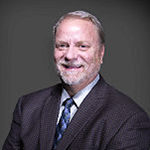
Chris McNair
While the financial and market analysis of the university that led to The Way Forward carefully examined recent years, it included a general look back as far as the 1970s, McNair noted.
“There has been an ebb and flow, with some good years and some bad years,” he said, noting the value of assets and donor contributions have been affected by the oil and gas economy in Texas.
Some alumni, donors and supporters of HSU have criticized the administration for not giving the campus community a greater voice in making the decision. Some questioned whether the university communicated the significant financial problems sufficiently and appealed to donors for additional gifts.
McNair, who became provost two years ago, noted town hall meetings already were being held when he was named interim dean after Tommy Brisco retired from that role in December 2017.
“Town halls were scheduled with faculty and staff in order for them to give their suggestions,” he said.
Leaders of Logsdon Seminary were asked to develop a plan to make the graduate programs financially sustainable, but they were unable to present a workable model, he said.
“That’s not a criticism. Seminary education is struggling around the country,” McNair said.
Development officers and administrators “worked hard” to find additional gifts, but raising enough endowment to produce sufficient annual distributions to make Logsdon Seminary sustainable was beyond the capability of the university’s donor pool, McNair said.
Dollars and cents
Once the “teach-out” program for students currently enrolled in Logsdon Seminary programs is completed in 2023 and the seminary is closed, the university anticipates between $400,000 and $600,000 in annual cost savings.
On its website, HSU posted responses to frequently asked questions regarding campus changes caused by The Way Forward plan. That FAQ reports the university’s budgeted operating expenses in fiscal year 2019 were $49,783,087. HSU reported $143,857,000 in restricted endowment funds and $50,850,000 in unrestricted endowment funds at the time the web pages were developed.
While most endowment funds are managed by HighGround Advisors, formerly known as the Baptist Foundation of Texas, “we don’t just use one manager,” McNair noted.
Another section on the website that deals specifically with questions regarding Logsdon reported the current value of restricted funds given to the Logsdon School of Theology and Seminary as $32.46 million, which produce an annual distribution of $1.62 million. The reported value of restricted endowments specifically for Logsdon was less than $793,000—about 2.4 percent of the total. They provide less than $40,000 in annual distributions, accounting for about $320 per student annually in endowment scholarships.
The website reported HSU spent $2.46 million on employee salaries and benefits, travel, supplies and equipment related to the Logsdon School of Theology and Seminary and close to $1.8 million in Logsdon’s overhead costs.
Total costs related to Logsdon minus the annual distribution from endowments leaves more than $2.6 million that have to be funded in other ways. Tuition payments—including support from BGCT—provides less than $1.4 million, leaving more than $1.2 million in unfunded costs for the Logsdon School of Theology and Seminary.
“Tuition is significantly discounted by us,” McNair said.
By the numbers
Looking at enrollment over the last five years, the website reported an overall decline of 34.3 percent in the Logsdon School of Theology’s undergraduate programs and a 16.2 percent decline in Logsdon Seminary graduate programs.
Photo by Julie Sorrels
A detailed look at enrollment reveals a somewhat more complex picture. According to information the university provided to the Baptist Standard, enrollment in Logsdon Seminary graduate programs increased 3.4 percent from fall 2014 to fall 2018, from 148 to 153.
Enrollment in the Master of Divinity degree program grew about 13 percent, from 85 in 2014 to 96 in 2018.
Overall enrollment for Logsdon Seminary peaked at 175 in 2016 and at 99 for the Master of Divinity degree program in 2017.
Enrollment in the Doctor of Ministry degree program declined from 34 students in fall 2014 to 27 students in fall 2019, reaching its peak enrollment at 44 students in fall 2016. The family ministry studies program enrollment declined from 25 students in fall 2014 to 17 in fall 2019, with a peak enrollment of 29 in fall 2015. Enrollment in the Master of Arts in Religion program never exceeded single digits, reaching its highest enrollment in fall 2017 with 7 students.
HSU trustees voted in October 2018 to close seminary extension campuses in Coppell, Lubbock, Corpus Christi and McAllen.
Undergraduate enrollment in the Logsdon School of Theology declined from 70 in fall 2014 to 46 in fall 2019. Enrollment peaked at 80 students in fall 2017 before dropping to 57 the next year.
Overall enrollment in Logsdon Seminary graduate programs far outpaced enrollment in the three Logsdon School of Theology undergraduate majors—Bible and biblical studies, ministry and youth ministry, and religion.
However, the high cost of operating a seminary and the university’s need to retain undergraduate Bible courses as part of its mission led to the decision to close Logsdon Seminary and direct assets toward the Logsdon School of Theology’s undergraduate programs, McNair noted.
Looking ahead
Elements of the three current undergraduate programs offered by the Logsdon School of Theology will be incorporated into the new major in Christian Studies, McNair said.
Bible classes have been a graduation requirement for all undergraduate students since 1902, the HSU website reports.
In the future, course offerings and academic programs will continue to be evaluated as part of The Way Forward, McNair said. The evaluation will include examination of enrollment, the number of students graduating with a particular major and operating expenses. At the same time, the university will find a way to offer programs vital to its mission.
“The fine arts will never be big revenue generators, but they are central to our focus as a liberal arts university,” he said, noting the undergraduate Logsdon School of Theology falls under that umbrella.
McNair anticipates HSU will continue to expand its online course offerings, but he emphasized it will not become an online-only school.
“I am a fan of traditional residential education. My parents sacrificed to send me here in the early 1980s,” he said. “I do not want us to become completely dependent on online courses, but there certainly is room for growth there.”
Academic programs will “ebb and flow” in the years ahead, just as they have throughout the university’s history, he noted, but a commitment to providing “quality education in a Christian environment is always foundational to everything we do.”
Bill R. Austin, longtime Texas Baptist pastor and educator, died April 17. He was 88. He was born Aug. 6, 1931 to Gilbert Wayne and Lola Ellis Austin in O’Brien. He professed faith in Christ and was baptized at age 9, surrendered to the ministry at age 12, was preaching youth revivals throughout West Texas by the time he was 15, and was called to his first pastorate at age 18. He earned his Bachelor of Science degree at Hardin-Simmons University and his Master of Arts and Doctor of Philosophy degrees from Baylor University. He met Margaret Heath of Levelland at Hardin-Simmons, and they married Aug. 7, 1950. He taught at Hardin-Simmons and Temple Junior College, and he served as chaplain at Baylor. His many pastorates included the First Baptist churches of Waxahachie, Vernon and Nacogdoches; University Baptist Church in Abilene; Calvary Baptist Church and Park Lane Drive Baptist Church in Waco; and churches in Oklahoma and California. He was a prolific writer and his many published books included Austin’s Topical History of Christianity. He developed an interest in art at a very early age and he painted off and on all his life, mainly self-taught and working with oils. After retirement, he returned to the easel and began painting commissioned works. He was preceded in death by his oldest brother Wayne and his sister Peggy. He is survived by two brothers, Hubert and Roy; his wife, Margie; son, Randy Austin and wife, Dara, of North Richland Hills; daughter, Terri McKee and husband, Mark of Hewitt; four grandchildren; and eight great-grandchildren.
Pastors face mental health challenges amid pandemic
April 21, 2020
NORMAN, Okla. (BP)—In recent weeks, as he has juggled altered responsibilities—and added some new ones—Tristan Martin has experienced an overwhelming sensation of busyness.
Amid the social distancing required during the COVID-19 pandemic, Martin, pastor of Alameda Baptist Church in Norman, Okla., is shepherding a congregation of mostly senior adults. He’s also helping to homeschool his young daughters while his wife, a behavior analyst working with autistic children, continues to work outside the home.
“I’m busier than I’ve ever been in ministry, but also in being a dad,” Martin said.
Martin’s situation isn’t unique during the pandemic, which has prompted not only changes in ministry structure but increased personal challenges and stress for pastors as they seek to meet the needs of their families, their congregations and their communities—and as they do it largely from home during a time of social distancing.
Intensified stress
A recent LifeWay Research study also found pastors are experiencing some intensified pressure points connected with their congregation’s needs. Among those: 26 percent of pastors reported worry over finances; 16 percent feel pressure over technological challenges and 12 percent felt pressure offering pastoral care through a socially distanced format.
Intensified stress is not unique to pastors as a recent poll, conducted by Monmouth University, found that 55 percent of people said their stress levels have increased since the pandemic began.
Ray Ortlund, president of Renewal Ministries and pastor to pastors at Immanuel Nashville, said this is a time when pastors honestly and humbly must admit their needs.
“The Lord is giving us pastors a gift during this time of difficulty and limitation,” Ortlund said. “He is giving us the gift of humility. The joy we so often felt during active ministry—yes, there was stress and disappointment, but there was joy too. And that joy we felt: Was it a function of character and faith, or was it a function of activity and adrenaline?”
Ortlund added having the humility to recognize needs may be greater than previously realized is also a pathway to revival for pastors.
Frank Lewis, pastor of First Baptist Church in Nashville, said the effort of making a daily routine in the midst of so much uncertainty has brought frustrations, new levels of irritation and stress.
“It’s a stress that’s just off the charts right now for me,” Lewis said. “That’s usually not me.”
Lewis said generally he is able to handle normal levels of stress well by handling his diet and exercise routine and practicing patience. But with the current events and increased personal demands, he has noticed in himself the temptation to respond to individuals with frustration and curt speech.
Another LifeWay Research study gathered responses from pastors in relation to the difficulty of connecting with their congregation and keeping up with needs in a manageable way. One response noted with the rapid change of job description and needs, there is a constant demand for communication and pastoral care. Another said the work can become tedious, and the avenues that would support the pastoral experience are all blocked.
Need to practice spiritual self-care
Geremy Keeton, senior director of counseling at Focus on the Family, said habits of personal, spiritual self-care that were already necessary for pastors are being revealed and amplified during the pandemic.
“A pastor’s ability to know how to gauge his need for self-care is essential every week of his ministry,” Keeton said. “Those who had that in place and do that well are having to buckle down and make more effort in doing it and are probably thriving because they’ve practiced, before coming into this, what self-care is. But if that was not in place, and you came into this with a deficit, it was probably going to push you to a place of realizing you need to do that, or to a breaking point.”
Keeton said pastors must care for their body, their mind and their spirit. They must be filled with the Spirit, in order to pour out to others.
“Pastors are holistically ministering to their flock, and so they have to holistically minister to themselves,” Keeton said.
Along with navigating care for his daughters, ages 5 and 7, Martin continues personal and academic study, as well as full-time ministry. Alameda Baptist’s Sunday morning services are broadcast on Facebook Live.
To maintain connection with the congregation, which averages a little more than 60 in attendance when meeting in person and is about 60 or 70 percent senior adult, Martin has spent plenty of time on the phone. That’s at least in part because some of the members don’t have access to or aren’t comfortable using Facebook.
But Martin, who is in his first pastorate, continues to find running important, both for fitness and stress relief, although he’s down to once or twice a week with the suddenly more hectic schedule—and after his treadmill died.
Spiritual disciplines more important than ever
Martin said the messages he’s been preaching are as much to his own heart as to the Alameda Baptist congregation.
Most important, Martin said, are the spiritual disciplines of prayer, solitude and reflection— always essential, but especially now.
“Being grounded in the spiritual disciplines is what is most helpful to me,” Martin said. “I know that nothing else is going to lift me out of isolation or depression or whatever is hitting me at the moment other than being in God’s word and meeting him there.”
Likewise, Lewis said, he has become more acutely aware of his need for prayer and spiritual discipline.
“I’m more conscientious than I’ve ever been in my ministry with regards to praying through crisis, and so I’m staying close to spiritual disciplines I’ve used for 40 years now,” Lewis said.
Ronnie Floyd, president and CEO of the Executive Committee of the Southern Baptist Convention, has long made a priority of addressing mental health concerns. At the 2013 SBC Annual Meeting, Floyd spoke in favor of a resolution on “Mental Health Concerns and the Heart of God,” saying, “it’s time that the SBC be on the front lines of mental challenges.”
During his years in ministry, Floyd also specifically has emphasized the need for pastors to pay attention to their mental and physical health. He suggested those concerns are magnified by the pandemic.
“The mental health of pastors is the top challenge we are facing over the next few weeks until we worship together again,” Floyd said. “Pastors should be very aware of this challenge so they can deal with it proactively.”
Floyd encouraged pastors to “prioritize and nourish their personal walk with Christ, discipline themselves to exercise 30-60 minutes a day”—outside, if possible—and to spend time weekly on Zoom calls with several friends who are also pastors, sharing their experiences and praying for each other.
“These simple but needed actions will help the pastor live in a healthy manner,” Floyd said. “Healthy pastors build healthy churches.”
‘Receive the compassion from God’
Rob Jackson, staff counselor at Focus on the Family and licensed professional counselor, encouraged pastors to receive God’s compassion during this time.
“Stop and think about the compassion God has for humanity,” Jackson said. “Stop and practice his compassion. Receive the compassion from God that you hope to be able to give out to others.”
Jackson said pastors should be patient with themselves, not over-extending themselves in ambitious new endeavors.
“This is the time to practice the most basic fundamentals of self-care and then, caring service to others,” Jackson said.
Chad Keck, pastor of First Baptist Church in Kettering, Ohio said he has found maintaining a consistent, dedicated time to spend outdoors to be essential to his wellbeing during the last few weeks. He said the slowed-down pace of life has caused many to evaluate what is important to them and realize the need for potential, long-term changes.
“These experiences force us to rethink what we are doing and how we are doing it,” Keck said.
Joe McKeever, former director of missions for the New Orleans Baptist Association and longtime pastor of churches in Mississippi, North Carolina and Louisiana, informally has counseled pastors for years. He said pastors are realizing more than ever the importance of encouragement from other pastors.
Echoing Floyd’s advice, McKeever said he has urged pastors to talk with each other, to share their successes as well as their needs and to simply be there for each other, learning and growing together.
Tony Rankin, minister of pastoral care at First Baptist Church Nashville and a licensed counselor, said pastors and laypeople alike must be willing to admit they do not have all the answers.
“It’s hard to explain why difficult things are happening all across the world,” Rankin said. “It’s hard when we don’t have all the answers for people in the church.”
And yet, Rankin said the unprecedented current challenges can prompt pastors to lean into a simple expression of faith that requires hope—and into a hope that requires faith.
COVID-19 forces church ministries to asylum-seekers to adjust
April 21, 2020
Social restrictions continue changing due to the COVID-19 pandemic, and for immigrants seeking asylum in the United States, those changes add more instability to their situation.
Churches in Texas with ministries for asylum seekers have been forced to make adjustments, said Jorge Zapata, coordinator of missions and Hispanic ministries at the Cooperative Baptist Fellowship of Texas and founder of Hearts4Kids.
“Many of us have increased our ministries to neighborhoods of lower-income Hispanic families in the Valley,” Zapata said.
Limited border crossing
Several weeks ago, the United States began limiting travel across its borders to essential travel. More recently, Mexico also began limiting travel from its border with the United States.
Immigrants seeking asylum, who already had to wait in Mexico while their cases were resolved under the Migrant Protection Protocol, also were able to cross the border until recently, Zapata explained.
Jorge Zapata
Now they also must remain in Mexico, which shifts more responsibility to churches in Mexico that until recently shared the ministry with churches in the United States once immigrants were able to cross.
“Right now, we are supporting churches in Mexico who can minister to immigrants,” Zapata said.
Zapata’s connections with pastors and churches around several border towns that go from the Lower Rio Grande Valley in Texas to California have all experienced changes. All of them continue their ministry with immigrants exclusively through churches in Mexico, he noted.
Some U.S. churches still send funds to churches in Mexico; others have found immigrant families in the United States who are being affected by COVID-19 and support them in some way.
Stress increases for immigrants
Stay-at-home orders from county officials vary from place to place, but the police are stopping some, asking them to explain why they are out of their homes.
“I know of some cases where individuals have been pulled over by officers three times while they were out in their cars,” Zapata said. “For many immigrants in the area, that can be really stressful.”
Families who need to go out to get food from church pantries—and even those who receive food from churches delivered to their doorsteps—fear that by stepping outside their homes, they could face legal problems with the local government or immigration agents, he noted.
Hispanic immigrant families also form an essential part of the service industry, which makes them vulnerable. Their need for income forces them into continued interaction with other people at a time when they should limit those interactions.
“People live day by day, week by week and paycheck by paycheck,” Zapata said.
Access to healthcare also is limited, so any unnecessary exposure to the outside seems almost out of the question for them—and more so when law enforcement is involved, Zapata added.
He noted—and immigration lawyers confirmed—that immigrants who show symptoms of COVID-19 safely can seek medical attention without fear of deportation.
Directing support to families and churches in need
The ministries Zapata is a part of are directing funds toward helping families, pastors and churches who need some assistance while everything else is shut down.
Churches that minister to low-income families also are experiencing more hardships now due to a significant drop in offerings, he noted.
“Everyone is in need right now,” Zapata said.
Churches in Mexico have accepted responsibility for ministry to immigrants, but they also must follow limited interaction with asylum seekers in Mexico according to guidelines from the Mexican government, he said.
“If a church has food or any other item they want to provide to a shelter of asylum seekers, then they need to go drop those items outside of their shelter and have someone come outside to pick them up,” he added.
Difficulty in receiving financial support
But the responsibility increases when many pastors and churches in Mexico begin feeling pressure from the lack of resources coming in every week.
Churches and ministries from the United States that provided food, clothing, healthcare items or construction materials now are limited to sending funds. But many churches in Mexico lack bank accounts or credit cards, so that makes it difficult for churches to receive them.
Pastors across the border from California who work with asylum seekers ran out of funds recently. When Zapata and Fellowship Southwest asked how they could support them, the pastors said the only food they would buy for themselves would be rice and beans. The rest of the money would be exclusively used for asylum seekers.
“Everything is on hold, except the ministry in the lives of immigrants” Zapata said. “For churches who had planned a mission trip to the Valley or across the border, then we ask they still use those funds to help the ministry of the ones who remain working here.”
Worship suspended but ministry continues
At Iglesia Bautista West Browsnville, where Carlos Navarro is pastor, the church’s ministry to immigrants—Golán—closed its doors about three weeks ago in order to follow the recommendations of the city.
Like other churches in the area, Navarro also traveled to Mexico up until less than three weeks ago to minister to migrants there, before Mexico also limited travel across its border.
Because of the networks Navarro built in the past years with government officials, he knew which decisions would be made regarding the city’s response to COVID-19, he said.
Work done to serve immigrants transitioned to feeding the homeless population in downtown Brownsville.
“There are close to 30 homeless people in the area, among them we know there are two or three immigrants who could not leave because everything else began shutting down,” Navarro said.
The church takes clothing, food and hygiene items twice a day for people in downtown Brownsville, he said.
Helping during crisis
With extensions in Southwestern Spain and Southern Mexico, Iglesia Bautista West Brownsville keeps a deep connection with areas where COVID-19 had already upended the economy and the healthcare capabilities of other nations, Navarro confirmed.
The association of hotel owners in Sevilla partnered with Golán Internacional so several meals could be distributed in the city.
Through other organizations in Europe, Golán Internacional also has provided ingredients for the preparation of meals which are then distributed to children, families and senior adults, Navarro said.
“Imagine what it would be like to suddenly have absolutely nothing to eat, that is what happened to many people in Spain,” Navarro affirmed. “We’re trying to give them something that will help them as they deal with this crisis.”
Out of all the Hispanic churches in the area, Iglesia Bautista West Brownsville is the only one still open right now, he said.
“This definitely affects most churches who depend on the support they receive from people every week,” he mentioned. “Many pastors and their families do not have income right now.”
Through local and state networks, Navarro said the church provides similar support for families in the area as the ministry they support in Spain.
“Thankfully through these networks God has been preparing us for this during the past two years,” Navarro said. “We see how God has moved around us and we are thankful for that.”
Because of God’s provision and preparation, Iglesia Bautista West Brownsville finds itself in a position to help others during this crisis, stated Navarro.
Moved to Mexico to minister
Other groups and ministries that previously ministered to immigrants have left the area already, both Zapata and Navarro confirmed. So, the need for support increased as the pandemic grew.
As Mexico prepared to limit travel across its border, Pastor Lorenzo Ortiz of El Buen Samaritano went across the border planning to stay until travel restrictions are lifted, said his daughter Ruth Ortiz, who is a missionary for the River Ministry of the Baptist General Convention of Texas.
Pastor Lorenzo Ortiz of El Buen Samaritano moved to Mexico after both the United States and Mexico began limiting their borders to only essential travel. Pastor Ortiz will remain in Mexico and minister to more than 170 asylum-seekers until travel restrictions are lifted. (Photo provided by Lorenzo Ortiz)
“He’s responsible for many things regarding some shelters where asylum seeking immigrants stay, so it was impossible for him not to be there during these travel restrictions,” she said.
From Monday to Saturday, Ortiz’ father will travel to Monterrey at least once a day to help migrants in Monterrey get to the border, where they can present themselves. Although asylum cases are postponed, asylum seekers still must present themselves at the border to receive another hearing date.
Sometimes, Lorenzo Ortiz will make the two-and-a-half-hour trip to Monterrey twice a day, his daughter said.
Pastor Ortiz is one of the few ministers in Northeast Mexico who still is allowed by the government to interact with asylum seekers in the country, Zapata noted.
His ministry includes finding a place for immigrants to shelter, finding and providing essential needs, transporting them to and from different locations, and providing pastoral care.
Ortiz provides shelter for immigrants in three locations—two in Nuevo Laredo and one in a ranch called El Derramadero, a few hours away from Saltillo. Iglesia de Dios en Derramadero in El Derramadero, where Ortiz’ aunt Eva Reyes Marquez is pastor, provides shelter to those who came looking for asylum in the United States.
Immigrants staying there go out looking for jobs and eventually pay for their own expenses too, but the church provides for them until they can find employment somewhere, Ruth Ortiz said.
Drug cartels follow and often extort asylum-seeking immigrants in Mexico, she noted.
“Cartel members have posed as police officers and stopped my dad on the road, and they have also gone to visit shelters, but thankfully nothing has escalated yet,” Ruth Ortiz said. “My mom and I are also definitely concerned about my dad because he is exposed to many people who may be carrying COVID-19.”
In Mexico, Pastor Ortiz works with close to 170 people at the shelters, but those numbers often can reach more than 250 people as well, she said.
PTSD common among asylum seekers
Whether asylum seekers flee their home countries because of financial hardships, violence, sex abuse or any other reason, most share a common trait—post-traumatic stress disorder, said Olga Harris, a licensed professional counselor.
“The reasons they come here are very different than those who come for the American dream,” Harris said. “They come here because of fear, because they are running away from a real threat.”
Harris recalled one of her patients who had a transportation business in Central America, which was enough to provide for his family. A gang located him and demanded 60 percent of his profits in exchange for his safety and the safety of his wife and daughter.
“He lived under fear, and every day, he could not tell whether that would be his last day,” Harris said.
The man left home and came to the United States, Harris said. While he was granted asylum, he already had started the petition to bring his wife and daughter before the government put on hold processes because of COVID-19.
Ministry and assistance provided by churches may seem like a drop of water in the desert for the situations most asylum seekers deal with, Harris said, but often that little bit helps them keep going another day.
“Even if it is just a drop, we must keep doing what we are doing because we alone are not it,” Harris said. “The drop of water we provide may add to other support others give them and that drop may fill one cup of water.”
Though asylum seekers in Mexico had the opportunity to return to their country, Zapata said, most decided staying in Mexico was a better option than going back.
“They’ll say: ‘We’re going to stay here, because we are dying in our own country from violence and hunger, and we risked our lives to come to the border. So, we’re not afraid of the coronavirus,’” said Zapata. “They really trust in God, who brought them here and will continue to protect them while they wait.”
Clergy note COVID-19 prevalence among African Americans
April 21, 2020
NEW YORK (RNS)—Pastor Frank Williams has been so busy leading two black churches in the Bronx with more than 200 members that he hadn’t really considered the full extent of COVID-19’s impact on his congregation, his family and his community.
Pastor Frank Williams leads two black churches in the Bronx. (Courtesy photo)
But when asked, the Southern Baptist minister realized after four weeks the list was long.
The Saturday before Easter, a beloved deacon—a decades-long friend who had been the property manager, the men’s ministry leader and the person who ran the van ministry picking up seniors for Bronx Baptist Church—died from complications related to COVID-19.
Williams’ wife, a hospital residency coordinator, and his three children, all under the age of 12, have recovered from COVID-19 and he preached his first online sermons from the Psalms while quarantined.
The 47-year-old pastor helped the staff of Wake-Eden Community Baptist Church’s elementary school shift to remote learning and, as the need for food in the nearby community increased, worked to provide families with food that previously would have been prepared for their children at a church day care.
“The impact is very real for us, not just here in New York, but very real for us as a congregation,” said Williams, a St. Kitts native whose churches include black Americans and immigrants from Africa and the Caribbean.
Ministers urge government to take action
Across the country, black clergy say the coronavirus is touching—and sometimes taking—the faithful who until a month ago were accustomed to meeting weekly in their pews. Some are mourning losses in the highest echelons of their denomination. Others are counting the dead, sick and unemployed.
Some African American pastors are joining forces to demand the Trump administration and congressional leaders take actions ranging from setting up testing sites in black and poor communities to providing masks to low-wage essential workers, prisoners and people living in homeless shelters.
The federal Centers for Disease Control and Prevention recently released a March report that showed 33 percent of hospitalized patients in a 14-state study were African American; comparatively, blacks constitute 13 percent of the U.S. population.
At least one historic black denomination has started a preliminary tally of the toll of COVID-19.
Gregory Ingram, who is bishop of the African Methodist Episcopal Church’s First Episcopal District, which includes the hard-hit areas of New York, asked presiding elders within it to report what they knew about members’ health and economic statuses. An April 15 report shows throughout the district, which also includes churches in states such as New Jersey and Delaware, 48 members have died, 258 have been infected and 1,913 have become unemployed as a result of COVID-19.
“I had one church that lost three members in one day,” Ingram said, referring to a congregation in Freeport, Long Island.
‘This is new territory for us’
Another of the deceased from the AME denomination is Yonkers Pastor Scott Elijah, who died in late March. He was remembered not only by his small church but by Local 100 of the Transport Workers Union, which recalled his work with NYC Transit in a “Lost to Coronavirus” listing: “The entire Track Division is in mourning.”
Ingram and his wife, Jessica Ingram, have been praying on 6 a.m. daily calls with members of their district and following up by phone with church members who have lost loved ones to COVID-19.
“This is new territory for us,” said his wife, who as the episcopal supervisor for the district has been co-hosting Zoom meetings with leaders among the young adults, laity and pastors in the district. The training and study sessions have centered on topics ranging from the “new landscape of the church” to health disparities. “And we don’t have answers, so basically I just express my prayers for them and listen and let them know that we are here for them.”
The Church of God in Christ, another historic black denomination, reportedly has lost close to a dozen of its bishops and other leaders to COVID-19, including Phillip Aquilla Brooks II, who was the Michigan-based first assistant presiding bishop.
“The loss of such a respected visionary leader cannot be verbally expressed,” said Presiding Bishop Charles Blake in a video announcement that did not specify Brooks’ or others’ cause of death. “I know that the death of Michigan Bishop Brooks, Nathaniel Wells and so many others has caused great concern and great pain throughout the church, concern for our leaders and concern for the future of the church.”
After noting that he and his family were well, Blake spoke of divine pledges and the need to lean on God.
“At this challenging time, I want you to remember that God has promised that the gates of hell shall not prevail against his church,” he said in the announcement on the homepage of the Church of God in Christ website. “And I’m absolutely confident that God is going to bring us through this tough time together. We as people of faith must look to God and to the word of God as we have in challenging times past for hope and for encouragement.”
Focus more on humanity than economy
At a video news conference hosted Wednesday by the Samuel DeWitt Proctor Conference and Repairers of the Breach, black clergy called on leaders at the White House and in Congress to provide more resources to African Americans and to focus more on humanity than the economy.
“Black people are more likely to be essential workers, keeping us safe and fed,” said Pastor William Barber II of Greenleaf Christian Church in Goldsboro, N.C., and president of Repairers of the Breach.
“But these are the very people the stimulus bill did not provide (with) the essentials of health care, living wages or even guarantee that no water would be shut off. While corporations in less than three weeks got $2.5 trillion.”
Clergy on the call spoke of praying over the phone with health care workers in their congregations who lack protective equipment and people who can’t pay their rent.
“There is no sheltering in place when there is no shelter,” said Yvette Flunder, a San Francisco preacher affiliated with the Metropolitan Community Churches and who oversees a ministry site that provides food, medical and housing case management services.
‘Communities in pain and grief’
Traci Blackmon, a justice executive minister for the United Church of Christ and leader of a church north of St. Louis, said her congregation includes bus drivers, grocery workers and mail carriers. She said five of about 80 congregants tested positive for COVID-19 and three went to the hospital multiple times before they could get tested, thus exposing their households in the meantime.
“I pastor people who are now seeking food for their children and for their families because those food services have had to be suspended because of the deaths of two bus drivers who died from COVID-19,” she said.
Pastor Frederick Haynes III leads Friendship-West Baptist Church in Dallas. (Photo by Jack Akana Jr.)
Pastor Frederick Haynes III of Friendship-West Baptist Church in Dallas opened the April 15 video conference with an “appeal to those in power on behalf of communities in pain and in grief.” In a separate interview, he noted black community leaders who have been concerned about environmental justice and health disparities will now have to see what more the black church can do.
“There are those of us who have been fighting for that and now we are upgrading our fight because we are seeing that this country has proven that it does not have a desire to protect us,” he said.
News reports have indicated other examples of how the coronavirus has ended the lives of longtime churchgoers and clergy from Louisiana to Maryland to New York City’s Harlem borough. A Virginia pastor who claimed “God is larger” than the coronavirus succumbed to it, his church announced.
Clergy tasked with memorializing people who have died, often unexpectedly, say the coronavirus has prompted uncharacteristic changes in funeral and burial traditions.
Pastor Adolphus Lacey of Bethany Baptist Church in Brooklyn, said April 14 his 900-member congregation has had three confirmed COVID-19 deaths. He officiated at two funerals the day before, one at a Brooklyn funeral home and one an hour-and-45-minute drive away in New Jersey.
Though familiar with the rites of death, Lacey said wearing masks, gloves and keeping socially distant has made the moments of farewell even more difficult.
One funeral, for a popular usher, was carried out on Zoom and so many wanted to participate, some never got past the virtual waiting room.
“The sad part, I said, he was at everybody else’s funeral but when it came to his funeral, nobody could be there but just his family,” said Lacey, whose church is affiliated with the Progressive National Baptist Convention Inc. and the National Baptist Convention U.S.A. Inc.
From his New York borough north of Lacey’s, Williams spoke of his longtime faith helping him cope with the sadness and hang on to hope.
“There are always people who experience loss and that’s the reality of grief,” said Williams. “We are experiencing that in the loss of our deacon but we are still praying for God’s preservation. And that really comes from Psalm 121, where it says ‘I will preserve you from all evil. I will preserve your soul.’”
COVID-19 hampers seminary education in prisons
April 21, 2020
ROSHARON (BP)—The 165 students earning bachelor’s degrees in biblical studies at Darrington Prison Unit in South Texas no longer can attend classes, with the prison on lockdown since the presence of COVID-19 was confirmed in the facility.
But the interruption is itself a learning experience for the men, who are being trained to minister while serving time at prisons across Texas.
“It is part of God’s equipping and his sovereignty for what these men need in their hearts,” said Brenna Norwood, director of programs for the Heart of Texas Foundation, which runs the prison education program in partnership with Scarborough College of Southwestern Baptist Theological Seminary and the Texas Department of Criminal Justice. “This is an interruption that (God) knew was coming, and he’s strengthening them. He’s growing them through this, preparing them for ministry in the midst of this.”
Two cases of COVID-19 have been confirmed at Darrington, a maximum-security facility with a population of about 2,000 men; 150 were being monitored after possible exposure to the coronavirus, the Texas Department of Criminal Justice reported April 14 on its website.
Prison seminary programs affected by pandemic
The Scarborough College Darrington Prison Extension program is among similar prison education programs offered by Southern Baptist seminaries in six states. All of the programs have been altered in some way by the pandemic.
Along with the program at Darrington, programs offered in North Carolina by Southeastern Baptist Theological Seminary and Louisiana by New Orleans Baptist Theological Seminary continue. Programs offered by New Orleans Seminary in prisons in Florida, Georgia and Mississippi have been suspended during the pandemic.
At Nash Correctional Institution in Nashville, N.C., the 66 men enrolled in Southeastern Seminary’s program have been able to continue their full academic load. Each class is divided among three separate rooms with no more than eight students per room. Desks are situated at least six feet apart, and instruction is conducted online through Zoom utilizing a large television screen, according to Seth Bible, director of prison programs for Southeastern Seminary.
“It allows me to log in from my house and project to all three classrooms simultaneously, so I only have to do one lecture,” Bible said.
Instructional opportunities in prison vary by state.
Limited opportunities in Louisiana
New Orleans Seminary is allowed to continue only a limited number of classes at Louisiana State Penitentiary at Angola, La., and the Louisiana Correctional Institute for Women in St. Gabriel, La.
Inmates at Louisiana State Penitentiary at Angola were the first to have the opportunity to pursue seminary training through a New Orleans Baptist Theological Seminary extension at the nation’s largest maximum security prison. Inmate Paul Will, pastor of Grace Baptist Church of the Main Camp, is a 2007 graduate of seminary’s extension program at Angola. (Baptist Press file image from “A New Hope,” a documentary about the ministry)
Kevin Brown, director of the seminary’s Prison Extension Center education, said chaplains with New Orleans Seminary doctorate degrees who are considered essential prison personnel are teaching some classes, and some students are completing assignments independently.
All other prison seminary classes have been suspended, including programs at Hardee Correctional Institution for men in Bowling Green, Fla.; the Mississippi State Penitentiary at Parchman, and the Whitworth Women’s Facility in Hartwell, Ga.
“We’re doing what we can do to keep moving, to keep the students advancing,” Brown said. “But this COVID thing, it’s more serious in prison than it is for you and I, because once it gets in the prison it’s not getting out. I mean, the prisoners can’t go anywhere.”
At least one Louisiana Department of Public Safety and Corrections employee at Angola has died of COVID-19, the agency announced April 10. Prisoners who tested positive for COVID-19 but were asymptomatic were being isolated in Camp J of the prison compound. Normally, many prisoners at the facility live in open dormitories.
A Mississippi inmate with another illness was found to have also had COVID-19 after his death at Parchman, the Associated Press reported April 14.
Internet access is not allowed in the prisons served by New Orleans Seminary, which prevents instruction via Zoom and other online platforms.
“We have the capabilities,” Brown said. “We haven’t figured out how to create sufficient firewalls to be able to teach into the prison.”
Brown said New Orleans Seminary has ordered the necessary equipment as authorities at Angola have considered allowing an exception, but approval hasn’t been given.
“The scary thing for them is, that if prisoners have access to the internet, they’ve got access to all the negative stuff on the internet as well,” Brown said.
New Orleans Seminary has nearly 150 students enrolled in the five states, according to Brown, who added that graduation will be delayed for some because of the pandemic, but the setback is temporary. New Orleans Seminary was the first Southern Baptist seminary to offer education in prison, beginning the program in 1995. The program has expanded to include two master’s degree opportunities, including the Master of Divinity with classes in biblical Hebrew and Greek.
“At Angola, it’s the gold standard,” Brown said. “Our guys have proven themselves to be amazing mentors and leaders, and have a degree of trust with administration that they don’t have in our other prisons.”
Texas classes suspended
At the Heart of Texas Foundation program, classes are suspended but students had completed enough course work before the pandemic to graduate this spring, Norwood said. For the first time in the program’s 10-year history, though, a chapel service will not be held for graduation.
Grove Norwood, Brenna’s husband and the Heart of Texas Foundation founder and CEO, said the students have been diligent in completing coursework despite the obstacles presented by the pandemic.
“They do work very, very hard in seminary,” Grove Norwood said. “This is no piece of cake. … The field ministers themselves are still the light in the darkest of places. Whether they’re talking across the hall to the cell next door, or to the bunk next door, their light is still shining.”
Men accepted into the Scarborough bachelor’s degree program are all transferred to Darrington Prison, a maximum-security unit near Rosharon, for more than four years of coursework, and then trained in the foundation’s field ministry program. Upon completion, they are transferred to their previous prison units to serve as ministers to fellow prisoners.
Southeastern Seminary plans to graduate its first class of seminary students in North Carolina prisons in 2021, with 26 students currently on course to graduate, and then to minister to others as they complete their prison terms.
Bible said seminary education is important to the rehabilitation of those who are incarcerated, and called it an important investment in the lives of those serving lengthy or lifetime sentences.
“We’ve seen the impact that it’s had at Angola in Louisiana, and also the impact that a similar program has had on the state of Texas through Southwestern Seminary,” Bible said.
“We believe that some of the most influential people inside of the prisons are actually those long-term folks, and so we see a real value in investing in them so that they can make a positive impact from the inside.”
Garland Acteens stay on mission during pandemic
April 21, 2020
GARLAND—Missions discipleship is personal for Mary Lou Sinclair and her Acteens group—even amid a pandemic.
Sinclair has been Acteens director at Freeman Heights Baptist Church in Garland more than 20 years. During that time, five of her Acteens have been named National Acteens Panelists, and three others have been selected as Top Teens.
They also have traveled extensively over the years to participate in mission trips, state and national Woman’s Missionary Union annual meetings and Blume, a national missions gathering for girls.
A close-knit group that reflects the church’s multicultural community, the Acteens describe themselves as family and thrive on frequent fellowship among the teens and their adult mentors. Based on their close connections, the 6th through 12th grade girls refuse to let coronavirus-induced social distancing and sheltering in place derail their missions and ministry focus.
Virtual meetings include prayer times
“We can’t begin to understand what is happening right now,” Sinclair acknowledged. “But we, as Christians, can be sure that there will be some good that comes out of all of this.”
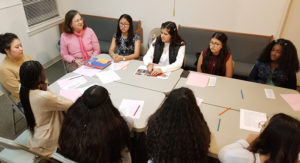
Acteens at Freeman Heights Baptist Church in Garland meet via Zoom video conferencing amid coronavirus-induced social distancing and sheltering in place. “It’s been really neat that we have the ability to use technology for our Acteens meetings,” noted Marisol Sandoval, one of the group’s Acteens leaders. (Photo courtesy of Marisol Sandoval)
On a practical level, Sinclair asked Marisol Sandoval, one of Freeman Heights’ youth ministers, to set up virtual Acteens meetings online to keep the group connected.
Sandoval, a former Top Teen who grew up as a member of Sinclair’s Acteens, now serves alongside Sinclair as an Acteens leader. In order to help transition the group’s meetings to video conferencing, “I had to learn everything I could about Zoom,” she said.
“It’s worked out pretty awesome. The girls are adapting well,” Sandoval added. “They want to be with us. They want to see us. They want to hear from us. It’s been really neat that we have the ability to use technology for our Acteens meetings.”
Sinclair said their virtual meetings still include several typical features such as “praying for people in our church, praying for national and state WMU, having our lesson and having Bible study.”
Along with using available tech options to stay in touch, the teens and their leaders continue to plan a variety of missions projects, including a virtual prayer walk of their neighborhood using GPS mapping. They also plan to sew protective masks for residents in area apartment buildings and send letters of encouragement to members of a local Chinese Christian church who may be feeling ostracized as some Chinese-Americans are harassed on social media and elsewhere.
Sinclair said the goal of the letters simply is to say to fellow Christians, “We’re praying for you, we’re so thankful that you’re here and safe and we want you to know that we care about you.”
Still involved in missions action
Long before the widespread impact of the coronavirus crisis, the Freeman Heights Acteens have been known as one of the most active youth mission groups in Texas Baptist life.
Freeman Heights Acteens typically spend several hours a week volunteering at the ROC (Re’Creation Outreach Center), a community ministry center that provides a food pantry, clothes closet, after-school tutoring, Bible studies and other ministries and activities for children, youth and families in the area. “This group of girls has become servants, not just those who are served,” affirmed Adam Wood, director of the ROC. (WMU photo by Pam Henderson)
The girls regularly volunteer at the ROC—the Re’Creation Outreach Center. The community ministry center provides such resources as a food pantry, clothes closet, after-school tutoring, Bible studies and a host of other ministries and activities for children, youth and adults.
Even while observing social distance restrictions, the Acteens have helped fill bags of groceries for families to pick up at the door of the ministry center.
“The ROC is really the home base for several faith communities in the Garland area. Ultimately, it’s a hub of gospel ministry within the area,” said Adam Wood, director of the ROC and lead pastor of The Neighborhood Church in Garland.
“One of the marks of effective community ministry is when the people you are serving become people who serve. One of the places we’ve seen that most is with this strong group of teenagers,” Wood said. “This group of girls has become servants, not just those who are served. I think it’s in large part because of their connection with Mary Lou and the Freeman Heights youth group.”
As her Acteens navigate a new normal, Sinclair plays a huge role in encouraging their ongoing missions commitment.
“Mary Lou is one of those people who does whatever’s needed,” emphasized Larry Venable, her longtime pastor at Freeman Heights. “What she has done with Acteens is fabulous, just teaching them spiritually, getting them involved in mission activity and growing. … She’s definitely captivated by her relationship with Christ and the gospel.”
Opportunities for spiritual growth
What previously was a typical Acteens gathering at Freeman Heights Baptist Church in Garland has now shifted to video conferencing and social media. “The girls are adapting well” to the virtual Acteens meetings, said Acteens leader Marisol Sandoval. “They want to be with us. They want to see us. They want to hear from us.” (WMU photo by Trennis Henderson)
Nayely Vallejo, one of the National Acteens Panelists nurtured by Sinclair, also helps lead Acteens alongside her mentor. Affirming the opportunity to “just live on mission with my fellow Acteens girls, showing people who Christ is and showing people our servants’ hearts,” Vallejo said, “Because of Mary Lou and because of how she’s raised us as GAs and Acteens, it’s just natural for us to serve everyone any chance we get.”
With this summer’s national WMU annual meeting cancelled and Blume postponed until 2021, Sandoval said their Acteens “are sad, but they’re fine.”
While coping with social distancing, loneliness and disappointment, “I think there’s been a lot of growth spiritually,” Sandoval reflected. “This has definitely taken us out of our comfort zone. We know from looking in the Bible that whenever we’re taken outside of our comfort zone, there’s growth and we learn to trust in God. We learn how important relationships are.
“It’s hard because we can’t really go and hug them,” she shared. “That’s one of the hardest things for this social distancing because you just want to hug them and just comfort them and you have to trust God that he’s there to comfort them and love on them.”
Before the current crisis erupted, Sinclair said she was involved in event planning with a group of state WMU leaders who “talked about being the hands of God and being able to use the tools that we have in our hands to do ministry.”
During a recent follow-up video conference call, “we talked about how the things in our hands are totally different than what they were before,” she said. “But God finds a way and we just have to be looking for how he can use us to do his ministry.”
Even amid the turmoil of a global pandemic, pursuing new and creative ministry opportunities is precisely what Freeman Heights’ Acteens continue to do—just as Mary Lou Sinclair faithfully has taught them.
Houston church honors Easter tradition with virtual choir
April 21, 2020
South Main Baptist Church in Houston met two seemingly irreconcilable goals—refrain from gatherings to protect public health and keep alive a beloved Easter tradition at the church—by putting together a virtual choir.
The offertory anthem during South Main’s worship service on Easter Sunday morning—as presented on the church’s Facebook page—featured a 65-voice virtual choir of church members singing the “Hallelujah Chorus.”
Virtual choirs—in which individual singers record and upload videos of themselves that are then synchronized and combined into a single choral performance—have become a social media phenomenon since stay-at-home orders across the country to halt the spread of COVID-19 began several weeks ago. However, American composer and conductor Eric Whitacre pioneered the technique more than a decade ago, said Carey Cannon, minister of music at South Main.
Cannon noted inviting members of South Main to sing the “Hallelujah Chorus” from Handel’s “Messiah” was a longstanding part of Easter Sunday worship long before he joined the church’s staff in 2013.
“How could we not do the Hallelujah Chorus on Easter?” he asked.
Given the short timeline, members of the pastoral ministry team at South Main had “varying levels of confidence” in the church’s ability to include a virtual choir of its members singing the “Hallelujah Chorus” in its online Easter worship service, but Cannon felt certain it could be accomplished, said Susan Moore, minister of administration for communication at South Main.
“The main thing I learned from this was when Carey has a vision for a project, let him run with it,” Moore said.
With a little help from his friends
Cannon enlisted the help of Joshua Lee Turner, a professional musician in New York who mixes and produces his own music videos.
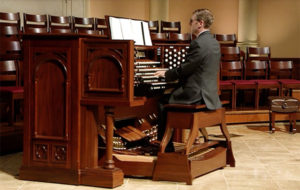
Yuri McCoy, organist at South Main Baptist Church in Houston, provides accompaniment for the virtual choir’s rendition of “The Hallelujah Chorus.” (Video Screen Capture)
Cannon—former minister of music at Providence Baptist Church in Charlotte, N.C., and associate conductor of the Charlotte Children’s Choir—knew Turner from their time together in North Carolina.
Turner agreed to edit and produce a video of the virtual choir if Cannon could get it recorded and send him the elements he needed.
First, Cannon made a recording of himself conducting the “Hallelujah Chorus,” accompanied by organist Yuri McCoy, and sent it to four section leaders of the sanctuary choir at South Main who recorded themselves singing the bass, tenor, alto and soprano parts.
Each member of the choir then received a digital file of the recording for his or her voice part, along with a PDF of the musical score. Cannon invited the choir members to record themselves on a smartphone or computer singing the Hallelujah Chorus and then send that recording to the church.
Overcoming obstacles
The first obstacle Cannon discovered was lack of equipment. Not everyone who had a computer or smartphone had headphones or earbuds with a microphone to go with it.
Carey Cannon
Once he was able to round up the necessary equipment, members had to get over their reluctance to record themselves singing a classical piece of sacred music—preferably with as few bloopers and outbursts of frustration as possible.
“I’m pretty sure my name is mud as far as some people are concerned right now,” Cannon said.
The first week, response was slow, he acknowledged. But by the time he reached Turner’s deadline for receiving recordings, 65 people participated.
“Some of the choir was pretty uncomfortable,” Moore said. “And yet, they did it.”
Cannon sent the digital files to Turner, who spent at least 10 hours on audio and 10 hours on video, mixing and producing a broadcast-quality presentation using Avid Pro Tools and Adobe Premiere software.
“He hit it out of the park,” Cannon said.
Viral response, national exposure
The virtual choir presentation was incorporated into the Easter worship service on Facebook Live, which then was posted for later viewing on both the church’s Facebook page and its website.
If the number who watched the livestream at 10 a.m. on Easter didn’t quite live up to Cannon’s expectations, the viral reaction later exceeded his wildest dreams—particularly after the choral presentation was part of a national newscast.
Steve Wells, pastor of South Main Baptist Church, told a neighbor who works for the Houston NBC-TV affiliate that the church was including the virtual choir singing the “Hallelujah Chorus” as part of its online Easter worship. She forwarded the information to the network, and the national NBC Nightly News April 12 broadcast included a clip of the choir’s performance.
“Of course, we appreciate the exposure for our church, but we’re more grateful for the gospel impact,” Cannon said. “On Easter Sunday evening, viewers of a national TV news broadcast experienced … a celebration of the Resurrection.”
South Main Baptist Church produced a brief “behind the scenes” video of how the virtual choir presentation was developed—both to satisfy curiosity and as an aid to other churches that are considering a similar project. View the video here.
Wingfield named Baptist News Global executive director
April 21, 2020
Baptist News Global announced April 15 its board of directors named Mark Wingfield, associate pastor of Wilshire Baptist Church and a former managing editor of the Baptist Standard, as executive director and publisher of the news service.
Wingfield, 58, will assume his new role July 1. David Wilkinson will retire June 30 as executive director and publisher after about 12 years as executive director and publisher of Baptist News Global and its predecessor, Associated Baptist Press.
Wingfield has served more than 16 years at Wilshire, where he oversees a dozen ministers and about 100 full-time and part-time staff.
Before joining the church staff, he worked about 21 years in religious journalism.
He was managing editor of the Baptist Standard from 1998 to 2003. Before coming to the Standard, he was editor of the Western Recorder in Kentucky, where he earlier served as news director.
Previously, he had been associate director of news and information for the Southern Baptist Convention’s Home Mission Board, director of news and information at Southwestern Baptist Theological Seminary and assistant editor of the Baptist New Mexican.
He is the author of Why Churches Need to Talk about Sexuality and Staying Alive: Why the Conventional Wisdom about Traditional Churches is Wrong.
Wingfield has been a frequent writer of opinion articles for Baptist News Global, where he began serving on the board of directors in 2012. He also has served on the Cooperative Baptist Fellowship Missions Council.
Around the States: Volunteers make doorstep deliveries to Buckner families
April 21, 2020
Volunteers from New Beginnings Baptist Church in Longview delivered a box of food and necessities to the doorstep of 16 families served by Buckner Family Pathways and Buckner Family Hope Center. In a time of social distancing due to COVID-19, it was encouraging for everyone to see volunteers serving while safely maintaining distance, Lindsay Miller, director of volunteer engagement for Buckner Children and Family Services, noted. “The volunteers were very conscientious to follow all of our guidelines and policies to keep our families safe, and the families wrote notes to thank them and taped them to their windows and doors,” Miller said.
Myriam Romero
Hannah Howard
National Woman’s Missionary Union named two Texas Acteens to the National Acteens Panel—Hannah Howard of Retama Park Baptist Church in Kingsville and Myriam Romero of Freeman Heights Baptist Church in Garland. Howard has served through Acteens—the missions group for girls in grades 7-12—four years, and Romero has served seven years. WMU selects National Panelists on the basis of academic excellence, leadership skills, and involvement in church and community. Tiffany Sherwood, Howard’s Acteens leader, described Howard as “a natural leader who leads with humbleness, grace and competency. I am impressed by her servant heart, dedication and willingness to learn and grow as a Christian.” Mary Lou Sinclair, Romero’s Acteens leader, said: “Myriam is very smart and capable. She is a leader in many ministries that she is a part of and eager to be a witness and show the love of Christ. Her faith in Jesus Christ is evident in her lifestyle and ministry.” Howard and Romero will serve alongside two other panelists—Madeleine Davis of Deep Springs Baptist Church in Peachland, N.C., and Jada Hanson of St. Stephen Missionary Baptist Church of La Puente, Calif. They will serve through 2020, and each will receive a $1,000 scholarship from the WMU Foundation. They may also have speaking opportunities in their respective states and will write blogs for Acteens at wmu.com/students.
Stephen Baldridge
The University of Mary Hardin-Baylor named Stephen Baldridge as dean of its College of Humanities and Sciences, effective June 1. Baldridge holds both a Ph.D. and master’s degree in social work from the University of Texas at Arlington, and he earned his undergraduate degree in social work from Lubbock Christian University. He has been on faculty at Abilene Christian University since 2009. He and his wife Hollie have four children: Hobson, 14; Penn, 12 and twins Izzie and Andie, 6.
Houston Baptist University announced online delivery of all summer 2020 courses, offering a 15 percent discount to students who register for six or more credit hours by April 17. “Our goal is to keep faculty and students safe while still providing convenient, quality education,” said Mike Rosato, HBU provost and vice president for academic affairs. “We realize students still need to progress in their studies, and this is the best way to help them when face-to-face instruction isn’t feasible.” Registration for both the summer 2020 and fall 2020 terms is underway. Residential classes currently are scheduled to resume in the fall semester.
Chaplains minister to soldiers at the heart of the outbreak
April 21, 2020
NEW YORK—When the COVID-19 outbreak hit New York City, makeshift medical facilities were set up across the city to treat patients, and the military arrived to help overwhelmed law enforcement officers maintain order, run testing facilities and ensure safety.
Joshua Choquette, a chaplain endorsed by Texas Baptists and captain in the Air National Guard, volunteered to go to New York City to minister to military personnel stationed there.
Doug Carver, executive director of chaplaincy for the North American Mission Board said a growing number of Southern Baptist chaplains also have been mobilized in support of Guard units in multiple states.
“They are distributing food to the needy, coordinating community relief efforts with local religious leaders and advising their senior military leaders on the safety, health and spiritual welfare of their troops,” Carver said.
Serving military at temporary medical center
Joshua Choquette, a chaplain endorsed by Texas Baptists and captain in the Air National Guard, volunteered to serve in New York City.
Choquette and two other Texas Baptist-endorsed chaplains began serving in 15 sites in Manhattan, Bronx, Brooklyn and Staten Island. The largest—the Jacob K. Javits Convention Center—was turned into a temporary medical center with more than 4,000 beds for COVID-19 patients.
Choquette cared for the military stationed in these sites, providing counseling, spiritual guidance and worship services.
He reported a large number of personnel asking spiritual questions, and he noted the worship services had large attendances.
For many people in New York, it marked the first time they have thought about their spiritual security in a long time, Choquette said. In the midst of a strong secular culture, fear and anxiety caused by turbulent times has caused many to ask deep questions, he noted.
“People are relying a lot more on prayer,” Choquette said. “And that’s people who aren’t even spiritual. It has put them a lot closer to death, or maybe they’ve lost a loved one, and so they have questions they’ve never had before.”
‘No end date … lot of unknowns’
In addition to supporting the spiritual needs of the military stationed in the city, Choquette also helped the military leadership refocus from a mission-based to needs-based mindset. The military traditionally operates around concrete missions with absolute goals, he explained.
“One of the ways this mission is unique is that there is no end date. There’s a lot of unknowns, which is not usually how the military operates,” he said. “And that lack of knowledge, along with the stress of worrying about their families, creates a lot of fear.”
The current mission, which has no end date and no clear goal for the military beyond maintaining order, requires a focus on the soldiers’ needs, he said.
As a chaplain, Choquette listens to individual problems and needs, and though he maintained confidentiality, he was able to convey general concerns and feelings to the leadership and suggest changes to boost mental and emotional health.
Just before Easter—when many predicted the impact of the virus would peak in the city—Choquette noted the cry for death to be pushed back across New York City, just as Jesus pushed back death with his resurrection. He prayed that this parallel of death and life would not be lost on the city’s residents and they would come to faith in Christ.
Prayer requested
Choquette was a Wiccan for 11 years, until “God hit … with full force,” he said. Since then, he has been devoted to sharing the hope and love he found in Christ with others.
He has been a military chaplain more than six years and has been serving in that capacity full-time for three years. He serves in the New York Air National Guard as 109th Airlift Wing chaplain and was endorsed by the Texas Baptists’ chaplaincy program in 2016. He volunteered to move down from upstate New York to New York City during the COVID-19 crisis, even though it meant being apart from his wife and four daughters for an indeterminate time.
Choquette asked Texas Baptists to pray for him and the other chaplains who are facing emotional hardships, such as being unable to see family for long periods of time. He also asked for prayer for chaplains who return home from hospitals every night and worry about potentially spreading the virus to their families.
Above all, Choquette encouraged churches to continue providing community and support despite being physically separated. The first churches often could not congregate due to persecution, and yet their numbers grew exponentially during that time, he said. Choquette implored churches to use this time wisely and to minister to those around them who do not have an eternal hope.
“The best thing we have is prayer and unity,” he said. “In many ways, this is an opportunity for the church. We need that closeness and support for each other, and we need to share it with the world.”
With additional reporting by Brandon Elrod of the North American Mission Board.

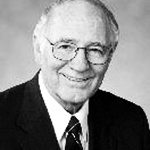 Bill R. Austin, longtime Texas Baptist pastor and educator, died April 17. He was 88. He was born Aug. 6, 1931 to Gilbert Wayne and Lola Ellis Austin in O’Brien. He professed faith in Christ and was baptized at age 9, surrendered to the ministry at age 12, was preaching youth revivals throughout West Texas by the time he was 15, and was called to his first pastorate at age 18. He earned his Bachelor of Science degree at Hardin-Simmons University and his Master of Arts and Doctor of Philosophy degrees from Baylor University. He met Margaret Heath of Levelland at Hardin-Simmons, and they married Aug. 7, 1950. He taught at Hardin-Simmons and Temple Junior College, and he served as chaplain at Baylor. His many pastorates included the First Baptist churches of Waxahachie, Vernon and Nacogdoches; University Baptist Church in Abilene; Calvary Baptist Church and Park Lane Drive Baptist Church in Waco; and churches in Oklahoma and California. He was a prolific writer and his many published books included Austin’s Topical History of Christianity. He developed an interest in art at a very early age and he painted off and on all his life, mainly self-taught and working with oils. After retirement, he returned to the easel and began painting commissioned works. He was preceded in death by his oldest brother Wayne and his sister Peggy. He is survived by two brothers, Hubert and Roy; his wife, Margie; son, Randy Austin and wife, Dara, of North Richland Hills; daughter, Terri McKee and husband, Mark of Hewitt; four grandchildren; and eight great-grandchildren.



 “Of course, we appreciate the exposure for our church, but we’re more grateful for the gospel impact,” Cannon said. “On Easter Sunday evening, viewers of a national TV news broadcast experienced … a celebration of the Resurrection.”