No safe place to be a Christian in China, report says

SILVER SPRING, Md. (BP)—China persecutes Christians to gain leverage in future diplomatic relations with the United States, a Christian seeking U.S. asylum claimed in a video released July 22 alongside a new report by International Christian Concern.

Liao Qiang, a member of Early Rain Covenant Church in Chengdu, further claimed in the ICC video that the Chinese Communist Party (CPC), “makes you think that they are willing to compromise, because they know Americans care about freedom of religion. If China makes concession in religious freedom, then U.S. should compromise in trade. It’s CPC who politicizes religious freedom, not Christians.”

Liao fled to Taiwan with his extended family after the Chinese government shuttered the church in December 2018. The video, recorded in May, accompanies the ICC’s new report on Religious Suppression in China, examining the “legal underpinnings and practical implications of China’s systematic repression of religion.”

Continued persecution of Christian families

Even as Early Rain Covenant Church founder Wang Yi and a church elder remain imprisoned for their faith, Qiang said China continues to persecute members of the church, forbidding parents to enroll their children in church schools, threatening to send children to government re-education camps, and forcibly sending adopted children back to their birth parents.

Early Rain Covenant Church of Chengdu member Liao Qiang (right) is shown in Taiwan with his daughter Ren Ruiting and son-in-law Peng Ran. (International Christian Concern Photo)

“The reason why we left China is because the Chinese Communist Party is limitless in its persecution. They not only threatened us, normal adult, normal church members, but they threatened our children,” Liao said.

“Some of our members have adopted children, and CPC forcibly sent the adoptive children back to the original family. That is the main reason why we fled China. Because we can’t guarantee our adopted child would not be taken away by them.”

The CPC forcibly removed four adopted children from one Early Rain Covenant Church family, returned them to their biological parents and eventually dispersed them among other homes, Qiang said.

“This is a living tragedy,” Liao said. “Their constant oppression made me feel we must flee China, because our children are most important to us.”

Government has sweeping authority

Gina Goh, ICC’s regional manager for Southeast Asia and the author of the report, said China’s vaguely worded constitution allows the government to define what falls within the realm of “normal religious activities,” giving the government the authority to “crack down on certain religious practices or even disband them.”

The government established its own set of rules governing religion in 2018. The “Regulations on Religious Affairs” bypassed passage by the National People’s Congress and the Standing Committee because the rules are regulations, not laws, Goh said.

Faith leaders are charged with such crimes as illegal business operation, unlawful assembly, disrupting public order or endangering national assembly.

Gary Bauer, a commissioner with the nonpartisan United States Commission on International Religious Freedom, participated in ICC’s webinar to release the report. Bauer thanked the ICC for its advocacy and commended the Trump Administration for prioritizing international religious freedom.

“Our work is possible because of the tireless efforts not only of ICC, but other groups … to uncover religious freedom violations and to report on them,” Bauer said. “Of course, Communist China does its best to hide its atrocious human rights record from the world, but because of reports like the one we’re here to discuss today, it is failing. The truth always comes out, and the truth is coming out now, and it’s indicting them, the Chinese Communist government.

“The Chinese Communist government is built on and relies on lies. One of the lies is the ludicrous claim that it only punishes religious believers when they violate the law. USCIRF and other organizations have documented many, many examples of imprisoned Christians, Uyghurs, Tibetans, Falun Gong practitioners whose only alleged crimes are practicing their faith.”

Persecutors fear exposure, transparency

Liao said transparency is one of China’s greatest threats.

“The biggest help is to report the persecution. Report it fairly. We aren’t saying the U.S. government should put pressure on the Chinese government. This isn’t what we hope for,” Liao  said.

“What CPC is most afraid of is being exposed. They are afraid of transparency. We don’t want the government or the public to pressure CPC. Because under such circumstances, CPC will definitely intensify religious persecution. The worse China-U.S. relations get, the more CPC persecutes Christians.”

Liao’s reluctance to appeal to the U.S. for intervention is understandable, Goh said, as such statements would draw more governmental persecution.

“Even receiving interviews in Taiwan, (Qiang’s) family was harassed by the government,” she said. “You can imagine if they stand out and say, ‘We want the U.S. government to do something for us,’ that would probably invite more persecution. But I don’t think that contradicts with other people’s efforts to try to do things on behalf of them.

“I think that’s all the more reason for us to actually speak on behalf of them, because they are not in a position to openly condemn or actually invite sanctions or punishment upon their government.”

Crackdown against churches

The ICC report chronicles China’s systematic campaign of Sinicization—a term coined in 2015—to make religious groups submit to socialism and assimilate into “a unified identity with Chinese characteristics.”

Chinese police demolished a Three-Self megachurch in Anhui without prior notice, interrupting worship service for perhaps 3,000 Christians. (China Aid photo via BP)

In addition to the actions taken against Early Rain Covenant Church, the report chronicles church closures and demolitions, arrests, disappearances at the hands of the government and social pressure and other aggressions. It makes policy recommendations for change.

“With the intensified crackdown against churches, both state-sanctioned and underground, there is no longer a safe place to be a Christian in China,” Goh wrote in the report, adding that “almost every province in China has seen Christian persecution on the rise,” while singling out Henan and Anhui provinces.

According to the report, those two provinces “have a high percentage of Christians,” and have seen active “cross demolition campaigns.”

“Thousands of crosses have been removed since 2018, with some churches leveled to the ground,” Goh wrote in the report. “Deteriorating Sino-U.S. relations could further encourage crackdown against churches in 2020.”

ICC is among many decrying religious persecution in China. USCIRF ranks China as a Country of Particular Concern in its 2020 report on global religious freedom.

The U.S. State Department, in its 2019 report on international religious freedom, said China destroyed Christian, Islamic, Buddhist, Jewish, Taoist and other houses of worship; barred people under 18 years of age from taking part in religious activities; and continues to imprison hundreds of thousands of Uyghurs and other Muslims, as well as Uyghur Christians, in internment camps.

Open Doors USA ranks China 23 on the 2020 World Watch List of the 50 most dangerous countries for Christians.




Churches hope to host remote learning sites for students

WASHINGTON (RNS)—Remote learning will be the rule for schoolchildren in Winston-Salem, N.C., for at least nine weeks this fall as the city tries to stem a surging coronavirus caseload.

But that doesn’t necessarily mean they’ll all be staying home. Several churches hope to host remote-learning sites for small groups of socially distanced kids.

Up to 30 students would gather daily—spread across three buildings at the St. Timothy’s Episcopal Church campus—in the mornings, if the bishop approves the idea. Church volunteers would enforce health protocols, tutor and lead prayers to begin and end the day.

“We know in our faith that it’s not good for us to be alone,” said Steven Rice, rector at St. Timothy’s, citing a biblical passage in Genesis. “Some socialization among people of their own age will be a great benefit (to the students). And if both parents have to work, at least half the day is better than nothing.”

Promising opportunity for ministry to students

From Connecticut to Hawaii, congregations are seeking ways to support families still smarting from last spring’s sudden adjustment to home-based learning during the pandemic lockdown. They’re exploring how underutilized church buildings might be put to a new use that allows education to continue while freeing up parents to work and attend to other responsibilities.

Proposals range from hosting students during online classes to providing study hall space for them to work independently.

Angela Gorrell

In such efforts, youth ministry experts see a promising opportunity.

“This is a way of reimagining children’s and youth ministry during a pandemic in a really amazing way that serves families and meets concrete needs,” said Angela Gorrell, assistant professor of practical theology at Baylor University and author of Always On: Practicing Faith in a New Media Landscape. “You can connect with kids in your neighborhood who might not otherwise be a part of your children’s and youth ministry.”

Congregations hope these plans can help reduce the acute stress they sense in their communities, especially among parents who can’t easily pivot to work from home and supervise children all at once.

Oases in an internet desert

In some cases, longstanding partnerships with districts are bearing new fruit.

Consider rural Graham County, N.C., where 8,500 people reside amid the Great Smoky Mountains. Locals depend largely on tourism jobs, such as cleaning second homes owned by residents of Atlanta and Charlotte. When the pandemic hit, 16 churches—Dry Creek Baptist, Eternal Believers and 14 others—became sites where families every day could pick up school lunches to go, along with breakfast for the next morning.

At least six Graham County churches also received mobile hotspot devices from the district, said Pastor Eric Reece of Robbinsville United Methodist Church, which received one of the devices.

That made them oases in what Reece calls an “internet desert,” where connectivity in homes is unreliable or unavailable. Robbinsville students were able to get their assignments and complete online coursework at his church when they picked up lunch.

Now Robbinsville UMC is gearing up to offer 40 hours a week of drop-in study hall access this fall. With Graham County schools operating at reduced capacity and having kids learn virtually on select days, students will be able to drop by the church with a parent any time between 8 a.m. and 4 p.m., log on and work in the fellowship hall. Two adults from the church will be there to supervise.

To respect social distancing, no more than 10 children will be allowed at a time.

“On their day that’s virtual, if they don’t have Wi-Fi at home, they can come here,” Reece said. “They can use their (district-issued) Chromebooks to go online and stay caught up on their work.”

Remote sites provide adult oversight,  tech support

In New Haven, Conn., the Greater New Haven Clergy Association announced that as many as 15 congregations are prepared to host children on days when they’re expected to learn virtually, which will be one to three days per week, depending on grade level.

Remote sites are needed, clergy say, because New Haven schools found that thousands of students were not engaging in school virtually from home. Among the reasons: no internet at home or no parental oversight of the learning process.

What role New Haven churches will have, if any, remains to be seen.

Among the topics of discussion: Will school buses bring kids to and from churches? Will schools send staffers to supervise remote learning or leave supervision to church volunteers? Will churches lease space to the district for remote learning or offer space free as a ministry to families?

“I’m not looking for any money to do this. I just see a need, and I don’t want money to be a hindrance to why we can’t get it done,” said Steven Cousin, pastor of Bethel African Methodist Episcopal Church in New Haven.

If technology supports are needed, Cousin said churches might seek in-kind donations from corporate sponsors.

Boise Kimber, pastor of First Calvary Baptist Church in New Haven, said that if churches provide a service to schools, they might deserve compensation.

“We have to have that conversation with the district and see what they’re willing to do if we take care of this for them,” Kimber said.

Build on cooperation, relationships

In some cases, churches and schools can build on past cooperation.

Our Redeemer Lutheran Church in Honolulu has rented out space in its former elementary school to nearby Voyager Public Charter School for almost a decade. The church also temporarily housed another school when that one suffered a flood.

Now Voyager urgently needs extra space in order to reduce density by spreading students out across a larger campus footprint. Our Redeemer’s solution: For a nominal fee, the church will provide an extra 8,000 square feet for a year in what used to be its high school building.

“The ‘annexed’ space makes it possible to spread our elementary grades out on our main campus to accommodate all-day, everyday face-to-face instruction for our K-2 learners, and 2 days/week for grades 3 through 6,” said Voyager Principal Evan Anderson in an email.

There are some challenges to hosting students in churches, from extra sanitation requirements to liability concerns, but optimists believe those can be managed by following guidelines from governments, denominations and insurers.

Still, some faith leaders regard it as too risky for their congregations to undertake.

“It’s a huge issue: People can’t bring their kids to work, and many don’t have the sort of jobs where they can work from home,” said John Cager, president of the Los Angeles Council of Religious Leaders and pastor of Ward African Methodist Episcopal Church.

“But there are few states as litigious as California. You bring the kids in and even if the district provides the supervision, what’s the church’s exposure if someone’s kid gets sick? … Everyone wants to do ministry, but no one wants to get sued doing ministry.”

In locations where churches feel able to help, districts are expressing gratitude.

“Not every family has a strong safety net of support for children, so we are leaning on our community partners of all kinds to help us create multiple safe places and spaces where children can learn and access their lessons,” said Brent Campbell, spokesperson for the Winston-Salem and Forsyth County Schools in an email. “Faith-based partners and others are offering to open their doors.”


Barbecue Baptist Church delivers meals and message

NAVASOTA (RNS)—Before the barbecue trailer, there was the toilet paper popemobile.

With toilet paper hard to come by as stay-at-home orders took effect in many states earlier this year to flatten the curve of the coronavirus, Chad McMillan put the pastor of First Baptist Church in Navasota, on a trailer surrounded by plexiglass, “like the popemobile,” he said.

He handed the pastor a T-shirt gun loaded with toilet paper, each roll wrapped with a Bible verse.

“And I said, ‘I want you to shoot toilet paper rolls to bless the community,’” said McMillan, the church’s pastor of students, evangelism and missions.

The toilet paper distribution went so well, he added a pulpit, sound system and piano so he could hold pop-up worship services while flinging the TP.

McMillan joked about adding a barbecue pit, too.

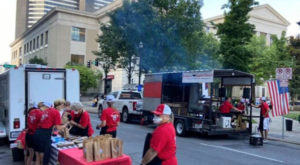
Barbecue Baptist Church—an outreach of First Baptist Church in Navasota— prepares ministry and meals in Louisville, Mississippi, during a road trip stop in June. (RNS Photo courtesy of Barbecue Baptist Church)

Then he did—and Barbecue Baptist Church was born.

Barbecue Baptist Church, an outreach of First Baptist, aims to bring a warm meal, a little levity and a reminder that people care to its community and beyond.

The church borrowed a catering trailer from a member and made an announcement on the local news in April: “Anybody who invites us to come, we will come to your house, and we will do a short worship service and give you a free barbecue meal,” McMillan said.

“People were staying in their homes, churches weren’t meeting and it was a real need people had,” he said.

In the first five weeks, Barbecue Baptist Church traveled around the county, serving about four meals a day, four days a week, McMillan said. Sometimes it would find a group of 20 people. Sometimes it would find a single elderly woman sitting on her porch.

Workers with Barbecue Baptist Church, an outreach program of First Baptist Church of Navasota, prepare food during a road trip stop in Nashville in June 2020. (RNS Photo courtesy of Barbecue Baptist Church)

Last month, the outreach decided to take the show on the road from Navasota to Nashville, visiting first responders and medical professionals in six different states across the South in seven days. On that trip alone, McMillan said, its team smoked 800 to 1,000 pounds of pork using post oak wood, offering a Central-Texas style of barbecue.

Along with the barbecue, McMillan said he’s been sharing a message of hope based on a passage from the biblical book of Romans—about suffering producing perseverance; perseverance, character; and character, hope.

And he tries to share some humor.

That’s “not to make light of what’s happening,” he said, “but to try to give people a moment of levity and joy to know that God loves them, and we love them.”

McMillan said Barbecue Baptist Church is planning another road trip soon and hopes to continue even after the coronavirus pandemic ends.


Fall sports at four Texas Baptist schools delayed until spring

Due to COVID-19, fall sports will be delayed until the spring semester at four NCAA Division III universities affiliated with the Baptist General Convention of Texas.

The American Southwest Conference Council of Presidents announced July 24 the decision to delay conference-scheduled competition and championship events for fall sports, including football, soccer, volleyball and cross country.

Texas Baptist schools affected are East Texas Baptist University, Hardin-Simmons University, Howard Payne University and the University of Mary Hardin-Baylor.

“In the midst of much uncertainty with recent COVID-19 spikes in our state and region, coupled with last week’s rigorous safety protocols released by the NCAA, which few DIII institutions can afford, the ASC presidents believe this is the best course of action at this time,” said UMHB President Randy O’Rear.

NCAA  issues updated safety protocols

The NCAA released its protocols—“Resocialization of Collegiate Sport: Developing Standards for Practice and Competition”—on July 16. Its recommendations include daily self-health checks, use of face coverings and social distancing, and testing for COVID-19 and results within 72 hours of competition for high-contact-risk sports.

Universities in the American Southwest Conference will be allowed to schedule organized team activities—workouts, practices and strength and conditioning training—at their own discretion and within local, county, state and NCAA health and safety guidelines.

“The action to move fall sports to the spring semester was a difficult decision, but the wisest course to ensure the health and well-being of our ETBU student-athletes and their fellow classmates, while providing our student-athletes the opportunity to prepare and practice this fall in preparation for spring competition,” said Ryan Erwin, ETBU vice president for student engagement and athletics.

Teams will play 50 percent of their normal schedules in the spring, and student athletes will not use a year of their eligibility during this academic year.

“Our student-athletes are eager to make the most of their time to train and compete,” said Hunter Sims, athletic director at Howard Payne. “Though the conference competition has been delayed, I’m pleased that the 50 percent plan will preserve their eligibility for the future.”

Decisions on American Southwest Conference schedules and championships for basketball and spring sports will be determined later.

“While we are disappointed that we will not be having a full sports championship season as scheduled, we fully anticipate giving our student athletes the best experience under the modified rules and regulations of the NCAA,” said John Neese, director of athletics at Hardin-Simmons.

In other non-sports-related developments regarding COVID-19 and Texas Baptist schools:

  • Baylor University will require all students, faculty and staff to test negative for COVID-19 before they return to campus for the fall semester.
  • Because of the uncertainty caused by the COVID-19 pandemic, UMHB will offer most of its fall semester courses in what the university calls its CruFlex format. The approach allows students to choose to attend their classes face-to-face, watch their classes online as they are taking place, or access their courses’ videos and assignments online 24/7. Additionally, students can move between these three modalities at any time during the semester, as needed.
  • Commencement for spring semester graduates of Baptist University of the Américas will be held at 9 a.m. on Aug. 1. Attendance will be by invitation only and limited to fewer than 100 individuals. The commencement ceremony will be conducted in accordance with local and state public health and safety guidelines and according to Centers for Disease Control recommendations.


Most churches worshipping in-person again—but cautiously

NASHVILLE, Tenn.—American Protestant churches are gathering again, but services and programs remain drastically different from the beginning of the year.

At the start of the COVID-19 outbreak in the United States, churches across the country stopped gathering in-person in a matter of weeks.

The latest LifeWay Research survey of Protestant pastors found congregations slowly and cautiously have started to meet again.

“While more and more churches have resumed in-person worship services, it has not always been a straight path back,” said Scott McConnell, executive director of LifeWay Research. “Some have had difficulty resuming or had to stop meeting again as things got worse in their area.”

Cautious regathering

Each Sunday in April, fewer than 1 in 10 Protestant churches held in-person services. Starting in May, those numbers began to climb. By the first weekend in June, a majority (55 percent) were gathering. In July, more than 7 in 10 have met physically.

Still, 21 percent of Protestant pastors say they have not met in person the past three months.

Around 1 in 5 churches (21 percent) offered drive-in services where attendees participated from their vehicles at some point during the pandemic.

For those churches choosing to meet physically indoors, 99 percent point to some type of health and safety precaution they are taking.

More than 3 in 4 pastors say they provided hand sanitizer, masks or gloves to those needing it (94 percent), conducted additional cleaning of surfaces (86 percent), or closed seats to increase distance between people (76 percent).

Most have recommended masks (59 percent), but only around a third (35 percent) have required attendees to wear them.

Around 1 in 5 have added services (21 percent) or additional viewing rooms (18 percent) to allow people to spread out more.

Others have conducted temperature checks of staff and volunteers (21 percent). Some have also checked temperatures of all attendees (14 percent).

“Resuming in-person worship services has not been reverting to worship as usual,” McConnell said. “Churches are making efforts to make the environment safe, but these efforts are often second-guessed by those who want more precautions or less restrictions.”

Impact of COVID-19 felt

While most Protestant churches still have not seen an attendee be diagnosed with COVID-19, the number of pastors who have is growing.

In March, 5 percent of pastors said one of their attendees had a positive diagnosis. That jumped to 20 percent in April. For May through July, 28 percent of pastors say someone in their church has been diagnosed with COVID-19.

One in 20 Protestant pastors (5 percent) dealt with an attendee dying from the coronavirus.

Pastors in the Northeast are more likely to say someone in their congregation has been diagnosed with COVID-19 (41 percent) and that someone in their congregation has died from it (10 percent).

In the past three months, pastors say church attendees have also dealt with reduced hours at work (74 percent) and losing a job (48 percent).

Pastors have also seen their congregations respond to shared needs, as 81 percent say attendees have helped each other with tangible needs and 60 percent say attendees have met tangible needs in the community connected to the coronavirus.

More than 4 in 5 pastors (83 percent) say new people who have not attended their church in the past have attended or connected online since the pandemic began. And 13 percent say an attendee has seen someone make a commitment to follow Christ after sharing the gospel.

In terms of the offering plate, 34 percent of pastors say their church has received less in 2020 than at this point in 2019, with 29 percent saying giving has stayed around the same and 28 percent saying it has increased.

“In the fall of 2019, 21 percent of churches had received less funds than the prior year. Now more than a third see offerings retracting,” McConnell said. “The last time we saw this type of financial decline was in the fall of 2010 after the full impact of the last recession.”

To meet their financial obligations, some Protestant pastors say they applied for government assistance. Two in 5 (40 percent) say they applied for help through the CARES Act or the Small Business Administration, with 38 percent saying they applied and were approved. More than half (58 percent) say they have not applied.

Self-identified evangelical pastors are more likely than mainline pastors to say they have not applied for government aid (67 percent compared to 47 percent).

What’s next?

Even though most Protestant churches are gathering, pastors are more hesitant to begin small group Bible studies or activities for children and teenagers.

Close to 3 in 10 pastors (29 percent) say in-person adult Bible studies are currently gathering, including 3 percent who say they never stopped. Almost 1 in 5 (18 percent) plan to restart those groups by September, 7 percent say some time in October through December, and 3 percent say in 2021. For 42 percent of pastors, they have not made that decision yet.

Half of Protestant pastors (51 percent) haven’t decided when to start in-person student ministry activities, while a quarter (23 percent) are meeting now, including 2 percent who say they never stopped. Some have made plans to begin in July (3 percent), August (7 percent), September (9 percent), at some point in October through December (5 percent), or in 2021 (2 percent).

Pastors are even more hesitant about kids’ ministry activities. Only 1 percent say they never stopped in-person activities with children, and 12 percent say they have resumed them. Almost 3 in 5 (57 percent) say it is still to be determined when they will start back. Fewer plan to begin in July (3 percent), August (6 percent), September (11 percent), at some point in October through December (7 percent), or in 2021 (3 percent).

“Maintaining social distance and necessary sanitation is very difficult with younger ages,” McConnell said. “To complicate things further, some of the volunteers who normally work with kids and students are in higher risk groups who are not ready to return any time soon.”

The online survey of 443 Protestant pastors was conducted July 20-22. Each survey was completed by the senior or sole pastor or a minister at the church. Responses were weighted by church average attendance, region, ethnicity of pastor and whether the pastor self-identified as evangelical or mainline to reflect the population more accurately.

The final sample is 443 useable surveys, providing 95 percent confidence that the sampling error does not exceed plus or minus 5 percent. Margins of error are higher in sub-groups. Comparisons are made to surveys using the same methodology conducted March 30-31 with 400 completes and April 27-29 with 470 completes.


Bible unread by many during the coronavirus pandemic

WASHINGTON (RNS)—People may be reading the news and “doomscrolling” through social media during the coronavirus pandemic, but they don’t appear to be reading the Bible.

That’s according to the 10th annual State of the Bible survey released July 22 by the American Bible Society.

The number of American adults the American Bible Society considers “Scripture engaged” based on how frequently they read Scripture and its impact on their relationships and choices dropped from 28 percent to 22.7 percent between January and June, according to additional data collected by the organization in June.

“What we saw between January and June was that 13 million people in America, who were previously really engaging meaningfully with Scripture, no longer were, and that was a serious drop-off,” said Plake.

Frequency of Scripture reading also dropped over the last year, with daily readers dropping from 14 percent to 9 percent and those who read the Bible several times a week from 14 percent to 12 percent, the lowest number on record, according to the survey, conducted in January with Barna Group, a Christian research firm.

The decrease in Bible use tracks with what the American Bible Society has seen over the past decade of State of the Bible research, according to the director. In 2011, about 64 million people said they never used the Bible, compared with 87 million to 90 million today, he said.

“Frankly, there’s just a much larger percentage of the American population over the last 10 years that says they never use the Bible,” Plake said.

Most of that change has come in what the American Bible Society calls “occasional” Bible users or the “movable middle.” Those people are less likely than they were 10 years ago to open a Bible in search of answers to their questions, according to the research.

‘COVID-19 has messed everyone up’

The number of people who regularly use the Bible—at least once a week—had held “fairly steady right up to COVID-19, and then COVID-19 has messed everyone up,” Plake said.

Women, who have led men in Bible engagement every year of the survey, now slightly trail behind men, he pointed out. He said that may be because of the extra demands mothers in particular have faced during the pandemic—juggling working from home and helping children with virtual learning as workplaces and schools closed to slow the spread of the novel coronavirus.

Many churches have moved online, he said, and that means people “can’t get together with their friends and study the Bible” the way they have in the past.

Plake urged church leaders to focus on the women in their congregations and communities who are “struggling in ways that might not make the headlines” and emphasized the importance of mentoring or meeting with church members in small groups to talk, pray and study the Bible together.

“I think the first thing is be assured that your role is critical in helping people maintain their faith and their deep connection to God,” he said.

“It’s easy to think, ‘Well, hey, they can stream a service anywhere,’ and many, many people have done that. But the reality is without our pastors helping us, without leaders in our churches helping us to stay connected, people struggle.”

The State of the Bible survey is an annual survey by the American Bible Society that examines “how adults in the United States related to the Bible, what questions they had about God’s Word, and what difference it was making in their lives,” according to the 2020 report.

This year, the American Bible Society and Barna Group surveyed 1,010 American adults online from Jan. 2 to 13 and 1,000 by phone from Jan. 8 to Feb. 11. The report states a margin of error of plus or minus 3.1 percentage points at 95 percent confidence.

The American Bible Society repeated the survey between May 28 and June 10 to measure the impact of the pandemic, surveying 3,020 American adults online with a margin of error of 1.78 percent at 95 percent confidence.


Around the State: Cruise-In food drive benefits Richardson community ministries

The Heights Car Show—an annual event at The Heights Church in Richardson—staged an out-of-the-ordinary event this year that raised more than $11,800 worth of food donations and cash contributions for Richardson’s Network of Community Ministries. When COVID-19 forced the cancellation of the typical car show, The Heights Car Show partnered with the Dallas Area Pontiac Association, the Ferrari Club of America DFW and other area car clubs to support a Cruise-In Food Drive on July 11. More than 100 cars participated, and the event generated more than 3,000 pounds of donated food and more than $6,500 in financial contributions. “I was really surprised by all of the people who braved the heat and donated so generously,” said Brian Ratcliff, Heights Car Show organizer. Participants drove their classic, exotic and sports cars to The Heights to donate cash and food items. Some set up lawn chairs in the shade to socialize and watch the parade of cars throughout the day. Participants wore masks and followed social distancing guidelines. Over the Heights Car Show’s 13-year history, it has raised more than $66,155 and contributed 11,600 pounds of food to the Network of Community Ministries. Gary Singleton is senior pastor and Richard Covington is missions pastor at The Heights Church.

Samela Macon

Buckner International named Samela Macon as vice president of domestic programs and support services for Buckner Children and Family Services, effective Aug. 1. She has served in that role in an interim capacity since March. Macon will provide leadership, oversight, supervision and management for all Texas programs and services, including Buckner Foster Care and Adoption, Buckner Family Hope Centers, Buckner Family Pathways and the nonprofit’s support center. Macon has more than 23 years of child welfare experience, including 18 years with Buckner, most recently as senior director of domestic foster care and adoption. “Samela’s years of service at Buckner, along with experience and personal growth serving in these capacities as a proven leader at Buckner made her the right choice to lead our domestic programs and support services,” said Buckner Children and Family Services Senior Vice President Henry Jackson. “Samela is passionate about serving vulnerable children and families with a commitment to excellence.” Macon received her Bachelor of Science degree in sociology from Lamar University. She currently is enrolled in Louisiana State University at Baton Rouge pursuing her Master of Science degree in leadership and human resource development.

In preparation for a possible storm along the Texas Gulf coast, Texas Baptist Men Disaster Relief Director Dwain Carter placed all volunteer feeding crews and shower unit personnel on alert effective July 21. “As the storm approaches the coast, I encourage each of you to pray for the area,” Carter wrote to TBM disaster relief volunteers. “Hopefully, the storm will weaken before making landfall. However, if need arises, I trust you will be prayed up and ready to go.”

Modern Healthcare recognized Abilene-based Hendrick Health System as one of the “2020 Best Places to Work in Healthcare.” The magazine created the “Best Places to Work” awards program to recognize companies that strive continuously to improve their work environment and increase employee engagement, satisfaction and retention through innovative changes in the workplace. The list is compiled based on responses to a confidential survey that provides the basis for analysis in leadership and planning; corporate culture and communications; role satisfaction; work environment; relationship with supervisors; training, development and resources; pay and benefits; and overall engagement. Brad Holland, president and CEO of Hendrick Health System, expressed his belief the recognition reflects Hendrick’s “daily commitment to deliver high quality health care emphasizing excellence and compassion consistent with the healing ministry of Jesus Christ.”

Retirement

Stan Allcorn as pastor of Pioneer Drive Baptist Church in Abilene, where he has served since 1998. The church will mark his retirement with a series of special events on Aug. 30. He will preach his final sermons as pastor in the 9 a.m. and 10:30 a.m. worship services, which also will include several presentations. An outdoor event with activities for the whole family and a “Roasted (All)Corn” tribute will be held from 7 p.m. to 9 p.m.


Latham Springs temporarily closes after COVID-19 exposure

Latham Springs Camp and Retreat Center at Aquilla has closed for two weeks and its staff is under “house quarantine” after the camp learned about confirmed cases of COVID-19 among members of a church group from Keller.

Keystone Church, a nondenominational congregation in Keller, rented the retreat center for a July 6-10 camp that involved about 450 students, sponsors and staff.

“On the first day of camp, after the group had been here a few hours, we received a call from a parent of one of the students that a family member had tested positive” for COVID-19, a statement issued by Latham Springs read.

“We immediately isolated the student and then sent her home. Two days later, we were notified that she had tested positive for COVID-19. The church immediately isolated her age group, and then anyone that had close contact with her was sent home. The rest of that group was isolated (after parents were notified) for the remainder of the camp and then sent home with parents.”

Latham Springs was notified of one other confirmed case of COVID-19 on July 11 and was told the two individuals who had confirmed cases “had possibly been in contact before camp,” according to Latham Springs.

In contact with Health Department

Mike Wilson, chief executive officer of Latham Springs Camp and Retreat Center, said he “contacted the Health Department on that same day and had a teleconference with them that evening, and remain in contact with them.”

One Latham Springs staff member tested positive for COVID-19 on July 15 but did not believe it was related to the July 6-10 camp.

“In an abundance of caution, we have closed our gate for two weeks and are keeping our staff under ‘house quarantine’ to monitor,” Latham Springs’ statement read.

The retreat center announced it does not have any additional youth camps scheduled this summer.

Latham Springs noted all church groups using its facilities receive a copy of summer camp guidelines and protocols established by the state, as well as additional protocols the retreat center has in place.

“Any person entering the campus is required to complete a pre-screening form. All campers are temperature checked upon arrival at camp. Daily temperature checks are done on all staff and guests,” the statement from Latham Springs read.

Keystone Church did not respond directly to an email request for information from the Baptist Standard.

However, the church posted the following on its Facebook page: “Keystone Church takes seriously the physical, spiritual and emotional health of our community and those that call Keystone Church their home. Keystone Church, along with other churches and local non-profit camp organizations, held summer camp. If any camper was possibly exposed, the parents or guardians of the exposed camper were immediately notified under the guidelines of The Texas State Health Department and the CDC. Keystone Church has always and will continue to pray for, invest in and serve our community.”


On the Move: Whitten

John Whitten to Pioneer Drive Baptist Church in Abilene as senior pastor, effective Sept. 1. He has been lead pastor of The Gathering at Pioneer Drive.

____________________________________________________________________________________

On the Move

Update us with your staff changes


NAMB lawsuit dismissal reversed, remanded to district court

NEW ORLEANS (BP)—A lawsuit against the Southern Baptist Convention’s North American Mission Board was remanded back to a district court by a federal appeals court on July 16, reversing a dismissal decision from April 2019 that stated the court could not consider Will McRaney’s claims because of the ecclesiastical abstention doctrine.

The ruling in the 5th U.S. Circuit Court of Appeals comes more than five months after oral arguments were heard in the case. The lawsuit, originally filed in 2017, involves Will McRaney, the Baptist Convention of Maryland/Delaware’s former executive director, and allegations that NAMB had intentionally defamed him and wrongfully influenced his 2015 termination by the BCMD after a dispute over collaborative missions efforts in the region.

In April 2019, Senior Judge Glen Davidson of the U.S. District Court Northern District of Mississippi dismissed the lawsuit, ruling the court could not consider McRaney’s claims because of the ecclesiastical abstention doctrine, which prevents the government from interfering in church or religious matters. McRaney’s counsel argued in the appeal the ecclesiastical abstention doctrine did not apply.

The three-judge panel did not determine whether the ecclesiastical abstention doctrine applied but instead pointed to the uncertainty of the facts surrounding the case.

The decision stated “the relevant question is whether it appears certain that resolution of McRaney’s claims will require the court to address purely ecclesiastical questions. At this stage, the answer is no.”

It continued: “At this time, it is not certain that resolution of McRaney’s claims will require the court to interfere with matters of church government, matters of faith, or matters of doctrine. … If NAMB presents evidence of these reasons and the district court concludes that it cannot resolve McRaney’s claims without addressing these reasons, then there may be cause to dismiss.”

McRaney claims victory

McRaney was quick to claim victory in the ruling.

“We are pleased with the 5th U.S. Circuit Court of Appeals’ legal ruling in our favor to reverse and remand the case back to the District Court so that the facts may be heard,” McRaney said in a statement.

“The clear message from the court was that (Kevin) Ezell and NAMB are not protected from violations of civil laws just because NAMB (is) a religious organization. We look forward to having Kevin Ezell, along with current and former NAMB staff, answer questions under oath so that justice can be served.”

No trial or depositions have been scheduled, however. Dates and court schedules for the possible continuation of the case in the U.S. District Court Northern District of Mississippi have not been set.

NAMB continues to dispute allegations

Following the decision, NAMB issued a statement reasserting “the Court of Appeals has not found NAMB at fault. It merely ruled that the District Court prematurely dismissed Will McRaney’s lawsuit. In fact, the court expressly recognized that further proceedings could well justify another dismissal. We have always disputed Will McRaney’s allegations, and we will continue our vigorous defense in the appropriate forum.”

McRaney’s suit claimed NAMB had prevented or attempted to prevent him from speaking at conferences after his departure from the BCMD, and that he suffered emotional distress when his photo was displayed in the reception area of NAMB’s offices in Alpharetta, Ga. Except to acknowledge the photo had been posted in the reception area of its headquarters, NAMB consistently denied those claims.

McRaney was the BCMD’s executive director from 2013 until he was terminated in June 2015. He filed suit in April 2017, after more than a year of online postings alleging various wrongdoing by NAMB and its president Kevin Ezell—including the claim, made in the lawsuit, that NAMB threatened to withhold money and to end a strategic partnership agreement for evangelism and church planting “unless McRaney was terminated.”

NAMB consistently has denied that claim, along with others. Its response to McRaney’s lawsuit stated the BCMD had become “a dysfunctional and difficult ministry partner” under McRaney’s leadership as executive director.


Annie Filmore and Danielson family desegregated Glorieta

SANTA FE, N.M. (BP)—Many Southern Baptists are familiar with Annie Armstrong, founder of the Woman’s Missionary Union and the namesake of the North American Mission Board’s annual Easter offering. Fewer know of Annie Filmore, a 20th century pioneer of Baptist missions, who was initially denied fellowship with Armstrong’s WMU because of the color of her skin.

Between 1920 and 1960, WMU held varying and sometimes conflicting positions on race relations in the United States. As early as 1927, WMU leaders took a public stand against lynching. In 1940, WMU trained Black women for ministry within their respective churches. However, in a 1946 issue of WMU’s Royal Service magazine, the organization rejected desegregation as “unreasonable.”

Three years later, in the same magazine, WMU promoted desegregation, and in the early 1950s supported the desegregation of public schools. Filmore became intimately familiar with WMU’s conflicting views on race relations in 1953, when she attempted to attend two WMU conferences in two different regions of the country.

Roadside encounter

Early in the morning on June 29, 1953, 23-year-old Dale Danielson felt the Holy Spirit prodding him to leave his family’s cabin at Glorieta Baptist Assembly and drive out past the camp’s gates to the old transcontinental highway. What happened next stuck with him for the rest of his life.

In a 1985 written account of that day, Danielson wrote that the “stillness of that early morning hour was enchanting.” However, it wasn’t long before that stillness was interrupted. According to Danielson, “the silhouette of a silver-sided, blue and white, Greyhound bus drove into sight atop the pass. It was slowing and its air brakes hissing as the driver pulled to the side of the highway as casually as a city driver pulls to a bus stop. Out here in the middle of nowhere, the door swung open and a passenger stepped off.”

The passenger was Annie Filmore, a Black woman from Durham, N.C. Filmore approached Danielson and asked if he was the camp manager. Danielson informed her that he was not, but offered to drive her to speak with him. She agreed.

Annie Filmore

During the drive, Filmore told Danielson that she and the other women in her church were not allowed to attend WMU weeks at Ridgecrest Assembly in North Carolina.

“Christians from all over the world come to it, but we are not allowed,” she said. “So, when I read about this new ‘Western Ridgecrest’ opening up, the Lord moved me to want to come.”

Filmore may have been referencing a public invitation to the camp by Harry Stagg, the Baptist Convention of New Mexico’s executive director, who called New Mexico “the finest possible atmosphere of international and interracial fellowship.”

At the time, the Baptist Sunday School Board (now LifeWay Christian Resources) generally opposed integrated gatherings at Ridgecrest. In 1946, the board rejected a proposal by Baptist Student Unions to include African American students at a retreat hosted by the camp.

‘I have to get on a bus and go home’

Spurred by the promise of Christian fellowship at Glorieta, Filmore purchased a $70 bus fare and embarked on the three-day journey to New Mexico, where she hoped to attend a WMU conference at the camp.

Danielson pulled up to the camp’s registration office, and the pair walked inside. Filmore told the registrar at the front desk that she had a reservation with E. Allison Herron, Glorieta’s manager. Danielson, noticing the look on the registrar’s face, decided to wait with Filmore. According to Danielson, “the registrar disappeared briefly into the back rooms and in a moment came and escorted Mrs. Filmore into the manager’s private office. The door closed.”

Danielson was left waiting in the lobby as Filmore, Herron and the registrar met privately.

Federal appeals court affirms dismissal of lawsuit regarding Glorieta sale
(Photo/Jim Veneman/LifeWay Christian Resources)

Danielson sensed a pivotal moment unfolding which had ramifications for the larger Southern Baptist legacy in the western United States. Recalling the event, he wrote, “Now the water of idealism was striking the wheel of reality in the registration office. The future hung in the balance. Would race discrimination inside the church be injected into the new day dawning in Western states?”

Danielson’s question was answered moments later, when Filmore emerged from Herron’s office, noticeably upset. She walked over to Danielson and sat down beside him.

“I have to get back on the bus and go home,” she told him. “He says he will let me stay, but only if I stay by myself. And since each hotel room is for three guests, I will have to pay triple rate. I don’t have enough money to stay.”

Guest in a private family cabin

Danielson objected, insisting she stay with him and his mother as a guest in their private cabin. Filmore obliged.

Filmore quickly bonded with Danielson’s mother Margaret. Of the two, Danielson wrote: “My mother was a very white, full-blood Scotsman, and Mrs. Filmore was a very Black Carolinian. But inside they were exactly alike. They were two of the most missionary-minded ladies to ever walk this earth.”

In a history of Glorieta written by Danielson and his wife Betty, he added: “I knew Annie Filmore was on a direct line to heaven just by talking to her. She and my mother were on the same wavelength. They were close in minutes, like two hearts jumping out for one another.”

According to Danielson, “the WMU ladies from everywhere adopted Annie Filmore into their hearts and made her their favorite guest that week, thus breaking down the decades of segregationism.” He noted that when Filmore knelt for her evening prayers, “heaven came down. She assaulted the streets of gold with the outpourings of a born-again soul.”

Reflecting on her friendship with Filmore, Margaret wrote: “She was the greatest blessing God brought into our home in that opening summer of 1953.”

After she returned home to Durham, Filmore wrote the Danielsons, thanking them. “Because of your generous attitude and help, I have rededicated my life to the Master,” she wrote.

Newspaper rebukes encampment administration

After learning of the incident at Glorieta, Lewis Myers, editor of the Baptist New Mexican, publicly rebuked Herron’s racist actions in a 1953 BNM editorial, writing: “(It) undid everything western Baptists strove for in getting Glorieta here. … We are a pageant of multiple peoples living together in diversity and sharing. God has made us one blood of all nations.”

In a Baptist New Mexican article published the following year, Myers commended the Danielsons’ actions, writing: “We hope that out here in the great Southwest where live four dominant races, the world can be shown what Christian amity can do.”

Dale Danielson, a lifelong member of First Baptist Church of Albuquerque, died in 2015. In a recent interview with the Baptist New Mexican, Betty Danielson spoke of her late husband’s character.

“He was just very mission-minded,” she said. “His mom was a great missionary woman in the church and won many, many people to the Lord in First Baptist Church. He was brought up to not be prejudiced against any other person, no matter what.”

Filmore was an active member of Mount Vernon Baptist Church in Durham, N.C. She held several leadership positions in the General Baptist Convention of North Carolina’s missions community. She served as the sixth president of the Durham County Missionary Union, corresponding secretary of Women’s Convention and an officer of auxiliary for the Lott Carey Baptist Foreign Mission Convention. She died in the 1970s.

 The information in this article is derived from two written accounts of Dale Danielson’s interactions with Annie Filmore; an interview with Betty Danielson; archival copies of the Baptist New Mexican and the Carolina Times; and the following books: Contending for the Faith: Southern Baptists in New Mexico, 1938-1995 by Daniel R. Carnett and Getting Right With God: Southern Baptists and Desegregation, 1945-1995 by Mark Newman. 


No name change considered for Baylor University

WACO—Baylor University wants to do a better job telling its “complete history,” but the university has no intention of changing its name, the chairman of the Baylor’s board of regents announced.

A large bronze statue of Judge R.E.B. Baylor is located on Founders Mall on the Baylor University campus between Waco Hall and Pat Neff Hall. It was dedicated Feb. 1, 1939. (Baylor University Photo)

At the regents’ July 16-17 teleconference, Chair Mark Rountree presented an update on the 26-member commission on historic campus representations. Baylor created the commission in response to a June 26 board resolution acknowledging the university’s historic connections to slavery and slaveholders.

“The charge of the commission’s work is not to change Baylor’s history or the name of our great university. Let me reiterate that changing Baylor University’s name is not under consideration by the commission, the board or the administration,” Rountree stated following the board meeting.

“Our focus is to better tell the complete history of Baylor and to continue to elevate what the Baylor name stands for—a place that integrates academic excellence and an unambiguous Christian commitment to expand minds, transform hearts and equip men and women to be difference makers in our ever-changing world.”

Judge R.E.B. Baylor—a founder of the university that bears his name—owned at least 20 slaves in 1860, and more than two-thirds of Baylor’s first 15 trustees were slaveholders, according to a February 2017 article. A large bronze statue of Judge Baylor is located on Founders Mall on the university campus.

Exploring ways to foster mutual respect

In response to a question raised during teleconference with reporters following the board meeting, Rountree explained the regents are encouraging the commission to learn from “best practices” of other universities that have conducted similar historical self-examinations.

Among other guiding principles, the board will urge the commission to focus on “addition as much as subtraction,” looking for ways to provide a more complete picture of Baylor’s history, and to practice “including without alienating” as much as possible, Rountree said.

Livingstone 200
Linda Livingstone

As part of Baylor’s ongoing efforts to foster diversity and mutual respect, President Linda Livingstone announced the university has committed an initial $5 million to launch the Trailblazer Scholars Program.

The program will focus on students from underserved communities who have a particular interest in multi-ethnic issues and a desire to take a leadership role in addressing issues of racial justice and healing, Livingstone explained.

A cohort of 20 students per academic year will be designated as Trailblazer Scholars, with the goal of having 80 on campus in four years.

Health protocols in place for fall semester

Both Rountree and Livingstone reported the regents heard extensive reports on plans Baylor is implementing to prepare for the fall semester in light of the continuing COVID-19 pandemic.

Baylor University President Linda Livingstone and Mark Rountree, chair of the university’s board of regents, respond to questions from reporters during a teleconference following the quarterly regents meeting. (Screen Capture)

Livingstone announced the university will implement a major public health educational campaign, “Family First,” as well as COVID-19 screening, testing and contact tracing.

Face coverings and social distancing will be required in public areas, enhanced cleaning protocols are in place, and university leaders are looking at the best ways to use facilities, she noted.

At this point, more than three-quarters of Baylor’s classes will have some in-person component—either entirely face-to-face or hybrid delivery of instruction—while the remaining 24 percent of classes will be delivered online.

A “dashboard” of COVID-19 metrics will guide decision-making, she noted. Key factors that will be tracked include total student COVID-19 cases and positive test results; quarantine and self-isolation rates; faculty illness rates; antigen presence in sewage from residence halls; regional hospital capacities; contact tracing data; and the operating status of local schools and daycare centers.

“We continue to plan for an on-campus start of the fall semester on Aug. 24 with the appropriate safety and social distancing protocols in place, but we are certainly prepared to shift our focus should COVID-19 conditions worsen,” Livingstone said.

In other business, the board:

  • Approved two appointees to the Baylor College of Medicine board of trustees—Brooks McGee, managing partner in Icon Wealth Partners investment company in Houston; and Gail Stewart, partner in Baker Botts international law firm in Houston.
  • Considered and approved modifications to Baylor’s sexual and interpersonal misconduct policy in response to new Title IX guidelines from the federal government.