Statewide survey reveals health concerns among Texas pastors

Nearly half of Texas Baptist pastors who responded to a recent statewide pastor health survey don’t get enough sleep, four out of 10 have high blood pressure, and one out of 10 has experienced a heart attack, stroke or other cardiac event.

Two-thirds of the pastors who participated in the survey report doing church work on their scheduled days off at least half of the time, and three out of 10 said their church-related income is insufficient for their household needs.

The survey, conducted by Texas Baptists’ Church Health Initiative of San Antonio, explored spiritual, physical, mental, financial, relational and work health. Out of 4,302 potential respondents, 560 pastors of churches affiliated with the Baptist General Convention of Texas completed the survey, a 13 percent response rate.

The survey showed 20 percent of Texas Baptist pastors who responded are experiencing at least one critical issue in the work life category, defined as:

  • Being highly dissatisfied with their overall work situation with their church, the quality of their relationships with other church staff, the quality of their relationships with lay leaders, and/or how much care/concern their lay leaders show toward their needs as a person.
  • Feeling not at all well trained for their ministry position.
  • Working 80 or more hours per week in any combination of jobs.
  • Having no days off from church work in a typical week.

The survey revealed in addition to the 40 percent of respondents who have high blood pressure, other diagnosed medical problems include high cholesterol (31 percent), diabetes (16 percent), depression/anxiety (12 percent) and heart disease (10 percent).

Other findings included:

  • Only 14 percent of pastors who responded to the survey qualified as having a healthy Body Mass Index, while 46 percent were considered obese, including 6 percent who qualified as extremely obese.
  • Young, white pastors were more likely than others to have considered looking for another job or leaving the ministry entirely.
  • More than one-fourth (27 percent) reported the presence of critical financial issues.
  • The average pastor who responded to the survey estimated spending 4.1 hours per week (or 35 minutes per day) in personal prayer. Nearly three out of 10 pastors who completed the survey pray fewer than two hours per week.

“This survey shows that being a pastor can be tough on your health,” said Ben Hanna, director of the Church Health Initiative. “When Jesus said ‘I have come that they may have life, and have it to the full,’ that included every part of our lives. So, we want to minister to the whole minister, help them grow in all areas—wisdom, stature and favor with God and man. That’s stewarding our health and honoring our Father.”

Webinar scheduled

Hanna and Elizabeth Coffee, regional specialist for Texas Baptists in San Antonio, will host a webinar “You Are Here” at 2 p.m. on July 23. It will include an overview of the main findings of the study and allow pastors and church leaders to discuss positive ways to move forward. To register, click here.

Hanna met with the Church Health Initiative Team to determine what key issues related to pastoral health could be addressed through current and future convention resources. The team is composed of Baptist institution representatives, local pastors, health experts and convention staff.

“The results from this survey will serve as a map that will guide our efforts to positively impact the health of our pastors,” Hanna said. “While we have a clearer picture of where we are, the next question is, ‘Where do we go from here?’ The Church Health Initiative is working to provide a clear path for holistic health.”

Resources being developed

The Church Health Initiative Team identified four key areas—physical, mental, financial and relational health—and determined resources for pastors that will be developed in the coming months.

To address physical health issues, Bobby Contreras, pastor of Alamo Heights Baptist Church in San Antonio, has volunteered to write a weekly blog about pastors’ health.

Jim Furgerson, associate professor of internal medicine at TCU School of Medicine and attending cardiologist at Brooke Army Medical Center, will produce videos specifically targeting pastor health. He also will pilot a comprehensive health program in the San Antonio area that will shed light on the specific health needs and solutions for pastors statewide.

The Church Health Initiative also has provided Teladoc Health services to 50 pastors in the San Antonio area.

In regard to mental health, Katie Swafford, director of Texas Baptists’ Counseling Services, will produce several videos to address burnout and chronic stress. Counseling services are also available to ministers and their families through Texas Baptists’ Counseling Services Network and South Texas Children’s Home Ministries.

To equip and encourage pastors with financial resources, Texas Baptists’ Center for Financial Health provides grants and financial training for ministers.

To promote relational health, the Church Health Initiative will partner with Blake Coffee, founder of Christian Unity Ministries, to share “The 5 Principles of Unity” in an online format.

The Church Health Initiative of San Antonio is made possible through a grant from the Baptist Health Foundation of San Antonio. It is strengthened by partnerships with organizations that provide resources to churches including the Baptist Credit Union, the San Antonio Baptist Association, Guidestone and STCH Ministries.

To read the full report, click here. To learn more about the Church Health Initiative, visit txb.org/chi

With additional reporting from Managing Editor Ken Camp.   



Commission named to study Baylor links to slavery

WACO—Baylor University named a 26-member commission to study the school’s historical links to slavery and racial injustice, and it set a Dec. 20 deadline for the group to present its final report to Baylor’s board of regents.

The commission’s study of “the complete history of Baylor and its founders and early leaders” could lead to some campus landmarks being removed, buildings renamed and additional historical context added.

Co-chairs of the commission are Alicia D.H. Monroe, provost and senior vice president at the Baylor College of Medicine and a Baylor University regent; Gary Mortenson, dean of the Baylor School of Music; and Walter Abercrombie, associate athletic director for the Baylor “B” Association.

Baylor President Linda Livingstone and Mark Rountree, chair of the board of regents, announced July 6 the names of the commission’s members and charged the group to:

  • “Review the complete historical record and context of the university and its founders and early leaders, including historical connections to slavery and racial injustice.
  • “Propose a plan for documenting and communicating the complete history of Baylor and its founders and early leaders, including historical connections to slavery and racial injustice.
  • “Evaluate all statues, monuments, buildings and other aspects of campus within this complete historical context and in reference to the original intentions behind their physical location, placement and naming and provide observations for consideration.
  • “Prepare a final report to be provided to the board of regents and the president no later than Dec. 20, 2020.”

Livingstone and Rountree said the commission will guide Baylor in presenting its “complete history as the university continues striving to foster an environment through which racial equality is inextricably linked to our mission” and in which people of color who are students, faculty, staff, alumni and supporters of the university “know they are valued and loved” throughout the extended “Baylor Family.”

“We believe now is the time for Baylor, as a Christian university, to lead by listening and learning with humility about our past and from voices that have been unheard for years while also taking tangible steps forward,” Livingstone and Rountree said in a public statement. “In addition to making an important and visible contribution to today’s campus and Baylor community, the commission’s work will create a lasting legacy for future generations of Baylor Bears.”

Members of the commission

Commission members include Michael A. Evans Sr., president of the Baptist General Convention of Texas, pastor of Bethlehem Baptist Church in Mansfield and a Baylor regent; Joel Allison, retired president and chief executive officer of Baylor Scott & White Health and former chair of the Baylor regents; Alan Lefever, director of the Texas Baptist Historical Collection; and Malcolm Foley, special advisor to the president for equity and campus engagement at Baylor and director of Black church studies at Truett Theological Seminary.

Also on the commission are Trent Hughes, vice president of sales at Curazene and vice president of the Baylor Alumni Board of Advocates; Mark Lovvorn, chairman and chief executive officer of Providence Bancshares Corporation in Dallas and a Baylor regent; and Michael McFarland, superintendent of schools for the Crowley Independent School District and a Baylor regent.

Baylor faculty and administrators on the commission include Cheryl Gochis, vice president for human resources and chief human resources officer; Dominique Hill, director of wellness and past president of the Black Faculty and Staff Association; Sandra Lene, associate vice president for operations and financial services and advancement; Bill Neilson, retired associate dean of the Honors College and clinical professor in medical humanities; Michael Parrish, the Linden G. Bowers Professor of American History; Coretta Pittman, chair-elect of the Faculty Senate; Mia Moody-Ramirez, chair of journalism, public relations and new media; Marcus Sedberry, senior associate athletics director for student-athlete development; Tyrha Lindsey-Warren, clinical assistant professor of marketing; and Doug Weaver, professor of religion and director of church-state studies.

Students serving on the commission are Katie Adair, president of the Graduate Student Association; Jayson Baldridge, a senior student-athlete in track and field; Lexy Bogney, a junior who is secretary and community coordination chair of the Baylor NAACP; Sutton Houser, senior and student body president; Sher Isada, junior University Scholar and student regent; and Mya Ellington-Williams, senior and member of the Black Student Union.

Ex-officio members of the commission are Kristy Orr, Baylor board professional; Todd Copeland, director of advancement marketing; and Karen Kemp, associate vice president for university marketing and brand strategy.

Less than two weeks earlier, Baylor regents approved a “resolution on racial healing and justice” that acknowledged some early founders, trustees and leaders of the university supported slavery.

In an article published in February 2017, Chris van Gorder, a Baylor religion professor, noted Judge R.E.B. Baylor owned at least 20 slaves in 1860 according to tax records, and 11 of Baylor’s first 15 trustees were slaveholders.


Baptist Standard app now available for Apple and Android phones

The Baptist Standard is available via a smartphone app in the Apple and Android app stores. Thanks to the generosity of donors, the app is available at no cost.

The app allows readers to stay current with the Standard, displaying news, opinion, resources and classified ads as soon as they are published. Each of these four categories is accessed easily at the bottom of the app screen.

App users also are not subject to social media algorithms or filters that govern what readers see in their feeds.

“With the new app, readers of the Standard don’t have to rely on social media algorithms to show them what they want to read,” Editor Eric Black said. “The app enables readers to see everything we publish and to decide for themselves what they want to read.”

App users can choose to receive push notifications alerting them when articles are published.

“The Standard app is not only convenient, but timely. It provides me with the information I need about faith, denominational and current events,” Darrell Dunton, a member of First Baptist Church in Midland and a member of the Standard board of directors, said.

“I like that news and opinion are separated so you can clearly see the difference,” Allen, a teenager in Plano, said about the app.

“The app is a new venture for us; so, we welcome feedback from app users about ease of use, availability of content, functionality and other ways the app can be improved,” Black said.

App feedback can be submitted by leaving a review in the Apple or Android app stores or by emailing the Baptist Standard at info@baptiststandard.com.

On the Way podcast

In addition to the new app, the Baptist Standard launched a new podcast on April 1 titled “On the Way.” Season 1 ends on July 8; season 2 releases August 26.

Interviews in the second season include: Kathryn Freeman, former director of public policy for the Texas Baptists’ Christian Life Commission; Rev. Tamiko Jones, executive director of WMU of Texas; Rhoda Gonzales, advertising production manager with Neiman Marcus; and Drayton McLane, former owner of the Houston Astros.

On the Way is available in Apple PodcastsSpotifyStitcherGoogle Podcasts and Amazon Alexa via TuneIn.

Connecting to the Standard

The Standard desires to keep Baptists connected by informing, inspiring and challenging people to live like Jesus. This desire is grounded in the following core commitments: historic Baptist principles, responsible journalism and the redeeming and reconciling work of Jesus Christ.

The app and podcast—along with the weekly newsletter, website and CommonCall Magazine—are expressions of the desire to keep Baptists connected.

Newsletter
Click here to sign up for the weekly newsletter of the Baptist Standard emailed each Thursday.

Donate
The Standard relies on donor support to produce the newsletter, podcast, website and app. Click here to make a tax-deductible donation.

CommonCall Magazine
Click here to subscribe to CommonCall, a quarterly print magazine with features not found in the Baptist Standard. Subscriptions are $24 per year. Churches receive special pricing. For more information, email kayla.peltoma@baptiststandard.com or call (214) 630-4571 ext. 1014.


Human trafficking report notes gains and losses

WASHINGTON (BP)—A nearly equal number of countries received upgrades and downgrades regarding their efforts against human trafficking in the last year, the U.S. State Department said in its annual Trafficking in Persons Report.

The State Department’s report, which was released June 25, graded 22 governments higher than the previous year but demoted 23 in its tier system of categorizing how 188 countries performed in preventing trafficking, protecting victims and prosecuting traffickers. An estimated 25 million adults and children are victims of sex trafficking or forced labor, according to the State Department.

The 20th annual Trafficking in Persons Report “helps us to see just how much work there is yet to do in helping vulnerable people escape the trap of these predators and predatory networks,” said Russell Moore, president of the Southern Baptist Ethics & Religious Liberty Commission. “That 25 million people are enslaved around the world is an indictment of our age. That many ignore this reality is an even further indictment. God created human beings in his image and never gave human beings dominion or ownership over other image bearers.”

In introducing the report, Secretary of State Michael Pompeo said, “Desecration of the inherent value and immeasurable worth of human beings, each of us created in the image of God, makes human trafficking a truly wicked act.”

Where do they rank?

The United States joined 33 other countries in Tier 1, a category reserved for governments that fully comply with the minimum standards to eliminate trafficking.

Meanwhile, China and Russia were among 19 countries in Tier 3, the category for governments that “do not fully meet” minimum standards and “are not making significant efforts to do so,” according to the report. Under federal law, President Trump will have 90 days to determine whether to eliminate non-humanitarian, non-trade-related foreign aid to governments in Tier 3.

Among the country upgrades and downgrades, Namibia and Singapore moved up one level to Tier 1, while Japan fell from Tier 1 to Tier 2. Afghanistan, Algeria, Lesotho and Nicaragua fell from the Tier 2 Watch List to Tier 3. Bhutan, the Democratic Republic of the Congo, Equatorial Guinea, The Gambia, Mauritania and Saudi Arabia moved from Tier 3 to the Tier 2 Watch List.

Tier 2 is for countries that do not satisfy minimum requirements fully but “are making significant efforts,” while the separate Tier 2 Watch List is reserved for countries that do not comply with minimum standards and are experiencing increased numbers of victims and failing to demonstrate efforts to combat trafficking.

‘Tough but fair’ assessment

Rep. Chris Smith, R-N.J., a leader in the anti-trafficking effort in Congress, described the report as “tough but fair.”

“Friends are taken to task,” he said. “It appears to call balls and strikes accurately. … The TIP report takes modern day slavery head-on, providing a measuring stick for progress—or for regression and sanction.”

Smith’s original anti-trafficking bill, which became law in 2000, established the Office to Monitor and Combat Trafficking in Persons and required an annual report. He also has authored four more anti-trafficking laws since then.

The report said the U.S. efforts that enabled it to remain in Tier 1 included “increasing the number of investigations, increasing the amount of funding for victim services, and increasing enforcement of the prohibition of imports made wholly or in part by forced labor.”

Yet, it also said the U.S. “prosecuted fewer cases and secured convictions against fewer traffickers, issued fewer victims trafficking-specific immigration benefits, and did not adequately screen vulnerable populations for human trafficking indicators.”

The Polaris Project, which describes itself as “a data hub for the anti-human trafficking field,” said in its assessment of the report, “There is not enough work being done federally to investigate labor trafficking and hold businesses accountable for labor trafficking abuses.” Polaris said the report shows only about 5 percent of federal convictions and prosecutions of human trafficking are labor related.

Joining the United States in Tier 1 were Argentina, Australia, Austria, The Bahamas, Bahrain, Belgium, Canada, Chile, Colombia, Cyprus, the Czech Republic, Estonia, Finland, France, Georgia, Guyana, Israel, South Korea, Lithuania, Luxembourg, Namibia, the Netherlands, New Zealand, Norway, the Philippines, Portugal, Singapore, Slovenia, Spain, Sweden, Switzerland, Taiwan and the United Kingdom.

In addition to China and Russia, Tier 3 consisted of Afghanistan, Algeria, Belarus, Burma, Burundi, Comoros, Cuba, Eritrea, Iran, Lesotho, Nicaragua, North Korea, Papua New Guinea, South Sudan, Syria, Turkmenistan and Venezuela.

Making ‘a positive difference’

Last year, Trump limited specific kinds of aid to the governments of 15 countries in Tier 3, according to Pompeo. In other anti-trafficking acts by the administration this year, the president hosted a White House Summit on Human Trafficking and signed an executive order to fight trafficking and online child exploitation in this country, Pompeo said.

Upon the report’s release, John Richmond, ambassador-at-large over the Office to Monitor and Combat Trafficking in Persons, said the “report and the United States have made a positive difference.” He said since the United States enacted the original anti-trafficking measure, the United Nations has adopted a protocol against trafficking and 154 countries have approved comprehensive anti-trafficking bills.

“The call of the 20th anniversary is clear,” Richmond said. “We must commit ourselves to our goal of freedom. What traffickers are doing is an affront to the dignity of every human life, and we can stop traffickers, protect victims and work to prevent this crime.”

The report, which covers April 2019 through March 2020, is available online at the U.S. State Department’s website.


Virtual worship conference offers training opportunities

Texas Baptists will join with 16 other Baptist state conventions Aug. 1 to host the Resourcing Worship Virtual Conference, online training for church leaders involved in worship ministry.

The conference grew out of a conversation at the onset of the COVID-19 pandemic between worship ministry consultants across the country who were looking for a way to provide resources in a safe environment at low cost to participants.

This large-scale ministry training event is believed to be one of the first partnerships between so many state conventions and other Baptist ministries for the purpose of worship ministry training.

“With practically all worship conferences and events canceled nationally this year due to the pandemic, the Resourcing Worship Virtual Conference brought to you by Baptist state worship leaders is a fantastic opportunity for all leaders of worship in the church with top names in the worship world,” said Tom Tillman, director of music and worship at the Baptist General Convention of Texas. “I’m excited that this can fill so many needs during a time when our worship leaders need some encouragement.”

Matt Redman wants audiences to connect with the mystery of Christmas
Matt Redman

In addition to keynote speaker Matt Redman, other featured leaders include Keith Getty, Matt Boswell, Shelly Johnson and Mike Harland. The vocal group Veritas will lead in times of worship throughout the daylong event.

More than 65 breakout sessions will feature speakers and artists familiar with worship ministry. A schedule of all the sessions can be found here. The schedule is being updated regularly as speakers are added.

Matt Freeman, associate director of worship and music at the South Carolina Baptist Convention, noted keynote speaker Matt Redman offers insights applicable to all levels of worship leadership.

“For the last three decades, Matt Redman has impacted the global church through leading worship, writing songs, teaching on worship and writing worship books. We are looking forward to him speaking on discipleship and development, songwriting and the future of worship in the church. We’re blessed to have him partnering with us for this conference,” Freeman said.

Breakout sessions will cover a variety of biblical, theological, practical and technological aspects of worship and local church ministry. Several sessions have been designed for senior pastors.

Registration for the online event is $15 per person through July 18 and $20 per person after July 18. Groups of five or more can register for $10 per person through July 18. Group members do not have to be from the same church, but a distinct email address for each individual must be submitted at the time of the group registration.

Following the conclusion of the conference, participants can access and view all of the conference content for an additional 90 days.

To register or for more information, click here.  


Guarneri nominee for BGCT first vice president

Julio Guarneri, lead pastor of Calvary Baptist Church in McAllen, will be nominated for first vice president of the Baptist General Convention of Texas.

Albert Reyes, president and chief executive officer of Buckner International, announced his intention to nominate Guarneri when Texas Baptists hold their first online annual meeting in November.

Reyes praised Guarneri as “an experienced pastor and an excellent thinker” who “has much to contribute” to Texas Baptists.

He pointed to Guarneri’s years of pastoral service in McAllen and Fort Worth, his early experience as a church planter in Corpus Christi, and his doctoral studies in leadership and missions.

“He will offer our convention a good perspective and provide a timely voice we need to hear,” Reyes said.

‘I believe in kingdom work’

Guarneri expressed willingness to serve if elected based both on his convictions about cooperation and his gratitude to Texas Baptists for their investment in his life and ministry.

“I believe in kingdom work. No one church can do as much as what we can do together,” he said.

“I am a strong believer in and recipient of the ministries of Texas Baptists, and I would like to give back.”

Guarneri views the next year as a pivotal time for individual congregations and the cooperative missions and ministries Texas Baptists support.

“Our churches and our denomination will need a fresh relaunch after the pandemic that has rocked our world and our state,” he said, citing the need to “stay on mission and stay relevant.”

Need to ‘lead by example’

In response to changing demographics in Texas and to rising awareness about racial justice issues, Guarneri said Texas Baptists need to “lead by example and set the tone” by engaging in dialogue and listening attentively.

As churches strive to reflect the racial, ethnic and socio-economic makeup of their communities, Texas Baptists should look at and learn from congregations that are doing a good job of becoming genuinely multicultural, he said.

“At the same time, we need to realize there’s not one formula that fits all situations,” he said. “Diversity is just that—diverse. Every church’s context is unique.”

Guarneri has been pastor since 2010 at Calvary Baptist Church in McAllen, a cross-cultural congregation in the Rio Grande Valley. Previously, he was pastor of Iglesia Bautista Getsemani in Fort Worth.

He also served Segunda Iglesia Bautista in Corpus Christi as minister of education and youth, and he was founding pastor of Shalom Baptist Mission in Corpus Christi.

Guarneri earned his undergraduate degree from Texas A&I University in Kingsville, a Master of Arts in Religious Education from Southwestern Baptist Theological Seminary and a Ph.D. in Leadership Studies at Dallas Baptist University.

He served on the BGCT Executive Board and was moderator of Tarrant Baptist Association. He has served on the board of trustees of Buckner International and what is now Stark College and Seminary.

He and his wife Monica have four children—Josh, Rachel, Mia and Stevan.


Bounce helps students find mission field at home

Pam Shaw marveled as she watched a group of students from First Baptist Church in Plano build a fence for her backyard.

“It’s amazing how many people are willing to come out and do something like this,” she said. “Sometimes we think people don’t do things like this anymore, but they do. This bunch did.”

The Plano volunteers were among 264 students and leaders from eight Texas Baptist churches who participated in the Bounce Back Home Day of Service on June 27.

The COVID-19 pandemic led to the cancellation of many mission trips because of travel restrictions, safety concerns and global uncertainty.

For David Scott, director of Texas Baptists’ Bounce Student Disaster Recovery program, the cancellations did not mark the end of a summer of missions and service. Rather, the change in plans offered a chance to challenge students to be creative and find missions opportunities in their own communities.

Bounce Back Home Day of Service offered students the opportunity to serve without the risk of travel. It also taught them missional living can happen in their own neighborhoods, not just in faraway places, Scott noted.

“We get excited about going to different places and serving there, but there’s so much to do at home too,” Scott said. “Even though this was not what we initially planned, we still made an effort to encourage kids and youth groups to be on mission in their communities. And that’s a big deal.”

Serving two neighboring senior adult women

The 34 students from First Baptist in Plano and their leaders served two senior adult women who live across the street from each other. Each lives alone, and both of their backyards had become overgrown and unsafe.

The students set to work pulling weeds, cutting tree branches, putting in pavers and clearing debris. At Shaw’s house, the students also built a new fence gate, since the old one had deteriorated.

Ian McGee, a junior, said he participated in Bounce Back Home because he had been involved with Bounce before and saw the importance of serving others. The pandemic brought normal life to a halt, and many of the students had few opportunities to serve or engage with others. The day of service gave them a valuable opportunity to add meaning to their summer vacations.

“You don’t want to be sitting at home doing nothing when there are people out there who need help,” McGee said.

Removing debris, meeting needs

East of San Antonio, First Baptist Church of La Vernia split its team of 27 students and leaders into two worksites. One group served a local food pantry, creating food kits that could be distributed quickly and hygienically.

The other group worked at the home of a recently widowed woman. Her late husband was—in her words—“a hoarder,” and clutter covered almost every inch of their 2.5-acre lot.

Students from First Baptist Church in La Vernia remove debris from a local woman’s house. (Photo courtesy of Texas Baptists)

Jonathan VanBruggen, student ministry pastor at First Baptist in La Vernia, explained his student group originally planned to serve in Houston. However, when they realized that was not feasible, VanBruggen adapted to find needs to meet in their own city.

Since the students would work one day instead of a whole week, he wanted to maximize their impact. He rented dumpsters, and church members brought their tractors to the house to help clean large items off the woman’s property.

“This was our big program for the summer. We normally do a mission trip with Bounce each year, because we believe in the mission of Bounce, reflecting Christ in our community and making disciples,” VanBruggen explained.

Worshipping and working together

In the evening, the students participated in the Bounce livestream worship service. Even though the students were tired from a long day of service, it was still meaningful to gather together and worship, VanBruggen said.

When a group gathers together, they can make a huge difference for those around them, he added.

“Yes, it was some sweat work for us, but it really wasn’t that big,” VanBruggen said. “But it was a huge blessing for the homeowner. I wanted this day to be as much of a blessing as possible.”


UMHB alumna: Alive by God’s grace after cheating death twice

A minor technicality in the way her father spelled his name—as opposed to the way the U.S. Army thought he should spell it—was the catalyst that prompted Adrienne Evans-Quickley to join the military.

When she was just a teenager, her father died while serving in the Army. When her mother went to collect his insurance, she was told the paperwork wasn’t valid, because her father had signed his legal name as “Jr.” instead of spelling it out as “Junior,” even though that was his legal name on his birth certificate.

Adrienne’s mom suddenly was left penniless as a single mom with five children—including a newborn—and she had just 30 days to move out of their quarters. Adrienne remembers her mom was “devastated” because she didn’t know how she was going to put her children through college.

Determined to help change the rules so others wouldn’t have to face similar circumstances, Adrienne decided to join the Army.

Two brushes with death

In 1975, she got her first taste of what being in the military would be like. She was 17 and serving as a Maryland Senate page when she was invited to go on a congressional tour to Vietnam. As her USO plane flew over the country, “things went horribly wrong,” she said, and the group ended up having to be rescued.

Thankful to be alive, she came back home and finished her requirements to graduate from high school. Despite having second thoughts about joining the Army after the close call in Vietnam, she enlisted a year later.

What she thought would be a 20-year career ended up being a 27-year stint, thanks to the onset of Desert Storm and Desert Shield. During her time in the military, she was deployed 11 times all over the world to places such as Grenada, Honduras, Africa and Panama, as well as Louisiana after Hurricane Katrina hit. Her career eventually came to an end when a missile hit the helicopter she was boarding in Afghanistan.

She recalls that fateful day just like it was yesterday—seeing the missile trail coming straight for the helicopter and yelling, “Missile!” Still hanging in the doorway, she was able to jump free from the hovering craft just as the missile exploded behind her. Left with a back injury, shrapnel wounds, and brain-stem damage, she was the only survivor.

Her family had been told she hadn’t survived. They were in the process of planning her funeral when she called to tell them she was alive.

While still in the military, she worked hard to change the protocols so families would no longer be falsely notified.

“My son still cries when he thinks about that moment, and he is 34-years-old now,” she said. “I believe that God does things for a reason. I really believe that every time there has been an incident in our lives, we are put in a place to do something, so it doesn’t happen to someone else. I found that in my life, most of the things the Lord has allowed me to do are because there is someone else who is supposed to benefit.”

During her stint in the Army, she had an opportunity to take early retirement. However, she still was working to prove her father had signed his legal name correctly so her mother could get the insurance money to which she was entitled.

“It took me 19 years to go through the paperwork needed and to learn the system enough, but in my 19th year, my mother got her backpay, her benefits and the insurance money,” she said. “It is also a requirement now that the military must tell you to sign your legal name.”

UMHB was ‘healing ground’

When Adrienne came to the University of Mary Hardin-Baylor to get a bachelor’s degree, she and her family lived just down the street from campus. Her two children walked her to school each morning since she was still recuperating from the helicopter accident and couldn’t yet drive.

“UMHB was my healing ground,” she said.

“My professors and counselors worked with me. They knew I was still shaky and fearful and didn’t like crowds, but they helped me,” she said. “There was a lot to overcome.”

She not only was able to get a bachelor’s degree in professional studies in 2008, but also went on to earn a Bachelor of Business Administration in 2010.

Since then, she has been an active proponent of veterans and served as the longest-running member of the Fort Hood Retiree Council, a veteran-based organization.

She also served as president of the Women’s Army Corps of Veteran’s Association Chapter 94. She and five other women veterans worked tirelessly to create Texas Women’s Veteran’s Day, which launched June 12, 2018. The June 12 date is significant, because that was the day in 1948 when President Harry S. Truman signed into law the Women’s Armed Services Integration Act, which enabled women to serve as permanent, regular members, not only of the Army, but also the Navy, Marine Corps and the recently formed Air Force.

After Texas created the special day, nine other states followed suit and now recognize women veterans on that day.

“Women are determined, and prayer does change things,” she said.

Even though Adrienne had a long and challenging military career, she says she believes God chose her for the job and gave her the fervor to keep pressing on. Now, she says it was worth it.

“I believe God took this little country girl, who was trying to help her mother and said, ‘I can work with this.’ And he let my experience make it easier for someone else.”

This article originally appeared in UMHB Life, the University of Mary Hardin-Baylor’s alumni magazine, and is reprinted with permission.  


White evangelicals address race, but for how long?

WASHINGTON (RNS)—Southern Baptist Convention President J.D. Greear said, “Of course, Black lives matter.”

Religious broadcasting veteran Pat Robertson stated: “It seems like now is the time to say, ‘I understand your pain. I want to comfort you.’”

Houston megachurch pastor Joel Osteen declared, “We need to stand up against injustice and stand with our Black brothers and sisters.”

Many prominent white evangelicals have made statements about Black lives in the weeks since the May 25 death of George Floyd. But is this new focus among white conservatives—and white Christians in general—momentary or lasting?

How white and Black Christians view racial inequality

Researchers working at the crossroads of religion and race say it’s too soon to say. But highlights of a forthcoming study, which looks at racism, biblical interpretation and church cultures, may indicate a long struggle ahead.

Michael Emerson speaks during the Mosaix Global Network’s Multiethnic Church Conference on Nov. 6, 2019, in Keller. (RNS photo by Adelle M. Banks)

Michael Emerson, co-author of the 2000 book Divided by Faith: Evangelical Religion and the Problem of Race in America, said 2019 findings indicate “zero evidence” of a closing of the long-standing gap between how white evangelicals and Black Christians view racial inequality.

When asked if the country has historically been oppressive for racial minorities, 82 percent of white evangelicals do not agree, said Emerson, head of the sociology department at the University of Illinois at Chicago. In comparison, among practicing Christians, 75 percent of African Americans agree, along with more than 60 percent of Hispanics, while 60 percent of whites do not agree.

When respondents were asked whether systemic racism or individual prejudices were the bigger problem in the country today, two-thirds of African Americans pointed to systemic racism while the same proportion of whites blamed individual prejudices. Among evangelicals, 72 percent faulted individual prejudices, 12 percent said systemic racism, and the rest answered, “I don’t know.”

Scholars of the Race, Religion and Justice Project—a collaboration considered the largest ever of its kind—report more than three-quarters of Black practicing Christians (78 percent) said the country has a race problem, compared with 38 percent of white practicing Christians.

The survey of 2,900 American adults, conducted in partnership with Christian research firm Barna Group, defined “practicing Christians” as people who identify as Christian, attend worship services at least monthly and say faith is important to them. The overall findings had an estimated margin of error of plus or minus 2.2 percentage points.

White evangelicals unlikely to call for systemic change

Glenn Bracey (left) and Michael Emerson present during Mosaix Global Network’s Multiethnic Church Conference on Nov. 6, 2019, in Keller. (RNS photo by Adelle M. Banks)

Glenn Bracey, a principal investigator for the project, along with Emerson, said the race-related statements by religious leaders in recent weeks may not foreshadow a coming structural transformation.

“I have noted a lot of churches, including the Southern Baptists, coming out and saying that this is even up to the level of a gospel issue,” said Bracey, an assistant professor in Villanova University’s Department of Sociology and Criminology. “That said, there doesn’t seem to be much understanding around the country, and certainly not being led by the church, of the systemic changes that would need to take place in order to realize how Black lives matter.”

He said such changes would involve spending money to reduce segregation in housing, education and employment.

“I haven’t seen any moves in that area,” said Bracey. “And our data suggest, I would say, that white evangelicals would have a long way to go before they were willing to see those.”

Black and white Christians read Bible differently

The project, whose additional results are expected in forthcoming publications, also examined some biblical interpretations by people who agree the Bible should be used to determine right from wrong.

There was no difference among practicing Christians of various races and ethnicities when asked about Ephesians 4:29, which cautions against using “unwholesome words” and was interpreted in a survey question as “Therefore, it is bad to use curse words.”

But there was significant divergence on other passages that deal with treatment of minorities and foreigners, such as Acts 6:1-7, which a survey question summarized as a description of early Christians reacting to complaints of an ethnic minority group and empowering leaders of that group to address the problem.

Respondents were asked whether they agreed or disagreed with this interpretation: “Therefore, it is good to listen to the complaints of ethnic minority groups and empower leaders within those minority groups to correct injustice.”

In the cases of three questions of this sort, the majority of people of color strongly agreed with the interpretation. Less than one-third of whites came to the same conclusion.

Not the end of racism

The scholars also gauged how willing respondents were to attend a church of a particular culture and one with a pastor of a particular race. Via computer, respondents were shown images of a Black or a white pastor with several randomly selected choices of music playing as they viewed the pictures, Emerson and Bracey said.

Respondents of any race were generally willing to attend a white male pastor’s church. Black people were fine with attending a Black male pastor’s church as gospel music (“I Do Worship” by the New Life Community Choir featuring John P. Kee) played with his photo.

“But the other folks were only willing to go to his church, if he was playing Hillsong music,” Bracey said of the survey that featured a Black pastor during the playing of Hillsong’s “Forever,” a worship song Emerson described as “classic contemporary white music.”

Emerson, who is white, said the findings demonstrate a white male advantage as churches make plans to expand.

“If you’re trying to build a church, start a church, grow a church, the sad message there is you want to hire a white pastor, a white male pastor,” he said. “If you’re African American, you’re going to have to do white culture, if you’re going to attract whites and Asians.”

Though the project’s findings preceded the events of recent weeks, Bracey said history may inform the outcomes from them.

“I don’t think protesting or activism is a waste of time by any stretch,” said Bracey, who is African American. “I’m glad that I live post-civil rights movement and not pre-civil rights movement as a Black man. But the end of Jim Crow was not the end of racism. And, these policy changes that we hope to see will not be the end of racism either.”


Texas Baptist leaders call for legislative review of policing

WACO—About 250 Texas Baptist pastors and Christian leaders have endorsed a call for Texas lawmakers to make sure police training and practices prohibit the use of excessive force.

Joel Gregory

Joel Gregory, professor of preaching at Baylor University’s Truett Theological Seminary, initiated the statement on social justice in policing, which specifically notes “the use of unnecessary force in encounters with African Americans.”

In part, the statement urges the Texas Legislature in its 2021 session “to review and as necessary legislate consistent policies binding on all law enforcement entities under its legislative oversight to prohibit the excessive use of force in police policies, especially the use of choke holds, that police be so trained, and that police be required by legislative law to report peers who use such abusive practices.”

Joining Gregory, who holds the George W. Truett Endowed Chair of Preaching and Evangelism at Truett Seminary, as initial signatories are: Howie Batson, pastor of First Baptist Church in Amarillo; Les Hollon, pastor of Trinity Baptist Church in San Antonio; Matt Snowden, pastor of First Baptist Church in Waco; Todd Still, dean of Truett Seminary; Jeff Warren, pastor of Park Cities Baptist Church in Dallas; Steve Wells, pastor of South Main Baptist Church in Houston; and Dennis Wiles, pastor of First Baptist Church in Arlington.

Broad-based support

More than 240 additional ministers and Christian leaders had signed the statement as of July 2. They include David Hardage, executive director of the Baptist General Convention of Texas, and BGCT President Michael Evans, pastor of Bethlehem Baptist Church in Mansfield.

Others who have endorsed the statement include Jon Singletary, dean of the Diana Garland School of Social Work at Baylor; Stephen Stookey, dean of the School of Christian Studies at Wayland Baptist University; Marv Knox, coordinator of Fellowship Southwest; Rick McClatchy, field coordinator for the Cooperative Baptist Fellowship of Texas; and Eric Black, editor and publisher of the Baptist Standard.

Most pastors who endorsed the document lead churches affiliated with the BGCT, but some also are dually aligned with the Southern Baptists of Texas Convention. At the national level, some of the churches are affiliated with the Southern Baptist Convention and others support the Cooperative Baptist Fellowship. A few individuals outside of Texas and a few non-Baptists also signed the document.

‘Wish to see change’

The statement begins by affirming “that most law officers in Texas are well intentioned, trained professionals who seek to do all in their power to treat persons fairly and with equal justice, risking their lives daily to do so.”

It ends similarly, with an expression of “respect for and confidence in those thousands of police officers who daily act justly, fairly and humanely in the discharge of their duties.”

At the same time, the statement asserts social justice requires legislative review of policing practices.

“We express our concern that urgent and widely known social justice concerns call for a Texas legislative review of police training and practices, especially the use of unnecessary force in encounters with African Americans,” the statement reads.

“We acknowledge that the death of George Floyd has focused the attention of all informed persons of good will on this singular issue. Indeed, it has created an unprecedented focus on this problem that calls for both religious and government leaders to attend to the matter with renewed urgency.

“We observe that the members of our own congregations have expressed their intense individual concern in unprecedented numbers and with unmatched intensity. They wish us to address this issue both in pulpit and in practice. In heretofore unsurpassed numbers they wish to see change.”

Read the entire statement here. The fourth paragraph of the article was edited after it  initially was posted to add one name that accidentally had been omitted from the listing of original endorsers.


Around the State: WBU hosts drive-through COVID-19 testing

U.S. Air Force personnel assisted when Wayland Baptist University in Plainview served as host site for COVID-19 drive-through testing. More than 300 individuals were tested. (WBU Photo)

Wayland Baptist University served as host site for COVID-19 drive-through testing on June 25. The Texas Department of Emergency Management tested 309 individuals, with assistance from U.S. Air Force personnel. Coralyn Dillard, director of health services at Wayland, noted the call center that handled registration received more than 6,000 calls the day before the event. The drive-through testing at the Wayland site was extended three hours beyond the original schedule, serving every vehicle waiting in line.

Members of the Newbury family gathered at Howard Payne University for the groundbreaking ceremony of the welcome center named in their honor. Pictured (left to right) are Jeanie McDaniel, Jana Penney, Julie Choate, Don Newbury and Brenda Newbury. (HPU Photo)

Howard Payne University held a groundbreaking ceremony June 25 to celebrate the beginning of construction on the Newbury Family Welcome Center. The facility is named for the family of Don Newbury, president of the university from 1985 to 1997 and current chancellor. The welcome center will be located on the historic former site of Old Main, the university’s original building, which was destroyed by fire in 1984. The new building not only will serve as a welcome center for visitors and prospective students, but also will house the HPU admissions office and provide space for meetings and events. In addition to Don and Brenda Newbury and other members of their family, others who participated in the groundbreaking ceremony included Cory Hines, HPU president; Deborah Cartwright, chair of the university’s board of trustees; Ronny Marriott, an HPU trustee and senior pastor of First Baptist Church in Burleson; Draco Miller, Brownwood mayor pro tem and city councilman; Chris Liebrum, director of Cooperative Program ministry at the Baptist General Convention of Texas; and Richard Jackson, former HPU trustee and president of the Jackson Center for Evangelism and Encouragement.

A $1.5 million gift to Baylor University from James Robert “JB” Parker, an orthopedic surgeon from Amarillo, will combine with a match from the Baylor Academic Challenge to create the James Robert Parker Endowed Chair in Health Science and Leadership. The chairholder will help teach and mentor the Baylor Honors College’s pre-medical, pre-health and science students, a population of approximately 400 students. The Parker Chair also will support students through supervision of Honors College theses, connect students to research programs, and develop clinical internship and research partnerships within local, regional and national health care providers and research centers.

Christopher McCloskey

Christopher McCloskey, a freshman at the University of Mary Hardin-Baylor, earned second place honors in the 2020 National Student Auditions during the virtual national conference of the National Association of Teachers of Singing. More than 750 participants applied to be considered for the competition, submitting performances via YouTube. McCloskey learned on May 27 he had been selected as one of 14 semifinalists. In a typical year, the semifinalists would be invited to perform live during the NATS National Conference. Due to COVID-19, however, this year’s conference was moved online. On June 21, McCloskey learned he was one of three finalists. Each finalist selected one of his or her three videos to be played, judged and ranked on a June 28 livestream.

(Photo courtesy of Steinway & Sons)

Wayland Baptist University and Weatherford College will join with Lubbock Independent School District, Arlington ISD and the Buddy Holly Hall of Performing Arts and Sciences to create a consortium in partnership with Steinway & Sons. Using Steinway’s Spirio | r high-resolution player piano capable of live performance capture and playback, the consortium will link students from high school to college via coordinated distance piano education allowing real-time sharing of live performances, one-on-one lessons and group masterclasses between remote locations. “We are excited to be part of this next generation of distance music education,” Wayland President Bobby Hall said. “Under the leadership of our visionary music faculty, we will cultivate fresh, distance partnerships while refining the curricular impact of the Spirio | r. In doing so, this will greatly increase our capacity to provide high-quality piano instruction for those in urban, low socioeconomic and remote locations.”

At a called meeting in mid-June, the Texans Against Gambling board of directors elected Mark Bumpus as its secretary and elected Michael Evans Jr. as a board member. Bumpus, who retired earlier this year as pastor of First Baptist Church in Graham, succeeds Jana Jackson, who is retiring from the staff of Dallas Baptist Association, as secretary. Evans is public policy director for the Texas Baptist Christian Life Commission.

The Cooperative Baptist Fellowship named two Texas Baptists as CBF Fellows for 2020-22: Kan’Dace Brock, church starter and co-pastor of The Message Church in San Antonio; and Israel Loachamin, director of La Puerta, a ministry to immigrants based at First Baptist Church in Waco. The CBF Fellow program helps young ministers make healthy transitions into congregational ministry by providing a range of professional development opportunities including peer learning, mentoring and coaching.

Anniversary

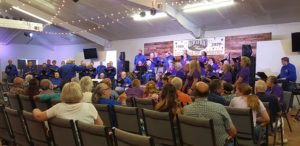
The Singing Men of South Texas and the Singing Women of South Texas performed at the centennial celebration for Alto Frio Baptist Encampment. (Photo / Jeff S. Bray)

100th for Alto Frio Baptist Encampment at Leakey. The camp celebrated its centennial with worship, fellowship and fireworks June 19-20. Alumni offered remembrances, and current staff presented future plans. Worship leaders included the Singing Men of South Texas and Singing Women of Texas as a combined choir. Rusty Brandon is executive director.


Court allows tuition tax credit for religious school scholarships

WASHINGTON—The U.S. Supreme Court ruled a state program that allows public funds to go toward private education cannot exclude religious schools.

In a 5-4 ruling on Espinoza v. Montana Department of Revenue, the court overturned a Montana Supreme Court decision that had invalidated a state program offering tax credit to people who funded scholarships in private schools, including religious schools.

The Montana Supreme Court ruled the dollar-for-dollar tax-credit program violated a state constitutional provision barring any government financial assistant—direct or indirect—to religious schools. The U.S. Supreme Court reversed the state court’s decision.

Writing the court’s majority opinion, Chief Justice John Roberts cited Trinity Lutheran Church v. Comer. In that 2017 decision, the court ruled Missouri acted improperly when it denied public funds to a church that sought financial assistance from a state program that provided grants for playground improvements.

The common thread connecting the Trinity Lutheran case to the Espinoza case is the denial of a public benefit to an otherwise qualified recipient based solely on religious identity, Roberts argued.

“A state need not subsidize private education. But once the state decides to do so, it cannot disqualify some private schools solely because they are religious,” Roberts wrote.

In a dissent, Justice Stephen Breyer cited not only legal precedents, but also the writings of Thomas Jefferson and James Madison to argue against using taxpayer-supported scholarships to pay for religious education.

“If, for 250 years, we have drawn a line at forcing taxpayers to pay the salaries of those who teach their faith from the pulpit, I do not see how we can today require Montana to adopt a different view respecting those who teach it in the classroom.”

‘Consistent with long-held American principles’

Both supporters and critics of the court’s decision in Espinoza v. Montana cited religious liberty. But some applauded the decision as a clear victory for the free exercise of religion, while others warned that it knocked a hole in the wall of separation protecting freedom of religion and opened the door to government interference in religious schools.

Russell Moore 150
Russell Moore

Russell Moore, president of the Southern Baptist Convention’s Ethics & Religious Liberty Commission, said the court “made the right decision,” and its ruling was “consistent with long-held American principles.”

“These scholarships were not a funding of religion, nor an entanglement of the state with the church. The issue here is whether a state-established scholarship program for private schools could discriminate against parents who chose to send their children to private schools that happen to be religious,” Moore said.

“As a Baptist committed to a free church in a free state, and to the separation of church and state, I believe this ruling maintains those right freedoms and boundaries. The Supreme Court should be commended for this decision.”

Kelly Shackelford, president and chief counsel to the Plano-based First Liberty Institute, commended the court for ruling the U.S. Constitution “prevents the government from treating religious organizations and schools unequally.”

“The justices made it clear that states cannot legally discriminate against religious organizations when they perform the same work secular institutions do.  This is a victory for religious liberty,” Shackelford said.

Texas Attorney General Ken Paxton similarly hailed the court decision.

“This is a fantastic victory, not just for school choice, but for religious liberty,” Paxton said. “I applaud the Supreme Court for correctly deciding that Montana’s no-aid provision unjustly barred religious schools from public benefits. The intolerant rule, which was based on nothing but religious affiliation, blatantly infringed constitutional religious liberties. Government must respect the closely held religious beliefs of its constituents.”

A ‘pyrrhic victory’ for religious schools

In contrast, Holly Hollman, general counsel for the Baptist Joint Committee for Religious Liberty, expressed disappointment in the court’s ruling. She called it a “pyrrhic victory” for religious schools because it opens them up to government influence and interference.

Holly Hollman

“The decision’s high concern for equal treatment of religious schools disregards the distinctiveness of religion in our constitutional order and contradicts the special treatment that religion rightfully receives to keep government from influencing and interfering with it,” she said.

“In a shell game that focuses on preventing discrimination based on religious status, the court fails to recognize Montana’s legitimate interest in protecting religious freedom by avoiding funding religious education.

“Though religious schools and some parents who choose them in states that have voucher programs will view today’s decision as a win, they may eventually see that it is a pyrrhic victory. The more that religious schools are treated just like all other private schools, the harder it is to justify and defend the special accommodations they receive, including in their hiring and firing practices, admission policies and curriculum choices.”

Rachel Laser, president and chief executive officer of Americans United for Separation of Church and State, said the Supreme Court “overturned decades of precedent in an effort to privilege certain religious beliefs and have them dominate our civic life.”

“Forcing taxpayers to pay for private religious education—as Montana’s tax-credit voucher program does—is a fundamental violation of their religious freedom,” Laser said. “Because religious schools are the epicenter of religious influence on the next generation, it’s imperative that the members of the faith support those schools, not the taxpayers at large.”

Charles Foster Johnson 150
Charles Foster Johnson

Charles Foster Johnson, executive director of Pastors for Texas Children, called the court’s decision “patently wrong” and “an attack” on religious liberty.

Public money should go to public schools that accept all children—not private religious schools that teach religious convictions, he asserted. By the same token, the “core religious mission” of parochial schools should be protected from government intrusion, he added.

“Let private schools remain private, public schools remain public. Commonsense Americans know this,” Johnson said. “Such wisdom that has sustained our country since its inception escaped the Supreme Court today.”