NAMB trustees pass significantly reduced budget

ALPHARETTA, Ga.—Trustees of the Southern Baptist Convention’s North American Mission Board passed a $99.8 million operating budget for 2021—down about 20 percent from the previous year—at their Oct. 5-6 meeting.

Even so, trustees celebrated God’s provision and Southern Baptist faithfulness during a year marked by a pandemic, economic uncertainty and social unrest. Most trustees attended the meeting in person with social distancing at NAMB’s building in Alpharetta, while some participated online.

When the COVID-19 virus sent the United States into a lockdown just as most churches normally would have been collecting the Annie Armstrong Easter Offering, NAMB stopped promoting the offering, NAMB President Kevin Ezell noted.

However, giving continued as churches found creative ways to continue supporting the offering. He called the $49.3 million given in 2020 “the greatest Annie Armstrong Offering” in history.

“It was not the largest. But it was the greatest,” Ezell said.

“The faithfulness of Southern Baptists is absolutely incredible and to me, never demonstrated better than giving almost $50 million in the midst of an unpromoted Annie Armstrong offering in the midst of a pandemic,” he said.

Trustees unanimously passed the $99.8 million operating budget for fiscal year 2021, down from the $124,230,000 budget originally approved for 2020. Early on in the COVID-19 pandemic, NAMB instituted budgetary freezes and cutbacks designed to keep missionaries on the field.

Ezell outlines priorities for 2021

In his president’s report, Ezell outlined three areas of priority focus for NAMB in 2021: collegiate evangelism, Hispanic church planting and Send Relief national mission trips.

Ezell told trustees that with more than 21 million college students in North America and more than 5,300 college campuses, college students are among the top 10 unreached people groups in North America.

He outlined for trustees the projected growth of America’s Hispanic population over the next 40 years. In 2016, the Hispanic population in the United States was 57 million. By 2030, it is expected to jump to 74 million and then 111 million by 2060, far outpacing the growth of any other ethnic group.

“We are very excited about putting a good deal of emphasis on our Hispanic church planting, and the reason we are doing it is the demographic projections,” Ezell said. “We are trying to get ahead of the growth.”

Ezell also presented plans for Send Relief national mission trips that will take place each month in different cities throughout North America beginning in fall 2021.

The goal of the mission events is to bring hundreds of volunteers to a city to focus on meeting needs and sharing Christ in communities, schools and churches. Send Relief will work with state Baptist conventions, local associations and churches to coordinate events.


Convención receives major grant from Lilly Endowment

The Hispanic Baptist Convention of Texas received a nearly $1 million grant from the Lilly Endowment to launch an initiative to help Hispanic churches thrive as they meet the distinctive ministry needs of their communities.

The Lilly Endowment awarded the $999,839 grant to enable Convención Bautista Hispana de Texas to establish its Iglesias Abundantes program.

Iglesias Abundantes will help Hispanic Baptist congregations engage unique ministry challenges they face—varying immigrant generations, diverse language usage and rapidly changing cultural needs.

Over five years, up to 50 congregations will have the opportunity to participate in a congregational learning experience that will explore the challenges, solutions, resources and practices to help them address the unique demands of their ministry setting.

Congregations will create individualized Abundante Plans and be eligible to receive up to $9,000 to implement their plans.

Jesse Rincones

“We appreciate the interest that Lilly Endowment has in our congregations and the confidence in Convención to award this grant,” said Jesse Rincones, executive director of Convención. “Hispanic Baptist churches will have the opportunity to engage their unique ministry challenges and develop thriving congregations that will bless their ministries, communities and the kingdom.”

The program is funded through Lilly Endowment’s Thriving Congregations Initiative, launched in 2019. The aim of the national initiative is to strengthen Christian congregations so they can help people deepen their relationships with God, build strong relationships with each other and contribute to the flourishing of local communities and the world.

Lilly Endowment is making nearly $93 million in grants through the initiative. Grants will support organizations as they work directly with congregations and help them gain clarity about their values and missions, explore and understand better the communities in which they serve, and draw upon their theological traditions as they adapt ministries to meet changing needs.

Convención Bautista Hispana de Texas is one of 92 organizations taking part in the initiative. They represent and serve churches in a broad spectrum of Christian traditions, including Anabaptist, Baptist, Episcopal, evangelical, Lutheran, Methodist, Mennonite, Pentecostal, Presbyterian, Reformed, Restoration, Roman Catholic and Orthodox, as well as congregations that describe themselves as nondenominational. Several organizations serve congregations in Black, Hispanic and Asian-American traditions.

“In the midst of a rapidly changing world, Christian congregations are grappling with how they can best carry forward their ministries,” said Christopher Coble, Lilly Endowment’s vice president for religion. “These grants will help congregations assess their ministries and draw on practices in their theological traditions to address new challenges and better nurture the spiritual vitality of the people they serve.”


Obituary: Lori Michelle Dockrey

Lori Michelle Dockrey of Colorado City, minister to youth and children, died Sept. 10. She was 43. She was born Nov. 25, 1976, in Colorado City to Jim Dockrey and Christy Stubblefield Dockrey. She earned a Masters of Arts in Christian Education degree from Southwestern Baptist Theological Seminary in Fort Worth. She not only was the longtime youth and children’s minister at First Baptist Church in Colorado City, but also was a friend, role model and No. 1 fan to all her students, past and present. She was an avid sports fan and attended the games of all her students whenever possible. She served as secretary for the board of the West Texas Children’s Advocacy Center, on the executive staff at Super Summer camps, on the board for Texas Baptist Conclave and as Fellowship of Christian Athletes huddle coach for the Colorado City Independent School District. She also was involved in the Mitchell County Ministerial Alliance, Rachel’s Challenge for Anti-bullying and RAD Self Defense Training. She is survived by her father Jim Dockrey and wife Sherry of Colorado City; her mother Christy Dockrey of Granbury; her brothers Justin Dockrey and wife Shane of Midland and Lance Dockrey and wife Caroline of Kandern, Germany; step-brothers Zach Anderson and wife Ashley of Corpus Christi and Jed Anderson and wife Misti of Canyon; and grandmothers, Dorris Dockrey and Ernestine O’Dell.

Around the State: Wayland students serve community

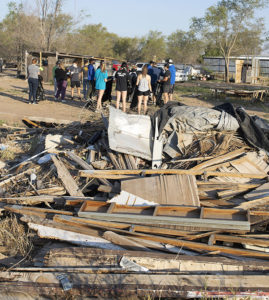
A large group of Wayland Baptist University students receive instructions before starting to clean up a residential lot in Seth Ward, a community on the edge of Plainview. The initiative was part of a student-led service project. (WBU Photo)

About 50 Wayland Baptist University students gathered at a vacant lot in Seth Ward, a low socio-economic community on the northeast edge of Plainview, on a recent Saturday morning to spend the day cleaning the area. Some involved in the service project were part of an orientation class required of all new students at the university, and several small chapel groups that are meeting this semester at Wayland joined in the project. Donnie Brown with Wayland’s office of spiritual development said the student-led initiative involving the chapel groups are benefitting several groups and organizations in the community. Chapel groups are assisting with food drives to benefit the Faith in Sharing House, working with organizations such as the Rainbow Room, Salvation Army and Crisis Center, and raising awareness about human trafficking.

Hardin-Simmons University will hold a chapel service at 9:30 a.m. on Oct. 13 marking the death of former HSU student Jonathan Price. On Oct. 3, Price was shot and killed by a Wolfe City police officer when Price reportedly was trying to intervene in a dispute and de-escalate a disturbance at a convenience store. The officer, Shuan Lucas, was charged with murder. Lucas is white; Price was African American. Price was a business student and football player at HSU in 2008. “Many remember Jonathan’s spirit and character. He will not be forgotten, nor will the tragic events and choices surrounding his death,” said HSU President Eric Bruntmyer. “At next Tuesday’s chapel, we are going to take time to remember Jonathan. Local leaders and professors will join in the discussion of Jonathan’s life and death as we consider how to help prevent other senseless deaths.” To view the livestreamed service, click here.

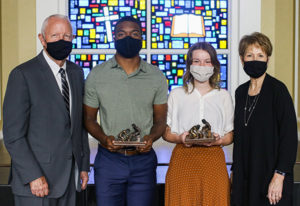
Two East Texas Baptist University seniors, Emily Jones from Beaumont and Mylan Shed from Teague, were recognized with a Riley Servant Leadership Award during chapel Oct. 5,. ETBU presents the award to students who are chosen for consistently displaying Christian servant leadership on campus and in the community. The students are pictured with President Emeritus Bob Riley and former ETBU first lady Gayle Riley. (ETBU Photo)

East Texas Baptist University seniors Emily Jones from Beaumont and Mylan Shed from Teague received the Bob and Gayle Riley Servant Leadership Award during chapel on Oct. 5. Award recipients are selected for consistently displaying Christian servant leadership on campus and in the community. Fellow students, professors and other members of the ETBU campus community submit nominations. Shed, who has served as vice president of the Student Government Association, has participated in the Black Student Association, Cultural Outreach Ministries, the Joyful Praise choir and dance ministry, and the Student Foundation. He also has been a Tiger Camp leader and Thrive mentor. Jones, who has served as president of the South Foundation, has been involved in Leadership Fellows and worked as a resident assistant, Tiger Camp leader and Titus ministries leader. She also volunteers in the community through service in Marshall public schools, teaches Sunday school at Mobberly Baptist Church and leads a Life Group at New Beginnings Baptist Church.

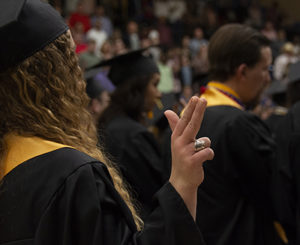
The University of Mary Hardin-Baylor held its annual ring ceremony Oct. 2. Senior students graduating in either December or next May were invited to participate in the campus tradition. This year’s event was socially distanced and held outdoors in front of Luther Memorial. UMHB will host an online Sader Day event for prospective students on Oct. 12. In the past, Sader Day events have given students the chance to experience a sample of college life, including attending class and participating in student events. Due to the impact of the COVID-19 pandemic, this year’s Sader Days are being delivered entirely online. The event includes a virtual tour of campus, an overview of the financial aid process and a primer on all of the traditions students can look forward to after becoming Crusaders. To register for Online Sader Day, click here.

Buckner Children and Family Services received a $620,000 grant to expand and support foster care and adoption services in Tarrant County. The two-year grant from the Rees-Jones Foundation will enable Buckner to renovate office and training space inside University Baptist Church in Fort Worth and fund local foster care and adoption case workers. Renovation of the third-floor church space, scheduled to begin in mid-October, will include a visitation room for biological parents to see their children who are in the state’s custody. “The Rees-Jones Foundation grant gives Buckner the opportunity to meet the significant need for kinship homes and therapeutic services to children in North Texas,” said Andi Harrison, Buckner regional director of foster care and adoption in North Texas. “Buckner facilitated 38 adoptions and impacted more than 200 lives through foster care placements in the Dallas area in 2018 and 2019 combined. The generosity of The Rees-Jones Foundation and University Baptist Church allows Buckner to increase these numbers by providing necessary services to Fort Worth and the surrounding Tarrant County community in an even larger capacity.” In Tarrant County, Buckner will work directly with Our Community Our Kids, which contracted with the Texas Department of Family and Protective Services to expand community-based care in the region, assuming case management responsibilities from Child Protective Services.


Wayland closes events to the public, cancels graduation

PLAINVIEW—Pointing to the difficulties in maintaining COVID-19 safety protocols, Wayland Baptist University announced Oct. 6 it will close all campus events to the public through December and cancel its graduation ceremony this semester.

“This was another one of those unprecedented decisions that we have faced this year,” President Bobby Hall said. “The health of our students has been our top priority.

“We have held a few events on campus that were open to the public, but through those events, we realized how difficult it is to maintain proper safety protocols.”

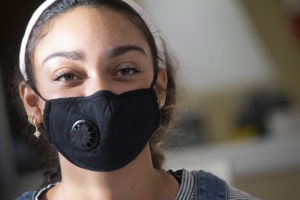
Wayland Baptist University student Eliana Vaughn dons a face mask while on campus. Wearing a face mask is one of the requirements Wayland placed on students, faculty and staff for a return to campus for the fall semester. (Wayland Baptist University Photo)

Hall emphasized the decision was not a result of an increase in COVID-19 cases but was made out of concern for maintaining a safe and healthy environment.

Wayland’s COVID-19 numbers have remained low throughout the semester as the university continues to follow safety guidelines, university officials reported. Protocols include cleaning and disinfecting classrooms and common areas, requiring face masks in all buildings and maintaining social distancing.

December ceremony cancelled due to anticipated crowd

Wayland leaders met last week to discuss the feasibility of holding a graduation ceremony in December. As they discussed plans and safety concerns, university officials said it became increasingly apparent proper safety protocols could not be followed with the number of people who would be expected on campus.

Wayland Baptist University administrators cancelled the December 2020 graduation ceremony out of concern for health and safety. (WBU Photo)

In May, graduates received a box containing their cap, gown and other information and paraphernalia. Hall said the university will do something similar for the December graduates, and they will be invited to take part in a future graduation ceremony.

“Graduation is such a special time, and we wish we could celebrate together,” Hall said. “We are proud of each and every one of our graduates and will celebrate with them in spirit, though not in person.”

Wayland also will close athletic events to the public. All university athletic events will continue to be played as scheduled through December but without spectators.

Wayland has only one football game scheduled for the fall semester on Oct. 31. Basketball season is scheduled to start in November with the first home games on Nov. 14. Games will be streamed live on www.wbuathletics.com.


Court hears arguments on damages for RFRA violations

The U.S. Supreme Court heard arguments Oct. 6 that people whose rights under the Religious Freedom Restoration Act have been violated should have access to the same legal remedies—including monetary damages—as those protected under other federal civil rights laws.

The case before the court, Tanzin v. Tanvir, deals with whether three American Muslims can seek damages from two dozen government agents.

The men—Muhammad Tanvir, Jameel Algibhah and Naveed Shinwari—alleged the FBI placed them on the No Fly List because they refused to serve as informants and spy on fellow Muslims, which would violate their faith.

The men eventually were removed from the No Fly List, but Tanvir asserted he had to quit his job as a truck driver because he could not fly home after making long-distance one-way deliveries. For an extended time, he also was unable to visit his ailing mother in Pakistan.

Meaning of ‘appropriate relief’ debated

Specifically, the case focuses on a statutory question regarding what remedies are available as “appropriate relief against a government” under RFRA. The 2nd U.S. Circuit Court of Appeals held “appropriate relief” can include monetary damages.

The federal government—defending the FBI agents—argued RFRA does not allow for monetary damages and permitting it would open the floodgates to lawsuits against government officials.

“‘Appropriate relief’ for civil-liberties violations has always included damages against officers, and RFRA is no exception,” according to a friend-of-the-court brief filed by the Baptist Joint Committee for Religious Liberty.

The BJC, along with the Christian Legal Society and others, filed the brief arguing RFRA always was intended to allow for monetary damages.

Holly Hollman

“The Religious Freedom Restoration Act, like other civil rights laws, is intended to hold government accountable for the protection of fundamental rights,” said BJC General Counsel Holly Hollman.

“In most cases where a violation is proven, the remedy will be for the government to reverse course. In some cases, however, monetary damages against individual government actors are appropriate and should be available to address the harm of a violation.

“We joined a brief with the Christian Legal Society and experts in religious liberty and remedies law that focuses solely on the statutory question in this case. The Supreme Court should affirm that RFRA was always intended to allow for damages under the same principles that are followed elsewhere in federal law protecting important civil rights.”

Brief explores history of RFRA

The brief, written by church-state scholar Douglas Laycock, who holds endowed chairs at the University of Texas and the University of Virginia, explores the legislative history of RFRA. The BJC chaired the Coalition for the Free Exercise of Religion that persuaded Congress to pass RFRA.

U.S. Supreme Court Building in Washington D.C. (Photo: bakdc / Shutterstock.com)

“Congress often explicitly excludes or limits damage remedies, especially in statutes authorizing litigation against government defendants,” the brief argues. “Given the long history of damage remedies for civil-liberties violations, Congress would have excluded such remedies if that were what it meant.”

The brief also refutes the idea that RFRA only authorizes relief against government, not against individual actors. RFRA “expressly defines government officials and persons acting under the color of law as government,” the brief states. The term “under color of law” refers to individuals who may be sued in a personal capacity for actions performed in an official capacity.

The Supreme Court originally was scheduled to hear oral arguments regarding Tanzin v. Tanvir in the spring, but it was rescheduled due to the COVID-19 pandemic. A decision is expected by next June.


LifeWay and Rainer settle contract dispute

NASHVILLE (BP)—LifeWay Christian Resources and Thom Rainer have agreed to settlement terms in a breach of contract lawsuit between the SBC entity and its former CEO.

The statement indicates the agreement was reached Oct. 5, a day after Rainer had tweeted his intent to accept LifeWay’s terms to end the lawsuit.

According to a statement jointly released Oct. 6, Rainer agreed to honor the terms of his separation agreement, including a noncompete clause. He also agreed “not to move forward with his business partnership with Tyndale House Publishers, which was a violation of his noncompete agreement.”

“Our prayer has always been that this could be resolved between LifeWay and Dr. Rainer amicably,” said Todd Fannin, chair of LifeWay’s board of trustees. “We’re thankful Dr. Rainer agreed to honor his word and commitment to LifeWay, which has been our goal from the beginning. The trustees and Dr. Rainer are looking forward to putting this behind us.”

In a statement provided to Baptist Press, Rainer said: “I am grateful to have this resolution between LifeWay and me. I look forward to once again focusing on serving local churches and those who serve them.”

Dispute over noncompete agreement

LifeWay filed a complaint Sept. 28 in Williamson County, Tenn., chancery court alleging Rainer had violated his separation agreement with LifeWay by publishing with a competitor.

The agreement between Rainer and LifeWay upon his 2019 retirement precluded him from having any business association with LifeWay competitors until Oct. 31, 2021. The agreement specifically listed Tyndale House Publishers as a LifeWay competitor.

In August 2020, Tyndale announced a multibook publishing partnership with Rainer, which also includes video curriculum.

Thom Rainer

Rainer told Baptist Press that an Oct. 1, 2019, letter from LifeWay granted him “rights reversal” on his writings and LifeWay officials communicated in subsequent verbal comments that he was released to publish books with any publishing house he selected. Previously, Rainer said he had received “a written and amicable release from publishing” with LifeWay, he had discussed the matter with LifeWay’s attorney and he had “assumed all was well” until receiving notice of the lawsuit.

On Oct. 4, Rainer tweeted that LifeWay had “put forth six stipulations to end the lawsuit,” and added: “For the sake of the Gospel, I plan to accept all of those terms on Monday. This legal battle between Christians before the watching world has to end. I will end it.”

Rainer confirmed to Baptist Press the next day that he had accepted the stipulations but declined to disclose specifics. The joint statement issued Tuesday simply referenced Rainer’s agreement to honor the original terms of his transition agreement, “including the non-compete clause” and “not to move forward” with the partnership with Tyndale.

Confusion and questions from trustees

The legal action led to confusion and questions last week from some of LifeWay’s trustees, who were taken by surprise. The board’s three officers defended their decision to sue, but former board chairman Jimmy Scroggins—who still serves on the board—maintained legal action should not have been taken and that the full board should have been notified. An emergency trustee meeting Sept. 30 was postponed by the 13-member trustee executive committee. Trustees were promised additional information within a week.

Along with the postponement, Fannin said in a statement that “in lieu of moving forward with litigation, both parties are currently exploring the possibility of an agreed upon resolution of the differences.” On Oct. 2, Fannin told Baptist Press LifeWay was “waiting on Dr. Rainer to respond to our suggested resolutions of the issues” in the dispute.

A new flurry of discussion about LifeWay’s handling of the conflict with its former CEO arose over the weekend after the entity sent trustees and employees an email from the three trustee officers—Fannin, vice chairman J.D. Perry and secretary Amy Mielock—detailing their claims against Rainer. In addition to facts previously stated in the suit, the email said LifeWay had paid Rainer more than $1 million plus benefits since his February 2019 retirement.

Rainer said last week he has returned his payments to LifeWay since late spring, after he was asked to forgo remaining compensation by Ben Mandrell, the current LifeWay president. Under his transition agreement, he was to remain a paid LifeWay employee through Oct. 31, 2020, as chief advisory officer. Mandrell has not commented publicly on the issue. Several requests by Baptist Press for an interview with Mandrell were declined by a LifeWay spokesperson.

“We have attempted to show grace and restraint in a difficult process and to preserve what will be embarrassing information to many involved,” the LifeWay trustee officers wrote Oct. 2, according to a copy of the email obtained by Baptist Press.

“We had hoped our request for a season of prayer would be embraced by all involved, but as misrepresentations continue to be published, we now believe it best to present these facts. Ultimately, it is always our goal to allow the truth to prevail.”

Rainer told Baptist Press on Monday he was “hurt” by the officers’ email but could not comment on its substance in light of the ongoing settlement talks.

Scroggins responded to the three officers in an Oct. 3 email to the full board. Among his claims: that the amount of money awarded to Rainer in his separation agreement is consistent with publishing industry standards; that the relationship between Rainer and Mandrell has been strained; and that while he is not defending Rainer’s actions, LifeWay’s “high profile, explosive, legal action was taken without notification, consultation, or affirmation from the Board.”

The lawsuit occurred “in direct violation of the principles in 1 Corinthians 6,” Scroggins wrote in a copy of the email obtained by Baptist Press. “Please read it for yourself if you have not done so. Even if Thom [Rainer] is wrong, the text actually says ‘It would be better to be wronged, or defrauded.’”

Scroggins requested an in-person trustee meeting in Nashville with masking and social distancing, though he said he’s willing to attend a meeting in any format, including Zoom. To date, no meeting has been announced publicly.


Scholars call out Russian persecution of Jehovah’s Witnesses

VILNIUS, Lithuania (RNS)—An international group of religion scholars—including a Baylor University professor—is calling on President Vladimir Putin and his administration to end the persecution of Jehovah’s Witnesses in Russia.

The scholars’ statement, released Oct. 1, followed the Center for Studies on New Religions’ one-day conference, “Jehovah’s Witnesses and Their Opponents: Russia, the West, and Beyond,” held online from Vilnius, Lithuania.

“As institutions and individuals concerned with religious freedom, we have followed the events in Russia with increasing alarm,” the center’s statement reads.

Among those events is a reported armed raid of 110 homes of Jehovah’s Witnesses in Russia’s Voronezh region in July that the scholars call the “largest number of coordinated raids on Jehovah’s Witnesses in modern Russia” and an “escalation” in the persecution of Witnesses in the country.

More than 170 Jehovah’s Witnesses have reportedly been imprisoned or put in pre-trial detention in Russia since 2017 for practicing their faith.

That’s when the Russian Supreme Court labeled Jehovah’s Witnesses an “extremist” group. Witnesses are a religious minority in the country, where the Russian Orthodox Church has the backing of the state.

“We are left with the impression that Jehovah’s Witnesses in Russia are being punished for their success in gaining new adherents, and because they are perceived as a ‘foreign’ religion. Freedom to proselytize and to persuade members of other religions is, however, an integral part of freedom of religion under Article 18 of the Universal Declaration of Human Rights,” the statement reads.

Signers include conference speakers J. Gordon Melton of Baylor University’s Institute for Studies of Religion in Waco; Massimo Introvigne of the Center for Studies on New Religions in Torino, Italy; Raffaella Di Marzio of the Center for Studies on Freedom of Belief, Religion and Conscience in Rome; and other international scholars of religion.

There are an estimated 175,000 Jehovah’s Witnesses in Russia.

Jehovah’s Witnesses are not recognized as Christian by Orthodox and some other Christian traditions, primarily because they do not believe in the Trinity. They also do not salute the flag, bear arms or participate in politics.


Link noted between daily spiritual experiences and well-being

WACO—Using smartphone check-ins twice a day for two weeks, Baylor University and Harvard University researchers have found a link between individuals’ daily spiritual experiences and overall well-being.

While other studies have found such a connection between spirituality and positive emotions, the new study is significant because frequent texting made it easier to capture respondents’ moment-to-moment spiritual experiences over 14 days rather than only one or two points in time, the researchers said.

matt bradshaw130
Matt Bradshaw

“This study is unique because it examines daily spiritual experiences—such as feeling God’s presence, finding strength in religion or spirituality, and feeling inner peace and harmony—as both stable traits and as states that fluctuate,” said study co-author Matt Bradshaw, research professor of sociology at Baylor University’s Institute for Studies of Religion.

“Because surveys usually capture only one or two points in time, researchers often have to assume that associations between spirituality and positive emotions capture stable traits in respondents rather than momentary states of mind. But these findings suggest that stable, consistent spiritual experiences as well as short-term periodic ones both serve as resources to promote human flourishing and help individuals cope with stressful conditions.”

Blake Victor Kent

Additionally, “the prevalence of smartphones makes this sort of ‘experience sampling’ study doable on a much larger scale than in the past, when pagers or palm pilots were used to trigger data collection,” said lead author Blake Victor Kent, research fellow of Harvard Medical School/Massachusetts General Hospital and a non-resident scholar at Baylor ISR.

The study—published in The International Journal for the Psychology of Religion—uses data from SoulPulse, a project funded by the John Templeton Foundation, to study religion, spirituality and mental and physical well-being.

Participants were 2,795 individuals who signed up for the study after learning of it through national media—including the Associated Press, the Religion News Service and The New Yorker—and by word of mouth.

Types of spiritual experiences

Kent said daily spiritual experiences are measured as one of two types:

  • Theistic spiritual experiences examine the degree to which God is experienced as present, available and active in the individual’s life using six questions: “I feel God’s presence,” “I find strength and comfort in my religion or spirituality,” “I feel God’s love for me directly or through others,” “I desire to be closer to God or in union with the divine,” “I feel guided by God in the midst of daily activities” and “I feel close to God.”
  • Non-theistic spiritual experiences assess transcendent feelings not specifically connected to God or a divine being using three questions: “I feel a deep inner peace or harmony,” “I am spiritually touched by the beauty of creation” and “I feel thankful for my blessings.”

To keep daily surveys short and interesting for participants, 10 to 15 items were pulled from some 100 questions and appeared with varying frequency. They included assessments of depression or positive emotions with such items as: “I feel downhearted and blue,” “I feel that life is meaningless,” “I am unable to become enthusiastic about anything,” “I am feeling happy,” “I am feeling that I have a warm and trusting relationship with others” and “I have something important to contribute to society.”

Another item asked whether, since the most recent daily survey, the person had experienced a stressful situation such as an argument with a loved one, illness, injury, accident, job stress, financial problems or tragedy.

“The findings indicate, as you would expect, that the wear and tear of daily stressors are associated with increased depressive symptoms and lower levels of flourishing,” Kent said. “What this study really contributes is that daily spiritual experiences play an important role as well. Essentially, if you take two people who have equal levels of stress, the one with more spiritual experiences will be less likely to report depressive symptoms and more likely to indicate feelings of flourishing. That’s a comparison between two people.

“But what about one person?” he said. “The unique thing about this study is we are able to show that when someone’s spiritual experiences vary day to day, the ‘above average’ days of spiritual experience are associated with better mental well-being than the ‘below average’ days.”


Obituary: Randy Gallaway

Randall “Randy” Lee Gallaway of Lubbock—collegiate minister, missions volunteer and motivational speaker—died Sept. 10. He was 73. He was born Sept. 9, 1947, to Norris Weaver and Mary Virginia (Moore) Gallaway in Austin. Weeks before his high school graduation, he suffered a devastating injury while assisting an electrician at his part-time job as an intern for American Manufacturing in Fort Worth. Doctors initially said there was no chance of recovery. After a lengthy hospitalization, 38 surgeries and rehabilitation, he graduated from Amon G. Carter Riverside High School in Fort Worth in 1967. Although he lost all of one arm and part of another, he was motivated to make the most of his second chance at life. He earned an engineering degree with honors at the University of Texas at Arlington before pursuing a lifetime of missions and ministry work. He met Mary Ann Milliken of Lubbock while leading evangelism workshops for the Baptist Student Union at Texas Tech University. They married in 1975. He graduated with a Master of Divinity degree from Southwestern Baptist Theological Seminary in 1978 and a Doctor of Ministry degree from Golden Gate Baptist Theological Seminary in 1987. In the mid-1980s, the Gallaways moved to Canada to plant a church and minister to college students. As self-supporting Mission Service Corps volunteers, they worked first in Vancouver, British Columbia, before launching student ministries in Toronto at the invitation of the Canadian National Baptist Convention. The Southern Baptist Convention’s International Mission Board appointed them as their first career missionaries to students in Canada. Their joint biography, Death Knocking, Life Calling, was published in 2014. In print and in numerous presentations around the globe, Gallaway presented his life motto: “Never give up! As long as there is breath in you, you must hold onto hope.” Survivors include his wife, Mary Ann Gallaway; children, John Gallaway and wife Chelsea of Casper, Wy., and Sage Gallaway of Lubbock; four grandchildren; sister Nancy Cooper; and brother Rex Gallaway.


Two DBU students killed in car accident

An early morning two-car accident on Oct. 4 claimed the lives of two Dallas Baptist University students.

Two first-year students—Kaitlyn Kotzman of Fort Worth and Karina de la Rosa of Pearsall—were killed in the crash on Mountain Creek Parkway, less than a mile from the university campus.

“We are devastated by this horrible loss of life,” DBU President Adam C. Wright said. “We are praying for the families of all those involved as they process through this tragedy.”

Three other students involved in the accident sustained non-life-threatening injuries and are recovering with their families, Blake Killingsworth, vice president for communications at DBU, reported on Oct. 6.

After an evening prayer service in Pilgrim Chapel on Oct. 5, DBU posted on Facebook: “Father, it is with heavy hearts that we draw near in prayer, not understanding but with confidence in your promise to work all things for our good and your glory, with confidence in your power to redeem and restore.

Dallas Baptist University students join in a prayer and praise service Oct. 5 in memory of two classmates killed in an auto accident. (DBU Photo)

“To the families of Karina and Kaitlyn, it was a gift to walk with your daughters. Our DBU Family grieves with you and continues to pray for you.

“To our students, we love you. We’re honored to be your DBU Family. We want to walk alongside you in this season.”

DBU administration announced the university will provide counseling for classmates and friends of the affected students.

On Sept. 25, a DBU doctoral student from Odessa and his wife were killed in an auto collision. Kenny Comstock, executive pastor of the nondenominational Crossroads Fellowship church in Odessa, and his wife Melissa died in a two-vehicle collision in New Mexico.


Pro-Trump evangelicals exposed to virus flout CDC guidelines

WASHINGTON (RNS)—At least two faith leaders, including one of President Donald Trump’s unofficial evangelical advisers, have tested positive for COVID-19 after attending a White House Rose Garden ceremony and a separate evangelical gathering in Washington, D.C.

Several other high-profile Christian leaders were also at one or both events. Some have since chosen to quarantine out of precaution, but others—including Jack Graham, pastor of Prestonwood Baptist Church in Plano, and Ramiro Peña, pastor of Christ the King Baptist Church in Waco—continue to travel and even to preach in front of their congregations.

University of Notre Dame President John I. Jenkins, who was present at the Rose Garden event, announced his positive test on Oct. 2 and is quarantining.

Pastor Greg Laurie of Harvest Christian Fellowship in Riverside, Calif., also in attendance at the Rose Garden ceremony, confirmed Oct. 5 he tested positive for COVID-19. Laurie said in a video he had been quarantining since Friday, when he received the diagnosis.

The Sept. 26 ceremony, announcing Trump’s new Supreme Court nominee, Amy Coney Barrett, was convened at the White House Rose Garden, where attendees sat close together, few wore masks and many were seen shaking hands when the event concluded.

At least nine in Rose Garden ceremony tested positive

With Laurie’s diagnosis, at least nine people from the Rose Garden ceremony, including Trump, have since tested positive for the novel coronavirus. And many faith leaders were photographed sitting near or next to them throughout the event.

At any given time, most were within feet of Jenkins, Laurie, former New Jersey Gov. Chris Christie, former White House aide Kellyanne Conway and White House Press Secretary Kayleigh McEnany—all of whom have since tested positive.

Paul Scalia, a priest at St. James Catholic Church in Falls Church, Virginia, and the son of Justice Antonin Scalia, announced to his church on Oct. 4 he tested negative over the weekend but that he would quarantine “at the recommendation of my doctor and per CDC guidelines.” Scalia sat in the same row and three seats down from Conway at the Rose Garden event.

Similarly, many other faith leaders who attended the event say they have since tested negative for the virus. Not all are adhering to those Centers for Disease Control guidelines, which recommend quarantining for 14 days after spending an extended period of time (more than 15 minutes) in close proximity (within six feet) to someone who tests positive for COVID-19.

Even with a negative test, the CDC still recommends a person exposed to COVID-19 quarantine for two weeks after last known exposure to the virus, since symptoms may take anywhere from two to 14 days to appear.

Indeed, many of the pastors in attendance preached to in-person congregations Sunday.

Laurie, who sat diagonally in front of Chris Christie during the Rose Garden event, preached during Harvest Christian Fellowship’s “Harvest at Home” online services Sunday, but it was unclear when his message was recorded and if there was anyone else present.

Jack Graham insists he is ‘ridiculously healthy’

Graham of Prestonwood Baptist Church sat directly in front of Chris Christie and next to Laurie at the Rose Garden event. He opened his service on Sunday by praying for the president, who was hospitalized on Friday after experiencing complications from his own COVID-19 infection, and the first lady, who also tested positive for the novel coronavirus.

Graham—speaking at one of Prestonwood’s worship services—then assured his congregation: “I am ridiculously healthy, let’s just put it that way. I’m not sick. I’m fine.

“I exercised every day this week … and flew to Atlanta to speak with the vice president on Wednesday,” he said. “I worked every day, preaching three times this weekend, so I don’t have COVID. Let’s just put it that way. I’m grateful for that, and we’re grateful for God’s protection always.”

Graham then preached a message titled “Socialism: A Clear and Present Danger.”

He did not mention being tested for COVID-19, and Prestonwood has not returned requests for comment by Religion News Service.

Skip Heitzig, pastor of Calvary Church in Albuquerque, N.M., sat in the row behind Jenkins during the Rose Garden event. A representative for Heitzig’s church said Heitzig “feels great” but did get a COVID-19 test early Saturday morning.

Heitzig’s team emailed RNS late Monday evening to say the pastor received a negative result from the test. But a Monday night result would mean he was still awaiting test results when he began preaching Sunday morning. He delivered his sermon in a closed studio but acknowledged other people were there, and attendees could be heard clapping as he spoke.

Paula White urges prayers for ‘supernatural healing’

Paula White, head of the White House Faith and Opportunity Initiative and often regarded as President Trump’s closest religious adviser, sat three seats down from Jenkins at the Rose Garden event. She preached in front of the Florida-based City of Destiny congregation on Sunday—where people were spaced apart, and many wore masks—and said she had been tested three times the previous week. All, she said, came back negative.

She called on those present to pray for “supernatural healing” for Trump and others suffering from COVID-19.

Jentezen Franklin, pastor of Free Chapel in Gainesville, Ga., who sat diagonally behind Jenkins in the Rose Garden, preached to his congregation on Sunday as well. He prayed for healing for the president and the first lady but did not mention during his introduction whether he had been tested for the novel coronavirus.

Before Sunday’s services, Franklin posted a video on Twitter sharing he had tested negative for COVID-19.

Representatives for his church did not respond to multiple requests for comment.

Liberty University acting President Jerry Prevo sat next to Jentezen Franklin during the event. A representative for the university said Prevo tested negative for the virus on Friday morning. Prevo tweeted on Saturday images of himself attending a Liberty football game with other people in what appeared to be a closed room.

“Loved cheering (Liberty football) onto another win today with this beautiful lady,” he tweeted, along with images of himself standing next to other people and speaking. “We had a great time getting to know some LU students, staff, and faculty at the game. Congratulations to (Coach Hugh Freeze) and the Flames for their 3-0 record. Go Flames!”

Bishop Harry Jackson, who leads Hope Christian Church in Beltsville, Md., appeared to sit on the end of the row behind Jenkins and directly across the aisle from Kayleigh McEnany, preached to an empty church on Sunday.

Pastor Robert Morris, who appeared to be sitting next to Jentezen Franklin at the Rose Garden event, also spoke to his Dallas-based Gateway Church, which gathered in person with some restrictions to celebrate its 20th year.

Neither immediately responded to requests for comment by RNS.

Waco pastor preaches to congregation

Peña of Christ the King Baptist Church also was at the Rose Garden event and preached to his Waco congregation on Sunday, although he sat farther away from people at the ceremony who have since tested positive for COVID-19. His church did not immediately respond to requests for comment.

Peña was part of a virtual call to prayer for President Trump, hosted by Trump’s daughter-in-law Lara Trump, Sunday afternoon with Franklin, White and Jackson. They were joined by Franklin Graham, head of the Billy Graham Evangelistic Association, who sat next to Jenkins at the Rose Garden, and his daughter Cissie Graham Lynch, who sat next to her father at the same event.

A BGEA spokesperson said both Graham and Lynch took COVID-19 tests this past week and were negative but did not specify when those tests were taken. The spokesperson said Graham is currently in a “remote area of Alaska.”

Ralph Reed, who sat two seats down from Peña, was tested on Wednesday and got a negative result. However, Reed led a Faith and Freedom Coalition conference in Atlanta, Ga., from Sept 30 to Oct 2 that featured speakers such as Vice President Pence.

Another scheduled speaker, Sen. James Lankford, was forced to leave the conference and quarantine after learning that Utah Sen. Mike Lee—another attendee at the Rose Garden event who Lankford had spent time with—had also tested positive for the coronavirus. Lankford—a Southern Baptist—has since tested negative, but remains in quarantine, citing CDC guidelines.

Reed, on the other hand, did not appear to quarantine. He closed out the indoor event on Friday evening—after news broke that both Trump and Jenkins had tested positive for COVID-19—by making a speech.

Many of these same evangelical faith leaders also joined thousands who attended a massive prayer march in Washington, D.C., the same day as the Rose Garden event.

Emily McFarlan Miller reported from Chicago.