Public school advocate pleased about Texas House elections
November 5, 2020
While much of the nation focused on the outcome of a still-to-be-determined presidential election, the executive director of Pastors for Texas Children closely watched contested races for the Texas House of Representatives—and he liked what he saw.
Charles Foster Johnson
“We note with profound gratification the emphasis on public education in this electoral cycle. Virtually every incumbent and challenger ran on a strong public education platform,” Charles Foster Johnson said.
“It is clear that the people of Texas want their House of Representatives to be fully affirming of great public schools for all 5.4 million Texas children, promote policies that protect and provide for them, and oppose policies that harm them.”
All 150 seats in the Texas House of Representatives and 16 out of 31 seats in the Texas Senate were up for election. Republicans continue to control both chambers of the state legislature.
“The Texas House has been good for the public schools. The Senate needs to improve, but we hope and pray it will,” Johnson said. Reflecting on the last legislative session, he noted the pressure many Senate Republicans feel from national advocates for the privatization of schools.
Johnson expressed appreciation to all who sought public office in the Texas Legislature.
“Both incumbents and challengers fought hard and often confrontational, contentious campaigns that produced untold stress on them and their families. This is the messy price we pay for open and free elections, and we honor all candidates for serving the public in this important and sacrificial way,” he said. “We have held every candidate in our prayers, and will continue to do so.”
Key issues for the next session
Looking ahead to the 87th Texas Legislature, Johnson outlined priority concerns in several areas:
Funding. During the previous legislative session, state lawmakers approved HB 3, filed by Rep. Dan Huberty, R-Houston, that provided $6 billion in new state funding for public education. Johnson hopes the next state legislature will continue to build on that progress. “It is crystal clear that public education support means support for budget plans that adequately fund our children’s public education, for a comprehensive study that determines what education actually costs in current dollars, and for new sources of state revenue to sustain HB 3,” he said. “We can’t afford to step back.” Texas lawmakers should support “teacher authority and compensation,” he added, noting the tremendous pressures and challenges teachers face in the COVID-19 era.
Vouchers. Support for public education means “opposition to any voucher proposal, regardless of its name, that diverts funding away from our neighborhood public schools to underwrite private and home schools,” Johnson said. He particularly expressed concern about proposed “virtual voucher” programs to transfer funds from public schools to private vendors of online education options.
Charter schools. Johnson voiced support for measures to enhance charter school transparency and accountability, and he opposed “charter school expansion that drains money away from public schools.”
Tests. Lawmakers should oppose “burdensome standardized testing that teachers and parents clearly abhor,” he said.
Johnson pledged to work with all 150 members of the Texas House and 31 members of the Texas Senate to advance those priorities for the sake of the state’s students.
“Universal education, provided and protected by the public, is an expression of God’s common good, as well as a Texas constitutional mandate. Our children are counting on us all to advocate for it,” he said.
Church ministers to needs in San Antonio’s poorest area
November 5, 2020
SAN ANTONIO—When Mike Sutton was young, he had no desire to become a minister.
Sutton was raised by his great-grandfather—a preacher—and was aware of the poverty and hardship some pastors face. He dreamed of becoming a counselor and a teacher.
However, by age 20, God called him into the ministry.
“It was then I realized that my great-grandfather was rich in everything that mattered,” Sutton said. “He was doing God’s work and he was a happy man.”
For the past 18 years, Sutton has been pastor of Mayfield Park Baptist Church in San Antonio, which he calls “a wonderful church filled with people who want to serve God and others.
“I’m like a fish in water,” he said. “And I couldn’t be happier.”
‘A heart to serve God and others’
Mayfield Park Baptist is a 70-year-old church located in the southeastern part of San Antonio. Membership is about 300 with an average pre-COVID-19 Sunday school attendance near 100.
The church aspires to live by its mission statement: “Connected to God, connected to each other, connected to the world.”
Mayfield Park seeks to minister to both the spiritual and physical needs of its community.
For more than a decade and a half, Virginia Rhue has directed the church’s food pantry and clothes closet ministry.
“She has a heart to serve God and others. Her kindness and compassion are vital to this ministry,” Sutton said.
Rhue began looking for a meaningful ministry after her husband’s death in 2002.
“To get my mind off my loss, in 2004 I started volunteering and I became more involved with my church,” she said. “I’m 85-years-old, and I’ve been working with this ministry 16 years.
Rhue acknowledges the challenges the ministry has confronted and continues to face. Currently, the food pantry’s normal operations have paused due to the COVID-19 pandemic. A key volunteer in the clothes closet ministry is dealing with health issues. And the community ministry always needs additional funds.
In spite of the challenges, Rhue finds the ministries fulfilling.
“This ministry makes me feel I’m doing something to serve God and those in need,” she said. “Helping others gives me a feeling of satisfaction.”
Significant needs in the neighborhood
The needs in the community are great, Sutton said.
Pre-pandemic, people from throughout the surrounding community lined up outside Mayfield Park Baptist Church, waiting for the twice-a-month food pantry to open. (Photo courtesy of Mayfield Park Baptist Church)
“Our area is one of the poorest in San Antonio,” says Sutton. “In fact, our ZIP code is located in the lowest economic region. And yes, we serve some people who are homeless.
“But we also have families who are struggling to put food on the table or pay rent. Grandparents are raising grandchildren.”
The church eagerly awaits the time when the worst of the COVID-19 pandemic has passed and it can resume opening its food pantry and clothes closet twice a month.
The office phone rings daily, as people ask when the church will offer those ministries again.
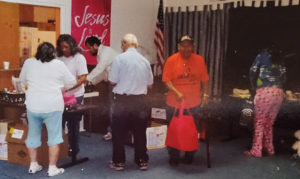
People come to the pick-up station at Mayfield Park Baptist Church in San Antonio to receive food and clothing. (Photo courtesy of Mayfield Park Baptist Church)
Depending on the number of positive COVID-19 cases in the area, the church hopes to start a once-a-month pickup in January. Before the virus started, 50 to 100 people came to the food and clothes pantry twice a month.
In the meantime, the church responds as best it can to urgent needs.
“People call in who need groceries … They are hungry,” Rhue said. “Grandparents who are raising grandchildren, a woman who has 10 people living in her small house, a man out-of-work due to COVID—we box up what is available, and they pick it up.”
Many of the individuals the church serves are elderly and at high risk of COVID-19. The volunteers and pastor seek to set a good example by wearing masks, maintaining social distancing and using hand sanitizer.
Need for more volunteers
Long-term, Sutton recognizes the church needs to expand its volunteer base.
“When I came as pastor 18 years ago, this was a younger congregation,” he said. “Today, many of our older workers have medical conditions that keep them from serving. We need workers to prepare food in advance, to help with those waiting in lines, and to prepare special packages for the homeless. And we need Christian men and women who can pray with the people.”
Volunteers from other churches in the area serve alongside members of Mayfield Park.
“We need workers who are compassionate and kind,” Sutton said. “We must remember that most of those who come are from the lowest economic group.”
Pastor Sutton is grateful for the support from the Texas Baptist Hunger Offering. With many families out of work due to COVID, more people need food.
Mayfield Park dedicates 1 percent of the church’s annual budget to the food ministry.
Quality clothes for job interviews
Other churches and individuals help by donating food and clothing.
Volunteer Sylvia Ledezma helps people find needed items in Mayfield Park Baptist Church’s clothes closet. Having the right clothes for a job interview often means employment, participants note. (Photo courtesy of Mayfield Park Baptist Church)
“Our people are so generous when it comes to keeping our clothes closet stocked,” Sutton said. “They donate ‘gently used clothing,’ and those who need these items are so grateful. These are usually high-quality and often the tags are still on.”
When people go in for a job interview, having the right clothing gives them a feeling of confidence, he noted.
The church also seeks to provide much-needed information to area residents, enlisting outside resource people to answer questions about Medicare, health insurance and prescription drugs and other health care issues.
Christian counseling also is making a difference in the lives of people in the Mayfield Park area. San Antonio is seeing more alcohol and drug abuse, domestic violence and unemployment during the pandemic, and mental health issues especially need attention in stressful times.
“God can turn around any situation,” Sutton said, citing Roman 8:28: “We know that all things work together for the good of those who love God … .”
Sharing God’s love
Some of those who seek counseling became acquainted with the church through its food pantry and clothes closet.
“Mayfield Park may be their only connection to a Christian environment. We pray with them and share God’s love,” Sutton said.
Mayfield Park Baptist sponsors Celebrate Recovery, a Christ-centered recovery program consisting of a 12-step ministry dealing with “hurts, habits and hang-ups.” The group meets each Friday night, with childcare and a meal provided. Large-group and small-group sessions are planned for both men and women.
Each Monday evening, a men’s accountability group meets in Sutton’s office. Participants engage in confidential discussion of everyday issues in a supportive atmosphere.
In a real sense, Sutton is fulfilling his early desire to become a counselor and teacher, as well as following God’s call to the pastorate.
“I feel so blessed that God called me into the ministry,” he said.
Sutton added he hopes the example of Mayfield Park will inspire other churches to serve their communities—“to do something for Christ and his people.”
Carolyn Tomlin writes for the Christian market and teaches the Boot Camp for Christian Writers.
Around the State: Brookshire establishes ETBU scholarship
November 5, 2020
East Texas Baptist University received $25,000 from Tyler-based Brookshire Grocery Company to establish an endowed scholarship program. Brookshire announced the establishment of the Focus on the Future scholarship program in partnership with ETBU and more than 40 other universities and colleges in Texas, Louisiana and Arkansas. The program is designed to reward students in Brookshire’s market areas for their dedication, hard work and outstanding academic achievements. “East Texas Baptist University is thrilled to receive support from the Brookshire Grocery Company’s Focus on the Future scholarship program,” said Scott Bryant, ETBU vice president for advancement. “Our students and their families benefit from scholarship support provided through endowments like this one. The Brookshire Grocery Company has a great reputation and has an outstanding history of serving our community well. East Texas Baptist University is thankful for the partnership with Brad Brookshire and the Brookshire Grocery Company.”
Irma Alvarado
The nonprofit Aggie Women organization recognized Irma Alvarado of First Baptist Church in Donna for her trailblazing legacy as one of the first Hispanic women to graduate from Texas A&M University. Alvarado earned a Bachelor of Arts degree in education from Texas A&M in 1970. She went on to work as a teacher for the Donna Independent School District, as well as at-risk counselor for the Pharr-San Juan-Alamo ISD and Ethel Carman Elementary School in San Juan. Alvarado is a former officer of the Hispanic Baptist Convention of Texas and Woman’s Missionary Union of Texas, and she served on the board of consultants for the Texas Baptist Christian Life Commission.
The Baptist History and Heritage Society named J. David Holcomb, professor of history and political science at the University of Mary Hardin-Baylor in Belton, as recipient of the 2020 Norman W. Cox Award. The award is named in honor of the first executive secretary of the Historical Commission of the Southern Baptist Convention. The society presents the award annually to the person judged to have submitted the best article published in the Baptist History & Heritage Journal in the preceding calendar year. Holcomb’s winning article, “Baptists and the Johnson Amendment,” appeared in the Spring 2019 issue of the Journal.
Tom J. Nettles
Tom J. Nettles has been appointed a visiting professor of historical theology at Southwestern Baptist Theological Seminary. He will teach a course titled “Scripture” that will examine the doctrine of the Bible, December 7-11 on the Fort Worth campus. Nettles earned both his Master of Divinity degree and his Ph.D. from Southwestern Seminary. He served on Southwestern Seminary’s faculty in the church history department from 1976 to 1982.
J.W. “Jack” MacGorman, professor of New Testament theology at Southwestern Baptist Theological Seminary from 1948 to 2001, will celebrate his 100th birthday Dec. 26. He cannot receive visitors other than family, but his daughter Linda indicated he would enjoy receiving celebratory notes and cards from friends, colleagues and former students. Correspondence may be sent to 34 Chelsea Dr., Fort Worth, TX 76134-1915.
Liberty deletes Piper videos after Trump criticism
November 5, 2020
LYNCHBURG, Va. (RNS)— Liberty University removed videos of evangelical author and speaker John Piper from its website after the well-known pastor wrote a blog post that was seen as critical of President Donald Trump.
John Piper (Courtesy Photo)
According to Christianity Today, Piper and Southern Baptist Convention President J.D. Greear recorded a video conversation with David Nasser, Liberty’s senior vice president for spiritual development, in mid-October. The two resulting videos were posted online about a week later.
The conversation was timed to coincide with the 20th anniversary of Piper’s best-known book, Don’t Waste Your Life. Greear has a new book out on a similar topic, What Are You Going to Do With Your Life?
On Oct. 22, Piper posted an article that was critical of fellow evangelicals for overlooking sins like boastfulness, vulgarity and sexual immorality while focusing on issues like abortion and “socialistic overreach.”
The New Testament calls the former “deadly,” argued Piper.
“To be more specific, they are sins that destroy people,” he wrote. “They are not just deadly. They are deadly forever. They lead to eternal destruction.”
Those comments led to pushback against the Piper videos.
University spokesman Scott Lamb told Religion News Service the school’s interim president, Jerry Prevo, who attended the White House ceremony where now Associate Supreme Court Justice Amy Coney Barrett was announced as the nominee, told staff to take down the videos. Lamb, who declined a request from Religion News Service for comment, told the evangelical magazine the videos had become “a controversy we did not seek out or desire.”
J.D. Greear
In a statement emailed to RNS, Greear said the conversation had focused on getting students involved in church planting and evangelicalism.
“Obviously, I am disappointed because the sole purpose of our conversation was to challenge Liberty students to consider how God wanted to use their lives in the Great Commission and to challenge them to give at least the 1st two years of their career to be a part of a church plant in the U.S. or abroad,” he said. “As followers of Jesus, mobilizing ourselves for the Great Commission is the most important thing for us to do, and our commitment to Jesus and his mission is something we can all be unified around.”
News that the Piper and Greear videos had been removed came a day after the Liberty’s board of trustees announced changes in the school’s leadership model, including hiring a chancellor “to be the university’s spiritual leader to ensure it is faithful to its Christian mission” and making sure convocation speakers fit the school’s doctrinal statement.
A video message from Sen. Ted Cruz, Texas Republican and former Trump critic who later supported the president, remains on the Liberty convocation website, as well as comments encouraging students to vote and to pray for the nation’s leaders.
Border pastors continue adapting ministry to immigrants
Lorenzo Ortiz leads El Buen Samaritano Migrante, a ministry that operates two shelters in Nuevo Laredo, plus one in Saltillo.
Lorenzo Ortiz comforts immigrants torn apart by trauma and despair in Nuevo Laredo, just across the Rio Grande from Laredo. Thousands of immigrant families languish under the Migrant Protection Protocols, widely known as the “Remain in Mexico” policy, which requires them to wait south of the border as they seek asylum in the United States.
Continuous postponement of their asylum hearings has caused immigrants who live in tent camps and shelters in Mexico to confront constant uncertainty.
“I’m working with moms who have risked their lives and their children’s lives, extorted by cartels, to cross to the United States,” Ortiz said. “Moms are crossing illegally or sending their children because the (border-crossing) bridges have not reopened, and immigration court hearings have not resumed due to the pandemic.”
Ortiz leads El Buen Samaritano Migrante, a ministry that operates two shelters in Nuevo Laredo, plus one in Saltillo, deeper into Mexico. In addition to protecting asylum seekers from Central and Latin America, the shelters also provide food to many Mexicans, who pass through their doors after being deported from the United States.
“We serve from 100 to 150 deported Mexicans every day,” Ortiz said. “Some of them have lived 30 to 40 years in the United States and are deported because they don’t have any documents.”
The U.S. Border Patrol increasingly is deporting undocumented immigrants who have lived in the United States for decades, he reported.
“They tell me they don’t know anyone in Mexico. They have families in the United States. They have U.S. citizen children, too,” Ortiz said.
Families are being separated, and cartels are extorting and kidnapping immigrants, especially at bus stops, he said. Fellowship Southwest has supported Ortiz’s ministry more than two years and recently helped purchase a van that enables him to keep immigrants safe and off the streets.
Working with immigrants in Matamoros
Near the Gulf of Mexico, Pastor Eleuterio González is trying to keep pace with U.S. Border Patrol’s daily expulsions of immigrants through the Gateway International Bridge between Brownsville and Matamoros, Mexico.
Eleuterio González and his church, Iglesia Valle de Beraca, feed and protect more than 1,600 immigrants living in the Alberca Chavez shelter in Matamoros.
“They are deporting a lot of people—way too many people,” González said. “Mexican authorities have lost control of this.”
Supported by Fellowship Southwest, González and his church, Iglesia Valle de Beraca, feed and protect more than 1,600 immigrants living in the Alberca Chavez shelter in Matamoros. They also minister in camps, where thousands of refugees live in tents.
Recently, three children showed up unaccompanied, and González searched for their parents in the massive tent camp near downtown Matamoros that is home to more than 4,000 immigrants.
“Matamoros does not have the capacity to help all migrants at this rate,” he said. “People are tired. Coronavirus is spreading, and there is already emotional and physical exhaustion.”
Across the border from Matamoros, pastors Rogelio Pérez of Iglesia Bautista Capernaúm in Olmito and Carlos Navarro of Iglesia Bautista West Brownsville continue to assist González’s ministry by providing clothing, food and essential items. Pérez and Navarro have adapted their ministries to assist González in Matamoros, ever since the Mexican and U.S. governments agreed to stop nonessential crossings at the border in March.
“I just received bags with new personal hygiene items and masks, and I am going to send them to Eleuterio González in Matamoros,” said Pérez, who—with the help of Iglesia Bautista Capernaum—feeds about 600 people in Olmito and surrounding communities.
Navarro is ready to reopen IBWB’s immigrant respite center that was shut down by the city in March due to the coronavirus pandemic. Once the respite center opens, it will complement González’s ministry in Matamoros.
Shelters due to reopen in Piedras Negras
Meanwhile, 320 miles northwest, Pastor Israel Rodríguez of Primera Iglesia Bautista in Piedras Negras plans to reopen a shelter—one of the church’s two shelters—he was forced to close in May. “There’s been an increase in migrants coming to Piedras Negras,” he said. “It seems to me that within the next few days, we are going to have to reopen the other shelter.”
Pastor Israel Rodríguez (center) of Primera Iglesia Bautista in Piedras Negras plans to reopen a shelter—one of the church’s two shelters—he was forced to close in May.
Rodríguez—who houses 48 people in the only open shelter in the city—said the government allows him to operate as long as he takes appropriate hygiene precautions to avoid the spread of COVID-19.
Several immigrants who live in the shelter have been baptized, he added.
“Last Sunday we baptized 14 people in our church, and five of them were migrants,” he said.
Network prepares for winter
About 500 miles northwest of Piedras Negras—across from El Paso in Ciudad Juarez—Pastor Rosalío Sosa is preparing for winter.
“We are installing heaters in the shelters,” Sosa reported. “With the heaters, we can move migrants to the outdoor tents in Palomas.”
Pastor Rosalío Sosa operates Red de Albergues para Migrantes—the Migrant Shelter Network—14 shelters in the state of Chihuahua, most of them in Ciudad Juarez, but also as far away as Palomas, about 100 more miles west into the desert.
Sosa operates Red de Albergues para Migrantes—the Migrant Shelter Network—14 shelters in the state of Chihuahua, most of them in Ciudad Juarez, but also as far away as Palomas, about 100 more miles west into the desert. Sosa plans to expand the Palomas shelter to deal with the increasing number of refugees there. Last month, the shelter served 1,436 immigrants expelled by the U.S. border patrol.
In Tijuana, close to the Pacific Ocean, Pastor Juvenal González labors to encourage and comfort pastors and immigrants alike.
“Due to the coronavirus, churches can’t meet at their full capacity,” González said. “The pastors don’t know what will happen to their congregations. But there is a new harvest—many Haitians.”
González—who oversees three shelters in Tijuana, where around 120 immigrants live—reported a church in Sinaloa comprised of 200 Haitians. “There are many Haitians being baptized,” he noted.
Despite spiritual victories, families from Central America who are under the “Remain in Mexico” policy are desperate, González said. “They are weary.”
Still, the need is so dire, González wants to do more. “It makes me sad that I can’t help more,” he lamented. “But I thank God we can be the hands and heart of Christ in the midst of all that’s happening.”
Elket Rodríguez, an attorney and minister, is the Cooperative Baptist Fellowship’s immigrant and refugee specialist. He lives on the U.S.-Mexico border, in Harlingen and works with CBF Advocacy, CBF Global Missions and Fellowship Southwest. He and Israel Rodríguez are not related; neither are Eleuterio González and Juvenal González.
National WMU board approves reduced budget
November 5, 2020
BIRMINGHAM, Ala. (BP)—The board of national Woman’s Missionary Union approved a 2020-21 budget for the missions organization that is down about $1 million from its $5.8 million 2019-20 budget.
The board learned 12 WMU staff members opted to accept the voluntary retirement offer announced by the organization in early August.
Both developments came as a result of a decline in sales due to COVID-19.
The 12 employees who accepted the retirement offer are “valued friends and colleagues (who) made countless contributions to our work over the years and will be greatly missed,” said Julie Walters, corporate communication manager for national WMU.
Current personnel at national WMU stands at about 40 staff members.
Walters explained that the 2020-21 budget was “adjusted based on anticipated expenses and projected revenue.”
Even with a decrease in staff members and budget, WMU leaders remain focused on the organization’s “mission of making disciples of Jesus who live on mission,” Walters said.
“Next steps include serving churches well and supporting pastors, providing more missional resources for individuals and families and exploring modifications to our business model,” she said. “Through WMU’s missions discipleship, leadership development and compassion ministries, we will seek to advance our current level of kingdom impact in every state and 39 countries.
“We are grateful for many who are coming alongside us to help—state WMU leaders, executive board members, independent contractors, volunteers. It is inspiring to see so many actively using their passion to serve God and serve others through WMU.”
National WMU is not a part of the Cooperative Program allocation budget and receives no funds from the Annie Armstrong Easter Offering or Lottie Moon Christmas Offering. National WMU is supported through the sale of magazines and products and from investments and charitable contributions through the WMU Foundation.
In late August, the WMU Foundation gave national WMU a $45,000 grant in an effort to help offset the loss for 2020 through pandemic.
Pilot project first step in Baylor partnership with Compassion
November 5, 2020
A major multidisciplinary partnership between Baylor University and Compassion International that could make an impact on global child poverty has launched with an online education pilot project involving a few bilingual pastors in Guatemala.
“Dream big. Test small,” said Mike Cookson, director of strategic partnerships at Compassion International, a Christian child-sponsorship agency that works in 25 countries.
In time, Baylor anticipates wide-ranging research across multiple academic disciplines to help Compassion International understand better the root causes that prevent children in poverty from flourishing, said Lori Baker, vice provost and professor of anthropology at Baylor.
“We’re looking at a lot of seedlings,” Baker said, referring to potential projects that may grow into significant initiatives spanning Baylor’s 12 colleges and schools.
Both the university and the child-sponsorship agency also hope to engage the rising generation of Christian leaders in ministries that help children to be freed from the grip of poverty.
“I can’t tell you how grateful I am to partner with Baylor to help release even more children from poverty in Jesus’ name,” said Santiago “Jimmy” Mellado, CEO of Compassion International, based in Colorado Springs, Colo.
“Innovating with a premier academic and research institution who shares our faith and our passion to serve the world’s most vulnerable children will be nothing short of transformational. Even in this early stage, I’m seeing how this partnership will expand our reach and impact to better care for more than 2.2 million children living in unacceptable poverty.”
Certificate program for Guatemalan ministers
The first tangible example of the partnership begins this week when eight pastors in Guatemala start an eight-week online certificate-level training program offered through Baylor’s Truett Theological Seminary.
In August 2018, Dean Todd Still of Truett Seminary participated with other Baylor representatives in an “immersion experience” in Guatemala through Compassion International.
“We went to do a lot of listening,” Still said.
At one point, he recalled asking a ministry leader in Guatemala, “If there is a way we could serve you, how could we best do so?”
Still learned pastors of Compassion International’s partner churches in Guatemala feel a need for additional theological education and ministry training.
So, he talked with David Tate, director of Truett Seminary’s online certificate program, about developing a program for ministers in Central America.
Rather than simply translate material into Spanish, Tate proposed a pilot project to evaluate Truett’s current certificate curriculum and determine how it can be made more culturally relevant and appropriate for Latin American pastors.
Working with Leonel Xuyá, national director for Compassion International in Guatemala, Truett enlisted eight bilingual pastors in Guatemala who agreed to take the introductory-level certificate program course, which focuses on adult learning skills and spiritual formation.
“They will go through the current English program with no changes, and we’re asking them to give us feedback,” Tate explained.
Expand into other Latin American countries
The initial cohort will meet via Zoom with facilitator Alejandro Gómez, assistant of partnership for Compassion International in Guatemala. The pastors will offer observations and critique of the program during listening sessions after four weeks and again when they complete the first course. Those observations will shape how Truett develops its Spanish-language certificate program for Latin American ministers.
Even before the first course began, Truett learned a lesson about how to deliver content more effectively, when the initial shipment of books and printed materials was held up in customs for an extended time, Tate noted.
“We will need to adapt to another format, either digital or video,” he observed.
Todd Still
Early next year, the group will begin a 12-week course in biblical interpretation, with opportunities for participants to provide feedback about how to make the course a culturally contextual learning experience.
“Baylor’s Truett Seminary exists to equip God-called people for gospel ministry in and alongside Christ’s church by the power of the Holy Spirit. That we could partner with our friends and colleagues at Compassion to offer theological education to Guatemalan pastors delights and excites me,” Still said.
“Additionally, I hope this important pilot project is but the beginning of an ongoing collaboration between Compassion and Truett in making theological study and ministerial training increasingly accessible to Spanish-speaking Christ-followers within our respective networks.”
Once the pilot project is completed, Compassion International and Truett Seminary plan to expand elsewhere in Latin America—particularly, Honduras, Nicaragua and Mexico. Each step of the way, Truett will continue to evaluate its curriculum to make it culturally contextual.
“How much we need to adapt it will depend on the length of the cultural bridge,” Tate said.
Truett Seminary has been “constantly refining” its certificate program since its inception, he added. Since the program went online in January 2015, more than 700 students have enrolled, and the seminary has awarded 150 certificates. In the previous five years, 244 students enrolled in the certificate program, and the seminary awarded 49 certificates.
As Truett evaluates the content of its certificate curriculum, the seminary not only will seek to learn from the culture and background of the pastors in Guatemala, but also from the spiritual wisdom they have to offer, Still insisted.
Meeting the needs of churches
Compassion International considers the pilot pastor-training project an appropriate first step in its partnership with Baylor, Cookson noted.
“At Compassion, we talk about the ‘three Cs’ of our mission. We are Christ-centered, child-focused and church-based,” he said.
While the agency’s Christian commitment and focus on children is obvious, its church-based approach to ministry sometimes is not as widely understood but is vitally important, he emphasized.
Serving the church—whether in Texas or globally—is central to Truett Seminary’s mission and to Baylor’s motto, Pro Ecclesia, Pro Texana, Still noted. He called the pilot program in Guatemala “a mustard seed beginning to something that could be consequential—dare I say maybe even monumental— for kingdom purposes.”
Baylor President Linda Livingstone concurred, describing Baylor and Compassion International as “two faith-based organizations whose complementary programmatic capabilities and research expertise will serve communities around the world, as well as enhance both organizations’ growth.”
“Our Christ-centered collaboration will expand the kingdom of God through a diversity of initiatives, including this initial effort to equip pastors in Guatemala with critical training as a component of the Baylor in Latin America initiative within our Illuminate strategic plan,” she said, referring to the university’s strategic academic plan to expand Baylor’s impact as a Christian research university.
Conference encourages love and unity in divisive times
November 5, 2020
BROWNWOOD—Seeking justice, demonstrating mercy and humbly following Christ are key aspects of living as the people of God, speakers at the 2020 Micah 6:8 Conference told listeners.
“Our congregations need to be on the frontlines, because we see passages [like Micah 6:8] that say ‘do justice, love mercy,’” Jeremy Everett, executive director at the Baylor University Collaborative on Hunger and Poverty, told participants at the conference, hosted by the Texas Baptist Christian Life Commission and Howard Payne University. “It’s a part of our faith to help others.”
Conference participants gathered both in-person and online for the Oct. 26-27 event to learn about engaging with issues such as racial inequality and gender gaps from a biblical perspective.
Meeting challenges in 2020
Katie Frugé, director of hunger and care ministries at the CLC, explained ways Texas Baptists and churches around the state have stepped up to face the difficult challenges in 2020.
The CLC was born out of concern for racial justice and reconciliation 70 years ago, and it has returned to its roots, responding to the recent deaths of Ahmaud Arbery, George Floyd and Breonna Taylor—African Americans killed in 2020.
She also described how the CLC has been involved in important COVID-19 relief work, including the distribution of food to more 1.3 million individuals through the Texas Baptist Hunger Offering. Texas Baptists also hosted about 4,000 Zoom meetings and 174 webinars to guide pastors and churches in response to the pandemic’s challenges, she reported.
“We learned that, while physically distant, we needed to remain emotionally close to each other, and the CLC needed to meet the needs of emotional connection for people,” she said. “We have confidence that the work of the CLC will continue to be relevant and powerful.”
Director of ethics and justice commissioned
David Sanchez, recently named director of ethics and justice for the CLC, was commissioned to his new position during the conference. Sanchez, a graduate of HPU, spoke of his call to ministry and his journey to serving with the CLC.
Cory Hines (left), president of Howard Payne University, presents David Sanchez, director of ethics and kustice at the Texas Baptist Christian Life Commission, with a certificate of commissioning while CLC Director Gus Reyes (seated) applauds.
“There were times I was sure God was pulling me in one direction, only for him to open a door somewhere else,” he said. “As long as I’m sure God is going to use me and I’m moving in that direction, God will steer me in the right direction.”
His father Daniel Sanchez, distinguished professor of missions at Southwestern Baptist Theological Seminary joined HPU President Cory Hines and Gary Gramling, dean of HPU’s School of Christian Studies, in delivering charges to the newly commissioned director.
During the conference, speakers discussed various social issues and how Christians can address them from a biblical viewpoint, with a particular emphasis on how COVID-19 has affected them.
During Everett’s session on hunger in Texas, he encouraged Christians and churches to look for ways to help others and move past social and economic differences. He explained that it is only through everyone’s cooperation that significant problems like hunger will be solved.
“We have to realize that no one organization can end hunger. Some people think it’s the church’s job, or the government’s job, or the nonprofit’s job. We all need each other to end these big problems,” he said.
Calls for unity
Without exception, speakers called for unity and a commitment to God’s will over politics and personal identity.
In addition to Everett, speakers included Mark Grace, chief of mission and ministry at Baylor Scott & White Health; Kathryn Freeman, former CLC director of public policy; and Gus Reyes, CLC director.
Grace discussed disparities in health care and the deepening divide in health care, emphasizing that providing for the health of others should not be a controversial issue for believers.
“It seems that often racial, economic and linguistic lines are more important to us than the example that the gospel gives us,” he said.
He encouraged conference participants to examine their own privileges—whether racial, economic or otherwise—and ask how they can lift up others who do not share those privileges.
During the upcoming 87th Texas Legislative Session, key issues will include COVID-19 policies, payday and auto loans, and race relations, Reyes said. He encouraged those in attendance to seek out their representatives and make their voices heard.
Above all, he urged conference participants to stick to the principles of Micah 6:8 and see beyond politics to the people behind them.
“I hope you will be kind in your heart to people who do not agree with you. I have a friend named Samuel Rodriquez who says that Christians don’t follow the agenda of the elephant or the donkey; we follow the agenda of the lamb. That agenda instructs me to love my neighbor,” Reyes said. “If we’re ever going to pull this country together, we’re going to need to figure out how to follow Jesus’ agenda and love our neighbors.”
Megachurches continue to grow and diversify
November 5, 2020
WASHINGTON (RNS)—America’s megachurches have continued to thrive over the past five years, attracting more worshippers, becoming more diverse and opening new locations.
A pre-pandemic, national survey of megachurches from the Hartford Institute for Religion Research found the median megachurch draws about 4,100 attenders to its worship services, up from about 3,700 in 2015.
The average megachurch budget is $5.3 million, up from $4.7 million in 2015. Seven out of 10 have more than one location. Six out of 10 (58 percent) say they have a multiracial congregation.
Despite the decline among Christian groups overall, most megachurches seem to be doing well, said Scott Thumma, professor of sociology of religion at Hartford Seminary and director of Hartford Institute.
“They continue to do things that other congregations should be doing,” Thumma said.
Thumma said the use of contemporary worship—along with a focus on small groups and international diversity—has helped megachurches continue to grow.
Most steer clear of politics
Megachurches, in general, he said, also tend to steer clear of controversy, staying away from culture wars or political battles.
Scott Thumma
According to the survey, few megachurches said they distribute voter guides (14 percent) or encourage voter registration (14 percent), or participate in get-out-the-vote efforts. Sixty-three percent said their church avoids political discussions when they gather. One in 5 said their congregation is politically active. Two-thirds disagree when asked if “everyone in this congregation has the same political position.”
Thumma said the growing diversity in megachurches reflects the changing demographics of the United States. Megachurches, he said, also attract younger worshippers than other kinds of churches.
“Megachurches are one of the few groups of churches that have a wide representation of people under 45,” he said. People in that age group, he said, tend to be more demographically diverse and more open to diversity. More than three-quarters of the churches (78 percent) in the survey said they were intentionally trying to become more diverse.
Still, Thumma pointed out, megachurch pastors themselves are not a diverse group. The average megachurch pastor is a 53-year-old white man who has been in place for 15 years. And many are in danger of losing effectiveness as leaders, he said.
According to the survey, most megachurches experience their biggest growth when their pastor has been in place for between five and 19 years. After 20 years, the growth drops off. The survey also found that after 15 years, a megachurch’s spiritual health begins to fail.
“The gist is that the period between 10 and 15 years of a pastor’s tenure produces the most spiritually vital congregational dynamic,” according to the report. “Prior to and after that point, it is a less robust picture, on average.”
Thumma said after 10 or 15 years, megachurches need to reassess to see if the way they are operating still meets the needs of the community around them. After that much time, things have likely changed and the church may have fallen into a rut.
“You can’t live on your charisma and assume the church is just going to keep flourishing and flourishing,” he said.
Among other findings:
Only two-thirds (68 percent) of megachurch attendees show up on any given Sunday, down from 82 percent in 2015 and 90 percent in 2000.
Half (51 percent) cooperate with other churches on community service projects.
One in 5 (21 percent) cooperate with people of other faith traditions on community service.
One in 5 (19.1 percent) declined by at least 2 percent in the last five years.
Sixteen percent merged with another church.
Just over half (56 percent) had between 1,800 and 2,999 average attenders per week, while 5 percent had more than 10,000 attenders.
The average megachurch offered about seven services a week.
Twenty-eight percent have paid, professional security at services. Thirty-eight percent have volunteer security.
Two-thirds (65 percent) of megachurches identify as evangelical.
Twelve percent identify as Pentecostal or charismatic.
Twelve percent identify as “missional.”
Seven percent identify as liberal, moderate or progressive.
Thumma said that overall, megachurches seem to be growing less comfortable with the term “evangelical” and are more open than in the past to working with those they disagree with on theological or political matters.
“You can see them moving ever so slightly toward the middle,” he said.
The survey included 580 megachurches with an average weekly attendance of 1,800 adults and children or more, and was part of the larger Faith Communities Today study. The survey was conducted from January until May 2020. The study was conducted by the Hartford Institute along with the Evangelical Council for Financial Accountability and Leadership Network.
Ahead of the Trend is a collaborative effort between Religion News Service and the Association of Religion Data Archives made possible through the support of the John Templeton Foundation.
Image courtesy of the Hartford Institute for Religion Research
Nigerian Christians killed and churches burned during protests
November 5, 2020
NIGERIA (BP)—An untold number of evangelical Christians are likely among growing deaths in Nigeria, an advocate for Christians in Nigeria said.
Police attacked peaceful protestors Oct. 20 at Lekki Toll Gate bridge in Lekki, Lagos. The protestors were marching against alleged longstanding police brutality and killings by Nigeria’s Special Anti-Robbery Squad, according to news reports.
The situation has fueled prayer walks and marches against economic insecurity and violence in other parts of the country, Christian Solidarity Worldwide representative Khataza Gondwe told Baptist Press on Oct. 28.
Police confirmed seven deaths of Christians in Abuja, according to Morning Star News in an Oct. 23 report. The news service said at least three Christians were killed in Abuja. Violent counter-protestors and “Muslim hoodlums” have also burned at least three church buildings in the capital city of Abuja and in Plateau and Kano states, Morning Star said in its report.
At least four Christians have been killed in Kano, Gondwe told Baptist Press from her office in London.
“It’s still early days to find out who has been killed,” said Gondwe, Christian Solidarity Worldwide’s Africa and Middle East team leader. “Nobody knows who has been killed in Lekki or elsewhere. The four that were killed, definitely (Christians) were killed in Kano state.”
Particularly, when the Christian Association of Nigeria sponsored prayer walks in Plateau, Kano and Kogi states Oct. 19-20, Gondwe said Muslims joined Christians in prayer because insecurity, violence and lawlessness are affecting both religious groups.
But criminal gangs, referred to as “thugs,” interrupted the prayer walk in Koji and attacked Christians as they retreated to a church, violently beating several pastors. The four Christians are believed to have been killed in Kano Oct. 19.
“We can’t really give you numbers, particularly because this movement was across the board,” Gondwe said. “There were no divisions along religious lines. There have been efforts to divide them along religious lines.”
“It’s pretty unusual” for Muslims to join in prayer with Christians, Gondwe said. “But in times like this when everybody’s marching, and everybody’s marching for the same thing, it would be quite straightforward. … It’s this coming together to pray because we’re all in this.
“People are pretty tired of the insecurity. Everybody’s suffering from it. Everybody’s being kidnapped. Everybody’s having to pay ransoms. Everybody’s losing people on highroads because armed robbers … are there, attacking and killing people.”
Gondwe described Kano as one of the most religiously volatile Nigerian states. The four were killed in a Christian district in the overwhelmingly Muslim Kano.
Christian churches continue to call for justice, Gondwe said, although prayer walking will be difficult in the current climate of unrest.
Protests began in early October against SARS forces after cellphone video surfaced of SARS police appearing to kill a young man in broad daylight when he refused to turn over his cellphone. According to longstanding accusations dating back several years, SARS forces routinely have robbed and attacked private citizens instead of protecting them.
Gondwe said the death toll from the police attack on protestors in Lekki, recorded on personal phone cameras, is unknown, but has been reported by Nigerian authorities as one or two.
Amnesty International and other groups have called the Lekki attack a “massacre.”
“What happened at Lekki Toll Gate has all the traits of the Nigerian authorities’ pattern of a cover-up whenever their defense and security forces commit unlawful killings,” said Osai Ojigho, Amnesty International’s country director.
“One week on, the Nigerian authorities still have many questions to answer: who ordered the use of lethal force on peaceful protesters?” Ojigho said. “Why were CCTV (security surveillance) cameras on the scene dismantled in advance? And who ordered electricity being turned off minutes before the military opened fire on protesters?”
Nigeria President Muhammadu Buhari’s office announced Oct. 11 that SARS had been disbanded, but Gondwe and others said the forces have continued attacks after previous such announcements. Protestors continue to call for an end to police brutality, regardless of whether such brutality is connected to SARS.
The young adults protesting in Lekki are “in deep shock,” Gondwe said. “I don’t think they expected anything like that to happen.”
Violence related to the SARS protests and other police brutality is jelling with violence in other areas of Nigeria from militant Fulani herdsmen and Boko Haram terrorists, Gondwe said.
“The two parts of Nigeria were pushing for different things,” she said, “but definitely in the center and north, Christians are suffering terribly. … Pray that government is held to account for every insecurity, every source of violence, whether it is religious violence and their inaction to it, whether it is violence by banditry (or) violence by police.”
Vietnamese Baptist Church burns amid Philadelphia unrest
November 5, 2020
PHILADELPHIA (BP)—The Vietnam Baptist Church in Philadelphia building was burned Oct. 27 during the second night of unrest in the city after the police shooting of a Black man.
Pastor Philip Pham received a call Tuesday night from a church member whose friend had seen the flames and seven fire trucks surrounding the church.
“I have no idea why they attacked our church,” Pham said. “They burned it from the roof. They threw flammable chemicals on the roof and [flames] burned through the roof” and down through the rest of the building. He said the facility is a “total loss.”
Of primary concern to Pham were three hard drives. Since before purchasing the building in 2005, Vietnam Baptist Church has served as something of a community center each weekday, providing help with immigration paperwork, taxes and even marriage counseling.
More than 15 years’ worth of information about hundreds of clients is on hard drives kept at the church. Pham said when he got the call about the fire, he immediately began praying that the data would be spared.
“I prayed right away: ‘God, please protect the hard drives,’” Pham recalled. “Other stuff can be recovered. But those files will never be recovered.”
When firefighters finally let him in after the blaze was extinguished, Pham said he was amazed.
“I saw the routers and modems and things surrounding the hard drives all burned, melted,” he said. “But that piece of hard drive, no harm. No harm at all. Just two feet above that, all melted. … That is amazing how God knows our needs and answers our prayers. He is an almighty God. He granted our prayer.”
The church is meeting mostly online due to strict pandemic-related restrictions in the city, Pham said. On Oct. 28, he was calling
Fire destroyed almost all of the church’s technological equipment. Miraculously, just two feet below the melted modem in this photo, three hard drives remained untouched by the flames (Photo from Pastor Philip Pham)
nearby schools to find a place to host the church’s leadership team as they broadcast its next livestream worship service.
“Remember us in your prayer in time of need like this,” he requested. “The church members here need encouragement. The majority of us have very strong faith in Christ, but a minority, a few new believers, they need their faith to grow. Pray for their faith to take deep root in the love of God so they can be steadfast in him. Not focus on the problem, but focus on Jesus. Please remember us in your prayers.”
Peter Yanes, executive director of Asian American relations with the SBC Executive Committee spoke with Pham shortly after the fire and prayed over the phone with church members as they gathered at the charred remains of their building.
Yanes said he was “compelled to reach out right away and find out more of the heartbreaking incident” after seeing videos Pham posted to social media Tuesday night.
“You can sense the heartfelt frustration and concern,” Yanes said of church members’ reaction to the fire. “I have encouraged [Pham] and prayed with his family that God has a higher purpose of them rising to the occasion with a testimony of hope in Christ Jesus.”
The turmoil in Philadelphia, sparked by the shooting of Walter Wallace Jr. by police, has at times seen violence and looting and led to a clash between demonstrators and officers at police headquarters, The Associated Press reported. It is not known if Vietnam Baptist Church is the only incident of arson.
One of three hard drives containing irreplaceable information that was spared by fire (Photo from Pastor Philip Pham).
According to AP, police—who were sent to Wallace’s home on Monday after his brother called 911—said Wallace ignored multiple demands to drop a knife he was holding and that when he advanced toward the officers, they opened fire. Wallace’s family maintains they had placed the emergency call because of Wallace’s mental state and had requested medical assistance and an ambulance.
In light of the violence in his city, Pham encouraged youth pastors to stress to young people the words of James 1:20: “The anger of man does not bring about the righteousness of God.”
“You cannot use your anger and be justified,” he said. “I would like to bring this message to all the young people.”
Pham said some of his church members are afraid because of the violence and looting, but he is encouraging them to keep an eternal perspective.
“So many things we don’t know, but God knows, so just trust God,” he said he told them. “Just do right. Don’t copy [those who practice violence], but do what the Bible says and what he wants us to do. Love them and pray for them that they may know Christ, that the Holy Spirit may convict them and they may seek God.”
Obituary: Nathan Mulder
November 5, 2020
Nathan Mulder, pastor of Flomot Baptist Church in Motley County, died Oct. 19. He was 76. He was born Jan. 20, 1944, to Arby and Letha Dolly Fitzgerald Mulder in Plainview. He grew up on the family farm at South Plains and continued to farm throughout most of his life. He graduated from Wayland Baptist College in Plainview in 1968. At age 17, he answered God’s call to the gospel ministry. He was pastor of Northfield Baptist Church in Northfield and Faith Baptist Church in Wellington before he was called as pastor of Flomot Baptist Church in Flomot, where he served more than 30 years. In addition to serving as pastor and farming, he also was chief probation officer for the 110th Judicial District in Floyd County several years. Nathan also served on the South Plains School Board, held several leadership positions with Caprock Baptist Association and was involved 14 years with Christian Women’s Job Corps of Floyd County and the surrounding area. He was preceded in death by his younger sister, Katherine Ruth Mulder Taylor. He is survived by his wife of 57 years Kathryn Mary Rowland Mulder; daughter Cindy Hilliard and husband Trent; daughter Penny Poole and husband Ricky; son James Mulder and wife Karen; son Cory Mulder and wife Lisa; 12 grandchildren; and four great-grandchildren.







 “Dream big. Test small,” said Mike Cookson, director of strategic partnerships at Compassion International, a Christian child-sponsorship agency that works in 25 countries.
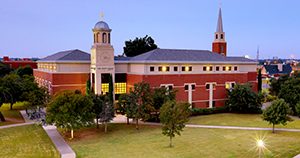 In August 2018, Dean Todd Still of Truett Seminary participated with other Baylor representatives in an “immersion experience” in Guatemala through Compassion International.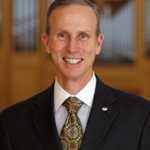


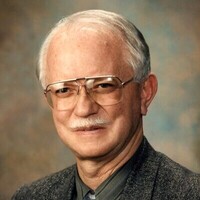 Nathan Mulder, pastor of Flomot Baptist Church in Motley County, died Oct. 19. He was 76. He was born Jan. 20, 1944, to Arby and Letha Dolly Fitzgerald Mulder in Plainview. He grew up on the family farm at South Plains and continued to farm throughout most of his life. He graduated from Wayland Baptist College in Plainview in 1968. At age 17, he answered God’s call to the gospel ministry. He was pastor of Northfield Baptist Church in Northfield and Faith Baptist Church in Wellington before he was called as pastor of Flomot Baptist Church in Flomot, where he served more than 30 years. In addition to serving as pastor and farming, he also was chief probation officer for the 110th Judicial District in Floyd County several years. Nathan also served on the South Plains School Board, held several leadership positions with Caprock Baptist Association and was involved 14 years with Christian Women’s Job Corps of Floyd County and the surrounding area. He was preceded in death by his younger sister, Katherine Ruth Mulder Taylor. He is survived by his wife of 57 years Kathryn Mary Rowland Mulder; daughter Cindy Hilliard and husband Trent; daughter Penny Poole and husband Ricky; son James Mulder and wife Karen; son Cory Mulder and wife Lisa; 12 grandchildren; and four great-grandchildren.