Young leaders share lessons learned in 2020

Young adult leaders from Texas Baptist churches considered biblical responses to escapism, racial injustice and political division during an online event prior to Texas Baptists’ virtual annual meeting.

During the past two months, young adult Texas Baptist church leaders have shared reflections through an online series called “20 Things We Learned in 2020.”

Those discussions culminated in an online event—the Devoted Young Adult Rally—streamed on Facebook Live and Texas Baptists’ website. Ten watch parties were scheduled around the state for young adults to meet and discuss what they heard.

Jonathan Pokluda, pastor of Harris Creek Baptist Church in Waco, discussed biblical approaches to issues millennials have struggled with in the midst of the challenges of 2020.

Escapism

In a video, Kaitlyn Anderson, a student at Baylor University’s Truett Theological Seminary, discussed escapism. Millennials often have a tendency toward escapism and a desire to flee from silence, negativity and pressure, she said. She talked about the rising mental health needs among teens and young adults.

After deleting apps that allowed for escapism and binging, Anderson discovered “there in the stillness and heaviness was Jesus.”

“We are called out of binge culture and escapism, and then we are comforted by the fact that our God is right in the middle of it, calling us to come alongside him and advocating for the gospel and everybody’s place in it,” she said.

Pokluda also addressed escapism and how the millennial generation often tries to escape from the challenges and hardships faced in this world.

“When we feel that, it’s a reminder to me that we weren’t made for this world,” Pokluda said. “He’s made for us another world, a kingdom, and he calls us to set our minds on the things above.”

Pokluda referred to Jesus’ teaching in John 16 that in the world there will be trouble, but Christ has overcome the world.

The solution to escapism is to lean into the church and be surrounded by the body of believers, Pokluda said. He also encouraged young adults to press into the Scripture, to seek God and to renew their minds by focusing on the promise that believers will dwell in the house of the Lord forever.

Racism

Kingsley Demakpor, associate student pastor at the Heights Church in Richardson, talked about racism, defining it as “placing the value of one race over another.”

“It is not just a social issue. It’s a gospel issue, because it is at the very heart of the teaching of the gospel in saying that God wants to reconcile all things through Christ,” Demakpor said. “As believers, we don’t shy away from the topic of racism, but we embrace it as a gospel issue, realizing that God wants to work through us to bring peace to our society.”

He described how Jesus transcended boundaries and asked the question, “In your life, in your church, do you have a faith that transcends boundaries?”

Pokluda then addressed the young adult group, teaching from Mark 10 about how Jesus did not come to be served but to serve.

“What I see in the life of Jesus is how amazing he was at empathizing with others. I think that’s an opportunity to lean into others to ask questions,” he said.

Drawing from 1 Corinthians 9, Pokluda discussed how Paul encouraged believers to become all things to all people that they might win some for Christ.

“There’s an exhortation in the Scripture to learn from those that we are around, to become like them so that we can minister to them,” Pokluda said.

Pokluda went on to say ministry could be a number of things such as helping others to heal, be a bridge, build a bridge and to reconcile.

“Reconciliation is core to what it means to be a follower of Jesus,” he said. “Reconciliation is really putting the pieces together.”

Politicization

Matt Thigpen, a young adult pastor in Austin, talked about how so many aspects of life in the United States have become politicized in the past year.

“The church should have always been known solely as a people about Jesus,” he said.

When everything becomes a political issue, however, Christians find themselves “getting in arguments about stuff that we were never meant to,” Thigpen said.

Drawing from James 1:19, Thigpen encouraged young adults to seek to listen to those around them and be slow to respond without drawing assumptions about others.

“I have this hope for the church that more than anything else we would be known for our love for Jesus,” he said.

Rather than a connection to a political party or another affiliation, believers should be known for their love and Jesus Christ, Pokluda insisted.

“Our identity has to be, first and foremost, beginning and end, identified with Christ,” he said.

Pokluda pointed to Joshua 1:9, saying he wants his household to be known for serving the Lord.

“We have to think, engage our minds, pray, seek the Lord and at the end of the day based upon what we know about God and his values, move forward,” he said.

African American worship rally encourages bold witnesses

Participants in the virtual African American worship rally heard a call to be bold witnesses for Christ and to let Jesus’ light shine.

The rally, scheduled in conjunction with Texas Baptists’ virtual annual meeting, was conducted online due to the COVID-19 pandemic.

“We cannot be together physically, but we can most certainly worship together in spirit,” said Edward Wagner, vice president of the African American Fellowship of Texas.

Kenneth O. Jackson, president of the African American Fellowship of Texas and pastor of New Light Baptist Church in Lubbock, delivered the message from Acts 4:13.

Jackson recounted the story of Peter and John, who were brought before the Sanhedrin and ordered to not speak about Jesus. The apostles refused, however, saying that they could not be quiet after all they had witnessed.

Jackson encouraged rally participants to be as bold as Peter and John in proclaiming the gospel.

“Keep being a bold witness. Keep telling people about the goodness of Christ,” he said.

Jackson noted Peter and John were common fishermen standing in front of some of the most powerful men in Judaism. But everyone could tell that there was something different about them, he added.

“When you have been in the presence of Jesus, you don’t have to tell anyone else. Because people who haven’t been with Jesus, they’re most certainly going to see the light of Jesus in you,” Jackson said.

Carry out the Great Commission and Great Command

Pastor Michael Evans of Bethlehem Baptist Church in Mansfield, president of the Baptist General Convention of Texas, extended greetings from Texas Baptists and offered a word of blessing.

“I pray that you are all blessed today and invite others to come and see what God is doing through our convention,” Evans said.

Roy Cotton, longtime director of African American ministries for Texas Baptists, and Ray Malone, director of human resources at the BGCT, introduced Oza Jones as the new director of African American ministries.

Jones thanked Texas Baptists’ leaders and those who prepared the way for him to serve as director.

“It is an honor and a blessing to be able to serve you … and we thank God for those who have gone before. I can’t wait to meet all of you in person after all of this is over,” Jones said. “I solicit your prayers as we lead that African American churches in Texas and beyond would carry out the Great Commission to the lost and carry out the Great Command to love all.”

Wagner encouraged rally attendees to participate in Texas Baptists’ annual meeting and offered a benediction in keeping with Jackson’s sermon.

“May our hearts be inspired by your word to be a bold witness,” he said. “May we come together to advance your kingdom and for the advancement of the gospel and to do the work of the Great Commission.”


SBTC executive director announces plans to step down

The founding executive director of the Southern Baptists of Texas Convention—a group that broke away from the Baptist General Convention of Texas 22 years ago—announced plans to step down from leadership at the end of next year.

Jim Richards, age 68, intends to transition from his role with the convention effective Dec. 31, 2021, according to an article from the Southern Baptist Texan and distributed by Baptist Press.

Baptist Press reported the SBTC board approved a succession plan and established a transition/search team that will include the board’s executive committee plus two at-large appointees.

The transition plan calls for Richards to help orient his successor for a time period determined by the transition team and then continue serving for some duration as assistant to the new executive director.

Richards reportedly told the board he had planned to begin his transition in April but delayed it due to the COVID-19 pandemic.

The Southern Baptists of Texas originally formed as a dissident group within the BGCT. Its members wanted the historic state convention to align more closely with positions taken by the national Southern Baptist Convention.

After the 1997 BGCT annual meeting in Austin, some leaders of the Southern Baptists of Texas announced their intention to form their own state convention, which they did one year later.

At that point, Richards—then an associational director of missions in Arkansas—was hired as the new convention’s executive director.

In the years that followed, Richards served on several SBC committees and boards, and he was elected first vice president of the SBC in 2007.


Priorities established to fight sex abuse in next year

NASHVILLE (BP)—Southern Baptist churches, entities and leaders will continue to receive guidance in the year ahead from a convention partnership leading the fight against sexual abuse.

The Sexual Abuse Advisory Group and the Ethics & Religious Liberty Commission released Nov. 11 the priorities for the next year in the effort to prevent sexual abuse and care for survivors. The document outlines the resources the partners will make available in a multi-faceted endeavor that began more than two years ago in response to reports of abuse among Southern Baptist churches and entities.

“We recognize the need for a widespread change and understand that a cultural shift takes years of effort,” the document states.

The advisory group and commission pledged to raise awareness and train churches how they can help prevent sexual abuse and “make churches safe for survivors.”

“When it comes to the moral witness of the people of Jesus Christ, there should be no greater priority than standing up to the depravity of sexual abuse within the church,” said ERLC President Russell Moore. “The Sexual Abuse Advisory Group is committed to calling churches to integrity on these matters and equipping churches on how best to do so.”

Priorities include:

  • Promote the Caring Well Challenge, a year-long, eight-step effort that began in 2019. In its first year, more than 1,000 churches participated in the challenge, which was relaunched in September.
  • Develop new resources, including guides on recruiting Vacation Bible School workers and camp counselors, as well as updated versions of instructions on reporting abuse and responding to disclosures of abuse.
  • Advocate at the federal and state government level for laws and regulations that will safeguard children and hold perpetrators accountable.
  • Create a series of “white papers” on state policy issues, including mandatory reporting and statute of limitations. The first white paper, published Oct. 30, offers guidance on enacting state laws to protect churches and other nonprofits from civil liability when they report sexual abuse allegations to a former employee’s current or potential employer.
  • Continue to make available videos from the ERLC’s 2019 Caring Well Conference and a recommended calendar for viewing the talks and questions for discussing them.

“This is not the end of our work on this subject, but only the beginning,” the document states. “We will continue to advance this important work, supported by Southern Baptists because we must do everything we can to protect the vulnerable and care for the survivors among us.”

Travis Wussow, ERLC’s general counsel and vice president for public policy, said: “Through our work over the last two years, we recognize that while we have taken important steps forward, there is much left to be done. As Southern Baptists, we must continue to push forward in order to prevent the pain and devastation abuse creates and to help those who have experienced abuse find healing through the power of the gospel.

“Over the next year, the ERLC, in partnership with the advisory group, will continue our efforts to prepare churches, promote convention-wide action and protect the vulnerable through public policy advocacy.”

SBC President J.D. Greear established the advisory group shortly after his 2018 election. In cooperation with the ERLC, the group of experts in a variety of fields received input from hundreds of people, including abuse survivors and their advocates, law enforcement officials, counselors, pastors, denominational leaders and lawyers.

Other resources already produced by the SAAG and ERLC include:


Around the State: ETBU holds Calling Conference

Jonathan Grenz

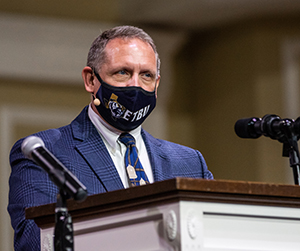
East Texas Baptist University hosted its sixth annual Calling Conference on Nov. 4 for students who feel called to vocational ministry. The conference provided students with a deeper understanding of how to identify and pursue their callings with opportunities to learn from experienced ministry professionals. Guest speakers were Jonathan Grenz, dean of the School of Ministry at Palm Beach Academy, and Phil Miller, acting director of the Great Commission Team for the Baptist General Convention of Texas. “You are on your own path, and you are discerning the way that it works for you,” Grenz told students. “Your specific calling, the unique thing that God wants to do in your life is progressive. It is unfolding over the course of your life. Where you are now is a great place to be, and where you’re at tomorrow is a great place to be, and where you’re going to be at 20 years from now is a great place to be. Focus on now and then let that calling unfold.”

Jimmy Dorrell

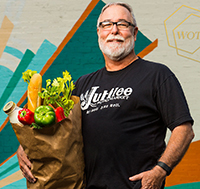
Baylor University’s Truett Theological Seminary launched a 10-course, primary-level certificate program in community development and ministry. The seminary developed the program in consultation with Jimmy Dorrell, co-founder and president emeritus of Mission Waco/Mission World and pastor of Waco’s Church Under the Bridge. The program includes six foundation-level courses, a class and project in Christian community development, a class in Christian witness and Mission Waco’s poverty simulation as an elective option. Dorrell will teach the class on “Community Development and Ministry” next year in Waco on Jan. 5-10 and in Houston at the No Need Among You Conference on Oct. 4-8. For more information, click here.

Jeff Ross

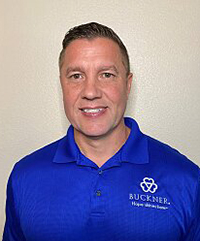
Jeff Ross was named interim senior executive director for Buckner Children and Family Services in Southeast Texas, effective Nov. 1. Ross will oversee operations serving vulnerable children and families in Houston, Beaumont and the surrounding areas. Ross has served with Buckner since 1995, most recently serving as the transitional program director in Beaumont. Previous roles with Buckner have included counselor, clinical director, program director, associate administrator and acting executive director. “Over the course of his 25-year career with Buckner, Jeff has time and again proven his dedication to serving the most vulnerable in Southeast Texas with faith, integrity and respect,” said Buckner Children and Family Services Senior Vice President Henry Jackson. “He will bring those same qualities to his work as interim senior executive director, providing leadership for our teams in Beaumont and Houston.” Ross earned his undergraduate degree in psychology from the University of Manitoba, and he earned both a Master of Business Administration degree and a Master of Science degree in community-counseling psychology from Lamar University. He is a licensed professional counselor and supervisor, a licensed child placing agency administrator and a licensed child care administrator. He and his wife Christina have a son Gavin, who is enrolled in the U.S. Air Force Academy, and a daughter Erin, who is a freshman at McNeese University in Lake Charles, La.

Southwestern Baptist Theological Seminary and Scarborough College will hold an in-person commencement ceremony at 10 a.m. on Dec. 4 for both spring and fall 2020 graduates. The seminary had canceled its spring commencement ceremony last May due to COVID-19—the first such cancelation in the institution’s 112-year history. The Dec. 4 ceremony will take place in MacGorman Chapel, with only graduates, faculty, and production staff present in the room. The nearly 29,000-square-foot auditorium has a typical seating capacity of 3,367, which has been significantly reduced for social distancing purposes to less than 600. At this point, 331 graduates have indicated their intention to participate in the ceremony, along with about 80 faculty and staff. Meanwhile, the graduates’ families will view commencement via a live simulcast from various locations across the Fort Worth campus. Social distancing will be employed in each location, and all attendees will be required to wear face masks. Stations for gatherings of families to meet with graduates following the ceremony will also be available across the 200-acre campus. Spring graduates, who received their diplomas by mail, have been invited to return for the fall ceremony in order to walk across the stage alongside the fall graduates. For family members and friends unable to attend, the ceremony also will be broadcast on Facebook Live.


Operation Christmas Child offers curbside drop-off

From online purchases to minimal-contact curbside drop-off, Operation Christmas Child—the Samaritan’s Purse program that provides shoeboxes filled with small gifts for children in developing nations—looks different this year due to COVID-19.

operation christmas childlogo200While some churches held “packing parties” to fill the shoeboxes as they have done in previous years, others opted out of the group activity this year due to concerns about social distancing and other pandemic-related protocols.
Samaritan’s Purse established COVID-19 protocols for packing, collecting and processing shoeboxes safely, and the organization communicated the information to volunteers.

This year, Samaritan’s Purse offered individuals and groups the opportunity to pack a shoebox digitally—selecting and purchasing toys online.

The organization also provided suggested alternatives to large packing parties, such as family-only events or individual shoebox filling stations at businesses. The group also highlighted the bulk purchase of bundled gifts that individuals could pick up at a church and small groups could then sort and place into shoeboxes.

Curbside drop-off limits contact

During National Collection Week, Nov. 16-23, more than 4,000 collection sites nationally—264 in Texas—will offer curbside drop-off where Operation Christmas Child volunteers with personal protection equipment will unload shoeboxes from donors’ vehicles.

“The objective is for it to be a safe experience for volunteers and for shoebox donors,” said Matt Smith, a member of First Baptist Church in Wylie and logistics team leader for Operation Christmas Child in South Collin County.

Typically, donors have been encouraged to enter a drop-off site, where they could talk to Operation Christmas Child representatives and learn more about the ministry.

“We’ve seen it as the opportunity to move from transaction to transformation,” Smith said, lamenting that COVID-19 makes that level of interaction impossible in 2020.

A family tradition

Smith has been a year-around volunteer with Operation Christmas Child the past three years.

Shoebox ministry
Sally Smith and her husband Carl pictured in a room full of shoeboxes for Samaritan Purse’s Operation Christmas Child ministry. She spent all year gathering material to include in the boxes, which are sent to children around the world. (File Photo: George Henson)

For him, involvement in the international ministry to children is a family tradition.

When bone and joint disease deprived his mother, Sally Smith, of participating in many of the mission-related activities she enjoyed, she began packing shoeboxes for Operation Christmas Child—sometimes up to 1,250 a year.

She died in 2015, but her son carries on her legacy by serving as a local Operation Christmas Child leader.

“We don’t know exactly what kind of impact COVID-19 will have in terms of the number of churches participating or number of shoeboxes collected,” Smith said. “We’ll wait and see what happens and trust God.”

To locate the closest shoebox drop-off location, click here.


Half of pastors see negative economic impact for church

NASHVILLE, Tenn.—After a few years of economic optimism, pastors say the 2020 economy is hurting their congregation.

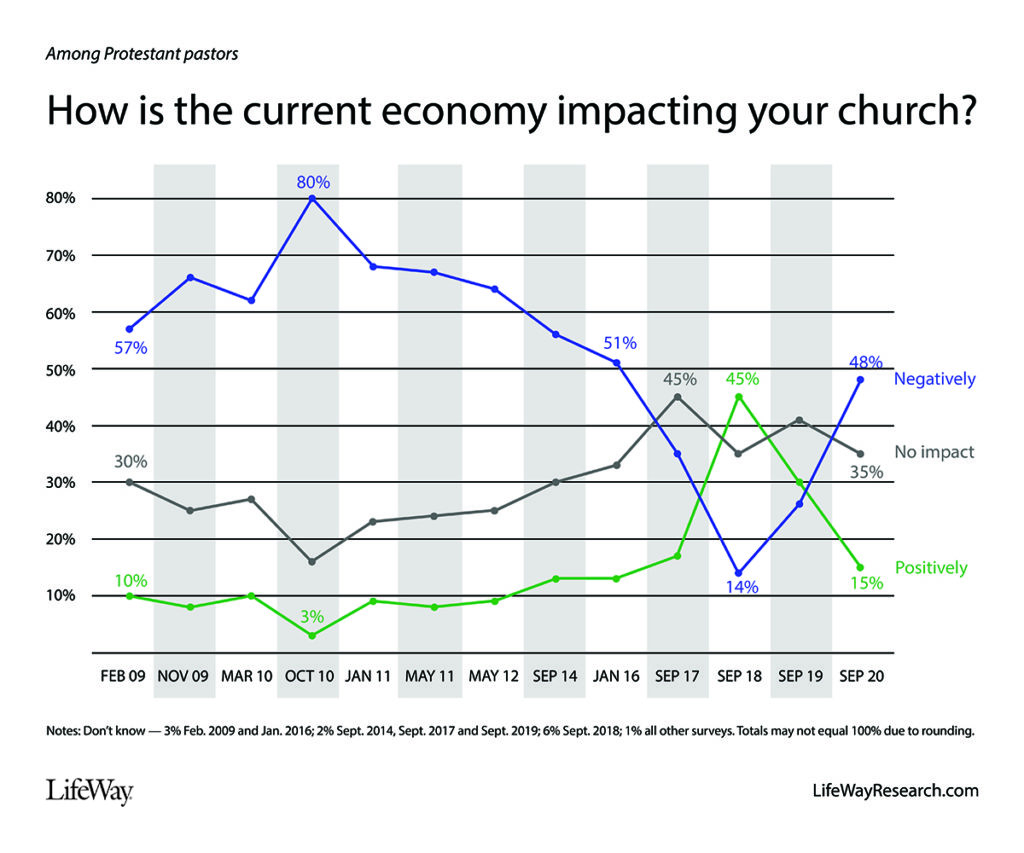
According to a new LifeWay Research survey, about half of Protestant pastors in the United States (48 percent) say the current economy is negatively impacting their church, including 5 percent who say the impact is very negative.

Around 1 in 6 (15 percent) believe the economy has had a positive effect, including 4 percent saying it is having a very positive impact. More than a third of pastors (35 percent) say there’s been no impact.

Even with a 12-point jump from 2018 to 2019 (14 percent to 26 percent), perceptions of negative impact had been trending downward since 2010 when 80 percent of Protestant pastors said the economy was harming their church.

The 2020 negative numbers are the highest since January 2016, when 51 percent of pastors said the economy was hurting their church.

“The recovery from the last recession was slow for many churches,” said Scott McConnell, executive director of LifeWay Research. “Even in a good economy, it can be easy to focus on external factors that are hurting your church’s finances. Clearly, many pastors are seeing the recession in 2020 impacting their church.”

Giving levels flat or down

Most Protestant pastors say giving has been at or below 2019 levels, as well as at or below their budget for this year. Around a third report giving levels lower than last year and lower than their current budget.

For close to half of churches (45 percent), giving in 2020 has been about what was budgeted. A third (33 percent) say it is lower than budgeted, while 21 percent say giving has been higher.

When compared to 2019, 35 percent say giving has dropped this year, 32 percent say it is the same, and 29 percent say it is above last year’s levels.

Those numbers accelerate a downward giving trend that began last year.

In 2018, LifeWay Resarch found 42 percent of pastors said their offerings were up, 37 percent said giving was the same, and 15 percent said it was below 2017.

Those numbers worsened slightly in 2019 when LifeWay Research found 37 percent said giving was up, 37 percent said it was the same, and 21 percent said it was below 2018 levels.

“2018 looks like as good as it gets for positive economic impacts for churches,” McConnell said. “People quickly got used to improved take-home pay from tax changes and were seeing flat wages meaning 2019 was more difficult for churchgoers to maintain 2018 giving. Now in 2020, a recession brought on by the COVID-19 pandemic has set a third of churches behind their 2019 giving.”

When asked about the specific percentage change from 2019 to 2020, 8 percent of Protestant pastors say their giving is down by 25 percent or more, 18 percent say it dropped between 10 percent and 24 percent, and 7 percent say it was a small drop of 1 percent to 9 percent.

Of those who say their giving increased in 2020, most say it went up a small amount. Around 1 in 8 pastors (12 percent) say giving was up by less than 10 percent, while 13 percent say giving was up between 10 percent and 24 percent. Few (3 percent) say giving at their church increased by 25 percent or more this year.

Some feel the pain more than others

Some churches are faring worse in giving than others in 2020. Minority led, mainline and smaller congregations are more likely to say they’ve felt the brunt of the declining economy.

African American pastors are the most likely to say the economy is having a very negative impact on their church (20 percent).

African American pastors also are more likely to say their giving is lower than budgeted (48 percent) and below 2019 levels (50 percent) than white pastors, among whom 31 percent report giving below budget and 34 percent who say offerings are down from last year.

Evangelical pastors are more likely than their mainline counterparts to say giving in 2020 is higher than budgeted (23 percent to 14 percent). Similarly, evangelical pastors are more likely than mainline pastors to say giving is above 2019’s offerings (32 percent to 19 percent).

Pastors of churches with worship service attendance of 250 or more are more likely than pastors of churches with fewer than 50 people to say their giving is up from 2019 (32 percent to 23 percent)

“The economic impact of COVID-19 has been very uneven, and that includes churches,” said McConnell. The types of churches most likely to be struggling financially are also the most likely to have not gathered in person recently, he observed, based on other research.

“The exception is larger churches, but they were most likely to have less than 30 percent of their pre-COVID attendance in person.”

The mixed mode survey of 1,007 Protestant pastors was conducted Sept. 2 to Oct. 1, using both phone and online interviews. Each survey was completed by the senior or sole pastor or a minister at the church.

Analysts weighted responses by region and church size to reflect the population more accurately. The completed sample is 1,007 surveys (502 by phone, 505 online). The sample provides 95 percent confidence that the sampling error does not exceed plus or minus 3.4 percent. This margin of error accounts for the effect of weighting. Margins of error are higher in sub-groups.


Surge prompts some churches to return to online-only worship

MESQUITE (BP)—A surge in new COVID-19 cases has some churches returning to online-only worship as many churches continue meeting onsite.

“This Sunday we will be online. We’ll be totally online,” said Terry Turner, senior pastor of Mesquite Friendship Baptist Church in Mesquite. “We’ve actually had a few weeks of indoor service, where we actually come together and we social distance. … Now that we’re back in the red zone (of COVID-19 case numbers) here in Texas, we have suspended our services, and we’re doing strictly online.”

A one-day rise of 121,890 new COVID-19 cases nationwide on Nov. 6 is the highest to date in the United States since the pandemic began, the Johns Hopkins Coronavirus Resource Center reported.

At 969,605 cases, Texas has surpassed California as the state with the highest number of cumulative cases. Texas’ cumulative COVID-19 death toll of 18,909 is second only to New York’s 33,657, Johns Hopkins reported.

El Paso a hot spot for virus

In the COVID-19 hotspot of El Paso, Immanuel Church has closed its school for a couple of weeks but continues onsite worship, Pastor J.C. Rico said.

“I would say here in the city, it’s about 50/50,” Rico said of El Paso Baptist Association’s 100 or so churches. “There are some that just have continued online. There are some that did go back to live, and a small percentage have just gone online again. … I would say about 40 percent of the churches here in El Paso are going live” in person.

El Paso reported 1,049 COVID-19 patients hospitalized Nov. 6, with 311 in intensive care units and 177 on ventilators, the City of El Paso reported.

Cielo Vista Baptist Church in El Paso returned to online-only worship Oct. 25, Lead Pastor Larry Lamb said in a video posted to Facebook.

“[I]f you live in El Paso you know the COVID cases have gone extremely high, a lot of COVID cases. So, out of protection for our community, our church community, we’re going to suspend our live weekend services until further notice,” he said in an Oct. 25 video.

“But we will be on Cielo Vista Church online every week. … We just pray for the pandemic to stop, we pray for healing, and we pray for the lives of people to be nourished also by truth but also in great health. So that’s why we want to protect our church family as much as we can. Stay safe, and do all the things we’re required to do.”

African American community hit hard

Mesquite Friendship Baptist Church is a member of Dallas Baptist Association of about 500 churches. Dallas County lists the COVID-19 risk level in the red zone, advising people to “Stay Home, Stay Safe.” The county has a cumulative total of at least 99,761 cases and 1,127 cumulative deaths, with 868 new cases reported Nov. 5.

Turner said his church has had deaths among its membership and among its extended church family including relatives and friends, but declined to provide a specific number.

“Among African Americans, the COVID-19 has had its highest impact, and we’ve seen a lot of that within our membership and their families,” Turner said. “We’ve had members who have passed from it, and then we’ve had members who have had family members that have passed from it.”

He referenced the church’s first member to die of the virus, a participant in the church’s health care ministry who died after contracting the virus in her professional work as a nurse.

“She was very, very committed to our ministry and our church,” he said. “And yet, at the same time, she was a nurse. and contracted it as a nurse.

“Our sensitivity to what COVID is doing is really at a high alert within our church and within our ministry, because we’ve seen so much of it. … Our members are as committed to supporting the church and to the ministry as they were before COVID-19 hit us,” both financially and spiritually.

Turner said he is monitoring the virus to determine when to resume onsite worship, but has no definite plans at this point.

Dallas Baptist Association Associate Director Scott Coleman said much of what he knows of churches’ current worship plans is anecdotal. An online survey conducted three weeks ago, Coleman said, drew responses from 50 churches, about 10 percent of the congregations in the association. One church was meeting in a parking lot.

“Exactly two-thirds were meeting in person, observing social distancing rules,” Coleman said. “We had … right at a quarter that were meeting virtually. … Only a few, about 7 percent, were still not meeting at all.”


Baptist theology professor and wife killed in wreck

FORT WORTH (RNS)—An adjunct professor at Southwestern Baptist Theological Seminary and his wife were killed in a fiery collision with an alleged drag racer on Nov. 6.

Meg and Ben Arbour (Facebook Photo)

According to news reports, Ben Arbour and his wife Meg were driving home from a date early Friday morning when a car that was racing on Risinger Road in Fort Worth struck their vehicle.

Their car burst into flames and both the Arbours and the driver of the racing vehicle were killed.

The Arbours, who were both 39, left behind four children, ages 10 to 16. They were members of Wedgwood Baptist Church in Fort Worth.

Pastor Dale Braswell told a local television station that the Arbours’ death was a shock.

“It’s one of those calls you dread getting,” he said

Arbour, who earned a doctorate from the University of Bristol, was a two-time graduate of Southwestern Seminary and taught there as an adjunct professor in the spring of 2020. He also taught philosophy at Weatherford College and worked as a finance manager at Sewell Lexus in Fort Worth.

“Ben was a brilliant and gracious person,” Brandon Smith, assistant professor of theology and New Testament at Cedarville University, told RNS via email. “Everyone who came into contact with him knew that Ben took philosophy and theology seriously; people who knew him better knew it was because he took his faith seriously.

“I don’t think I ever had a conversation with him where he didn’t have some sort of book or research idea he was dwelling on, which usually centered on him wanting to see Christian philosophy done well, with a seriousness about the Bible and orthodoxy.”

Serious work but able to laugh at himself

Derek Rishmawy, a writer and campus minister, said Arbour worked on what is called “analytic theology,” which combines systematic theology with the tools of analytic philosophy.

“He also just had a good sense of humor—even in an argument. You could jab with a sharp point and he’d jab back, but in good humor,” Rishmawy wrote in an email to RNS.

Longtime friend John Gilhooly, a professor of philosophy and theology at Cedarville University, recalled the first time he met Arbour, when they took a long road trip together for a conference, “he argued with me for the entirety of the 16-hour car ride.”

“He argued fiercely because he cared deeply. He took his work seriously, but he could laugh at himself,” Gilhooly wrote in an email.

“Ben was a wonderful, relentless, indefatigable advocate for clarity in our speech about God, purity in our devotion to Christ, and charity in our conduct by the Spirit. He was a loyal friend: equal measures bold and honest. He knew no strangers because he showed no partiality,” he said.

The Fort Worth Star-Telegram reported the other car allegedly racing at the time sped away after the accident.

A GoFundMe campaign has been set up for the Arbour children.


Baylor keeps virus under control but cannot be complacent

WACO—At their fall meeting, Baylor University’s board of regents considered COVID-19’s impact on students’ health and safety, on the university’s budget and on plans for next semester.

(Photo by Matthew Minard / Baylor University)

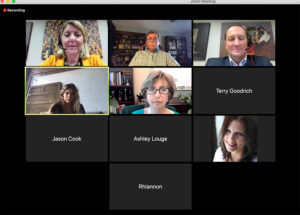
During a Nov. 6 teleconference for news media, President Linda Livingstone noted the meeting provided regents a taste of what students have experienced this semester. During the hybrid meeting, some regents participated via Zoom teleconference, and others attended it inside one of the large portable tent-like structures erected on the Baylor campus.

Regents who participated in the in-person meeting had to undergo rapid COVID-19 testing at the university’s respiratory clinic. In-person participants also followed university health protocols that require wearing face masks and social distancing.

Baylor experienced an initial spike in COVID-19 cases in early September, but the number of new cases dropped by October and has remained stable, Livingstone reported.

“We were able to respond quickly to reverse that early fall trend by providing a comprehensive educational, testing, contact tracing and treatment program on behalf of student health and well-being,” she said.

Baylor’s online public COVID-19 dashboard shows a cumulative total of 1,254 cases since Aug. 1, but only 52 in the past seven days, with a 2.8 percent positivity rate.

Baylor University President Linda Livingstone (top row left) and Board of Regents Chair Mark Rountree (top row right) respond to questions from the news media. (Screen Capture)

“Our numbers continue to look good. Our positivity rate is low, but we can’t be complacent,” Livingstone said, pointing to a recent spike—locally and nationally—in cases of COVID-19.

“So, we have to continue to be diligent as we move through the next two and a half weeks or so of the semester leading up to Thanksgiving.”

Prior to the launch of the semester and in anticipation of a “second wave” of the virus in the fall, Baylor adjusted its schedule so students would not return to campus for classes after Thanksgiving.

In mid-April, Baylor announced a series of measures to cut costs by up to $80 million in response to the COVID-19 pandemic. Even so, expenditures related to COVID-19 continue to run higher than originally budgeted—particularly related to testing, campus infrastructure modifications and technology, Livingstone noted.

She acknowledged Baylor continues “to experience significant uncertainty” as it looks ahead to the spring semester.

“We don’t really know what the spring semester is going to look like, but we know that we have worked very hard this fall,” she said. “We’ve learned a lot, and we’ll be prepared to bring our students back in January.”

In an October teleconference, regents approved a 2 percent increase in tuition for the 2021-22 academic year, with no increase in room and board, lab fees, summer school rates or Baylor Law School tuition. The university reported the tuition increase is the lowest in two decades.

In other business:

  • Livingstone reported the university administration received the recent Baylor Student Senate resolution asking for a reinterpretation of Baylor’s statement on human sexuality and policy change that would allow an LGBTQ group to become an officially chartered student organization. The matter was not on the board’s agenda, but regents “continue to have discussions as a board about how we are creating a caring community” for all students, she said.
  • Board Chair Mark Rountree reported the 26-member commission on historic campus representation—created to examine Baylor’s historic links to slavery—expects to deliver its findings to Livingstone in December. “Their work has been marked by a real sense of humility, mutual respect and, at the end of the day, a desire to bring forth for the board’s consideration recommended actions that would unite and strengthen the entire Baylor family.” After board consideration in early 2021, Baylor plans to release the findings and recommendation in the spring.
  • On a related subject, Livingstone reported continued progress in fostering an environment where racial equality is linked to Baylor’s mission and students of color feel valued and loved. Baylor’s first mandatory diversity education program for all students, faculty and staff will be released this week and completed by the end of the semester.
  • Regents approved a Ph.D. in anthropology with a specialization in the anthropology of health.


Oregon decriminalizes opioids; other states legalize marijuana

SALEM, Ore. (BP)—Oregon will become the first state in the nation to decriminalize possession of small amounts of drugs including Oxycodone, cocaine, heroin and methamphetamine beginning in February 2021.

Voters approved the measure on Election Day by a margin of 58.6 to 41.4 percent and concurrently approved by 66.7 to 33.3 percent a new tax on tobacco and E-cigarettes to fund treatment programs in place of incarceration for drug users. Several other states passed measures legalizing only marijuana.

Regarding gambling expansion, voters approved measures in Colorado, Maryland, Nebraska and South Dakota, including racetrack betting, gaming, sports betting and charitable bingo and raffles.

Southern Baptist Ethics & Religious Liberty Commission executive Travis Wussow said the changes in the “predatory drug and gambling industries” are alarming.

“These industries exploit our neighbors who are poor, vulnerable and addicted. They deceptively extract money from communities that are already under-resourced, leaving strained relationships and broken homes in their wake,” Wussow said.

“Pastors and church leaders must see this challenge for what it is and be ready to step into the gap for their communities and oppose the expansion of these industries in their states.”

Randy Adams, executive director and treasurer of the Northwest Baptist Convention, believes Oregon’s drug decriminalization measure will increase addiction, leading to “serious health and family problems, among other things.”

“We can expect that drug decriminalization will create a need for further taxation to deal with the fallout from increased drug use,” he said. “It is quite ironic that Oregon’s tax on tobacco is intended to provide health services for prevention and cessation programs for tobacco and nicotine related diseases.”

Southern Baptists comprise a small portion of voters in the state that has fewer than 150 Southern Baptist churches and missions, according to the Annual Church Profile.

“In some states, Baptists are a significant voting bloc and thus wield significant political influence. We do not have that kind of influence in Oregon and Washington,” Adams said.

Marijuana legalization measures approved

Marijuana legalization measures passed in Arizona, Montana, New Jersey and South Dakota. Arizona Proposition 207, approved by 59.8 percent of voters, legalizes the substance for people at least 21 years old, places a 16 percent tax on marijuana sales and requires the Arizona Department of Health and Human Services to write rules regulating marijuana businesses.

Arizonans approved medical marijuana in 2010 but last opposed recreational use in 2016 with just 51.3 percent of the vote, according to Ballotpedia.com. Republican Gov. Doug Ducey opposed the measure both years.

Montana legalized, with 56.7 percent of the vote, the possession and use of marijuana for individuals at least 21 years old and approved a 21 percent tax on marijuana sales. The measure takes effect Jan. 1, 2021, according to the Montana Secretary of State’s office. Medical marijuana has been legal in the state since 2004.

New Jersey legalized the possession and use of marijuana for persons age 21 and older and legalized the retail sale of marijuana. The measure, New Jersey Public Question 1 passed by 66.9 percent of voters with just 63 percent of precincts reporting, and takes effect Jan. 1, 2021.

South Dakota approved both recreational and medical marijuana use. Constitutional Amendment A received 53.4 percent of the vote to legalize recreational use of marijuana and simultaneously require the South Dakota State Legislature to pass laws providing for the use of medical marijuana and the sale of hemp by April 1, 2022, according to the amendment. A companion initiative, Initiated Measure 26, which was approved by 69 percent of voters, orders the creation by October 2021 of a medical marijuana program for people with debilitating medical conditions.


Mother and daughter transformed through Buckner ministries

When Alissa Campos was 9 years old, she and her younger sister were removed from their mother’s care and placed in the home of their great aunt in Midland.

Alissa was old enough to know her mother wasn’t doing well, and she spent the rest of her childhood angry at her for not taking the necessary steps to rectify the situation.

“When I was younger, me and my mom’s relationship was really great. She was a good mom,” Alissa said. “The last time she went away, I had so much anger and so much resentment and sadness, it was just horrible.”

Alissa had to grow up fast. While her aunt doted on her younger sister, Alissa always felt she was an outsider, someone who just came with her baby sister. She never was able to establish a connection with her aunt.

But Alissa was determined and ambitious. When she was just 16 years old, she completed a certification to get her certified nurse assistant license. But nobody would hire her because she was under 18.

Awkward reunion

Just before she turned 18, she had the opportunity to meet her mother for the first time in years. It was awkward, she said, but they stayed and talked for hours. After that conversation, Alissa and her mom started communicating more through text messages and on the phone.

Alissa came to Dallas to visit her mother and her half-sisters. Her mother was living at Buckner Family Pathways, a transitional home for single parents to receive affordable housing, child care and counseling while attending college.

During the visit, Alissa’s mother encouraged her to apply to the Buckner NextStep program, a transitional home for young women who have aged out of foster care and located on the same campus as Family Pathways. Alissa didn’t want to leave Midland. So, she just put the thought behind her.

But she continued to think about it. Just weeks after graduating from high school, she moved to Dallas and was accepted into the program. Living on the same campus has helped Alissa and her mother repair their broken relationship. Talking to her mom and half-sisters used to be uncomfortable for Alissa, but now it’s completely natural.

Relationship restored

“We spent a lot of time apart, and I spent a lot of time hating her,” Alissa said. “And it doesn’t feel that way now. Like it feels like we’ve been together all this time.”

Alissa was able to see the positive changes in her mother and see how Family Pathways gave her mother the direction and help she needed to be a good mother and student.

“She works really hard,” Alissa said about her mom. “I wish I could work that hard. I really do.”

Where there was once resentment now there is only admiration. Alissa marvels that such a transformation has taken place.

Determined and ambitious

While Alissa may not think she works as hard as her mom, she is determined and has goals too. She started attending college to renew her CNA certification and work toward her associate degree. She continues to get certifications as an EKG technician and in phlebotomy. Eventually, she wants to become a nurse.

Alissa Campos, whose life was changed through her involvement with the Buckner NextStep program, works as a certified nursing assistant at Ventana by Buckner, a senior living community in Dallas. (Buckner Photo)

The counselors at NextStep have helped Alissa with resources and guidance to help her succeed after she leaves the program, such as learning to make a budget and saving. They even helped her navigate how to buy a new car.

“Buckner has done so much for me and my family,” Alissa said.

Now Alissa is part of the Buckner family. When Ventana by Buckner, the newest Buckner senior living community to open in Dallas, was hiring, Alissa applied and was hired as a CNA in skilled nursing. She works the night shifts, so she can still attend school during the day.

It feels very natural for Alissa working with patients, and it’s something she has grown to enjoy.

“It just kind of feels like I’m just there to help them. And that’s really it,” Alissa said. “And you get to know a lot of these patients and they talk to you. It’s nice.”

Alissa has one more year in the NextStep program, and she is determined to glean as much information as she can during that year.

“I have goals,” Alissa said. “I need to save more because I don’t want to be in a bind. I need to learn to budget. I’m trying to be as independent as I can be.”