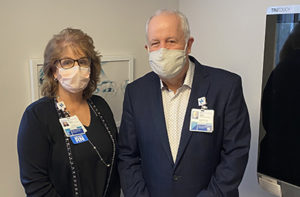
Stephen Reeves elected to lead Fellowship Southwest

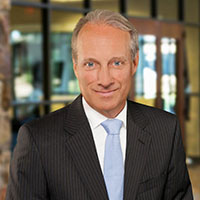
Stephen Reeves, former director of public policy for the Texas Baptist Christian Life Commission, has been elected executive director of Fellowship Southwest.

Reeves will succeed Marv Knox, who founded the ecumenical network affiliated with the Cooperative Baptist Fellowship in 2017. Fellowship Southwest encompasses Arizona, New Mexico, Northern Mexico, Oklahoma, Southern California and Texas.

Reeves, an attorney, began working with CBF’s advocacy program in 2013 after serving with the Texas CLC in Austin. Previously, he was staff attorney for the Washington-based Baptist Joint Committee for Religious Liberty.

In addition to leading Fellowship Southwest, Reeves will continue to direct CBF advocacy. CBF will provide financial compensation to enable Fellowship Southwest to hire an associate coordinator.

The move will bring Reeves from the CBF headquarters in Georgia back to his home region, where he grew up, was educated and worked much of his career.

‘Take the movement to new heights’

Michael Mills, chair of the Fellowship Southwest search committee and pastor of Agape Baptist Church in Fort Worth, expressed confidence Reeves will “stand on the shoulders” of the organization’s founding executive director and “take the movement to new heights.”

“We began our search by looking for a candidate with a compassionate and enduring heart, an entrepreneurial and adaptive mind, a collaborative and ecumenical spirit, and the experience to boot. We have found all this and more in Stephen Reeves,” Mills said.

Reeves expressed excitement about the opportunity to lead Fellowship Southwest.

“I am thrilled and humbled that the search team and board are giving me the opportunity to lead Fellowship Southwest into the future,” he said. “I believe deeply in the power and potential of this ecumenical, multi-racial Christian witness in the Southwest committed to cooperative and compassionate missions and advocacy.”

Reeves said he considers it “an honor to build upon the strong foundation laid over the last four years.”

“I look forward to strengthening our congregational ties beyond our corner of the Baptist world as well as working with my CBF colleagues in the region,” he said. “And I’m proud of the progress we’ve made in CBF advocacy in the last seven years and delighted to continue providing leadership at a national level even as I bring more advocacy experience to Fellowship Southwest.”

Fellowship Southwest ‘at a critical juncture’

Meredith Stone, chair of the Fellowship Southwest board, affirmed the wisdom of naming Reeves to the leadership role at this point in the organization’s history.

“Fellowship Southwest is at a critical juncture as we are continuing our ministries in association with CBF Global while also taking steps and aspiring toward greater ecumenical partnerships within the Southwest,” said Stone, executive director of Baptist Women in Ministry. “Stephen Reeves is a proven leader in relationship building and ecumenical collaboration, which makes him an ideal choice to lead Fellowship Southwest into its next phase of ministry.

“Stephen’s experience, familiarity and connectedness within the Southwest region and his commitment to making the world a more just, equitable and compassionate place will serve Fellowship Southwest well in the years ahead.”
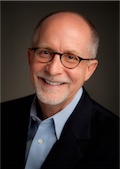
knox
Marv Knox

Knox expressed delight with Fellowship Southwest’s choice for its next leader.

“Stephen knows and loves the Southwest, and his heart beats for our vast and varied region,” Knox said. “He’s already familiar with our network, and he understands the issues—such as immigration, education and church vitality—central to our ministry and to our future.

“Stephen’s extensive advocacy connections will enable Fellowship Southwest to more than fulfill our aspiration to be a vibrant ecumenical organization. And he shares our values, so he will keep us faithful, agile and kind.”

Reeves’ tenure will begin March 15. To ensure leadership continuity, the Eula Mae and John Baugh Foundation has provided a grant that will enable Reeves and Knox to work together until Knox’s retirement later this year.

CBF Executive Coordinator Paul Baxley praised Fellowship Southwest’s selection of Reeves.

“Fellowship Southwest has made a remarkable decision in calling Stephen Reeves to serve as executive director,” Baxley said. “He is uniquely suited to lead Fellowship Southwest’s continued growth in public witness, ecumenical ministry and shared mission in the Southwest.”

Back home again

Reeves, who grew up in Austin, is a graduate of the University of Texas at Austin and the Texas Tech University School of Law. He is proficient in Spanish and is a member of the State Bar of Texas.

He serves on the boards of the Baptist Joint Committee and Passport Camps, as well as the strategic advisory board of Good Faith Media and the Baptist World Alliance Commission on Racial, Gender and Economic Justice. He is co-chair of the Center for Responsible Lending’s Faith & Credit Roundtable. He is a former board member of Christians for Environmental Stewardship and Stop Predatory Gambling.

He also served in youth ministry positions for churches in Virginia and Texas.

Reeves’ wife, Deborah, is an ordained chaplain. They are the parents of three children—Kellyn, Garrett and Landry.


Baylor regents accept commission report on school’s history

Baylor University regents accepted the final report from a commission formed to examine the university’s history and its founders’ links to slavery and racial injustice.

At their quarterly meeting, held via teleconference, the regents also instructed the university’s administration to develop an action plan for the board’s consideration based on the commission’s recommendations.

Baylor plans to release the commission’s full report by the end of March. First, the university will hold three forums as part of its ongoing “Baylor Conversation Series: Perspectives on Our History” on March 2, 9 and 16.

Each forum will be held from 6 p.m. to 8:30 p.m. on Zoom and include panelists from universities in Texas and other experts to discuss slavery in the United States, slavery in Texas and among Texas Baptists, and the historical findings of the commission and the framework for the recommendations.

“The commission has given a great gift to Baylor, one in which racial equality is inextricably linked to our Christian mission and that reflects the voices and perspectives of all 26 diverse members of the commission in the final report and recommendations,” said Board Chair Mark Rountree of Dallas. “As we take the next steps in this process, the board is committed to providing a Christ-like compassion and dedication to equality, justice and conciliation at Baylor, throughout our state and nation and among all people.”

Slaveholders among early Baylor leaders

Last summer, Baylor’s board of regents passed a “Resolution on Racial Healing and Justice” that asserted the university’s Christian mission is “inconsistent with racism in any form,” but acknowledged some of the university’s founders and early leaders supported slavery.

In a February 2017 Waco Tribune Herald article, Baylor religion professor Chris van Gorder reported tax records showed Judge R.E.B. Baylor owned at least 20 slaves in 1860, and 11 of Baylor’s first 15 trustees were slaveholders. He also noted all of the university’s first buildings in Independence were built by slave labor.

Regents created the 26-member Commission on Historic Campus Representations at Baylor University to “review the historical context of the university and its connection to all statues, monuments, buildings and other aspects of the campus in reference to their physical location, placement and naming.”

The commission was given the charge to:

  • Review the complete historical record and context of the university and its founders and early leaders, including historical connections to slavery and racial injustice.
  • Propose a plan for documenting and communicating the complete history of Baylor and its founders and early leaders, including historical connections to slavery and racial injustice.
  • Evaluate all statues, monuments, buildings and other aspects of campus within this complete historical context and in reference to the original intentions behind their physical location, placement and naming and provide observations for consideration.
  • Prepare a final report to be provided to the board of regents and the president no later than Dec. 20, 2020.

The commission completed its report and presented it to Baylor President Linda Livingstone and the chair of the board of regents in December. In the weeks prior to the regularly scheduled board meeting, regents met in specially called sessions so the commission’s co-chairs and other members could present the report, which the regents then discussed at the Feb. 19 meeting.

The board passed a resolution expressing gratitude to members of the commission “for their extensive labor and prayerful deliberation in the course of successfully fulfilling their charge and providing this service, as volunteers, to the university and the Baylor Family.”

The resolution also recognized and expressed appreciation of both regents and the Baylor administration for the “extraordinary leadership, dedication and selfless service of the commission’s three co-chairs marked by humility, discernment, and prayer.”

It praised the three co-chairs—Regent Alicia D.H. Monroe; Gary Mortenson, dean of the Baylor School of Music; and Walter Abercrombie, associate athletics director—“for their care in fostering an environment in which the voices and thoughts of all 26 members of the commission were thoughtfully considered and reflected in this gift to Baylor.”

Administration to develop action plan

Regents charged the university administration to develop a proposed action plan regarding the Commission’s recommendations. The administration will provide a briefing for regents’ consideration and action in accordance with existing board policies and procedures, prior to the implementation of any recommendation.

“The commission’s report tells more than the story of Baylor’s history. It is a testament to the importance of telling the truth, of asking for forgiveness and of reaching out to others impacted by the institution of slavery in fulfillment of our Christian mission and in keeping with our Christian witness,” Livingstone said.

“We will take great care as we begin looking deeper at the commission’s recommendations to develop a proposed action plan for consideration by the board in the months ahead.”

Lori Scott Fogleman of Baylor University contributed to this article. 


Texas Baptists serve neighbors hit hard by winter storm

As Texans struggled with bitter cold, prolonged power outages, burst pipes and water-boil mandates, Texas Baptists reached out to neighbors in need.

When the winter storm dropped temperatures to the single digits and dumped record snowfall across the state, churches that still had utilities opened their facilities as shelters and warming stations.

Providing a warm welcome

Like many churches, First Baptist in Temple cancelled in-person worship services on Feb. 14, offering an online alternative. But two days later, the church opened its doors as a warming center and shelter.

“Some on our staff still have no power and water, like many in our community,” Evan Duncan, the church’s teaching and communications pastor, wrote in a Feb. 18 email. “Last week, we partnered with another church to prep their warming center, but as things worsened, we knew we needed more placed throughout our community.”

For those who needed shelter from the cold but were unable to navigate treacherous roads, First Baptist in Temple offered free rides to the nearest warming center.

Vista Community Church, another Texas Baptist congregation in Temple, partnered with local assisted living facilities to house residents in its church facility.

About 35 miles to the north, Highland Baptist Church in Waco posted a Facebook notice Feb. 15: “Highland will be a warming center from this evening (Monday) at 6 p.m. until 6 a.m. on Thursday morning. If anyone needs a place to come and rest, warm up or recharge your phones, our doors are open the next 60 hours to serve others.”

The church asked members to volunteer for three-hour shifts throughout the week, offering snacks and a warm welcome to people seeking shelter.

In downtown San Antonio, First Baptist Church opened its facility as a temporary winter shelter for unhoused people who normally live on the city’s streets and as a warming center for anyone who needed it.

Offering hospitality

Some Texas Baptists who had electricity posted open invitations on social media, saying their homes were available to any friends or neighbors who needed a hot meal or a warm place to rest.

Grateful individuals around the state posted “thank you” notices on Facebook to Texas Baptists who opened their homes to families who were without power or whose houses were damaged by burst water pipes.

“Our pastor and his family hosted our kiddos at their home today,” one deacon at a Garland church wrote on social media, adding he and his wife also enjoyed a hot meal at the pastor’s home.

The deacon and his family were without power 54 hours, and their home sustained serious water damage from burst pipes, but he wrote, “We are well provided for. God’s taking care of us.”

‘Thankful to find relief from the cold’

In Dallas, Buckner International opened its Family Hope Center at Bachman Lake as a warming center, providing residents of the surrounding neighborhood respite from the cold.

Local residents find warmth and shelter at the Buckner Family Hope Center at Bachman Lake. (Buckner Photo)

“It has been a hard year for the families in our community,” said Ricardo Brambila, director of the Family Hope Center. “They come into the warming center anxious. They keep their heads up, but they have sadness in their hearts. They’re so thankful to find relief from the cold.”

At mid-week, about two-thirds of the families the center normally serves were without power. The center made its warming station available to anyone in the community who needed relief from the cold and a place to recharge cell phones. The Texas Rangers Baseball Foundation provided funds to enable the center to offer food to people who were seeking shelter.

“We are all in this together,” Brambila said. “This is our community, and we want to be a good neighbor. Families are hurting, especially children. When the families are here, we hope they see the compassion and love we have for them. We want them to leave with hope.”

Caring for senior adults

In Houston, Tallowood Baptist Church delivered 115 cases of water to senior adults at Buckner Parkway Place after local officials issued a boil-water mandate. Church members scattered throughout the city purchasing cases of water for the senior living community.

Volunteers from Tallowood Baptist Church in Houston deliver bottled water to the Buckner Parkway Place senior living community. (Buckner Photo)

Parkway Place already had a 700-gallon emergency reserve of bottled water on hand before the winter storm. Workers at the senior living community distributed the available water to more than 220 residents on Feb. 16 and 17, but Parkway Place eagerly accepted the extra water from Tallowood in light of the uncertain duration of the water-boil order.

Abraham Mathew, executive director of Parkway Place, praised Tallowood—as well as Gateway Church, a nondenominational congregation that provided residents 100 blankets—for “their selflessness and dedication to supporting the seniors in our community.”

“While we feel confident in the resources we had on-site already, knowing that kind people are thinking about us and want to ensure our well-being during this difficult time has been uplifting for the residents and associates in our community.”

Churches throughout the state reported flooding and damage to their facilities due to burst pipes. Pastor Joseph Fields of New Beginnings Church in Lewisville posted a video on Facebook showing water from a broken pipe spraying across the lobby of the church’s new facility, along with the message: “By God’s grace, we will be stronger after this ordeal is over.”

Even as temperatures began to creep above the freezing mark, some churches cancelled in-person worship services on Feb. 21—partly due to uncertainty regarding the conditions in their buildings and partly in response to calls for energy conservation.

TBM at work around the state

Texas Baptist Men deployed a shower and laundry unit to Cedar Hill, where 700 residents were without water due to broken pipes. At the request of city officials, TBM also provided a large generator.

TBM volunteers in East Texas provide meals for families affected by the winter storm. (TBM Photo)

TBM volunteers delivered to East Texas Baptist University two pallets of bottled water and 50 water filters that screw onto faucets after Marshall was placed under a boil-water order. Additional water filters will be delivered to churches in Houston.

A TBM food-service team in East Texas prepared meals and snacks for families affected by the winter storm at several locations around Lindale.

TBM provided a generator to supply electricity for about 24 hours for a warming station at First Baptist Church in Edgewood, and it provided shower and laundry units to warming stations in Comanche and Allen.

Another TBM shower and laundry unit was committed to First Baptist Church in Marble Falls once the roads in the area are clear enough for it to be delivered.

“This is truly a statewide emergency in every sense of the word,” said TBM Disaster Relief Director David Wells. “Every city, every region of Texas is being affected. We are seeking to provide help, hope and healing as quickly as possible.”

Across the state, TBM placed its regional shower and laundry units, flood recovery crews and emergency food-service teams on standby to meet needs in their areas.

“People are hurting,” Wells said. “They’re tired. They’re overwhelmed by the situation. We are mobilizing volunteers to meet their needs, help them and lift their spirits.”

To support TBM disaster relief financially, give online at TBMTX.org/donate or mail a check to Texas Baptist Men, 5351 Catron Drive, Dallas 75227.

Includes reporting by Aimee Freston of Buckner and John Hall of TBM.


Two Christians in Pakistan charged with blasphemy

A pair of young Christians in Pakistan have been charged with violating that nation’s blasphemy law—an offense that carries a mandatory death penalty if the accused is found guilty.

Human rights organizations that focus on the persecution of Christians have reported Haroon Ayub Masih and Salamat Mansha Masih were accused of making derogatory remarks against Islam and the Quran while distributing Christian literature and preaching in Lahore.

Conflicting accounts

The United Kingdom-based Centre for Legal Aid, Assistance and Settlement reported Haroon Ahmad registered the complaint against the two young Christians.

He claimed the two young men approached him and his friends in Lahore’s Model Town Park, handed him a copy of the “Water of Life” evangelistic booklet and began preaching. According to the complaint Ahmad filed, the two Christians told him the prophet Muhammad had strayed from true religion and only the Bible—not the Quran—is true.

However, attorney Aneeqa Maria, who is representing Haroon Ahmad Masih, offered a different account, as reported by Morning Star News. He said the two young Christians were studying the Bible together in the park when a group of Muslims approached them and told them to stop.

When Haroon Masih told the group it was not a crime to read the Bible in a public place, the Muslims began questioning them about their faith, Maria told Morning Star News. When asked if any reading material was available to help understand the Bible, Haroon Masih offered a copy of the “Water of Life” booklet, he said.

Haroon Masih returned home, but Masha Masih remained in the park. A few minutes later, Maria said, the Muslim youth returned and attacked Harron Masih. They then summoned the park’s security officers, saying the two Christians had used derogatory terms for the Quran and the prophet Muhammad.

Someone summoned individuals from the Tehreek-e-Labbaik Pakistan, an extreme Islamist political party, who pressured the police to file blasphemy charges against the two Christians, Maria added.

‘Intolerance and violence’

The exact circumstances in this case notwithstanding, everyone has the right to preach and propagate their religion under Pakistani law, said Nasir Saeed, director of CLAAS-UK.

However, Saeed said, Pakistani society “has been torn apart by intolerance and violence,” which he called “a far cry” from the nation’s highest ideals.

“Religious minorities are increasingly the targets of bigotry, which is often instigated by extremist forces, Islamic political parties and their leadership,” Saeed said.

Currently, 24 Christians are in Pakistani prisons due to blasphemy charges, International Christian Concern reported.

“We here at International Christian Concern are concerned for the safety of the Haroon Ayub Masih and Salamat Mansha Masih. We are also concerned for the safety of the broader community these men represent,” said William Stark, regional manager for International Christian Concern.

“In many cases, the mere accusation of blasphemy against a Christian is enough to spark mob violence in Pakistan. This violence is often not limited to those accused. There are many examples in which a blasphemy accusation has exploded into violence against an entire Christian community,” Stark said.

“We call for a complete and fair investigation into the accusation against Haroon and Salamat. Too often, Pakistan’s blasphemy laws are misused to justify mob violence or settle personal vendettas. Too often, these laws have been a tool in the hands of extremists seeking to stir up religiously motivated violence against minority communities.”

Last December, both the U.S. Senate and House of Representatives passed resolutions calling for the repeal of blasphemy and apostasy laws around the world. The Baptist Joint Committee for Religious Liberty was part of a broad-based coalition that has called for an international ban on blasphemy laws.

Both the U.S. Commission on International Religious Freedom and the U.S. Department of State have designated Pakistan among their Countries of Particular Concern, a designation reserved for egregious offenders of religious liberty and freedom of conscience.


NAMB appeals to Supreme Court in McRaney case

WASHINGTON (BP)—The Southern Baptist Convention’s North American Mission board has filed a petition with the Supreme Court of the United States in its ongoing case involving a lawsuit against the board filed by a former Baptist state executive director.

mcRaney130
Will McRaney

The lawsuit, originally filed in 2017 by Will McRaney, former executive director of the Baptist Convention of Maryland/Delaware, alleges NAMB intentionally defamed him and wrongfully influenced his 2015 termination by the regional convention after a dispute over collaborative missions efforts in the region.

NAMB legal counsel George McCallum called the allegations “unfounded” in a statement to Baptist Press in November of last year, adding NAMB “consistently denied” McRaney’s claims.

The lawsuit was dismissed by a lower court in April 2019 because of the judge’s concerns over the ecclesiastical abstention doctrine, which prevents the government from interfering in church or religious matters. But the 5th U.S. Circuit Court of Appeals overturned that decision in July 2020.

First Liberty Institute represents NAMB

In its appeal, NAMB is being represented pro bono by First Liberty Institute, a Plano-based organization dedicated exclusively to defending religious liberty claims.

Kelly Shackelford

“The U.S. Supreme Court has made it clear that the Constitution protects the independence of religious organizations to choose their own leaders,” Kelly Shackelford, president, CEO and chief counsel for First Liberty Institute said.

“Just as courts cannot tell the local church who it must hire to preach their beliefs, teach their faith, and carry out their mission, courts cannot influence those decisions when there are two groups working together. The First Amendment strikes that balance for us in favor of church autonomy.”

If the appeal is denied, the case would simply be remanded back to the U.S. District Court Northern District of Mississippi. However, if the appeal is granted by the Supreme Court, it would result in either a ruling or a hearing with the Court.

Dismissals and overturned decisions

Should the appeal be successful, it would uphold the original ruling, in which Senior Judge Glen Davidson dismissed the lawsuit, ruling the court could not consider McRaney’s claims because of the ecclesiastical abstention doctrine.

A three-judge panel from the 5th U.S. Circuit Court of Appeals overturned that decision but did not determine whether or not the ecclesiastical abstention doctrine applied, instead pointing to uncertainty of the facts surrounding the case.

The 5th Circuit’s decision stated “the relevant question is whether it appears certain that resolution of McRaney’s claims will require the court to address purely ecclesiastical questions. At this stage, the answer is no.”

It continued: “At this time, it is not certain that resolution of McRaney’s claims will require the court to interfere with matters of church government, matters of faith, or matters of doctrine. … If NAMB presents evidence of these reasons and the district court concludes that it cannot resolve McRaney’s claims without addressing these reasons, then there may be cause to dismiss.”

After an unsuccessful appeal for a hearing with the 5th Circuit, NAMB announced in December it would appeal to the Supreme Court.

Explore First Amendment protections

In a letter sent to Southern Baptist leaders, Danny de Armas, chairman of the NAMB board of trustees, wrote that the entity would appeal the decision to the Supreme Court and allow “the federal courts (to) fully explore the religious liberty protections afforded all churches and ministries by the First Amendment to the U.S. Constitution.”

Underscoring the importance of the religious liberty implications, de Armas said “this case is far bigger than NAMB or one person’s claims. It is about protecting our churches and pastors from intrusive government interference into our polity and practices. It’s about standing up for the religious freedoms we enjoy as Americans, as followers of Jesus, as Southern Baptists, and as pastors.”

Regarding the appeal filed with the Supreme Court, de Armas stated: “How religious organizations cooperate with local churches is a sacred right protected by the First Amendment. We just want to be able to freely share the Gospel and execute our ministry strategy without interference from the government.”

McRaney did not respond to a request for comment from Baptist Press.

The Supreme Court is not expected to determine whether to accept NAMB’s petition until later this year.


Ministries to refugees impact community and world for Christ

KNOXVILLE, Tenn.—The crisis surrounding an Iraqi refugee family’s house fire helped churches engage busy young women in hands-on missions.

Several congregations are working with such ministry groups such as Love World, Welcome House Knoxville and Knoxville Internationals Network.

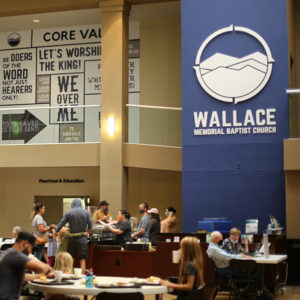
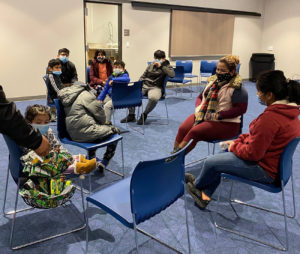
Wallace Memorial Baptist Church in Knoxville, Tennessee, is among area congregations seeking to encourage missions support and involvement at home and around the work. Wallace Memorial’s Love World missions group involves young women in a variety of hands-on missions projects with local ministries such as Welcome House Knoxville. (WMU photo by Pam Henderson)

Kimberly Poore is a member of the Love World team at Wallace Memorial Baptist Church in Knoxville. The missions group, which launched in 2019, is geared toward young women ages 25 to 40. She said the leadership team seeks “to educate and also provide mission opportunities for other Wallace women within our church.”

Love World’s missions focus includes ministering alongside Welcome House Knoxville, a nonprofit ministry that provides temporary housing for immigrant and refugee families in the Knoxville area.

The ministry’s primary aim is “building long-term relationships through short-term housing,” according to welcomehouseknoxville.org. Providing “safe and loving space for individuals and families in transition to permanent housing” allows volunteers “to share the love of Jesus through the ministries of hospitality and friendship.”

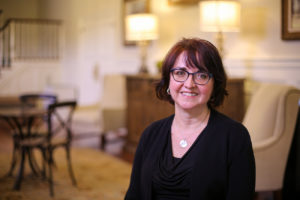
Cindy Hood, the founder and director of Welcome House Knoxville, noted that long-term housing often is difficult to find for many refugees. “We are a ministry that wants to show the love of Jesus through Christian hospitality,” she explained. “I feel like the best I can do is be the hands and feet of Christ in a very practical way. (WMU photo by Pam Henderson)

Cindy Hood, the founder and director of Welcome House, noted long-term housing often is difficult to find for many refugees, especially for larger families and single women with children.

After visiting a similar refugee ministry model while on a family vacation in North Carolina, Hood said she returned home with a burden to partner with Bridge Refugee Services, Knoxville’s local refugee resettlement agency.

Following discussion with leaders at Central Baptist Church of Bearden and Knoxville Internationals Network, she began working to establish Welcome House Knoxville as a nonprofit ministry.

Renting an unused missionary guest house from a local church, Welcome House officially opened in 2019 to provide short-term housing for refugees or other internationals. The ministry also recruited Sunny Ikojoh—who came to the United States as an international student—to serve as the minister of hospitality for guest families.

Meeting needs in times of crisis

Since opening Welcome House’s doors, the ministry has offered help to “several single moms, mostly from Africa, with toddlers,” Hood said. Most recently, they hosted the refugee family of seven from Iraq whose rental home was destroyed last summer in a house fire.

Welcome House Knoxville serves refugee families and other internationals in need to temporary housing. Director Cindy Hood noted that when guests move into Welcome House, “I want it to feel like you’re at a friend’s house and you can relax.” (Photo courtesy of Cindy Hood)

Volunteers from Welcome House, Love World and KIN all came together to help meet that family’s urgent need in the midst of crisis.

“At supper time, they were cooking. The mom stepped out of the kitchen and when she came back in, the kitchen was on fire,” Hood recounted. “It was too much for them to put out themselves. And so they just really escaped with what they were wearing. They had a few trash bags of just some things they grabbed, but most things they lost in the fire.”

After the family spent a sleepless night in a local business where the father works, KIN’s director put them in contact with Welcome House and “they were able to spend their second night at Welcome House,” Hood said.

“We put out on our Facebook page what their story was, and we had churches and individuals give through our website, and we were able to give them gift cards,” Hood said. “A volunteer took them shopping to buy clothing, shoes, personal necessities.”

The Iraqi father asked several times: “Is this safe? Will this be safe for my family?” she recalled.

“I assured him that yes, it was going to be very safe and that Sunny would be taking care of them—and he has,” she said.

“We are a ministry that wants to show the love of Jesus through Christian hospitality,” Hood emphasized. “However, we don’t require that someone is a Christian to live in the house. But we also are very willing to tell them why we’re helping them. … I feel like the best I can do is be the hands and feet of Christ in a very practical way.

“When I got the call about the Iraqi family, they needed to move in the next day,” Hood said. “So, I got in contact with Kimberly Poore. She made a couple of phone calls, and she and another woman were able to meet me and my family—my husband and daughter —and Sunny at the house, and we just went through and cleaned the house super quick.”

When refugees or other international guests move into Welcome House, “I want it to feel like you’re at a friend’s house and you can relax,” Hood said.

“There’s food in the refrigerator,” she said. “There’s clean towels, clean sheets. You don’t have to really think about taking care of yourself for a few hours or a few days. You can just exhale.”

Equip and educate volunteers

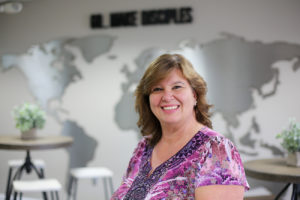
Jani Whaley, executive director of Knoxville Internationals Network, said her group’s goal is to serve internationals “by equipping and educating church members and small groups so that relationships can be built and the gospel message can be given.” Her organization often partners with Welcome House Knoxville to help match available volunteers with various ministry needs. (WMU photo by Pam Henderson)

Jani Whaley, executive director of Knoxville Internationals Network, said her group’s goal “is to reach the internationals through the churches by equipping and educating church members and small groups so that relationships can be built and the gospel message can be given.”

With a database of 300 volunteers, she said, KIN often helps “find volunteers for the Welcome House as far as cleaning and getting supplies.”

Recalling the night of the house fire, Whaley said, the Iraqi family had been living “just down the street from where I live personally.”

“I saw the fire trucks,” she recalled. “I saw the fire, and I didn’t even realize that there was a refugee family that lived in that house. It was just a few hours later I got a call stating a refugee’s house just burned down and there’s five children involved.”

As a former short-term missionary to the Middle East, Whaley said, “I have a heart for all internationals, but there’s something special about those Middle Eastern people that just really tugs at my heartstrings.”

After connecting with the family’s teenage daughter who speaks English, “I went over there within the hour and met the family and talked to the father and met all the children and developed a friendship right then and there,” Whaley said.

The next day, she went over to their house “and loaded them up in my car and just picked through the rubble of their house. We took them to the Welcome House and got them situated.”

‘Do life’ alongside refugee families

Sunny Ikojoh, who serves as minister of hospitality for Welcome House Knoxville, came to the U.S. from Nigeria in 2015 to attend seminary. The Welcome House facility is a former missionary guest house that the ministry rents from a local church to provide short-term housing for refugees. (WMU photo by Pam Henderson)

In his role as minister of hospitality, Ikojoh stepped in to assist the displaced family with day-to-day adjustments.

“When that incident happened, we saw the love of Christ,” he recalled. “We don’t get to choose where we shine the light. The light is meant for everywhere, taking away all darkness all around.”

Ikojoh, who grew up in Nigeria, came to the United States in 2015 to attend seminary. After working with refugee families during a volunteer mission trip, “I fell in love with that. I felt a deep sense that God was calling me into this ministry.

“I cannot fully understand what a refugee experiences. I can’t even fully understand what it means to be a refugee,” he acknowledged. “But being an international student, I can identify that truly they do go through a cultural shock.”

“When we intentionally engage our international neighbors and make them feel at home, then we have been the light of Christ,” Ikojoh said. “We just listen and pay attention and ask the Holy Spirit to guide us as we respond to these needs. I think the goal is to do life alongside these people.”

In her leadership role with Love World, Poore helps coordinate the group’s quarterly gatherings in members’ homes. Activities range from hosting missionary speakers to providing a monthly fellowship brunch for international moms.

When Cindy Hood shared about Welcome House at one of the gatherings, “I felt the Lord really just putting that on my heart to be involved,” Poore said.

While she and other Love World volunteers have served the Iraqi family and other refugees by helping clean Welcome House and provide other needed resources, Poore said she hasn’t personally met the house’s international guests.

But that doesn’t diminish her enthusiasm for her behind-the-scenes ministry opportunities.

“We know their story,” she pointed out. “So, we feel connected to them in that way.

“Being a part of this is important to me because God calls us to be disciples, make disciples of all nations. He also calls us to unite together, to bear one another’s burdens.”

That powerful truth is making a practical impact for refugee families who call Welcome House Knoxville their temporary home.

To view a related video, click here.


Churches offer warm welcome to Texans hit by winter storms

As a winter storm left millions of Texans without electricity in below-freezing temperatures for hours—sometimes even days—some Texas Baptist churches opened their doors to provide warmth and food to affected individuals.

‘So that no one would have need’

Community Missionary Baptist Church in DeSoto opened its facilities as a registered secondary shelter and emergency rescue center.

The church continues to provide food, showers and shelter to anyone in need, including families whose homes are without electricity and the local homeless population.

To comply with COVID-19 safety protocols, the church has placed families in their own individual rooms when possible.

Despite the overwhelming amount of need the church faces, Lynn Harper, young adults pastor at Community Missionary Baptist Church, praised God for giving the church the resources to continue serving people.

He explained that community and service always has been at the heart of the congregation’s mission, as led by Pastor Oscar Epps.

“The root of our ministry is community-style fellowship, like Acts 2, which says, ‘so that none would have need.’ So for us, this service is not a disposition that started from this snow storm, because community has always been in the forefront of our hearts and our pastor’s heart,” he said.

A place of respite and refreshment

First Baptist Church in Richardson partnered with the city to provide a warming station for the community.

Families are encouraged to come and enjoy complimentary hot chocolate and coffee as they warm up and charge their devices. They may also stay the night in the activity center, where cots and blankets have been set up.

Missions Pastor Ron Evans said the church wants to provide respite from the stress and harsh conditions many have had to endure—to be a place where people can relax and temporarily forget about their problems.

Keith Lowry, discipleship pastor at First Baptist in Richardson, explained there are families that have been without power for two days or more in below-freezing temperatures, and providing a space for warmth is essential for peoples’ health.

Whenever there are needs in the community, he said, the church follows Jesus’ command in Matthew 25:40, “‘Truly I tell you, whatever you did for one of the least of these brothers and sisters of mine, you did for me.”

‘God allow us … to be a part of his work’

In Conroe, Under Over Fellowship has been providing shelter to more than 60 people since Feb. 14, when the city contacted the church about opening as a warming center.

Volunteers serve three meals a day to those staying at the church facilities, and they also began delivering hot meals to families and individuals in areas with no power or water, including a community of elderly residents.

Under Over Fellowship Pastor Jerry Vineyard told about an elderly woman in nearby Montgomery, who called the church to say her electricity had gone out. She was frightened that the frigid temperatures could seriously injure her and her two pets.

Vineyard was able to locate a propane heater and drove on icy roads to deliver it to her. Since then, the church has checked in on the woman daily, replacing the propane and providing hot meals for her.

“I think it is a prime opportunity for the gospel. Anytime there is a crisis, people are looking for an answer. And we have the greatest answer to any problem—Jesus,” Vineyard said. “The greatest blessing that comes from all of this is that God allows us to serve. He allows us to be a part of his work.”


Pew study details Black Americans’ faith and religious practice

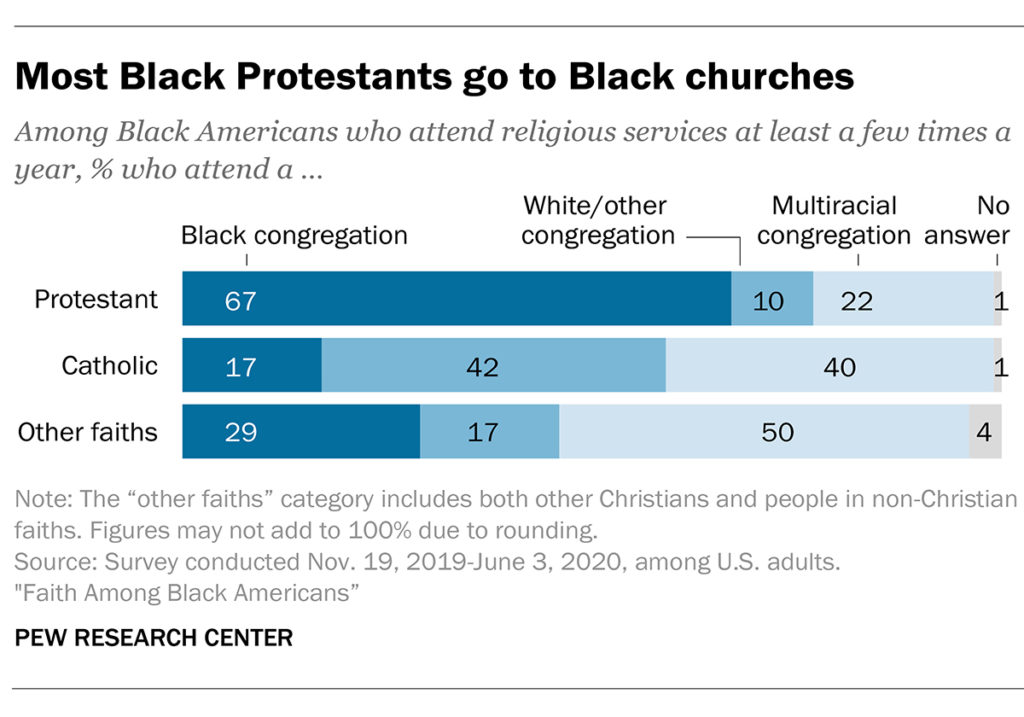
WASHINGTON (RNS)—Most Black Americans attend predominantly Black congregations, but a majority think such congregations should welcome people of other races, a study from Pew Research Center shows.

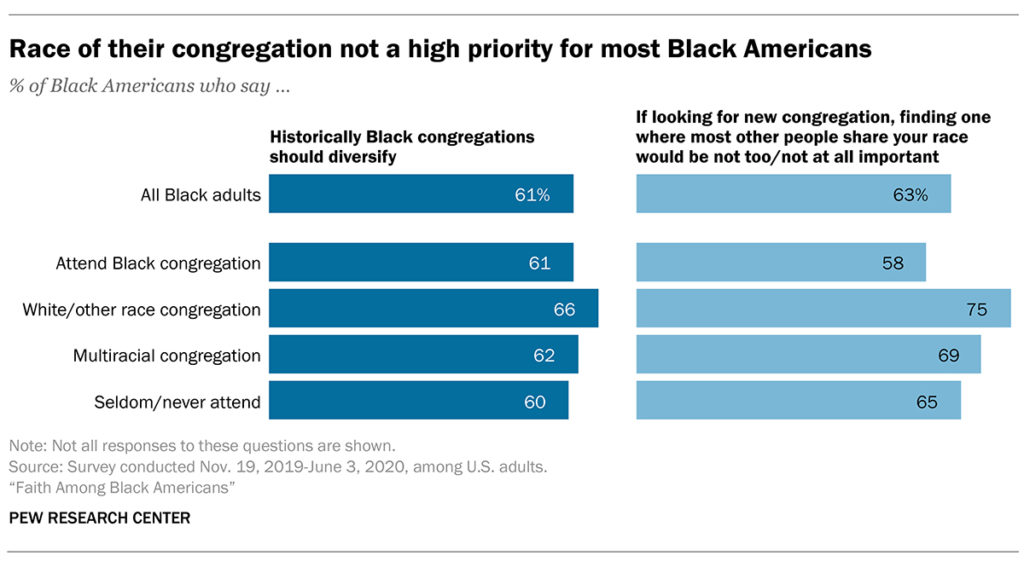
“Most Black Americans, including those who go to Black churches, say that they think congregations that have historically been Black should work to diversify rather than trying to retain their traditional racial character,” said Besheer Mohamed, a Pew senior researcher.

“They say that if they were looking for a new church, the race of a congregation and the race of leadership would be not that important.”

Pew describes its new 176-page report, based on a survey of 8,660 Black adults, as its “most comprehensive, in-depth attempt to explore religion among Black Americans.”

“The number of Black respondents in this study is bigger than most entire studies,” said Mohamed.

He said the breadth of the study could help dispel the notion the Black church is monolithic and could also demonstrate there is more to Black religious life than what happens in church.

“When we ask (about) when you’re making major life decisions, they’re much more likely to say they rely on prayer and personal religious reflection than to say they rely on advice from clergy and religious leaders,” he added.

Black Christians also regard some topics as a matter of faith, even if they aren’t spoken explicitly from the pulpit.

“People see, for example, opposing racism as essential to their faith, whether or not they’re hearing sermons about it,” Mohamed said.

Differences noted within Black America

The large sample size allowed researchers, who conducted their survey from November 2019 through June 2020, to learn some specific differences in beliefs and practices within Black America.

For example, while 44 percent of Black adults overall say clergy should officiate same-sex wedding ceremonies, 37 percent of Black Protestants agree, compared to 62 percent of Black Catholics and 64 percent of religiously unaffiliated Black people.

“Despite the fact that Catholics remain a relatively small share of the Black religious profile, that difference is really striking,” said Mohamed, who is also co-author of the “Faith Among Black Americans” report.

Researchers defined Black congregations as those where most or all attendees are Black and senior religious leaders are Black. Congregations labeled “white or other race” have attendees who are mostly white, Asian, Hispanic or mostly of a different (non-Black) race and are where most or all of the religious leaders are of the same different race as one another. Multiracial congregations primarily are those where no single race makes up the majority of attendees.

Black Protestants comprise two-thirds (66 percent) of Black Americans, while Catholics are 6 percent of that population. Another 3 percent identify with “other Christian faiths,” mostly Jehovah’s Witnesses, and an identical percentage (3 percent) affiliate with non-Christian faiths, most often Islam.

Almost one-fifth (21 percent) are not affiliated, mostly “nothing in particular,” but 3 percent of the unaffiliated say they are agnostic or atheist.

The study also showed differences between Black Americans based on their place of birth and their age.

African immigrants are more likely to be religiously affiliated than U.S.-born Black Americans, but less likely to be Protestant. Both African-born and Caribbean-born Black adults are more likely to be Catholic than Black adults who were born in the United States.

Almost half of U.S.-born Black adults support the idea of religious leaders conducting same-sex ceremonies (46 percent), while 21 percent of African-born adults and 32 percent of Caribbean-born Black adults do.

The study found 23 percent of Black Protestants are affiliated with historically Black denominations, such as the National Baptist Convention USA, Church of God in Christ and the African Methodist Episcopal Church; 32 percent were ambiguous or vague about their affiliation, such as describing themselves as “just Pentecostal” or “just Baptist,” while 30 percent were aligned with mainline or evangelical denominations that are not historically Black. Fifteen percent said they were nondenominational.

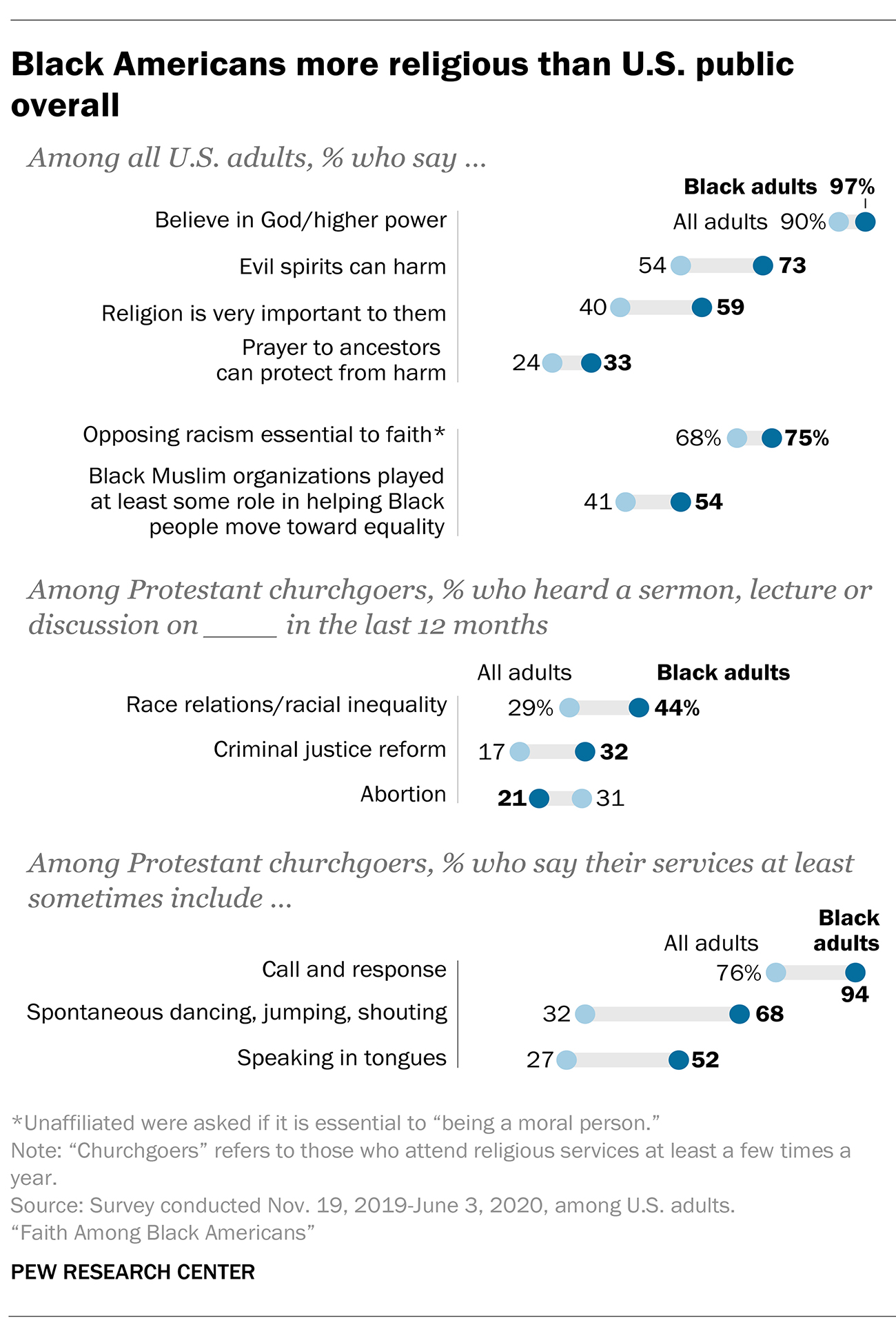
Almost all (99 percent) of Black Americans who attend a Black Protestant church at least a few times a year said they had heard “amen” or other so-called call-and-response expressions of approval in their services; three-quarters (76 percent) said there was dancing, shouting or jumping and more than half (54 percent) said there was praying or speaking in tongues.

Those who attend white, multiracial, Catholic and other Christian churches almost uniformly were less likely to report these experiences. But more than half (54 percent) of Black Americans attending multiracial Protestant churches also reported that speaking and praying in tongues occurred in those settings.
Younger Black adults are less likely to attend predominantly Black congregations, with almost half (53 percent) of both Generation Z (born after 1996) and millennials doing so, compared to two-thirds (66 percent) of both baby boomers and members of the silent generation (born before 1946).

Younger Black adults were also less likely to say they were raised in a Black church, and those who do attend religious services are less likely to attend a congregation that is predominantly Black.

African Americans are more religious than Americans overall, based on their belief in God or a higher power (97 percent compared to 90 percent); opposition to racism being essential to their faith (75 percent compared to 68 percent); believing evil spirits can harm (73 percent to 54 percent); and saying religion is very important to them (59 percent compared to 40 percent).

The study also looked at some of the tensions between what Black Americans think Black congregations should be doing and their actual actions. Mohamed said some findings show Black Americans are more egalitarian than their congregations.

“Men and women are almost as likely to say that opposing sexism is essential to their faith—essential to what being a Christian means to them, if they’re Christian—as to say that opposing racism is, but they’re much less likely to hear sermons about sexism than racism. So we definitely see this difference.”

Among other findings:

  • Church shopping: When looking for a new house of worship, Black Americans want a congregation to be welcoming (80 percent) and offer inspiring sermons (77 percent). Other factors are less likely to be considered “very important,” including belonging to their denomination (30 percent).
  • Prayer: 63 percent of Black Americans say they pray daily; one in five (20 percent) pray at a home altar or shrine at least a few times a month.
  • Sermons: An equal number of Black Protestant churchgoers—nearly half—have heard sermons on the topic of racial inequality (47 percent) and on voting (47 percent).
  • Political party: Almost two-thirds of Black Democrats (64 percent) who go to religious services attend a Black congregation, compared to fewer than half of Black Republicans (43 percent). By a 2-1 margin (22 percent to 11 percent) Black Republicans are more likely than Black Democrats to attend houses of worship where most of the congregants are white.
  • Time: More than a quarter of Black religious service attendees (28 percent) say their services last about two hours, and a third (33 percent) say they last an hour and a half. Another 14 percent say their services last more than two hours.

The study had an overall margin of error of plus or minus 1.5 percentage points for the sample of 8,660 Black adults and margins of error for specific groups, ranging from plus or minus 1.5 percentage points for U.S.-born Black respondents to plus or minus 8.6 percentage points for African-born respondents. An overall sample of 13,234 U.S. adults had a margin of error of plus or minus 1.5 percentage points.


Christians in Congo face growing terrorist violence

EASTERN CONGO (BP)—Spiraling Islamist terrorism that has killed more than 100 people in a two-week span in the Democratic Republic of Congo is calling renewed attention to Christian persecution there.

The terrorist group Allied Democratic Forces is blamed for the deaths in at least three attacks in late December and early January in efforts to establish a Muslim caliphate in the predominantly Christian country, Open Doors reported.

“The killing of innocent civilians on an almost daily basis is an underreported tragedy,” Open Doors senior analyst Illia Djadi said after the attacks spanning Dec. 31-Jan. 14. “It is a reminder of what is happening in other parts of the central Sahel region.”

Djadi compares the violence to that spreading across the Sahel region of northern Nigeria, where Boko Haram and related extremists are blamed for 37,500 deaths since 2011, according to a new report from the U.S. Commission on International Religious Freedom.

“Think of groups like Boko Haram in northeast Nigeria for example,” said Djadi, who covers freedom of religion or belief in Sub-Saharan Africa for Open Doors. “The ideology, the agenda of establishing a ‘caliphate’ in the region, and the way they operate is the same, and we can see how they afflict terrible suffering on innocent people.”

Congo on Open Door’s World Watch List

ADF has been active in Congo for decades, but its expansion led Open Doors to include Congo for the first time this year on its World Watch List of the 50 most dangerous countries for Christians.

Congo, which is 95 percent Christian, debuted at number 40, mainly ranked for violence, persecution against churches and social persecution against Muslims to convert to Christianity.

“The attacks from the ADF and other militant groups in the DRC are why violence is a huge risk for the Christian population and churches in the regions where militants are active,” Open Doors said in its 2021 Watch List.

“The violence has resulted in more than a million internally displaced people. Additionally, followers of Jesus are at risk for kidnappings and having their homes destroyed.”

ADF attacks have reportedly increased since authorities launched an offensive against the group in October 2019. In the latest attacks in Congo, the ADF is blamed for killing 46 members of the Pygmy ethnic group in Ituri province on Jan. 14, 22 civilians in an overnight raid on the village of Mwenda on Jan. 4, 17 residents of a nearby village the previous week, and 25 people in the village of Tingwe on Dec. 31, Open Doors said. ADF used guns and machetes.

The U.N. has said the ADF is connected to a network of jihadists across Africa. Unlike Boko Haram, the ADF has not linked itself to the Islamic State group, but ISIS has begun to claim responsibility for ADF attacks.

ADF, Boko Haram and the Islamic State in West Africa Province are broadly accused of committing war crimes and crimes against humanity. In its latest report, USCIRF said there is reasonable evidence that Boko Haram and the ISWAP have committed such crimes, and recommends regional approaches to fighting such violence.

“Regional approaches continue to put pressure on violent jihadist groups operating in this region, primarily through military operations. However, militant Islamist groups in Nigeria demonstrate remarkable staying power and threaten to coopt and ‘Islamize’ other violent conflicts in Nigeria and throughout the region,” USCIRF said. “Thus, these groups will likely continue to pose threats to religious freedom in Nigeria and elsewhere in the future if efforts do not adapt to address the challenges facing the current approach.”


Around the State: International association moves to DBU

The International Association of Baptist Colleges and Universities—an organization that seeks to advance Baptist higher education through connection, collaboration and sharing best practices—has moved its home office from Samford University in Birmingham, Ala., to the Dallas Baptist University campus. “Christian higher education is at a crossroads,” said Ashley Hill, executive secretary of the association. “Never before in history have there been greater challenges, but with great challenges come great opportunities.” The association’s goal is “to ensure that our Baptist colleges, universities and seminaries band together to weather these days and come out better positioned to serve students as they seek to serve the Lord,” she said. It sponsors an annual conference each summer, publishes The Baptist Educator journal and hosts webinars, fellowships, mentoring programs, and other services. Hill earned her undergraduate degree from Auburn University and a Master of Arts in Professional Development degree with a concentration in higher education from DBU. She is pursuing an Ed.D. in higher education administration from Southwestern Baptist Theological Seminary. She and her husband Jonathan have two daughters—Patterson, who is in the seventh grade; and Mary Anneliese, a freshman at DBU.
Howard Payne University has postponed its Spring Family Reunion, originally scheduled for Feb. 20. The move was prompted by the American Southwest Conference’s decision to postpone competition through Feb. 21 due to extreme weather conditions. HPU’s event was to feature tailgate activities prior to the HPU football game at Gordon Wood Stadium. The university will announce a rescheduled date and other related details when finalized.

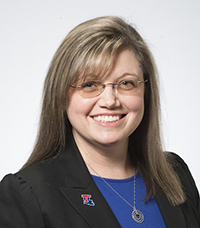
Katie Evans was named dean of the College of Science and Engineering and professor of mathematics at Houston Baptist University. For the past 16 years, Evans was a professor and administrator at Louisiana Tech University. President Robert Sloan said Evans’ “academic experience, commitments to teaching and research, personal faith and history of administrative excellence make her a great fit for this important role at HBU.” Her appointment at HBU is effective beginning July 1. As a first-generation college student, Evans graduated summa cum laude in mathematics from Morehead State University, then earned her Master of Science Degree and doctorate in mathematics from Virginia Tech. After a postdoctoral research experience in mechanical engineering at Oregon State University, she began her academic career at Louisiana Tech.
____________________________________________________________________________________

Around the State

Update us with your ordinations, ministry anniversaries and retirements


Refugee resettlement offers ministry opportunities

WASHINGTON (BP)—The decision to increase dramatically the number of refugees to be welcomed into the United States will provide Christians important opportunities for gospel witness and service to those fleeing oppression, some Baptist leaders said.

President Biden announced Feb. 4 he would raise the ceiling for refugees to 125,000 in the federal fiscal year that will begin in October and issued an executive order designed to rebuild the resettlement program.

The president, as well as agencies that help resettle refugees in this country, acknowledged the rebuilding process will take time. The new cap far surpasses the ceiling of 15,000 set by the Trump administration during its final year.

The church’s role: ‘Show the love of Christ’

“It’s the government’s role to determine the immigration and refugee resettlement policy for our nation,” said Bryant Wright, president of Send Relief. “It’s the church’s role to show the love of Christ in hopes that their hearts will be open to receiving the greatest expression of God’s love through salvation in Jesus Christ.”

Send Relief is the Southern Baptist Convention’s compassion ministry performed through the cooperative effort of the North American Mission Board and International Mission Board. Care for refugees is one of Send Relief’s focus areas.

“Jesus commanded the church to go and take the gospel to the nations,” said Wright, a former SBC president. “So, when the nations come to where we live in the United States, what an opportunity that God is giving the church to show Christ’s love.”

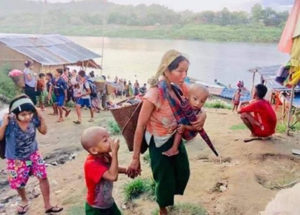
Through the work of indigenous church planters and in partnership with the Karen Baptist Convention and other regional Baptist groups, Greater Houston Burmese Christian Fellowship has continued its ministry to internally displaced people and refugees in Myanmar, even when COVID-19 prohibited international travel. (Photo courtesy of Greater Houston Burmese Christian Fellowship)

Russell Moore, president of the SBC Ethics & Religious Liberty Commission, said he prays Christians “will lead the revitalization of America’s commitment to be a beacon of freedom and safe harbor for the oppressed and persecuted.”

“Our advocacy for religious minorities in peril around the world, whether they be Uyghurs in China or Christians in Syria, is a priority of our work at the ERLC,” said Moore, who expressed his gratitude for Biden’s actions. “Now is the time to rebuild America’s refugee resettlement program. … I urge the administration to take the next step and officially raise the refugee ceiling.”

The newly announced refugee cap follows four years of record-low ceilings established by President Trump—from 45,000 in the 2018 fiscal year to 30,000 in 2019 to 18,000 in 2020 and 15,000 in the current year. In the 10 years prior, the United States welcomed an average of about 67,000 refugees each year, according to the Pew Research Center.

The number of admissions often is less than the ceiling. The record high for the cap and admissions is 232,000 and 207,000, respectively, in 1980, Pew reported.

Global increase in refugee population

The United States’ reduction in the ceiling has come at a time when strife in multiple countries has resulted in massive numbers of refugees. As of mid-2020, an estimated 26.3 million people were considered refugees, according to the U.N. High Commissioner for Refugees. More than 80 million people, including 30 to 34 million children, were forcibly displaced, the UN reported.

More than 60 percent of refugees—as well as Venezuelans who were displaced abroad—were from five countries. In addition to Venezuela (3.7 million people), they were the Syrian Arab Republic (6.6 million), Afghanistan (2.7 million), South Sudan (2.3 million) and Myanmar (1 million).

The United Nations has defined a refugee as “someone who is unable or unwilling to return to their country of origin owing to a well-founded fear of being persecuted for reasons of race, religion, nationality, membership of a particular social group, or political opinion,” according to its 1951 Refugee Convention.

Refugees must pass a stringent screening process that includes multiple biometric and biographic checks and an interview before being eligible to enter the United States, according to 2020 guidelines by the U.S. Citizenship and Immigration Services. The processing time before refugees enter this country averages 18 months to three years, the Christian humanitarian organization World Relief reported.

Baptists have history of ministry to refugees

The Southern Baptist history of ministering to people fleeing to the United States includes the sponsoring of nearly 15,000 refugees from 1975 to 1985, which resulted in the planting of more than 280 ethnic churches, according to a resolution approved by messengers to the 2016 SBC annual meeting.

The 2019 back-to-school event in Clarkston, Ga., is one example of the kinds of projects Send Relief carries out to serve refugee families. Caring for refugees is one of Send Relief’s focus areas for compassion ministry. (BP Photo)

Send Relief served 13,933 people in its work with refugees and internationals in North America in 2020. It mobilized more than 850 people to serve in refugee ministry. Those numbers do not include overseas work with refugees.

Southern Baptists in Montgomery, Ala., are among those who serve refugees. Montgomery Baptist Association collaborates with First Baptist Church in Montgomery to minister to 250 to 300 international families, including refugees, from 42 countries, said Susan West, director of the association’s conversational English ministry. More than 30 churches participate in the ministry, and others support the work financially.

During the 2019-20 school year, the ministry served 13 refugee households before the COVID-19 pandemic, West said. It has ministered to at least six refugee families this school year. The refugees during these two years have come from three continents, she said.

“As followers of Jesus, we are called to welcome the strangers among us,” West said in an email interview. “No passport is needed to do the Great Commission in our own neighborhoods. The world is here.”

The practical ministry to refugees and other internationals includes English classes, as well as preschool childcare and transportation to the classes for many families, West said. It also consists of a citizenship class, the opportunity to grow food in a community garden and trips to museums and other local sites. The volunteers also accompany families to medical appointments and parent conferences at school as requested. They cook and eat with the refugees and other internationals and otherwise spend time developing relationships, she said.

Each family is offered a Bible in its “heart language,” and each child receives a copy of the Jesus Storybook Bible. Their reading of the Bible prompts questions of the volunteers, West said.

Literacy ministries open doors

lester meriwether200
Lester Meriwether

Lester Meriwether, executive director of Literacy Connexus, agreed English-as-a-Second-Language classes and other literacy ministries help churches establish relationships that open doors to ministry and Christian witness.

While it will take refugee resettlement agencies time to rebuild the infrastructure lost in the past four years, churches can begin now to prepare for ministry to refugees in the months and years ahead, Meriwether asserted.

He suggested practical steps to take now:

  • Foster understanding. Issues related to immigrants, refugees and asylum seekers have become politicized in recent years, he observed. The political climate has made some pastors reluctant to support ministry to those groups because they are fearful of creating congregational division and conflict, he added. Focus on clear needs, such as reading readiness programs from preschool children from non-English-speaking families. “Trust the lay people,” Meriwether said. “When they see the needs, they will respond.”
  • Learn from other churches. Look at success stories. Some Texas Baptist churches have been involved for decades in ministry to internationals in general and new arrivals in particular. ESL classes often have been starting points for other ministries such as cooking classes, sewing circles, Bible studies and other programs. “Once a church reaches out to people with classes in English proficiency, ministry can go many different directions,” he said.
  • Train volunteers. Literacy Connexus typically trains about 300 volunteers a year in ESL instruction, but it had to suspend training events for the past year to the COVID-19 pandemic. However, plans are in place to resume in-person training—as well as teleconferences—in upcoming months.

For more information, click here.

With additional reporting by Managing Editor Ken Camp. 


CommonCall: Ministry of Grace

When Mark Grace retired at the end of January as chief mission and ministry officer at Baylor Scott & White Health, it marked the end of a career in institutional chaplaincy. But it doesn’t mean Grace will stop serving in what he calls “ministry on the boundaries.”

Growing up as a preacher’s kid, Grace felt a call to ministry early in life and started preaching at age 13. He followed the typical path to the pastorate, earning an undergraduate degree in religion at Howard Payne University and a Master of Divinity degree from Southwestern Seminary.

As a college student, Grace spent three summers on the Rio Grande, working as a student missionary with Texas Baptists’ River Ministry. He points to Elmin Howell, founding director of River Ministry, as a major influence in his life.

“A lot of what shaped my approach to ministry I learned on the River,” he said. “I learned that you meet people where they are, and you go serve them.”

‘Where I needed to be’

With his Spanish skills and educational background, Grace assumed he likely would serve as pastor of a Hispanic Baptist church after graduating from seminary in 1983. But near the end of his time at seminary, personal involvement with the Azle Pastoral Counseling Center pointed him in a different direction.

“I went to Baylor University Medical Center,” he recalled. “I lacked a lot of skills. But I learned the difference between ham-fisted helping and real helping. … After three weeks, I just knew it was where I needed to be.”

Grace felt more comfortable in a setting where he ministered among people of all faiths and no faith and trained others to do so, rather than “moderating a business meeting in a Baptist church.”

“Chaplaincy is ministry on the boundaries,” he said. “Hospital chaplaincy is on the boundaries of science and faith, of the church and the world. I’m not necessarily interested in just doing ministry that’s limited to within the church walls.”

After several years working as a chaplain and as coordinator of chaplaincy ministry, Grace became director of pastoral care and counseling at Baylor. He worked in that role 16 years.

“I was free to make it up as I was going along,” he said.

‘We can do better’

Along the way, Joel Allison—then CEO of the Baylor Health Care System—talked to him about how the hospital system could do more in terms of its Christian ministry of healing.

“Joel said, ‘Mark, I think we can do better,’” Grace recalled.

That led to the creation of the office of mission and ministry at the health care system and Grace’s appointment as vice president overseeing it. The office coordinates three components—spiritual care to patients, their families and hospital staff; pastoral education programs for ministers and seminary students; and Faith in Action initiatives.

When it launched, Allison outlined a four-fold purpose for the office of mission and ministry:

  • Re-envision ways to strengthen and streamline the health care system’s Christian ministry of healing.
  • Explore new ways to engage and support employees as they live out their faith and values in service to others.
  • Embed mission and ministry across the entire health care system.
  • Partner with other Christian agencies to help meet medical missions needs locally and globally.

Don Sewell, who had worked with the Baptist General Convention of Texas as its director of Partnership Missions, joined the staff to lead the Faith in Action initiatives. Among other ministries, Faith in Action has enabled the hospital system to direct outdated but perfectly good equipment and supplies to medical and humanitarian missions causes around the world.

As Sewell said after the health care system sent a 40-foot container filled with examining tables, hospital beds, stretchers and other supplies to an overseas hospital: “It’s old to us, but it’s gold to some hospitals in other countries.”

Helped shape institutional culture

In his role as chief mission and ministry officer, Grace has helped shape the culture throughout Baylor Scott & White Health.

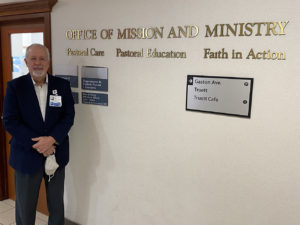
Mark Grace retired at the end of January as chief mission and ministry officer at Baylor Scott & White Health. (Photo courtesy of Baylor Scott & White)

“Our core commitment is advocating for genuine whole-person care, which I believe is at the heart of the ministry of a Christian healing institution,” he said.

“Sometimes I hear people say (about the health care system), ‘We need to be uncompromisingly Christian,’” Grace said. “I understand what they are saying, but I think we need to be uncompromisingly caring and compassionate.”

Looking at the statistics, he noted, a rising percentage in the general population either claim no religious affiliation or have walked away from the religious traditions they once followed.

“The nones and the dones show up in the hospital every day,” Grace said.

Those individuals are unlikely to respond to someone preaching to them, but they are receptive to loving actions, he noted.

“If the gospel is not there at the worst moments of life for a person, it’s not worth the paper it’s printed on,” Grace said.

Innovation and creativity

During the COVID-19 pandemic, bringing the gospel message of hope to people in crisis has demanded creativity. Fortunately, prior to the pandemic, the health care system already was exploring the potential for telecare and video-based chaplaincy.

Grace has felt comfortable in an environment that embraces innovation.

Mark Grace, recently retired chief mission and ministry office at Baylor Scott & White Health, visits with Karla Ramberger, chief nursing officer for Baylor University Medical Center. (Photo courtesy of Baylor Scott & White)

“You’ve heard of a calf looking at a new gate? I never saw a new gate I didn’t like,” he said.

In addition to ministering to patients and their families, the hospital chaplains have offered spiritual support to physicians and nurses during a time of exceptional stress, anxiety and uncertainty.

“I’ve been amazed at their courage and their willingness to throw themselves into the breach,” Grace said.

Early in his retirement, he plans to take three months off for rest and renewal—and spend time with grandchildren.

After that, he wants to minister among the residents of West Dallas through Iglesia Bill Harrod, where he and his wife Linda were senior pastors eight years before transitioning to pastor emeritus status.

“I love West Dallas,” Grace said of the neighborhood served by Iglesia Bill Harrod—located in one of the region’s poorest ZIP Codes.

He also hopes to do more writing, particularly on the subject of prayer.

“I’ve grown to have a deeper and deeper understanding of the importance of prayer,” he said. “I want to help people understand especially the power of prayer in their lives.”

Read more articles like this in CommonCall magazine. CommonCall explores issues important to Christians and features inspiring stories about disciples of Jesus living out their faith. An annual subscription is only $24. To subscribe to CommonCallclick here.