Supreme Court agrees to hear abortion case
WASHINGTON (RNS)—The U.S. Supreme Court will hear a case involving a challenge to a Mississippi law prohibiting most abortions after the 15th week of pregnancy, a move that could have nationwide implications.
The case, Dobbs v. Jackson Women’s Health Organization, revolves around a Mississippi law passed in 2018 that bans all abortions after 15 weeks “except in a medical emergency or in the case of a severe fetal abnormality.” The ban was blocked by lower courts who argued it violated previous Supreme Court rulings.
The case centers on whether states are permitted to ban abortions before a fetus can survive outside the womb and is seen as a direct challenge to Roe v. Wade, a landmark 1973 Supreme Court decision that legalized abortion nationwide.
The Texas Legislature approved a bill banning abortion when a fetal heartbeat is detected, arguably as early as six weeks. The legislation makes an exception for medical emergencies but not for rape or incest.
The bill also empowers private citizens to sue abortion providers or anyone helping a woman get an abortion after a fetal heartbeat can be detected. Gov. Greg Abbott signed the bill into law on May 19.
New composition of the Supreme Court
Justices will likely hear the Dobbs v. Jackson Women’s Health Organization case in the fall, marking the first time the conservative-leaning court will directly address the issue of abortion since Amy Coney Barrett was elevated to Supreme Court justice in October 2020.
 Barrett, a conservative Catholic, twice voted in abortion-related cases before joining the Supreme Court, both times in ways seen as benefitting abortion restrictions. In 2006, she signed a newspaper ad opposing “abortion on demand.”
Two other justices appointed by President Trump—Neil Gorsuch and Brett Kavanaugh—voted in a different case last year that could have closed two of Louisiana’s three abortion clinics. They were outvoted, with Chief Justice John Roberts, a conservative, joining liberals in striking down the law in question.
But with Barrett replacing the late Justice Ruth Bader Ginsburg since then, the conservative-leaning court may not need Roberts’ vote should they decide to uphold the Mississippi law.
Pro-life groups encouraged
March for Life, the anti-abortion group that hosts an annual event of the same name in Washington, D.C., expressed support for upholding the Mississippi law in a statement.
“States should be allowed to craft laws that are in line with both public opinion on this issue as well as basic human compassion, instead of the extreme policy that Roe imposed,” read a statement from Jeanne Mancini, the group’s president.
Elizabeth Graham of the Southern Baptist Ethics & Religious Liberty Commission said the Supreme Court’s consideration of the case “could be a generationally significant case for the future of abortion in America.”
“All Americans of goodwill want the state to protect their neighbors from harm, and yet, just as Jesus told us, we will argue among ourselves about who really counts as our neighbor,” said Graham, the ERLC’s vice president of operations and life initiatives.
“The question our nation must wrestle with is whether or not a child in the womb is, indeed, a preborn child and, therefore, our neighbor. As Christians, knowing the answer is not a reason to feel moral superiority, but to lament the abortion industry’s legal lies and to work to undo them. This case could be instrumental toward that end.”
Abortion rights advocates concerned
Abortion-rights advocates raised warnings about the threat to Roe.
The Supreme Court order “is an ominous sign and an alarming reminder that the threat to the legal right to abortion is imminent and real,” said Christian LoBue, chief campaigns and advocacy officer for NARAL Pro-Choice America. “If Roe v. Wade were to fall as a result of this case, states across the country are poised to ban abortion.”
Lower courts struck down Mississippi’s 15-week ban. Based on Supreme Court precedent, a federal judge ruled in 2018 the law is unconstitutional because it prohibits pre-viability abortions. The Fifth Circuit Court of Appeals in New Orleans affirmed the ruling the following year.
Alabama and Arkansas approved bans in 2019 and 2021, respectively, without a starting point in pregnancy. At least 10 states have enacted laws that prohibit abortion after a fetal heartbeat can be detected, which could occur as early as six weeks into pregnancy.
Through the first four months of 2021, a total of 13 states placed into law 61 abortion restrictions, including eight bans on the procedure, according to a report issued April 30 by the Guttmacher Institute.
With additional reporting by Tom Strode of Baptist Press and Managing Editor Ken Camp. The 5th paragraph was edited after the story initially was posted to note Gov. Greg Abbott’s action.
 Joreen Hayes Bozeman of Garland, Christian educator and conference leader, died May 13. She was 90. She was born March 5, 1931, in Manning to David Franklin Hayes and Zula McGaughey Hayes, the eighth of 10 children. She married Karl Bozeman on Aug. 18, 1951, and served alongside him in ministry for decades. She was a kindergarten teacher seven years and taught preschoolers more than 30 years. She worked as the director of childhood education on a church staff and was a preschool curriculum writer for the Baptist Sunday School Board. She led training conferences in 38 states and taught leadership conferences at Glorieta Baptist Assembly and Ridgecrest Conference Center many summers. In later years, she taught senior adults, and in her final years, she played hymns on the piano for residents at the assisted living center where she and her husband lived. The Women’s Auxiliary Board at Dallas Baptist University, on which she served about 15 years, presented her the Ruth Award in 2008. She is survived by her husband of 69 years, Karl; daughter Karen Gray and husband Gary of Pine Bluff, Ark.; daughter Brenda Hass and husband Artie of Garland; six grandchildren; 12 great-grandchildren; and a sister, Mary Still of Lufkin.




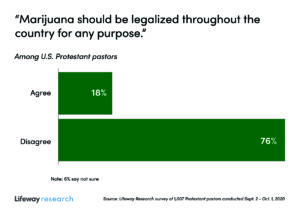 Among Protestant pastors, however, few believe marijuana use should be legal nationwide. According to a
  Few pastors see nothing wrong with smoking marijuana to get high. Closely matching legalization percentages, almost 4 in 5 Protestant pastors (78 percent) agree getting high smoking marijuana is morally wrong, 17 percent disagree, and 5 percent are not sure.
 “While marijuana and many other narcotics are not mentioned in the Bible, getting drunk to the point of triggering hallucinations is,” McConnell said. “There is consistent rebuke throughout Scripture for using alcohol to the point of losing control of your words and actions that pastors reflect in their reactions to marijuana today.”