Litton, Greear say permission granted to borrow from sermon

NASHVILLE (BP)—Following the release of a video showing similarities in a sermon, SBC President Ed Litton and his predecessor J.D. Greear said Litton had sought and received permission to use material from a sermon earlier preached by Greear.

The video, which was released June 24, contains six minutes, 57 seconds of interwoven clips from a sermon delivered by Greear in January 2019 and another by Litton in January 2020. Both messages, based in the book of Romans, addressed homosexuality. Greear’s sermon lasted 53 minutes, 31 seconds; Litton’s was 40 minutes, 45 seconds in length.

JD Greear 200In a statement released June 26, Litton, senior pastor of Redemption Church near Mobile, Ala., said although he had received permission, he apologized for not crediting Greear. Greear confirmed Litton’s account in a statement issued the same day, writing:

“I told him whatever bullets of mine worked in his gun, to use them!”

Litton was elected SBC president June 15 at the SBC annual meeting in Nashville, succeeding Greear. After the election, he described the SBC as “a family” that sometimes seems dysfunctional but said he hoped to build bridges during his tenure, and that Southern Baptists would “leave this place focused … with a direction—and I believe a better direction—for the future.”

In the statement, Litton described a sermon preparation process involving a preaching team of eight men from the Redemption congregation and staff who “meet weekly to discuss study insights, outlines, and approaches to the text” in addition to consulting commentaries as well as other books and individuals.

Permission obtained to use material
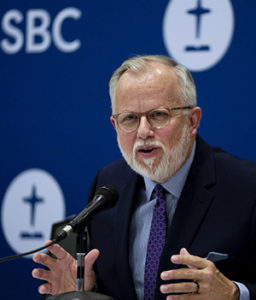
Ed Litton answers questions during a news conference following his election as Southern Baptist Convention president. (Photo / Adam Covington)

According to Litton, as the team met to plan a series on Romans, their process led them to Greear’s message on Romans 1, which Litton found “insightful, particularly his three points of application.”

Litton said along with permission to use that material, Redemption’s preaching team also secured permission from The Summit Church to use the chapter and verse breakdown.

“My own take on these kinds of things is usually shaped by the input of many godly men and women,” Greear wrote. “Ed and I have been friends for many years and we have talked often about these matters, and I was honored that he found my presentation useful.”

That particular sermon, Greear wrote, had “got[ten] a lot of traction, and clips and summaries of this message were shared on a number of blog and podcast sites.” He added that it was “one of the most widely distributed messages I’ve ever preached at The Summit Church.”

In his June 26 statement, Greear also responded to accusations that in the sermon, he had adapted a story from Paul David Tripp as his own. The account was about seeing the lostness on display while visiting a pagan temple—Greear in Southeast Asia and Tripp in northern India.

“I had had the same experience [as Tripp],” said Greear, who served in Southeast Asia with the International Mission Board. “In fact, almost every missionary I know has had this same moment of revelation. It’s a common insight among missionaries on the field, one that is shared often in prayer and support circles.”

Greear said he had related the experiences as his own because they had, indeed, happened to him and were common among missionaries. Litton, who has never lived in Asia, chose instead to relate the story in Tripp’s words.

In a statement released June 28, elders of Redemption Church addressed their reasoning in removing some sermons from the church’s YouTube channel and website.

“By the action of the leadership at Redemption Church we have taken down sermon series prior to 2020 because people were going through sermons in an attempt to discredit and malign our pastor,” the statement from the elders said. “It is our highest priority to care for and shepherd our church.”

Sermons from 2020 through the present are posted to Redemption’s YouTube channel. Sermons from 2021 are currently posted to the church’s website.

The video with clips from Greear’s and Litton’s sermons is hosted by an anonymous YouTube account, which was created June 24, the same day the video was published. The anonymous account has no other videos.

‘I should have given him credit’

In the statement issued Saturday, Litton said he should have publicly credited Greear at the time of his sermon.

“As any pastor who preaches regularly knows, we often rely on scholars and fellow pastors to help us think and communicate more clearly with the goal of faithfully preaching the truths of Scripture to our congregations,” Litton wrote. “But I am sorry for not mentioning J.D.’s generosity and ownership of these points. I should have given him credit as I shared these insights.”

Litton wrote that “out of a commitment to full transparency,” he had gone through all 46 sermons in the Romans series, finding “in some places similar illustrations, quotes or points of application.” He said one sermon shared a title with a Summit sermon, another a similar outline.

Addressing the matter, he wrote, is important “to provide the truth and to take responsibility for places where I should have been more careful.”

“I am committed to being a man of integrity and humility,” Litton wrote. “I will not waver from that as I lead Redemption Church to be Christ followers and the SBC to unite around her mission.”


Convención a family reunion after pandemic

DALLAS—After COVID-19 prevented the Hispanic Baptist Convention of Texas from meeting in person last year, this year’s June 27-28 gathering at Dallas Baptist University looked more like a family reunion and worship celebration than a business meeting.

“The COVID-19 pandemic brought us disruptions, challenges, fear, pain and much more,” said Jesse Rincones, executive director of Convención. “These challenges and even the loss of loved ones reached our congregations and affected the lives of our people.”

Even so, he noted, Hispanic Texas Baptists have reason to give thanks to God for his constant love, for pastors and churches who adapted and continued to minister, for members who remained faithful in giving and service, and for the ability to continue cooperating in missions and ministry, Rincones noted.

“Una Iglesia Fortalecida” (A Strengthened Church) was the theme of the Convención annual meeting, as Hispanic Texas Baptists celebrated God’s faithfulness in bringing them through a difficult time.

Tony Miranda, president of the Hispanic Baptist Convention of Texas, preaches to the Convención annual meeting at Dallas Baptist University. (Photo / Ken Camp)

“In a changing world, there are truths that do not change,” Tony Miranda of Primera Iglesia Bautista in Austin told the Hispanic Baptist Convention of Texas in his presidential message.

The COVID-19 pandemic brought many unwelcome changes in 2020, but it also enabled God’s people to see more clearly those spiritual truths from God’s word that are unchanging and immovable, he emphasized.

“The message of salvation and hope we proclaim is the same before, during and after COVID,” Miranda said. “This message has the same power to save, and the world needs it both yesterday and today.”

The Holy Spirit is with God’s people and indwelling God’s people, and no pandemic can change that, he stressed.

“In such a changing world, in the midst of chaos and despair, let us trust in the Lord based on this truth. Be strong in the grace that is in Christ Jesus,” Miranda said.

Ramón Medina, global pastor of the Spanish ministries of Champion Forest Baptist Church in Houston, pointed to Acts 16 as an example of how God sometimes changes the plans we have made.

The Apostle Paul had his own well-planned missionary journey in mind. But Paul adjusted those plans and responded in obedience when he was called to preach the gospel in Macedonia, Medina explained.

“I must remember that my good plan is not always God’s plan,” he said. “I must keep my heart humble to discover God’s plan.”

Officers elected

During a brief business meeting, Convención messengers re-elected by acclamation Miranda as president and Abiel Ake of Primera Iglesia Bautista in Edinburg as secretary.

Messengers also elected Silvia Ake of Edinburg as first vice president and re-elected Edson Lara of McAllen as second vice president.

They approved a $396,000 budget for 2022, with the bulk of the budget devoted to administering the Thriving in Ministry and Thriving Congregations grants from the Lilly Endowment.

New directors approved for the Convención executive board are Eder Ibarra from Calvary Baptist Church in McAllen, Eduardo Marquez from Iglesia Bautista Hosanna in Houston, Sergio Ramos from The Promise Church in Dallas and Abigail Rojas from Iglesia Bautista Azle Avenue in Fort Worth.

Convención recognized as the Top 15 cooperating churches: Iglesia Bautista Getsemani in Fort Worth, Alliance Baptist Church in Lubbock, Calvary Baptist Church in McAllen, Woodland Baptist Church in San Antonio, Iglesia Nueva Vida in Brownwood, Iglesia Bautista Redencion in Houston, Azle Avenue Baptist Church in Fort Worth, Iglesia Bautista Segunda in San Angelo, New Life at the Cross in Corpus Christi, Agape Baptist Church in San Antonio, Iglesia Bautista Victoria en Cristo in Fort Worth, Hispana Baptist Church in Lubbock, Emmanuel Baptist Church in McAllen, Iglesia Bautista Emanuel in Farmersville and Iglesia Bautista el Calvario in Mount Pleasant.


Bautistas de El Paso abren un centro de ministerio para migrantes

Las necesidades cambiantes de una iglesia de El Paso y las crecientes necesidades de las personas recién llegadas a la frontera entre Estados Unidos y México coincidieron para ayudar a abrir un nuevo ministerio en conjunto.

Durante una oleada de inmigración anterior, el pastor principal de la Iglesia Bautista Scotsdale en El Paso, Patrick Six, comenzó a pensar en cómo su iglesia podría participar en un ministerio para los migrantes.

Él y algunos otros pastores de la Asociación Bautista de El Paso discutieron si la iglesia podría albergar tal ministerio. Sin embargo, cambios dramáticos en la política de inmigración y la pandemia de COVID-19 pusieron esos planes en espera.

Mientras tanto, durante la pandemia, la Asociación Bautista de El Paso se asoció con el programa Farmers to Families (De los Agricultores a las Familias) del Departamento de Agricultura de EE. UU. para satisfacer las necesidades alimentarias en el área. En un año, la asociación ayudó a distribuir más de $8 millones en alimentos frescos a familias a través de 150 iglesias y organizaciones locales.

Una puerta se cierra, otra se abre

Larry Floyd, director ejecutivo de la Asociación Bautista de El Paso

Cuando terminó la participación de la asociación en ese programa, los líderes se dieron cuenta de una afluencia renovada de migrantes, refugiados y solicitantes de asilo, y de la oportunidad de ayudar a un grupo en particular.

“Estas son personas que han sido examinadas minuciosamente y se les ha otorgado un estatus legal temporal que les permite estar en los Estados Unidos, pero necesitan ayuda para conectarse con sus patrocinadores en este país”, dijo Larry Floyd, director ejecutivo de la Asociación Bautista de El Paso.

Si bien algunas otras agencias y organizaciones en El Paso ayudan a vincular a los recién llegados con sus patrocinadores en los Estados Unidos, la mayoría ofrece esa ayuda “menos el evangelio”, dijo Floyd. Por experiencia previa, estaba convencido de que brindar el servicio ofrece una vía para compartir el amor de Cristo.

Cuando Floyd fue pastor de City Church (Iglesia de la Ciudad) en Del Río, del 2015 al 2019, trabajó con el pastor de misiones Shon Young para lanzar la Coalición Humanitaria Fronteriza de Val Verde. Ahí fue donde Floyd se dio cuenta de la oportunidad de ministrar a las personas y familias recién llegadas, y conocía el proceso que se requiere para iniciar este tipo de organización.

Shon Young, de la Coalición Humanitaria Fronteriza de Val Verde, habla con un grupo de la Asociación Bautista de El Paso sobre qué esperar al inaugurar un centro de ministerio para migrantes. (Foto cortesía de Larry Floyd)

Floyd presentó a los líderes de las asociación su visión de un centro ministerial que pudiera ofrecer una variedad de servicios. El centro podría ayudar a los recién llegados a conectarse con sus patrocinadores y facilitar los arreglos de viaje. También podría suministrar alimentos, ropa y artículos de higiene personal; podría ofrecer un lugar para ducharse, proporcionar alojamiento limitado durante la noche, organizar actividades para niños, y presentar el evangelio tanto con palabras como con hechos.

“He recibido llamadas del estado de Washington, Tennessee, Alabama, Carolina del Norte, Carolina del Sur, Idaho, Nuevo México y, por supuesto, de todas partes de Texas. El motivo de las llamadas: para ver cómo pueden ayudar con la crisis fronteriza en El Paso”, dijo Floyd.

Parecía haber disponibilidad de voluntarios a corto plazo y alguna ayuda financiera de fuera de la región. Sin embargo, la asociación necesitaba un grupo central de voluntarios locales comprometidos para tener el personal necesario en el centro y, lo que es más importante, un sitio para albergarlo.

Iglesia pone a disposición sus instalaciones

En ese momento, la Iglesia Bautista de Scotsdale volvió a entrar en la conversación. Cuando la congregación era significativamente más grande, construyó un centro de vida cristiana que la iglesia ya no usa de manera regular y que podía usarse para el ministerio a los migrantes.

Patrick Six, pastor principal de la Iglesia Bautista Scotsdale en El Paso

“No somos tan grandes como solíamos ser”, dijo el pastor Six, “pero es como la pregunta que Dios le hizo a Moisés: ‘¿Qué es lo que tienes en tu mano?’ ¿Qué tiene Scotsdale? No tenemos los miembros para proporcionar la mano de obra para este tipo de ministerio, pero tenemos un edificio”.

Six se reunió con los ancianos de su iglesia para presentarles la idea de hacer que el centro de vida cristiana estuviera disponible como sede del Centro del Ministerio Migrante de El Paso. Una vez que ese grupo aprobó la propuesta, Six invitó a Floyd a asistir a la próxima reunión de negocios de la iglesia, para responder preguntas e inquietudes.

“La iglesia votó abrumadoramente a favor de ofrecer el centro de vida cristiana para este ministerio”, dijo Six.

La iglesia hizo la oferta a la asociación sin una fecha de finalización predeterminada, reconociendo que el ministerio de migrantes ocuparía todas las instalaciones los siete días de la semana, potencialmente brindando servicios las 24 horas del día a los invitados.

“Es como la regla para un viaje misionero: sé flexible”, dijo Six.

‘Confíen en el Señor’

Si bien los voluntarios a corto plazo ya han expresado su interés, Floyd reconoce que la clave para un centro de ministerio sostenible son los voluntarios locales comprometidos. De manera que ha organizado reuniones de interés para responder preguntas, reclutar voluntarios y solicitar apoyo.

“Después de mucha oración y asegurar un lugar para comenzar este enorme ministerio, creemos que ahora es el momento de seguir adelante y crear un Centro de Ministerio Migrante que estará bañado en el amor de Cristo”, escribió Floyd en una publicación reciente de su blog.

El Centro del Ministerio de Migrantes de El Paso abrirá sus puertas el 7 de julio. La asociación ha establecido un portal para donaciones en línea y ha creado una Lista de deseos de Amazon con los artículos que el centro necesita, como equipo de recreación simple para niños, artículos de limpieza, artículos de higiene personal, artículos para el cuidado de bebés y material de oficina.

Si bien el centro se está preparando para recibir hasta 200 invitados por día, ese número podría variar ampliamente y los líderes del ministerio no sabrán exactamente qué esperar hasta que el centro esté funcionando completamente, reconoció Floyd.

“Es un tiempo interesante en la vida de una ciudad fronteriza”, dijo. “Simplemente confiamos en el Señor y tenemos fe en que él traerá a las personas que necesitamos para este ministerio”.

Para obtener más información sobre el centro y las oportunidades de voluntariado, comuníquese con la Asociación Bautista de El Paso al (915) 544-8671 o epba@elpasoba.org.


Cientos de hispanos celebran la providencia de Dios a través 2020 antes de la reunión anual de la SBC

#NASHVILLE, Tenn. (BP) – Los bautistas hispanos se presentaron por centenares a la celebración hispana antes de la reunión anual de la Convención Bautista del Sur (SBC) celebrada en Nashville.

Los aproximadamente 800 líderes, pastores y familias hispanos que asistieron a la celebración de adoración representaron iglesias de todo Estados Unidos, incluido Puerto Rico.

Entre los sets de adoración dirigidos por The Florida Worship Band con una orquesta en vivo dirigida por el renombrado Camp Kirkland, una entrevista con el pastor y médico Miguel Nuñez, los saludos de Ronnie Floyd y un mensaje bíblico del pastor Ramon Medina, no hubo un momento aburrido o tranquilo esa noche.

Las iglesias hispanas, como otras, se apresuraron a encontrar nuevas formas de hacer iglesia cuando la pandemia cambió la vida como todos la conocían en marzo de 2020. Un poco más de un año después, las iglesias están comenzando a caminar cautelosamente hacia una forma de normalidad nuevamente pero con cierta incertidumbre.

Como pastor, Núñez comprende lo que muchos en esa sala se preguntaban y temían y, como médico, pudo ofrecerles algunas respuestas y consuelo. En una entrevista dirigida por Julio Arriola, director ejecutivo de relaciones y movilización hispana de la SBC EC, Núñez habló sobre la vacunación, la inmunidad, las nuevas variantes del virus y la prudencia mientras el mundo se abre nuevamente.

Cuando se trata de la vacuna, Núñez dijo que debe confiar en la ciencia que creó la vacuna y no dejar que las publicaciones en las redes sociales influyan en su decisión final de vacunarse. Pero, dijo, “no estemos divididos por una vacuna, sino unidos por el Evangelio”.

A medida que surgen nuevas variantes en el United Kingdom, África y China, Nuñez explica que las vacunas disponibles en Estados Unidos siguen siendo eficaces contra ellas.

“Estas no son cepas nuevas; son nuevas variantes. A medida que el virus se copia a sí mismo, comete errores y eso conduce a las nuevas variantes que estamos viendo, y nuestras vacunas siguen siendo eficaces para protegernos de ellas”. La esencia del virus, explicó, sigue siendo la misma.

Al leer de Hechos 16, Medina recordó a los pastores que los planes humanos, no importa cuán buenos y pensados ​​sean, nunca serán mejores que los de Dios y para entender el plan de Dios, los corazones de los creyentes deben ser humildes y estar listos para obedecer.

Como Pablo planeaba ir a Asia Menor a predicar el Evangelio, muchos pastores e iglesias tenían planes para 2020 y sus ministerios. Pablo y su equipo no pudieron evangelizar en Asia Menor al igual que muchas iglesias y pastores no pudieron llevar a cabo los planes para 2020.

Aún así, el plan de Dios era que Pablo y su equipo predicaran en Macedonia y una vez que Pablo reconoció y entendió esto, se preparó y salió. Así también, dijo Medina, los creyentes deben escuchar la voz de Dios y obedecer la tarea que él pone ante su pueblo.

El presidente y CEO del Comité Ejecutivo (EC) de la SBC, Ronnie Floyd, hizo una aparición sorpresa en la reunión hispana en la que animó apasionadamente a los hispanos a llegar a otros hispanos enviando más trabajadores al campo.

“Hay más de 60 millones de hispanos en Estados Unidos. Para el 2030, habrá 75 millones, para el 2040, 88 millones y para el 2060 probablemente habrá 111 millones… por eso ustedes son la mayor oportunidad de crecimiento dentro de la SBC”.

Floyd presentó un fragmento de Visión 2025 ante el grupo y los desafió a plantar 800-1000 iglesias hispanas para 2025 y a enviar más misioneros hispanos bilingües a grupos étnicos no alcanzados.

Durante los últimos diez años, se han plantado 130 iglesias hispanas cada año en América del Norte según la Junta de Misiones Norteamericana (NAMB).

Al final de la noche especial, Julio Arriola, director ejecutivo de relaciones y movilización hispana de la SBC EC, cantó “La Bendición” y la orquesta cerró la noche con una conmovedora interpretación de “Joyful, Joyful We Adore Thee”. Cuando los mensajeros hispanos dejaron el salón del Music City Center esa noche, muchos se sintieron animados, renovados y emocionados por lo que Dios tiene reservado para sus ministerios.


West deletes ‘Modest Is Hottest’ video after pushback

WASHINGTON (RNS)—Christian musician Matthew West thought he was poking fun at overprotective dads with a new song “Modest Is Hottest.”

Instead, he stepped into a firestorm about evangelical purity culture.

The song, which he posted on his YouTube channel, featured lyrics like “Modest is hottest, the latest fashion trend. It’s a little more Amish, a little less Kardashian,” and claims that boys really love “a turtleneck and a sensible pair of slacks.”

A video of the song showed West trying to cover up his teenage daughters, who greet his efforts with a series of eye rolls.

The lyrics also include a line about West grounding his daughters for wearing crop tops and a prayer asking God to make them “more like Jesus and less like Cardi B.”

‘Demeaning’ according to critics

Critics say the song—which gained attention during the recent Southern Baptist Convention annual meeting—promotes evangelical purity culture that blames women for the inappropriate actions of men and has been used to blame abuse survivors for tempting their abusers.

Singer and songwriter Audrey Assad described the phrase “modest is hottest” as “demeaning to women AND men.”

“‘Modest is hottest’ centers men and their preferences in how women should look—still sets being found hot by men as the ultimate goal for women—and positions all men as creeps who can’t handle seeing a woman’s bare skin without turning into out of control monsters,” she wrote.

The video for the song has been removed from West’s YouTube channel. The song itself can still be found on Spotify.

“I’m blessed to be the father of two amazing girls,” he wrote on Twitter after pulling the song. “I wrote a song poking fun at myself for being an over-protective dad and my family thought it was funny. The song was created as satire, and I realize that some people did not receive it as intended. I’ve taken the feedback to heart. The last thing I want is to distract from the real reason I make music—to spread a message of hope and love to the world.”

A well-known Christian songwriter and artist, West has been nominated several times for Grammys and has been named Billboard’s Christian songwriter of the year. He played “Modest Is Hottest” at a lunch event during the SEND conference that preceded the SBC annual meeting.

Attempted satire

His 2020 satirical song “Quarantine Life” has been played more than 2 million times on YouTube, and he said that he was trying to make fun of himself in the song.

Christian attempts at satire have backfired in the past, most notably in the case of the Babylon Bee, which started out as an Onion-like publication poking fun of evangelical church culture only to become part of the culture wars and fake news disputes of the Trump era.

Evangelicals long have promoted what critics call the “sexual prosperity gospel,” which promised that God would bless those who put off sex until marriage. That often involved young women attending “purity balls” and wearing rings to symbolize their promises to abstain from sex.

In recent years, evangelical churches have dealt with a series of abuse scandals in which pastors and other leaders have been accused of sexual misconduct. In one case, a megachurch pastor received a standing ovation after he admitted to past “sins” after being accused of coercing a teenage girl into oral sex when he served as a youth pastor while a college student.

Messengers at the Southern Baptist Convention’s recent annual meeting passed a resolution calling for anyone who commits sexual abuse to be permanently banned from ministry.


Issues arise regarding Texas Baptist College name

When Southwestern Baptist Theological Seminary announced recently it was renaming its undergraduate school “Texas Baptist College,” two issues quickly came to light—a state convention with a similar registered trademark and a university with a historic claim to the name.

For nearly a decade, the Baptist General Convention of Texas has operated under the “Texas Baptists” trademark, and “Texas Baptist College” was part of the institutional name of what is now East Texas Baptist University for four decades.

ETBU filed an application with the U.S. Patent and Trademark Office for the service mark “Texas Baptist College” on May 13—one month before Southwestern Seminary filed a similar application.

However, the seminary insisted it already had obtained from the State of Texas a “doing business as” designation for the name before ETBU filed its paperwork.

James A. Smith, associate vice president for communications at Southwestern Seminary, confirmed seminary officials did not consult with anyone related to the BGCT prior to the name change, but the seminary conducted appropriate research.

“Given the confidential nature of the matter and the authority of our board of trustees to act, it was not appropriate to consult outside parties about a possible name change prior to that action,” Smith said.

“We did our due diligence before recommending the name change, which included a trademark status search and filing an assumed name certificate (d/b/a) in March in anticipation of our board’s action.”

BGCT adopted ‘Texas Baptists’ name decade ago

Texas BaptistsThe BGCT’s claim to the “Texas Baptists” trademark grew out of recommendation by its Future Focus Committee, appointed after a motion made at the 2007 annual meeting.

That committee initially recommended the convention change its name to “Texas Baptist Convention.” After a motion at the 2008 BGCT annual meeting to change the name was referred to the BGCT Executive Board, the committee instead decided to retain “Baptist General Convention of Texas” as the legal name, but the BGCT registered and began to use “Texas Baptists” as the convention’s trademark.

In June 2010, the BGCT filed for the trademark/service mark “Texas Baptists” with the U.S. Patent and Trademark Office. The trademark was registered in August 2011, and the BGCT granted its affiliated institutions permission to use the trademark.

ETBU has historic link to ‘Texas Baptist College’ name

ETBU entrance 300One of those institutions with its own distinctive claim to the “Texas Baptist College” moniker is ETBU, located in Marshall, 180 miles east of Southwestern Seminary’s Fort Worth campus.

“Of course, East Texas Baptist College used Texas Baptist College in its corporate name for four decades, from 1944 to 1984, and we continue to use Texas Baptist College as a part of our name in relationship with thousands of ETBC graduates from that period of our history,” said President J. Blair Blackburn.

“As part of our ongoing protection of ETBU’s intellectual property rights, ETBU sought and obtained the BGCT leadership’s authorization to continue the use of Texas Baptist College and to utilize this name in our academic programming.”

With regard to Southwestern Seminary’s undergraduate school, Blackburn said: “East Texas Baptist celebrates all of our Christian educational partners among our fellow Baptists here in Texas. Most certainly, we strive to collaborate with other Baptist institutions as we all commit to advance God’s kingdom through Christ-centered higher education.”

Seeking some kind of resolution

Moving forward, officials at the BGCT, ETBU and Southwestern Seminary have spoken in terms of finding “a reasonable and cooperative resolution,” a “workable resolution” or a way to “ensure amicable co-existence.”

BGCT Executive Director David Hardage affirmed the seminary—as well as ETBU—saying: “We are grateful for the kingdom impact of Southwestern Baptist Theological Seminary and want to be friendly partners in mission and ministry. Of course, the BGCT deeply values its longtime and close relationship with ETBU and will be supportive of ETBU’s name and brand—and, at the same time, be careful guardians of our name and brand. Therefore, we are working with all parties involved to find a reasonable and cooperative resolution to the matter.”

Similarly, Blackburn said, “East Texas Baptist is focused on and committed to advancing the mission of our university, and we are working with all parties involved in this situation to find a reasonable and workable resolution.”

Southwestern Seminary insisted “no institution had made claim” to the “Texas Baptist College” name until after its board acted.

“Since announcing the name change, we have had cordial conversations with various Texas Baptist partners, and we have received near-universal affirmation for the name change from Baptists in Texas and across the Southern Baptist Convention,” Smith said.

“The fact is ETBU filed a trademark application after we were granted an official d/b/a with the State of Texas and our board’s approval of the name change. Indeed, prior to our actions, no institution had made claim to the name.”

“We believe reasonable parties understand that ‘Texas Baptist College’ is an identity distinctly different from other institutions and is decisively connected to Southwestern Seminary’s heritage in Texas Baptist life. Nevertheless, we are engaged in active communications with ETBU to ensure amicable co-existence.”

Mark Wingfield of Baptist News Global contributed to this article. 


Author Philip Yancey still believes in amazing grace

WASHINGTON (RNS)—When he first moved to the Rocky Mountains in the early 1990s, bestselling author and speaker Philip Yancey set a goal of climbing all the 58 peaks in Colorado that are over 14,000 feet tall.

Now 71, Yancey has accomplished that goal. He and his wife, Janet, still enjoy hiking and mountain climbing. But their focus has changed.

“We’ve gone from trying to check off the peaks to enjoying the wildflowers along the way,” said Yancey. “Maybe that is part of the maturing process.”

Yancey is perhaps best known for his 1997 book, What’s So Amazing About Grace?, a look at Christian teachings on forgiveness and how grace plays out in people’s lives. A new video curriculum of the book has just been released, with updated stories and a series of talks from Yancey. A new memoir from Yancey, called Where the Light Fell, is due this fall.

Yancey’s books—with titles like Where Is God When It Hurts?, The Jesus I Never Knew, Church: Why Bother? and Finding God in Unexpected Places—have sold millions of copies since the 1970s, drawing readers to his thoughtful take on the Christian life.

That take is a far cry from his youth, where he grew up in a fundamentalist, King James-only church near Atlanta that often viewed the outside world with fear.

Nearly 25 years after What’s So Amazing About Grace? was first published, its message remains relevant, Yancey said.

“We all felt if there’s ever a time for the message of grace, now is the time,” he said. “It’s such a divided country, and the church has not been a helpful part of that. “

Religion News Service national writer Bob Smietana spoke to Yancey recently by Zoom. This interview has been edited for length and clarity

What do you think people are missing about grace right now?

You know, I coined the word “ungrace” in the book. And it seems to me “ungrace” is always present, it just takes different forms. When I was growing up in a very fundamentalist, rigid, legalistic, hellfire brimstone church, the ungrace was mostly about behavior. There were all these rules—don’t go mixed swimming, don’t go bowling, don’t go dancing, don’t go to movies, you know, all that. That was a form of ungrace that I encountered in adolescence and childhood.

And then it changed. It took a political cast, where the ungrace was more directed toward how you handle people who disagree with you. Because politics is an adversary sport. And as soon as you jump in, the temptation is to play the power games.

What do you think keeps people from believing in grace and extending it to others?

I keep coming back to the word “fear.” In the evangelical movement where I grew up, it was the fear of hell, for sure. And fear of the world. And then fear of electing a Catholic president and John Kennedy and fear of the Left Behind series, fear of homosexuals, fear of secular humanism, fear of communism.

But we’re still living in that kind of fear-based environment. It seems to me that’s kind of a fatal flaw of our movement.

 What surprises you these days?

I’m reminded regularly of God’s sense of humor. We had a bird feeder outside our house and an entire ecosystem developed around that bird feeder. You know, the laws of nature are pretty tough. They boil down to this: Big animals eat little animals. But in our bird feeder, there were two exceptions: a skunk and a porcupine.

When you look at these animals, I mean they’re actually beautiful, amazing works of art. But they’re just comical. And I love that aspect of God. I had never thought of God having a sense of humor, a sense of whimsy, but the animal world surely shows that.

If you could talk to evangelical leaders right now or to people in the pew, what would you tell them?

I go back to that beautiful discourse in John Chapters 13 to 17, which is Jesus’ last time with his disciples. He’s turning over the whole thing to them. And they haven’t really proven themselves. In fact, they’ve proven themselves unreliable. So, what did he do? He washed their feet. And he said to them, this is your stance in the world. You’re a servant, you’re not the leaders. Then he said, you should be known by your love. And you should be known by your unity. Those three things.

Yet so often the church seems more interested in cleaning up society, you know, returning America to its pristine 1950s. That’s the myth we have—we are making America pure again, cleaning it up.

Jesus lived under the Roman Empire, Paul lived under the Roman Empire, which was much worse morally than anything going on in the United States. They didn’t say a word about how to clean up the Roman Empire, not a word. They just kind of dismissed it.

So, why are we here? Well, we’re here to form the kind of community that makes people say, “Oh, that’s what God had in mind.” We’re here to form pioneer settlements of the kingdom of God, as N.T. Wright puts it. It’s about demonstrating to the world what the whole human experiment is about.

Let’s remember why we are here. We love people, we serve and we show them why God’s way is better. Let’s concentrate on that rather than tearing people down or rejecting them or denigrating them in some way. We’re here to bring pleasure to God. I believe we do that by living in the way God’s Son taught us to live when he was on earth.


Can Litton solve Southern Baptists’ trust problem?

WASHINGTON (RNS)—The Southern Baptist Convention has trouble with a capital T—and that stands for trust.

The lack of trust was palpable during the SBC’s recent annual meeting in Nashville, Tenn., where local church messengers often overruled Baptist leaders from the meeting floor.

“As far as trust in leadership—that is one thing that came through loud and clear,” James Pittman, pastor of New Hope Community Church in Palatine, Ill., told Religion News Service in a phone interview after the annual meeting. “There’s no trust.”

The SBC’s leadership has gotten pushback in recent months over a statement against critical race theory made by the presidents of six SBC seminaries, costing the support of prominent Black pastors, as well as over its slowness to get a handle on sexual abuse cataloged in a 2019 Houston Chronicle report.

These controversies have been exacerbated by two high-profile departures—that of influential Bible study teacher Beth Moore, who disagreed with the SBC leaders’ attachment to former President Donald Trump, and the denomination’s chief ethicist, Russell Moore. The latter, who is not related to Beth Moore, was a champion of sexual abuse survivors, and in a letter leaked just weeks before the annual meeting he criticized the leadership for silencing him.

All of these internal pressures are playing out against the larger backdrop of decline: The SBC has lost more than 2 million members since 2006.

‘My goal is to build bridges and not walls’

Ed Litton answers questions during a news conference following his election as Southern Baptist Convention president. (Photo / Adam Covington)

The person charged with helping lead the convention forward is a soft-spoken pastor from Mobile, Ala.—Ed Litton, best known for his work on racial reconciliation. Litton was elected SBC president in a hotly contested election, winning over Georgia pastor Mike Stone in a runoff.

Stone is a founder of the Conservative Baptist Network, which contends the convention has become “liberal” and “woke.” His share of the presidential vote shows that many in the rank and file share the CBN’s concern.

Litton rejects those claims but has said he wants to work with all Southern Baptists to “iron out our differences.”

“I want to be clear that my goal is to build bridges and not walls,” he said during his first news conference.

Doing that will take a lot of work.

Litton was candid about the challenges facing the SBC during an interview two days after his selection. He described himself as a local church pastor who deals mostly with the real-life issues of people, rather than as a denominational influencer.

“There are some people who fly at a 40,000-foot level—they see everything,” he said. “I’m a crop duster.”

He said he has faith in the people of the SBC, who he said love Jesus and want to love their neighbors. Just after he was elected, he said that outgoing President J.D. Greear, a North Carolina megachurch pastor, told him he would be “blown away” by how kind people would be to him, especially ordinary church members.

No easy task

Still, he said, he knows there will be troubles in trying to help Southern Baptists continue to work together. It’s not an easy task.

Despite being the largest Protestant denomination in the U.S., with about 14 million members, the SBC is a remarkably flat organization: Southern Baptists often say that the headquarters of the denomination is the local church.

While they cooperate on missions, evangelism, disaster relief, education and other ministries, all that cooperation is voluntary, and often up for debate.

Nathan Finn, a Baptist historian who serves as provost of North Greenville University in South Carolina, said the recent annual meeting was an example of the SBC’s long history of insider versus outsider battles. And for the most part the insiders lost in Nashville, he said.

Messengers from local churches overruled SBC leaders at several points, most notably over an investigation into how the denomination’s Executive Committee has treated sexual abuse survivors and handled allegations of abuse. The Executive Committee wanted to oversee the investigations. Messengers were having none of that.

“I think the Southern Baptists have said loud and clear that our leaders are denominational servants and we intend to hold our denominational servants accountable,” Finn said.

‘Perennial tension’

Despite Litton’s victory over Stone, Finn does not see the Conservative Baptist Network or other critics of current SBC leaders going away.

“There is this perennial tension over, why are we cooperating and who do we trust to navigate the ship,” he said.

Pittman, the pastor at New Hope Church, left Nashville unsure whether his congregation could remain in the SBC.

“I don’t see a path forward with the convention,” he said, adding that he and other New Hope leaders would meet soon to decide what to do next.

New Hope, founded in the 1950s as the First Baptist Church of Palatine, has been part of the SBC nearly seven decades. When Pittman arrived in 2014, the church had a handful of older members and was on the brink of closing.

“We got down to almost nobody,” he said. “We stayed around and said, ‘Let’s see what God will do with this.’”

New Hope has grown in recent years, transforming from a mostly white congregation to a diverse church. He said church members have been concerned about critical race theory and its effects on the SBC. Pittman, who is Black, is mistrustful of CRT too, calling it a “different gospel” that assigned guilt to people based on the color of their skin.

Pittman, a first-time attendee of the annual meeting, was disappointed that messengers did not specifically reject CRT. He felt Southern Baptist leaders didn’t always follow their own rules. His church, he said, can’t partner with an organization whose leaders do that.

Larger trend of distrust of institutions

Evan Stewart, assistant professor of sociology at the University of Massachusetts Boston, said the SBC reflects a bigger trend of public distrust of religious institutions.

In recent decades, he said, confidence in organized religion has dropped, according to the General Social Survey. In the 1970s and 1980s, he said, about 30 percent of Americans had a great deal of confidence in organized religion. Today, that’s dropped to about 20 percent, he said.

“It’s hard to tell if that decline is from folks who say, ‘I have no confidence in organized religion,’ or if folks are saying, ‘I am just a little more tempered in my confidence,’” he said.

For his part, Litton said Southern Baptists have to decide whether they want to work together despite their differences.

“I think Southern Baptists have to ask themselves, or Great Commission Baptists have to ask themselves, do we really want to glorify God, by cooperating?” he said, using an alternate name for Southern Baptists.

Exercise ‘compassion muscles’

To cooperate, he said, they will have to exercise what he called their “compassion muscles” by loving their neighbors. He said Southern Baptists are known for their theology but have neglected that part of the faith.

Litton said he is ready for the challenge ahead. But he knows things could get ugly, and he worries that his church in North Mobile might not be ready for the criticism he will face.

“I feel the need to brace them for the social media,” he said. “I don’t think they have a clue what’s coming.”

Southern Baptists, he said, have to be “tender with those who are suffering and mercy, merciful for those who need the gospel.”

Being tender, in Litton’s eyes, is not a sign of weakness. His approach to ministry, especially in recent years, has been shaped by personal tragedy. His first wife, Tammy, was killed in a car wreck after 25 years of marriage.

Her death shook him. Litton said God was with him as he grieved and the experience of grieving made him stronger and more empathetic to others. That experience, he suggests, will give him what it takes to restore faith in the SBC.

“I’ve always been told as a pastor that I had empathy,” he said. “But the reality of pain means I have credibility.”


Will Willimon puts his preaching toolbox to the test

WASHINGTON (RNS)—Good preaching took a hit during the coronavirus, with many preachers speaking into their computers from their living rooms or from an empty sanctuary, cut off from the eyes and ears of their listeners.

Will Willimon, Duke Divinity School faculty member, preaches in the Duke Chapel. (Photo courtesy of Duke Divinity School)

A 30-minute documentary about Will Willimon, one of the most effective preachers in the English-speaking world, according to a Baylor University survey, shows how a master craftsman approaches the task.

Filmed before the pandemic but released last month on South Carolina’s ETV, “A Will to Preach” follows Willimon, 75 and still preaching and teaching at Duke Divinity School, as he goes from Scripture study to sermon.

Willimon has worn many hats over the years. He was dean of the Duke Chapel for 20 years, a bishop in the North Alabama Conference of the United Methodist Church for eight years and the author of about 70 books.

But at heart he’s a preacher, still delivering sermons each Sunday—currently at First Baptist Church in Asheville, N.C., filling in for the summer for a minister who is on sabbatical.

Willimon
William Willimon, an acclaimed preacher and professor at Duke Divinity School, delivered the 2016 T.B. Maston Lectures in Christian Ethics at Hardin-Simmons University. (HSU photo by Phil Dosa)

A native of South Carolina, Willimon never lost his deep Southern accent or his ability to charm listeners with stories. He tells stories in a conversational way but often leaves listeners pondering a witty or enigmatic ending.

His friend and sometime collaborator, the theologian Stanley Hauerwas, once wrote that Willimon is a master of the “Southern con,” by which he meant someone much smarter than he lets on but able to sweet-talk people with his down-home gift of gab.

Religion News Service spoke to Willimon about how he approaches preaching and what makes for a good sermon. The interview was edited for length and clarity.

The documentary starts with a quick discussion of the merits of using the lectionary, the prescribed Scripture readings for the church year. Why do you like using the lectionary?

In a sense, you preach what you’re told to preach. It can protect the congregation from the minister’s pet crusades. It can also protect the church from being jerked around by the concerns of the moment and the obsessions of that particular demographic. The Scripture sets the agenda.

But it also means there are moments when Scripture doesn’t want to talk about what we want to talk about. My own church—the United Methodist Church—is splitting over sexual orientation. Scripture isn’t interested in sexual orientation. I like the way the lectionary says, “How about spending some time talking about what Scripture thinks is important?”

The documentary talks about how you approach preaching by telling stories. When did you first realize you needed to be a storyteller to be a good preacher?

When I was growing up, I thought there’s so many uninteresting sermons because sermons needed better ideas and there were no good ideas in my preacher’s sermons. So as a young preacher I tried to have some stirring, engaging, maybe even controversial idea that I worked into a Christian insight.

But at some point I learned you can’t talk about Jesus in abstractions and in ideas. It’s concrete, it’s the incarnation, it’s a story. To preach that story, narrative is uniquely suited. Our lives are narratively constructed. For most of us, life is a matter of trying to find a coherent narrative by which our life has a beginning, a middle and an end.

I guess I ended up telling stories because I noted that nobody remembered the theoretical aspects of my preaching. All they remembered was the stories.

One of the risks of telling a story is that people interpret it from a variety of perspectives. But of course, that’s also the risk biblical writers will take. Those multiple interpretations means the Holy Spirit is working in people’s souls. That’s only a problem if you think a preacher’s job is to give you one authoritative, final interpretation.

Someone in the documentary says you make up stories. Why?

A story is a conglomeration of things that have happened. I’ve been preaching at First Baptist Church in Asheville, and I was saying Jesus doesn’t always deliver us from difficulty but puts us in difficulty. I ended by talking about an older woman from Raleigh going to a Black Lives Matter demonstration at 11 o’clock at night. That’s a true story. Yet some of the details I changed a bit. But I ended my sermon by saying, “What kind of savior would put an old lady out in downtown Raleigh in the middle of a demonstration with glass breaking?” And I said, “The same kind of savior that put the disciples in a boat during a storm.” The story illustrated the point better than simply the abstract statement “Jesus puts people sometimes in peril.”

Race is a subject that comes up in the documentary. Is that something you talk a lot about?

I’m from Greenville, S.C. I was heavily influenced in my early days of ministry by a few pastors who did some remarkably courageous things and many paid dearly for it. My students will sometimes say: “Oh, I can’t get into this issue. Everything is so politicized now and America is so divided.”

I said: “I’m sorry if you don’t deal well with controversy, and I’m sorry if you can’t handle someone saying, ‘I disagree with you.’ But that comes with the territory of preaching. And it can even be part of the adventure.”

Stanley Hauerwas once wrote an essay about you in which he (facetiously) described your technique as the “Southern con.” What do you think of that?

My defense is I think God gives us whatever you’ve got as a preacher. If you are charming to the point of deceitfulness, God says, “Let me use that. Try not to deceive people. But charm them if you can.” As Emily Dickinson said, “Tell all the truth. But tell it slant.” If you tell it directly, the light of truth can blind people.

Also, I’m from the 1960s, and I have an authority problem. I’ve never liked to be told, “You need to do this and you need to do that.” I’ve tried to entice people into goodness. I try to instruct but also leave people room to make that discovery themselves and to willingly go in a certain direction.

I’ve been watching preaching online (during the pandemic). Much of the preaching is scolding and kind of “Hello, good morning. Let me tell you, we have a racial problem in America. You wouldn’t know that. But I’m telling you that. And here’s what you need to do next week to work on that.” Well, where’s God in all of that? I resist that kind of preaching. How about trusting (listeners) to be concerned about these matters, too?

People have noted you often end sermons abruptly or enigmatically.

So did Jesus. Many parables have no explanation, no ending. I think partly a sermon is a communal product. A sermon doesn’t end until God says it’s over. Many times, God doesn’t say it’s over until months later in the heart and mind of a hearer. It’s a sign that, in a sense, to be a Christian means you’re busy living out sermons in your own life.

Someone once told me, “You didn’t really apply; you didn’t tell us how to use this in our daily lives.” Well, I said, “I don’t know how you would use this in your daily work. That’s your problem. Apply it, and let me know how it goes.” I don’t want Christians to think it’s all tied up in a bow and finished. This is one you finish in your own discipleship, in your own life.


Around the State: Hispanic Baptists honor Bob Sena

Hispanic Baptists recognized Bob Sena with the Gary Cook Servant Leader Award during a June 13 gathering in Nashville, held in conjunction with the Southern Baptist Convention annual meeting. Named for Dallas Baptist University Chancellor Gary Cook, the award honors those within the Hispanic Baptist community who have made an impact on church life. Cook was in attendance to present the award to Sena, noting his service to the Baptist General Convention of Texas and beyond. Sena earned a Bachelor of Arts degree at Wayland Baptist University, a Master of Religious Education degree from Southwestern Baptist Theological Seminary in Fort Worth and a Doctor of Ministry degree from Golden Gate Seminary in California. He serves as director of the Hispanic Doctor of Ministry program at Midwestern Seminary. In 2014, he was named Hispanic relations consultant to the Executive Committee of the Southern Baptist Convention. Previously, Sena was director of the church planting group of the Hispanic resource development and equipping team of the North American Mission Board, was a NAMB national Hispanic missionary and was Hispanic evangelism associate for the BGCT. He has more than 50 years of leadership in Baptist life, including service as pastor of churches of varying sizes in Texas and Georgia. He and wife Priscilla have been married 55 years.

HighGround Advisors appointed Helge Rokenes as chief investment officer, effective Aug. 2. Rokenes served as the managing director of the Meadows Foundation since 2014. Previously, he was investment manager for ABH Capital Management and an institutional sales analyst for JP Morgan Asset Management. He earned a Bachelor of Arts degree from Texas Lutheran University and a Master of Business Administration degree from Baylor University. “Helge shares HighGround’s commitment to professional excellence and has the right combination of investment leadership and technical experience to fill this critical position,” said Jeff W. Smith, president and CEO of HighGround Advisors. “Leveraging his extensive knowledge, he will play a key role as we continue to build on HighGround’s 91-year history of providing financial services to nonprofit organizations and families dedicated to transforming lives.” Rokenes will serve alongside current HighGround CIO Joe Wright throughout the fall until Wright’s retirement on Dec. 31.

East Texas Baptist University sophomore Ethan Thurston and senior Cody Ross won the Carhartt Bassmaster College Series Classic at Eagle Mountain Lake with a four-fish bag that weighed 16 pounds, 6 ounces.

Ethan Thurston, a sophomore at East Texas Baptist University, and Cody Ross, a senior at ETBU, won the Carhartt Bassmaster College Series Classic at Eagle Mountain Lake on June 14 with a four-fish bag that weighed 16 pounds, 6 ounces. It marks the third championship tournament won by the ETBU Tiger bass fishing program in the last year, having the top boat at qualifying tournaments on the Ouachita River in Louisiana and Lake Chickamauga in Tennessee. The Tiger bass fishing team was named Southern Conference School of the Year in 2019, and it earned the top title in collegiate fishing with the Fishing League Worldwide 2020 Tackle Warehouse School of the Year title in December 2020.


On the Move: Longoria

Manuel Longoria to First Bilingual Baptist Church in Albuquerque, N.M. as pastor, effective July 1. He served most recently as pastor of Primera Iglesia Bautista in Austin.


Pastors say abusive peers should step down permanently

NASHVILLE, Tenn.—As Christian groups and denominations debate the proper response to clergy sexual misconduct, most pastors believe those who commit such crimes should leave public ministry permanently.

At the recent Southern Baptist Convention annual meeting, the topic of pastoral sexual abuse and assault dominated much of the conversation and business, including passing a resolution that “any person who has committed sexual abuse is permanently disqualified from holding the office of pastor.”

A Lifeway Research study revealed a significant majority of U.S. Protestant pastors share that opinion, whether the victim is a child or an adult.

“Most current pastors believe the office of pastor is incompatible with having sexually abused or assaulted another,” said Scott McConnell, executive director of Lifeway Research. “This does not convey that they believe these behaviors are beyond God’s forgiveness, but a large majority believe sexual abuse is a permanent disqualification from ministry leadership.”

Sexual abuse of a child

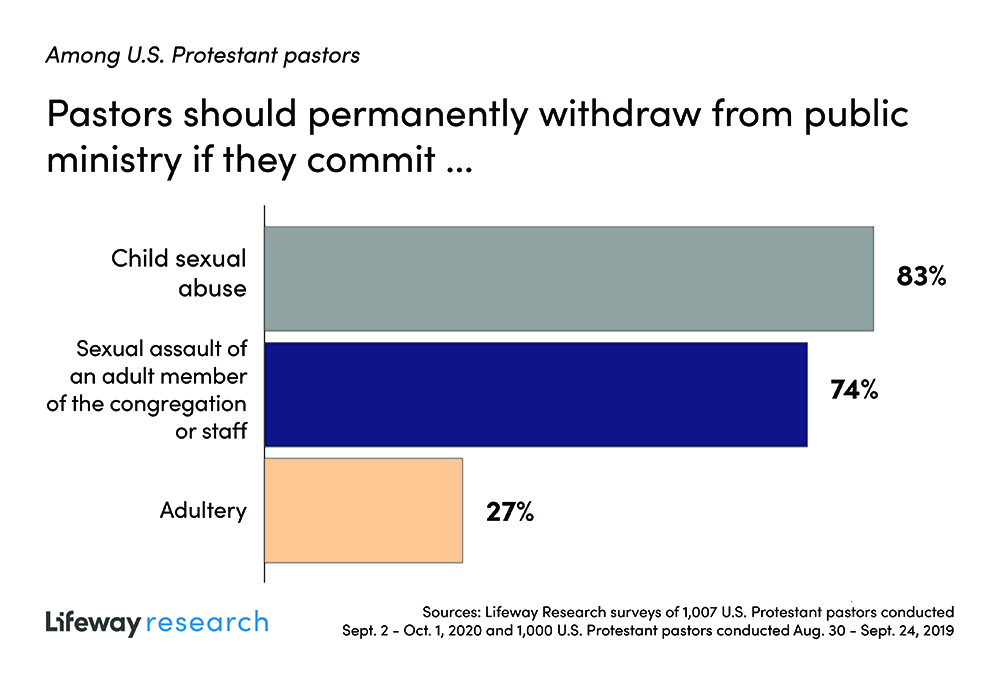
More than 4 in 5 Protestant pastors (83 percent) say if a pastor commits child sexual abuse, that person should withdraw permanently from public ministry. For 2 percent the time away should be at least 10 years, while 3 percent say at least five years and 3 percent say at least two years.

Few point to a shorter time frame as appropriate—1 percent say at least 1 year, and fewer than 1 percent say either six months or three months. Another 7 percent say they aren’t sure how long the time frame should be.

While majorities of every demographic group of pastors support a permanent exit from public ministry for child sexual abuse, some are less supportive than others. Pentecostal pastors (60 percent), African American pastors (67 percent), pastors with no college degree (69 percent), and pastors 65 and older (76 percent) are among those least likely to support permanent withdrawal.

The U.S. Sentencing Commission reported 98.8 percent of sexual abuse offenders were sentenced to prison and their average sentence was almost 16 years.

“The five years or less time frame, that 7 percent of pastors suggest is appropriate, does not even cover the length of the typical prison sentence for offenders convicted of sexual abuse,” McConnell said.

“In contrast, more than 10 times that number of pastors do not hesitate to say the disqualification from ministry should be permanent for a pastor who commits child sexual abuse.”

Adult sexual abuse/assault

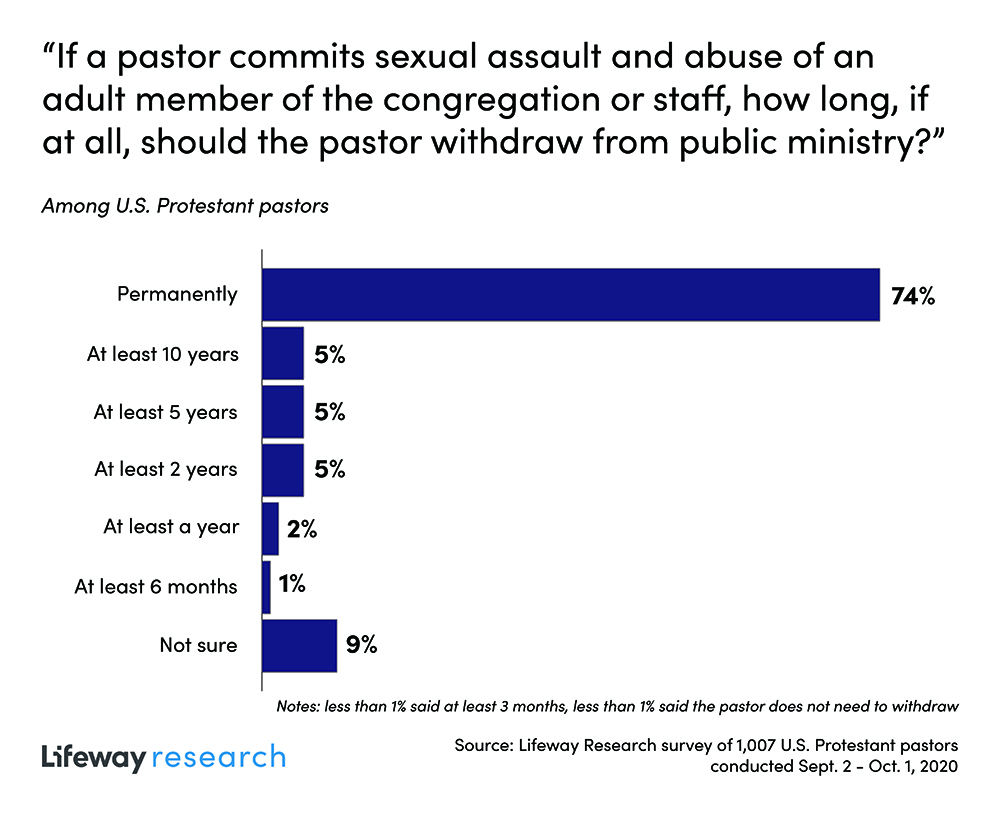
A sizable majority of Protestant pastors (74 percent) also supports a permanent withdrawal from public ministry for any pastors who commit sexual assault and abuse of any adult member of the congregation or staff. One in 20 say the time away should be at least 10 years (5 percent), at least five years (5 percent), and at least two years (5 percent).

Again, few pastors back shorter time frames, with 2 percent saying at least a year, 1 percent at least six months, and fewer than 1 percent at least three months. Fewer than 1 percent say the pastor does not need to withdraw at all. Almost 1 in 10 (9 percent) say they’re not sure.

Pentecostal pastors (44 percent) are the only demographic in which a majority do not support permanent withdrawal from public ministry for pastors who commit sexual assault of adults under their care and supervision in church. Other demographics are also less supportive of the pastor stepping away permanently, including African American pastors (58 percent), pastors without a college degree (63 percent), and pastors 65 and older (69 percent).

“When someone sexually assaults an adult, it is both a violent sin and a crime. It is the opposite of the love, care and respect toward another the Bible teaches,” McConnell said.

“The role of pastor has incredibly high standards in the Bible, including that the overseer of those in the church be above reproach or beyond criticism. Seventeen percent of pastors think someone could move beyond reproach in this matter given enough time.”

A 2019 Lifeway Research study found many Protestant churchgoers believe there are additional undisclosed instances of Protestant pastors sexually abusing children or teens (32 percent) or sexually assaulting adults (29 percent).

In that same study, 3 in 4 churchgoers (75 percent) say they want a careful investigation of the facts if someone accused a pastor at their church of sexual misconduct. Few (14 percent) say their reaction would be to want to see the minister protected.

Compared to their perspective on abuse, pastors are much more divided over the proper response to adultery, according to an additional 2019 Lifeway Research study.

What about adultery?

While clear majorities say pastors who commit child sexual abuse or sexual assault should withdraw permanently from ministry, only 27 percent believe that should be the result of a pastor committing adultery. A plurality (31 percent) is not sure.

“While adultery implies a consensual affair, it is not such a simple distinction for those serving in the role of pastor, as indicated by the 31 percent who were not sure in the previous survey,” McConnell said.

“For a pastor who holds a position of trust and spiritual authority over those in their congregation, an adulterous relationship with one of them, where an imbalance of power exists, would still constitute sexual assault.”

The mixed mode survey of 1,007 Protestant pastors was conducted Sept. 2 – Oct. 1, 2020 using both phone and online interviews. Each survey was completed by the senior or sole pastor or a minister at the church. Analysts weighted responses by region and church size to reflect the population more accurately. The completed sample is 1,007 surveys (502 by phone, 505 online). The sample provides 95 percent confidence the sampling error does not exceed plus or minus 3.4 percent. Margins of error are higher in sub-groups.