Around the State: ETBU receives grant for Dean Center

East Texas Baptist University received a $500,000 grant from the Dean Foundation to create the William B. Dean Center for Language and Literacy Development. The Dean Center encompasses an expansion of ETBU’s downtown campus learning center at the Marshall Grand for the new Master of Science in speech-language pathology program and the enhancement of the university’s student-focused learning support services program. “In honor of the late William B. Dean, M.D., noted pediatrician and pioneer in the field of learning challenges and dyslexia, and founder of the Dean Learning Center, East Texas Baptist University seeks to recognize and build upon Dr. Dean’s legacy as an esteemed medical leader and advocate for children with learning differences,” ETBU President J. Blair Blackburnsaid. “ETBU’s Dean Center for Language and Literacy Development will pay tribute to Dr. Dean’s influential impact in people’s lives through his pedagogical and technical innovations for the learning challenged and through his community service engagement and life contributions.” The Dean Center for Language and Literacy Development will be an approximately 4,000-square-foot learning space on the 7th floor of ETBU’s Marshall Grand. The Dean Center will include a clinic reception area, instructional classroom space, treatment clinic with a closed-circuit camera system and observation space, and auditory assessment labs, allowing supervisors and faculty to monitor therapy sessions in real-time. The new academic space will include a small kitchen lab equipped with a refrigerator, microwave, cabinets and sink to properly store and manipulate food for swallowing and feeding therapy.

The University of Mary Hardin-Baylor will remember the 2,977 Americans who lost their lives during terrorist attacks 20 years ago and honor local Bell County first responders during Patriot Day events on Sept. 11. Events include a 4 p.m. showcase on King Street in Belton featuring firetrucks and K-9 police units. Prior to a 6 p.m. football game in which UMHB faces East Texas Baptist University, first responders will be recognized, and UMHB’s One Voice will sing the national anthem, followed immediately by a flyover from Fort Hood. Local first responders and active-duty military personnel will be granted free admission to the game. The UMHB chapter of Young Conservatives of Texas will plant a flag in front of Luther Memorial on the campus in honor of all the Americans killed on 9/11. The on-campus memorial will be on display throughout the day. “As a university, it is our privilege to honor local first responders alongside those brave men and women who lost their lives on this day 20 years ago,” UMHB President Randy O’Rearsaid. “It’s hard to believe that 20 years has passed, but we are blessed to live in this great nation and hope that, in some small way, our campus events will memorialize this important day in our country’s history.”

Howard Payne University will host the Stinger Spectacular—an event that combines Homecoming, Yellow Jacket Preview and Family Weekend—on Oct. 1-2. Yellow Jacket Preview will offer prospective students the opportunity to meet faculty and staff, tour the campus and learn about student life at HPU. Friday events include a Family Weekend dinner at 5 p.m., an alumni banquet at 5:45 p.m. and Cobbler on the Campus, featuring musical entertainment by Austin Upchurch from 7 p.m. to 8:30 p.m. Saturday events include an alumni breakfast at 8 a.m. and the Stinger Spectacular Parade beginning at 10 a.m., a family barbecue at 11:30 a.m. Saturday afternoon sports events include women’s soccer, men’s soccer and football games. The weekend also features performances of “Cinderella,” a concert by the HPU alumni choir, an exhibition featuring the HPU marching band and an alumni art exhibit. To see a detailed schedule of events or to register, click here.

Ralph Douglas West, founding senior pastor of the Church Without Walls in Houston, challenged students during chapel services at the University of Mary Hardin-Baylor to put their trust in God. West urged students to allow God to direct their paths. “Knowledge can give you direction; wisdom can fulfill the destination,” West said. “Make sure to program your life’s GPS to get you where God wants you to go.”

The Christian church in the United States faces a “cultural tsunami” and a “rising tide of opposition” unprecedented in American history, cultural observer and Christian apologist Jim Denison told a chapel audience at Southwestern Baptist Theological Seminary. Denison, the founder and chief vision officer of the Denison Forum, explained unseen underwater earthquakes cause tsunamis. He identified four “earthquakes” that have triggered the tsunami in American culture—the denial of biblical truth, the denial of biblical morality, the idea that Christians are oppressors and the rise of radical secularism. He challenged students to begin every day by surrendering to the Holy Spirit, engage the culture, build commonality with non-Christians, lead people to Jesus and leave the results to God.
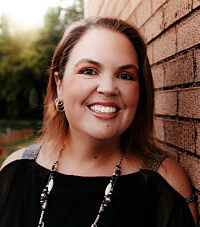
Buckner Westminster Place senior living community named Crystal Muniz as executive director, effective Sept. 7. A 25-year veteran of the senior living industry, Muniz most recently served as the health care administrator for Baptist Retirement Community in San Angelo, also operated by Buckner Retirement Services. Earlier this year, Westminster Place celebrated its 25th anniversary, which is the same amount of time Muniz has served seniors. Prior to her role as the health care administrator for Baptist Retirement Community’s Sagecrest Alzheimer’s Care Center, her senior living experience included business office manager, human resources and certified nursing assistant. Muniz earned her bachelor’s degree from Abilene Christian University and her long-term care administration certificate from Tarrant County Community College.


TBM faces lengthy response after Hurricane Ida

ST. AMANT, La.—The high-pitched buzzing of chainsaw fills the air like clouds fill the sky in this small community northwest of New Orleans. Nearly every home needs some work on trees, most have temporary blue tarps covering the roof, and piles of debris line the sides of the roadway.

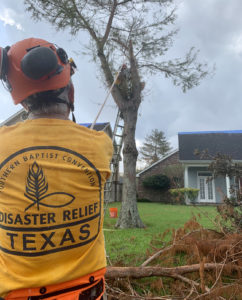
A TBM chainsaw crew works in South Louisiana to remove broken limbs from a wind-damaged tree. (TBM Photo / John Hall)

It’s the sound of progress—the sound of brighter tomorrows.

With every cut, a path is cleared for people to move forward, thanks to six Texas Baptist Men volunteer chainsaw teams and nine TBM heavy machinery teams.

The teams are working in multiple sites across more than 30 miles from Baton Rouge to LaPlace, where many neighborhoods have been severely affected by Hurricane Ida.

“I don’t know exactly how wide the devastation is, but I’d say it’s probably at least 20 miles wide, and it’s from the coast all the way through Louisiana. We have at least five or six stations where we’re serving with chainsaw teams,” said Gene Walker, an on-site coordinator for TBM disaster relief.

“Looking down the street, it’s very upsetting. You see everybody’s belongings, sheetrock on the street. And we’re putting trees on top of that. They haven’t had electricity for 12 days or so, and they’re being told it’ll be Sept. 23 before they get it. People are hurting. It’s street after street after street. It’s the whole town. I’m a crotchety old guy, and it makes me tear up.”

Asked to provide 30,000 meals daily

TBM volunteers Stretch Nilson (left) and Ed French transport food in an insulated Cambro to provide for the needs of people in South Louisiana after Hurricane Ida. (TBM Photo / John Hall)

Thirty-seven miles from where Walker was standing, a whirl of TBM volunteers were meeting needs of another kind. The TBM state feeding unit—an 18-wheel tractor-trailer rig equipped with a mobile field kitchen—was preparing 2,200 Salisbury steaks to distribute across the area for lunch. Then, they washed everything up and produced almost 5,000 dinners that afternoon.

Just as they wrapped up the day, the Red Cross asked the team if they would ramp up to provide 30,000 meals a day moving forward, the maximum output for the mobile kitchen.

People are coming back to the disaster area and seeing the devastation to homes they left behind. Still without power in many places, cooking a meal has become at best difficult for many people. It’s impossible for others.

TBM-cooked meals such as red beans and rice, pulled pork, chicken, rice and hamburgers mean more than nutritional help. They’re reminders that people care—that God cares.

“Through all the devastation, it’s just amazing to see God work,” said Gary Finley, on-site coordinator of the state feeding unit. “That’s why I do it—to be the hands and feet of Christ and get out and see what can happen. Helping people is great. Christ met people’s needs. If we can meet people’s needs, and we can introduce them to Jesus, that’s what this is all about.”

Huge area, even greater needs

That approach to serving made a significant impact in Séverine Vicknair’s life. Walker’s team was taking down a tree that had broken in her backyard.

“We got flooded, and I already don’t know anymore where to start or turn, and those wonderful, wonderful men are here and taking so much pressure off my shoulders,” she said. “We are so very much blessed. Thank you so very much.”

With more than 100 volunteers on site and replacement teams forming to serve behind them, TBM leaders anticipate a lengthy response in the area.

“The area is large, and the needs are even larger,” TBM Disaster Relief Director David Wells said. “Our volunteers are working hard and representing Christ well. They’re making a tremendous impact in the lives of people in Louisiana each day. Please keep the people of Louisiana in your prayers as well as TBM volunteers who are responding. Your prayers are truly making an incredible difference.”

To support TBM financially, visit tbmtx.org/donate or send a designated check to Texas Baptist Men, 5351 Catron Drive, Dallas, TX 75227.


Afghan evacuees turn attention to families left behind

WASHINGTON (RNS)—Mustafa was back in Afghanistan visiting his wife and daughter when the Taliban literally moved in next door. He knew they had to get out of the country immediately.

But this time, he said, he wasn’t leaving without his wife and daughter.

That harrowing journey took them two days just to get into the airport in Kabul; another two, to finally board a plane. It spanned three countries, with a stop in Qatar on their way from Afghanistan to the United States. It also meant a heartbreaking goodbye to parents, siblings and their families.

Mustafa, who asked to be identified only by his first name, still considers his family one of the lucky ones, able to flee Afghanistan before the Aug. 31 cutoff for the withdrawal of U.S. armed forces and allies from the country.

‘The mission is not complete’

Now faith-based refugee resettlement agencies are helping people like Mustafa and their families settle into their new homes in the United States and advocating for those left behind.

“We remember the thousands of lives lost in the conflict in Afghanistan, including American service members, Afghan civilians, and others. But the mission is not complete,” said Jenny Yang, senior vice president of advocacy and policy at World Relief, the evangelical Christian relief organization that assisted Mustafa when he immigrated by himself to the United States in 2017.

“The United States and the international community must do the hard work now of protecting and assisting those who cannot remain in Afghanistan safely.”

Mustafa, now 29, never wanted to leave Afghanistan, his family, his education or the small media company he founded with his brother. But after working as an interpreter and analyst for America and other international organizations, he’d received both direct and indirect threats against his life from the Taliban.

There were frequent clashes between the Afghan government and the Taliban, he said.

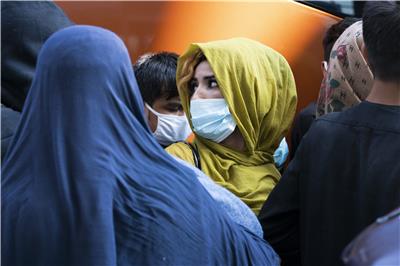
Families evacuated from Kabul, Afghanistan, wait to board a bus after they arrived at Washington Dulles International Airport, in Chantilly, Va., on Wednesday, Aug. 25, 2021. (AP Photo/Jose Luis Magana)

“All I remember in Afghanistan was war. I was born in war, raised in war, grew up in war. Part of my education was under the Taliban system a long time ago,” he said.

“When we are leaving our home in the morning, we don’t believe that we will come back alive in the evening.”

At the time, Mustafa said, the process of getting a Special Immigrant Visa, designed for Afghans employed by or on behalf of the U.S. government, was relatively quick and easy.

Not sure what to expect in the United States, he came alone in 2017, thinking his wife could join him in a few months once he had settled into the country. But the process “changed completely” after former President Donald Trump took office, Mustafa said, and her application was denied.

Forced to deal with the unexpected

He had started the process over and was visiting his wife and 1-year-old daughter in Kabul when the Taliban seized power several weeks ago. It was unexpected, he said. He never heard a single shot fired in the city.

When members of the Taliban began sheltering in front of their house, Mustafa, his wife and daughter went to stay with a friend who lived near the airport. He tried not to be afraid, he said, focusing instead on doing what he could to help his family.

He spent a day trying to get inside the airport, along with his brother and brother-in-law, who already were in the middle of the SIV process, and his father, who previously had worked with the British Embassy. But the scene outside the airport was crowded, chaotic and punctuated by gunfire meant to control the crowd, and he returned to his friend’s house that night, unable to get inside.

The next day, Mustafa made the difficult decision to part ways with his parents and siblings, telling his father he’d do all he could to get him out of Afghanistan once he had left. He couldn’t lose the chance to get his wife and daughter out of the country, he said.

When he secured emergency visas for his wife and daughter and was told they could come with him, “that was the most beautiful moment of the story,” he said.

‘There are lots of other people like my family’

Once the trio made it inside, they spent two nights sleeping in the airport before they were able to board a packed military plane bound for Qatar in the wee hours of the morning.

After waiting seven hours on a hot tarmac for transportation to a shelter in Qatar, they boarded a second flight to Washington, D.C. They slept through the 14-hour flight, exhausted after their dayslong ordeal, and arrived Aug. 21 in the U.S., he said.

On Aug. 30, as the deadline for U.S. withdrawal closed in, his brother and brother-in-law still were waiting on a phone call from the U.S. Embassy telling them to come to the airport, he said.

“There are lots of other people like my family,” he said.

Faith-based refugee resettlement organizations—many of which urged the Biden administration months ago to begin evacuating Afghan allies before its planned troop withdrawal—have continued to advocate for those like Mustafa’s family who have been left behind.

Working as advocates

World Relief has resettled about 6,300 individuals with Special Immigrant Visas in the last five years and has a lot of relationships with Afghans in the U.S., said Matthew Soerens, U.S. director of church mobilization for World Relief. Almost all have reached out to the organization in recent days “desperately concerned” for someone who is still in Afghanistan, he said.

“We are not moving past the reality that for the many who got out, who are starting to arrive, many others did not get out, including people who had pending Special Immigrant Visa applications because of their service to the U.S. military or other parts of the U.S. government. … We do not consider that acceptable,” Soerens said.

Advocates aren’t sure what the process will look like to help those people continue to flee Afghanistan, which has become more difficult since the airlift ended. But that’s something the United States and other governments need to figure out, he said.

Organizations like World Relief, which form the backbone of the U.S. refugee resettlement system, also are working to meet the needs of Afghans arriving with SIVs or on humanitarian parole. Department of Homeland Security Secretary Alejandro Mayorkas has said the United States expects to welcome 50,000 evacuated Afghans through what it is calling Operation Allies Welcome.

Many remain in third countries undergoing security vetting and screenings before they can be admitted to the U.S.

Found a ‘very welcoming place’

Coming to the U.S. in 2017 was a tough decision, Mustafa said, because, “I had to leave everything back in Afghanistan and come back and start everything from scratch in the U.S.”

But he found a “very welcoming place” in World Relief’s resettlement office in Modesto, Calif., he said.

The organization provided classes to help him learn about American culture and all the other things he needed to know about life in the United States. He remembers it helping other families to settle into and furnish housing.

Housing remains one of the biggest needs for evacuees arriving without the kind of credit history many landlords require, Soerens noted.

So far, more than 360 Afghan allies, most with SIVs, have arrived at World Relief offices across the country, he said.

The organization has been told to expect even more people to arrive with humanitarian parole status, he said. Many could have pending SIV cases. Others may be religious or ethnic minorities, women who sought education or people who served nongovernmental organizations with American affiliations.

Evacuees thoroughly vetted

Soerens said he has talked with former Homeland Security officials about the vetting process those evacuees are going through now in third countries. Officials are using the same biographic and biometric tools to vet people they normally would for the refugee resettlement process, he said. If there’s any confusion about who a person is, he or she isn’t brought to the U.S.

“We want everyone to be thoroughly vetted, and we have a great deal of confidence in the U.S. government’s ability to vet people appropriately based on a really impressive record of doing so,” he said.

Faith-based agencies are working quickly now to rebuild their capacity after years of cuts to the refugee resettlement program under President Trump. They’re also raising funds and advocating for legislation to provide the same assistance to Afghan allies that refugees normally would receive.

And churches have been quick to respond, according to Soerens. As of last week, World Relief’s Chicagoland office received 800 inquiries from people interested in volunteering to help Afghans arriving in the area. In an average month, it receives about 25.

“We’ve been really, really thankful for the just unprecedented support from churches in particular, both in terms of financial support and volunteers,” Soerens said.


Vernon pastor one-third of way into preaching marathon

VERNON (BP)—Every day for more than a month, Toby Castleberry has stood behind the pulpit at Calvary Baptist Church to deliver the greatest message he says has been missed in a time of seemingly nothing but bad news and division.

This time a year ago, he and others in his church noted “how you heard nothing but about the election and pandemic,” Castleberry said.

“It was just fighting everywhere and left you feeling hopeless. We started talking about what we could do and realized we need to hold up Christ for others to see,” he said.

‘We know Jesus is the answer’

About a month later, Castleberry felt led by God to preach for 100 straight days about Christ’s love.

“I told a few folks, and they thought it was pretty radical, but we know Jesus is the answer for these situations,” he said.

Early this summer, he settled on preaching through the Gospel of John and began on a Saturday evening, Aug. 7. Since then, he has worked through it verse by verse for his Sunday morning messages and each evening at 6 p.m.

The series is called “So Loved” and focuses on the central verse of John 3:16, pointing out how God so loved the world that he sent his only son to die on behalf of humanity’s sins. Jesus’ death and resurrection is the best news of all, as far as Castleberry is concerned, and it should take precedence over all other.

Two congregational songs precede each sermon, except for Wednesdays, when Calvary’s student band leads worship, and Saturdays, which Castleberry described as a “gospel music service with a full band and choir.” Ten minutes before each gathering, a group meets in Calvary’s foyer to pray over the service.

Taking a toll

Barely a third through the 100 days, he admitted that the physical toll is harder than he expected. Ten years ago, he preached a seven-day revival meeting, but no others beyond three or five days.

“You have to have the mindset that you’re going to do it one more day,” he said.

It’s not like he doesn’t have other things going on, either. The Castleberrys are also a tennis family. And though it’s traditionally regarded as a spring sport, his daughter, Sarah Jo, is beginning her sophomore season for Dallas Baptist University. His sons, Kell and Will, also play. His wife, Carrie, is the head tennis coach at Vernon High School, where the Lions play tennis in both the fall and spring.

“We’re busy all the time, but God led me to preach this series,” he said. “These messages are about how loved we are and how the closer we look, the greater we see his love. It’s astonishing. We’re halfway through the sixth chapter, and it becomes amazing how compassionate God is to sinners.”

Reaching a wide audience

Each service is live-streamed and placed on the church website, as well as Facebook and YouTube. Messages are also available by podcast.

“Last week, [people in] 24 countries—including Pakistan and Saudi Arabia—watched the message, as did 29 states,” he said.

On Aug. 1, the final Sunday before beginning the “So Loved” series, Castleberry completed another series titled “Preparing for Something Great.” In that final message, he noted how God tends to work in two ways—through what is unlikely and what is unorthodox.

Preaching 100 straight days during one of the busiest times of the year checks both of those boxes. But Castleberry has witnessed the series’ impact, both from the viewership around the world as well as within his congregation.

“It’s been amazing to see the church members who have not missed any days,” he said. “Our older adults have been encouraged and are attending. It’s been better than I would have imagined, honestly.”

Castleberry has been in the ministry for 16 years and has read through John several times before. But any focused Bible study, he added, brings new life to Scripture for the reader.

“Time spent in God’s word is a blessing,” he said. “And the more you spend, the greater truths you see about who Christ is.

“As believers we need to be reminded and encouraged about our Savior’s love. That propels us to tell the lost how loved they are. The world has done so much to twist the message of Christ, when really he is the message.”


Pastors in NY and NJ deal with flash flooding

NEW YORK (BP)—Pastor Daniel McGhee had just driven his daughter Emma Kate to college in Jersey City, N.J., and picked up daughter Ella from her downtown Manhattan job when the rain began to pour.

“She and I drove through, actually, some really deep water. We had to really make sure we didn’t get in some water that was too deep for my minivan,” McGhee, lead pastor of Connection Church in Astoria, Queens, said Sept. 3.

“And as we’re driving home, my wife (Kari) calls my daughter and tells her that the basement’s flooding. … She sent us pictures and our basement was flooding and it had about 6 inches of water in it.”

A few miles from McGhee’s Astoria home, Pastor Larry Mayfield was conducting a counseling session at his home in Woodside, Queens, when his church’s children’s director Candace Profit called for help. Dirty water mixed with sewage was flooding her basement apartment home.

New York pastor and church planter Larry Mayfield has begun the process of ripping ruined flooring and sheetrock from his flooded basement in Queens, but will be able to remain in his home.

As Mayfield and his wife Lindsey prepared to help Profit, they encountered their own flooded basement. Lindsey drove the mile to Profit’s home as Larry Mayfield tried to save his basement.

In the Mayfields’ Woodside community of about 85,000 people, a 2-year-old toddler and his parents were among those who died as floodwaters swamped basement apartments too quickly for families to flee.

‘Pulling together and helping one another’

After the remnants of Hurricane Ida moved to the northeast, flash flooding and tornadoes that killed more than 40 people in New York, New Jersey and neighboring states activated pastors to help those in need, Missionary Won Kwak said.

“Churches and planters throughout all five boroughs have been hit hard by the unexpected level of rainfall caused by Ida,” said Kwak, who serves as a non-staff pastor at Mission City Church, a church plant in Brooklyn. “Many are pulling together and helping one another and their neighbors bail out. … Northern New Jersey was also hit very hard.

“Parks and baseball fields and so many areas have become manmade lakes,” Kwak said.

None of the pastors Baptist Press talked to reported any loss of life among their congregations, but some families were displaced. In the congested metropolitan areas impacted, basements are heavily utilized as living spaces.

New York pastor and church planter Larry Mayfield has begun the process of ripping ruined flooring and sheetrock from his flooded basement in Queens, but he will be able to remain in his home. (Photo courtesy of BP)

McGhee’s basement took on as much as 8 inches of “really dirty water,” ruining electronics, photos, clothing and shoes. The family is saving what they can.

“All of my neighbors flooded. … This was aggressive. It was a lot of water that came in,” McGhee said. “What happens is the drainage system just can’t get rid of the water fast enough, and so it just starts to pool up. And as it pools up, it just comes through the doors of your home and just can’t go anywhere fast enough. It’s just overwhelming.”

McGhee’s basement will need to be gutted and renovated, and he’ll likely have to find a new place to live.

“We are still cleaning up, still trying to make sure our place is dried out,” he said. “We’re trying to find another place. … It’s very expensive. Whenever you move, in New York especially, you have to pay a broker fee. A broker fee’s going to cost you an extra month’s rent. So … $4,000 a month for an apartment, you have to pay first month’s rent, you have to pay a one-month’s deposit and a one-month’s broker fee. So you’re looking at $12,000. … We don’t have that kind of money sitting around.”

Connection Church meets in a Lutheran church building that didn’t flood, McGhee was happy to hear.

Mayfield helped McGhee plant Connection Church in 2012 before planting Queens Church Ministry in 2019, a congregation that has grown to 120 members.

‘Pray for our faith to be resilient’

“Most of our church people were good. The only two people that flooded were me and the children’s director,” Mayfield said. “It flooded from my backyard through the house. We’ve ripped up all the floors and taken out sheetrock and stuff. … And then our children’s director, Candace … she lives in a basement apartment, and it flooded about 6 inches.”

Profit, a single mom of four, is displaced and will need to find other housing. She lost most of her family’s clothing, some furniture and many possessions, Mayfield said. Queens Church Ministry rented a storage locker for the two families and others to store belongings at no cost as they clean their homes.

Christians know the biblical answers to such problems, McGhee said, but applying them when tragedy strikes can be more difficult.

“God’s working through all things for the good of those who love the Lord and that, even in the midst of trials, we know that God is with us. He has not abandoned us,” McGhee said. “We know those things foundationally are part of our faith, but functionally many times we don’t feel that in a moment sometimes.”

McGhee encouraged other Christians to pray for those in New York.

“Pray for our faith to be resilient in this time, and … just pray that we would be able to love and serve our neighbors in a way that would help them experience the love of God.”


More than 80 Louisiana Baptist churches damaged

ALEXANDRIA, La. (BP)—More than 80 Southern Baptist churches in South Louisiana suffered structural damage due to Hurricane Ida, Louisiana Baptist Convention Director of Missions John Hebert said.

“We have churches ranging from desperate to recovering, and the desperate ones need help. They’re below I-10. Insurance rates are out of this world. It’s going to be tough for them,” Hebert told Baptist Press on Sept. 1.

“But most of our churches will be OK in the long run. It’s just right now, we have a crisis at hand and we need all the help we can get.”

Churches in several communities in Terrebonne, Lafourche, St. John the Baptist and Jefferson parishes were damaged, including churches on the North Shore of Lake Pontchartrain and spanning more than 150 miles inland to Denham Springs. Ida killed at least eight people in the state.

“Devastation runs straight up 55, massively damaged all the way to Denham Springs,” said Hebert, who is assisting churches and pastors in recovery efforts as Southern Baptist disaster relief focuses on the larger community.

“Churches are just trying to get through the week right now,” he said. “We’re trying to just take care of the basic needs. … But they can’t think beyond getting the power back on right now.”

Louisiana deaths include four nursing home residents who died Sept. 2 and were among hundreds evacuated to Tangipahoa Parish ahead of the storm, nola.com reported. The bulk of the deaths from Hurricane Ida, at least 23, occurred in New York, New Jersey, Pennsylvania and Maryland as the remnants of the storm system caused massive flash flooding in the Northeast.

Damaged church serves as feeding site

In Louisiana, Southern Baptists have established about 10 mass feeding units in multiple locations.

“We need volunteers, we need money, we need relief supplies, and that’s what we’re focused on right now, is relief,” Hebert said. “The next phase of this is rebuild. You help them get stabilized, and then you can think about starting to rebuild and get it back the way it was. We need help getting these churches stabilized right now.”

First Baptist Church of Golden Meadow, which lost part of its roof in the storm, was preparing to serve as a feeding site on Sept. 3, according to its Facebook page. Water, tarps, diapers and wipes, hygiene products and cleaning supplies were made available to affected residents. The church is also setting up a shower trailer, but said it won’t be usable until water service is restored.

Grand Isle, the lone inhabited barrier island on Louisiana’s Gulf Coast, was decimated in the storm. First Baptist Church of Grand Isle, the only Southern Baptist congregation there, already had been without a pastor for months, said Nathan Stanford, the congregation’s previous pastor. No one associated with the church was available for comment.

“Grand Isle is wiped out. I’m understanding that the devastation’s like we’ve never seen in a storm,” Hebert said. About 80 miles north of Grand Isle, the more than 30 churches in Terrebonne and Lafourche parishes were also hard-hit.

“The churches there, almost all of them are damaged, and damaged pretty severely,” Hebert said. “Roofs are gone. Pastors that live there, their homes are affected. Probably everybody down there has to have a roof. Unless it’s a real heavy duty steel roof, it’s gone.”

The Louisiana Baptist Convention lists supply drop-off locations and needed supplies on its website, requesting gas cans, brooms, disposable masks, latex gloves and other items, and is collecting information from pastors regarding damage to churches and homes.

Electrical power remains out in the area, with perhaps 1 million residents lacking power across several parishes. Entergy New Orleans said it was still assessing damage and hopes to have an estimate this evening of when more power will be restored, nola.com reported. The utility provider restored power to about 11,500 customers in New Orleans on Sept. 1, focusing on critical services such as hospitals.

Nearly all of New Orleans remained in the dark, as well as about 220,000 customers in East Baton Rouge, Ascension and Livingston parishes, 200,000 in Baton Rouge, and all of Terrebonne and Lafourche parishes. Water also is turned off.


Survey: Most Americans know and trust their neighbors

NASHVILLE, Tenn.—Despite quarantines and social distancing keeping people in their homes during the pandemic, Americans still say they know their neighbors, a Lifeway Research study reveals.

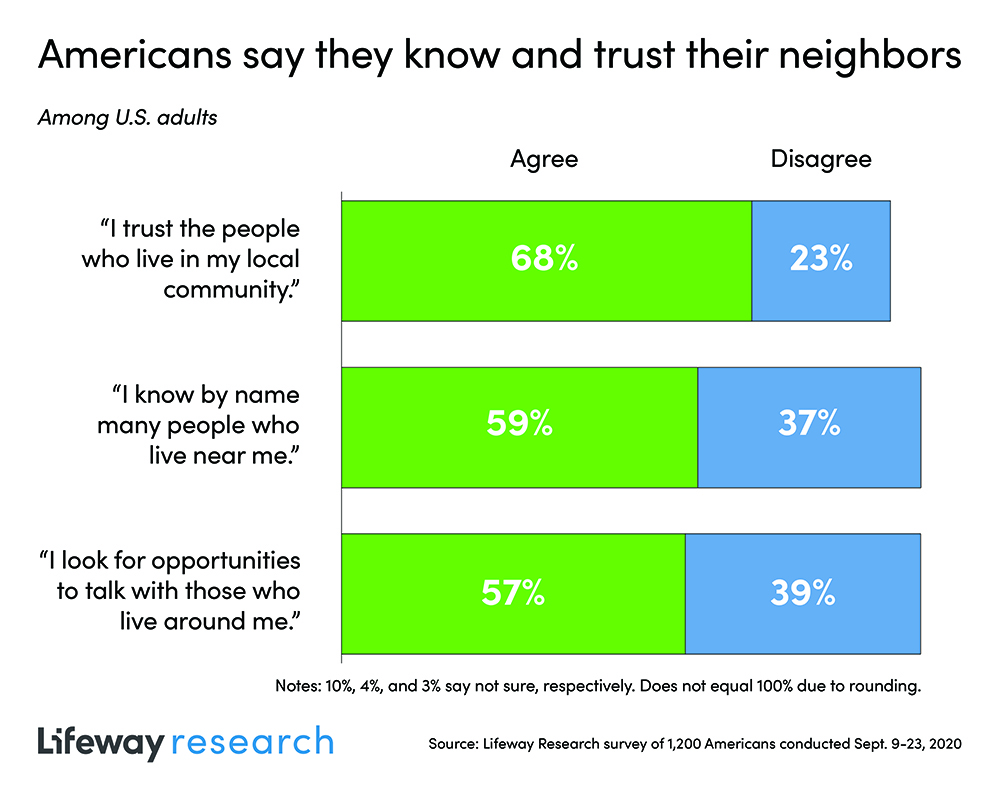
Almost 7 in 10 U.S. adults (68 percent) say they trust the people who live in their local community. Close to a quarter of Americans (23 percent) disagree, and 10 percent say they aren’t sure.

“Trust is the basis of a peaceful society,” said Scott McConnell, executive director of Lifeway Research. “It’s a hopeful sign that amid months of distancing and political unrest more than two-thirds of Americans trust those in their community.”

Men (72 percent) are more likely than women (63 percent) to say those who live around them are trustworthy. Those 65 and older are most likely to agree (79 percent), while younger adults, aged 18-34, are least likely to agree (59 percent).
Residents of the South (24 percent) are more likely than those in the Midwest (18 percent) to disagree and say they don’t trust the people who live in their community.

Religious identity makes a difference

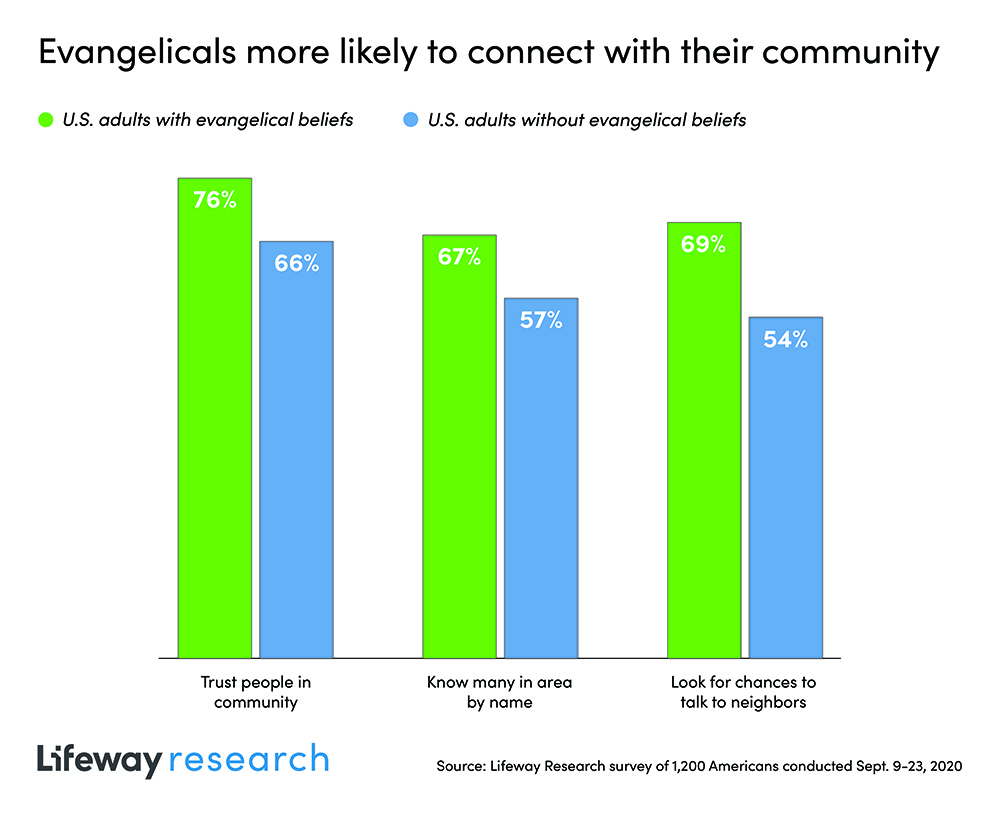
Religious identification and practice also play a role in the likelihood someone is trusting of those in their neighborhood. Protestants (71 percent) and Catholics (69 percent) are more likely to agree than the religiously unaffiliated (60 percent). Americans with evangelical beliefs (76 percent) are also more likely to trust their community than those without evangelical beliefs (66 percent).

Specifically among those who identify as Christian, those who attend church services at least four times a month (17 percent) are less likely than those who attend less than once a month (25 percent) to express doubt about trusting the people who live near them.

Six in 10 Americans (59 percent) say they know the names of many people who live near them. More than a third (37 percent) disagree, and 4 percent aren’t sure.

Those with a bachelor’s degree or more (65 percent) are more likely than those who have a high school diploma or less (55 percent) to know those in their neighborhood by name. Among religious groups, the unaffiliated are most likely to disagree (44 percent).

Christians who attend church at least monthly (71 percent) are more likely than those who attend less frequently (51 percent) to say they know the names of their neighbors. American adults who hold evangelical beliefs (67 percent) are also more likely than those without such beliefs (57 percent) to say they know the people who live near them by name.

“Remembering the names of people you meet is the first sign that you care about them,” McConnell said. “For Christians, caring can also include praying for those individuals by name and for their relationship with God.”

Looking for conversations and connections

The conversations may have taken place through masks or six feet apart, but most U.S. adults are seeking chances to have a conversation with their neighbors.

Almost 3 in 5 Americans (57 percent) say they look for opportunities to talk with the people who live around them. Four in 10 disagree (39 percent), and 3 percent aren’t sure.

Again, men (65 percent) are more likely than women (50 percent) to seek out such moments of conversation. Those 65 and older (69 percent) are the age range most likely to agree.

Those with a bachelor’s degree (66 percent) or a graduate degree (64 percent) are more likely than those with a high school diploma or less (51 percent) to look for opportunities to talk with neighbors.

The religiously unaffiliated are the most likely to want to stick to themselves, as 49 percent disagree they are seeking such community conversations.

Christians who attend church at least monthly (71 percent) are more likely than those who attend less frequently (51 percent) to look for opportunities to talk to those who live around them. Those with evangelical beliefs (69 percent) are also more likely than those without such beliefs (54 percent) to want those times of discussion.
“Those with lower trust and fewer connections in the community are also the groups less likely to want to seek out conversations with others. This is true of the religiously unaffiliated and those with a lower socioeconomic level,” McConnell said.

“Despite a greater interest in talking with neighbors among Christians who frequently attend church, a Lifeway Research study before COVID revealed that these conversations do not always include faith. In fact, 55 percent of Protestant churchgoers had not shared with anyone how to become a Christian in the previous six months.”

The online survey was conducted Sept. 9-23, 2020, using a national pre-recruited panel. Researchers used quotas and slight weights to balance gender, age, region, ethnicity, education and religion to reflect the population more accurately. The completed sample of 1,200 surveys provides 95 percent confidence that the sampling error from the panel does not exceed plus or minus 3.2 percent. Margins of error are higher in sub-groups.


California Baptists partner to provide relief after wildfire

GREENVILLE, Calif. (BP)—Southern Baptists near the largest wildfire in California recorded history are working together to provide practical relief to their community.

The Dixie Fire started in mid-July and continues to burn throughout northern California. The Associated Press reports the fire has burned more than 783 square miles and destroyed more than 1,000 buildings.

The community of Greenville was particularly affected, and churches in Feather River Baptist Association have joined with California Baptist Disaster Relief volunteers, Send Relief and the Red Cross to bring help.

Living out faith

Jay Ballard, associational mission strategist for the Feather River Baptist Association, said half of the 20 churches in the association are in areas under either an evacuation mandate or an evacuation warning.

“We need to be in the midst of the fight, rather than standing on the outside throwing gospel bombs hoping it hits someone,” Ballard said. “People live out their theology on mission and ministry. When we give people an opportunity to serve, that’s when they live out the Jesus we keep teaching about.”

Due to the constantly changing status of evacuations, Ballard said relief effort locations have changed over time and have included local colleges and churches in the association.

Volunteers have provided hygiene supplies, clean water and even temporary housing for those who have had to evacuate. They also have prepared more than 1,000 meals, Ballard said, adding that hundreds of people indicated they were open to pastors in the association calling to follow up with them.

Meeting physical and spiritual needs

Daniel Hanna, pastor of Chester (Calif.) Baptist Church, echoed the importance of seeking to meet spiritual needs while serving physically. Chester Baptist Church is one of three congregations in Feather River Baptist Association providing relief and supplies to the community.

“Even if we could help people with every physical need that they have, they still have an eternal spiritual need that we need to be concerned about,” Hanna said. “Natural disasters make people think about eternity, and it’s clear that Jesus met people’s physical needs but also meet their ultimate spiritual needs.”

Daniel Hanna, pastor of Chester (Calif.) Baptist Church, spoke at Greenville Baptist Church when it held its first service since losing more than half of one of its buildings in the fire. He reminded the congregation the power of God is far greater than any physical disaster. (BP Photo

Hanna praised his church staff and volunteers, including Associate Pastor Luke Hall, who organized meal distribution with the Red Cross.

As other relief organizations eventually leave after immediate needs are meet in the wake of the disaster, Hanna emphasized local Southern Baptist churches and associations can have the “staying power” necessary to make a lasting impact. The association will need to stay involved in the lives of those they helped in the coming weeks and months.

Hanna spoke at Greenville Baptist Church when it held its first service since losing more than half of one of its buildings in the fire. He reminded the congregation the power of God is far greater than any physical disaster.

“The infinite glory of God is far greater than this fire,” Hanna said. “As I say that to brothers and sisters, I can see their eyes sparkle with being reminded the reality of that truth.”


Supreme Court lets stand Texas fetal heartbeat law

In a 5-4 decision, a divided U.S. Supreme Court refused to block the new Texas law banning abortions after a fetal heartbeat can be detected.

The law—which went into effect Sept. 1—prohibits abortion as early as six weeks into a pregnancy, and it authorizes anyone in the general public to sue for damages anybody they believe is “aiding and abetting” an abortion.

The Texas Legislature approved the law at the end of the regular legislative session in May. It makes no exceptions for rape or incest, but it does allow an exception for “medical emergencies.”

In a statement on its website, Texas Right to Life said it is “thrilled with the outcome,” calling the court’s decision “a massive victory for the pro-life movement.”

Rachel Laser, president and CEO of Americans United for Separation of Church and State, issued a statement denouncing the new Texas abortion law.

“Abortion bans are the result of the crumbling of church-state separation. The First Amendment prohibits the government from imposing one set of religious beliefs on others, but Texas’ new draconian law and other attempts by states to ban reproductive freedom do just that,” Laser said.

A majority of Supreme Court justices denied an application for an injunction against the law’s implementation. They stated Whole Women’s Health and other applicants presented “complex and novel antecedent procedural questions on which they have not carried their burden.”

No ruling on the law’s constitutionality

However, the matter may not be settled for the long term.

“In reaching this conclusion, we stress that we do not purport to resolve definitively any jurisdictional or substantive claim in the applicants’ lawsuit,” the majority opinion stated. “In particular, this order is not based on any conclusion about the constitutionality of Texas’ law, and in no way limits other procedurally proper challenges to the Texas law, including in Texas state courts.”

Chief Justice John Roberts—joined by Justice Stephen Breyer and Justice Elena Kagan—dissented from the majority, writing: “The statutory scheme before the Court is not only unusual, but unprecedented. The legislature has imposed a prohibition on abortions after roughly six weeks, and then essentially delegated enforcement of that prohibition to the populace at large. The desired consequence appears to be to insulate the State from responsibility for implementing and enforcing the regulatory regime.”

In a blistering dissent, Justice Sonia Sotomayor called the court’s majority order “stunning.”

“Presented with an application to enjoin a flagrantly unconstitutional law engineered to prohibit women from exercising their constitutional rights and evade judicial scrutiny, a majority of Justices have opted to bury their heads in the sand.”

In their application, the abortion providers and abortion rights advocates who asked for the emergency injunction asserted the new law would block 85 percent of the procedures previously performed in the state and force most clinics to close.


Cuban Baptist pastors fined but will not face prison

Two Baptist pastors in Cuba who were detained for an extended period after nationwide protests July 11 will be fined but will not face prison sentences.

Yarian Sierrra (left) and Yeremi Blanco from the Berean Baptist Mission in Matanza were detained nearly two weeks in Cuba. (Facebook Photo via CSW)

Yéremi Blanco Ramírez and Yarian Sierra Madrigal learned Sept. 1 the Cuban government will impose a fine—but not sentence them to prison—for participating in the protests, according to Christian Solidarity Worldwide, a United Kingdom-based human rights organization focused on religious liberty.

The two Berean Baptist ministers, associated with William Carey Biblical Seminary, were released from prison in late July and placed under house arrest after being detained incommunicado nearly two weeks. The wife and child of Sierra Madrigal were evicted from their home after state security officers threatened their landlord.

Blanco Ramirez and Sierra Madrigal were among the Christian leaders who were detained following the July 11 demonstrations throughout the nation. Protestors marched under the banner “Patria y Vida” (Homeland and Life), calling on the government to allow humanitarian aid into the country and make it accessible to the general population.

Yusniel Pérez Montejo, a minister affiliated with the Eastern Baptist Convention of Cuba, also was detained in connection with the July 11 demonstrations but released prior to the two Berean Baptist pastors.

Another Protestant minister, Lorenzo Rosales Fajardo, remains in detention after more than seven weeks. He was transferred to a maximum security prison on Aug. 9, and his appeal was denied by Cuban authorities.

While expressing thanks for the release of some prisoners of conscience, a spokesperson for Christian Solidarity Worldwide said Cuban authorities must do more.

“While we welcome the fact that Pastors Blanco Ramírez and Sierra Madrigal have not been handed prison sentences, we maintain that they never should have been imprisoned or accused of anything in the first place,” said Anna-Lee Stangl, head of advocacy for CSW.

“We are also deeply concerned at the continued and unjust detention of Pastor Rosales Fajardo. We call on the Cuban authorities to drop the charges against all three men, releasing Pastor Rosales Fajardo immediately and without condition, and cancelling any fines imposed on Pastors Blanco Ramírez and Sierra Madrigal.”


Incumbent BGCT 1st VP Guarneri nominee for reelection

Julio Guarneri, incumbent first vice president of the Baptist General Convention of Texas and lead pastor of Calvary Baptist Church in McAllen, will be nominated for reelection.

Tony Celelli, president of Stark College and Seminary, announced he will nominate Guarneri at Texas Baptists’ annual meeting in Galveston, Nov. 14-16.

Celelli praised Guarneri as “a Baptist statesman for today and for the next season” in Baptist life.

“Julio has a heart for missions and evangelism,” he said, noting the priorities of Guarneri’s ministry are in line with Texas Baptists’ priorities.

Celelli also characterized Guarneri not only as “a product of Texas Baptists,” but also as a “pioneer among Texas Baptists.”

“Calvary Baptist Church is a pioneer in ministry—a church that is multiethnic, multigenerational and multicultural,” he said.

‘Churches need to be encouraged’

Guarneri said he is willing to serve another term if elected, because he is excited about what is happening among Texas Baptists in the areas of discipleship, church planting and church revitalization.

“I want to be part of that and to share in shaping its implementation,” he said.

Reflecting on the challenges churches and their leaders have faced during the COVID-19 pandemic, Guarneri said, “Churches need to be encouraged.”

“By networking, we can help churches recover—to experience healing from the losses they sustained and look to the future with optimism,” he said.

“The role of the convention is to cast a vision and to encourage pastors to cooperate and network.”

Guarneri voiced support for Executive Director David Hardage’s GC2 initiative—emphasizing Texas Baptists’ commitment both to the Great Commission and the Great Commandment as given by Jesus.

“I’d like to see Texas Baptists continue to position themselves in a Christ-like position,” he said, resisting the temptation to be “coopted by a political agenda.”

“We can be kingdom-minded,” he said.

Guarneri also noted his desire to see Texas Baptists’ multicultural and multiethnic work grow and expand.

Leading a cross-cultural congregation

Since 2010, Guarneri has been pastor at Calvary Baptist Church in McAllen, a cross-cultural congregation in the Rio Grande Valley.

Previously, he was pastor of Iglesia Bautista Getsemani in Fort Worth for 17 years. He also served as minister of education and youth at Segunda Iglesia Bautista in Corpus Christi, was founding pastor of Shalom Baptist Mission in Corpus Christi and was pastor of Primera Iglesia Bautista in Taft.

Guarneri was born in Mexico City but attended junior high and high school in South Texas. He earned his undergraduate degree from Texas A&I University in Kingsville, a Master of Arts in Religious Education degree from Southwestern Baptist Theological Seminary and a Ph.D. in Leadership Studies from Dallas Baptist University.

He has served as moderator of Tarrant Baptist Association and on the board of trustees of Buckner International, as well as on the board of what is now Stark College and Seminary.

He and his wife Monica have four children—Josh, Rachel, Mia and Stevan.


Around the State: Renovated Tidwell Bible Building opens

The newly renovated Tidwell Bible Building—a 67-year-old landmark on the Baylor University campus—reopened Aug. 25. (Baylor Photo)

Baylor University marked the opening of the newly renovated Tidwell Bible Building with a ribbon-cutting ceremony on Aug. 25. The renovation and preservation of the 67-year-old building was planned as part of the $300 million in capital improvements to support the aspirations of the Give Light fundraising campaign. The project was funded through a $15 million lead gift from the Sunderland Foundation of Overland Park, Kansas, and a completion gift from the late Barbara “Babs” Nell Baugh, of San Antonio, and The Eula Mae and John Baugh Foundation. “Tidwell Bible Building is a much-loved landmark at Baylor University, and we are grateful to the Sunderland Foundation and the Baugh family for helping us to restore and preserve this wonderful piece of Baylor’s history,” President Linda A. Livingstone said. “At some point in their Baylor journeys, practically all of our students have taken a class in Tidwell, which houses some of our core disciplines, and we are grateful that this Baylor tradition will continue on for future generations because of their generosity.”

Wayland Baptist University President Bobby Hall (right) visits with Don Newbury (left), humorist and retired Howard Payne University, and Lance Wood, pastor of First Baptist Church in Clarendon, during a reception at his home. (WBU Photo)

Wayland Baptist University and the Baptist General Convention of Texas sponsored The Gathering for West Texas pastors and their families at Wayland on Aug. 27-28. About 50 pastors and family members from Lubbock Area Baptist Association, Caprock Plains Baptist Association and Amarillo Area Baptist Association took part in the event. Donnie Brown, director of spiritual life at Wayland, said he worked with Texas Baptists to organize the event after seeing pastors struggle with COVID-19 and the effect it had on their churches and ministries. “We wanted to give them an opportunity to get away, relax and have fun being around other ministers with similar experiences who could encourage each other,” Brown said. Don Newbury, retired president of Howard Payne University and noted humorist, was the featured speaker. After dinner, participants attended a dessert reception at the home of Wayland President Bobby Hall. Participants in a panel discussion about the effects of COVID-19 on ministry included Jerry Joplin, director of Lubbock Area Baptist Association; Kenneth Jackson, pastor of New Light Baptist Church in Lubbock, Lorrie Brown, university minister at First Baptist Church in Plainview; Emily West, wife of Jacob West, pastor of First Baptist Church in Plainview; and Lance Woods, pastor of First Baptist Church in Clarendon.

A record number of new students at Dallas Baptist University participate in the opening session of SWAT—Student Welcome and Transition week. (DBU Photo)

Dallas Baptist University welcomed the largest first-year class in the school’s history during SWAT—Student Welcome and Transition week. More than 700 new students participated in SWAT, along with 100 upperclassmen who led a variety of games, Bible studies and other activities. As part of SWAT, students worked in service projects at Mission Arlington, Brother Bill’s Helping Hand, Cornerstone Baptist Church in Dallas and other sites throughout the Dallas-Fort Worth area.

Tanner Wright (teamusa.org)

Tanner Wright, a graduate of Hardin-Simmons University, placed seventh overall in the finals of the 100-meter T47 competition at the 2020 Paralympic Games in Tokyo, clocking a time of 11.21 seconds. He will compete in his signature event, the 400-meter T47, on Sept. 2.

Wayland Baptist University, the Jimmy Dean Museum and the City of Plainview are among the sponsors of the inaugural Jimmy Dean Music and Arts Festival from 9 a.m. to 9 p.m. Sept. 4 on the Wayland campus. More than 40 vendors and six food trucks will be set up, along with the Mustang Club Car Show. Outdoor concerts are scheduled throughout the day, ending with a 7 p.m. concert by the Sounds of West Texas featuring special guest Donna Deanperforming some of Jimmy Dean’s biggest hits. There is no charge for admission to any of the concerts or events associated with the festival.

Fellowship Southwest passed the $500,000 mark in allocations to ministries serving immigrants along the U.S./Mexico border. So far, ministry partners supported by Fellowship Southwest have fed, sheltered and protected more than 300,000 vulnerable people—particularly refugees amassed along the border who are seeking asylum in the United States, said Jorge Zapata, associate coordinator of the Cooperative Baptist Fellowship of Texas.

Anniversary

20th for Dennis Wiles as senior pastor at First Baptist Church in Arlington.

Retirement

Ron Lyles after 40 years as pastor of South Main Baptist Church in Pasadena and 50 years as a Texas Baptist pastor.