Obituary: Aubrey Howell

Aubrey Howell of Lubbock, longtime Baptist pastor, died June 29. He was 92. He was born in Whiteface to Henry Robert and Mearl Howell. He married college sweetheart Jewell Howell on Sept. 4, 1954, in Petersburg, and they celebrated 70 years of marriage last September. His mentor, Bill Clauterbaugh, shaped his early ministry, guiding him from Happy Valley Church in Carlsbad, N.M., to seminary and beyond. He served 64 years in ministry as pastor of churches across Texas, New Mexico and Colorado. He retired at age 88 from Mackenzie Terrace Baptist Church in Lubbock. He was preceded in death by brothers, Duane, David and Virgil. He is survived by his wife Jewell; daughters Thana, Lana and Tami, along with their spouses; six grandchildren; 10 great-grandchildren; a brother, Ray Howell; and his best friend, Ted James. In lieu of flowers, the family requests that donations be made to Wayland Baptist University.


Christians divided on budget reconciliation bill

Some Christians praised President Donald Trump’s victory in securing congressional approval of his “Big Beautiful Bill” as a “milestone for the pro-life movement,” while others critiqued its cuts in social programs as “devastating” to the nation’s most vulnerable citizens.

After the U.S. Senate and House of Representatives narrowly passed the budget reconciliation package, Trump signed it into law in a July 4 ceremony.

Brent Leatherwood, president of the Southern Baptist Convention’s Ethics & Religious Liberty Commission, celebrated Trump’s signing of the budget reconciliation bill because it defunds Planned Parenthood, “the nation’s largest abortion provider,” and related entities for one year.

“With the president’s signature, today marks a new milestone for the pro-life movement. Defunding Planned Parenthood and big abortion have long been a priority for Southern Baptists, Christians and pro-life activists,” Leatherwood asserted.

“These heinous organizations profit from death and, all too often, it is taxpayers who have funded their work. That repugnant scheme is halted beginning with this law.”

‘A cause for celebration’

Individuals and groups who have advocated for the sanctity of life are “beginning to see the fruit of our efforts,” he added.

“We have brought forth generational victories with executive action, in the courts and now, finally, through the legislative process. It is fitting that this law is signed on the 249th anniversary of America’s birth, as it marks an undeniable step towards a more perfect union, a project set in motion by our Founders.”

Leatherwood thanked Trump and congressional leaders, as well as many Southern Baptists “who have been so courageous in boldly and publicly proclaiming what we know to be true about life: Each of us is made in the image of our Creator. As a result, every life is precious and deserved to be protected by the law.”

“We are closer to fully achieving that principle today than we were yesterday,” he said. “That is truly a cause for celebration on this, our Independence Day.”

Similarly, Terry Schilling, president of the conservative American Principles Project, called the budget reconciliation bill “a monumental victory for American families, delivering historic pro-family policies that strengthen our great nation.”

“I applaud President Trump for his unwavering commitment to putting families first and building a brighter future for our country,” Schilling said.

‘This isn’t reform—it’s abandonment’

Not all Christians joined in that “celebration” of the budget reconciliation bill becoming law or saw it as “putting families first.”

Jeremy Everett, founding executive director of the Baylor Collaborative on Hunger and Poverty, said he and his colleagues were “not only grieved” but “stunned” by drastic cuts in funding for the Supplemental Nutrition Assistance Program.

“The decision to gut SNAP, the most effective anti-hunger program in our nation’s history, is not simply misguided policy. It is a compromise of values.”

For more than 60 years, SNAP has “fed hungry children, strengthened rural economies, and helped working families bridge the gap between hardship and stability,” Everett noted.

The billions of dollars cut from SNAP “will be devastating for struggling Americans,” he said.

“Families will lose access to basic nutrition. Children will go to school hungry. Seniors will skip meals to afford medicine,” Everett asserted.

Since states will be faced with the “burden of billions in program and administrative costs,” some may choose to “opt out of SNAP entirely,” he added.

“This isn’t reform—it’s abandonment,” Everett insisted.

‘A litmus test for the condition of our souls’

Christians should recognize that treatment of “the least of these” represents “a litmus test for the condition of our souls,” he said.

“To reject care for the vulnerable is to reject Christ himself,” Everett said. “It is to replace humility with arrogance, mercy with ideology, and love with fear. When our leaders prioritize politics over people, especially the poor, they may win the day, but they lose the way.

“Let us be clear: empathy is not weakness. Compassion is not compromise. Feeding the hungry is not a partisan issue—it is a gospel issue. As believers, we are not called to shrink back in moments like this. We are called to stand up.”

Celia Cole, CEO of Feeding Texas, the state association of food banks, urged elected officials to recognize “a budget is a moral document, and this one fails the test.”

The budget reconciliation bill “marks the most devastating rollback of food assistance in our nation’s history—slashing an estimated $186 billion from SNAP and reneging on our nation’s commitment to ensuring access to food for those in need,” Cole said.

“In Texas, the consequences will be severe. The state will be forced to absorb an estimated $806 million annually in new SNAP obligations, placing an untenable strain on our budget and threatening the food security of millions of Texans,” she asserted.

“Families already struggling to afford groceries, rent and health care will face even greater hardship. Seniors, veterans, working parents and children will be pushed further into poverty—not because they’ve done anything wrong, but because the burden of balancing the budget was placed disproportionately on those already facing the greatest challenges.

“At the heart of a just and compassionate society is the belief that no one should go hungry. Access to food is a basic human need. Ensuring that every person, regardless of age, parental or employment status, or other circumstance can put food on the table is not just a matter of policy—it’s a reflection of our shared values. … Together, we must uphold the promise that in this country—and in this state—everyone has a seat at the dinner table.”


Grant to Baylor Social Work spurs questions (Updated)

Baylor University recently announced—and then rescinded—a grant focused on the study of the “disenfranchisement and exclusion of LGBTQIA+ individuals and women” in churches.

On June 30, Baylor University’s Diana R. Garland School of Social Work announced a grant awarded to Baylor’s Center for Church and Community Impact, or C3I. The nearly $644,000 grant from the Eula Mae and John Baugh Foundation will fund a study “to help foster inclusion and belonging in the church.”

“This grant will help us better understand the disenfranchisement and exclusion of LGBTQIA+ individuals and women within congregations to nurture institutional courage and foster change,” the announcement reads.

Courage from the Margins: Inclusion and Belonging Practices for LGBTQIA+ and Women in Congregations is the study funded by the $643,401 grant.

In his weekly email, Texas Baptists Executive Director Julio Guarneri responded to “questions and concerns among several” about the announcement. Acknowledging “we are trying to learn more about what this means,” Guarneri cited several certainties among Texas Baptists.

Linda Livingstone, Baylor University president, issued a statement for Baylor faculty, staff and alumni on July 9 stating that “Dean Jon Singletary and principal investigator Dr. Gaynor Yancey have voluntarily offered to rescind their acceptance of this grant on behalf of the School of Social Work and return all associated funds to the Baugh Foundation.

“We recognize that this situation has caused concern and confusion for many within the Baylor Family and among our broader community of churches, partner organizations, and supporters. This has been a learning opportunity for many involved in this situation, and we aim to work alongside our college and school leaders, faculty, and research community, particularly during these challenging times for higher education.”

Livingstone added that Baylor will remain “committed to its unique role as a Christian research university—one that encourages rigorous inquiry and thoughtful exploration of complex issues. We will continue to support our faculty and researchers in pursuing meaningful scholarship, while ensuring that such work aligns with our institutional processes.”

Julio Guarneri, Texas Baptists executive director, expressed his appreciation for Baylor’s decision.

“I am thankful for this decision made by Baylor leadership,” Guarneri said.

“The decision is consistent with Baylor’s policies and statement on human sexuality. We appreciate Baylor President Linda Livingstone and Truett Seminary Dean Todd Still for their commitment to these biblical and historical principles and for their leadership,” Guarneri added.

Focus and goal of C3I study

The Courage from the Margins study “will focus on the lived experiences of emerging adults. It will assist us in filling out the bigger picture of congregations’ practices that result in an environment of belonging,” Gaynor Yancey, director of the Center for Church and Community Impact (C3I) and Lake Family Endowed Chair in Congregational and Community Health, said.

“Through our research, we want to expand our picture of what congregations do and do not do in their caring practices with all people about their experiences of belonging” Yancey added.

According to the announcement, “Many LGBTQIA+ individuals and women experience what researchers call ‘institutional betrayal’ within their faith communities—situations where the institutions they depend on for spiritual support fail to protect them or even actively harm them,” a focus of C3I’s work.

This failure or harm “might involve exclusion from church activities, family estrangement and painful conflicts that leave lasting emotional wounds.”

The study “prioritizes [marginalized] voices, giving them a safe space to share their experiences and guide positive change within faith communities. … Listening to and understanding the stories of these often-marginalized populations can promote a trauma-sensitive sense of belonging, cultural humility and institutional courage in congregations.”

“Social work values and competence through the ethical integration of faith and practice prompt C3I to constantly and consistently nudge faith-based organizations to be proactive in establishing institutional courage,” the announcement states.

“The study will help congregations develop greater cultural sensitivity and humility, trauma-informed approaches to ministry, concrete steps toward genuine inclusion, and environments where all members can thrive.”

Study methodology

“Researchers will recruit two groups of 25” emerging adults ages 18-24 “from across the country … to a series of confidential interviews, focus groups, and surveys to facilitate a deeper understanding of their lived experiences with congregations.”

Data gathered “will directly inform trauma-sensitive training resources that C3I will develop for congregational use, providing guidance on inclusivity and institutional courage.”

Further, “C3I will pilot the curriculum at a gathering of congregations, measuring success through attendance and feedback specific to what a congregation plans to implement, such as the adoption of more inclusive language.

“Findings [from the pilot] will be shared through online publications, digital platforms, faith-based conferences and academic articles.”

Gratitude for grant

“The generous support of the Baugh Foundation allows C3I to deepen its work at the intersection of faith, justice and community and is both timely and essential,” Jon Singletary, dean of Baylor’s Garland School of Social Work, said.

“We are always so grateful for the support and encouragement of the Eula Mae and John Baugh Foundation for our ongoing research in assisting congregations in ministering to marginalized populations,” Yancey said.

“For several years, they have assisted us with funding for research to study the inclusionary practices of congregations with people who are marginalized in numerous ways,” she added.

“Congregations have the potential to be spaces of healing and belonging, yet too often they become sources of exclusion and harm. This grant equips us to listen deeply, study carefully and partner faithfully with churches seeking to become more just and welcoming communities,” Singletary added.

“This is about our hearts, for sure, and how we act on God’s softening of our hearts toward those who live life in the margins and shadows, rarely experiencing a sense of belonging,” Yancey stated. “Congregations are uniquely positioned in community life to be those places of care.”

Texas Baptist position

“While we are trying to learn more about what this means, there are things that are certain and which I want to communicate to you,” Guarneri wrote in his July 3 weekly email update. “We are seeking to learn more from Baylor’s leadership so that we can decide how to best move forward.”

Guarneri reaffirmed the Baptist General Convention of Texas’ position on marriage, sexuality and gender: “Texas Baptists remains committed to our conviction that biblical sexuality is a gift from God, which consists of a relationship between a man and a woman within the covenant of marriage.

“While we consider any sexual behavior outside of the above definition of biblical marriage sinful, we strive to love every person with the desire that they would be faithful followers of Christ,” Guarneri added.

“We also believe that God created every human being as either male or female. Gender is not a choice but a gift from God. This has not changed for us,” Guarneri added.

Further, “in our commitment to the Great Commandment and the Great Commission, we believe that every human being is made in the image of God and is worthy of dignity, respect and love.”

In keeping with this commitment, Guarneri pointed Texas Baptists to resources prepared by the Texas Baptists Christian Life Commission “for churches to learn how to minister to those struggling with gender identity. Our desire is for our churches to be welcoming and loving of all people while remaining true to the biblical standards of holiness and God’s design.”

BGCT/Baylor relationship

Responding to questions about the BGCT’s relationship with Baylor University, Guarneri acknowledged “the relationship has changed over the years. In contrast with the universities that are affiliated with us, our relationship with Baylor University is by special agreement.”

This special agreement has funding and governance implications, Guarneri explained.

“Cooperative Program funding does not support Baylor’s general budget,” Guarneri stated. “We designate our funding for scholarships of ministers’ children, the work of the Baptist Student Ministry, which Texas Baptists oversees, and ministry student scholarships exclusively.”

Additionally, the “BGCT elects approximately 25 percent of Baylor’s board of regents, allowing Texas Baptists to have a voice but not control of the university,” he continued.

For those asking about Baylor’s and Truett Theological Seminary’s position on sexuality, Guarneri stated Truett’s “is essentially the same as the BGCT’s and not unlike that of Baylor University’s.”

“Pastors and leaders who are concerned or have questions are encouraged to contact [Baylor] University and Truett Seminary administration,” Guarneri added.

Statement from Baylor University

Baptist Standard contacted Baylor University administration following Guarneri’s weekly update and received the following statement:

“Baylor’s institutional beliefs, policies, and statements have not changed. Our commitment to our Christian mission and identity remains steadfast, and we continue to uphold the biblical values that have long shaped our University’s foundation.

“In particular, Baylor affirms the biblical understanding of human sexuality as a gift from God. Christian churches across the ages and around the world have affirmed purity in singleness and fidelity in marriage between a man and a woman as the biblical norm. This conviction continues to guide our institutional policies and our approach to student life, academics and spiritual formation.

“It is important to understand [the Courage from the Margins study] is not an activist endeavor aimed at changing our Baptist churches or redefining biblical truth. Rather, it is an educational program designed to equip church leaders with resources and perspectives to engage on these difficult issues within their congregations thoughtfully and pastorally and to better understand and, specifically, minister to individuals who may feel marginalized or excluded.”

Editor’s Note: The story originally was posted July. 3. It was updated July 9 to include statements from Baylor University President Linda Livingstone.


Liderazgo y gratitud destacan Convención 2025

Los asistentes a la reunión anual de la Convención Bautista Hispana de Texas 2025 se reunieron en la Primera Iglesia Bautista de Duncanville para celebrar a los líderes de larga trayectoria, desarrollar nuevos líderes, agradecer las bendiciones financieras y elegir a los nuevos directivos.

Bea Mesquias, de la Iglesia Bautista Ágape de San Antonio, fue reconocida por su trayectoria de servicio a la Unión Femenil Misionera de Texas y sus 15 años como directora ejecutiva de la UFM. Mesquias también fue la primera mujer elegida presidenta de la Convención. La sucesora de Mesquias es Silvia Ake, quien también sucedió a Mesquias como directora de la UFM de Texas.

Raquel Contreras Smith fue homenajeada por sus años de servicio como editora y directora ejecutiva de Casa Bautista de Publicaciones, ahora conocida como Editorial Mundo Hispano.

Alfonso Flores también fue homenajeado por sus 63 años de servicio en el ministerio y 35 años como pastor de la Primera Iglesia Bautista Mexicana de San Antonio.

Además de estos reconocimientos, la Convención celebró una asistencia récord. En comparación con las 600 personas que asistieron a la reunión anual de 2024 en Houston, 911 asistieron a la reunión de este año.

Formando nuevos líderes

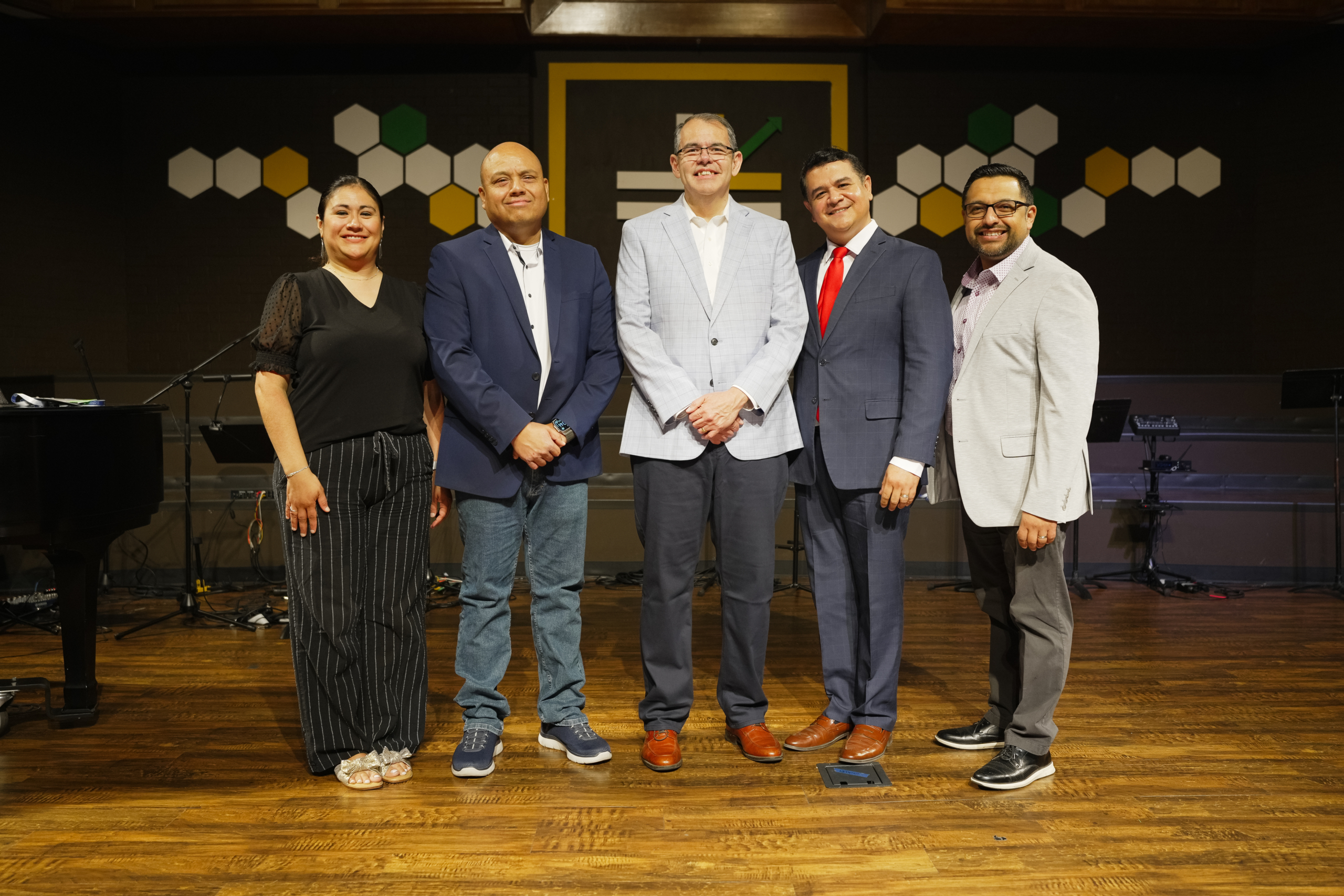
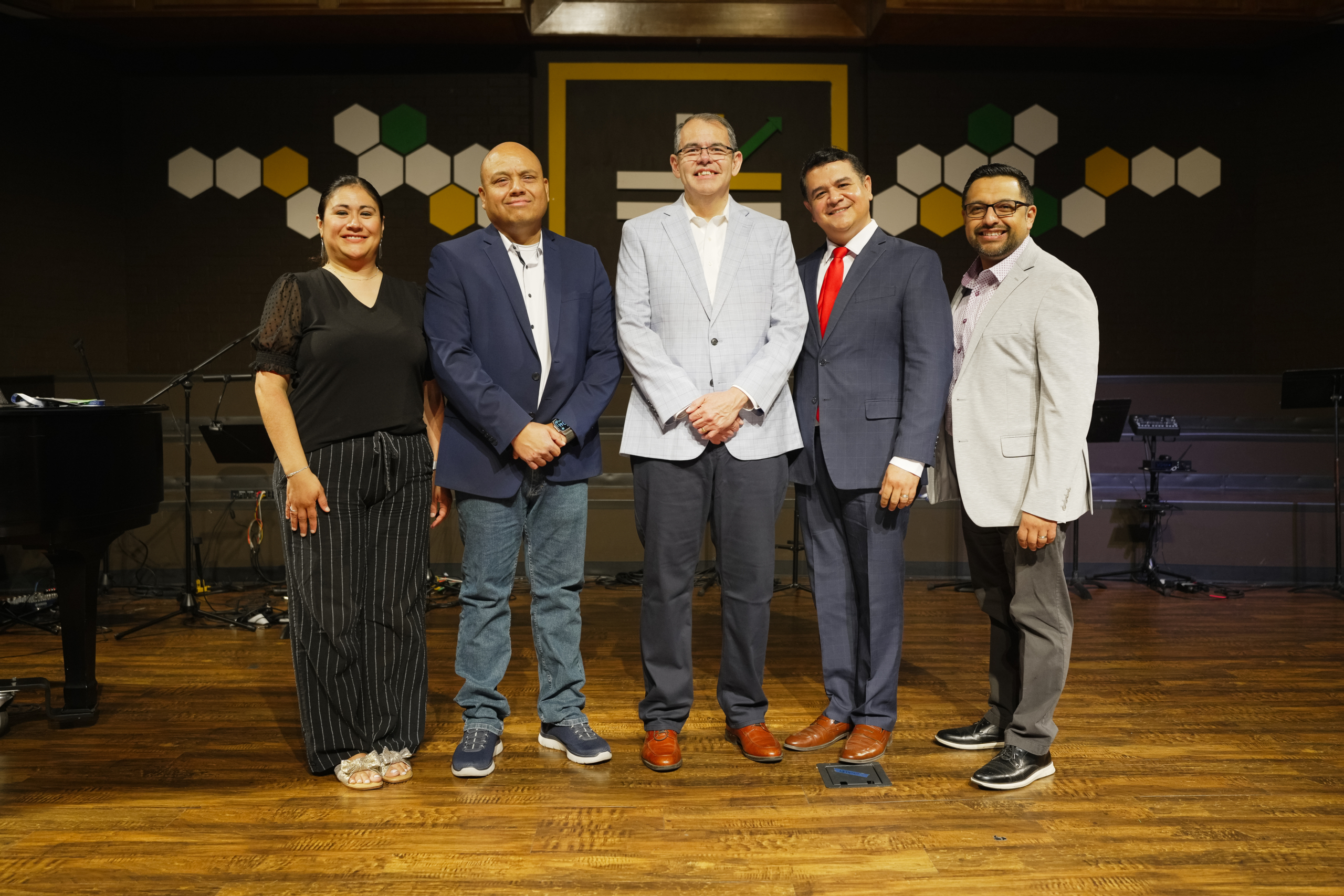
Oficiales nuevas de la Convención, de izquierda a derecha: Lidia-Salazar, secretaria; Demetrio Salazar, segundo vicepresidente; el director ejecutivo de la Convención, Jesse Rincones; Edson Lara, presidente; Fernando Rojas, primer vicepresidente. (Foto de la Convención)

El tema de la reunión anual de 2025, “De Generación en Generación”, y los talleres se centraron en el desarrollo y la formación de nuevos líderes.

Las iniciativas de educación hispana son una parte importante del desarrollo y la formación de nuevos líderes. Estos esfuerzos buscan ampliar las oportunidades para que los estudiantes hispanos asistan a la universidad y realicen estudios de posgrado.

Bendiciones financieras

El director ejecutivo de la Convención, Jesse Rincones, agradeció los esfuerzos de las iglesias por unirse para fomentar la cooperación entre ellas y ampliar la labor de formación de nuevos líderes para la próxima generación.

Rincones informó sobre una extensión de cinco años de una subvención del Fondo Lilly para Prosperar en el Ministerio, que financia la Iniciativa Conexión Pastores, lanzada en 2019. La iniciativa está diseñada para “conectar a los pastores en grupos de pares saludables para ayudarlos a prosperar en el ministerio”. La subvención amplió el programa para ministrar a las esposas de pastores bautistas hispanos a través de la nueva obra de Conexión Esposas.

Otra subvención de Lilly, recibida en 2024, estableció CANTA. El acrónimo significa “Congregaciones que Ayudan a los Niños a Transformarse en Adoradores”. El programa crea materiales de adoración y capacitación para niños en iglesias hispanas.

Otra subvención de Lilly, recibida en febrero, apoya una colaboración para el desarrollo de capacidades entre la Convención y la Red Nacional Bautista Hispana, llamada Adelante. Esta subvención permite a la Convención contratar a un director de desarrollo y participación eclesial y lanzar una iniciativa para desarrollar jóvenes líderes latinos a través de una experiencia de cohorte de un año.

Elección de nuevos directivos

Durante la sesión de negocios del martes por la mañana, Edson Lara, pastor de la Iglesia Bautista Emanuel en McAllen, fue elegido presidente de la Convención.

Fernando Rojas, pastor de la Iglesia Bautista Azle Avenue en Fort Worth, permanecerá como primer vicepresidente. Demetrio Salazar, pastor de la Primera Iglesia Bautista de Belton, también fue reelegido segundo vicepresidente. Lidia Salazar, maestra de escuela, esposa de Demetrio Salazar y miembro de la Primera Iglesia Bautista de Belton, fue elegida secretaria.

Celebrando la jubilación de una líder

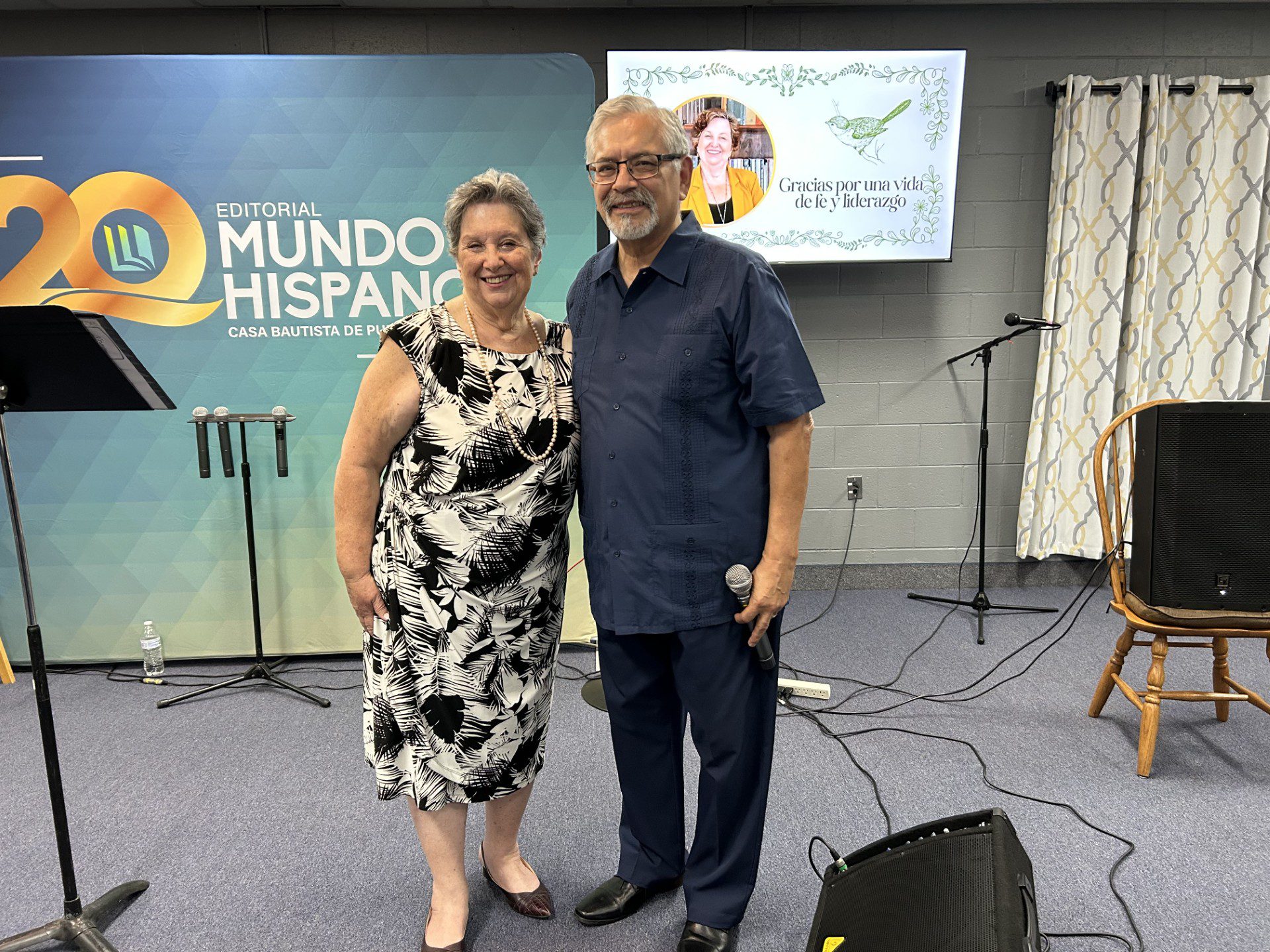
Raquel Contreras, directora ejecutiva y editora de Editorial Mundo Hispano, se jubila junto al presidente de la junta directiva, Gus Reyes, director de alianzas hispanas de Dallas Baptist University. (Foto cortesía)

Tras 12 años como directora ejecutiva y editora de Editorial Mundo Hispano, Raquel Contreras, chilena de nacimiento, se jubila. Es abogada de profesión. Se graduó del Southwestern Baptist Theological Seminary y tiene un Doctorado en Divinidad de Dallas Baptist University.

Editorial Mundo Hispano fue fundada por los misioneros J. Edgar y Mary Davis en Toluca, México, en 1905, y posteriormente se trasladó a El Paso. Contreras fue elogiada por su capacidad para mantener la empresa a flote y servir a la comunidad cristiana hispana incluso en tiempos difíciles, como la pandemia.

Editorial Mundo Hispano celebra su 120th aniversario de servicio a los cristianos de habla hispana en todo el mundo. Proporciona Biblias, programas de escuela dominical y una gran variedad de libros. Carolina Carro de Mangieri, directora de eventos globales y confraternidad de Baptist World Alliance, comenzará a desempeñarse como nueva directora ejecutiva y editora de la editorial este agosto.


Texas Baptists celebran la educación superior hispana

Texas Baptists honraron a estudiantes y líderes educativos hispanos durante un banquete de recaudación de fondos tras la clausura de la reunión anual de la Convención Bautista Hispana de Texas 2025, celebrada en la Primera Iglesia Bautista de Duncanville.

Becas

Se recaudaron $8,500 para financiar nueve becas otorgadas por la Oficina de Educación Hispana de Texas Baptists a estudiantes hispanos de pregrado que asisten a una universidad afiliada a Baptist General Convention of Texas y son miembros de iglesias bautistas de Texas.

Estudiantes hispanos bautistas de Texas que recibieron becas. (Imagen cortesía)

Los beneficiarios de las becas son:

Celina Aguirre, estudiante de ciencias políticas en Dallas Baptist University y miembro de la Iglesia Bautista Park Cities en Dallas.

Luis Alfredo Esquivel, estudiante de estudios bíblicos en Baptist University of the Américas y miembro de Southwest Baptist Church en San Antonio.

Osmara Dayanira Flores, estudiante de consejería clínica en Wayland Baptist University y miembro de la Iglesia Bautista Emmanuel en McAllen.

Ana Martínez, estudiante de enfermería en la University of Mary Hardin-Baylor y miembro de la Iglesia Bautista Getsemaní en Fort Worth.

Jazmín Lizbeth Olivarez, estudiante de administración de empresas en BUA y miembro de la Iglesia Bautista Elohim en Bryan. Olivarez dio su testimonio durante el banquete sobre su llamado al liderazgo ministerial. También habló del valor de la educación y su agradecimiento por el apoyo financiero de Texas Baptists.

• Libni Shetler, estudiante de enfermería en Houston Christian University y miembro de First Baptist Church en Marble Falls.

Marlon Vargas Zea, estudiante de negocios y teología en BUA y miembro de la Iglesia Más Allá de la Cruz en San Antonio.

Jayson Villalobos, estudiante de mercadotecnia en Howard Payne University y miembro de la Primera Iglesia Bautista en Azle.

Sofía Villarreal, estudiante de comportamiento humano en BUA y miembro de Life Church de San Antonio.

Líderes de la Iniciativa de Educación Hispana

Además de otorgar becas, el banquete celebró los 21 años de la Iniciativa de Educación Hispana de Texas Baptists y honró a sus líderes clave.

Albert Reyes, presidente y director ejecutivo de Buckner International, expresidente de Baptist University of the Américas y primer presidente hispano de BGCT (2004), impulsó la formación de un Grupo de Trabajo para la Educación Hispana a principios de la década de 2000.

El grupo de trabajo se creó en 2005 y Felipe Garza fue su primer presidente.

Gus Reyes, director de alianzas hispanas en DBU, fue el primer miembro del personal de Texas Baptists en dirigir la Iniciativa de Educación Hispana antes de convertirse en director de la Comisión de Vida Cristiana de Texas Baptists.

Gabriel Cortés fue director de la Iniciativa de Educación Hispana de 2014 a 2018. Posteriormente, se desempeñó como jefe de personal en la BUA antes de regresar a Texas Baptists en 2024 como director de educación hispana.

Rolando Rodríguez, director de Texas Baptists en Español, fue director de la Iniciativa de Educación Hispana de 2018 a 2024.

Lorenzo Peña dirigió una iniciativa especial centrada en la educación superior hispana de 2022 a 2023 a petición de David Hardage, exdirector ejecutivo de Texas Baptists.

Celebrando el pasado

Albert Reyes, presidente y director ejecutivo de Buckner International, pronuncia el discurso inaugural durante el banquete de educación hispana de Texas Baptists. (Foto cortesía)

Albert Reyes pronunció el discurso principal del banquete, compartiendo su propia trayectoria educativa desde la Primera Iglesia Bautista en Corpus Christi, pasando por la Mary Carroll High School, hasta Angelo State University, donde obtuvo un Doctorado en Ministerio en Misionología del Southwestern Baptist Theological Seminary y un Doctorado en Liderazgo de Andrews University.

Cuando Reyes era presidente de BUA, “la tasa de finalización de la escuela preparatoria en Texas para los adolescentes hispanos era de alrededor del 50 por ciento”, dijo, “y la tasa a nivel nacional era del 33 por ciento a principios de la década de 1990”.

“Hemos mejorado drásticamente esas cifras en los últimos 35 años. Hoy, la tasa de finalización de la escuela preparatoria hispana se sitúa en el 88 por ciento”, añadió, citando datos de la Fundación Annie E. Casey.

Desafiando el futuro

Reyes se refirió a las realidades demográficas actuales y futuras, haciendo referencia a las estadísticas y proyecciones de Texas 2036.

“Hoy en día, Texas alberga a 32 millones de personas. Para 2036, se espera que Texas aumente entre 3 y 5 millones de personas, principalmente debido a la migración interna. En 2022, hace tres años, los hispanos se convirtieron en el grupo poblacional más numeroso de Texas.

“Para 2050, dentro de 25 años, la población hispana de Texas será el grupo racial-étnico más numeroso en todas las categorías de edad. En otras palabras, en el futuro, o serás bilingüe y bicultural, o estarás solo.

“Para el otoño de 2042, dentro de unos 15 años, se proyecta que el número de graduados anglosajones, afroamericanos y asiáticos disminuya en un 26 por ciento, un 22 por ciento y un 10 por ciento, respectivamente”.

Otras estadísticas señalan la urgencia con la que las universidades e instituciones de educación superior deben involucrar a los estudiantes hispanos.

“El Centro Nacional de Estadísticas de Educación informa que la proporción de estudiantes hispanos de secundaria es mayor en California, con un 56 por ciento, Texas, con un 53 por ciento, y Florida, con un 38 por ciento”, informó Reyes desde Texas 2036.

Más cerca de casa para los asistentes al banquete, U.S. News & World Report muestra que Dallas Independent School District informa que la matrícula estudiantil hispana alcanzó el 70 por ciento en el año escolar 2023-2024, afirmó Reyes.

Ante estas estadísticas, Reyes instó a las iglesias, colegios y universidades de Texas Baptists a estar “preparadas para los hispanos”.

“Educar es redimir”, dijo Reyes, citando un mensaje que recordaba haber leído durante su propia trayectoria en la educación superior. “Educar a alguien es redimir todo lo que Dios quiso que fuera y equiparlo, discipularlo, prepararlo para una vida con propósito”.


Texas Baptists celebrate Hispanic higher education

Texas Baptists honored Hispanic students and education leaders during a fundraising banquet following the conclusion of the 2025 Convención Bautista Hispana de Texas annual meeting held at First Baptist Church in Duncanville.

Scholarships

A total of $8,500 was raised, funding nine scholarships awarded by Texas Baptists’ Office of Hispanic Education to Hispanic undergraduate students attending a Baptist General Convention of Texas-affiliated university and who are members of Texas Baptist churches.

Texas Baptist Hispanic student scholarship recipients. (Courtesy image)

Scholarship recipients are:

Celina Aguirre, a political science major at Dallas Baptist University and member of Park Cities Baptist Church in Dallas.
Luis Alfredo Esquivel, a biblical studies major at Baptist University of the Américas and member of Southwest Baptist Church in San Antonio.
Osmara Dayanira Flores, a clinical counseling major at Wayland Baptist University and member of Iglesia Bautista Emmanuel in McAllen.
Ana Martinez, a nursing major at University of Mary Hardin-Baylor and member of Iglesia Bautista Getsemani in Fort Worth.
Jazmin Lizbeth Olivarez, a business administration major at BUA and member of Iglesia Bautista Elohim in Bryan. Olivarez gave her testimony during the banquet about her call to ministry leadership. She also spoke of the value of education and her appreciation for Texas Baptists’ financial support.
 Libni Shetler, a nursing major at Houston Christian University and member of First Baptist Church in Marble Falls.
Marlon Vargas Zea, a business and theology major at BUA and member of Iglesia Mas Alla de la Cruz in San Antonio.
Jayson Villalobos, a marketing major at Howard Payne University and member of Primera Iglesia Bautista in Azle.
Sofia Villarreal, a human behavior major at BUA and member of Life Church of San Antonio.

Hispanic Education Initiative leaders

In addition to awarding scholarships, the banquet celebrated 21 years of the Texas Baptists’ Hispanic Education Initiative and honored the initiative’s key leaders.

Albert Reyes, president and CEO of Buckner International, past-president of Baptist University of the Américas and first Hispanic president of the BGCT (2004), called for the formation of a Hispanic Education Task Force in the early 2000s.

The task force was created in 2005, and Felipe Garza served as its first chair.

Gus Reyes, director of Hispanic partnerships at DBU, was the first Texas Baptists staff member to serve as director of the Hispanic Education Initiative before becoming director of Texas Baptists’ Christian Life Commission.

Gabriel Cortés was Hispanic Education Initiative director from 2014 to 2018. He then served as chief of staff at BUA before returning to Texas Baptists in 2024 as director of Hispanic education.

Rolando Rodriquez, director of Texas Baptists en Español, was Hispanic Education Initiative director from 2018 to 2024.

Lorenzo Peña led a special initiative focused on Hispanic higher education from 2022 to 2023 at the request of Texas Baptists’ past-executive director David Hardage.

Celebrating the past

Albert Reyes, president and CEO of Buckner International, delivers the keynote during the Texas Baptists Hispanic education banquet. (Courtesy photo)

Albert Reyes delivered the banquet’s keynote, sharing his own educational journey from Primera Iglesia Bautista in Corpus Christi through Mary Carroll High School to Angelo State University and on to a Doctor of Ministry in Missiology from Southwestern Baptist Theological Seminary and a Ph.D. in Leadership from Andrews University.

When Reyes was president of BUA, “the Texas high school completion rate for Hispanic teens was about 50 percent,” he said, “and the rate nationally was 33 percent in the early 1990s.”

“We have dramatically improved those numbers over the last 35 years. Today, the Hispanic high school completion rate is right at 88 percent,” he added, citing data from the Annie E. Casey Foundation.

Challenging the future

Reyes then pointed to demographic realities today and into the future, referring to statistics and projections from Texas 2036.

“Today, Texas is home to 32 million people. By 2036, Texas is expected to gain another 3 to 5 million people, due primarily to domestic migration. In 2022, three years ago, Hispanics became the largest population group in Texas.

“By 2050, 25 years from now, the Hispanic population in Texas will be the largest racial-ethnic group in every age category. In other words, in the future, you will either be bilingual and bicultural, or you will be by yourself.

“By the fall of 2042, about 15 years from now, the number of Anglo, Black and Asian graduates is projected to fall by 26 percent, 22 percent and 10 percent, respectively.”

Further statistics point to the urgency with which colleges and universities need to engage Hispanic students.

“The National Center for Education Statistics reports the proportion of Hispanic high school students is highest in California with 56 percent, Texas with 53 percent and Florida with 38 percent,” Reyes reported from Texas 2036.

Closer to home for banquet attendees, U.S. News & World Report shows Dallas Independent School District reports Hispanic student enrollment at 70 percent in the 2023-2024 school year, Reyes said.

In light of these statistics, Reyes challenged Texas Baptist churches, colleges and universities to be “Hispanic-ready.”

“To educate is to redeem,” Reyes said, quoting a message he remembered reading during his own journey in higher education. “To educate someone is to redeem everything God intended them to be and to equip them, to disciple them, to prepare them for a life of purpose.”


Leadership and gratitude highlight 2025 Convención

Convención Bautista Hispana de Texas 2025 annual meeting attendees gathered at First Baptist Church in Duncanville to celebrate longtime leaders, develop new leaders, give thanks for financial blessings and elect new officers.

Bea Mesquias of Agape Baptist Church in San Antonio was recognized for her lifetime of service to Unión Femenil Misionera de Texas and her 15 years of service as UFM executive director. Mesquias also was the first woman elected president of Convención. Mesquias’ successor is Silvia Ake, who also followed Mesquias as director of UFM de Texas.

Raquel Contreras Smith was honored for her years of service as she retires as editor and executive director of Casa Bautista de Publicaciónes (Baptist Spanish Publishing House), now known as Editorial Mundo Hispano.

Alfonso Flores also was celebrated for his 63 years of service in ministry and 35 years as pastor of Primera Iglesia Bautista Mexicana in San Antonio.

Along with these recognitions, Convención celebrated record attendance. Compared to the 600 who attended the 2024 annual meeting in Houston, 911 attended this year’s meeting.

Growing new leaders

The 2025 annual meeting theme “From Generation to Generation” and workshops focused attendees on growing and training new leaders.

Hispanic education initiatives are a significant part of growing and training new leaders. These efforts seek to expand opportunities for Hispanic students to attend college and graduate school.

Financial blessings

Convención Executive Director Jesse Rincones gave thanks for the efforts of churches joining together to grow the cooperation of churches and to further outreach for training new leaders for the next generation.

Rincones reported a five-year extension of a Lilly Endowment Thriving in Ministry grant funding the Conexion Pastors Initiative launched in 2019. The initiative is designed “to connect pastors in healthy peer groups to help them thrive in ministry.” The grant expanded the program to minister to the wives of Hispanic Baptist pastors through the new work of Conexión Esposas.

Another Lilly grant received in 2024 established CANTA, the Spanish word for “sing.” The acronym translates in English as Congregations Helping Children Be Transformed into Worshippers.” The program creates children’s worship and training materials for Hispanic churches.

Another Lilly grant, received in February, supports a collaborative capacity development collaboration between Convención and the National Hispanic Baptist Network called Adelante. The grant enables Convención to hire a Director of Development and Church Engagement and launch an initiative to develop young Latino leaders through a year-long cohort experience.

New officers elected

New Convención officers, L to R: Lidia-Salazar, secretary; Demetrio Salazar, second vice president; Convención Executive Director Jesse Rincones; Edson Lara, president; Fernando Rojas, first vice president. (Convención photo)

During the Tuesday morning business session, Edson Lara, pastor of Iglesia Bautista Emanuel in McAllen, was elected Convención president.

Fernando Rojas, pastor of Iglesia Bautista Azle Avenue in Fort Worth, will remain as first vice president. Demetrio Salazar, pastor of Primera Iglesia Bautista of Belton, also was reelected second vice president. Lidia Salazar, school teacher, wife of Demetrio Salazar, and member of Primera Iglesia Bautista of Belton was elected secretary.

Celebrating a leader’s retirement

Retiring after 12 years as CEO, publisher and editor of Baptist Spanish Publishing House/Editorial Mundo Hispano, Raquel Contreras, a native of Chile, is a lawyer by profession. She is a graduate of Southwestern Baptist Theological Seminary and has a Doctor of Divinity from Dallas Baptist University.

Editorial Mundo Hispano was started by missionaries J. Edgar and Mary Davis in Toluca, Mexico, in 1905, and later moved to El Paso. Contreras was praised because she was able to keep the company afloat and serving the Hispanic Christiam community even during hard times, including COVID.

Retiring Baptist Spanish Publishing House CEO and Publisher Raquel Contreras with Board Chair Gus Reyes, director of Hispanic partnerships at Dallas Baptist University. (Courtesy photo)

The Editorial Mundo Hispano/Hispanic Baptist Publishing House is celebrating its 120th anniversary of service to Spanish-speaking Christians throughout the globe. It provides Bibles, Sunday school curriculum, and a great variety of books. Carolina Carro de Mangieri, director of global events and fellowship for the Baptist World Alliance, will begin serving as the new CEO and publisher of the publishing company this August.

UPDATED: Reporting on the Texas Baptists Hispanic Education Banquet was removed and will be corrected and published separately.


On the Move: Beltran, Dodson, Keele, Miller, Pigott, Rives, Sivils, Walker

Kyler Beltran to Valley Ranch Baptist Church in Coppell as worship pastor. Beltran, who previously served Valley Ranch on an interim basis, recently graduated from Dallas Baptist University, where he led the chapel worship team.

Kyle Dodson to Valley Grove Baptist Church in Stephenville as minister of college and missions, from the Tarleton Baptist Student Ministry, where he was a campus missionary.

Ryan Keele to First Baptist Church in Center as pastor of worship and administration. This is his first full-time ministry position.

Ray Miller to First Baptist Church in Abilene as senior pastor, from Crievewood Baptist Church in Nashville, Tenn., where he was senior pastor and adjunct professor of Bible at Belmont University.

Kelly Pigott to First Presbyterian Church in Roswell, N.M., as pastor, from Hardin-Simmons University where he was professor of church history.

Randy Rives to Inglewood Baptist Church in Grand Prairie as minister of music.

Sean Sivils to Northside Baptist Church in Victoria as executive pastor, from First Baptist Church in Wimberley, where he was pastor of students.

Michael Walker to First Baptist Church in Smyer as pastor.


Around the State: Wayland group returns from Honduras

A team of students, faculty and staff from Wayland Baptist University has returned from the university’s seventh trip to Honduras, where they participated in a week-long medical mission to rural villages near Granadilla. The mission—led by Adam Reinhart, dean of the Kenneth L. Mattox School of Mathematics and Sciences, with assistance from Donnie Brown, director of spiritual life—combined medical outreach with gospel-centered ministry. Rebekah Grigsby, dean of the Ben and Betha Mieth School of Nursing at Wayland’s San Antonio campus, also was involved in the trip. Other participants included Olivia Fisher, Sarai Segura, Jazmin Ortega, Dylan Dodd, Carter Biggs, Rogelio Saucedo, Peyton North, Chloe Ratheal and Ellen Bruffey. The trip, part of an ongoing partnership with Joseph Denton and Tree of Life International, offered students in pre-health programs hands-on experience in health screenings, medication distribution and anti-parasite treatments. But organizers say the trip is about much more than physical care. “What excited me most was seeing students use their gifts and abilities to serve others and share the gospel,” Brown said. “This isn’t just about doing good—it’s about equipping students to live missionally, both in Honduras and when they return home.”

Cora Moncibaiz, Future Texas Business Legend Scholar and owner of Imago Dei Events. (Courtesy Photo)

This spring, Dallas Baptist University alumna Cora Moncibaiz was named one of the 2025 Future Texas Business Legend Scholars by the Texas Business Hall of Fame. Selected from universities across Texas, Cora joins 21 students recognized for their entrepreneurial drive, leadership and vision for the future of business in Texas. While at DBU, she served as a student worker for the Women’s Auxiliary Board—a role that sparked a love for event planning and floral design. This passion blossomed into a thriving business, and in 2021 she began Imago Dei Events—a wedding and event company that reflects Cora’s heart for ministry and her desire to serve others with purpose. What began with grocery store flowers, and a dream has turned into a thriving business now recognized across the Texas business community. For the full list of 2025 Texas Business Hall of Fame Scholars click here.

Citizens National Bank President JD Johnson was a participant in HPU’s North Texas Alumni Golf Tournament. (HPU Photo)

Howard Payne University’s fourth annual North Texas Alumni Golf Tournament was held June 23 at Texas Rangers Golf Club in Arlington. Alumni and friends networked and connected while also raising funds to support student scholarships at HPU. The first-place team was comprised of Bryan Allen, Garrett Goodwin, Tim Goodwin andRoyce Jesko. The second-place team included Brad Andrews, Garrett Einspahr, Mike Hibbs and Eric Skalos. Third place went to Rodney Bell, Chase Brown, Jim Miller and Terry Minton. Randy Lewallyn, a 1997 alumnus and HPU trustee, served as chair of the tournament. Plans are underway for the 2026 tournament. Alumni and friends can visit www.hputx.edu/golf for updates.

Woman’s Missionary Union of Texas will partner with Send Relief and Texans on Mission to share Jesus through Serve Brownsville on the Texas border, July 31 to Aug. 3. During the event, WMU of Texas will host a block party featuring a school supplies drive, as well as crafts and activities for kids. Volunteers will have an opportunity to share the gospel with children and adults, as WMU of Texas provides activities and play for children while other events meet additional needs in the community. Texas Baptists can bring hope and healing to those in need through the back-to-school drive and block party, benefiting children and families in the Brownsville area by joining the volunteer team serving in Brownsville, giving online or collecting school supplies by July 17. Visit wmutx.org/brownsville to register, give or access the donation list and drop-off instructions.

Wayland Baptist University celebrated the successful completion of its three-year Thrive Campaign, raising more than $19.5 million. (Wayland Photo)

Wayland Baptist University celebrated the successful completion of its three-year Thrive Campaign, raising more than $19.5 million and surpassing its original $18 million goal by more than $1.5 million. The comprehensive campaign has fueled projects that support students across every area of university life, from academic programs to student services and campus enhancements. Launched in 2022, the Thrive Campaign shattered records for the number of donors in fiscal year 2023 and 2025 and set a record for any three-year period. Federal grants were secured to support first-generation and military-affiliated students through scholarships, staffing, and programs such as the Summer Bridge Program and a new Veteran Success Center.

Ahead of the 23rd Baptist World Congress in Brisbane, Australia, July 7-12, the Baptist World Alliance and Baylor University announced the establishment of a Baptist World Alliance Program—the first-ever university-based, graduate-level study center devoted specifically to the study of the life, history and ongoing mission and ministry of the BWA. The BWA Program will be housed at Baylor’s Truett Theological Seminary. Baylor University President Linda Livingstone and BWA General Secretary Elijah Brown will participate in a ceremonial signing of the programagreement July 10. The BWA Program will operate at Truett Seminary and stretch across the Baylor family to offer multidisciplinary, academic and scholarly education, research, support and practical engagement. Anticipated activities include both non-credit and graduate-level certificates for current and future leaders, pastors and students; collaborative learning opportunities including courses, workshops, conferences and seminars; speaking opportunities at Baylor University and BWA events; and support for research and active scholarship. In addition, Baylor University and Truett Seminary will offer seminars leading to a Doctor of Ministry in collaboration with the John Leland Center for Theological Studies at the BWA global headquarters in Falls Church, Va.

Marv Knox, founder of Fellowship Southwest (left), poses with current Executive Director Stephen Reeves. (Courtesy Photo)

Fellowship Southwest received the McCall Racial Justice Trailblazer Award at this year’s Cooperative Baptist Fellowship General Assembly. Presented during the annual luncheon hosted by CBF’s Pan African Koinonia, the award celebrates the legacy of Emmanuel McCall and honors those working to advance racial justice within and beyond the church. In his acceptance remarks, Stephen Reeves, executive director of Fellowship Southwest, expressed his appreciation for sharing the honor with Broadway Baptist Church in Fort Worth, noting: “Racial justice is absolutely at the heart of what Fellowship Southwest is all about.”

Since 2010, WMU of Texas Women’s Build volunteers have traveled to the Rio Grande Valley to offer hope, build relationships and share Jesus. Women’s Build, a ministry of WMU of Texas, is an annual women-led home build experience in partnership with Buckner International. Each year, two teams of volunteers build a brand-new home for a family participating in Buckner’s Family Hope Center Program. No experience is necessary to come learn how to build a home while sharing the gospel. This year’s Women’s Build Project will be in Mission. Team One will build on Oct. 19-24 and Team Two on Oct. 23-28. Cost is $185 per person, including room and board. Visit https://www.wmutx.org/get-involved/womens-build for more information.

Retirement

Alfonso Flores after 63 years of ministry, including the last 35 years as pastor of Primera Iglesia Bautista Mexicana in San Antonio.


Families react to court’s LGBTQ books decision

(RNS)—The U.S. Supreme Court ruled June 27 in favor of religious parents from Maryland’s Montgomery County who sought to remove their children from classes that discussed LGBTQ-themed storybooks.

U.S. Supreme Court Building in Washington D.C. (Photo: bakdc / Shutterstock.com)

Conservative justices voted 6-3, with liberal justices dissenting, in Mahmoud v. Taylor, brought before the court in April. The lawsuit represented Muslim and Christian families who argued Montgomery County Public Schools infringed on their religious rights by barring them from opting their children out of the lessons.

While not definitive, the decision signals the justices’ inclination to see religious parents succeed in their two-year legal challenge to the school’s policy that has dominated discussions at school boards and divided county residents.

While the decision concerns advocates of the LGBTQ community, some of the county’s religious parents celebrated what they considered a victory.

The case is also one of many related to religious freedom on the court’s docket for this term, signaling a sustained interest and concern for religious liberty and expression.

‘Historic victory for parental rights’

Lightstock Image

The school board’s decision interfered with children’s religious development and burdened parents in the exercise of their religion, Justice Samuel Alito wrote in the majority opinion.

The books, Justice Alito wrote, are “unmistakably normative,” and “designed to present certain values and beliefs as things to be celebrated and certain contrary values and beliefs as things to be rejected.”

Eric Baxter, vice president and senior counsel at Beckett Fund for Religious Liberty, the legal group representing the religious parents, called the ruling a “historic victory for parental rights in Maryland and across America.”

“Today, the court restored common sense and made clear that parents—not government—have the final say in how their children are raised,” he said.

‘Chilling message to many’

Montgomery County’s Board of Education and Montgomery County Public Schools said in a joint statement the ruling sends a “chilling message to many valued members of our diverse community.”

“Although not surprised, we are disappointed in today’s ruling,” they said in the statement. “This decision complicates our work creating a welcoming, inclusive and equitable school system.”

The school system will continue to offer inclusive books and will soon announce guidelines for the upcoming school year in alignment with the Supreme Court decision, the statement said.

In fall 2022, Montgomery County Public Schools announced a new inclusive English/language arts curriculum for pre-K to 5th-grade students, which included a few books that discussed gender and sexuality.

The books included Pride Puppy! about a family celebrating Pride Day, and My Rainbow about a mother creating a rainbow-colored wig for her transgender daughter. Both were removed from the curriculum in October amid the legal dispute.

Initially offered opt-out but dropped it

After some parents and school principals opposed the new curriculum, Montgomery County Public Schools allowed parents to opt their children out of classes discussing the books. However, in the spring of 2023, the school board removed that option.

Following that decision, a group of three Muslim and Christian families sued Montgomery County Public Schools, arguing that not being allowed to opt out represented religious freedom infringement. In August 2023, a U.S. district court dismissed the request by parents, siding with the school district.

“The plaintiffs have not shown that [Montgomery County Public Schools’] use of the storybooks crosses the line from permissible influence to potentially impermissible indoctrination,” wrote the judge in the district court opinion.

The Supreme Court decision reverses lower court rulings.

Shows concerns of court’s majority

Holly Hollman, general counsel at the Baptist Joint Committee for Religious Liberty, a faith-based organization advocating for religious freedom, said the decision signals that the court’s majority seems to be concerned about the loss of some religious perspectives in culture.

Holly Hollman

As many previous cases have indicated that exposing students to certain ideas, characters or themes through school curricula wasn’t sufficient to state a constitutional claim, this decision is notable in its “unwillingness to view this curriculum as simply exposure to ideas,” she said.

“For the majority’s perspective, this material or this curriculum, and perhaps the teacher’s guide more importantly that went with it, seem to be telling students what to think about issues of gender identity and sexual orientation in ways that the parent asserted interfered with their ability to provide the religious formation for their children at that age,” Hollman said.

In the majority opinion, Alito noted the curriculum posed “objective danger” to students and exerted a “psychological ‘pressure to conform’ to their specific viewpoints” upon children.

Raises questions about opt-out policies

The decision raises questions about public schools’ ability to enforce opt-out policies for classes that address contentious topics in the future, said Hollman.

In the opinion, the conservative justices don’t restrict the type of opt-out requests that can be made, though the decision implies it can be invoked only in cases that pose a “very real threat of undermining” children’s religious beliefs.

“It does make it more difficult for school boards because they will have to consider opt outs, perhaps in more cases than they had in the past,” Hollman said.

For Wael Elkoshairi, a Muslim father whose daughter was a third-grader in Montgomery County Public Schools when the dispute started, the case’s elevation to the Supreme Court reflects a lack of constructive dialogue between parents and Montgomery County Public Schools.

“We’re very happy. At the same time, we’re kind of scratching our heads as to why it took this to get to some type of dialogue” between parents and Montgomery County Public Schools, he said.

‘We were called book burners’

Elkoshairi, who believes “marriage is between a man and a woman,” said the books were inappropriate and contradicted his religious beliefs.

As a result, he became involved with the group of parents protesting the inability to opt out. He argued religious parents like himself have been harshly criticized for their dissent.

“We were called book burners,” he said. “We never looked to change any of the books or the curriculum. … We were looking for the accommodation that was afforded to us initially.”

The problem goes beyond the storybooks, said Elkoshairi, who thinks the curriculum is the latest example of schools overstepping on topics related to gender and sexuality.

“It’s a very slippery slope the parents are on right now,” he said. “We could not agree … where inclusion stops and indoctrination starts.”

‘Setback—but not a major setback’

David S. Fishback is a member of Temple Emanuel of Kensington, a Reform Jewish temple that co-sponsored the April 22 rally outside the Supreme Court. Fishback, a former Montgomery County Public Schools parent who supported the curriculum, said the court’s ruling is a “setback—but not a major setback.”

“While this, for now, deprives [Montgomery County Public Schools] of one particular tool advancing the interests of creating an atmosphere of respect for all people … (the district) will continue to do so, in that respect,” he said. “I’m disappointed in the decision, but I’m very, very pleased that our elected leadership is standing firm.”

Mark Eckstein, a Montgomery County resident who sat on the advisory committee that introduced the curriculum, said though it seems to have backfired, the storybooks only intended to expose children to the diversity of sexual orientations and gender identities.

“It’s not like we have an agenda—it’s already there,” he said, adding the Supreme Court’s decision reflects an over-politicization of the dispute.

“These kids know about it from YouTube. They know about it because their teachers are gay. They know about it because our county council president is gay.”

LGBTQ advocate calls ruling ‘heartbreaking’

Brian K. Bond, CEO of PFLAG, an organization advocating for the LGBTQ community and allies, in a statement June 27 called the decision “heartbreaking” for “LGBTQ+ students, families and employees of Montgomery County Public Schools.”

The storybooks benefited the students both academically and socially, he argued.

“Learning about different people, histories and experiences in school benefits students,” he said. “It strengthens empathy and a sense of belonging, increases test scores and graduation rates, and betters mental and physical health, brain development and connections to school and community.”

Following Montgomery County Public Schools’ decision to remove parents’ rights to opt out, Elkoshairi enrolled his daughter in a homeschool cooperative coordinated by Muslim families living in the county.

“It cost us money, and it’s cost us time and energy, over and above what we normally were doing with public schools, but we felt like we had no option,” he said. “We were kind of pushed into the corner.”


Russia severely violates religious freedom, report says

The Russian government continues to violate the rights of religious groups “in blatant violation of international law,” a new report from the U.S. Commission on International Religious Freedom reported.

Russian troops destroyed the library of Tavriski Christian Institute in Kherson, Ukraine. However, the school is committed to continuing its mission. (Courtesy Photo)

“Throughout 2024 and the first half of 2025, Russia prosecuted members of perceived ‘non-traditional’ religious organizations for their religious activities in both Russia and Russian-occupied territories of Ukraine,” policy analyst Dylan Schexnaydre wrote.

Russian law defines Christianity, Islam, Judaism and Buddhism as “traditional” religions, while it grants special recognition and privileges to the Russian Orthodox Church of the Moscow Patriarchate.

“Authorities also targeted independent civil society organizations, human rights activists working on [freedom of religion or belief], and dissidents expressing opinions involving religion,” the report stated.

The report—“Russia’s Persecution of Religious Groups and FoRB Actors”—said human rights groups have identified hundreds of people in Russian custody who were imprisoned for exercising their right to freedom of religion or belief.

Closing churches, arresting religious leaders

Russian authorities continue to perpetrate “particularly severe violations of religious freedom against a range of religious groups and freedom of religion or belief actors,” the commission report said.

Violations cited include closing houses of worship and assaulting, arresting and even torturing religious leaders.

The report cites the example of a ban on activities the Fourth Cassation Court of General Jurisdiction imposed on a Baptist house of prayer in Kurganinsk.

“According to authorities, the house of prayer had failed to properly register as a religious organization and thus had conducted illegal missionary activities for its roughly 1,500 attendees. Authorities sealed the building shut following the most recent ruling,” the report stated.

Last September, the Central District Court of Sochi fined and ordered the deportation of an 85-year-old Polish Roman Catholic priest who had served in Russia close to 30 years, the commission report noted. He was charged with “illegal missionary work” when he lost the documents that permit him to preach in Sochi.

Authorities criminalizing peaceful religious actions

Russian courts last year considered 431 cases of religion law violations—many related to alleged “illegal missionary activities”—resulting in fines totaling more than 4.7 million rubles (more than $58,000), the report said.

“Authorities criminalize the activities of several peaceful religious organizations by designating them as ‘extremist,’ ‘undesirable,’ or ‘terrorist’ despite a lack of evidence or even specific allegations that those accused promoted, participated in, or plotted violence,” the commission report stated.

“Additionally, the government penalizes human rights activists documenting [freedom of religion or belief] violations, those engaging in perceived religiously offensive expression, and religiously grounded anti-war protestors through the country’s foreign agent laws, blasphemy law, and war censorship laws.”

Authorities have cracked down on dissenting religious speech since Russia launched its full-scale invasion of Ukraine in February 2022, adding anti-war religious leaders to its foreign agents registry, the commission report stated.

Last October, law enforcement officers assaulted and arrested a Pentecostal pastor at his home after he preached a sermon calling on Christians not to participate in the war against Ukraine.

In November, the Berezovka District Court fined a Baptist 60,000 rubles for refusing to serve in the Russian military, and other religious conscientious objectors have been imprisoned.

‘Intense persecution’ in Russian-occupied Ukraine

In Russian-occupied Ukraine, religious communities—including some Christian groups—have been subjected to “intense persecution,” the report stated.

 “Russian de facto authorities have banned the Orthodox Church of Ukraine (OCU), Ukrainian Greek Catholic Church, Jehovah’s Witnesses, and various Protestant groups, including Baptists, Pentecostals, and Seventh-day Adventists,” the report said.

A Russian airstrike on Palm Sunday killed at least 34 people in the northeastern Ukrainian city of Sumy in the deadliest attack of the conflict so far this year. (Photo distributed by the Ukrainian Council of Churches and Religious Organizations)

Ukrainian nongovernmental organizations report at least 47 religious leaders have been killed, and more than 640 houses of worship and other religious sites have been damaged or destroyed in Russian-occupied Ukraine since February 2022.

At least one Orthodox Church of Ukraine priest and two Ukrainian Greek Catholic priests reportedly were tortured.

Since 2017, the U.S. Commission on International Religious Freedom has recommended Russia be named a Country of Particular Concern for engaging in “systematic, ongoing and egregious” religious freedom violations.

The U.S. Department of State designated Russia as a Country of Particular Concern the first time in 2021 and redesignated it as such the two following years.

Most recently, the commission not only called on the State Department to continue to designate Russia as a Country of Particular Concern, but also impose targeted sanctions on Russian government agencies and officials responsible for violations of religious freedom.

The commission also urged Congress to advocate on behalf of prisoners of conscience in Russia.


Accrediting body extends sanctions for Southwestern

FORT WORTH (BP)—Southwestern Seminary President David S. Dockery announced June 27 the Southern Association of Colleges and Schools Commission on Colleges extended sanctions against Southwestern Baptist Theological Seminary first implemented in 2023.

Dockery noted the regional accrediting body acknowledged “significant recent accomplishments in addressing noncompliance” and that institutional evidence “makes it reasonable for the Board to assume it will remedy all deficiencies within a 12-month period.”

In an eight-page letter to the Southwestern community, Dockery noted the institution’s “long-term pattern of challenges, financial and otherwise” and pledged to continue to work with the agency to address its concerns.

He also pledged to Southwestern’s “constituents and publics” that the institution “will work faithfully and responsibly concerning expectations from accreditors.”

Dockery commended the work of the board of trustees, faculty, staff, students and others “who have worked so hard, sacrificed, served, prayed, given, supported, counseled and encouraged” the administration for the past 33 months.

“The decision from SACSCOC, which cannot be appealed, does not in any way take away from the remarkable strides that have been made by the entire Southwestern community since the fall of 2022,” he said, adding it is “vital to recognize” all academic programs “remain fully accredited.”

Dockery said the association’s “decision must not be seen as a setback but only as further motivation to continue the institutional resolve and good progress that has been made to this point.”

Continued optimism

In a separate statement, Bob Brown, chairman of the seminary’s board of trustees, said while he is disappointed in the decision, he is “extremely optimistic about Southwestern’s future.”

“With our enrollment continuing to rise and our financial position measurably stronger, there are sound reasons to be positive about the future of SWBTS,” said Brown, executive director of Lakeway Christian Schools in White Pine, Tenn.

“However, my optimism is primarily driven by the work of the Holy Spirit on Seminary Hill with hope and unity sweeping the campus in tangibly observable ways every day.”

Expressing appreciation for Dockery and the rest of the seminary leadership, Brown also pledged the “full cooperation” of the board of trustees with the regional accrediting agency “to take the actions necessary to bring the seminary in full compliance with its accreditation standards and policies.”

In its disclosure statement posted on the organization’s website on June 27, the Southern Association of Colleges and Schools Commission on Colleges reported the seminary’s accreditation has been continued for “Good Cause” and placed on “Probation” for 12 months following its review, citing Core Requirement 13.1 (Financial resources) and Standard 13.3 (Financial responsibility).

These two standards have been at the core of the concerns from the agency since the conclusion of the 2021-22 fiscal year when the institution completed the year with an operational deficit of $8,911,823 and a decrease in net assets of $15,317,497.

“These standards expect the institution to have sound financial resources and a demonstrated, stable financial base to support the mission of the institution and to manage its financial resources and operate in a fiscally responsible manner,” the notice said.

The Southern Association of Colleges and Schools Commission on Colleges noted after two years of monitoring: “Instead of removing the institution’s accreditation, the SACSCOC Board of Trustees can act to extend the accreditation for Good Cause if (1) the institution has demonstrated significant recent accomplishments in addressing non-compliance, and (2) the institution has provided evidence which makes it reasonable for the Board to assume it will remedy all deficiencies within a 12-month period, and (3) the institution has provided assurance to the Board that it is not aware of any other reasons, other than those identified by the Board, why the institution cannot be continued for Good Cause.

“Probation for Good Cause is the most serious public sanction imposed by the SACSCOC Board of Trustees short of loss of accreditation.”

Dockery expressed gratitude for the commendations offered by Southern Association of Colleges and Schools.

While acknowledging Southwestern is not in compliance with the agency’s standards, Dockery noted the seminary’s financial position in the spring of 2025 “was measurably stronger” than it was in the spring of 2021 when its accreditation was reaffirmed.

Committed to continued improvements

“Southwestern has reached a place of financial stability, but we need to establish what SACSCOC refers to as ‘a pattern of financial stability.’ Our efforts are now focused on ongoing sustainability as well as additional improvement,” he said.

“We respect the SACSCOC process and promise to work with them regarding next steps,” Dockery said. He invited the seminary community “to join with me in asking the Lord for his ongoing help as we recommit ourselves to the good work that has been started.”

Dockery also said he welcomed the seminary’s regional accreditor for its April 2026 site visit to evaluate the institution’s progress. The seminary remains in good standing with its national accreditor, Association of Theological Schools.

Dockery’s letter cited many enrollment and financial metrics that demonstrate dramatic improvements in the financial picture of the seminary since the initial warning status was put in place by SACSCOC in 2023 and before.

Among the metrics cited by Dockery are:

  • increases in enrollment headcount, annual credit hours taught, and fulltime equivalent enrollment;
  • “positive” budget trends in the current budget year, which ends July 31, compared to the prior budget year, and a “positive change” of $8 million in the operational budget in the past two years;
  • significant increases in tuition and operating revenues, decreases in operating expenses, and reduction in number of full-time employees;
  • reduction in long-term debt and the complete elimination of short-term debt;
  • decreased liabilities and increased assets; and
  • change in cash position from a loss of nearly $5 million in 2022 to a gain of more than $9 million in 2024, and an increase in cash and cash equivalents from $1.7 million to more than $12 million.

“Overall, these numbers have resulted in a significant change in Southwestern’s overall financial picture,” he said, noting the seminary’s bankers “have applauded the commendable progress” of the institution since the fall of 2022.

“We pledge to the Southwestern constituents and publics that Southwestern will work faithfully and responsibly concerning expectations from accreditors,” Dockery said.

“I invite Southwesterners to join me with a new resolve for the sake of Southwesterners who have gone before us, for our shared love for our current students, and for our shared hopefulness regarding future students.

“Together, we will work to seek first God’s kingdom and his righteousness in all things, trusting in our providential God and acknowledging our full and complete dependence on him for his provision and protection for Southwestern in the days to come.”

Dockery’s letter to the Southwestern community is available here, as well as a Frequently Asked Questions document here.