Firm selected to conduct review of SBC Executive Committee

ASHEVILLE, N.C. (BP)—A task force appointed by Southern Baptist Convention President Ed Litton has selected Guidepost Solutions to oversee a third-party review of the SBC Executive Committee’s past handling of sexual abuse issues.

According to a statement released by the task force, Guidepost Solutions was selected in part due to its “extensive background in abuse, trauma, and abusive dynamics, with considerable background involving abuse in religious contexts, significant experience with corporate and legal dynamics which contribute to the mishandling of or proper responses to, sexual abuse, survivor care and abuse prevention.”

The task force also cited Guidepost Solutions’ “robust understanding of and focus on the impact of leadership, with significant skill assessing and reporting on cultural dynamics of an institution and their impact on abuse and abuse prevention.”

Guidepost’s “in-depth understanding of best-standards practices for investigations and assessments with the ability to provide clear guidance and input to the task force on best methods for pursuing transparency, accountability, and reform in the investigative process” was also commended in the task force release.

Mandated by SBC messengers

Messengers approved the formation of the task force at the 2021 SBC annual meeting in June, just five days after the Executive Committee had announced Guidepost would conduct a similar review at its own request. The Executive Committee-commissioned review was subsequently put on hold pending the actions of the task force.

In a statement released to Baptist Press, the SBC Executive Committee welcomed the announcement saying: “Now, nearly three months after the annual meeting, the Executive Committee welcomes the announcement that Guidepost Solutions has been chosen by the task force to conduct the third-party inquiry of the Executive Committee.”

Pastor Rolland Slade of Meridian Baptist Church in El Cajon, Calif., is chair of the SBC Executive Committee. (Screen Capture)

Rolland Slade, Executive Committee chairman, also affirmed the Guidepost selection, saying: “I thank the task force for their diligence in selecting Guidepost Solutions. Now that we know the firm, we can all move forward to the next steps. As I asked in June, please be patient with all of us as we walk this road together. We want to make sure we do things right.”

The task force previously had released a statement Sept. 3 posting answers to frequently asked questions regarding the task force and its work. Recommendations in the statement ranged from the scope of the independent review to methods of funding the probe.

Regarding funding for the review, the task force noted that the “Executive Committee is responsible for figuring out how” to fund the review but recommended the Executive Committee use its cash reserves to cover the associated costs, though the original motion stated that “the review shall be funded by allocations from the Cooperative Program.”

Probe does not include abuse at local-church level

The task force also clarified that while the time frame of the independent review goes back to Jan. 1, 2000, its scope should focus on the actions of the Executive Committee alone, saying the parameters of the third-party independent review “do not include any allegations of sexual abuse or mishandling of abuse at the local church level, except to the extent that those allegations against local church pastors impacted or were impacted by the words and actions of the Executive Committee.”

The group is also calling on members of the Executive Committee to waive attorney-client privilege, saying that “an overwhelming majority of SBC messengers has requested it.”

The task force said it believes waiving attorney-client privilege “is necessary for assessing any mishandling, for accurately making recommendations for reform, and for accountability and transparency. Waiver is absolutely critical to ensuring that the third-party firm has full access to relevant and material information.”

Regarding the questions related to attorney-client privilege, the Executive Committee statement said “the Executive Committee leadership is not opposed in principle to requests for the waiving of attorney-client privilege considerations when it is relevant, it is appropriate, and it is in consultation with the third-party commissioned to conduct the inquiry, Guidepost. Speculation to the contrary is internet rumor and untrue.

“Ultimately, these are decisions for the Executive Committee’s board of trustees, and we are working to provide information to the board of trustees so they can make informed decisions they deem appropriate within the confines of all legal (i.e. fiduciary) considerations as everyone seeks to appropriately implement the will of the messengers. We urge the public to leave this review now to Guidepost and the Executive Committee to be handled in an appropriate and professional manner on behalf of all Southern Baptists.”

Executive Committee meets next week

The SBC Executive Committee will meet Sept. 20-21 and is expected to address items related to the independent review at that time.

Task force members are Chair Bruce Frank, lead pastor of Biltmore Baptist Church of Arden, N.C.; Vice Chair Marshall Blalock, pastor of First Baptist Church of Charleston, S.C.;

John Damon, chief executive officer of Canopy Children’s Solutions, Jackson, Miss., and member of Broadmoor Baptist Church, Madison, Miss.; Liz Evan, judicial law clerk at Tennessee Court of Criminal Appeals, Nashville, and member of Hilldale Baptist Church, Clarksville, Tenn.; Heather Evans, director of Evans Counseling Services, Coopersburg, Pa., and member of Cornerstone Presbyterian Church in Center Valley, Pa.; Andrew Hébert, lead pastor of Paramount Baptist Church, Amarillo; and Bucas Sterling III, senior pastor of Kettering Baptist Church, Upper Marlboro, Md.

Rachael Denhollander, an attorney, advocate and educator from Louisville, Ky., and Chris Moles, an ordained minister from the Christian and Missionary Alliance and ACBC certified counselor, serve as advisers to the group.

According to the task force release, survivors, witnesses and other members of the public who wish to communicate with the Guidepost team can email ECCInvestigation@guidepostsolutions.com.

The task force also stated that “persons reporting information to this email address can do so anonymously. Names and other personally identifying information of survivors and witnesses who choose to report information to this email address will remain private so long as permitted by law. Only Guidepost will have access to the information submitted to this email address; it is not accessible to the task force or the SBC.”


IMB updates vaccination policy to maximize access

RICHMOND, Va. (BP)—Desiring to help its personnel maintain access to unreached peoples and places and remain healthy, the Southern Baptist Convention’s International Mission Board announced a policy Sept. 8 related to COVID-19 vaccinations.

This policy addresses the challenges of overseas life and travel requirements for IMB missionary personnel and staff members who travel overseas.

The policy requires IMB missionaries and their children ages 16 and older to be vaccinated against COVID-19 prior to attending field personnel orientation prior to their long-term field service.

IMB missionaries and their children ages 16 and older also are required to be vaccinated against COVID-19 prior to attending a stateside conference during their periodic return to the United States.

Attendance at the two conferences is mandatory for missionaries before initial entry or return to a country of service. The policy also requires staff members who must interact with field personnel at field personnel orientation and stateside conferences to obtain COVID-19 vaccination. The policy is effective immediately.

Volunteers serving with IMB field teams must follow the recommendations and requirements of the government of the hosting country for the volunteer trip. IMB does, however, recommend those who are not required to be vaccinated by the host country to consider being vaccinated, given the risks associated with travel.

The recommendation for volunteers is designed to protect not only the volunteer, but also the field personnel, national partners and ongoing field ministries.

Maintain access to unreached, protect health

“The International Mission Board exists to serve Southern Baptists in carrying out the Great Commission to make disciples of all nations—even to those people in the overpopulated urban cities, even to those in the hardest-to-reach jungles and plains,” said IMB President Paul Chitwood.
“And the IMB is pressing forward to share the gospel even in the midst of an ongoing global pandemic that is no respecter of geographical boundaries or human demographics.”

“We must make every wise decision, even when a decision is exceptionally difficult, that maintains our team members’ access to the growing number of unreached peoples and places around the world where vaccines are required for entry,” Chitwood added. “We also want to do all we can to undergird our team members’ spiritual and physical health to maximize our effectiveness as we serve Southern Baptists in our global gospel endeavors.”

A growing number of the countries in which IMB field personnel serve are requiring proof of a COVID-19 vaccine to enter, remain in or exit the country. Some field personnel have reported incidents in their countries of service where proof of vaccination must be shown for adults and older children to board a subway, enter a shopping mall, eat in a restaurant, or board an airplane for travel.

Vaccination requirements are not new for the IMB. Since the IMB implemented vaccine requirements for field personnel in the 1980s, the number of vaccine-preventable illnesses have significantly decreased among IMB field personnel and their families.

Adhering to WHO and CDC recommendations

The IMB requires certain vaccines for several reasons:  Vaccines prevent unnecessary sickness, suffering, and even death for field personnel and their families; vaccines protect national partners and those who missionaries minister to from contracting illnesses from IMB personnel and their families; vaccines help ensure better health for field personnel so they can focus on the missionary task; and vaccines lower medical expenses, which fosters good stewardship of the funds that have been entrusted to IMB.

IMB’s medical team and senior leadership team are adhering to precautions recommended by the World Health Organization and the Centers for Disease Control and are following all local and federal regulations with the policy. As of Sept. 3, 2021, the Pfizer vaccination is available in the United States and is authorized for everyone age 16 and older. Personnel and staff received a list of additional approved vaccines that fulfill the policy for adults, as well as directives for those personnel who have a physician-documented medical exception.

Senior leaders acknowledge that the policy may result in some field personnel and staff members choosing not to join the IMB; to take a leave of absence; or to discontinue their employment with the IMB because of the requirement. Throughout the years, others have opted out of serving internationally with IMB due to other vaccine requirements.

“We take seriously our responsibility to make the best decisions we can for those serving with IMB,” said Todd Lafferty, IMB executive vice president. “The challenges of COVID-19 continue to deeply affect us all. Some have lost loved ones, others have dealt personally with terrible illness, and many remain in lockdown throughout the world. Just when it seems the pandemic may be loosening its grip, more information arrives, and we encounter new complications.”

“Praise the Lord that we all have hope and faith in Jesus Christ to carry us through these turbulent times,” Lafferty added. “We know exactly who is in control, and we cannot lose sight of how God is using us for his purpose and mission in our day. We are called to bring the hope of eternal life to those who have not yet had the opportunity to hear the gospel.”

Navigating difficult decisions

Chitwood said IMB’s senior leadership team and medical personnel continue to navigate many difficult decisions stemming from COVID-19 and the ways in which it affects various family situations and plans for IMB’s field personnel and staff. He said they continue to seek God’s wisdom as the organization navigates each difficult decision and as conditions continue to change.

Ultimately, he said, the IMB aims to remain on mission, unwavering in its work to advance the gospel.

“We’re praying that this will be a time of global awakening, that many would come to know the Lord as the fear of the global pandemic lingers,” Chitwood said. “We know that the Lord has given an ultimate cure.

“As humans, we’re afraid of death, but the believer doesn’t have to be afraid of death. Death has no sting, and the Lord’s given us his vision in Revelation 7:9—a great multitude from every nation, from all tribes, all peoples, all languages around the throne in heaven.

“We’re praying and trusting that some will be there because of the way God used this pandemic to foster a new openness to the gospel. We want to be on the field to take that good news to these souls.”


‘In Christ Alone’ still inspires after 20 years

NASHVILLE (RNS)—The melody that changed Keith Getty’s life was first scratched out on the back of an electric bill in a humble flat in Northern Ireland.

At the time, he thought it wasn’t that great. But it was the best he could come up with.

So, he sent a recording of the melody on a CD to Stuart Townend, an English songwriter he’d met a few months earlier at a church conference, in hopes Townend might be able to turn the melody into a serviceable hymn.

Getty was right.

Success came as a surprise to creators

That melody became the basis for “In Christ Alone,” released in 2001. It is one of the most popular songs in Protestant churches, according to the Christian Copyright Licensing International, which tracks songs sung in churches. The song also launched a new era of modern hymn writing.

And it all came as a surprise to the tune’s authors.

In a 2016 interview recounting the origins of “In Christ Alone,” Townend said there was nothing memorable about his meeting with Getty.

“We got together, we had a coffee, nothing particularly eventful happened,” Townend recalled. “He said he’d send me a CD with some of his song ideas. … It arrived and I wasn’t expecting anything.”

Then he popped in the CD and immediately changed his mind. He eventually called Getty and the two talked about writing a musical version of a church creed that would recount the story of the life, death and resurrection of Jesus.

The song originally started with the line “My hope is found in Christ alone.” Getty suggested switching the verse around to start with “In Christ alone.” After some hesitation, Townend did so, and the song came to life. Getty has described Townend’s lyrics for the song as “absolutely brilliant,” capturing the story of Christian faith in a powerful and lovely way.

Paved the way for other modern hymns

Getty has sometimes called “In Christ Alone” a “rebel song”—a kind of protest against the more contemporary worship songs that sound more like pop music than traditional hymns. It was the first of a series of modern hymns he’s helped write, combining singable melodies with theological reflection.

He believes they are the type of songs Christians need in a complicated and ever-changing world.

“If we’re going to build a generation of people who think deep thoughts about God, who have rich prayer lives, and who are the culture-makers of the next generation, we need to be teaching them songs with theological depth,” he said in a 2016 interview about his approach to hymn writing.

Keith and Kristyn Getty (Courtesy Image)

Getty and his wife, Kristyn, who perform together and tour with their four kids and an Irish-themed band, are back in Nashville, Tenn., after nine months on lockdown in Northern Island, where they have a home. Being back in Ireland was respite for the Gettys after a decade and a half of touring, recording and building a music publishing business. They spent much of the time walking on beaches, hanging with their kids and hosting weekly hymn sings on Facebook Live.

They returned to Nashville just in time for their annual Sing! conference, which is expected to draw about 6,500 people, with an additional 40,000 streaming online. The event, held this year on Sept. 13-15, has drawn more than 16,000 people in person in the past and has included packed hymn singing events at both the Grand Ole Opry and the Bridgestone Arena in downtown Nashville.

Presbyterian minister Kevin Twit, founder of Indelible Grace, a Nashville music company that sets traditional hymns to new tunes, is a big fan of the Gettys. He sees “In Christ Alone” as a marriage between well written and inspiring lyrics and a hymn tune that’s both compelling and flexible. The song works as well on a pipe organ with a choir as it does in a small church with a guitar and a handful of voices, he said.

“That’s hard to do,” he said.

Theological depth in contemporary setting

Twit, who leads the Reformed University Fellowship at Belmont University in Nashville, said “In Christ Alone” appeared on the scene just as a number of younger evangelicals were looking for songs with more theological depth than the contemporary songs they had learned in church growing up. Getty, Twit said, understands the way songs people sing in churches shape both their theology and the way they live their lives.

“I think he really gets that worship is formative,” he said.

Constance Cherry, professor emeritus of worship and pastoral ministry at Indiana Wesleyan University, believes “In Christ Alone” has succeeded by combining the traditional structure of a hymn with the kind of instrumentation used in more contemporary worship settings.

She said the structure of a hymn makes it easier for hymn writers like Getty and Townend to dig deep into a theological topic.

Cherry also appreciates that the Gettys are focused on creating hymns that make it easier for congregations to sing together. That’s a lost art, she said, in a time when many more contemporary worship songs are modeled after what is popular on the radio. While she appreciates contemporary praise songs, she said they are often focused more on the musicians than on the congregation.

“Every worship song in any worship service has one goal—and that is for the people to sing,” she said.

Brian Hehn, director of the Center for Congregational Song, the outreach arm of The Hymn Society in the United States and Canada, also points to the flexibility and beauty of the melody of “In Christ Alone” for the hymn’s enduring success. The melody falls in a comfortable range for most people and is simple and accessible while still intriguing to listen to. And it works for praise bands and choirs alike—a key to a successful congregational song, he said.

Broad and theologically complex lyrics

Townend’s lyrics, Hehn added, are beautifully crafted and full of nuance. They walk the worshipper through the life of Jesus, from the Incarnation—“Fullness of God in helpless babe,” as the hymn puts it—to the death of Jesus and then his resurrection. The song also connects God to the life of worshippers, “from life’s first cry to final death.”

Because of that, the hymn works in a variety of settings, from a Christmas or Easter celebration to a regular Sunday service.

The song also contains surprising theological complexity, said Hehn. It’s perhaps best known for a line about the wrath of God being satisfied in the crucifixion, which reflects a theology known as penal substitutionary atonement that’s commonly accepted in evangelical churches. But that has led other churches to change the lyrics of the hymn—and caused the song to be dropped from a Presbyterian Church (USA) hymnal after a proposed lyric change was rejected.

But “In Christ Alone” also references the Christus Victor view of the atonement, which celebrates Jesus’ victory over the grave, and the ransom view of the atonement, which stresses that God purchased forgiveness of human sin from the devil with the sacrifice of Jesus.

“I find that wonderfully broad,” he said.

While congregational singing may be on decline in American churches, Hehn said, it remains vital in many churches around the world. And there will always be a need for songs like “In Christ Alone.”

“No matter how you interpret the Bible, it is impossible to get around the fact that we’re supposed to sing together,” Hehn said.


NIH director ‘a bit’ frustrated with evangelicals about vaccine

WASHINGTON (RNS)—A day after President Joe Biden announced sweeping policy changes to continue to address the COVID-19 pandemic, one of his administration’s top health officials said he doesn’t expect widespread use of religious exemptions to get around them.

Francis Collins, director of the National Institutes of Health, also acknowledged Sept. 10 he is “a bit” frustrated with fellow evangelicals who have hesitated or refused to get the vaccine, even as the delta variant has led to an average of more than 1,000 U.S. deaths a day.

Collins said he hopes the “much more muscular requirements” will make “a big difference” in reducing the number of unvaccinated Americans, noting the country needs to vaccinate at least five times the 800,000 who are being vaccinated daily in order to overcome the variant.

Among the new policies is an “emergency rule” Biden said the Labor Department will develop to require U.S. businesses with 100 or more employees to mandate their staffs are fully vaccinated or show weekly they have tested negative for COVID-19.

Collins spoke to Religion News Service about how that rule might affect religious organizations, how clergy can help congregants view vaccinations and how part of his “calling” is to encourage religious groups to work to end the pandemic.

The interview has been edited for length and clarity.

Love your neighbor and get vaccinated

President Biden said on Thursday that “this is a pandemic of the unvaccinated,” and you have urged your fellow evangelicals to get vaccinated as an “opportunity to do something for your neighbors.” But studies have shown white evangelicals are among the most resistant and hesitant toward the COVID-19 vaccine. Does this make you frustrated with your fellow believers?

Well, to be honest, it does a bit. But I’m also trying to be sure I’m listening carefully to what the concerns are because I don’t think lecturing is probably the best way to get people to change their minds.

It is odd because evangelicals generally believe strongly in this love-your-neighbor principle. And we do know if we want to get this terrible pandemic to come to an end, it’s going to require all of us to get engaged in getting immune, and the best way to do that is with a vaccination.

And by vaccinating yourself, you’re also providing protection to the people around you who are depending on you not to spread that virus to them, particularly people who are immunocompromised from cancer or organ transplants or kids under 12 who can’t be vaccinated yet.

There have been some reports of pastors with near-death experiences with COVID who have changed their mind about their resistance to the vaccine at that point. Is their example what it might take for some people to roll up their sleeves?

I think every person’s got a somewhat different threshold for what it’s going to take. It’s often somebody they trust, who’s willing to talk with them, listen to the concerns—much of which are fed by conspiracies on social media that basically don’t have any truth to them but are troubling if you’ve heard them several times—and then basically get the confidence of that person that the evidence really is in favor of this. And that, for somebody who’s a believer, this is what you could call an answer to prayer.

If we’ve all been praying to God to somehow deliver us from this terrible pandemic, and what happens is these vaccines get developed that are safe and effective, well, why wouldn’t you want to say, “Thank you, God” and roll up your sleeve?

As the new announcement by the administration was made Thursday, a senior administration official told reporters there’ll be “limited” exemptions for federal workers for religious reasons. Do you know what that means or could you give an example of what that might be?

I think every agency is going to have to figure out exactly how to interpret that. I would say if people are going to say there’s something special about COVID-19 vaccinations that require even more religious exemptions than you would have for a flu vaccine, they’re going to have to explain why that is.

Somehow COVID-19 has taken on this big concern, this cloud of uncertainty, that it doesn’t deserve. And it’s been approved now by the FDA in full approval. If people are planning to do the religious exemption, (they’re) going to have to really come through with a coherent argument about why that applies in this place.

Religious organizations that have more than 100 employees—I would imagine they would generally be expected to follow this mandate and have people vaccinated or have a weekly negative COVID test. Could an organization like that get a wholesale exemption for all of their employees?

I would have a very hard time imagining how that could be justified, given the importance of getting everybody protected against this. And to do this wholesale, it’d be hard for me to understand how that would apply. What would be the basis of that? I can’t really come up with a good example of how that fits.

‘The truth will set you free’

For months, you and other people in the administration have talked about faith leaders of various perspectives as being “trusted partners” in the efforts to get people vaccinated against COVID-19. Has that approach shifted, or do you think those efforts haven’t worked as well as you had hoped?

Oh, I think they have worked in many individual circumstances. I do think faith leaders have been in a tough spot. And some of them, even though they’ve come around, personally, to the view that the vaccine is something they want for themselves and their families, they’ve been reluctant to raise it amongst their parishioners because of the fear this might be divisive.

I’m hoping we’ve now reached the point where the evidence is so strong—where we see people dying around us—that those faith leaders will decide it’s worth taking the risk to get some pushback. To basically say, folks, let’s look at the truth of this. The truth will set you free.

And what role in general, other than what you’ve said, do you see ahead for the involvement of faith leaders, with the new rules the president has announced?

Well, no doubt they will be asked whether this is a violation of personal freedom. And I hope pastors listening to that will listen carefully, but also remind us as Americans freedom is about rights but it’s also about responsibilities.

I cherish my freedom as an American. I’m proud of my country. But I know I’m not free to go out and get drunk and get behind the wheel of an automobile.

There are limits here, in terms of what that freedom implies and those responsibilities, for a pandemic, kind of kick in and they have for decades. Go back to when we had smallpox that was killing people across this country more than 100 years ago, or polio.

When you have those circumstances where it’s not just about a person, it’s about the whole community, then we all have a shared responsibility. And I hope pastors will feel comfortable reminding people of that, and Christians especially ought to resonate with that, since we’re all known for our ability to reach out, our determination to take risks to help other people. Here’s a chance to do exactly that.

Evangelicals not a homogeneous group

Circling back to the question about evangelicals and hesitancy, or resistance. Are there misconceptions about white evangelicals and the COVID vaccine and shifts, perhaps, in their attitudes about them that people may not realize?

Well, it’s certainly a mistake to try to imagine white evangelicals are this highly homogeneous group. There’s lots of different people who fit into that particular description of a faith tradition. I’m one of them, but I’m probably a little different than somebody you might meet in a typical white evangelical church in Mississippi. But I think what we share as believers is this commitment as followers of Jesus that we want to share that good news with other people.

And here’s a chance to share the good news in a different way. I don’t know that it would be fair, though, for me to try to generalize whether white evangelicals, as a group, have come around. Some certainly have. Some are still pretty resistant.

Are you still continuing to speak to religious groups as you have from the National Cathedral to webinars with evangelicals, or is that part of your work more complete?

No, I am willing to speak to any religious group at any time about this. This is part of my calling, I guess, as a scientist who’s also a believer. So I’d be delighted to find opportunities to do that any day, every day.


Beth Moore and Russell Moore share laughter, regrets

NASHVILLE (RNS)—Two of the best-known ex-Southern Baptist leaders in the country got together at a Nashville church on Sept. 9 for a night filled with Bible verses, banter and bittersweet memories.

The event, entitled “Lessons in Leaving (and Staying),” featured Bible teacher Beth Moore and ethicist Russell Moore—and was the first live event for a new Public Theology Project from Christianity Today magazine, where Russell Moore landed after leaving the Southern Baptist Convention’s Ethics and Religious Liberty Commission.

Beth Moore is founder of Living Proof Ministries in Houston. (Courtesy Photo)

The event, held at Immanuel Church, west of downtown Nashville, started with a mock confession from Beth Moore.

“I am Russell Moore’s mother,” she said, and then pointed to a pair of screens on the side of the stage, where a series of photos from a fake family scrapbook flashed, all with Russell Moore’s head pasted on each of them. In real life the two are not related, a fact often lost on their critics.

The joke set the tone for the night—which was filled with good-natured banter about the state of the evangelical church, as well as poignant reflections on what each lost in departing from the faith community that raised them.

Left SBC after controversy

Both of the Moores left the SBC earlier this year after months of ongoing controversy, most of it related to their public criticism of Donald Trump, their concerns over racism in the denomination and their advocacy for survivors of sexual abuse among evangelicals.

Leaving the Southern Baptist Convention was like a death of a close friend, said Beth Moore. The SBC had been her whole world, and her home church had helped save her while growing up in a troubled home.

Her faith in her fellow Baptists was rocked when many Baptist leaders rallied to support Trump after the release of Access Hollywood tapes that captured the then-presidential candidate making lewd comments about forcing himself on women.

Beth Moore, who has spent decades in women’s ministry, said she felt compelled to speak up after hearing the remarks, which she learned of while traveling home after spending time with Native American women in Arizona, where some of the women she spoke to had experienced abuse.

“What would you expect out of someone who lives their whole life serving women,” she asked the audience of about 250 people who gathered for the live taping of the newly launched “The Russell Moore Podcast.”

Then she added: “I expected Donald Trump to be Donald Trump. That was not a shock to me. I did not expect us to be us.”

Her 2016 criticism of Trump did not land well. Her ministry, Living Proof, lost millions in revenue, and she became a symbol of “liberalism” invading the SBC, according to her critics.

‘The pulpit had become a threat to women’

Things got worse, she said, after she joked about speaking in a church on Mother’s Day, leading to accusations that Baptist women were trying to take over the pulpits of Southern Baptist churches.

Nothing could be further from the truth, she said. Women are not a threat to the pulpit.

“No, no, no,” she said. “Forgive me. The pulpit had become a threat to women.”

The fallout from leaving the SBC has had moments of consolation, Beth Moore admitted. Many friends have reached out to commiserate with her, and she has found new allies along the way.

She does have one pet peeve. Many well-intentioned friends have reached out to say, “I am so sorry that so many people hate you.”

“There is nothing about that I find helpful,” she said to raucous laughter and applause.

Cost of staying at ERLC too high

For his part, Russell Moore—who recently joined Immanuel, which is not affiliated with the SBC—spoke about his public departure from the ERLC, which came after years of conflict and a pair of investigations into whether or not Moore’s public statements about Trump and issues like immigration and abuse had hurt the SBC.

Russell Moore is former president of the Southern Baptist Convention’s Ethics & Religious Liberty Commission (Photo/Amber Dion)

He said he could have stayed at the ERLC. But the cost would have been too high.

“I could have won the conflict that needed to be fought,” he said. “But I realized I would have to have a conflict. And I didn’t want to be the kind of person I would be on the other side of that.”

Russell Moore also noted his friendship with Beth Moore had come as a surprise. A proponent of complementarianism, a theology that prescribes different roles for men and women in the home and in the church and bars women from the pastorate, he had been critical of her leadership and ministry in the past.

With some chagrin, he pointed out that in 2006, he had called her teaching “a gateway drug to feminism,” a statement he now regrets.

When he was under fire, however, Beth Moore reached out with support, first by direct messages on Twitter, and later with texts. Russell Moore and his wife, Maria, eventually became friends and confidants with Beth Moore, supporting each other through the maelstrom that engulfed them both.

Russell Moore joked that many friends also supported him, some of them even offering to buy him a beer or share a shot with him, something that had not happened since he was a teenager.

Still called to ministry, committed to Jesus

Both of the Moores said that, while they have left the SBC, they have not lost their faith in Jesus. While both love the church, they urged the audience to put their faith in Jesus and trust God is at work.

“I couldn’t let myself ever think this doesn’t end well,” said Beth Moore. “Because that was unacceptable.”

Both of the Moores said they plan to stay in ministry, though Beth Moore admitted retreating from the public eye sounds appealing at times. But God called her to ministry, she said, and had not yet told her to stop.

She made that point while recalling an online controversy caused by outspoken California pastor John McArthur, a noted critic of women in ministry. During an event in 2019, McArthur said Moore should “go home” rather than teaching the Bible.

McArthur’s comment, which was referenced several times on Thursday as a punchline for jokes, never bothered her, Beth Moore said, since the pastor was not a Southern Baptist and she did not know him.

Then she turned to the audience and whispered, “I am not going home.”

“You can’t make me, because you are not my boss.”


Obituary: Tommy McMillan

Thomas Dale “Tommy” McMillan of Plainview, assistant baseball coach at Wayland Baptist University, died Sept. 5. He was 67. He was born on Oct. 30, 1953, in Lubbock to Denzil and Jeane McMillan. He grew up in Plainview and played basketball and baseball for Plainview High School. He earned an undergraduate degree from Texas Tech University, where he played baseball for the Red Raiders. He married Susan Kruzensk on Jan. 7, 1977, in Lubbock. McMillan was an accountant more than 30 years. After he retired from accounting, he became the assistant baseball coach for Wayland Baptist University, which he considered his dream job. He was involved with the Wayland Baseball program from 2007 to 2021. McMillan was a member of First Baptist Church in Plainview where he was a deacon and served on many committees. He also was involved in the community as president of the Lion’s Club, Optimist Club and Bulldog Booster Club. He was heavily involved with the local, regional, and national Babe Ruth Baseball program, umpiring many Babe Ruth regional and World Series tournaments. Survivors include his wife Susan McMillan of Plainview; daughter Lori Johnston of Plainview; son Chance McMillan and wife Kelsey of Plainview; five grandchildren; and brother Ronnie McMillan and wife Dawn of Frisco.


Court halts Texas execution for now, will hear oral arguments

The U.S. Supreme Court halted the execution of a Texas inmate who had asked the state to allow his pastor to lay hands on him and pray for him at the moment of his death—a request the state denied.

The court granted the temporary stay of execution hours before John Ramirez, who was convicted and sentenced to die for the 2004 murder and robbery of a Corpus Christi convenience store clerk, was scheduled to die.

Significantly, the court called for oral arguments regarding the case in October or November.

Ramirez had asked prison officials to allow Dana Moore, pastor of Second Baptist Church in Corpus Christi, to lay hands on him and pray for him when he is executed by lethal injection.

When the Texas Department of Criminal Justice denied Ramirez’ request, citing security concerns, Ramirez filled suit.

Lower courts sided with TDCJ, saying the state agency has a “compelling interest in maintaining an orderly, safe and effective process” when carrying out executions.

‘The power of touch’

Moore began his role as spiritual adviser to Ramirez four years ago, after two members of his church who knew the inmate and had been visiting him no longer were able to make the 300-mile trip from Corpus Christi to Livingstone.

After Ramirez made a profession of faith in Christ on Texas Death Row, Second Baptist Church allowed him to join the congregation by proxy, Moore said.

Ramirez wants Moore not only to pray, but also to lay hands on him at his most difficult imaginable moment, and Moore wants to be able to honor that request.

“We learn from Scripture the power of touch,” Moore said. “Jesus touched people, and they were healed. People touched Jesus and received healing. Jesus welcomed children and took them in his arms. … Touch is powerful.”

Several cases regarding spiritual advisers

The Ramirez case marks the fifth time in two years the Supreme Court has been presented with a question regarding a spiritual adviser being present in the execution chamber.

One case involved a Texas Death Row inmate Patrick Henry Murphy, who wanted a Buddhist spiritual adviser in the execution chamber. At the time, TDCJ allowed its employed chaplains in the death chamber, and it only had Christian and Muslim clergy on staff.

For a time, TDCJ responded by prohibiting any spiritual advisers or chaplains from being physically present in the execution chamber, a policy that drew criticism from across the religious spectrum.

That outcry led the TDCJ to change its policy and permit condemned inmates to be accompanied in the execution chamber by the spiritual adviser of their choice, subject to verification and a background check. However, the spiritual adviser is required to stand in the corner and not make physical contact with the condemned during the procedure.

First time court granted full review

While the Supreme Court has been presented with several cases in recent years involving the question of a spiritual adviser in the execution chamber, the Ramirez case marks the first time the court has granted full review, including briefing and oral argument, said Jennifer Hawks, associate general counsel for the Baptist Joint Committee for Religious Liberty.

“Cases about the religious exercise of prisoners boil down to the tension between protecting the ability of inmates to practice their religion and ensuring the safety and security of the prison,” Hawks said. “In agreeing to hear this case, the court takes on the weighty question of whether the safety protocols of an execution justify denial of a prisoner’s free exercise.”

Moore agreed the Supreme Court could render a “big decision” regarding religious liberty.

“It’s a time for prayer,” he said. “Scripture commands us to pray for those in authority, and that includes the Supreme Court—praying for wisdom.”


Facing forward difficult for Afghans, Baylor panelists say

Many Afghans hope for a better future, but those hopes have dimmed in the past month, a panel of experts told a Baylor University webinar audience.

Facing Forward: Afghanistan After America” was the theme of the online discussion, sponsored by the Baylor Institute for the Study of Religion and the Keston Center for Religion, Politics and Society.

One panelist—Fawzia Koofi, a former member of Parliament in Kabul and former vice president of the National Assembly in Afghanistan—left Afghanistan only 24 hours before the webinar.

“My mind and heart and everything—including my family members—are still in Afghanistan,” Koofi said.

Aref Dostyar, consul general of Afghanistan to the Western United States, likewise emphasized the subject of Afghanistan’s future is neither remote nor abstract to those with ties there. He originally was scheduled to be in Kabul on Aug. 16—one day after the city fell.

“This is a very personal matter for all of us from Afghanistan,” Dostyar said. “Sometimes it’s difficult for us to get our heads around it, because it’s not just a piece of analysis. It’s not theory. It’s real life for us. Our friends are there. Our families are there. Our lives are there.”

‘Opportunities are shrinking’

Koofi observed “the opportunities are shrinking” for women and minorities to have any role in Afghanistan’s political structure.

During negotiations with the Taliban in the months prior to their seizure of power, she said, her baseline for conversations was making sure “the rights and liberties of individuals were respected.”

However, when former President Ashraf Ghani fled from Kabul, the Taliban filled the power vacuum with little opposition, Koofi noted. Now, the Taliban has little motivation to listen to voices calling for a more inclusive and representative government, she observed.

Koofi holds out little hope the Taliban acting on its own will allow women and minorities to hold strategic positions in government. However, international pressure could improve the situation, because the Taliban government “wants international recognition,” she said.

“There are countries and individuals working to give the Taliban the recognition they want, but in the meantime, we have to watch carefully their links to other militant extremist groups,” Koofi said.

Afghan women have ‘minimum expectations’

Koofi noted she faced some domestic criticism for being willing to negotiate with the Taliban to try to win concessions. Critics said the dialogue gave an appearance of legitimacy to a terrorist group, she said.

“It’s always easy to talk and exchange views with a group when you are same-minded. But with a group where there is a huge difference, to the extent that they are ready to kill another human being because of political differences, it’s not easy. But it’s important that we engage them,” she asserted.

Today, she said, women in Afghanistan have “minimum expectations” from the government—“expectations to be respected as a human being, to have the right to an education, to have the right to have a say in the future of the government—basic principles of democracy.”

‘The end of war is not the beginning of peace’

While the departure of U.S. troops from Afghanistan was the precipitating event that led to the Taliban’s abrupt rise to power, further military involvement will not solve the problems the nation faces, Dostyar asserted.

“There is no military solution to the problem in Afghanistan,” he said. “I think that seizure of power is not peace. When we say there is no military solution, that means even if you win a war, you may not be able to establish peace. The end of war is not the beginning of peace in our country.”

Dostyar urged his audience to recognize the “multi-faceted context” and complexity of Afghanistan’s multi-layered situation.

“There are definitely domestic elements to this, but to say it is just a civil war is over-simplifying the problem, the issue and the conflict in Afghanistan,” he said.

Currently, Afghanistan faces “enormous economic challenges” and “massive internal displacement” of about a half-million people, Dostyar observed.

‘The hard part is governing’

Ambassador Jonathan Addleton, former civilian representative to Southern Afghanistan and rector of Forman Christian College in Lahore, Pakistan, noted many Americans have forgotten the sacrifices and suffering of the Afghan people.

“For some reason, long wars tend to lead to short memories—even amnesia,” he said.

Addleton pointed out the Taliban has seized power, but it has yet to form a stable government.

“Winning wars, like winning elections, is the easy part. The hard part is governing. That still lies ahead,” he said.

Addleton urged an American webinar audience to recognize that the withdrawal of U.S. military does not mean the end of conflict.

“Conflict is not over just because somebody announces it,” he said.

‘This could have been avoided’

Similarly, Koofi commented, “I don’t think silencing the guns means peace.”

She insisted a conditional withdrawal of U.S. troops—rather than a “rushed” withdrawal to meet a deadline—could have provided time for negotiation and potentially prevented the collapse of the Afghan government.

“This could have been avoided,” she asserted.

Dostyar emphasized the need for global leadership at the international level. He urged Americans to recognize there still may be time to work toward a political settlement that offers a hopeful future for Afghanistan, since the Taliban has not fully formed a government yet.

“We should not give up on Afghanistan. It’s not over,” he said. “You have a partner in the Afghan people.”


Keller church prepared to resettle Afghan refugees

Northwood Church in Keller has trained 150 members to help resettle Afghan refugees when they arrive in North Texas.

“Every day, we’re told the first families could arrive today, or it might be a week from now,” said Bob Roberts, global senior pastor at Northwood Church, a Tarrant County congregation affiliated with Texas Baptists. “Right now, they are housed in U.S. military bases, just waiting to be resettled.”

The Northwood volunteers will help the new arrivals move into apartments, provide them with transportation and assist them in finding jobs. The church organized 10 ministry teams of volunteers to help refugees.

“Our people already have raised between $60,000 and $70,000” to assist the refugee families, Roberts said.

Responding to request from World Relief

A few weeks ago, Roberts received a call from World Relief saying a significant number of Afghan refugees will be resettled in the Dallas-Fort Worth area.

Northwood Church has a longstanding ministry among the Afghan people. Roberts began helping build schools and medical clinics in Afghanistan not long after the 9/11 attacks 20 years ago.

He and Scott Venable, lead pastor at Northwood Church, announced the need to help resettle refugees and urged members to attend a World Relief-sponsored informational meeting in Fort Worth.

At the meeting at Southcliff Baptist Church a few days later, Northwood members made up about half of those in attendance.

“We began training our people—not only about resettlement, but also Afghan culture. We want to make sure we go slow and be culturally sensitive,” Roberts said.

‘Serve people who are hurting’

As part of the Baptist World Congress, Bob Roberts, senior pastor of Northwood Church in Keller and co-founder of Multi-faith Neighbors Network, leads an online seminar about offering a public witness in a pluralistic world. (Screengrab Image)

He pointed to a three-fold motivation for Northwood’s involvement in refugee resettlement.

“First, it’s an opportunity to serve people who are hurting. Second, it’s an opportunity to present a positive witness of Jesus to people who are in need. And third, in a polarizing time, it’s an opportunity for us to come together to serve,” he said.

In addition to his ministry at Northwood Church, Roberts also is seeking to help Afghan refugees through his leadership role with the Multi-Faith Neighbors Network. The network seeks to “build resilient communities of mutual trust and respect among faith leaders through civic engagement, authentic relationships and honest dialogue.”

As part of a 9/11 Day of Service, the network coordinated a national campaign encouraging churches, mosques and synagogues to assemble personal hygiene kits for Afghan refugees.

Evangelical Christian churches, mosques and synagogues in Dallas-Fort Worth, Houston, Austin, Detroit, Miami, Nashville, Philadelphia, Pittsburgh and Washington, D.C., committed to join the initiative.


Obituary: Randy Parsons

Randy Parsons of Lubbock, longtime church musician, died Aug. 5. He was 85. He was born Dec. 10, 1935, to T.C. and Graham Armstrong Parsons in Waxahachie. He graduated from Waxahachie High School, and he earned degrees from Baylor University and Southwestern Baptist Theological Seminary. On Aug. 26, 1958, he married Myrna Darden in Lorenzo. During his long career dedicated to church music, he served churches in Texas, Oklahoma and Colorado. His last 14 years in church music ministry were at Trinity Baptist Church in Lubbock. When he was able to go back to work after a liver transplant, he served as an adjunct professor in church administration and academic adviser at Wayland Baptist University’s Lubbock campus. He loved working with sanctuary choirs, youth choirs and ensembles. He was a member of the Singing Men of Texas, traveling with the group on concert tours in Brazil and Australia and performing at the Myerson Symphony Center in Dallas. He was preceded in death by his sister Jeannine Bullion. He is survived by his wife Myrna; son Matt Parsons and wife Teresa of Eugene, Ore.; daughter Pam Ketelboeter and husband Randy of Murrieta, Calif.; four grandchildren; and brother John Parsons and wife Claudia of Waxahachie. Memorials may be sent to the Baylor University Gift Office, Lubbock Area Endowed Scholarship (Account 478SEJX) One Bear Place, Box 97050, Waco, TX 76798.


Around the State: ETBU receives grant for Dean Center

East Texas Baptist University received a $500,000 grant from the Dean Foundation to create the William B. Dean Center for Language and Literacy Development. The Dean Center encompasses an expansion of ETBU’s downtown campus learning center at the Marshall Grand for the new Master of Science in speech-language pathology program and the enhancement of the university’s student-focused learning support services program. “In honor of the late William B. Dean, M.D., noted pediatrician and pioneer in the field of learning challenges and dyslexia, and founder of the Dean Learning Center, East Texas Baptist University seeks to recognize and build upon Dr. Dean’s legacy as an esteemed medical leader and advocate for children with learning differences,” ETBU President J. Blair Blackburnsaid. “ETBU’s Dean Center for Language and Literacy Development will pay tribute to Dr. Dean’s influential impact in people’s lives through his pedagogical and technical innovations for the learning challenged and through his community service engagement and life contributions.” The Dean Center for Language and Literacy Development will be an approximately 4,000-square-foot learning space on the 7th floor of ETBU’s Marshall Grand. The Dean Center will include a clinic reception area, instructional classroom space, treatment clinic with a closed-circuit camera system and observation space, and auditory assessment labs, allowing supervisors and faculty to monitor therapy sessions in real-time. The new academic space will include a small kitchen lab equipped with a refrigerator, microwave, cabinets and sink to properly store and manipulate food for swallowing and feeding therapy.

The University of Mary Hardin-Baylor will remember the 2,977 Americans who lost their lives during terrorist attacks 20 years ago and honor local Bell County first responders during Patriot Day events on Sept. 11. Events include a 4 p.m. showcase on King Street in Belton featuring firetrucks and K-9 police units. Prior to a 6 p.m. football game in which UMHB faces East Texas Baptist University, first responders will be recognized, and UMHB’s One Voice will sing the national anthem, followed immediately by a flyover from Fort Hood. Local first responders and active-duty military personnel will be granted free admission to the game. The UMHB chapter of Young Conservatives of Texas will plant a flag in front of Luther Memorial on the campus in honor of all the Americans killed on 9/11. The on-campus memorial will be on display throughout the day. “As a university, it is our privilege to honor local first responders alongside those brave men and women who lost their lives on this day 20 years ago,” UMHB President Randy O’Rearsaid. “It’s hard to believe that 20 years has passed, but we are blessed to live in this great nation and hope that, in some small way, our campus events will memorialize this important day in our country’s history.”

Howard Payne University will host the Stinger Spectacular—an event that combines Homecoming, Yellow Jacket Preview and Family Weekend—on Oct. 1-2. Yellow Jacket Preview will offer prospective students the opportunity to meet faculty and staff, tour the campus and learn about student life at HPU. Friday events include a Family Weekend dinner at 5 p.m., an alumni banquet at 5:45 p.m. and Cobbler on the Campus, featuring musical entertainment by Austin Upchurch from 7 p.m. to 8:30 p.m. Saturday events include an alumni breakfast at 8 a.m. and the Stinger Spectacular Parade beginning at 10 a.m., a family barbecue at 11:30 a.m. Saturday afternoon sports events include women’s soccer, men’s soccer and football games. The weekend also features performances of “Cinderella,” a concert by the HPU alumni choir, an exhibition featuring the HPU marching band and an alumni art exhibit. To see a detailed schedule of events or to register, click here.

Ralph Douglas West, founding senior pastor of the Church Without Walls in Houston, challenged students during chapel services at the University of Mary Hardin-Baylor to put their trust in God. West urged students to allow God to direct their paths. “Knowledge can give you direction; wisdom can fulfill the destination,” West said. “Make sure to program your life’s GPS to get you where God wants you to go.”

The Christian church in the United States faces a “cultural tsunami” and a “rising tide of opposition” unprecedented in American history, cultural observer and Christian apologist Jim Denison told a chapel audience at Southwestern Baptist Theological Seminary. Denison, the founder and chief vision officer of the Denison Forum, explained unseen underwater earthquakes cause tsunamis. He identified four “earthquakes” that have triggered the tsunami in American culture—the denial of biblical truth, the denial of biblical morality, the idea that Christians are oppressors and the rise of radical secularism. He challenged students to begin every day by surrendering to the Holy Spirit, engage the culture, build commonality with non-Christians, lead people to Jesus and leave the results to God.

Buckner Westminster Place senior living community named Crystal Muniz as executive director, effective Sept. 7. A 25-year veteran of the senior living industry, Muniz most recently served as the health care administrator for Baptist Retirement Community in San Angelo, also operated by Buckner Retirement Services. Earlier this year, Westminster Place celebrated its 25th anniversary, which is the same amount of time Muniz has served seniors. Prior to her role as the health care administrator for Baptist Retirement Community’s Sagecrest Alzheimer’s Care Center, her senior living experience included business office manager, human resources and certified nursing assistant. Muniz earned her bachelor’s degree from Abilene Christian University and her long-term care administration certificate from Tarrant County Community College.


TBM faces lengthy response after Hurricane Ida

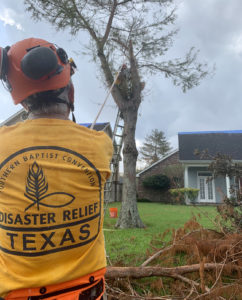
ST. AMANT, La.—The high-pitched buzzing of chainsaw fills the air like clouds fill the sky in this small community northwest of New Orleans. Nearly every home needs some work on trees, most have temporary blue tarps covering the roof, and piles of debris line the sides of the roadway.

A TBM chainsaw crew works in South Louisiana to remove broken limbs from a wind-damaged tree. (TBM Photo / John Hall)

It’s the sound of progress—the sound of brighter tomorrows.

With every cut, a path is cleared for people to move forward, thanks to six Texas Baptist Men volunteer chainsaw teams and nine TBM heavy machinery teams.

The teams are working in multiple sites across more than 30 miles from Baton Rouge to LaPlace, where many neighborhoods have been severely affected by Hurricane Ida.

“I don’t know exactly how wide the devastation is, but I’d say it’s probably at least 20 miles wide, and it’s from the coast all the way through Louisiana. We have at least five or six stations where we’re serving with chainsaw teams,” said Gene Walker, an on-site coordinator for TBM disaster relief.

“Looking down the street, it’s very upsetting. You see everybody’s belongings, sheetrock on the street. And we’re putting trees on top of that. They haven’t had electricity for 12 days or so, and they’re being told it’ll be Sept. 23 before they get it. People are hurting. It’s street after street after street. It’s the whole town. I’m a crotchety old guy, and it makes me tear up.”

Asked to provide 30,000 meals daily

TBM volunteers Stretch Nilson (left) and Ed French transport food in an insulated Cambro to provide for the needs of people in South Louisiana after Hurricane Ida. (TBM Photo / John Hall)

Thirty-seven miles from where Walker was standing, a whirl of TBM volunteers were meeting needs of another kind. The TBM state feeding unit—an 18-wheel tractor-trailer rig equipped with a mobile field kitchen—was preparing 2,200 Salisbury steaks to distribute across the area for lunch. Then, they washed everything up and produced almost 5,000 dinners that afternoon.

Just as they wrapped up the day, the Red Cross asked the team if they would ramp up to provide 30,000 meals a day moving forward, the maximum output for the mobile kitchen.

People are coming back to the disaster area and seeing the devastation to homes they left behind. Still without power in many places, cooking a meal has become at best difficult for many people. It’s impossible for others.

TBM-cooked meals such as red beans and rice, pulled pork, chicken, rice and hamburgers mean more than nutritional help. They’re reminders that people care—that God cares.

“Through all the devastation, it’s just amazing to see God work,” said Gary Finley, on-site coordinator of the state feeding unit. “That’s why I do it—to be the hands and feet of Christ and get out and see what can happen. Helping people is great. Christ met people’s needs. If we can meet people’s needs, and we can introduce them to Jesus, that’s what this is all about.”

Huge area, even greater needs

That approach to serving made a significant impact in Séverine Vicknair’s life. Walker’s team was taking down a tree that had broken in her backyard.

“We got flooded, and I already don’t know anymore where to start or turn, and those wonderful, wonderful men are here and taking so much pressure off my shoulders,” she said. “We are so very much blessed. Thank you so very much.”

With more than 100 volunteers on site and replacement teams forming to serve behind them, TBM leaders anticipate a lengthy response in the area.

“The area is large, and the needs are even larger,” TBM Disaster Relief Director David Wells said. “Our volunteers are working hard and representing Christ well. They’re making a tremendous impact in the lives of people in Louisiana each day. Please keep the people of Louisiana in your prayers as well as TBM volunteers who are responding. Your prayers are truly making an incredible difference.”

To support TBM financially, visit tbmtx.org/donate or send a designated check to Texas Baptist Men, 5351 Catron Drive, Dallas, TX 75227.