Research shows Bible study helps reform prisoners

WASHINGTON (BP)—Incarcerated individuals became more forgiving, accountable, grateful and capable of self-control after taking an eight-week Bible study on the Gospel of Mark, a newly released study from Prison Fellowship International and Baylor University found.

The course, “The Prisoner’s Journey,” also helped decrease depression, anxiety and anger among those enrolled, thereby reducing drug abuse and fighting, according to initial findings of the first phase of the study conducted in prisons in South Africa and Colombia.

byron johnson300
Byron Johnson

Byron Johnson, founding director of Baylor’s Institute for Studies of Religion, said the research shows the importance of faith-based prison reform.

“Programs like (The Prisoner’s Journey) yield empirical validation of the reality that much of the truly innovative work being done in the name of prison reform is coming from faith-based programs operated by organizations like Prison Fellowship International,” Johnson said.

“These remarkable programs—led by faith-motivated volunteers—are doing a lot to transform individuals and prisons across the world. I hate to think where we would be without these ministries that are dedicated to serving the least of these.”

Baptist Briefs: Prison church joins Baptist association
Inmates at Louisiana State Penitentiary at Angola were the first to have the opportunity to pursue seminary training through a New Orleans Baptist Theological Seminary extension at the nation’s largest maximum security prison. Inmate Paul Will, pastor of Grace Baptist Church of the Main Camp, is a 2007 graduate of seminary’s extension program at Angola. (Baptist Press file image from “A New Hope,” a documentary about the ministry)

Southern Baptist seminaries have offered Bible-based degrees to prison populations, beginning 20 years ago with the New Orleans Baptist Theological Seminary’s flagship program at Louisiana State Penitentiary at Angola. Graduates become ministers among their fellow inmates.

Jody Dean, senior regional associate dean for New Orleans Seminary extension centers, said such programs are part of the seminary’s mission.

“As you unpack our mission statement, the prison programs fit clearly in line with our mission of those that are called to walk with Christ to help them be prepared to proclaim his truth and fulfill his mission,” Dean has said. “And we see them doing that by beginning to teach the word (of God), share the truth and share Christ with those around them.”

Baylor University and Prison Fellowship International released initial findings Oct. 20 after conducting the 40-month study that ended in April, revealing varying degrees of change among prison populations based on such variables as their relationship with God before they enrolled in the Bible study, and whether they were motivated by a sincere desire to change or a selfish desire to possibly earn early release from prison.

Warden calls for churches to help break cycle of criminal activity
Prisoners gather in the yard at the Texas Department of Criminal Justice Darrington Unit in Brazoria County. Southwestern Baptist Theological Seminary and the Heart of Texas Foundation launched Bible college courses there modeled after a program at Louisiana’s Angola prison. (Heart of Texas Foundation Photo)

In Colombia, researchers compared 217 prisoners engaged in the Bible study with the outcomes of 217 prisoners not enrolled in the Bible study.

“In Colombia, we found inmates who completed the Bible study increased their religious involvement,” researchers said, with participants ranking near a negative 0.10 before the Bible study, and rising to a positive 0.60 after the Bible study on the researchers’ religiosity scale, but researchers did not cite specific numerical results. “On the other hand, there was no significant change among those who did not participate in the program (control group).”

Among the 437 inmates who took the Bible study in South Africa, compared to a control group of 125, researchers said their findings “confirmed the importance of religious involvement in relation to inmate transformation through the development of prosocial changes in self-identity and moral character.

Specifically, increased religiosity contributed to an inmate’s cognitive and emotional identity transformations as well as the virtues of forgiveness, empathy, and self-control, which in turn reduced inmate’s negative emotional states.

In addition, involvement in The Prisoner’s Journey course decreased the risk of prison misconduct both directly and indirectly by fostering gratitude among participating inmates.”

Researchers did not reveal numerical findings among the South African participants, but researchers hope to expand the study to include additional prison populations.

More than 460,000 incarcerated people have taken the course Prison Fellowship International conducts in prisons in 39 countries including Latin America, the Asia Pacific region, the Caribbean, Europe and the Middle East.

Prison Fellowship International promotes itself as having worked since 1979 to transform prison populations with the power of the gospel, hoping to engage 20 percent of the global prison population with The Prisoner’s Journey Bible study. Annually, 15 million people worldwide are imprisoned, the group noted.


Around the State: Baylor University receives $2 million gift

A $2 million gift to Baylor University from alumnus Matthew B. Lindner of Cincinnati, Ohio, will support the university’s department of film and digital media develop and implement the Baylor in L.A. program. The Los Angeles-based program—currently in early planning stages—will offer a highly selective and competitive residential learning opportunity for students who desire a career in film and digital media in California. The Baylor in L.A. program will be an immersive educational experience providing students with the internship experiences and industry connections that will help advance their careers after graduation. “It hasn’t been a secret that we have long wanted to expand our presence to L.A. as we seek to provide opportunities for our students to establish themselves in the film and television industries there, and Mr. Lindner’s gift gives us the opportunity to do that in a way that allows all students equal access to internships and opportunities,” said Chris Hansen, chair of the department of film and digital media. The Lindner Endowment is the second such fund established to support efforts on the West Coast by Baylor’s department of film and digital media. In 2019, Kathy and Don Tinius established the Tinius Family Endowed Fund in Film and Digital Media for Baylor in L.A. to help advance institutional planning for the program and to encourage other donors in giving to the project, efforts that were delayed due to the COVID-19 pandemic.

East Texas Baptist University faculty, staff, donors, and supporters gathered Oct. 15 to bless the foundation of the Great Commission Center. The ceremony included a time of prayer, worship and a time of dedication for the transformative learning facility and discipleship training center. (ETBU Photo)

East Texas Baptist University faculty, staff, donors and supporters gathered Oct. 15 to bless the foundation of the Great Commission Center. The ceremony included a time of prayer, worship and dedication for the learning facility and discipleship training center. Attendees wrote a Scripture of dedication or blessing on cards that were sealed into canisters and placed in the building site prior to the pouring of the foundation. The Great Commission Center will house the Great Commission Program, an institution-wide initiative which connects the ETBU community with service opportunities locally and globally, the Hale School of Business and the Career Development Center. Construction began with site development in August. The projected completion date for the Great Commission Center is spring 2023.

Gilberto Cerredera, pastor of Prestonwood en Español in Dallas, leads a prayer for Luis C. Juarez and his wife Cesia during a commissioning service at First Baptist Church in Kaufman. (Photo / Ken Camp)

Luis C. Juarez was commissioned for his role as vice president of student affairs and dean of students at Criswell College during an Oct. 24 service at First Baptist Church in Kaufman. Brent Gentzel is senior pastor of First Baptist Church in Kaufman, and Pablo Juarez is pastor of First Baptist Church Kaufman en Español. Barry Creamer, president of Criswell College, joined denominational leaders including Jesse Rincones, executive director of the Hispanic Baptist Convention of Texas and Nora Lozano, executive director of the Christian Latina Leadership Institute as guest speakers at the commissioning service. Speakers noted Juarez—a native of Nicaragua—is among only a few Hispanics to serve in an executive leadership role at a Texas college or university. Juarez is a graduate of Baptist University of the Américas and Dallas Baptist University.

Wayland Baptist University has been awarded a grant of $299,956 by the Department of Justice to fund safety programs on the Plainview campus. The grant will be used as part of the Protecting Pioneers initiative, to increase safety measures and educate students on the dangers of domestic violence, dating violence, sexual assault and stalking. The project will increase training—including bystander intervention training—for all students, while developing local programs and enhancing security on the Plainview campus. The training also will educate students on the reporting process and protocols, and provide access to local and national resources for assistance. It will address topics such as filing local criminal charges, common myths about the causes of violence against women, how to support peers who are victims, and the benefits of reporting these crimes. The grant also will fund the installation of 23 surveillance cameras and 20 keyless entry systems on the Plainview campus, including electronic door locks on residence halls not already equipped with an advanced locking system. Wayland will form a coordinated community response team with participation from the Crisis Center and Plainview Police Department to increase information sharing and make services more efficient.

Dallas Baptist University faculty members Dave Arnott (left) and Sergiy Saydometov (right), along with Jeffrey Johnson (center), dean of the College of Business, have launched the Institute for Christian Economics. (DBU Photo)

Dallas Baptist University faculty members Dave Arnott and Sergiy Saydometov, along with administrator Jeffrey Johnson, dean of the College of Business, have launched the Institute for Christian Economics. Their expressed goal is to help Christians engage the world of economics in a biblical manner. Arnott and Saydometov are authors of Biblical Economic Policy: Ten Scriptural Truths for Fiscal and Monetary Decision-Making. Arnott also produces a weekly podcast, “The Christian Economist.”

Students, faculty and guest gathered on the University of Mary Hardin-Baylor campus in Belton on Oct. 22 to celebrate the dedication of the McClinton Family Intramural Fields. (UMHB Photo)

About 500 students, faculty and guests gathered on the University of Mary Hardin-Baylor campus in Belton on Oct. 22 for the dedication of the McClinton Family Intramural Fields. Carol and Paul “Crunch” McClinton of Waco donated $1 million toward converting 2.6 acres of fields from natural grass to artificial turf. Other improvements include new field lighting, the Crunch Time Pavilion and permanent striping for the recreational sports played on these fields, including football, lacrosse, soccer and softball. National Baseball Hall of Fame pitcher Nolan Ryan threw out a ceremonial first pitch at the dedication ceremony. “We are proud to have the McClinton name on this incredible facility at UMHB,” said UMHB President Randy O’Rear. “Our intramural fields are one of the busiest places on campus, and our students deserve this beautiful new space to gather and play.”

During the Calling Conference at ETBU, students heard from guest speakers including (from left to right) Christopher Dickey, chaplain and University of Notre Dame Army War College Fellow; Tom Tillman, director of music and worship at Baptist General Convention of Texas; Jennifer Howington, childhood ministry specialist at BGCT; Erica Harnisch, assistant director for Go Now Missions at BGCT; Julio Guarneri, senior pastor at Calvary Baptist Church in McAllen; and Cory Liebrum, youth and family ministry specialist at BGCT. (ETBU Photo)

East Texas Baptist University hosted its seventh annual Calling Conference on Oct. 20. The event provided students who feel drawn to vocational ministry a deeper understanding of how to identify and pursue their callings with opportunities to learn from experienced ministry professionals. Guest speakers included Julio Guarneri, senior pastor at Calvary Baptist Church in McAllen, and Christopher Dickey, chaplain and University of Notre Dame Army War College Fellow. The program also featured Baptist General Convention of Texas leaders Tom Tillman, director of music and worship; Cory Liebrum, youth and family ministry specialist; Jennifer Howington, childhood ministry specialist; and Erica Harnisch, assistant director for Go Now Missions.

The Brownsville Police Department and Buckner Children and Family Services announced a new collaboration to support vulnerable children and families in the Rio Grande Valley. Officers will distribute contact cards to youth and parents in at-risk situations, referring them to the Buckner Family and Youth Success program. The cards are printed in English and Spanish, and they include a QR code along with phone numbers and the website for the program. “This program allows officers to provide the best care and assistance for our community’s families when they are in crisis,” Brownsville Police Chief Felix Sauceda said. Buckner Family and Youth Success is designed to reduce family conflict, help with family support and skills, and prevent the problems of runaway, school attendance issues and delinquent behaviors. The free program helps youth and families resolve crises and establish and achieve goals that strengthen and promote healthy families. Services provided to the youth and families include screening/intake, crisis intervention, skills-based training, case management services, case follow-up and outreach.

Anniversary

10th for Milfred Minatrea as pastor of Grand View Baptist Church in Mesquite.

Retirement

John McCullough after 15 years as bivocational pastor of Berea Baptist Church in Big Spring and 52 years in ministry. Berea Baptist Church donated $30,000 to the Southern Baptist Convention’s International Mission Board and $27,000 to Send Relief in his honor.


On the Move: Foster

Tanner Foster to High Pointe Baptist Church in Cedar Hill as minister of youth/creative media from First Baptist Church in Venus, where he was youth minister.


Umpire-minister Ted Barrett returns to World Series

HOUSTON (BP)—Ted Barrett—a Baptist minister and umpire—is back in the World Series.

A full-time umpire for Major League Baseball since 1999, Barrett is co-founder of Calling for Christ.

On Oct. 15, the day after his crew wrapped up the divisional round between the Giants and Dodgers, Barrett received word that for the fifth time he would be among those making the calls on baseball’s biggest stage.

The 56-year-old ordained Southern Baptist minister has a seasoned perspective from when he first began calling some MLB games in 1994.

“It’s truly a gift,” he told Baptist Press “All good things come from God, and this was a surprise for me.”

Typically, four to five years may pass between an umpire’s opportunities to be in the World Series.

Barrett’s work off the baseball field overshadows his work on it. Through Calling for Christ, he encourages peers to stay strong in their faith through—when possible—in-person gatherings but also by virtual meet-ups from whatever various cities have a game that day.

In his career, he’s witnessed the gospel’s impact on umpires working a high-stress job that has no shortage of people telling you you’re doing it wrong.

“It’s been really cool coming up with guys in the minor leagues who, at first, had no interest in church or Scripture,” he said. “I get to see their participation grow at things like a retreat or spring training Bible study. They get involved and go deep. It’s great to watch.”

‘Give it all to God and let things play out’

Umpires Ted Barrett, Angel Hernandez, Lance Barksdale and Alex Tosi huddle before the New York Yankees take on the New York Mets in a baseball game on Friday, Sept. 10, 2021, in New York. (AP Photo/Adam Hunger)

Two of those involved in Calling for Christ, Alfonso Marquez and Mike Muchlinske, were on the field with Barrett during Game 1 of the World Series. All three carried a small, metal cross Barrett’s 81-year-old dad, Jim, a retired welder from Buffalo, N.Y., made in his backyard in Arizona.

“Since he makes them, they’re all a little different,” said Barrett. “Mine is attached to my stopwatch, and so when I walk around, it hangs from my pocket. Fans will see it and say something. They also see us pray at home plate before a game.”

That witness extends to the game itself.

“On the field, I want to be an example of a Christ-follower with integrity. I say Jesus would have been the ultimate umpire, with his ability to make the tough calls. I call people out, but grace and forgiveness can be there when confrontation happens. When I walk out there, I feel I have favor from God with the interaction I have with players, managers and coaches.”

Baseball in 2021 is different than last year, he noted. Although there was a champion crowned in 2020, the absence of crowds made the game different. It was very strange and surreal, he said.

“I’m really looking forward to tonight and having the fans back,” Barrett said prior to the first game of the 2021 World Series.

And yet, he’s even more eager for what comes after the season. That includes spending time with his grandkids, ministry through Calling for Christ and filling pulpits.

“A lot of guys, as we get older, realize more and more how much we rely on God,” he said. “The reality is God has been carrying me all along. Whatever God has next, I’m going to enjoy it. We’re to give it all to God and let things play out.”


SBC Executive Committee schedules closed-door meeting

NASHVILLE (BP)—Officers of the Southern Baptist Convention Executive Committee have issued a call for a special meeting of the trustees at 10 a.m. Oct. 28.

The meeting will be held in executive session to “update legal, audit and personnel matters,” Chairman Rolland Slade said.

Thirteen trustees have resigned since the board voted to waive attorney-client privilege on Oct. 5 on matters related to the investigation of the Sexual Abuse Task Force. President Ed Litton appointed the task force at the direction of messengers at the 2021 SBC annual meeting.

The full number of trustees should be 86, according to bylaws. The board currently stands at 72, since 13 members have resigned since the Sept. 20-21 trustee meeting, including Steve Swofford and Barbara Norris of Texas.

Others who have resigned are Robyn Hari, Ron Hale and Chuck Williams of Tennessee; Mark Elliott of Nebraska; Chad Garrison of Arizona; Melissa Golden, Paul Hicks and Phyllis Ingraham of Alabama; Kim Grueser of Pennsylvania; Paul McPherson of Arkansas; and Rob Showers of Virginia.

Modena Henson from North Carolina resigned before the Sept. 20 meeting because of a personal relocation.

Long-time legal counsel Guenther, Jordan and Price informed the board Oct. 11 of their desire to withdraw as the Executive Committee’s legal counsel because of the trustee’s decision to waive privilege. The group had represented the Executive Committee since 1966.

The meeting also comes days before SBC Executive Committee President and CEO Ronnie Floyd and Executive Vice President Greg Addison are scheduled to leave their posts Oct. 31.


Middleman turns church’s burden into ministry’s blessing

WACO—Jesus’ instruction to his disciples—“Freely you have received; freely give”—not only guides Middleman Ministries’ approach to reaching teenagers on the margins of society. It also governs its approach to churches and other ministries.

Giving away custom-made skateboards and other equipment to young people who may consider themselves misfits offers Middleman Ministries an avenue for introducing teenagers to the free grace God offers in Jesus Christ.

In addition to skating clinics and outreach in skating parks, Middleman—a ministry partner of Columbus Avenue Baptist Church in Waco—also seeks to pair adult Christian mentors with young people. One way the adults and teens bond is by working together on old cars.

“They learn by doing—lessons about restoration, redemption and vision. … By working on old cars, they learn about restoring value to what some may not see as valuable,” said John Barnard, Middleman’s founding director.

The newest aspect of that ministry centers on turning old vans some churches may see as a burden into a gift other skateboarding ministries view as a blessing.

Pastor M.L. Walker of Living Witness Missionary Church in Waco recently turned over to Middleman Ministries the keys and title to a church van. (Photo courtesy of Middleman Ministries)

The church van initiative involves Middleman receiving donated old vans from churches that no longer need them. Mentors and teens then restore the vans, and Middleman gives them to other skateboarding ministries around the country.

Barnard sees the initiative as a “win-win” for everyone involved. Churches are freed from the responsibility of maintaining insurance and registration for vehicles they are not using. Mentors spend quality time with young people working on the vans. And skating ministries can use the vans to transport skaters and their equipment to events.

“This is a gamechanger, as most skate ministries in the country are volunteer-led with tiny—if any—budgets,” Barnard said.

Middleman is committed to making the process as easy for churches as possible, he noted.

“All a church does is hand over a title and the keys. We put the insurance in our name the same day,” Barnard said. “We even have a car hauler trailer if the van doesn’t start.”

Middleman then works with the receiving skateboard ministry to put the vehicle in their name within 30 days.

Pastor M.L. Walker of Living Witness Missionary Church in Waco recently turned over to Middleman Ministries the keys and title to a church van.

“He was excited to not have the burden of insurance anymore after four years of paying on a van that didn’t run,” Barnard said.

Any church interested in donating a van to Middleman Ministries can contact John Barnard at 979-270-0822 or john@middleman-ministries.org.  


Pandemic increased stress but few pastors left the ministry

NASHVILLE, Tenn.—Pastors have faced increased stress during the COVID-19 pandemic, as churches were forced to adapt overnight. More felt their role was overwhelming at times, but few pastors actually decided to leave the ministry.
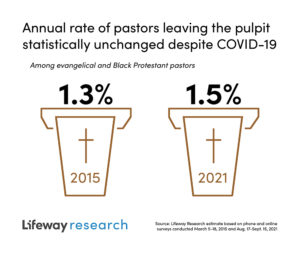
A new Lifeway Research study found close to 1 percent of evangelical and historically Black Protestant senior pastors step away from the pulpit each year—a rate statistically unchanged from a 2015 Lifeway Research study.

“COVID-19 was neither a small nor short-lived stressor for pastors,” said Scott McConnell, executive director of Lifeway Research. “Many have speculated that pastors have been opting out of the pastorate as a result. That is not the case. They are remaining faithful to the calling at levels similar to those seen before the pandemic.”

The August-September 2021 study surveyed more than 1,500 pastors serving in both evangelical and historically Black Protestant churches.

Around 1 in 6 pastors (17 percent) started at their current church during the pandemic years of 2020-2021. Half of the senior pastors facing the ministry upheaval brought on by COVID-19 were new to their role, and 51 percent are serving in their first church as senior pastor.

More than 1 in 3 pastors (37 percent) say they were the senior leader of their church 10 years ago. Among those congregations that had a different pastor in 2011, most of the previous pastors are now either retired (30 percent) or pastoring another church (28 percent).

In that time frame, some stepped away from the pulpit for a different ministry role (13 percent) or are working in a non-ministry position (8 percent), according to the current pastor. Combined, those two groups who leave the pastorate before retirement reveal an annual pastor attrition rate of around 1.5 percent.

“COVID-19 is not the only pressure pastors face, nor is it the most likely reason pastors from a decade ago are no longer pastoring,” McConnell said. “Baby Boomer pastors are reaching retirement age, and while many continue pastoring for years afterward, retirement is still the most common reason a pastor from 2011 is not pastoring a decade later.”

Thinking of their predecessor in cases where that person is working outside the pastorate, current senior pastors are most likely to say the previous pastor left due to a change in calling (32 percent), church conflict (18 percent), burnout (13 percent), being a poor fit with the church (12 percent), or family issues (10 percent).

Fewer point to a moral or ethical issue (8 percent), an illness (5 percent), personal finances (5 percent), or a lack of preparation (3 percent).

Conflict and change

Regardless of how the previous pastor left, the vast majority of pastors feel confident in their position. Nine in 10 pastors (90 percent) say they are sure they can stay at their current church as long as they want, including 60 percent who strongly agree.

While only 15 percent of pastors a decade ago have left the pastorate and fewer than 1 in 6 pastors say conflict drove that pastor from the pastorate, many pastors have experienced conflict in their church.

Among the pastors surveyed who pastored a different church previously, almost half (47 percent) say they left their last church because they took it as far as they could. Another third (33 percent) say their family needed a change. A quarter say there was conflict in the church (25 percent). More than 1 in 5 points to the church not embracing their approach to pastoral ministry (22 percent) or having unrealistic expectations of them (21 percent). Another 18 percent admit they were not a good fit for the church. Few say they were reassigned (14 percent) or asked to leave the church (10 percent).

Even if conflict didn’t cause them to leave their last church, most pastors (69 percent) say they dealt with some type of conflict there.

More than 1 in 3 say they experienced a significant personal attack (39 percent), had conflict over proposed changes (39 percent), or were in conflict with lay leaders (38 percent). More than a quarter ran into disagreements over expectations about the pastor’s role (28 percent) or their leadership style (27 percent). Fewer experienced conflict over doctrinal differences (12 percent) or politics (8 percent).

“Churches are groups of people, and even like-minded people do not always get along,” McConnell said. “It would be naïve to think a church would not experience disagreements. The important thing is whether that church maintains unity and love for each other as they navigate those differences or stoops to personal attacks as many pastors have experienced.”

Their previous experience with conflict leads 4 in 5 pastors (80 percent) to expect they will have to confront it in their current church in the future. As part of this preparation, 9 in 10 say they consistently listen for signs of conflict in their church (90 percent) and invest in processes and behaviors to prevent it (89 percent).

Overworked and overloaded

Direct conflict with churchgoers is not the only type of issue pastors face in their ministry. They often feel overworked and overloaded as individuals and worry about the toll their work may take on their family.

Most pastors say they are on-call 24 hours a day (71 percent) and their role is frequently overwhelming (63 percent). Half of pastors (50 percent) say the demands of their job are often greater than they can handle. Many say they feel isolated (38 percent) and face unrealistic expectations from their church (23 percent). One in 5 pastors (21 percent) admit they frequently feel irritated at their church members.

“The impact of the pandemic may be most noticeable in pastors’ increased agreement that the role of being a pastor is frequently overwhelming, which jumped from 54 percent in 2015 to 63 percent today,” McConnell said.

“But there has also been a shift in how some pastors think about their work. Fewer pastors agree they must be ‘on-call’ 24 hours a day, declining from 84 percent to 71 percent. Perhaps even more telling, the majority of pastors (51 percent) strongly agreed with this expectation in 2015, while only a third (34 percent) strongly feel this obligation today.”

Almost all evangelical and Black Protestant pastors are married (95 percent), and their role as spouse, and often parent, has the potential to conflict with their role as church leader. Most, however, feel serving in vocational ministry has been good for their family.

More than 9 in 10 pastors say their spouse is very satisfied with their marriage (96 percent) and enthusiastic about life in ministry together (91 percent). A similar percentage (94 percent) consistently protect time with their family. Most pastors were able to take a week’s vacation with their family last year (83 percent) and plan monthly date nights with their spouse (66 percent).

As a result, few say their work keeps them from spending time with their family (31 percent), and even fewer feel their family resents the demands of pastoral ministry (19 percent).

Still, 2 in 5 pastors say they are often concerned about their family’s financial security.

“Fewer pastors are concerned about their family’s financial security—41 percent today compared to 53 percent in 2015,” McConnell said. “This decrease in the number of pastors stressed over their personal finances may be due to increased generosity in their church or financial stimulus checks from the government. It is still more common for a pastor to be worried about their own finances than to report declines in giving at their church.”

Encouragement and support

While families may provide some added stress and responsibilities for pastors, they are also one of the sources of encouragement and support. They also are a channel through which a congregation can care for their pastor. Nine in 10 pastors (90 percent) say their family receives genuine encouragement from their church.

Close to 9 in 10 (86 percent) feel their church gives them the freedom to say no when faced with unrealistic expectations. While few say their church has a plan for the pastor to periodically receive a sabbatical (32 percent), almost 9 in 10 say they have a day to unplug from ministerial work and have a day of rest at least once a week (86 percent).

Pastors are also leaning on others for support and encouragement. Most say at least once a month they openly share their struggles with their spouse (82 percent), a close friend (68 percent), or another pastor (66 percent). Others say they are able to speak with lay leaders in the church (42 percent), a mentor (40 percent), another staff member (35 percent), a Bible study group in their church (23 percent), or a counselor (9 percent).

“The difficult moments and seasons pastors face require ongoing investment in their spiritual, physical and mental well-being,” McConnell said. “Most pastors and churches have practices that help the pastor in these ways, but there are often missed opportunities to encourage, build up and avoid misunderstandings.”

The study was sponsored by Houston’s First Baptist Church and Richard Dockins, M.D. The mixed mode survey of 1,576 evangelical and Black Protestant pastors was conducted Aug. 17–Sept. 15, 2021, using both phone and online interviews.

The completed sample is 1,000 phone interviews and 576 online surveys. Responses were weighted by region, church size and denominational group to reflect the population more accurately. The sample provides 95 percent confidence the sampling error does not exceed plus or minus 2.7 percent. Margins of error are higher in sub-groups.

Comparisons are made to a phone survey of 1,500 evangelical and Black Protestant pastors conducted by Lifeway Research March 5-18, 2015.


Cuban pastor faces possible 10-year prison sentence

A Cuban Protestant pastor detained more than three months without trial may face a 10-year prison sentence, and two Baptist ministers held during the summer have been threatened with imprisonment if they participate in any further activity considered critical of the government.

Maridelegnis Carballo was informed Oct. 22 the government is seeking to impose a 10-year sentence on her husband, according to Christian Solidarity Worldwide, a United Kingdom-based human rights organization focused on freedom of religion and conscience.

Cuban State Security detained her husband, Pastor Lorenzo Rosales Fajardo of the Monte de Sion Independent Church in Palma Soriano, after he was involved in peaceful protests on July 11.

He currently is being held at Boniato Maximum Security Prison after more than a month at the Versalles State Security facility, where he reportedly was beaten and urinated on by guards. He lost a tooth due to the severe beatings.

His wife of more than 20 years has been permitted only one 90-minute visit with her husband in more than three months, and he has been allowed only a few three-minute phone calls with his family.

“He is not a criminal; he is a man of God,” Maridelegnis Carballo told Christian Solidarity Worldwide. “I am very afraid for his life, for the terrible treatment to which he is being subjected and even now he is in a situation where he is totally unable to defend himself. They are violating everything. … My children and I plead for help, please. These are cries for help which we lift up to God and to you. He is in danger.”

Previously detained pastors harassed by authorities

Yarian Sierrra (left) and Yeremi Blanco from the Berean Baptist Mission in Matanza were detained nearly two weeks in Cuba. (Facebook Photo via CSW)

The day before Maridelegnis Carballo received word about her husband’s potential 10-year sentence, two Baptist ministers received warnings from Cuban State Security about the consequences if they engage in protests or criticism of the government.

Yéremi Blanco Ramírez and Yarian Sierra Madrigal, who are associated with William Carey Biblical Seminary, were released July 24 after being detained incommunicado nearly two weeks, first in a women’s prison in Matanzas and then in a state security facility.

On Sept. 1, the two ministers were informed they would be fined but not face a prison sentence for their involvement in the nationwide July 11 protests.

However, the pair were summoned by State Security Oct. 21 and forced to sign an Acta de Advertencia, a legal document justifying their arrest and imprisonment that could be used against them in the case of any future offenses.

Mervyn Thomas, founder of Christian Solidarity Worldwide, called for the release of Lorenzo Rosales Fajardo and for the government to stop its harassment of other religious leaders engaged in free speech and peaceful protests.

“We share Maridilegnis Carballo’s disappointment in learning that the Cuban government will be seeking to impose a 10-year prison sentence on Pastor Lorenzo Rosales Fajardo, and are horrified, if not surprised, to learn of the inhumane treatment he has been subjected to while in prison,” Thomas said.

“We renew our demand that the Cuban government drop all charges and immediately release Pastor Rosales Fajardo and cease its harassment of Pastors Sierra Madrigal and Blanco Ramírez, as well as other religious leaders who are doing nothing more than attempting to exercise their right to peacefully and freely express themselves, a right that is inextricably linked with freedom of religion or belief.”

Several weeks ago, Christian Solidarity Worldwide presented a petition with more than 2,000 signatures to Cuban Ambassador Barbara Montalva Alvarez at the country’s embassy in London, demanding the release of Rosales Fajardo.

Other religious leaders involved in the nationwide peaceful demonstrations on July 11—including Yusniel Pérez Montejo, a minister affiliated with the Eastern Baptist Convention of Cuba—likewise were detained and interrogated by authorities.

In August, Amnesty International reported Cuban authorities “scaled-up a decades-long policy of repression that criminalizes peaceful protest and imprisons and ill-treats Cubans from all walks of life simply for expressing their views.”


Influential musician Ralph Carmichael dead at 94

NASHVILLE (BP)—Often called the “father of contemporary Christian music,” Ralph Carmichael left his mark on the music industry in seven decades and at least as many genres. Carmichael died Oct. 20 at the age of 94.

Planning to become a pastor, Carmichael attended Southern California Bible College. But he pursued music instead and became head of the school’s music department. The innovative, contemporary arrangements he did with the school’s various music groups and ensembles won him acclaim, but churches often found them too worldly.

In the 1950s and ‘60s, Carmichael crossed easily between working with Gospel greats like George Beverly Shea and arranging for jazz legends like Ella Fitzgerald and Nat King Cole. And all the while, he was composing music for TV shows, including I Love Lucy and Bonanza, films like the 1958 hit The Blob and many others.

In 1966, he founded Light Records to give voice to the growing Jesus Movement. Artists he signed, like Andrae Crouch and the Winans, soon became major players in a whole new kind of music.

“The rise of the Christian music industry is not that long of a story,” said Mike Harland, associate pastor of worship at First Baptist Church of Jackson, Miss. “Just 40 years ago, there really was no such thing as a genre of Christian music. It grew out of the Jesus Movement.

“Ralph Carmichael was one of those legitimate music industry executives that built the bridge between what was happening in the Jesus Music movement … to the church itself.”

Harland, who served several years as the director of Lifeway Worship before returning to local church ministry, first encountered Carmichael’s work singing in youth choir.

“He was the father of the youth musical,” Harland said of Carmichael, whose work in musicals like Tell It Like It Isand Young Messiah was performed in churches far and wide. “When it came to the Baptist tradition, his name was on it.”

Many more Christians were exposed to Carmichael’s work in film scores he wrote for the Billy Graham Evangelistic Association—20 in all, including 1970’s The Cross and the Switchblade.

Others remember singing his songs—like “The Savior Is Waiting” (which Harland called “a staple of Baptist hymnody”), “He’s Everything to Me,” “Reach Out to Jesus” (recorded by Elvis Presley) and “Love is Surrender” (recorded by the Carpenters).

Perhaps his best known, most enduring work was 1960’s “The Magic of Christmas,” an album of mostly sacred Christmas songs by Nat King Cole. Carmichael’s tender, lush arrangements can still be heard just about anywhere each Christmastime, and his and Cole’s version of “The Christmas Song” is considered a classic.

Harland said Carmichael was a well-respected musician who just happened to be a Christian, which lent legitimacy to a struggling new industry.

“His faith found its expression in his life,” he said. “And his life was a musician. … It would be very difficult to measure the impact Ralph Carmichael had on American music in general but particularly Christian music.”

Harlan likened it to the “coaching tree” concept in football, when people make connections based on coaches they’ve worked with or for.

“If there were a musician tree, it goes back to Ralph Carmichael,” he said.


Baylor study analyzes impact of COVID-19 on pediatric nurses

WACO—While pediatric advance practice registered nurses are being affected by the COVID-19 pandemic in multiple ways, the most difficult challenge is mental health struggles experienced by themselves and their families, according to a new Baylor University-led study.

The study—led by Jessica Peck, clinical professor at Baylor’s Louise Herrington School of Nursing and published in the Journal of Pediatric Health Care—examined the holistic effects of COVID-19 on pediatric-focused advance practice registered nurses

Based on a survey of 789 participants, the study shows pediatric advance practice registered nurses experienced increased burnout and mental health concerns during the COVID-19 pandemic.

Pandemic alters pediatric care delivery

A consequential impact of COVID-19 has been the alteration of pediatric care delivery. Pediatric agencies have experienced disruptions in care provisions, patient presentations, clinical practices, immunizations and revenue, according to the study.

Furthermore, some pediatric nursing professionals have transitioned to working with adult populations, while others have been furloughed or laid off due to a strong demand for critical care nursing services and a lower demand for primary care nurses.

“While physical disease impacts on children have generally not been as dire as some historic precedents like polio, they are by no means spared,” Peck said.

“Pandemic conditions have fundamentally altered the norms of pediatric care delivery and, as a profession, we share collective concerns: severe COVID in children with pre-existing conditions, life-threatening multi-system inflammatory syndrome, disturbing disparities in severity of illness and death, particularly for children of color who account for 75 percent of pediatric COVID-19 deaths, and free-falling immunization rates with recovery not yet in sight.”

The research shows that 34 percent of pediatric advance practice registered nurses are experiencing moderate to extreme concern for professional burnout, while 25 percent of respondents feel anxious or nervous and another 15 percent are experiencing depression or hopelessness.

Overall, 20 percent of participants reported feeling moderate to extreme concern for their mental health.

“As a profession, many pediatric nursing professionals are working far more hours for far less compensation, isolated from professional networks. They are learning new technologies and implementing new policies in little time with even less support. Pediatric clinics are severely disrupted,” Peck said.

“Children’s hospitals received less than 1 percent of all federal relief monies provided to U.S. hospitals, leaving children without access to care. Faculty are exhausted and experiencing vicarious trauma hearing devastating stories from their students. All of this contributes to destabilized pediatric infrastructure, which disproportionately impacts marginalized children.”

Not only has COVID-19 impacted registered nurses, but it also has had significant impact on their families. Most respondents noticed an increase in clinical presentations of child mental or behavioral health concerns (73 percent), isolation and limited socialization (72 percent) and parental anxiety (71 percent).

One of the most alarming findings was the increase in child mental or behavioral health concerns that nurses noticed, Peck said.

“This problem is multifactorial, with isolation, loss of safety net services, family stressors and trauma and deferred care and services all compounding this issue across communities worldwide,” she said.

More than a third of the respondents had moderate to extreme concern over professional burnout due to rapid changes and disinformation.

In addition, lessons learned during the pandemic will shape the next generation of pediatric advance practice registered nurses.

Peck noted three practical implications of the study:

  • Nurses are not heroes or angels and should be treated as humans with physical and mental health needs. Nurses should be supported to prioritize individual health promotion behaviors and resource access.
  • Health care organizations and leaders need to affirm and reinforce the value of nursing with diverse and equitable representation in decision-making forums and assurance of access to supportive resources without fear of discrimination, stigma or bias.
  • Support for public civility towards nursing professionals and public health experts is crucial, with policy support for zero tolerance of violence towards nurses.

Kate Nelson is a student news writer with Baylor University Media and Public Relations.  


Baptist watchdog issues annual ethical fashion report

WASHINGTON (RNS)—The fashion industry continues to struggle with wage gaps and sustainability, according to a report from an Australian Baptist watchdog group, despite marked improvement in how the industry treats workers and sources its goods over the past few years.

Baptist World Aid Australia’s 2021 Ethical Fashion Report scorecard rated roughly 100 fashion companies, which averaged a score of 33.6 out of 100 compared with all industries the group tracks.

“We’ve seen considerable progress in the fashion industry and engaged with many brands that are committed to becoming more ethical and sustainable,” said Peter Keegan, Baptist World Aid’s director of advocacy. “But these grades and scores show us we’re not there yet.”

Baptist World Aid Australia has published the annual Ethical Fashion Report since 2013, as part of its efforts to alleviate global poverty and challenge injustice. According to the report, the global fashion industry, which employs some 50 million people, is one of the top five industries most at risk for complicity in modern slavery.

Group assigns ethical ratings to brands

Brands are rated in five categories, which include environmental sustainability, human rights monitoring and worker empowerment.

Using the organization’s Brand Finder, shoppers can compare the ethical ratings of their favorite brands, which receive grades from A+ through F based on a numerical score.

This year, 40 percent of companies improved their score compared with 2019, and the industry saw an overall increase in companies using sustainable fibers and tracing raw materials. Twenty companies earned an A+ and A, 55 received B or C and 23 received D or F.

Popular brands including H&M, Converse and Patagonia earned an A rating, while Roxy and Forever 21 earned an F.

The average company scored a D for work on wage improvement and worker unions. The report also found that only 15 percent of companies are paying workers in their supply chain a living wage, a drop from 20 percent in 2019.

The report attributed the decline to pandemic-related losses, noting garment workers have collectively lost more than $16 billion in wages since COVID-19 began.

“Our research identified a vast gap between the ethical sourcing measures companies put in place, and real, tangible outcomes for garment workers,” said Chantelle Mayo, advocacy project manager for Baptist World Aid Australia. “That’s a big hurdle for any consumer trying to shop ethically, and an area we need to keep pressuring the fashion industry to address.”


Texas Baptists honor some of the state’s BEST educators

Texas Baptists recently recognized nine public school educators as BEST—Baptist Educators Serving Texans.

The Baptist General Convention of Texas established the annual BEST Awards to celebrate Christian educators who are living out their faith daily among their students and recognize the Texas Baptists institutions that taught them.

The award recipients are:

  • Hector Marquez, a graduate of the Baptist University of the Américas and a 9th grade science teacher and coach in the Lamesa Independent School District.
  • Ashley Minton, a graduate of Baylor University and principal of Canyon Ranch Elementary in Irving.
  • Cynthia Spencer, a graduate of Dallas Baptist University and a 5th grade math teacher in Mansfield Independent School District.
  • Jennifer Carlile, a graduate of East Texas Baptist University and a 2nd grade teacher at Bullard Independent School District.
  • Daisy Sanchez, a graduate of Hardin-Simmons University and a counselor in Bronte Independent School District.
  • Jonathan Powell, a graduate of Houston Baptist University and principal of Keefer Crossing Middle School in New Caney.
  • Bobbette Bell, a graduate of Howard Payne University and a high school librarian in Salado Independent School District.
  • Dolores Kemp, a graduate of the University of Mary Hardin-Baylor and a retired teacher and administrator at Belton Independent School District.
  • Rodney Wallace, a graduate of Wayland Baptist University and principal at Ash Program in Plainview.

The award process was coordinated by Cooperative Program Director Bruce McCoy and the office of Cooperative Program ministry.

The annual BEST Award is presented to select Texas Baptists institution graduates who currently serve in faculty or administration roles in the Texas public school system and are members of a church supportive of the Baptist General Convention of Texas. One graduate is selected from each Texas Baptist educational institution.

Graduates from these universities represent an estimated 6 percent to 8 percent of the more than 357,000 public school educators in Texas.

“These BEST Award recipients serve as our representatives of the Lord Jesus Christ in the Texas public school system as the ‘salt of the earth’ and the ‘light of the world’ (Matthew 5:13-14),” McCoy said.

“These recipients are shining examples for Christ as they represent thousands of other Texas Baptists educators just like them who serve the Lord with wisdom and skill. We gladly celebrate each of our 2021 BEST Award recipients.”

EDITOR’S NOTE: This article originally posted on Oct. 22, was revised on Oct. 26. In the original version, based on information provided by Texas Baptists, the recipient from BUA was misidentified. The actual recipient is Hector Marquez.