Around the State: Wayland students dedicate recycled bench
September 17, 2025
Representatives of Corteva AgriScience joined Wayland Baptist University students, faculty, staff and administrators Aug. 5 to dedicate a new recycled-material bench on the north side of the Mabee Laboratory Sciences Building. The bench was made possible through Corteva’s donation of plastic lids collected by employees at the Plainview facility, along with financial support to cover transportation and production costs. The project reflects a shared commitment to sustainability and environmental responsibility between the university and Corteva.
The University of Mary Hardin-Baylor announced a $1 million gift to establish the Marek-Smith Special Education Endowed Scholarship by donors who wish to remain anonymous. The scholarship will support UMHB Bachelor of Science in Education students seeking special education certification. The university opened the Marek-Smith Center for Teacher Preparation in spring 2024. This state-of-the-art facility houses innovative classrooms equipped with cutting-edge technology, resources, equipment and tools for training special education teachers.
In celebration of Hispanic Heritage Month, UMHB is hosting the 10th annual Latino Fest on Friday, Sept. 19, from 5:30 to 8:30 p.m. at Luther Memorial on the UMHB campus. The Fiesta en la Calle event is hosted by UMHB Kingdom Diversity and Hispanic Student Association.
Park Cities Baptist Church in Dallas has partnered with University of Texas Rio Grande Valley Baptist Student Ministry to host Career Coaching, an annual event where Park Cities members offer career guidance to students in both a classroom setting and one-on-one meetings. Some one-on-one sessions have resulted in mentorship after the students graduated. The Park Cities team will be on-campus for career coaching on Nov. 11-14.
Howard Payne University is pleased to announce the creation of the Center for Faculty and Student Research. This new center embodies HPU’s mission to equip the whole person for intellectual inquiry, integrity and service to God and humanity. Dennis Gibson, director of research and associate professor of chemistry, will oversee this new initiative. The Center for Faculty and Student Research is designed to elevate the student educational experience by cultivating a vibrant culture of critical thinking and innovation.
Hardin-Simmons University and Baylor University were recognized among the nation’s top academic institutions, earning a spot on The Princeton Review’s list of “Best Colleges: Region by Region” for 2026. They were among only 41 colleges in the Southwest—spanning Arizona, Colorado, New Mexico, Oklahoma and Texas—to earn this distinction. In total, The Princeton Review recognized 631 colleges across seven zones (Northeast, South, Southwest, Midwest, Mid-Atlantic, West and International), representing about 26 percent of America’s four-year institutions.
Only two-thirds of U.S. Christians believe all have sinned
September 17, 2025
GLENDALE, Ariz. (BP)—Only 66 percent of American Christians accept the biblical teaching that all have sinned, George Barna said in the latest release from the 2025 American Worldview Survey he oversees at Arizona Christian University.
Most Christians, 72 percent, also believe people are “basically good at heart” and “should not be pejoratively characterized as sinners,” Barna said, revealing confusion among Christians regarding the biblical concept of sin.
“Only 14 percent of self-described Christians hold a biblically consistent theology of sin,” Barna, director of research at ACU’s Cultural Research Center, said of the findings released in two parts Sept. 4 and Sept. 16.
“While most adults acknowledge that sin exists, many reject the truth that all have sinned and fall short before God. This misunderstanding strikes at the very heart of the gospel message.”
‘Blur the seriousness of sin’
Among the larger population, 52 percent believe everyone has sinned, Barna said, with more than 70 percent saying people should not be characterized as sinners because they are basically good at heart.
“And by believing people are ‘basically good at heart,’ the overwhelming majority of Americans (75 percent) blur the seriousness of sin,” Barna wrote of the findings. “In fact, the perspectives that most Americans have on sin are riddled with both logical and theological inconsistencies.”
The findings come from the second of those two waves of research in the 2025 American Worldview Survey conducted by the CRC among a national, demographically representative sample of 2,000 adults at least 18 years old.
Researchers examined trends in beliefs about God, truth, sin and salvation in hopes of understanding key aspects of American faith and providing insights to strengthen Americans’ biblical worldview. The second wave of research was conducted in May.
Among key findings:
95 percent of self-identified Christians believe sin exists, 60 percent believe they are sinners, 66 percent believe everyone has sinned, and 72 percent believe people are basically good at heart.
73 percent of Protestant churchgoers believe everyone is a sinner, compared to 57 percent of Catholics.
Among Protestants, 70 percent of mainline church attendees said they personally sin, followed by 69 percent of those attending independent or non-denominational Christian congregations, 61 percent of attendees of Evangelical churches, and 55 percent of adults attending charismatic or Pentecostal churches.
In the larger population, adult members of Gen Z (18- to 24-year-olds) are least likely to believe everyone sins, polling at 41 percent; followed by Millennials, 49 percent; Gen X, 53 percent; and Baby Boomers, 57 percent. In the larger population, 62 percent of Blacks believe everyone has sinned, followed by 51 percent of whites, 50 percent of Hispanics and 28 percent of Asians.
‘Harmful strategies’
“Taking refuge in the idea that other people have a sin problem, but they personally do not, or that sin is an outdated concept, are harmful strategies,” Barna said.
“Parents, pastors, and religious influencers have a vital responsibility to keep basic biblical truths before the Christian body, including the reality of sin and its repercussions.”
The church loses its power and authority when its understanding of and response to sin are not distinct from the culture, Barna said.
“As our nation is reeling from the tensions and sadness heightened by recent episodes of political violence, suicides, rampant crime, and other threats to our way of life and existence, the opportunity for the Church to restore sanity and security by unashamedly proclaiming the truths conveyed in the Bible is undeniable,” Barna said.
“The only question is who will be bold enough to steadfastly share God’s truths with a people who so desperately need his forgiveness and loving guidance.”
Gary Hollingsworth named ERLC interim president
September 17, 2025
WASHINGTON (BP)—Retired South Carolina Baptist state convention leader and longtime pastor Gary Hollingsworth has been selected as interim president of the Southern Baptist Convention’s Ethics & Religious Liberty Commission, effective Oct. 1.
Hollingsworth was named to the post by ERLC trustees at their meeting Sept. 16.
“I do believe (Southern Baptists) desperately need the voice and the work of the ERLC,” Hollingsworth told Baptist Press. “If I can be just a very small part of that and getting it ready for whoever God will bring next, I’m excited about that to see what he will do and how he’ll do it.”
Hollingsworth, 67, was elected unanimously in 2007 as executive director-treasurer of the South Carolina Baptist Convention. He retired from the role in 2023.
‘A lot of challenges’
He comes to the role following the resignation of Brent Leatherwood in July after leading the commission for two years. In June, messengers to the SBC annual meeting voted by 56.89 percent to hold on to the ERLC.
It was the third time since 2018 that messengers have voted on whether to defund or eliminate the commission. A similar motion in 2023 was ruled out of order.
“I know there are a lot of challenges, certainly in the past, but we’re kind of just looking forward,” he said.
ERLC Trustee Chairman Scott Foshie believes Hollingsworth’s longtime pastoral ministry will help guide the commission.
“Gary brings a unique combination of executive leadership, relational depth, and pastoral heart that will serve Southern Baptists well as he leads the ERLC through this season of transition and opportunity,” Foshie said.
Decades of ministry experience
Before coming to South Carolina, Hollingsworth served at Immanuel Baptist Church in Little Rock, Ark., almost 10 years.
“We’re thankful for his obedience and availability to be used by God and this way to serve and empower churches as we take the gospel to our culture and the public square,” Foshie said.
In his ministry career, the Alabama native has also served as senior director of cultural evangelism for the North American Mission Board. He pastored First Baptist Church of Trussville, Ala., for a decade and also was pastor of churches in Kentucky and Virginia.
He previously served as president of the Arkansas Baptist Convention.
Hollingsworth served as a trustee for the Alabama State Board of Missions from 1999-2005 and as board chairman from 2002-2004. He was president of the Alabama Pastors’ Conference in 2004.
He served as a NAMB trustee from 2002-2005 and on the SBC Committee on Committees in 2004 and 2014.
In Arkansas, he has served as a convention trustee and was board president from 2012 to 2014. He has also served as a trustee of New Orleans Baptist Theological Seminary.
Pledges to follow God’s direction
He holds a bachelor’s degree from the University of Alabama, a Master of Divinity degree from Southwestern Baptist Theological Seminary and a D.Min. from Southern Baptist Theological Seminary.
Hollingsworth told trustees that he doesn’t have all the answers but plans to lead them to seek God’s direction for the ERLC.
“We’re trusting him,” he said. “I promise I’ll give it my very best.”
Miles Mullin, who has served as acting president since Leatherwood’s resignation, will return to his previous role of ERLC chief of staff, Foshie said.
World Vision CEO discusses humanitarian aid post-USAID
September 17, 2025
NEW YORK (RNS)—Two months after the Trump administration dismantled the United States Agency for International Development, the federal agency that delivered foreign assistance to developing countries, humanitarian organizations are reorganizing as they reel from the effects.
World Vision, an international evangelical humanitarian organization, counted on the U.S. government for one-third of its funding. As a result of USAID cuts, as the agency’s remaining operations were absorbed under the auspices of the State Department, World Vision lost 10 percent of its revenue.
The humanitarian agency had to terminate nearly 20 programs addressing child malnutrition, emergency relief and food and water security in countries such as Bangladesh, Uganda, Brazil and Colombia, according to the organization.
About 3,000 World Vision employees were at risk of losing their jobs amid the funding cuts, organization leaders told State Department officials earlier this year.
Still, Edgar Sandoval, CEO of the Seattle-based organization since 2018, remains hopeful. The cuts, which he characterized as “meaningful but limited,” haven’t diverted the organization from its goal to lift 300 million people out of extreme poverty by 2030.
Now seeking to galvanize American Christian donors, the group is focusing on highlighting what it means to be a Christian humanitarian organization.
“Whatever the issue is, when people of goodwill and people of faith understand the needs around the world, they have always stepped up,” Sandoval said in a recent interview with Religion News Service, in which he discussed the consequences of USAID cuts and how World Vision navigates the resulting financial uncertainty.
The interview has been edited for brevity and clarity.
It has been two months since USAID officially ceased to exist. What were some of the immediate consequences on your operations?
I think today, we are hopeful about the future. When the cuts were announced back in January, we were concerned. Considering the fluid and changing nature of information that was flowing, we were not really sure where things were going to land, so we immediately got to work.
There was a call to apply for waivers if an organization thought the work was life-saving. A lot of the work we do is life-saving emergency assistance. We were able to get quite a bit of waivers and extensions through our program.
We’re going to be seeing a 10 percent to 11 percent reduction in revenue this year. That’s a meaningful reduction, and it impacts a lot of kids, vulnerable children. But it’s also limited because we have a portfolio of funding resources where the U.S. government is not the majority. We have private donors, corporations, foundations, churches and sponsors.
We are continuing to look at the future, and we stand on 75 years of weathering … all kinds of storms. We worked with 15 different administrations over those 75 years. We remain very confident that we’ll be able to not only continue our operation but actually do the most ambitious campaign we’ve ever had: to reach 300 million people, mostly vulnerable people, with life, hope and a future.
Were you able to maintain all operations and initiatives despite the funding cuts?
We had to cut some programs. We do two types of work: relief and development. We were able to maintain the vast majority of the relief, and we had most of the cuts on the development side.
On the relief side, we got lots of extensions. For instance, I was concerned about one of our programs in Ethiopia that was a grant-funded program. It’s a really important program because it serves as a bridge for people who are ultra-poor to be able to feed themselves with emergency food and save some of the money they earn as daily laborers to build a small business and eventually leave the food distribution. Through our advocacy work, we have gotten an extension all the way through 2026.
On the development side, which is the smaller part of our U.S. grant-funding portfolio, there we had to stop. We had to stop one program in Rwanda that was geared towards children with disabilities.
I visited Rwanda two years or so ago to see that program. I met Abraham, a young boy who has cerebral palsy and spent the vast majority of his life at home with his mom. Through this program, Abraham has a wheelchair now, he goes to school every day and has community. It warms my heart to see the tremendous impact that we were having, not only in Abraham’s life, but also in the life of Abraham’s mom as his primary caretaker.
I have some experience with children with disabilities. One of our daughters has cerebral palsy as well, so I know how hard it is to take care of the most vulnerable. It broke my heart to think that program could come to an end. It did get stopped from a U.S. government standpoint. The good news is some of our primary donors stepped in to fund the program, and right now, it continues to be funded.
As you’re looking for new donors, what have you found to be most important in conveying the mission and values of World Vision?
There’s two big issues right now in the humanitarian sector, one is funding. Even before the U.S. government decisions, the humanitarian sector already had a huge gap in terms of funding versus needs.
The other issue, that since the beginning of 2025 has maybe become more poignant, is the misconceptions about whether humanitarian assistance works or doesn’t work. Right now, at World Vision, we are reframing, reclaiming the narrative with the fact that we have seen over 75 years on the ground.
For instance, the PEPFAR program for HIV and AIDS, a bipartisan program from the U.S. government, has saved 26 million people. There’s about 8 million children every year that are born HIV free. There’s 2 to 3 million children being vaccinated against polio. We’ve eradicated smallpox.
Some of the things that we remind our donors is that over these 75 years, we’ve learned a lot also on how to get even better for the future.
I remind them that one of the biggest crises we have today in the world is the lack of access to clean water. Yet World Vision is the largest (nongovernmental) provider of clean water in the world. We have the capabilities, the expertise to do that, and we can do it at scale. We can help solve the water crisis in the world. What’s needed is the funding to do it.
Besides access to clean water, what else is World Vision focusing its efforts on and why?
Water is one, the other one is people living in extreme poverty without enough income to provide for their families. People don’t want to be dependent on assistance. All they need is an opportunity and some tools and enablers for them to do so.
We started a program about seven to eight years ago called the THRIVE program, and we have proven through third-party research that this program literally helps families lift themselves out of extreme poverty. It is geared towards smallholder farmer communities in places like Africa but also some places in Latin America.
At the core foundation of the program is what we call the biblical empowered worldview. It starts with the premise of reminding everyone that they were created in the image of God and have agency and resources that they can harness to lift themselves out of poverty.
We also provide other training, capacities, farming techniques, appropriate drought-resistant seeds and access to free markets.
You’re leading a Christian humanitarian organization that has been affected by the decisions of a government that increasingly brands itself as being Christian. How do you wrestle with that?
The Bible is very clear about what it means to be a Christian, a follower of Jesus Christ, and he starts with the promise that you help, you love your neighbor. That’s what we’re trying to do, and God has enabled us with 75 years of experience to do that—to come to the hardest places. And so, we are reminding everyone that to put your faith in action means helping the poor and the oppressed.
White church dedicates memorial to the enslaved
September 17, 2025
WASHINGTON (RNS)—A predominantly white church that sought to learn about its racial history has dedicated a memorial to the enslaved people who once worked on the building’s land in downtown Washington, D.C.
First Congregational United Church of Christ, which dates to 1865, dedicated six recently installed stained-glass panels, titled “Forever in the Path,” on Sept. 14.
A decade ago, the congregation began carefully studying its roots. Some members knew the church’s founders were abolitionists and helped support the creation of Howard University, a historically Black institution in Washington.
Accepted the challenge to look deeper
Renee K. Harrison (Courtesy photo)
But when congregants marked the church’s 150th anniversary in 2015, Howard University School of Divinity professor Renee K. Harrison, the preacher for that occasion, challenged them to look deeper into its history, including into the former slave owners from whom the land was purchased.
Now, Harrison, who wrote Black Hands, White House: Slave Labor and the Making of America, said the church’s years-long initiative to investigate and share that history is “highly unusual”—especially as a predominantly white congregation.
“I think the most important thing is that a Christian institution, a white Christian institution, decided to celebrate the people that work the land—both the celebration of those that were there and those that are there,” Harrison said in an interview days before the dedication ceremony.
Kelly Brown Douglas, canon theologian of the Washington National Cathedral, said the use of stained glass can serve multiple purposes now, as it did in medieval times when windows were not merely decorative but told biblical stories to illiterate people who could not read the Bible for themselves.
“It’s important that these people are finding ways to bring the Black story into a sacred space,” she said upon learning of the project at First Congregational UCC. “What it’s saying is that this story is God’s story, and God’s story is found in this story. And these people, like any other people, are sacred.”
Churches remove windows honoring Confederacy
Many predominantly Black churches have stained-glass windows that incorporate Black history. Other churches with predominantly white congregations in recent years have chosen to use new stained-glass artwork to depict modern aspects of Black history, while removing windows that highlighted the history of the Confederacy.
In 2021, the Cathedral of the Rockies, a predominantly white United Methodist church in Boise, Idaho, replaced a stained-glass window honoring Confederate Gen. Robert E. Lee with an image of Bishop Leontine T.C. Kelly, the first African American woman bishop elected in its denomination.
In 2023, the National Cathedral unveiled new stained-glass windows depicting racial justice protests that replaced panes honoring Lee and Confederate Gen. Stonewall Jackson.
Church discovered history of enslaved people
According to First Congregational United Church of Christ, which describes itself as one of the first racially integrated congregations in Washington, D.C., more than 40 people were enslaved by two families on its property, then a tobacco plantation, between 1750 and 1856.
In 2022, W. Antonio Austin, then a Howard doctoral student, researched the church’s history and in a report identified almost two dozen enslaved men, women and children who worked on the property owned by the Burnes family.
“Some of these individuals were enslaved by several generations of this family,” Austin wrote in his report, citing a document from the Maryland State Archives.
On All Souls Sunday in 2023, the church acknowledged the enslaved people, stating their names in a ceremony that featured candles, artifacts and blessings.
‘Sharing light and needing light’
In August, the stained-glass artwork, whose title evokes a portion of the last stanza of the Black national anthem “Lift Every Voice and Sing,” was installed. Jessica Valoris, a Washington-based artist who describes herself as being of “Black, Jewish and mixed ancestry,” has described the artwork as a means “to use commemoration as an invitation towards reparations, education, and communal reckoning.”
Harrison said the artist’s choice of stained-glass panels, which hang from a ceiling in front of clear windows, is fitting.
“In order for people to receive it, it has to be told with light,” Harrison said. “I think that there’s something about the sacredness of a story sharing light and needing light.”
Valoris’ written description reads: “Glass, both strong and fragile, represents the fragmentation created by systems of slavery, and also the repair that happens through our work of tending to the broken places.”
One of the panels is dedicated to Sal, an enslaved girl.
“Sal, a 9-year-old girl, was the first documented person enslaved by the Burnes family in 1750,” writes Valoris in an explanation of her artwork. “She is noted for her potential ‘increase.’ The panel depicts a mother and child, imagining Sal, reconnected to her loved ones.”
Another panel portrays Betty, an enslaved person documented in Austin’s report for being persistent in advocating for her needs and those of others who had been forced to work on the land.
Renewed covenant to ‘seek justice’
Senior Minister Amanda Hendler-Voss. (Photo courtesy of First Congregational United Church of Christ)
Amanda Hendler-Voss, senior minister of First Congregational UCC, viewed her church’s stained-glass dedication as a timely action.
“We speak this truth in a time when our nation’s president weaponizes political power to whitewash our history of slavery and Jim Crow by distorting the stories of triumph over adversity, silencing the songs of resistance, and punishing institutions that foster diversity, equity and inclusion,” she said.
“‘Forever in the Path’ calls us to renew our covenant to seek justice, love mercy and walk humbly with our God.”
The stained-glass artwork, which hangs near the entrance of the church, also helps declare the contemporary building is, in fact, a house of worship.
“Because our building is modern, people often fail to recognize that a church lives within our space, and we have been trying to be more intentional in announcing to the public our presence as a church; the stained glass is visible from the outside and helps signify that we are a church, albeit a modern one,” Hendler-Voss told Religion News Service in an email.
Douglas, who is also a visiting theology professor at Harvard Divinity School, helped guide the National Cathedral’s process that led to its new stained-glass windows. She said the story First Congregational UCC is telling represents a process of reparations similar to that occurring in the Episcopal Diocese of Washington and among white churches in particular in that diocese, as well as in other regional Christian organizations and denominations.
“Anytime you say reparations, people think of money, but it’s about more than that,” she said. “It’s about planting the seed for a future so that we don’t find ourselves back in a predicament of having to talk about reparations. And one of the ways in which you do that is you change the narrative, and you expand the narrative.”
Baptists denounce violence, call for prayer after shooting
September 17, 2025
Baptists from varied perspectives denounced political violence and called for prayer after the shooting death of political activist Charlie Kirk. However, they took different postures regarding many aspects of Kirk’s message.
Texas Baptists’ Christian Life Commission issued a statement Sept. 10 calling the shooting “an assault on the image of God” and saying “gun violence is in direct opposition to the pro-life values Texas Baptist churches hold.”
The CLC asked Texas Baptists to pray for Kirk’s family—“especially his wife and young children, and all who have been touched by this tragedy.”
While not mentioning the specific content of Kirk’s rhetoric, the CLC said his “prove me wrong” events “focused on important issues on which people disagree.”
“Kirk believed the best solution to a dispute was open dialogue, not violence,” the CLC stated. “The Christian Life Commission shared his vision of returning civility to the public square.
“This begins with Christians leading the way. We must love our neighbors as ourselves and recognize that, being made in God’s image, we have more in common than what divides us.”
SBC leaders laud Kirk’s ‘profound impact’
Southern Baptist Convention leaders issued a statement—initially released by SBC President Clint Pressley and endorsed by the convention’s first and second vice presidents and by all 12 SBC entity chief executives—similarly condemning violence, but also expressing gratitude for Kirk’s message.
Turning Point USA Founder Charlie Kirk speaks during a campaign rally, Oct. 24, 2024, in Las Vegas. (AP Photo/John Locher, File)
“Political violence is a grave sin, and it represents a threat to our nation and its government. The murder of Charlie Kirk is a grave warning to us all as we consider the health of our nation and society,” the SBC leaders stated.
“All persons of good will must condemn this premeditated act of violence and see the depth of evil in this murder and in a spirit of violence that will undermine our ability to function as a nation.”
While voicing concern for Kirk’s family and pledging prayers for them, the SBC statement also expressed gratitude for Kirk’s “public witness to Christ and for his courageous defense of the dignity of the unborn and a host of other moral issues.”
“We rightly appreciate the profound impact Charlie Kirk has had on our young people, inspiring them to live with bold conviction and take righteous action,” the SBC leaders stated.
“We call for righteousness and justice and for the lawful prosecution of the assassin and urge Southern Baptists to join us in praying for his repentance and salvation. We also call for Southern Baptists and all Christian brothers and sisters to recommit ourselves to the defense of life, liberty, and biblical morality in our nation, and we pray for an end to political violence in any form. We condemn any retaliatory violence.”
After the SBC leaders released their statement, they allowed other Southern Baptists to endorse it.
Texas Baptists who signed the statement included Joseph Adams, senior pastor of First Baptist Church in Mount Pleasant and second vice president of the Baptist General Convention of Texas; Greg Ammons, senior pastor of First Baptist Church in Garland; Kevin Burrow, senior pastor of First Baptist Church in Eastland; and Jeff Williams, senior pastor of First Baptist Church in Denton.
‘Gap between Black and White evangelicals’
While the statement from SBC leaders condemned retaliation, it did not address the issue of gun violence, nor did it mention any of Kirk’s statements regarding race.
Dwight McKissic
In contrast, Senior Pastor Dwight McKissic of Cornerstone Baptist Church in Arlington denounced Kirk’s murder and affirmed his biblical orthodoxy in a Sept. 10 post on X, formerly Twitter. However, in a series of tweets, he listed multiple quotes by Kirk questioning the ability and intelligence of Black women.
“On the subject of race, and race related matters, I’ve disagreed with every word I’ve heard him speak thus far. I’m beginning to draw the conclusion that White evangelical Christians and Black evangelical Christians are miles and miles apart on racial subject matter,” McKissic wrote.
Three days later, McKissic tweeted: “The gap between Black and White evangelicals surrounding this issue is widening as I tweet. The SBC unqualified endorsement of Charlie Kirk will and already has set race relations back to the 50s. Really unwise move on the part of all White entity heads.”
In the immediate aftermath of Kirk’s shooting death, George Mason, founder of Faith Commons and senior pastor emeritus at Wilshire Baptist Church in Dallas, posted on social media: “Every human life matters. Charlie Kirk’s murder is an assault against God, in whose image he was created.
“Whatever your politics, violence diminishes us all. Just stop it. Nothing good comes of it. It only leads to greater polarization. Now is the time to prove that empathy is strength not weakness.”
Ukraine retreat offers peace in midst of trauma
September 17, 2025
Leo Regheta led 160 pastors and their families for a weeklong retreat in prayer and a peaceful time with God along the Black Sea in Odesa, Ukraine.
The group was aware of the war taking place to the east, describing how at night hundreds of drones would cover the skies “like swarms of flies.”
All the pastors, their wives and children were from the front lines of Ukraine.
During the retreat, worship—led by young adults—included prayer gatherings for men, art therapy, storytelling for women, seminars on healing and programs for children and teenagers.
Conversations on anxiety, fear and loss created an environment of sharing, praying and encouragement during the retreat.
“Some of them came up to us and said they have never vacationed on the beach their whole lives,” Regheta said.
“All of them came from the frontline zones. All of them came from the daily experience of hearing sirens and watching things get bombed.
“One pastor was looking down as he said: ‘I’ve seen things in my life that no human being should have seen. I have picked up bodies of young soldiers, so young, they didn’t have a mustache growing on their lips.’ So, people were traumatized.”
Another account was of a family of refugees who escaped with all their documents packed, saying, “We are not sure there will be a home for us to go back to.”
The inspiration for trauma healing care
Regheta and his team at Hope International Missions are familiar with the dangers that come with visiting and serving in the region and caring for refugees of the war in Ukraine.
“Our ministry has been doing mostly summer camps and leadership training for over 25 years,” Regheta said.
“A couple of years before the [2022] wars started, we were invited to Ukraine. We were already there doing camps and leadership training,” he continued.
“When the war happened, things broke loose. We got requests for gas money from our church partners as they were taking people to safety. They were taking people to the border. Other people were picking up from the border.”
A team of female volunteers was sent to Krakow and Warsaw, Poland, to meet incoming trains with women and children during the first weeks of the war.
The team met a director of a refugee center who served many of the men, women and children who fled. The connection birthed an opportunity for Hope International Missions to create a summer camp for children suffering from trauma from the war.
“You could see that they are still processing the trauma,” Regheta said.
A few weeks after working with kids, the discussion to include trauma healing for women began. Female refugees said they were struggling with their mental health and were in as much need as their children.
“God has put our organization in touch with Christian psychologists, trauma therapists and other Christian leaders who are doing those very things,” Regheta said.
“We did 10 conferences for women and trauma healing in Poland, Germany, Belgium, Italy, Latvia and then Ukraine. Our organization has been inside Ukraine seven or eight times since the war started.”
Regheta is going back to Ukraine in October with Hope International Missions to host two major trauma healing conferences for women in Kharkiv and Odesa. They are expecting 600 women throughout Ukraine to attend the weekend conferences. The event also will include partners from Ukraine and a trauma healing practitioner from the United States.
A local connection
In Plano, where Regheta serves as pastor of River of Life Church and connects with refugees from Ukraine weekly, he knows firsthand how the trauma of the war has affected the youngest of his congregants.
“I met a couple of families here in North Texas that are still recovering, and their children are still recovering,” Regheta said.
“One family came to our church and their older daughter, who must have been 6 or 7 at the time—that was two years ago—she was grabbing onto her mom’s skirt, hiding behind, and I said: ‘Hello, little princess. How are you?’
“The youngest one came out and gave me a high-five. The older one kept hiding. The mom says, ‘She’s still recovering from what happened in Kyiv.’ Those kinds of observations and experiences gave us the first face-to-face understanding of how bad the trauma is.”
In April, Dallas Mayor Eric Johnson phoned Regheta to inform him the city of Dallas would become a sister city to Kharkiv. The city officially signed a memorandum and in March, Kharkiv Mayor Ihor Terekhov came to Dallas by invitation of the city, where he also had a chance to meet volunteers and leaders of Texans on Mission.
The Dallas mayor’s office is working with the mayor of Kharkiv and Hope International Missions to set up a trauma healing center in Kharkiv, locally run by residents in Kharkiv.
“We realized to help people more long term, we need to really invest into trauma healing for them. And our organization, being a Christ-centered, biblically based organization, we understand the real transformation comes from the Lord,” Regheta said.
“The real healing only comes from Jesus. He is not just putting a bandage on something that hurts. He is healing from the inside.”
But Hope International Missions still is looking for support from churches and individuals.
Regheta added that they are grateful for the support they have received from individuals, churches, ministries like Texas Baptists and others.
To support Hope International Missions’ efforts through fiduciary donations or giving of materials like biblical trauma healing lessons or laptops, or books, visit https://www.him4nations.org.
East Texas layman building children’s home in India
September 17, 2025
Andrew “AJ” Ireton owns a small construction company in Van Zandt County, but his clients know he won’t be available for a couple of months. The Baptist layman will be building a children’s home in eastern India.
About a year ago, Ireton met Pastor Maduh—whose full name is withheld for security reasons—at a conference at Rose Heights Baptist Church in Lindale.
At a conference in Lindale, Andrew “AJ” Ireton learned about a ministry to at-risk children in India. (Courtesy Photo)
Maduh leads Global Kingdom Ministries in India, where he is pastor of a church and currently shelters 25 at-risk children in a rented house. Some are orphans, while others were rescued from sex trafficking.
At the conference, Ireton learned Maduh was building a children’s home/safe house that also will provide a place for his church to meet. But construction stalled soon after the foundation was completed.
Ireton saw it as the perfect intersection of his construction experience—including building on a mission trip to Mexico—and his sense of God’s calling to minister to children in need.
“It was a divine appointment all the way around,” he said.
Ireton grew up attending First Baptist Church in Stanton with loving adoptive parents. However, he struggled with depression and said he “believed the enemy’s lie that I would never amount to anything.”
“This path led me into sin and addiction until January 2018, when in a Texas jail cell, I encountered the Lord in a powerful way,” he wrote in a recent newsletter to ministry supporters.
‘Vision of children crying out in need’
Construction stalled on a children’s home/safe house in India soon after the foundation was completed. (Courtesy Photo)
God gave him “a vision of children crying out in need of safety and care,” he wrote. “From then on, I dedicated my life to serving the Lord wholeheartedly.”
Ireton has made international mission trips previously. So, customers of Trinity Handyman Service understand he sometimes is not available for several weeks at a time. And East Texas businesses understand when he contacts them seeking ministry support.
“I’ve been calling in favors, dotting every I and crossing every T to get ready,” he said.
When Ireton packed up his equipment to leave for India, about half of the money required to complete the first phase of the construction project was in hand.
“We’re stepping out in faith and trusting that the Lord will provide the rest of the funds once I get down there,” he said.
Ireton knows his wife Meagan and their four children will be “living on bare minimum” until his return, but they support his commitment to go where he believes God leads.
“When the Lord opens a door, sometimes he kicks it in,” he said.
Charlie Kirk leaves behind a vast and influential network
September 17, 2025
(RNS)—A week before he was shot and killed while speaking at an event at Utah Valley University, Charlie Kirk, the head of Turning Point USA, posted to his more than 5 million followers on X, “No civilization has ever collapsed because it prays too much.”
“But a civilization that abandons God will deteriorate and ultimately collapse from the inside out, or because it loses the will to repel a malicious, external force,” Kirk tweeted.
Charlie Kirk speaks at Texas A&M University as part of Turning Point USA’s American Comeback Tour on April 22, 2025, in College Station. (Meredith Seaver/College Station Eagle via AP, Associated Press File Photo)
It was one of dozens of religious messages Kirk tweeted or said publicly over the past few years, each promoting an uncompromising form of evangelical Christian faith fused with his famously bellicose political conservatism.
Initially known for his work with college students, Kirk’s Christianity became a central part of his public life in recent years.
Mentored by and connected with prominent conservative pastors, Kirk’s take on religion seemed to be one he hoped would permeate American society from education to culture to politics.
His approach proved deeply controversial but also powerful. In the wake of his killing, Kirk leaves behind a vast faith-rooted network of politically active religious leaders that will likely continue to influence politics for years to come.
‘Unparalleled on the Christian right’
“Turning Point USA is an organization that is unparalleled on the Christian right today,” said Matthew Taylor, a senior scholar at the Institute for Islamic, Christian, and Jewish Studies in Baltimore.
It’s a somewhat unexpected legacy for Kirk, whose fervent embrace of evangelicalism came near the end of his life. Kirk, who died at age 31, grew up attending a congregation in the Chicago suburbs affiliated with the Presbyterian Church (USA), a liberal mainline tradition.
It wasn’t until 2019 his evangelical shift became apparent in his public work, when he joined then-Liberty University President Jerry Falwell Jr. to create the Falkirk Center for Faith and Liberty at the evangelical Christian school.
While that project ultimately faltered after Falwell was involved with a series of scandals, it was around the same time Kirk met Rob McCoy of Godspeak Calvary Chapel in Newbury Park, Calif. McCoy said the two found common cause in a desire to join their faith with their politics.
“Charlie goes, ‘I didn’t know a guy like you existed,’” McCoy recalled in a 2023 interview with Religion News Service. “And I go ‘What?’ And he goes, ‘A pastor in politics.’”
Godspeak was the first church to invite Kirk to visit as a guest speaker, McCoy said. Soon, the two began organizing what would become Turning Point USA Faith, a religion-focused Turning Point USA project.
Connected to Seven Mountains Mandate
Matthew Boedy, a professor at the University of North Georgia who has studied Turning Point USA, said McCoy pushed Kirk to embrace a specific theology known as the Seven Mountains Mandate.
That particular evangelical movement centers on the idea that Christians should claim dominion over seven “mountains” of society—family, religion, education, media, entertainment, business and government.
“(Kirk) then moved Turning Point into all those seven areas,” said Boedy, author of the forthcoming book The Seven Mountains Mandate: Exposing the Dangerous Plan to Christianize America and Destroy Democracy.
By 2020, Kirk was referring to the concept publicly and tying it directly to his political projects. While discussing President Donald Trump at that year’s Conservative Political Action Conference, Kirk exclaimed to the crowd, “Finally, we have a president that understands the seven mountains of cultural influence.”
Kirk would invoke the phrase rarely over the next few years, but he became a fixture in a broader effort to create a distinctly conservative Christian America, with Turning Point USA leaning harder into evangelicalism.
By 2023, some churches openly affiliated with the organization on their websites. That year, a Turning Point Academy initiative offering “both a classic, pro-American curriculum as well as a Christian educational programming option” listed nearly 20 affiliated schools, many of them Christian.
Infused with Christian nationalist themes
One church in particular became a launching pad for Kirk’s religious work: Dream City Church in Phoenix, near where Kirk lived. For a time, Kirk hosted monthly “Freedom Night in America” events at the megachurch, a model that was eventually replicated at other houses of worship.
By 2023, Turning Point USA Faith was hosting conferences for pastors, encouraging them to preach far-right politics from the pulpit as part of a church-growth strategy. Boedy attended Turning Point’s most recent pastors’ summit this summer in Georgia and was struck by the spectrum of faith leaders who traveled from across the state to attend.
“What Turning Point was doing at Dream City and these Freedom Nights and at different pastor summits, I think the people (Kirk) brought there really helped the people in the audience—and the audience’s pastors—to see how they could do politics from the pulpit that they weren’t doing before,” Boedy said.
Kirk’s own brand of faith was deeply conservative and often appeared infused with forms of Christian nationalism. In a public appearance he promoted on his X feed, Kirk argued the “body politic” of the United States at its founding was so Protestant that the “structure of government was built for the people who believed in Christ our Lord.” He then argued the United States requires a Christian populace to properly function.
“One of the reasons we’re living through a Constitutional crisis is that we no longer have a Christian nation, but we have a Christian form of government, and they’re incompatible,” he said. “You cannot have liberty if you do not have a Christian population.”
Criticized religious leaders who differed
Much like his famously debate-focused politics, Kirk’s public religious appeals could be similarly contentious. He criticized religious leaders whom he disagreed with, such as Civil Rights leader Martin Luther King Jr., who Kirk, in a 2023 appearance, derided as “awful” and “not a good person.”
He also urged followers to pressure otherwise like-minded faith leaders who stopped short of embracing his politics to do so, such as when he chided pastors for not doing more to resist COVID-19 pandemic restrictions on churches or condemn abortion.
“If you are a pastor and you are not speaking out for pro-life ideas and policies and politicians, you should resign from the ministry, because every pastor needs to be speaking out about abortion in their church,” Kirk said in 2024 while speaking at a conference at Dream City.
He later added, “How many of you know a weak pastor that needs to be confronted by a believer and say, ‘Either you need to lead, follow, or get out of the way—and preach the word, or not be a pastor any longer?’”
Kirk also voiced frustration in a debate over Catholicism while speaking with Michael Knowles, a conservative political commentator, at Turning Point USA’s America Fest late last year. In a cordial but sometimes tense back-and-forth with Knowles, who is Catholic, Kirk referred to then-Pope Francis as a “Marxist” and suggested the pontiff was a heretic.
Boedy noted he has personal experience with Kirk’s willingness to single out opponents: Boedy was placed on a TPUSA “professor watch list” in 2016 for writing an editorial opposing legislation that would allow concealed weapons on college campuses.
Meanwhile, Kirk sometimes sparred with opponents further to his right, both politically and religiously. Nick Fuentes, known for extremist rhetoric that conflates white nationalism and Christian nationalism, feuded with Kirk for years, accusing him of being inadequately conservative. In 2019, followers of Fuentes—sometimes called “Gropyers”—regularly disrupted Kirk’s campus events.
Quickly built an influential network
But even when steeped in theological debate, Taylor and Boedy both said Kirk was focused on building a winning political coalition. He routinely worked with people he disagreed with theologically—including Knowles—so long as they overlapped with his right-wing political vision.
The result was building an influential network of conservative Christian pastors, leaders, churches and schools in a shockingly short amount of time.
That coalition has mourned Kirk’s killing with a zeal he long modeled. In the hours following his death, faith leaders and politicians alike—including Trump—declared Kirk not just a victim of political violence, but a martyr.
It’s that kind of fervor, experts say, that likely will keep Kirk’s religious network a force to be reckoned with for some time.
“I’d argue there might not be a more important institution on the religious right, right now,” than Turning Point Faith and Turning Point USA, Taylor said.
Kirk impacted generation of young Christian conservatives
September 17, 2025
(RNS)—The lawn of Grand Canyon University near downtown Phoenix was filled with hundreds of students on Sept. 10 as the evangelical Christian school came out to grieve together the shocking passing of activist Charlie Kirk, who had been killed by a sniper’s bullet earlier in the day in Orem, Utah.
One by one, they spoke into a mic, many praying for Kirk’s wife and two children and sharing stories about his impact. Less than a year ago, many of these same students were sporting grins and red MAGA hats as Kirk, founder of the campus organization Turning Point USA, visited Grand Canyon on his “You’re Being Brainwashed” tour.
“His impact was astronomical,” said Gwyn Andrews, 22, who founded a Turning Point USA chapter at the University of West Georgia. “Every single person that is in my generation knows his name.”
Charlie Kirk speaks at Texas A&M University as part of Turning Point USA’s American Comeback Tour on April 22, 2025, in College Station. (Meredith Seaver/College Station Eagle via AP, Associated Press File Photo)
Launched in 2012 when Kirk was just 18, Turning Point USA began as a way of educating students about fiscal responsibility and capitalism, but grew into a conservative powerhouse with more than 800 chapters on college and high school campuses.
His success came because as a speaker and debater he faced off against conservative Christian kids’ “woke” counterparts, tirelessly representing conservative, and, increasingly, Trumpian viewpoints.
He was doing just that at Utah Valley University when he was shot and killed at age 31 by an assassin.
“Turning Point realized the importance of explaining and debating and championing conservative ideals to people under the age of 30,” said Isaac Willour, a conservative journalist and commentator.
Kirk’s approachability and self-confidence touched something in the teens and 20-somethings he set out to lead, as did Turning Point USA’s cheeky merchandise and celebrity-studded events—answering the kind of glam that accompanied liberal visitors to campus.
Inspired loyalty, cultivated personal connections
Once he’d pulled them in, Kirk’s unswerving commitment to conservative values made them loyal. Framing his political convictions as rooted in biblical truth, he emboldened many who say they had been made to feel ashamed for having conservative values. Then he supported them with a robust, savvy, financially successful organization willing to go to bat for what they believed.
Students’ first encounters with Kirk were often social media videos and podcasts. But on his college tours and at his annual, convention-sized AmericaFest conference in Phoenix, Kirk cultivated personal connections.
Several students told RNS they admired Kirk in part because he wasn’t a politician. Barely in his 30s when he died, Kirk came off not as an idol, but as a “like-minded believer” who shook students’ hands, liked their social media posts and took them seriously, said Andrews.
Leading by example, Kirk gave permission for conservative students to speak their minds and equipped them with the skills to discuss conservative ideas about abortion, gun rights, race, gender and sexuality with their liberal peers, students said.
Claire Gorlich (Courtesy Photo)
“So many students like myself at one point were so afraid to speak up, because they’re afraid of either getting rejected by different friend groups or their professors or people in their community,” said Claire Gorlich, 22, who started a Turning Point USA chapter at St. Mary’s Notre Dame, a Catholic college in Notre Dame, Ind.
“He really was the person that just made it, honestly, very cool to be conservative and made people feel confident.”
Many of his young followers aspired to debate like Kirk, said Matthew Boedy, a professor of religious rhetoric at the University of North Georgia and author of a forthcoming book on Kirk called The Seven Mountains Mandate.
Turning Point USA encouraged that impulse for debate, preparing students to defend conservative positions, an approach that distinguishes the group from other conservative college organizations.
Resonated with Gen Z young men
Kirk’s insistence on the legitimacy of conservative viewpoints resonated particularly with men in Generation Z.
JJ Glaneman, a 20-year-old junior at Duquesne University in Pittsburgh who started an unofficial chapter of Turning Point USA after the school’s student government blocked an official one, told RNS society has pushed the narrative that men are not entitled to an opinion on abortion. Kirk never hesitated to express his own staunch opposition.
“He taught this generation of men that it’s not only all right to be masculine; it’s great to be masculine,” said Glaneman.
After Turning Point USA launched its Faith Initiative in 2021, partnering with churches to host religious conferences, Kirk’s emphasis on his evangelical faith became a more central message and his rhetoric about “reclaiming the country for Christ” grew bolder.
“If the church does not rise up at this moment, if the church does not take its proper role, then the country and the republic will be gone as we know it,” he said at a May 2021 Turning Point USA Faith event at Dream City Church in Phoenix.
Recently shifted focus to Christian colleges
Turning Point USA, which had begun at secular schools, focused more on Christian colleges in recent years. Between 2020 and 2024, Turning Point USA chapters appeared at more than 45 Christian colleges or universities; however, as of last year, only 21 chapters were active.
Boedy said Kirk became the “go-to” person for conservative college students looking to translate faith into action.
“He talked about moral topics. He talked about God. He tweeted about that. I think that more and more Christian students were attracted to him because of that,” Boedy said.
“There were some Christian colleges that didn’t want Turning Point chapters for various reasons, but the more conservative ones certainly did. And I think that they were part of the choir that he was preaching to.”
Naming his values as not just political, but biblical, resonated with many young people seeking clarity, direction and meaning. As a husband with two young children, Kirk exemplified to many young conservative Christians what their futures could look like.
Tied to a deep sense of purpose
He gave young people the sense that conservative values about family, stability, sexuality and gender were tied to a deep sense of purpose.
Gathered in arenas and standing shoulder to shoulder with other conservative youth from across the country, they heard fervent speeches about the promise of their generation.
“They put so much effort into the aesthetics and to making sure that everybody’s excited,” said Sarah Stock, 21, founder of the Turning Point USA chapter at Vanguard University in Orange County, Calif.
“They have flames coming up on stage. They have the president come to speak at their events, and everyone’s excited to see their favorite speakers.”
Stock added that Turning Point USA ensured that local chapters had the funds to host their own enticing events and pay for students to participate in national events. Tax filings from June 2023 showed Turning Point USA took in $81.7 million, up from $2.05 million in 2015.
After signing up to be president of her Turning Point USA chapter in 2023, Stock was flown out to West Palm Beach, Fla., to join a Chapter Leadership Summit for other chapter presidents. Turning Point USA covered the flight and accommodations.
“As a young person who just encountered politics online, the real-life events are what really makes you want to actually get involved,” said Stock.
Out of sync with social justice-oriented youth
Kirk’s more controversial takes, especially demeaning comments about Black and LGBTQ Americans—he was virulently against diversity, equity and inclusion initiatives, called George Floyd a “scumbag” and said a Bible verse about stoning gay people to death was “God’s perfect law”—are out of sync with the social justice sensibility of many young adults.
But some conservative Christian students told RNS Kirk’s comments about race and LGBTQ issues had been taken out of context. Others simply agreed with Kirk.
“It sounds like all of those are valid points,” said Stock about Kirk’s views on race. She said while Floyd did not deserve to die, she did question his character. She added that affirmative action makes it difficult to always know about an individual’s qualifications.
But they universally denied characterizations of Kirk as racist. “He felt like the left was treating people differently based on skin color, and he would stand there and say: ‘No, this person is Black, this person is white. It doesn’t matter. We should all be treated the same.’ And people would take that and interpret it as racism,” Gorlich said.
In the wake of Kirk’s killing, students, while grieving the loss of a person many felt personally connected to, are concerned about the appalling rise in political violence.
The near-assassination of Donald Trump in Butler, Penn., in July 2024 already proved right-wing politicians could be targets. Now, students say, any person with right-wing or conservative beliefs could be at risk.
“We realize that, if they think that Charlie deserves to die for his views,” Stock said, “they think that we deserve that as well.”
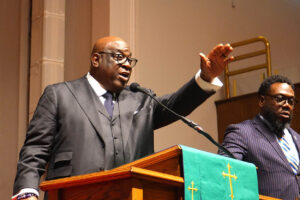
National Baptists hear first female preacher at meeting
September 17, 2025
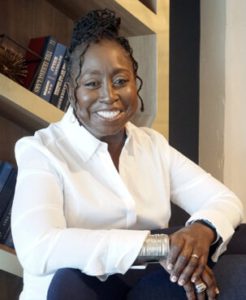
(RNS)—As she prepared to preach at the Sept. 9 evening service at the annual session of the National Baptist Convention U.S.A. Inc., Tracey L. Brown admitted to feeling the nerves she always has before entering a pulpit and “dealing with people’s souls.”
But the occasion took on other emotions when the New Jersey minister learned from convention leaders that she would be the first woman ever to preach to the 145-year-old, historically Black denomination’s annual meeting.
“I feel humbled and honored,” Brown, 63, founder and pastor of Ruth Fellowship Ministries in Plainfield, told Religion News Service hours before the service at the Kansas City Convention Center in Kansas City, Mo.
‘Tonight will go down in the history books’
Religion scholars said Brown’s preaching was a noteworthy moment, even as women have long been preaching in local Baptist churches, often without much recognition.
When Gina Stewart preached at a meeting of four Black Baptist denominations in 2024, the historic moment temporarily disappeared from the Facebook page of the NBCUSA.
A later post on the page reassured members that the stream of the service was not blocked by its officers or administrators, but there also were claims some attendees chose not to be present when Stewart spoke.
“It’s a long time coming; it’s 2025,” said Bible scholar and retired professor Renita Weems concerning Brown’s sermon. “A lot of local churches are light-years ahead of the executive cabinet of the National Baptist Convention.”
Boise Kimber is president of the National Baptist Convention, USA, Inc. (Photo by DuWayne Sterling/NBCUSA)
Boise Kimber, who is leading his first annual session as president of the denomination, has talked about his plans to increase the visibility of women leaders in the denomination, along with younger and newer pastors. Earlier this year, he appointed Debbie Strickling-Bullock as the first female chairman of the board of the National Baptists’ Sunday School Publishing Board.
“Tonight will go down in the history books,” he said at the conclusion of the evening worship service. “So, Tracey Brown, we are grateful for you.”
Kimber has had to overcome a contentious process that marred his election last year in which he ended up as the sole candidate on the ballot after officials determined he had received the required 100 endorsements from member churches and other National Baptist entities to qualify to run for president.
He then drew pushback this summer over reports that he and other Black church leaders were involved in accepting a donation from Target for education and economic development initiatives. even as other prominent Black Baptist leaders boycotted Target for pulling back on diversity, equity and inclusion programs.
His support for women’s leadership, however, has drawn praise.
“He made some missteps, but on the woman issue he is on the right side of history,” said Weems, former academic dean at American Baptist College, a National Baptist-affiliated institution in Nashville, Tenn. “I have to take my wig off to him.”
Changes in the church and the nation
Brown’s sermon, which lasted about 30 minutes, focused mostly on recent changes in the church. Though she misses some of the traditions lost due to the COVID-19 pandemic, she said, she noted that the church has benefited from being forced to adapt.
“The pandemic showed us what took maybe two and a half, three hours could be done meaningfully in less time with the Spirit still having his way and without being quenched,” she said. “The pandemic taught us that good church did not mean all-day church. Amen, somebody.”
She turned briefly to what she called the “cruel” Trump administration immigration policies being carried out by U.S. Immigration and Custom Enforcement agents, saying, “We are witnessing the legalization of criminal activities by the Ku Klux Klan, which has changed their name to ICE.”
But she expressed faith in a better future. “Even now, in the turbulence of today, we declare that the same God who brought us this far is the same God that will bring us and carry us forward,” she said.
Brown, who has served as a city councilwoman in Plainfield and has led her predominantly Black congregation for more than a quarter century, has achieved other firsts as a woman: She was the first woman elected moderator of the Middlesex Central Baptist Association of New Jersey and the first African American woman to serve as a New Jersey state police chaplain.
Cheryl Townsend Gilkes, professor emerita of African American studies and sociology at Colby College who now teaches at Hartford International University for Religion and Peace, said Brown’s preaching at the National Baptists’ annual session is another marker in a gradual prominence for Black women ministers affiliated with denominations such as the National Baptist Convention USA and the Progressive National Baptist Convention Inc.
“When a door is open, for Black women preaching, whether it be at the Hampton University Ministers’ Conference or the joint board meeting of various National Baptist associations, such as NBC or PNBC, or as will happen tonight at the National Baptist Convention, when those doors are open, they are usually not shut,” she said in an interview hours before Brown’s sermon.
“The other problem for Black women preachers is they have to be twice as good to get half as far.”
White evangelicals say election results in God’s plan
September 17, 2025
(RNS)—White evangelical Christians long have been seen as President Donald Trump’s most loyal supporters. And they often believe everything is part of God’s plan.
It’s little surprise, then, that 7 out of 10 (71 percent) believe God played a role in putting Trump back in the White House after the 2024 election—or that the same number said God’s plan was also for Joe Biden to be president four years earlier.
Few evangelicals, however, believe either candidate’s policies played a role in God’s plans.
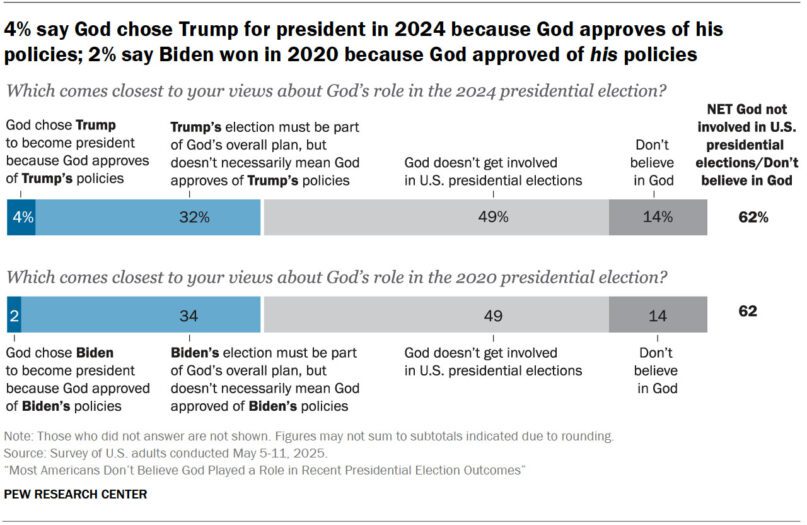
Those are among the findings of a new Pew Research Center report about how Americans view the role God plays in elections. The report, released Sept. 9, was based on a May 2025 survey of 8,937 Americans, with a margin of error of plus or minus 1.4 percentage points.
Overall, the report found that when asked about the results of the 2024 election, nearly half of Americans (49 percent) said God does not get involved in U.S. presidential politics, while another 14 percent said they don’t believe in God.
A third (32 percent) said that Trump’s election was part of God’s plan, but that God didn’t necessarily approve of the former real estate mogul and reality TV star-turned-politician’s policies. Only 4 percent say God chose Trump because God approves of Trump’s policies.
These percentages match results from the 2020, 2016 and 2012 elections. A third (34 percent) of Americans said Biden’s election was part of God’s plan in 2020. A previous survey found that 27 percent of Americans said Trump’s election in 2016 was part of God’s plan. And 29 percent said the same about Obama’s election in 2012.
Theological views lead to interesting survey results
Chip Rotolo, a research associate at Pew and author of the report, said that there appears to be some theological consistency in how religious Americans see the outcomes of presidential elections. He also said those theological views may have led to interesting results in the survey.
“It definitely introduces some interesting data points,” he said. “Republicans are twice as likely to say God played a role in Biden’s election than Democrats are.”
The survey found differences in the way religious Americans see God’s role in politics. White evangelicals and Black Protestants were most likely to say that the election results were part of God’s plan. Catholics (67 percent) and nonevangelical white Protestants (66 percent) were more likely to say God doesn’t get involved in presidential elections.
Ninety percent of Americans with no religious affiliation saw no role for God in the recent presidential elections.
“The vast majority of religiously unaffiliated Americans—a group made up of atheists, agnostics and people who say their religion is ‘nothing in particular’—say that God does not get involved in elections (45 percent) or that they don’t believe in God (44 percent),” according to the report.
Party affiliation also revealed differences in how Americans connect faith and political outcomes. Half (52 percent) of Republicans and those who lean Republican said that either it was God’s plan for Trump to become president in 2024 (44 percent) or that God chose Trump based on Trump’s policies (8 percent). Only 25 percent of Democrats saw God’s hand in Trump’s election.
How much does religion affect voting?
Researchers also found differences in how much religion impacts voting and beliefs about whether good Christians should oppose Trump.
“White evangelical Protestants and Republicans are especially likely to say religion shapes how they vote,” according to the report.
White evangelicals are much more likely (51 percent) to say religion shapes how they vote a great deal or quite a bit than are Americans overall (25 percent). So do 37 percent of all Protestants, 31 percent of Black Protestants and 30 percent of Jews. Only 20 percent of nonevangelical white Protestants, 24 percent of Catholics and 6 percent of the religiously unaffiliated say religion shapes their vote.
Researchers also asked Christians whether “good Christians” can disagree about Trump. Overall, 80 percent said good Christians can disagree. Eleven percent said opposing Trump was essential for good Christians, while 7 percent said supporting Trump was essential for good Christians.
“Large majorities of Christians across various religious traditions and political party lines say that good Christians can disagree about Donald Trump, ranging from 76 percent of Hispanic Catholics to 85 percent among White evangelicals,” according to the report.
Ten percent of white evangelicals and Republicans said supporting Trump was essential for good Christians. By contrast, 1 in 4 Democrats (24 percent) said opposing Trump was essential.
“Overall, there’s consensus among most American Christians that ‘good Christians’ do not need to take a particular view on Trump,” the report said.
White evangelicals and Republicans were also most likely to say religion affects how they treat others and how they view morality.
“White evangelicals and Republicans also stand out for the large shares who say religion shapes how they treat other people and think about morality,” according to the report.
“For example, 88 percent of White evangelicals say religion shapes how they treat others a great deal or quite a bit, and 86 percent say the same about religion shaping their morality – among the highest percentages of any religious group analyzed.”
Among the religiously unaffiliated, 17 percent said religion shapes how they view morality or how they treat people.