Family lives with ups and downs of fostering and adoption

MISSION—There’s a sense of energy when you walk through Faith and Gerald Varlack’s front door. It’s more than a house; it’s an experience.

Gerald Varlack plays on the floor with his adopted son. (Buckner Photo by Mark Sandlin)

Maybe it’s the original art or the comic book collection displayed on the brightly painted walls of blue, orange and green in their open-concept home in Mission. Or maybe the music playing in the background.

Perhaps it’s the bright sun filtering through large windows and onto a lifetime of family photos of the couple with their three adult biological children—Cherish, Japheth and Adriel.

More likely, though, the energy in the house comes from the constant movement and laughter of three children all under age 3.

The couple adopted the 2-year-old boy after fostering him since he was a newborn. They currently are fostering the other two and hope to adopt one of them soon.

The experience that is the Varlack home can be credited to the family’s personal vibrancy. Faith and Gerald both are educators—she teaches choir, and he teaches math—as well as artists. All members of the family are active musicians.

Faith Varlack reads to her adopted son. (Buckner Photo by Mark Sandlin)

Faith and Gerald Varlack participate in the music ministry of Calvary Baptist Church in nearby McAllen, and their three older children have been vocalists in school and church since childhood.

But adding to the energetic feel of the home is the couple’s admission they’re also roller coaster riders of sorts. As they say, it comes with the territory of God’s calling for them to serve as foster and adoptive parents.

“When you walk into the Varlack home, it’s a little bit of chaos since we’ve gotten the last placement in here. But it’s a home filled with love,” said Melanie Mata, the Varlacks’ Buckner case manager and adoption worker. “Everyone is very hands-on, very attentive, very patient with one another. Everyone helps out and picks up the pieces.”

When Faith first approached Gerald about her desire to foster a few years ago with another agency, Gerald responded with a single question: “Why do you want to do this?”

“He’s the more logical one,” Faith said.

Riding ‘an emotional roller coaster’

By 2018, though, the couple had prayed through their mutual decision to become foster parents through Buckner.
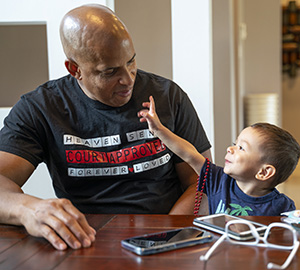
Gerald Varlack firmly believes: “The orphan finds mercy in God, and God cares about the orphans. It’s really what we should be all about.” (Buckner Photo by Mark Sandlin)

“We finish the trainings, we get certified, and we get our first placement, a couple of boys,” Gerald recalled. “And that placement is very … What’s the word I would use, Faith?”

“An emotional roller coaster?”

“An emotional roller coaster,” he agreed. “The pendulum shifted from high excitement and then high anxiety and then back and forth between those two.”

Gerald described the highs: “God was giving us this opportunity, and we looked at it as ministry with caring and compassion, everything like when we talk about what it means to be a Christian and what it really means. … ‘Widows and orphans,’ right? The orphan finds mercy in God, and God cares about the orphans. It’s really what we should be all about. I guess for me I was feeling, ‘Wow, this is what my faith in action looks like.’”

But, like any roller coaster, there were dips. After seven months of caring for the boys, the Varlacks realized their foster children needed a higher level of care than they could supply.

“They were amazing kids,” she said. “That [honeymoon] phase ended and then we thought, ‘This is above our ability’ and we had to let that placement go. Then it was a lot of questioning ourselves if we failed and a lot of regret, to the point that Gerald asked, ‘I don’t know if I want to do this anymore.’”

Part of Gerald’s disappointment, Faith explained, stemmed from his passion. “He really gave everything, I mean everything. Those were his boys. It was hard, getting him to want to foster again.”

But Buckner foster care staff found another placement, a brother and sister who were soon to be reunited with family. Since the placement was temporary, both Buckner and the Varlacks felt it might be a good transition to a more positive experience for the foster parents and children.

“They said the little boy was very aggressive, and he wouldn’t talk to anybody,” Faith said. “But in one month’s time, he was talking and smiling, and that was because of Gerald. In his heart, he was saying: ‘I’m not going to fall in love again. I’m not going to do it.’ Yet, he still was so amazing with them. It was a great experience, and Gerald was more open to the next placement.”

From foster care to adoption

Gerald’s eyes light up as he confirmed her words. “After that one, after the little boy and the little girl, that’s when this guy came,” he said, looking at the couple’s newly adopted son. “He was our third placement, right out of the hospital.”

As a foster mother, Faith Varlack enjoys every child in her home, recognizing her calling is “to love them while we have them.” (Buckner Photo by Mark Sandlin)

The child came into their lives in 2019 as an emergency placement at just 3 weeks old and eight weeks premature.

“He was a preemie, so every hour and a half to two hours he needed to eat,” she said. “We had a solid three months of no sleep. We were zombies that summer. With those kinds of experiences, you can’t help but fall in love, right?”

When the couple learned the boy probably would not return to his birth mother because of decisions she was making, they were determined to “fight for this baby” and adopt him. But his adoption proved to be another roller coaster, as efforts to reunite him with his birth mother floundered while she struggled with drug use and jail time.

It eventually led Faith to the emotional realization that a foster parent’s job “is to love them while we have them.”

“And that was a hard lesson,” she said between tears. “But that was a lesson I learned with Gerald. I’m trying not to get emotional. It’s so hard. But when I let it go and I let God have control … it was easier for me to actually take the next placement, and the next placement, because it’s not about me controlling it. It is about whatever God wants.

“When the adoption finally happened, I was like, ‘OK, God, you chose us, you decided we were the ones that were the best home for him.’ It’s a big responsibility, but it was also a big ‘Wow.’”

‘Baby Moses’

While their son’s recent adoption has proven to be a high point in the family’s roller coaster ride, the addition of a baby in late March provided a butterfly-in-the-stomach moment for them.

The Varlacks had indicated they would be willing to adopt an infant, but the day the baby arrived, they were presented with a quick-response proposal by CPS: Would they be willing to make the decision to adopt this child they’d never fostered—or even seen?

The infant came to them under the Texas Safe Haven Law—commonly referred to as the Baby Moses Law—that allows parents unable to care for a newborn the ability to bring the child to a designated safe place, with no questions asked.

Faith recalled the phone conversation. “They said: ‘There’s a baby, and it’s under the Baby Moses law, so it’s going to go to adoption. Are you interested?’” she said. “I was like: ‘What? You’ve got to be kidding.’”

The family’s response was immediate. “Well, just throw our name in there, and we’ll see,” she told the caseworker. “I doubted it would happen because there’s just so many people. And then he called back and said: ‘They chose you. CPS chose you.’”

Faith Varlack rocks a baby she and her husband currently are fostering and whom they hope to adopt soon. (Buckner Photo by Mark Sandlin)

“We got the call on Friday, and then he came to us on Saturday,” she said. “Again, I felt that same responsibility, like God chose us, because there’s a lot of people that could have been chosen in the situation. He thought we were good enough, deserving enough to raise this child.”

The Varlacks hope to adopt “Baby Moses” in the near future.

Cherish, 24, is their oldest daughter. She said her parents’ commitment to children has given her a lot of respect for them.

“In that way, my opinion of them hasn’t changed much,” Cherish said. “They’re great, but I think I have a lot more respect for them and now know how much work it was to have three toddlers at the same time.”

Reflecting on their foster and adoptive journey—all of the roller coaster’s ups and downs—Faith reflected on how it’s been a spiritual journey as well.

“It’s so hard to believe. I’m pinching myself,” she said. “We have six children right now. and we’ve fostered over 12, but my prayer is that these boys would feel loved, and not just loved by us but loved by God. I know God has a purpose for them.”

She gives thanks for “the opportunity to be in their lives” and prays “that they will just be happy and really, really will serve God.”

“I want them to do really great things,” she said. “I really have dreams for them to do that, because I don’t think it was an accident that they were with us.”
Russia added to list of worst religious liberty violators

WASHINGTON (RNS)—The U.S. State Department has added Russia to its list of nations it considers among the world’s most egregious violators of religious freedom.

Russia joins Myanmar (also known as Burma), China, Eritrea, Iran, North Korea, Pakistan, Saudi Arabia, Tajikistan and Turkmenistan on the list of “countries of particular concern.”

Nigeria omitted from list

Nigeria, which was on the list last year, is not included, as of Nov. 15. The U.S. Commission on International Religious Freedom expressed its disappointment in the omission and urged the State Department to reconsider.

“USCIRF is disappointed that the State Department did not adopt our recommendations in designating the countries that are the worst violators of religious freedom,” said USCIRF Chair Nadine Maenza.

“While the State Department took steps forward on some designations, USCIRF is especially displeased with the removal of Nigeria from its CPC designation, where it was rightfully placed last year, as well as the omission of India, Syria, and Vietnam. We urge the State Department to reconsider its designations based on facts presented in its own reporting.”

Russia had been on the second-tier “special watch list” in the 2020 designation. Algeria is now listed on the second-tier list, joining Comoros, Cuba and Nicaragua, which were also listed in 2020.

“In far too many places around the world, we continue to see governments harass, arrest, threaten, jail and kill individuals simply for seeking to live their lives in accordance with their beliefs,” Secretary of State Antony J. Blinken said Wednesday.

“This administration is committed to supporting every individual’s right to freedom of religion or belief, including by confronting and combating violators and abusers of this human right,” he added.

Entities of particular concern named

Blinken also redesignated these militant groups as “entities of particular concern”: al-Shabab; Boko Haram; Hayat Tahrir al-Sham; the Houthis; the Islamic State group, or ISIS; ISIS-Greater Sahara; ISIS-West Africa; Jamaat Nasr al-Islam wal Muslimin; and the Taliban.

Earlier in November, the U.S. Commission on International Religious Freedom reiterated its recommendations for the State Department’s designations. Russia, along with Syria, India and Vietnam, was among its suggestions for the CPC list.

“For years, the Russian government has conducted a purge of ‘non-traditional’ religions, frequently labeling as ‘extremists’ and imprisoning peaceful Jehovah’s Witnesses, and readers of the moderate Islamic theologian Said Nursi,” USCIRF stated in a November fact sheet.

“Russian courts continue to deliver harsher and more numerous prison sentences for Jehovah’s Witnesses seeking to practice their faith.”

With additional reporting by Managing Editor Ken Camp. 


Around the State: Baylor names Foster Basketball Pavilion

Baylor University will name its basketball pavilion for Paul and Alejandra Foster of El Paso in recognition of the Fosters’ $100 million gift in 2019 to the university’s Give Light Campaign. The couple’s donation launched the public fundraising campaign for the basketball pavilion, home to Baylor’s National Championship basketball teams. Their gift, which until now was anonymous, also sparked creation of a dollar-for-dollar matching program for qualifying gifts providing faculty support to Baylor in support of Illuminate, the university’s strategic plan. Known at the time as the Baylor Academic Challenge, the program—which prompted the funding of 14 faculty endowed chairs—now will be known as the Foster Academic Challenge. “Paul and Alejandra Foster have truly been champions for Baylor University and our students, and we are excited to make this announcement so that our Baylor Family can join with us in celebrating their transformational philanthropy,” said Baylor President Linda A. Livingstone.

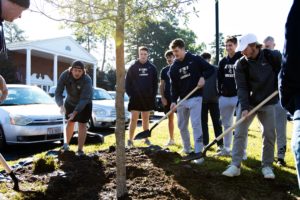
To turn Arbor Day into a service-learning experience, East Texas Baptist University provides an opportunity for students to get involved in the tree planting process each year. (ETBU Photo)

East Texas Baptist University uses Texas Arbor Day—the first Friday in November—as a service-learning experience each year by involving students in tree planting on campus. This year, 80 ETBU students—including a significant number of student athletes—planted four live oak trees in front of Jarrett Library.

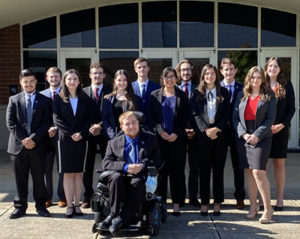
Members of the recently formed Dallas Baptist University debate team earned a first-place sweepstakes award in Team International Public Debate in the Pejaver Memorial Forensic Tournament in Murfreesboro, Tenn. (DBU Photo)

Members of the recently formed Dallas Baptist University debate team earned a first-place sweepstakes award in Team International Public Debate in the Pejaver Memorial Forensic Tournament in Murfreesboro, Tenn. Freshman Jess Perez took the top prize among speakers, earning both the first-place speaker and best novice awards. Three DBU teams advanced into elimination rounds: Joseph Alcazar and Greyson Goebel; Madison Kitner and Perez; and Luke Castleand Harmony Miller. In Individual Public Debate competition, Josh Ballard won five of six preliminary rounds in the novice division, eventually winning third-place speaker, and Miller won first-place speaker in the junior varsity division. All seven DBU competitors in Individual Public Debate—Jascha Ely, Dayton Thomas, Justin Hamilton, Alcazar, Castle, Goebel and Miller—advanced to elimination rounds.


Ed Stetzer: Tumultuous times call for fearless followers

GALVESTON—In “tumultuous and turbulent times,” Christians can find guidance and motivation in unchanging truths from Scripture, missiologist and cultural observer Ed Stetzer assured Texas Baptists.

Stetzer, director of the Billy Graham Center at Wheaton College, addressed the Baptist General Convention of Texas annual meeting in Galveston.

Preaching from John 20:19-21, Stetzer used the Risen Christ’s appearance to his frightened disciples to remind Christians today how they should respond in troubling times.

“Fear is always the opposite of faith,” he said.

While “fear is a recurring theme in our day,” Christians can counter the cultural factors that feed fear by remembering they serve a risen Savior, Stetzer asserted.

“We need people today who will say, ‘We are not afraid because Jesus is back from the dead,’” he said.

Peace in tumultuous times

The first words Jesus spoke to his frightened followers who gathered behind locked door was “Peace be with you.”

“Peace is always the Christian response,” Stetzer said.

However, he acknowledged, too many 21st century American Christians are “discipled by cable news sources and spiritually formed by social media” rather than by the gospel.

While some Christians bemoan the loss of “home field advantage in culture,” Christ wants his followers to focus on the centrality of his sacrificial death and victorious resurrection, Stetzer asserted.

“The cross is always our hope and motivation,” he said.

‘Cultural conversions’ can birth spiritual renewal

Society is on the “front end” of a period of “cultural convulsions,” Stetzer observed.

The last year comparable to the past one was 1968—a time characterized by rioting in the streets and political assassinations, he said. However, it also birthed the “Jesus Movement” that shaped a generation of young Christians, he noted.

Similarly, the current “tumultuous time” could spark a renewed “pervasive commitment to the gospel,” he said.

God wants followers who are known for “running toward the crisis” with a message of transformation and hope rather than retreating, Stetzer said.

“We always go because Jesus came to us,” he said.

Like the Hebrew Prophet Isaiah, he said, God wants followers who are willing to respond to his call by saying: “Here I am, Lord. Send me.”

“The moment we are in does not pause the mission we are on,” Stetzer said.


Texas Baptists reminded of local church centrality

GALVESTON—Speakers at Texas Baptists’ annual meeting in Galveston emphasized the central role of the local church in God’s mission and testified to God’s greatness.

“The local church is God’s plan A, and there is no Plan B. … In all its messiness and sinfulness, it’s still God’s plan,” said Thom Rainer, CEO and founder of ChurchAnswers.

Rainer, former president of Lifeway Christian Resources, and Samuel Tolbert, president of the National Baptist Convention of America and pastor of the Greater Saint Mary Missionary Baptist Church in Lake Charles, La., addressed a Monday afternoon worship session at Texas Baptists’ annual meeting.

Rainer referenced Acts 2:41-42 about the growth of the early church through preaching, prayer and regular gatherings. While today’s society is ever-changing and this post-quarantine world brings many questions, he said, there is still much to learn from the church in Acts.

‘Prayer is the pinnacle’

“The plan is to be totally consumed. They devoted themselves. They were consumed, passionate. The meals and teachings were important. But prayer is the pinnacle,” he said. “If prayer is a ‘P.S.’ in your church and not the heartbeat of what your church is doing, it’s time to get a blank slate and start all over.”

Rainer recalled a time in his pastorate in Birmingham, Ala., when he was low and asked the church to lift him in prayer. One member named Francis took up the charge and enlisted others to help. Every day at noon, more than 100 members prayed for their pastor.

“Imagine if every church had people who were so consumed with prayer that they couldn’t help but be prayer warriors,” he said. “From the pastor who was ready to throw in the towel, I became a pastor who saw that church transformed. It did not begin with the giftings of Thom Rainer. It began with the power of prayer.”

Rainer noted the simplicity found in the example of the church in Acts 2.

“The local church is not to be minimalized or trivialized. It is Plan A,” he said. “The local church is worth saving and worth making a difference in our community. It’s where we should give our devotion unashamedly and expect it of others. God has used the church from Pentecost until now, and upon this rock he will build it. It’s time for a fresh perspective on God’s church.”

Testimony to God’s greatness

Tolbert used the final verses of the book of Jude to illustrate what he called “the testimony of the benediction.”

“God is able to keep you from falling and to present you faultless,” he quoted from Jude verse 24.

Samuel Tolbert, president of the National Baptist Convention of America and pastor of the Greater Saint Mary Missionary Baptist Church in Lake Charles, La., preached during a Monday afternoon worship session at Texas Baptists’ annual meeting. (BGCT Photo by Robert Rogers)

“While we’re going through a test, we need to be writing our testimony. The God you trusted before this challenge is still the same God,” he said.

“Jude declares the ability of God in this benediction. God is able—not getting ready to become able and not having a strategic plan to be able but he is able.”

Tolbert noted Jude cited attributes of God in his benediction.

“He is a wise God, in a class all by himself,” Tolbert said. God is the Savior, and the only way to redemption is through Jesus, he emphasized.

Jude “talks about God’s greatness and majesty, dominion and control, his capacity to direct our lives. He declares the ability of God but closes with the alliance formed in the benediction, Tolbert concluded.

“God is constantly working in concert with creation to carry out his will,” he said. “It’s a partnership that has been forged—present and future.”


Hardage highlights Texas Baptists’ accomplishments

GALVESTON–David Hardage, executive director of the Baptist General Convention of Texas, celebrated the diverse accomplishments of Texas Baptists in his report to Texas Baptists’ 136th annual meeting.

Hardage introduced the young leaders from across Texas who make up the sixth cohort of Leadership Texas Baptists, an effort to raise up the next generation of leaders for the convention. He celebrated the young leaders’ active role in the convention.

“We want this convention to be as bright in the future as it is today,” he said.

To work on building a bright future, Hardage said, the Center for Church Health recently called Jonathan Smith to lead in church revitalization and replanting. That ministry will be especially needed as churches come out of the pandemic and need to rethink and “re-vision” who they are, he added.

Hardage also spotlighted the Missionary Adoption Program, first established in a partnership with the Brazilian Baptist Convention to allow churches in Texas and churches in Brazil to team up to support a Brazilian missionary in Brazil.

“Four-and-a-half years ago, when we signed that partnership, we had zero MAP missionaries in zero countries,” Hardage said. “God has opened doors, and we now have more than 80 Missionary Adoption Program participants in nine countries. God continues to open the doors.”

Hardage spoke of the good and hard work being done through the Center for Cultural Engagement and the Christian Life Commission.

“In Austin, Texas, it’s a challenge sometimes to represent causes that are good, right and biblical,” he said. “But we Texas Baptists are doing that and standing against causes that are not good, not right and not biblical. I’m grateful for our CLC and what they do.”

The Center for Ministerial Health has proven indispensable through the tumult of the pandemic, providing both counseling services and financial assistance to pastors in crisis, Hardage said.

“This past year, our counseling service had more calls than we ever had before from pastors and their families,” he reported. Through the counseling services, pastors are able to access the mental and emotional help they need during challenging times, he explained.

“You’ve helped more than 1,000 pastors this past year,” Hardage said.

“In the early stages of the pandemic, you provided more than $1 million,” he continued. “With that, we helped almost 400 small church, bivocational pastors literally survive the early stages of the pandemic, many of whom had lost their jobs. You helped them not only keep food on the table, but keep ministry going in their churches.”

Hardage also celebrated the Center for Collegiate Ministry.

“You put campus missionaries this fall on 120 college and university campuses in this state. Every day on those campuses, students are coming to Christ,” Hardage said.

He offered closing words of encouragement to Texas Baptists.

“We’re enjoying a season of peace and unity,” he said. “Texas Baptists, guard that. Anytime the enemy sees an advancement of the kingdom like that of which we’re a part of today, he will seek to destroy that. We are going to guard our unity and peace. Good days are ahead.”


Texas Baptists create task force to address generational change

GALVESTON—Texas Baptists addressed generational change at their annual meeting, voting overwhelmingly to create a task force to explore ways to increase Millennial and Generation Z involvement in churches and the denomination.

At the Baptist General Convention of Texas annual meeting in Galveston, messengers also approved a related resolution about ministry to Millennials and Generation Z, elected officers and adopted a nearly $34.6 million budget.

The Galveston meeting was the first in-person annual meeting Texas Baptists held since 2019. Last year, a streamlined version of the meeting was moved online due to the COVID-19 pandemic.

The meeting’s hybrid format allowed messengers to vote online via Zoom, as well as in person at the Galveston Island Convention Center. However, of the 1,113 registered messengers, only 88 participated online.

Involve Millennials and Gen Z in BGCT

Chris McLain, pastor of First Baptist Church in Bandera, submitted a motion calling for the convention to form and fund a task force that will recommend ways to involve Millennials and Generation Z in Texas Baptist life and ministry.

Demographers generally define Millennials as individuals born between 1981 and 1996. They typically describe individuals born between 1997 and 2015 as belonging to Generation Z.

McLain’s motion called on the BGCT president to “appoint a task force to study and recommend ways to increase involvement of Millennial and Gen Z Baptists in the life of the convention and its cooperating churches. The task force will have a budget of up to $10,000 to cover the expenses of the committee. The task force will report its findings and recommendations at the September 2022 Executive Board meeting for review and to the 2022 annual meeting of the convention for consideration.”

Speaking in favor of his motion, McLain expressed appreciation to Texas Baptists for investing in his life—nurturing him spiritually, shaping his faith through Super Summer youth discipleship camp and Baptist Student Ministry, and providing for his theological education.

However, he noted, many in his generation and those in the generation behind him lack those deep connections to Texas Baptists. Furthermore, those who want to “give back” to the convention may struggle to find opportunities to serve, he added.

Prior to the annual meeting, McLain said he and others in The Pastor’s Common network wanted Texas Baptists to think strategically about how to “have younger leaders in the pipeline and provide on-ramps for them to get involved.”

Related resolution adopted

Messengers also approved a related resolution on generational change commending Texas Baptists for their “long tradition of sharing the gospel and reaching the ‘next generation’ for Christ.” However, it acknowledged “young people are leaving the church at alarming rates.”

The resolution cited Gallup as reporting only 36 percent of Millennials are members of a church. It noted American Bible Society asserts only 9 percent of Generation Z are “Bible-committed Christians.” The resolution also noted the median age of Texans is 34, according to the U.S. Census.

The approved resolution reaffirmed Texas Baptists’ “commitment to reaching, discipling, caring for and welcoming Millennials and Gen Z” into churches and “calling into ministry and training up Millennial and Gen Z Christians, equipping them as pastors and leaders.”

The resolution encouraged the BGCT and “all its churches to make a purposeful effort to minister to Millennials and Gen Z, both through the promotion of young leaders and shifts in ministry strategy that engage those generations’ language and cultural ethos with the gospel.”

Messengers approved two other resolutions—one expressing appreciation to the annual meeting’s host city and its churches, and the other affirming “the ongoing efforts of Texas Baptists following Christ’s example of engaging, empowering and entrusting women with the gospel.”

Officers elected

Texas Baptists re-elected as president Jason Burden, pastor of First Baptist Church in Nederland, and as first vice president Julio Guarneri, pastor of Calvary Baptist Church in McAllen.

Texas Baptists re-elected as president Jason Burden (center), pastor of First Baptist Church in Nederland, and as first vice president Julio Guarneri (right), pastor of Calvary Baptist Church in McAllen. They elected Nebiye Kelile (left), pastor of Pathway Church and Orchard Hills Baptist Church in Garland, as second vice president. (Texas Baptists Communications Photo)

They elected Nebiye Kelile, pastor of Pathway Church and Orchard Hills Baptist Church in Garland, as second vice president. The incumbent second vice president, Jordan Villanueva, now a professor at Howard Payne University, did not seek a second term.

Other officers reelected at the annual meeting were Bernie Spooner from Plymouth Park Baptist Church in Irving as secretary of the corporation and David Cozart from Meadowbrook Baptist Church in Waco as registration secretary.

In his presidential address to the annual meeting, Burden called on Texas Baptists to recognize current “extraordinary times” as “an inflection point” that demands both continued innovation and faithful obedience to God’s clear commands.

“God gives simple instructions to people like you and me so we can respond in simple obedience,” he said.

Budget approved

Messengers approved a $34,588,280 total Texas budget for 2022, a $321,592 increase over the 2021 budget.

The 2022 budget, recommended by the BGCT Executive Board, projects a $32.8 million net Texas budget based on Cooperative Program giving and investment income. It depends on $27.37 million in Texas Cooperative Program receipts from churches.

Next year’s budget anticipates slightly more than $5.4 million in investment income and more than $1.77 million in additional revenue from conference and booth fees, product sales and other sources.

In his report to the annual meeting, BGCT Executive Director David Hardage highlighted advances by Texas Baptist churches, support offered by BGCT staff and wide-ranging efforts by ministry partners globally and in other parts of the nation.

“We are enjoying a season of peace and unity. Texas Baptists, guard that,” Hardage urged. “Anytime the enemy sees an advancement of the Kingdom like that of which we’re a part of today, he will seek to destroy that. We are going to guard our unity and peace. Good days are ahead.”

Messengers to the annual meeting also:

  • Agreed to continue the division of undesignated receipts from affiliated churches, with 79 percent allocated for the BGCT and 21 percent for worldwide causes. Each church determines the recipient or recipients of its worldwide giving.
  • Voted to allocate an anticipated $1 million in worldwide missions initiatives and partnerships in this manner: $340,000 for missions mobilization, $200,000 for River Ministry and Mexico missions, $100,000 for Texas Partnerships, $55,000 for the Baptist World Alliance, $5,000 for the North American Baptist Fellowship, $50,000 for intercultural international initiatives, $200,000 for Go Now Missions, $20,000 for the Hispanic Education Task Force and $30,000 for chaplaincy.
  • Approved a motion by Chad Edgington, pastor of First Baptist Church in Olney, calling for the GC2 statement of faith to be amended to include a reference to the Ascension of Christ. GC2—an emphasis on the Great Commission and Great Commandment—is envisioned as a movement to share the gospel and show God’s love. In September, the BGCT Executive Board approved the statement of faith, designed to establish theological parameters for cooperation with others outside of Texas Baptist life who want to cooperate with Texas Baptists. While most of the GC2 statement summarizes central theological beliefs, it also includes some social issues not included in the 1963 Baptist Faith & Message, the statement of faith adopted by BGCT annual meeting messengers. The GC2 statement affirms “the sanctity of human life from conception to natural death,” defines marriage in terms of one man and one woman, and identifies gender exclusively as male and female.
  • Approved a slate of directors to the BGCT Executive Board and trustees of affiliated institutions nominated by the Committee on Committees, Committee to Nominate Executive Board Directors and the Committee on Nominations for Boards of Affiliated Ministries.
  • Collected $3,618 during a worship service to benefit relief and development ministries supported by the Texas Baptist Hunger Offering.

The 2022 BGCT annual meeting will be held Nov. 13-15 in the Waco Convention Center.


Texas Baptists urged to make disciples and embrace unity

GALVESTON—Texas Baptists at the opening worship service of their annual meeting in Galveston heard calls to make disciples and embrace unity.

Jason Bryant, western heritage consultant with the Baptist General Convention of Texas, spoke on the importance of teaching members of Texas Baptists congregations how to be disciple-makers.

“We do a poor job in our churches getting people into their fishing boots,” Bryant said. “Jesus said, ‘Come follow me, and I will show you how to fish for people. It’s not just pastors who have the responsibility to fish for people. It’s not just deacons. Every believer in Jesus Christ has the responsibility to fish for people.”

Similarly, Jesus said to “go and make disciples,” or “put on your walking boots” and walk alongside people in their spiritual journeys. Bryant encouraged churches to use the model Jesus used—personal interaction over the course of years.

Walking alongside a new believer one-on-one is an essential part of discipleship, he said.

“You can’t make a new disciple in a few weeks in a new believers class,” he said. “Jesus, over three years, poured into and invested in those 12. We call ourselves people of the book. We need to get back to making disciples the way the book made disciples.”

Bring a culture of true unity

Incumbent Second Vice President Jordan Villanueva encouraged Texas Baptists to unite in the gospel.

Second Vice President Jordan Villanueva calls on Texas Baptists to preserve unity. (BGCT Photo by Robert Rogers)

He spoke about the story of the council of Jerusalem in Acts 15, in which a faction in the church pushed for Gentile converts to be circumcised and keep the law of Moses. Paul and Barnabas traveled to Jerusalem to present this debate to the apostles and elders.

The council talked past each other rather than listening to understand. Peter stood up and addressed the assembly, saying God makes no distinction between the Gentile and Jewish believers, “having cleansed their hearts by faith.”

“One thing we can take away from this council is that true unity doesn’t negate the fact that there’s going to be tough conversations,” Villanueva said. “Often, we think to have true unity, we can’t talk about the tough issues at hand. But Peter proves that doesn’t work. By just talking past the issues, we do not reach true shalom.”

Villanueva encouraged listeners to stand in contrast to the broader culture of division in the world today.

“We need to be influencing the world,” he said. “We need to bring a culture of true unity, true shalom, true peace. That doesn’t mean we stop talking about the difficult issues, the things that make us nervous and sweat a little bit.

“We engage in those conversations in spiritual humility, humbly coming before each other, listening so that we will understand and bringing the good news of the gospel to these many conversations that need to take place.

“There’s opportunity in unity. There’s opportunity to show the world what it looks like to be a part of the kingdom of God.”


BGCT messengers elect officers and approve budget

GALVESTON—Texas Baptists elected officers and approved a nearly $34.6 million budget during the first business session at the Baptist General Convention of Texas annual meeting in Galveston on Nov. 15.

They also approved a slate of directors and trustees for boards, and they allowed messengers to introduce motions for consideration during the Nov. 16 business session. One motion called for the creation of a task force to facilitate greater Millennial and Generation Z participation in the BGCT.

Messengers to Texas Baptists’ annual meeting reelected as president Jason Burden, pastor of First Baptist Church in Nederland. (BGCT Photo by Robert Rogers)

The meeting’s hybrid format allowed messengers to participate online via Zoom, as well as in person at the Galveston Island Convention Center.

Messengers to the annual meeting re-elected as president Jason Burden, pastor of First Baptist Church in Nederland, and as first vice president Julio Guarneri, pastor of Calvary Baptist Church in McAllen.

They elected Nebiye Kelile, pastor of Pathway Church and Orchard Hills Baptist Church in Garland, as second vice president. The incumbent second vice president, Jordan Villanueva, now a professor at Howard Payne University, did not seek a second term.

Approved the 2022 budget

Messengers approved a $34,588,280 total Texas budget for 2022, a $321,592 increase over the 2021 budget.

The 2022 budget, recommended by the BGCT Executive Board, projects a $32.8 million net Texas budget based on Cooperative Program giving and investment income. It depends on $27.37 million in Texas Cooperative Program receipts from churches.

Next year’s budget anticipates slightly more than $5.4 million in investment income and more than $1.77 million in additional revenue from conference and booth fees, product sales and other sources.

Messengers also voted to continue the division of undesignated receipts from affiliated churches, with 79 percent allocated for the BGCT and 21 percent for worldwide causes. Each church determines the recipient or recipients of its worldwide giving.

An anticipated $1 million in worldwide missions initiatives and partnerships will be allocated in this manner: $340,000 for missions mobilization, $200,000 for River Ministry and Mexico missions, $100,000 for Texas Partnerships, $55,000 for the Baptist World Alliance, $5,000 for the North American Baptist Fellowship, $50,000 for intercultural international initiatives, $200,000 for Go Now Missions, $20,000 for the Hispanic Education Task Force and $30,000 for chaplaincy.

Messengers to the annual meeting approved a slate of directors to the BGCT Executive Board and trustees of affiliated institutions nominated by the Committee on Committees, Committee to Nominate Executive Board Directors and the Committee on Nominations for Boards of Affiliated Ministries.

Miscellaneous business

Chris McLain, pastor of First Baptist Church in Bandera, submitted a motion calling for the formation of a task force that will recommend ways to involve individuals age 40 and younger in BGCT life and ministry.

The motion states: “I move that the president of the Baptist General Convention of Texas appoint a task force to study and recommend ways to increase involvement of Millennial and Gen Z Baptists in the life of the convention and its cooperating churches. The task force will have a budget of up to $10,000 to cover the expenses of the committee. The task force will report its findings and recommendations at the September 2022 Executive Board meeting for review and to the 2022 annual meeting of the convention for consideration.”

Chad Edgington, pastor of First Baptist Church in Olney, introduced a motion calling for the GC2 statement of faith to be amended to include a reference to the Ascension of Christ.

GC2—an emphasis of BGCT Executive Director David Hardage focusing on the Great Commission and Great Commandment—is envisioned as a movement to share the gospel and show the love of Christ.

The BGCT Executive Board in September approved the statement, designed to establish the theological parameters for cooperation with others outside of Texas Baptist life who want to cooperate with Texas Baptists.

Messengers will consider the motions, as well as resolutions, during the Tuesday morning business session on Nov. 16. That session also will include the president’s address and various reports.


Friends of Truett challenged to ‘close the gap’

GALVESTON—With 368 students and 322 endowed student scholarships, Dean Todd Still wants to see Baylor University’s Truett Theological Seminary “close the gap” by endowing 12 scholarships per year for the next four years.

Still issued the challenge—to provide an endowed scholarship for every student—during the Friends of Truett Dinner in Houston on Nov. 14, held in conjunction with the Baptist General Convention of Texas annual meeting.

If Truett supporters fulfill the challenge, it won’t be the first time they have met an ambitious goal.

When Baylor launched its Give Light campaign to support its Illuminate academic strategic plan, the seminary was given a $50 million fund-raising target.

“Last May, Truett eclipsed that goal,” Still announced, noting it was “the first academic unit at Baylor” to surpass its assigned goal.

About 1,700 contributors gave almost $50.8 million to fund 43 endowed scholarships and five faculty chairs.

“In the last five years, Truett’s endowment grew from $51.8 million to $111.8 million,” Still said.

In spite of “the COVID-19 cloud that cast a pall over all our lives,” Truett continued to launch new initiatives in the past two years, Still noted. He pointed to programs in Houston and San Antonio, as well as the Wesley House of Studies.

At its most recent meeting, he added, Baylor’s board of regents also approved three new master’s degree offerings at Truett Seminary—the Master of Arts in Theology and Sports Studies; the Master of Arts in Contextual Witness and Innovation; and the Master of Arts in Theology, Ecology and Food Justice.

At the same meeting, regents approved cutting tuition costs for students at Truett Seminary by more than one-third, reducing the “sticker price” per credit hour from $1,071 to $690.

By reducing tuition costs and increasing endowed scholarships, Truett students are more likely to graduate and serve in ministry “without the albatross of debt around their necks,” Still said


Martinez on treasure hunt for historical insight

Boxes filled with old files may not excite many people, but Bobby Martinez sees them as buried treasure—valuable resources that reveal Hispanic Texas Baptists’ history and heritage.

Martinez, a Ph.D. student in Baylor University’s religion department, wants to shed light on the people, events and institutions that shaped Hispanic Texas Baptist life.

Boxes filled with old files may not excite many people, but Bobby Martinez sees them as buried treasure—valuable resources that reveal Hispanic Texas Baptists’ history and heritage. (Photo / Ken Camp)

“There is a broader Baptist tradition than the Anglo Baptist story we typically are taught,” he said. “I want to bring the complex history of Hispanic Baptists to the forefront.”

He is working as an intern at the Texas Baptist Historical Collection in Waco, meticulously cataloging and reviewing the records of the Hispanic Baptist Convention of Texas and related documents.

Martinez, a graduate of Howard Payne University and Baylor Truett Theological Seminary, is serving as a Hispanic Theological Initiative Scholar, a program designed to encourage Latinx doctoral students.

The program, based at Princeton Theological Seminary, involves a consortium of two-dozen schools, including Harvard Divinity School, Vanderbilt Divinity School, Brite Divinity School, Duke University and Fuller Theological Seminary.

“Sometimes I feel like I am in way over my head,” said Martinez. “I carry the weight of knowing I am in select company. At the same time, I love doing the work.

“I tend to second-guess myself, because the spaces of academia are not really made for me. But I made it, and I am thankful for professors who have believed in me.”

Examining boxes and boxes of material

Martinez is reviewing material in more than 60 file boxes of archival material, examining items page by page to identify and organize the available records.

Ernest Atkinson, a missionary with the Southern Baptist Convention’s Home Mission Board for 40 years, placed 26 boxes of personal files, photos and other records in the Texas Baptist Historical Collection.

Atkinson served 28 years at the Mexican Baptist Bible Institute—later known as Hispanic Baptist Theological Seminary—as professor, librarian and dean.

The boxes Martinez already has examined include minutes of the Mexican Baptist Convention of Texas—later Hispanic Baptist Convention of Texas—from 1910 until the 1980s, along with records from the institution in San Antonio now known as Baptist University of the Américas.

Uncovering unknown resources, discovering gaps

Alan Lefever, director of the Texas Baptist Historical Collection, said he knew only in general terms what archival materials related to Hispanic Texas Baptist history were in the collection before Martinez started working on the project.

“He already has been able to identify significant material and discover gaps in the historical record that we need to fill,” Lefever said.

Jesse Rincones, executive director of the Hispanic Baptist Convention of Texas, expressed appreciation to the Hispanic Theological Initiative for making it possible to inventory and catalogue important historical records.

“We knew we had a lot of resources, but we’ve never had the volunteers or staff available to go through them in a methodical way,” Rincones said.

“The older I get, the more I realize how valuable our history is. … As we learn about the challenges Hispanic Baptists in Texas have overcome, we discover the faithfulness of those who have come before us, and we are reminded of God’s faithfulness throughout our history.”

‘I want to tell the story of our people’

Martinez particularly is interested in reading all available material related to two key figures in 20th century Hispanic Texas Baptist history—Josue Grijalva and Leobardo Estrada.

Grijalva was dean of the Mexican Baptist Bible Institute from 1962 to 1981 and president of the renamed Hispanic Baptist Theological Seminary from 1989 to 1993. From 1981 to 1989, he was national consultant of ethnic leadership development for the Home Mission Board.

Estrada was language missions coordinator for the Baptist General Convention of Texas, a president of the Mexican Baptist Convention of Texas and preacher on La Hora Bautista radio program.

“I want to tell the story of our people,” Martinez said. “It’s a complicated history.”

He expects his doctoral dissertation to grow out of the work he is doing—perhaps exploring how controversies in relatively recent Southern Baptist and Texas Baptist history affected Hispanic Texas Baptists.

“I want to see Texas Baptists and Hispanic Baptists in Texas take ownership of the story and ask, ‘What are we going to do with it?’” he said.

‘A labor of love’

Martinez views himself as an “insider-outsider” when it comes to Hispanic Texas Baptist life.

Martinez is the grandson of a Mexican Baptist pastor. In some ways, the history he is uncovering and hopes to record is the story of his family and other families like his.

At the same time, as a “military kid” who spent some time in Germany and Virginia and grew up attending First Baptist Church in Copperas Cove, his personal experiences have been in predominantly Anglo churches. Currently, he attends Calvary Baptist Church in Waco, where he is involved in ministry to youth.

“I haven’t really been part of Convención, so I can be somewhat objective in looking at its history. At the same time, it’s in some sense autobiographical when I look at the story of Hispanic Texas Baptists,” he acknowledged.

“I’m passionate about it. This is a labor of love.”

Martinez wants to connect with anyone who has additional records and resources beyond those in the Texas Baptist Historical Collection—particularly the Grijalva or Estrada family. He can be reached at (254) 371-5383 or (254) 754-9446. 


Flap over God’s pronouns might save Elm Mott church

ELM MOTT (RNS)—A small Baptist church in Central Texas received more than $15,000 in donations after a conservative group criticized the congregation’s website for using the wrong pronouns for God.

Beth Allison Barr

“This is close to paying for a month of our operating budget,” author Beth Allison Barr, whose husband is the church’s pastor, told her Twitter followers Nov. 10 after an initial $6,500 in donations had been made to the church. “We are overwhelmed, humbled & in awe of you. Thank you. Thank you. Thank you.”

The donations were inspired by an unlikely source—a fundraising appeal from the Council for Biblical Manhood and Womanhood, which has been critical of a popular recent book from Barr.

Colin Smothers, the executive director of CBMW—started in the late 1980s to help churches defend themselves against “secular feminism”—recently wrote a fundraising email that criticized both Barr’s book and her church, First Baptist Church in Elm Mott.

Online statement of faith cited

The church’s online statement of faith included the word “Godself” instead of “himself” for God. Smothers also wrote a longer article, which ended with a request for donations, that further criticized the church and its “eye-popping statement of faith.”

“This kind of revisionism is dangerous, unorthodox, and should be rejected by confessional Christians,” Smothers wrote.

First Baptist in Elm Mott was mentioned because of its ties to Barr, a Baylor University professor and associate dean. She’s the author of The Making of Biblical Womanhood: How the Subjugation of Women Became Gospel Truth, which critiques the teaching of groups like the CBMW.

Barr has no official role at the church and had nothing to do with the statement of faith. That statement of faith, according to the church website, predates her husband’s arrival as pastor. She’s used to people taking issue with her work but said going after her church was “below the belt.”

“What really ticked me off was that it wasn’t just attacking me,” she said. “It was attacking this congregation that had nothing to do with any of that, aside from the fact that they hired my husband.”

She added: “It was really uncalled for.”

Church facing financial challenges

Barr was also concerned CBMW was trying to raise money off of critiquing her church. Like many small congregations, First Baptist has struggled during COVID, with attendance at services dropping from about 70 to less than 30.

The church also has faced financial struggles. Last fall, the church’s former secretary was indicted on charges of embezzling more than $150,000 from the church, wiping out much of the congregation’s savings.

The church has orthodox views of Christian beliefs such as the Trinity and a high view of the Bible, Barr said. It also has a long history of supporting women in ministry, dating back to the 1930s, and has tried to be faithful to serving its community, she said, despite the struggles of COVID.

Part of larger debate

The critique of First Baptist, which is affiliated with the Baptist General Convention of Texas, reflects a larger debate over the roles of women in the church and at home that has intensified in recent years, pitting groups such as the CBMW that promote “complementarianism,” a view that men and women are equal but have different roles, against those who hold egalitarian views.

Authors such as Barr and Calvin historian Kristin Kobes Du Mez—whose book Jesus and John Wayne: How White Evangelicals Corrupted a Faith and Fractured a Nation, was also critiqued in Smothers’ letter—have argued the complementarian view has been harmful to women in the church, while leaders in the Southern Baptist Convention have labeled women who preach as threats to biblical authority.

After Barr shared the CBMW article on social media, it was updated to include a statement from the First Baptist website, which has since replaced the term “Godself” with “Himself.”

“While there is nothing inaccurate about the word ‘Godself,’ the Scriptures clearly uses ‘Himself” in reference to God, and our church has no problem with that,” the statement read. “We seek to use gender-neutral pronouns when the scriptural text does so in the original languages, and we use gendered pronouns when the text does so in the original languages.”

Smothers, who did not immediately reply to a request for comment, called the statement a “‘neutering’ of God’s self-revelation.”

Church receives unsolicited donations

After Barr tweeted about the CBMW fundraising email, First Baptist began receiving donations through the church’s website. By Wednesday afternoon, more than $6,500 had come in from 80 donors. After Barr tweeted that total, Arlington pastor Dwight McKissic promised more was on the way.

Becky Castle Miller was one of the donors who chipped in. A recent graduate of Northern Seminary in Lisle, Ill., she knows Barr from Twitter but has never met her in person. Miller served on the staff of a small church in the Netherlands, a congregation she loved dearly, before returning to the United States.

“I would have been mama bear-angry if someone had gone after my church the way CBMW mocked Dr. Barr’s church,” she said. “I love Jesus, and I love the church. I care about small churches. I’m sad to hear about the struggles First Baptist of Elm Mott has been facing.”

‘Reminder of God’s faithfulness’

By Thursday morning, more than $15,000 in donations from 182 people had been received at the church, according to the church’s pastor, Jeb Barr.

“We’re a small church in a low resource community, and COVID has hit us pretty hard,” he said. “This will be our Thanksgiving miracle!

“It’s also a reminder of God’s faithfulness and provision, often in ways we could never anticipate. On a practical level, we meet in an aging facility, and there are needed repairs that we’ve been putting off that we may now be able to address,” he continued.

“This might help save our church,” Beth Allison Barr said.