Baptists helping in ‘mammoth’ tornado relief operation
December 15, 2021
MAYFIELD, Ky. (BP)—Southern Baptist disaster relief teams began working Dec. 14 in west and south-central Kentucky in some of the areas most affected by the tornadoes that tore through the mid-South on Dec. 10.
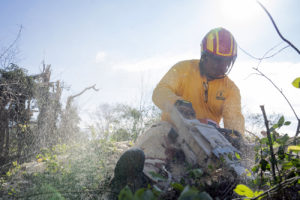
Volunteer Tim Feeney with North Carolina Baptists on Mission disaster relief helps remove downed trees at a home in Mayfield, Ky., on Dec. 14. (Photo / Morgan Bass)
Teams from Kentucky, North Carolina, Missouri and Texas have responded to calls for help.
Kentucky Gov. Andy Beshear said at least 100 Kentuckians remain missing as recovery efforts continue. The storms that stretched across Arkansas, Illinois, Kentucky, Ohio and Tennessee early Saturday morning have left more than 70 dead.
Kentucky Baptist Glenn Hickey, the incident commander for the site in hard-hit Mayfield, Ky., called the destruction the worst tornado-related damage he’s ever seen.
As he drove to the site on Saturday morning, he took note of damage stretching more than 150 miles between Bowling Green and Mayfield.
Disaster relief crews are providing chainsaw assistance as they help people get to their homes and remove trees from homes, Hickey said.
“We have teams going out and tarping where there’s roof damage—trying to protect whatever is left of homes, if we can,” he said.
For many in Mayfield, repair is not an option.
“Many houses will be condemned and will have to be completely rebuilt,” he said.
A Southern Baptist Send Relief tractor trailer made its way west Tuesday from Ashland, Ky., to Mayfield and to Mt. Juliet, Tenn., bringing enough roofing material for 480 homes, Kentucky Today reported.
Baptist disaster relief chaplains also are on the ground near the most gruesome sights where survivors’ loss is great. Vande Slonecker is helping lead the chaplain team as they assess the area and make their first contacts with residents.
“Right now, people are having an adrenaline shock. It’s very hard for them to understand what they’re seeing,” she said. In the coming days, she added, adrenaline will wear off, and shock will set in as residents will need help to process and comprehend the devastation.
“The reality will set in, and the grief will come,” Slonecker said. “It’s our job to say, ‘Yes, you are going through a very rough time, but God is here, and he sent us to be here with you, holding your hand, helping you through this the best we can.’”
Slonecker, a veteran chaplain and caregiver, has worked disaster response in the Gulf Coast, along the East Coast and in Kentucky. She said the devastation is massive, because it is so widespread.
So many people have lost everything, and for those recovering, “the rebuilding process and what is ahead for this town is mammoth compared to some of the places I’ve been,” she said.
Obituary: Cathy Lawrence
December 15, 2021
Cathy Lynn Lawrence, longtime ministry assistant with Texas Baptist Men, died Dec. 13 in Dallas. She was 71. She was born Aug. 24, 1950, in Dallas to Arnold William Dollgener and Hallie Marie Kirkland. She worked for Texas Baptist Men as a secretary and ministry assistant 15 years until her retirement. She was a lifelong member of Hickory Tree Baptist Church in Balch Springs. She enjoyed her retirement spending time with family, friends and her beloved pets. She was preceded in death by her first husband Alan Pace Smith, her late husband Robert Lawrence and seven siblings. She is survived by son Chris Smith and his wife Kim, son Shane Lawrence and his wife Kristin, and daughter Andrea Harrison and husband Taylor; five grandchildren; and brothers Robert Dollgener and James Dollgener.
Pew Research: America continues to grow more secular
December 15, 2021
WASHINGTON (RNS)—Next week, most Americans will celebrate Christmas, marking the birth of Jesus. But a new poll from Pew shows the share of U.S. adults who consider themselves Christian is falling.
Only 63 percent of Americans self-identify as Christian this year, a marked drop from 75 percent 10 years ago.
The declining percentage of Americans who say they are Christian is offset by a growing number of people who call themselves atheist, agnostic or people of no particular faith. These unaffiliated Americans make up a full 29 percent of the U.S. population, up from 19 percent in 2011.
“The secularizing shifts evident in American society so far in the 21st century show no signs of slowing,” the Pew researchers concluded. “The religiously unaffiliated share of the public is 6 percentage points higher than it was five years ago and 10 points higher than a decade ago.”
Though Christians are still a healthy majority, their decline is perhaps best reflected in two questions from the poll: how often people pray and how important religion is in their lives.
Only 45 percent of U.S. adults said they pray on a daily basis (down from 58 percent in a similar 2007 survey).
And the number of Americans who say religion is “very important” in their lives is also falling: 41 percent of Americans consider religion “very important” in their lives, down from 56 percent in 2007.
Politic environment a factor
Protestants account for most of the decline—down 4 percentage points from five years ago and 10 percentage points since a decade ago, with both evangelical and nonevangelical Protestants declining overall to 40 percent of U.S. adults. Catholics held relatively steady at 21 percent.
“This is at least in part a reaction to the political environment,” said David Campbell, professor of American democracy at the University of Notre Dame who has written about American secularization.
“Many people turning away from religion do so because they think of religion as an expression of political conservatism, or as a wing of the Republican Party. That’s especially true of white Americans. The more religion is wrapped up in a political view, the more people who don’t share that political view say, ‘That’s not for me.’”
There was no corresponding rise in the number of Americans adhering to other faiths. A total of 6 percent of Americans identify with non-Christian faiths, including 1 percent who describe themselves as Jewish, 1 percent Muslim, 1 percent Buddhist, 1 percent who are Hindu and 2 percent who identify with a wide variety of other faiths.
But notably, the number of atheists and agnostics in the survey roughly doubled in the past decade to 4 percent and 5 percent respectively, up from 2 percent and 3 percent in 2011.
Bigger culturally than numerically
Some scholars said this doubling may not be as big a shift numerically as it is culturally.
“There’s less stigma attached to being an atheist,” said Ryan Burge, assistant professor of political science at Eastern Illinois University and the author of a book about the “nones,” or the religiously unaffiliated. “It’s revealing of what’s been there for a long time, rather than a big shift. People may not have answered honestly 20, 30 years ago.”
But Burge said the decline of Protestant Christianity from 52 percent in 2007 to 40 percent today is significant.
“It’s more evidence that America is going to be much different,” Burge said. “Think of American history. For a plurality of Americans to say religion is not important, that’s a big shift in how we think about ourselves.”
A survey released by PRRI during the summer found that the religiously unaffiliated had lost ground, making up just 23 percent of the country. But the Pew poll found little to support that conclusion. The number of people with no religion grew steadily from 16 percent in 2007 to 29 percent in 2021, Pew indicated.
The poll was part of the National Public Opinion Reference Survey conducted by Pew online and by mail between May and August. The survey was conducted among 3,937 respondents, who took the poll on their own (not in response to an interviewer). It has a margin of error of 2.1 percentage points.
Southern Baptist women lead where they can
December 15, 2021
WASHINGTON (RNS/AP)—Jacki King, the women’s minister at Second Baptist Church in Conway, Ark., first felt a call to ministry as a college student.
She decided to follow it, giving up her pre-med major and her spot on a college softball team for ministry training at a small Bible school with a mostly male student body. She picked Criswell College in Dallas because it was where her pastor was a dean. She wanted to teach the Bible the way he did.
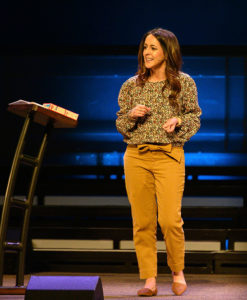
King thought at the time she only had two options for ministry—marrying a pastor or serving as an overseas missionary.
“I really didn’t want to be married to a lead pastor,” she said.
But God, as the saying goes, had other plans.
She met Josh King, an aspiring preacher at Criswell, fell in love and married him. They went into ministry together with his pastor role opening doors for her.
Today, King is an author as well as a Bible teacher, and she worries too much of the conversation about women’s roles in the church is focused on what they cannot do—namely, serve as senior pastor in a Southern Baptist church—rather than what they can do.
The Bible shows women and men as partners and portrays women leading in the early church, King said. She points to Phoebe, who is mentioned in the New Testament book of Romans, along with other women leaders.
“Women are part of the Great Commission,” she said, a reference to Jesus’ command to spread his teaching around the world and make disciples.
Tension in the SBC over the role of women
Few congregations could function without the work of female members. Still, there is tension in the Southern Baptist Convention over the role of women, mainly over how to put a section of the denomination’s statement of faith—the 2000 version of the Baptist Faith and Message—into practice. That section, based on the SBC’s interpretation of Bible verses like 1 Timothy 2:12 and Titus 1:5-9, deals with leadership in churches.
“While both men and women are gifted for service in the church, the office of pastor is limited to men as qualified by Scripture,” the statement reads.
Beth Moore is founder of Living Proof Ministries in Houston. (Courtesy Photo)
But local Southern Baptist churches, because they are governed autonomously, are free to decide how to implement that teaching.
For some in the nation’s largest Protestant denomination, the statement of faith means the senior pastor must be a man, but staff and other pastoral roles can be filled by women, including teaching the Bible to both men and women. For others, pastoral duties, especially preaching, are limited to men, and women are only allowed to teach the Bible to other women and children.
These two views clashed in spring 2019, when Beth Moore, then a beloved Southern Baptist women’s Bible teacher, tweeted about speaking at a Mother’s Day church service. It led to a social media firestorm and renewed criticism of women preachers and teachers from more conservative Southern Baptists.
In spring 2021, Moore left the SBC, citing a number of concerns, including how the denomination has handled sexual abuse allegations, as well as sexism and racism within its ranks.
“At the end of the day, there comes a time when you have to say, this is not who I am,” she told Religion News Service at the time.
Baptist women in ministry in a bind
This ongoing fight has left some women leaders who feel called to ministry in a bind.
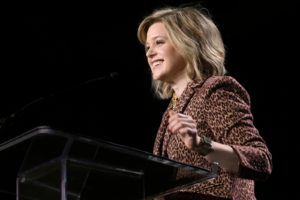
Katie McCoy leads prayer and reads Scripture as she begins the first worship session of the 2021 Texas Baptists annual meeting at the Galveston Island Convention Center in Galveston, Texas, on Nov. 16, 2021. In 2019, King, McCoy and other faithful Southern Baptists launched the SBC Women’s Leadership Network to foster female leaders across the evangelical denomination. (Photo / Jerry Neil Willliams / Texas Baptists)
“Until we stop debating or demanding an ever-narrowing conformity, we will continue to circle a revolving door of unnecessary controversy,” said Katie McCoy, women’s ministry director for the Baptist General Convention of Texas and former seminary professor, in an email.
Jacqueline Scott, a member of Dorrisville Baptist Church in Harrisburg, Ill., and women’s Bible study teacher, said being a leader is a natural outgrowth of her faith, and she has always felt called to encourage people to reach their potential.
“I’ve realized that being a leader is just something that is almost ingrained,” she said. “You don’t even realize that you’re doing it.”
Scott believes her faith frees her from some of the limitations society puts on her gender. But, she said, Christians put up boundaries too, restricting what people can do for God and how they share the gospel—forgetting everyone has a place in the church’s mission.
Still, Scott believes the Bible limits the role of pastor to men, and she thinks they are better suited for that role.
“On the other hand, do I believe that women can be preachers?” she said. “Yes, I do.”
In 2019, King, McCoy and other faithful Southern Baptists launched the SBC Women’s Leadership Network to foster female leaders across the evangelical denomination.
“I get to have tons of conversations with women across our convention about … how they’re serving and how their creativity and resilience is changing communities and schools and churches,” King said. “None of that is platformed. None of that is shared to the world.”
‘Leadership is influence, not necessarily position’
King pointed to the examples of Lottie Moon and Annie Armstrong, legendary missionaries in Southern Baptist life. Two of the largest denomination-wide offerings are named after the women.
Leadership is more than high-profile ministries, McCoy said. It can look like women hosting college students for the holidays, mentoring young moms and organizing community service projects, she said.
“Leadership is influence, not necessarily position,” McCoy said.
Called to ministry at 22, McCoy, who holds a doctorate in systematic theology, said her parents, professors and peers encouraged her to pursue leadership in Baptist life. Today, she is the new women’s ministry director for Texas Baptists, recently making the jump from an SBC seminary to the state convention.
Texas Baptist churches seemed to have worked out how to cooperate despite their differences over the role of women, and they do it “without the controversy—or perennial acrimony—the SBC experiences,” McCoy said. It is a local church matter and not a test issue for joining the state convention, she said.
“Many of our 5,300 churches are just as conservative as the SBC, affirming the same confessional documents,” McCoy said, adding that others allow women to preach or teach, but limit pastor and elder positions to men.
‘As a woman, I couldn’t grow beyond where I was’
When McCoy previously worked at Southwestern Baptist Theological Seminary in Fort Worth, she said she felt valued by the administration and supported by President Adam Greenway but felt limited as an employee of an SBC seminary.
“I felt that, as a woman, I couldn’t grow beyond where I was,” McCoy said.
Despite her credentials, McCoy knew teaching in the School of Theology wasn’t an option. It would be, she said, “at best, fodder for the next alarmist documentary, and at worst, a call for investigations and resignations” at the SBC’s national gathering.
“If the SBC ever looks around and realizes it has lost a generation of women leaders, it won’t be because those women drifted into liberalism. It will be because they’re exhausted,” she said.
Instead, McCoy was named an assistant professor of applied theology and women’s studies, but in the School of Educational Ministries, which prepares students for church ministry more practically. She doesn’t fault Greenway.
“I do, however, fault a religious culture that so caters to its fundamentalist fringe that it views women teaching theology courses as a more imminent threat to its doctrinal purity than decades of infighting and rancor,” McCoy said.
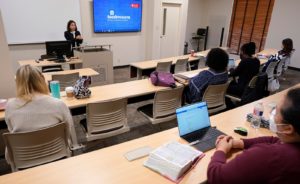
Ashley Allen teaches a women’s ministry class at Southwestern Baptist Theological Seminary in Fort Worth on Nov. 18, 2021. (AP Photo/LM Otero)
Ashley Allen, a women’s ministry professor and the director of news and information at Southwestern Seminary, does not feel restricted by the denomination’s beliefs.
“I abide by what Scripture says,” Allen said. “But at the same time, Scripture provides opportunities for me as a woman.”
In college, Allen knew she was being called to a Christian vocation, but she refined that calling through the example and guidance of the ladies at her church—many of whom didn’t carry a title.
“They were what I define leadership to be now, which is influencing,” Allen said. “When you are influencing somebody else, you’re leading them—good or bad.”
Men, including a seminary dean, a professor and a state convention leader, also championed Allen along her career path. Allen said they invested in her, ran interference and recommended her for different positions.
Today, Allen is doing the influencing, and she would like to see more women in Southern Baptist life fostering leadership among their peers in “whatever it may be, but really coming alongside those ladies and giving them opportunities to be able to serve and to use their gifts.”
This story is part of a series by the Associated Press, Religion News Service and The Conversation on women’s roles in male-led religions.
Texas Baptists respond after tornadoes hit mid-South
December 15, 2021
GARLAND—When multiple tornadoes ripped through the mid-South, a Dallas-area Baptist congregation partnered with Texas Baptist Men to deliver supplies to help a Hispanic Baptist pastor in Mayfield, Ky., minister to his community.
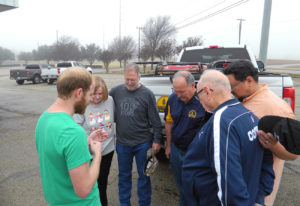
Pastor Daniel Camp (left) of South Garland Baptist Church gathers for prayer with (left to right) ministry assistant Marcy McLendon, volunteer driver Steven Branch from The Village Church in Flower Mound, Rupert Robbins of Texas Baptist Men, deacon Garold May and student minister Jorge Rivera. TBM transported four generators and various other supplies the Garland church provided to a Hispanic congregation in Mayfield, Ky., after a tornado hit the community. (Photo / Ken Camp)
Late Friday night Dec. 10, a series of tornadoes swept through Arkansas, Missouri, Tennessee and Kentucky. The longest-tracking tornado, packing wind speeds in excess of 150 mph, originated in Arkansas and appeared to remain on the ground more than 200 miles into Kentucky.
During a Dec. 13 news conference, Kentucky Gov. Andy Beshear confirmed 64 deaths in his state due to tornadoes. However, he added, “undoubtedly, there will be more” fatalities, noting 105 people remained unaccounted for at that point.
TBM placed its statewide network of disaster relief volunteers on alert over the weekend, and leaders began working with counterparts in other states on a coordinated response.
David Estevez, who leads the Hispanic ministries at South Garland Baptist Church, and Jorge Rivera, the Garland congregation’s student minister, contacted Jaime Masso, pastor of Primera Iglesia Bautista Hispana in Mayfield, Ky., to check on his well-being.
Members of South Garland Baptist Church donated more than 650 diapers in 24 hours for Primera Iglesia Bautista Hispana in Mayfield, Ky., after a tornado hit the community. (Photo / Ken Camp)
Estevez is a longtime friend of Masso, and Rivera had been working with him to plan a student mission trip to Kentucky this summer.
At a regularly scheduled church council meeting on Dec. 12, Estevez and Rivera reported to South Garland Baptist Church leaders about needs in southwestern Kentucky.
Masso was safe, and his church facility was not damaged seriously, but its sponsoring congregation—First Baptist Church in Mayfield—lost most of its buildings, Estevez said.
The American Red Cross and several other organizations were using the Hispanic church’s building as its headquarters for relief. Masso was providing shelter in his home for some people affected by the tornado. But like other Mayfield residents, his house lacked electricity and likely would be without utilities for an extended time.
Rivera told the church council a member of South Garland Baptist Church already had offered to loan two generators to Masso. By later Sunday evening, another member offered to let him borrow two more, if they could be transported to Kentucky.
Appeal for donations
At 8 a.m. Monday morning, Pastor Daniel Camp sent an email to members of South Garland Baptist Church reporting on the needs. He appealed for donations of disposable diapers of all sizes and women’s hygiene products, along with financial gifts for the Hispanic church in Mayfield.
“By 9 o’clock, we already had received $1,500,” said Marcy McLendon, the church’s ministry assistant.
Rupert Robbins of TBM (left) and volunteer driver Steven Branch from The Village Church in Flower Mound, secure generators and other equipment provided by South Garland Baptist Church for a Hispanic church in Mayfield, Ky., to use after a tornado. (Photo / Ken Camp)
Within 24 hours, South Garland Baptist raised $3,450 and collected more than 650 diapers, assorted feminine hygiene products and other personal items, along with four generators, two filled 5-gallon gasoline containers, assorted extension cords and other supplies.
The church also received an envelope filled with notes of encouragement for the people of Mayfield from students at Conrad High School in Dallas, where Estevez teaches.
In the meantime, the pastor connected with Rupert Robbins, associate director of disaster relief for TBM. Robbins enlisted a driver—Steven Branch, a volunteer from The Village Church in Flower Mound—and TBM provided a truck to transport the donated items to Kentucky.
The loaded truck left the South Garland Baptist Church parking lot at 10:30 a.m. on Tuesday, a short time after a mobile freezer filled with food left the TBM headquarters in Dallas, bound for Murray, Ky.
Loving ‘in truth and action’
“1 John 3:18 tells believers to love not in words or speech, but in truth and action, and you were exceedingly faithful to that command,” the church’s pastor wrote in a follow-up email to members. “Presented with an opportunity to help those in need, you stepped up in a big way, and I am overwhelmed with pride and gratitude for your generosity.”
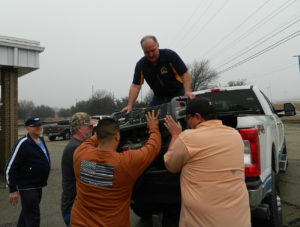
Volunteers load a generator onto a pickup truck in the South Garland Baptist Church parking lot. The Garland church donated supplies for a Hispanic congregation in Mayfield, Ky., after a tornado. Texas Baptist Men transported the equipment and supplies to Kentucky. (Photo / Ken Camp)
He asked members to pray for Branch as he made the trip to Kentucky and for Masso as he and his church ministered in their hard-hit community.
“And let us all give thanks for the privilege of being used by God to help his people,” he concluded.
In addition to helping the Garland church deliver donated items to Mayfield and sending the mobile freezer to support Southern Baptist disaster relief teams already on the ground in Kentucky, TBM also was making final preparation to send chainsaw teams to the disaster sites, TBM Executive Director Mickey Lenamon said on Tuesday morning.
“All our chainsaw teams are on standby to minister, and some of them may deploy as soon as this week,” Lenamon said. “We know the needs are immense, and TBM volunteers are striving to meet them as quickly as possible.”
All other TBM volunteers—emergency food service, shower and laundry, chaplains, asset protection, damage assessors and incident management personnel—remain on alert for later deployment in what likely will be a lengthy relief operation.
To support TBM disaster relief financially, visit tbmtx.org/donate or send a designated check to Texas Baptist Men, 5351 Catron Drive, Dallas, TX 75227.
Obituary: Bill Glass
December 15, 2021
Bill Glass, an All-American football star at Baylor University who led the Cleveland Browns to an NFL championship and led a pioneering prison ministry, died Dec. 5 in Waxahachie. He was 86. Glass was born in 1935 in Texarkana, but his family moved to Corpus Christi when he was 5 years old. At age 14, his father died—a loss that shaped his future approach to ministry, which often focused on providing father figures to young men. After becoming a Christian as a high school student, Glass enrolled at Baylor University in 1953. At Baylor, he helped establish a chapter of Campus Crusade for Christ. He also met his wife of 60 years, Mavis, at Baylor after she read a newspaper story about a football player who taught a Sunday school class. While in the NFL, he earned Pro Bowl honors four times, and in the off-season, he earned a degree from Southwestern Baptist Theological Seminary. In 1965, he presented his Christian testimony at the first nationally televised Billy Graham Crusade. After he retired from the NFL in 1969, he began a ministry now known as Bill Glass Behind the Walls. In 2019, the ministry reported that up to that point in its history, Bill Glass Behind the Walls had trained 58,550 Christians to share their faith; presented the gospel to 6 million incarcerated individuals; and recorded more than 1.2 million commitments to Christ. Glass wrote a dozen books, including one in partnership with William M. Pinson Jr. He served nine years on the Baylor University board of regents, and he was awarded the university’s Pro Ecclesia Medal of Service in 2013. He was preceded in death by his wife Mavis in 2017. Glass is survived by three children, Billy, Bobby and Mindy.
Americans concerned too many seeking religious exemptions
December 15, 2021
WASHINGTON (RNS)—A new poll reveals most Americans are in favor of offering religious exemptions for the COVID-19 vaccines, but they express concern too many people are seeking such exemptions.
In the same survey, more than half of those who refuse to get vaccinated say getting the shot goes against their personal faith.
The Public Religion Research Institute and Interfaith Youth Core conducted the poll, released Dec. 9. It investigated ongoing debates about COVID-19 vaccines, as well as emerging divisions over whether religious exemptions to the shots should even exist.
According to the survey, a small majority (51 percent) of Americans favor allowing individuals who would otherwise be required to receive a COVID-19 vaccine to opt out if it violates their religious beliefs, compared with 47 percent who oppose such religious exemptions.
Partisan differences evident
The divide, which researchers noted has remained roughly the same since they began surveying on the question earlier this year, yawns wider when respondents are broken out by party. Only 33 percent of Democrats support religious exemptions to vaccines, whereas most independents (53 percent) and a broad majority of Republicans (73 percent) favor them.
Even so, majorities of almost every religious group believe there are no valid religious reasons to refuse a COVID-19 vaccine, including Hispanic Catholics (68 percent), other Christians (68 percent), Jewish Americans (67 percent), Hispanic Protestants (64 percent), white Catholics (62 percent), members of The Church of Jesus Christ of Latter-day Saints (60 percent), Black Protestants (59 percent), white mainline Protestants (56 percent) and other Protestants of color (51 percent).
Religiously unaffiliated Americans were the most likely to say there are no valid religious reasons to refuse the vaccine, at 69 percent, whereas white evangelical Protestants were the only faith group among whom fewer than half (41 percent) said the same.
Two groups—white evangelical Protestants and “other Protestants of color,” a category that includes Asian Americans, Pacific Islanders and Native Americans, among others—were the only major faith groups among whom less than a majority (38 percent each) agreed that “too many people are using religion as an excuse to avoid COVID-19 vaccination requirements.”
Jewish Americans, on the other hand, were the most likely to agree with the statement (72 percent), followed by Latter-day Saints (68 percent) and religiously unaffiliated Americans (67 percent). Hispanic Catholics, Black Protestants, white mainline Protestants and Hispanic Protestants all hovered between 63 percent and 58 percent.
A majority of Democrats (77 percent) and Americans overall (59 percent) also said they believe too many people are using religion as an excuse to avoid COVID-19 vaccines, but Republicans (41 percent) and Republicans who trust far-right news sources (18 percent) were notably less likely to agree.
The survey was conducted between Oct. 18 and Nov. 9, before the discovery of the omicron variant of the novel coronavirus. While a smattering of preliminary research suggests the new strain may produce more mild cases, reports it also may be more transmissible and at least partially evade protection from two-dose vaccines have spurred a surge in Americans seeking booster doses.
Most faith groups supportive of vaccines
Faith groups and religious leaders generally have been supportive of vaccines overall, and many have assisted with the vaccine rollout by partnering with government leaders to host vaccination drives at their houses of worship. Faith leaders also actively promoted inoculations across the globe, with rabbis participating in vaccine trials and Pope Francis describing getting the shot as “an act of love.”
Religious outreach appears to be working, according to PRRI’s data. Among Latter-day Saints, 46 percent said faith-based approaches impacted their decisions to get vaccinated, as did 27 percent of Black Protestants and 26 percent of Hispanic Catholics. The numbers were generally even higher among devotees who attend religious services regularly.
Vaccine acceptance has increased greatly across religious groups since March. For example, Hispanic Protestants leapt from 43 percent in the spring to 77 percent by November. White evangelicals also increased, from 45 percent to 65 percent, although they are now the religious group with the least amount of vaccine acceptance.
Dallas pastor Robert Jeffress, one of former President Donald Trump’s faith advisers during his presidency, told the Associated Press “there is no credible religious argument against the vaccines.”
Several major U.S. Catholic dioceses and archdioceses have taken similar stances.
“There is no basis for a priest to issue a religious exemption to the vaccine,” read a letter sent to priests by the Archdiocese of New York.
Opposition in some religious communities
Yet, the PRRI data underscores the faith-fueled vaccine debates that continue among some religious communities. A vocal subset of Americans express vaccine hesitancy or even outright anti-vaccine sentiment, with many couching their beliefs in a mixture of conspiracy theories and Christian nationalism.
The percentage of vaccine refusers has remained roughly stable for many religious groups. This includes white evangelicals, whose vaccine refusal rate has consistently hovered around 25 percent—the highest of any religious group.
Staff Sgt. Travis Snyder (left) receives the first dose of the Pfizer COVID-19 vaccine given at Madigan Army Medical Center at Joint Base Lewis-McChord in Washington, south of Seattle. Nurse Jose Picart (right) administered the shot. (AP Photo/Ted S. Warren, File Photo from Dec. 16, 2020)
Some conservative activists have actively encouraged people to opt out of various vaccine mandates by asking for a religious exemption. Among their reasons: opposition to pharmaceutical companies that develop vaccines using cells believed to have been originally derived from tissue from fetuses aborted decades ago—a common practice used in the creation of many modern medicines.
The debate escalated last month when faith leaders organized by a band of onetime Trump faith advisers sent a letter to U.S. military leaders urging them to allow service members to opt out of mandated COVID-19 vaccination because of their faith.
“We should be rewarding their bravery and the bravery of all our men and women in uniform, by not forcing them to choose between sincere religious convictions and staying in the military,” the letter read in part.
According to the PRRI poll, vaccine refusers are deeply supportive of religious exemptions, with 85 percent backing them compared with 44 percent of vaccine-acceptant Americans.
Vaccine refusers were also the most likely to say they agree with the statement that “receiving the COVID-19 vaccination goes against my religious beliefs,” with 52 percent saying yes.
But the number shifted when the question was changed slightly to emphasize the teachings of their faith: Only 33 percent said they agreed that “the teachings of my religion prohibit receiving a COVID-19 vaccination.”
The survey was conducted online, reached more than 5,700 total respondents and reports a margin of error of plus or minus 1.7 percentage points.
House passes Uyghur Forced Labor Prevention Act
December 15, 2021
WASHINGTON, D.C. (BP)—The House of Representatives overwhelmingly passed the Uyghur Forced Labor Prevention Act on Dec. 8. The ban blocks imports from the Xianjiang province of China where more than 12 million Uyghur are being held.
The people, most of whom are Muslim, are being forced into slaved labor and to undergo population control efforts.
Factories in the province create components for U.S. companies such as Apple and Nike.
Earlier in the week, the Biden Administration announced a diplomatic boycott of the 2022 Winter Olympics in Beijing because of the Chinese Communist Party’s human rights atrocities against the Uyghur. Britain and Australia subsequently announced they would join the diplomatic boycott.
Southern Baptists call for end to Uyghur genocide
Messengers to the 2021 Southern Baptist Convention Annual Meeting in June passed a resolution speaking to what is being called the genocide of the Uyghur people.
“We strongly urge the United States government to continue to take concrete actions with respect to the People’s Republic of China to bring an end to the genocide of the Uyghur People,” the resolution says, “and work to secure their humane treatment, immediate release from reeducation camps, and religious freedom.”
SBC Ethics & Religious Liberty Public Policy Director Chelsea Sobolik is calling on the Biden Administration to take the next step.
“I’m grateful that the House passed this important bill, countering the Chinese Communist Party’s horrific genocide of the Uyghur people,” Sobolik said. “Congress should reconcile the Senate version and President Biden should swiftly send the legislation into law.”
Beyond calling for the end of the genocide, the SBC resolution calls for the U.S. government to grant refugee status to the Uyghur and create pathways for them to enter the country.
“We implore the United States government to prioritize the admission of Uyghurs to this country as refugees, and provide resources for their support and resettlement,” it says.
Mike Stone withdraws Russell Moore defamation lawsuit
December 15, 2021
NASHVILLE (RNS)—A legal battle between a former Southern Baptist ethicist and one of his chief critics is over for now.
Lawyers for Georgia Baptist pastor Mike Stone filed paperwork Dec. 9 to withdraw voluntarily a complaint filed in federal court against Russell Moore, the former head of the Southern Baptist Convention’s Ethics and Religious Liberty Commission. The complaint was dismissed without prejudice Dec. 10 by U.S. District Court Judge William Campbell.
That dismissal came a week before the deadline for Moore to file a response to Stone’s initial complaint, filed this fall in U.S. District Court for the Middle District of Tennessee, which accused Moore of defamation, false light invasion of privacy and intentional infliction of emotional distress.
Stone claimed two letters written by Moore—and leaked anonymously to media—painted him in a negative light and damaged his bid to become SBC president.
In those letters, Moore claimed the SBC’s Executive Committee, of which Stone is a former chairman, had covered up sexual abuse and that he was pressured to silence an abuse survivor who spoke at an ERLC conference on sexual abuse.
Stone has denied those claims.
“Plaintiff’s business operations have already been negatively impacted by Defendant’s untruthful statements due to a decreased trust and confidence in Plaintiff in the religious community, and the Plaintiff’s pastoral efforts will undoubtedly suffer decreased church attendance and a reduction in donations and honorariums because of Defendant’s statements which are untruthful and have cast Plaintiff in a false light,” the complaint filed by Stone’s lawyers alleged.
History of discord
The two long had been at odds. As chair of the SBC’s Executive Committee, Stone had spearheaded an investigation into Moore’s tenure at the ERLC, which concluded the agency was a distraction from the SBC’s broader mission. It was the second time Moore had been investigated—prompted in large part by his criticism of Donald Trump and his push for the SBC to address issues of racism and sexual abuse.
Moore resigned as president of the ERLC about a month before the SBC’s annual meeting to become a public theologian for the evangelical magazine Christianity Today. He also left his Southern Baptist home church to join a nondenominational congregation.
Stone’s bid for presidency was backed by the Conservative Baptist Network and Founder’s Ministries, two conservative groups that claim the SBC became liberal because of leaders like Moore and former SBC President J.D. Greear.
Stone narrowly lost the presidency at the annual meeting in June to Ed Litton, a relatively unknown senior pastor of Redemption Church in Saraland, Ala., who has made racial reconciliation a hallmark of his ministry.
During a public taping of his podcast in September, Moore said he could have remained at the ERLC but that the cost of doing so was not worth it.
“I could have won the conflict that needed to be fought,” he said in September. “But I realized I would have to have a conflict. And I didn’t want to be the kind of person I would be on the other side of that.”
Neither Moore, Stone nor their attorneys could be reached for comment.
Miles llegan a Cristo a través del ministerio de migrantes de la iglesia
December 15, 2021
BROWNSVILLE, Texas (BP) – El pastor Carlos Navarro y los Ministerios Golán de la West Brownsville Baptist Church llevan mucho tiempo dedicados al ministerio de los migrantes que buscan entrar a Estados Unidos a través de Matamoros, justo al otro lado de la frontera entre Texas y México. En abril de 2019, la iglesia abrió con entusiasmo su renovado centro de descanso, una parada para los migrantes que entran legalmente a Estados Unidos, autorizados por ICE y la patrulla fronteriza y que esperan ser transportados a destinos dentro de Estados Unidos.
Cuando Navarro y los voluntarios no estaban repartiendo agua, artículos de higiene y folletos del Evangelio a través de la frontera, estaban alimentando a los migrantes y distribuyendo ropa, Biblias y artículos de viaje a los huéspedes migrantes temporales en la iglesia. Al menos, hasta que llegó el COVID.
Aunque la afluencia de solicitantes de asilo disminuyó durante la administración de Trump, dijo Navarro, la iglesia continuó compartiendo el Evangelio con los que llegaban.
Desde abril de 2019, Navarro estima que la iglesia ha ministrado a casi 17.000 migrantes, ha repartido 7.255 Biblias y ha servido 28.000 comidas. Estas cifras reflejan los tiempos antes y durante el COVID.
Navarro admite que la pandemia le puso algo de pausa al ministerio en 2020, pero él y su esposa pudieron vacunarse como trabajadores esenciales en otoño de ese año.
Con la llegada del gobierno de Biden, Navarro dijo que las puertas de entrada a Estados Unidos se abrieron más. Navarro, con menos voluntarios que en los días anteriores a la pandemia, volvió a intensificar el alcance de la iglesia a los migrantes.
“Empezó a llegar una gran avalancha [de migrantes],” dijo Navarro.
Cuando las autoridades del condado cerraron el centro de alivio de la iglesia a los migrantes debido a las restricciones del COVID, el ministerio se trasladó a la terminal local de autobuses.
Navarro describió la manera en que las cosas funcionan actualmente en Brownsville.
ICE y las autoridades fronterizas hacen pruebas de COVID a los inmigrantes, dijo Navarro. Los que dan negativo y tienen patrocinadores en Estados Unidos son enviados a la estación local de autobuses para esperar el transporte. Cuando ICE está a punto de liberar a un grupo de entre 75 y 100 personas, Navarro recibe una llamada telefónica. Él y los voluntarios de Golán se dirigen a la estación de autobuses con agua y artículos de primera necesidad. Él predica el Evangelio y los miembros de la iglesia distribuyen mochilas llenas de Biblias, tratados y otros artículos útiles.
Los migrantes que dan positivo al COVID son puestos en cuarentena en un hotel de la zona, dijo.
Últimamente, los migrantes proceden mayormente de Haití, dijo, aunque también ven muchos de Venezuela, Cuba y Nicaragua. Otros llegan de Guatemala, Honduras, El Salvador, México, Perú, Ecuador, Colombia, República Dominicana, Bangladesh, Pakistán e India.
Navarro subraya que las personas a las que atiende la iglesia han sido admitidas legalmente en el país. La ciudad de Brownsville y el condado de Cameron no les permiten pasar la noche, por lo que parten hacia otras zonas de Estados Unidos, principalmente Florida.
Navarro calcula que unos 5.792 migrantes se han decidido por Cristo bajo el ministerio de la iglesia desde abril de 2019. A medida que cientos de nuevos creyentes se dirigen a Florida, no solo les da su tarjeta de presentación, sino que les dice que se pongan en contacto con él cuando estén establecidos. Les recomienda iglesias donde pueden continuar su nuevo camino con Jesús en el Estado del Sol.
Los pastores de Florida han notado el aumento de los números. Por recomendación de 38 pastores bautistas de Florida, Navarro fue invitado a Lakeland, Florida, para dirigirse a grupos en la reunión anual de la Convención Bautista de Florida del 7 al 9 de noviembre. Habló de Proverbios 14:25 en la sesión en español de la convención y dio una breve presentación a Tommy Green, director ejecutivo de los bautistas de Florida.
“Apreciamos al hermano Carlos,” dijo Scottie Stice, director de Ayuda en Desastres de la SBTC, sobre Navarro y su iglesia. “Un testigo fiel. Un fiel evangelista. Es increíble lo que él y Golán y West Brownsville Baptist han hecho para ministrar a los migrantes.”
Navarro entiende la controversia en torno a la inmigración. Ciudadano estadounidense que ha recibido numerosos premios cívicos, ha formado parte de consejos locales, estatales y nacionales, e incluso fue invitado a la Casa Blanca durante la administración Bush. Navarro fue en su día un inmigrante ilegal que huyó de su Guatemala natal para escapar de la prisión política…o de algo peor. (Véase La crisis de los inmigrantes, una forma de vida).
Durante una escala reciente en el aeropuerto internacional de Dulles, en Washington, D.C., Navarro fue abordado por una mujer que hacía labores de limpieza.
“Disculpe, señor. ¿Es usted de Texas? ¿Es usted pastor?,” le preguntó. Luego pasó a darle las gracias. “Estoy trabajando aquí legalmente. Usted me ayudó, usted y su iglesia.”
Navarro dijo que la iglesia podría utilizar kits de higiene y camisetas, tamaños S, M, L y XL, para su ministerio en curso.
Los inmigrantes están aquí. Hablarles de Jesús es lo que hay que hacer, cree él.
Diplomatic boycott of Olympics in China draws praise
December 15, 2021
Advocates for international religious freedom applauded the Biden Administration’s call for a diplomatic boycott of the Winter Olympic Games in Beijing due to China’s human rights record.
The White House announced Dec. 6 the United States will not send any diplomatic or official representatives to the Winter Olympics. U.S. athletes still will be allowed to compete.
Within two days, the United Kingdom and Australia joined in the diplomatic boycott.
White House Press Secretary Jen Psaki cited China’s “ongoing genocide and crimes against humanity in Xinjiang and other human rights abuses.” Xinjiang Province is home to the Uyghur Muslims, a persecuted ethnic and religious minority.
‘Hold China to account for its egregious violations’
The U.S. Commission on International Religious Freedom had recommended that the United States not send official representatives to the Beijing Olympics due to the Chinese government’s crackdown on religious freedom.
James W. Carr, chair of the commission, called China “one of the worst violators of religious freedom in the world.”
The diplomatic boycott sends “a strong and unequivocal message to the Chinese government: the international community condemns and does not tolerate its egregious policies that actively persecute religious minorities,” Carr said.
Nury Turkel, vice chair of the commission, commended the Biden Administration for implementing the diplomatic boycott and “demonstrating the United States’ unwavering commitment to religious freedom.”
“The Chinese government’s systematic, ongoing and egregious violations of religious freedom and other human rights of Uyghur Muslims, Tibetan Buddhists, Christians, Falun Gong practitioners, and many others betray the Olympic spirit. In fact, a genocidal regime should not have been granted the privilege to host the Olympics in the first place,” Turkel said.
Mervyn Thomas, founder of Christian Solidarity Worldwide, a United Kingdom-based human rights organization focused on freedom of religion and conscience, similarly applauded the diplomatic boycott.
“Uyghurs, Christians, Muslims, Tibetan Buddhists, Falun Gong practitioners and others continue to suffer under a grave and ongoing crackdown on religion or belief across the country, while the authorities also target anyone who stands up for human rights,” Thomas said.
“As long as this goes on, governments should take this opportunity to demonstrate that there can be no business as usual while these atrocities are taking place, and states must continue to hold China to account for its egregious violations at every opportunity both in public and in private.”
Urging House of Representatives to act
While the diplomatic boycott has drawn widespread praise, some individuals have criticized the U.S. House of Representatives for delaying action on the Uyghur Forced Labor Protection Act.
The bill passed the U.S. Senate in July, but it has failed to advance in the House.
Brent Leatherwood, acting president of the Southern Baptist Convention’s Ethics & Religious Liberty Commission wrote a letter Dec. 3 to Secretary of State Antony Blinken urging him to “do everything within his power” to expedite the bill’s passage.
“The Uyghur Forced Labor Prevention Act is a necessary step for the United States to rightly prioritize human dignity in China,” Leatherwood wrote.
‘Sorcery’ the fastest-growing search term on Bible Gateway
December 15, 2021
WASHINGTON (RNS)—The topics people search for each year on Bible Gateway are always interesting, according to Jonathan Petersen, content manager of the website. But this year’s may be the “most intriguing,” Petersen wrote on the site.
Searches for the words “sorcery” and “sorceries” saw the biggest spike, increasing 193 percent over the last year on Bible Gateway, which allows users to read and search the text of multiple translations of the Bible.
And that doesn’t appear to be because witchcraft is increasingly becoming mainstream, even trendy.
Rather, Petersen wrote, curiosity over what the Bible has to say about sorcery is related to heightened interest in the Greek word “pharmakeia.” He pointed to its definition in the Mounce Concise Greek-English Dictionary of the New Testament: “employment of drugs for any purpose; sorcery, magic, enchantment.”
Shutterstock Image
“Pharmakeia” appears in Galatians 5:19-21: “The acts of the flesh are obvious: sexual immorality, impurity and debauchery; idolatry and witchcraft; hatred, discord, jealousy, fits of rage, selfish ambition, dissensions, factions and envy; drunkenness, orgies, and the like. I warn you, as I did before, that those who live like this will not inherit the kingdom of God.”
The word also appears in Revelation 18:23, which reads in part, “By your magic spell all the nations were led astray.”
Debates over COVID-19 vaccines
More recently, it has appeared in debates over COVID-19 prevention measures, particularly opposition by some charismatic and evangelical Christians to vaccines against the disease caused by the novel coronavirus.
Sherri Tenpenny—an osteopathic doctor and longtime anti-vaccine activist who appears on the Center for Countering Digital Hate’s “Disinformation Dozen” list—used the term this past year during her Instagram Bible study “Happy Hour with Dr. T.”
In a March 25 video, Tenpenny took aim at pastors, priests and rabbis who closed their houses of worship during the height of the COVID-19 pandemic and later opened them as vaccination centers, “pleasing the pharmakeia, the sorcerers, no doubt,” she said.
In an April 8 video, she again mentioned church leaders opening their sanctuaries to “sorcerers” to administer COVID-19 vaccines, which she believes are “experimental genetic modification tools” that will “permanently mark” recipients.
“What about Jesus healing the sick with his hands and with prayer? Our Lord would have never turned to the pharmakeia, the sorcerers, overlooking his father’s results,” Tenpenny said.
Christian singer and former “American Idol” contestant Danny Gokey also referenced “pharmakeia” in a series of tweets earlier this week linking COVID-19 vaccines to the “mark of the beast” mentioned in the biblical book of Revelation.
“Revelations also emphasizes how the whole world will be deceived by Pharmakeia,” Gokey tweeted.
The word has come up in blog posts, podcasts and on Amazon, where it has appeared on T-shirts (alongside search terms “vax Mandate Tyrants lockdowns”) and self-published books dating back to 2018 claiming to unmask a spirit of pharmakeia controlling the pharmaceutical industry worldwide.
Pop culture influences Scripture searches
It’s not unusual for people to search the Bible online to see what it has to say about major events in news and pop culture, according to Petersen of Bible Gateway.
“It seems topics that dominate the news media and social posts cause people to wonder what the Bible might have to say about them, so they search keywords and phrases on Bible Gateway to see what they can find,” he said.
For example, Petersen said, searches for Luke 10:18—“He replied, ‘I saw Satan fall like lightning from heaven.’”—jumped this year when the verse appeared on Lil Nas X’s “Satan Shoes.”
Last year, Bible Gateway saw a spike in searches for terms such as racism, justice, equality and oppression after the killing of George Floyd by Minneapolis police and the protests that followed.
The site also noted a surge in searches for what the Bible has to say about such topics as disease, pestilence and plague around the emergence of COVID-19 lockdowns and for politics-related terms in the lead-up to the presidential election.
Its most-read verses have remained the same for years: “For God so loved the world that he gave his only Son, so that everyone who believes in him may not perish but may have eternal life” (John 3:16) and “For surely I know the plans I have for you, says the Lord, plans for your welfare and not for harm, to give you a future with hope” (Jeremiah 29:11).
Its top two most-searched terms have also remained unchanged: “love” and “peace.”
 Cathy Lynn Lawrence, longtime ministry assistant with Texas Baptist Men, died Dec. 13 in Dallas. She was 71. She was born Aug. 24, 1950, in Dallas to Arnold William Dollgener and Hallie Marie Kirkland. She worked for Texas Baptist Men as a secretary and ministry assistant 15 years until her retirement. She was a lifelong member of Hickory Tree Baptist Church in Balch Springs. She enjoyed her retirement spending time with family, friends and her beloved pets. She was preceded in death by her first husband Alan Pace Smith, her late husband Robert Lawrence and seven siblings. She is survived by son Chris Smith and his wife Kim, son Shane Lawrence and his wife Kristin, and daughter Andrea Harrison and husband Taylor; five grandchildren; and brothers Robert Dollgener and James Dollgener.
 King thought at the time she only had two options for ministry—marrying a pastor or serving as an overseas missionary.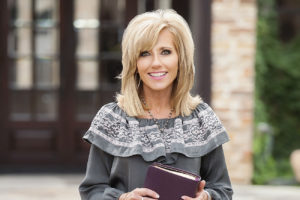


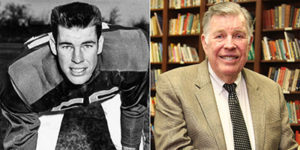 Bill Glass, an All-American football star at Baylor University who led the Cleveland Browns to an NFL championship and led a pioneering prison ministry, died Dec. 5 in Waxahachie. He was 86. Glass was born in 1935 in Texarkana, but his family moved to Corpus Christi when he was 5 years old. At age 14, his father died—a loss that shaped his future approach to ministry, which often focused on providing father figures to young men. After becoming a Christian as a high school student, Glass enrolled at Baylor University in 1953. At Baylor, he helped establish a chapter of Campus Crusade for Christ. He also met his wife of 60 years, Mavis, at Baylor after she read a newspaper story about a football player who taught a Sunday school class. While in the NFL, he earned Pro Bowl honors four times, and in the off-season, he earned a degree from Southwestern Baptist Theological Seminary. In 1965, he presented his Christian testimony at the first nationally televised Billy Graham Crusade. After he retired from the NFL in 1969, he began a ministry now known as Bill Glass Behind the Walls. In 2019, the ministry reported that up to that point in its history, Bill Glass Behind the Walls had trained 58,550 Christians to share their faith; presented the gospel to 6 million incarcerated individuals; and recorded more than 1.2 million commitments to Christ. Glass wrote a dozen books, including one in partnership with William M. Pinson Jr. He served nine years on the Baylor University board of regents, and he was awarded the university’s Pro Ecclesia Medal of Service in 2013. He was preceded in death by his wife Mavis in 2017. Glass is survived by three children, Billy, Bobby and Mindy.
 Faith groups and religious leaders generally have been supportive of vaccines overall, and many have assisted with the vaccine rollout by partnering with government leaders to host vaccination drives at their houses of worship. Faith leaders also actively promoted inoculations across the globe, with rabbis participating in vaccine trials and Pope Francis describing getting the shot as “an act of love.”