Study reveals some crimes go up when it rains on Sundays
December 8, 2021
WASHINGTON (RNS)—A study from the Review of Economics and Statistics found the more it rains on Sunday mornings, the more white-collar, drug- and alcohol-related crimes there are.
More rain means fewer people go to church, said the study’s author, Jonathan Moreno-Medina, assistant professor of economics at the University of Texas at San Antonio.
The decline in church attendance is correlated with an increase in yearly rates of arrests for certain kinds of crime, including embezzlement, fraud, drug possession and driving under the influence.
“The results suggest that church attendance reduces the prevalence of substance-related crimes and white-collar crimes,” the study found. “At the same time, there is a lack of evidence supporting the notion that church attendance alleviates serious crimes, such as murder, robbery or rape.”
Moreno-Medina said he long has been interested in discussions about the impact religion has on the broader culture. Some people argue religion can solve all of society’s problems, he said. Others argue religion is irrelevant.
For this new study, titled “Sinning in the Rain,” he was hoping new data sources, such as Google’s Popular Times, would allow him to measure changes in religious behavior and to see what effects those changes had.
He also relied on the American Time Use Survey, which helped him identify when people are at church, usually on Sunday mornings. He then looked at rainfall during those times as well as arrest rates overall, curious to see what he would find.
“I didn’t know what exactly I should expect,” he said.
Multiple factors affect crime rates
Moreno-Medina said a number of factors, including weather, have been shown to affect crime rates. For example, he said, hotter weather sometimes is correlated with more violent crimes. The calendar also plays a role: Other studies have found that fewer crimes occur on Sundays than on other days of the week.
“It can readily be corroborated that Sundays are the days when fewest crimes are committed and that there is no jump in crime right after the time of church,” Moreno-Medina argues in the study.
A number of previous studies have found a connection between crime and religious behavior. In 2018, a group of sociologists looked at 40 years of studies about the impact of religion on crime and found “certain aspects of religion reduce participation in criminal activity.”
“In addition,” the study concluded, “the specific ways in which these factors are associated with crime reduction have not been comprehensively identified.”
A 2008 study in The Quarterly Journal of Economics found the repeal of so-called blue laws—which limited commercial activity on Sundays—led to increased drug and alcohol use. And a 2006 study in the Journal of Law and Economics found crime rates go up slightly after Easter, at a time when people are most likely to go to church.
Growing up religious also has been associated with better health outcomes, as has regular participation in religious services.
Moreno-Medina takes a middle road when it comes to the relationship between religion and crime. At least in his study, he noted, less church attendance seemed to have no impact on more violent kinds of crime. And while religion is important, he said, it’s not a cure-all.
“I don’t want to push it to say that this study is showing that religion is required for our community to be able to live in harmony,” he said.
HPU prof hopes to combat hunger with micro-animal farming
December 8, 2021
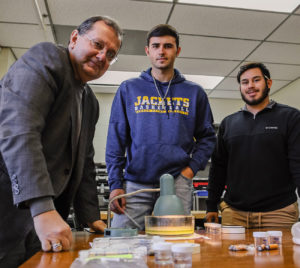
BROWNWOOD—Howard Payne University professor Martin Mintchev and students from his engineering science class aim to combat world hunger using micro-animal farming.
Martin Mintchev (left), professor of engineering at Howard Payne University, and students Jayden Modrall and Rylee McGee have developed a laboratory project to grow tardigrades, microscopic animals to be cultivated as a potential food source. (HPU Photo)
Their design, provisionally called Microfiest, attempts to grow microscopic animals known as tardigrades as rapidly procreating cellulose-to-protein converters. Once the contained environment is converted from being dominated by cellulose to being dominated by tardigrades, it will be dried and milled into protein-rich flour.
“These micro-animals can survive tremendously varied and even very difficult environmental conditions and, if properly farmed, multiply rapidly,” said Mintchev, professor of engineering and chair of HPU’s department of engineering.
“Because they consume cellulose while growing protein in the process, and due to their extremely high reproducibility, they can be considered an extremely rapid cellulose-to-protein converter and a potentially reliable food source.”
Mintchev devised the micro-animal farming project not only as an educational opportunity for his students in engineering design and entrepreneurship, but also to motivate them to become part of a possible solution of one of the world’s most pressing problems—hunger.
“If we learn how to farm micro-animals in huge quantities by feeding them with cellulose that is indigestible for humans, the resulting protein might deliver valuable and much needed nutrition,” he explained.
Tardigrades can preserve themselves in a dormant state even if light, water and cellulose become unavailable, without any need for refrigeration or special conditions, he noted. That creates the possibility of long-term simple storage.
Project has a patent pending
The fully functional tardigrade farm is, for now, a glass container full of algae, moss, water, light and an initial population of approximately 120 tardigrades. The tardigrades live, grow and procreate under a caging nanomesh lid.
The project has a pending patent authored by Mintchev; Gregory Hatlestad, associate professor of biology; and Lester Towell, former professor of computer information systems and former chair of the department of computer information systems.
The initiative was designed to position the team at the forefront of the fight against hunger while giving the students an opportunity to participate in the process of developing a real business partnership.
For now, the team is learning whether tardigrades can be farmed in unpretentious environments and in great enough numbers. The second part of the project will seek to maximize protein yield by providing engineering control of moisture, temperature and cellulose supply while ensuring continuous tardigrades population-growth monitoring.
“We have left the estimates of the eventual protein yield and calories for last, when we become certain that these micro-animals can be reliably farmed,” Mintchev said.
Previous and ongoing attempts at farming miniature animals such as ants, flies, grasshoppers and crickets delivered some protein yields, but the problems related to the special farming environment needed jeopardized their potential as a reliable food source, he explained.
“In contrast, tardigrades do not require any particularly special conditions to thrive and rapidly procreate, as long as cellulose content and water are provided,” he said.
Potential to benefit millions globally
Mintchev formed the Microfiest Partnership with two seniors majoring in engineering science—Jayden Modrall of Yantis as chief executive officer and Rylee McGee of Freeport as chief operating officer. Mintchev serves as president of the partnership.
“This is a very interesting project for our students,” said Gerry Clarkson, dean of HPU’s School of Science and Mathematics. “Dr. Mintchev has given Jayden and Rylee the opportunity to participate in a project that can potentially address the global problem of inadequate food resources while simultaneously learning about all the processes involved in designing and implementing a major project from its very early stages. Such projects are a valuable and integral part of the education of our engineering students.”
Mintchev expressed enthusiasm for the endeavor’s long-range potential.
“I hope this new farming niche will result in the most rapid and yet the most simple and unpretentious cellulose-to-protein converter ever, and that our work will one day benefit the millions of hungry people around the globe,” he said.
Obituary: Pablo Garcia
December 8, 2021
Pablo “Paul” Garcia of Hereford, a longtime Texas Baptist pastor and missionary, died Nov. 30. He was 82. Garcia was born June 26, 1939, in Tahoka. He was ordained as a minister in O’Donnell in 1964. He was pastor of churches in Petersburg, Paducah, Lubbock, Ropesville, Midland, Seminole, Pecos and Hereford during his 57 years in the ministry. From 2002 until his retirement on June 26 this year, he was pastor of Primera Iglesia Bautista Nueva Vida in Hereford. He served as a missionary with the Southern Baptist Convention’s Home Mission Board, and he also preached throughout Mexico and in parts of South America. He was a former president of the Compañerismo Noroeste. He enjoyed serving as a chaplain with Samaritan Hospice and working with Kings Manor Methodist Retirement Home and Hereford Nursing and Rehab for many years. He was preceded in death by siblings Luis Garcia, Sylvester Garcia Jr. and Lupe Garcia; half-brothers Raul, Roy and Sammie Garcia; and a great-great grandchild, Logan Noel Garcia. He is survived by his wife Eva of Hereford; son Paul Garcia Jr. of Midland; son Noel Garcia and his wife Linda of Lubbock; daughter Halynn Garcia of College Station; daughter Olivia Garcia of New Braunfels; six grandchildren; 11 great-grandchildren; two great-great-grandchildren; siblings Elida Perez of Frisco, Esther Castro of Lubbock, Amanda Perez of Ralls, Angelita Niemeyer of Houston, Alonzo Garcia of Wolfforth and Santos Garcia of Vernon; and half-brothers and half-sisters Eliseo Garcia, Margie Garcia, Rosie Garcia, Paula Garcia, Modesta Garcia and Elijeo Garcia.
Around the State: Students design exhibit about integration of Wayland
December 8, 2021
Wayland Baptist University students Chloe Barham (right) and Devin Davis (center) speak with Plainview Herald Editor Ellysa Harris about their integration exhibit during an opening reception. The students researched and designed the exhibit as part of a history practicum course. (WBU Photo)
As a history practicum project, Wayland Baptist University students Chloe Barham and Devin Davis researched and designed a museum exhibit focused on Wayland’s integration in 1951. Barham and Davis chronicled the decision by Wayland President James Marshall to allow Annie Taylor, a Black schoolteacher from Floydada, to enroll in classes. They examined the decision in conjunction with social and cultural expectations of the time period. The students worked with Melissa Gonzalez, director of the Llano Estacado and Jimmy Dean museums on the Wayland campus, and Rebekah Crowe, who oversees the history practicum course. The experience led to a comprehensive exhibit currently on display at the Jimmy Dean Museum. The integration exhibit will be on display until the next practicum exhibit is ready in fall 2022.
Alexandra Ronnenberg
Alexandra Ronnenberg, who graduated from Baylor University in May with an undergraduate degree in elementary education, has been named Texas Clinical Teacher of the Year. She earned the recognition for outstanding instruction and interaction with children while a senior at Baylor. The award honors senior-level teacher-education students from the Texas Directors of Field Experience, the organization of faculty members within university teacher-education programs who supervise field experiences. It was presented during this fall’s statewide meeting of the Consortium of State Organizations for Texas Teacher Education. Ronnenberg is the fourth Baylor intern to receive the award in the last five years it has been presented. No award was given in 2020 due to COVID-19. Ronnenberg completed her student teaching in a first-grade classroom at Hillcrest Professional Development School in the Waco Independent School District. After graduating from Baylor, she stayed at Hillcrest and now teaches second grade with many of the same students in her class. “I feel so grateful to have started my career at a school I know and love,” Ronnenberg said.
At fall commencement, the University of Mary Hardin-Baylor presented the Loyalty Cup to Mercedes Saldivar of Richland Hills and Gilda Tchao of Midland. UMHB awards the Loyalty Cup to students who are considered most representative of the university’s ideals, traditions and spirit. Kailyn Strain of Hutto received the President’s Award for meritorious service. Jonathan Stirtz of Duncanville was named as the Honors Program Summa Cum Laude graduate. UMHB awarded 333 undergraduate degrees, 45 master’s degrees and 39 doctoral degrees at commencement. Fifteen graduates were the first in their families to earn a college degree, UMHB President Randy O’Rear noted.
Eleven months after a fire destroyed New Light Church’s building in the Pleasant Grove section of Dallas, the congregation gathered to dedicate their new facility in Mesquite. “Up from the ashes, we rise” was the theme of the Dec. 7 worship service. Members and guests gathered at Inspiration Church in Mesquite, where they have shared the facility since the January fire, and traveled by motorcade to the new church building. Oza Jones Jr., director of African American ministries for Texas Baptists, was guest speaker. Shaun Rabb is pastor of New Light Church.
Family’s support helps Baylor protect Black Gospel music
December 8, 2021
WACO—A professor’s search-and-rescue mission to prevent the loss of musical history and a family’s desire to honor the wishes of their late husband and father combined not only to preserve a distinctly African American art form, but also give it the academic attention it previously lacked.
Baylor University recently dedicated the Black Gospel Archive and Listening Center at Moody Memorial Library. It serves as the permanent home for the Black Gospel Music Restoration Project’s collection of recordings from that genre’s Golden Age, 1945 to 1975. The physical collection includes more than 10,000 vinyl LPs, along with a vast holding of digitized material representing about 1,900 artists.
Robert Darden, professor of journalism at Baylor University, is founder of Baylor’s Black Gospel Music Restoration Project. (Photo/ Baylor Marketing and Communications)
“We’re told it is the largest Black Gospel music collection accessible to the public,” said Bob Darden, the Baylor journalism professor and former Gospel Music editor for Billboard Magazine whose vision birthed the Black Gospel Music Restoration Project.
In 2009, the Prichard Family Foundation established the Lev H. Prichard III Traditional Black Music Restoration Endowed Fund. Earlier this year, Ella Prichard and the family foundation gave $1.5 million to establish the Lev H. Prichard III Chair in the Study of Black Worship. The endowed faculty position will further the work and research of the restoration project, as well as advance scholarship in Black worship and preaching.
“Outside of the [restoration project’s] original donor, Charles Royce, it’s pretty clear that the Prichards are the primary angels for this project,” Darden said. “But it’s not just the money, as significant as that has been and as generous as the Prichard family has been. It’s Ella’s support as a former university regent and influencer, helping an old journalism professor learn how to work with administration and lobby for the project. She is our greatest advocate.”
Chain of events leads to restoration project
In February 2005, Darden wrote an op-ed article in the New York Times describing the influence of Black Gospel music on many musical genres. He explained unless the original recordings and memorabilia from the Golden Age of that genre were preserved, vitally important history would disappear.
“It would be more than a cultural disaster to forever lose this music,” he wrote. “It would be a sin.”
That article sparked a $350,000 gift by Royce, a Connecticut businessman with no previous connections to Baylor. Ella Prichard, in turn, read an article about Royce’s donation and the fledgling Black Gospel Music Restoration Project, which she pointed out to her husband Lev, founder of the Prichard Oil Company and Apco Minerals.
“Lev was the music lover in the family,” she recalled.
In particular, he enjoyed Black music in all its forms. Growing up in Oklahoma, his family employed a Black woman as a live-in cook and frequent babysitter for their son.
“If they went to the movies together, he sat in the Black balcony with her. If his parents were away for a weekend, he went to church with her,” Ella said. “It may not have been altogether unique, but it certainly was not typical for a white child in Oklahoma to be reared with one foot in Black life.”
As he grew older, Lev’s appreciation for Black culture led to his passion for traditional Black music—jazz, blues and gospel.
Honor Lev Prichard’s memory
So, when the Prichards’ high-school-age grandson planned a campus visit to Baylor University, Lev—in spite of failing health—insisted on accompanying him, on the condition he could visit with Darden and learn more about the Black Gospel Music Restoration Project.
“An entourage from the development office trailed down to the studio [in the Ray I. Riley Digitization Center] with him. Lev sat down in the studio. The door was closed, and for the next 45 minutes he listened to music while the development officers cooled their heels in the hallway,” Darden recalled. “When he emerged, he said something to the effect, ‘I want to help make sure this happens.’”
Prichard gave an initial donation to the project. After his death in April 2009, his family and its foundation decided to honor his memory by establishing the endowed fund to benefit the restoration project.
Donating to the project was an easy decision, but attaching Lev Prichard’s name to it required some serious family discussion and deep thought, Ella recalled.
“Lev couldn’t stand recognition for giving. It made him so uncomfortable,” she said.
However, after his death, many beneficiaries of his anonymous gifts spoke about how his generosity made so many good things possible.
“As the things he had quietly done came to light, we had to get used to that,” she said.
She and Darden both praised Pattie Orr, dean of Baylor University Libraries when the Black Gospel Restoration Project launched, for her vision and support. Likewise, they expressed appreciation to her successor, John Wilson, and to Jeffry Archer, the current dean who committed resources to the Black Gospel Archive and Listening Center.
“At a university, different disciplines tend to operate in silos. Libraries are the only institution on campus everybody trusts, because they exist to serve everyone. When it comes to academic turf wars, libraries are Switzerland. They don’t have an agenda,” Darden said.
‘Opened doors to the Black community’
Ella Prichard and the Prichard Family Foundation established an endowed fund to help support the Black Gospel Music Restoration Project at Baylor University and gave $1.5 million to the university to establish an endowed chair in the study of Black worship. (File Photo / Ken Camp)
Ella Prichard—a longtime advocate for social justice who wrote editorials in the Baylor Lariat when she was a student calling for the integration of Baylor University—sees the Black Gospel Music Restoration Project and the endowed chair in the study of Black worship as significant for the university.
“I’ve always wanted Baylor to be a school for all Baptists. This has opened doors to the Black community in ways nothing else has,” she said, noting Black churches and worship are “a major part of the story of Black culture.”
Prichard—a longtime member of First Baptist Church in Corpus Christi and now a member of Wilshire Baptist Church in Dallas—commended Baylor for naming its Commission on Historic Campus Representations. She particularly applauded Baylor President Linda Livingstone and her administration for taking steps to implement the commission’s recommendations to address the university’s historic links to slaveholding and racial injustice.
“Baylor has done a phenomenal job addressing its own history of racism,” she said.
The endowed chair in the study of Black worship and the programs the chair oversees will provide scholars opportunities to explore the contributions of the Black church within an interdisciplinary context.
‘A perfect fit for Baylor’
Unlike most art forms, Black sacred music does not have a prominent professional journal where peer-reviewed papers can be published or platforms where scholars can conduct seminars, Prichard noted.
“It’s been neglected by the academy,” she said. “It’s a perfect fit for Baylor.”
In 2015, the Black Gospel Restoration Project became part of the permanent Musical Crossroads exhibition at the Smithsonian Institution’s National Museum of African American History and Culture.
Both the physical collection and digital archives continue to expand exponentially, and Archer already has pledged Baylor University Libraries will devote additional space to it as needed.
The Prichard family has celebrated the way the project has grown from an effort at preserving vinyl recordings to a multidisciplinary research initiative.
“The vision just keeps widening,” Ella Prichard said. “My life has been enormously enriched by the experience. It took so many people for it to get to this point, and every link in the chain of events was important.
“Bob and Mary Darden are convinced it was providential. I guess I’m not quite as Calvinistic as that. But there’s no question the right people entered the project at the right time each step of the way. It had to have God’s hand on it.”
Three more kidnapped mission workers in Haiti released
December 8, 2021
Three of the North American mission workers held hostage more than seven weeks by a gang in Haiti were released Dec. 5, Christian Aid Ministries announced.
The Ohio-based organization posted on its website Dec. 6 the three individuals “are safe and seem to be in good spirits.” Christian Aid Ministries is a nonprofit organization largely supported by Amish, Mennonite and other conservative Anabaptist churches.
A few days before Thanksgiving, the organization announced the release of two of the 17 individuals kidnapped in mid-October. Twelve continue to be held hostage.
“As with the previous release, we are not able to provide the names of the people released, the circumstances of the release, or any other details,” the Christian Aid Ministries website announcement stated.
Call to pray and fast
The organization asked Christians around the world to join in three days of prayer and fasting for the remaining hostages.
“Please continue to intercede for those who still are being held, as well as those who have been released,” the website announcement stated. “We long for all the hostages to be reunited with their loved ones.”
On Oct. 16, a dozen mission workers and their five children were returning to their home base after visiting an orphanage when they were abducted in Ganthier, about 20 miles east of Haiti’s capital city, Port-au-Prince.
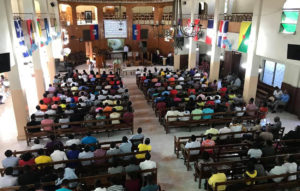
File photo of worship at First Baptist Church in Port-au-Prince, Haiti. (Courtesy of Elijah Brown, BWA)
The 400 Mawozo street gang claimed responsibility and demanded $1 million ransom for each hostage, the Haitian Minister of Justice told the Washington Post.
The abduction of the Christian Aid Ministries missionaries occurred less than three weeks after gunmen attacked First Baptist Church in Port-au-Prince, killing 60-year-old deacon Sylner Lafaille and kidnapping his wife. Marie Marthe Laurent Lafaille was released four days later.
On Nov. 30, Christian Aid Ministries issued a call to prayer not only for their own mission workers, but also for others in Haiti who suffer.
“As we work through the kidnapping of our workers, we are aware that numerous kidnappings—mostly of Haitian people—continue to take place in Haiti. In addition to the families of our workers, we recognize that other families are anxiously awaiting the return of their loved ones,” the organization stated.
“The political situation in Haiti remains volatile. As a result, millions of Haitians face huge challenges, encounter danger, and struggle to provide for themselves. Pray for our Haitian friends.”
The group also has asked Christians to pray for “the kidnappers, that God would touch their hearts and bring them ‘out of darkness into his marvelous light,’” quoting a New Testament passage from 1 Peter 2:9. “We desire that God would soften their hearts and that they would release our loved ones.”
The Giving Manger launches 5 million acts of kindness
December 8, 2021
WASHINGTON (RNS)—When Allison Hottinger and Lisa Kalberer’s children were small, the sisters had no trouble coming up with ways to make the Christmas season feel magical for them. What was more difficult, Kalberer said, was making it feel meaningful.
That is, until Hottinger remembered an unusual holiday decoration she’d seen at a friend’s house when she was a little girl: a small wooden manger. When she asked about it, her friend told her that whenever her family did something kind, they added a piece of straw to the manger.
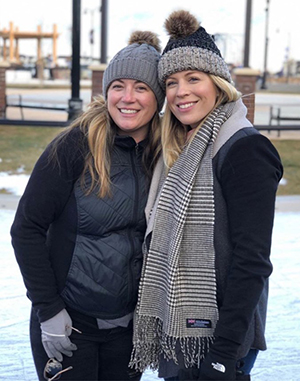
Sisters Allison Hottinger and Lisa Kalberer created The Giving Manger to make Christmas more meaningful for their children. (Courtesy Photo)
The sisters searched stores and the internet but couldn’t find anything like it. So they created their own.
This Christmas, they’re celebrating 5 million acts of kindness all over the world, inspired by what they call “The Giving Manger.”
“It is a constant stream of messages from people with little tiny kids who thank us for just having something that’s focused on the real meaning of Christmas,” Kalberer said.
“They’re able to have really sweet and wonderful conversations about Christ and about the real reason we celebrate, because they’re not just focused on Santa or elves or things like that. They’re talking about Christ’s life, and they’re talking about his example, and those are the things that just bring us to tears.”
The Giving Manger wasn’t an immediate hit with the sisters’ kids, though, she recalled.
Hottinger’s husband created the first manger in their garage. Hottinger bought straw for it from a craft store.
When they presented it to their five children, they were less than enthused.
So, Hottinger started by doing small acts of kindness for them, placing a piece of straw in the manger when she put their shoes away or picked up their toys. Pretty soon, they joined in, wanting to create a soft bed for the clay baby Jesus they placed inside on Christmas Day.
Tradition has continued to grow
When friends and neighbors began asking for something similar, Hottinger and Kalberer launched a Kickstarter for a boxed set that includes a small wooden manger, a clay Jesus and about 50 pieces of straw, as well as a picture book, titled “The Giving Manger,” that explains the tradition, with illustrations by artist Emily King.
The 2015 crowdfunding campaign reached its $15,000 goal in just 72 hours, Kalberer said.
In the years since, the tradition has continued to grow as influencers and everyday people have made The Giving Manger part of their Christmas celebrations and shared about its impact. Fans include celebrity chef Jamie Oliver and his wife Jools Oliver, who posted about her family’s tradition on Instagram.
“Being kind is THE only thing that matters and we hope they carry this tradition through to their little families too,” Jools Oliver wrote.
Kalberer said she’s moved by the acts of kindness she sees kids doing each year.
They aren’t necessarily big things, she said. The Giving Manger website includes ideas like sharing toys, cleaning bedrooms or, for older children, visiting an elderly neighbor.
And it doesn’t matter how many pieces of straw end up in the manger for baby Jesus’ bed.
“His love doesn’t change,” Kalberer said.
She remembers her own son, now nearly 15, insisting on bringing boxes of candy canes to the airport as they traveled to visit family one Christmas years ago. While she stressed over tickets and luggage and making it to their flight on time, he handed out the candy canes to people working at the airport to let them know their work was appreciated.
“I was out of my mind that he thought that extra step of who really needed a candy cane, and we had people at the Delta desk crying,” she said.
The sisters may have been surprised by the success of The Giving Manger, but, as a mom, Kalberer said she understands why it has resonated with families and how acts of kindness get to the heart of the story of Jesus’ birth.
The message of Christmas is peace and joy, she said.
“It’s hard to be in a bad mood when you’re doing something for somebody else,” she said. “It’s just hard to not feel that peace and joy and all the things we’re trying to celebrate.”
Vance Pitman to lead NAMB’s Send Network
December 8, 2021
ALPHARETTA, Ga. (BP)—Vance Pitman, who planted Hope Church Las Vegas in 2000 and was pastor there 21 years, will lead the North American Mission Board’s church planting efforts as the new president of its Send Network.
“I’ve been part of Send Network since its inception, but I’ve been part of it on the field—as a church planter, a pastor and a Sending Church. Now I get to be part of it from a different vantage point,” Pitman said.
Under Pitman’s leadership, Hope Church has played a part in planting more than 70 new churches. Throughout its history, more than 300 members of Pitman’s congregation have been sent out to help start new churches.
“I want to take what the Lord has allowed us to be able to do at Hope Church and help be part of raising up the next generation of church planters and pastors across North America,” Pitman said.
Pitman will resign from Hope Church and begin his new role at NAMB on March 1, 2022.
“I am excited about the days ahead for NAMB and Send Network,” said NAMB President Kevin Ezell. “Vance is a church planter at heart, and he has already had a great influence on Send Network. We look forward to seeing what God has in store for us as we continue to meet needs, share the hope of the gospel and plant churches throughout North America.”
Pitman has been closely involved in Send Network several years. He contributed significantly to the development of the network’s church planter assessment process, which helps ensure church planters are well qualified for their role. He is also regularly featured as a speaker at NAMB church planter training events.
Pitman follows Dhati Lewis, who led Send Network three years. In mid-November, Lewis shared his plans to leave NAMB at the end of the year to concentrate more fully on developing and mentoring young leaders who will plant churches in the urban context.
“Vance is a close friend, fellow pastor and church planter,” Lewis said. “I’ve learned a lot from him, and I look forward to the ways he will help Send Network continue to plant churches everywhere for everyone.”
Pitman and his wife, Kristie, relocated to Las Vegas in 2000 to plant Hope Church. Their sending church was First Baptist Church in Woodstock, Ga. What started as a small group meeting in their living room eventually grew to a church of more than 4,000 members with 54 languages spoken among them.
“For me, it’s always been about the kingdom [of God] being expanded,” Pitman said. “I want us to trust God for an even greater future than we’ve already seen in Send Network.”
TBM handles logistics to address foster care housing
December 8, 2021
Texas Baptist Men disaster relief volunteers are helping address an out-of-the-ordinary emergency by helping the Texas Department of Family and Protective Services care for children in the foster care system.
Texas faces an acute shortage in available licensed homes where children and youth in foster care can be placed, and the situation has grown worse since the beginning of the COVID-19 pandemic.
The Texas Legislature passed SB 1896—signed into law by Gov. Greg Abbott—that prohibits children from sleeping in the state agency offices.
TBM volunteers are loading, unloading and assembling furniture for homes where children in foster care are being housed until they can be placed with a family. (TBM Photo)
As a short-term solution, the state is leasing homes where DFPS staff temporarily can care for children who enter the foster care system until they are placed, so the children and youth won’t have to spend the night in an office. When the needs arise, the state agency has to furnish the homes on short notice—often in as little as 48 hours.
Last month, a representative from the DFPS Office of Faith-based and Community Engagement contacted TBM to ask for logistical assistance.
“They may have furniture available that has been donated in San Antonio, but it needs to be in Houston or wherever,” said Rupert Robbins, TBM associate director of disaster relief.
So, the state agency asked TBM volunteers to take responsibility for loading, unloading and assembling the furniture.
“At this point, we’ve completed three projects—in San Antonio, Houston and Belton,” Robbins said. “The social workers are doing more than they ever signed on for, and this is a way we can help them out of a bind and love on them a little bit.”
Mickey Lenamon, TBM executive director and CEO, sent an email to all registered volunteers Nov. 18 requesting help in handling the furniture.
“Some items are as large as couches. Others are small as chairs. Construction of the furniture is simple,” Lenamon wrote. “In other words, anyone who wants to help can. No experience is necessary.”
About 70 volunteers throughout the state responded to the appeal, Robbins said. Also, Kingsland Baptist Church in Katy agreed to handle any needs in the greater Houston area, he added.
“It’s a privilege we have. We get to watch God work and to love on people,” Robbins said.
Few confident they could tell biblical Christmas story
December 8, 2021
NASHVILLE, Tenn.—Most people in America may hang Christmas decorations and exchange gifts on Dec. 25, but few say they could give all the details about the biblical Christmas story.
A Lifeway Research study finds 9 in 10 U.S. adults say they celebrate Christmas, including many non-Christians. Overall, 91 percent of Americans celebrate the Christmas holiday, unchanged from 2010.
“Americans may celebrate the Christmas holiday in many different ways, but very few skip a Christmas celebration completely,” said Scott McConnell, executive director of Lifeway Research. “Even many of those who aren’t as familiar with the story of Jesus’ birth find ways to observe the holiday.”
Catholics (99 percent) and Protestants (97 percent) are most likely to commemorate the day of Jesus’ birth. Still, significant majorities of Americans of other religions (74 percent) and those with no religious affiliation (82 percent) also celebrate Christmas. Women (94 percent) are more likely than men (89 percent) to observe the holiday.
Geographically, the most Christmas spirit may reside in the Midwest (94 percent), as residents there are more likely to say they celebrate than those in the Northeast (88 percent).
Most want more Christ in Christmas but fuzzy on the details
In a 2018 Lifeway Research study, 65 percent of Americans said Christmas should be more about Jesus. While 2 in 3 may want more Christ in Christmas, most couldn’t give you all the details of Jesus’ birth story.
Slightly more than 1 in 5 Americans (22 percent) say they accurately could tell the Christmas story found in the Bible from memory. A plurality of U.S. adults (31 percent) say they could tell the story but may miss some details or get others wrong. Another quarter (25 percent) could only give a quick overview and 17 percent say they couldn’t tell any of it.
“While fictional Christmas stories seem to multiply each year, the biblical account of Jesus Christ’s birth is unchanged since it was recorded in the Bible,” McConnell said. “Yet almost half of Americans do not think they could share the Christmas story somewhat accurately from memory. Of all the Christmas programs churches offer in December, possibly the most important is simply reading the biblical account of the Christmas story itself.”
More church means more Christmas story recollection among self-identified Christians. Those who attend a worship service four times a month or more (45 percent) or 1 to 3 times a month (24 percent) are more likely than Christians who attend less than once a month (13 percent) to say they could tell all the biblical story accurately.
More education also grants more Christmas confidence. Americans with a graduate degree (35 percent) or bachelor’s degree (26 percent) are more likely than those with some college (19 percent) or a high school diploma or less (18 percent) to say they could relay the complete story.
Americans with evangelical beliefs are three times as likely as those without such beliefs to say they could accurately tell the full biblical Christmas story from memory (46 percent to 15 percent).
The religiously unaffiliated are least confident in their recollection of the story. Only 1 in 10 (10 percent) say they could retell the whole Christmas story from the Bible, fewer than any other religious demographic.
The online survey was conducted Sept. 3-14 using a national pre-recruited panel. Analysts used quotas and slight weights to balance gender, age, region, ethnicity, education and religion to reflect the population more accurately.
The completed sample is 1,005 surveys, providing 95 percent confidence the sampling error from the panel does not exceed plus or minus 3.3 percent. This margin of error accounts for the effect of weighting. Margins of error are higher in sub-groups.
Pro-lifers hopeful after high court abortion arguments
December 8, 2021
WASHINGTON (BP)—The U.S. Supreme Court’s oral arguments Dec. 1 left pro-life activists hopeful the justices are poised to uphold a state ban on abortion after 15 weeks’ gestation and possibly to overturn long-standing decisions in support of legalized abortion nationwide.
During a nearly two-hour session, conservative justices questioned the high court’s previous rulings that prohibit bans on abortion before an unborn child is viable in their consideration of Mississippi’s 2018 Gestational Age Act.
The high court also pondered at length if it would be appropriate to reverse its own precedent of almost 50 years that struck down all state restrictions on abortion.
The Supreme Court had limited its consideration of the law to whether “all pre-viability prohibitions on elective abortions are unconstitutional.” Viability—the ability to survive outside the womb—typically is considered to be several weeks after the 15-week limit set by Mississippi’s law.
Mississippi, however, had also asked the high court to overturn the Roe v. Wade opinion of 1973 and the Planned Parenthood v. Casey ruling of 1992, decisions that prohibit states from banning abortions before an unborn child is viable.
The Roe decision legalized abortion throughout the country, while Casey affirmed Roe but permitted some state regulation of the procedure.
Justices’ comments and questions offer clues
The questions and comments from the conservative wing of the court suggested the justices’ opinion, which is expected to be issued by next summer, might maintain Mississippi’s ban and undermine Roe without overturning it explicitly or actually reverse Roe and Casey, thereby returning abortion policy to the states.
“Today was a good day for the pro-life movement” at the Supreme Court, tweeted Brent Leatherwood, acting president of the Southern Baptist Ethics & Religious Liberty Commission.
While he acknowledged it is difficult to forecast the court’s ruling based on the oral arguments, Leatherwood said in an ERLC news release: “After listening to today’s proceedings, I’m left asking a simple question: What good is precedent if it is bad? At multiple points, whether it was, for example, the faulty reasoning of Justice Harry Blackmun in his Roe opinion or the irrelevance of the viability standard, it should be abundantly clear that the precedent in the area of abortion is completely unmoored from the Constitution itself.
“Furthermore, it completely disregards the individual whose rights are most affected: the preborn child,” he said. “That cannot continue. Denying the dignity of our most vulnerable neighbors should not be a hallmark of American jurisprudence.”
In friend-of-the-court briefs, the ERLC and some other pro-life organizations urged the Supreme Court not only to uphold the state ban but also to reverse Roe and Casey.
No ‘alarm bells’ sounded
Ed Whelan, distinguished senior fellow at the Ethics and Public Policy Center, said he heard nothing from five justices in the conservative wing of the court that “set off any alarm bells in my mind.” He referred to associate justices Clarence Thomas, Samuel Alito, Neil Gorsuch, Brett Kavanaugh and Amy Coney Barrett.
In a post for National Review Online’s Bench Memos, Whelan said Chief Justice John Roberts “seemed to be searching for a middle ground that would enable him to vote in favor of the Mississippi 15-week ban without overturning—or at least without declaring the overturning of—Roe and Casey.”
He expressed hope Roberts “will conclude that there is no middle ground and will lead a supermajority of justices to overturn Roe and Casey.”
James Bopp, general counsel of the National Right to Life Committee, described the oral arguments in a written statement as “very encouraging. It is apparent from the questions that a majority of the Court is seriously considering at least rejecting the viability line that currently prohibits prohibitions on abortion prior to viability.”
During the arguments, Mississippi Solicitor General Scott Stewart told the justices the Roe and Casey decisions “haunt our country.”
“They have no basis in the Constitution. They have no home in our history or traditions,” Stewart said.
“For 50 years, they’ve kept this court at the center of a political battle that it can never resolve.”
In arguing for the abortion issue to be returned to the states, Stewart said, “Roe and Casey have failed, but the people, if given the chance, will succeed.”
Abide by precedents
Julie Rikelman, senior litigation director of the Center for Reproductive Rights, contended the Mississippi law “is flatly unconstitutional under decades of precedent.”
The Casey and Roe opinions “were correct,” she said. Stare decisis, a legal doctrine that says a court should abide by its previous rulings, “presents an especially high bar here,” Rikelman told the justices.
The Roe and Casey decisions protect a woman’s rights, and viability as the dividing line in abortion law has proven to be “enduringly workable,” she said.
Roberts, however, said viability, “it seems to me, doesn’t have anything to do with choice” and asked why 15 weeks would be “an inappropriate line” for a woman to have had a choice for an abortion.
“When you get to the viability standard, we share that standard with the People’s Republic of China and North Korea,” Roberts said. “And I don’t think you have to be in favor of looking to international law to set our constitutional standards to be concerned if [you] share that particular time period” with two oppressive regimes.
Regarding stare decisis, Alito asked Elizabeth Prelogar, the U.S. solicitor general, if Plessy v. Ferguson, an 1896 Supreme Court ruling that found racial segregation laws were constitutional, should have been overturned if it were reargued a year later. The high court did not correct Plessy until 1954 in Brown v. Board of Education.
“I think it should have been overruled, but I think that the factual premise was wrong in the moment it was decided, and the court realized that and clarified that when it overruled in Brown,” said Prelogar, who argued in opposition to the Mississippi law in behalf of the Department of Justice.
Members of the high court’s liberal wing—Stephen Breyer, Sonia Sotomayor and Elena Kagan—expressed skepticism about, if not opposition to, reversing the Roe and Casey precedents.
In 2018, a federal judge invalidated the Mississippi law because it prohibits pre-viability abortions. The Fifth Circuit Court of Appeals in New Orleans affirmed the ruling the following year in the case, Dobbs v. Jackson Women’s Health Organization.
Mississippi’s ban permits an exception for threats to the life or “substantial and irreversible impairment of a major bodily function” of the mother. It also allows an exception for a “severe fetal abnormality” that “is incompatible with life outside the womb.”
If Roe is overturned, 26 states are either certain or likely to prohibit abortion, according to an Oct. 28 analysis by the Guttmacher Institute, a research and policy organization that supports abortion rights.
The United States has one of the most permissive abortion policies in the world. A study released in July by the pro-life Charlotte Lozier Institute showed 47 of 50 European nations ban elective abortions or restrict them to 15 weeks or earlier. The United States reportedly is one of only six countries, including China and North Korea, that permit elective abortions after 20 weeks’ gestation.
Around the State: DBU recognizes Clark Hunt with award
December 8, 2021
Dallas Baptist University recognized Clark Hunt as the recipient of the 2021 Russell H. Perry Free Enterprise Award during the annual award dinner on Nov. 22. Hunt is the chairman and chief executive officer of the Kansas City Chiefs. Since he became CEO in 2010, the Chiefs have earned five AFC West Division Championships, seven playoff appearances, and the franchise’s second Lombardi Trophy as World Champions in Super Bowl LIV. Hunt, a Dallas native, also is a founding investor-operator in Major League Soccer, serving as chairman and CEO of FC Dallas. He and his wife Tavia are involved in numerous philanthropic initiatives in both Kansas City and Dallas. One of the Hunt family’s lasting legacies is the Chiefs Charity Game, which has raised more than $13.5 million for local youth-focused charities since its inception in 1985. In 2016, the Chiefs were named Business Philanthropist of the Year in Kansas City by Nonprofit Connect. DBU established the Perry Award to recognize leaders whose lives are testimonies of achievements in free enterprise and service to the community. Over the past 34 years, the gala award dinner has provided scholarship support for more than 2,500 DBU students.
East Texas Baptist University recognized 62 graduating seniors with the presentation of their official ETBU class ring at a mid-November ring blessing ceremony. (ETBU Photo)
East Texas Baptist University recognized 62 graduating seniors with the presentation of their official ETBU class ring at a mid-November ring blessing ceremony. As a token and gift of appreciation from the university to graduating seniors, the class ring symbolizes the university’s blessing over students as they commence from ETBU to pursue their vocational callings. Each class ring features the university seal, surrounded by the cornerstones of ETBU—Veritas, Mores and Scientia, Latin for truth, character and knowledge. Inscribed in the ring are significant reminders of ETBU and the Christian faith, such as historic Marshall Hall, the Light on the Hill, Max Greiner’s Divine ServantStatue and the Bible.
Mike Hammack
Wayland Baptist University named Mike Hammack vice president of institutional advancement. Hammack has served as vice president of advancement at Hardin-Simmons University since 2011 and in the HSU development and advancement office since 2007. “Mike brings a clear commitment to Baptist higher education and a proven record of success in institutional advancement,” Wayland President Bobby Hall said. Previously, Hammack worked for Children at Heart Ministries in a variety of roles, including time as executive director and chief operating officer of Gracewood, a residential ministry for single mothers and their children. At Wayland, Hammack will oversee the university’s fundraising and development campaigns, as well as marketing, communications and alumni.
Friends, family and former players on the men’s golf team at the University of Mary-Hardin Baylor raised $100,000 to endow a scholarship in honor of former head coach Randy Mann and his wife Caroline. (UMHB Photo)
Friends, family and former players on the men’s golf team at the University of Mary-Hardin Baylor raised $100,000 to endow a scholarship in honor of former head coach Randy Mann and his wife Caroline. The Randy and Caroline Mann Endowed Scholarship will be awarded to a UMHB student seeking a degree in sports management and accounting. Randy Mann, vice president for athletics at UMHB from 2012 to 2021, led the UMHB men’s golf team to three Southwest Conference championship titles during his nine years as head coach. He also led the men’s team to their first-ever NCAA Division III National Championship Tournament berth in 2001 before being promoted to associate athletic director in 2008. Caroline Mann, a UMHB graduate, is assistant treasurer at McLane Company. “The Manns have impacted many lives in the past 20 years at UMHB,” said President Randy O’Rear. “I am grateful to those who gave so generously to create this scholarship to honor Randy and Caroline’s lives of service. I cannot think of two people more deserving.”
The B.H. Carroll Theological Institute received a $1.03 million gift from the Fred Propst estate. Propst, who died in October, was a supporter of the institute and friend to its former chancellor, Russell Dilday. A portion of the gift will be used to establish the Fred and Ruby Propst Scholarship Fund to assist students called into gospel ministry. “We believe it is important to invest a portion of these financial resources in our students. The work they do will pay eternal dividends as they serve in the global and diverse ministries of Christ’s church,” said Gene Wilkes, president of the institute.
 Pablo “Paul” Garcia of Hereford, a longtime Texas Baptist pastor and missionary, died Nov. 30. He was 82. Garcia was born June 26, 1939, in Tahoka. He was ordained as a minister in O’Donnell in 1964. He was pastor of churches in Petersburg, Paducah, Lubbock, Ropesville, Midland, Seminole, Pecos and Hereford during his 57 years in the ministry. From 2002 until his retirement on June 26 this year, he was pastor of Primera Iglesia Bautista Nueva Vida in Hereford. He served as a missionary with the Southern Baptist Convention’s Home Mission Board, and he also preached throughout Mexico and in parts of South America. He was a former president of the Compañerismo Noroeste. He enjoyed serving as a chaplain with Samaritan Hospice and working with Kings Manor Methodist Retirement Home and Hereford Nursing and Rehab for many years. He was preceded in death by siblings Luis Garcia, Sylvester Garcia Jr. and Lupe Garcia; half-brothers Raul, Roy and Sammie Garcia; and a great-great grandchild, Logan Noel Garcia. He is survived by his wife Eva of Hereford; son Paul Garcia Jr. of Midland; son Noel Garcia and his wife Linda of Lubbock; daughter Halynn Garcia of College Station; daughter Olivia Garcia of New Braunfels; six grandchildren; 11 great-grandchildren; two great-great-grandchildren; siblings Elida Perez of Frisco, Esther Castro of Lubbock, Amanda Perez of Ralls, Angelita Niemeyer of Houston, Alonzo Garcia of Wolfforth and Santos Garcia of Vernon; and half-brothers and half-sisters Eliseo Garcia, Margie Garcia, Rosie Garcia, Paula Garcia, Modesta Garcia and Elijeo Garcia.



 Catholics (99 percent) and Protestants (97 percent) are most likely to commemorate the day of Jesus’ birth. Still, significant majorities of Americans of other religions (74 percent) and those with no religious affiliation (82 percent) also celebrate Christmas. Women (94 percent) are more likely than men (89 percent) to observe the holiday.
 “While fictional Christmas stories seem to multiply each year, the biblical account of Jesus Christ’s birth is unchanged since it was recorded in the Bible,” McConnell said. “Yet almost half of Americans do not think they could share the Christmas story somewhat accurately from memory. Of all the Christmas programs churches offer in December, possibly the most important is simply reading the biblical account of the Christmas story itself.”

