Churches still recovering from pandemic losses

NASHVILLE, Tenn.—Compared to the beginning of 2021, more U.S. Protestant churches are gathering in person and more churchgoers are filling the pews. However, the return to pre-pandemic attendance levels has stalled in recent months.
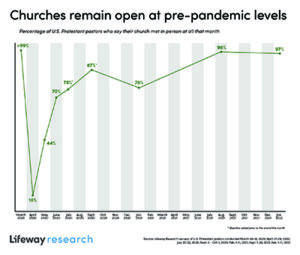
The latest Lifeway Research study found, despite a new variant wave of COVID-19, 97 percent of U.S. Protestant churches met in person during January 2022, while 3 percent say they did not gather for in-person services.

The percentage of churches meeting in person is statistically unchanged from an August 2021 Lifeway Research study, when 98 percent of churches physically gathered, but is up significantly from the 76 percent that met in January 2021.

“Almost all churches are able to meet in person for worship, though a few are struggling to re-open their doors,” said Scott McConnell, executive director of Lifeway Research. “Many more churches are working to restart all their important ministries and continuing to encourage people to resume in-person participation.”

Less than one-fourth at January 2020 attendance levels

More than 1 in 5 U.S. Protestant pastors (22 percent) say their church is close to January 2020 attendance, with 10 percent saying they are at 90 percent to 100 percent of pre-pandemic levels and 12 percent reporting attendance is now higher than before COVID-19.
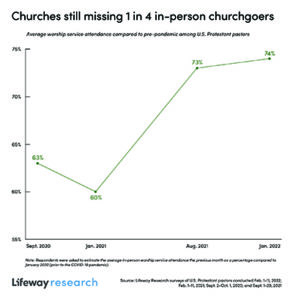
The same percentage of pastors (22 percent) reported crowds reaching at least 90 percent of their pre-pandemic attendance in August 2021. In January 2021, however, only 8 percent of churches had such levels.

Compared to January 2021, far fewer churches today have crowds of less than half of what they had in January 2020. At the beginning of last year, 31 percent of churches were at less than 50 percent of their pre-pandemic attendance levels, including 8 percent of churches that were below 30 percent. Now, 14 percent are below 50 percent attendance, and only 1 percent still say their congregation is less than 30 percent of what it was before COVID-19.

More than 8 in 10 churches have an attendance of at least half of what it was prior to the pandemic. The average U.S. Protestant church reports attendance at 74 percent of what it was prior to COVID-19, which means 1 in 4 pre-pandemic churchgoers are still missing from in-person worship services.

“People’s return to in-person worship services has stalled,” McConnell said. “There has been virtually no change in average attendance since August 2021. Some of this is the direct impact of COVID with people getting sick, needing to quarantine or being at high risk. But this also likely includes healthy individuals choosing to not return.”

The smallest churches, those with attendance less than 50 before COVID-19, are the most likely to be back at pre-pandemic levels. More than a third of those small churches (37 percent) report their attendance is at least 90 percent of what it was in January 2020, including 18 percent who say they have grown numerically during the pandemic.

Impact of online worship

Most churches shifted to some type of online video services during the height of the pandemic. Now, many are asking those watching online to participate in person.

In January 2022, more than 9 in 10 U.S. Protestant pastors (94 percent) say their churches provided some type of video content for their congregations, including 84 percent who livestreamed their worship services and 10 percent who posted a video of the sermon later. Prior to the pandemic, Lifeway Research found 2 in 5 churches said they neither livestreamed their service nor posted the sermon online later.

As the pandemic progressed, more churches shifted to livestreaming services. In March 2020, around 2 in 3 pastors (65 percent) said they livestreamed services, and more than a quarter (27 percent) posted a sermon online later.

With more churches using online video in recent years, 45 percent of Americans said they watched a Christian church service online during the pandemic, including 15 percent who say they normally don’t attend church, according to a 2021 Lifeway Research study.

Now, however, as almost all churches are holding in-person services again, many pastors say they want to see some online viewers transition to physical participation. Three in 5 pastors (60 percent) say they are exhorting online worshipers, who are able, to resume or begin to attend in person.

“Livestreaming has done a lot of good for churches, allowing members to hear weekly messages during the pandemic and allowing churches to reach new people,” McConnell said. “Many pastors are hoping and actively working to reduce the number of shut-in members who are physically able but aren’t gathering in person with other believers.”

Evangelical pastors (70 percent) are more likely than mainline pastors (49 percent) to say they’re specifically encouraging those watching online to physically attend if they are able. Pastors of churches with 200 or more in attendance on Sunday (72 percent) are more likely than smaller churches to also say they’re asking those able to transition from online to in person.

Lasting impact of the pandemic
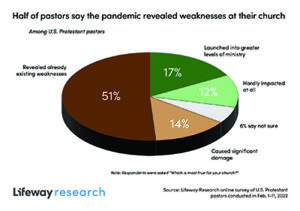
The pandemic continues to have a lasting impact on congregations, and most pastors say that it’s been a negative one. Half (51 percent) say COVID-19 revealed weaknesses that already existed in their ministry, and 14 percent say the pandemic caused considerable damage to the church’s ministry. Far fewer say COVID-19 has hardly had any ministry impact on the congregation (12 percent) or has launched the church to greater levels of ministry (17 percent).

Most congregations have faced COVID-19 directly. Almost 9 in 10 pastors (88 percent) say someone in their church has been diagnosed with COVID-19 in the last six months. Around 1 in 5 congregations (21 percent) say a churchgoer has died from COVID-19.

Additionally, 88 percent of U.S. Protestant pastors say attendees at their church have helped each other with tangible needs in the past six months. Almost 2 in 3 (63 percent) say churchgoers have recently met pandemic-related needs in the community. In a 2021 Lifeway Research study, most Americans (53 percent) said churches in their community have been helpful during the pandemic.

While only 12 percent of churches say they have grown numerically during the pandemic, most say they have connected with new people during the last six months. More than 4 in 5 pastors (83 percent) say new people who haven’t attended their church in the past have recently attended or connected in person. Around 3 in 4 pastors (74 percent) say they’ve had new people attend or connect with their church online in the past six months. Still, a third of pastors (33 percent) say the considerable number of needs within their congregation has made it hard to focus on reaching their community.

Two in 5 pastors (40 percent) admit that it’s hard to keep a positive tone among the leaders of the church. When asked directly about the attitude of the congregation, a quarter of pastors (24 percent) say the church is concerned about having fewer people and activities than before the pandemic, 27 percent say their congregation is moving forward but is exhausted trying to cover all the bases, and 44 percent say the congregation is excited about what God is doing today.

Returning to small groups and age-level ministries

In addition to returning to in-person worship services, most U.S. Protestant pastors say their churches also are restarting small groups, student ministry and children’s ministry.

More small groups are meeting now, and more are meeting in person compared to last January. On average, pastors now report 79 percent of their small group classes for adults that existed prior to the pandemic are now meeting, including 69 percent that are gathering in person. In January 2021, 36 percent of groups that existed before COVID-19 met in person, 25 percent connected online or by phone, 33 percent didn’t meet and 6 percent no longer existed. Today, 13 percent of groups aren’t meeting and 8 percent no longer exist.

Among churches that had student and kids ministry activities prior to the pandemic, most have restarted but have yet to see their attendance return to pre-pandemic levels. Churches also remain more hesitant to resume all activities for children compared to teenagers.

Almost 9 in 10 pastors who had student ministries prior to COVID-19 say they have resumed at least some activities in person (86 percent), including 70 percent who say all their activities are back to meeting in person.

The average pastor with at least some of their student ministry activities meeting in person says attendance for those is 65 percent of what it was prior to the pandemic. Most (58 percent) say attendance is below 90 percent of pre-COVID levels, but 33 percent report attendance close to early 2020 levels. Another 10 percent say their student ministry has grown.

Like student ministry, close to 9 in 10 churches who had children’s ministry activities before the pandemic say they have restarted at least some activities in person (86 percent). Churches are less likely, however, to say all their activities for children are back to gathering in person (64 percent). Almost a quarter of churches (22 percent) say they are only doing some of their kids’ activities in person.

In the average U.S. Protestant church holding at least some of their children’s ministry activities, 64 percent of kids are participating compared to pre-pandemic attendance. Three in 5 (60 percent) say attendance is below 90 percent of what it was before COVID-19. And again, like with student ministries, 32 percent report attendance close to early 2020 levels, and 8 percent say their kids ministry has grown.

“The typical church has made great progress this last year in resuming Bible studies for all ages,” McConnell said. “Restarting Sunday schools and small groups have allowed the majority of pre-pandemic participants to re-engage in this vital connecting point.”

The online survey of 560 Protestant pastors was conducted Feb. 1-11, 2022. Each survey was completed by the senior or sole pastor or a minister at the church. Responses were weighted by church average attendance, region, ethnicity of pastor and whether the pastor self-identified as evangelical or mainline to reflect the population more accurately. The final sample is 560 usable surveys, providing 95 percent confidence the sampling error does not exceed plus or minus 6.2 percent. Margins of error are higher in sub-groups.


Baptists respond to escalating Ukrainian crisis

More than 377,000 refugees from Ukraine crossed the border into Poland in six days, and Polish Baptists are turning their churches into temporary shelters as refugees continue to arrive at a rate of 50,000 a day.

“Mostly women and children are crossing the border, as men over 18 are required to stay in Ukraine due to the martial law,” according to a March 1 situation report from the European Baptist Federation. “One border guard has even begun to refer those without family members to go directly to the nearest Baptist church.”

EBF reported one church with capacity for 50 people housed 140 individuals over the weekend, with some guests sleeping on pews in the sanctuary.

“Volunteers are working around the clock to clean bed sheets, provide food and check in new people who are coming in,” the EBF update stated. “The coordinating team is beginning to connect people with churches all over Poland where they can stay.”

Refugee crisis accelerates

The United Nations refugee agency reported March 1 more than 660,000 refugees have fled Ukraine to neighboring countries in six days, and some people are waiting in line up to 60 hours to enter Poland. The UN estimates at least 160,000 Ukrainians are displaced within their own country.

In Latvia and Lithuania, Baptists have mobilized and stand ready to receive refugees and assist those who are expected to arrive through Poland.

Baptist churches in Romania reported their congregations along the border with Ukraine are attempting to serve twice as many refugees as they have the capacity to house.

While fewer refugees are entering Slovakia, the Baptist Union there is working with 26 of its churches close to the border. Those churches have contacted church leaders in Ukraine to let them know they are capable of caring for up to 300 people at a time.

“Belarus is struggling as many young people try to flee the country to avoid conscription into the war efforts,” the EBF report stated. “Russian Baptists are mobilizing to help refugees that have fled across the Russian border.

“The international sanctions are beginning to have an impact on our Russian and Belarussian brothers and sister.”

Humanitarian aid from Hungarian Baptists

EBF also reported Hungarian Baptist Aid is working both within Hungary to assist refugees and in Ukraine to deliver humanitarian supplies for Ukrainian Baptists to distribute. Like other congregations in neighboring countries, churches in Hungary are providing shelter to refugees.

Texas Baptist Men is among the groups supporting the ministry to refugees and internally displaced people through its partnership with the Baptist World Alliance and EBF.

EBF also reported the Baptist Union in Ukraine safely moved its offices from Kyiv to Lviv, and churches around the country are serving displaced people.

“Churches in the east are connected with churches in the west that can receive families that are fleeing,” the EBF update stated. “For now, it is still possible to purchase some goods in many parts of the country, but shortages will come. EBF is in frequent contact with Baptist leaders as they share their needs.

“Though the Ukrainian brothers and sisters are shaken, they are resolute that God will reveal his glory in all things. They have peace despite the situation and are faithfully sharing the light of Christ in the darkness.”

BWA hosts global online prayer event

Baptists in more than 50 countries gathered online Feb. 28 to pray for Ukraine and Eastern Europe. The Zoom call included participants from Cuba, Lebanon, Myanmar and Nigeria—places where Christians know firsthand about oppression and violence. BWA coordinated the event, and leaders from all six BWA regions voiced prayers.

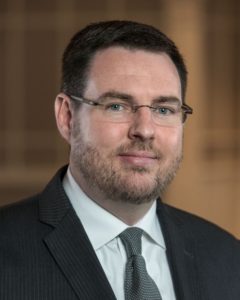
BWA General Secretary Elijah Brown invited Igor Bandura, vice president of the All-Ukrainian Union of Associations of Evangelical Christians-Baptists, to update participants in an online prayer event about the situation in his country and among its 1,110 Baptist churches. (Screen capture)

BWA General Secretary Elijah Brown invited Igor Bandura, vice president of the All-Ukrainian Union of Associations of Evangelical Christians-Baptists, to update participants on the situation in his country and among its 1,110 Baptist churches.

“We are trying to build international relations and organize and unite all the people who are working to provide humanitarian aid,” he said.

Cars lined up at the country’s borders extend up to 20 to 30 kilometers—from 12 to 19 miles—as people seek to reach safety in neighboring countries, he said. “It takes sometimes two or three days,” he added.

Bandura commended his countrymen for their courage and resolve in the face of danger.

Russian leaders expected Ukraine to fall within 48 hours, but “Ukraine is still alive,” he said.

Even in the midst of attacks, Ukrainian Baptists met to worship—publicly in church sanctuaries in the west, while fellow believers in the east gathered online, outdoors or huddled in cellars, Bandura said.

The Holy Spirit gave worshippers “confidence that Ukraine will be saved—that Ukraine will overcome this evil sin,” he said.

To contribute to TBM relief to Ukrainian refugees and internally displaced people, click here. To donate directly to BWA, click here.


Cabrera nombrado director senior de Send Network Español

PUERTO RICO— La Junta de Misiones Norteamericanas, o NAMB por sus siglas en inglés, ha llamado a Félix Cabrera a liderar la iniciativa Send Network Español (SNE) como director principal de la misma.

Send Network Español es un medio que asiste a las iglesias a identificar, desarrollar y enviar hombres llamados que aspiran a iniciar iglesias en Norteamérica. El propósito principal es simplificar y contextualizar el proceso de cómo plantar iglesias en Norteamérica y proporcionar acceso a nuestras iglesias a los recursos que Send Network provee.

Como director principal, Cabrera guiará a SNE a identificar iglesias y candidatos para el programa de residencia y reclutará a iglesias para dar comienzo a las residencias. Actualmente SNE tiene residencias en Oklahoma, Utah, Houston, Washington D.C., Miami y Puerto Rico.

El programa de residencia esta diseñado para ser una incubadora de plantación de iglesias en la cual hombres con el llamado para plantar serán descubiertos, equipados, enviados y sostenidos mientras llevan el Evangelio de Jesús a toda su ciudad.

Durante la residencia los plantadores recibirán equipamiento teológico al igual que refuerzos en las áreas espirituales, ministeriales y administrativas.

Cabrera asume su nuevo rol después de servir tres años como Director Ejecutivo de la Convención de Iglesias Bautistas de Sur de Puerto Rico (CIBSPR). En esa posición, Cabrera guio a la CIBSPR a niveles históricos de ofrendas al Programa Cooperativo y las ofrendas misioneras Lottie Moon y Annie Armstrong.

Cabrera es conocido por su corazón para las misiones y plantación de iglesias además de su extensiva experiencia en las mismas.

“Félix tiene un corazón para movilizar y equipar a plantadores que hablan español y lo ha estado haciendo muy bien por muchos años,” dijo el presidente de NAMB, Kevin Ezell.

“Su rol liderando Send Network Español nos permitirá traer nuestros mejores recursos de asesoramiento al igual que de equipamiento, entrenamiento, y cuidado a los plantadores que hablan español, en su idioma”.

“El tiempo no puede ser mejor ya que la población hispana en Norte América seguirá creciendo por las próximas décadas y los Bautistas de Sur debemos empezar miles de iglesias para suplir esa necesidad.”

Scott McConnell, director de Lifeway Christian Resources, ha trabajado junto a Cabrera y dice que el “tiene un fuerte antecedente en la inversión en las cosas que ayudan a que las iglesias y sus plantadores prosperen.”

“El es un plantador de iglesias y ha entrenado a otros plantadores dándole la experiencia práctica que los prepara para el ministerio. Mientras hace todo eso,  modela un ministerio Cristocéntrico y de enseñanza bíblica. Los Bautistas del Sur nos beneficiaremos de su servicio como líder de Send Network Español”.

En tanto Ed Litton, presidente de la Convención Bautista del Sur, agrega: “En mis cuatro décadas de ministerio, yo creo que Félix Cabrera es quizás el mejor ejemplo que he visto de una vida comprometida a estar en misión. Félix tiene una mente estratégica, un corazón evangelístico, y una pasión de ver vidas cambiadas por el poder del Evangelio”.

“Él es, sin duda, uno de los mejores soldados que los Bautistas de la Gran Comisión han enviado al campo de misiones. Estoy agradecido a Dios porque continúa ampliado el alcance del ministerio de Félix”.

Bajo el liderazgo de Cabrera, las iglesias Bautistas de Puerto Rico crecieron de 35 a 52, lanzaron tres nuevos ministerios y se unieron a la Junta de Misiones Internacionales (IMB por sus siglas en ingles) para enviar a tres misioneros a servir entre los no alcanzados del Norte de África y el Medio Oriente.

“La pasión de Félix de ver a más hispanos llevando el evangelio alrededor del mundo y haciendo discípulos de todas las naciones lo llevó a él y a los Bautistas de Puerto Rico a unirse a IMB para movilizar más iglesias a las naciones,” dijo Paul Chitwood, presidente de IMB. “Esperamos con interés ver como ayuda a las iglesias Hispanas en toda la Convención Bautista del Sur a enviar más misioneros a las naciones a través de IMB”.

Publicado por Keila Diaz  el 14 de febrero 2022 en https://www.baptistpress.com/resource-library/espanol/cabrera-nombrado-director-senior-de-send-network-espanol/


‘Miracle from God’ needed, Ukrainian Baptist leader says

LVIV, Ukraine (BP)—“We need a miracle from God,” Yaroslav Pyzh, president of the Ukrainian Baptist Theological Seminary in Lviv, Ukraine, said from his western Ukraine home on Feb. 26.

In a Zoom interview with Southwestern Baptist Theological Seminary’s communications staff, Pryzh said as he prays for the miracle, he is marshaling the people and resources of his school to help people displaced by the war.

Pyzh, a 2012 Doctor of Philosophy graduate of Southwestern Seminary, has served as president of the Ukrainian seminary since 2013. Lviv is 600 miles west of the capital city of Kyiv, where Russian forces have been trying to capture the nation’s capital since invading the country in the early morning hours of Feb. 24.

Many Ukrainians have been fleeing the country through the western Ukrainian city, which is approximately 40 miles from the shared border with Poland.

Initially, Pyzh thought he and his wife of 25 years, Nadia, would be safe in Lviv. However, events of recent days have shown otherwise, although the city has not been hit directly yet, Pyzh said.

“We thought that Lviv is a safe place,” Pyzh said. “But it turned out to be that Lviv was not that safe. We have air raid sirens off and on. We’ve been hit by ballistic missiles, about 20 kilometers away from Lviv, and we kind of lost that safety. So, that was an awakening kind of feeling.”

Pyzh recognizes as “partners” from the West begin to supply Ukraine with aid through Poland, the convoys must travel through Lviv, “and my concern is that Russia will start targeting Lviv.”

That realization led Pyzh to ask believers to pray “for a miracle” because “in Ukraine, the only thing that will help us is God’s miracle.”

“We just need a miracle, and that’s exactly what will save us—God’s miracle,” Pyzh said. “So, I ask people to pray for a miracle without specifying what miracle.”

Like Gideon’s army

Pyzh compared the current situation in Ukraine to the story of Gideon from Scripture. The story “kind of stands out” with Gideon’s small “army of 300 going against thousands of people,” Pyzh observed. “In our case, we have a disadvantage in everything.”

But Ukrainians are “strong in their spirit” with a “great willingness to fight,” Pyzh said.

Following Russia’s invasion of the country, Ukrainian President Volodymyr Zelenskyy declared martial law across the country, and shortly thereafter, reports began to emerge that the Ukraine State Border Guard Service forbade all men between the ages of 18-60 years old from leaving the country. The larger cities, he explained, have also been put under a mandatory curfew at nighttime.

The curfew “is a good thing” because “it keeps people inside,” Pyzh explained. “Whoever is outside should not be outside. It means that they don’t belong here, because we have a lot of people that are sent by Russia” to set GPS-enabled devices to allow ballistic missiles to target specific locations.

He said the curfew is also for “protection” as many people have left their apartments as they have fled the country and the curfew is a deterrent from break-ins.

The country has been placed under a “war state,” which means there are checkpoints entering and exiting the cities, which is for security reasons, Pyzh said.

Displacement opens doors to minister

As Ukrainians are leaving the country for Poland, their trek through Lviv has opened doors of ministry for the seminary.

During the first three days of the war, the seminary served almost 250 people through humanitarian aid, offering a place to sleep, food, and counseling services. The seminary staff converted three of their buildings into makeshift dormitories with mattresses and pillows, and are prepared to convert classrooms and office space as sleeping quarters if necessary.

Two waves of refugees have come through the seminary seeking aid. Pyzh said the first wave of people, who came through the first day of the war, were in “fairly reasonable emotional condition” while the second wave, who came almost a day later, were “in very bad condition.”

“I don’t even want to know what they went through,” Pyzh said, adding “they are scared.”

On the first day of the attack, the seminary was focused on its students and alumni. Classes were in session, and the on-site students from the eastern part of Ukraine could not return home. Pyzh and his team realized there were more people to help.

In response, Pyzh divided the seminary staff and professors into four teams—administration and support, receiving and placing, the chaplaincy team, and the communications team. He empowered each team to use their “best judgment” in making decisions.

Mobilizing students and graduates to offer aid

Pyzh said seminary leadership has used their network of 2,000 students and graduates in Ukraine and Poland to mobilize and offer aid to the displaced Ukrainians who are traveling through Lviv and need places to stay.

Using the same structure of the database used to keep track of students and alumni, seminary leaders have transferred the template into an online form that allows them to capture names, contact information, and other pertinent information of refugees who come through the seminary for help.

Pyzh explained the information can be used later in the event people are “lost or missing.” The seminary can then provide information about their last known contact.

A second database was established for students and alumni to volunteer to open their homes to help house refugees. The faculty and staff of the Ukrainian seminary currently have displaced families living with them, including Pyzh and his wife who have two families in their home.

The students and alumni who volunteer their homes are matched with displaced people who come to the seminary for aid as they travel through Lviv.

The third database is for those who want to volunteer to help, which ranges from providing counseling to refugees who need it, making homemade meals, providing toys for the children, or donating clothes. Many of the volunteers are the seminary’s students.

Pyzh said the seminary is not charging people for help, but explained those who have been helped are grateful, including one woman who left behind a small box of chocolates and 1,000 Ukrainian hryvnia, the equivalent of approximately $35 U.S., with a note asking that the money be put toward helping someone else.

‘Give glory to God’

Because the country has been placed in a “war state,” large gatherings are not allowed. However, Pyzh said, churches across the nation are responding with prayer and collecting items as they have “become a center for the community where people can donate food, clothes, everything.”

“All that is happening mostly in western Ukraine, because we are not occupied, and we are not having any kind of pressure,” Pyzh said. “Kyiv, Kharkiv, even Odessa, I guess, and other cities, eastern Ukraine, they cannot do that because they are under constant threat of those military actions there. But here, people are definitely open to do whatever needs to be done.”

Pyzh said in recent days, people have “gotten a lot more older” than they were previously, describing each day as a year.

“I think what our people experienced in the last three days, I’m sure changed them completely,” Pyzh said. “All the pain, all the fear, all that kind of stuff that we experiencing as making us into a different type of people. I really hope that we will become stronger.

“We will understand that everything we have is not really ours. We are kind of lucky to have what we have and so you better value what we have. And I really hope that as a result of that people will give glory to God.”

Pyzh is requesting fellow Christians across the world to petition God for a miracle to rescue Ukraine, provision of resources to serve people, a quick end to violence and for people to realize a miracle from God means glory goes to God.


Creative evangelist unlocks the mystery of the gospel

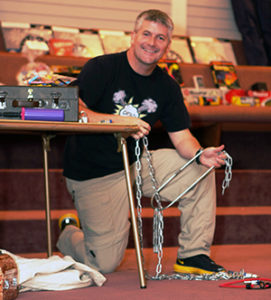
ROUND ROCK—Rich Landry, better known as Captain Escape, captivates audiences with illusions, stunts, escapes and humor as he attempts to unlock the mystery of the gospel through his creative evangelistic presentations.

Whether he is on stage or off, Rich Landry—also known as Captain Escape—desires to use his platform to share the gospel. (Courtesy Photo)

Throughout his ministry, Landry has juggled a busy schedule while working full-time during the week for a software company and also performing at children’s ministry events such as camps, conferences, Upward sports award nights and other evangelistic outreach events.

When he isn’t performing stunts or illusions, Landry attends First Baptist Church in Round Rock, where he serves as a deacon and a Sunday school teacher. With the support of others in his church, he felt the Lord leading him to communicate the gospel message creatively through an itinerant ministry.

“I went to my pastor at the time, Gary Brinkley, to talk with him about life,” Landry recalled. “He said it was clear God was calling me to work more intentionally for the Lord. So, together we set about trying different roles at church for me, and that’s when I started teaching sixth graders in Sunday school. From there, I started taking kids to camp in the summer.”

Several years later, in his quest to find various ways to serve the Lord, Landry was inspired by watching Keith Coast, a children’s evangelist and illusionist, perform at a children’s camp.

“I was watching Keith on stage at camp one day with our church’s recreation director, and when I told her, ‘I can do that,’ that’s when my journey to become an ‘evangetainer’ began.

“Based on that conversation, I was immediately hired for an Upward event by that same recreation director. When I told her that I didn’t have an act yet, I was told: ‘You have 7 months. Good luck!’ And thus, Captain Escape was born. My wife and I took a walk that evening, and God gave me the ideas for my first show as we walked that evening. I was able to use that exact show for several years.”

As word began spreading, it wasn’t long before Landry started receiving requests to take his show on the road.

Inspired by testimonies

During his travels, Landry has been impacted by testimonies he has received about his ministry and the creative ways he is able to reach people with the gospel message.

“I remember receiving a Facebook message from someone that I had met at a children’s camp who was a police officer in Sweetwater,” Landry recalled. “He said they had raided a drug house, and sadly there were two kids in the house. Their parents or whoever was their guardian had brought them there with them, and it was a very sad situation.

“As the police arrived to do their job, the kids were scared and crying. Believe it or not, one of the kids had on a Captain Escape shirt that said, ‘Believe there is good in the world,’ and the words, ‘Be the good,’ were in bold print with the verse Galatians 6:9-10 below.

“He said because of the shirt, he was able to instantly connect with the children by saying, ‘I know Captain Escape, too.’ It still gives me goosebumps thinking about this, and I think that if everything I have done in this life was for that moment then my life was well spent.”

Bringing encouragement

Whether he is on stage or off, Landry desires to use his platform to share the gospel.

“My favorite part is helping others and being helped by others,” Landry noted. “I will admit that speaking and entertaining to rooms with hundreds of people can be intimidating, and it can fill one with doubt about their own ability.

“However, every single time I doubt, God sends a small child to tell me what a great job I did that day, which is why I want to be like the children and encourage everyone I can each day. One of the ways I try to bring encouragement to people is by sharing an encouraging word and Bible verse each day on Captain Escape’s Twitter.

“I’ve learned that life is hard, but God is still good. We all need a little help, and I want to be God’s helper every day. I want to live every day for God and do all I can do to be a light for others to see him in me.

“God has taught me so much through the years, but one theme stands very clear—we are to love God, love others and tell the world about him. We do that by loving and encouraging others in their walk with God. I don’t live to be Captain Escape. I live to do God’s will. Some days, I struggle more than I would like to, but every day I get up and live for him again.”


Baptists globally called to pray for Ukraine

The Baptist World Alliance has invited Baptists worldwide to join in a unified hour of prayer at 9 a.m. Central on Feb. 28.

The global prayer gathering will include prayers voiced from BWA leadership from all six of the ministry’s regions around the world.

Christians globally are encouraged to click here to register their commitment to join in solidarity and prayer at this critical time.

“As brothers and sisters within a global Baptist family, we are all called to be both peacemakers and people of prayer,” said Elijah Brown, BWA general secretary “As one Baptist family rooted in Jesus Christ as Lord, we bear witness to the biblical truth that ‘if one member suffers, all the members suffer with it.’ We know it is vital for Baptists around the world to stand with those who are suffering and to fervently pray for peace.”

Throughout the month of March, the European Baptist Federation will host an international prayer gathering on Zoom every Wednesday, rooted in the belief that “prayers are more powerful than anything else.” To register, click here.

The BWA also is the lead partner in organizing a multi-faith prayer meeting scheduled at the United Nations Church Center Chapel in New York City at noon EST on Thursday, March 3, “Global Prayers for Ukraine: A Multi-Faith Service for Peace and Freedom in a Hurting World.”

“Faith leaders from around the world, including BWA General Secretary Elijah Brown, will be participating in a service of prayer for both the cessation of violence and the return of freedom to people in Ukraine,” said Scott Stearman, BWA United Nations Representative.

In addition, BWA Women and European Baptist Women United are praying with women’s leaders in both Ukraine and Russia. Brown also is working with Baptist leaders in Russia to plan an upcoming visit to join them in prayer, worship and ongoing ministry.

For churches that want to designate a portion of their worship services to prayer for the people of Ukraine, a prayer guide and additional resources are available here.

Already raised $250,000-plus in aid

Baptist World Aid Director Marsha Scipio convened a Baptist World Alliance Forum for Aid and Development coordination call on Feb. 25 with representatives from more than 25 Baptist unions and aid organizations, resulting in more than $200,000 raised within 48 hours of the first airstrike. Attendees pledged to raise additional support over the coming weeks.

“The level of support our global Baptist family is demonstrating to not just the Ukrainian Baptists, but also to the communities in which they serve, is a testament to the strength and generosity of the global Baptist movement,” said Scipio.

“It is a privilege to come alongside courageous Ukrainian pastors who are keeping the church doors open amid inconceivable trepidation, transforming their churches into places of refuge for the displaced. With BFAD, we will continue to respond to the myriad of needs, as a people who believe biblical compassion requires action.”

A video update from General Secretary Brown was distributed to the BWA’s network of Global Impact Churches, calling for prayer and support, as well as a call to action to its 245 member bodies in 128 countries and territories. BWA President Tomás Mackey issued a statement in both English and Spanish.

“We regret that the humanitarian, economic, political, and other consequences of these actions are serious and painful,” Mackey said. “We have hope in the knowledge that God is at work in the world he loves and in which he has placed us as his disciples who learn from Jesus how to live with integrity the values of his kingdom and how to reflect the fruit of the Holy Spirit.”

Responding to the developing crisis

Earlier in the month in response to the rising tension along the Ukrainian and Russian border, the BWA hosted Igor Bandura, vice president of the All-Ukrainian Union of Associations of Evangelical Christians-Baptists and a BWA General Council Member, at the organization’s headquarters in Falls Church, Va.

Bandura and Brown joined in a series of key meetings and roundtables hosted in Washington, D.C., on Feb. 10 that brought together representatives from human rights and religious freedom organizations in the United States.

With more than 130,000 troops amassed on three sides of Ukraine, Brown traveled to Kyiv the following week to participate in a national prayer gathering on Feb. 16, at St. Sophia Cathedral—the oldest church in Ukraine—where he prayed alongside other faith community leaders, including Catholics, Orthodox and Pentecostals.

Departing less than 100 hours before commercial aviation to Ukraine was suspended, Brown also gathered with the national council of the Baptist Union as they prayed and prepared to help Baptist churches serve as communities of hope.

On Feb. 24, Ukrainians woke to the sounds of sirens and falling artillery as Russian military launched a full-scale invasion by land, air and sea. Within hours, the European Baptist Federation organized a global solidarity call to hear directly from Baptist leaders in Ukraine. Attended by more than 75 Baptist leaders around the world, the global Baptist community pledged support and prayers as Bandura emotionally described the short-term and anticipated long-term impact of the attacks.

BWA leaders across various departments—including BWA Women, BWAid, Integral Mission and Global Partnerships—have connected with Baptist leaders in Ukraine, Russia and neighboring countries to express support and mobilize responses.

Baptist churches in the westernmost region of Ukraine have established their buildings as “Centers of Hope” to provide food and shelter for the displaced. Hungarian Baptists have set up a humanitarian aid center from which they are distributing food and hygiene kits and providing basic medical care. Baptists in Poland are already welcoming refugees into their homes and churches as well as the Warsaw Baptist Theological Seminary.

Escalation of already existing conflict

Since 2014, portions of eastern Ukraine have been ravaged by political and military conflict, and the already occupied territories have faced increasing persecution and hardship.

“In the Luhansk Occupied Territory, the Ukrainian Baptist churches were officially declared a terrorist organization, therefore requiring all of the churches to close,” Brown said. “The Baptist hymnal and the Gospel of John were outlawed as ‘extremist material.’ The churches that have tried to remain open do so at great risk and in secret.”

In September 2018, the BWA and the European Baptist Federation (EBF)—one of the six regional fellowships of the BWA—participated in a joint solidarity visit to the border of the occupied territories in a region called the “Gray Zone.” Participants included Brown, Paul Msiza, Tony Peck, Jenni Entrican and Helle Liht.

Despite persecution and the daily hardship of life in an area of conflict, 25 Baptist churches have been established in the Gray Zone in the last five years. Over the last six years, the Baptist union in Ukraine has invested more than $54,350,000 Ukrainian Hryvnia (equates to over $2 million USD) into the Gray Zone for aid, relief and community development. Pastors who have fled from the occupied territories and resettled elsewhere in Ukraine, including in Kyiv and Lviv, have started 10 new churches.

Today the All-Ukrainian Union of Associations of Evangelical Christians-Baptists is the second largest Baptist community in Europe and the Middle East and is also the largest Protestant group in Ukraine with over 100,000 members across more than 2,100 churches. They have been a member body of the BWA for 30 years as has the Russian Union of Evangelical Christians-Baptists.


Blasts force students to evacuate from Odesa seminary

Missile blasts forced the evacuation of students from Odesa Theological Seminary, but administrators and employees of the Baptist school hope the campus may be used to offer aid to people displaced by the Russian invasion of Ukraine.

Oleksandr Geychenko, president of Odesa Theological Seminary, described the assault on his city and the rapidly changing situation in his country in an email received Friday morning, Feb. 25.

Geychenko wrote about hearing “the sounds of blasts” as missiles hit military targets on Feb. 24, and Ukrainian forces fired air defense shots in return. Some seminary employees said they saw a few drones, but they had no idea if they were Russian or Ukrainian, he stated.

“The attack caught us in the middle of a session,” Geychenko wrote. “We quickly evacuated all the students from our campus. A number of employees who have little children gathered together and moved to one of the regions in western Ukraine where we had previous arrangements with the local Christians.”

However, he and a majority of seminary employees remained in Odesa at this point, he added.

‘Everyone is ready to assist’

“Today, we discussed with the employees the possibility of turning the campus of OTS into [a] refugee and logistics center if the refugees move into this direction,” he wrote. “Everyone is ready to assist. However, all this would depend on the fight around Odesa.”

Geychenko added he had a conversation with an “Odesa regional pastor” who confirmed the Odesa Baptist Association of churches will assist if a center is established at the seminary.

Geychenko noted most displaced people seemed to be traveling toward western Ukraine or Moldova, and local churches were organizing to minister “in the context of war.”

In a Feb. 24 conference call involving 75 ministry partners globally, leaders of the Baptist Union of Ukraine and the European Baptist Federation discussed plans to establish “centers of hope” in each of the nation’s six westernmost regions to shelter displaced families and individuals. They also are coordinating efforts to mobilize churches along evacuation routes to provide care for displaced people.

At the time he wrote, Geychenko reported Odesa seemed to be “calm and controlled.”

“It seems that the major efforts are directed to the capital city of Ukraine. A number of my friends who live at the outskirts of Kyiv are reporting serious fights around,” he wrote.

“The office of the Ukrainian Union of Churches of Evangelical Christians-Baptist has evacuated today. The situation is changing every hour. So, it is hard to say what it would look like tonight.”

Providing humanitarian aid

The European Baptist Federation, working with the Baptist World Alliance, is providing humanitarian aid to the region.

Texas Baptist Men—a ministry partner of BWA—committed to send “a significant amount of funds to Christians in the region,” TBM Executive Director Mickey Lenamon said in a Feb. 25 email.

Funds will be used to provide food and water for displaced families and individuals, as well as clothing “for those who left their homes quickly with very little,” Lenamon said.

Along with other Baptist leaders, he urged Texas Baptists to pray for the people of Ukraine, for world leaders who are making “crucial decisions,” and for Christian leaders in nations surrounding Ukraine, as they respond to refugees fleeing violence.

To contribute to TBM relief to Ukraine, click here. To donate directly to BWA, click here.


Baptist churches in Ukraine mobilize for ministry

Even while bombs fell around them, Baptists in Ukraine made plans to care for their neighbors who were displaced by a Russian military invasion.

Elijah Brown

“Twenty-four of the 25 Baptist regions in Ukraine have recorded attacks, including some near their churches,” said Elijah Brown, general secretary of the Baptist World Alliance. “That’s how widespread it is.”

Brown was among 75 Baptists globally who joined a Feb. 24 call with leaders of the Baptist Union of Ukraine and the European Baptist Federation.

Representatives of Texas Baptist Men, the Christian Life Commission, Buckner International and the Joel T. Allison Faith in Action Initiatives at Baylor Scott & White Health also participated.

Brown noted Ukrainian Baptists reported missiles that exploded within 100 meters of an orphanage they support, which houses 60 children. In anticipation of violence involving ground troops, leaders of the orphanage posted notices on all the windows and doors of the building: “Be careful. There are orphans here.”

Planning to establish ‘centers of hope’

Already, Baptists in Ukraine are planning to establish “centers of hope” at churches in each of the nation’s six westernmost regions to shelter displaced families and individuals. They also are mobilizing churches along the most likely evacuation routes to provide care for people journeying from east to west.

“These are places where travelers can get food, rest, wash their clothes and receive spiritual care,” Brown said. “Already, 8,000 copies of the Gospels have been sent to churches to help them as they provide spiritual support.”

The European Baptist Federation—with BWA support— is working closely with the Baptist Union of Ukraine to coordinate humanitarian relief. The first truck loaded with humanitarian supplies left Hungary on Feb. 24 and was expected to cross the border into Ukraine the next day.

On social media, the European Baptist Fellowship posted a message of solidarity with the people of Ukraine and call to prayer for those in harm’s way.

“The European Baptist Federation laments and denounces the Russian attack begun by Russia on Ukraine early this morning. We pray unceasingly for the people of Ukraine and cry out for God’s protection and justice for the vulnerable,” the post reads.

“We affirm and encourage the work of Ukrainian Baptists in reaching out in the love of Christ to those most affected by the conflict. We call upon those in power to use their courage, wisdom, and resources to make peace and to stop war.

“We as European Baptists stand with our Ukrainian brothers and sisters ready to assist in humanitarian outreach in regions affected by the conflict.”

Peter Mitskevich, a professor of religion in Moscow and a leader in the Baptist Union of Russia, likewise posted on Facebook a message expressing his prayers for Ukraine.

“These days will go down in history. I pray for my relatives in Ukraine, for my brothers and sisters by faith, and for the people of Ukraine. I greet you all dear friends. Peace to your heart. I so wish I could stop the bloodshed,” he posted.

‘Disturbing and frightening’

For Christians in Ukraine, apprehension and uncertainty marked the days leading up to the invasion. Slava Gerasimchuk, a graduate of the B.H. Carroll Theological Institute, teaches Old Testament at Odesa Theological Seminary in Ukraine. In a Feb. 18 email, he called the daily news at that point “disturbing and frightening.”

“The surest thing is that no one is sure of anything,” Gerasimchuk wrote. “Sometimes it seems that the people sitting in the Kremlin are also not completely sure how far they are ready to advance in order to get what they want out of the situation.

“The events that have occurred since the annexation of Crimea and occupation of the Donbass clearly indicate that Putin will go as far as he is allowed to. He has sufficient military strength to turn most of his threats into reality.”

In comparison, he observed, Ukraine is economically, militarily and politically weak.

“Our leaders are not ready for war. However, Ukraine is backed by many Western countries. It is great to know that we are not alone in this time of great distress and danger for our nation,” Gerasimchuk wrote.

Christians in Ukraine prayed—and asked other Christians globally to join in praying—that “the almighty and merciful Lord will thwart the wicked plans of those who intend to do great harm to our land,” he continued.

Hope for the best, prepare for the worst

While trusting in God and praying for peace, Gerasimchuk also prepared for the worst.

“If the worst scenario does come to pass and the conflict escalates into a full-scale war, I will try to take my family to Western Ukraine or Moldova, where I have many relatives, including my mother and two brothers,” he wrote. “It is quite stressful to be in a situation where you have to consider evacuating your family, but that is a real possibility we are facing.”

About a week before Gerasimchuk’s email, Oleksandr Geychenkо, president of Odesa Theological Seminary, sent out a broadly distributed letter describing the situation from his perspective and requesting prayer.

“On the one hand, what you are hearing about now on the news is basically what we have been living with for the last eight years,” he wrote. “The war goes on. Casualties are regular. Negotiations are futile. The rumors of an invasion intensify from time to time.

“Speaking about life in general, we do not observe any panic around us or serious preparations being made. Life goes on as usual. Almost. We are used to it.

“On the other hand, the situation is also very much different from what we have been living with. Possibly, Ukraine has never seen such an intensive exchange of diplomatic visits and talks, such a heavy influx of military aid from international partners, and such a flow of sensational publications in world news regarding the dates and plans of a Russian invasion. All this makes us realize that the situation is complex and very serious.

“But above all these things, there is the reality of God’s kingdom. God rules over history and directs its movement towards its final goal. He does this in an implicit, hidden, yet irresistible way. The kingdom of this world will one day become the kingdom of God. We do not doubt it!

“So, we just keep doing what we are called to do, even though we know that something is going on. We keep praying to the Lord, trusting him, and following his way. We ask you to join our prayers at this crucial period for our country.”


Ukrainians remain hopeful in face of Russian invasion

A week before Russia’s invasion of Ukraine, Leonid Regheta, pastor of River of Life Church in Plano, called Christians to pray “for the King above every earthly king to protect and bless this beautiful country.” Despite the early morning invasion Feb. 24, he remains hopeful.

Russian forces were reported crossing the Ukraine border from Belarus in the north, Russian-annexed Crimea in the south, and almost the full length of Ukraine’s border with Russia. Explosions occurred in Kyiv, Ukraine’s capital city.

“I was really, really hoping it won’t come to this,” Regheta wrote shortly after the invasion. “I was hoping, along with millions of others, there will be no invasion, no explosions, no taking over of Ukrainian territories by the Russian army.”

Repeating a point he made a week earlier, Regheta continues to “believe Ukraine is a bargaining chip between Russia and the West,” stating, “I believe Western and Russian politicians are trying to score points using Ukraine.”

Reports from Ukraine

Regheta spent the night corresponding with people in Ukraine, as well as members of his congregation in North Texas.

He reported a recently married couple with plans to have children and start a business in Ukraine saw those plans halted when the husband was recalled to the Ukrainian army to defend against the Russian invasion.

Just before midnight, he spoke with a woman in his congregation whose only son and parents were in Kyiv. “She was crying over the phone, wanting to know if it is even possible to fly [her son and parents] out of the country.”

Scanning social media, he said his “friends, relatives and ministry colleagues … [were] waking up to explosions, sirens and sounds of war.”

When asked how churches in Ukraine are faring, Regheta said the churches there “will be ready to help … just as they did eight years ago,” referring to Russia’s 2014 incursion into Crimea and two eastern regions of Ukraine.

Continuing hope

Expressing his continuing hope, Regheta noted “the iconic Ukrainian poem, ‘Contra Spem Spero’” and “its theme of resilience in the face of enduring hardships.”

“The poem was composed more than a hundred years ago,” he stated. “But is as relevant for the Ukrainian people today as when it was composed by Lesya Ukrainka.

“The poem’s Latin title can be roughly translated as ‘Being Hopeful in the face of Hopelessness.’ And that’s what we are today. And will always be. With God’s help.”

How churches can help

In 2014, Ukrainian churches housed refugees fleeing Crimea and eastern regions of Ukraine.

“There were thousands of families displaced [in 2014], and there are and will be many more as the result of” Russia’s current invasion, Regheta stated.

“Specifically, thousands of families are escaping the large cities now and are moving to villages and smaller cities, hoping to hide from artillery, explosions and bombs going off,” he continued.

“Churches are there to help in every possible way: clothes, food, lodging, transportation [and more]. That happened eight years ago, and I am already seeing reports of churches helping today in the similar way,” Regheta said.

Churches outside Ukraine can provide the greatest help now through “financial assistance to the local churches [in Ukraine] and credible ministries on the ground,” Regheta said. One such ministry he suggested is Hope International Ministries, “where [he has] been serving as a chairman of the board of directors for more than 10 years.”

Hope International Ministries is “trying to raise at least $20,000 and will soon start helping dislocated families in Ukraine.”

Updated 1:25 p.m., Feb. 24, 2022.


Around the State: Black and white pastors discuss friendship

When two Houston pastors—one Black, one white—met on a Holy Land trip, they never expected to become hunting buddies or share the platform at the funeral of George Floyd, an African American murdered by a Minneapolis policer officer. Steve Wells, pastor of South Main Baptist Church, and Ralph West, founding pastor of Houston’s Church Without Walls, discussed their friendship during a session at a conference offered both online and at Baylor University’s Truett Theological Seminary, “Do you want to be healed? Racism in the White Church.” They cited two factors that contributed to their friendship. First, Todd Still, dean of Truett Theological Seminary, brought them together by inviting them on a trip to the Holy Land. Second, both pastors made it priority to spend time together.

Aileen Gregorio Mejia

Nievez Montañez

National Woman’s Missionary Union named two Texas Baptist young women as 2022 National Acteens Panelists—Aileen Gregorio Mejia and Nievez Montañez, both from Freeman Heights Baptist Church in Garland. “We are excited to have these young women represent Acteens this year,” said Heather Keller, WMU ministry consultant for children and students. “The young women on this year’s panel are amazing examples of what Acteens is all about—making disciples of Jesus who live on mission.” Mejia is a cancer survivor who went through a year of medical treatment for leukemia. As a result of that experience, her goal is to become a nurse and for God to use her through her vocation to minister to others. Montañez, who professed faith in Christ during the summer of her sixth grade year at a Girls in Action camp, was the first member of her family to become a Christian. Since then, her sister, mother and father all have made faith commitments to Christ.

The U.S. Department of Education designated Baptist University of the Américas, Houston Baptist University, Howard Payne University and Wayland Baptist University as Hispanic Serving Institutions. In Hispanic Serving Institutions, Hispanics represent at least 25 percent of the undergraduate full-time student enrollment. The designation and associated grants are intended to expand and enhance the schools’ academic offerings, program quality and institutional stability. Baylor University, Dallas Baptist University, Hardin-Simmons University and the University of Mary Hardin-Baylor were designated as Emerging Hispanic Serving Institutions, a classification for schools with at least 15 percent Hispanic student enrollment but less than 25 percent.

Wayland Baptist University broke ground on a new addition to the science building and officially named the Kenneth L. Mattox School of Mathematics and Science for Dr. Kenneth Mattox, a 1960 Wayand graduate. Pictured are (left to right) are Lance Landusky and Michael Haverdink of Sandia Construction; WBU students Tejay Lozano and Elizabeth Wirth; WBU Board of Trustees President Rick Breeden; WBU President Bobby Hall; Mabee Foundation Executive Director Mike Goeke; Dr. Kenneth L. Mattox and his wife June; WBU development officer Mike Melcher; Dean of the School of Mathematics and Science Dr. Adam Reinhart; WBU Students Araceli Torres and Carson Grawunder; and Brian Griggs and Amber Buscarello of the Parkhill architectural and engineering firm. (Wayland Baptist University Photo)

Wayland Baptist University broke ground for construction of the Mabee Laboratory Sciences Building on Feb. 18. The groundbreaking ceremony also marked the naming of the Kenneth L. Mattox School of Mathematics and Science. Dr. Kenneth L. Mattox, a heart surgeon and longtime administrator at Ben Taub Hospital in Houston, is a 1960 graduate of Wayland. He provided the lead gift, and the Mabee Foundation provided a large portion of the funding for the new 9,600 square feet addition to the science building. The addition will contain two laboratory and lecture spaces, along with a chemical stock room with a chemical preparation area. The building will include a large open room that will serve as an instrument lab and collaborative space for upper-level courses, as well as a dedicated laboratory for undergraduate research. The building also will feature faculty offices, a large conference room that doubles as a classroom, and a commons area where student can gather.

A donor, who wishes to remain anonymous, gave $1 million to the University of Mary Hardin-Baylor to establish an endowed scholarship in honor of Julie O’Rear in recognition of her service to the university as first lady. O’Rear, a UMHB graduate, was a clinical research nurse at Scott & White Hospital in Temple until her husband Randy was elected president of UMHB in 2009. “In the same way I received scholarship assistance when I came to UMHB, this endowment is going to provide financial blessings to UMHB students now and into the future,” she said. “I am most excited because, for years to come, this endowment will help students afford to have the same UMHB experience I had—even long after I’m gone.”

Travis Craver

Hardin-Simmons University named Travis Craver as associate vice president for spiritual formation. Craver, who serves on the Abilene City Council, worked five years as director for spiritual formation at HSU. Previously, he served as a minister to students at Pioneer Drive Baptist Church in Abilene. He earned his undergraduate degree and a master’s degree in family ministry and counseling from HSU, and he earned a doctorate in spiritual formation and leadership from Baylor University. He and his wife Caroline have two children—Savannah and Linus.

At its regular quarterly meeting, the Baylor University board of regents voted to increase the total project cost of the Foster Pavilion—future home of Baylor’s men’s and women’s basketball teams—from the initial $185 million to $212.6 million. In December, the board announced a partnership with the City of Waco to construct the Foster Pavilion at the Baylor Riverfront-Cityside location, adjacent to the Clifton Robinson Tower on the west side of I-35. Since that time, the cost of construction materials and labor have increased significantly. The increased cost is expected to be offset by continued significant fundraising momentum on the heels of Baylor’s 2021 men’s basketball national championship. Construction of the Foster Pavilion is expected to begin in June 2022, with an early opening of the facility targeted for January 2024. The adjoining development center’s opening is anticipated in April 2024.

Andrea Sparks

Buckner International named Andrea Sparks as director of government relations. Sparks worked in the office of Gov. Greg Abbott as founding director of the Governor’s Child Sex Trafficking Team for the past five and a half years. She earned her undergraduate degree from Tulane University and was an honors graduate of the University of Texas School of Law. She served as the executive director of the National Center for Missing & Exploited Children’s Texas regional office, the director of public affairs for Texas CASA (Court Appointed Special Advocates), and as a solo practitioner representing children and families in child protection, juvenile justice and adoption cases. “Andrea Sparks has an impressive record fighting to protect Texas children, and we are excited to have her join the Buckner team,” said Buckner President and CEO Albert Reyes. “Andrea’s guidance and leadership will help us work together with our elected officials to transform the lives of our most vulnerable people.”

The Marsh Center for Chaplain Studies at the B.H. Carroll Theological Institute is offering a free webinar for chaplains, ministers and students who work in secular institutions. The webinar, “Speaking Your Relevance in Your Institution’s Language,” is scheduled from 2 p.m. to 4 p.m. on March 10. Panelists will discuss the importance of understanding the value and relevance of chaplain ministry and communicating the “return on investment” to a business or institution. To register, click here. For more information, email jbrowning@bhcarroll.edu.


Baptist Women in Ministry seeks award nominations

Baptist Women in Ministry is accepting nominations for the 2022 Frankie Huff Granger Distinguished Mentor and Church of Excellence awards.

Established in 2013, the Distinguished Mentor Award honors the legacy and ministry of Frankie Huff Granger, who served at First Baptist Church in Berea, S.C., more than 20 years.

Granger served as a mentor to young women who were discerning their callings from God, and as an example and role model when few women ministers to fill that role could be found.

The Frankie Huff Granger Distinguished Mentor Award will recognize someone who:

  • Demonstrates a commitment to nurturing the callings and giftedness of Baptist women called to ministry through their time, energy and personal investment.
  • Displays dedication to advocacy for the affirmation and elevation of women in ministry and leadership among Baptists.
  • Is a seasoned minister or layperson who has several decades of participation and service in Baptist life, and is an active member of a congregation affiliated with Baptists.
  • Exhibits integrity and spiritual maturity in their personal and professional life.

Also established in 2013, the Baptist Women in Ministry Church of Excellence Award honors churches that have taken intentional and consistent actions toward affirming, empowering, and providing opportunities for women ministers and leaders.

The award recognizes congregations that have nurtured the faith of women of all ages, affirmed women’s callings and giftedness, blessed and ordained women as ministers, called women to serve in their midst, commissioned and sent women out to serve in the world, and have stood alongside Baptist Women in Ministry and encouraged its work with their prayers and contributions.

The Church of Excellence will be a congregation that:

  • Affirms and ordains women for all expressions of ministry and leadership.
  • Demonstrates support of women in ministry by taking action to eliminate barriers for women in ministry and leadership in their congregation.
  • Nurtures and cultivates the callings of women of all ages, calls women to leadership positions, and intentionally creates a supportive environment for women ministers in their midst.
  • Advocates for women beyond its own congregational community.
  • Is affiliated with a Baptist denominational group.

Nominations are due March 31 and can be made by visiting BWIM’s webpages for The Frankie Huff Granger Distinguished Mentor Award and the Church of Excellence Award.


Sexual abuse report not the end for SBC Executive Committee

NASHVILLE (BP)—A question about the scope of the investigation into allegations of mishandling sexual abuse claims by the Southern Baptist Convention Executive Committee led to a pledge by committee members to see the upcoming “final” report as only the start to dealing with its impact.

“This investigation and the findings of it are not the ending of where we stand regarding sexual abuse,” said Mike Keahbone, pastor of First Baptist Church in Lawton, Okla. “It’s the very beginning. As an Executive Committee, with one heart [and] regardless of how the votes went in the past, we are united to stand against sexual abuse wholeheartedly.

“… You can bet that we’re going to move forward aggressively in how to address [sexual abuse]. We are all committed to that.”

His fellow trustees’ applause showed their agreement.

Keahbone’s words came during a time when questions were allowed from the floor and signaled a shift from last fall’s contentious Executive Committee meeting. At that gathering, debate concentrated at waiving attorney-client privilege as mandated by SBC messengers in June. Additional online meetings in the following weeks led to a vote to waive privilege, which in turn led to 17 resignations of the 86-member body.

Moments before Keahbone’s response, abuse survivor Hannah-Kate Williams asked SBC President Ed Litton, who was standing in for Sexual Abuse Task Force Chairman Bruce Frank, about allegations that are “public knowledge and well-documented” but nevertheless occurred outside of the investigation’s timeline.

“What is the task force or the SBC looking to do to handle that as it relates to the ongoing investigation?” she asked.

Scope of investigation underscored

Litton responded by reiterating that the scope of the investigation—Jan. 1, 2000, through June 14, 2021—was approved by messengers. Transparency has been key to the investigation, he said. Furthermore, the upcoming report will include suggestions and recommendations for dealing with sexual abuse and how those decisions will fit into Southern Baptist polity.

Although not technically a member of the task force, Litton is chair on the Cooperation Committee, a liaison between the task force and Executive Committee ensuring transparency during the investigation.

He delivered the report in place of Frank, who couldn’t attend due to a scheduling conflict, and Task Force Vice Chair Marshall Blaylock, who was absent due to his mother’s recent death.

Trustees also had questions on the amount of information gathered for the report as well as the possibility of seeing it before its general release.

“Is it reasonable to ask that somehow we would see [the report] … in advance of the general public so we would know what’s about to come out?” asked Jay Ridenour, pastor of First Baptist Church in Sudbury, Mass. The extra time would be beneficial, he said, in preparing for how to address the report’s contents and interpret it for others.

Litton, pastor of Redemption Church in Saraland, Ala., agreed such a request was reasonable. However, he noted, it was wise to defer to Frank regarding whether it could happen and in what manner.

Guy Frederick, pastor of Mapledale Baptist Church in Sheboygan, Wis., asked for clarification on the reported four terabytes of information handed over to Guidepost and if that fit the definition of the “narrow scope” the investigation was to have.

Gene Besen, the Executive Committee’s interim legal counsel through Bradley Law Firm, addressed trustees saying that search terms determined by Guidepost were “more narrow” than the search terms suggested by the Executive Committee’s legal team.

“[Four terabytes] is a whole lot of data, no doubt about it,” he agreed. But it fits “squarely within the confines of what their mandate was and the information that is to be investigated.”

At the start of his report, Litton said the investigation was “progressing” and commended Executive Committee staff and trustees for their cooperation. Challenges related to scheduling, he added, appear to have been resolved.