TBM Builders rebuild church gym a hurricane destroyed

ROCKPORT—More than four years after Hurricane Harvey, Rockport still is recovering from storm damage. But thanks to Texas Baptist Men Builders, one church’s recovery is much closer now than just a few months ago.

When Hurricane Harvey struck the Texas Gulf Coast in 2017, Rockport took a direct hit. The storm crawled through the state at a sluggish 5 mph, wreaking havoc in its path with powerful wind, heavy rains and even tornadoes.

Coastal Oaks Baptist Church sustained significant damage. One of the church’s largest buildings, which housed the only privately owned gymnasium in town, required demolition.

The church called on TBM to see where the ministry could help.

In November, about 14 TBM Builders began work on the facility, which eventually will house a gym, education space and kitchen. Volunteers framed the first and second floors of the new space, handled electrical work and assisted in other projects as needed.

“The work we do is behind the scenes, but it helps pastors and teachers do what they’re called to do,” TBM Builders Coordinator Wayne Pritchard said. “We provide facilities for people to use to minister to others for Christ.”

Once completed, the building—designed with youth in mind—will open many doors for ministry in Rockport, said Ken Marks, project manager at Coastal Oaks Baptist Church.

In addition to youth ministry, it also will serve as an event space for the community, he added.

“It is really hard work but some of the most gratifying work I’ve ever done in my life,” said TBM volunteer Randy Lloyd, who regularly serves with TBM Church Builders alongside his wife of 47 years Patsy. “It’s gratifying because we know it’s work for the Lord and not for us.”


Respond to doubts and deconstruction by listening and loving

HOUSTON (BP)—It’s not easy for a young preacher to stand before his congregation week after week while questioning fundamental truths of the Christian faith. Twenty years ago, that’s the position Steve Bezner found himself in.

Bezner questioned nearly everything about his faith—from who Jesus was, to the nature of the Bible, to the miraculous.

“I was frightened,” said Bezner, now senior pastor of Houston Northwest Church. “I was afraid it would come through in my preaching.”

Bezner didn’t call his experience during those dark nights of wrestling with doubts in the late 1990s deconstruction. But as he tells it, his struggles sound like the growing movement of that name occurring throughout the evangelical world in recent years.

Despite Bezner’s doubts, God continued to use the young pastor in his church. People were coming to faith in Christ and getting baptized.

Struggles made pastor more empathetic

Two decades later, Bezner confidently affirms the historic doctrines of the church and biblical orthodoxy, but he believes the years wrestling with doubts helped him grow as a Christian and made him a better pastor.

He thinks back to his own doubts as he writes sermons to ensure he is thinking about the questions he was asking. Particularly during Christmas and Easter, he tries to signal to his listeners that he understands their struggles and can help.

“It also makes me more empathetic and gentler,” Bezner said. “If people want to meet one on one and have questions, I’m not looking to doubt them. I’m not looking to question why they have these doubts. I’m looking to say, ‘Tell me what your questions are.’”

Ted Cabal, professor of philosophy of religion at Southwestern Baptist Theological Seminary, notes the term deconstruction has its roots with Jacques Derrida, whose skepticism led him to question the existence of truth.

Today, in evangelical circles, the term relates to people taking apart their previously held faith system. The term has become broad enough to include everything from a complete rejection of orthodox Christianity to a sincere Christian’s rethinking previously accepted doctrinal and cultural beliefs.

Cabal doesn’t believe deconstruction should be classified as a new intellectual movement but placed within a history of doubt Christians have responded to for the entire history of the church.

‘Deconstruction’ not all bad

Cabal doesn’t believe it’s all bad, either. In today’s culture, when many Americans see themselves as Christians when their beliefs clearly don’t line up, it’s better for people to be clear about their doubts, he noted.

“I think in these cases, it’s actually better that people come to recognize what they really believe, instead of rocking along, … [saying,] ‘I’m a Christian, I don’t really care to think about really important things like God and life and death,’” Cabal said.

“I think this is an opportunity for us to have more serious conversations with people who really do feel these things, viscerally. They’re upset. They’re mad at the church, or they’ve gone through some terrible life experience of suffering and mad at God. Well, that’s what [the church is] here for.”

Cabal encourages Christians to keep gospel conversations going with people who are dealing with doubts. Apologetics can be a good tool for this, he believes. Christians don’t need to be experts in science and philosophy to respond biblically.

“Have a conversation and care enough about them and love them and be kind and thoughtful, even as the Lord has been with us,” said Cabal, who served as the general editor for Broadman and Holman’s Apologetics Study Bible.

“For someone like me, who was a blasphemer, evil, unbeliever, why should I not extend the very same kind of grace of God as he did to me?”

Don’t be afraid of tough questions

David Rathel, an associate professor of Christian theology at Gateway Seminary, said Christians shouldn’t be afraid of tough questions brought on by people deconstructing their faith. Rathel points to narratives throughout the Christian tradition—from Scripture to church history—of people wrestling with doubt and despair.

“The Christian intellectual tradition is rich enough to handle the questions we throw at it,” Rathel said. “We don’t have to be afraid to come with hard, deep, difficult questions because the doctrine can do its work.”

Rathel believes much of the deconstruction discussion is coming not from intellectual questions about Christianity but out of responses to pain. Like Cabal, Rathel urges Christians to “listen and love.

“Let them tell their story,” Rathel said. “Don’t run to the defensive, and don’t always reach for the canned answer.”

He says it’s “bigger than a conversation between two brains.” It’s important for Christians responding to these doubts to understand why these questions are being asked before trying to answer them.

Mentors needed to guide doubters

Bezner believes people who are struggling through doubts need a trusted mentor with whom they can discuss their questions.

“I had a mentor. I had the space to read,” Bezner said. “I was able to answer some of my questions and say: ‘OK, I’m not crazy. This makes sense.’”

Now, Bezner wants to be that kind of mentor to others as they walk through doubts. Not everyone with whom Bezner walks through doubts comes to faith or comes back to faith, but he keeps the conversation going.

“I think that’s probably the key pastorally,” Bezner said. “I think when people have doubts, it’s not their doubts that lead them out of the faith. It’s whenever their church or their pastor or their mentor won’t let them have doubt and ask questions.

“Most of the time, doubts come because of personal experience, or through discovering new information. And so, if we believe that God is the God of truth, and that all truth is God’s truth, then we shouldn’t be afraid of new information.

“We should be able to say, ‘OK, if that’s new information that’s come to light, and that’s truthful information, then there’s got to be a way that it integrates into the scriptural narrative in a way that completely supports what God has told us.’”


Irving church connects student athletes to the love of Christ

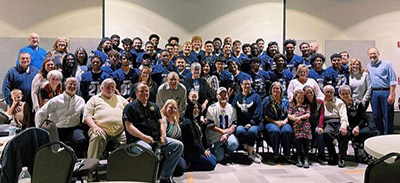
IRVING—To demonstrate the love of Christ and meet needs in their community, members of Oak View Baptist Church in Irving developed an outreach program to encourage student athletes to press on towards the goal.

The church began the sports outreach by adopting the varsity football team from Nimitz High School.

When members of Oak View Baptist Church in Irving adopted the varsity football team from Nimitz High School, it opened up a wide opportunity for ministry in their community. (Photo courtesy of Oak View Baptist Church)

As word spread about the positive impact the program was making on the team, it wasn’t long before the church was given another opportunity—to sponsor the boys’ and girls’ basketball teams.

With both outreach programs, church members of varied ages show support for the players and their families with encouraging notes, care packages and attendance at home games. The weekly care package usually consists of items such as a sports drink and snacks such as baked goods, chips or protein bars. In addition, church members often include a Bible verse and note of encouragement with each care package.

“It is encouraging to watch members of Oak View come out to the games, especially those who have no relatives or friends directly involved,” said Jack Teel, minister to students.

“They are coming to support their player, and you can see the joy it brings to their lives. At each game, I watch the players look up into the stands and point to the section where our church members are sitting and wave at them. Then, I watch our sponsors light up with pride for the students.”

Making a connection with students

Before each season begins, the church holds a “meet-and-greet” event, where church members and student athletes get acquainted. At the end of each season, the church hosts a lunch for the players and their families.

“Our desire is to make a connection with the students and let them know that people care about them and want to support them,” said Lynda Randle, who serves weekly in the student ministry and coordinates the football outreach.

“We want to help get them connected to a local church if they don’t already have one. It’s always a special time when the players come to church, and we can get to know them better.”

Teel agreed, adding: “The response has been amazing since we started the program a few years ago. It truly is a unique way for us to reach our community. It has allowed us to hear stories of how our bags and personal notes have reached these players in their time of need—both on and off the field and the court. It has been a great vessel to spread the love of Christ in our community.”

Student athletes comes to faith in Christ

Through the years, many of the players have connected with the church and made professions of faith, including Delontae Scott, who played football at Nimitz and now plays in the NFL for the Pittsburgh Steelers. Scott began attending Oak View’s student ministry when he was a high school student and gave his life to Christ as a result of the football outreach.

Many of the students and their families have stayed in contact with their sponsors even after graduation, which has allowed church members to continue the connection.

“This outreach is about planting seeds,” said Wes Pyfer, who coordinates the basketball outreach. “You never know what the Lord has in store. It’s exciting to get to know these players and let them know that someone cares about them.

“Many of their families have to work and aren’t able to attend games. So, this is especially meaningful for them to have supporters cheering them on during the games. The players are so appreciative of the care packages and look forward to receiving them each week. It means a lot to the coaches, as well, to know that people are coming alongside them and supporting the team.”

By continuing the connection with these players, Teel recognizes the opportunity the sports outreach opens up to influence the city for Christ.

“The ultimate goal of the outreach is to live out our mission statement as a church and connect people to the life-changing love of Christ,” Teel said.

“I would love to see this outreach expand beyond what it is today and crossover into other sports, as well as the arts program. Any place that we might be able to reach a student and their family in a way that otherwise might not be possible is exciting to me. We have a mission field here, and I am excited to see what God has in store.”


Obituary: Jack MacGorman

John William “Jack” MacGorman, long-time professor of New Testament at Southwestern Baptist Theological Seminary, died on Christmas Eve at age 100, two days shy of his 101st birthday. Born in 1920 in Nova Scotia, Canada, MacGorman moved across the United States border to Caribou, Maine, at age 7. From 1937 to 1938, he studied at Colby College in Waterville, Maine. These academic pursuits were hindered, however, by the onset of bronchiectasis, a severe lung disease. In May 1939, MacGorman checked into a hospital for one month’s observation. He stayed for more than two years. In 1941, despite the aid of a renowned Harvard Medical School doctor, MacGorman was dismissed from the hospital as inoperable. Following the doctor’s advice to leave the Northeast for the “high and dry climate of Arizona,” MacGorman moved south. By the time he reached Texas, however, he had run out of money. He recovered from his illness in Austin, and in 1945, he enrolled in Southwestern Seminary. In a journal entry from his first day of classes, Sept. 11, 1945, MacGorman wrote of his “deep, deep sense of gratitude” to God for his mercy, for sparing his life, and for bringing him to Southwestern. MacGorman completed his Bachelor of Divinity and Doctor of Theology degrees at Southwestern by 1956. In 1948, he was added to the seminary’s faculty as professor of New Testament. Serving 53 years, MacGorman had one of the longest tenures of service in the history of Southwestern. Following his retirement in 2001, MacGorman stayed connected to the life of the seminary, helping in classes and faithfully attending chapel services and other campus events. Southwestern honored him with a Distinguished Alumnus Award in 1986 and the L.R. Scarborough Award in 2008. In 2011, MacGorman was present as Southwestern dedicated the MacGorman Chapel and Performing Arts Center, named in his honor. In addition to teaching at Southwestern, MacGorman taught and lectured throughout the world and wrote and edited numerous books and articles. He also served in pastoral positions at churches in Maine and Texas. In 2020, ahead of his 100th birthday, MacGorman donated his personal library to the seminary. The donation included thousands of titles from MacGorman’s time as a student and faculty member, as well as many titles from his father, also a minister. Additionally, MacGorman donated many of his files, notes, and records from classes and sermons dating back to the 1940s. MacGorman was preceded in death by his wife of 71 years, Ruth, and their son Stephen. He is survived by their seven children, Donald, Robert, Linda, Deborah, John, Adam and Timothy; 11 grandchildren; and 19 great-grandchildren.




Outreach ministries have grown during pandemic

WASHINGTON (RNS)—More than half of Christian congregations say they have started a new ministry or expanded an existing one during the COVID-19 pandemic, according to a new survey.

On average, in fact, these Christian houses of worship began or broadened more than three of their outreach activities in response to the pandemic.

“The level of new and intensified social outreach and community ministry undertaken by the nation’s churches is monumental,” reads the report by the Hartford Institute for Religion Research.

The second installment in a five-year project that began earlier this year called “Exploring the Pandemic Impact on Congregations,” it is based on a collaboration among 13 denominations from the Faith Communities Today cooperative partnership and institute staffers.

If their findings are representative of the roughly 320,000 Christian congregations in the country, the institute said, the researchers estimate nearly 175,000 churches launched or expanded ministries, funds and supplies in response to the pandemic over the past two years.

Overall, almost three-quarters (74 percent) of churches have offered social support during the pandemic and close to two-thirds of congregations say they have been involved in new ministries.

Evidence of changing attitudes

The new findings, a November survey drawn from 820 responses from representatives of 38 Christian denominational groups, showed significant changes in congregations’ attitudes toward change, particularly increasing diversity.

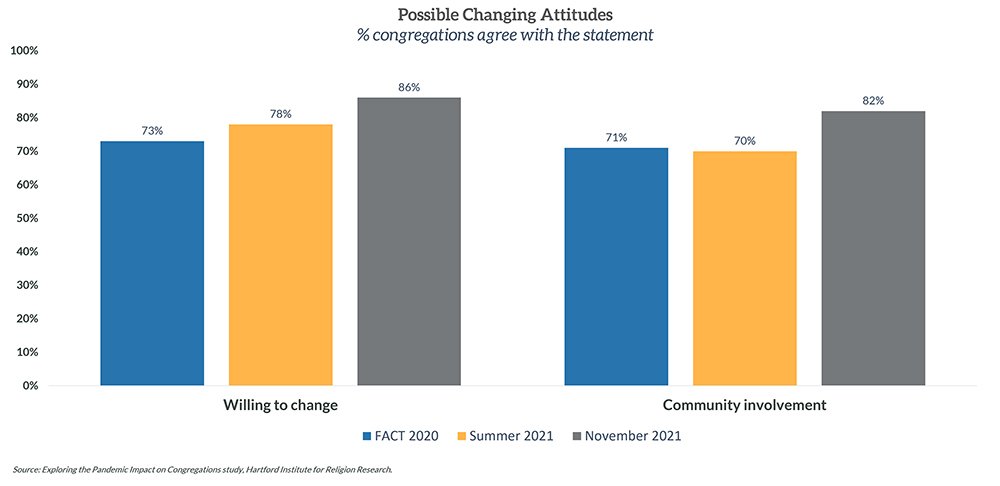
Less than three-quarters (73 percent) agreed in 2020 that their congregations were willing to change to meet new challenges. That increased to 86 percent in November.

There also seemed to be greater interest in striving to be diverse, with 38 percent describing themselves as doing so in November compared with 28 percent in summer of 2021 and 26 percent before the pandemic and before the majority of the 2020 protests spurred by the murder of George Floyd, a Black man who died under the knee of a white Minneapolis police officer.

But even as congregations considered new ways of operating, an increasing number are concerned about their future, with 23 percent saying they are worried about their ability to continue, compared to 16 percent in the summer.

The institute’s researchers also estimated about 200,000 church members have lost their lives due to COVID-19.

The percentage of churches reporting deaths within their membership increased from 17 percent in the summer to 28 percent in November, when the second survey was conducted. The average number of deaths among those reporting losses in their congregation was 2.3, up slightly from 2 in the summer.

“This is a sobering picture. However, we would have expected an even greater loss, given the aging population of regular churchgoers,” Allison Norton, co-investigator of the study, told Religion News Service in an email.

The project’s first report, based on responses from summer 2021, showed about a third of congregations had increased requests for food. About a quarter received more requests for financial assistance during the pandemic.

Churches ‘have risen to the occasion’

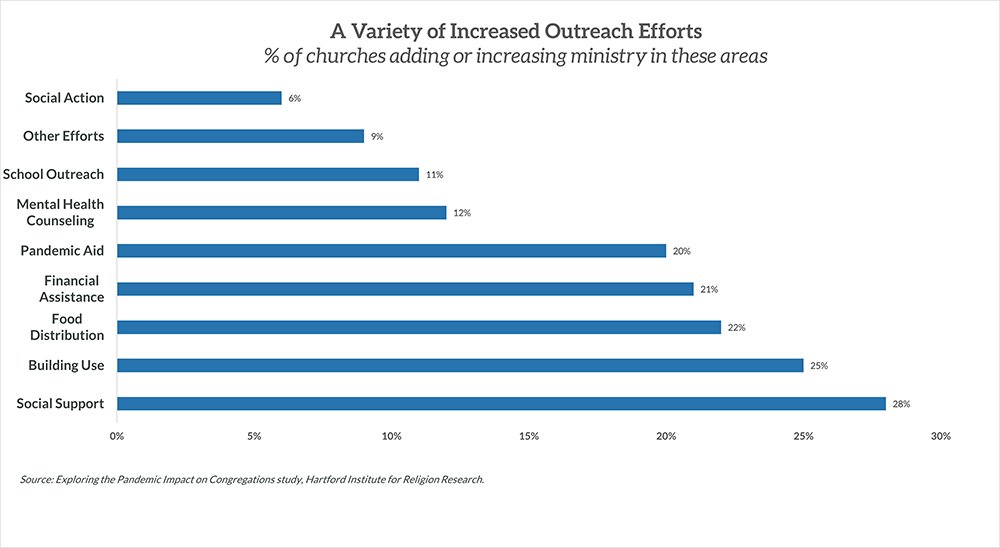
The November survey found 22 percent said they had added or increased food distribution and 21 percent had enhanced or begun financial assistance for their community.

Norton said churches “have risen to the occasion,” during a difficult time for the country.

“There is a willingness in many churches to respond to the challenges of this time with experimentation and change,” she said.

A larger percentage—about 28 percent—have started or expanded community support ministries, using phone trees to inform and encourage members and nonmembers or offering elder care options, such as providing rides to medical appointments.

Even as sanctuaries were closed to in-person worship and other meetings moved online, about a quarter of congregations expanded the use of their buildings for other activities, from helping homeless people to offering child care and tutoring.

About a fifth of congregations were involved in ministries specifically tied to the pandemic, such as hosting vaccine clinics, making masks or holding celebrations for front-line workers.

Twelve percent started or increased mental health ministries, and 6 percent said they had new or expanded ministries related to social action, with some involving voter registration or anti-racism initiatives.

Hard to predict the future

In a finding similar to the first study, most congregations said they are using a hybrid form of worship, with 85 percent offering both in-person and virtual options. Fifteen percent of those surveyed in November said they were solely gathering in person and 3 percent opted only to meet virtually.

While attendance remains depressed, the survey found the rate of attendance decline between 2019 and 2021 was 9 percent. It had been down 12 percent in the summer.

The number of congregations reporting a severe decline of 25 percent or more fell from 35.2 percent in the summer to 30.3 percent in November. And the number reporting growth of 5 percent or more increased from 28 percent to 37 percent.

With the omicron variant contributing to the continuing pandemic, researchers acknowledge it is hard to predict future plans for activities such as fellowship events and religious education, which were still below pre-pandemic levels.

“For many churches, their situation will never be the same,” the report concludes. “They will never be the same because of the loved ones and members that they have lost. They will never be the same because of the ministries that they have started and expanded.”

The findings in the new report, “Congregational Response to the Pandemic: Extraordinary Social Outreach in a Time of Crisis,” have an estimated overall margin of error of plus or minus 4 percentage points. It is part of a multiyear project funded by the Lilly Endowment.


Student ministry leaders point to youth mental health crisis

ROCKWALL (BP)—Lauren Coats has seen firsthand the impact of a growing mental health crisis among young people.

The number of calls from parents of teens and children looking for help to her three counseling centers has nearly doubled in less than two years.

Lauren Coats, a pastor’s wife, founded Rockwall Counseling and Wellness about a decade ago.

“During COVID, I’ve hired probably six therapists that work exclusively with children and teens because of the need and the demand—and they stay full,” said Coats, a pastor’s wife who started Rockwall Counseling and Wellness nearly a decade ago.

Coats’ experience in the Dallas area echoes a national trend U.S. Surgeon General Vivek Murthy noted in a recent advisory on a youth mental health crisis. The advisory describes a crisis that predates COVID-19 shutdowns and has manifested itself in “an alarming number of young people [struggling] with feelings of helplessness, depression, and thoughts of suicide,” according to Murthy in a release by the U.S. Department of Health and Human Services.

The report then notes the altered school, home and community experiences of youth caused by the COVID-19 pandemic worsened the problem.

Not just related to the pandemic

Richard Ross, a professor of student ministry at Southwestern Baptist Theological Seminary, says the mental health issues facing America’s youth won’t go away when COVID-19 does. Much of it, he believes, relates to the cultural collapse youth are experiencing right now.

Richard Ross

“Any time a culture collapses, there will be pain and harm in people’s lives,” said Ross, who has been involved in youth ministry more than 50 years. “Sadly, the first people to experience that pain and injury will be the most vulnerable—the children and teenagers. Ultimately, the young are at risk because the majority in the U.S. have turned their backs on God.

“Those who care for the young will need to join the Great Physician to keep children and teenagers from experiencing harm even after the pandemic.”

Ross said he teaches young pastors at Southwestern Seminary to engage hurting teenagers in three ways. First, ensure they have a personal relationship with Jesus.

“Teenagers most need heart transplants to move from drowning in crisis to flourishing,” Ross said. “And Jesus is the only one who can perform such transplants. Meeting Jesus is the beginning of transformation.”

Ross also encourages youth ministers to develop a list of biblically faithful counselors to whom they can refer students. He also tells youth ministers to prioritize the formation of “warm, strong heart connections” between teens and parents, teens and mentors, and teens and spiritually healthy congregation members.

“Teenagers isolated and cut off from the significant adults in their lives are always at risk,” Ross said. “Teenagers who live with solid heart connections with significant adults can weather almost any storm in life.”

Be ready to respond

Shane Pruitt, who serves as the national next gen director with Southern Baptists’ North American Mission Board, says he urges youth leaders to have responses ready for youth mental health needs. Like Ross, he recommends youth pastors have Christian counselors they can recommend to students.

But he also tells youth pastors to include gospel-centered, biblical help for mental health issues within their discipleship process. He notes there is a lot of unhelpful mental health self-diagnosis taking place among youth right now.

“We don’t need 15-year-olds diagnosing other 15-year-olds with depression and anxiety,” Pruitt said. “I think we just got to have an answer to those things. If the church largely remained silent on mental health, and the culture screams it, then a whole generation only hears one worldview.”

Pruitt encourages youth ministers to involve parents, too. That means equipping and educating them on mental health issues. It also means bringing parents into conversations they’re having with young people who are struggling.

Be alert to warning signs

Coats tells parents and church leaders to keep an eye on youth who are isolating themselves and showing significant personality changes. It’s normal, she says, for teenagers to be moody, but major changes in personality and no longer wanting to interact in person with others are warning signs.

“Obviously, self-harm is another thing parents report all the time to me. They notice first their teenagers were cutting themselves,” Coats said. “But when we really start digging into it, there’s also isolation and personality changes that they haven’t really picked up on, or they thought maybe were normal.”

Coats recommends that youth leaders and parents bring mental health professionals into the situation as early as possible.

“The sooner a kid or a teenager can start to speak with a counselor the better,” Coats said. “Right now, in my incoming calls, people are saying they’ve noticed issues with their kids for six months at this point. That’s really a long time to wait to get your kiddo help.

“If we had a child that we thought had an ear infection or strep throat, we would call the doctor right away. If we have a kid experiencing anxiety, or depression, or some other mental-health issue, I think calling right away is important.”

Pruitt said he hopes these mental health challenges facing teenagers will open the church’s eyes to the urgency of sharing the gospel with young people. He says he has seen more professions of faith in Christ at youth events where he has preached this year than in the last three to four years combined.

“You kind of saw it with Millennials, but especially with Gen Z. They’ve really been told this self-help nonsense, to look inward for happiness, hope and peace,” Pruitt said. “We know, you have to look outward first, before you can have that on the inside. We need to look outward to Jesus.

“We need the Holy Spirit and to be born again. [The youth] are trying to find it within themselves. I think they realize quickly, it’s not in there. So, they start looking for something beyond themselves.”


Around the State: Collection dedicated at Wayland-San Antonio

Wayland Baptist University recently dedicated the Richard Hughes II Biblical Studies Collection at its San Antonio campus. The study space and dedicated research materials offer ministry students easy access to research material, spaces for collaborative learning and individual quiet study, computer and media resources, and access to electronic databases. The Richard Hughes Biblical Studies Collection was made possible through the primary gift of Michelle and Tracy Taylor, along with supporting gifts from family and friends, in memory of Richard Hughes, Michelle Taylor’s son, who died in a car wreck Christmas Day 2018.

Dallas Baptist University presented an honorary Doctorate of Humanities degree to Gail Linam (center), pictured with her husband Dennis (left) and DBU President Adam C. Wright. (DBU Photo)

Dallas Baptist University presented an honorary Doctorate of Humanities degree to Gail Linam, who has served in various academic administrative capacities at the university more than 30 years. Linam, currently academic dean and institutional accreditation liaison, led DBU through three of its last 10-year accreditation reviews by the Southern Association of Colleges and Schools Commission on Colleges, and she helped establish the Center for Mentoring. Other roles in which she has served at DBU include provost, vice president for undergraduate affairs, dean of the College of Education and executive director of the Women’s Auxiliary Board. She is a graduate of Baylor University and Southwestern Baptist Theological Seminary. She and her husband Dennis, a former vice president at DBU, have three children and one grandson. They are members of First Baptist Church in Arlington.

Kari Dingler

The Howard Payne University Women’s Club has scheduled its annual Yellow Rose Scholarship Luncheon for April 7 on the HPU campus. Kari Dingler of Midland will be the keynote speaker at the event. After receiving her Bachelor of Music degree from HPU in 1985, Dingler taught elementary music, led a select children’s choir and presented musicals for her church. She has served as pianist and worship leader more than three decades. She is involved with Court Appointed Special Advocates, serves on the board of High Sky Children’s Ranch and is a founding member of You Can Free Us India. The recipients of the Yellow Rose Award and Yellow Rose Scholarship will be recognized at the luncheon. Table sponsorships will be available for purchase Jan. 10.

The five ministry centers within the Baptist General Convention of Texas recently released a statistical summary for 2021. Through virtual and in-person consultations, events and meetings, the Center for Church Health trained more than 20,000 individuals. The Center for Missional Engagement worked with more than 100 new churches that recorded 7,769 professions of faith in Christ. Texas Baptists’ area representatives within the Center for Ministerial Health made more than 13,000 contacts, and the center contributed $30,000 toward the counseling needs of ministers and their families. Within the Center for Cultural Engagement and the Christian Life Commission, the Texas Baptist Hunger Offering enabled ministries to serve more than 21.7 million meals. The Center for Collegiate Ministry reported Baptist Student Ministries made an impact on the lives of more than 62,000 students, including 282 who made professions of faith in Christ.


Obituary: Pat Luttrell

Patsy Lynn Luttrell, longtime consultant with Woman’s Missionary Union of Texas, died Dec. 12 in Vernon. She was 76. She was born in Vernon on Dec. 29, 1944, to Ed and Maureen Luttrell. After graduating from Vernon High School, she attended Hardin-Simmons University, where she earned an undergraduate degree in 1967. As a student, she served as youth director at First Baptist Church in Vernon and also served Dallas Baptist Association as a recreation director at Mount Lebanon Baptist Encampment. She taught speech from 1967 to 1975 at Grand Prairie High School before returning to Hardin-Simmons University to serve as an admissions counselor. She joined the Texas WMU staff in 1983 as the Baptist Young Women/Baptist Women consultant. She retired from Texas WMU in 1999, but she answered God’s call to come out of retirement and served as an employee of Texas Baptist Men until 2005. She returned to Vernon, where she volunteered with Meals on Wheels and Hospice of Vernon. She was actively involved in the ministries of First Baptist Church of Vernon, where she was a vital part of the Baptist Women, taught a women’s Sunday School class for years, volunteered for the card ministry and served on multiple committees. She is survived by her two nephews, Chan Baker and Clay Baker, multiple cousins and a host of friends. A celebration of life service is scheduled at 2 p.m. on Jan. 15, 2022, at First Baptist Church in Vernon.



‘Mary Did You Know’ writer good-natured over controversy

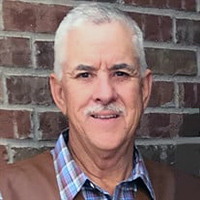
NASHVILLE (RNS)—For Mark Lowry, almost every day is Christmas.

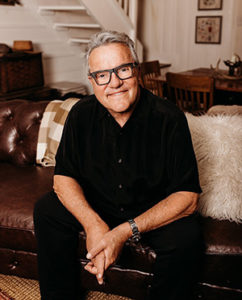
Mark Lowry wrote “Mary, Did You Know?” with Buddy Greene in 1991.

Whenever the storyteller and singer takes the stage for a concert, he always closes the show with the same song—“Mary Did You Know?”—no matter what time of year it is.

“When you have one hit, you better end with it,” Lowry said in a recent phone interview.

Lowry co-wrote “Mary Did You Know?” with Buddy Greene, a well-respected songwriter and instrumentalist, in 1991, while both were on tour with famed gospel singers Bill and Gloria Gaither.

Recorded first by Christian singer Michael English, the song has become a modern Christmas staple, covered by some of the biggest names in the business: Dolly Parton, Kenny Rogers and Wynonna Judd, Kathy Mattea, Mary J. Blige, Clay Aiken, Carrie Underwood and the a cappella vocal group Pentatonix.

How it all began

The idea for the song dates back to conversations the 63-year-old had with his mother about Jesus and Mary. Most revolved around the question: What was it like to raise the son of God?

“Literally, what was it like teaching the word of God to talk,” he said. “What was it like to give him a haircut? Did she ever walk into his room and say, ‘Clean this mess up?’”

He added that most of the questions he had did not make their way into the song—only the ones that rhymed made it.

Those conversations also touched on spiritual topics, like the mystery of the incarnation, said Lowry. They eventually inspired a series of short monologues Lowry wrote in 1984 for a Christmas concert at Thomas Road Baptist Church in Lynchburg, Va., then led by Jerry Falwell. Those monologues were the glue that held the show together, serving as a transition from one Christmas song to another.

They stuck with Lowry, who thought they might work for a song if he could find the right music. Several musicians tried to come up with melodies, but none fit, said Lowry.

Then, while on tour with the Gaithers, he showed the lyrics to Greene and asked him to have a go. Greene took them home and started working on some music.

Lowry recalls that Greene, who could not be reached, had spent a day listening to Christmas carols written in minor keys, like “What Child is This?” and “We Three Kings” before composing the melody for “Mary Did You Know?”

“It was beautiful,” he said. “It was haunting, and it made the song work. It didn’t take away from the message. It elevated the message.”

While writing lyrics, Lowry said he imagined himself as an overly enthusiastic angel who showed up at the manger during the Christmas story and was filled with questions. He used the phrase, “Did you know” to express that enthusiasm—as if the angel was bubbling over with joy for what the birth of Jesus meant. The questions in the song are the questions Lowry would have asked if he had been there.

Assused of ‘theological mansplaining’

But that phrase has gotten Lowry in trouble in recent years—seen as a kind of theological mansplaining.

“Listeners have complained that, yes, Mary knew that she was going to bear the Messiah, the promised salvation of Israel, and that, therefore, the rhetorical question upon which the song rests is either redundant or condescending,” author Joy Clarkson, host of the “Speaking with Joy” podcast, wrote in a 2018 article entitled, “Yes, Mary Knew.”

That phrase has also inspired a series of sarcastic social media posts. “Mary did you know … that there’s a boy on his way to gift your newborn with a drum solo,” tweeted author and pastor Courtney Ellis. “Mary did you know we’ve been trying to reach you about your extended warranty,” tweeted Texas attorney Robert Callahan II. There’s even a satire of the song, “Mary Freaking Knew.”

Lowry is pretty good-natured about the criticism of the song. He’s quick to admit it has shortcomings, which he thinks are more evident to his fellow Christians who are more familiar with theology than the average person who hears the song. The last thing he wanted to do was to insult Mary or anger his fellow believers.

“I never meant for it to start a war or irritate people,” he said. “I definitely didn’t want that.”

That response fits Lowry’s character. He’s long used humor to help his fellow evangelicals lighten up, preferring laughter to a fight any day.

Still, he’s grateful for what he called the “miracle of the song.” Lowry, who has never been married, views his songs as his children. None of them, he said, has grown and had a life of their own the way “Mary Did You Know” has.

Most of all, he hopes the song will point people to the story of the baby Jesus and what his arrival would mean.

“I hope the song makes people think about the baby Jesus,” he said. “I hope it sends them running to Luke 1 to find out what Mary knew.”


Kansas camel escapes Nativity scene

BONNER SPRINGS, Kan. (RNS)—A camel sent police scrambling in a Kansas City suburb. The dromedary in question escaped a Nativity scene in Bonner Springs, Kan.

The incident is the latest chapter in the colorful and often chaotic history of camels in the United States.

The animal was part of a drive-thru Nativity scene at the National Agricultural Center and Hall of Fame when its halter broke. Chased soon after on foot, the camel managed to avoid its pursuers.

A camel used for a Nativity scene in Bonner Springs, Kansas, spent several days on the run before being captured. (Photo courtesy of Bonner Springs Police Dept.)

The next day the animal traversed parts of the K-7 Highway, and despite being spotted by many motorists, it again eluded capture. Images and videos of the animal soon went viral. Police officials suggested on Facebook that the situation could “only be described as a scene out of another cop movie.”

At one point, Bonner Springs Police Department pursued the camel on golf carts after it strayed onto a golf course. The camel visited several neighborhoods before being cornered and lassoed by an animal control officer. Its owner then arrived to take possession of the nomadic creature.

“The camel was reunited with its owners and will go back to doing camel things,” the Bonner Springs Police Department said in a statement posted on Facebook.

This isn’t the first time Kansas police officers have had to respond to an escaped camel over the holiday season. In December 2019, police in Goddard, Kan., reported a traveling animal trio consisting of a camel, a cow and a donkey. Shortly thereafter the camel was reunited with its owners, but not before viral photo comparisons to a real-life Nativity scene.

Similar incidents have not always ended so tamely. In 1997, a camel that escaped mid-performance from a Kent Island, Md., Nativity pageant was struck and killed by a passing automobile.

A 2010 dress rehearsal for a Nativity play at First Baptist Church in West Palm Beach went awry when a camel slipped and went crashing into the congregation. Neither the camel nor the actor portraying one of the magi was injured in the fall, though the camel, known as Lula Bell, was withdrawn from the actual performance “for safety reasons.”

Animal rights groups long have complained of the use of live animals in Nativity scenes. Due to their size, camels have drawn particular concern. A two-humped Bactrian camel can weigh more than 2,000 pounds.

“Camels aren’t even fully mature until 7 years of age,” said PETA in a 2020 statement condemning the use of all live animals in Nativity scenes. “But many are forced into performances well before that. In nature, these gentle, social animals, who softly blow in one another’s faces to say hello, would be traveling with their family herds.”


Obituary: W.T. Smart

W.T. Smart, a Texas Baptist Men disaster relief volunteer, died Dec. 17 in Lindale. He was 70. He was born Sept. 5, 1951, in Gilmer to Joe Lewis and Hazel Stella (Stiner) Smart. He lived in Lindale for 50 years, where he was a member of First Baptist Church. He was the retired owner/operator of S&S Truck and Tractor in Swan. In addition to his volunteer service through TBM, he was involved in the Lindale Rural Water Board, the Mineola Community Bank Board and the Smith County Sherriff’s Advisory Board. He enjoyed fishing, traveling, attending auctions, morning coffee with his friends and spending time with his family. He was preceded in death by sisters, Ruby Weed and Betty Truett and brothers, Joe and Borden Smart. He is survived by his wife of 40 years, Connie Smart of Lindale; daughter Audrey Renee Sanders and husband Ben of Lindale; daughter Whitney Morgan Bray and husband Jared of Lindale; four grandchildren; sisters Delores Prickett, Sherrie Ledesma, Wilma Burgess and Blanche Mize; and brother Troy Smart.


Preemptive Love Coalition accused of misleading donors

WASHINGTON (RNS)—After several former employees of Preemptive Love Coalition accused co-founders Jeremy and Jessica Courtney of misleading donors and abusing staff, the board of directors of the popular international aid group has hired the investigative firm Guidepost Solutions to look into the allegations.

Founded by the Courtneys in 2008, Preemptive Love raises millions of dollars each year for relief work in several countries including Iraq, Syria and Mexico.

On Dec. 16, Preemptive Love’s former communications director, Ben Irwin, published an article on the online platform Medium that accuses the Courtneys of verbally and psychologically abusing staff and running the organization “like a cult” by demanding absolute loyalty and punishing dissent.

The next day, Preemptive Love’s board published an open letter saying they received “serious complaints” from a number of former employees about the Courtneys involving “race, gender and power dynamics.” The complaints, which came in the form of a letter sent in August and signed by more than two dozen former employees, led the board to launch the investigation.

Founders placed on leave of absence

According to the board’s letter, the Courtneys will take a leave of absence during the investigation, but the board allowed them to retain “a small number of carve-outs for which Jeremy and Jessica could remain partially engaged with their duties.” The Courtneys have been removed from direct management and financial decisions.

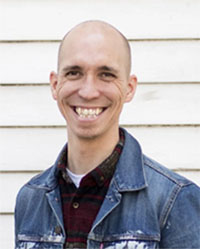
Jeremy Courtney, founder of Preemptive Love

The Courtneys are former missionaries who have kept close ties with Christian donors and leaders. Irwin wrote that, while many think Preemptive Love is a Christian charity, it is technically not religously affiliated.

Jeremy Courtney, who grew up in Leander as the grandson of a Baptist minister, attended Howard Payne University and earned his Master of Divinity degree from Baylor University’s Truett Theological Seminary.

In his Medium article, Irwin accused the Courtneys of deceptive messaging aimed at donors. He included a picture of a since-removed Instagram post from August in which Preemptive Love used the Haitian earthquake to solicit donations, despite having no programming in Haiti.

Irwin also claimed that Jeremy Courtney edited video footage to make it appear that he was caught in an airstrike in Mosul, Iraq, in 2017. Irwin alleged that while Courtney was present in the city at the time, the explosion effects were added post-production to exaggerate his proximity to danger.

Allegations of questionable spending

Irwin also claimed he observed questionable spending practices. Early in the pandemic, according to Irwin, Jeremy publicly announced waiving his $165,000 a year salary to preserve staff and programming, only to reinstate his pay months later. Irwin also wrote that in 2021, Preemptive Love spent $208,000 to send packages with “designer-quality” shirts to thousands of monthly donors while seeming to mislead staff about how they were paid for.

Irwin, who worked for Preemptive Love six years, resigned on July 26, the same day he filed a whistleblower complaint to the board.

Following Irwin’s post on Medium, former employee Audrey White recently posted on Twitter asking the public to hold the Courtneys and the board accountable for abuse of power and exploitation of vulnerable people. “I saw them humiliate the refugees they claimed to be empowering, abuse and bully the local (Iraqi) female staff while preaching about ‘loving anyway’ online,” White wrote.

Former Preemptive Love writer Courtney Christenson also wrote an open letter to the Courtneys, which she posted online. “I cannot sit by and watch you preach peace while you bully, gaslight, and abuse the peacemakers on your team until they give up and quit,” Christenson wrote.

The board is currently awaiting the results of the investigation and expects them “very soon,” according to their letter.

“No matter what we learn, the board is committed to making all necessary decisions, no matter how difficult, to rectify any past missteps, renew our commitment to care for every team member, and ensure that PLC becomes a healthier organization,” they wrote.

Irwin thinks that the Courtneys need to step down if the organization is to be a true force for good.

“Before I left, I said there was only one way forward, and that was facing rather than trying to bury the harm that was caused, or gaslighting the people you’ve hurt,” Irwin told RNS. “There is still only one way forward. ‘Love anyway’ is a powerful vision. But it does not eliminate the need for accountability and justice.”