ERLC president says he won’t tell Christians how to vote

WASHINGTON (RNS)—The new chief ethicist for the Southern Baptist Convention hopes his fellow Southern Baptists will vote in the upcoming mid-term elections in ways “that protect life, that protect religious liberty, that protect marriage.”

But in the end, he said, it’s up to each person to vote the way they see best.

“I will say it’s not my role to bind anyone’s conscience in terms of how to vote,” said Brent Leatherwood, newly elected president of the SBC’s Ethics and Religious Liberty Commission, in a video press conference Sept. 15.

Leatherwood, who was named interim president of the ERLC last fall, succeeds Russell Moore, who resigned in 2021 to join the staff of Christianity Today magazine. A former executive director of the Tennessee Republican Party, Leatherwood, 41, first began working at the ERLC in 2017.

His remarks about voting contrasted with those of a fellow SBC leader, Al Mohler, president of Southern Baptist Theological Seminary, who suggested people who vote the wrong way are not good Christians. Speaking at the Pray, Vote, Stand Summit, a conservative Christian event in Atlanta, Mohler said Christians needed to understand the importance of voting as a sign of faithfulness to God.

“They need to understand that insofar as they do not vote or they vote wrongly, they are unfaithful,” said Mohler in a video clip shared widely on social media. Along with serving as a seminary president, Mohler is editor of World Opinions, a conservative Christian political opinion site.

A lightning rod role

Leatherwood—who declined to address Mohler’s remarks—specifically steps into a role that has long been a lightning rod. Moore’s tenure in office, from 2013 to 2021, was riven with controversy, especially due to his long criticism of Donald Trump and his advocacy for racial justice and care for victims of sexual abuse.

Richard Land, who led the ERLC from 1988 to 2013, retired after scandals involving plagiarism and insensitive remarks made about the death of Trayvon Martin.

Yet Southern Baptists remain supportive of the ERLC. An attempt to dismantle the ERLC failed at the SBC’s annual meeting in June by an overwhelming majority. A vote to defund the agency failed in 2018 as well.

Headquartered in Nashville, the ERLC also maintains an office in the nation’s capital that works on public policy.

Leatherwood plans to spend the first few months meeting with SBC pastors and leaders, listening to their concerns and connecting with them. He said his role is to come alongside churches and then to speak into the public square.

He stressed the need to have a close tie to churches and acknowledged that the role has been controversial in the past.

“I have a vision for what I think the ERLC needs to look like,” he said. “But I need to step back and realize this is not a commission that I own. I’ve been given stewardship over it.”

Author and speaker Dan Darling, a former colleague of the new ERLC chief, called Leatherwood a natural leader, with both the political knowledge and personal skills to do the job well. Darling also said that Leatherwood brings a layperson’s perspective to the job, rather than a pastor’s.

“People love working with him,” he said. “I really think the ERLC is in a good position to succeed.”

Abortion opponent, not an abolitionist

Leatherwood, an outspoken opponent of abortion, has clashed in the past with so-called abolitionists who seek to pass legislation ending abortion with no exceptions and who seek criminal penalties, including murder charges, against women who have abortions. That movement has found support among Southern Baptists in Oklahoma and among leaders like Mohler who has said he would support criminal charges for women who have abortions.

A group of Christian groups that oppose abortion wrote to state legislators earlier this year opposing such penalties, drawing the ire of abolitionists.

“We state unequivocally that we do not support any measure seeking to criminalize or punish women, and we stand firmly opposed to including such penalties in legislation,” the letter read.

That led abolitionists like Florida pastor and failed SBC presidential candidate Tom Ascol and Oklahoma pastor Dusty Deevers to criticize the ERLC and Leatherwood’s leadership.

In 2021, Southern Baptists passed a resolution calling for the complete abolition of abortion, over the objections of the resolutions committee. But a proposed resolution that included calls for criminal penalties failed to reach the floor of the annual meeting in 2022.

“We simply want abortion abolished by establishing equal protection both for all our preborn neighbors from conception, and for women who are tragically coerced into abortion so they will not be viewed the same as those who willfully murder their preborn children,” said Deevers, an Oklahoma Baptist pastor and outspoken abolitionist.

Work with task force to implement sex abuse reform

In an online press conference Sept. 15, Leatherwood also said the ERLC would continue plans for a denomination-wide assessment of the SBC on the issue of sexual abuse. He said the agency would work alongside a newly appointed SBC task force charged with implementing abuse reform passed at the 2022 annual meeting.

Both Moore and Land praised Leatherwood’s election, with Moore calling him “brilliant, godly, brave, and Christlike.” Other leaders, like Frank Williams, head of the SBC’s National African American Fellowship, also offered compliments.

“His commitment to Gospel-centered public policy is seasoned by his sensitivity to the nuanced lived experiences of our diverse Southern Baptist family,” Williams said.

Leatherwood said Southern Baptists are known for their strong opinions and disagreement, which is not a bad thing. And while each SBC church is autonomous, he added, they also often cooperate.

“It is a Baptist strength that we are cooperative in our work,” he said. “We’re not just independent. We are actually interdependent. And when we come together and realize we rely on one another, it helps us to project a voice into the public square that is needed now as much as ever.

Disaster relief leads to marriage for volunteers

Dianne Crouch said her “first date” with future husband Rick was working on a “mud-out” disaster relief mission.

She met Rick in Weslaco through her work with Texas Baptist Men and his with New Mexico Disaster Relief.

The mud-out “date” occurred later in Groves after Hurricane Harvey in October 2017. One month after they removed water-soaked flooring and damaged sheetrock from a home, they were married.

Dianne had been a TBM volunteer since 2011, three years after becoming a widow. She began by volunteering on a flood recovery team and then switched to the incident management team handling administration.

“I love the opportunity to be able to serve the volunteers that the Lord sends to go out and to be his hands and feet,” she said. “We are one big family.”

‘Conventional dating wasn’t an option’

Rick lived in Albuquerque, N.M., and started working with the New Mexico team in 2014. He worked with flood and fire recovery, as well as chainsaw and feeding teams. He also was their team chaplain most of the time.

“Since Rick and I lived in two different states, conventional dating wasn’t an option. So, I received permission from the New Mexico blue cap (on-site disaster relief leader) to work with their team in Groves for a week doing mud out,” Dianne said.

“I arrived on Sunday morning and met Rick at the church they were attending that morning. Then we attended another service at the church where they were staying. Then spent the rest of the week serving the Lord together doing mud out. It was an awesome time.”

One month later, Rick arranged for Dianne to stay with some friends in Albuquerque, and she “drove up so we could spend some time getting to know each other.” They married on Nov. 28, before Dianne returned to Texas.

‘Both felt this was the Lord’s will’

“We both felt this was the Lord’s will and the direction he wanted us to go,” she said. “Six months later, we moved to my home outside of Aransas Pass, and Rick started serving with TBM.”

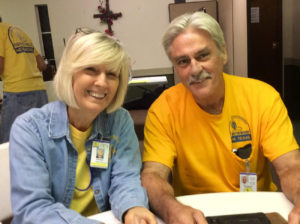
Dianne and Rick Crouch, who met when working on a mud-out disaster relief mission after Hurricane Harvey, serve together as Texas Baptist Men volunteers. (TBM Photo)

Rick said he volunteers because the “love of Jesus Christ has so deeply transformed me that I am compelled to go out and share that love with others.” Dianne said she shares the call.

The “act of sharing with others continues to change, build and transform me,” Rick said. “It’s that act of giving that gives so much back to me. I also volunteer to be part of a team of men and women working together to bring hope and comfort to families devastated by disasters. The fellowship within those teams is very special.”

Rick said he has “learned that it takes no special talents or skills to be a volunteer, only a desire to serve, getting out of your comfort zone in order to help someone experiencing disaster in their life.

“Every disaster is a bit different except for hurting people needing hope and guidance in putting their lives together again,” he continued. “That’s when we (TBM volunteers) come alongside. We listen, pray and help evaluate their situation.

“That first contact has a huge effect on their hearts and minds. People are so grateful, and as you often work with them for days as you are working on their home, you’ll witness God working in their lives. Sometimes slowly but often a flood of the Holy Spirit will come upon them, and they want to know Jesus as you do.”

The Crouches now live in Aransas County and attend Oak Ridge Baptist Church in Portland.

“To share Christ is the greatest moment in my life while working in disaster relief, to share what Jesus has done for me. Your story is powerful,” Rick said.


Baptist Women in Ministry: Broken systems can be reshaped

ABILENE—Too often, men have overlooked and silenced women who have sought to proclaim the gospel or exercise leadership in the church, Meredith Stone told the Texas Baptist Women in Ministry Conference.

Women in ministry have been treated as “forgettable,” “ignorable,” “disposable” and “invisible,” the executive director of national Baptist Women in Ministry said to the Sept. 16 conference at Abilene Christian University.

The perspective of women frequently has been discounted or dismissed, Stone said.

“We don’t hear from women. We hear about women,” she said.

Stone cited the story of a slave girl whom the Apostle Paul and his companions encountered in Philippi, challenging her audience to “see the invisible woman” in the narrative recorded in Acts 16:16-19.

The girl had a spirit of divination, from which her owners profited. She followed Paul and his traveling party, crying out, “These men are servants of the Most High God, who proclaim to you the way of salvation.” When she continued to do this “many days,” Paul was “annoyed” and cast the spirit out of her.

‘Victim  of a broken system’

Stone noted the story was told entirely from the male perspective. The girl—unnamed in the Scripture—was treated as little more than a plot device by the narrator and as an annoyance by the protagonist, Stone asserted.

“Her pain and needs were not acknowledged,” she said. “She was the victim of a broken system. She was treated as property.

“But she was made in the image of God and open to the revelation of God. … She was different. Her difference enabled her to see things from another perspective. She proclaimed the gospel, but she did it in a different way and not in the normalized voice.”

Stone cited findings from the State of Women in Baptist Life Report 2021. The survey revealed 86 percent of respondents reported they experienced obstacles in ministry because they are female. About 6 in 10 (59 percent) said they felt overlooked or silenced in their ministry settings. At least 7 in 10 (72 percent) said they had to demonstrate greater evidence of competence than their male counterparts.

“These statistics reveal brokenness,” Stone said. “The system created by men and for men is broken.”

However, Jesus showed another way, she said. Instead of treating women as forgettable, ignorable, disposable or invisible, he highlighted them, cited them examples to be remembered, respected and honored them, and entrusted the message of his resurrection to them.

“The system is broken, but it can be reshaped by following the example of Jesus,” Stone said. “The system can be renewed, but it’s going to take all of us.”

‘Go to the potter’s house’

Lynn Brinkley, associate director of national Baptist Women in Ministry, encouraged conference participants to “go to the potter’s house” as described in Jeremiah 18.

“The potter’s house is the destination for those who have been wounded,” Brinkley said.

Lynn Brinkley, associate director of national Baptist Women in Ministry, encouraged conference participants to “go to the potter’s house” as described in Jeremiah 18. (Photo / Ken Camp)

Sometimes, women in ministry are clay in the hands of the Master Potter, and sometimes they seek to take on the potter’s role, she said.

“We have been like potters at the wheel, reshaping broken places in our own lives,” she said, pointing specifically to the disruption and isolation the COVID pandemic caused.

Whether making adjustments in the midst of a public health crisis or responding to injustice, churches cannot afford to take the position, “If it ain’t broke, don’t fix it,” she noted.

“Women in ministry are broken, and some things need fixin’,” she said.

Oppressive systems, patriarchal structures and toxic narratives have wounded women who felt God’s call to ministry but were ignored, disregarded or disrespected, she noted.

Describing “lumps in the clay” the potter must smooth out, Brinkley said, “We have been blemished by systems that hurt us.”

Churches, individuals and society in general all “need fixin’,” she said, but God is capable of renewing and reshaping.

“The Lord is near the brokenhearted,” Brinkley said. “God is able to restore broken things. … Divine hands are at the wheel, shaping and forming us into new vessels.”

But to become a usable vessel, women who are being shaped for ministry must commit to spending time on the wheel and enduring the fire, trusting God with the outcome, she said. God not only can renew, reshape and reform individuals, but also can do the same to denominations.

“The Bible shows us God can do anything but fail,” Brinkley said.

She challenged women to go where God calls.

“Go and become change agents. … You may be broken, but you are still useful,” she said. “You are a gift to the church.”


Baylor prof records stories of Baptist women in ministry

Mandy McMichael of Baylor University has spent the past two years interviewing Baptist women in ministry, asking them to describe their experiences.

Mandy McMichael is associate director and J. David Slover assistant professor of ministry guidance at Baylor University. (Photo / Baylor University)

“It has inspired me, how dedicated these women have been to living into their calling, no matter the cost,” McMichael said.

McMichael, the J. David Slover assistant professor of ministry guidance at Baylor, hopes to create an oral history collection that can be a resource and tool for young Baptist women moving forward.

“They just don’t know the stories of women who have come before them,” she said. “Some of them still haven’t heard a woman preach.”

Meredith Stone, executive director of Baptist Women in Ministry, emphasized the value of the stories being gathered.

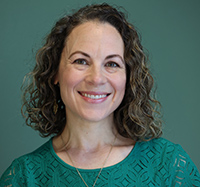
Meredith Stone

“Because of the long-standing discrimination against women’s leadership among Baptists, bias against women is embedded in the foundations of a Baptist expression of faith,” Stone said. “Hearing and recording the stories of Baptist women’s callings helps us to know where we have been, so that we can form a vision for where we need to be.”

McMichael acknowledged that reality and wanted to provide a resource to help students struggling with their own calling to ministry.

 “That’s part of what I wanted to do for my students … give them this collection of stories to say, ‘You’re not alone, and there’s not one way to do it,’” she said.

‘Not a closed collection’

With the support of Baylor’s Institute for Oral History, each interview has been recorded and transcribed. By December, McMichael hopes to complete 60 interviews, but she expects her research will continue to be a work in progress even after that.

“It’s not a closed collection. It will always—in my view—be open to having more stories added to it,” she said.

McMichael’s research has been funded by a two-year grant from Louisville Institute, which has allowed her to expand her vision for the project.

“I’ve interviewed some women who are in seminary now, all the way to women who have retired from ministry,” she explained.

In the long run, McMichael hopes to build an interactive, in-depth database that also will allow users to access related resources.

“There will also be an annotated bibliography that lives with the oral history collection. So, you’ll have … primary sources of women telling their stories, but you’ll also have books, articles, podcasts that have been done about women in ministry,” she explained.

While the development of her catalog is a hope for the future, McMichael touched on the hope her project has provided in the present.

“Hearing people’s stories is sacred to me. Being trusted with their joys and their struggles is something I don’t take lightly. I have cried in interviews. I have laughed in interviews. But I leave each interview full of hope for the church,” she said.

“I think that that’s one of my favorite things about being a scholar, about being a writer, is saying: All of life is complex and complicated, and we should look for the similarities and how we can reach across divides.”

Answering the call ‘outside of traditional channels’

Still, she acknowledged the bias within the Baptist tradition against women in church leadership roles.

“I’m seeing those themes of … women sometimes having to go outside of traditional channels to get the same support and just to find a way to work,” she said. Some Baptist women who feel called to the pastorate have “had to reimagine the places that they’re serving as pastoral ministry roles, she noted.

Stone also commented on the lack of denominational backing for women in ministry.

 “Even among more supportive communities, there is often a disconnect between beliefs about women’s equality that are professed and what is practiced in our congregations,” she stated.

McMichael underscored that same idea.

“This has been said before in other places, but I’ll say it again: Baptist churches who support women in ministry, who theologically agree that women can be called to serve in every level of leadership in the church, need to hire women,” she said.

“Support is great, but these women want to serve, so give them places to serve. … Hire women to serve in denominational leadership besides [ministry to] children, youth and women.”

In some circles, women in ministry are “demonized” by people “who think that they are out there just trying to prove a point or champion a cause,” McMichael observed.

Call for churches to ‘expand their imaginations’

“When you slow down and listen to their story … they are people who are called by God to do this work in the world, just like male ministers are,” she said. “It’s a calling. It’s a vocation. And it’s been good to step into that and listen.”

McMichael hopes churches will consider providing places of service to women who feel called to ministry.

 “There are so many churches that are looking for ministers and so many women who feel called to ministry looking for places to serve,” she said. “Wouldn’t it be great if all those churches looking for ministers would expand their imaginations enough to hire the women who want to come and serve alongside them?”

As her two-year grant draws to a close, McMichael reflects on what she has learned through her interviews.

“This has been a hope-filled project for me, not because everything has worked out perfectly all the time, but because I am confronted with the evidence of God’s work in the [lives] of women and the way they have used their gifts to serve God—even when so much has been stacked against them,” she said.

“I just really hope, yes, that my students will feel less alone, but also that any attention that’s brought to their stories will result in other people taking down a few of those roadblocks and making their path just a little bit easier.”

McMichael continues to seek Baptist women in ministry to interview. Email Mandy_McMichael@baylor.edu or call (254) 710-6353.

Lauren Turner, a student at the University of Mary Hardin-Baylor, is serving this semester as an intern with the Baptist Standard.


Food insecurity down nationally but not in Texas

The percentage of households nationally that lack consistent access to food decreased last year, but food insecurity in Texas continues to outpace the national average, a recently released study by the U.S. Department of Agriculture revealed.

At the national level, 10.2 percent of households in 2021 were considered food insecure, compared to 10.5 percent the previous year—the lowest rate of food insecurity since measurement began in 1996, according to the USDA Household Food Security Report.

Craig Gunderson, the Snee Family Endowed Chair at the Baylor Collaborative on Hunger and Poverty and professor of economics, pointed to the national findings as “great news.”

“In 2020, there were 38 million food-insecure Americans, which fell to 33 million in 2021,” Gunderson said. “Disparities in food insecurity also fell as rates for Hispanics and Black persons fell substantially from 2020.”

However, Gunderson added, the United States still has “a long way to go” to eliminate food insecurity, noting “33 million food-insecure Americans is still too high.”

In Texas, the prevalence of food insecurity remained essentially unchanged from 2019 to 2020 at 13.4 percent, outpacing the national average over the same period. One in seven Texans—1.5 million households—faced the threat of hunger, officials with Feeding Texas noted.

“Far too many Texans are still seeing the impact of the pandemic and food inflation on their dinner tables,” said Cecilia Cole, CEO of Feeding Texas, a network of 21 regional food banks across the state.

While disparities in food insecurity fell nationally, a Feeding America study showed 1 in 4 Black Texans and 1 in 4 Hispanic Texans faced food insecurity, compared to 1 in 14 white Texans.

The Map the Meal Gap study also showed children are more likely than others to face hunger, with 1 in 5 Texas children living in food-insecure homes.

“That’s a sad statistic, but the good news is that we have the tools to solve hunger in Texas,” Cole said. “Hunger-fighting programs like school meals are available and should be strengthened to support more equitable outcomes in our state.”

The Texas Baptist Hunger Offering helps reduce food insecurity by supporting food pantries, job training programs and economic development initiatives sponsored by churches, associations and their ministry partners.


Court reverses course on LGBTQ club at Jewish school

WASHINGTON (RNS)—In a surprising reversal, the U.S. Supreme Court said Sept. 14 Yeshiva University must for now recognize an LGBTQ student club the school claims violates its religious beliefs.

The 5-4 decision follows a stay of a lower court decision on Sept. 9 from Justice Sonia Sotomayor temporarily allowing the Orthodox Jewish university in New York to refrain from formally accepting the group.

According to the Sept. 14 order, in which Sotomayor was joined by Justices Ketanji Brown Jackson, Elena Kagan, Brett M. Kavanaugh and Chief Justice John Roberts, the university must first pursue relief through the state courts before the Supreme Court can intervene.

“If applicants seek and receive neither expedited review nor interim relief from the New York courts, they may return to this court,” Sotomayor wrote.

In a searing dissent, Justice Samuel Alito, joined by Justices Clarence Thomas, Neil Gorsuch and Amy Coney Barrett, disagreed.

“As a last resort, Yeshiva turned to this court, but the majority—for no good reason—sends the university back to the state courts,” the dissenting justices wrote. “The upshot is that Yeshiva is almost certain to be compelled for at least some period of time (and perhaps a lengthy spell) to instruct its students in accordance with what it regards as an incorrect interpretation of Torah and Jewish law.”

The conservative justices added Yeshiva is likely to win if its case comes before the Supreme Court.

 JQY, a nonprofit that supports Orthodox Jewish queer youth, commended the court’s move.

 “Today is a turning point for LGBTQ Jews in the Orthodox community who, for too long, have been told that their identities are not a sin, yet made to feel like their self-worth is against Jewish law (Halacha),” said JQY Executive Director Rachael Fried.

JQY has been funding events for the YU Pride Alliance and providing mental health support for its members as the group advocates for official campus recognition. JQY leaders have argued the group simply is seeking to receive funding and space to gather on campus for events such as picnics and movie nights, something they say shouldn’t be considered a religious violation.

“In framing this as a religious emergency that has to be stopped, to me, (Yeshiva is) demonstrating the very homophobia that they claim doesn’t exist on campus,” Fried told Religion News Service in an earlier interview.

The university’s leaders counter that officially recognizing the group would conflict with their deeply held beliefs.

“We only ask the government to allow us the  freedom to apply the Torah in accordance with our values,” Ari Berman, president of Yeshiva, said in a press release issued when the school sought a stay from the high court in August.

Eric Baxter, vice president and senior counsel at the Becket Fund for Religious Liberty, which is representing Yeshiva, said Yeshiva will follow the Supreme Court’s instruction to “make an additional effort to get the New York courts to grant them emergency relief.”

Baxter noted that if relief is not provided, the Supreme Court made clear Yeshiva can request its protection again.

Four students representing the YU Pride Alliance initially sued the school for discrimination in April 2021. In June 2022, the New York County Supreme Court decided in favor of the students, ruling that Yeshiva’s amended 1967 charter declared the school’s primary purpose educational, rather than religious. The New York court ordered Yeshiva to recognize the club and denied the school’s request for a delay, prompting Yeshiva to file an emergency request for a delay with the Supreme Court on Aug. 29.

Likely an objection to the ‘shadow docket’

Marc Stern, chief legal officer of the American Jewish Committee, called the decision “not a decision on the merits,” saying he suspected at least some of the justices voted to allow the LGBTQ club to go ahead “because they object to what they see as the abuse of the so-called shadow docket, where parties skip ordinary requirements of litigation in the rush to obtain a decision by the court.”

With four justices dissenting, Stern said, “it does seem likely the case will be back before long in the Supreme Court, this time on the merits.”

Stanley Carlson-Thies, founder of the Institutional Religious Freedom Alliance, called the Supreme Court’s ruling a procedural decision that reflects the challenge of trying to resolve the conflict between LGBTQ rights and religious freedom in the court system.

He pointed out the case could take years to resolve, and that in the meantime, Yeshiva could experience what it perceives as damage to its “internal religious operations,” he said.

Carlson-Thies said the court has a long and consistent record of safeguarding the religious freedom of institutions, and he would be surprised if Yeshiva didn’t ultimately win the case.

“It’s impossible to have a diverse set of universities without allowing universities to be diverse,” Carlson-Thies told RNS. “In a pluralist setting, you have to let these entities have some internal autonomy to do things or else they can’t be distinctive.”


Around the State: TBM volunteers provide flood recovery

Texas Baptist Men disaster relief workers donated more than 3,000 hours of volunteer labor in the aftermath of flooding in the Dallas-Fort Worth area. (TBM Photo)

Texas Baptist Men disaster relief workers donated more than 3,000 hours of volunteer labor in the aftermath of flooding in the Dallas-Fort Worth area. Between Aug. 24 and Sept. 7, TBM volunteers completed 26 flood-recovery projects. They prepared 465 meals for volunteers and the public, provided access to 170 showers, washed 64 loads of laundry and distributed 277 storage boxes to residents. They distributed 82 Bibles and recorded 21 professions of faith in Christ.

Early High School was one of several Brown County schools visited by Howard Payne University representatives presenting shirts to the university’s alumni who serve there. Pictured (left to right) are Judith Ozuna, Jonathan Ceniceros, Amanda Elkins, Xavier Haines, Sidney Sizemore, Kelly Griffin, Tiffany Daughtery, Caitlyn Tidwell, Tasha Carter and Brittany Dunlap with Susan Sharp from the HPU School of Education. (HPU Photo)

Howard Payne University’s School of Education and office of alumni relations recognized more than 160 alumni who serve as teachers and administrators in the six school districts within Brown County. Each educator received an HPU t-shirt, delivered to his or her school at the beginning of the school year, with a note of encouragement. The goal of the initiative was to celebrate the impact the teachers and administrators have in the Brown County area. “We knew our alumni teachers have a big impact in the community, but realizing the actual number of individuals was truly remarkable,” said Kalie Lowrie, assistant vice president for alumni relations. “We wanted to take time to let them know we value and appreciate the impact they are making in our area. The last few years through the pandemic have been really difficult for many people, and we wanted these teachers and administrators to know we were praying for them and are here to support them in any way we can.”

University of Mary Hardin-Baylor students placed 2,977 American flags on campus to honor the lives lost in terrorist attacks on Sept. 11, 2001.

University of Mary Hardin-Baylor students placed 2,977 American flags on campus to honor the lives lost in terrorist attacks on Sept. 11, 2001. The memorial, organized by the UMHB chapter of the Young Conservatives of Texas, was  located at the center of the UMHB campus, adjacent to Walton Chapel and Luther Memorial. Two boards listed the names of 9/11 victims. To remember the lives lost in the 9/11 terrorist attacks, East Texas Baptist University hosted a memorial stair climb at the Marshall Grand—home of ETBU’s Teague School of Nursing—in conjunction with the Harrison County ESD 3 Fire Rescue on Sept. 10. Active and retired firefighters, law enforcement officers, first responders and military service joined in the event. Participants climbed the equivalent of 78 floors—the highest point reached in the World Trade Center towers—wearing a name of a fallen 9/11 hero.

The Center for Healthy Churches named Matt Cook as its director. He succeeds Bill Wilson in that role. Cook, who began service as the center’s assistant director in September 2019, holds a Master of Divinity degree from Truett Theological Seminary and a Ph.D. in church history from Baylor University. His pastoral experience includes five years as pastor of First Baptist Church in Rosebud, along with later pastorates in Little Rock, Ark., and First Baptist Church of Wilmington, N.C.

Anniversary

90th for First Baptist Church of Lake Worth. The church will celebrate a homecoming reunion Sept. 18. Four former pastors are expected to attend. Lunch will follow the 10:30 a.m. service of worship and remembrance. Charlie McLaughlin is pastor.

75th for Hampton Road Baptist Church in DeSoto on Sept. 18. Kelly Wolverton is senior pastor.

35th for Cyndy Engel as administrative assistant and financial secretary at Broadview Baptist Church in Abilene.

5th for Bob Cheatheam as pastor of Builders Baptist Church in Merkel.

Retirement

Joseph Tillery as pastor of First Baptist Church in Lockney, effective Oct. 2. He served more than 51 years in vocational Christian ministry.


Brent Leatherwood named ERLC president

NASHVILLE (BP)—The Ethics & Religious Liberty Commission board of trustees named Brent Leatherwood president of the Southern Baptist Convention’s public policy entity in a unanimous vote Sept. 13.

“I am honored and humbled to be given the opportunity to serve this historic institution as its next president,” Leatherwood told Baptist Press.

He says he will base his time at the helm on God’s word and the Baptist Faith and Message.

“Rooted in Scripture and guided by the Baptist Faith and Message, this team will remain fervently committed to carrying out our ministry assignment—faithfully serving our churches and growing our convictional presence in the public square on behalf of our convention. That means speaking with biblical clarity about the issues that matter to Baptists: the inherent value of life, religious liberty at home and abroad, human dignity and the flourishing of families,” Leatherwood said.

Leatherwood has served as the entity’s acting interim president since Sept. 14, 2021. He follows Russell Moore who left the post in May 2021.

Leatherwood said he’s learned much about leading the ERLC over the last year.

“True leadership begins as service,” he said. “That has been the heart I have brought each day to the ERLC these past 12 months. And it is that same heart I will continue to bring as this new chapter begins.”

Moore brought Leatherwood on board in 2017 to serve as the director of strategic partnerships.

Leatherwood is a deacon at The Church at Avenue South, a Nashville church plant of Brentwood Baptist Church. He says he looks forward to opportunities to serve churches and state conventions in the ERLC role.

“We have made it a priority to come alongside and equip our churches, partner with our state conventions, and support our sister SBC entities, he said. “This commission will continue to do so in this new season, because we know the Southern Baptist Convention is stronger when we are cooperating on mission together.”

Leatherwood served as the executive director of the Tennessee Republican Party from December 2012 to December 2016. There, he managed the organization’s campaign apparatus at the federal, state and local levels. Under his guidance, the Tennessee GOP helped elect more than 800 candidates, including several to statewide offices—believed to be the most in any four-year timeframe in the organization’s history.

He also has worked on Capitol Hill as a senior legislative aide to former Rep. Connie Mack, R-Fla. In that role, Leatherwood guided the domestic priorities for the congressman on the House Budget Committee and the House Transportation & Infrastructure Committee.


Fuller Theological Seminary names first Black president

WASHINGTON (RNS)—Fuller Theological Seminary, the nation’s largest interdenominational seminary, has chosen a Baptist as its new president—David Emmanuel Goatley, the first Black person to hold the office.

He will replace Mark Labberton, who announced he was stepping down last year after 10 years as president, saying he hoped his replacement would be a woman or person of color.

Goatley comes to Fuller from Duke Divinity School, where he was hired in 2018 to direct the office of Black church studies and to teach theology. He has since also become associate dean for academic and vocational formation. He will take the helm at Fuller in January.

Fuller, which offers master’s and doctoral degree programs, contains two schools: the School of Mission and Theology and the School of Psychology & Marriage and Family Therapy.

The seminary, founded in Pasadena, Calif., in 1947 by the radio evangelist Charles E. Fuller, enrolled 2,458 students in 2021-22, slightly down from 2,788 in 2018-19, according to the Association of Theological Schools.

It is seen by many as more progressive than some of its evangelical counterparts. School officials have allowed an LGBTQ student group on campus, for instance, even as they have maintained a traditional sex ethic in its code of conduct.

Santiago “Jimmy” Mellado, CEO of Compassion International, who chaired Fuller’s presidential search team, said Goatley was “uniquely prepared” to further Fuller’s mission.

A native of Louisville, Ky., Goatley, 61, is ordained in the National Baptist Convention. He earned a Ph.D. at Southern Baptist Theological Seminary and is best known for his theological study of mission work. For more than two decades, he served as CEO of Lott Carey Baptist Foreign Mission Society, a Black missions agency, stepping down in 2018.

“Blessed with an extraordinary collection of life experiences, healthy drive, innovative spirit, relevant capabilities all seasoned with wisdom, he brings a track record of building up diverse leaders for Jesus across the globe,” Mellado said.

Goatley acknowledged the strain on Christian theological education at a time when enrollments are declining, churches are closing and Christians are shrinking as a share of the U.S. population. In 2019 Fuller closed campuses in Orange County, Northern California and the state of Washington, but the seminary retains its campuses in Pasadena, Phoenix and Houston.

“These are tough times for institutions to serve the church,” Goatley said in a telephone call. “But we’ve been through tough times before. We won’t shrink from the challenge. ”

Goatley also cited the cost and accessibility of theological education, as well as what he called the “toxicity of the culture,” among the challenges he will face in guiding the seminary.

He said he was drawn to Fuller because of its commitment to ministerial and vocational formation, its willingness to work in residential, remote and hybrid education and what he called its “commitment to the world.”

“That resonates with me and who I am and where I find energy,” Goatley said.


Fewer than half of Americans may be Christian by 2070

WASHINGTON (RNS)—America long has prided itself on being a country where people can choose whatever religion they like. The majority has long chosen Christianity, but by 2070, that may no longer be the case.

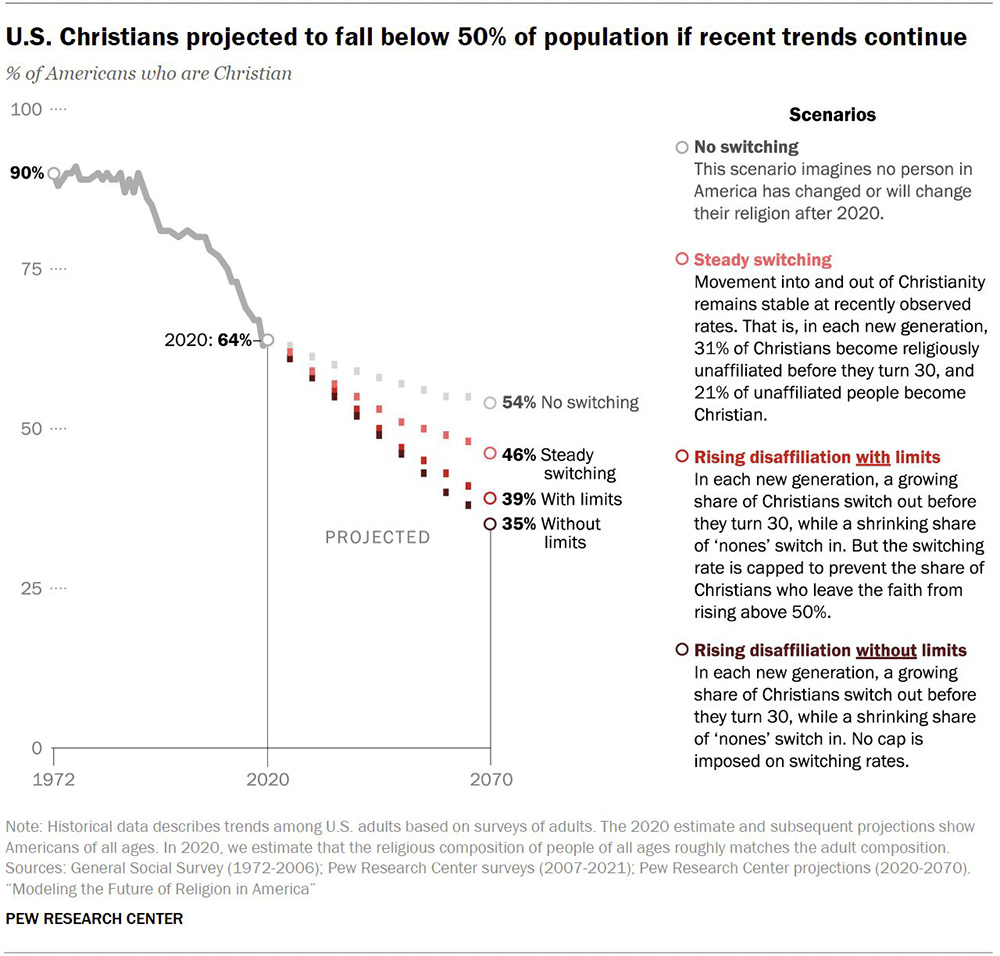
If current trends continue, Christians could make up less than half of the population—and as little as a third—in 50 years.

Meanwhile, the so-called nones—the religiously unaffiliated—could make up close to half of the population. And the percentage of Americans who identify as Muslims, Jews, Hindus, Buddhists and other non-Christian faiths could double.

Those are among the major findings of a new report from the Pew Research Center regarding America’s religious future—a future where Christianity, though diminished, persists while non-Christian faiths grow amid rising secularization.

Using multiple factors to project future

Researchers projected possible religious futures for the United States using a number of factors, including birth rates, migration patterns, demographics like age and sex, and the current religious landscape.

They also looked at how religion is passed from one generation to another and how often people switch religions—in particular, Christians who become nones, a number that has been increasing in recent years.

They projected four different scenarios, based on differing rates of religious switching—from a continued increase to no switching at all.

“While the scenarios in this report vary in the extent of religious disaffiliation they project, they all show Christians continuing to shrink as a share of the U.S. population, even under the counterfactual assumption that all switching came to a complete stop in 2020,” according to the report. “At the same time, the unaffiliated are projected to grow under all four scenarios.”

Increasing numbers become disaffiliated

Currently, about a third (31 percent) of Christians become disaffiliated before they turn 30, according to Pew Research. Twenty-one percent of nones become Christian as young adults. Should those switching rates remain stable, Christians would make up 46 percent of the population by 2070, while nones would make up 41 percent of the population.

If disaffiliation rates continue to grow but are capped at 50 percent of Christians leaving the faith, then 39 percent of Americans are projected to be Christian by 2070, with 48 percent of Americans identifying as nones.

With no limit placed on the percentage of people leaving Christianity and with continued growth in disaffiliation, Christians would be 35 percent of the population, with nones making up a majority of Americans (52 percent).

If all switching came to a halt, then Christians would remain a slight majority (54 percent), while nones would make up 34 percent of Americans, according to the projection model.

Non-Christian faiths would rise to 12 percent to 13 percent of the population, largely due to migration, in each scenario. Migration does affect the percentage of Christians, as most immigrants coming to the United States are Christians, said Conrad Hackett, associate director of research and senior demographer at Pew Research Center.

“Still the greatest amount of change in the U.S., we think currently and in the future, will come from switching,” he said.

Projections not predictions

Researchers stressed the report contained projections based on data and mathematical models, not predictions of the future.

“Though some scenarios are more plausible than others, the future is uncertain, and it is possible for the religious composition of the United States in 2070 to fall outside the ranges projected,” they wrote.

One reason for the decline among Christians and the growth among the nones in the models is age. While Christians have more children than nones, they are also older. Pew estimates the average Christian in the United States is 43, which is 10 years older than the average none.

“The unaffiliated are having and raising unaffiliated children while Christians are more likely to be near the end of their lives than others,” Stephanie Kramer, a senior researcher at Pew, told RNS in an email.

Using mathematical models, Pew has also projected the future of religion around the world. Those models were adapted for different regions, said Hackett. Muslims, for example, he said, tend to have the youngest population and the highest fertility rates, driving the growth of that faith.

However, he said, in the Gulf states, migration has brought many Christians from other countries to the region as temporary workers.

Examining multiple variables

The current report takes advantage of the amount of data collected about the U.S. religious landscape. Researchers also looked at intergenerational transmission for the first time, said Kramer.

“The variables we use to study that were: What is the mother’s religion? And what is the teen’s religion,” she said. “If that was a match, we consider the mother’s religion transmitted.”

Researchers also looked at a relatively new trend of disaffiliation among older Americans. Sociologists have long focused on younger people, who are most likely to switch religions. But in the United States and other countries, older people are also starting to switch at growing rates.

“It’s not as large scale, but it’s still significant,” said Hackett. “And it’s contributing to the religious change that we have experienced and that we expect to experience in the years ahead.”

Hackett said that the projections do not show the end of Christianity in the U.S. or of religion in general, which he expects to remain robust. And most nones, while claiming no religion, do not identify as atheists.

Kramer said the United States appears to be going through a pattern of secularization that has happened in other countries, though “we may be a bit behind,” she added.

Other factors outside the model—such as changing immigration patterns and religious innovation—could lead to a revival of Christianity in the United States, according to the report. But none of the models shows a reversal of the decline of Christian affiliation, which dropped from 78 percent in 2007 to 63 percent in 2020, according to Pew research.

In the report, researchers note that “there is no data on which to model a sudden or gradual revival of Christianity (or of religion in general) in the U.S.”

“That does not mean a religious revival is impossible,” they wrote. “It means there is no demographic basis on which to project one.”

Ahead of the Trend is a collaborative effort between Religion News Service and the Association of Religion Data Archives made possible through the support of the John Templeton Foundation.


Former Baylor President Ken Starr dies at 76

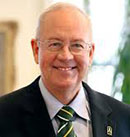
Ken Starr, the former independent counsel in the Clinton administration Whitewater investigation who later became president and chancellor of Baylor University, died Sept. 13 at age 76.

Starr, former U.S. Solicitor General and a U.S. circuit court judge, died at Baylor St. Luke’s Medical Center in Houston due to complications from surgery, a statement from his family said.

Starr 130
Ken Starr

Starr was elected president of Baylor University in February 2010, and he concurrently held the title of university chancellor beginning in November 2013.

Baylor’s board of regents removed Starr as president in May 2016, citing the university’s “fundamental failure” to handle sexual violence complaints appropriately under his leadership. He soon resigned as chancellor and later stepped down as a professor at the Baylor Law School.

However, for six years, Starr oversaw significant expansion at Baylor, including construction of McLane Stadium, the Hart Track and Field Stadium, the Paul Foster Campus for Business and Innovation and Elliston Chapel, along with renovation of three residence halls.

He also led in fundraising for the university, beginning with his first major project—completing ahead of schedule the $100 million President’s Scholarship Initiative.

During Starr’s time as president, Baylor also took significant steps toward becoming a top-tier research university, expanding the Baylor Research and Innovation Collaborative and establishing the Robbins College of Health and Human Sciences.

Praised for public service and scholarship

“Judge Starr had a profound impact on Baylor University, leading a collaborative visioning process to develop the Pro Futuris strategic vision in 2012 that placed Baylor on the path to where we are today as a Christian Research 1 institution,” President Linda Livingstone said.

“Judge Starr was a dedicated public servant and ardent supporter of religious freedom that allows faith-based institutions such as Baylor to flourish,” Livingstone said.

Noting she and Starr served together as deans at Pepperdine University, she added, “I appreciated him as a Constitutional law scholar and a fellow academician who believed in the transformative power of higher education.”

Livingstone expressed condolences on behalf of the university and the Baylor Family to Alice Starr and the rest of Starr’s family.

“May God’s peace and comfort surround them and give them strength now, and in the days to come,” she said.

Tommye Lou Davis, Starr’s chief of staff at Baylor, spoke of the “great honor” to serve alongside him.

“His warm, inclusive personality brought the campus uniquely together. He was deeply loved by students, highly respected by faculty and staff, and greatly admired by alumni and the broader Baylor family,” Davis said.

“Judge Starr’s brilliant mind, affable personality and tireless efforts on behalf of the university have left an indelible mark on all of us fortunate enough to have worked with him. I will always be grateful for his friendship, dynamic leadership and selfless service to Baylor University.”

Kenneth Winston Starr was born July 21, 1946, to William D. and Vannie Trimble Starr, and he grew up in San Antonio.

He earned his undergraduate degree from George Washington University, a master’s degree in political science from Brown University, and his Juris Doctor degree from Duke University.

Starr argued 36 cases before the U.S. Supreme Court, including 25 as U.S. Solicitor General from 1989 to 1993. He was U.S. Circuit Judge for the District of Columbia Circuit from 1983 to 1989.

From 1989 to 1993, he was the independent counsel who led an investigation into the Whitewater real estate investments of President Bill Clinton. The inquiry expanded into other areas, including suspected perjury by Clinton regarding his relationship with Monica Lewinsky.

The allegation in the Starr Report that Clinton lied about the sexual relationship with Lewinsky in a sworn deposition led to Clinton’s impeachment.

After Starr left Baylor University, he worked with the Lanier Law Firm and was a commentator for Fox News.

Starr is survived by his wife of 52 years, Alice; son Randall P. Starr and wife Melina; daughter Carolyn Doolittle and husband Cameron; daughter Cynthia Roemer and husband Justin; nine grandchildren; a sister, Billie Jeayne Reynolds; and a brother, Jerry Starr.

Lori Fogleman of Baylor University contributed to this article.


Woodson wants to help abuse survivors receive therapy

WASHINGTON (RNS)—For years, Jules Woodson has advocated for reform in the Southern Baptist Convention, hoping to assist survivors of sexual abuse and hold abusers to account.

Now she’s joined a nonprofit effort to connect abuse survivors with mental health services and counseling, through a new initiative announced Sept. 12.

“I’ve always wanted to be part of something bigger than my own story,” said Woodson, co-founder and chief operations officer for Help;Hear;Heal, a nonprofit that will provide scholarships to abuse survivors seeking counseling.

The nonprofit will fund six sessions of counseling for abuse survivors through a partnership with Thriveworks, a counseling practice that provides in-person and online therapy. Survivors can get assistance through the Help;Hear;Heal website, which will link them to Thriveworks.

Abuse survivors often face challenges in getting the help they need, said Todd McKay, founder and CEO of Help;Hear;Heal. There’s often a great deal of shame and trauma when they come forward about abuse and the headaches of navigating the health care system, where insurance doesn’t always pay for counseling.

Some survivors, especially younger people still on their parents’ insurance, may not be ready to reveal that they have been abused, he said.

“Our model is, we’ll deal with insurance later,” McKay said. “Let’s give you the support you need immediately to help.”

McKay became involved in assisting abuse survivors after learning that a member of his family had been sexually abused. That family member was able to get help, in part because McKay could afford it.

“We were lucky in that we could write a check,” McKay said. “Not everyone can do that.”

He also worries that some survivors may give up on getting counseling because of the headaches involved—or will remain silent.

Woodson’s story of abuse captured national attention

McKay first met Woodson on social media, where she often advocates for abuse survivors in the SBC and other church settings. The story of her own abuse gained national attention in 2018 after she confronted the pastor who had abused her 20 years earlier when she was a teenager and her abuser was a youth pastor.

Her abuser went on to become a megachurch pastor. His church gave him a standing ovation after he confessed. He later resigned and started a new church.

Since that time, Woodson has become an advocate for abuse survivors. During the SBC annual gathering this past summer, the denomination passed a resolution apologizing to Woodson and nine other survivors by name. The denomination also passed a set of reforms designed to address abuse.

In the months after the SBC meeting, Woodson said she’s been devoted to her new work, helping raise funds and get the word out.

She said that coming forward about her abuse caused conflict in her family and sent her looking for counseling, something she continues still. She hopes her work with Help;Hear;Heal can not only fund counseling but also make it easier for abuse survivors to come forward.

Sexual abuse often involves shame and stigma, making it difficult for survivors to tell anyone about their experience, meaning they often live with pain for years.

“We really want to break down the stigma,” Woodson said. “We want to give the resources, the access to funding for survivors to get in, make that initial disclosure, start to unpack the trauma they’ve experienced, so they can make a long-term plan for what healing looks like.”

Woodson said the program is meant to help survivors from any background, not just those who have experienced abuse in the church.

McKay, who grew up Catholic and Methodist, no longer identifies with any religious group. He said his family’s experience of abuse made him want to help others who have experienced the same thing. He said there are many local nonprofits already helping abuse survivors but he wanted to do something that could help people on a more national basis.

He also wanted to take some of the stress out of looking for help during a crisis and hopes online access to counseling can ease some of the burdens for survivors and their families.

“Let’s make this as simple and as quick as possible to get you in to talk to someone,” he said.