Around the State: BUA and El Paso Baptist Association enter agreement
July 27, 2022
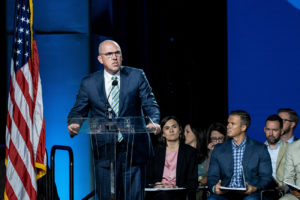
Abe Jaquez of Baptist University of the Américas and Larry Floyd of El Paso Baptist Association entered a partnership to help equip Spanish-speaking pastors for Texas Baptist churches.
Abe Jaquez, president of Baptist University of the Américas, and Larry Floyd, executive director of El Paso Baptist Association, signed a memorandum of understanding to work together in offering accredited undergraduate theological education in Spanish. The partnership, designed to equip Spanish-speaking pastors for Texas Baptist churches, will involve recruiting students for BUA’s Bachelor of Arts in Biblical/Theological Studies degree, offered online entirely in Spanish. The fall cohort begins Aug. 22. For more information, click here.
Dallas Baptist University students traveled this summer to England. (DBU Photo)
Dallas Baptist University students traveled this summer to England to learn about events in intellectual, political and religious history where they occurred. DBU President Adam C. Wright, Vice President Blake Killingsworth and Mary Nelson, director of the Ph.D. in leadership studies program, led 41 doctoral students from three cohorts. Undergraduate students were led by Mark Cook, assistant professor of leadership and biblical studies; Michael Whiting, assistant professor of Christian history and leadership; and Nick Pitts, an alumnus of the Cook School of Leadership. DBU students visited the home of C.S. Lewis, attended evensong service at Oxford’s Christ Church, and explored both Cambridge and Windsor Castle. They also participated in historical tours of Blenheim Palace, Parliament, Westminster Abbey, St. Paul’s Cathedral and the Churchill War Rooms in London.
During the Baptist World Alliance annual meeting, Texas Baptists participated in a panel discussion on immigration and ministry along the U.S./Mexico border. Julio Guarneri, senior pastor, Calvary Baptist Church in McAllen, provided the biblical rationale for ministry to immigrants, including the command to the people of Israel in Deuteronomy 10 to remember when they were aliens and sojourners in Egypt. “Everybody’s a stranger sometime,” Guarneri said, quoting Joel Gregory, professor at Baylor University’s Truett Theological Seminary. Calvary Baptist in McAllen worked in cooperation with Texas Baptists, Buckner International, Texas Baptist Men and BCFS, formerly Baptist Child and Family Services. George Solis reported on the work of Texas Baptists’ River Ministry, and Jorge Zapata described Fellowship Southwest’s immigrant relief ministry.
Albert Reyes, president and CEO of Buckner International, won an award for Leadership Excellence in the category of mega nonprofit at the D CEO’s Nonprofit and Corporate Citizenship Awards on July 21.
Anniversary
175 for First Baptist Church in Gonzales. The congregation and guests will celebrate with a potluck meal following the morning worship service on July 31. Josh Breslaw is senior pastor.
BGCT executive director search committee named
July 27, 2022
DALLAS—Officers of the Baptist General Convention of Texas and its Executive Board named a search committee to recommend Texas Baptists’ next executive director.
The committee will review applicants and seek out the next executive director to succeed David Hardage, who announced on July 1 his plans to retire at the end of the year.
The committee is comprised of seven Executive Board members, chosen by the BGCT chair and vice chair, and eight at-large members, chosen by the president and vice presidents. At-large members are members of BGCT churches who are not members of the Executive Board.
The search committee will be led by Chair David Mahfouz, pastor of First Baptist Church in Warren.
Other members of the committee are;
Janice Bloom, member of First Baptist Church in Garland;
Goldenstene Davis Sr., associate pastor of education/ministry at Singing Hills Baptist Church in Dallas;
Lester Leonares, member of First Philippine Baptist Church in Missouri City;
Suzanne Liner, member of First Baptist Church in Lubbock;
Pete Pawelek, pastor of Cowboy Fellowship of Atascosa County in Pleasanton;
Alfonso Flores, pastor of Primera Iglesia Bautista in San Antonio;
Eder Ibarra, director of strategy implementation at Rio Grande Valley Baptist Association and member of Calvary Baptist Church in McAllen;
Cindy Wiles, executive director of Restore Hope and member of First Baptist Church in Arlington;
Dennis Young, pastor of Missouri City Baptist Church;
Darin Wood, pastor of First Baptist Church in Midland;
Duane Brooks, pastor of Tallowood Baptist Church in Houston;
Mark Rotramel, pastor of First Baptist Church in El Paso;
Wendell Wright, director of church, community and denominational relations at Dallas Baptist University and member of Park Cities Baptist Church in Dallas; and
Albert Reyes, president and CEO of Buckner International and member of Park Cities Baptist Church.
“I believe that I speak for each member of the committee in sharing that we are honored to be asked to serve in this capacity, but also must confess that it is a humbling experience,” Mahfouz said.
“This role will require an investment of time and energy on the part of each member of the committee. We need the prayers of all Texas Baptists as we embark on this task. Each member of the team needs to bring to the table spiritual discernment, wisdom, patience, and a commitment to build relational trust and cooperation.”
Advisory group formed
In addition to the committee, an advisory group has also been formed to aid in the search. Unlike the committee, the advisory group cannot vote to nominate but can offer advice to the committee as requested.
Advisory group members are Tamiko Jones, executive director-treasurer of Woman’s Missionary Union of Texas; Mickey Lenamon, executive director/CEO of Texas Baptist Men; Todd Still, dean of Baylor University’s Truett Theological Seminary; Cory Hines, president of Howard Payne University; and Phil Miller, director of Texas Baptists’ Center for Church Health.
“While we are saddened by the announcement of Dr. Hardage’s retirement, we celebrate the tremendously positive impact he made on the ministries of Texas Baptists,” said Craig Christina, associate executive director of Texas Baptists.
“The executive board has elected a diverse executive director search committee representing various geographical and ethnic groups across the state. Each member is experienced in Texas Baptist life and will add valuable insights into the nominating process.”
The first step for the committee will be to engage in a time of prayer, orientation and listening to best understand the needs of the convention.
After the committee has developed a profile for the next executive director, the position will be announced formally. A special, designated email address will be set up to receive nominations at that time.
Once the search committee has a nominee, the nominee will be presented to the Executive Board for election.
As the committee begins the search process, members request prayers that God will grant them wisdom, patience, discernment and faithfulness.
Christina added: “We ask all Texas Baptists to continue to pray for David and Kathleen Hardage as he retires; the search committee members as they organize; the new executive director as the Lord calls, equips, and prepares them; and the ongoing work of BGCT ministries and staff as we serve the churches and facilitate the movement of God’s people to share Christ and show love. We have a strong foundation built upon the love of Christ, and the best days for Texas Baptists lie ahead.”
Human trafficking report highlights inequity, war’s impact
July 27, 2022
WASHINGTON (BP)—Incorporating the leadership of survivors and programs to address societal inequities are two essentials in the fight against human trafficking, the U.S. State Department said in its 2022 Trafficking in Persons Report.
Human Trafficking
Russia’s war on Ukraine has greatly increased the number of people vulnerable to traffickers’ snares, the U.S. said in releasing the report. The 634-page report highlights global human trafficking in forced sex and labor, including government-sponsored trafficking, in nearly 200 countries ranked by their progress in fighting the crime.
The United States is one of 30 Tier 1 countries, signaling conformance to minimum anti-trafficking standards under the Trafficking Victim Protection Act of 2000. Tier rankings do not indicate the extent of human trafficking in any particular country named, but ranks the level of engagement of standards established by law, the report stipulates.
The report signals that the U.S. must do more to fight human trafficking at home and abroad, a representative from the Southern Baptist Ethics & Religious Liberty Commission said.
“Human trafficking—modern-day slavery—is a horrific reality of our time,” said Hannah Daniel, policy manager of the ERLC’s Washington office.
“This report exposes the ways that the Chinese Communist Party is using forced labor in its Uyghur internment camps and rightly urges the United States to prioritize these concerns, particularly as it engages with China on climate change. The report also demonstrates the significant danger and trauma that many around the world face when they are displaced from their homes.
“As we face an unprecedented scale of displacement around the world, the United States must do more to combat human trafficking and address the root causes that create such vulnerabilities where it can thrive.”
Joining the U.S. in the Tier 1 ranking of countries doing the most to fight human trafficking are Argentina, Australia, Austria, the Bahamas, Bahrain, Belgium, Canada, Chile, Colombia, Cyprus, the Czech Republic, Estonia, Finland, France, Georgia, Germany, Guyana, Iceland and Lithuania.
Countries ranked in Tier 3, those furthest from meeting minimum standards established by law, are Afghanistan, Belarus, Brunei, Burma, Cambodia, China, Cuba, Curacao, Eritrea, Guinea-Bissau, Iran, North Korea, Macau, Malaysia, Nicaragua, Russia, Sint Maarten, South Sudan, Syria, Turkmenistan, Venezuela and Vietnam.
Nearly 100 countries are ranked Tier 2, and another 34 are on the Tier 2 Watch List of countries making significant efforts to meet compliance standards.
In the midst of humanitarian crisis
The 2022 report comes in the midst of a humanitarian crisis, U.S. Secretary of State Antony Blinken wrote in the report’s introduction.
“Russia’s senseless continued invasion of Ukraine and its devastating attacks across that country have inflicted unfathomable pain and suffering and forced millions of Ukrainian citizens and others to flee seeking safety. We are deeply concerned about the risks of human trafficking faced by individuals internally displaced by the war, as well as those fleeing Ukraine, an estimated 90 percent of whom are women and children,” Blinken wrote. “The food insecurity and other broader effects of Russia’s war exacerbate trafficking risks around the globe.
“Let us stand together and press for accountability from those leaders who condone and support human trafficking, create conditions ripe for mass exploitation, and perpetuate this fundamental insult to human dignity. Those that perpetrate, condone or support this crime must be held accountable.”
Minimum legal standards require governments to prohibit severe forms of human trafficking and punish such acts; to prescribe more severe punishment when trafficking involves fraud, force, coercion, rape, death or sex trafficking of minors incapable of consenting; in most severe cases, prescribe punishment that deters the offense and reflects its heinous nature; and make serious and sustained efforts to eliminate severe forms of human trafficking.
Kari Johnstone, senior official and principal deputy director of the Office to Monitor and Combat Trafficking in Persons, indicated the importance of engaging survivors in anti-trafficking efforts and strategies, as well as addressing the impact of societal inequities on potential targets of human trafficking.
“As a critical means to continuously improve anti-trafficking efforts, stakeholders should engage with survivors of human trafficking; to listen to, learn from, and lift the voices of those with lived experience,” Johnstone said in the report’s introductory comments.
“The Department of State continues to prioritize the integration of survivor expertise into our work. Another key priority, which also requires the counsel of survivors, is increasing our efforts to meaningfully incorporate equity in our anti-trafficking work.”
Young Bible-engaged care about prisoners, immigrants
July 27, 2022
PHILADELPHIA (BP)—Younger Christians who engage with Scripture are more apt to care for prisoners and immigrants as neighbors than are older Christians, the latest release from the 2022 State of the Bible reveals.
While older Scripture-engaged Christians, those age 77 and above, more often say it’s important to be good neighbors, the difference is likely attributable to seniors’ narrower definition of the term neighbor, the American Bible Society said in releasing the chapter focusing on being a good neighbor.
“It’s possible that many of these seniors … are defining neighbor very specifically, if they have developed deep relationships with those who have lived near them for years,” the American Bible Society said in releasing the fourth chapter of the report.
“In the digital world of younger respondents, when people routinely interact with others on the other side of the globe, the concept of neighbor becomes more abstract.”
Among the Scripture-engaged of all ages, being a good neighbor ranked as highest among what the American Bible Society described as pro-social priorities, followed by advocating for the oppressed, caring for the environment, caring for those in prison, befriending people of other religions, befriending people of other races, and welcoming immigrants.
All priorities ranked between 4.4 and 5.3 on a scale gauging importance between a low of 1 and a high of 6.
But Gen Z ranked higher than other generations in caring for those in prisons, scoring 3.7 compared to seniors or elders who ranked 3.5; and 4.2 in welcoming immigrants, compared to 3.5 among seniors, the American Bible Society reported from the study conducted in January.
“For a representative cross-section of American adults, being a good neighbor and caring for the environment are the highest rated priorities overall,” the American Bible Society said. “The questions on prisoners and immigrants have the lowest ratings.”
Study participants described as comprising a “movable middle” on Scripture engagement, and those who are disengaged scripturally ranked lowest in all categories except caring for the environment. Here, those described as scripturally disengaged tied with participants described as Scripture-engaged, ranking at 4.8 in environmental care.
Studied neighborly characteristics and desires
The American Bible Society studied neighborly characteristics among American adults in its 2021 report as well, but in 2022 in addition to actual activities, looked at the desires of Americans regarding neighborliness.
The study considered Americans’ desires in following Jesus’ teachings on loving neighbors and focused on seven specific categories indicated above.
“Controversy swirls around a number of these issues. Some might be considered more political than religious,” the American Bible Society said. “Yet, though they might disagree on specifics, students of Scripture apparently recognize a biblical call to act on these matters—to welcome, befriend, care and advocate.”
“This year’s report shows clearly that Scripture-engaged people make better neighbors. They care for people in need. They take civic duty seriously. They realize they don’t know everything, and they admit that in conversation. They serve others in a variety of ways.”
Previous chapters, released in April, May and June, focused on the level of Scripture engagement, how the Bible shapes ideas about spiritual things, and how Scripture engagement impacts trauma survivors.
Future chapters, scheduled for monthly releases, will focus on faith, the Bible and technology, and generosity.
American Bible Society researchers collaborated with the University of Chicago’s National Opinion Research Center to survey a nationally representative group of American adults on topics related to the Bible, faith and the church.
The study conducted online via telephone produced 2,598 responses from a representative sample of adults 18 and older in all 50 states and Washington D.C.
Hymn Society continues push for more diverse music
July 27, 2022
WASHINGTON (RNS)—Rahel Daulay, a Methodist who had traveled from Indonesia, was explaining the proper way to dance while singing a hymn she had brought from Southeast Asia—bending knees slightly “to humble yourself” and turning toward one’s neighbors, palms together at the chest. Then turn forward, lift up the arms and hold the hands upward.
For the 300-some members of the Hymn Society in the U.S. and Canada, who hadn’t met in person for three years, it was a liberation.
Attendees stand during a performance at the Centennial Celebration Hymn Festival. (Photo courtesy of The Hymn Society/Glen Richardson)
“Let us come and worship our Creator,” they sang at their annual conference, as they swayed and danced at Catholic University’s Edward J. Pryzbyla University Center. The organization comprises representatives from more than 50 denominations who speak as many as six languages. Some had traveled as many as 8,000 miles to attend.
Since COVID-19 hit, many of the academics and music practitioners in attendance have not been able to sing out even in their home churches, as congregational singing has been stifled in many houses of worship for fear of spreading the virus.
Though masking was enforced, the pandemic had lifted just enough this year for organizers to go ahead with the 2022 in-person meeting, celebrating the society’s 100th year of existence.
“For the past three years, it’s been so nice to see all of your faces on screen and be together in that way, but there is nothing like seeing your faces out here and being together to sing,” said Executive Director J. Michael McMahon in greeting attendees.
Society examines social effects of hymns
With the theme “Sing the World God Imagines,” the gathering demonstrated the powerful influence hymns have, not only on faith communities, but also on politics and society at large across the globe. Lecture sessions addressed topics such as the ongoing effects of colonialism on the texts and tunes they choose to sing.
Consciousness of hymns’ power has driven a growing diversity in the Christian hymnody, and members and guests at the meeting insisted the trend continue into the coming century.
“I have had the pleasure of watching this community grow to embrace and to celebrate the way the gospel can be preached and sung and prayed in many tongues and rhythms, calling forth an array of gifts much like the first-century church,” said conference preacher Cynthia A. Wilson, a United Methodist and leader of a new Black church music institute at Garrett-Evangelical Theological Seminary.
“But as we move into this century, friends, I promise we will not get through it without the boldness of protest, the power of prayer and the potency of God’s song.”
Participants expand their repertoire
Monday’s opening worship service featured Wilson’s sermon and songs like “Let it Rise,” “God Is Here” and “Order my Steps.” For much of the rest of the meeting, participants, including several dozen online, took turns leading and learning unfamiliar songs from many lands as well as familiar hymns with new beats and new words.
On Wednesday, Mikako Ehara, head of church music for the Japan Baptist Convention, taught “God’s World,” the song featuring a Japanese folk melody based on a nursery rhyme she compared to “The 12 Days of Christmas”—“where a line is added with each new verse” about creation as told in the Book of Genesis.
“Let’s rejoice all together,” the song began. “Wonderful, wonderful God’s creation.”
In a prerecorded video from Australia, Tanya Riches talked about the musical evolution of Hillsong, whose music ministry has provided a thick songbook for evangelical Christian churches around the globe.
Riches, a senior lecturer at Hillsong’s college in Sydney, noted that Hillsong was once known best for Darlene Zschech’s 1993 “Shout to the Lord.”
By 2016, however, Hillsong’s co-founder, Brian Houston, who resigned earlier this year, told conference-goers in the U.S. that the song’s time had passed.
“This song’s moment is no longer relevant to the congregation’s work in the Spirit,” Riches explained.
Mikie Roberts, program executive for spiritual life and for faith and order for the World Council of Churches, described in a later plenary how his home country of Antigua and Barbuda had gained independence in 1981 in part through the use of patriotic hymns that reached people through their churches. To reach the most people, the tunes excluded the familiar syncopation of local Calypso music.
“The patriotic and the national songs had to be simple, yet direct, so that they could be promoted in schools, played on the air and sung every day including Sunday,” said Roberts, a Moravian pastor.
Panelists grapple with origins of hymns
An international panel of speakers grappled with the origins of the hymnody in parts of the world where songs brought by Western missionaries still are revered more than other church music, including the songs of local cultures.
“We’re still in the process of decolonizing what we are singing,” said Gerardo Oberman, a leader of Reformed Churches in Argentina and one of the panelists, speaking through a translator.
“We are still trying to find our own voice or trying to find our own rhythms. Because there’s a little bit of a disconnect between what we sing in our homes, what we sing on the streets, and what we sing in our churches.”
Michael Hawn, an Iowa native who has long advocated for including global music in American congregations’ worship services, said that, despite concerns about Western music’s dominance, some people across the globe made traditionally Western hymns genuinely their own.
“I have developed a little bit more awareness and sympathy for ‘What a Friend We Have in Jesus’ being sung in Yoruba—or not just in the language, but in a style that reflects they’ve Africanized it,” said Hawn, professor emeritus of church music at Southern Methodist University’s Perkins School of Theology. “And so, it’s not a simple transplant; it’s a reconstruction, a certain kind of hybridity.”
Within three years of the Hymn Society’s first meeting in 1922, the Baptist Standard Hymnal and The Book of American Negro Spirituals were published. But by the 1980s and 1990s, Hawn said, there was a greater consciousness of being inclusive, and hymnals began to include more global music. People developed more intentionality about “what sounds take place in a sacred space.”
Accordingly, the conference’s closing festival on Thursday, at National City Christian Church, mixed the church’s organ with the djembe, a West African drum, as well as voices and brass instruments and music by a range of composers.
“And now, as we prepare to go forth, may the spirit of God blow among us to bring forth new songs,” said McMahon as he closed the meeting, “songs of faith, songs of healing, songs of transformation, songs of peace, songs of a world remade.”
Raushenbush: Christian nationalism a threat to democracy
July 27, 2022
WASHINGTON (RNS)—The Interfaith Alliance is one of a constellation of nonprofit organizations promoting religious pluralism and democracy that have mobilized as the Christian and political right has dominated the religious liberty debate in recent years.
The alliance recently announced Paul Raushenbush, an interfaith leader, journalist and American Baptist minister, would become its new president and CEO, replacing Rabbi Jack Moline.
A former associate dean of religious life at Princeton University, Raushenbush founded Huffington Post’s religion section in 2009 before serving as senior vice president of Auburn Seminary, and most recently as senior adviser for public affairs and innovation at Interfaith America.
His personal history, as much as his resume, reads like a wall chart of American religious pluralism. He is the great-grandson of Louis Brandeis, the first Jewish Supreme Court Justice. And he is the great-grandson of Walter Rauschenbusch, the foremost theologian of the social gospel movement in the early 20th century, which sought a Christian rationale for solving social ills such as poverty, alcoholism, crime and child labor. He is currently at work on a biography of his grandmother, the economist Elizabeth Brandeis.
Interfaith Alliance, a small nonprofit with annual revenue of less than $1 million, was formed in 1994 after GOP allies of conservative religious groups scored major gains in the midterm elections, taking back the U.S. House from the Democratic majority after 40 years. It was the beginning of a long-term political shift.
The group established an office in Washington and formed local chapters across the country, challenging the predominance of the religious right by pointing out the ways it was trying to enshrine its beliefs at the expense of America’s religious diversity.
In 2022, that fight has taken on new urgency.
Raushenbush equates his mission to fight Christian nationalism with shoring up democracy, which has been under threat not only from the Jan. 6 insurrection, but in efforts to overturn the 2020 election and waves of voter suppression laws that put minorities at risk.
Religion News Service spoke to Raushenbush, 58, as he was visiting his childhood home in Madison, Wisc. The interview was edited for length and clarity.
How does the Interfaith Alliance do its work—advocacy, lobbying?
We do a lot of work on (Capitol) Hill. We talk about legislation to make sure multiple religious voices are heard. We’ve spoken about religious freedom, separation of church and state. We were part of an amicus brief (in support of) the Equality Act.
We’re very active on a national level, but there are 20 chapters that work on a local level, which feels as important as ever. I strongly believe that you’ll find religious diversity in every community. It’s important to recognize that’s fundamentally a strength for America, not a threat. This circle has to include everyone. White Christians don’t get to say, “This is our country, and the rest are lucky to be invited.”
Some religious minorities actually supported the recent Supreme Court ruling allowing a public high school coach to offer a Christian prayer at the 50-yard line. What’s your position?
I think people should be themselves as religious people. But when they start exercising their religion in pluralistic spaces, not recognizing the authority they’re wielding, we’re getting into coercion. We’re getting into the religious freedom rights of the students, not just the coach.
I don’t want to erase religion. I’m a pastor, and I appreciate the gifts of spirituality. (But) I’m very concerned about the ways religion can be used to coerce in spaces that are supposed to be welcoming to all. Everything has a place. A place for prayer is not a place where some can’t participate. It’s a terrible use of religion.
Is separation of church and state going to be a big issue for the Interfaith Alliance?
Absolutely. The origin of church and state is to protect religion from over-encroachment by the state. Public schools should be places where people can come as they are. That includes nonreligious people, whether secular humanists or atheists. I’m not interested in erasure. I want to draw the line at making religion positive and non-coercive.
How does the Interfaith Alliance gain traction on this issue?
People are recognizing that the Supreme Court’s agenda is informed by a religious perspective that is alienating to the majority of Americans. What we’re seeing is the effort of a minority—white Christians—attempting to exert undue influence on the majority of Americans. People are aware of that.
If you look at religious communities, almost everyone views pluralism and multi-faiths as a positive. That’s what we’re going to be putting out there. We’ll be good partners, and we’ll invite others to partner with us.
Do you have any particular partners in mind?
I want to work with various religious traditions, but I’m also interested in some unlikely alliances. What do people doing legal work, like Democracy Forward, have to say about this? What does it mean to partner with organizations, like PEN America, that are involved in freedom of speech and freedom of expression?
You’re starting your new job in September. What are your immediate plans?
We’re going to see a lot more mobilization. We will be appropriately involved in the midterm elections and working hard around preservation of democracy and voting rights, viewing that as an important component of freedom of conscience. I want to widen the base. I want people to feel that the Interfaith Alliance can be a great partner, even if you’re not a religious organization.
Research shows racial disparity in Texas hunger
July 27, 2022
One Texas child out of five faced hunger in 2020, and the threat of hunger was most significant for Black and Hispanic Texans, new information from Feeding America’s Map the Meal Gap report reveals.
Overall, the report shows the food-insecure population in Texas topped 3.7 million, with 1,395,890 children experiencing food insecurity.
While 1 in 8 Texans overall experienced food insecurity in 2020, the report shows the ratio was 1 in 14 white Texans, compared to 1 in 4 Blacks and 1 in 5 Hispanics.
“These numbers confirm that a long history of discriminatory policies have created and sustained significant disparities in hunger,” said Jamie Olson, director of policy and advocacy at Feeding Texas.
A breakdown of hunger rates in five of the state’s largest counties reveals the percentage of white Texans living in hunger in the single digits, compared to an average of 18 percent for Hispanics and 24 percent for Blacks.
Feeding America’s report on racial inequities regarding hunger and the well-being of people of color is consistent with other studies, said Irene Gallegos, director of hunger and care ministries with the Texas Baptist Christian Life Commission.
For example, she pointed to U.S. Health and Human Services’ Healthy People Initiative, which sets measurable goals—such as reducing household food insecurity and hunger.
Looking at data from 2018 to 2020, white households with food insecurity decreased from 11.1 percent to 10.5 percent. However, the same study shows increased food insecurity in Black, Hispanic and Native Hawaiian populations.
“Such racial and ethnic disparities in food insecurity are racial injustices,” Gallegos said, noting racial injustice is one of the four public policy priorities for the Christian Life Commission in the upcoming Texas legislative session.
“In addition to public policy advocacy, the CLC continues to address racial injustices in food insecurity by supporting ministries who distribute groceries, hot nutritious meals and fresh produce in many communities across Texas,” she continued.
“We are grateful for the many individuals and churches who support the Texas Baptist Hunger Offering and being ‘all in’ in the fight against hunger.”
Baptists in Brazil welcome refugees from Afghanistan
July 27, 2022
Brazilian Baptists have welcomed more than 100 refugees from Afghanistan to Vila Minhya Pátria—the Homeland Refugee Village—where they receive care, learn skills to prepare them for long-term residence in Brazil, and see the love of Christ in action.
After the U.S. military withdrawal from Afghanistan and the Taliban subsequently reclaimed control, Human Rights Watch reported it triggered an accelerated human rights crisis.
Fernando Brandão, executive director of the National Mission Board for Baptists in Brazil, welcomes Afghan refugees to the Homeland Refugee Village. (Courtesy Photo)
“After the Taliban’s takeover of Afghanistan, we felt the pain of the Afghan people who would once again go into distress due to the rules imposed by the extreme group that regained power,” said Fernando Brandão, executive director of the National Mission Board for Baptists in Brazil.
Since last September, the Brazilian government has granted humanitarian visas to people affected by serious and widespread human rights violations in Afghanistan.
Brandão, who recently was in the United States to attend the Baptist World Alliance annual gathering, noted Brazilian Baptist involvement in receiving refugees followed contact from a BWA representative. The BWA contact forwarded a letter from an American nongovernmental organization working in Afghanistan and seeking places to receive refugees.
“We were challenged to host a group of 89 Afghans,” Brandão said.
Baptists in Brazil also responded to requests from the Guarulhos Social Service office, after an unexpectedly large number of families had arrived at the international airport with nowhere to go.
Accepting the challenge by faith
Brazilian Baptists agreed to welcome Afghans before they had a place that could accommodate the families they expected to receive.
However, a couple heard Brandão preach at First Baptist Church of Atibaia in São Paulo. In his sermon, he talked about the opportunity to care for people in need. The couple responded to the challenge.
A couple provided Brazilian Baptists the loan of property at no cost to house Afghan refugees. (Photo courtesy of Fernando Brandão)
“God had already awakened their hearts to this mission back in September 2021, when they watched the Afghans’ escape in the news,” Brandão explained. “The couple had a space that worked as a kind of inn with 82 chalets, a central restaurant, a leisure area and all the necessary structure. And they made this entire structure available through a loan agreement, at no cost.
“God began to work a miracle there, and it all became a confirmation of what he was doing. The project is now a reality, and it has been a fantastic experience, to see the smile and hope reborn in each family that we have with us.”
The Vila Minha Pátria, supported by Brazilian Baptists’ National Mission Board and Foreign Mission Board, received its first families on April 19.
Afghan children receive loving attention at Vila Minhya Pátria, operated by Baptists in Brazil. (Photo courtesy of Fernando Brandão)
“Since then, we have already welcomed 112 people,” Brandão said.
The refugees not only receive shelter, food and health care at Vila Minha Pátria, but also learn Portuguese and participate in classes about Brazilian culture.
“Six people have already left the village, because they had some Afghan friends with jobs in São Paulo,” Brandão said. “We have requests to welcome more families that have arrived in São Paulo every day.
“The physical capacity of the village is 150 people, but we need to have more people on our team, so we can serve more people than the ones we already have with us.”
Brandão cited the example of one Afghan man to illustrate the impact Christian love in action is having on refugees. Using a translation app on his cellphone, the man told Baptists at the village: “For my people, religion is more important than people. But for you, people are more important. You can love us in a way that our own people could not.”
‘What it means to live the love of God’
Brazilian Baptists view the refugees’ arrival in their country as a gift from God.
“God has given us the privilege of taking care of people who lived in a country closed to the gospel. And, today, through daily practice, we have communicated what it means to live the love of God,” Brandão said.
“Taking care of them is obeying God’s direction for us. It has been a faith experience. We believe that we will still see extraordinary things from God. Every day, they have become more special to us. We will do everything in our power to make this experience very special in their lives.”
After refugees spent a relatively brief time in the village, Brazilian Baptists plan to enlist churches, associations and individual families to sponsor them as they are mentored, participate in job training and work toward independence, Brandão explained.
“We are a people moved by the love of God, who drives us to love our neighbors and put ourselves in their shoes. Offering shelter to refugees is sharing the love we ourselves have received,” Brandão said. “It is fulfilling what the Bible says in receiving, welcoming and showing love.”
Christian pop star Amy Grant named Kennedy Center honoree
July 27, 2022
WASHINGTON (RNS)—Contemporary Christian musician Amy Grant has been named one of the Kennedy Center’s five honorees for 2022.
“Never in my wildest dreams did I imagine ever receiving this prestigious Kennedy Center Honors,” Grant said. “I cannot wait to celebrate with my fellow honorees, friends and family. Thank you for widening the circle to include all of us.”
The center plans to fete Grant in its 45th class of honorees that also includes actor George Clooney, singer Gladys Knight, Pulitzer Prize-winning composer Tania León and the rock band U2.
Kennedy Center Chairman David M. Rubenstein lauded Grant, saying in a statement that she “became the first artist to bring contemporary Christian music to the forefront of American culture, then equally thrived after crossing over into mainstream pop with hit after hit, and today is revered as the ‘Queen of Christian Pop.’”
Over more than four decades, Grant has had album sales exceeding 30 million and more than a billion global streams, earning three multiplatinum albums, six platinum albums and four gold albums.
She was the first contemporary Christian musician to have a No. 1 hit on the pop charts with “Next Time I Fall,” a 1986 duet with Peter Cetera of the band Chicago, and the first to perform at the Grammy Awards, eventually becoming a six-time Grammy winner.
“Baby, Baby,” a hit from her 1991 platinum album “Heart in Motion,” helped spread her fame. As she marked its 30th anniversary last year, she told Religion News Service it was both an overwhelming and joyful experience.
“It’s like the jumping through the ring of fire,” Grant recalled in the interview. “Pretty hot when you’re in the middle of it, but it doesn’t last that long.”
Breaking new ground
Center director Deborah F. Rutter told the Associated Press that Grant’s inclusion broke new ground for the Kennedy Honors.
“We’ve had gospel before,” she told AP. “We’ve had plenty of R&B and soul. … We’ve had country music, but we haven’t necessarily had Amy Grant and Christian pop in the same way.”
Other gospel music winners have been Marion Williams, star of the Ward Singers and later a soloist, in 1993; and Mavis Staples, a member of the Staples Singers, who also moved onto a solo career, in 2016.
Other 2022 honorees have been known for their faith connections. Gladys Knight, a convert to The Church of Jesus Christ of Latter-day Saints, has sung at the Mormon Tabernacle Choir’s Christmas concerts. U2, with lead singer Bono, has been known for its Bible-related lyrics in songs such as “I Still Haven’t Found What I’m Looking For.”
Eileen Andrews, vice president of public relations for the Kennedy Center, told RNS that while Grant is the first contemporary Christian artist to be honored, others have had gospel music connections, most prominently Aretha Franklin, who recorded gospel albums and was celebrated at the Kennedy Center Honors in 1994.
Grant and the other honorees will be saluted in a celebrity-filled gala at the center’s Opera House on Dec. 4. It will be broadcast at a later date on CBS.
Bart Barber wants the SBC to regain its rural soul
July 27, 2022
FARMERSVILLE (RNS)—Fighting summer sunlight tinged mauve by stained glass windows, a screen at the front of the sanctuary flashed the week’s birthdays as members of the First Baptist Church in Farmersville filed in for the 11 a.m. service—business as usual at the small-town church north of Dallas.
Except for one thing: A month before, the church’s pastor, Bart Barber, had been elected president of the Southern Baptist Convention.
Bart Barber, pastor of First Baptist Church in Farmersville, speaks during the Southern Baptist Convention annual meeting at the Anaheim Convention Center in Anaheim, Calif. Barber was elected president in a runoff vote. (Photo by Justin L. Stewart/Religion News Service)
Barber succeeds Ed Litton, an Alabama pastor who declined to run for a customary second term as president, adding more drama to the denomination’s 2022 annual meeting, where Southern Baptists approved a series of reforms to address sexual abuse. Those reforms had been drawn up after a report, released days before, found SBC leaders had mistreated survivors of abuse by pastors and church staff for years and sought to downplay its severity.
While he has been involved with SBC polity for years—most recently as head of the resolutions committee—Barber is the first SBC president in nearly two decades not to emerge from an urban or suburban megachurch.
Barber said the jump from leading a small-town church to representing the nation’s largest Protestant denomination is “tons of pressure every day, starting at 4 in the morning.”
At the 11 a.m. service, Barber delivered a sermon on grace and forgiveness based on a passage from the Book of Leviticus. He excoriated social media cancel culture as the modern equivalent of a bloodthirsty mob, before reviewing Farmersville’s recent Bible youth retreat. Some campers, he jested, “met Jesus for the first time. Others met COVID BA.5.” The hundred or so predominantly white congregants in the pews laughed appreciatively.
Barber’s win at the June meeting in Anaheim, Calif., represented progress in the SBC’s long battle over sex abuse reform. He supports the appointment of a task force in charge of creating a long-sought database of abusers for use in background checks and urging greater accountability.
Barber supports autonomy and decentralization
But Barber also talks about shifting the balance “to the people” of the SBC, arguing that decentralization—preserving the historical autonomy of the denomination’s churches—will mean more transparency and vigilance in preventing further sexual abuse.
“The SBC is decentralized in terms of polity for the same reasons that the (U.S.) Constitution, if it were being followed, is decentralized in terms of polity,” Barber said. “We are decentralized because of a suspicion of power.”
Pastor Grant Gaines presented a motion calling for a task force to oversee a third-party investigation into allegations of mishandled abuse claims at the SBC Executive Committee. (RNS Photo / Kit Doyle)
Critics argue the SBC’s decentralized structure makes it more difficult to discover abuse and hold its perpetrators accountable. SBC leaders long emphasized that churches’ independence meant the SBC had no ability to force specific action against abuse, and insisted SBC leaders could not keep a database because they had insufficient oversight.
The SBC’s adherence to decentralization was an “excuse,” said Grant Gaines, senior pastor of Belle Aire Baptist Church in Murfreesboro, Tenn.
The SBC’s lack of oversight, but mostly its mismanagement, allowed abusers to slip through the cracks, Gaines said, adding most SBC leaders and churches now want to collaborate to address the abuse.
But Barber’s vision of the SBC is small-d democratic, and nonhierarchical. He wants to champion the unheard voices of Southern Baptists in the far-flung, often isolated rural churches like his. Barber said he hopes to use social media to give a voice to SBC members who’ve previously been ignored.
“Social media democratizes the ability to be heard,” said Barber, who has more than 20,000 followers on Twitter and has tweeted just shy of 50,000 times.
Need to revitalize rural churches
Some of his impetus comes from a proposal originally forwarded by Oklahoma pastor Luke Holmes in 2021 and adopted at this year’s meeting in Anaheim that resolved to “establish, help, and revitalize” churches in towns with fewer than 25,000 people.
The resolution identifies rural areas as places where “Jesus regularly identified himself with … like Nazareth,” painting small churches as mission fields. It also recognizes the difficulty of leading such outposts, calling attention to rural pastors’ vulnerability to anxiety, isolation and depression.
Barber, who has spent 23 years in Farmersville (population 3,500), said growing smaller churches is a “timeless” idea and hosted a Twitter Space to explain the rural resolution after it passed.
“It was like, ‘How is it that we haven’t done this resolution yet?’” he said.
Barber often posts photos and videos of his ranch and his cattle—one of which is named Bully Graham—but ranching is more than a branding choice. A re-emphasis on rural churches, he believes, can reconnect Southern Baptists with what initially attracted them to the faith, he said.
Nancy Gilmer, who has been missions director at Barber’s church since 2017 and a “Southern Baptist since before I was born,” agreed that focusing on rural churches made strategic sense. The majority of Southern Baptist churches have 100 members or fewer, said Gilmer.
“Small-town fellowship means the church is my family,” Gilmer said. “We’ve raised each other’s kids, we care about each other, we serve together.”
Gilmer added Barber is what the SBC needs as it tries to heal divisions that have cropped up over the sexual abuse scandals and over race, which conservatives have blamed on “wokeness.” Gilmer calls Barber a “normal guy” whom God is using to secure a future of a united SBC.
“Outsiders looking in can see that we’re having some family squabbles,” Gilmer said. “God has been cleaning house for the last few years and reshaping us for his glory.”
Lead an ‘army of peacemakers’
For his part, Barber often talks and tweets about an “army of peacemakers,” referring to a grassroots coalition of Southern Baptists who can find unity in the Bible. Such peacemakers are “the immune system of the church,” he says in his church website’s FAQs.
The army of peacemakers became an unofficial campaign slogan for Barber’s run for presidency, contrasting with #ChangeTheDirection messaging peddled by those in the Conservative Baptist Network, a group of ultraconservatives that has been vocally critical of recent leadership.
“I’m pulling the SBC back from the brink of the sexual abuse scandal, division, factionalism largely created by secular, political forces pushing their way in the church,” Barber told RNS.
“Even if there is a parting of ways or separation in the church, let’s not damage our souls on the way out,” he said.
Identifying the polarity between what he calls the “knuckle-dragging fundamentalists” and “woke or liberal” groups vocal in the SBC, Barber said he does not fit into either camp—and that’s his selling point. (He said he identifies as an “old-time traditionalist” on most doctrinal issues. His congregation is uniquely aligned with the Southern Baptists of Texas Convention, which broke away from the Baptist General Convention of Texas.)
Eddy Daniel, a third-generation Baptist deacon and a member at First Baptist in Farmersville for 45 years, said he hopes Barber can succeed in creating common ground to heal the convention.
“Our church is big enough to handle his presidency—not big enough in size, but big enough in its close-knit nature,” Daniel said.
Barber said his tasks as a peacemaker will not be complete until “Jesus returns.” Still, he said, he will make the decision on whether to run again in due time.
“My decision will be based on answering: Am I still in love with Southern Baptists a year from now? Am I still in love with Jesus a year from now? Is my home church still in love with me?” Barber said. “The presidency of the SBC is not worth losing any of those things.”
On the Move: Bridgmon
July 27, 2022
Thomas Bridgmon to South Avenue Baptist Church in Pasadena as pastor, effective Aug. 28. He currently is pastor of Merlin Community Baptist Church in Merlin, Ore. Previously, he was pastor of Second Baptist Church in Lake Jackson.
Around the State: HPU tops Forbes Financial Grades list for Texas
July 27, 2022
Howard Payne University
Forbes recently named Howard Payne University as the top-ranked university in Texas on its 2022 College Financial Grades list. HPU received an A- grade and ranked No. 61 out of 905 private, not-for-profit institutions of higher education nationally and No. 1 in the state. Only 69 institutions on the Forbes list received an A- ranking or higher. Ranking criteria analyzed institutions for financial aid distributed to students, spending to educate their students and the ratio of debt to assets, as well as other factors. “We are honored to have been named to the Forbes 2022 College Financial Grades list,” said HPU President Cory Hines. “This recognition is the result of hard work by many, but it doesn’t mean the work is finished. This university’s mission is ongoing. I am pleased to reflect on the impact of HPU’s mission on our students and know it will continue with the support of the HPU family.” For more information about the 2022 College Financial Grade list, click here.
Two University of Mary Hardin-Baylor students—Raymond Kennedy and Bayleigh Grogan—received American Southwest Conference Distinguished Scholar-Athlete Awards.
Two University of Mary Hardin-Baylor students—Raymond Kennedy, a mechanical engineering major from Waxahachie and defender on the soccer team, and Bayleigh Grogan, a pre-physical therapy major from Wimberley and a softball pitcher—received American Southwest Conference Distinguished Scholar-Athlete Awards. Twelve other UMHB students were named to ASC Distinguished Scholar-Athlete Teams: Ryan Farmer, an engineering major from Manvel, baseball; Luke Feely, a finance major from Argyle, men’s basketball; Ashley Faux, a pre-physical therapy major from Frisco, women’s basketball; Sean Reid, an international business major from Killeen, men’s cross country; Holly Dasher, an education major from Katy, women’s cross country; Sante Parker Jr., a computer science major from Katy, football; Parker Mitas, an engineering major from The Woodlands, men’s golf; Sarah Kmiecik, a marketing major from Houston, women’s golf; Maren Fields, a pre-physical therapy major from Keller, women’s soccer; Ethan Kittredge, an accounting major from McKinney, men’s tennis; Adrianna McElwain, a biology major from Friendswood, women’s tennis; and Kayla Janikula, a pre-physical therapy major from Kingwood, volleyball.
B.H. Carroll Theological Institute received a $827,746 grant from the Lilly Endowment to help establish its Hispanic Theological Education Program. The program is funded through Lilly Endowment’s Pathways for Tomorrow Initiative, a three-phase initiative designed to help North American theological schools prioritize and respond to pressing challenges as they prepare pastoral leaders for Christian congregations. Carroll’s program, under the direction of Adlin Cotto, is designed to provide access to theological education programs and services in the heart language of current and future ministers. In particular, the grant will help fund the employment of professors who teach in Spanish, make possible the creation of course materials in Spanish, enhance internet access in locations where classes are offered, and assist in obtaining theological library resources for Spanish speakers.
Anniversary
First Baptist Church in Booker will celebrate its centennial—postponed two years due to COVID-19 restrictions—on Sept. 17-18. The church would like to reconnect with past members. For more information, call (806) 658-4672 or visit the Facebook page “FBC Bookers 100+ Year Celebration” by clicking here.


 While older Scripture-engaged Christians, those age 77 and above, more often say it’s important to be good neighbors, the difference is likely attributable to seniors’ narrower definition of the term neighbor, the American Bible Society said in releasing the chapter focusing on being a good neighbor.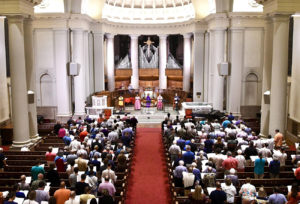
 “These numbers confirm that a long history of discriminatory policies have created and sustained significant disparities in hunger,” said Jamie Olson, director of policy and advocacy at